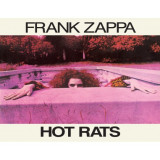
The second solo album by Frank Zappa, Hot Rats (October 1969) is one of the most influential Jazz fusion albums ever. It marked Zappa's first recording project after the dissolution of the original version of The Mothers of Invention. Multi-instrumentalist Ian Underwood is the only member of the Mothers to appear on the album and was the primary musical collaborator.
Other featured musicians include bassists Max Bennett and Shuggie Otis; drummers John Guerin, Paul Humphrey and Ron Selico; and electric violinists Don "Sugarcane" Harris and Jean-Luc Ponty. The first Frank Zappa album recorded on 16-track equipment, Hot Rats was included in the book 1001 Albums You Must Hear Before You Die, and was given a rating of 4½ stars in Al/Music, with Steve Huey stating that "few albums originating on the rock side of jazz-rock fusion flowed so freely between both sides of the equation, or achieved such unwavering excitement and energy". The model on the cover is Miss Christine, from the group GTO's.
quête:such
- A1: We Want Your Beer
- A2: Geek Attack
- A3: Waiting Game
- A4: Let Yourself Go
- A5: Sick Of Regrets
- A6: Judgement Day Is Near
- B1: Sunday Afternoon Barbeques
- B2: Parental Guidance
- B3: Tourist Dream
- B4: Scot Free
- B5: A Night Out With Where's The Pope?
- B6: Alcohol
Hailing from Adelaide, South Australia in 1985, the ‘debut’ full-length by Where’s the Pope? established the band as a bridge between greasy, hardcore punk thrills and manic thrash attacks. After a hiatus and a slight line-up change, Sunday Afternoon BBQs diverts from the typified, aural reference points in critical UK punk icons such as Disorder and Discharge but sees the band refined as they carve out a passage soaked entirely in their own electric stink. This is a record rejoicing in the lore of beery adolescents on the edge of the city streets with the dark, frenetic menace of ‘Geek Attack’, or the tumultuous sludge of ‘Tourist Dream’ insurmountably evidential in just how profoundly important the band was to the Australian circuit.
New Zealand’s jazz luminaries have assembled to form an allstar cluster: The Circling Sun.
Originally formed in mid 2000s, the New Zealand based jazz
collective, are set to release their debut LP Spirits, an eight
track collection that channels the greats of spiritual and
modal jazz and their own unique South Pacific spirit and
sensibility.
The group pay homage to Afro-American genre pioneers
such as Alice Coltrane, Yusef Lateef and Pharoah Sanders,
whilst incorporating a whole lot of love and appreciation
for a myriad of Afro, Latin and contemporary musical forms.
The choir used for the recording is made up of mostly
Pacific Island and Maori singers and artists, an important
acknowledgement of and reflection on their countries own
culture and heritage that seeps into all their work.
Native Soul Recordings made a great start with release 001 and the follow-up is easily as good. It's a collaborative offering from two venerated veterans in Roman Nunez and JT Donaldson that taps into both men's signature sounds. The result is 'Feelin' Real Good' which will indeed make you feel real good such is the irresistibly warm nature of its bump 'n' slide house groove and twinkling late night melodies all topped off with a smart male vocal. JT Donaldson also offers a more trippy out and tech-y dub and synth laden remix. This is timeless and summery house music that oozes class and sophistication.
Italian born, London-based soundsmith Andrea Ottomani dons his Big Hands moniker for an excursion in modern dub on the burgeoning Teeth label. Ottomani is the artist behind the label Baroque Sunburst, which he runs with Soreab, and he also forms half of jazz techno unit Ottomani Parker with Abraham Parker.
The Vulgarity Of Snow is Ottomani’s woozy, lilting soundwalk through techno, experimental electronics and scorched earth acid. The untitled tracks are less like distinct entities and give way to a larger, conjoined pair of triptychs spread out over two sides of wax. They feel like a paean to the format, which no doubt comes from Ottomani’s time spent working at one of London’s most revered record shops. As a longer, more probing piece, it’s anathema to talk about The Vulgarity Of Snow in terms of bpms and sub-genres, and arguably it owes as much to free jazz and psych-rock as it does to more leaden styles such as dub and roots. At times it pays tribute to the work of acts like Basic Channel and Random Trio, deploying dub electronics in novel ways, but it is also broader in its choice of sounds. On B2, for example, Mino Carbone, the artist’s uncle and an Italian anarchist from the same lineage as artists like Dario Fo, plays a song from that tradition. It’s not a chaotic piece, but it’s not heavily constrained.
Teeth is an ideal home for Ottomani’s freeform work, following contributions to Beat Machine, Blank Mind and Oscilla. The label is the brainchild of Jojo Mathiszig, who also runs Farringdon record shop and radio station Kindred. Slade graduate and Kindred co-founder, Scarlet Griffiths, supplies the artwork following on from her recent exhibition at Dinner Party Gallery.
Kicking off our new Toolroom Trax vinyl series which celebrates the best releases from Toolroom’s sister label is Italian super-duo Twolate with the incredible new single 'Baila'. A straight-up 4 to the floor club shaker, with powerful hard-hitting drums, deep punchy afro vocals with carnival whistles and percussion hits that will turn the dancefloor into a fiesta. Two dance heavyweights collide on our next offering; best-selling house artist CASSIMM and Chicago house royalty Gene Farris for their latest collaboration 'Party People'. With numerous #1 singles and remixes on Beatport and Traxsource, CASSIMM returns to Trax with his notorious sound of feel-good, high-energy house music, team that with Gene Farris as he effortlessly delivers another irresistible vocal hook. 'This is for my people, my party people'. James Haskell kicks things off on the b-side with 'Check It Out'. With numerous releases on D4 D4NCE, LoveJuice and of course Toolroom, James Haskell is fast gaining support from the scenes top tastemakers including Bob Sinclar, Leftwing : Kody, David Guetta, Tita Lau and Dombresky to name a few. Gracing club hotspots around the world, James Haskell is set to top the charts with his Tech House and Big Room sound. Closing out the Sampler is Toolroom Trax A&R and Music Curator Danny Rhys with his percussive tech house weapon 'Sibali'. Following on from his 2021 Traxsource number #1 single 'Damn Good', in collaboration with house vocalist legend Mr. V. With releases on respectable labels such as Farris Wheel Recordings, Flashmob, HouseU and There Was Jack, Danny Rhys boasts high, feel-good energy, bumpy basslines, rolling percussion and infectious vocals that has since gained respect from AAA talents such as Gorgon City, TCTS, Kryder and of course Mark Knight.
DJ Support from Danny Howard, Annie Mac, Mistajam, Pete Tong, Charlie Hedges, Kraak & Smaak, Maxinne, Todd Terry, Alex Preston, Full Intention, GW Harrison, DJ Rae, Rudimental, Alaia & Gallo, Illyus & Barrientos, Johan S, David Penn, Sam Divine, Riva Starr, Claptone, Nice7, Dario D’Attis, Mousse T, S-Man, Huxley, KC Lights, Friend Within, Dombresky, Gorgon City, Chris Lake, Format:B, Pirupa, TCTS, Alan Fitzpatrick, Low Steppa, Mat.Joe, Raumakustik, Eskuche
Rayko the Spanish Disco Producer and DJ extraordinaire has been busy in his Madrid based Studio burning the midnight oil to deliver Vadillo Vice Volume two.
Four reworked funk fuelled bass heavy cuts, tried and tested by the man himself on dancefloors across the globe and due to be released on vinyl only later in the year.
Deeply rooted in the golden era of the 70s and 80s, Rayko’s influences are masterfully interpreted and transformed into modern day dancefloor bombs, and are a key signature sound of his long established label Rare Wiri (Since 2008) an outlet for his productions alongside other likeminded artists such as Daniele Baldelli, Man Parrish, Gazeebo, Ilija Rudman, Ichisan, Spirit Catcher, Mushrooms Project, Eric Duncan among many others.
- 01: The Hitman (Intro)
- 02: New Day Feat. Irene And Bnc
- 03: Sharpshooters Feat. Moka Only
- 04: License To Kill (Interlude)
- 05: Wasteland Feat. Jean Clow
- 06: Lost In The Arkyve (Remix) Feat. Arkyve, Ellay Khule, Acid Reign
- 07: No Frame
- 08: Invasion (Area 52)
- 09: Rise Feat. Silvandgold
- 10: King Of The Kings (Remix) Feat. Blu
- 11: Hartro Feat. Speach Impediments
Sharpshooters is the long-awaited collaborative album from Destruct & DJ Zole. The two Natives from Southern California who have been true contributors to the Los Angeles Hip-Hop scene for over a decade now. Sharpshooters showcases a vast arrangement of styles blended into one solid LP with a hint of nostalgia hence the title of the project.
Sharpshooters while paying homage to the golden era of Hip-Hop also has a fresh perspective on how the culture sounds today and at the same time inspired one of the greatest wrestlers, Bret Hart.
In a refreshing way it all culminates into a unique experience for the listener with amazing guest features to back it, at the end of the day Sharpshooters represents two genuine and diverse artists entering their prime and creating a timeless piece of art appropriately named after a legend’s finishing move.
Sharpshooters is released on vinyl by the label Mind The Wax as of March 8th, 2024 and includes 11 tracks.
Destruct has been in the music scene and has released over 30 studio albums including two with his live band "Inner City Soul". He has been blessed as well to run his own studio "Area 52" where he provides recording and executive producer services. He also has a film production company now called “The Resident People” where he has directed and filmed several music videos and short films with much more to come.
By today, Destruct has rocked hundreds of shows with legends like KRS-One, Slum Village, Dilated Peoples, Rakim, Psycho Realm, Method Man from Wu-Tang & more. He has also collaborated with artists such as Grammy award-winning Sirah, Sean Price, Kev Brown, Blu and Exile to just name a few.
All and all Destruct is here to be much more than your everyday Hip Hop artist, but a true contributor to the culture and lifestyle, progressing the movement forward. Destruct is here for a legacy, not a trend.
DJ Zole is a DJ/Producer from Southern California. He gained his experience coming up as a touring HipHop DJ and Producer/ Turntablist who has been a DJ for major acts ranging from Sage Francis (Strange Famous Records), Atmosphere, Abstract Rude, Project Blowed, 2Mex, and many others.
Since 2004, DJ Zole has travelled the globe performing and creating. He's a highly decorated engineer and producer with his degree in Audio Engineering Mixing and Mastering Certified through Musicians Institute Hollywood.
- A1: Brainticket - Places Of Light
- A2: T.j. Lawrence - Fireplay
- A3: Robert Rental - Double Heart
- B1: African Head Charge - No, Don't Follow Fashion
- B2: Keith Hudson - Nuh Skin Up Dub
- C1: Smokin' Cheeba - When I Was A Youth
- C2: The Wad - 15 Inches
- D1: Idjut Boys & Laj - Foolin' (Beatin On Dave)
- D2: Jbb Et Soprann - Tibi Lap
Part 2.[29,83 €]
Optimo (Espacio) started life as a weekly club night. It was born at The Sub Club in Glasgow on a wet, windy, wintry November Sunday night in 1997. Run by JD Twitch and partner in crime Jonnie Wilkes. Optimo was a reaction against what felt like an increasingly conservative musical soundtrack in clubs here at that time. Clubland felt as if it had become very bland and a bit too serious; it was the era of the dawn of the Superstar DJ. Clubs often felt like bastions of male energy. It seemed dance music and culture was going somewhere far, far away from where it was meant to be. The notion of fun had got lost.
It was no longer the world they had devoted ten years of their lives to already, and lots of their friends felt the same. When the opportunity came up to do a Sunday night at The Sub Club it felt like the perfect opportunity to rip it all up and start again. So they did. There was nothing in the city (or possibly anywhere) like it. As the club believed wholeheartedly in what they were doing, there was no pressure from The Sub Club to fill the club. So, they embraced the freedom. Groups of people who had never been in the same room at the same time before came together. A community of kindred spirits started to emerge.
Word spread, slowly. Lots of people checked it out. Many loved it, some hated it. The core of the Optimo idea was to embrace music they loved that might work on the dancefloor from whatever era or genre they thought felt right. It might not seem very radical now but at that time it was revolutionary.
After about a year and a half, the club went from having 100 people attending most nights to suddenly one week having 500 people turn up. It was very weird. It was as if a collective light bulb went off in people’s heads in Glasgow. From that week on, until the very last weekly Sunday night at the Sub Club, in 2010, over a decade later, it was packed.
There were 550 Sunday Optimo nights. A LOT of music was played. So, what was the music? People often find it hard to pin down exactly what Optimo is. This has been a positive but also a negative as we live in a world where people want easily defined “brand identities”. The simplest definition of the music played is “music for dancing”, which of course is a very broad definition. Even better than trying to define it in words, we have these 2 volumes of music that give a hint of what that might be.
This is not a “Best of Optimo” or a “Greatest Hits of Optimo” compilation. For people who come to, or used to come to the nights there are of course “Greatest Hits”. But, over such a long timespan they are “hits” belonging to a certain moment in time and space. Someone who came to Optimo in 1997 would have a completely different notion of the big tracks at the club to someone coming in 2003, or 2010, or today. This compilation is just a snap shot missing several genres that might make up the DNA of Optimo. There is though a broad sweep through lots of music Optimo loves, that they believe is amazing. Music that they know will rock a dancefloor, that they have played between 1997 and 2023. Of course Optimo nights were not all about rocking the dancefloor. The first hour was always a time for them to play music they loved that often was far removed from the dance. Side 1, Volume 1 of this compilation is the kind of music one might hear at the very start of an Optimo night.
Optimo have always loved a good slogan. The most long lived, and fitting Optimo slogan is "We Love Your Ears", which is in essence what it is all about to them.
- A1: Chris & Cosey - Take Control
- A2: Isolators - Concentrate On Us
- B1: Mike Dunn - Life Goes On
- B2: Kc Flight - Voices (Original Dub Mix)
- C1: Faze Action - Good Lovin' (Special Disco Mix)
- C2: Hannah Holland - Ekotypic
- D1: Divine - Shake It Up
- D2: Xs-5 - I Need More (Extended Dance Version)
- D3: Liquid Liquid - Optimo
Part 1.[29,83 €]
Optimo (Espacio) started life as a weekly club night. It was born at The Sub Club in Glasgow on a wet, windy, wintry November Sunday night in 1997. Run by JD Twitch and partner in crime Jonnie Wilkes. Optimo was a reaction against what felt like an increasingly conservative musical soundtrack in clubs here at that time. Clubland felt as if it had become very bland and a bit too serious; it was the era of the dawn of the Superstar DJ. Clubs often felt like bastions of male energy. It seemed dance music and culture was going somewhere far, far away from where it was meant to be. The notion of fun had got lost.
It was no longer the world they had devoted ten years of their lives to already, and lots of their friends felt the same. When the opportunity came up to do a Sunday night at The Sub Club it felt like the perfect opportunity to rip it all up and start again. So they did. There was nothing in the city (or possibly anywhere) like it. As the club believed wholeheartedly in what they were doing, there was no pressure from The Sub Club to fill the club. So, they embraced the freedom. Groups of people who had never been in the same room at the same time before came together. A community of kindred spirits started to emerge.
Word spread, slowly. Lots of people checked it out. Many loved it, some hated it. The core of the Optimo idea was to embrace music they loved that might work on the dancefloor from whatever era or genre they thought felt right. It might not seem very radical now but at that time it was revolutionary.
After about a year and a half, the club went from having 100 people attending most nights to suddenly one week having 500 people turn up. It was very weird. It was as if a collective light bulb went off in people’s heads in Glasgow. From that week on, until the very last weekly Sunday night at the Sub Club, in 2010, over a decade later, it was packed.
There were 550 Sunday Optimo nights. A LOT of music was played. So, what was the music? People often find it hard to pin down exactly what Optimo is. This has been a positive but also a negative as we live in a world where people want easily defined “brand identities”. The simplest definition of the music played is “music for dancing”, which of course is a very broad definition. Even better than trying to define it in words, we have these 2 volumes of music that give a hint of what that might be.
This is not a “Best of Optimo” or a “Greatest Hits of Optimo” compilation. For people who come to, or used to come to the nights there are of course “Greatest Hits”. But, over such a long timespan they are “hits” belonging to a certain moment in time and space. Someone who came to Optimo in 1997 would have a completely different notion of the big tracks at the club to someone coming in 2003, or 2010, or today. This compilation is just a snap shot missing several genres that might make up the DNA of Optimo. There is though a broad sweep through lots of music Optimo loves, that they believe is amazing. Music that they know will rock a dancefloor, that they have played between 1997 and 2023. Of course Optimo nights were not all about rocking the dancefloor. The first hour was always a time for them to play music they loved that often was far removed from the dance. Side 1, Volume 1 of this compilation is the kind of music one might hear at the very start of an Optimo night.
Optimo have always loved a good slogan. The most long lived, and fitting Optimo slogan is "We Love Your Ears", which is in essence what it is all about to them.
- Downpour
- Together
- Task
- Overskog
- Landmarks
- Triptrap
- Sparkling Pendulum
- Satellite
- Threat - Waterfront Complex
- Aquaphobia
- Onto A New Dawn
- Not Your Rain
- Fragile
- Threat - Metropolis (Day)
- Breathing Hyometer
- Trusted Component
- Accidented Condition
- Threat - Pipeyard
- Chilblain Grace
- Vast Unlife
- Threat - Outer Expanse
- Veiled Northstar
- Refelection Of The Moon
- Sheer Ice Torrent
- Lost City
- Orange Lizard
- Obverse Of The Old Wind
- New Else Viii
- Random Fate
- Scapeless Doubt
- Outro Theme
Double LP on recycled & random-coloured "Re-Vinyl" Return to the unwavering wild in Downpour, where you explore new, harsh lands and survive new predators. As time passed, the slugcat has evolved. With five variants of the species - take advantage of various skills that they possess and explore their own personal tales. Black Screen Records, Videocult and Akupara Games are excited to take you an aural journey into the strange land of "Rain World: Downpour". Two LPs pressed on recycled & random-coloured "Re-Vinyl". The soundtrack is housed in a beautiful gatefold sleeve comes with UV spot varnish. The artwork was created by Kelocitta who has also reimagined the vinyl art for "Rain World". The "Rain World: Downpour" soundtrack is a collaborative work that was made possible by James Primate, Lydia Esrig, Intikus, Ongomato, Connor "12LBS" Skidmore and Progfox. A unique piece of music and very interesting mesh of different styles that truly bring the environment of Rain World to life. It's fully enjoyable without the game itself. The songs of "Rain World: Downpour" are a treat to experience, with some themes referencing the original soundtrack, such as "Threat - Waterfront Complex" or "Reflection of the Moon", and some being whole new, entirely original tracks, such as "Breathing Hyometer", "Fragile" and "Sheer Ice Torrent". Once you've experienced the "Rain World" soundtrack and gotten a feel for the style of the artists who worked on the music, "Rain World: Downpour" is an amazing continuation to experience next.
A four-piece band based in Tokyo.
Initially playing reggae/dub music, the band gradually developed into an innovative fusion of diverse musical influences, such as jazz, soul, psyche pop, new age, and exotica. A sound is based on groove and euphoria, with nostalgic melodies.
They have performed at iconic events in Japan such as Fuji Rock Festival, and also have been looking overseas since they performed in Canada(Toronto, Montreal, and Vancouver) in 2019. The new EP "Ramble In The Rainbow"(2024) is their first international release on the US label Peoples Potential Unlimited.
The work shows their musical maturity, drawing inspiration from Sun Ra, Lee "Scratch" Perry, and Yasuaki Shimizu.
The deep and swinging groove is what makes Buddy Guy’s Slippin’ In so wonderful. The album earned Guy the Grammy Award for Best Contemporary Blues Album. Slippin’ In was produced and engineered by the great Eddie Kramer, who manned the board for Jimi Hendrix and many others. Guy finds his way back to the blues, with some incredible electric guitar sounds. He was backed by a stellar cast of musicians that included Stevie Ray Vaughan band mates Tommy Shannon, Reese Wynans, and Chris Layton. Some absolute blues classics and up-tempo rockers found their way to Buddy’s tracklist. He uses the blues in such a fantastic way that everything turns out to be positive. Just listen and you’ll hear what the master of blues is doing.
We Jazz launches a new magazine bringing together contributors from such sources as Pitchfork, WIRE, Downbeat, The Quietus, Jazzwise, Deutschlandfunk Kultur, etc. Altering its title according to each issue's lead story, the first 128-page edition of the publication is entitled "World Galaxy" in connection to the cover story about Alice Coltrane written by US author Ashley Kahn. Other writers for the first issue include Phil Freeman, Debra Richards, Stewart Smith, Daniel Spicer, Peter Margasak, Andreas Müller, Matti Nives, Christian Adofo, Samy Ben Redjeb, 4AD's US Label Manager Nabil Ayers, plus more.
Topics in addition to the Alice Coltrane lead in include Sun Ra in Egypt, Scatter label profile, John Corbett, vinyl production in 2021, free jazz hero Alan Braufman, Finnish guitarist Raoul Björkenheim's jazz photos from 1976-77, a collection of European modern jazz posters, Oiro Pena, records / books / design, etc.
"We wanted to create a quality magazine with top content and a very organic feeling," says the magazine's co-editor and AD / graphic designer Matti Nives. "To us that means inviting some of our favourite writers to come up with ideas about topics they would like to cover, and linking up with great local illustrators and photographers. We hope that the end result would differ from other prints out there and provide fresh ideas in relation to the music we love."
Going forward, the English-language We Jazz Magazine is planned to be published twice a year.
Language: English
We Jazz follows the success of the sold out debut issue of their new magazine with issue number 2 (Fall 2021), entitled “Pursuance”. The cover story by Ashley Kahn features John Coltrane in connection to the new release “A Love Supreme – Live In Seattle”. Other inspiring stories on music include Irreversible Entanglements by Daniel Spicer, Ben Lamar Gay by Stewart Smith, Linda Fredriksson by Arttu Tolonen, Marshall Allen by David Mittleman, French Caribbean Music by Markus Karlqvist, Pablo Held by HT Nuotio, record reviews, book reviews, plus more. This is a magazine put together by a quality cast of writers and illustrators/photographers with references such as The Wire, The Quietus, Pitchfork, Jazzwise, etc. All content is original and exclusive to this edition.
First time vinyl release for this classic LOW holiday recording.
Their attention to musical detail combined with the heavenly vocal harmonies of ALAN SPARHAWK and MIMI PARKER (R.I.P.) are perfectly attuned to both traditional carols like “Silent Night” and more contemporary tunes such as “Blue Christmas.”
Christmas contains a selection of seasonal songs, including four originals by the band, mostly recorded at Lowʼs 20º Below studio in Duluth, MN. “If You Were Born Today” and “Blue Christmas” were released as a 7-inch single in 1997 on the English Wurlitzer Jukebox label, while “Taking Down The Tree” is taken from a 1998 compilation of live recordings issue by the Dutch VPRO radio station.
What Do We Do Now is the fifth solo studio LP recorded by J Mascis since 1996. This is obviously not a very aggressive release schedule, but when you figure in the live albums, guest spots, and records done with his various other bands (Dinosaur Jr., The Fog, Heavy Blanket, Witch, Sweet Apple, and so on), well, to paraphrase Lou Reed, "J's week beats your year." What Do We Do Now began to come together during the waning days of the Pandemic. Utilizing his own Bisquiteen Studio, J started working on writing a series of tunes on acoustic with a different dynamic than the stuff he creates for Dino. "When I'm writing for the band," he says, "I'm always trying to think of doing things Lou and Murph would fit into. For myself, I'm thinking more about what I can do with just an acoustic guitar, even for the leads. Of course, this time, I added full drums and electric leads, although the rhythm parts are still all acoustic. Usually, I try to do the solo stuff more simply so I can play it by myself, but I really wanted to add the drums. Once that started, everything else just fell into place. So it ended up sounding a lot more like a band record. I dunno why I did that exactly, but it's just what happened." Two guest musicians are playing this time out; Western Mass local Ken Mauri (of the B52s) plays piano on several tracks. Since J himself has some experience with keys, when asked why he needed a hired gun, he says, "Ken is great, and he plays all the keys. I tried playing some keyboards on the first Fog album, but I'm really only comfortable playing the white notes, so it's kind of limiting. laughs Nowadays, I could just turn the pitch on a mini Mellotron to play different sounds, but black keys just seem hard. For whatever reason, I just like banging on the white ones. Seems like it's harder to figure out how to stretch your fingers around the other ones." Mauri has no such qualms and plays all the keys very damn well. He sounds especially great on "I Can't Find You," where he is Jack Nitzsche to J's Neil Young, creating one of the album's loveliest tunes. The other guest musician, Matthew "Doc" Dunn, is also prominent on this track. Dunn's steel guitar manages to both widen and soften the musical edges of the music, giving it a full classicist profile. Dunn is an Ontario-based polymath who J met through Matt Valentine. After J played on Doc's great 2022 Sub Pop single, "Your Feel," he figured it was time for payback. Both Dunn and Mauri add beautifully to the songs here, helping to transform them from acoustic sketches into full-blown post-core power ballads. What Do We Do Now is the finest set of solo tunes J has yet penned, and the way they're presented is just about perfect. Asked if he would be touring to support the album, J says he'll be doing some weekend dates, but he probably won't be putting a band together. And I'm sure these songs will sound great solo and acoustic, but the arrangements on this album are truly great and put a cool, different spin on Mascis' instantly Recognizable approach to making music. So, what do we do now? Not sure. But apparently, what J does is to make one of his most killer records ever. Hats off to him. - Byron Coley
toechter is an all-female trio operating from Berlin. toechter’s 2nd full-length album »Epic Wonder« sees its classically trained members blend elaborate string arrangements with ethereal indie pop and delicate rhythms. Katrine Grarup Elbo, Lisa Marie Vogel and Marie-Claire Schlameus exclusively use analogue sound sources (such as violin, viola, cello, and their voices), which were then electronically processed.
Named after the Greek god of the wind, toechters 2022 album »Zephyr« exhaled deeply with concurrently invigorating and confusing sounds. »Epic Wonder«, their second album, was created in the spring and summer of 2023. Playing with forms and contours, the music sounds like the awakening of something new. One seems to be listening to an ongoing conversation, an exchange about what music could be, where it wants to go and how it contributes to our view of life. It all rests on a simple premise:
»Every sound you hear in our universe comes from us. The string trio is the core of toechter, the starting point of all our work.«
Those looking for new worlds of sound can find them in the work of this classically- trained musicians. Whether they add voices or percussive instruments, sample the sounds, or manipulate them electronically; ultimately they are exploring the string trio's place in a world shaped by the digital.
»Prelude« opens the album, seemingly a conversation, yet not only between humans. We catch the word ›love‹ which soon morphs into pure sound images, while a violin theme tentatively takes over. Is it the dawning of a new day? The chorus of sound transforms into a fascinating rhythmic figure, creating a club-like experience that fades out in delicate structures. A perpetual transformation.
According to toechter, »Epic Wonder« is all about making connections. Connections between people, animals, plants, fungi, rocks, soils, oceans, ice caps, stars, and planets. One imagines oneself in a folk-pop song of the 60s, or even blown around by Morricone's desert wind:
»The world as we see it is in desperate need for a deeper understanding; for compassion, for empathy. We have to understand that we are all part of the same organism. Epic Wonder is a dream, a wish, a longing for kinship between all species that share the world - all that is alive.«
The acoustic throbbing and knocking in »Sea Of Serenity« makes you think of encounters with mythical creatures or planetary oceanography; and out of the mechanically clacking groove of »Shift Souls« a gentle, but steady movement awakens with voices that seem to sound from the depths of the sea. Everything is in flux, floating in and out of dimensions and elements.
The album ends with »Mercury«, spherically elegant and almost science fiction-like. Here, a pizzicato melody leads us back to the baroque, simultaneously representing a detail of intertwined sonic worlds, while the steady, housy baseline develops its driving theme.
»Creating the music for the album, we allowed ourselves to waft away with the aspiration that connections are possible. Sometimes dwelling on subtle, yet marveling phenomena like the evening fog covering a valley on Midsummer, sometimes on grandiose splendors like the genesis of mountains or the birth of a child - letting interactions and encounters with other beings float through the musical universe as drips of emotional perceptivity.«
For the visual manifestation of »Epic Wonder«, toechter has engaged with Finish up-and-coming lens-based artist Aino Kontinen. Her work will grace both the cover art of the album and accompany the first single and video as an ephemeral tale in motion.
After nearly two decades releasing music on prominent Drum n Bass labels such as Creative Source, Soul:R and Paradox Music, Paris based producer Naibu is finally launching his own imprint, Minato Music. Starting things off with this new solo LP entitled ‘Sans Soleil’, Naibu draws inspiration from the very best of 90s Drum n Bass and Anime film scores of that period, to create a modern day soundtrack that is relevant both at home and on the dancefloor.
Featuring a 40-piece strings orchestra, a Japanese women’s choir and the vocal talent of legendary singer Robert Manos, this album masterfully blends the evocative beauty of the human soul with cold synthesized sounds, deep sub basses and original hand-crafted breakbeats. This massive project, which took nearly 5 years to complete, is an emotional journey through time and a future classic.