Stockholm repper Patrik Eriksson is a proponent for deep and loopy techno, under his Dold moniker the DJ/producer delivers all manner of introverted compositions, moments designed for home and club that resonate with an evocative and redoubtable simplicity. His catalogue of releases on co-run label Arsenik are an ongoing dialogue with live partner Kuf and a selection of well-known peers, stripped down techno that conveys a cogent message with its straight talking approach.
The Revival Recordings (BAS 014) is another vinyl feather in Dold's cap, a five track release that takes the relay from his developing opus and sprints assuredly on. A1 Work Me pairs mercurial hi-hats with subaquatic squeaks, while its successor keeps tempo and switches its leitmotif for hollow, metallic repetitions. The temperature rises with Solid Solitude, the A3 banger that's likely to make its way into many a closing set towards the end of summer. The B side takes a darker turn with Insight (B1), a slower, more philosophical entry suggestive of breezy Scandinavian nights. B2 points its arrow in another direction still, more urban, more clubfloor, shuffling acid beats that tie the record and Dold's many-faceted influences together in a neat package. There's a bit of everything here, and a hint at both Dold's capacity as a producer and what might be yet to come. A promise of compelling techno from the north that's sure to put his star on the rise.
quête:switch tech
Warehouse Find!
Swedish DJ/Producer Christian Nielsen debuts on Maceo Plex's Ellum imprint with the ‘Love Struck’ EP this May.
The four track EP continues a strong start to 2020 with releases from Raxon and Avision and, true to the label’s form, is all about weighty, characterful cuts from Nielsen, an artist who has previously chalked up releases for the likes of Kompakt, Of Unsound Mind and Play it Down.
The titular opener of ‘Love Struck’ is a swaggering, low slung affair with a growling bassline underpinning a pitch shifted vocal refrain and piercing rave stabs - a mutant beast which fuses techno, Garage and rave aesthetics in anthemic style. The skeletal rhythms and gritty acid flair of ‘For Myself’ follow in a track that, through some nifty builds, manages to pull off a big room energy as much as it does a basement vibe. ’Switch’ is next up and, with a rock solid groove, vocal sample and subaquatic tones, displays just how well Nielsen can create a monster with few elements. The heaviest track, ‘Pulse’, rounds off ‘Love Struck’ with a huge, padding kick drum and resonant percussive lead doing the heavy lifting while counterpointed by judiciously employed warm, cossetting jazz flute licks
Slush Records are back for their second outing, remastering and rereleasing Sedona’s highly sought-after 1995 track, ‘Pulsation’. A portal to the underground of the ‘90s, Sedona’s original mixes and the remix from Robert Vaughan, fuse progressive house, trance and breakbeat, each oscillating to their own unique frequency. Not stopping there, Slush Records enlist the expertise of Seoul-born, Amsterdam-based Naone for a mesmerising new remix that harnesses all of that early ‘90s energy, with a fresh dynamism.
The story of Sedona begins with Dale Charles and Benny Blanco. As a touring DJ and buyer at Boston Beat Records in the mid ‘90s, Dale Charles was in diggers paradise. Freestyle was big business at the time and as a progressive house and breaks DJ, Dale couldn’t help but notice how good the drum programming was on some of the tracks. He spent endless hours trawling through the shops near 10,000 freestyle records, hoping to find that elusive secret weapon.
One day Dale found the break he was searching for and took it to Benny’s studio. Benny was an aspiring DJ and, more crucially, a producer with a conveniently concreted basement apartment he was slowly filling with synths, samplers and drum machines. Sampling and chopping up this gem of a break, utilising two TB-303’s that Benny recorded live for the acid lines and creating that signature throbbing arp on a Roland JD-800, the basis of ‘Pulsation’ was born.
The duo created a series of different mixes to tweak the feeling of the track. The ‘Ascending Mix’ and ‘Sinister Mix’ bookend this reissue. The former, a club-focussed cut with subtle to squelching 303 lines, rumbling sub bass frequencies and pulsating arps that anchor the track, as the sacred drum break fires your brain into trance-infused euphoria. The latter, an ominous slice of teleportational ambient electronica, sucking you into a wormhole of galactic synthesis and dream-state harps.
The first of the remixes sees Slush draft in the progressive wizardry of Naone to provide a fresh new take on the track. Leaning into the otherworldly ‘90s atmosphere of the original, Naone radiates the pulsating theme through swelling synth stabs and a driving acid bassline. Switching up the feel with an electro-tinged drum beat, she distorts the acid dials till the track explodes into a dystopian realm of twisted techno.
The second is Robert Vaughan’s ‘Test Tube’ mix from the original 12 Inch. A no-nonsense prog headspinner, that garnered plays from the likes of Sasha and Digweed. An acclaimed DJ and producer across the ‘90s, with releases on the likes of Space Records and Metropolis, Vaughan injected the track with added breakbeat energy and swirling, tripped-out breakdowns to masterful effect.
A timeless dancefloor classic, expertly remastered and reissued with a remix that both honours and updates the original.
The very first Buchla synthesiser performance by revolutionary composer Suzanne Ciani finally makes its fifty year journey from its switch-on New York art gallery to its long deserved and discerning global phonographic audience.
With this previously unheard vinyl pressing, Finders Keepers Records are proud to present an archival project of ‘art music’ that not only redefines musical history but lays genuine claim to the overused buzzwords such as pioneering, maverick, experimental, groundbreaking and esoteric, while questioning social politics and the evolution of music technology as we have come to understand it. To describe Italian-American composer Suzanne Ciani’s resurrected Buchla concert records as genuine gamechangers would be a gross understatement. These records represent a musical revolution, an artistic revelation, a scientific benchmark and a trophy in the cabinet of counterculture creativity. This sonic installation album, alongside her recently liberated WBAI/Phill Niblock 1975 sessions (FKR082), are triumphant yardsticks in the synthesiser space race and the untold story of the first woman on the proverbial musical moon. While pondering the early accolades attached to these golden era New York recordings it’s daunting to learn that these records were in fact not even records at all.
What exists on this disc now was a manifesto and a one-time gateway to a new world, which somehow was only partially pushed ajar. Captured here is a genuine live act exploring new territories with a fully performable music instrument. If the unfamiliar, modernistic, melodic pulses, tones and harmonics found on these 1970’s artistic gallery collaborations/ live presentations (then soon to be followed by academic grant applications and educational demonstrations) had been placed in a phonographic context alongside the widely marketed work of Morton Subotnick, Walter Carlos or Tomita, then the name Suzanne Ciani and her infectious influence would have already radically changed the shape, sound and gender of our record.
With the light of Buchla and Ciani’s initial flame Finders Keepers continues the journey through the vaults of this increasingly celebrated music legacy, illuminating these ‘non-records’ that evaded the limelight for almost half a century. You can’t write history when you are too busy making it. With fresh ink in the bottomless well, let’s start at the beginning. Again
4-channel rotary mixer with 3-band frequency isolator and filter section for DJs
OMNITRONIC TRM-422: THE ROTARY MIXER ON A NEW LEVEL
The desired child
Omnitronic's popular TRM series has been expanded: the TRM-422 combines all the proven features of the previous models, but additionally offers functions that numerous fans had wished for. During the development of the mixer, the focus was on the demands and suggestions of the community.
FULL CONTROL
Each of the 4 input channels has 2 line inputs, one of which can become a phono input at the touch of a button. The channels are each equipped with a volume as well as a gain control. In addition to the master isolator (bass, mid & high), the DJ has the option to activate a filter with HPF, BPF, LPF, resonance and sweep controls in each of the 4 input channels.
The master output is available to the DJ in both XLR and RCA versions.
EFFECT WAYS
The use of external effect devices is possible through an FX-In and FX-Out via 6.3 mm jack. The mixer's master insert is also equipped with a send & return (unbalanced) path. This allows additional external effects to be looped into the mixer.
DVS INTEGRATION
The mixer's timecode outputs allow easy integration of a DVS system (Digital Vinyl System) such as Traktor or Serato.
MONITOR SECTION
The booth output of the TRM-422 is provided with one XLR and one RCA connector. The signal of the booth output can be easily adjusted to the conditions in the DJ booth with the help of an EQ (High & Low).
MICROPHONE INPUTS
The TRM-422 offers 2 microphone inputs. The first mic input gives the DJ the ability to modify the mic signal with EQ (high & low).
BACKUP SOURCE
With the help of the AUX input on the front panel, players such as smartphones, tablets or MP3 players can easily be connected via mini-jack (3.5 mm) and thus serve as a backup solution.
ACTIVATABLE CROSSFADER
If you don't want to do without a crossfader during your DJ set, you have the option to assign each of the 4 channels to the integrated crossfader. If the crossfader is not used, it can easily be switched off.
SET RECORDING
The RCA record-out makes it easy to record your own DJ set.
FEATURES
4-channel rotary mixer with 3-band frequency isolator and filter section for DJs
3-band master frequency isolator with vintage ALPS potentiometers (Blue Velvet RK27)
Kill cut feature allows DJs to completely remove low, mid and high frequencies for amazing mixing
Filter section with HPF, BPF, LPF, resonance and sweep control for creative sound shaping
4 stereo input channels with gain control, clip LED, 3-way equalizer and phono/line switching
2 microphone input channels with gain control, 2-way equalizer on air switch
High-grade components ensure long life and excellent sound quality
16-digit stereo LED level meter, switchable between master and booth outputs
Booth output with separate 2-way equalizer and level control
PFL section with 16-digit stereo LED level meter, level control, PFL/master mix control and cue mix/split option
Fully assignable VCA crossfader with adjustable curve
2 effects send/return paths
4 direct outputs for Timecode applications
Inputs: 8 x line and 4 x phono (RCA L/R), 1 x front aux (mini jack)
Outputs: master and booth (XLR/RCA L/R), record (RCA L/R), master insert send/return (RCA L/R), FX in/out (stereo jack)
483 mm rack installation possible with supplied mounting brackets
Desktop console housing
TECHNICAL SPECIFICATIONS
Power supply: 100-240 V AC, 50/60 Hz
Power consumption: 24 W
Protection class: Class I
Power connection: Mains input IEC connector (M) mounting version Power supply cord with safety plug (provided)
Frequency range: Microphone 20 - 20000 Hz
Line 20 - 20000 Hz
Phono 40 - 18000 Hz
S/N ratio: >97,2 dB line
>91,7 dB Microphone
THD: Line -68 dB
Control elements: Power switch, source selector, Crossfader, Crossfader selector switch, Crossfade curve switch; Cue mix split function, EQ controls
Status LED: Power, master level meter, clip, CUE
Connections: Input: 4 x line via stereo RCA
Input: 4 x line/phono via stereo RCA
Input: 2 x Microphone via 3-pin XLR
Output: 1 x headphones via 6.3 mm jack socket (stereo) mounting version
Output: 1 x headphones via 3.5 mm jack (stereo) mounting version
Output: 1 x rec. via stereo RCA
Output: 2 x booth via 3-pin XLR
Output: 1 x booth via stereo RCA
Output: 2 x master via 3-pin XLR
Output: 1 x master via stereo RCA
Output: 1 x AUX sends via 6.3 mm jack socket (stereo) mounting version
Output: 1 x AUX returns via 6.3 mm jack socket (stereo) mounting version
Chanals: Input chanel: 4 x stereo with Line-Line/Phono switch via RCA, channel control via Rotary, 3-band tone control EQ, source selector, gain control, CUE switch, FX routing switch, Crossfader selector switch,
Microphon chanal: 2 x mono via XLR, channel control via Rotary dial, ON AIR switch,
Master output: 2 x stereo via XLR, channel control via Rotary
Booth output: 2 x stereo via XLR, channel control via Rotary
Rec. output: 1 x stereo via RCA
Headphones output: 1 x stereo via Plug 6,3mm/3,5mm (Jack), channel control via Rotary dial, Cue mix split function,
Max. level: Output: +18 dBu
Material: Metal
Housing design: Desktop console housing
Dimensions: Width: 41 cm
Depth: 28,5 cm
Height: 10,5 cm
Weight: 5,74 kg
Rotary mixer with 3-band frequency isolator, VCR filter and FX loop
Filter section with resonance and sweep control for creative sound shaping 3-band master frequency isolator with vintage ALPS potentiometers (Blue Velvet RK27) Kill cut feature allows DJs to completely remove low, mid and high frequencies for amazing mixing
2 stereo input channels with gain control, clip LED, 3-way equalizer, FX Send and phono/line switching
2 microphone input channels with gain control, 2-way equalizer on air switch
2 effects send/return paths
Dual analog VU meter
Direct outputs for Timecode applications
High-grade components ensure long life and excellent sound quality
Booth output with separate 2-way equalizer and level control
Record output, independent of the master
Fully assignable VCA crossfader with adjustable curve
Outputs: master and booth (XLR/RCA L/R), record (RCA L/R), master insert send/return (RCA L/R), FX in/out (stereo jack)
Desktop console housing
TECHNICAL SPECIFICATIONS
Power supply: 100-240 V AC, 50/60 Hz
Power consumption: 15 W
Protection class: Protection class I
Power connection: Mains input via IEC connector (M) mounting version power supply cord with safety plug (provided)
Frequency range: 20 - 20000 Hz
S/N ratio: >100 dB
THD: 100 dB
Klirrfaktor: <0,05 % bei 1 kHz
Gain: Line -12 dB bis +12 dB
Phono -40 dB bis +5 dB
FX 20 dB
Mikrofon 55 dB
DJ Filter: Zuweisbar: LPF, HPF,
Isolator: Master Gain:- ∞ bis +9
Low/Mid 300 Hz, 18db/Okt , Butterworth
Mid/High 4000 Hz, 18db/Okt , Butterworth
Steuerelemente: Netzschalter, Quellen-Umschalter, Crossfader, Crossfader-Wahlschalter, Crossfade-Curve Schalter; Cue-Mix-Split-Funktion, Klangregelung
Status LED: Power, Masterpegelanzeige, Clip, CUE
Anschlüsse: Eingang: Line über 2 x Stereo-Cinch
Eingang: Line/Phono über 2 x Stereo-Cinch
Eingang: Mikrofon über 1 x 3-pol XLR/6,35mm Klinke (W) Kombibuchse Einbauversion
Eingang: AUX Returns über 2 x 6,3-mm-Klinke (sym.)
Ausgang: Timecode über 2 x Stereo-Cinch
Ausgang: Kopfhörer über 2 x 6,3 mm Klinkenbuchse (stereo) Einbauversion
Ausgang: Kopfhörer über 1 x 3,5 mm Klinkenbuchse (stereo) Einbauversion
Ausgang: Rec. über 1 x Stereo-Cinch
Ausgang: Booth über 2 x 3-pol XLR
Ausgang: Booth über 1 x Stereo-Cinch
Ausgang: Master über 2 x 3-pol XLR
Ausgang: Master über 1 x Stereo-Cinch
Ausgang: AUX sends über 2 x 6,3-mm-Klinke (sym.)
Kanäle: Eingangskanal: 2 x Stereo mit Line-Line/Phono Schalter über Cinch, Kanalregelung über Rotary-Drehregler, Regler 3-Band EQ, Quellen-Umschalter, Gainregler, CUE-Schalter, FX Routing Schalter
Mikrofonkanal: 1 x Mono über Kombibuchse (XLR/KLINKE), Kanalregelung über Rotary-Drehregler, Regler 2-Band EQ, ON AIR Schalter
Master-Ausgang: 1 x Stereo über XLR oder Cinch, Kanalregelung über Rotary-Drehregler
Booth-Ausgang: 1 x Stereo über XLR oder Cinch, Kanalregelung über Rotary-Drehregler, Regler 2-Band EQ
Rec. Ausgang: 1 x Stereo über Cinch, Kanalregelung über Rotary-Drehregler
Kopfhörer-Ausgang: Stereo über Klinke, Kanalregelung über Rotary-Drehregler
Max. Pegel: Ausgang: +21 dBu
Material: Metall; Aluminium
Gehäusebauform: Tischpultgehäuse
Maße: Breite: 45 cm
Tiefe: 26 cm
Höhe: 16 cm
Gewicht: 5,50 kg
Two years after the release of the Polarius EP Inner Voices Of A Clown, Danny Wolfers returns to Altered Circuits, this time under his best-known alias Legowelt, for Ruins Of Cracktopolis: a collection of "hymns to survive the dystopian circus of today's techno scene" in the artist's own words. On Do You Know Who You Never Be, a short staccato lead and dark chords revolve around a monolithic kick drum pattern that takes care of the cadence and bass. A mysterious vocoder and a laser sequence that gets torn and twisted to the max join, but the track never loses its steady pace - it gets help from shakers so much mixed to the front they could be lifted from a B'more track.
Amidst the effervescing 303 lines and bold drum sequences of In A Trance Dance All Night" Wolfers finds a canvas for a stretched synthesizer jam with eighties breaking allure. This melody, together with the pads and vocal, are drenched in reverb - they float like mist ascending from the The Hague dunes. Throughout Ruins Of Cracktopolis, more vintage Dutch West Coast, the hiss-laden broken beat that guides the bass sequences and ominous blippy synth patterns switches to a 4/4 structure and back. These make for captivating shifts in pace while the minor progressions continue unfolding. Like Twin Peaks targets prime energy once the arpeggiator sequence present from the start lowers an octave. The track runs smooth like a pomade slick-back; it's only tempered slightly when the crunchy kick and tom change place for a moody chord sequence break. Even if these four tracks target the club, they are equally suited for - quoting Wolfers again - "leisurely home listening". Their greatest strengths are, as so often, their melodic aspects.
The artist is known to be a synthesizer aficionado, but his unique personal touch immediately shines through no matter which gear he works with. The machines never seem to dominate the composing process; quite the opposite: it's as if he isn't programming or registering as much as trying to teach them his take on electronic music.
Second drop in the Talismann KLINIEK series. Talismann selects another batch of his iconic, high energy techno weapons. This time exploring the equilibrium between light and dark with the expansive trip 'De La Tourette' as a remarkable highlight, switching from sparkling melodies to a rumbling dark energies.
Features
NEW features of the MK2 version
Built for the club: Rigid chassis construction with an even heavier design with additional reinforcements made of metal, rubber and molding compound for high vibration damping and isolation
More powerful starting torque (adjustable from 2.8 - 4.5 kg/cm)
Fine-tuned motor control for further optimization of wow and flutter and rotation
Newly developed, height-adjustable tone arm base (VTA) and Anti-Skating control
Particularly light weight and rigid, satin aluminium material used for tone arm pipe
Pitch scale for precise adjustments
Optional ground terminal offers additional protection in complex club & studio environments
Easily replaceable, freely rotatable LED needle light in new aluminium design
High-quality and hard-wearing silver metallic finish
Quartz driven DJ turntable with upper-torque direct drive
Adjustable stop speed (0.2 - 6 sec.)
Precise control of motor with 3 speeds (33 1/3, 45 & 78 RPM)
Precision manufactured, die cast aluminium turntable
Rubber inlays for reduction of vibrations and background noise
Statically-balanced universal S-shaped tonearm with hydraulic lift and anti-skating mechanism
Universal connection for pickup systems (SME)
Pitch range +/-8 %, +/-16 %, +/-50 % (Ultra Pitch)
Quartz lock
Additional start/stop button for vertical positioning
Reverse function: switch for forwards and reverse operation
Recessed connection cavity for easy installation in cases & seamless adjustment
Phono and line out (no grounding required)
Removable mains and RCA cable
Safety mains switch
Shock-absorbing feet against vibrations
Technical Data
Turntable:
Type: direct-drive turntable
Drive: quartz driven upper-torque direct drive
Motor: 16-pole, 3-phase, brushless motor
Turntable speeds: 3 speeds, manual (33 1/3, 45, 78 RPM)
Starting torque: 2.8 - 4.5 kg/cm (adjustable)
Adjustable stop time (0.2 - 6 sec.)
Start-up time / change to RPM: 55dB (DIN-B)
Brake system: electronic brake
Platter:
Material: die cast aluminium
Diameter: 332 mm
Weight: approx. 1.5 kg
Tone arm:
Type: universal, statically balanced, S-shaped
Effective length: 230 mm
Overhang: 15 mm
Tracking error range: < 3°
VTA setting range: 0-6 mm
Useable weight of pickups: 3.5~8.5 g (incl. headshell 13~18 g)
Anti-skating range: 0 - 3 g
Effective tone arm mass: 30 g
Connections: 1x Phono/Line Out (gold-plated), 1x GND earth connection
General:
Power supply: AC 115/230 V, 60/50 Hz (EU/US), AC 100 V, 50/60 Hz (JP)
Power consumption: 13 W
Dimensions: 458 x 354 x 144,6 mm
Weight: approx. 11.7 kg
Accessories included: turntable, slipmat, LED needle light, counterweight, PHONO Cinch cable with earth, AC mains adapter, operating instructions
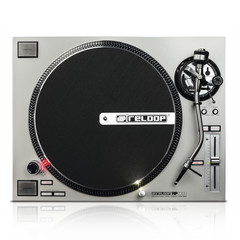
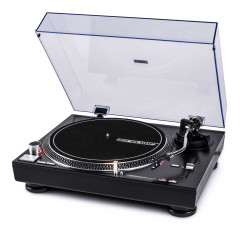
The RP-4000 MK2 is a solid DJ turntable for advanced users. The new MK2 version comes with several improvements, including a newly developed top panel and reworked metallic buttons with enhanced feel as well as a variety of functions. Precise motor control with 3 speeds: The precision-engineered die-cast platter is accelerated by a powerful motor with a high-torque direct drive of more than 1.8 kg/cm. The precise motor control with 3 speeds (33 1/3, 45 & 78 rpm) allows for the RP-4000 MK2 to play back any record. The pitch section with a selectable range of +/-8% and +/-16%, respectively, is suitable for the finest pitch adjustments. Statically balanced s-shaped tone arm: The RP-4000 MK2 features a statically balanced s-shaped tone arm with hydraulic lift and anti-skating mechanism. Via the universal connection for pick-up systems (SME) a large number of pick-up systems can be connected. Reverse function, pitch reset and extendible needle illumination: Additional features, such as reverse play and pitch reset, offer all DJs direct control of their turntable. With the push of a button the aluminium target light can be extended, so that the needle position can be seen in dark surroundings. Newly developed top panel and sturdy housing design: The new deep black metallic top panel construction is equipped with metallic buttons for start/stop, platter speed, pitch control, reverse function and tempo reset. The improved touch upon hit offers a clear haptic feedback. The sturdy construction with optimized damping features and shock-absorbing feet improve isolation from unwanted vibrations. With pick-up and headshell (made by Ortofon in Denmark): The RP-4000 MK2 comes with the high-quality OM Black pick-up, handmade by Ortofon in Denmark, pre-fitted to a headshell ready for immediate playback.
Technical data Turntable:
Type: direct drive turntable
Drive: quartz-driven high-torque direct drive
Motor: 8-pol., 3-phase, brushless DC motor
Turntable speeds: 3 speeds, manual (33 1/3, 45, 78 rpm)
Starting torque: > 1.8 kg/cm
Brake time: 50 dB (DIN-B)
Brake system: electronic brake
Platter:
Material: aluminium die-cast
Diameter: 332 mm
Tone arm:
Type: universal, statically balanced, s-shaped
Effective length: 230.5 mm
Overhang: 16 mm
Tracking angle error: < 3°
Applicable pick-up weight: 3.5 - 8.5 g (incl. headshell 13 - 18 g)
Anti-skating range: 0 - 7 g
Connections:
1x PHONO out (gold-plated), 1x GND
General:
Power supply: AC 115/230 V, 60/50 Hz (EU/US), AC 100 V, 50/60 Hz (JP)
Power consumption: 12 W
Dimensions: 450 (w) x 352 (d) x 144 (h) mm
Weight: appr. 9.8 kg
Included accessories:
Platter, OM Black pick-up system (by Ortofon), headshell, slipmat, counterweight, AC psu, instruction manual
Features
NEW in the MK2 version:
Newly developed top panel and reinforced housing construction
Reworked metallic buttons with improved feel & tactile response
Precision Pitch with selectable ranges of +/-8 % & +/-16 %
Tempo reset (Quartz Lock) feature
Superior finish in deep black metallic
Quartz-driven DJ turntable with high-torque direct drive
Designed for professional use
Powerful brushless DC motor with more than 1.8 kg/cm torque
Precise motor control with 3 speeds selectable (33 1/3, 45 & 78 rpm)
Reverse function: switch for forward/reverse playback
Precision-engineered die-cast aluminium platter with stable rotation
Statically balanced s-shaped tone arm with hydraulic lift and anti-skating mechanism
Universal connection for pick-up systems (SME)
Extendible needle illumination
Shock-absorbing feet for vibration isolation
Sturdy, heavy construction with optimized damping features
Prepared for dust cover (available as optional accessory)
Incl. slipmat, removable headshell and ready-mounted OM Black pick-up made by Ortofon
Aural Imbalance has enjoyed a colourful and celebrated journey through music over the years, taking in ambient soundscapes, deep house and of course, a pioneering role in atmospheric drum & bass. With Spatial, he has unearthed a pure, varied musical prowess seldom seen, with the ability to control both the lighter aspects of the mix as well as expert breakbeat craft. Infinity Spectrum showcases the breadth of talent Aural Imbalance possesses in one incredible package, not to be missed.
A1 - Aurealis
Opening the album with a wonderfully serene track, Aural Imbalance delicately rolls out his trademark smooth ambience with building cymbals and an energetic break merging perfectly in the mix - along with a great, pounding undertone of bass. Riddled with old-school sensibilities, Aurealis layers the building blocks until the track opens up further through a superbly lush breakdown, blooming like a flower in the summer sun before the breaks return.
A2 - Glistening Stars
Washing strings and the chitter-chatter of playful effects introduce Glistening Stars, before familiar, crisp old school breaks steal the limelight. A happy earworm melody soon reveals itself, and the breaks are gradually filtered back in following an other amazing breakdown before the melody takes on new life. Packed with detail and soul, this track will repeat on you long after you've moved on.
B1 - Alpha
Curious, apprehensive tones punctuate a fascinating intro, with a deep old school bassline creeping out first to greet us, before the hi-hat laden break loses its inhibitions and roams free.
Crafting a deliciously textured atmosphere, Aural Imbalance continues to showcase the breadth of his production techniques in his Spatial form, flecking the track with sumptuous melodies to create yet another gem.
B2 - Stargazers
This piece opens with a special blend of quiet, epic serenity, evoking hope and wonder as amen cymbal work and a stabbing snare-heavy break pattern rise and fall in the surrounding symphony. The quietly musical bassline plays a key role in the aural world-building here, complementing the breaks it harmonises with superbly. Aural Imbalance allows the composition to breathe and flourish for a superbly executed final act. Delightful.
C1 - Slow Motion
Introduced with quietly filtered breaks, Slow Motion dials back the pace with a break pattern which relaxes the snare while still maintaining a playful energy as the kicks and bass bumble along below. A uniquely atmospheric yet eccentric melody takes shape with dreamy pads filling the backdrop, and calming scatterings of echoing effects colliding and combining to generate a blissful collage of sound.
C2 - Apparition
Switching up the vibe we have Apparition, which boldly utilises long, tranquil yet purposeful pad work before an immense break pattern riddled with stark snares and a jumpy bassline which rides the smothered kickdrums so well, they appear to be fused as one. The breaks on this are truly special and will move the discerning dancefloor for sure, Aural Imbalance continuing to reveal a never-ending depth to his sound.
D1 - Artificial Satellite
Introduced with smooth synths and DJ-friendly hi hats, Artificial Satellite sees Aural Imbalance laying down a fresh showcase of old-school breakbeats, laced with that inimitable Spatial flavour. A swirling low-key sci-fi vibe punctuates the breakdown before the beats re-emerge. A deep, brooding bassline pulses beneath throughout, while the perfectly executed breaks enjoy their final flourish.
D2 - Unknown Forces
Finally, up steps Unknown Forces for a blistering finale to the LP. Aural Imbalance is at his amen-editing best here with a truly superb showcase of analogue break patterns to nourish the ears and set pulses racing on the dancefloor. Deep bass elevates the gentle intro before thumping kicks begin an epic workout, chopped to perfection with synths and strings flying gracefully above. We couldn't have a Spatial LP without an amen banger could we? What a way to end
Words by Chris Hayes (Spatial/Red Mist)
Afro-Cuban star Daymé Arocena has announced her new album 'Al-Kemi' which will be released on February 23 via Brownswood Recordings. It is her first album since 'Sonocardiogram' in 2019.
Dayme's new single "American Boy" accompanies her album announcement. No other song on the album embodies Arocena’s artistic liberation like “American Boy” - an exhilarating, futuristic slice of progressive pop. “I wrote it ten years ago, but thought it was too much of a pop song,” Dayme reflects. “In an indirect way, the music industry had shown me that I wasn’t welcome in that world. There isn’t a Black woman like me who enjoys the kind of success usually reserved for Rosalía or KAROL G. The image of music genres like salsa or bachata has been painfully distorted throughout the years. You are supposed to clone and fuse yourself in order to conceal your Black or indigenous side. They told me I didn’t fit in that world, but I’m going to prove them wrong.”
When Daymé decided to switch gears and record her fourth studio album in Puerto Rico with the iconic producer Eduardo Cabra (Calle 13), she never imagined that she would end up moving there.
“From the moment I stepped foot on the island, I realized that I never wanted to leave,” says the 31 year-old Cuban singer/songwriter with a hearty laugh. “At the time, I had spent three years away from Cuba, living in Canada with my husband. I called and asked him to come over to Puerto Rico, and to please bring all my stuff. It wasn’t a conscious decision on my part. It was simply love at first sight.”
Relying on instinct and intuition is how Daymé has managed her career since she burst on the international scene with 'Nueva Era,' her prodigious debut album, in 2015. Now, she has fully reinvented her sound with 'Al-Kemi,' a revolutionary – and transformative – fusion of neo soul singing, Afro-Caribbean beats and slick new millennium pop.
The album is titled 'Al-Kemi' with the Yoruba word for alchemy. "It means the cosmovision of transformation," she explains. "It is mixing all the elements to achieve an unbeatable result, full of shine and light, like gold springing from the skin."
From the cosmopolitan smoothness of lead single “Suave y Pegao” – an effortless fusion of jazz, bossa nova and urbano stylings with reggaeton star Rafa Pabön on guest vocals – to the smoldering neo-soul of “A Fuego Lento,” with Dominican singer Vicente García, Daymé’s latest album relies on sacred formats of the past but rearranges them in a conscious quest to redraw the very definition of what Latin pop is supposed to sound like.
“It was definitely a team effort,” she reflects from her new home in San Juan. “Flexibility may well be my biggest virtue. I’m always open to every possible suggestion when it comes to making things better. My piano player, Jorge Luis "Yoyi" Lagarza, and I worked on the demos with the rest of my band. Then with Eduardo Cabra’s direction, we enlisted musicians from all over the Caribbean – Cuba, Puerto Rico, the Dominican Republic. Everybody added their energy and coloring.”
It was Daymé’s piano player who originally suggested she contact Eduardo Cabra known for combining commercial aptitude with a refined sense of craftsmanship. Not only did Cabra accept the singer’s offer, but he also invited her to stay at his home during the four months when they recorded 'Al-Kemi' in his Puerto Rico studio.
“I had no idea that he was familiar with my music,” she enthuses. “Eduardo has been in the industry for a long time, and he comes from a world that is more global and commercial than mine. He was the ideal candidate for this project, but I initially didn’t know if he would understand the social, psychological and personal complexities of the message that I wanted to express.”
“Daymé is one of the most talented musicians that I’ve ever worked with,” says Cabra. “Working together was a joy, because she knew exactly the kind of fusion that she was going for: a cross between her Afro-Cuban roots – which clearly are strong on this album – with the more contemporary vein of analogue synths, samples and a bit of electronica. We wanted both worlds to communicate, to be both respectful and disrespectful to the ancestral colors. I feel comfortable with both, and even Calle 13 walked the two paths. This is also the album where Daymé opened up to the Caribbean at large. Her understanding of harmony and her performance skills are out of this world.”
Born in Havana in 1992, Daymé grew up immersed in Afro-Cuban folk, but also listening to cassette tapes of Sade Adu, her father’s favorite singer. She was identified as a prodigious
talent at only 8 years old and soon started studying music. After studying at the prestigious Amadeo Roldán conservatory, she became co-founder and band member of the Cuban-Canadian jazz collective Maqueque in 2017. With the collective, she launched several international tours and earned a GRAMMY nomination.
“In Cuba, the emphasis on technique is exacerbated,” Daymé explains. "At the same time, opportunities are scarce on the island. A career in music provides a potential for escape, which is why the competitiveness is off the charts.”
FUJI||||||||||TA returns to Hallow Ground with his second full-length for the label after we had released his international breakthrough album »iki« in early 2020. Active since 2006, the Japanese composer and sound artist has become prolific since the release of »iki,« releasing a slew of records while also touring the world. His new album »MMM« is Yosuke Fujita’s most complex so far. Changing the set-up of his pipe organ by switching to an electric air pump allowed him to activate new sonic and compositional potentials of the instrument, while he also expanded upon his experiments with his own voice. »MMM« is a masterpiece of conceptual and formal rigour—a testament to how multi-layered and versatile the music of FUJI||||||||||TA can be.
Previous releases had already showcased Fujita's interest in working with the rhythmic potentials of the organ he built himself in 2009. Replacing its hand-operated air pump with an electric one allowed him to work with it more freely and simultaneously record its sounds. This marked the starting point for the opener »M-1,« for which he recorded the pipes by waving a gun microphone close to it, thus creating shifting rhythmic patterns. The piece engages in a perpetual play of repetition and difference, balancing sonic intensity with compositional dramaturgy. For »M-2,« the artist uses his voice and works with a singing technique he has developed over more than a decade: constantly exhaling and inhaling, he puts a strain on his internal organs in order to create what he calls a »third voice.« The resulting piece is built on a throbbing rhythmic foundation topped by wordless melodies.
»M-3« closes the album as a synthesis of these two pieces, but is far more than the mere sum of its parts. The subtle tonal shifts of the organ take on a more subdued role this time, and Fujita’s scat growling and singing reappears in processed form. »M-3« combines the rhythms and melodies of the previous pieces to let something entirely new emerge out of them, much like the album is based on perpetual changes and recombinatory strategies. In fact, Fujita explains, the acronymic title can be read in many ways: this album is minimalistic, but freely mixes and mingles different materials in magical and even metaphorical ways while also paying its dues to his wife and daughter—M. and M. Just like its title can mean a lot of different things, »MMM« itself is ever-evolving, traversing different moods and opening itself up to a plethora of interpretations at each of its many turns.
Delphine Dora is a prolific composer, improviser and musician who has released on a plethora of labels including Recital, Morc, Sloow Tapes, Feeding Tube, Okraïna and more, and ‘Le Grand Passage’ is her Modern Love debut, a stunning set of songs for piano and voice, recorded in one take without overdubs or edits.
In an act of pure expression, Delphine Dora recorded the 8 songs of ‘The Great Passage’ in a single take, succumbing to a whirlwind of inspiration that transported her beyond the material world. Baroque paradigms bleed into fragile, introspective mantras, expressed through a made up language of existential yearning and channeled through piano and voice. It’s music that caresses the sublime, made without any premeditation.
Delphine was nearing the end of a three-day prepared piano residency when an technician stepped in to tune her grand piano for her final performance. He removed the objects from the strings and fixed the pitch, leaving Dora with a freshly tuned instrument. Mesmerised by its new sound, she proceeded to switch on her recorder and pour out her soul, channeling, in her own words, "something greater than myself".
The result is some of the most unusual but elevated material the prolific composer, improviser and multi-instrumentalist has ever recorded, rooted in a deep understanding of European musical history but willing to push at its boundaries, questioning the earthly logic of life and death, asceticism and impiety. Glistening imperfections lash 'The Great Passage' to the physical world, but Dora - seemingly possessed as she quivers in a fictional dialect - lets her fantasies intensify her spirit, lifting the music towards the heavens. It's not sacred music, per se, but it is unashamedly mystical.
On the luxurious, languid opening, Dora dissolves eerily familiar romantic piano motifs into an attentive ceremony, singing with charged emotion. Her words aren't really decipherable, but their resonance vibrates beyond language; it's striking to hear how confident she is in vulnerability. She lets the piano wrap into her voice, connecting us directly to a unique mode of emotional expression by urging us - the listener - to project our own meaning onto her abstracted words.
Dora refers to the act of improvisation itself as a way to indicate "the fragility of being”, and as her words blur in and out of focus, dipping from a hoarse croak to a choking wail, she places herself at the very edge of musical formality, questioning strictures put in place to suffocate self-expression. Her music has often been labeled "outsider", but here she sounds intimate and interconnected, more self-consciously candid than anything traditional might have allowed. She conjures affecting, plainspoken poetry, like a bedside diary written in a hypnagogic, delirious state: a stream-of-unconsciousness, channelling the beyond.
The album title connects to a book dedicated to French philosopher and activist Simone Weil, who famously pored over global religions to ascertain spiritual truths. To Weil, meditation was a passage to access mystical experience, or a bridge between humanity and divinity. In Dora's hands, this idea is a corridor between herself and the listener, a liminal place where she's able to address feelings without making anything explicit. The title, of course, also refers to life, its impermanence, finitude, and fragility, presenting the complex, multi-dimensionality of being through one of the most undiluted, unbridled set of songs imaginable.
One of the greatest, heaviest, and most sought-after guitar records from 1970s West Africa, available on vinyl for the first time in over a decade!!!
Bamako, Mali, 1973: Rail Band, the official orchestra of the Malian state railway, drops their self-titled LP. It’s a relentlessly soulful and hypnotic blend of American funk, jazz horns, and Afro-Cuban music, reflected through centuries-old Mandé tradition and blasted at top volume by some of the continent’s greatest artists.
Led by legendary trumpet and saxman Tidiani Koné and held aloft by the intricate web of Djelimady Tounkara’s rumbling, reverb-soaked guitar, Rail Band’s sprawling compositions embody West African storytelling traditions while exulting in the technology and modernity of a newly independent Mali. Vocalists Salif Keita and Mory Kanté, two heroes of African music who would achieve global fame as soloists, are endlessly emotive, oscillating between silky ballads and funk screams. The band’s sound is filled out by layers of percussion, rolling guitars, and melodic horns filtered through the Caribbean.
Starting in 1970, Rail Band played five nights a week, from 2 pm til the early hours, at the Buffet Hotel de la Gare. Their audience was an international array of businessmen, young partiers, and people of the Bamako night. The band was incredibly versatile, switching genres, rhythms, and styles to meet their crowd. It was a volatile mix, one that would fall apart soon after these recordings were made, with Salif Keita’s departure to start the rival Les Ambassadeurs. Though Rail Band continued in many distinguished forms, the eight songs on this album reveal one of the greatest bands to ever exist, at the height of their creative powers.
On “Duga”, a composition dating back to the 13th century and passed on through oral tradition by the jelis (griots), the Rail Band replace balafon with the interplay of Cheick Tidiane’s speaker-rattling bass and Alfred Coulibaly’s tasteful organ. “Marabayasa,” with its iconic sax intro and Mory Kanté channeling James Brown, is a deep-cut favorite of DJs around the world. Part of a long and regal lineage of Malian guitar orchestras initially tasked with translating the region’s traditional music to modern instrumentation, Rail Band morphed and reenvisioned those traditions with a style and energy that has never been matched.
Fixed Rhythms is proud to release a masterpiece double LP by Texas techno young star, Decoder aka Gautham Garg (as seen on Axis Records, Float Records, Amotik, Molecular, Science Cult, Subsist and more). He also runs the fabulous new imprint Toca alongside Jay York. Fixed Rhythms released a 12” EP entitled “Boulder” under his Cratan alias in 2021, and copies zipped on out the door. Not expecting this to be any different.
This is 8 tracks of hypnotic, bendy techno (with a C1 electro switch-up). You’re instantly transported to the depths of the cosmos within your mind on the first needle drop. User beware, this will hypnotize the dance floor. A track for all moments of the deep dance, with a D2 that ends the double LP with a powerfully optimistic sonic statement.
Mastered by Dietrich Schoenemann.
Design by Nick Owen.
Distributed by One Eye Witness.
Limited edition of 300 copies on black vinyl. Don’t sleep!
Experiences Limited, now 3XL, with a new LP from Exael on a highly atmospheric ambient jungle tip, deploying 30 mins of percussive spasms seeping into smoked-out zoners - highly tipped if yr into anything from Lee Gamble to Malibu.
Clearing their cache of stray bullets, Exael returns with a gyring plunge into percussive wormholes and low-lit mood enhancers .The tracks are broadly cleft along schisms of dark/light and demonic/angelic, switching from restive propellers to more sublime sensations in a fine testament to their practice - making for prob our favourite Exael release thus far.
On the “darker” side, they commit the convulsive, fractious footwork pulses and warped tones of ‘Circle (Squishy Mix)’ in a sort of parallel to 33EMYBW’s insectoid rhythms and combustion systems, while ‘Ice That melts The Tips’ trades in rapid, ice-skating thizz and ‘Ghoul Search (Demonic Attachment Mix)’ fires up the junglist particle accelerator for a proper gauntlet of hyper techstep dynamics.
The contrast is epitomised by ’Composure’, arranging flinty breaks on a luscious waterbed of floating pads, before ‘Eidolon’ renders a sort of airborne dembow pressure in the vicinity of Ben Bondy & special guest dj’s xphresh works. ‘L-theanine’ closes the session on a fine tread inside emo ambient styles and flurries on the same spectrum between DJ Lostboi and Teresa Winter, complete with a reverberating, half-buried vocal.
Following a first iteration which set the tone for our newly-minted Heimat series in explosive fashion, here comes the much anticipated second batch of our zeitgeistian take on today's scene's, its current potential and destination. Showcasing productions from artists keen to roll up their sleeves and sail into the impassible status quo, this new number packs the kind of red-hot hammering and cutting-edge punch we've been so adamant to push and defend over the past decade. Berlin-based French producer Arkan steps in first with a proper magnetic depth charge. Dwelling the darker layers of our ocean floor as its name suggests, 'Submarine' is pure hypnotic material geared up for heavy-duty boogie in the warehouse. Filling its ballast tanks with a hefty deluge of muscular bass onslaughts, sonar-like bleeps and untamed cascades of loopy arps, this one rolls and pitches like a haunted ship on predator mode. Adding his dynamic pulse and mind-bending spin to the A-side, Frameworks & Untertwegs bossman Decka cuts a path of straight mental obliteration as he smashes the doors of the club wide open and parades all guns blazing with the unapologetic crusher that is 'Circumvent'. A no-holds-barred workout for the strong stomachs, churning out fiery bars of kick-drum/squelchy bass contrast with in-your-face swagger. Switching on to the flip side, there's Manchester's Yant cruising with the ebulliently dynamic (no shit, Sherlock) tune, 'Moving'. A multidirectional concerto of pong-like modularity and racing synth arpeggios flying off like coloured bricks in a Tetris game gone absolute batshit. The kind of hi-intensity burner that'll awaken any lukewarm mid-set flow with its bouncy unpredictability and ruthless forward-pushing thrust. Rounding it off on a further minimal note, Amsterdam up-and-comer Hitam treats us to an inch-perfectly engineered finale with a stripped-back - yet, absolutely not hollow - bomb, 'Venusian Winds'. Gutsy that one sure is, with its metronomic step ticking at near-cyclonic speed and cleverly arranged, subtly FX-coated funk keeping things both suspenseful and focussed thru and thru. A sleek combo of pared-down brutalism and masterly executed analogue tailoring altogether. All dressed in clear purple marbled wax for the occasion, "Heimat II" shall please both the techno purist and visual aesthete in you with its velvet touch and effortless chic.
- A1: Darkland (00:39)
- A2: Tulips (02:55)
- A3: Immaculate Conception (00:46)
- A4: Love Theme No 3 (01:23)
- A5: The Owl In Daylight (00:51)
- A6: Innovative Patterns (02:24)
- A7: Osiris (00:58)
- A8: Groove Experiment No 3 (01:49)
- B1: Raincloud (03:57)
- B2: Phonic (00:48)
- B3: Love Theme No 2 (01:58)
- B4: Italian Summer (00:52)
- B5: Endless (02:11)
- B6: Wonder Theme (01:09)
- B7: Willow (01:06)
2023 Repress
Maston’s Darkland is a breezy collection of the material from the Tulips sessions that didn’t make it on to the original LP. Originally a digital-only release for those in the know in the autumn of 2018, after re-issuing Tulips in 2020 it made too much sense for Be With to give Darkland a vinyl release.
Like Tulips, Darkland was recorded mostly in Hoorn, in the Netherlands, between 2015-2017 during downtime from Frank’s touring duties with Jacco Gardner’s band. Bits were also done in Los Angeles on some extended trips back home.
The collection plays like an alternate view of Maston’s instant modern classic Tulips; a companion piece to the LP proper with similar mixture of shorter themes and more full length tracks. As Frank Maston explains: “I think Darkland is the shadow of Tulips in a way… what it might’ve been in a different universe. But the heart of Tulips beats in these songs as well and they evoke the same memories and feelings for me. I see my process playing out across these songs - lots of experimentation and trying out new techniques and sounds and just sort of going for it.”
Frank goes on: “It was all from the same pool of material, like 30+ ideas. I was making a lot of little demos… some would be more fleshed out and become songs and others would just be a cool riff and not go anywhere. When I started trying to form it all into an LP I went through all the sessions and ideas and collected the ones I thought were the most fleshed out and cohesive together as a whole. There were a fair amount of songs that were finished and in hindsight really should have been on Tulips (like what would’ve been the title track). And the rest of these songs are either very early versions of tunes that ended up on Tulips or some cool ideas that just ended up being dead ends. It definitely shows how wide my net was in the beginning before I narrowed the record down stylistically.”
Darkland opens with its ornate 39 second title-track before striding into “Tulips”, that full-length title-track that never was. It’s a real head-nod, percussive-rich electric piano stunner that would’ve been a comfortable standout on the album proper. But now this “downlifting” gem is given ample room to shine on this record.
The funky organ-led bass and drums workout “Immaculate Conception” will keep your neck gently snapping while MPC fiends go reaching for their sampler. And that’s gospel. “Love Theme No 3” cuts a breathtakingly stylish vibra-slapped swathe through the middle of the opening side before we’re startled by the pronounced bass and twinkling percussion of “The Owl In Daylight”. Charming digi-drums underpin the wonky synth (quiet-)banger “Innovative Patterns” which has a lovely melodic switch-up in the final third before the tempo (and hairs on your neck) rise on the faintly creepy yet imminently groovy “Osiris”. The gorgeously soft-focus “Groove Experiment No 3” closes out the first half in slow-mo wonderment.
The lushly melancholic “Raincloud” ushers in side B before the emotionally-stirring “Phonic” taps at the door, coming on like the long lost sister to Pet Sounds’ “Let’s Go Away For A While”. Next up, the swooning beauty “Love Theme No 2” keenly sways in front of you, growing ever more insistent and hypnotic. The too-short “Italian Summer” conjures the same flirtatious imagery as the title hints at whilst “Endless” is a fascinating “piano-pella” alternative version to “Rain Dance” from Tulips. “Wonder Theme” has a nostalgic, exotic 60s swing and album closer “Willow” is a hushed, campfire folk gem. The gently circular strumming is just magical.
Speaking to Aquarium Drunkard back in 2019 about the sessions that became Tulips, Frank noted: “I was really surprised by the lack of sunlight during my first winter in Holland, so I would call it Darkland which then became the name of the first demo I wrote during that time. It was also the working title of the record when I first started writing. Some are full songs that didn’t make the cut (including what would have been the title track), some are just ideas that I never finished.”
Whilst we were working on Darkland’s vinyl release Frank explained more specifically about the music that didn’t make it on to Tulips: “When I was putting together the tracklisting for Tulips I was already thinking that whatever didn’t make it onto the LP would be cool to release eventually somehow. The response to Tulips has been so passionate over the years that it’s nice to be able to offer another piece of that world. And for me personally it’s amazing to have more of my work out there in the world. Most common bit of feedback was that many of these songs should have been on Tulips. The odd friend says it’s much better than Tulips.”
Just like Tulips before it, Simon Francis’s vinyl mastering for Darkland has been cut at 45rpm so you can trip out to this as well at a woozy 33 1/3. The artwork too has been designed by Frank himself as a literal visual continuation of the Tulips cover.
We couldn’t possibly say whether Darkland is better than Tulips, and luckily we don’t have to decide.
These outstanding Technics slipmats featuring the skull and headphones dj design will look great on any set of turntables.
Based on iconic, Mexican Day of the Dead imagery, cleverly features a distressed vintage, tattoo style print of classic dj related equipment;
Including turntable tone arms, 7” single adapators, 12” vinyl, cross-faders, speakers, switches and headphones.
These slipmats are suitable for any set of vinyl decks.
Made from the finest but strongest felt material, DMC slipmats are the no.1
choice for djs and vinyl lovers across the World.
Dependable & hard wearing, they are also resistant to dust & other
particles, so will not scuff, scratch or damage vinyl.
Great for your home, studio, club or in competition.