Sol Power Sound returns with an EP of two blistering (and rare) island disco cuts remixed by Bosq and the Sol Power All-Stars that will make you forget that summer has come to a close. Officially licensed from the estate of Nappy Mayers, who wrote and produced both originals, both tracks capture Nappy’s exquisite sound that dominated the Trinidadian discotheques in the late 1970s and early 1980s but never received the international acclaim they deserved.
Bosq, a long-time friend of the label, leads things off on the A-side with his fiery dance floor flip of Nadie La Fond’s “Three Way Situation.” In his classic yet understated style, Bosq adds just enough, enhancing the captivating groove, while preserving the true essence and of the original. Using both vocal and dub parts Bosq turns up the funk and transforms the tune into a blistering modern disco cut that works equally well on the beach, in a dark club, or at your favorite underground afterhours.
On B1, the Sol Power All-Stars present an extended disco dub of the 1980 Nappy Mayers tune “Let Yourself Go.” The Sol Power crew opts to work with the b-side version of the original, which bypasses the lead vocal and instead focuses on the synth-bass led groove, an unforgettable chorus, and powerful disco horns. Toss in some chopped up flute, guitars, and synth and you’ve got yourself a party. And did we mention drums and perc? Don’t miss the massive soca break that will take you straight to a carnival jam in the islands.
Alongside remastered extended 12” versions of both original vocal cuts, Trini Disco Dubs highlights the genius of Nappy Mayers, a legendary Caribbean songwriter, producer, and performer, through the lens of modern producers who are at the top of their game.
Buscar:sy us
2024 Repress
All in that stark contrast between ethereal spaciousness and steely, martial rhythms out the industrial spectrum, 'Far Field' takes us on a voyage across the board, from breaks-heavy machine stunts to washed-out tapestries, via EBM-laced detours and junglistic maneuvers. Investigating the nexus zone between dance functionality and limitless escapology, it extrapolates both artists' blends to further immersive, hypnotic effect. Taking over the A side, .VRIL gets the ball rolling with 'Lost Together', which sets the tone on a low-slung, nostalgia-drenched note; combining the syncopated swagger of downtempo techno with ambient-oid stasis and static-filled opacity. Like watching an all-metal sun sinking past the blazing skyline. Revving up the engines, 'Fnord' feat. RAeYN conjures up a way more muscular arsenal of big-room-ready wares, from aggro snare salvos to anthemic synth kinetics, through that replicant-hunting kinda vibe. One to have the Saturn rings go hula hoop, with all woofers and brains in the vicinity melting in XTC. Shutting the A side off, 'We Believe' returns to a lighter, more vaporous mindset but sure implements that signature heavy swing of .VRIL, flush with textured kicks and FX-soaked arps. True monster prog swell. Flip it over and there's HVL dishing out a textbook example of his vortical electronic furls with the title-track, 'Far Field' - an oneiric drift that slowly rises from its heavy-lidded slumber, ascending towards bleepin' n bloopin' experimental effervescence as bars fly by. A number bound to hack your body and mind into two distinct facets, and while one dances its way frantically across the ever buzzing space/time continuum, the other shall reach a state of healing calm and transcending ubiquity. Smoothly shuttling us off to the upper layers of the ionosphere, 'Lancet Mxi' clenches it on a trippy note, taxiing us midway zero-G UK bass territories and eerie ambient abstraction. HVL's total, widescreen vision at its most unhindered, all set at expanding your mind to yet uncharted horizons of sound and closing the gap between two distant, estranged galaxies. A fractured headspace to both dance and dream to. *Dressed in a fine piece of artwork courtesy of Daniel M. Diaz, 'RYCL021' comes pressed on 180g audiophile black vinyl for optimal playing and listening experience.
The Check In brings us 006 by Duncan Thomas. Anyone operating in the world of deep minimal groovers have heard the whispers and tales of his genuinely unique grooves, blurring the lines of deep and soulful to light-hearted and bouncy.
Hard synth stabs and a punchy drum grooves open the EP through the A1 Espresso Tonic, a deep roller which is seductively euphoric. Then into Movin’ To The Sound which brings out the jazzy side of Duncan Thomas with synth licks and floaty chord progressions.
Flip over and you land on See You Never which leans to the festival forrest with heavy swing, a driving lead and laser sounding synth chords. Followed by the B2 Hello Out There which closes off the EP and is easily the most soulful of the four cuts. The repeating chord stabs are undoubtedly nostalgic and the bass-line routes the nostalgia to the dancefloor. This is a sunrise groove if ever there was one
- A1: New Gold Dream (81-82-83-84)
- A2: What Can You Do For Me
- A3: Soulution
- B1: Believe In Me
- B2: Too Much To Swallow (Part 1)
- B3: Something Good
- B4: I Want You
- C1: States Of Mind
- C2: Trance Atlantic Glide
- C3: Kinetic Synthetic
- C4: My Mind Must Be Free
- D1: Highlander - Cj Bolland Mix
- D2: Ohio - Dj Misjah Mix
- D3: Star - Union Jack Mix
" Utah Saints are one of the most important acts since the inception of electronic dance music. Early adopters of sampling, they brought the artform - used chiefly in hip-hop in the 1980s - into new realms.
" Incorporating rock, dance and hip-hop elements into their music, they scored 5 Top 40 UK singles including 'Something Good' and 'What Can You Do For Me' and a Top 10 album in the space of just two years.
" Out of print since its original release over 30 years ago, Utah Saints' eponymous debut album returns on 2LP - remastered & extended with 3 sought after remixes by CJ Bolland, DJ Misjah and Union Jack. Includes special limited edition mirror board packaging, for National Album Day 2024.
- Burilbunbol Suma 06:43
- Makamiba 07:29
- Yine Ntaripaga 06:59
- Tivona Vonbubo 06:38
- Yine Mmema 06:59
- Tigantabame 06:57
- Hoyenbesa Nini 06:27
- Abayetidu Ma 04:17
lp wiBola’s music melds sheer force of spirit with a sound not often heard by ears outside the remote Upper East Region of Ghana. This man who grew up herding livestock in the savannah, far away from the tropical coast and cosmopolitan cities of Accra and Kumasi, has aligned himself with national and international means of expression to transform his hometown sound into something downright avant-garde. His bold fury stems from the kologo—a two-stringed lute with a calabash gourd resonator—and Frafra language vocals, emitted in raspy bursts.
Traditionally, kologo performances occur at pito (local beer made from fermented millet or sorghum) bars, weddings, funerals, festivals or spontaneous jams on the street, which are the environments where Bola honed his craft as a solo musician. In recent years, he came into contact with people like his mentor Guy One who helped him get into the studio to document what is some of the most dynamic music to come out of Ghana since the emergence of hiplife in the mid-'90s.
Volume 7, which came out in 2009, is just one entry in a brilliant series of recordings Bola has released on CD and cassette. Although he employs a traditional instrument and the age-old mode of griot story-telling, Bola embraces elements of up-to-the-minute mainstream Ghanaian music—drum machines, synths, bone-shaking bass. Inspired by pioneering kologo greats like King Ayisoba, Bola has taken a dynamic instrument used by traditional healers and herbalists to sing to god in search of advice and taken it to futuristic heights.
“A huge thing for this record was to make it feel as close to our live show as possible,” says Tom Sharkett of W.H. Lung’s latest album. “We didn’t want it to sound live but we wanted to capture the excitement of the live performances.”
This is something that has become paramount to the group in recent years as they have undeniably blossomed into one of the most joyous and arresting live bands in the country. “The reason I’m in a band is to play live music,” says singer Joe Evans. “For me, music is live music. That’s what it’s for, to be played with people.”
The five-piece band, also featuring Chris Mulligan, Hannah Peace, and Alex Mercer-Main, decided to try something new on their third album after two incredibly successful collaborations with previous producer Matt Peel. In order to capture the energy, spirit and dynamism of their live shows, they relocated to Sheffield to work with Ross Orton (MIA, Arctic Monkeys, Working Men’s Club) who was able to harness this side of the band to remarkable effect. “Ross is the Sheffield Steve Albini,” says Evans. “He’s the king of not overthinking it and trusting the process of the art of recording songs. He was always there to stop us fucking around with cerebral stuff and get it down.” Sharkett echoes this too: “He was the exact producer we needed without us even realising. His productions and mixes are bombastic, lively and in your face and that’s exactly what we wanted.”
However, while this album is rooted in a sense of capturing a moment and a sparky liveness, that’s not to say it’s a raw or ragged record. It is still a meticulously composed, delicately layered and pristinely produced piece of work that, in true W.H. Lung style, runs the gauntlet from dance to pop to indie while still capturing that distinctly unique quality that is unquestionably their own. “It was a really big thing for me to realise what made us sound like us on this record,” says Sharkett. “I think the album sounds a lot more confident and self assured because of it. Some songs sound just so much like Lung and I’m really proud of that. I’m not sure we’ve done that as consistently across the other records.”
While the band have drilled deeper into finding their own singular identity, it’s not a record resting on its laurels. It’s a significant leap forward, expanding on their solid foundations while also breaking new ground. “The big difference with this record is its directness in every sense,” says Sharkett. “The songwriting is more upfront. Previously we’d focused a lot on vibe and production as opposed to just writing songs. The overall mission here was to revert to a classic songwriting structure and for the production to come afterwards.” And so what you have on this record are deeply considered and well-crafted songs, then recorded with blistering intensity in the moment, and then given a touch of experimentation afterwards. Then throw in Orton’s contributions to the band and it’s proven to be a real winning formula. “He brought a real dose of magic to the songs we’d written,” says Sharkett. “And brought an extra bit of wonk and quirkiness each time.”
The band’s ability to write more traditional and conventional songs is clearly a skill they’ve taken to with ease, at times there’s an almost Springsteen-like quality – but if he'd ever had an ecstasy period – to tracks such as ‘Thinner Wine’ and ‘Bloom and Fade’. While ‘How to Walk’ was constructed with one thing only in mind: that it would absolutely slay on stage. “I can’t wait to play this live,” says Evans. “We wanted a song to represent our live set, a new big one, and this is it.” Once again it leans towards the anthemic, with its driving, propulsive charge complete with incandescent synths and vocal melodies so irresistible you can already hear them being sung in unison by a crowd.
It’s an incredibly difficult feat to pull off a record that is more rooted in traditional songcraft while also capturing the power of a live performance, as well as pushing sonics into experimental new directions while working with a brand new collaborator. But here the band has managed to do just that. And the album’s closing song ‘I Will Set Fire To The House’ is a perfect example of such a thing. It’s a song that feels immaculately constructed but also very much alive and of the moment as its radiating synths engulf from the off, and Evans’ vocal is silky but powerful and in perfect symbiosis with Peace’s. It’s a song that captures the endless joys of music playing long into the night. “It may be a bit of a bloody bombastic way to end an album saying ‘and we’ll dance into the sunrise’,” says Evans. “But fuck it.”
MORE PRESS ON ‘VANITIES’ (MELO131)
"Vanities artily refines an exhilarating brand of up-front electro-dance" MOJO ⅘
'Idiosyncratic yet euphoric electronic pop on triumphant second LP' 9/10 Uncut
''One of the most effective alternative pop albums of the year'' 4/5 Record Collector
'Dance music for the modern age' - The Times (4*)
50 frequency and amplitude modulated sine waves describing a landscape / Trigram for Earth. Trigram for Earth, by Flora Yin Wong, is inspired by traditional eight-sided Pakua mirrors and the trigrams inscribed on each of their edges. The function of the mirrors is to show the nature of reality as being composed of mutually opposing forces and modulate them. Here, energies seem to be manipulated to guide and direct our listening, lost in a maze of sound, diffracted to the point of merging with the artist's own listening, through her memories, her obsessions, the fragments she carries within her. Flora Yin Wong invites us to embark on a multi-faceted investigation of sound, a journey through the meanders of liberated sonic forces, an auscultation of her own listening and a portal, at last, ajar to a fragmented and forever mysterious inner world.In his work '50 frequency and amplitude modulated sine waves describing a landscape,' Sébastien Roux applies his approach to algorithmic composition to the observation of the natural world, bringing the sound of the sea and the song of birds into the electronic domain, transmuting them into each other through a slow process of gradual modulation. Exploring the abstract space of pure sounds between two naturalistic tableaux, Sébastien Roux offers us a fascinating meditation on the world of synthesis, revealing, with an economy of means and great formal elegance, the magic of sonic simulacrum (deepl propose simulacra, mais là je suis pas assez calé_) and the strange beauty of the artificial, in a gesture that is ultimately as poetic as it is musical.
Time to welcome another newcomer to Freerange with a brilliant debut that has already been gaining a lot of interest from early spins. Stefano Ritteri should be a familiar name to many, having dropped several well- received releases on key labels such as Pets, Rockets & Ponies and Get Physical as well as his own monthly Rinse France radio show. A producer in the old school sense, he has the ability and desire to flip from deep, emotive and down tempo jams to the most impactful, high energy floor fillers, all with a deft touch and unique and experimental spin. The Italian producer, now relocated to London, has a studio chock full of vintage synths and hardware outboard which keep him inspired and ensure his output sounds fresher and fatter than most, as can be heard on this excellent two-tracker entitled A Different Happiness EP The title track is a spaced out, percussion-heavy jam which takes a minimal approach but wins hearts and minds with an ear-worm of a melody that gets gets you hooked in from the start. Snippets of spoken word add to the intense atmosphere making this one of those sure-fire, perennial tracks which can work in a variety of sets and still guaranteed to make an impact and stand out in the crowd. Flip over for Pocket Melody, another simple yet effective and inventive track which sees Stefano letting loose on his synths and coming up with some warped Zawinul-inspired vibes in the process. The playful melody snakes around in an improvised way whilst the dubby drums and classic analogue machine beats ensure everyone stays locked into it's hypnotic groove. Definitely a producer to watch for us and we're sure Stefano is on track to continue making some amazing music. We hope you love this as much as we do!
Nour Mobarak’s Dafne Phono is an adaptation of the first opera, Dafne, composed and written by Jacopo Peri and Ottavio Rinuccini in 1598. Drawing on the myth of Daphne and Apollo from Ovid’s Metamorphoses—a story of unrequited love, patriarchal possession, conquest, and transformation—Mobarak’s multimedia and multispecies reimagining splinters the opera’s Italian libretto. Alongside English and Greek versions, it is translated into some of the world’s most phonetically complex languages—Abkhaz, San Juan Quiahije Eastern Chatino, Silbo Gomero, and !Xoon. In this process, the narrative—and an artifact of Western culture—is dismantled, metabolized, and rendered into unruly utterances that shape the sensorium as much as they do the capacity for sense-making. These voices are given material form by a cast of mycelium sonic sculptures whose rhizomatic compositions and broadcasted recordings resemble the formation and mutation of language over time, reconstituting speech into a new, polyphonic body politic, composed of voices whose striking, poetic utterances transfix and transcend meaning.
The A-Side of the record presents a stereo version of Mobarak’s 15-channel sound installation, Dafne Phono. The B-Side uses a recording of a portion of the translation process the libretto underwent in Namibia, live-processed by the artist.
The LP is published on the occasion of Nour Mobarak’s exhibition at The Museum of Modern Art, New York (October 26, 2024–January 12, 2025), with support from Sylvia Kouvali.
Artist Bio:
Nour Pamela Mobarak (Lebanese-American, b. 1985, Cairo, Egypt) lives and works between Los Angeles; Bainbridge Island; and Athens, Greece. Her works have been shown at Sylvia Kouvali (formerly Rodeo), London/Paris; Schinkel Pavillon, Berlin; MIT List Visual Arts Center, Cambridge, MA; Amant, Brooklyn; JOAN, Los Angeles; Kim? Contemporary Art Centre, Riga; Miguel Abreu Gallery, New York; Hakuna Matata, Los Angeles; and Cubitt Gallery, London. Exhibitions at the Museum of Modern Art, New York, and Castello di Tivoli Museo d’Arte Contemporanea, Turin, are forthcoming. She has performed at Western Front, Vancouver; 2220, the Hammer Museum, and LAXART, Los Angeles; Cafe OTO, London; Renaissance Society, Chicago; the Museum of Contemporary Art, San Diego; and elsewhere. Her music has been released by Recital (Los Angeles), Cafe OTO’s TakuRoku (London), and Ultra Eczema (Antwerp), and she has had sessions on BBC Radio 3, NTS Radio, and Dublab Radio. Mobarak’s writing has been published in Triple Canopy, F.R. David, The Claudius App, and the Salzburg Review, and her first catalog, Sphere Studies and Subterranean Bounce was published by Recital (2021). She received a BA in English and Media Studies from Sussex University and did further studies at Université Paris-Sorbonne, Paris IV. She has held residencies at Denniston Hill, New York and the Institute of Contemporary Art, Los Angeles, and was the recipient of the 2023 FOCA fellowship award. Mobarak was a 2024 faculty at Bard College MFA program.
Dafne Phono Vocalists:
Apollo: Renato Grieco (Italian)
Cupid: Arnou Argun (Abkhaz)
Dafne: Agnes | xaye (!Xoon)
Ovid: Olivia O’Dwyer (Latin)
Venus: Don Eugenio Darias (Silbo Gomero)
Abkhaz Chorus: Liana Ebzhnou, Murman Guaramia, Fatima Kharzalia, and Gunda Osia
Chatino Chorus: Felix Daniel Peña Mendes, José Vasquez Canseco, Catalina Candelario Matias, and Claudia Garcia Baltazar
!Xoon Chorus: Franco Tsame, John Djujui Klosi Barase, and Charity Tsame
Clarinet: Steve Kado
For the next reissue in Mr Bongo’s Cuban Classics series, we look to Raúl Gómez’s entrancing 1977 Instrumental album. Presenting a unique blend of orchestral disco and jazz-funk, with Afro-Cuban flavours and soundtrack influences, it’s rich with drum breaks, energy and evolving compositions. A record that forever keeps you guessing, powered by an exemplary orchestra at the top of their game.
Cuban composer and singer Raúl Gómez is most known for featuring in the groups Mirtha Y Raul and Los Bucaneros alongside producing the Cuban classic Los Reyes 73 album, amongst a whole host of other incredible productions over the years. Released on Cuba’s state-owned label Areito, Instrumental sees Gómez not only as an instrumentalist and author, but also as a producer and arranger.
It's an album that deftly evades pigeonholing. Floating between instrumental mood music and library/soundtrack mastery, followed by explosions of cosmic-Latin funk, psych guitar workouts and compositions that reflect the orchestrated disco coming out of the US at the time, from greats such as Love Unlimited or MFSB. Lace that together with a healthy serving of Afro-Cuban magic to underpin the tracks and it’s a recipe for a record that captivates from start to finish.
Predominantly an instrumental album as the title suggests, the record showcases the Orquesta EGREM in full flow, soaring strings and vibrant horns at every turn. Highlights include 'Mi Samba Carnaval' with its breathtaking drum break, bubbling synths and sublime arrangements and the romantic film music impressions of ‘Tema De La Sierra', that have been a sampling source for many a producer. Elsewhere, ‘6 Son’ is a mind-melding psych guitar powerhouse, with 'Dacapo', written by Gilberto Peralta, offering up a slice of atmospheric and energetic Latin shuffle. One of only a handful of tracks where scat vocals compliment the orchestral tones, a Brazilian percussion theme marries with dancefloor sensibilities for a dose of feel-good, brilliance.
A wide-ranging, multi-dimensional release, Instrumental exhibits musicianship, composition and creativity at its finest and demonstrates another key example of the rich output of music that flowed from the island of Cuba post revolution.
Chicagos einzigartig erschütternde und technisch grausame Chaos-Einheit Immortal Bird ist zurück mit ihrem mit Spannung erwarteten dritten Album. Auf dem 2019er Album "Thrive on Neglect" manövrierte sich die Band durch ein Amalgam von Klängen, das sich zu einer verzerrten und kantigen Darbietung von vielschichtigen Ängsten entwickelte und nun als Sprungbrett für die weitere Entwicklung auf dem neuen Album "Sin Querencia" dient.
Immortal Bird vereinen Elemente aus Death und Black Metal, Hardcore-Tumult, eine Dosis Noise Rock aus ihrer Stadt und eine kompositorische Komplexität, die an Grenzgänger wie Gorguts und Ulcerate erinnert.
- Nachfolgealbum zu 'Thrive On Neglect' von 2019
- US-Tournee für Ende 2024 und bis 2025 geplant
- Ausgewählt, um für Emperor in Chicago 2023 zu eröffnen
- FFO: Pig Destroyer, Cattle Decapitation, Krallice, Oathbreaker, Converge, Full Of Hell, Cretin, Tombs, Cult Leader
Chicagos einzigartig erschütternde und technisch grausame Chaos-Einheit Immortal Bird ist zurück mit ihrem mit Spannung erwarteten dritten Album. Auf dem 2019er Album "Thrive on Neglect" manövrierte sich die Band durch ein Amalgam von Klängen, das sich zu einer verzerrten und kantigen Darbietung von vielschichtigen Ängsten entwickelte und nun als Sprungbrett für die weitere Entwicklung auf dem neuen Album "Sin Querencia" dient.
Immortal Bird vereinen Elemente aus Death und Black Metal, Hardcore-Tumult, eine Dosis Noise Rock aus ihrer Stadt und eine kompositorische Komplexität, die an Grenzgänger wie Gorguts und Ulcerate erinnert.
- Nachfolgealbum zu 'Thrive On Neglect' von 2019
- US-Tournee für Ende 2024 und bis 2025 geplant
- Ausgewählt, um für Emperor in Chicago 2023 zu eröffnen
- FFO: Pig Destroyer, Cattle Decapitation, Krallice, Oathbreaker, Converge, Full Of Hell, Cretin, Tombs, Cult Leader
Ekoplekz is Nick Edwards from Bristol, UK. He made waves in the 2010s with his distinctive brand of lo-fi analogue electronica for labels such as Planet Mu, Mordant Music, Punch Drunk, WNCL and Perc Trax, while also playing live around Europe. In recent times, Nick has preferred to remain a low-key presence, but Selvamancer are excited to have coaxed him back with his first vinyl release in 5 years! Dirtbokz is an 8 track mini-album that showcases the Ekoplekz sound of now. Recorded as always on four track cassette using hardware analogue synths and drum machines with minimal post-production, the tracks retain a raw immediacy and the dirty, dub-infused sound that he was always known for. For the Dirtbokz LP, Ekoplekz reaches back to the early acid, electro and primitive rave of his youth, all mixed in a hazy reverb-soaked echo chamber inspired by his love of '70s Jamaican dub reggae. 'Frampton Kotteral' takes a gentle detour into more melodic, sentimental territory and the set closes with the forlorn acid comedown of 'Phader'.
Black Truffle is pleased to announce a tenth anniversary reissue of Oren Ambarchi’s Quixotism, originally released on Editions Mego in 2014. Recorded with a multitude of collaborators in Europe, Japan, Australia and the USA, Quixotism presents the fruit of two years of work in the form of a single, LP-length piece in five parts. Quixotism takes the driving rhythmic aspect of works such as Sagittarian Domain to new levels, with the entirety of this long-form work built on a foundation of pulsing double-time electronic percussion provided by Thomas Brinkmann. Beginning as almost subliminal propulsion behind cavernous orchestral textures and John Tilbury’s delicate piano interjections, the percussive elements (elaborated on by Ambarchi and Matt Chamberlain) slowly inch into the foreground of the piece before suddenly breaking out into a polyrhythmic shuffle around the halfway mark, and joined by master Japanese tabla player U-zhaan for the piece’s final, beautiful passages.
The pulse acts as thread leading the listener through a heterogeneous variety of acoustic spaces, from the concert hall in which the Icelandic Symphony Orchestra were recorded to the intimacy of crys cole’s contact-mic textures. Ambarchi’s guitar itself ranges over this wide variety of acoustic spaces, from airless, clipped tones to swirling, reverberated fog. Within the complex web Ambarchi spins over the piece’s steadily pulsing foundation, elements approach and recede in a non-linear fashion, even as the piece plots an overall course from the grey, almost Nono-esque reverberated space of its opening section to the crisp foreground presence of Jim O’Rourke’s synth and Evyind Kang’s strings in its final moments. Formally indebted to the side-long workouts of classic Cologne techno, the long-form works of composers such as Éliane Radigue and the organic push and pull of improvised performance,
Quixotism is constantly in motion, yet its transitions happen slowly and steadily, often nearly imperceptible, the diverse elements which make up the piece succeeding one another with the logic of a dream.
At the time of its first release, Quixotism was clearly a summation of Ambarchi’s work in the years leading up to it. Now, listening back a decade later, it also seems like an arrow pointing to the future, suggesting paths that would be explored further in works to come: the pulsating guitar layers of Hubris, the album-length collaboration with Jim O’Rourke and U-zhaan on Hence, Shebang’s joyous layering and percussive drive. Now sounding better than ever in a new remaster by Joe Talia, the time is ripe to rediscover its quixotic charms.
Ella Raphael ist mit einer erstaunlichen Stimme gesegnet, voller Wärme und Emotionen; sie ist einnehmend, wie ein alter Freund, der Geschichten erzählt und spinnt. Mad Sometimes ist ihr Debütalbum, das über Fire Records erschienen ist.Aufgewachsen in London, umgeben von Geräusch, hörte sie erst Ella Fitzgerald, Sarah Vaughan, Etta James, während sie Queen, den Beatles und die Stones aus der Sammlung ihres Vaters begegnete. Ellas musikalische Reise setzte sich in Australien fort, wo sie viele andere Musiker traf und schließlich mit Möchtegern-Piraten segelte, die am Bug ihres Bootes sangen und beschlossen, dass Musik der richtige Weg für sie ist. Begeistert von der Musik, die sie auf weiteren Reisen durch die USA und Europa entdeckte, verfeinerte sie diese eklektische Mischung und fügte Love, Serge Gainsbourg, Karen Dalton, Vashti Bunyan, Catherine Riberio And Alpes, die ursprünglichen Meister des Tropicalia, exotische 50er-Jahre-Gitarren und die esoterischen Klänge der mittleren/späten Beatles hinzu. Sie hat einen Sound perfektioniert, der so vielfältig ist wie ihre Einflüsse und Erfahrungen, eine Musik, die so schön ist wie ihre Umgebung. Sie nutzt die Feinheiten und subtilen Nuancen des Klangs, um sowohl Licht als auch Dunkelheit in ihre Musik zu bringen. Auf ihrer ersten LP entsteht ein Klang aus einer stilvollen Mischung aus Lap Steel, Mandoline, Guiro, Congas, Synthesizern, einer Shruti-Box und Streichinstrumenten, die von Ella, Eyal Samson, Uzi Ramirez, Ron Ephrati, Guy Mintus und Amir Sadot gespielt werden. "A timeless, Tropicalia-tinged day-dream" Gorilla Vs Bear Goldfarbenes Vinyl (mit DLC) oder Digi-Sleeve-CD!
- A1: Perc
- A2: Please Come Back And Knock
- B1: Music Of Spheres
- B2: Asset
- B3: Feelu
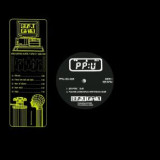
Long time PPU contributor, video producer, and designer, SOFTgrid steps into the fold with their EP “Knock”. Includes “FEELU” as featured in the 2024 summer blockbuster Bad Boys IV : Ride Or Die starring Martin Lawrence & Will Smith.
Demoscene and Cracktro enthusiast, SOFTgrid started life navigating the dark waters of text user interfaces, with early memories of Bulletin Board Systems, and as time and technology progressed, they eventually obtained the various bits of software needed for their creation, this was by means of WAREZ servers in private chat rooms far from town hall.
SOFTgrid is most at home organizing their existence to a grid, be it pixels or the linear movement of sound on a timeline. ASCII and ANSI are their preferred means of expression, SID and PAULA chips their preferred means of communication.
mindSET is the ninth album from enigmatic producer SW., directly following this summer’s excursion into his trademark techno, IDM and bleep soundscapes, on the myDEFINITIONS Vol II album. But with his mindSET album SW. takes a left turn, as pioneers often do, and we find ourselves on the lesser traveled side roads of electronic music history. Or in SW.’s own words: “the more abstract leftfield elements.”
It’s in these less-defined areas that SW. finds his sweet spot, building dancefloor soundtracks that defied definition. And with mindSET the sounds and the machines might have changed, the methodology remains the same.
“It draws from what was more generally seen in leftfield as a term for the slightly off-kilter house and broken beats that didn’t fit neatly into classic genres, whether that was Chicago house, French garage, drum and bass, or broken beat. It’s more about those in-between sounds that never really took off, only appearing briefly in the early to mid-90s and then quickly disappearing. There was a certain magic in that moment, which I wanted to capture. Also, the entire album was produced using classic analog equipment, with old machines that were used during that era. That’s the approach I’ve taken.”
The eight tracks on mindSET are shaped out of de-tuned techno pop synths and heavy, syncopated drums, grooving along chopped-up polymeters to create an eerie mood, as if orbiting an undiscovered planet for the first time. The harmonic movements are often bent out of shape, sometimes veering towards Gherkin Jerks or Cristian Vogel territory. But in the end, the sounds are less important than the atmosphere, and the tracks represent an attitude or an approach - to creating the music as well as experiencing it. mindSET is a nod to those dancers sharing an oddball moment, and for those of us on the same wavelength, it's a vibe we can all get inside.
Blue Vinyl[32,73 €]
The Flat Earth is the second studio album by English new wave and synth-pop musician Thomas Dolby, it was released on 10 February 1984 and peaked at No. 14 on the UK Albums Chart. The first single from the album was "Hyperactive!", which peaked at No. 17 in the UK Singles Chart. The album charted at No. 35 on the US Billboard Hot 100. The album has held up very well 40 years after its release; a crisp production, brilliant songwriting by Thomas Dolby and a fantastic ensemble of supporting players makes this record a classic in its own kind. The Flat Earth is available on black vinyl and contains an insert.
- A1: John Martyn - Small Hours
- A2: Stephen Whynott – A Better Way
- A3: April Fulladosa - Sunlit Horizon
- B1: Sylvain Kassap - Plancoët
- B2: Manu Dibango - Night In Zeralda
- B3: Henri Texier - Hocoka Time
- B4: Nivaldo Orneleas - O Que Ha
- B5: 808 State – Pacific State (Massey’s Conga Mix)
- C1: Magma - Eliphas Levi
- C2: Homelife - Stranger
- C3: Michael Gregory Jackson - Unspoken Magic
- D1: Dora Morelenboum - Avermelhar
- D2: Simone - Tudo Que Você Podia Ser
- D3: Experience Unlimited – People
- D4: Otis G. Johnson - I Got It
- D5: Mel & Tim - Keep The Faith
Oxblood Coloured Vinyl[36,09 €]
Exploring late-night, after-hours meditations on sound; ‘Everything Above The Sky (Astral Travelling with Luke Una)’ is a new compilation by the titular DJ, promoter and enigmatic cultural curator. Off the back of the E Soul Cultura phenomena, this compilation comes at a timely point in Luke’s rich career as he soars the heights of playing all over the world. Avoiding any chance of his sound being pigeonholed, Luke has put together a tracklist of songs and music that have a transcendental feel, after coming off the grid, going back to source, outside the city walls .
Music has long been believed to aid out of body experiences and many of us have searched long and hard for a combination of those elusive ingredients that might alleviate some of the monotony of everyday life, our daily routines and obligations, and those things that seem to block us from the spirit of the universe. In this collection, Luke selects music with all the right ingredients in just the right quantities, allowing the listener to engage in an esoteric journey of enlightenment through sound. Being a prolific collector of music, Luke initially delivered enough tracks to compile several compilations, making the licensing process the biggest effort to date for the label. The music moves softly and slowly, never becoming too intrusive, exemplifying the wonderful elevating properties of simple songs played from the heart.
Luke’s Everything Above The Sky manifesto reads, “Astral Travelling in the meadowlands with acid folk, spiritual jazz, around midnight hocus pocus, cosmic psychedelic soul, magical spellbound whirling swirling love songs, Brazilian ballads of light into machine soul gospel utopia dreaming, Balearic bossa, Outer Space ancient African drum, the breath of trees, escaping the big bad modern world, gathering round winter fires, walking amongst the bracken in Padley Gorge in late summer twilight, overlooking the Hope Valley, escaping ego, detaching and finally letting go amongst the stars with the slowly floating people. It’s beautiful beyond. Everything above the Sky”.
Beginning his career as an original Sheffield house young blood in the mid 1980s, Luke’s move to Manchester and partnership with Justin Crawford saw the birth of Electric Chair, a cornerstone cult night in the UK underground club scene. Then came Electric Elephant, a Croatian festival paying homage to their wild eclecticism from Balearic to Brazilian to É Soul, house, disco and techno. Luke’s much loved, long-running Homoelectric night and more recently Homobloc sell out festival for 10,000 souls has been at the forefront of Manchester’s LGBTQ+ cultural landscape. Luke’s Friday evening show on Worldwide FM captured imaginations and became a cult four-hour must-listen monthly journey for fans all over the world. Today, Luke remains, as ever, at the forefront of a changing milieu, pairing the momentous legacy of Manchester’s 80s and 90s scene with the delivery of what today’s club communities need to get down.
One of London’s most loved underground parties, Tangent, celebrates its 10th birthday this year with a new compilation on Mr Bongo. Its residents, John Gómez and Nick the Record, have curated a selection of prized, rare and dancefloor-ready tracks that have soundtracked the past decade of their parties. Alongside remastered reissues of these original cuts, the CD version of the compilation also houses three incredible edits from Nick, John and Dan Tyler of the Idjut Boys. These were too good not to press onto vinyl, so we’ve given them the standalone 12" they deserve.
Contextualising their edits Nick states, “Tangent was not only the place for us to play the music we love the most, it also became the testing ground for our edits. It was really helpful being able to see the effect each of these had on a dancefloor before the records were released and many of them also became firm Tangent classics.”
Up first, Nick is joined by Dan Tyler (Idjut Boys), who he runs the edit label Record Mission with, for a furiously feel-good re-edit of Leo Basel’s ‘Quelle Drôle De Vie’. Basing their edit on the 1987 ‘Special Remix’, it does what any great re-work does, dropping the sections from the original that don’t quite hit the mark, whilst focussing on the gold in amongst it all. The result is a slice of peak-time, French boogie joy, that will warm even the coldest hearts.
John then joins Dan at the dials for a cosmic revamp of Love Isaacs 'Surprise Surprise'. A serving of ‘80s electro-funk, dripping in swagger with a highlife tinge. John and Dan extended the grooves for maximum dancefloor power, space echoing it into the stratosphere at all the juiciest points.
Lastly, Nick takes on Rick Asikpo and Afro Fusion 'Let's Get High' from the super sought-after 1980 album, Got To Be Me. Celestial, gospel-infused soul from Nigeria, Nick homes in on the energetic last 2 minutes of the original as the building block of his 12-minute edit. A completely reworked, feverishly paced creation, Nick switches the sections around, saving the slow, soulful segment for a brilliant cosmic breakdown before the track erupts back into its full flow. Synthesised, jazz-funk elation from start to finish!