After making a worldwide splash in late 2020 with their De La Soul collab "Baby Got Work" feat Kapok, Potatohead People are back with a brand new must cop release that crosses both sides of the Atlantic as the Magnificent DJ Jazzy Jeff and legendary UK producer and keyboard player Kaidi Tatham team up to remix the forementioned track.
Bringing the energy up and out into a classic Hip-Hop vibe, Jeff & Kaidi infuse a head knockin' drum break complete with classic JJ scratches, synth bass, and Rhodes chords on top of Posdnuos's rhymes about getting your head down, putting your boots on and getting to work - helping to make the world better place for all of us. Vancouver collaborator Kapok sings aboout the shortness of our lives, and the potential in all of us to get the work done that we need to do. It's an allusion to the desperate times we're live in, with a hopeful call to action for all of us to roll up our sleeves and get down to the business of change.
The original "Baby Got Work" is included on the B-Side of the remix due to popular demand!
a 01: Baby Got Work (DJ Jazzy Jeff & Kaidi Tatham Remix) feat. Posdnuos & Kapok
Suche:sy us
Clear Vinyl
Eugene Synegal's early career as a teenager was the guitarist of Sam & The Soul Machine before moving to Los Angeles to join the group Sage and later in the 1970s recording on Lee Dorsey's Night People and The Neville Brothers records.
These previously unreleased recordings were birthed in the early 1970s, sometime during Eugene's trips back and forth between Los Angeles and New Orleans. A couple years after these recordings were immortalized onto 1/4" reel-to-reel tape an unusual crime scene involving Eugene and his girlfriend reads as if it was a chapter taken directly out of a pulp fiction novel. An Australian socialite named Patrica Galea, remained unsolved for 30 years. The robbers took $400, two diamond rings, a $1,400 cigarette lighter and two mink coats. They failed to collect Galea's $6,402 which was hidden in her freezer. This money was sent from Australia and was being used to fund Eugene's album as well as starting a new music publishing company in Hollywood. This was the life of Eugene. Playboy extraordinaire, jet-setter and guitar chops that would turn the head of Hendrix!! Around 2006 the owner of the West Hollywood apartment expressed a desire to learn more about its history and met with detectives who were unable to locate the file since it was buried in the cold cases section. The files were found, the case was reopened, solved and two men were arrested in 2007.
These recently unearthed 1970s recordings by Eugene are a reflection of his pure soul as well as a blend of psychedelia and funk that the band Sage was experimenting with in Los Angeles during that time period.
From a historical sense, these two recordings are significant because it bridges the historical and influential New Orleans music scene during the early 70's with the psychedelic rock and folk scene that was emerging just walking distance from the West Hollywood apartment that Eugene was living in with Galea during that time.
Eugene's unique guitar style paired with a deep-rooted gospel sensibility is a window into the artistry and songwriting capability of this incredibly talented man.
Traditional village music transformed into fiery and frenetic underground Hip Hop. Emerging from the digital cultural renaissance of the early 2000s, where DIY studios sprung up throughout West Africa, "Patriote" is a shining example of localized global music. Hypnotic and driving rhythms built from sampled percussion and chopped-up instruments combine with syncopated staccato "ragga" inspired flow into infectious hammering tracks that sound like nothing before. Mamaki Boys was formed in 2002 by Aziz Tony, Bachou Issouf, and Salif André, when a local Hip Hop movement was exploding in the capital of Niger. "Patriote" was recorded to address a trend in the scene they perceived as too derivative. Produced at Studio BAT, one of the first studios in Niamey, Mamaki Boys sought to merge modern Hip Hop with traditional music. They invited elder musicians into the studio to play Nigerien instruments like duma and kalango, which were sampled and looped over their compositions. "We wanted to put tradition in the rap, ancestral dances, the things that our grandparents did in the village," Aziz explains. "Our mission was to re-value the culture, put it into Hip Hop, and to show all the colors of our country." Self-describing their music as "tradi-moderne", a Nigerien movement of folk revitalization, their cultural manifesto presents through every aspect of their work. Each track relies heavily on traditional instruments, and each rhythm is based on a dance from Niger. Their mission extends to the urgency of their lyrics: Takai challenges the population to preserve their culture, Kagani Kagani is a demand to take back mineral, oil, and uranium rights from their colonizers, while Komando uses war cries to inspire artists to keep speaking out. A strong entry in 21st-century global music, Mamaki Boys "Patriote" takes back the tools of globalization, repurposing them in the fight for cultural identity. Originally self-released in 2009 on limited edition CDR in Niger.
Book + CD
In the year 2018 visual artist Ken Verhoeven (1991, lives and works in Antwerp) presented his Friendship Paintings, a collection best described as “deconstructed designs for friendship bracelets”, at Trampoline gallery in Antwerp.
The subject: the friendship bracelet. A wristband infused with meaningful (?) symbols. Symbols crafted thread after thread. One pulls a string, and ... friendship happens. Or ... friendship is being manipulated by symbolism. Not unlike a fetish.
Ken Verhoeven upcycled this vulgar object and brought it inside the art gallery. Where he showed not only the designs, but also the schematics for how to craft each bracelet. Like exposing the crystals of friendship.
It is a recurring storyline in Ken Verhoeven’s work. In the words of gallerist Stella Lohaus “he constantly interprets curiosities that casually present themselves in the world around him.”
Friendship Songs For this book, Ken Verhoeven structured ten works as a dramatic narrative.
He invited me to translate these works to music. To treat them as sheet music. Graphic scores. From here on, the Friendship Paintings become Friendship Songs.
On the accompanying CD, i recorded 10 arrangements of the 10 scores. Not unlike how Ken Verhoeven only used an existing DIY online generator to create the designs – i stuck to very limited tools while arranging the music. Namely one Roland Sound Canvas module for the sounds, Christian Schubart’s seminal book about the aesthetics of the tonal arts – to determine the tonality of each score, and the Spectrotone Instrumental Tone-Colour Chart for the instrumentation. The latter being a system invented a century ago in Hollywood, to apply different colours to the various instruments and registers of an orchestra.
We arrive at objective musical interpretation. However, since we are not dealing with heartless content here, the arranger does need to take subjective decisions, to bring the arrangements home. These small musics can / should (who is the manipulator now?) be played as a friendship bracelet. Thus: as endless loops. Every song repeats itself as long as you wish for. Like the symbol on the bracelet is being repeated until the circular object is finalized. Once, twice, 10, 20, 100, ?? times. Enjoy, Friend!
Lieven Martens, Deurne 28 june 2021
Tkać means ’to weave’ in Polish. On this album, Swedish–Polish composer and musician Marta Forsberg delivers two compositions that capture her unique ability to transmit visions of light into glimmering sonic landscapes. To weave: crossing threads of dreams and light under and over each other.
LED AND LOVE SOUNDS is a live recording of a piece based on frozen and processed violin sounds. Weave and Dream was composed on an OP-1 synthesizer, and Forsberg’s use of LED light strips played a crucial role in the composition process.
This is tactile drone music, enriched by Nikos Veliotis' mixing work (MMMΔ) and the mastering by Mell Dettmer (collaborator of Eyvind Kang, SunnO))), Earth, Tim Hecker).
"The composer and sound artist now lives in Berlin, but is closely associated with the so-called Stockholm Drone Society around artists such as Kali Malone, Mats Erlandsson and Ellen Arkbro.
Having recently presented a composition for an installation with LED lights with her album New Love Music, now combines older material from very similar contexts: »LED AND LOVE SOUNDS« was performed in an art gallery and consists of processed violin sounds that Forsberg layers into haunting drones in front of the clearly audible soundscape of the room. »Weave and Dream« has been written for synthesiser and was part of an installation style that combined LED lights and fabrics with music.
More insistent in style and more intense in sound, the effect of »Weave and Dream« is similar to that of the first piece: Forsberg’s music enters into a dialogue with space and time that unfolds its full power even without the originally associated visual and physical experiences – very slowly and carefully, of course." (field notes)
Binding a deep social and political conscious with rigorous musical experimentation, the Brussels based, Italian pianist, performer, composer, Giovanni Di Domenico, delivers Downtown Ethnic Music, the 4th instalment of Die Schachtel’s Decay Music series, focused on inspired contemporary experimental efforts in the ambient, ethereal, and emotively abstract music.
Over the last decade or so, Giovanni Di Domenico has carved a deep path through a diverse number of discrete fields within experimental music, working in various ensembles - Abschattungen, AufHeben, Bonjintan, Cement Shoes, Delivery Health, Going, etc. - as well as producing a discography of critically heralded solo efforts, and intimate collaborations with Jim O'Rourke, Tatsuhisa Yamamoto, Akira Sakata, Arve Henriksen, Tatsuhisa Yamamoto, Alexandra Grimal, Nate Wooley, Chris Corsano, and others.
Downtown Ethnic Music encounters Di Domenico reimagining the future of urban music, pluming the mysterious and emotive depths of self, to arrive at vision of sonorous utopia, radically divergent from those of the past. Hybridizing numerous forms of musical practice, while making a conceptual nod to Jon Hassell’s notion of the "fourth world”, as well as the cross-temporal transnationalism of Roberto Musci, Aktuala, Futuro Antico, and the Third Ear Band, Di Domenico’s vision of democracy - rendered through the creative metaphors of sound - is a true to life, bristling conflict, as open-ended as it is ordered, and as dramatic and tense as it is beautiful, playful, and refined.
A colorful tapestry of ideas, experiences, histories, and reference points, woven from a pallet of electronics, synthesis, and various acoustic sources - the intervening rhythms of drummer João Lobo, vocals by Pak Yan Lau and Patshiva CIE women choir, the horns of Ananta Roosens and Jordi Grognard etc. - across the length of Downtown Ethnic Music, the boundaries between idiom, expressive concept, collective, and individual blur, giving way to a visionary, forward-thinking rendering of electroacoustic music, that subtly reminds us of the social and political potential of art.
Seamlessly incorporating bubbling electronic abstraction, sprawling ambience and long tones, throbbing kosmische, acoustic free improvisation, and the human voice, Giovanni Di Domenico’s Downtown Ethnic Music represents a high-water mark in an already astounding career. Issued by Die Schachtel in a one-time edition of 250 copies, pressed to 180g marble vinyl and housed in a pro-printed inner sleeve and jacket, contained in a silk-screen PVC sleeve.
- A1: Shooter
- A2: Back Up 2021 (Feat Debby Friday & Sb The Moor)
- A3: Wriggle
- A4: Hot Fuck No Love (Feat Cakes Da Killa & Maxi Wild)
- A5: Our Time (Feat Nailah Middleton)
- B1: Wriggle (Homemade Weapons Remix)
- B2: Back Up (Dave Quam Remix)
- B3: Hot Fuck No Love" (Jana Rush's Naughty Bitch Remix)
- B4: Wriggle (Cardopusher's Ebm Remix)
LP[17,19 €]
This LP finally brings a Clipping fan-favorite, 2016's Wriggle, onto vinyl in an improved, expanded version that features new art, previously unreleased remixes, and a track that's exclusive to the vinyl format. The original, digital-only Wriggle EP was six tracks that weren't finished in time to make it onto the group's 2014 Sub Pop debut, CLPPNG. For "Shooter," Clipping recorded themselves firing fifteen different guns, the sounds of which exclusively constituted the beat's drums, augmented only by a synthesized tone-row. The verses referenced the well-worn technique of "hashtag rap," but instead of using it to boast about the rapper's personal wealth and masculine prowess, Clipping put forth imagistic narratives of three violent encounters. True to much of the group's music, "Shooter" was an attempt to reframe a familiar style and test the limits of its formal capabilities. "Hot Fuck No Love" contains what might be the most explicit verse to date from Clipping's favorite New Jersey rapper Cakes Da Killa. The EP's title track, "Wriggle," was built around a sample of the influential power-electronics song "Wriggle Like a Fucking Eel" by Whitehouse, transforming William Bennett's torturous imperative into a instructional dance-floor banger. "Wriggle" and "Shooter" have become classic Clipping tracks and staples of their live show. With this vinyl edition, Clipping fans old and new - and there are many new fans thanks to their breakout 2020 album, Visions of Bodies Being Burned, and Daveed Diggs' thriving acting career - get the vinyl version of Wriggle they've been clamouring for.
This album was originally composed in October 2017, performed and recorded live in Kasteliotissa Medieval Hall, Nicosia, on the 19th of November 2017 as an accompanying soundtrack to Fritz Lang's two hour-long edit of the film Metropolis (1927). Commissioned by the the curators of the 'German expressionism in Cinema exhibition' to compose and perform a live soundtrack, Panagiotis and Yiannis employed a hardware heavy arsenal to produce one of their longest pieces. modular synthesizers, guitars, drum samplers and drum machines are all protagonists. The performance lasted for two hours and was recorded in its entirety. It was later edited down to preserve all sound design qualities and a somewhat live feel. The title is an homage to the main actress of the film.
Panagiotis Mina and Yiannis Eliades, longstanding members of 'do it together' collective Honest Electronics and producers of their own material as Panayotis and Isel respectively, often collaborate on projects such as Brigitte. Panagiotis Mina is a producer, musician and visual artist. He lives and works in Cyprus from Pyrgatory studios, his out in the country home diy studio project. Yiannis Eliades produces and performs music using a blend of analog and digital synthesizers, drum machines and twisted recordings, on his own or as part of duos (MYHN, Carnal Throes).
Eamon Harkin, 1/2 of Mister Saturday Night Records and Nowadays in NYC, brings us a balmy 4 track EP, simultaneously full of longing, bliss, and hope. Adeptly oscillating between techno and house, these ear-worm, tastefully catchy tracks will find themselves perfectly at home both on reopened, outdoor summer dance floors as well as on bedroom stereo systems. If you do find yourself on a reopened dance floor, you may end up shedding a joyful tear to one of these.
Limited edition of 300 copies on black vinyl. Mastered by Dietrich Schoenemann. Design by Nick Owen. Photography by Frank Harkin.
DJ Sotofett and LNS have teamed up with Tresor Records for Sputters. The double-vinyl album with 15 cuts spans a hybrid of warped electro and psychedelic hypnosis, all the while remaining fixed in an unmistakable dance release. Recorded between 2017 – 2020, and bookmarked throughout by intros and interludes dug out from archival material, it's a deconstructed yet classic compound of techno-sonics.
LNS from Calgary, Canada, is rooted in braindance, electro and acid. Releasing 12inches on both her self-titled imprint LNS and Sotofett’s Wania - LNS, whilst in the studio, has often pointed out “the lacking blend of dub and electro in dance music”.
DJ Sotofett, hailing from Moss, Norway, is among a myriad of things commonly known for the extended work of his Sex Tags Mania and Wania labels, without forgetting his afro, dub and jazz releases on Honest Jon's London.
Together both artists give space to a guest appearance by E-GZR, a fellow Wania artist, to open the Sputters journey. The sinus bending drum stutter of K.O. by E-GZR collisions flanging basses and chronic-inducing synth pads to blueprint the technoid atmosphere to come. LNS & DJ Sotofett take control with El Dubbing, evoking an effect-heavy demeanour, typical of the Sex Tags Mania soundworld that DJ Sotofett is responsible for, this time rubbing up against solid electrified rhythms. The hypnotic moods carry over to Dúnn Dubbing's deep delays, freely running over a surprisingly minimal skeleton retaining a solid direction. Crafting a warmly emotive end of Side-A with sparse rhythms to perfection.
A meaner turn introduces Side-B. Hints of electro are scattered everywhere, fat basslines, ricocheting drums and synths that mourn and drift in and out of harmony. Vitri-Oil exposes a tumbling sound design, fog-lit chords of material fragility and nosedives - with an alive mix that wallows and grows in equal measures. The side closes with Shim, a classic drift between house and techno releasing sensual euphoria with the albums first big surprise – grand strings.
“LNS wanted to sell her TR-606, while my reply was for us to make a track with the 606 sounding so fresh that she'd never even think about selling it again” Sotofett states. Side-C proves the artists to be some of the most singular producers around with album centrepiece The 606. Clocking in over 10 minutes, it kicks off as a driving techno banger, chugging bass and big chords. Midway through everything falls away, and out of the void enter scattered drums and improv piano lines emerge, while twisted dubs lead us back in an enduringly warm groove.
Side-D sets the clock back to the original electroid foundation of the album, casting fires with alien vibrations. Synchronic Bass Blort is a hard-hitting electro track, steaming sonics and thrills, its melodic hook diving in subterranean motions. On Sputtering the duo raspily beams into outer space, with fizzy motives that disfigure and dazzle while the harmonies of the closing track is for yourself to experience.
DJ Sotofett and LNS deliver an album inhabiting a world full of sci-fi sonics and fierce groove. Their sound is free and live, simultaneously wondrous and sharp.
Clear Vinyl
DDS catch enduringly absorbing sonic alchemist Jim O’Rourke at his knottiest and most ingenious in a wormholing suite of amorphous rhythm and psychedelic electronics - a massive RIYL Autechre, Roland Kayn, Bernard Parmegiani, NYZ, Keith Fullerton Whitman.
Playing up to and into DDS’ freeform aesthetics, O’Rourke renders 40 minutes shearing hyaline synth tones and ruptured rhythm generated at his Steamroom facilities in Tokyo, a modular outzone trawling that harks back to his iconic Mego releases and some of the more recent Steamroom experiments. It’s an ideal addition to the ever expanding DDS cosmos, following Demdike’s recent ‘Drum Machine’ expo with a slice of purist and screwed modular magick that transcends early
electronics and modern styles in pursuit of musical sensations that defy stylistic brackets.
‘Too Compliment’ was assembled using a bespoke Hordijk modular system, a rare West Coast-style setup hand made by Dutch engineer Rob Hordijk. O’Rourke focuses on the frequency shifter here, using it to coax out fluxing tone thickets, haphazard frequencies and elongated drone corridors.
It’s transportive stuff, harking back to the early days of private press academic synth music but also sitting on edge alongside Autechre’s recent long-form work, as well as O’Rourke’s classic “I’m Happy, And I’m Singing, And A 1, 2, 3, 4” In O’Rourke’s hands, the mass of electronics takes on throbbing, organic dimensions, congealing
grey matter and purplish veins of fluid in viscous transitions that glisten and spark with invention as they form new tissue. What comes out is as unearthly as the earliest electronic music, but also
blessed with a psychedelc spirit in a way that’s long kept O’Rourke right out on his own, teetering between paradigms yet never settling into any single style. If you’ve always been keen on finding a way into that sprawling soundworld, ‘Too Compliment’ is a perfect entry point into a highly rewarding creative macrocosm.
Discos Transgénero re-issue the Marnie Weber classic first solo LP, “Songs Hurt Me” originally from 1989. This seminal record was an important part of the Los Angeles post-punk performative art rock scene. Brooding synthesizers, heavy bass, strange melodies, and poetic lyrics lead you through an industrial journey. These songs were born from Weber’s earliest performance art characters: a deer, an old woman, a manic courtesan, and a butterfly. Songs Hurt Me was originally co-produced by Phillip Drucker AKA Jackson Del Ray of Savage Republic and 17 Pygmies fame.
Marnie is a pioneer in art rock from the 80’s in Los Angeles. She emerged early in the music scene as the bass player in the Party Boys, a formative and important Los Angeles post-punk downtown art scene band. During this period, the Party Boys performed shows with The Minute Men, Savage Republic, The Red Hot Chili Peppers, Fourwaycross, The Blue Daisies, Perry Farrell’s first band Psi Com, Camper Van Beethoven, and many more. Bruce Licher of Independent Project Records, whom Marnie met in art school, released the first Party Boys record. After performing with the Party Boys, Marnie went on to become a noted solo performative art musician in her own right. She has released five solo records and numerous group album releases.
As a visual artist Marnie created the cover of Sonic Youth’s A Thousand Leaves album – interesting to note Marnie is the hamster girl on the cover. She also designed posters for Sonic Youth and did a co-release of her second album with Thurston Moore on his label Ecstatic Peace. Expanding from her musical roots, Marnie exhibits artwork, films, sculptures, collages, sound installations, and costumes internationally in museums and galleries. She has had two extensive survey exhibitions of her artwork – most recently at the Museum of Contemporary Art in Geneva.
Songs Hurt Me was remastered by Mark Wheaton at Catasonic Studios Los Angeles using the original tapes for an unprecedented restoration of this historic album. Discos Transgénero has thoughtfully designed and pressed the reissued LPs in Germany. This unique edition of Songs Hurt Me is a limited release of 400 copies distributed worldwide.
- A1: Africa Is My Root - Osayomore Joseph And The Creative Seven
- A2: Ta Gha Hunsimwen - Akaba Man The Nigie Rokets
- A3: Popular Side - Akaba Man And The African Pride
- B1: Iranm Iran - Victor Uwaifo And His Titibitis
- B2: Sakpaide No 2 - Victor Uwaifo And His Titibitis
- B3: Ta Ghi Rare - Akaba Man The Nigie Rokets
- C1: My Name Is Money - Osayomore Joseph
- C2: Ogbov Omwan - Akaba Man The Nigie Rokets
- C3: Aibalegbe - Victor Uwaifo And His Titibitis
- D1: Who Know Man - Osayomore Joseph And The Ulele Power Sound
- D2: Obviemama - Victor Uwaifo And His Titibitis
- D3: Ororo No De Fade - Osayomore Joseph And The Ulele Power Sound
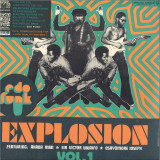
Analog Africa Presents Edo Funk Explosion Vol. 1, available on
2xLP/Gatefold LP with 20-page booklet / CD with 36-page booklet. It was
in Benin City, in the heart of Nigeria, that a new hybrid of intoxicating
highlife music known as Edo Funk was born.
It first emerged in the late 1970s when a group of musicians began to experiment with different ways of integrating elements from their native Edo culture
and fusing them with new sound effects coming from West Africa s night-clubs.
Unlike the rather polished 1980 s Nigerian disco productions coming out of the
international metropolis of Lagos Edo Funk was raw and reduced to its bare
minimum.
Someone was needed to channel this energy into a distinctive sound and Sir
Victor Uwaifo appeared like a mad professor with his Joromi studio. Uwaifo
took the skeletal structure of Edo music and relentless began fusing them with
synthesizers, electric guitars and 80 s effect racks which resulted in some of the
most outstanding Edo recordings ever made. An explosive spiced up brew with
an odd psychedelic note known as Edo Funk.
That’s the sound you’ll be discovering in the first volume of the Edo Funk Explosion series which focusses on the genre’s greatest originators; Osayomore
Joseph, Akaba Man, and Sir Victor Uwaifo: Osayomore Joseph was one of the
first musicians to bring the sound of the flute into the horn-dominated world
of highlife, and his skills as a performer made him a fixture on the Lagos scene.
When he returned to settle in Benin City in the mid 1970s - at the invitation of
the royal family - he devoted himself to the modernisation and electrification
of Edo music, using funk and Afro-beat as the building blocks for songs that
weren’t afraid to call out government corruption or confront the dark legacy of
Nigeria’s colonial past.
Akaba Man was the philosopher king of Edo funk. Less overtly political than Osayomore Joseph and less psychedelic than Victor Uwaifo, he found the perfect
medium for his message in the trance-like grooves of Edo funk. With pulsating
rhythms awash in cosmic synth-fields and lyrics that express a deep personal
vision, he found great success at the dawn of the 1980s as one of Benin City’s
most persuasive ambassadors of funky highlife.
Victor Uwaifo was already a star in Nigeria when he built the legendary Joromi
studios in his hometown of Benin City in 1978. Using his unique guitar style as
the mediating force between West-African highlife and the traditional rhythms
and melodies of Edo music, he had scored several hits in the early seventies,
but once he had his own sixteen-track facility he was able to pursue his obsession with the synesthetic possibilities of pure sound, adding squelchy synths,
swirling organs and studio effects to hypnotic basslines and raw grooves. Between his own records and his production for other musicians, he quickly established himself as the godfather of Edo funk.
What unites these diverse musicians is their ability to strip funk down to its
primal essence and use it as the foundation for their own excursions inward to
the heart of Edo culture and outward to the furthest limits of sonic alchemy.
The twelve tracks on Edo Funk Explosion Volume 1 pulse with raw inspiration,
mixing highlife horns, driving rhythms, day-glo keyboards and tripped-out guitars into a funk experience unlike any other.
- A1: Conjunto Típico Corazón De La Selva - Alegría En La Selva (02:47)
- A2: Los Pihuichos De La Selva - La Carachama Coqueta (02:46)
- A3: Los Pihuichos De La Selva - Chupizinatay Yacui (02:37)
- A4: Los Pihuichos De La Selva - Shamuy Pacarina (02:32)
- A5: Los Pihuichos De La Selva - El Montañés (02:41)
- A6: Los Pihuichos De La Selva - El Huancahui (02:38)
- A7: Los Pihuichos De La Selva - Flautero De La Montaña (02:31)
- A8: Los Pihuichos De La Selva - El Jornalero (02:30)
- B1: Los Pihuichos De La Selva - La Danza Del Trapichero (02:32)
- B2: Conjunto Típico Corazón De La Selva - Picaflor Loretano (02:31)
- B3: Conjunto Típico Corazón De La Selva - Ushpagallo (02:56)
- B4: Conjunto Típico Corazón De La Selva - Punchacacho Tutacacho (02:50)
- B5: Los Pihuichos De La Selva - De Dónde Vienes Loretano (02:31)
- B6: Conjunto Típico Corazón De La Selva - Bailando En La Selva (02:52)
- B7: Los Pihuichos De La Selva - La Huayranguita (02:34)
Andrés Vargas Pinedo is a prominent composer of Amazonian popular music from Peru. He is blind and has excelled as a player of the quena and the violin. He was born in the city of Yurimaguas but he developed as an artist in Lima, for thirty years he has worked as a traveling musician on a street in the San Isidro district of Lima. Throughout his career, he has formed and joined various popular music groups. This compilation presents fifteen songs of his authorship, belonging to his first two groups: Conjunto típico Corazón de la Selva and Los Pihuichos de la selva, active between 1965 and 1974, and which helped define the sound of Amazonian popular music.
These years saw the emergence of an Amazonian popular music movement led by Vargas Pinedo as well as groups such as Los Solteritos, Flor del Oriente or Selva Alegre. These artists based their music on the rhythms of the Amazonian folklore (pandilla, sitaracuy, movido, cajada, chimayche) and were nourished by influences from the coast and the highlands of Peru, as well as by the tropical rhythms of Brazil, Colombia and Ecuador, achieving a musical synthesis that is an invitation to collective celebration and endless dance. A sound that is defined by a constant and hypnotic rhythmic base of kick and snare drums, upon which the quena and violin develop imaginative melodic lines. Sometimes there is a singing voice, sometimes the voices playfully appear as sounds that identify Amazonian popular speech or that emulate jungle animals.
The fifteen tracks gathered in 'El fabuloso sonido de Andrés Vargas Pinedo: Una colección de música popular amazónica' (1966-1974) / 'The fabulous sound of Andrés Vargas Pinedo: A collection of Amazonian popular music' (1966-1974) are a good introduction to the work of an essential creator of Peruvian music, whose sound expresses the spirit of the Amazonian people and summarizes the transition from tradition to the popular in the context of the emergence of a record industry of Amazonian music. Andrés Vargas constitutes a fundamental basis for the music of the Amazon, as his work synthesizes diverse influences, having that original root as its main motive.
This compilation is presented in vinyl format and includes a brochure with extensive information and photos. The audio has been remastered directly from the original tapes. Edition of 300 copies. Art by Jordy García (Blumoo Posters).
crystal blue vinyl
South London based producer Lxury is a subtle experimentalist, pairing house rhythms with eclectic genre blending and risk-taking. Returning to Shall Not Fade's Lost Palms series for a second record, Smart Digital Life EP shows the maturity and complexity of his production while keeping the energy light and summery.
"1722" opens things up with dreamlike pitched vocals that provide a vaporwave feel, hypnotizing over stuttering synths and a wonky beat. "Spin" has an experimental sound palette, a euphoric pulse and a sweet melody, dance music doused in honey.
This sweetness spills over onto the B side; "Pad Ma" sounds like a pumping club track meets a trip to the fairground - unstoppably buoyant and headsy. The vocals in "When I Wake Up" spin around your head before a muscular beat kicks in, the most stripped back and raw sounding of the record. This one is certain to get heads down and feet moving. "Up High" is an expansive closing track, built around fuzzy drums as the clever use of vocal samples creates a melody with a loved-up feeling; it's a tour-de-force of Lxury's delicate production skills.
Snapped Ankles return to the forest, but it's not as they left it. Trees planted in neat rows. A well-ordered monoculture with access roads and heavy machinery. The smell of greenwashed money in the air. There's no sign of the ancient woodland they emerged from on debut album, Come Play The Trees. And it's far cry from the gentrified East London they found themselves hawking on Stunning Luxury. All is not well in the face of progress. Welcome to the Forest Of Your Problems. Even among the famously close-knit woodwose community there are factions forming. Meet The Business Imp, The Cornucopian, The Nemophile and The Protester. Each with their own motivations and belief systems. Their own sense of injustice: contradictions, anxieties and guilt. There are woodwose who have risen to the top in the boom and bust world of real estate and hedge funds. Grab what you can before the next crash. Others find euphoria in the absolute conviction that wealth and technology will see us through this. There are those with their recycling in order, who are well-versed in the prospect of imminent ecological and economic collapse, burying themselves in vegan cookery and extensive international holiday itineraries. And there's an increasing number angry at the state of the world, ready to take to the streets and the trees in an attempt to force real change. Forest Of Your Problems runs the gamut of modern woodwose emotions. In this neat human approximation of the forest, it's an increasingly knotted affair. Despite all of this, Snapped Ankles haven't lost their innate ability to make you want to move your feet - their Teutonic forest rhythms are still shot through with post-punk lightning. Whether they're exploring those opportunities which might arise when a Nigerian prince emails out of the blue on 'The Evidence', or referencing the crooked woodwose attempting to go straight on 'Rhythm Is Our Business', this is music to lose your inhibitions to. The moments of pure elation on 'Shifting Basslines Of The Cornucopians' are worth the admission price alone - "It's a great time to be alive!" ...apparently. Snapped Ankles outsider status has always allowed them to hold a mirror up to society. Now the boundaries are not so clear. In the four years since Come Play The Trees was released, their cult has flourished. Previous album Stunning Luxury saw the band invited to play the BBC 6 Music Festival and a KEXP session on the back of a sold-out UK tour which culminated with two nights at Village Underground in London. As those who have witnessed the shamanic ritual of their live shows will attest, they are a truly unique, communal experience. Forest Of Your Problems will see the woodwose bring their ancient forest rhythms and high-wire, multi-media live act to ever bigger stages - including Camden's iconic Roundhouse in October.
Blue Vinyl
Lynch protégé and Twin Peaks sound designer Dean Hurley coaxes an incredible puzzlebox of atmospheres and mood pieces on this killer contribution to our Documenting Sound series, now remastered and pressed on vinyl for what is, perhaps unsurprisingly, the most cinematic and neon-lit instalment in the series. Like a
smudged and overdubbed copy of the BoC Maxima tape, with added iridescence.
Across almost 40 minutes we transition from aerosolised synths to romantic chromatics, thru to Nurse WIth Wound-style severed rhythms and fading glimmers of hope, ‘Concrete Feather’ epitomises Dean Hurley’s prized knack for nuanced instrumental story-telling in the finest and most engrossing style we could imagine. Against the backdrop of the Hollywood film industry that has primed us for as long as we can all remember, the music spans a panorama of lush, mirage-like choral pads and starry flickers thru to gloaming
nightmare sequences and screwed drums, while touching on some of the dankest synth tones this side of his ‘Anthology Resource’ volumes or indeed his soundtrack work for Twin Peaks: The Return. It’s full of dread and a slowly unfolding sense of tragedy.
“Having a regular practice of recording is probably the single most important element to my craft. It’s a way of dropping indiscriminate mile markers while constantly moving forward in time without ability to pause.
Over the years, working for David Lynch taught me a great deal about this and the concept and importance of experimentation. I’ve found myself clinging to those lessons during this time and using them as tools for both productivity and balance. His notion of experimentation is a simple one, yet incredibly profound. It was one of the very first words I heard him say during our initial meeting, and I never stopped hearing the term daily over the subsequent 13 years working together. An ‘experiment’ can provide a legitimate mental back-entrance into the act of creation. It can position an approach toward discovery as opposed to effort, and eliminate the thought that one needs to ‘will’ something into existence. It also aids in calming the judgmental
side of a brain from stepping on/interfering with expression…after all, experiments are not about success or failure, they’re simply about learning. In the Lynch school of thought, multiple experiments then become firewood…and with firewood, one can not only build but actually sustain a fire…even turn it into a multipleacre blaze or more.
Dean Hurley
Following the release of Limewax's Untitled and Speed Dealer Moms' SDM-LA8-441-114-211, Trickfinger and Aura T-09's Evar Records imprint is keeping its foot on the gas, officially introducing the arrival of its sub-label, RAVE4EVAR. Embracing more of an outlaw mindset, RAVE4EVAR was created as a place for rebellion to collide with rave, offering refuge for off-the-cuff releases, special projects and occasional one-off collaborations.
Ushering in the sub-label's inaugural release, RAVE4EVAR is proud to present Chicago-based DJ, producer and new media artist S4M23's debut EP, Angelface. The five-track project, set to arrive on July 2nd via a limited edition cassette and digital download, combines haunting vocals with pounding kicks and rave synths to create a moving take on hardcore. Written and recorded during a weeklong session in April 2020, the creation of Angelface took place during a period of processing grave personal loss juxtaposed with the collective state of chaos, grief and fear brought on by the covid-19 pandemic.
Within that specific period of time, S4M23 channeled intense emotion to reflect how cathartic it can be to honor the connections we build with one another despite how frenetic and heart-wrenching the circumstances of a particular moment or experience can be. Pouring an immense spectrum of emotions into Angelface, these productions eschew simple repetition to create unexpectedly complex rhythms and textures that evoke the sounds of British club music and '90s rave, while simultaneously creating something entirely new.
(part 2/3 featuring Sept, Raven, Frazi.er & Trym) Amelie Lens' EXHALE Records continues to deliver fiercely dynamic techno from the underground's most promising, rising and established artists with its second VA compilation.
Amelie Lens' EXHALE Records continues to deliver fiercely dynamic techno from the underground's most promising, rising and established artists with its second VA compilation.
Following EXHALE's first VA release in 2020, the party series turned label once again welcomes existing members, flourishing producers and blossoming new artists to the EXHALE family for its second various artists compilation.
Opening the second EXH002 vinyl is 'Bóg Jest w Techno' event boss Sept, who presents us with a stripped back cut layered with piercing synth keys and gentle electro elements in 'Beyond The Veil'. Acid stabs and a female voice echo the track title in Raven's trippy cut 'Metal On Metal', with light airy synths to close out that simulate euphoria. We're taken on a dark and weighteir expedition with Frazi.er in 'Systematic Ignorance' - a brooding bass drives the sound, with acid melodies adding texture throughout. Keeping up pace is 'Kendall' by Trym, a cinematic composition that utilises cymbals, hi-hats and synth notes to create a brighter melody over its dark percussion.
- A1: Alf Layla
- A2: Hazihi Laylati
- A3: Fakarouni
- B1: W Marrat El Ayam
- B2: Amal Hayati
- B3: Men Ajel Aaynayk
- B4: Anta Oumri
Omar Khorshid (9-Oct-1945 – 29-May-1981) is an Egyptian musician, composer, accompanist, and actor.
Born in Cairo, Omar Khorshid was a well-known guitarist who accompanied many Arabic singers, including Farid Al Atrach, Oum Koulsoum, Mohammed Abdel Wahab, and Abdel Halim Hafez.
From 1973 to 1977, Khorshid moved to Lebanon and began recording albums under his own name, working with sound engineer Nabil Moumtaz at Polysound Studios in Beirut.
Khorshid's musicality in orchestra performances, original songs, and film scores was considered revolutionary at the time in the Middle East. His extensive theoretical knowledge, fusion of Western sounds with Eastern sounds, and incorporation of different, more modern instruments (e.g. the electric guitar, electric keyboard, and synthesizer) in Arabic music was previously unheard of.
Khorshid's unique style sparked inspiration from many aspiring musicians not only in the Middle East, but in Europe and the Americas as well. His mixing of "modern" instruments with older Arabic tunes spawned a new, more modern sound of Arabic music that many use for belly-dancing today.
![Potatohead People & De La Soul - Baby Got Work (DJ Jazzy Jeff & Kaidi Tatham Remix) [feat. Posdnuos & Kapok]](https://www.deejay.de/images/l/4/7/978647.jpg)