For several years now, Young Kulcha has been establishing himself as the favourite of European sound systems. The young German-Congolese artist sets dub and reggae parties alight with his sharp lyrics and voice reminiscent of some of the most admired reggae artists such as Hugh Mundell, Dennis Brown and Garnett Silk.
With ‘More Work To Be Done’, Young Kulcha presents a track that encourages younger generations to remain optimistic and resilient despite the difficult times our societies are going through. Accompanied by the exceptional Swiss studio band The 18th Parallel, ‘More Work To Be Done’ plunges us straight into a Jamaican sound system party from the early 1980s, where the combination of Roots Radics and Scientist would have shaken the neighbourhood with their unparalleled heavy sound. With a dub B-side by Westfinga, the new European generation pays tribute to Jamaican legends with this musical bombshell!
Поиск:system roots
Все
“Tubby did three original dub albums, ‘Dub From The Roots’. ‘The Roots of Dub’ and the third is ‘Brass Rockers’ with Tommy McCook ‘pon the flying cymbals. Where he mixed it with the horn going in and out in a dub way and one named ‘Shalom Dub’ you can call Tubby’s too because he mixed the versions as they were off forty fives’’
Bunny ‘Striker’ Lee
King Tubby and Producer Bunny ‘Striker’ Lee are intertwined in the birth of Dub Music. After discovering a mistake that made a ‘serious joke’ (more of which later...) they went on to release the first pressings of this new musical genre namely ‘Dub Music’. Tubby’s vast knowledge of electronics and Bunny’s vast catalogue of rhythms would lay the foundations of what today is taken as a standard... the Remix / Version cuts to an existing vocal tune.
Osbourne ‘King Tubby’ Ruddock was born in Kingston, Jamaica on 28th January 1941 and grew up in the High Holborn Street area of downtown Kingston. He studied electronics at Kingston’s National Technical College and also on two correspondence courses from the U.S.A... When he had qualified Tubby began repairing radios and other electrical appliances in a shack in the back yard of his mother’s home. His work in the early days included winding transformers and building amplifiers for Kingston’s Sound Systems. Tubby built his first Sound System in 1957 playing jazz and Rhythm & Blues at local weddings and birthday parties. His reputation as a man who knew and understood both electronics and music grew steadily and as the sixties drew to a close. Tubby
purchased his own basic two track equipment. He installed this alongside his dub cutting machine, a home-made mixing console, and his impressive collection of jazz albums in the back bedroom of his home at 18 Dromilly Avenue which he christened his music room.
Tubby and Striker were at Treasure Isle Studio’s one day while Ruddy from Spanish Town was working with the engineer Byron Smith....
“Tubby and myself was talking when Ruddy was cutting some dub but Smithy (engineer) made a mistake through we were talking and forgot to put in the voice. It was two track recording in those days. Ruddy said ‘No Man! Make it stay! and so they cut the rhythm. When I went over to Ruddy’s that Saturday night a dance was in progress and when they played the vocal to the tune... then he said we’re going to play ‘Part Two’. They never called it ‘Version’..and then he played the rhythm track. The song was a catchy song and everybody started to sing along and the deejay started to toast so everything went down well. On Monday morning I went up and I said ‘Tubbs the mistake we made was a serious joke.It mash up Spanish Town! The people went wild. So you have to start to do that now ‘cause when the man put on the ‘Part Two’ everyone start singing this song. It played about twenty times. I said you try Tubbs!’...Well the next Saturday night now when Tubby strung up down the farm U Roy said he’s going to play ‘Part Two’ but Tubby did it different now. He started with the voice then dropped it out and let the rhythm run and then he brought in the voice in the middle and from there Tubby started to get really popular.’’
Bunny ‘Striker’ Lee
Dynamic Sounds upgraded to sixteen track recording in 1972 and Tubby purchased, again with the help of a deal brokered by Bunny Lee. The old four track equipment and the MCI console from their Studio B. The four tracks now gave him far wider scope to work with and he began to create a new musical form where the bass and drum parts were brought up while the faders allowed Tubby to ease the vocal and rhythm in and out of the mix. It was only a matter of time before Tubby’s dub plate experiments began to make it on to vinyl and the first ever long-playing King Tubby releases would feature a collection of his mixes to a selection of Strikers rhythms. So please sit back and enjoy this historic set of sounds. Lovingly restored and with a few extra gems added to the CD Editions. These releases were the first to carry the name of King Tubby and the first to credit the great musicians that contributed so much to the rhythms that made these albums possible.
B' ROOTS SOUND SYSTEM presents the first release of its record label -NORTH&SOUTH Reggae Label-. A 12inch worked with Sergio López aka Japu, from Lana Studio in Linares (Jaén-Andalusia-Spain).
A version of the original riddim by N. Bailey with the voice and lyrics of Natty Nature. 'Keep up the vibe', a song full of powerful melodies, where the lyrics refer to creating a harmony between the music and the listener through the vibration of the instruments, the voice and each sound element. That is, keeping the energy and creativity awake in perfect balance.
On the other side, Jorge Dopico contributes his art in 'Trombone vibe', to keep the energy at its highest until the end of the album. A trombone line that delights anyone who loves the most melodic and instrumental reggae.
All this, supported by the respective Dub Versions, by Sergio López aka Japu, from Lana Studio. Providing the riddim, production, mixing and mastering of this sensational first work.
- 1: Invocation
- 2: Grotto That Returns The Echo Of My Cry
- 3: Face Of Unknown Stars
- 4: This Who Do Not Dance
- 5: Boiling Vortex
- 6: The Shining Host
The late pedal-steel guitarist Susan Alcorn leaves a final surprise hinting at new directions left underexplored on her collaboration with Nomad War Machine, the improvising metal duo of drummer Julius Masri and guitarist James Reichard. Their death-metal-influenced pummel adds new fire to her molten flow across a suite of improvised tracks that show off the vast range and simpatico of the trio. Julius Masri and James Reichard of Nomad War Machine: “An unexpected opportunity arose out of a catching-up conversation where Susan had revealed a recent fascination with death metal, confessing, ‘I’m 70 years old—I think about death!’ She had learned a couple of Arch Enemy songs on her pedal steel, particularly compelled by their frontwoman’s intensity and vigor as a performer. Voicing an appreciation for the hook-oriented sound of Swedish death metal made sense for a melodic thinker whose roots as veteran pedal steel player reached into the Texan Western swing circuit in the ’60s and ’70s. For her, ever the explorer, metal was a new, appealing point of departure into fresh musical territory. When she expressed an interest in playing with Nomad War Machine, it felt like there was a whole world of shared or complementary interests to explore.” Though known for her fluency in jazz, country, and free improvisation, Alcorn had also studied Arabic, the oud, and maqam, with all holding a deep curiosity for her. Pre-’70s country & western music had also been a lifelong presence for both members Nomad War Machine. Masri, a Lebanese free-jazz and metal drummer, and devoted fan of Texas swing legends like Speedy West, Jimmy Bryant, Leon Rhodes, and Joe Maphis, was also steeped in Arabic music traditions. James Reichard, before coming to “freely” improvised metal, xenharmonic music, and non-Western tuning systems, had grown up being subjected to countless singalongs to numerous pre-’70s country records, entranced by the pedal steel.
- A1: Streets Of Africa
- A2: Breeze At Dawn
- A3: E Dey Pain Me
- A4: Where You Dey
- A5: Nature Taking Over (Ft Pupajim & Ras Tinny)
- B1: Asking Why
- B2: Mountains Move
- B3: Green White Green
- B4: No Doubt
- B5: Shining
- C1: Streets Of Dub
- C2: Dub At Dawn
- C3: E Dey Dub Me
- C4: Where You Dub
- C5: Dub Taking Over
- D1: Asking Dub
- D2: Mountains Dub
- D3: Green Dub Green
- D4: No Doubt Dub
- D5: Shining Dub
Crowned Eagle is the powerful new album from Alpha Steppa and long-time collaborator Nai-Jah. Blending ten potent vocal tracks with ten heavyweight dubs, this double-sided journey is inspired by Nai-Jah’s Nigerian heritage: an exploration of ancestral wisdom, modern struggle and spiritual resilience. Musically, the album bridges old and new, weaving together roots reggae, dub, afrobeat and beyond, all through the unmistakable lens of Alpha Steppa’s signature style: deep, spacious and defiantly conscious. Following the success of their Streetdub video series across social media, which has reached millions and featured frequent high profile collaborators, Alpha Steppa and Nai-Jah are set to take their sound worldwide with a global tour in 2026.
"Alpha Steppa is paving the way for a generation who are keen to tread new waters." DJ Mag
“One of the most prolific and inventive dub producers around.” Wire
“A serious player in the sound system world.” Mixmag
“Obliteratingly heavy bass.” Q Mag
Two years after their debut on Berlin-based Mannequin Records, Parisian duo Leroy Se Meurt returns with their second full-length album, Hier Pour Toujours. Far from any sense of nostalgia, this record offers no illusion of hope—history repeats itself, the future looks bleak, and their brand of electronic punk is the perfect soundtrack to it all.Drum machines dictate the pace while synths saturate the space, looping sequences grind relentlessly, and vocals lead this machine orchestra straight into the heart of the chaos. Drawing from their roots, Leroy Se Meurt pushes their fierce electronics further than ever—experimenting with bold slogans, spoken passages, and powerful sing-along choruses.The album opens with Pas Ma Croix, a commanding anthem built for the stage. It flows into Du Plafond à La Terre, driven by a monstrous electro beat and bassline, flirting with emotional vulnerability in its chorus before exploding into a synth solo. Alevlere Karşı once again taps into the duo’s EBM-meets-Turkish vocals signature style, hitting the mark with dancefloor precision.The title track, Hier Pour Toujours, closes side A with a more intimate, drumless moment—solemn but no less intense.That brief calm is shattered by Déviance, marking the return of guitars and an eruptive chorus brimming with raw energy. From there, the album launches into the furious Révolte Ardente, with its syncopated rhythm and vocals drenched in distortion, and continues with Pro Déclin, a stripped-down rhythmic skeleton carrying anti-growth mantras straight to the point. In a world clouded by confusion, the most direct messages often land the hardest.For a change of scenery, Fütürsüz dives into John Carpenter-esque territory—no drums, eerie night-streaked synths, and, for the first time in the band’s history, nearly clean vocals.Closing the record, Encore crawls at a BPM so slow it’s nearly in reverse. But what it lacks in speed, it makes up for in weight—a crushing incantation capable of toppling sound systems.With Hier Pour Toujours, Leroy Se Meurt isn’t offering optimism, but rather persistence. Nothing is settled yet—and perhaps, just perhaps—there’s still light at the end of the tunnel.
With the 7th Grade of the Riddim Dub School series, Prince Istari enters Junior High School. Prince Istari returns with his Riddim Dub School series now on 12inch, pushing deeper into the intersection of dub, drum and bass, and sound system culture. This 6-track EP, titled "lessons into drum and bass wise", explores raw rhythms, analog feedbacks, and heavy low-end pressure.
The EP starts with a Drum and Bass cut with a One Drop of the DUB ME LOOPY tune from Riddim Dub School 5th Grade. INTIMACY COORDINATOR follows with a heavy Disco Dub. The last track on Side A is LABOUR’S DUB, with deep bass polished through spring reverb. The shakers come in late and push the whole thing forward. Side B begins with GONE TOO SOON from Riddim Dub School 4th Grade, in an alternative version. It’s followed by the most upfront track on the release CONQUERING DUB – brass fanfares and a deep disco rocker beat with minimalistic arrangement. NO DUB INNA DI WRONG ends the 7th Grade with a roots way style. It suggests
that dub music doesn't belong to or support negative, corrupt, or unjust actions or spaces. Dub music stays righteous, true, or positive, and doesn’t associate with bad vibes or wrongdoing.
- A1: Ree-Vo 'Protein' (The Bug Remix)
- A2: Ree-Vo 'We Go' (Object Object Remix)
- B1: Nøise 'Automatic' (Ree-Vo Remix)
- B2: Ree-Vo 'Groove With It' (Deadverse Remix) By Dälek
Originally released as a digital double a side both lead tracks were chosen by the remixers and the results are like an electrical storm.
Newark, NJ’s Dälek (Will Brooks) drags T. Relly’s growl through the quicksand, a cacophony of whiplashed beats and visceral loops spurring our protagonist on. It’s a gaggle of Ghostface Killas trapped in a hall of mirrors; it’s next door’s MBV heard through the walls whilst submerged in a low-lit bathtub. And Wu Tang are pulling the plug out.
Kevin Martin aka The Bug continues to release teeth rattling sonic masterpieces, his most recent being November’s ‘Implosion’ on his own Pressure label. In his hands ‘Protein’ becomes a submarine bass, head n’ rig wrecker opting here for more of his hooky ‘In Blue’ style Bug mix. As Kevin said – “to my fantastical mind it sounds like Bug dirt ‘n’grind Vs Yin Yang Twins’ louche swagger and Neptunes funk”.
“In Bristol, it was hip-hop and reggae renegades meeting up with white ex-punk guitarists, alternative pop pioneers hanging out with underground roots music makers, and sound system sonic stalwarts grooving out with rave’s space cadets that laid the bedrock for such an explosion. And if you think that such an eclectic melting pot ever went away, you would be wrong. Ree-Vo is all the proof that you need” – The Big Takeover
We the cyber ants
survivors of the post human era
by smashing dystopic hegemonies
together in colonies we cooperate
through a chemical communication strategy.
Crossing underground labyrinths
as clever roots
in symbiotic relationships we live and
in freaky spirals we dance 'til down.
Catching electricity with feelers
we destroy the buildings of
the enemies of love.
We're a neglected community
an unconquered moltitude of
Yessensis
Longicornis
Solenopsis and Subterranean
Martialis Eureka
Colobopsis Explodens and more.
Souls inside exoskeletons
we don't need your past
'cause we are your future.
- A1: Echo45, We Are! Feat. Oscar Jerome
- A2: Dive Into Feat. Louis Vi
- A3: Desire Feat. Haile Supreme, Liam Bailey
- A4: Bang Bien Feat. Yasiin Bey
- B1: Echo45 Feat. Liam Bailey
- B2: True Feat. Sadie Walker
- B3: I Remember Feat. Greentea Peng
- C1: Starwood Bound Feat. Sadie Walker
- C2: Ain't So… Feat. Lsk
- C3: Mumzie Cut Feat. Liam Bailey
- D1: Holding On Feat. Ladi6
- D2: Wind Of Change Feat. Yarah Bravo
- C3: Hop-To-Mystic Feat. Liam Bailey
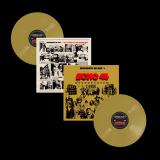
Aufgewachsen in der Soundsystem-Kultur des englischen Leeds, kaufte sich George für einen Fünfer - mit freundlicher Genehmigung seiner Mutter - eine alte, ramponierte Lautsprecherbox, die er "Echo45" nannte. Über diese Box lernte er Kevin Harper kennen, ein Gründungsmitglied von Nightmares on Wax – eine zufällige Begegnung, die sein Leben verändern sollte. Mit dem neuesten Nightmares On Wax-Release "Echo45 Sound System" führt er diese Tradition nun einen Schritt weiter und liefert ein Mixtape ab, das sich wie eine Feier und ein Bekenntnis zugleich anfühlt. Ein lebendiger Soundsystem-Trip, inspiriert von der originalen Echo45-Lautsprecherbox, der mit furchtlosem Spirit Soul, Roots, Hip-Hop, Dub und elektronische Texturen verbindet. Mit einem sorgfältig zusammengestellten Ensemble von Kooperatoren – darunter Yasiin Bey, Greentea Peng, Sadie Walker, Oscar Jerome und Liam Bailey – spiegelt die LP nicht nur die Vergangenheit von Nightmares On Wax wider. Obwohl es tief in seinen Ursprüngen, der Soundsystem-Kultur und dem Piraten Radio verwurzelt ist, verkündet es mutig, wohin George geht. Limitierte Auflage auf goldfarbigem Doppelvinyl.
- A1: African Roots (3:28)
- A2: Squatters Connection (4:37)
- A3: Black Is A Natural Fact (3:30)
- A4: Economical System (4:03)
- B1: Right Time Come (3:44)
- B2: Natty Dread International (3:16)
- B3: Mutual Inspiration (3:50)
- B4: Humble Lion (3:12)
This debut album captures Massive Dread at an early stage of his career when he was starting to make a name for himself as a unique voice in reggae. The production has that classic late-70s roots vibe—deep basslines, steady drum rhythms, and dub influences mixed with Massive Dread’s distinctive vocal style.
The album contains a mix of vocal tracks and deejay toasting, showcasing Massive Dread’s versatility. His style helped bridge the gap between the roots reggae era and the rising dancehall movement.
180-gram Vinyl incl. insert with sleeve notes.
Musicians
Drums: Lowell ‘Sly’ Dunbar
Bass Guitar: Robert ‘Robbie’ Shakespeare
Lead Guitar: Winston ‘Bo Peep’ Bowen
Organ: Ansel ‘Pinkie’ Collins
- Caught
- It's Fear
- The Argument
- A Man Of Custom
- No Parlez
- The Blistered Salver
- World Service
- A Different Lie
On Beacon Hill: at twilight we find Anthony Moore, roots winding backwards to the halcyon days of Slapp Happy and the "70s progressive art rock scene, at guitar and piano. With the atmospheres and accompaniments of AKA & Friends, he breathes infernal new life into songs from his six decades of multivarious music making. This new delivery system is unto a séance, a communal incantation, twining Anthony"s avant and pop traditions together in a darkly radiant coil of folky chamber music; a rope to lower the listener through cobwebs and murk, unveiling new life beneath Anthony"s mad old lines. AKA are Anthony Moore, Keith Rodway and Amanda Thompson. A pagan family of sound worshipers hailing from that unholiest of all places: Hastings UK, home of Crowley and Turing. Like their sinister forbears in that infamous tradition, this latest trinity shares a passion for subverting pattern and number, factoring unlikely permutations arising from sea and horizon, greensward, the southerly aspect, and the planisphere as half-world. Their equatorial shore speaks of a planet of water and earth, fire and air. AKA"s humble tools of choice for this endeavor are guitar, piano, organ, synthesizer and vocals. The Friends of AKA are Tullis Rennie, trombone and electronics; Olie Brice, double bass; Richard Moore, violin; and Haydn Ackerley, guitar. They too navigate the shoreline of the south coast, haunt the same taverns and regularly play together in whatever combinations fit the bill. Leaving the drums (and their drummer) at home to realize anew these dreamladen songs, AKA & Friends ensure that the notes fall around the beat and not on it, so as to define the pulse with absence. As such, time is liberated, prised free from the merciless clock; a rhythm of waves, passing through a steady-state universe of no beginnings and no endings. Discontinuities are dissolved, all is transition.
- A1: Natty Dub Source: Natty Dread In A Greenwich Farm / Cornell Campbell
- A2: Lee's Dub Source: Lee's Dream / Derrick Morgan
- A3: Wonder Why Dub Source: Wonder Why / Cornell Campbell
- A4: I'm Gone Dub Source: I'm Gone / Derrick Morgan
- A5: Country Boy Dub Source: Country Boy / Cornell Campbell
- A6: True Believer Dub Source: True Believer / Johnny Clarke
- A7: Care Free Dub Source: Care Free / Mighty Diamonds
- A8: Rasta Train Dub Source: Mule Train / Johnny Clarke
- B1: Move Out Of Babylon Dub Source: Move Out Of Babylon / Johnny Clark
- B2: Give A Little Man A Great Big Hand Dub Source: Give A Little Man A Great Big Hand / Cornell Campbell
- B3: Feel So Good Dub Source: Feel So Good / Derrick Morgan & Paulette
- B4: For The Rest Of My Life Dub Source: Wonder Why / Cornell Campbell
- B5: When Will I Find My Way Dub Source: When Will I Find My Way / Owen Grey
- B6: I'm Leaving Dub Source: I'm Leaving / Derrick Morgan & Hortense Ellis
- B7: Feel Lost Dub Source: Feel Lost / Bb Seaton
- B8: Dawn Dub Source: Dear Dawn / Barrington Spence
2024 Reissue
“Tubby did three original dub albums, ‘Dub From The Roots’. ‘The Roots of Dub’ and the third is ‘Brass Rockers’ with Tommy McCook ‘pon the flying cymbals. Where he mixed it with the horn going in and out in a dub way and one named ‘Shalom Dub’ you can call Tubby’s too because he mixed the versions as they were off forty fives’’
Bunny ‘Striker‘ Lee
King Tubby and Producer Bunny ‘Striker’ Lee are intertwined in the birth of Dub Music. After discovering a mistake that made a ‘serious joke’ ( more of which later...) they went on to release the first pressings of this new musical genre namely ‘Dub Music’. Tubby’s vast knowledge of electronics and Bunny’s vast catalogue of rhythms would lay the foundations of what today is taken as a standard... the Remix / Version cuts to an existing vocal tune.
Osbourne ‘King Tubby’ Ruddock was born in Kingston, Jamaica on 28th January 1941 and grew up in the High Holborn Street area of downtown Kingston. He studied electronics at Kingston’s National Technical College and also on two correspondence courses from the U.S.A... When he had qualified Tubby began repairing radios and other electrical appliances in a shack in the back yard of his mother’s home. His work in the early days included winding transformers and building amplifiers for Kingston’s Sound Systems. Tubby built his first Sound System in 1957 playing jazz and Rhythm & Blues at local weddings and birthday parties. His reputation as a man who knew and understood both electronics and music grew steadily and as the sixties drew to a close. Tubby purchased his own basic two track equipment. He installed this alongside his dub cutting machine, a home made mixing console and his impressive collection of Jazz albums in the back bedroom of his home at 18 Dromilly Avenue which he christened his music room.
Tubby and Striker were at Treasure Isle Studio’s one day while Ruddy from Spanish Town was working with the engineer Byron Smith....
“Tubby and myself was talking when Ruddy was cutting some dub but Smithy (engineer) made a mistake through we were talking and forgot to put in the voice. It was two track recording in those days. Ruddy said ‘No Man! Make it stay! and so they cut the rhythm. When I went over to Ruddy’s that Saturday night a dance was in progress and when they played the vocal to the tune... then he said we’re going to play ‘Part Two’. They never called it ‘Version’..and then he played the rhythm track. The song was a catchy song and everybody started to sing along and the deejay started to toast so everything went down well. On Monday morning I went up and I said ‘Tubbs the mistake we made was a serious joke.It mash up Spanish Town! The people went wild. So you have to start to do that now ‘cause when the man put on the ‘Part Two’ everyone start singing this song. It played about twenty times. I said you try Tubbs!’...Well the next Saturday night now when Tubby strung up down the farm U Roy said he’s going to play ‘Part Two’ but Tubby did it different now. He started with the voice then dropped it out and let the rhythm run and then he brought in the voice in the middle and from there Tubby started to get really popular.’’
Bunny ‘Striker’ Lee
Dynamic Sounds upgraded to sixteen track recording in 1972 and Tubby purchased, again with the help of a deal brokered by Bunny Lee. The old four track equipment and the MCI console from their Studio B. The four tracks now gave him far wider scope to work with and he began to create a new musical form where the bass and drum parts were brought up while the faders allowed Tubby to ease the vocal and rhythm in and out of the mix. It was only a matter of time before Tubby’s dub plate experiments began to make it on to vinyl and the first ever long playing King Tubby releases would feature a collection of his mixes to a selection of Strikers rhythms. So please sit back and enjoy this historic set of sounds. Lovingly restored and with a few extra gems added to the CD Editions. These releases were the first to carry the name of King Tubby and the first to credit the great musicians that contributed so much to the rhythms that made these albums possible.
- A1: Displacement (Kmru Rework) Feat Kmru
- A2: Reprisal (Penelope Trappes Rework) Feat Penelope Trappes
- A3: Empire Systems (Kevin Richard Martin Rework - Iced Mix) Feat Kevin Richard Martin
- B1: Ausencia (Mabe Fratti Hiatus Rework) Mabe Fratti
- B2: Persistence (Abul Mogard Rework)Feat Abul Mogard
- B3: Secretly Wishing For Rain (William Basinski & Gary Thomas Wright Rework)
A decade after its release, A Fragile Geography returns transformed. This limited edition cassette accompanies the AFG10 anniversary reissue, offering an inspired re-envisioning of Rafael Anton Irisarri’s landmark compositions. Reworks presents distinctive readings of these pieces, with each artist leaving their personal mark on the material. The titles remain unchanged, with the sole exception of “Hiatus,” reborn here as “Ausencia.” Together, these reimaginings extend the emotional cartography of the album into new terrains.
KMRU reframes “Displacement” with expansive, glimmering layers that open into meditative ambient landscapes. Nairobi born and Berlin based, he is known for morphing field recordings into vivid aural experiences, often capturing the texture of footsteps, foliage, and distant city life and weaving them into contemplative soundscapes. In this version he introduces subtle new sounds, including stringlike synths that trace and heighten the piece’s emotional arc. The result invites close listening, offering enveloping tones where the organic and the synthetic gently collide and flow.
Penelope Trappes renders “Reprisal” as a voice-led invocation of the delicate and the intimate. Her wistful vocals bloom with fragile sorrow, rising over shimmering strands of strings to create a sound world at once sacred and shadowed. She is adept at channeling inherited grief into music that is transcendent and otherworldly. The interplay of her voice, the strings, and her use of space and depth draws those qualities into Irisarri’s orbit, imbuing “Reprisal” with the same spiritual weight and clarity that define her most powerful work.
Kevin Richard Martin (a.k.a. The Bug) transforms “Empire Systems” into a cavernous “Iced Mix,” driven by polyrhythmic double bass motifs and sculpted from subterranean pressure and negative space. Known for pushing sound to its physical limits, Martin brings the stark intensity of his dub and noise infused practice into Irisarri’s architecture. The track seethes with harmonic distortion and erupts in white noise rhythms, its brooding low end depth and icy reverberant textures amplifying the tension. Vulnerability and force are set in stark relief, as silences feel as heavy as the bursts of sound themselves. The result is a stark study in atmosphere, restraint and impact, reframed through Martin’s singular lens of sonic mass and low end intensity.
On Side B, Mabe Fratti opens with a cinematic, dreamlike, Lynchian reimagining of “Hiatus” in her native Spanish (“Ausencia”). She threads cello and voice so wondrously that her rendering feels at once hauntingly beautiful and disquieting. Emotionally charged melodies shift in unexpected directions, while her soft, intimate vocals hover above Irisarri’s brooding synth textures. Fratti’s gift for blending experimental and avant pop sensibilities with visceral, emotionally powerful expression shines resplendently here. She gives voice to Irisarri’s reflections on the passage of time and his growing desire to reconnect with his familial roots.
Abul Mogard stretches “Persistence” into a vast drone elegy. A master of patient sound sculpting, Mogard layers evolving waves of analog synths into a dense shroud that radiates its own internal light. Gradual surges of tone and subtle harmonic shifts emphasize the piece’s endurance and inevitability. Irisarri’s original composition, in Mogard's hands, becomes a rumination on time’s unrelenting flow. Melancholy and transcendence coexist in equal measure in this engulfing, cathartic rework.
William Basinski and Gary Thomas Wright close the cycle with a spectral version of “Secretly Wishing for Rain.” Basinski’s field recordings of Reseda rainfall and birdsong, which open and close the rework, add a personal touch and evoke the imagined sound of a grainy film reel flickering to life. The piece suspends Irisarri’s yearning for the Pacific Northwest, lodging it hazily between memory, place and an unreachable dream. It feels like a fading recollection, half forgotten and half felt. A final gesture that dissolves the album into vapor, leaving the listener adrift in its lingering afterglow.
Mastered with great care by Stephan Mathieu and featuring a remixed version of the original artwork by Daniel Castrejón, this edition refracts the language of the original through new prisms. Less a return than a passage, across time, across interpretation, into uncharted emotional realms.
- 1: Shy Girl
- 2: Ooh Baby
- 3: Rockaway
- 4: Night Night
- 5: Holding On
- 6: In The Pictures
- 7: Frontline
- 8: Take Me In Your Arms
- 9: Crying Wolf
- 10: River Runs Deep
- 11: Hello Operator
- 12: We Share Love
Orange Vinyl[27,10 €]
Almost fifteen years since the release of her self-titled debut LP on Mr Bongo, reggae’s orator of love Hollie Cook is returning to the label for Shy Girl, her fifth studio album and her most authentic yet. Woven with tight grooves, beautiful vocals and catchy melodies, Shy Girl hears singer and songwriter Hollie Cook revel in her contemporary lovers rock sound, more confident and open to vulnerability than ever before.
A sun-drenched exploration of love in all its guises, Shy Girl tells stories of the magical and the melancholy, the heart-lifting and heart-breaking, across 12 luscious, analogue reggae compositions - the culmination of a soft-hued and instantly recognisable “tropical pop” sound that Cook has made her own.
Put together across three years and four cities – from LA and NYC, to Vejer de la Frontera in Spain and Cook’s hometown London – Shy Girl was written with long-time collaborators, The General Roots Band, and features a contribution from legendary dub MC Horseman, who lends his voice to the album’s first single ‘Night Night’.
The album opens with the title track ‘Shy Girl’, a buoyant and elastic slice of lovers rock that was written in a moment of spontaneous intuition, and bubbles with a charisma and positivity that Cook radiates. “I’m not a natural show-off,” Cook explains. “The Shy Girl theme is me. It’s just about being my most vulnerable self and being as true to the music that Iove as possible.” It is this honesty which shines throughout, from the chugging deep dub of ‘Frontline’, complete with raking electric guitar lines, to the bittersweet roots ballad ‘We Share Love’, which closes out the album.
It's clear to see that Cook’s songwriting draws on a lifetime of musical influences and inspirations. From her father, Sex Pistols drummer Paul Cook’s record collection and touring with post-punk icon Ari Up’s The Slits, to her love for strong female-led pop music and the bassweight of London’s sound system culture. Enamoured with the music of Janet Kay and Phyllis Dillon, Shy Girl represents a homecoming and a coming-of-age for Hollie Cook, distilling and refining a shimmering reggae sound that will capture your heart, as it first captured hers.
Almost fifteen years since the release of her self-titled debut LP on Mr Bongo, reggae’s orator of love Hollie Cook is returning to the label for Shy Girl, her fifth studio album and her most authentic yet. Woven with tight grooves, beautiful vocals and catchy melodies, Shy Girl hears singer and songwriter Hollie Cook revel in her contemporary lovers rock sound, more confident and open to vulnerability than ever before.
A sun-drenched exploration of love in all its guises, Shy Girl tells stories of the magical and the melancholy, the heart-lifting and heart-breaking, across 12 luscious, analogue reggae compositions - the culmination of a soft-hued and instantly recognisable “tropical pop” sound that Cook has made her own.
Put together across three years and four cities – from LA and NYC, to Vejer de la Frontera in Spain and Cook’s hometown London – Shy Girl was written with long-time collaborators, The General Roots Band, and features a contribution from legendary dub MC Horseman, who lends his voice to the album’s first single ‘Night Night’.
The album opens with the title track ‘Shy Girl’, a buoyant and elastic slice of lovers rock that was written in a moment of spontaneous intuition, and bubbles with a charisma and positivity that Cook radiates. “I’m not a natural show-off,” Cook explains. “The Shy Girl theme is me. It’s just about being my most vulnerable self and being as true to the music that Iove as possible.” It is this honesty which shines throughout, from the chugging deep dub of ‘Frontline’, complete with raking electric guitar lines, to the bittersweet roots ballad ‘We Share Love’, which closes out the album.
It's clear to see that Cook’s songwriting draws on a lifetime of musical influences and inspirations. From her father, Sex Pistols drummer Paul Cook’s record collection and touring with post-punk icon Ari Up’s The Slits, to her love for strong female-led pop music and the bassweight of London’s sound system culture. Enamoured with the music of Janet Kay and Phyllis Dillon, Shy Girl represents a homecoming and a coming-of-age for Hollie Cook, distilling and refining a shimmering reggae sound that will capture your heart, as it first captured hers.
First official vinyl showcase from Untamed Sounds Studio featuring Lucadread on vocals. Digi Killer style.
Untamed Sounds Studio was established in 2015 in Northeast Italy as a sound system, hosting regular events for several years. In 2019, the physical system was sold, and the project moved to the UK, shifting its focus to music production. Since then, Untamed Sounds has collaborated with a wide range of sound systems, DJs, and singers, particularly in the dubplate field, providing exclusive tracks to sounds across the globe. Whether it's roots, dub, digital, or year 3000 style, Untamed Sounds continues to staying true to its foundation, rooted in Jamaican music.
Produced and Arranged by Untamed Sounds.
Mixed by Dougie Conscious at Conscious Sounds Studio, UK.
Mastered by Dubfiles.
- A. Clement Moore - Everytime I Do My Thing
- B. Clement Moore - Everytime Dub
Clement "Minkie" Moore's introduction to the music business came via his friend the great deejay U Roy. Back in the mid 1970s, Minkie and U Roy were both living in the Tower Hill area of Kingston, and U Roy was resident deejay on King Tubby's sound system. Minkie followed his friend and the sound, and occasionally U Roy let him hold the mic and deejay on Tubby's set. U Roy encouraged Minkie to take music more seriously, and with that encouragement, his first record "Wickedness" was made. Minkie got a cut of a rhythm from his friend the late Sydney Wilson, and voiced and mixed the rugged deejay tune "Wickedness" at King Tubby's studio. Sydney had earlier voiced this rhythm as a tune called "Why Do I Cry", but alongside "Wickedness", voiced it again with a new vocal called "Time Has Gone". In fact that tune and "Wickedness" share the same dub version. Clement continued to move in the music scene, next recording for Harry J's Jaywax label in 1979 with a tune called "Jah Is Real", as a duo named UNI-TONE along with his friend Denzil. Then in 1980, Clement revisited the great rhythm of "Wickedness", deciding to this time sing rather than deejay on the rhythm. He returned to Harry J studio, adding some choice new instrumental overdubs on the rhythm for this new cut, "Every Time I Do My Thing." In the decades since, astute roots collectors have honed in on this excellent rhythm and its several cuts, not least of all this pair of them by Mr. Clement "Minkie" Moore. It should be noted that in the manner of the day, other associates of Tubby's studio, Prophets Yabby You and Alric Forbes, also utilized this rhythm. Minkie's musical journey continued thru the 1980s, when he linked with American group Lambsbread, writing and performing on their second album which was recorded at Channel 1 in early 1987. In the 1990's Clement returned to self-production on his Allah label, in addition to cutting a 45 for Chinna Smith's High Times label. Nowadays Clement is still going strong, occasionally dropping new music like "Greedy", recorded at Bravo's Small World studio in downtown Kingston.
- A. Jah Minkie - Wickedness
- B. Jah Minkie - Wickedness Dub
Clement "Minkie" Moore's introduction to the music business came via his friend the great deejay U Roy. Back in the mid 1970s, Minkie and U Roy were both living in the Tower Hill area of Kingston, and U Roy was resident deejay on King Tubby's sound system. Minkie followed his friend and the sound, and occasionally U Roy let him hold the mic and deejay on Tubby's set. U Roy encouraged Minkie to take music more seriously, and with that encouragement, his first record "Wickedness" was made. Minkie got a cut of a rhythm from his friend the late Sydney Wilson, and voiced and mixed the rugged deejay tune "Wickedness" at King Tubby's studio. Sydney had earlier voiced this rhythm as a tune called "Why Do I Cry", but alongside "Wickedness", voiced it again with a new vocal called "Time Has Gone". In fact that tune and "Wickedness" share the same dub version. Clement continued to move in the music scene, next recording for Harry J's Jaywax label in 1979 with a tune called "Jah Is Real", as a duo named UNI-TONE along with his friend Denzil. Then in 1980, Clement revisited the great rhythm of "Wickedness", deciding to this time sing rather than deejay on the rhythm. He returned to Harry J studio, adding some choice new instrumental overdubs on the rhythm for this new cut, "Every Time I Do My Thing." In the decades since, astute roots collectors have honed in on this excellent rhythm and its several cuts, not least of all this pair of them by Mr. Clement "Minkie" Moore. It should be noted that in the manner of the day, other associates of Tubby's studio, Prophets Yabby You and Alric Forbes, also utilized this rhythm. Minkie's musical journey continued thru the 1980s, when he linked with American group Lambsbread, writing and performing on their second album which was recorded at Channel 1 in early 1987. In the 1990's Clement returned to self-production on his Allah label, in addition to cutting a 45 for Chinna Smith's High Times label. Nowadays Clement is still going strong, occasionally dropping new music like "Greedy", recorded at Bravo's Small World studio in downtown Kingston.
- A1: Cold World
- B1: Cold Dub
UK sound system culture stays strong with the heavyweight new 7” release from Vibronics and veteran roots vocalist Tann-I Browne, dropping now on the SCOOPS label. Titled “COLD WORLD”, this is a hard-hitting vocal and dub cut.
A first-time collaboration between these two UK reggae powerhouses, “COLD WORLD” is a potent slice of UK Roots Vocal + Dub, driven by Tann-I Browne’s unmistakably rich and powerful voice and reality-driven lyrics. The production is signature Vibronics: an up-tempo, militant stepper riddim laced with deep bass, crisp percussion, and the unmistakable touches of future dub.
The B-side version strips it down and dubs it out in true Vibronics style—ready for sound system play at full power.
This release is pressed on 7” vinyl and presented in a full-colour printed SCOOPS label sleeve, making it a collector’s item as much as a sound system weapon.