Punk pioneers Crass continue their vinyl reissue series, re-pressing their limited releases by adjacent artists through Crass Records, in association with One Little Independent. The series, including over twenty bands and solo artists recorded at the legendary Southern Studios and produced by Penny Rimbaud, continues with two more historic pieces from the Crass Records catalogue; The "Grey" EP by North London post-punks Lack of Knowledge, and "Beware" by US anarchists Sleeping Dogs. Sleeping Dogs were one of only two American bands to release on Crass Records and in 1982 their sardonic and sludgy, but politically sharp, hardcore made up the "Beware" EP. They were first formed under the moniker Arsenal by the late artist, and designer of the iconic Crass logo, David King. "Beware" showed the originality and potential of Sleeping Dogs, even as Rimbaud and Crass guitarist Phil Free augmented the band"s sound for the studio session. The front cover of the single featured its own striking image, courtesy of King. Sleeping Dogs disbanded shortly after, re-emerging briefly under the new guise of Brain Rust a few years later. Distorted, biting, and beat-driven, the collection is a well-researched and poignant expose of Western imperialism. First released on 7" vinyl, limiting the sound, the new series has been remastered for 12" by Alex Gordon at Abbey Road Studios, allowing them to be heard as never before. This, plus enlarged replicas of the original covers, brings new gusto to their already radical sound. Penny Rimbaud notes that "Our (Crass") interest was never in personalities, profits or power, and neither did we have time for reformist liberals. Our position was solidly revolutionary; we took no prisoners. Talking the talk was never enough for us, no, we demanded that we also walk the walk. Ours wasn"t a show, it was a battle, not a living, but a lifestyle, a lifestyle with a difference - rather than looking only to ourselves, we sought to share our gains. I feel that this willingness added great strength to the form of anarchism that we practiced both on stage and out on the street."
Buscar:t a m 22
Primetime Entertainment’ is PET NEEDS’ second studio album and is produced by friend and fan Frank Turner. Simultaneously loud and quiet, raucous party anthems sit alongside thought-provoking personal songs; it’s the sound of a band stepping up a gear to match their catapult on the big stages across the world. Having already toured Europe supporting Frank Turner in the first half of 2022, including Germany, Netherlands, France and more – the touring continues joining Frank on his mammoth 50 States in 50 Days tour of the US throughout June and July and then finally across the UK in September and October. ‘Primetime Entertainment’ is released on 9th September and will be available on CD, LP, digital and cassette. Timeline: Track 1 – ‘Get On The Roof’ – released as a single on 24th June ‘22 "After a gruelling 8 hour drive from a gig in South Devon back to Essex, I was reunited with my wonderful partner Lorna. We threw an old mattress out of our bedroom window onto our roof and clambered out, armed with a rucksack full of the remainder of last night's rider. We listened to cinematic theme tunes as the sun set over the chimneys on the horizon. Come early morning, we rolled back into the house. I grabbed my acoustic guitar, pressed "record" on my phone and sung a dizzy, euphoric stream of consciousness to my voice notes. It felt good, but they always do at that time of night, haha. On second listen in the morning, I felt excited about the tune and started to refine it. As soon as it hit the practice room we turned it into a party banger!"
Clear Vinyl
Originally released in 2020 on cassette and digitally. more eaze is the nom de plume of Austin, TX mainstay m.maurice, a roving experimentalist who’s explored an astoundingly diverse range of sounds, from drone and computer music to avant-pop and beyond. claire rousay is a San Antonio, TX-based percussionist/composer/sound artist who uses physical objects and their potential sounds as a way to explore queerness, human physicality, and self perception. Together—through a suite of deeply personal aural collages—two of Texas’ most vital and vibrant sonic searchers beg the eternal question: If I Don't Let Myself Be Happy Now Then When?
Although only their debut album together, If I Don’t Let Myself… reveals a profound and fruitful relationship between m and claire. But the symphonic symbiosis goes even deeper still. Outside of musical breakthroughs, the pair helped each other conquer intensely personal changes, with m and claire transitioning and coming out as non-binary and trans, respectively.
As m explains, “to me this record is very much about this process of becoming—trying to reach something and getting there but sometimes not being quite where you want to be but at least getting closer. It’s about feeling alternately empowered and insecure socially as you transition and trying to cope with these conflicting emotions.”
Musically, the album showcases startlingly sincere sets of serrated but sedative situational music. A-side epic Drunk is a sprawling but taut rove of aural duality. Passages of exquisite elegance subtly clash with shimmering shards of sound. Pre-op is a poised and pensive piece of solemn reflection, harrowingly honest and delivered with clarity and composure, while Post-op closes out the set in a wholly uplifting and optimistic flair.
If I Don't Let Myself Be Happy Now Then When? is ultimately about coping during the respective transitioning phase in both of their lives, obliquely blissful and fraught with freedom.
The debut of Hamburg trio Cloud Management stages the meeting of three proven exceptional figures: Thomas Korf and Sebastian Kokus have been responsible for some stunning leftfield neo-kraut releases with their band Love-Songs in recent years; Ulf Schütte has been one of the most productive, and innovative protagonists of experimental electronic music in Germany for many years (see Datashock, Phantom Horse, or his most recent collaboration with G. Steenkiste/Hellvete on Umor Rex, for example). Following Love-Songs' highly acclaimed collaboration with Schütte, »Spannende Musik«, released in 2021, the formation of Cloud Management as a group in its own right marks a new beginning, which is celebrated with the long player on Altin Village & Mine.
The album is characterized by a dense texture of repetitions in which (modular) synthesizers and bass go head-to-head. It is on this foundation that the formal grammar of the album develops over its nearly 45-minute running time, organized along precise interventions into the hypnotic pulse: What is recognizable as echoes of 1960s/70s minimalism or Cluster functions on »Cloud Management« not in the sense that the sequences or the sequencers are left to themselves, but as highly concentrated, microscopic work on repetition. This virtuosically arranged, groove-based and even danceable density of the seven pieces never sounds strained or as an end in itself, but floating, cloud-like. The polyrhythmic workouts are at all times in the service of a refreshing expanse that opens up from the sonic saturation and is far removed from the formulaic box-checking often associated with the attribute ›kosmisch‹. »Cloud Management«, thus, marks not an exercise in the traditions of a musical past, but a distinctive position within contemporary electronic music.
All songs are written, recorded and produced by Ulf Schütte, Thomas Korf and Sebastian Kokus.
British producer Jonathan Hipgrave aka Jonny3snareS hits the right snare - as the Dutch say - with his brand new Parasol EP on Utrecht's 030303 Records. With plenty of off-tone melodies from another galaxy and hard hitting and impatient snare drum compositions, this is braindance at its very best. Upon reading track names like Custard Rollneck, Milk on Sofa and Pond Life, you expect to hear acid heavy, euphoric and sometimes slightly uneasy dancefloor nostalgia in the best Rephlex tradition and that is exactly what you get. Big tip for fans of Cornish acid!
- A1: Bergsonist – Southern Sea Palm (Eisenia Arborea)
- A2: 400Ppm – Spiny Lobster (Panulirus Interruptus)
- A3: Virgo Four – Giant Black Sea Bass (Stereolepis Gigas)
- A4: Ouse – Neptune’s Necklace (Hormosira Banksii)
- A5: Lst – Crystal Jellyfish (Aequorea Coerulescens)
- A6: Nick Klein – Bladder Wrack (Nereocystis)
- A7: Suburban Cracked Collective – Garibaldi (Hypsypops Rubicundus)
- A8: Spor Tranquil – Giant Bladder Kelp (Macrocystis Pyrifera)
- A9: Ivory Whips – Blacksmith Chromis (Chromis Punctipinnis)
- A10: Léo Hoffsaes – Juvenile Painted Greenling (Oxylebius Pictus)
- B1: Dopplereffekt – Bat Ray (Myliobatis Californicus)
- B2: Tolouse Low Trax – Elk Kelp (Pelagophycus Porra)
- B3: The Hobbits – Treefish (Sebastes Serriceps)
- B4: Dissemblance – Clouded Moray (Echidna Nebulosa)
- B5: Liquid Soap – Jewel Anemone (Corynactis Viridis)
- B6: Axel Larsen – Brown Macroalgae (Sargassum Horneri)
- B7: Scythe – Sunflower Star (Pycnopodia Helianthoides)
- B8: The New Wagers – Old Souls
- B9: Newworldaquarium – Nudibranch (Hermissenda Opalescens)
Bladder by the Light is a conceptional compilation between Obsolete Future and the Parisian painter Marion Guillet. It was compiled by Marion Guillet & Conor Walker.
2022 Repress
Modern Obscure Music has been making links with the Far East since label boss Pedro Vian visited Japan and this is their first 12” release from a Japanese artist. Albino Sound is Hirotaka Umetani from Osaka and here he presents Black Lagoon. This is an exciting EP of experimental soundcapes and left of centre dancefloor escapades with an extra special remix from German producer DJ Normal 4. Black Lagoon opens the EP with live percussion and mysterious sounds and is followed by the mesmerising tones of Plum Valley. Transparent Colony is an open-armed ambient cut and the EP finishes with two versions on Dried Seeds. The original is an energetic mover and DJ Normal 4's Vibe Strike Remix is an eastern synth inspired mission.
- A1: Return To Hot Chicken
- A2: Moby Octopad
- A3: Sugarcube
- A4: Damage
- B1: Deeper Into Movies
- B2: Shadows
- B3: Stockholm Syndrome
- B4: Autumn Sweater
- B5: Little Honda
- C1: Green Arrow
- C2: One Pm Again
- C3: The Lie & How We Told It
- C4: Center Of Gravity
- D1: Spec Bebop
- D2: We're An American Band
- D3: My Little Corner Of The World
25TH ANNIVERSARY in Yellow Vinyl
The eighth Studio Album by the Band, released on April 22, 1997. It was produced by Roger Moutenot and recorded at House of David in Nashville The Album expands the guitar-based pop of its predecessor Electr-O-Pura to encompass a variety of other music genres, including Bossa Nova, Krautrock and Electronic Music. Most of the Songs on the Album deal with melancholy emotions and range from short and fragile Ballads to long and open-ended dissonance.
- 1: Runner: I. Sixteenths
- 2: Runner: Ii. Eighths
- 3: Runner: Iii. Quarters
- 4: Runner: Iv. Eighths
- 5: Runner: V. Sixteenths
- 6: Music For Ensemble And Orchestra: I. Sixteenths
- 7: Music For Ensemble And Orchestra: Ii. Eighths
- 8: Music For Ensemble And Orchestra: Iii. Quarters
- 9: Music For Ensemble And Orchestra: Iv. Eighths
- 10: Music For Ensemble And Orchestra: V. Sixteenths
‘Runner is a calmly luminous orchestral piece with the pulsating, propulsive
rhythms that animate much of Mr. Reich’s music.’ – New York Times
‘Reich interweaves the two groups to create a dense textural tapestry that sounds like his most native orchestral thinking to date. A beautiful and dramatically charged masterpiece.' – San Francisco Chronicle
Nonesuch Records releases the first recordings of Steve Reich’s Runner (2016) and Music for Ensemble and Orchestra (2018), performed by the Los Angeles Philharmonic and conducted by Susanna Mälkki.
Reich says Runner is written “for a large ensemble of winds, percussion, pianos, and strings. While the tempo remains more or less constant, there are five movements, played without pause, that are based on different note durations. First, even sixteenths, then irregularly accented eighths, then a very slowed-down version of the standard bell pattern from Ghana in quarters, fourth a return to the irregularly accented eighths, and finally a return to the sixteenths but now played as pulses by the winds for as long as a breath will comfortably sustain them. The title was suggested by the rapid opening and my awareness that, like a runner, I would have to pace the piece to reach a successful conclusion.”
“Music for Ensemble and Orchestra is an extension of the Baroque concerto grosso where there is more than one soloist,” the composer continues. “Here there are twenty soloists – all regular members of the orchestra, including the first stand strings and winds, as well as two vibraphones and two pianos. The piece is in five movements, though the tempo never changes, only the note value of the constant pulse in the pianos. Thus, an arch form: sixteenths, eighths, quarters, eighths, sixteenths. Music for Ensemble and Orchestra is modeled on my Runner, which has the same five movement form.”
Nonesuch has recorded every new piece of music by Steve Reich since 1985, beginning with The Desert Music and continuing through 2018’s Pulse/Quartet, resulting in 22 albums and the two box sets Phases in 2006 and Works: 1965-1995 in 1997. Most recently, the label released his Reich/Richter, performed by Ensemble intercontemporain and conducted by George Jackson, in June 2022. The Times said, ‘What a delight to be able to focus on the music, delivered here with a clever mix of pinprick precision and reverberant haze by 14 members of Ensemble Intercontemporain. The more intently you listen, the more subtleties emerge among the shifting, criss-crossing textures and phrases, sometimes coloured with gentle melancholy but decisively upbeat by the end. Reich/Richter is an ear-tickling tonic and a happy companion to Reich’s newly published book, Conversations.’ Nonesuch will put out a collection of Reich’s complete works in 2023.
Reich released a book earlier this year, Conversations, that includes dialogues with past collaborators, fellow composers, musicians, and visual artists who have been influenced by his work, including: David Lang, Brian Eno, Richard Serra, Michael Gordon, Michael Tilson Thomas, Russell Hartenberger, Robert Hurwitz, Stephen Sondheim, Jonny Greenwood, David Harrington, Elizabeth Lim-Dutton, David Robertson, Micaela Haslam, Anne Teresa de Keersmaeker, Julia Wolfe, Nico Muhly, Beryl Korot, Colin Currie, and Brad Lubman. The Wall Street Journal called the book ‘a testament to the influence of an idea – one that triggered a cultural turning point,’ and the New York Times said, ‘The joy of the book is to hear artists from a variety of disciplines and backgrounds rhapsodizing about their relationship to Reich’s music and how it influenced their own creative processes.’
Steve Reich has been called ‘America’s greatest living composer’ (Village Voice), ‘the most original musical thinker of our time’ (New Yorker), and ‘among the great composers of the century’ (New York Times). His music has influenced composers and mainstream musicians all over the world. Music for 18 Musicians and Different Trains have earned him two Grammy Awards, and in 2009, his Double Sextet won the Pulitzer Prize. Reich’s documentary video opera works – The Cave and Three Tales, done in collaboration with video artist Beryl Korot – have been performed on four continents. His recent work Quartet, for percussionist Colin Currie, sold out two consecutive concerts at Queen Elizabeth Hall in London shortly after tens of thousands at the Glastonbury Festival heard Jonny Greenwood (of Radiohead) perform Electric Counterpoint followed by the London Sinfonietta performing his Music for 18 Musicians.
In 2012, Reich was awarded the Gold Medal in Music by the American Academy of Arts and Letters. He has additionally received the Praemium Imperiale in Tokyo, the Polar Music Prize in Stockholm, the BBVA Award in Madrid, and the Golden Lion at the Venice Biennale. He has been named Commandeur de l’Ordre des Arts et des Lettres and has been awarded honorary doctorates by the Royal College of Music in London, The Juilliard School, and the Liszt Academy in Budapest, among others. ‘There’s just a handful of living composers who can legitimately claim to have altered the direction of musical history and Steve Reich is one of them,’ states the Guardian.
Redefining what an orchestra can be, the Los Angeles Philharmonic (LA Phil) is as vibrant as Los Angeles, one of the world's most open and dynamic cities. Led by Music & Artistic Director Gustavo Dudamel, this internationally renowned orchestra harnesses the transformative power of live music to build community, foster intellectual and artistic growth, and nurture the creative spirit. This is the third recent recording by the orchestra on the label; the others were the Louis Andriessen pieces The only one and Theatre of the World. Additionally, the Los Angeles Philharmonic’s recordings of The Gospel According to the Other Mary and Must the Devil Have All the Good Tunes?, with Yuja Wang, released on Deutsche Grammophon, are included in this year’s John Adams Collected Works boxed set. Nonesuch also released an LA Phil recording of Adams‘ Naïve and Sentimental Music in 2002.
Susanna Mälkki is sought-after at the highest level by symphony orchestras and opera houses worldwide. About to embark on her final season as Chief Conductor of the Helsinki Philharmonic Orchestra, she concludes a seven-year tenure with a distinctive dynamism and imaginative flair to her programming. In addition to a full season in Finland, she will lead the Helsinki orchestra on tour to the prestigious Lucerne and Edinburgh festivals, New York’s Carnegie Hall, and Washington’s Kennedy Centre this season.
Broken Bone White Vinyl[41,98 €]
Draped in a flag of patriotic shame, the Hated stormed onto the scene just as D.C.’s Revolution Summer was swerving out of control. Channeling Bad Brains’ Black thrash and Hüsker Dü’s zen approach to hardcore, Dan Littleton, Erik Fisher, Colin Meeder, and Mike Bonner synthesized their own version of what became emo in 1985. Remastered from the original analog tapes, Best Piece Of Shit Vol. 4 compiles their D.I.Y. debut cassette, the No More We Cry EP, and 14 period bonus tracks from the Hated vault, spread across two LPs and annotated by fellow Annapolis hooligan Andrew Gebhardt. Decorated with extensive photo documentation and cut’n’paste ephemera, this Hated-approved set captures a band, a scene, and a country on the verge of either exploding or imploding. Never said it’d be like this, right?
Black Vinyl[38,61 €]
Draped in a flag of patriotic shame, the Hated stormed onto the scene just as D.C.’s Revolution Summer was swerving out of control. Channeling Bad Brains’ Black thrash and Hüsker Dü’s zen approach to hardcore, Dan Littleton, Erik Fisher, Colin Meeder, and Mike Bonner synthesized their own version of what became emo in 1985. Remastered from the original analog tapes, Best Piece Of Shit Vol. 4 compiles their D.I.Y. debut cassette, the No More We Cry EP, and 14 period bonus tracks from the Hated vault, spread across two LPs and annotated by fellow Annapolis hooligan Andrew Gebhardt. Decorated with extensive photo documentation and cut’n’paste ephemera, this Hated-approved set captures a band, a scene, and a country on the verge of either exploding or imploding. Never said it’d be like this, right?
Violet Vinyl
The debut of Hamburg trio Cloud Management stages the meeting of three proven exceptional figures: Thomas Korf and Sebastian Kokus have been responsible for some stunning leftfield neo-kraut releases with their band Love-Songs in recent years; Ulf Schütte has been one of the most productive, and innovative protagonists of experimental electronic music in Germany for many years (see Datashock, Phantom Horse, or his most recent collaboration with G. Steenkiste/Hellvete on Umor Rex, for example). Following Love-Songs' highly acclaimed collaboration with Schütte, »Spannende Musik«, released in 2021, the formation of Cloud Management as a group in its own right marks a new beginning, which is celebrated with the long player on Altin Village & Mine.
The album is characterized by a dense texture of repetitions in which (modular) synthesizers and bass go head-to-head. It is on this foundation that the formal grammar of the album develops over its nearly 45-minute running time, organized along precise interventions into the hypnotic pulse: What is recognizable as echoes of 1960s/70s minimalism or Cluster functions on »Cloud Management« not in the sense that the sequences or the sequencers are left to themselves, but as highly concentrated, microscopic work on repetition. This virtuosically arranged, groove-based and even danceable density of the seven pieces never sounds strained or as an end in itself, but floating, cloud-like. The polyrhythmic workouts are at all times in the service of a refreshing expanse that opens up from the sonic saturation and is far removed from the formulaic box-checking often associated with the attribute ›kosmisch‹. »Cloud Management«, thus, marks not an exercise in the traditions of a musical past, but a distinctive position within contemporary electronic music.
All songs are written, recorded and produced by Ulf Schütte, Thomas Korf and Sebastian Kokus.
First-time reissue of Aroma Di Amore's debut album, originally released in 1984.
Aroma Di Amore is/was Belgian’s premier cult band. Since the early eighties ADA innovatively combined electronics with rock. With a mix of razor-sharp Flemish lyrics and unconventional song structures the group earned a cult status in Belgium and abroad. 40 years later they conclude their career with a few last concerts and a vinyl box set spanning the years 1983-1987.
At the notorious Rock Rally of 1982 Aroma Di Amore stands out with their wonderful handling of the Flemish language, a deep bass, typical cold new wave drums, biting guitar riffs with the occasional flavor of absolute madness. Frontman Jos Verlooy adopts the stage name Elvis Peeters. The explanation for this remarkable pseudonym choice: in 1977 – the period of the singer's musical awakening – one of the two famous rocking Elvises (not Costello, but Presley) succumbs to his pill addiction. So, dixit Verlooy, there is an Elvis vacant. A banal surname belongs next to that exotic first name. A combination that breathes rock 'n' roll, according to the singer.
His companion Gerry Vergult – who very much determines the sound with his metallic riffs, somewhat indebted to Jean-Marie Aerts – adopts the stage name Fred Angst. Completely in line with the depressing zeitgeist of the 1980s. Gerry eats and breathes music. Besides composing most of ADA’s songs, he records & self-produces a few fantastic dark en loner solo minimal wave tracks as Fred Angst. He is still musically active, more towards the electronic leftfield nowadays under the moniker Zool.
It is clear from an early age that companion Elvis Peeters possesses the gift of the word. As an adolescent he published the punkzine “Dus”. The punk spirit stimulates Peeters. He begins to transform the poetry that he has been entrusting to paper for some time into song lyrics. It is on a whim and without any stage experience that punk friends Peeters and Angst register for the Rock Rally as Aroma di Amore. On a bed of post-punk and cold wave (Joy Division, Wire and Sisters of Mercy are the main influences), they initially let out playful, minimalist and nonsensical slogans such as "Doe De Mafia" (1982) and "Gorilla Dans De Samba" (1983). Later on, the tone becomes more serious, although Peeters' choice of words continues to show a penchant for absurdism and sarcasm. No one in Dutch songwriting imitates this verbal elasticity, certainly at that time.
The numerous songs about war are downright horrifying. In the 1980s, an arms race is underway. When the Belgian government decides to install nuclear missiles in 1981, Aroma di Amore asks for one minute of silence in the hall during performances. In "Lauwe Oorlog" (1983), Peeters exposes the core of his unrest: “paraat voor de parade / de vrede wordt begraven / met militaire eer”. To this day, the frontman of AdA still proudly wears his at least 30 year old 'atomic energy, no thanks!' button.
In 1984 Aroma releases Koude Oorlog on the new and independent Brussels label Play It Again Sam. The traditional press and radio ignore the record, but in the alternative circuits the mini-album does not go unnoticed, and the group starts to build a solid fan base, resulting in more and more offers for gigs. There's also interest in the Netherlands, and due to the international contacts of PIAS, the record also ends up in France, Switzerland, Spain and Canada.
Encouraged by this modest success, the group returns to the studio for a 12" single. With new group member Frits De Cauter on sax, they record "Voor De Dood". To this day, Voor De Dood remains the most popular AdA song, as evidenced by the countless compilations on which the song has appeared.
AdA goes to the Netherlands to record their next album “De Sfeer Van Grote Dagen”. The people from Nasmak have built a new studio in Eindhoven and one of the members, Theo Van Eenbergen (later Henry Rollins), will be the producer. “De Sfeer Van Grote Dagen” is the group's most adventurous album, and the reviews are again unanimously favorable. However, sales are disappointing and PIAS proposes to recruit Chris Reed of Red Lorry Yellow Lorry and record a new single with him. "Zonder Omzien" is recorded at the prestigious Pyramid Studio. However, PIAS is waiting to release the album and in the meantime AdA is recording a number of extra tracks with producer Ludo Camberlin, including "Koekoek In De Stad". Towards the end of the year, Lo and Elvis travel to Africa for a few months and as a result the group comes to a standstill. In this period, Zonder Omzien is released.
At the beginning of 1986, Peeters and Meulen return, and Andrea Smits leaves the group. Luc Pillards is hired as a replacement, and when Ludo Camberlin presents himself as a new label boss and producer (Anything But Records), they start recording their first full album for the label. “Harde Feiten" kicks in immediately, and the group is back up to cruising speed. In the first week of release, the record even appears in the bestseller list of the record stores.
At the beginning of 1987 the recordings for the second album start, this time in a production by Peeters and Angst themselves. Shortly after the shooting, AdA goes to Switzerland for a short but successful tour, with Men 2nd and Cas & Organized Crime as support act. "Koudvuur" is published in the autumn and considered to be their strongest record so far by the group, the reactions are rather low. Both the reviews in the press and the sales are disappointing and put a damper on the joy. Nevertheless, the group is invited to perform in Valencia, Spain, where they have an unexpected success.
MUTANT SOUNDS BLOG
Aroma Di Amore have always been outsiders, even within the confinement of the alternative rock circuit. Their peculiar blend of raw guitars, electronics, Dutch lyrics and unconventional song structures was too hybrid for many. Those howewer who, without prejudice, would lend an ear to the band's music, discovered an energetic, authentic and uncompromising collective that stood above all trends. While so many Belgian "connaisseurs" had their doubts about the possibilities of international recognition for a band singing in Dutch, Aroma Di Amore toured France, Switzerland and Spain; their records figured in alternative charts from Poland to Canada.
From beginning to end the nucleus of Aroma Di Amore consisted of Elvis PEETERS, who in a inimitable, possessed way delivered his highly original lyrics, and Fred ANGST, guitarist mastering the heaviest riffs as well as refined tapestries of sound. Furthermore, the line-up varied throughout the band's carreer with:- H.K. (Guitarist from 1982 until 1983)- Andrea SMITS (Organ from 1982 until 1985)- Luc PILLARDS (Synthsizer in 1986)- Jan WANDELAAR (Guitar and synthesizer in 1986)- Pulcherie (Saxophone in 1983)- Wout DOCKX (Bass from 1987 until 1988)and especially- Lo MEULEN (Bass from 1983 until 1987)and the late Frits DE CAUTER (Saxophone from 1984 until 1986)contributing to the music.
First-time reissue of Aroma Di Amore's 4th EP, originally released in 1986.
Aroma Di Amore is/was Belgian’s premier cult band. Since the early eighties ADA innovatively combined electronics with rock. With a mix of razor-sharp Flemish lyrics and unconventional song structures the group earned a cult status in Belgium and abroad. 40 years later they conclude their career with a few last concerts and a vinyl box set spanning the years 1983-1987.
At the notorious Rock Rally of 1982 Aroma Di Amore stands out with their wonderful handling of the Flemish language, a deep bass, typical cold new wave drums, biting guitar riffs with the occasional flavor of absolute madness. Frontman Jos Verlooy adopts the stage name Elvis Peeters. The explanation for this remarkable pseudonym choice: in 1977 – the period of the singer's musical awakening – one of the two famous rocking Elvises (not Costello, but Presley) succumbs to his pill addiction. So, dixit Verlooy, there is an Elvis vacant. A banal surname belongs next to that exotic first name. A combination that breathes rock 'n' roll, according to the singer.
His companion Gerry Vergult – who very much determines the sound with his metallic riffs, somewhat indebted to Jean-Marie Aerts – adopts the stage name Fred Angst. Completely in line with the depressing zeitgeist of the 1980s. Gerry eats and breathes music. Besides composing most of ADA’s songs, he records & self-produces a few fantastic dark en loner solo minimal wave tracks as Fred Angst. He is still musically active, more towards the electronic leftfield nowadays under the moniker Zool.
It is clear from an early age that companion Elvis Peeters possesses the gift of the word. As an adolescent he published the punkzine “Dus”. The punk spirit stimulates Peeters. He begins to transform the poetry that he has been entrusting to paper for some time into song lyrics. It is on a whim and without any stage experience that punk friends Peeters and Angst register for the Rock Rally as Aroma di Amore. On a bed of post-punk and cold wave (Joy Division, Wire and Sisters of Mercy are the main influences), they initially let out playful, minimalist and nonsensical slogans such as "Doe De Mafia" (1982) and "Gorilla Dans De Samba" (1983). Later on, the tone becomes more serious, although Peeters' choice of words continues to show a penchant for absurdism and sarcasm. No one in Dutch songwriting imitates this verbal elasticity, certainly at that time.
The numerous songs about war are downright horrifying. In the 1980s, an arms race is underway. When the Belgian government decides to install nuclear missiles in 1981, Aroma di Amore asks for one minute of silence in the hall during performances. In "Lauwe Oorlog" (1983), Peeters exposes the core of his unrest: “paraat voor de parade / de vrede wordt begraven / met militaire eer”. To this day, the frontman of AdA still proudly wears his at least 30 year old 'atomic energy, no thanks!' button.
In 1984 Aroma releases Koude Oorlog on the new and independent Brussels label Play It Again Sam. The traditional press and radio ignore the record, but in the alternative circuits the mini-album does not go unnoticed, and the group starts to build a solid fan base, resulting in more and more offers for gigs. There's also interest in the Netherlands, and due to the international contacts of PIAS, the record also ends up in France, Switzerland, Spain and Canada.
Encouraged by this modest success, the group returns to the studio for a 12" single. With new group member Frits De Cauter on sax, they record "Voor De Dood". To this day, Voor De Dood remains the most popular AdA song, as evidenced by the countless compilations on which the song has appeared.
AdA goes to the Netherlands to record their next album “De Sfeer Van Grote Dagen”. The people from Nasmak have built a new studio in Eindhoven and one of the members, Theo Van Eenbergen (later Henry Rollins), will be the producer. “De Sfeer Van Grote Dagen” is the group's most adventurous album, and the reviews are again unanimously favorable. However, sales are disappointing and PIAS proposes to recruit Chris Reed of Red Lorry Yellow Lorry and record a new single with him. "Zonder Omzien" is recorded at the prestigious Pyramid Studio. However, PIAS is waiting to release the album and in the meantime AdA is recording a number of extra tracks with producer Ludo Camberlin, including "Koekoek In De Stad". Towards the end of the year, Lo and Elvis travel to Africa for a few months and as a result the group comes to a standstill. In this period, Zonder Omzien is released.
At the beginning of 1986, Peeters and Meulen return, and Andrea Smits leaves the group. Luc Pillards is hired as a replacement, and when Ludo Camberlin presents himself as a new label boss and producer (Anything But Records), they start recording their first full album for the label. “Harde Feiten" kicks in immediately, and the group is back up to cruising speed. In the first week of release, the record even appears in the bestseller list of the record stores.
At the beginning of 1987 the recordings for the second album start, this time in a production by Peeters and Angst themselves. Shortly after the shooting, AdA goes to Switzerland for a short but successful tour, with Men 2nd and Cas & Organized Crime as support act. "Koudvuur" is published in the autumn and considered to be their strongest record so far by the group, the reactions are rather low. Both the reviews in the press and the sales are disappointing and put a damper on the joy. Nevertheless, the group is invited to perform in Valencia, Spain, where they have an unexpected success.
MUTANT SOUNDS BLOG
Aroma Di Amore have always been outsiders, even within the confinement of the alternative rock circuit. Their peculiar blend of raw guitars, electronics, Dutch lyrics and unconventional song structures was too hybrid for many. Those howewer who, without prejudice, would lend an ear to the band's music, discovered an energetic, authentic and uncompromising collective that stood above all trends. While so many Belgian "connaisseurs" had their doubts about the possibilities of international recognition for a band singing in Dutch, Aroma Di Amore toured France, Switzerland and Spain; their records figured in alternative charts from Poland to Canada.
From beginning to end the nucleus of Aroma Di Amore consisted of Elvis PEETERS, who in a inimitable, possessed way delivered his highly original lyrics, and Fred ANGST, guitarist mastering the heaviest riffs as well as refined tapestries of sound. Furthermore, the line-up varied throughout the band's carreer with:- H.K. (Guitarist from 1982 until 1983)- Andrea SMITS (Organ from 1982 until 1985)- Luc PILLARDS (Synthsizer in 1986)- Jan WANDELAAR (Guitar and synthesizer in 1986)- Pulcherie (Saxophone in 1983)- Wout DOCKX (Bass from 1987 until 1988)and especially- Lo MEULEN (Bass from 1983 until 1987)and the late Frits DE CAUTER (Saxophone from 1984 until 1986)contributing to the music.
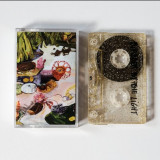
Tape
By its very nature, intuition is something of which we easily lose sight. Music however, as both bridge and secret technology, connects the natural, artificial, and the earned. It can act as both a reminder of cultures and people gone, while materialising and alchemising from thin air elements not to be found on any periodic tables, and visions no human can see.
»Pin down the dust« is the first meeting of Nighte - Christina Carter (Charalambides) and Mari Maurice (more eaze) - and it feels both automatic and natural. The collaboration stems from a spontaneous decision by the duo to start playing together weekly. “That's how this music was made,” explains Carter, “with gut feeling as the guiding principle. Mari understands the music I've made on such a deep level that playing with her feels so natural.”
The result of this meeting is inarguably some of the most beautiful music to ever emerge from either Carter or Maurice. The structures are spacious, generous, and gentle, with scraped violin strings and seemingly ancient moans strewn sparingly like falling leaves on a picnic blanket. Having begun life as freeform interplays between the duo recorded live at Maurice’s house, overdubs were later added and the material mixed by Maurice alone into finalised pieces.
Maurice’s varied instrumentation litters the background with distant and oneiric miscellanies, from groaned saxophone phrases and heavenly organ drones to glissandi guitars. Carter’s voice sits in the centre, embodying and channelling (mostly) wordless human ecstasy - and at times unease - amidst the allotment of blossoming sounds. Maurice & Carter’s clairvoyant connection notwithstanding, music always offers a portal back to our buried intuitions. “Pin Down The Dust” is both a tribute and a guide to this spontaneity and instinct, putting aside thought in favour of feeling.