Die Outlaws aus Down Under liefern mit Album Nummer 6(66) eine weitere unerbittliche Lektion in Sachen Aggression. Never Surrender" ist ein wütender Angriff aus schwarzem Thrash, Kettensägen-Riffs und kriegerischen Trommeln, der keinen Moment Pause zulässt, während er 40 unnachgiebige Minuten lang wütet. Mit diesem Werk machen Deströyer 666 keine Gefangenen!
FFV: Archgoat, Nocturnal Graves, Motörhead, Venom, Midnight
Buscar:t mid
Die Outlaws aus Down Under liefern mit Album Nummer 6(66) eine weitere unerbittliche Lektion in Sachen Aggression. Never Surrender" ist ein wütender Angriff aus schwarzem Thrash, Kettensägen-Riffs und kriegerischen Trommeln, der keinen Moment Pause zulässt, während er 40 unnachgiebige Minuten lang wütet. Mit diesem Werk machen Deströyer 666 keine Gefangenen!
FFV: Archgoat, Nocturnal Graves, Motörhead, Venom, Midnight
- A1: I Don't Know Anyone, I Am
- A2: Stones Pull Out Heart
- A3: I Don't Want To Ask Your Father Or Anything
- A4: Melanchole/Diary (Part 1)
- A5: I Was All Over Her
- B1: Like You Know I Get Old
- B2: Post-Traumatic All-Night-Long
- B3: Voice Vi
- B4: Reprise
- B5: (Dream) (Dream)
- B6: Needs No Progress, I Will Lie
- B7: Girl
- B8: Te Aroha
Melanchole is a collection of ambitious lo-fi pop songs recorded by Daniel Johann in the winter of 2012 in Wellington, New Zealand, when Johann was only 15 years old. The songs deal with the awkwardness of growing up, the pains of being apart, and the anxieties of being alive and real. Originally self-released on bandcamp, the album became a viral internet sensation, garnering over 100 million streams on Spotify and a large TikTok following. In 2018, Danger Collective remastered Melanchole and reissued it on vinyl with a new track listing; the first pressing sold out within the first 24 hours it was released. This third pressing will be released on doublemint green vinyl with a brand new album cover, packaged with an OBI strip and a 12x12 insert. Johann continues to remain somewhat of an enigma, rarely performing live or giving interviews. After almost a decade since his debut, Johann is currently in the midst of recording a follow-up album. “Really just the first of its kind. A study in experimental music and conceptualizing sounds that not many else would have a vision for.” // “The echoing soundtrack of loneliness in my head.” // “One of my favourite lo-fi records finally gets remastered and released on vinyl. I daresay that the changes to the track listing make this version of the album even better than the original.” // “I didn’t think it was possible for home to feel so melancholy.” // “Amazing amazing AMAZING lo-fi album.” // “This album habis a hazy, dreamily sedating effect on the careful and passionate listener. Simply put this album is entrancing with weeping, wistful melodies synchronized with Picasso’s blue period.” // Track Listing: 1. I Dont Know Anyone, I Am 2. Stones Pull Out Heart 3. I Dont Want To Ask Your Father Or Anything 4. Melanchole / Diary Pt. 1 5. I Was All Over Her 6. Like You Know I Get Old 7. Post-Traumatic All-Night-Long 8. Voice Vi 9. Reprise 10. (Dream) 11. Needs No Progress, I Will Lie 12. Girl 13. Te Ahora
Well we are going back to Dayton yet again for some more of that 1980's Boogie Funk!!!
PLATYPUS IS: Jerry Johnstone (Lead and Rhythm Guitar), Lloyd “Rok” Jones (Bass Guitar and all Bass), Kerry “Bogart” Rutledge (Vocals/Guitar), Arthur “Hakim” Stokes(Vocals/Percussion), and Curtis Sanford (Drums & Percussion) all from Dayton, Ohio!
Special shout out to former PLATYPUS members Dana Meyers Vocals/Autoharp), since those days, Solar Records, Songwriter, Producer for The Whispers, Shalamar and The Spinners, Floyd “Spoon” Weatherspoon (Vocals), since those days performing with “The Motown Sounds Of TOUCH” and Larry Hines (Lead and Rhythm Guitar extraordinaire) Deceased.
PLATYPUS RELEASED 2 albums for Casablanca Records – “Platypus” (1979) and “Cherry” (1980) and recorded more wonderful unreleased music. Super Disco Edits is proud to be releasing previously Unreleased song Side A “I LIKE YOUR LOVIN” Lead vocals Kerry “Bogart” Rutledge, with Guest Vocals Keith Harrison (Of Faze O and Dazz BandFame), Side B “I NEVER KNEW LOVE (Could Feel This Way)” Lead Vocal Arthur“Hakim” Stokes, written By Dana Meyers, along with Belinda Lipscomb and Jeffrey Cooper (Of Midnight Star Fame)
Brandneues Album des US-Future-Funk-Produzenten Yung Bae featuring Channel Tres, EarthGang, Jon Batiste, AWOLNATION, Cosmo's Midnight, Pink Sweat$, u.a. 'Groove Continental: Side A' ist ein Sommeralbum voller Wohlfühl-Disco, Funk, Hip-Hop & Soul. Yung Bae, ein Vertreter des Vaporwave-Subgenres Future Funk, kombiniert Electro-Funk-Sounds mit japanischen 1980er City-Pop-Samples zu einem verspielten Disco-Pop. Bierfarbenes 180g Vinyl.
Die Originalbesetzung von Black Ox Orkestar ist nach einer 15-jährigen Pause wieder zusammen. Die aus der fruchtbaren Montréaler Post-Punk-Agit-Prop-Szene der frühen 2000er Jahre hervorgegangene Band besteht aus Scott Gilmore, Jessica Moss und Thierry Amar von Thee Silver Mt. Zion (Amar komponiert und spielt auch weiterhin Bass für Godspeed You! Black Emperor) und Gabriel Levine von Sackville. Black Ox Orkestar haben Mitte der 2000er Jahre zwei gefeierte Alben mit aufgewühltem akustischem Avant-Folk veröffentlicht, auf denen sie osteuropäische und nordafrikanische Folklore durch die Linse einer düsteren, resonanten Indie-Rock-Sensibilität erforschten und Interpretationen von Instrumentalstücken aus verschiedenen jüdischen, rumänischen und arabischen Traditionen den Originalen gegenüberstellten. Auch dank Gilmores politisch aufgeladenem jiddischen Gesang sind diese frühen Alben für eine neue Generation von Musikern und Fans der jiddischen, Klezmer- und jüdischen Diaspora-Musik zu Meilensteinen geworden. Das von Greg Norman (Jason Molina, Nina Nastasia, Electrical Audio) hervorragend produzierte Album Everything Returns macht genau da weiter, wo die Band aufgehört hat: ein einschneidend atmosphärisches, melancholisches und doch entschlossenes Album einzigartiger moderner jüdischer Folkmusik, bei dem Klavier, Geige, Kontrabass, Klarinette und Cymbalom die Kerninstrumentierung bilden und die Gesangsstücke hauptsächlich auf Jiddisch gesungen werden. ENG Everything Returns reunites the original Black Ox Orkestar lineup following a 15-year hiatus. Arising from the fertile Montréal post-punk agit-prop scene of the early 2000s, the band comprises Scott Gilmore, Jessica Moss and Thierry Amar of Thee Silver Mt. Zion (Amar also continues to compose and play bass for Godspeed You! Black Emperor) and Gabriel Levine of Sackville. Black Ox made two acclaimed albums of roiling acoustic avant-folk in the mid-2000s, exploring Eastern European and North African folkways through the lens of a gritty, resonant indie rock sensibility, juxtaposing interpretations of instrumentals from various Jewish, Romani and Arabic traditions with originals led by Gilmore's politically-charged Yiddish vocals. These early albums have since become lodestars for many among a new generation of Yiddish, Klezmer and radical Jewish diasporic music practitioners and fans. First revealing its resurrection in February 2022 with a surprise flexi 7" single issued by left journal Jewish Currents as a gift to its thousands of subscribers, Black Ox has indeed fully and fruitfully reunited. Exquisitely recorded by Greg Norman (Jason Molina, Nina Nastasia, Electrical Audio), Everything Returns picks up right where the band left off: an incisively atmospheric, melancholic yet resolute album of uniquely modern Jewish folk music, with piano, violin, upright bass, clarinet and cymbalom making up the core instrumentation, and the vocal tunes sung primarily in Yiddish, alongside album centerpiece "Viderkol" and closer "Lamed-Vovnik" where English also features. This is not fusion music, but diaspora music: a cross-cultural call and response of musical lexicons, emerging from the history of Jewish persecution and displacement, the musicology of 19th century repertoire from Jewish shtetls , the improvisational traditions of nusakh in Jewish music and taqsim in Arabic music, and a wider polyglot dialogue of Jewish, Slavic, Arabic, and Central Asian musical traditions. Lyrically and stylistically, Everything Returns connects key current issues_from refugees forced to leave their homes, to the return of fascism and exclusionary nationalism_with the legacy of modernist Yiddish poetry and song. The new Black Ox Orkestar album is a sublime, poetic, politically-informed statement of re-energized diasporic musical intent, where Gilmore's voice and the band's simmering arrangements conjure an ardent, doleful balladry that echoes the sound and sensibility of artists like Tindersticks, The National, Nick Cave and Leonard Cohen. Everything Returns is a haunting, richly textured, darkly sparkling song cycle at once from a vanished world and very much of our time and place. Thanks for listening.
Inspiration comes in many forms; the city in which we live, the culture from countries across the globe and our love for TV, film and books.This rings true for FFF as a move from his home of Vlissingen in 98 to Rotterdam, combined with his love for UK sounds and comic books created a unique, outward-looking perspective. The DJ, producer and long term party thrower now turns in a record for Low Battery; so come and see for yourself.
Opening track 'In Toom' launches a satellite straight into deep space, picking up transmissions from an unknown source. The track deploys alien electronics and other-worldly vocal snippets, building a curious and ghostly atmosphere. Bass lures heavy around the mid-way point creating an increasing sense of unease, as unidentifiable objects head straight for earth. The aptly titled 'Desperately Seeking Summer' is a giant leap toward the good times ahead. You can sense its energy in the air; the smell of freshly cut grass, the charcoal from a newly lit BBQ and the coastal breeze on a warm summer's day. Summer is almost here and we could all do with a serotonin boosting elixir.
The B-side opens with 'Voices' as candy-floss vocals topped with xtra sugar taste even better with every play; while ascending basslines and frenetic drums join hands to produce that FFF energy we all know and love. 'Full of Light' provides tranquility at the end of a wild ride, as shimmering synths shine with radiant bliss with the power to transcend "bathed in light and lifted in what I can only call another dimension."
100% GALCHER was by all accounts a game-changer when it landed in 2013 as an hour of original music from a relatively unknown producer ushered in by the beloved mix series Blowing Up The Workshop. Galcher Lustwerk's signature sound — a smoky stream-of-consciousness baritone shadow-boxing with beats, informed by funk, rap, rhythm, and blues — felt like an epiphany, impossibly hypnotic and complete. Resident Advisor writes, "100% GALCHER laid out a louche, lysergic and resolutely black take on deep house." Pitchfork remembers the music's immediate impact: "It's the sort of gem you felt inclined to pass around” — and by year-end list time, word-of-mouth intensified. It was Resident Advisor and Juno's mix of the year, and earned a top-ten placement in FACT Magazine's albums list, as well as Philip Sherburne's personal rundown for Spin." Since then, select songs from 100% GALCHER have seen small-run pressings, while the album has lived primarily on SoundCloud and YouTube as a low-key cult legend. The gateway into Lustwerk's now well-established catalog, known for its reliability as a late-night listen and its prophetic vision for the near future of underground dance music. RA would later name it a mix of the decade, citing its influence and imagination: “Original in every sense — unknown, unheard and unbelievably good.” In late 2022, marking ten years since he first recorded the material, Lustwerk returns to Ghostly International to release 100% GALCHER as a remastered limited-edition double LP.
Lustwerk is a product of the Midwest. Growing up in Cleveland, he'd tape over his parents’ cassettes and spend hours at his family computer recording loops and designing artwork for the jewel cases of burned CDs. In high school, he turned to Ableton Live and absorbed every electronic music magazine he could find at the local Borders Books store. In excerpts from the 100% GALCHER liner notes, Lustwerk looks back: "My dad drove me to this shop on the westside Bent Crayon, where I would get anything the blogs told you to get + whatever the clerk recommended. CDs stayed in their packaging, there was always an overflow of vinyl stacked on the floor. I was too shy to listen to anything before buying."
As a college student at RISD, he played in noise bands, plugged into Providence's DIY scene via Myspace, and started DJing weeknights at bars downtown. There he connected with Young Male and DJ Richard, who would go on to found White Material Records and offer their third release to Galcher Lustwerk, an alias realized via CAPTCHA test, a perfect artifact of its internet age. By 2012, Lustwerk had drifted to New York City and settled into a graphic design job, quickly growing disenfranchised by office culture. "Some days I felt like a token, other days I felt invisible." At night, he and his friends were carving out their own space
RIYL: A Hawk And A Hacksaw, Leonard Cohen, Daniel Kahn, Xylouris White, Arooj Aftab, Tindersticks, Nick Cave, Alasdair Roberts, Geoff Berner, The Klezmatics. Deluxe 180gLP with 350gsm Arktika jacket/inner + 36”x12” art/lyrics fold-out + DL. CD in gatefold jacket + art/lyrics fold-out. Recorded by Greg Norman (Jason Molina, Nina Nastasia, Electrical Audio). Everything Returns reunites the original Black Ox Orkestar lineup following a 15-year hiatus. Arising from the fertile Montréal post-punk agit-prop scene of the early 2000s, the band comprises Scott Gilmore, Jessica Moss and Thierry Amar of Thee Silver Mt. Zion (Amar also continues to compose and play bass for Godspeed You! Black Emperor) and Gabriel Levine of Sackville. Black Ox made two acclaimed albums of roiling acoustic avant-folk in the mid-2000s, exploring Eastern European and North African folkways through the lens of a gritty, resonant indie rock sensibility, juxtaposing interpretations of instrumentals from various Jewish, Romani and Arabic traditions with originals led by Gilmore’s politically-charged Yiddish vocals. These early albums have since become lodestars for many among a new generation of Yiddish, Klezmer and radical Jewish diasporic music practitioners and fans. First revealing its resurrection in February 2022 with a surprise flexi 7” single issued by left journal Jewish Currents as a gift to its thousands of subscribers, Black Ox has indeed fully and fruitfully reunited. Exquisitely recorded by Greg Norman (Jason Molina, Nina Nastasia, Electrical Audio), Everything Returns picks up right where the band left off: an incisively atmospheric, melancholic yet resolute album of uniquely modern Jewish folk music, with piano, violin, upright bass, clarinet and cymbalom making up the core instrumentation, and the vocal tunes sung primarily in Yiddish, alongside album centerpiece “Viderkol” and closer “Lamed-Vovnik” where English also features. This is not fusion music, but diaspora music: a cross-cultural call and response of musical lexicons, emerging from the history of Jewish persecution and displacement, the musicology of 19th century repertoire from Jewish shtetls, the improvisational traditions of nusakh in Jewish music and taqsim in Arabic music, and a wider polyglot dialogue of Jewish, Slavic, Arabic, and Central Asian musical traditions. Lyrically and stylistically, Everything Returns connects key current issues from refugees forced to leave their homes, to the return of fascism and exclusionary nationalism—with the legacy of modernist Yiddish poetry and song. The new Black Ox Orkestar album is a sublime, poetic, politically-informed statement of re-energized diasporic musical intent, where Gilmore’s voice and the band’s simmering arrangements conjure an ardent, doleful balladry that echoes the sound and sensibility of artists like Tindersticks, The National, Nick Cave and Leonard Cohen. Everything Returns is a haunting, richly textured, darkly sparkling song cycle at once from a vanished world and very much of our time and place. Tracklist: 1 Tish Nign 2 Perpetual Peace 3 Oysgeforn / Bessarabia Hora 4 Mizrakh Mi Ma’arav 5 Skotschne 6 Viderkol (Echo) 7 Epigenetik 8 Moldovan Zhok 9 Lamed-Vovnik
Recorded and produced in their top of the range, custom-built analogue
home studio based in their Liverpool flat, forthcoming album HISS was
painstakingly and lovingly crafted by the band, who reveal themselves as
true audiophiles and songwriters of the highest calibre in the process
The record sees the band coming full circle, triumphantly returning to the lofi
roots that began their journey. Traversing the subsequent ups and downs of indiepop stardom since their major label debut in 2017, the band have found
themselves most at home back where it all began "at the quiet, sentimental heart
of their delicately unfurling, midnight- hour- favouring songwriting magic, with
complete creative control."Of the cathartic nature of the undertaking, Halls says:
"HISS is as honest an album as I'll ever be able to make. It was winter 2020; the
whole world had ground to a halt, and the pain of being separated from pretty
much everything I love had begun to turn into music in my head."
Originally released in 2014, “Instruction Booklet N. 1232” marks the first cassette release on Dauw for Tatersall under his The Humble Bee moniker. Taking advantage of the format, each side on “Instruction Booklet N. 1232” is reserved for a single piece nearing the 20-minute mark.
“Exploding View” (aka Side A) swells into existence with a very grand sounding synth-driven melody. Of course the other thing that’s present is the decaying sound of the tape loop that’s working to bring that music to life. At first, the melody grows and grows, fairly undisturbed, but eventually the sound of so-much tape warble threatens the rising nature of the piece until it sounds as though it is one loop away from total decay and simply fluttering out of existence.
But of course that’s the point. There’s a tension between that grand melody that opens these moments and that warble. It’s a lesson in opposites: the mechanics of a tape loop, guaranteed to break down, placed in contrast with those signature Tatersall melodies, which somehow seem eternal. And just as that tension seems too much to bear — the melody dies to be replaced by something altogether new. What comes next is something much quieter, driven by a sub-aquatic bassline, some rhythmic tape hiss and some gentle piano.
It’s a very dramatic and sudden break. The technical elements of that could be attributed to Tattersall’s understanding of how far a melody can be pushed before it succumbs to the abuse of being processed out of existence — perhaps the tape had been looped and processed to its breaking point. Regardless of whether it was a technical or artistic choice, that hard break serves an important narrative function. Frequently in instrumental music, musicians play with opposites (quiet-loud, clean-distorted) to create a narrative to their work since they don’t have words/lyrics as a tool. In the case of The Humble Bee’s use of tape loops, one set of opposites in tension is always driven by the fragility of the melodies and the limitations of a machine guaranteed to inevitably decay the media it is designed to support. And where one thrives, the other takes a backseat. As side A winds down, the melodies are much more sparse — appropriate for en ending, yes; but it also gives more space for those hisses and crackles to claim their moment.
Side B is filled out by “Manual with Foot Pedal” and it begins as gently as its predecessor ended. Slowly eking outing it existence – it’s as if watching Tatersall set the board, showing his players on opposite sides of the table before really setting them in motion to do their thing. By the piece’s midpoint, melody has taken centre stage as a glitchy, piano-led rhythm marches its way forward, clearly carving out its space and claiming its territory. And almost immediately following that: the decay takes over again and those tape loops seem processed to near death — the melody almost barely decipherable as it flutters under the weight of the history of being looped/played ad nauseum. And in the very final moments, the melodies are sparse again, giving the tape hiss room to play its part — it’s as if Tatersall is giving both players enough space to take their final bows.
Tape
Originally released in 2019, Craig Tattersall unspooled a gorgeous tape of disintegrated piano meditations and dusty lower case ephemera.
On the A-side it’s a dreamily searching, silty flux of piano notes peeling in slow motion. Strings drift over, connoting cold breezes and infrasonic, spectral presences, but the effect is far from menacing, it’s more a tranquil shade of sublime, like those hours after midnight when the meridian sounds of road traffic and human life have ebbed off into the distance and you’re left with the sighing creaks of a room.
The sound is remarkably different on the B-side. Here the air gradually thickens with murkier sub-harmonic distortion, bordering on a seething sense of aggression relative to most of Tattersall’s other output, pushing the grim murk to a logical entropy that precipitates elegiac pauses for reflection and warbling closure.
Los Angeles Free Music Society (LAFMS) formed in the mid-1970s as a loose-knit experimental music collective and multimedia publishing vehicle. Founded by teenage Le Forte Four members Chip Chapman, Joe Potts and Rick Potts and soon joined by Tom Recchion of Doo-Dooettes, LAFMS incorporated free improvisation, modular synthesizers, tape music, sampling, musique concrète, homemade instruments, noise, mail art and avant-rock in permissive and anarchic sessions at the Raymond Building and Poo-Bah Record Shop in old Pasadena. Inspired by The Residents, LAFMS self-released records and periodicals, organized performances and connected with fellow outsiders via post in the years before punk. Their uninhibited, egalitarian ideal of music-making and DIY distribution would influence generations of underground musicians.
In 1977, LAFMS released Blorp Esette, one of several compilations tracking the collective's growth and wild-eyed experimentation. Ace Farren Ford, an early LAFMS recruit from the Poo-Bah circle, produced the album and solicited cover artwork by Don Van Vliet (Captain Beefheart). Ford appears in various configurations alongside members of Smegma, Le Forte Four and "unknown artist" (as the credit for more than one piece reads). The Residents, showing their affinity with LAFMS, contributed "Whoopy Snorp" for their first non-Ralph Records release. Blorp Esette shows the artists grasping for new, non-idiomatic voicings and collaborative modes, anticipating LAFMS affiliates and offshoots such as Airway, Human Hands and Monitor. A second volume would come out in 1980, featuring Ford's punk band The Child Molesters. If you're looking for the missing link between mid-'70s art practice and outsider music, then look no further.
This first-time vinyl reissue is limited to 500 numbered copies. Comes with inserts.
2022 Repress
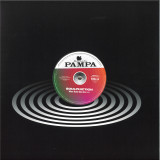
The Artist Concurrently Known As Jackmate has been already been indoctrinated into our cult since he signed onto he Pampa bookings roster awhile back. As SoulPhiction he is also co-founder of Philpot, the Stuttgart-based label, home to the majority of his releases over the past 10+ years. Anyway, we get the privilege of stamping the Turkey logo on SoulPhiction's first proper release of 2013, following his remixes for Murat Tepeli and Detroit Swindle. 'When Radio Was Boss' is a tribute to those magical electromagnetic waves that ruled yesteryear. With that prototypical Pampa percussion-rattling and clanking its way into the room-and a warm, round bassline bounce combined with some symphonic froth in the atmosphere, this track definitely demands airplay. On the dancefloor, at least! (And right in the middle of the track, catch the pleasantly jarring shout-out from WBAU, the call sign of the defunct New York radio station that counted members of Public Enemy and hosts of Yo! MTV Raps amongst its staff.) On the flip, the bpm gets cranked down just a bit for 'Maybachswagger"-If the A-side is a tribute to radio, the B has roller-skating on its mind. Starting out spooky with a sampled voice cooing over a slightly detuned bassline, the surprise comes in the final third, when a kawaii disco vibe drops in, seducing you onto the rink for a few laid-back laps.
Electronic funk holy grail written and superbly arranged by the likes of the south Italian-based singer and multi-instrumentalist Mario Rosini. This incredibly rare original 7" reportedly dropped in the mid-80s during the blueprint of the Italodisco era and, in some way, it fixes perfectly those feelings but with an upgrade that places it at a level to be considered as a classic of the dance scene without the time and genre limits. Fully restored from the original source the reissue comes courtesy of Erezioni, after a quite long time of interrupted transmissions
Los Angeles Free Music Society (LAFMS) formed in the mid-1970s as a loose-knit experimental music collective and multimedia publishing vehicle. Founded by teenage Le Forte Four members Chip Chapman, Joe Potts and Rick Potts and soon joined by Tom Recchion of Doo-Dooettes, LAFMS incorporated free improvisation, modular synthesizers, tape music, sampling, musique concrète, homemade instruments, noise, mail art and avant-rock in permissive and anarchic sessions at the Raymond Building and Poo-Bah Record Shop in old Pasadena. Inspired by The Residents, LAFMS self-released records and periodicals, organized performances and connected with fellow outsiders via post in the years before punk. Their uninhibited, egalitarian ideal of music-making and DIY distribution would influence generations of underground musicians.
LAFMS primarily reached outside Los Angeles via word-of-mouth and the United States Postal Service, foreshadowing the self-publishing and cassette trading networks of post-punk and industrial subcultures. In 1976, Joe Potts solicited recordings from LAFMS affiliates and admirers to edit and compile I.D. Art #2, utilizing correspondence art's technique of "assemblings." (The first installment in this series was a magazine, and the third was a coloring book.) Potts received dozens of pieces by members of Le Forte Four, Doo-Dooettes, Smegma and Ace & Duce as well as painters, filmmakers and non-artists with few recording credits to their name, creating a delirious, winking sound-art collage of field recordings, voicemails and improvisations. Participants purchased time on the record and received one copy each of the finished LP, realizing the philosophy contained in LAFMS' motto: "The music is free, but you have to pay for the plastic, paper, ink, glue and stamps."
This first-time vinyl reissue is limited to 500 numbered copies. Comes with insert.
Los Angeles Free Music Society (LAFMS) formed in the mid-1970s as a loose-knit experimental music collective and multimedia publishing vehicle. Founded by teenage Le Forte Four members Chip Chapman, Joe Potts and Rick Potts and soon joined by Tom Recchion of Doo-Dooettes, LAFMS incorporated free improvisation, modular synthesizers, tape music, sampling, musique concrète, homemade instruments, noise, mail art and avant-rock in permissive and anarchic sessions at the Raymond Building and Poo-Bah Record Shop in old Pasadena. Inspired by The Residents, LAFMS self-released records and periodicals, organized performances and connected with fellow outsiders via post in the years before punk. Their uninhibited, egalitarian ideal of music-making and DIY distribution would influence generations of underground musicians.
Live At The Brand documents the second performance of newly formed LAFMS core groups Le Forte Four and Doo-Dooettes on July 8, 1976 at the recital hall of the Brand Library in Glendale. Le Forte Four (now joined by Tom Potts) did not actually perform live, but rather created 44 pyramid-shaped headphone helmets with internal quadraphonic speakers and countless wires in order to share their latest tape assemblages with showgoers deprived of sight. The recordings delivered in this Fluxus-inspired manner feature the Buchla synthesizer at nearby CalArts, radio interpolations, group improvisations, addled outbursts and splices from source material lost to time. Doo-Dooettes – Tom Recchion, Harold Schroeder, Juan Gomez, Dennis Duck and Fredrik Nilsen – performed a series of alternately droning and chaotic duets with guitar, percussion, piano, tape loops and synthesizer, all improvised around loosely structured compositions and culminating in a spontaneous group composition at the end of the program. Originally released in 1976, the double LP would be LAFMS' third release.
This first-time vinyl reissue is limited to 500 numbered copies. Comes with inserts.
Los Angeles Free Music Society (LAFMS) formed in the mid-1970s as a loose-knit experimental music collective and multimedia publishing vehicle. Founded by teenage Le Forte Four members Chip Chapman, Joe Potts and Rick Potts and soon joined by Tom Recchion of Doo-Dooettes, LAFMS incorporated free improvisation, modular synthesizers, tape music, sampling, musique concrète, homemade instruments, noise, mail art and avant-rock in permissive and anarchic sessions at the Raymond Building and Poo-Bah Record Shop in old Pasadena. Inspired by The Residents, LAFMS self-released records and periodicals, organized performances and connected with fellow outsiders via post in the years before punk. Their uninhibited, egalitarian ideal of music-making and DIY distribution would influence generations of underground musicians.
Poo-Bah Records, with its import bins and backroom jam space, attracted the pseudonymous artists forming the initial incarnation of long-running collective Smegma. Early members Ju Suk Reet Meate, Dennis Duck, Cheez-it Ritz, Big Dirty, Amazon Bambiand Dr. Id contributed to various LAFMS compilations and combinations before several core members relocated to Portland, Oregon in 1975, where they recorded their debut album Glamour Girl 1941. Originally released on the LAFMS label in 1979, the LP combines rock instrumentation with tape, synthesizer, horns and voice in a tempestuous cauldron of anti-academy improv and alien noise. Beyond its roots in LAFMS, Smegma would help shape the early Portland punk scene in the late '70s alongside Wipers and Neo Boys. In more recent years, they have collaborated with Merzbow and Wolf Eyes.
This first-time vinyl reissue is limited to 500 numbered copies. Comes with insert.
One Day I'm Going to Soar is the 2012 album by Dexys, formerly known as Dexys Midnight Runners.
It was the band's fourth studio album, but its first in 27 years. The album features, alongside Dexys' lead singer (and leader) Kevin Rowland, 1980s Dexys members Big "Jim" Paterson, Pete Williams and Mick Talbot, as well as new recruits Neil Hubbard, Tim Cansfield and Lucy Morgan, and guest vocalist Madeleine Hyland, who duets with Rowland on several songs.
The album struts from different themes and genre’s, including '70s string-soaked disco ("I'm Always Going to Love You"), lounge bar jazz-soul ("Me"), and seductive Al Green-esque funk ("She Got a Wiggle").
Previously described as an ‘idiosyncratic & brave record’ this fan favourite is being reissued on vinyl for the first time since its initial release in 2012.
- A1: Grand Bazaar, Istanbul
- A2: Voluntary Retirement
- A3: New Digs
- A4: Severine
- A5: Brave New World
- A6: Shanghai Drive
- A7: Jellyfish
- A8: Silhouette
- B1: Modigliani
- B2: Day Wasted
- B3: Quartermaster
- B4: Someone Usually Dies
- B5: Komodo Dragon
- B6: The Bloody Shot
- B7: Enjoying Death
- C1: The Chimera
- C2: Close Shave
- C3: Health & Safety
- C4: Granborough Road
- C5: Tennyson
- C6: Enquiry
- C7: Breadcrumbs
- C8: Skyfall
- C9: Kill Them First
- D1: Welcome To Scotland
- D2: She's Mine
- D3: The Moors
- D4: Deep Water
- D5: Mother
- D6: Adrenaline
Thomas Newman became the ninth composer in the James Bond series history. His score for Skyfall won the BAFTA Award for Best Film Music. In 2013, it became one of two Bond scores to be nominated for the Academy Award for Best Original Score. The other to be nominated was the score from The Spy Who Loved Me. Skyfall does not contain the title song performed by Adele.
Skyfall (2012) is the twenty-third spy film in the James Bond film series. It features Daniel Craig in his third performance as James Bond, and Javier Bardem as Raoul Silva, the film's villain. The movie was directed by Sam Mendes. The story centres on Bond investigating an attack on MI6. The attack is part of a plot by former MI6 agent Raoul Silva to humiliate, discredit and kill M as revenge against her for betraying him. The film sees the return of two recurring characters to the series after an absence of two films: Q, played by Ben Whishaw, and Moneypenny, played by Naomie Harris. Skyfall is the last film of the series for Judi Dench, who played M, a role that she had played in the previous six films.
The limited edition of Skyfall of 1.500 individually numbered copies is pressed on coloured (transparent & black mixed) vinyl. The package includes a big poster, a 4-page insert and 2 printed innersleeves. Both innersleeves have one hole in the middle to show James Bond on the labels. Don't forget to check the secret service inscriptions on the run out grooves.