On April 7th electronic luminary Nathan Fake presents the new longplayer ‘Crystal Vision’ on his own Cambria Instruments imprint, which features collaborations with Clark and Wizard Apprentice.
This is music for music’s sake – recorded without angles, agendas and themes – so Fake was free to simply continue honing his craft and express himself non-literally. Aptly titled, there’s a clarity of execution and ambition, and a peak effectiveness to the record that just sounds right.
Continuing to set a personal bar higher and topping his own best, the mark of master craftsperson is everywhere, but that doesn’t mean it’s polished; There’s plenty of rawness evident, with spiky sonics keeping ears on high alert – full of endorphin-flooded rave energy.
Following a short, scene-setting ‘Arrival’ – a simple major chord arpeggio played on a Jupiter 6 which sounds like curtains opening at dawn, things begin apace with ‘The Grass’, which hurtles like a precision-tuned bullet train through Arctic tundra. The undulating effect of compression is emphasised by the classic techno trope where 2 rhythms jar yet interlock, creating an exquisitely disorientating strobe-like flutter. On the track’s guest, Fake comments, “I fell in love with Wizard Apprentice's ‘I Am Invisible’ and felt our musical styles were similar. Their vocals are smooth and clear and sharp at the same time. They’re like a calm within the storm.”
Inspired by Italo disco but sounding wholly alien and futuristic, ‘Vimana’’s fizzing buzzsaw arpeggiated bassline, popping snares and bright whirling melody are equally an electro trance melange, with an effervescent major chord Arp that kicks in midway.
Reminiscent of what used to be called ‘funky techno’ but with sparklier sounds, ‘Boss Core’ blinds like sunshine bouncing off ice. Using his trusty Boss DR550 drum machine, and inspired by Autechre's ‘Vose In’, the track peaks by reaching that melancholic/euphoric axis for which he is loved.
With chugging slow breakbeats not a million miles from Board Of Canada or trip hop, ‘Crystal Vision’ rolls along, with the melody opening up, revealing more hidden notes as it progresses, building into a fractal, kaleidoscopic mosaic.
An emotional outpouring with serotonin surging through the circuitry, classic breakbeats and layers of lazers, ‘Bibled’ has all the hallmarks of a classic. This is a bonafide festival-set closing, hugging-your-mates, moment – or, with its guitar solo, “a power ballad” – as Nathan calls it.
A minimalistic moment of calm midway through the album, ‘CMD’’s gently comforting dreamscape is conjured with FM stacked and detuned sine waves which are left to breathe, whilst the chunky Chicagoan house jack of ‘Hawk’ brings to mind classic Relief records, but even more detuned and wibbly, and laden with synths.
As the title suggests, ‘Amen 96’ is in Fake’s own words, “me having a go at jungle. I grew up listening to it, and I remember as a teenager it sounded like the most intense and otherworldly music ever. It still does. This track is an experiment to see how my melodic style works against amen breaks”. Closer to the braindance end of the spectrum than ‘proper’ jungle (and all the more interesting for it), Fake channels the spirit of Squarepusher but makes it his own, brimming with melodious twinkle.
A collaboration with Nathan’s close friend and genuine musical hero Clark. ‘Outsider’ finds this dream team alchemising pure gold that’s bigger than the sum of their parts. Skittering, intense, far-reaching end epic, the pair close proceedings on a grandly dramatic note. In 2020 Nathan released the album ‘Blizzards’, which was described by The Quietus as “his best work”, and “his best LP yet” yet by Resident Advisor. The equally well received ‘Blizzards Remixes’ EP which featured Afrodeutsche and Irene Dresel followed in 2021, as did a nationwide UK tour.
An in-demand remixer, Fake has added his magic to tracks by Radiohead, Clark, Perc, Jon Hopkins, GoGo Penguin, Dominik Eulberg, Christian Löffler and Damian Lazarus, working for labels including Ninja Tune, Domino, Warp, Blue Note and Kompakt.
quête:t mid
Running Back welcomes Firas Waez and his studio character 9th House for a flock of heartfelt and intuitive house tracks. Centered around uplifting chords and joyous melodies, upbeat drums and shuffling hi-hats, it feels like being in a circle dance, watching flowers turning into fruits or caterpillars into butterflies.
Made with the tools of today, but with a burdening love for the ancient magic and positivity of this music. The results being highly contagious. Whether its any of the 9th House’s solo works like Reuben or the collaboration with Matrefakt, it’s impossible to hold still. But as no one can live off love alone, there is also an odd one out. The eponym Midas swaps vintage techniques and the love potion of its counterparts for sharp and exact peak-time magic that makes endorphins rush and cheeks blush. Whichever you finally pick of the five tracks, any of them are an amulet against bad times. A Midas’ touch indeed! Happy house painting artwork courtesy of Luciano Calderon via ruttkoswki;68.
- A1: Evol - The Dark Dreamquest (Intro)
- A2: Corvus Neblus - Forever I Shalt Dwell In Ravenloft
- A3: Asmorod - Fiat Abyssus (Second Chapter)
- A4: Vindalv - Swærþ Stimma (Excerpt)
- B1: Apeiron - Pan's Journey To The Cosmic Void
- B2: Secret Stairways - Lammas Tide
- C1: Dolch - Tumulus
- C2: Endoki Forest - Ii
- C3: Lunar Womb - Night Towers
- C4: Maelifell - La Dame Du Lac
- D1: Kadotus 609 - The Summoning Through Crimson
- D2: Neptune Towers - To Cold Void Desolation
In the early 1990s, a handful of black metal artists were enticed by the possibility of conjuring new fantastical worlds from the deep isolation of their home setups. Rather than the dense metal sound of their existing projects, this new direction would be centred around intimate synth soundscapes: forlorn organs and otherworldly MIDI theatrics.
The music on ASCEND is predominantly from self-produced, self-distributed releases, typically manufactured in small numbers. Though some artists producing this style of music, most notably Mortiis and Burzum, gained wider recognition outside underground circles, it is only in recent years that the sound and its influence has really been appreciated. This is particularly the case with the late Matthew Davis and his recently reappraised Secret Stairways project, whose song ‘Lammas Tide’ (from the 1997 Enchantment of the Ring album) appears on ASCEND. A simple home recording on a Yamaha KX-W392 manages to be both elegant and tortured, ambiguously devotional and recalling latter years Popol Vuh.
This battle between dark and light is a constant thread through ASCEND, with simple minimal synth lines that can be both delicate and menacing. Compilation opener ‘The Dark Dreamquest’ from Italian black metal group Evol is loaded with occult warning, and Finnish act Kadotus 609’s ‘The Summoning Through Crimson’ is languid, twisted and dark. In spite of the darkness, several pieces of the music on ASCEND have formal similarities with the sometimes saccharine new age music that rose to prominence in that era: but to a rougher, darker ends. The closing song from Darkthrone icon (and past NTS radio host) Fenriz, under his Neptune Towers pseudonym, pulls us further out, with ‘To Cold Void Desolation’ — an astral synth project, akin to ’70s kosmische muzik masters Harmonia.
The gentler side can often amplify an uncannily sinister edge, heard in German act Dolch’s ‘Tumulus’, where orc marching horns contrast against delicate rompler harps and softly whispered chanting. It hammers home a deep loneliness and detachment constant throughout ASCEND, made possible by these unusual contrasts, both unsettling and otherworldly.
Orange Vinyl
»Love As Projection« is the new album by Frankie Rose, her fifth studio LP and second for Night School following the reissue of her interpretation of The Cure’s »Seventeen Seconds«. Frankie Rose has forged an enviable musical legacy, from playing with bands like Crystal Stilts and The Vivian Girls but on »Love As Projection« she takes a bold step into electronic pop production. A sumptuous recorded statement, it dances in ecstasy and broods on the tumult of the western world’s decay in equal proportion. At the heart of the album is glowing, confident songwriting, resplendent in hooks and choruses but still touched with an optimism undimmed.
After spending nearly two decades establishing herself across New York and Los Angeles independent music circles, Rose re-emerges after six years with a fresh form, aesthetic, and ethos. Celebrated over the years for her expansive approach to songwriting, lush atmospherics, and transcendent vocal melodies and harmonies, »Love As Projection« is a reintroduction of her established style through the lens of contemporary electronic pop. Recorded with producer Brandt Gassman and mixed with long-term collaborator Jorge Elbrecht this is the album Frankie Rose has been building up to her entire career.
More than a rebirth, a refinement, a resurgence, »Love As Projection« boasts a widescreen scope: a long- form project heavily considered for half of a decade, culminating in the most personal and accessible collection of art-pop that Frankie has ever written. When Rose aims for the pop jugular as in first lead track »Anything«, the result is unstoppable. A majestic pop song built for radio, it erupts into an irresistible chorus that marries classic epic 80s American pop with the cult effervescence of Strawberry Switchblade »It’s like a prom scene in a John Hughes movie. It’s a hopeful song about abandoning fear even if the world is quite literally on fire.. In the end, at least we have each other,« says Rose. »Sixteen Ways« further boasts a propulsive, massive chorus, though tempered by a cynicism built in global post-truth, global malaise. »It’s about getting your hopes up, but simultaneously making lists in your head about how it will never work out in your favour.«
The big anthems don’t let up there. On »DOA« some massive, rolling drums lathered in big mid-80s gated reverb dovetail with a syncopated baseline for the ages as Rose’s vocal sails effortlessly above. The effect isn’t unlike ethereal vocalists Clannad circa Howard’s Way or Enya jamming with Simple Minds in their stadium-conquering heyday. Rose tempers the adrenalin with heart-tugging bittersweet tones and there are plenty of them. »Sleeping Night And Day« takes its time with an off-the-cuff chorus, swirling around in harmony and chorus-bass. »Saltwater Girl« picks up the balladeering baton with another nod to album track-mode Switchblade, deep space opening up in the mid-tempo drum track and soupy, digital atmospherics. Album closer »Song For A Horse«, reimagines modern Pop production a-la-PC Music but shorn of the meta-atmosphere. Pianos, swelling synths, minor keys cut through with major. These moments, also seen in Feel Light offer ballast to the soaring pop choruses. Moments like these are big oceans of emotion to fall into before being led out by Rose into a bright new day.
»Love As Projection« is released in the USA by Slumberland.
Two years after their previous effort, regular as clockwork, Swiss throbbing synth pop duo Veil Of Light is back with a new album and what can we say? These guys keep on getting better and better.
If you have followed the Zurich-based outfit over the past few years, you must have noticed the constant moving towards 80’s FM new wave and synthpop tones – without losing their electro/body music outline – that have marked the band’s parable, especially since their latest Landslide LP.
Sundancing is their sixth full-length and it stays the course, bringing what we’ve just said to the next step. Nine new dancy and bright tunes with emotional depth that blend lush instrumentation and robust rhythms, guided by funky and rubbery basslines. Syncopated rhythm sections match suburban cool synths in the lead single Apricot Kiss and Hypersleep, while Raindancing and Tonight summon a sinuosity long gone since the mid Eighties. The musical backdrop here serves as the fundament for emotional vocals delivering lyrics dealing with the fragility of love, joy and loneliness.
There’s some subtle addictiveness to these songs, one that will gently grab you by the collar of your coat and stick the refrains from Sundancing inside your head for good.
Veil Of Light might make it look easy to keep it neat without being minimalist, intimate without being depressing, romantic in the most true sense of the word, but we know that’s possibly the hardest thing to do.
Riding high on the inexplicable Tech-house adoption of their last release, Talking Drums return with hit number six.
This desert island disc finds the family bagging a last minute flight to sunnier climes, where the cocktails are strong and the seas are calm.
On 'Air Ecosse', the crew provide an engine overhaul to a middling slice of Scotch boogie, squeezing maximum thrust out of the new beat-y intro before a bubbling bassline and chiming chords provide some serious uplift. The captain takes the comms for a late deadpan vocal, hinting at a little Pet Shop Boys karaoke prior to touchdown in paradise.
The percussion pals kick off the Birkies on the B side, boarding the bateau with a pair of proper harbour heaters. 'Too Yacht To Handle' bubbles along like Mick'n'Keef in disco mode, oozing grooves under a swooning vocal a la Nicolette Larson. A hazy arrangement lets the music play, indulging the instrumental breaks, soaring synths and subtle delays in true 12" Extended Mix stylee, perfect for peak-time at poolside or la playa.
Dropping the tempo to a sunset strut, 'AORwaves' provides the perfect cool-down, as TD cut back the fat on a forgotten soft-rocker to create a cosmic yacht bomb. Low slung, sleazy and spaced out, this is gonna rock a bar set and beyond.
Limited Press - Numbered Insert - Drum Fun Guaranteed.
Death Is Not The End's 333 sub-label follows the reissue of Devon Russell's Darker Than Blue LP late last year with a first-time reissue of a veritable reggae-dancehall holy grail - Robert Ffrench's 1985 LP 'Wondering'.
Pioneering artist and producer (and cousin of the late, great Pat Kelly) Robert Ffrench was born in central Kingston in 1962, recording his first records in 1979 at the age of 17. Coming out off the back of a slew of roots & early dancehall-style 45s cut with a wide range of producers thoughout the early '80s, the Wondering LP followed closely after two acclaimed LP sets ('Showcase' produced with Lord Koos & 'The Favourite' for Ossie Thomas' Black Solidarity label - plus a split showcase LP with Anthony "Gunshot" Johnson for Jah Thomas' Midnight Rock label).
Ffrench would write and produce the Wondering LP himself in it's entirity, laying down the tracks at Herman Chin-Loy's Aquarius & Michael Carroll's Creative Sounds studios with the help of engineer Christopher Daley. Representing the sound of an artist first confidently sriking out on his own, the album elegantly mixes a classic rub-a-dub & lovers rock-inspired sound with nascent digi-esque flourishes. It boasts an enviable list of contributors too, incl. Sly & Robbie, Dwight Pinkney, Robbie Lyn, Nelson Miller (Burning Spear) and Ronald "Nambo" Robinson among others, with Beres Hammond also providing backing vocals in places.
Following the release of Wondering, Ffrench would continue to write and produce, soon after releasing two further self-produced LPs for Edgar White's Parish label - and founded his own 'France' label in the late 80s, through which his productions would start to hit big, most notably alongside Courtney Melody on 'Modern Girl', and with US rapper Heavy D on the track 'More Love'. Robert's productions released through later label 'Ffrench' would go on to boast the cream of the crop of dancehall artists throughout the 90s and early 2000s, and he is often credited with discovering Buju Banton (producing his first single "Ruler" on the Stamina riddim). Ffrench is still actively producing music of his own to this day, having released singles 'Everyday of My Life' and 'Black Is a Colour' in late 2022 and Feb 2023 respectively, available through all digital platforms now.
333, under exclusive license from Robert Ffrench.
Anno 2022 stiegen die deutschen Extrem-Metaller MYSTIC CIRCLE aus den dunklen Untiefen empor und veröffentlichten ihr selbstbetiteltes neues Studio-Album.
Dieses führte zu einer eindrucksvollen Rückkehr, samt einem furiosen Charteinstieg auf Platz #78 in den offiziellen deutschen Albumcharts.
Mit viel neuer Inspiration schufen die beiden Hauptmitglieder Beelzebub und A. Blackwar neun neue Tracks für ihr neuntes Studioalbum, das "Erzdämon" heißen wird und am 17. März 2023 auf ihrem neuen Label Fireflash Records das Licht der Welt erblickt.
DJ Girl is a DJ and producer who was raised in Detroit, but since the pandemic has been based in Austin, Texas. She's the co-founder of the up and coming Eat Dis Records and her recent releases have been generating excitement in all the right places.
In some ways, 'Hellworld' feels like a direct relation to a lot of early 2000s Planet Mu releases. It could sit neatly alongside Hellfish or Neil Landstrumm, with a similar anything-goes, gleeful attitude, but instead DJ Girl mashes together a driving sound that is founded upon Detroit techno and electro, Chicago juke and Miami bass, with an old school/new school production style that's finessed with distortion and sparse IDM production.
It's a midwest USA style that takes a leaf from DJs and producers such as the wild-style hard techno of Lenny Dee, the tough midwest acid of Woody McBride and the system wrecking electro of Dynamix II, with a joyful, take-no-prisoners bounce.
'Hellworld' kicks off with the industrial juke of 'Get Down', followed by the powerful electro of 'Opp Pack Hittin' (the first of two tracks to feature MC Malik McFly).
'Technician' is a chirpy old school electro track that gets crazier as it progresses, while 'Lucky' mashes together samples and rough beats like an electro version of breakcore.
'Gallery' again features Malick McFly and switches between footwork beats, pumping techno and electro.
'So Hot' is hard 8-bar electro while 'When U Touch Me featuring Irish producer Lighght feels like a very manic take on hyperpop.
The album ends with the tough, spiralling acid of 'Groover' which wouldn't be out of place on a late nineties Jeff Mills mix. The fun is infectious on this one.
In 1975, under the oppressive air of military dictatorship in Brazil, brothers Lelo and Zé Eduardo Nazario invited bassist Zeca Assumpção to join their musical experiments in a basement under Sao Paulo’s Teodoro Sampaio Street. As teenagers, the trio had already been playing together in Hermeto Pascoal’s Grupo, alongside guitarist Toninho Horta and saxophonist Nivaldo Ornelas, and it was while working together under Hermeto’s direction that the Paulista rhythm section (as they were then known) began to realise their own potential.
With many nightclubs and venues closed in the mid-70s and government censors dictating the output of radio, TV and art galleries, many Brazilian artists fled during the years of dictatorship. But underground, Grupo Um were fusing avant garde ideals with contemporary jazz and Afro Brazilian rhythm; making phenomenally free and expressive music - in stark contrast to the sterile, conservative conditions being imposed above ground.
Just like Hermeto Pascoal’s Viajando Com O Som from the following year, Starting Point was recorded over two days at Vice-Versa Studios, by revered engineer Renato Viola. The studio was one of the best in Sao Paulo and musicians communicated with engineers through cameras and a monitor, allowing the group complete immersion in the process. They also made use of the studio’s hemispherical tiled room, which served as an acoustic reverberation chamber.
The album begins with Zé Eduardo Nazario’s thunderous drum solo on “Porão da Teodoro”, before clearing the clouds with the lone Berimbau which opens “Onze Por Oito”. Built around a hypnotic electric bass line, heady Fender Rhodes improvisations, and more rip-roaring drums, it’s a rapturous, electrifying freak-jam in 11/8.
Like some invertebrate deep-sea curiosity, the free-form “Organica” is made up of Lelo Nazario’s playfully eerie prepared piano, with Zé Eduardo’s percussion flurries darting around Assumpçao’s double bass. The equally non-conformist, percussion-only piece “Jardim Candida” features many of Zé Eduardo’s home-made instruments, including a long saw blade played with vibraphone sticks and violin bow. While working with Hermeto, Zé Eduardo famously built his own all-in-one percussion set-up known as the “Barraca de Percussão” (Percussion Tent) - the first of its kind in Brazil, which he would also use on Hermeto Pascoal’s Viajando Com O Som and throughout his career.
“Suite Orquidea Negra'' (Black Orchid Suite) was written by Lelo Nazario as the score for an imaginary movie - the story of a rare, black orchid which produced a substance meant to cure all diseases, but which had mysteriously disappeared from the laboratory… “As a screenplay it’s not very good” reflects Lelo in jest, “but the music ended up being very interesting, the way its parts are chained to one another carries a little of the mystery I imagined for the movie.”
The album closes with the triumphant “Cortejo dos Reis Negros” (Procession of Black Kings) - a groovy variation on the Maracatu rhythm, with a two-note bassline underpinning piano improvisations, exultant wordless vocals, cuicas, slide-whistles and a very special guest appearance from Zé’s dog Bolinha.
Starting Point was to mark the inception of one of Brazil’s most daring instrumental groups. Their debut now sits in the lofty echelon of otherworldly 70s Brazilian music, alongside the likes of Marcos Resende & Index’s self-titled debut, Cesar Mariano & Cia’s Sao Paulo Brasil, Azymuth’s debut and indeed Hermeto Pascoal’s Viajando Com O Som. But just like all of those titles, which were either shelved or largely ignored at the time, Grupo Um - so radically ahead of their time - struggled to find a label to release their debut album. So Lelo kept the tapes safe in his archives, which is where they sat for almost half a century. Finally, almost fifty years later, this mesmerising piece of history is here, and it was only the beginning...
Grupo Um’s Starting Point will be released by Far Out Recordings, on vinyl LP, with an insert featuring unseen photos and liner notes by the Nazario brothers, as well as a CD on 17th February 2023.
Alvars Orkester was formed in 1987 in Johannishus, a small village in the south-east of Sweden by a group of young boys interested in the mysteries of psychic sickness, mental institutions, industrial music culture and the power of sound. For the first very creative years, Alvars was very active within the independent cassette culture scene releasing their stuff (that quite soon drifted from the industrialism inspired by Test Dept, TG, SPK and z'ev to an atmospheric, psychedelic and quite ambient version of noise) on small labels in Italy, Portugal, USA etc.
Joachim Nordwall writes: "1990-1991. In the middle of all teen confusion going on, me and Zwarre had a long creative time together. Recording every weekend, connecting with like-minded (or at least we thought so) people around the world and trading tapes with whoever. Our world was analogue synths, Party Zone late Friday nights on MTV, zines and out-there experimental music. By then, we had a few tapes out and had "Nobody Finds Nothing" being released on the Italian super-label (in our opinion) Biotope Art Organization. We were in the midst of something and recorded "Nuthull" for another Italian top level label called Old Europa Café. However, they did not like it and the tape was abandoned and forgotten. Then years and years later, close to present time, Zwarre was in touch with OEC for some reason and had the master returned." - Joachim Nordwall, Gothenburg, 21 February 2023
Eric Clapton’s eponymous first solo album, originally released in August 1970, represents one of rock history’s most successful reinventions. After emerging as one of the seminal guitar heroes of the ’60s, the English superstar decisively re-established his musical priorities with Eric Clapton. The album marked Clapton’s transition from flashy instrumental icon to well-rounded recording artist, downplaying sonic pyrotechnics in favour of a song-focused ensemble approach that would lay the groundwork for his massively successful solo career. For the occasion, he surrounded himself with a new cast of American musicians, tapping into a rootsy musical foundation that provided an inspired framework for his talents. This Anniversary Deluxe Edition presents Eric Clapton – Eric Clapton in three separate mixes –
The Eric Clapton Mix, The Delany Bramlett Mix and The Tom Dowd Mix (The UK Version). The Eric Clapton mix is being released in full for the first time. This anniversary collection also includes some singles, alternate versions and session outtakes.
NYC’s Jkriv delivers a package of proto and golden era house re-edits for longtime pals Pleasure of Love.
The Razor N Tape label co-founder has reliably delivered dancefloor ready cuts on Z Records, Glitterbox, Barefoot Beats, Rocksteady Disco as well as his own imprint. On his first Pleasure of Love release Jkriv explores house in all its NYC glory; extending the energy on mid-late 80s proto (Got a Thing, Don’t Take Your Love Away) and masterfully looping and building tension with underappreciated early 90s house (G.D., Feel It). Expert level re-rubs by one of NYC’s finest producers.
recut and repressed !
When Belgium’s Bonzai Records released Cherrymoon Trax I “The House Of House” in 1994 it was like nothing I had ever heard before. It is a masterpiece that captures the energy and euphoria of rave culture from the mid 90s in such an iconic way. I picked this track out of my record collection a few months ago and felt compelled to create a tribute to this groundbreaking work.
My respect to the original producers Yves Deruyter; Alex Stephenson; Frederico Santini and Franky Kloeck. (Thomas Schumacher)
Dynamite cuts 45s series is proud to release two gems from the Perception label both First time on 7” vinyl. Taken from the hard to find John Bartel LP which was released 1971, these two bangers, needed to be part of the DC series, classic and unknown drum samples.
A - “Boogie” is super heavy funk n Jazz dj dancer.
B - “You’ve just been bitten” Great mid-tempo vocal funk groove, with lots of drum break
SPF 50, real name Stephan Kimbel Olson, has graced New York’s finest sound systems with his deep, rolling club sets. In his numerous roles – DJ, engineer, party promoter, label head, producer and dancer – Stephan has become an essential contributor to New York’s nightlife culture, a fixture in the city’s extended sonic community.
On Social Life, his first release with NY label Bliss Point, Stephan has channeled two booming club workouts, each with modular synthesis evoking the organic: an unruly bassline snakes through the aural fauna of “Body Concept”, while breaks and acid fly by on “Liquid USB”, an intricate sonic constellation propelling through space, culminating in the release of classic house chords midway.
On the B side, Stephan takes us deeper into the unknown. “Grove Map” is world-building club ambiance aptly named after The Grove, a stage deep in the woods at New York’s Sustain-Release festival, where portals have long been known to be opened. “Iris (Bad Water Version)”, rounds out the offering, a drippy dub that time seems to slip off of, perfect for a melted warm up or come down.
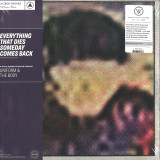
On the heels of their monolithic collaborative LP Mental Wounds Not Healing, the collaboration between industrial-noise post-everything bands Uniform & The Body returns with a second entry, Everything That Dies Someday Comes Back. Comprised of an amalgam of abrasive influence that spans Swans-y dirge and purge, Whitehouse’s clenched-jaw noise, middle-period Ministry’s penchant for metallic post-industrial everything, New Order’s nose for melodic emotionality, and Juicy J-inspired beats, Uniform & The Body’s approach delves deeper down the rabbit hole than before, igniting a sonic world of terror and bliss poised to grip the throats of fans yet again. Prepare for a record that the band self-describes as “the middle ground between Robyn and Corrupted, but weirder.”
Much like the collective’s bombastic debut, Everything was built over a series of collaborative sessions with Seth Manchester at Machines with Magnets in Rhode Island, mixing industrial-influenced synths, squalls of harsh noise, manipulated guitar, oodles of samples along with hard rock-inspired riffs, saccharine pop, and the alternately antagonistic and harrowing vocals of Michael Berdan
Two rarities from Deadmau5’s illustrious collection get a much deserved repress. First up ‘People Are Still Having Sex’, a cover version of the 1991 original by LaTour that was produced in Deadmau5’s mid-2000s heydays and has never been released on vinyl before. Trademark big beats and electrified synths lay the foundation for the looped-up hook vocal to run wild.
On the flip the twisted, tribal channelling John Made remix of 'Desynchronized' from 2009 that has previously only ever been available on a bootleg release, now officially released for the first time.
‘Horsepower’ marks the Dutchman’s third credit on Drumcode this year, following a strong collaborative work with Weska ‘Shades of Summer’ and the new remixes of ‘Your Mind’ from Charles D, his classic with Adam Beyer from 2018. Bart’s also been busy throughout the summer season, a fixture at our Off Sonar, Drumcode Miami and the Drumcode Ibiza event
His latest two tracker continues this reach vein of form. The title track is vintage Bart Skils; a searing festival-ready bomb built around a dreamy vocal sequence and long mid-section break that drops back into stomping techno territory. ‘Sunshine in the Dust’ brings the party with lively percussion, flamboyant vocal samples and tough bottom end. A super fun track bursting with Latin flavours.
Double Touch return to All Day I Dream label to release their four track EP, Storm. The duo is joined by Reigan, who contributes vocals for two tracks on the EP.
The EP kicks off with its title track, which features vocals from Reigan about power, control, and the bliss of surrender. Reigan and Double Touch are frequent collaborators; Reigan has contributed vocals for past Double Touch EPs released on All Day I Dream, TRYBESOF, and Magician on Duty.
Complex layers of percussion commence the record. Over the course of the introduction, melodic elements are slowly incorporated, crescendoing as Reigan begins to sing the first verse. The track breaks down around the midway point - as the percussion fades away, Reigan’s voice is highlighted, and tension builds. After the next chorus, the drums are reincorporated, as latent energy is released.
Regarding her lyrics, Reigan said: “The feeling of surrender comes during the melodic change in the chorus. I say “take hold of me” twice and then when I say “and you take all of me” the lift in the note feels euphoric. This is the surrender to power. ‘Storm’ is a dance of power and passion, pleasure and control. It’s leaning into the bliss of surrender while exploring the indirect holders of power in doing so.”