Eagerly awaited debut album from oft-cited UK's most out-there band, features in the works with The Quietus and Wire already.
180GM PRESSING - 500 COPIES ONLY.
Difficult times required difficult music, my Yarns, that's why we had Guttersnipe; with its own sort of energy-kind there then.Reiner: A singular yield, a singular yield now.Barns: A whot
Reiner: A singular yield mate! Rich guitar strang, flow motive pounding underneath.Vox like Death come winding through the fields. Barns: Hell of a way to describe a vocal style.
Me: Nah but for real my Donny, Have you read a presser 1 sheet lately It's the most
They say the PR era, circa late 80's killed the golden age of music journalism:
They say Guttersnipe have continuously melted all the forms that they come up against. They are right. Because Guttersnipe is not part of a tradition we know well. You will identify the departure from it though, immediately, upon hearing My Mother The Vent. This LP, the promotional version of which, likely sits in your hands (disk, whatever). The innovation here is a FIRM commitment to the flowmotive polyrhythm underwriting the seared, nay fried, tonal rainbow and de-reasoned vox.
Not Nate Nelson, nor John the masseuse dude from Sightings but TIPULA CONFUSA. Don't want to put the captain obvious pants on so tight I can't jump around the yard because why waste a good yard hang. I'll put on my blighty nighty instead. UROCERAS GIGAS has bridged so many gaps, finally unlocked the AxeWeld CODE and is really playing the thing. Not to mention bringing forth a world-view so utterly unique. Good luck finding anything like it.
Finally some REAL disjunction in the music; clear and intended. In an age when most computer music composers use stochastic systems and still manage to drop some linear pathground shit, the brawler drums and slanky guitar constructions on My Mother The Vent are a genuine treat. I've spent too much of my adult life so far hearing too much of this shit to not recognize REAL GAME. And here it crawls out of the grey shadows of ol' BLIGHTY.
Our post-music age: after the fine human endeavour known as music, the result of letting the cybernetic run ITS horrible game on us. I'm not waxing confusingly in a rarefied tone here. Nor running the boring sci-fi script. I really think that is were we is. We left the human-music-on-a-human-scale behind and much to our detriment. Here we sit in our crumbling reality. But Guttersnipe come paleo, like the rhapsodes with long ass memories rattling off Homeric verse well into the age of manuscript culture, but here, with future tones. Luckily. Otherwise, me and the record label here wouldn't be wasting our time and yours with a 1 sheet for My Mother The Vent.
So a proper first time on wax for these amazing creatures is a welcome addition to the world of things. These drums and these guit-lines are so cranké, as they say here in my odd neighborhood. These voices are so utterly expressive without even the damn language at hand ; like the great horns. We'll rinse this record out, I'll put on my old blighty nighty and go dance in the street. Alex Moskos, Montreal, August 2018Guttersnipe is:UROCERAS GIGAS - Guitar, Analog Synth, VoxTIPULA CONFUSA - Drums, Drum Synth, Vox
Buscar:t scale
Tribal psychedelic tribe, at the Trancy frontier... with an experimental size awaking the hardness as well as the naivless scale. Difficult cult ! Enjoy ! And finally The Illusionist will reward the patient mlistenners with his kicker mental morphing. To seem simple is not so easy.
- A1: Rain Of Terror (Prince Fatty Dub)
- A2: We Must Be Sacred (Prince Fatty Dub)
- A3: How Many Bullets (Prince Fatty Dub)
- A4: Certain Images (Prince Fatty Dub)
- B1: The Music (Prince Fatty Dub)
- B2: Understand What Black Is (Prince Fatty Dub)
- B3: What I Want To See (Prince Fatty Dub)
- B4: North, East, West, South (Prince Fatty Dub)
Last year saw The Last Poets celebrate their 50-year anniversary with the righteous, politically-charged poetic record, "Understand What Black Is". Now to continue the party, Brighton production-maestro Prince Fatty has reworked the album with a fresh twist and blend of smooth, dub-delights. Set to land on the 29th March, the revolution marches on - this is "Understand What Dub Is".
After Prince Fatty's involvement in the production of the original project, he was the perfect person to help update the record with five decades of experience for a new audience to enjoy. The ten tracks of "Understand What Black Is" depict a relevant, historical philosophy of identity and race that has followed The Poets over the last 50 years. Since the origins of the civil rights movements back in the late 60's, Abiodun Oyewole and Umar Bin Hassan (two of the longest-standing group members) have provided social commentaries and a voice to African-American consciousness that has now been heard on a global scale.
Their raps, exploitations and insights quickly evolved into the origins of hip-hop in Harlem, New York back in 1968, and now in 2019 they continue to voice their dedication to the cause with the backing of slick rock-steady infused beats to keep things moving. Having had their work sampled by the likes of NWA, Dr Dre, Kanye West, Snoop Dogg and countless others is just a testament to the timeless sounds and prophecy they have created, and now Prince Fatty has stepped up to put his stamp on it.
Prince Fatty's ever-reliable work gives "Understand What Black Is" another lease of life as he maintains an undeniably slick groove throughout. Both therapeutic and warm, the soulful rhythms of "Understand What Dub Is" provide the perfect platform for The Last Poets to delve into everything from Trump's inauguration, nods to Biggie Smalls and respect to Prince. The calm, collective and downright thought-provoking words go hand-in-hand with the roots-driven reggae medleys with ease - this is dub in its rawest form.
Not only do these songs explore personal struggles and individual endeavours, they also represent a collective of deprived aspects of humanity and socialism, that perhaps now need to be pointed out more than ever. Although there is a variation of sound, the overlying topics remain a constant - it is time to "Understand What Black Is" once more.
New installment in the Slow Life catalog by Primary Perception, two blood brothers born and raised in the Canary Island, but living in Berlin for the last years. It's in the German capital where they got to meet and support the Slow Life crew since their beginnings, and where they developed their fresh but
matured sound shown on this their first album. "Evidence of a Primary Perception" clearly has the trademark Slow Life character, combining broken beats, pads, acid bass lines, ambient passages, and overall, groovy deepness. They have more music coming soon in 2017, so as the label suggest: "They
are here to stay!".
- A1: I Made A Date (With An Open Vein)
- A2: I Can Tell You're Leaving
- A3: Ferrari In A Demolition Derby
- A4: Ain't Nothing Wrong With A Little Longing
- B1: Excursions Into Assonance
- B2: Everytime I Close My Eyes (We're Back There)
- B3: Love Is A Velvet Noose
- B4: My Husband's Got No Courage In Him
- B5: Riding
- B6: Lord Bless All
Alt. folker Will Oldham - better known as Bonnie 'Prince' Billy - is set to drop a joint record with gently psychedelic crew Trembling Bells
Just four years after their debut album Carbeth, Trembling Bells are amassing a formidable body of work at a startling velocity. Just twelve months after the release of their critically acclaimed third album The Constant Pageant, the Glasgow quartet return to share the billing with a similarly restless creative spirit. A few thousand miles separate Will Oldham and Trembling Bells' drummer and principal songwriter Alex Neilson, but their stories intersect as far back as 2005, when the young Leeds-raised Neilson found himself playing drums on Alasdair Roberts' No Earthly Man, with Oldham producing. In time, a friendship between mentor and student became one between two kindred musicians. Neilson augmented his work with free-psych-drone practitioners Directing Hand by playing with the Bonnie 'Prince' Billy band. The drummer's eagerness to experience new epiphanies yielded unforgettable memories. In Big Sur, he recalls, 'we took mushrooms at midnight, then visited a natural hot spring built into the dramatic cliffs overlooking the Pacific Ocean. The stars were as vivid as frozen fireworks.' All of which is worth dwelling on, because without that background of mutual openness and empathy, it's hard to imagine The Marble Downs existing.
Neilson recalls a conversation about a 'collaboration' in the summer of 2010, though stresses that it 'was nothing too formal at first'. By the end of that year, a limited-edition seven-inch New Year's Eve Is The Loneliest Night of the Year showed what an inspired match the vocals of Trembling Bells singer Lavinia Blackwall and Will Oldham made. The cut-glass precision of the classically-trained student of medieval music and the worldly, careworn tones of Oldham created an unlikely chemistry. It must have seemed that way to Neilson too. He set about assembling a cache of songs with the purpose of further harnessing that chemistry. The result is an album that has, once again, redrafted the boundaries of what Trembling Bells can achieve together. Indeed, genre-lines aren't terribly helpful this time around. Yes, Trembling Bells' love affair with traditional music remains a constant — most emphatically so on the unaccompanied Blackwall/Oldham two-hander, My Husband's Got No Courage In Him. Then there is Blackwall's musical setting of Dorothy Parker's poem Excursion Into Assonance — and the thorough-going new-found classicism of Neilson's increasingly assured songwriting. Albeit delivered with Trembling Bells' rain-lashed sense of abandon, Love Is A Velvet Noose sounds like a standard of sorts — a warped consequence of Neilson's increasing fascination with the songbooks of Cole Porter and Hoagy Carmichael. 'I'm not saying I stand any chance of emulating them,' he adds, 'but the appreciation is definitely there.'
The knowledge that Oldham and Blackwall would be sharing centre-stage on The Marble Downs gave Neilson extra impetus to flex his songwriting muscles. I Can Tell You're Leaving finds both vocalists on irresistible form, dissecting their dying relationship with no heed to the other's feelings. 'You treat me like a child,' sings Oldham. 'I need a man,' she responds, barely catching breath. 'Now like Merle Haggard, you'll see the fighting side of me,' he later promises. 'I guess that's one of the lighter moments on the album,' ponders Neilson, 'I was trying to get a Planet Waves-era Bob Dylan feel there, with the piano and walking bassline.'
Here and elsewhere, the band — Blackwall, Neilson, bassist Simon Shaw and guitarist Mike Hastings — has never sounded more psychically attuned to one-other. On the slow-reveal sonic establishing shot of I Made A Date (With An Open Vein), two minutes of manic modal chaos elapses before Oldham takes the narrative reins of a majestic call-and-response folk-rock epic. The electrifying free-folk portent of Riding — a revival of the Palace Brothers classic — is no less compelling, calling to mind the words of broadcaster Stuart Maconie when he praised Trembling Bells for their ability to invoke simultaneously 'the charm of folk music and the power of rock.' Ditto Ain't Nothing Wrong With A Little Longing, in which Neilson slams down a four-to-the-floor beat over a synergy of demonic krautrock keys and a dialogue between Oldham and Blackwall that scales Nancy & Lee levels of romantic intrigue.
With nine songs gone and one remaining, the album's sonic undulations find an arresting denouement in the form of an inspired cover. Adapted from Robin Gibb's 1970 solo masterpiece Robin's Reign, Lord Bless All sees Trembling Bells tease out the hymnal qualities of Gibb's original with a slow volcanic upswell which — on four minutes — explodes into heavy psychedelic technicolour. What pleases Alex Neilson when he listens back is 'a sense of a common vocabulary and identity being forged.' If, by that, he means that there isn't another band on the planet that quite sounds like Trembling Bells, it would be hard to disagree. The evidence is right here.
'I didn't know anything about Trembling Bells. I just heard them and was knocked out. I instantly became a fan.' Paul Weller
'Trembling Bells are my kind of band.' Joe Boyd
"Jesus fucking shit! These jamz claw so hard at the tatties below methinks the Lord misnamed them, having intended to say Trembling BALLS." Will Oldham
'A poetic incantation of British identity far brighter than Michael Gove's GCSE syllabus.' Stewart Lee
'This time, I'm attempting to reclaim the art of songwriting from the charity shop bargain bin.' Alex Neilson
Both Stephen Vitiello and Taylor Deupree are seasoned collaborators. Each new collaboration is a new context, a new conversation and a unique opportunity to learn. Vitiello has worked with musicians such as Scanner, Steve Roden, Ryuichi Sakamoto and Machinefabriek. As an artist often
represented in galleries and large scale sound installations he has also had the frequent opportunity to work with visual artists from the likes of Tony Oursler to Julie Mehretu and Joan Jonas. Deupree has a long history of collaboration including early works with Christopher Willits and Richard Chartier as well as Marcus Fischer, Ryuichi Sakamoto, and Bon Iver's S. Carey. Fridman Variations is Vitiello and Deupree's third release
together and continues their tradition of exploring their unique form of experimental improvisation.
Stemming from a live performance at NYC's Fridman Gallery, Fridman Variations was co-produced by the gallery and will remain as part of the gallery's publications. Fridman Gallery is a visual exhibition space that also boasts a unique dedication to experimental music through their annual New Ear Festival, at which Vitiello and Deupree performed and recorded the main piece for this album.
Side A of Fridman Variations is the live recording, edited for vinyl while side B contains two pieces made with some of the same source material as the live performance and intended to be related, but entirely new, works. Guitar, modular synthesizer and a small tape synthesizer are at the heart of these songs. The improved layers draw on buried melodies and hint of feld recordings and found textures. Not overly melodic, not
overly noisy, Vitiello and Deupree like to fnd the edge between the pretty and the obscure, often suggesting more than laying their intentions bare. This type of sound is one that the duo often explores as an opportunity for Deupree to adventure beyond his melodic comfort zone and for Vitiello to work and experiment with new instruments and how they interact with his signature guitar.
One of the biggest inspirations to the artists for this work was the hushed and dreamy state of the audience during the performance. The late-night ambience added to the immersive quality of the surround speakers and helped to channel creativity and a sense of sharing
Both artists feel that recording live performances is an opportunity to capture a unique moment that simply won't happen again. Despite a performance's faws or imperfections the energy and interaction is a special moment in time for the performers and audience. The opportunity to not only document it for the listeners who were present but also to be able to share the moment with those who weren't there is a positive one.
To further be able to expand on the ideas in the controlled studio environment serves to enrich the experience and further the communication.
The Orbit was founded in 2016 by saxophonist Soren Lyhne Skov and pianist Peder Vind. The two had been playing together for over a decade in various groups inspired by afro-beat and ethio jazz. The idea with Orbit is to maintain the feel of certain musical traditions but to explore them through a modal jazz perspective.
The ominous Orbit Bound is centered around the figure played by the bass clarinet. The time is 9/8 and with the sound of the bass clarinet you might get a Balkan feel. But the scale is more Middle Eastern making it difficult to place precisely - like an orbit constantly moving.
NV is a tribute to the North Western borough of Copenhagen, which is a multi-ethnic and partly still ungentrified part of Copenhagen. The area has its struggles and social problems but at the same time it is also a place of warmth, surprises and lot of untapped talent.
This song has a loose minor scale theme with some sparse piano chords and a solid bassline leading the way. The drums are constrained giving the track a feeling of unreleased energy similar of the potential energy in NV.
Genre: Electronic, World (Arabic). 180gram vinyl includes 12'x24' art print poster + 320kbps DL card. RIYL: Matar Mohammad, Pauline Oliveros, Nadah El Shazly, Lucrecia Dalt, Chino Amobi, Sote, Arca, Fatima Al Qadiri, Tacita Dean, Stan Brakhage. Jerusalem In My Heart (JIMH) returns with Daqa'iq Tudaiq, the third full-length album from the Montréal-Beirut contemporary Arabic audio-visual duo, following the acclaimed 2015 release If He Dies, If If I f If If If (ye ar-end li sts at The Wire (#39), The Quietus (#24) and A C loser Listen (Top 10), among other accolades).
Featuring voice, electronics, buzuk and other instrumentation from composer-producer Radwan Ghazi Moumneh (Matana Roberts, Suuns, Big Brave) and abetted by the 16mm analog film work of Charles-André Coderre in live performance, JIMH continues to expand the horizons of its profound conceptual and aesthetic engagement with Arabic/Middle-Eastern traditions. Daqa'i q Tudaiq translates as 'minutes that bother/oppress/harass'—which presumably needs no further explanation—and features two distinct album sides of music. Side One realizes a long-held dream of Moumneh's to record a modern orchestral version of the popular Egyptian classic 'Ya Garat Al Wadi' by the legendary composer Mohammad Abdel Wahab. JIMH assembled a 15-piece orchestra in Beirut, enlisting the celebrated Montréal-Cairo composer Sam Shalabi (Land Of Kush) as arranger and musical director for the session. Anchored by the stately hypnotic pace of mallet and percussion instruments (riq, santur, derbakeh, kanun), the piece unfolds with lush, languid, reverb-drenched manoeuvrings through virtuosic Maqam shifts (Oriental scales). Moumneh's melismatic lead vocals and electronic production sensibility pay homage to the genre's documented historical recording traditions, while pushing things subtly and respectfully into new territories of sonic distortion and noised, artefact-laden transmission.
The song's original title (with lyrics penned in 1928 by the poet Ahmad Shawqi) translates as 'Oh Neighbour Of The Valley', but JIMH takes a different line from the original lyric as the new title for its orchestral-electronic re-interpretation. 'Wa Ta'atalat Loughat Al Kalam' (' The Language Of Speech Has Broke Down') is an expression of wordless love and transcendent communication between two lovers' eyes in Shawqi's poem; JIMH re-titles the song with this line, exploding the sentiment with more complexity, tragedy and socio-political meaning - also prefiguring the formal aesthetic ruptures JIMH bring to the piece itself. Love in a time of politics, politics in a world conspiring against love, and the specificity of Arab diasporic experience in our brutish 21st century. Side Two comprises four tracks of non-ensemble 'solo' material by Moumneh which push rupture and decomposition/recomposition of tradition further into avant-garde territory - voice, buzuk and electronics take the lead on a suite of emotive and evocative songs, including the percussive loopdriven instrumental 'Bein Ithnein' ('Between Two' ) and the stunningly unsettling processed vocal track 'Thahab, Mish Roujou', Thahab' ('(The Act Of) Departing, Not Returning, Departing'). Daqa'iq Tudaiq is a masterful, mesmerizing artistic statement and confirms Jerusalem In My Heart as one of the most engaged and forward-looking avant-Arabic projects at work in contemporary music today. Thanks for listening.
- A1: Nights Out
- A2: The End Of You Too
- A3: Radio Ladio
- A4: My Heart Rate Rapid
- A5: Heartbreaker
- A6: On The Motorway
- B1: Side 2
- B2: Holiday
- B3: A Thing For Me
- B4: Back On The Motorway
- B5: On Dancefloors
- B6: Nights Outro
- C1: Our Raid
- C2: Lets Have A Party
- C3: The Chase
- C4: Holiday (Bedtime Dub)
- C5: Please Me
- C6: Over
- D1: Matthias Gathering
- D2: Heartbreaker (French Version)
- D3: A Thing For Me (Breakbot Remix)
- D4: Intro Thing (Demo)
- D5: Young Americans (Demo)
- D6: Output (Demo)
- D7: Das Booty (Demo)
As Metronomy work on their forthcoming sixth album, they take a moment to reflect on the 10th anniversary of their breakthrough album 'Nights Out'. Metronomy's Joseph Mount has delved into the archives for 'Nights Out: 10th Anniversary Edition' which will be released on February 8th on Because Music.
It features the original critically acclaimed album alongside a second LP which expands upon Mount's vision with a set of unreleased demos, rarities and b-sides - many of which make their first appearance on vinyl. Two of the highlights come with alternative versions which have become staples of the Metronomy live set: a bedtime dub version of 'Holiday' which takes it into a darker, glitchier direction, and a French-language version of 'Heartbreaker'.
Mount's Francophile leanings are also explored in Breakbot's remix of 'A Thing For Me', which contrasts French touch vibes with Mount's distinctly English-accented vocals. Previously issued on an exclusive Rough Trade bonus disc, 'Over' is an instrumental of cinematic scale, while the disc closes with four previously unreleased demos including the leftfield minimalism of 'Das Booty'.
Although Metronomy's 2006's debut album 'Pip Paine (Pay The £5000 You Owe)' was discovered by those in the know, it was 'Nights Out' that captured the imagination of a much wider audience. Mount achieved the seemingly impossible: he highlighted both the joyous atmosphere of a big night out and a taste of the resultant comedown in a set that playfully veered towards being a concept album.
About Nights Out Joseph Mount says: 'Oscar reminded me the other day how I said to him on completing Radio Ladio 'I think I've just written my first number 1'. I hadn't. We also reminisced about the day we borrowed the Honda Insight for the album artwork: I found the owner on an enthusiast chat room, we gave his daughter two Kate Nash tickets and a meet and greet with Kate in exchange for a few shots with the vehicle... simpler times. Shout out to Myspace.'
Metronomy's most recent album 'Summer 08' was released in 2016 to widespread critical acclaim. DIY described it as a 'pure-pop odyssey' and NME concluded, 'Mount has done it again. He could write music about the impact of Brexit on the UK's trade with China and make it sound amazing. He's that good.'
Metronomy bring 2018 to a close when they play Edinburgh's Hogmanay Street Party on December 31st. The 65,000 capacity show is headlined by Franz Ferdinand and completed by Free Love.
Italian duo Neverdogs mint their brand new label Bamboleo Records with a powerful four-track EP that serves as a fine statement of intent.
The label will focus on house, techno and minimal with a funky edge. As well as their own material, it will release big names from the international scene and aims to inspire and generate new emotions for the dance floor.
Up first is the thrilling 'Underground Activity', a dubbed out deep techno roller. It has warm chords bringing plenty of scale to the slick, kinetic drums.
The superb 'Solution' is a more churning, lively tech cut with wobbling hooks and metallic drums. It's one to get the floor moving, with dark vocals finishing it in style.
Keeping up the dynamic dancefloor vibes, 'Stop Talking' slips into a moody and stripped back house framework, with dry hits echoing out into a cavernous atmosphere. With real swagger and cosmic overtones in the keys, it's another excellent side to this pair's sound.
Last of all, 'Destination' is a dramatic vocal DJ tool with broad synths and molten bass all warping round each other.
James Place returns with his new LP "Still Waves To A Whisper" (the fourth release on Umor Rex). Flitting between the dreamworld of hauntological synth music and hypnotic techno functionality, Still Waves To Whisper showcases James Place's continuing development of dramatic (and varied) sound worlds.
Musically, Still Waves To A Whisper contains both some of the most immediately danceable and straight up beautiful tracks of James Place's career. Utilising voice samples from the same source as his last album, Voices Bloom, opener 'Known Cry' is a heavenly coda of sunlight bursting through clouds, warm synths drifting across restrained pulses. 'Timing and Lighting' went through countless live iterations before the current version was tracked for this album, a tunneling exploration of rhythm with a dose of sardonic humor. 'Move In Blue (Homeward Mix)' is James Places' rework of a track from 2017's Voices Bloom, obsessively remixed and revisited, here littered with additional melodies and populated by newly sampled voices. Closing track 'Names' is perhaps the most outright beautiful James Place recording to date. A stripped back rework of a live version of Living On Superstition's 'Another Mourning In America', the tune is based on a melodic line written after the studio recorded version. Interwoven with a sampled vocal, and rinsed of all of the original song, 'Names' is left behind a stark and compelling descendant. The digital release includes a remix of 'Move In Blue' by Persuasion aka Devon Hansen.
The title, Still Waves To A Whisper, stems from a conversation between Place and another artist on methods to ease anxieties and the benefits of a focused practice. The hope's for this music to continue that conversation on a larger scale.
All songs written, produced and recorded by Phil Tortoroli between 2015 — 2018 in Brooklyn, NY. Vocals by Sam Sally and an unknown guest.
Mastered by Rafael Anton Irisarri at Black Knoll Studio, NY. Photos & Design by Daniel Castrejón.
Günter Schickert, four decades of multi-instrumental cosmic explorations, under Berlin's sky, above genres, and compromises.
It was memorable the time when I firstly listened to his debut LP of 1974, the monumental Samtvogel. It overwhelmed me with layers of echoing guitars roaring into space, causing a powerful release of dopamine spreading through my skin, in the way an Interstellar Overdrive', or a Richard D James Album would do. It was a proof of the divine to discover Günter Schickert, it is a profound honour today to present on Marmo his seventh album to date, Labyrinth, the first to be released on vinyl format since 1983`s Kinder In Der Wildnis.
Schickert's Samtvogel, self-published first, then licensed to Brain, equaled the imaginative leap and sonic power of the early Pink Floyd, Manuel Gottsching's Inventions For Electric Guitar or A.R. & Machines's Die Grüne Reise. What followed, from his second LP Überfällig on Sky Records to his collaborations with Klaus Schulze, Jochen Arbeit and Schneider TM, even if little acclaimed, spans a large spectrum of music styles, always through a distinctive and personal aesthetic, that is deeply linked to the one he firstly crafted back in '74, when Schickert pioneered the use of echo effects applied to guitar playing.
And now Labyrinth, a record that stands for versatility, where genres do not matter, soundscapes or life situations take over, song-writing emotions pop out, handing out a spectrum of surprises to the listener. You may find yourself flying low along steep cliffs and with a blink of eye you are thrown into a Middle Eastern scenery.
The album is divided into two parts, two different production bulks and periods of Günther Schickert's life. Side A features a selection of tracks recorded in 1996, appearing on the 2012 album HaHeHiHo, released via Pittsburgh based VCO Recordings, on a limited press of 100 units, tape format only. I felt that the visionary and emotional richness of these pieces deserved the vinyl format and a chance to reach to a wider audience.
The Raga-inspired Morning' opens Labyrinth with exotic charm and bitter-sweet nostalgia. Sieben' kicks off with the same guitar scales of the previous theme, before the motorised progressions of a Korg MS-20 synth surprisingly storm in, carrying along an intersecting multitude of filters and sharp guitar effects, flowing into an epic, paradisiac ending. Ninja Schwert' remains on astral dimensions, it is a struggle of cosmic forces, where the steady ride of a pounding beat gets embraced by different guitar layers and analogue electronic filtering. The side closes up with HaHeHiHo', a slow ballad featuring Mr. Schickert on vocals, guitar, bass guitar and drum machine - an example of simple, stripped down yet gifted songwriting that is capable to reach the heart of the listener.
Side B contains material produced between 2007 and today. The intricate, bewildering Tsunami' shows the multi-instrumental and recording abilities of Günter Schickert: a field-recorded storm with mesmerising powers, a peculiar progressive approach to guitar playing. Mysterious sinister spirits and sounds are emerging and the feeling of being lost in a pleasant trance arises. In contrast, Oase' muffles the intensity and jumps into a completely different soundscape, where in liaison with the sounds of a rolling drum tom and a desert-like trumpet, the microphone carefully captures the found sound tones of everyday-life objects and actions. Like HaHeHiHo on side A, Checking' represents the vocal gem of the B side, in a raw and direct way of songwriting like if Syd Barrett was his invisible helper. Palaver' (which means unnecessarily talk' in German) assembles different vocal recordings of Schickert into a bizarre free-style conversation through a mysterious language, where he attempts to emulate illiterate children conversating. The final track, Morning (Slide)', reprises the opening theme, this time solely performed through the caressing dilated sounds of Günter's slide guitar.
- A1: Head In The Stars
- A2: Never More (Feat. Youthstar)
- A3: Bury Me (Feat. Kendra Morris)
- B1: Rema
- B2: Shamans (Feat. Asm)
- B3: Nile (Feat. Priestess & Asm)
- C1: The Unwilling Passenger (El Mundo, Pt 1) (Feat. Stogie T)
- C2: The Worst Part (El Mundo Pt. 2)
- C3: Show No Face (Feat. Foreign Beggars)
- D1: Not Going Down (Feat. Alo Wala)
- D2: Squamata
- D3: Cheers (Feat. Ceza, Onjuicy)
Matteo (aka Zé Mateo), Musician, Script-writer, Director And One Of The Founding Member Of The Band Chinese Man, Will Release His First Solo Album In 2018. This Album Is Called Scaglia (« Scale » In Italian).
For Several Years, While Matteo Was Making Music, Touring With The Band Chinese Man, Through Life Crisis, Places He Crossed And People He Met, He Has Been Producing Music. On Summer 2017, Gathering All These Tracks Created From Those Different Places And Emotions He Experienced, Matteo Has Been Able To Create Various But Coherent Pieces Of Music That Can Match These Multiple Environments.
The Symbol Of Chameleon Seemed Like The Obvious Choice, As Adaptation Is Its Strength. The Creative Process Is Hybrid And Progressive, Sometimes Very Personal, Sometimes Collaborative, Fully Arranged Or Inspired By A Sample. We Might Add An Instrumental Piece Later With Maybe A Mc Or A Singer.
Matteo Usually Works With Musicians Who Bring Their Own Style Or Capture Themes He Worked On And Offered Them. For The Whole Creative Process,
Matteo Also Gathered Artistic Advices From His Friends From Chinese Man And People Of Talent Who Are Part Or Collaborate With The Record Label Chinese Man Records.
Composer, Synthesist And Producer Matt Robertson Is Set To Release His New Album 'entology' Via Tape Club Records On 16th November 2018. It Follows His Warmly Received 2016 Album 'in Echelon', Described By Mojo As "nils Frahm's Modern Classical Meets Jon Hopkins' Grainy Techno", "an Album Of Symphonic Electronica And Leftfield Techno Thats Cinematic In Scale" In Mixmag And "magnificent Wild Sound" By The Line Of Best Fit.
As Musical Director For Björk, Cinematic Orchestra And Anohni As Well As Working With Lamb, Emiliana Torrini And Bat For Lashes, Matt Has A Wealth Of Experience Collaborating With Some Of The Most Exciting Artists In The World. Working With A Collection Of Vintage, Modern And Diy Synths, And Combining Electronic Music Production With Classical Composition And Cinematic Soundscapes - Artists, Producers And Film Composers Alike Seek His Enveloping And Distinct Sound.
"i Love The Idea That Not So Very Long Ago, The Idea That A Species Could Become Extinct At All Was Laughed At. In The 17th Century, Fossils Were Believed To Be From Mythical Creatures Like Dragons. In 1796, George Cuvier Presented The Idea That A Species Could Have Existed And Now No Longer Existed, And He Was Laughed At By Scientists. Darwin Then Suggested That Evolution Did Not Need Catastrophic Events To Explain Extinction - More That It Was Due To Perpetual Competition In An Overcrowded World.
I'm Adopting The Word "entology" To Be An Awareness Of Our Current Period Of Geological Time Being An Extinction Period, Where An Extinction Period Is Defined As A Time When A Significant Proportion Of Species Die In A Geologically Insignificant Amount Of Time. I Was Trying To Imagine The Obvious Desolate Spaces Of A Post Apocalyptic World, But Also The Slightly More Opaque Vision Of The Fact That So Many Things Are Becoming Extinct Around Us Without Us Noticing, Or Even Being Aware Of Their Existence In The First Place.
The Idea Is Of Desolation But, Because Of The Awareness, Also Of Hope."
- Matt Robertson
After two visionary LPs for his own tiny Nodlew label, Weldon Irvine signed to RCA for Cosmic Vortex (Justice Divine), exploring the deeply spiritual and political terrain of his previous efforts on the kind of grand musical scale that major-label funding accommodates.
This is a big, bold record by any measure, with a startlingly pronounced focus on lyrics and vocals. At the same time, however, the melodies spread out like tentacles, informed by the improvisational sensibilities of jazz and the deep-groove spirit of funk. Jason Ankeny/AMG
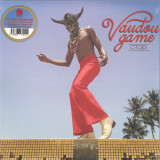
No one had been through those doors in years. Unchanged, seemingly untouched, just a Guard watching over it, one wondered whether the place would ever see the light of day again. Built in the 70s by Scotch, there were only twenty such places in the entire world. Twenty studios, all identical. Most had undergone a digital makeover in the 80s, but not this one; situated in Lomé, this studio had stayed true to its original form. Silent and uninhabited but waiting for one thing, and one thing only: for the sacred fire to be lit once again. That of the Togolese Recording Office, is studio OTODI for those in the know. Through thick layers of dust, the console was vibrating still, impatient to be turned on and spurt out the sound so unique to analog. That sound is what Peter Solo and his band Vaudou Game came to seek out.
The original vibrations of Lomé's sound, resonating within the studio space, an undercurrent pulsing within the walls, the floor, and the entire atmosphere. A presence at once electrical and mystical sourced through the amps that had never really gone cold, despite the deep sleep that they had been forced into. In taking over the studio's 3000 square feet, enough to house a full orchestra, Vaudou Game had the space necessary to conjure the spirits of voodoo, those very spirits who watch over men and nature, and with whom Peter converses every day.
For the most authentic of frequencies to fully imbibe this third album, Peter Solo entrusted the rhythmic section to a Togolese bass and drum duo, putting the groove in the expert hands of those versed in feeling and a type of musicianship that you can't learn in any school. This was also a way to put OTODI on the path of a more heavily hued funk sound, the backbone of which maintains flexibility and agility when moving over to highlife, straightens out when enhanced with frequent guest Roger Damawuzan's James Brown type screams, and softens when making the way for strings. Snaking and undulating when a chorus of Togolese women takes over, guiding it towards a slow, hypnotic trance. Up until now, Vaudou Game had maintained their connection to Togo from their base in France. This time, recording the entire album in Lomé at OTODI with local musicians, Peter Solo drew the voodoo fluid directly from the source, once again using only Togolese scales to make his guitar sing, his strings acting as channels between listeners and deities...
Smalltown Supersound is proud to present our new signing Bendik Giske from Oslo, Norway.
In addition to original track Adjust this EP also contains remixes from Total Freedom, Lotic, Rezzett and Deathprod.
The performance artist and saxophonist's mesmerizing debut takes listeners on a true journey through the euphoria and wanderlust of nights spent clubbing—using little more than his voice, saxophone, his instrument of choice, and more than a few well-placed microphones.
Giske finds a natural home in Smalltown Supersound as he cites Lindstrom's arpeggio sounds and Evan Parker's circular breathing as references, both of whom have released on the label. By combining the two extreme sides of the scale, he seamlessly fuses freeform jazz and club music.
Blumoog Music is glad to receive Edit Select, a remarkable artist known worldwide. In these new two track you will be able to appreciate his magical touch and creativity for electronic music. Edit Select knows how to create a breathtaking atmosphere with his psychedelic style and well defined touches which create these masterpieces that are recognized on a worldwide scale.
To complete this episode, there are also two tracks by M. R. E. U. X Two tracks that define is psychedelic — electronic creations like a sonorous master blacksmith.
These tracks in anagogic style, which is like a brand for M. R. E. U. X will make you beg for more.
The result of these two artists and there creations will confirm the growth and fame of these small label that is slowly making its way to the top. Blumoog Music is ready to blow your mind to a hole new sonorous level!
- A1: Don Drummond & The Skatalites - Rain Or Shine
- A2: The Gaylads - Morning Sun
- A3: Delroy Wilson - Just Because Of You
- A4: Alton Ellis - Sunday Coming
- B1: Jackie Opel - I Am What I Am
- B2: Peter Tosh - I Am The Toughest
- B3: Delroy Wilson - Get Ready
- B4: Mr. Foundation - Timo-Oh
- B5: Roland Alphonso & The Soul Brothers - Provocation
- C1: Leroy & Rocky - Love Me Girl
- C2: Slim & Delroy - Look Who Is Back Again
- C3: The Skatalites - Spread Satin
- C4: Barrington Spence - Contemplating Mind
- D1: Ernest Ranglin - Psychedelic Rock
- D2: Bob Marley & The Wailers - Destiny
- D3: Roland Alphonso - Reggae In The Grass
- D4: Zoot Simms - We Can Talk It Over
- D5: Jackie Mittoo - Hi Jack
Studio One Freedom Sounds Is The New Collection From Soul Jazz/studio One Focussing On The Intense Period In The Second Half Of The 1960s When Studio One's Vast And Unbeatable Output Of Ska, Soul, Rock Steady And Reggae Made It Literally One Of The Hottest Musical Empires In The World.
During This Highly Successful Period, Clement 'sir Coxsone' Dodd Released Hundreds And Hundreds Of Superlative Singles Seemingly On An Almost Daily Basis, In The Process Making Huge Stars Out Of Jamaican Singers Such As Alton Ellis, Delroy Wilson, The Wailers, Slim Smith, Jackie Opel And Many More.
Powered By The Finest In-house Musicians Working In Jamaica, Whether It Was The Skatalites, Jackie Mittoo's Soul Brothers, The Sounds Dimension Or The Soul Vendors, Studio One Functioned As Hit Factory On The Scale Of Motown In The Usa, Shaping And Defining Reggae Music For Decades To Come.
Singlehandedly Studio One's Founder Clement Dodd Was Able To Create The Most Successful Vertically-integrated Record Company That Jamaica Had Ever Known With Pressing Plant, Printers, Studio, Shops, And Sound Systems All Running At Once, With Over 50 Employees And Hundreds Of Artists Working With Studio One During This Time.
Studio One Freedom Sounds Tells The Story Of Studio One In The 1960s With A Stunning Set Of Ska, Soul, Rock Steady And Reggae Killer Tunes As Well As Informative Sleevenotes And Track-by-track Info By Noel Hawks. The Album Is Released As Heavyweight Double Vinyl (+ Free Download Code), Deluxe Cd And Digital Album.
Seth Troxler & The Martinez Brothers' Tuskegee Music welcomes Chicago legend K- Alexi Shelby for a new EP that features some essential solo cuts as well as two great collaborations with Tony Lovlesss.K-Alexi is a genuine Chicago great. He's been at the core of the scene since the eighties and releasing his raw grooves on DJ International, Trax and Transmat, as well as his own K Klassik label. He has recently remixed for Seth Troxler's other label, Say It Play It, but is now back serving up the sort of engaging originals that have made him such an enduring star.
Excellent opener 'Cherry K Moon' is a raw slice of deep and soulful tech. The driving bassline melts your mind as afro percussion and driving drums make for a solid groove below. It's one for the late-night hours that will twist and turn any crowd inside out. The superb 'Dark Smile' is less tense and more house oriented in nature, with preacher style vocals up top and busy kicks down low. Live, chattery hand claps bring an organic feel and synth stabs inject looseness that will get hands in the air.
The pressure then builds through the manic Tony Lovlesss collab 'Anal Probe', a powerful techno track with hi tech drums and taught synths freaking you out as they ride up and down the scale. Their second track together 'Fly Shit' is more playful with radiant synths opening it up to the skies and lively, funky drum programming bringing a real sense of a sun kissed terrace party. Last of all, the standout 'Run With Jackals' feat. A.D.M is another heavily percussive track with rattling toms, vocal chants and hammering hits all adding up to a compelling afro-house rhythm. These are all innovate tracks that explore various different moods and grooves with a real sense of quality.
As The Title Suggests, Joakim Recorded This New Album Last Year At Studio Venezia, The Installation/sculptural Ensemble/recording Studio Created By Xavier Veilhan For The Prestigious 2017 Venice Art Biennale. Built Inside The French Pavilion & Inspired By The Grotto-like Merzbau By Kurt Schwitters, Studio Venezia Had Dozens Of Artists Create And Record There Over The 6 Months Of The Biennale (from Chassol To Brian Eno, From Joakim To Sebastien Tellier), Invited By Xavier Veilhan Himself With The Help Of Co-curator Christian Marclay.
With An Impressive Collection Of Rare Instruments From Medieval Horns To Rare Modular Synths (baschet Crystals And Percussions, A Buchla, A Clavinet...), Studio Venezia Was An Amazing Creative Playground For The Adventurous Musician. Those Instruments Were Captured By A Team Of Sound Engineers In The Best Possible Way Thanks To Nigel Godrich's (beck, Radiohead...) Mobile Studio Loaded With State Of The Art Vintage Recording Gear.
Before Going There In May 2017, Joakim Examined The Instrument List And The Specific Context Of A Studio Open To The Public Within An International Contemporary Art Exhibition To Anticipate His Creative Process. Instead Of Drafting Compositions And Demos Ahead Of The Recording Session, He Decided To Have An in-situ' Approach By Creating A System Involving The Visitors Of The Studio In The Composition Phase. Joakim Asked Random Visitors Of The Pavilion To Pick A Word, A Letter (between A And G), Tap A Tempo And Sometimes Choose The Instruments That He Would Play For Each Piece. The Word Was Translated Into A Chord Using A Transcription Table Joakim Invented. Hence The Song Titles Made Of The Given Word Plus The Name And Origin Of The Contributor. The Music Was Then Mostly Improvised, Based On Those Chords, Scales And Tempi. The Recordings Were Then Taken Back To New York Where Joakim Made Some Light Editing And Mixed The Pieces.
In Terms Of Influences, Joakim Tried To Channel The Spirit Of Proto-ambient German Heroes Cluster, 60s And 70s Modal Jazz, Japanese Evocative Minimalism And Drone Composers' Hypnotic Transcendence.
One Can Hear The Studio Through These Recordings, Which Was The Point, To Use The Studio As An Instrument, Like The Kraut Rock Pioneers Did. You May Hear The Floor Cracking, People Talking Or Coughing, And The Peculiar Quality Of Music Recorded In A Large Space With Its Acoustic Properties, A Rare Occurrence When Everyone Is Now Working From Small Home Studios And Major Large Studios Are Closing Down. This Album Also Marks A Return For Joakim To His Musical Education As A Classically Trained Pianist As You Can Hear Him Improvise On The Piano ( arms', air', dream'), Fender Rhodes ( trust') Or Harpsichord ( absense').
Following The Release Of The Studio Venezia Sessions, Joakim Will Create A Live Performance Based On His Experience In Venice. The Premiere Of This New Solo Performance Is Commissioned By The Villa Medicis In Rome For Their Villa Aperta Festival Early June. More Shows Will Follow.
Tresor is glad to announce the release of Manni Dee's first album 'The Residue', on June 15th.
Based in London, Manni Dee is held in high esteem by many for his spotless production and relentless DJ sets. The gleaming rendition of Manni's creative vision stuns. He knows sounds inside-out, making his studio a favorite stop for many to receive Manni's expertise.
The production of 'The Residue' was inspired by the city of London and its general living conditions. More particularly, how social cleansing, inequality and the political situation generally - and on a holistic scale - informs internal and external locus of control.
'The Residue' is disconsolate, and with such heart-wrenching tracks as 'In Communal Solitude', 'Vicarious Living' or 'Submit. Breathe.' or the mutinous 'At Mercy of the Muse' and 'Paroxysm' Manni Dee clearly cuts out his insurgent statement.
In parallel to his regular DJ schedule, Manni Dee will also take his sonic proclamation in its live PA form out to the most advanced stages starting this summer.
Dynamic composer Neil Cowley is set to release 'Spacebound Tapes' a four track EP featuring remixes of his Trio's 'Spacebound Apes' album ("A miss- this-at-your-peril release" Drowned In Sound 9/10) by Rival Consoles, Throwing Snow, Christian Löffler and Vessels
'Spacebound Apes' was written by Cowley for his trio and long-time bandmates drummer Evan Jenkins and bassist Rex Horan, with contributions from Brian Eno collaborator Leo Abrahams on guitars and FX. A bold exercise in atmosphere and emotion, the album was woven together with some of the most breathtaking, impassioned music that Neil has created. Originally inspired by Arthur C Clarke's 1956 sci-fi book 'The City and the Stars' the album was recorded at Cooper Hall, a studio and cinema set deep in the Somerset countryside with Stanley Kubrick's '2001 A Space Odyssey' running on permanent rotation.
The sci-fi aesthetic is firmly grasped by the four remixers, echoing the theme in their own reinterpretations. The reimagined tracks retain the inventiveness of the originals while exploring progressive but considerate paths. In his version of 'Weightless', Erased Tapes signed Rival Consoles feeds off of the electronic songwriter's critically lauded humanised techno, while rising German musician Christian Löffler brings new dimensions of space and scale to 'Death To Amygdala'. Houndstooth's Throwing Snow delights in deconstructing 'Duty To The Last' with pulsing energy and Vessels' take on 'Echo Nebula' applies machinic facets to the delicate sounds of the original.
Soul Jazz Records' latest album 'Yoruba! Songs and Rhythms for the Yoruba Gods in Nigeria' is newly recorded in Lagos, Nigeria. The album is co-produced by Soul Jazz Records label head Stuart Baker and Laolu Akins (founding member of the legendary 1970s Nigerian Afro-Funk/Rock group Blo). Yoruba! features an array of local master drummers led by Olatunji Samson Sotimirin and singers (featuring the lead vocals of Janet Olufanmilayo Abe) performing heavyweight Afro-rhythms, with talking drums, Bata and Dundun drums and a mass of percussion in these deep spiritual and sacred songs used to honour and worship the traditional and ancient Yoruba gods in Nigeria, West Africa.
The enormous impact of Yoruba and West African music and culture is worldwide - from the first Afro-centric explorations of African-American jazz musicians in the 1950s such as Art Blakey, Randy Weston and Dizzy Gillespie, the explosion of Nu Yorican Latin music in New York City starting in the 1960s - Mambo, Boogaloo, Latin funk and soul - through to the sacred and powerful Afro-derived music of the religions of Santería in Cuba, Candomblé in Brazil and Voodoo in Haiti, which all came into existence on account of the Atlantic slave trade which began over 400 years ago. On a wider scale West African music remains the primary root of all African-American musical forms - from New Orleans jazz to Bronx rap, gospel, soul and more.
This album features songs honouring the Nigerian gods of the Yoruba traditional religion - Yemoja, Obatala, Ogun, Sango and others - as well as a selection of instrumental cuts focussing on the Bata and Dundun drums. The album comes complete with extensive text and photography included in the 40-page outsize booklet/gatefold double vinyl + inners showing the influence of Yoruba culture throughout the world and the social and historical context for the music contained here.
Watch out for a limited edition remix of the project by Osunlade, also forthcoming on Soul Jazz Records.
Solar Phenomena are keeping up a busy and high quality release rate in 2018 with a fifth offering already. This one is a three tracker from STL, who already released his 'If Time Would Move Backwards EP' on the label earlier in the year.
The title track opens the account with blown out drums trudging along in ever changing patterns. Swirling, lo-fi ambience adds scale to the track and encourages you to get lost in the middle of it all. 'Weed Detective' is ten minutes of psyched-out and stripped back drum work at an inviting mid tempo. Keys dance and heavily treated vocal sounds trip you out in slow motion. Last of all, 'Scubbu Babe' has finger clicks, bright and mild crazed keys and ad libbed vocal sounds all doing gymnastics round more of those trademark drums. Once again, STL proves he operates in a world of his own.
Here We Are Releasing The Second Album Of Cologne Born Producer Thyladomid Who Is Familiar To Many Through His Work On Hamburg Label Diynamic Which Has Lead Him To Perform Around The World, Together With Artists Such As: Adriatique, Solomun, Kollektiv Turmstraße, Hosh, David August, Stimming, And Many More. More Then 30 Minutes Playing Time, 6 Tracks And Artwork By Florian Kramer Offer A Lot To Discover. Thyladomid Is Famous For His Forward Thinking Deep Melodic Dance Music Which Earned Him Respect And Support From Many People Of The Scene And Evolved Also In Cooperations With Adriatique And The Singer Mahfoud. You Can Find Two Tracks Featuring Mahfoud On The Album. With His First Album "interstellar Destiny" In 2015 Thyladomid Has Already Changed Towards More Introspective Music And You Will Hear He Has Taken That A Step Further Here. In Comparison To His First Album, "places" Refers To Different Places Which Inspired Him To Write The Album And Offers A Higher Level Of Complexity In The Making Of Music Which Has Helped Thyladomid To Enhance The Moody Quality In A Dazzling Way Sometimes Even Spine Tingling When You Let Yourself Go To Explore The Abundance Of The Trax. As He Said In His Own Words: - the Albums Intention Was That Of An Organic Produced Album With Different Moods. Instruments Such As Piano And And Violin As Well As Field Recording Bring Alive A Special Quality. The Bouncing Of Stones On A Frozen Pond Recorded With Multiple Microphones Suggest For Example An Authentic Spacious Quality. The Self Recorded Percussion, Sometimes Quite Exotic Were Included In All Of The Tracks. The Combination Of Synthetic Sounds With Traditionally Instruments Was One Of The Big Challenges For Me. The Piano And Prophet 6 Und The Moog Sub37 Were The Main Instruments Used For The Album'. Thyladomid Started Working On The Album 2 1/2 Years Ago. His Classical Training On The Piano Helped To Quickly Come Up With A Musical Theme Which Is Based On Different Tonalities Which Were Then Linked To Each Other And Which Actually Helped To Structure The Whole Release. The Good Weather In Summer Was A Good Inspiration And Finally Led To The Idea To Dedicate Tracks To A Certain Place, A Place Which Means A Lot For Him. From That Idea The Title Of The Whole Album Derived: "places ". "a Little Church In Amsterdam" As He Says "is Such A Track Encouraged By The City Of Amsterdam I Love And Respects So Much And Actually Have Spend So Much Time In. It Is A Track I Played Outside In My Garden To Friends And Which Works Perfectly For Me.' "a Little Church In Amsterdam" Is A Track Where Melodies Bloom And Flourish. It Feels Like Zooming In On Nature Grasping A Time Lapse Symphony. "blossoming Limburg Ft Mahfoud" Was Born In The Capital Of Limburg Which Is Located In The South Of The Netherlands And Reflects The Summer Of 2017 And Was Recorded In A Warehouse. It Reflects The Intimacy And Synergetic Level Between Mahfoud And Thyladomid. The Fantastic Deep Vocal Track Is Spiced Up With Lots Of Acoustic Details Which All Happen In The Background But Effectively Surface To Pull The Listener Into His World. "night Owl" Is A Lyrical Dreamy Piano Piece With A Melancholic Note And An Ear For Details. Acoustic Finesse Presented On An Episodic Scale. We Guess The Track Was Influenced By The Works Of Four Tet Or Pantha Du Prince. "kollwitzplatz" Is A Small Park In Berlin's Prenzlauer Berg Which Was Thyladomid's Home For 2 Years . - the Cafes And Restaurants Laced By The Alleys Of The Kollwitz District Resemble A Piece Of Home For Me And Represents The Time Of My Stay In Berlin'. Musically "kollwitzplatz" Is Full Of Life. You Can Hear Children Talking While The Piano Attracts Sounds Like Moths Are Attracted To Light. The Track Offers This Richness Of Percussive Elements And Sound Sources Creating A Stunning Complexity Which Does Not Limiting Itself But Rather Creates This Free Flow Of Acoustic Signals. You Instantly Will Feel: There Is A Lot To Discover At "kollwitzplatz". "underwater Rhapsody", The Title Says It All: It Has That Episodic, Free-flowing Structure, Featuring A Range Of Highly Contrasted Moods, Color And Tonality. What It Actually Means To The Listener Is That Grande Chords Meet Dissonances Of Sound That Fly In Like Drones Cross The Big Time Melodies That Gain A Centrifugal Force At Times... And All This Leaves You Dizzy And Creates Another Big Listening Experience As The Whole Album Is Directed To Entertain You In A Smart And Distinguished Way.
[E b2 | Places Ft. Mahfoud
"It was the most beautiful summer of my life."
Memories — places, vacancies, allusions — are fundamental characters in Mary Lattimore's evocative craft. Inside her music, wordless narratives, indenite travelogues, and braided events skew into something enchantingly new. The Los Angeles-based harpist recorded her breakout 2016 album, At The Dam, during stops along a road trip across America, letting the serene landscapes of Joshua Tree and Marfa, Texas color her compositions. In 2017, she presented Collected Pieces, a tape compiling sounds from her past life in Philadelphia: odes to the east coast, burning motels, and beach town convenience stores. In 2018, from a restorative station — a redwood barn, nestled in the hills above San Francisco's Golden Gate Bridge — emanates Hundreds of Days, her second full-length LP with Ghostly International. The record sojourns between silences and speech, between microcosmic daily scenes and macrocosmic universal understandings, between being alien in promising new places and feeling torn from old native havens. It's an expansive new chapter in Lattimore's story, and an expression of mystied gratitude. A study in how ordinary components helix together to create an extraordinary world.
Awarded a residency at the Headlands Center for the Arts, Lattimore spent two summer months living with 15 fellow artists — writers, playwrights, musicians, poets, painters, activists, curators — in a cluster of old Victorian military buildings on the Northern Pacic Coast. Days offered solitude, Lattimore set up in a spacious barn, able to arrange her instruments at will. Nights welcomed new perspectives. "Hanging out with a lot of accomplished artists with poetic ways of looking at the world was really inspiring. My heart was in a bit of a tangle after leaving Philadelphia. I was holding onto things instead of moving forward. My time there was a nostalgia detox, a way to press reset in a healthy way. Also breathing in the freshest air in America, straight off of the ocean, felt good."
Throughout the shifting locales there is one consistent companion Lattimore engages: a 47-string Lyon and Healy harp. The instrument wires directly into her psyche. Pitchfork's Marc Masters posits, "she can practically talk through it at this point, she's created a language." The space and stillness of the Headlands afforded Lattimore freedom to her expand her vocabulary, to stretch out and experiment with layers of keyboard, guitar, theremin, and grand piano. Lattimore's voice sweeps beneath the plucks and washes of opener It Feels Like Floating,' enraptured by the winding current, and reappearing in the second minute of the immense "Never Saw Him Again." The track elevates towards a shimmering apex of static and percussion before organ drone yields to signature halcyon utters. As with much of Lattimore's work, the track titles are telling, "Baltic Birch" is a somber windswept march that sways gracefully out of step, a remembrance of a recent trip to Latvia where she was struck by the abandoned resort towns along the Baltic Sea. Hello From The Edge of The Earth' is an earnest reection of Lattimore's love of the natural world, recognizing the thresholds of varying terrains.
The album's fth track borrows its name from Lattimore's favorite line in Denis Johnson's short story Emergency' from Jesus' Son. A character, lost in a blizzard, reassesses a disjointed universe, a clash between curtains of snow and angels descending out of a brilliant blue summer: it isn't an apocalypse, it is a drive-in movie, with stars hovering above the lot, off the screen, in the throes of the Midwestern storm. This mix-up is disorienting and existentially tragic, Lattimore's darkly strummed piece is a melancholic parallel, mimicking Johnson's elegant suture attaching two remarkably discontinuous spaces.
Micro-revelations, not quite as bright as torn skies but nonetheless enlightening, were everyday occurrences during Lattimore's residency. Living small days with small tasks — feeling little dramas within the arcadian universe of a national park — rendered her the sense that disjointed spaces can be interconnected no matter the enormity that divides them. It's in this elastic scale of perception that something as simultaneously simple and intricate as Hundreds of Days can ourish.
- Second solo album for Ghostly, past releases on Thrill Jockey
- Recently toured w/ Sharon Van Etten, Jarvis Cocker, Kurt Vile, Steve Gunn, Julia Holter, Iceage
- Mary Lattimore has been featured on Pitchfork, NPR, The Wire Magazine, and more
"Hi again!
It's been a couple years, but I've put together a new record, this time with my neighbor Stu and a few other friends. Stu's been tuning the piano Linda and I were using for our Lejsovka & Freund and Trouble Books recordings, and I've always enjoyed the test scales and vignettes he would run through checking his work.
I floated the idea to collaborate on a sort of 70s/80s ECM kinda vibe, and soon started bringing my laptop and a couple microphones over to his house to collect his improvisations and have him add to pieces I had started. Other friends from the neighborhood dropped by to add parts here and there as well.
The recordings were made primarily in the summers of 2016 & 2017 (with a break in-between to mourn the triumph of neo-fascism as well as the passing of beloved pets). Ultimately I tried to follow the feel of those summer nights and the tranquility they offered. Open air or at least open windows, drifting along, you know"
-KF, Spring 2018.
Aqueduct Ensemble is a collaboration between Ohio based artist Keith Freund - who has previously released music as part of both Lejsovka & Freund and Trouble Books - and his neighbour Stu, who is a piano tuner and professional pianist. Their debut album together, "Improvisations On An Apricot" is the second release from label Last Resort, and follows G.S Schray's "Gabriel" (2017) - the sleeves for which were both designed by Keith, who does does all the art direction for the label. Beginning life in 2013 as an NTS radio show of the same name, Last Resort is run by Tom Cathcart from his home in London.
The optimum effect of Music of the Five Elements will be achieved if each side of this recording is played through, from beginning to end without interruption. Music of the Five Elements, when used as a meditational or body work tool, rather than entertainment, will increase in effect over time. Overplaying or improper use, however, may eventually diminish its designed effect'
.
Music is the healing force of the universe. It's an ancient idea bandied about by Pythagoras and Plato. In the last century, music as medication has been explored by musicians as diverse as Albert Ayler, Spacemen 3 and Pauline Oliveros. Nowhere did this concept gain more traction than in the so-called realm of New Age Music, an entire movement of synth droners and echoey flautists recording home-baked healing mantras on 4-track. In recent years, thanks to cassette collecting devotees and open-minded music journalists, New Age has shed its flowing robes and is being mined for the truly incredible music that swells under its pastel surface. Musician/acupressurist Sam McClellan's 1982 Music of the Five Elements is one of those revelatory discoveries, an unrivalled work of intense research and focus, simultaneously a near perfect work of art and a scientifically sound elixir for body and mind.
After studying electronic composition at Hampshire College with Randall McClellan (no relation), Sam McClellan became intrigued with the possibilities of healing through music. He explored this idea by applying the ancient Chinese philosophy of medicine to the principles of musical composition. Using the pentatonic scale (the traditional scale of Chinese music), McClellan related each of the notes to one of the five elements (Wood, Fire, Earth, Metal Water), and created five variations for each. He experimented with tempo, beat, pitch, duration, and sound quality, studying the effect on people's energy levels. Using the results of his tests he developed a comprehensive theory of sonic healing and spent the next year composing an album designed to help people achieve inner balance, reducing anxiety and energy depletion.
Music of the Five Elements is not only the acoustic massage' that McClellan set out to make, but is a fully realized and peerless piece of music. Taking cues from Minimalism, American Primitive guitar (Fahey & Basho) and even psychedelia, the album is a continuous sound voyage for voice, synthesizer, guitar, bowed bass, piano, effects and ciao (Chinese flute) all played by McClellan himself. Although divided into sections, the journey is best undertaken as a whole, without distraction.
This August sees Stone Foundation release their fourth studio album 'A Life Unlimited' featuring ten new original recordings.
Last year's album 'To Find The Spirit' was easily their most successful seeing the band reach No. 33 in the Independent Charts, receive regular Radio 2 play, achieve glowing reviews in The Mirror, Scootering, R2, Jocks & Nerds magazine and saw the band tour Japan twice where the huge attendances helped secure them a recording contract with the prestigious P-Vine label and an appearance at Fuji Rocks festival.
'A Life Unlimited' features contributions from Graham Parker (The Night Teller), US soul stalwart Nolan Porter (Beverley), vocal harmony group The Four Perfections (Pushing Your Love) and Blow Monkeys frontman Doctor Robert
Howard (A Love Uprising). 'A Life Unlimited' sees Stone Foundation develop their unique style of soul, funk & jazz to a much broader scale. Horn driven arrangements add colour to an inspired display of songs that are unquestionably the group's strongest to date. Thought provoking lyrics and strong melodies sit upon a stylish musical bed.
The first single from the album 'Beverley' was the title music in the award winning (best film at the Portobello film awards & East End film festival ) Cass Pennant & Alexandra Thomas film of the same name starring Vicky McClure (this is England) and Laya Lewis (Skins)
"The kind of melancholia I'm talking about, by contrast, consists not in giving up on desire, but in refusing to yield. It consists, that is to say, in a refusal to adjust to what current conditions call 'reality' - even if the cost of that refusal is that you feel like an outcast in your own time." (Mark Fisher, Ghosts Of My Life, Zero Books 2014, p. 24) In Ghosts of My Life: Writings on Depression, Hauntology and Lost Futures', the author Mark Fisher outlines - to put it in a big way - a resistant melancholy. This stands in contrast to leftist melancholy resignation', as well as something which Fisher does not talk about: its common masculine counterpart, habitual post-left cynicism - as in seen it all before'. Fisher calls this hauntological melancholy. Haunting, spooks, ghosts and apparitions are an almost constant presence on I Started Wearing Black', the second album by the Cologne-based artist Sonae (pronounced so-nah'). The term hauntology shares a fate with retro-futurism when it comes to inflationary overuse and abuse. It's a conceptual container that looks good and can hold a lot, indeed, too much. Furthermore, hauntology has its peak season behind it, a term on the threshold of its expiration date. Nevertheless, I would like to rehabilitate hauntology and use it properly to characterize I Started Wearing Black', because the term is rarely as compelling to describe music as is the case here. The most recent other example could be Asiatisch' by Fatma Al Qadiri, but with a completely different frame of reference. What are the ghosts of this music It rustles, crackles, ruffles, crunches, rattles, scrapes, sometimes a beat emerges from the constant noise, sometimes an obscure voice mumbles incomprehensibly, sometimes a melancholy piano figure is prevented by this noise from coming too much to the foreground. It definitely is eerie - to bring into play another term used by Fisher in the title of his latest book, The Weird and the Eerie'. In British pop-jargon, eerie first occurred to me more often when referring to particularly leftfield, spooky and... well... ghostly dub, a bass-heavy, echoing noise, from Augustus Pablo to Creation Rebel to Burial. Unlike the Wald & Wagner records by Wolfgang Voigt, Sonae is not a kind of neo-romantic veiling with a tendency for escapist nebula. It is more a noise of latency. The noise signals a latent - not necessarily acute - threat, a latent uneasiness about... yes... about what About a System Immanent Value Defect' That's the name of a track on I Started Wearing Black' where something that sounds like a French Horn (or a foghorn) battles for attention through or against the background noise. An email from Sonae: The piece 'System Immanent Value Defect' should actually be called 'I See Turkey'. I wrote it for my fellow student Elif - she is a pianist and Gezi Park activist from Istanbul. Through her I witnessed the inner conflict and agitation that political circumstances can create: her feelings of guilt when there was an attack, with her safe in Germany as a student, watching the events from afar. It was horrible. When her mother begged her not to come home because she feared for her safety, I felt a cold shiver run down my spine. I started with the piece from this mood, beginning with the piano, then the noise (modulated sinusoidal curves), which reminded me of waves and the then heatedly discussed Mediterranean sea: atmospheric, melancholy motifs. In contrast is the anger, the pressure, represented in corresponding sounds - hopefully audible! - During this time I started to think about world views as they can be found around the globe, in how far they held by societies and their political representation. I realized that I know of no political system that is actually about the people and what would do them good. It's always about positions, power, money. I thought that was a lot more frightening on a global scale than merely viewing Turkey in isolation. That's why the piece is called "System Immanent Value Defect", because our world suffers from precisely that. Everywhere, it's all about the wrong things.' Between the wrong things there are happy moments. In the title track, after 184 seconds of rattling and hissing, a beat is unleashed, like an arrow released from a spanned bow, a beatific relief, if there is such a thing. White Trash Rouge Noir' first meanders along spookily, then after 144 seconds it transforms itself into a distant cousin of Einstu¨rzende Neubauten's Yu¨ Gung', but there is no Big Male Ego to be fed here, and the black in the album title is a completely different type of black from that of the Neubauten. Furthermore, I Started Wearing Black' was finished long before the black dresses were worn at the Golden Globes as a sign of protest against sexual violence. Sonae writes that she herself started wearing black some time ago. Her reasons are so-called personal ones: ... resulting from an individual situation (lovesickness), I started to wear black (gaining weight and feeling ugly).' The political dimension of gaining weight, feeling ugly and therefore dressing in black in I Started Wearing Black' lurks within the noise and never becomes explicit and only rarely manifest - or a manifesto. Sonae writes about the track We Are Here': A piece for minorities... in this case, considering the current pop-feminist discourse, explicitly for women. Female artists have long been saying loud and clear that 'we are here' and 'electronic music is not a boys club!' But this pop-feminist moment should only be seen as one part of the dedication of the piece. It is for minorities, for the oppressed, who didn't belong enough.'
Klaus Walter
- A1: Tizita (10:00)
- A2: Addis Nat (04:34)
- A3: Gum Gum (06:47)
- B1: Anchihoye Lene (07:06)
- B2: Lala Belu (04:42)
- B3: Yefikir Engurguro (06:15)
First new LP in over 15 years. Builds on 3 successful ATFA reissues of Mergia's music. Legendary artist still active after decades of historic work. Modern Ethiopian jazz built on ancient scales and standards. Capping several successful years traveling the world performing to audiences big and small, Hailu Mergia's Lala Belu has been a long time coming. It builds on Mergia's remarkable career resurgence over the past few years. Beginning in 2013 with the reissue of his dreamy Hailu Mergia and His Classical Instrument followed by the enormous success of his seminal Ethio-jazz masterpiece Tche Belew and continuing with last year's widely acclaimed Wede Harer Guzo, Mergia has received considerable accolades from listeners and press globally, including The New York Times, Pitchfork and The Wire. His old recordings are cherished revelations for Ethiopian music fans; however, Mergia's return to the stage has been just as inspiring and electrifying. Mergia's vintage recordings are known for an inherently mysterious and worn-in quality, while his new recordings echo his band's 21st century live show with modern instrumental interpretations of crucial Ethiopian standards and Mergia's own original compositions. Tony Buck (drums) and Mike Majkowski (bass), who have backed Mergia on tour throughout Europe and Australia, form the bass-drums trio on the recording. Having played venues from Radio City Music Hall and the Kennedy Center to jazz festivals, rock clubs and DIY spaces all over North America, Europe and Australia, Mergia and Awesome Tapes From Africa want to document this moment in his landmark career with a snapshot of Mergia's current sound. Since he emigrated from Ethiopia and built a life in Washington, D.C. around 1981—where he remains working as an airport taxi driver when he is not on tour—Mergia's career has followed a humble trajectory. He made a few recordings in America but they didn't easily reach fans back home. He kept making music on his own and with friends but after the early 80's his gigs in the U.S. mostly dried up. It wasn't until he began working with Awesome Tapes From Africa and putting together bands with the help of booking agents and musicians in Europe and the U.S., that he was able to chart a new path. With a broad audience of young listeners in diverse venues and distant locales, at age 71, Mergia is enjoying his comeback and is not slowing down.
Seeking the overwhelming vibration of the genuine sound wave and its profound echo on the soul, Kenneth James Gibson has spent his career experimenting under a variety of aliases like as many brushstrokes to an ever polymorphic palette - successively releasing as (a)pendics.shuffle, Bell Gardens, Reverse Commuter, dubLoner, Kenneth James G., KJ Gibbs, Bal Cath, Eight Frozen Modules, and Premature Wig... the list is long. Near to two years after his first incursion on Kompakt with his third studio LP 'The Evening Falls', Gibson returns with 'In The Fields Of Nothing', his second full-length delivery for the Cologne-based imprint.
A piece of intricate scales and moods, by turn streaming with the quiet flow of a small meandering rill, then suddenly veering off into an oceanic kind of tumult, 'In The Fields Of Nothing' was conceived as a proper film soundtrack with its rhythmic ebb-and-flow and deep sense of immersion, pulling the strings to an imaginary scenario where the uncanny rubs shoulders with a minute care for the immersion and deep emotional involvement of its whole.
Like entangling multiple levels of consciousness through a millefeuille of textures, piano and strings as well as a flurry of subtly FX-soaked instrumentals, Gibson reflects on his new album - created and recorded right after 'The Evening Falls' came out - as hugely inspired by the lushly forested mountain landscapes of his home region, the bewitching Idyllwild, California. With each track being an essential petal in the narrative corolla figured by Gibson, it's a breathing forest of sounds that deploys, bearing the memories of Kenneth's early morning and late night wanderings in the wild, alone and not, with the ancient trees' vital force for main companion.
An attempt at capturing a slice of these ephemeral sensations felt when striding along across the steep ridges and stony paths of the San Jacinto mountains, staring at the star-studded dome or gazing into the quiet horizon at dawn, 'In The Fields Of Nothing' eludes the single genre encapsulation, opting for the all-embracing openness of scope as it hops from droney melodic interplays ("Her Flood") and roomy string-laden folk drifts ("Further From Home") through Ligetian webs of sound ("Thirsty Lullaby", "Fields Of Everything") and poignant threnodies ("Unblinded"), onto sorrowful pop ballads ("Far From Home") and lulling ambient scapes ("To Love A Rotting Piano", "Plastic Consequence")
Seven years ago, Unbalance created his own label as a base for his musical ideas; a platform to play around with the conception of what "techno" is and would be alongside his own creative progression. Come to present day and the label is now at its ninth release, reaching a point where the line of accumulated experiences must be drawn in the sand — and the experiences of previous projects and releases lead to venerable conclusion.
Enter Ten, an album of internalized strife that was created during a period of big changes in the artist's life. Between enduring personal experiences, his creative output veering between his straightforward club eccentricities and subdural sensibilities; Unbalance cultivates a symbiotic link between sounds played and sounds portrayed — whilst paying tribute to the essence of groove, vibration and the hypnotic unknown that exists to balance the scales. This album will be the final point in the label's journey into the depths of multifaceted techno music.
Following up 'Drawn With Shadow Pens' on Spectrum Spools, Belgian sound artist Yves De Mey returns with 'Bleak Comfort', his third solo full-length. Geared towards serving up an intense musical experience, the album deconstructs regular club music to highlight some of its key elements in a transformative way.
An album about absence, malfunction and disorientation, 'Bleak Comfort' is equally packed with floor-functional material and left-of-centre electronics. By turn sizzling and spherical, convulsive and atmospheric, Yves De Mey ushers his listener in a hypnotic kaleidoscope of sounds, providing a fascinating picture of his ever dynamic grammar at variable scales and tempos.
Two Dutch institutions in Delsin and 2000 And One team up for a reissue of the 1994 EP Belongings. It was an early release on 2000 and One's influential 100% Pure label and found him in full on space-techno. The EP has been fully remastered and sounds as gloriously futuristic now as it did more than 20 years ago. 'It Belongs To Me (Version)' is an intergalactic techno track with pads drifting off to an infinite horizon as a soft acid line burrows into the big, icy hi hats and punting drums. It's perfectly spacious and sombre, while 'It Belongs To Me (Reprise)' is a much more downtempo and thoughtful version of the track where pained leads synths take the lead and the drums are off in the distance. It's the sound of resignation and dejection in techno form. 'Crystal' then layers in new age harmonies as classic dusty break beats do their dance below. Again the synths are smeared and grand in scale and the whole thing feels like a blissful rave comedown. Last of all, 'Bowed' is a happy and manic melodic track with warped bass and fluttering snares that carry you away to the stars.
'Coscienza Cibernetica' comes out with a remarkable Mannella's A side - here presenting his new live project as DAHRAXT - flavoured by a rare remix from one of most solid electronics music pillar: Tobias. (Ostgut Ton / Non Standard Production).
On Mannella's version, deconstructed vocals scurrying up and down the scales, muscular drum machine and razor-sharp synths, take over the atmosphere.
Tobias. strip it down, showing all his intimate post-punk background on a clever, steady and 'non-standard' vision of what electronic music can be.
Alongside De Gama, Pierandrea The Professor aka Les Inferno is the man behind the much-loved Samosa imprint. A DJ for over 30 years, 'The Professor' is well known in his native Italy as a true vinyl connoisseur, a fact that's no doubt attributable to a seventy-thousand strong vinyl collection.
And so it is that he pipes up with the label's latest. Under his Les Inferno alias, Pierandrea concocts two classic jams (and two neat interpretations of each). A full-scale disco explosion, the EP is a treat for fans of sun-kissed house, the likes of which is sure to win plaudits from DJs such as Prosumer, Hunee and Ben UFO.
The action kicks off courtesy of the original Everything I Do'. Produced with an obscure disco sample at its core, it's a dreamy anthem with roots that will speak to fans of vintage Loft records especially. Effortlessly simple but devilishly catchy, it's the perfect tonic with which to help ease the autumn blues. The 'breakdown'
version strips the original of its vocals, allowing the drums to take centre stage alongside its gorgeous melodies.
On the flip, What Do You Think' goes even funkier still, with its dancefloor prowess epitomised by a vocal that wouldn't sound of place in Paradise Garage. A truly momentous record, it's sure to unleash pandemonium on any DJ it's allowed to let loose on. If you're after something similar but without the campness of the original,
there's a dub version that ought to do the trick. A stunning release throughout.
Never before reissued, this legendary 1968 EMI recording is a revered Indian jazz rarity, a collectors' holy grail. Raga Jazz Style is an original Indian excursion into Indo-jazz fusion. A one-away recording from the almost unknown Bombay jazz scene, it is among the few jazz LPs to hail from the subcontinent.Closely contemporary with the UK-based explorations of Amancio D'Silva, John Mayer and Joe Harriott, Raga Jazz Style takes the melodic, scale-based raga system of Indian classical music and marries it with a swinging jazz rhythm section assembled by Bollywood's most highly acclaimed musical directors, the soundtrack composing duo Shankar Singh and Jaikishan Panchal.Singh and Panchal were a dominant force in Hindi film music from the late 1940s onwards. Shankar had been trained in classical tabla, while Jaikishan was an expert harmonium player. They worked together on well over a hundred films, and their innovative compositions and orchestral scoring revolutionised the music of the nascent Bollywood industry. Central to their sound was regular collaborator Sebastian D'Souza. From 1952 onwards, D'Souza would work on every Shankar Jaikishan soundtrack, eventually becoming Bollywood's most coveted musical arranger.
Originally from Goa, D'Souza had cut his teeth in the dance-band era, arranging and playing with his uncle's jazz bands in Lahore and Quetta. After Partition, he had moved to Bombay to follow the reliable work provided by the film industry, where Goan musicians had become the mainstay of Bollywood's film studio orchestras. Goans were also the core of Bombay's thriving dance-hall and hotel-based jazz scene, with artists including saxophonist Braz Gonsalves, guitarist Amancio D'Silva and trumpeter Chic Chocolate all working in the city during the post-war years.
The team assembled for Raga Jazz Style were drawn from this inventive and forward-thinking milieu. Pianist Lucilla Pacheco, saxophonist Manohari Singh and guitarist Anibal Castro were all fixtures on the Bombay jazz circuit, while drummer Leslie Godinho is reputed to have taught Joe Morello the 5/4 'Take Five' beat when they jammed together during Dave Brubeck's State Department tour of India. To this jazz backbone was added the sitar of Ustad Rais Khan, scion of long line of classical instrumentalists, and nephew of the renowned sitarist Ustad Vilayat Khan. Bombay's jazz modernists had been experimenting with the fusion of ragas and jazz since the 1950s, long before American or British jazz musicians had tuned in to Indian classical music. But very little of this exciting scene was ever captured on record. Raga Jazz Style offers a rare chance to hear the innovative sounds of the Indian jazz scene, as peerless composers Shankar Jaikishan and arranging supremo D'Souza join with veteran Bombay jazzers to explore classical themes in a jazz setting — eleven ragas to a swinging beat!This is a highly impressive inaugural salvo by Outernational Sounds, using original masters and beautifully rendered facsimile artwork, with 180g vinyl pressed at Pallas, in Germany.
Following his acclaimed collaboration on Strut with The Heliocentrics, the Father of Ethio jazz presents his brand new studio album, 'Mulatu Steps Ahead' for 2010! The album explores new directions in fusions of Western jazz with Ethiopian modes, moving forward the pioneering sound Mulatu developed during the '60s and '70s, showcased on the recent Strut compilation 'New York * Addis * London'.
For the new album, tracks were recorded with members of Either/Orchestra in Boston, with contributions by traditional Ethiopian musicians in Addis, members of The Heliocentrics and some of the UK's leading jazz and African players during the final sessions in London in November 2009.
Each track on the album tells its own story. The reflective, opener, Radcliffe, was composed specifically for the Radcliffe Institute during Mulatu's time lecturing at Harvard in Boston - the original score is now framed on the wall there. The Way To Nice was written and arranged on the tour bus during Mulatu's recent French dates - "with this track, you are travelling on a long journey, talking and thinking" explains Mulatu. "It was inspired by the many beautiful places on the coast road around Nice." Assosa adapts traditional music from the Assosa tribes in North-Western Ethiopia and Mulatu's Mood re-works a Mulatu jazz fusion composition from the early '90s into a new swinging Afro highlife arrangement. "I wanted to use West African styles within this version and try new ways of using the beautiful sound of the kora." Boogaloo and I Faram Gami I Faram reprise Mulatu classics with new, fuller scores and bonus digital track Derashe highlights the traditional diminishing scales of the Derashe people of Southern Ethiopia, a musical technique that would later feature in the classical compositions of Debussy and the jazz of Charlie Parker. "Many debate how this music developed but the Derashe have played these scales for centuries. It is an untold story."
For all of his life Berlin based musician Drei Farben House has been thrilled by the artistic concepts of repetition and modifying resemblances. Small but precise and perceptible variations of (musical) themes have been fascinating him throughout his life as a lover of dance-infused Pop. The artistic concept of handwriting has been questioned in the world of fine arts with some justification, but Michael Siegle aka Drei Farben House has remained a strong advocate of this artistic principle which in his view has resulted in so many impressive musical expressions in the history of Soul and Disco --reference points which have been particularly important to Siegle's creative work. The album's sleeve shows the 'Doris and Norman Fisher House' in Hatboro (a suburb of Philadelphia) designed by Louis I. Kahn from 1960-1967. Kahn, based in Philadelphia and one of the most influential architects of the twentieth century, was already in his sixties and progressively getting famous around this time for his sensitive combination of concrete and brick in larger scales. The almost spiritual sensibility of his buildings and his poetry of light created deep, fundamental connections between the spaces and their inhabitants. New Release Information "Every building must have . . . its own soul", this famous quote of Kahn can easily be seen in the modest and wonderfully warm Fisher house which consits of two intersecting cubic volumes created from cedar wood - finished at the same time when only twenty miles away the newly founded Sigma Sound Studio recorded the Delfonics first record, installing the basements of Philadelphia Soul which was later leading to Phillysound, Disco and House.
Espen Beranek Holm is a Norwegian musician and comedian, born 1960 and began his music career as a clarinetist. Inspired by early synthesizer bands Kraftwerk and The Residents, he began making experimental pop music. His debut single Dra te' hælvete' was released in 1981 and was immediately banned by national TV/radio channel NRK due to explicit lyrics. This gave the young artist tons of publicity, helping the single spend almost 6 months on the national charts.
Beranek returned to the Starholm Studios in Oslo from June - September 1981 to record nine new compositions. His debut album, Sound of Danger', was released on Mind Expanding Records in November 1981. Nowhere near as accessible as the previous single, the album fared poorly commercially. Withdrawing from the single's fun, kitsch pop, the album is cool and static, driven by thin rhythm boxes, cold synths, and glacial guitars. Taking heavy cues from David Bowie, all of the songs are sung in a nasally English accent, a rare occurrence in Norway at the time. The lyrics are melancholic, but tinged with paranoia. There are also upbeat tracks that evoke a prog or glam sensibility a la King Crimson, Alan Parsons, or Roxy Music.
All songs have been remastered for vinyl by George Horn at Fantasy Studios in Berkeley. Housed in the original jacket featuring red, black, and white lines that evoke a visualized Richter Scale designed by Monica Moltzau. Each copy includes a 2-sided 8x11' insert with lyrics and an autographed press photo of Beranek.
Stirred up from deep within, from an abstract spiral of sound and movement, from a sensation of time and space absolving and converging at once, the Black Flower musicians have molded a tangible matter: the album Artifacts. Their second full album sounds international and ageless. Eastern influences, Ethiodub and jazz effortlessly merge. Fantasy and reality seem to fuse. In a word: nourishment for body and soul.
"Psyche-delicious and accessible 20th century Ethiodubjazz. As if John Zorn put on Fela Kuti's shoes and imbibed Mulatu Astatke's whirls."
Piloted by saxophonist /flutist /composer Nathan Daems (Ragini Trio, Dijf Sanders, Antwerp Gipsy-Ska Orkestra), this instrumental band aims for originality. Fellow musicians and 'brothers down the road' are Jon Birdsong (dEUS, Beck, Calexico) on cornet, Simon Segers (Absynthe Minded, De Beren Gieren, Stadt) at the drums, Filip Vandebril (Lady Linn, The Valerie Solanas, Antwerp Gipsy-Ska Orkestra) at the bass and Wouter Haest (Los Callejeros, Voodoo Boogie) playing keys.
For many of us, the Ethiopian aspect once made known to the world by Mulatu Astatke will stand out. Still, Black Flower further adds oriental scales, Afrobeat à la Fela Kuti, jazz in a John Zorn way and varied western music traditions such as rock and dub. The resulting melting pot is undoubtedly inspired by Nathan's distant travels and the multifariously colorful city of Brussels.
...Pretty legit if you ask me - LeFto, Studio Brussel
After their well-received debut album Abyssinia Afterlife (2014, W.E.R.F. / Zephyrus Records) that created an atmosphere of mythical figures and psychedelia, Black Flower now reflects on ancient and modern cultures. The album title Artifacts refers to centuries-old fragile objects or tools that empowered the development of human culture. The world today would look entirely different without those artifacts. The seemingly brittle suddenly becomes a powerful welding cornerstone. Add the musicians' personal musical backgrounds and the result is an album with an ageless mystique. Artifacts is the synthesis of different cultures, of the past and present, and personal and collective memories. It is the soundtrack to modern reality, based on the elements that connect us.
Brilliant - Gilles Peterson, BBC Radio 6
One of Belgium's Best Bands of these past years (...) Black Flower does not simply play a tune, they always groove! - Kurt Overbergh, Ancienne Belgique
Uncomplicated originality, plenty of space for fantasy and an organic tone: those are the ingredients for Black Flower to lay claim to an age-old human ritual: dancing! Still, Black Flower also stands out in various other settings. Their audience at a jazz club will have felt exalted, their audience at a late-night show will not have resisted dancing. The band wields influence over their surroundings in a way only heart-and-soul musicians can. This mastery has repeatedly taken them to United Kingdom, France, the Netherlands and Germany.
the half Mexican half French drum and bass label, based in
both country, and launched in 2016, created and owned by
Joaquim Plossu in order to release deep and liquid jazzy
music @ 170 bpm, and also at other tempos. Sable Noir
Recordings provides us with a platform to release quality
music.
Black Truffle is thrilled to announce Reverse Tree, the new LP from the acclaimed duo of Eyvind Kang and Jessika Kenney, two musicians who have established themselves as powerful voices working at a unique intersection of contemporary composition, improvisation, and Asian traditional music forms. Either individually or as a pair, they have worked in contexts ranging from performances of traditional Persian and Javanese music to collaborations with Sunn O))), but their work together as a duo (documented on The face of the earth and Aestuarium, both released on Ideological Organ/Editions Mego) most clearly represents the central concerns of their diverse practices: a music of the inner life of sound, demanding ritualistic focus and promising heightened sensations.
On Reverse Tree, the duo expand their work together into the realm of the chamber ensemble, presenting two side-long works that feature Kenney's voice and Kang's viola alongside a multitude of other instrumentalists. Kang's Thoughts on Being Exiled to the Frontier, for Lord Wei, inspired by a text by the Tang dynasty poet Hsueh T'ao, features an all-star international ensemble: Kang, Kenney, maverick Israeli conductor Ilan Volkov on violin, Icelandic cellist Hildur Guðnadóttir, and guitarists Oren Ambarchi and Stephen O'Malley. The piece is primarily composed of irregular patterns of pizzicato notes and guitar harmonics, gently falling in and out of sync and providing a subtly unstable support for Kenney's voice, which sings long, wavering tones, at times reminiscent of Michiko Hirayama's classic performances of Scelsi. Drawing on 20th century instrumental techniques, alternate tuning systems, non-western music and the experience of nature (the irregular rhythms of the piece calling to mind nothing so much as drops of rain), the piece opens a space both serene and subtly uneasy.
Kenney's 'Elm features Kenney and vocalist Nova Ruth (of Filastine & Twin Sista) alongside an ensemble of strings and Seattle's Gamelan Pacifica, performing on Javanese instruments tuned to the slendro scale. An uncanny timbre created by bowing the keys of the Gamelan's instruments, supported by bowed harmonics from the strings, is heard consistently throughout the piece. After a long introductory section in which this harmonic cloud slowly descends from shimmering high notes to rumbling bass, the vocalists enter, singing a slow and stately setting of a 19th century Surakarta poem (attributed to Mangkunegara the IV). The melody is sung as a rich and wavering heterophony, with the ensemble sometimes rising up to support individual notes. The poem deals with the idea of a form of knowledge achieved through deeds, as a practice and state of the heart. This is music in slow motion, in which, in Kenney's words,
Wally Badarou was at the cutting edge musically with his fusion of African grooves with the emerging electro sounds of the early 1980s. His debut album 'Back To Scales' in 1980 has been long out of print and is considered a treasure by many connoisseurs.
Wally plays synthesizer, co-writing and performing Level 42 often considered their 'fifth member'. He also played with Robert Palmer, Talking Heads, Foreigner, Grace Jones and Manu Dibango. He also known for a later hit single Chief Inspector', and Mambo' from the same year (1984) was sampled by Massive Attack
This is a great album deserving appreciation by a wider audience with such an amazing collection of important songs. It was recorded in France, the country of his birth, originally released on French label, Barclay
THE ASSISTENZ is the culmination of a four year creative hot streak as vivid as any part of CRISTAN VOGEL's long career. The trio of dance oor-oriented records formed by 2012's The Inertials, 2014's Polyphonic Beings and now THE ASSISTENZ are sensual pleasures rst and foremost: a lifetime of study of frequencies and rhythms on the frontline of the world's clubs has been put into the creation of sounds that interface with the nervous system and emotional re- sponses with extraordinary immediacy. But there's much more too: together with the more ab- stracted album Eselsbru¨cke, these form an enticing sonic narrative, encoded themes running through them, each part revealing more about the whole. THE ASSISTENZ, then, is many things: a personal document, a tribute to Copenhagen where it was recorded and after whose famous cemetery it is named - but also the nal piece in this bigger puzzle, which unlocks untold secrets from the previous three records.
There's a deeper history, of course. CRISTIAN's productions going back to the start of the 1990s have woven their way into the fabric of underground culture. His own recent remasters of his early albums, and the Sub Rosa Classics 1993-1998 collections have shown just how potent his early work remains. But his new work exists in a very different world to those past works, and is far removed from the recent electronic generations who he has in uenced too. In fact, as you listen to THE ASSISTENZ, you realise that there's no point making comparisons with other elec- tronic producers at all. While you will certainly hear some of the most fundamental and enduring vectors of underground music - dub, electro, acid, funk - owing through the tracks, even those things are rebuilt from the molecular level, created completely afresh with new, precise, but some- what skewed vision.
CRISTIAN's understanding of music now is spectral. That is to say, with every step through his exploration of sound over the years, he has made more and more detailed analyses of the specif- ic frequencies that make up speci c sounds and produce speci c effects on the human mind and body. And as a result, his own sound synthesis - increasingly done via the Kyma programming platform - is more and more able to reach beyond the 'synthetic' and impact in uncanny and wonderful ways. The most obvious sense of this is the way his sounds touch on the human voice: not just in the chattering, shimmering, singing tones of THE ASSISTENZ's ghostly centrepiece 'Barefoot Agnete', in the alien radio signals of 'The Merman's Dream' or even in the subliminal 'aaah's hiding in the background of the noisy 'Vessels', but in the way any sound, anywhere in any track can sound peculiarly vocal, heard from the right angle.
And it's not just the boundary between human and non-human, or that between acoustic and synthetic, that get blurred to the point of non-existence. CRISTAN's creative methodology now is all about leaving you so uncertain about where anything came from, or what scale the sounds are operating on, that you have no choice but to let go of preconceptions and standardised criti- cal faculties and go with it. Sometimes that can take you to places where darkness and physical- ity close in on you as on 'Vessels' or 'Telemorphosis', or into haunted spaces on the edge of the void like those of 'Snowcrunch' and 'Barefoot Agnete', but even in those, there is euphoria. And in the voluptuousness of 'Hold' or the body-rocking funk of 'Cubic Haze', all the abstraction is grounded in the sheer pleasure of your own bodily responses to the sound.
So many of the science ction dreams of the 1990s are now (virtual) reality. We live in a time when social networks consciously manipulate our emotions, where data is money, where ma- chines learn, where images can't be trusted, and where the synthetic can feel more real than real. Over some 25 years, CRISTIAN's experiments have traced much of this weirdness and evolved with it, and his understanding of synthesis and algorithmic processes to create structure makes him one of the most important composers working today. But THE ASSISTENZ doesn't just ex- periment with the interfaces between mind, body and machine: it expresses those relationships in ways that are beautiful, troubling, moving and scary, and which even make you want to dance. Together with the preceding three albums it enacts a glorious, endlessly-explorable mapping of just what electronic music can do.
Born in Sao Paulo to a deeply religious family, Laercio has been around music all his life - amidst the challenges of daily life, his adventist parents would whip out all sorts of instruments whenever the situation would allow it, introducing a young and curious mind to a wide range of musical expressions. It should come as no surprise, then, that our hero quickly felt at home with notes and bars, choosing the flute as his first weapon of choice which he eagerly studied from the age of seven.
Even later non-musical career choices always reflected an infatuation with the world of sounds, like his stint as a capoeira teacher, combining martial arts, acrobatics and dance.
With such a multi-faceted background in music, the inevitable tinkering with synthesizers and other means of electronic sound generation was rather a question of time than one of ambition, and sure enough we find Laercio roaming the parties of the mid-noughties, absorbing the unique melange of styles and scales that inform club culture to this day.
In stark contrast to most other rave inductees at the time, however, he never wanted to become a DJ: his area of expertise is the performance, not the collecting and curating of other people's releases, and it shows in the unusual fact that Laercio has held club residencies as a live electronic musician in venues like Sao Paulo's The Edge without ever so much as touching a record.
In these release L_cio has worked with D.O.C. mastermind Gui Boratto. and the result is music for the dancefloor.
The eight tracks on 'Versus' exemplify a remarkable cross-pollination of genres, a true testament to the intense, 'it takes a village' spirit of collaboration among the artists in the Wolf & Lamb aquarium.
The LP kicks off with "Real Love," an electronic duet with San Francisco's PillowTalk. A sparse, airy kick and lackadaisical, scale-climbing bass line complement a vocoder-drenched croon, evoking nothing less than an R&B version of Aphex Twin's Selected Ambient Works. In the album's next track, "Fo Porter," butter soft vocals from Voices of Black ("I want it/I need it/I just can't get enough/I hold it/I squeeze it/I just won't give it up") complement lush orchestral arrangements, doing for hip-hop inflected dance music what Metro Area does for disco.
"In The Morning," an after the after party, hands to the air entry into the house of god, will instantly conjure up for those lucky enough to have visited the Marcy the familiar image of Gadi's hands feeling up the wall in ecstasy while Zev soldiers through the groove. "Weekend Affair," perhaps the real standout of an all-round exemplary album, punctuates stuttering, oscillating synths with a ferocious cowbell and moaned vocals, continuing a long-standing New York tradition of sexualized Downtown funk.
The gorgeous "Serpentine," with it's kettle-drum compression worthy of Phil Collins's "In the Air Tonight" and atmospheric vocals from French chanteuse Rap Lisa, is rounded out by the it's a perfect ending to the album, a moment of calm before the sharks, always on the move, start circling again.
Gone beyond. That's what they say when an (astro) pilot crashes to earth and takes the journey into the big sky.
When Juan Trippe took that last flight little did he know that his re-incarnated self would be an electronic pioneer. In tandem with his co-pilot Guido Zen (his own father also a pilot) and Kyle Martin (from the Land Of Light) they formed Brain Machine and scaled the highest Peaks to bring back music both unearthly and intensely human.
Are we all not stardust anyway This music proves it, takes you out flips you over and rolls you in stardust. Don't try and think it through, make sense of it, grasp it - just wander in wonder and bask in beauty.
Get lost again.
Completing a quick fire trio of new EPs, Constant Sound hits release number six with a pair of new tracks from VRSION that come with a dance floor friendly remix from Persuader. VRSION is a German producer who has already made a big impact with his release on Craig Richards' excellent The Nothing Special label. Following up that in fine style is the opener here, 'Torn', which is a hurried and urgent track that sits on the divide between house and techno. It is driven and slick, rubbery and hypnotic but has plenty of nuance and funk in its well programmed drums. Some occult sounds and wordless vocals embellished the whole thing and it really is the sort of track that blows dance floors apart and will stand out in any set. 'Capricorn Meet Leo' then toys with kinked drum patterns, rattling percussion and fathom deep bass that sucks you right into VRSION's world. It's a restless place where harmonies ride up and down the scale, cause claps come at you from odd angles and dark vocals add a sense of paranoia. Remixing this one is Persuader, who does so with a stripped back sense of restrain. he retains the original's weirdness, but layers in serene pads and tripped out atmospherics that really make it ripe for playing at 4am. This is the most adventurous release yet for Constant Sound, and is sure to prove one of its bets as a result.
With our first release of 2016, we welcome one of South London's _nest, Dullah Beatz, with his EP "Ballys On". Known to the label for a while, Dullah has been around since Grime started but the availability of a lot of his beats has been sparse. So after a guest appearance on our first album, JT The Goon's "King Triton," we're proud to present Dullah's most substantial release yet. On the A side for the 12th release on Oil Gang, the orchestral minimalism of the title track gives way to the Indian scales of "Time," both of them full of sub and menace. Then on the B side, there's a track called... "Oil Gang". This was Dullah's choice, we're not just going on an ego trip. The echoes of the label's recent styles are there though, a JT style flute riding gunshot hats and amsfeedback. The last track, Floating, rounds up the EP with a bit of tribal space and steel drums riding Dullah's inimitable style. This is the first time theres been a proper Dullah Beatz statement on vinyl and we're really happy it gets to be us at Oil Gang that got to do it.
Chapter 1: 'The soul within them'
Beneath their rugged skin and scalding flesh, there is a human soul trapped in eternity, burning with excruciating and insatiable energy.
Chapter 2: 'Inside their lair'
In the mountains old as the world itself, warlocks from across the lands has gathered inside their cavernous lair to celebrate and bless the birth of a hundred dragons. As they chant, their mother roar.
Chapter 3: 'They soar through flames'
Up in the endless sky, the hunters are soaring in the flames blasting from their jaws. With scales hot as the sun, flesh like molten iron, the fly in honor of this day of legends.
Chapter 4: 'Hatchlings, hatching'
As the celestial portals align, the hatchlings start to hatch. Catching their first glimpse of starlight and screaming to the eternal void as their tiny wings start to flap.
Supported by:
Deepbass, Ness, Rraph, Svreca, Antonio de Angelis, Arnaud le Texier, Hector Sandoval (Exium), Kwartz, Takaaki Itoh, The Noisemaker, Unam Zetineb, Valentin Corujo (Exium), Vilix, Mattias Fridell, Oscar Mulero, Refracted, DJ Sandrien, Eric Cloutier, Giorgio Gigli, Nihad Tule, Attemporal, Ben Buitendijk, Brendon Moeller (Echologist), Etapp Kyle, Nima Khak, Rasmus Hedlund, Retina.IT, Victor Martinez, Antonio Ruscito, Dubit, Periskop, Shaded Explorer, Warmth, Astronomical Telegram to name a few.
Record Store Day 2015 will see a special release from Gene Hunt directed and selected by label boss I-Robots.
The two track vinyl EP features unreleased material produced in the early years of the famed Chicago artist's career in the 80s and is dedicated to musical legend Frankie Knuckles who appears on the artwork in a rare picture with Gene Hunt from back in the day.
Gene has regularly produced and remixed for the label before now (including remixing Klein & M.B.O. 'Last Call' and on forthcoming I-Robots project 'Dirty Talk' ft. Donna McGhee) and has already assured his place in house history as a DJ headlining clubs like Warehouse and the Music Box as well as playing with the likes of Ron Hardy and Larry Heard.
As a producer he has been on top of his game for three decades and has released on legendary imprints such Rush Hour, Svek, Djax and many more, so is a true house icon.
His first cut here, 'Drive Yourself Nuts' is a classic bit of Chicago jack with prickly percussive patterns staying busy on top of punchy drums. Wonky bass, physical grooves and coarse claps all make this one a standout banger for the peak of the night.
On the flip of this special package, 'Wildside D Dubb' is a slow building, mania inducing tune with a lead synth line slithering about over dusty metallic drums. Eventually some acid bleeds into the mix and pans all around, adding a sense of scale to this heady, freaky, dance floor smasher. As ever, Opilec Music show others how it is done with this real and rare bit of true Chicago house history.
For our next release we have called upon Sideways. Two artists who's relationship with Watergate dates back to the clubs beginning nearly twelve years ago. It was in the early 90's when Marcus Kaye and Lee Ching worked at two of the most influential record shops in the UK resulting in a mutual friendship born out of an eternal hunt for new and exciting music. Soon both were at the forefront of a progressive Drum and Bass movement under their Marcus Intalex and Dj Lee monikers performing on a global scale and contributing some of the most influential music of the genre but never actually collaborating. As Kaye broadened his horizons creating the Trevino alias to critical acclaim and Ching went the mundane route of 9 to 5 normality the duo's still weekly conversations about the nuances of modern house and techno turned into Sideways. Finally, after more than a decade, the two have joined forces to bring us the truly unique and exciting EP, Retraced". Although all the tracks on Retraced' are rooted heavily in a techno aesthetic, they all possess parts spanning across a wide range of genres from drum and bass to deep and soulful house. With the title track Retraced' the two take a euphoric journey laced with rich strings laid over a hefty bassline while Minor Difference' holds no punches and goes straight for the four to the floor approach ripe for the strobe lights on a crowded, dark dance floor. The final cut on the EP is PJ's Groove' and of all the three, it's the throwback. With crisp open hi hats, warm organ stabs and big washed out pads it feels like a trip down memory lane, yet with an updated, modern twist. After more than a decade in the making, we think it's the perfect collaboration for us at Watergate and, we think you will feel the same.
The unsung hero of melodic techno prepares to step up to the Poker Flat plate for a second time, continuing the partnership that began with the epic 'Planet Funk EP' earlier this year. Vince Watson is a stalwart of the scene and truly in a league of his own: an unparalleled discography, a singular flair for arrangement, and a signature sound of lush layers and deep irresistible grooves. 'Rock It' is another complete chapter written in Watson's unique vocabulary. The EP's title track's swift pacing and bright multi chords-create a constant state of uplift and progression, movement and light. Subtle changes and hypnotic building loops drive this number towards a state of blissful contradiction: slow-burn euphoria. 'Sonar' contains all the scale, emotion and colour that the title may suggest; a prominent chord progression is sustained throughout, running through the track like a shot of neon, ensuring its future a peak time anthem. 'Feel It' is the yin to the yang of the previous tracks, easing into a looser, deeper tech house tempo, and unravelling tight melodic harmonies for breezy watercolour washes of pads.
Two of Harvey Scales' finest recordings back to back on one 45rpm single re-issue. Trying to Survive is probably his most sought after release in the world of soul 45rpm single collectors. It is not only the rarity but quality though which makes this re-issue a must-have for all soul lovers who do not want to spend $1000+ for an original copy.
The world of roots reggae & dancehall has been fully awoken to the fantastic analogue sounds of Kalbata & Mixmonsters' music - and even Rob Da Bank, Robert Elms, & Toddla T and The Wire magazine have supported and enthusiastically raved about their brand new yet wonderfully old school music.
And now - in time for summer festivals and carnivals, the floor shaking, speaker rattling track Congo Beat The Drum featuring Major Mackerel gets the 12 inch single treatment. The pounding drums and the larynx busting vocal performance from the Jamaican veteran is an unstoppable, unforgettable and frankly mesmerising experience!
Released alongside the original (and an instrumental version of stand out album track Out Of Road) is an amazing remix by Kahn - the Bristol based producer, renowned dubstepper, remixer, member of the Sureskank Collective - who with this remix displays his mastery of blending all kinds of styles, and injects his remix with some of his favourite influences - including Middle Eastern music scales - which ensures his reworking of Congo Beat The Drum is fresh, original and inspiring.
This single will be one of the sound system hits of summer 2014!
The cover of Panthera Krause's last Riotvan EP already featured a little doggy. His new piece Laika extends this tradition on a larger scale and is devoted to one of the most famous four-legged friends in history. Laika was the first dog in space and the most adequate epitome of the spirit that is inherent in Panthera's pieces.
During the '70s, work days at Umiliani's Sound Workshop Studios were hectic; thousands of sessions were held in order to keep up with a very busy Italian movie industry: Hundreds of soundtracks alongside with music library were recorded and released on vinyl in very limited quantities for TV and film production use only. Those LPs are now proper collectors' items, extremely hard to find.
Filled with hypnotic bass lines, heavy drums and screaming fuzz guitars "Underground", the first LP of the fictitious group known as Braen's Machine, is one of the rarest and the most expensive of them all, always "reaching" sky high prices throughout the second hand vinyl market. A fast-beat jam with hammond scales and a twin lead guitar theme ("Flying") opens the A Side soon followed by "Imphormal", a classicfunk-beat-meetsfender- rhodes-and-psychedelic-guitar number. The music then switch to "thriller territories" with "Murder" which is based on prepared piano swells and a deeply hypnotic walking bass, reminiscent of the best Morricone's soundtracks for Dario Argento's movies. Two highly percussive songs complete the A Side: "Gap" is an improvised song with guitar and keyboards dwelling over an infectious drum rhythm while a marching snare and a vibraslap effect are the special features on "Militar Police".
The mood relaxes slightly on the opening of the B Side with a lazy jazz groove on "New Experience" but the rock influences are soon brought back on the following track "Fall Out". "Obstinacy" is all about keyboards with syncopated rhodes themes and distorted hammond sustained notes whilst the fuzz guitar is back again screaming through the left channel on the last song of the album, "Description". We could happly say that that was the golden age of the Italian music library. But who's behind the name "Braen's Machine" On the original cover the songs are credited to the composers Braen and Gisteri. Braen was a pseudonym often used by Alessandro Alessandroni, an extremely skilled and versatile musician, and one of Umiliani's closestcollaborators. He could write, conduct and arrange, he could sing (ever heard "Mah Na Mah Na"), he could whistle (ever heard Morricone's "For a fistful of dollars") and he could play almost anything: guitar, bass tuba, accordion, sitar and the list grows..... His first album "Alessandro Alessandroni e il suo complesso" (Sermi, 1969), had transformed the Italian library music from orchestral sound beds into the psychedelia we all love; the extremely fuzzy guitars are very "present" on "Underground" too. For a long time Gisteri's real identity was rather mysterious; often wrongly attributed to Umiliani. Gisteri was the pseudonym of Oronzo De Filippi, art name of Rino De Filippi, music supervisor to the Italian public broadcast company (RAI) between the '60s and the '70s. De Filippi composed other notable pieces such as "Riflessi" (Edipan, 1975) and "Nel mondo del lavoro" (Sermi, 1972).
De Filippi passed away few years ago but we were able to contact Alessandroni to talk about this LP. Remembering "Underground" recording session as one of the thousands he took part of, Alessandroni told us that this record was produced very quickly, in two days maximum. This was made possible by a team of wonderfully capable session musicians and the creative genius behind the mixing desk; this incredible combination helped to focus on the mood of each track even more. Unfortunately there are no liner notes but Alessandroni's memories and speculations, based on other music tracked in the same period at Soundworkshop by resident engineer Claudio Batussi, led us to identify this as the most probable lineup: Munari on drums, Majorana on bass, Vannucchi on keyboards and Alessandroni himself on guitar. For this reissue the sound has been restored and the cover art reproduced exactly as it was.
Ovum's 20th birthday celebrations continues with the return of Itamar Sagi. Itamar Sagi debuted on Ovum in 2009 with the amazing Fiona/Agnes Blue. After a five year hiatus from the label, he triumphantly returns with the Invisible Key EP. Raised in the hot spot of Tel Aviv, with his artist roots deep in the techno underground. Itamar is from the new breed of the current techno wave. Already well respected, Sagi's reputation continues to grow with his unique floor filling productions. His productions have caught the attention of legends such as Laurent Garnier, Josh Wink, Carl Craig, Francois K and others. It wasn't long before he found recognition on a worldwide scale, including reviews and interviews with many of the world's most popular dance magazines and radio stations. With releases on Ovum, Be As One, Soma, Drumcode and more, Sagi has shown that he is here to stay. The Invisible Key EP kicks off with the title track 'Invisible Key", which is classic Sagi. The track slowly brings you in with it twists and turns. The track bubbles and builds and creates a tension that will keep the dance floor wanting more and more. The second track from this EP 'New Order' harkens back to the sound of Basic Channel, G-Man, and John Ciaffone. Sagi once again builds the tension with vocal samples and effects that deliver an absolute massive punch without being over done. For the final track 'Dub Superstitions", Sagi brings us a proper techno workout. The track percolates and builds and once again Sagi's amazing use of tension deliver a proper massive finish to this stellar EP.
Once upon a time...in the midst of masked identities, artist pseudonyms and the like, Midnight Shift introduces a creature not even of human form.
Tapirus conjures music reflecting the duality of his soul. On one hand, rough and acidic to tell of the terrain of his past. And on the other, pure ethereal sounds borne of another place. This EP, showcasing 3 songs of the Tapirus alongside a remix by label artist Basic Soul Unit, is just the introduction to his tale.
The wiggly 'Acid Love Story' enters the room with its tight drum programming and infectious bassline commanding attention. A voice speaks of a love lost: 'She left...she left. Dark time ahead. Dark times in my head.' But perhaps the story is not yet over.
'Trying to Make Something of Life' continues the monologue, conveying an acidic almost bitter experience. Freaked out and haunting, this track is literally inspired by the dead. It lays as atribute to losing yet another close companion in life.
On the flipside, 'To Live in the Hearts...' and its remix comes through. Ascending the scales of life, its Asianic influence and soaring chords take one beyond the clouds. Basic Soul Unit's transforms the track helter-skelter, a frantic pace turning the peaceful tune into beautiful art of war.
*This is the second solo album from Ken Camden who lives and works in Chicago. He also plays in the Implodes sound quartet. *Space travel is the dream of many and the reality of few. Since Yuri Gagarin rst shed the bonds of earth gravity in 1961, only about 500 humans have made the trip beyond the atmosphere. *Ken Camden travels to space while still grounded on terra rma. His vessel of choice is a guitar and some effects with which he journeys on fantastical expeditions and surveys the biggest territory of all, the one between your ears. *The glimmering sound elds he forms could be a soundtrack to an epic 60's science-ction lm, or a long forgotten grade school educational lm strip explaining how humans would be living on Mars early in the 21st century. *Camden's narrative rejects the dominant dystopian view of the future and posits that there are great voyages yet to be made in inner and outer space. *The album forms a gravity-free environment in which the listener is suspended, enhancing an aural excursion to the outer reaches of the musical Kosmos. *Press quotes for Lethargy & Repercussions: 'Transcendence achieved.' Tiny Mix Tapes 'It's an album that, although it's only been recorded once, feels forever embedded in the present tense when you listen to it.' Attn Magazine 'Ken Camden fuses the mystery of Eastern scales with Krautrock and Karl Stockhausen inspired themes, yet his sound remains futuristic.' Bearded 'Awesome record of shimmering, electronically modied solo guitar music. The pulsing, gated rhythms do have a certain (k) / (c) luster that reminds me of Achim Reichel and / or Steve Hillage, but the sound- palette is decidedly contemporary, with endless synchronized delays & comb lterings making the proceeding just so rich & dense.' Keith Fullerton Whitman *Track listing:
Struments Records starts 2013 launching Nuevo Dia EP, second release of the label from Barcelona. In this occasion the reference is signed by the Catalan duo Aster, which counts with high quality remixers such as Benjamin Damage and Dexter. Nuevo Dia, the homonymous topic that starts and gives name to this second reference Struments Records, backs seven minutes in which multiple and varied melodies of different natures mix up with rhythmic patterns coming from a dynamic bass and evoking feminine vocal samples. A cut treated with strong dynamism in which the allusion of movement is constant. In Placido Domingo an acid bass line goes along the minutes transforming into the main character. The theme goes on for five minutes at a slower pace responding to the classical patterns of acid-house, introducing initially percussive rhythms, followed by dynamic involving notes and ending with a fantastic melodic take-off. The remix brought by Dexter increases and decreases during seven minutes, converting the original melody into an easily adapting scale to the first hours of the night. Using vocal samples it gives a surrounding perspective and introduces a powerful bass perfectly suitable for this newer clubber version of Nuevo Dia. Benjamin Damage bends Nuevo Dia with frequencies and filters, darkening brief melodic spaces to introduce a powerful and raw drum which reveals a postindustrial background through the late hours of the night. The monotonic rhythms of this reconstruction include in itself a progression of a surrounding physical and mental dance.
A long lost gem back in stock again for lovers and collectors of true
skool ELECTRO sounds. About seven years after it's original release
one forgotten box with 30 copies of this limited to 300 hand-stamped
7" pressing suddenly and surprisingly re-appeared from the vaults of
Intrauterin Recordings.
Sascha Müller, one of Germany's most active underground producers with
a large release scale on several digital labels, serves a nice MINIMAL
ELECTRO re-lick of Paul Hardcastle's anti-war anthem "19" plus
"Travelbox", a storming ACID ELECTRO piece for The Hague's underground
Bunker parties. For those who know...
Soda Gong presents “Support Surfaces,” the new record by Alexi Baris, a musician hailing from Vancouver, British Columbia. Baris’ methods are patient and deceptively rigorous, trading in sonics that are at once organized and organic. Synthetic and acoustic elements are presented in sonorous states of perpetual flux, carefully amalgamated into structures of fertile ambiguity. His is a diligent and painterly approach to sound design and arrangement, in which tiny events are magnified and brought up close, and expansive gestures are repurposed and shifted in scale. There is an abiding quality to these compositions, sounds that have been hung in the air with remarkable restraint and left to float there, defined by texture, tone, and their own entrancing spatiality.
All music by Alexi Baris.
Mastered by Kassian Troyer at D&M.
Artwork and Design by Alex McCullough.
Following releases on West Mineral and Lillerne Tapes, Iggy Romeu’s inimitable Mister Water Wet project makes its Soda Gong debut. “Top Natural Drum” feels like a double entendre ode to digging culture, drawing equally from the plantlife in the dirt and the grooves in the stacks. Tracks like opener “Soak” concoct a haze of resonant ceramic/wooden percs, skittering drum programming, and addictive yet diffuse melodic and harmonic textures. Dusty-fingered nodders like “Caged at Last”, “Classicfit,” and “Gossamer Hits Softly Spun” harken back to the glory days of instrumental hiphop and downtempo, sounding a bit like transmissions from some lost Landspeed Records or Mo’ Wax comp, or like field recordings from the courtyard at Scribble Jam that have been infused with the slippery sonic signatures and sleights of hand that define MWW productions. What links these two distinctive tonal registers is a sort of lingering warmth – warmth like the saturation of natural dye or sunlight on a brisk, clear Midwestern autumn day.