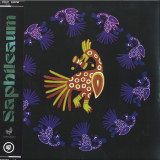
Saphileaum (the pseudonym of Georgian multi-media artist Andro Gogibedashvili) is inspired by Georgian myths and legends, esotericism, earth, unity, truth and the secrets of the universe.
Over the past few years, Saphileaum has released a diverse array of albums and EPs on labels such as Good Morning Tapes, Oslated, Silent Season, Mule Musiq and Slow Life, each one reflecting his unique blend of cosmic expansiveness, tribalism and meditative storytelling.
On his first collaboration with P&F Recordings, he draws inspiration from mysticism, self study, ancient civilizations and their various cultures and mysteries.
These musings unite to create an immersive sonic experience that traverses cosmic and tribal landscapes, bringing us 'TAMALUNGMA'.
Here, the listener enters a mystical realm-space, where nature's precious spirits guide you through a journey of transition. As you walk this path, their wisdom and presence illuminate the way, helping you move closer to your true purpose.
quête:tam tam
After some time fostering the birth of Melbourne/Naarm’s Solace Bar & Club, circuit|breaker returns with the last offering in our initial run of three Various Artists releases: CBRK003. As always, our focus is razor sharp on cultivating connection, between our home and the global artistic domain. With our third release, we bring you five of the boldest talents, both emerging and established, that are sure to set the standard for forward-thinking electronic music.
TAMIZDAT Records, the forward-thinking, club-driven stem of MixCult Records, returns with its third vinyl release — Panacea EP TMZ003, a potent compilation of cutting-edge Tech House crafted by rising prodigies: Caputi, Osman Öz & SUBMINIMAL, Dawn Gab and Nikdo.
Designed for the dancefloor yet rich in sonic nuance, Panacea EP strikes a delicate balance between raw bassline power and refined beauty. Each track showcases an evolutive approach to club music — immersive, rhythmic, and brimming with personality. The artists push boundaries while maintaining an irresistible groove that keeps the body moving and the mind engaged.
TAMIZDAT carves its own lane within the MixCult universe, channeling dub techno aesthetics into a club-forward format that feels both current and timeless. This EP is a declaration of intent: sleek, bold, and undeniably danceable.
Whether you're spinning late-night sets or deep-diving into thoughtful listening, Panacea EP delivers on all fronts. Don’t miss out on this essential slice of modern club culture — get your hands on TMZ003 VA – Panacea EP and feel the pulse of the future.
MixCult Records unveils TAMIZDAT, which in Russian TAM means “there” (as a reference of an aboard, western location), and IZDAT means “to publish”. It was the name for banned books and magazines published "there", that is, abroad.
Limited edition.
180 G. BLACK VINYL WITH LINER NOTES IN CREOLE, FRENCH, ENGLISH
Originally released in 1979, "Spiritual Sound" lives up to its name, a soaring, triumphant album, six tracks of spirit magic from Guadeloupe.
Telluric, intense, terribly alive, the gwoka drums of Guadeloupe carry the identity of a painful and fervent island. Marked forever by the crime of slavery, Guadeloupe's créolité cherishes the ka drums and their natural environment: the low-pitched boula drum with male goatskin, the high-pitched soloist makè drum with female goatskin, the chacha, ti bwa, triangle, calabash and other percussion instruments that surround them, and the voices - the fiery, proud, timbred, urgent voices of the gwoka.
This album is also a legend for its voices: in his then dazzling youth, singer Lukuber Séjor was one of the first gwoka artists to largely feminize the chorus of répondè, who converse with his text delivered in a straight and powerful voice.
And everything here sets new standards. In 1979, Mizik Filamonik - Spiritual Sound proclaimed a spiritual patriotism of ferocious intensity. The album by Lukuber Séjor - whose spelling alone is a battle - sets out to give Guadeloupe the intangible weapons of self-respect and self-knowledge, through a singular practice of traditional music.
The genesis of gwoka music is less straightforward than one might imagine... The drums performed the servile task of accompanying the work of slaves in the fields and during the “corvées” imposed by the administration, before being freely practiced by the common people after the abolition of 1848. At the heart of the conviviality of the Guadeloupeans furthest from the cities - geographically and socially - the gwoka drums come out for carnival, funeral wakes and neighborhood celebrations, but also during strikes, fits of anger and armed vigils of the riots and revolts that have punctuated the island's history. For generations, governors of the colony and then the prefects of the overseas department of Guadeloupe have been viewing the gwoka as a potential for turbulence and a threat to public order.
But as the Beatlesmania, “chanson engagée” and rock revolutions unfolded in Europe, young people turned to the drums of mizik a vié nèg (“bad negro music”, in Creole), which Guadeloupeans had learned to despise by following the “assimilation” process advocated by the school system and most of the political class. At the end of the sixties, in a Guadeloupe mourning the deadly repression of the May 1967 social movement, they played traditional music, refusing to wrap it up in tourist prettiness and madras folk costumes. Instinctively, they played a rough and contemporary gwoka, led by the incendiary Guy Konkèt. This was the era of decisive 45 rpm records such as Robert Loyson's Kann a la richès, which brought to light the fieriest words of union rallies.
At his home in Sainte-Anne, Lukuber Séjor played with flautist Olivier Vamur and his brother Claude Vamur, who cobbled together a drum kit from tin crockery and became, a few years later, the most influential drummer in Kassav'.
These were the years of the Bumidom program, when young Guadeloupeans were encouraged to emigrate to mainland France. At the age of twenty, Lukuber Séjor embarked on the liner Irpinia, disembarking at Le Havre and taking the train to the Gare Saint-Lazare - the route taken by thousands of young West Indians who went on to study or looked for work, all the while trying to maintain a link with their homeland. In this case, it's at the Antony university residence, where Lukuber played the drum and participated in a thousand gwoka updates and aggiornamentos, while exile reinforced the need for a spiritual link with the native land.
In 1978, Guy Konkèt played at the Salle Wagram, a historic event for West Indian music. After serving as répondè - i.e. backing vocalist - on one of his home-recorded albums, Lukuber joined his live band. Little by little, he became one of the key artists on a circuit parallel to French show business. At a student party in Caen, he met a young woman from Martinique who, at the time, was more motivated by her ambitions as a visual artist than by her vocation as a musician. Her name was Jocelyne Béroard and, a few years before she plunged into the Kassav' adventure and became the greatest West Indian singer of her generation, she designed the cover of Lukuber Séjor's LP.
This ambition was obvious and imposed its will. A more or less regular band was formed, with Roger Raspail, Rudy Mompière and Éric Danquin on ka drums, Claude Vamur on ti bwa, Olivier Vamur and Françoise Lancréot on flutes and Annick Noël on keyboards. Lukuber Séjor is set on wanting to extend the gwoka palette to other instruments, as the jazz-rock revolution opens a thousand new doors. Annick Noël will play a wide range of timbres and textures on electric piano and synthesizer. Another novelty: the répondè are two men and two women, Roger Raspail, Olivier Vamur, Françoise Lancréot and Maryann Mathéus ...
Mizik Filamonik - Spiritual Sound is a self-production in which the singer and leader sank all his savings, allowing him no more than a single day in the studio. The first side is more of a musical manifesto, with the first two tracks, Éritage and Penn é plézi, being instrumentals. The third, Son, forcefully celebrates the need for Guadeloupeans to connect with the gwoka. In fact, Jocelyne Béroard's cover shows a tambouyé in the shadow of a cloudy sky, against which a radiant sun is rising and whose light will soon flood the entire landscape. The silhouette and face of this man strongly evoke the immense Vélo, master of the ka, rejected at the time on the fringes of society.
The second side of the LP is surprising. Formally, three tracks are explicitly linked like the three parts of a triptych. Primyé voyaj evokes the appalling tribulation of Africans deported as slaves to Guadeloupe; dézyèm voyaj speaks of the Bumidom program and the economic, political and social forces driving young Guadeloupeans towards the mirage of prosperity in France; twazyèm voyaj closes the cycle with the emigrants' return from Europe after years away from their island...
This gwoka, obsessed with the need to save Guadeloupe spiritually, appeals far beyond the politicized audience. Mizik Filamonik - Spiritual Sound instantly became a classic, although Lukuber Séjor never really made a career for himself as a musician.
After all, the album was released in 1980, with no promotional resources in France or Guadeloupe - and therefore no concerts. The thirty-two-year-old author, composer and performer made his own third trip back to Guadeloupe. He set up a small woodworking business, which he lost in Hurricane Hugo in 1989. His other activity, teaching in a medical-educational institute, became the core of his professional life. He continued to be an active campaigner - a campaigner for the Creole language, a campaigner for the reawakening of identity, a campaigner for special education, a campaigner for a thousand causes that he ignited with his generous and perceptive enthusiasm, such as the defense of breadfruit fries...
The echoes of his 1979 album have not died down. Of course, the use of Penn é plézi as the theme tune for Radio Guadeloupe's funeral notices from 1980 to 1992 kept him in the collective memory, but he continues to sing and compose sporadically, as with his all-female
vocal group Vwapoulouéka... Still convinced that music is a means of liberating the spirit, he continues the journey of a young man eager to deploy the power of Creole music and language.
Bertrand Dicale
discos elgozo is proud to present our second single with two songs by Las Raras Del Folclor, a queer feminist musical project from the Colombian Caribbean, which harnesses the decolonising power of cumbia and drums to heal the community and transgress patriarchal orders. This musical project is part of the LBT Raras no tan Raras Corporation, which was born in 2019 in preparation for LGBT Pride Day in Barranquilla, Colombia.
Las Raras Del Folclor are feminist, maricas, drummers and caribbean. Their musical proposal is a disruptive political bet, where the lyrics carry a message of respect for the lives and re-existences of sexual and gender diversities, while the drumming and collective chants unite us in the joy of the movement of our diverse bodies. If in the first track, La Denuncia, we find the strength of our ancestral women to confront patriarchal violence, in the second track, La Pajarera, we find the community that welcomes and cares for us.
Credits:
Mayré Rivero: Voz principal (B), maracas, coros, palmas y animaciones.
Madeleyne Camargo: Voz principal (A), coros, animaciones y palmas.
Dani Brache: Llamador, coros y animaciones.
Maria Camila Navarro: Tambora, coros y animaciones.
Alejandra Peñaloza: Tambor alegre, coros, palmas y animaciones (B).
Naikel Villarruel: Tambor alegre, coros y animaciones.
Grace Lascano (Orito Cantora): Coros, palmas y producción musical.
Jenn del Tambo: Tambores, jamblock, platillos, palmas y producción
musical.
Composición y Autoría: Mayré Rivero, Madeleyne Camargo, María Camila
Navarro, Alejandra Peñaloza, Isabela Luján, Alana Delgado, Dani
Brache, Naikel Villarruel, Eliana Villa, María Serje y Grace Lascano
(Orito Cantora).
‘Nothing Iz Sacred’ is a statement, a collection of tracks that resist the pull of the fleeting, throwaway nature of today’s music scene. In an age where everything is often stripped down, consumed, and discarded, this 8-track LP stands as both a nudge and a reminder—a poke at the culture that surrounds it - it isn’t here to blend quietly into the background, nor to satisfy the urge for quick hits and shallow thrills.
Each track on the LP is woven with the sounds and textures Workforce has become known for, yet there’s a rawness here—a willingness to push boundaries, to blur the edges of genre and style. The LP is a blend of the familiar and the experimental, where thoughtful moments meet jagged beats, and where soulful undertones collide with darker layers. It’s a space that resists easy categorization, daring listeners to explore without expectation, to find meaning in the spaces between the sounds. This isn’t a record designed for the disposable playlists of tomorrow; it’s for those who know that music can mean more, and who understand that it is meant to live with us, to grow, and to shape the communities around it. This record isn’t about the chase for the next hit or the endless scroll; it’s for the ones who value artistry, who find culture in the smallest details, who want something real to hold onto.
‘Nothing Iz Sacred’ is brought to life with the voices and musicality of some incredible collaborators. Tyler Daley’s unmistakable warmth, Bobbie Johnson’s sharp lyricism, Tamara Blessa’s haunting soul, Leroy Horns’ textured brass, and Ed Zuccollo’s nuanced piano work all carve their own paths through the record. Together, they amplify the album's heartbeat, adding layers of richness and depth.
360 mcn white-white light cardboard paper / one side only hand plasticization / 2 separated parts prints / hand gluing / PVC outers / original artwork / gatefold sleeve / Bandcamp limited edition 30x60 cm insert with extended liner notes by Tony Higgins and Interview with Babs Robert and Sébastien Gorlé with exclusive pictures and self-portrait by Babs Robert himself printed on GF Smith "Takeo Tant Select" Canvas Paper tip-on left jacket panel / Exclusive never released Memorabilia from Babs Robert's vault.
Personnel:
Babs Robert - alt sax, tenor-sax, electric tenor-sax, Bin Recorder, Acme siren, Chinese-bell, sleigh-bells, maracas, tambourine,hand-rattle,claves)
John Van Rymenant - baritone-sax, fluegelhorn, Bala, tambourine, sleight-bells, cowbell, triangle, claves
Johnny Peret - vibes, bongo's, cowbell, maracas, castanets, rattle-snakes, tambourine, drums, woodclock, trinagle
Johnny Brouwers - piano, prepared-piano, triangle, cowbell, sleigh-bells, maracas, caves,hand-rattle, guiro, woodblock, tambourine
Paul Dubois - bass, triangle, cowbell, claves, rattlesnakes, hand-rattle, woodblock, tambourine
Michel Gobbe - bass,Chinese-bell, claves
Robert Pernet - drum, tambourine, seven-notes M'Bichi, guiro, alarm-siren, home-made metal xylophone, African telephone-drum, triangle, sleigh-bells, Siku
Notes:
Despite its modest role on the world stage, Belgium has produced a number of internationally renowned musicians and composers. There is the iconic gypsy jazz guitar maestro Django Reinhardt, whose position remains unassailable, and guitarist/harmonica player Toots Thielemans, who became an internationally renowned artist performing and recording with Bill Evans, Oscar Peterson, Ella Fitzgerald, Peggy Lee, Shirley Horn and Quincy Jones. The other key Belgian figure is composer/arranger Francy Boland, co-leader with US bebop drumming legend Kenny Clarke of Europe's leading big band of the 60s, the Clarke-Boland Big Band.
The Love Planet performed in the main clubs of Brussels, such as Blue Note, Pol's Jazz Place, and Smog as well as in major musical events throughout Belgium including to big festivals in 1969 - the Avant-Garde Festival in Ghent and the First International Jazz Event in Liege – where the Love Planet shared the bill with Miles Davis - and the Bilzen Jazz Festival in 1970. The contrast between the musical architecture of the themes and sonic freedom in the improvised playing perfectly illustrated the polymorphism – an order within disorder – which the Love Planet aimed for.
The initial original quartet line-up was Babs Robert (sax), Paul Dubois (bass), Johnny Brouwers (piano), and Johnny Peret / Robert Pernet (dru- ms). On the album session, the quartet was augmented with the addition of John Van Rjimenant (saxes) and Michel Gobbe (bass). As well as their main instruments, the band members also played an array of unusual instruments, principally percussion. This is the first official re-release
of the 'Babs Robert and the Love Planet'. Original copies of the album fetch many hundreds of Euros on the collecting circuit and it remains a curious and fascinating window into a moment in time that still resona- tes some fifty years later. Come with us to the Love Planet. (Tony Higgins)
Havoc are back, with the fourth release on their label, and arguably the strongest effort yet. Here we have 4 reimagined efforts, including a galloping disco delight that's been tamed to perfection, a deconstructed US New Wave track guaranteed to get the freaks and fiends moving (wait for that kooky vocal and guitar halfway through!), a little-known German 80s gem given the trademark Havoc treatment, and a catchy as hell slo-mo Austrian Europop groover. With these fellas edits finding favour with the likes of DJ Harvey, you know this is likely to disappear fast, get on this while there are still copies left!
With an intrigue for a particular niche of old UK hardcore which takes cues from Sheffield bleep ambience, heady rave futurism and soft, almost new age synth pads, Blank Mind presents ‘Lost Paradise: Blissed Out Hardcore 91-94’. Though the records gathered for the compilation span a short three-year period and bridge the gap between scenes, the collection manages to find a sweet spot where the influence of Warp’s Artificial Intelligence, back room chill out sonics and the nascent jungle boom meet with elements of Italian piano house and slower breakbeat cuts.
Opting to focus on atmosphere to highlight shared connections; in this case the duality of often serene and calming soundscapes with frenzied breaks and bass (see Hedgehog Affair’s ‘Parameters’ and Luxury’s ‘Twirl’ respectively); Lost Paradise is a formidable collection of tracks plucked from a thriving time for British dance music experimentation. The general themes of ascension and escapism channelled through digital samplers are also inescapably linked to a turbulent time in politics, beginning in the post-Thatcher years and culminating in the year the harshest anti-rave Criminal Justice Act came into force.
Initially building the compilation around DJ Mayhem’s track ‘Inesse’, Blank Mind label founder Sam Purcell and Amsterdam based producer Tammo Hesselink began a process of swapping favourites and deep cuts to spread across this 2x12” doublepack. The compilation avoids any obvious centrepieces through masterful sequencing, allowing for moments of refrain and tempo changes in a way that helps add to their overall vision of what this music is and can be; “We wanted to frame hardcore in a different light, looking at this idea of ecstasy through the traditional meaning of the word and exploring that symbolism”. By drawing from what some might consider the softer edges of the movement, the pair offer a look into the relevance of these tracks in the contemporary era, where the past years have seen both an explosion in popularity of old ambient/new-age music and a certified jungle revival.
***** AUGMENTED REALITY COVER *****
For the third release on Dust In Grooves, Olivia Mendez curates a compilation EP that honours the boundary pushing spirit of the vinyl-only imprint and presents a collection of mind bending tracks by emerging and established techno producers. The first VA instalment on DIG showcases adventurous, challenging, and dynamic cuts while maintaining the groovy and raw signature sound of the label. Bridging the analog format with a forward thinking design is the animated cover created by visual artist Deniz Bicer, she is also known as Ojelibalon.
LKY - Bitter
Bitter by Manchester based producer LKY is a direct immersion in the atmospheric depths conveyed within a minimalistic tool track. With trippy loops and changing beats, this opener leaves a bitter taste of the sweaty, trance-infused 90s.
Deluka - R.A.W
R.A.W glistens with a mind-bending sound design, produced by the No Signal Records founder Deluka. He delivers a visceral, hypnotising track with quirky highs and stomping, rhythmic lows, captivating the attention all throughout the end.
Metapattern - Tamakotuma
On the B side, the relentlessly driving and layered Tamakotuma by Metapattern, beams with melting synths, intense rhythm and skewed melodies. After joining the Mord and HAYES families, Metapattern contributes a dynamic track with evolving retro-futuristic design, journeying across dimensions.
Dotdat - Take me to Detroit
An homage to the roots of timeless sound and community, Take me to Detroit by Dot Dat is a soothing dance-floor energy tamer, filled with melodic arpeggios and spacious drums. After his release on Truncate records, Dot Dat closes out the DIG VA with a slower-paced track, laced with classic synths.
Words by Lora Mateeva
Animation - Deniz Bicer
Master - Nihad Tule
Graphist - Ferdinand Prat
PulciPerla will unveil “Tatekieto”, their new album, on its release, January 04, 2025, on Prado Records / Cie Pulcinella / The Pusher. This opus will be presented on Wednesday, February 05, 2025, on the stage of FGO - Barbara, Paris (France) during an exceptional launch concert. The eponymous single “Tatequieto” was released on all platforms on November 22, 2024.
Take an iconoclastic and energetic quartet from Toulouse, combine it with a female power trio from Bogotá, shake it up, and you will get Pulciperla!
After an explosive encounter in Colombia in 2019, the fiery trio La Perla and the unclassifiable Pulcinella decided to create an original repertoire: a hybrid, swaying, and sensual music where vocals, saxophone, keyboards, double bass, and percussion blend generously, driving a powerful trance-like pulse. A quirky and striking repertoire infused with bullerengue, reggaeton, funk, and champeta influences, which stirs the fire and gets you moving. The tribal music of La Perla’s percussionist singers merges with Pulcinella’s explosive groove to electrify the audience and awaken their primal instincts!
PulciPerla is composed of :
La Perla: Diana Sanmiguel: vocals, maracas, guacharaca;
Giovanna Mogollón ‘’Roberta Leono’’: vocals, tambor alegre;
Karen Forero:vocals, gaïta, tambora
Pulcinella: Ferdinand Doumerc : saxophones, flutes, keyboards;
Jean-Marc Serpin: double bass;
Bastien Andrieu: keyboards ;
Pierre Pollet: drums
10, 9, 8, 7, 6… the countdown to blastoff has started! Paris-based band Setenta is preparing for their upcoming 20th anniversary by releasing their sixth album, Apollo Solar Drive. The record is poised to be their best yet and is the culmination of an odyssey of artistic discovery. Setenta has been constantly striving for illumination through the years, yet also exploring the dark side of the human condition along the way. As the band describes it, this record is an Afro-Latin retro-futurist tribute to the sun. If their previous album, Materia Negra, launched the Setenta space shuttle crew into the void of “dark” matter and black holes, they now change course and valiantly approach the sun at full warp speed, taking us from darkness into the light. Miraculously, Setenta manage to bring some of the rhythmic and harmonic material they’ve explored on Earth with them, yet boldly dare to go where no one has gone before, challenging themselves to take their music, and their audience, to uncharted dimensions and new realms of existence.
In keeping with the themes of Materia Negra, FIP (Radio France) selection in 2020, Setenta’s sixth mission to explore “the great beyond” of “inner space” is aptly titled Apollo Solar Drive, emphasizing the band’s turning to the life-giving light of the sun for inspiration while playfully echoing the title of Eddie Palmieri’s Latin funk and social commentary masterpiece, Harlem River Drive. The overall vibe is warm and positive, propelled by the dual energy thrusters of funky, fierce beats and deceptively complex arrangements, yet going down smooth in the best sense of the word, like your favorite tropical cocktail or classic jazz dance fusion record of the 1970s. Of course this delicious treat is served with a special Setenta flavor all its own.
This time around, Apollo Solar Drive celebrates the trajectory of the band’s unique interstellar journey by deploying a resolutely jazzy, “funkadelic” angle to their beloved Afro-Latin music. Setenta’s band members tell their truths as a collective, with an emphasis on instrumental sections, focusing on the interweaving of multiple keyboards and guitars, while condensing the vocals to group choruses, as opposed to the solo voices of the past. The overall approach is more futuristic in its conception and realization, from the arrangements to the sonic engineering, although the rhythmic base still remains rooted in Afro-Cuban traditions as well as those of other Caribbean nations.
Pablo E. Yglesias (DJ Bongohead) of Peace & Rhythm (USA)
Ambient explorers SWIMS come up trumps with the debut record by London musician and visual artist Loz Keystone, and Glaswegian electronics tamperer and jazz trumpeter Christos Stylianides.
"Craobh Haven" is the dreamlike product of a week's residency in a little cabin in the Scottish village of the same name. Driving around the surrounding countryside each day to gather field recordings, evenings were spent by the duo assembling their findings into tape loops. These little rotating sculptures - containing stones and the rushing waters of the Craignish peninsula, the voices of locals and the cabin's oven timer - formed the basis for one track per night.
While Keystone's whirling touches of Moog, guitar and space echo suggest the murky, placid vastness of the record's setting, the pitch-shifted, probing trumpet of Stylianides soars and stacks countermelodies like vapour trails braided in the atmosphere.
For a record made out of loch water, Hebridean slate and mud - it is surprisingly tuneful and sometimes almost groovy. Recommended if you like Jon Hassell, Roméo Poirier, Spillage Fete.
Earquake 1991[22,48 €]
Earquake 1992[22,48 €]
Earquake 1993[22,48 €]
Earquake 1994[22,48 €]
Earquake 1996[22,48 €]
Earquake 1997[22,48 €]
Earquake 1998[22,48 €]
Earquake 1999[22,48 €]
It is the year 1995 and it’s summer, the second extremely hot summer after 1994, and the asphalt on Gladbacher Straße in Cologne is glowing. Ravers in much too wide and much too colorful clothes doze off in the glaring midday heat. These are the last days of the legendary Delirium record store, a socio-cultural biotope that would later become KOMPAKT. In June 1995, the store moved deeper into the Belgian Quarter, to Brabanter Straße 42 near Friesenplatz.
Wolfgang Voigt liked to wear too-big sunglasses even back then, just as he already had the master plan for the next few years, the new store, the renaming to KOMPAKT, and the upcoming takeover of the musical world order by minimal techno in his head. On less sunny days, the musician Wolfgang Voigt was tinkering with his very own label Profan, a new sound, new pseudonyms and masquerades. His alter ego Mike Ink had grown tired, another self, one of many, was now pushing forward to become the next torch in the storm.
By early 1995, the first Grungerman EP, "Hout," had been released on Profan. A nucleus of ambient loops that already announced the sonic aesthetics of GAS, stoic rhythmic structures that would shape the coming decade of minimal house and techno, and an all-encompassing gloom and heaviness that didn't want to fit at all with the gaudy reality of the nineties between Loveparade, Mayday and VIVA House TV. This probably most hedonistic decade of the 20th century had celebrated, besides techno, above all a rough guitar music called Grunge, coined and immortalized by a depressive, hyperactive and narcoleptic young man with matted blond hair who had taken his own life a year before. In no other track has Wolfgang Voigt packed these inner and outer contradictions of his art as well as of the mid-nineties more ingeniously than in "In Tyrannis". From wall to wall there are four steps.
"Klang" by Wolfgang Voigt originally comes from the first and only GAS EP on Profan, "Modern", from the spring of 1995 and is one of the most beautiful exhibits of Voigt's sound of those years, which relentlessly runs its course somewhere between glistening sunrises on Ecstasy and bad drugs in the dark Liquid Sky Cologne. With "Hocker DJ 1" and "Hocker DJ 2" there are two more musical references to this myth-enshrouded place in Kyffhäuserstraße, where for a few years the entire, so-called Sound Of Cologne had literally settled down.
Wir schreiben das Jahr 1995. Es ist Sommer, der zweite extrem heiße Sommer nach 1994, und der Asphalt auf der Gladbacher Straße in Köln glüht. Raver in viel zu weiten und viel zu bunten Klamotten dösen ihren Rausch aus in der grellen Mittagshitze. Es sind die letzten Tage des legendären Delirium Plattenladens, eines soziokulturellen Biotops, aus dem später die Firma Kompakt hervorgehen sollte. Im Juni 1995 erfolgte der Umzug tiefer hinein ins Belgische Viertel, in die Brabanter Straße 42 in der Nähe des Friesenplatz.
Wolfgang Voigt trug schon damals gerne zu große Sonnenbrillen, so wie er bereits den Masterplan für die nächsten Jahre, den neuen Laden, die Umbenennung in KOMPAKT sowie die anstehende Übernahme der musikalischen Weltordnung durch Minimal Techno im Kopf hatte. An weniger sonnigen Tagen tüftelte der Musiker Wolfgang Voigt an seinem ureigenen Label Profan, an einem neuen Sound, neuen Pseudonymen und Maskeraden. Sein Alter Ego Mike Ink war müde geworden, ein anderes Ich, eines von vielen, drängte nun nach vorne, um die nächste Fackel im Sturm zu werden.
Anfang 1995 war die erste Grungerman EP “Hout” auf Profan erschienen. Ein Nukleus aus ambienten Loops, die bereits die klangliche Ästhetik von GAS ankündigten, stoischen rhythmischen Strukturen, die das kommende Jahrzehnt Minimal House und Techno prägen sollten, sowie einer allumfassenden Düsternis und Schwere, die so gar nicht zur knallbunten Realität der Neunziger Jahre zwischen Loveparade, Mayday und VIVA House TV passen wollte. Dieses wohl hedonistischste Jahrzehnt des 20. Jahrhunderts hatte neben Techno vor allem eine raue Gitarrenmusik namens Grunge gefeiert, geprägt und unsterblich gemacht von einem depressiven, hyperaktiven und an Narkolepsie leidenden jungen Mann mit verfilzten blonden Haaren, der sich ein Jahr zuvor das Leben genommen hatte. In keinem anderen Track hat Wolfgang Voigt diese inneren und äußeren Widersprüche seiner Kunst wie auch dieser Zeit Mitte der Neunziger genialistischer verpackt als in “In Tyrannis”. Von Wand zu Wand sind es vier Schritte.
“Klang” von Wolfgang Voigt stammt ursprünglich von der ersten und einzigen GAS EP auf Profan, “Modern”, aus dem Frühling 1995 und ist eines der schönsten Exponate des Voigtschen Sounds dieser Jahre; ein Track, der irgendwo zwischen gleisenden Sonnenaufgängen auf Ecstasy und schlechten Drogen im dunklen Liquid Sky Cologne unerbittlich seine Bahnen zieht. Mit “Hocker DJ 1” und “Hocker DJ 2” finden sich zwei weitere musikalische Referenzen an diesen mythenumrankten Ort in der Kyffhäuserstraße, an dem sich für einige Jahre der gesamte sogenannte Sound Of Cologne im wahrsten Sinne des Wortes niedergelassen hatte.