Black Truffle is pleased to announce the first LP documenting master khene player Sombat Simla, the label’s first collaboration with Japanese sound artist, field recordist, and researcher Yasuhiro Morinaga. Simla is known in Thailand as one of the greatest living players of the khene, the ancient bamboo mouth organ particularly associated with Laos but found throughout East and Southeast Asia. His virtuosic and endlessly inventive renditions of traditional and popular songs have earned him the title ‘the god of khene’, and he is known for his innovative techniques and ability to mimic other instruments and non-musical sound, including, as a writer for the Bangkok Post describes, ‘the sound of a train journey, complete with traffic crossings and the call of barbecue chicken vendors’. Aided by a group of Thai friends, in 2018 Morinaga travelled to the Maha Sarakham province in the Isan region, arranging to meet Simla in a remote spot surrounded by rice fields. Then and there, Morinaga recorded the solo performances heard on the LP’s first side. At Morinaga’s request, Simla began with a rendition of the train song ‘Lot Fay Tay Lang’. Beginning with long tones that seem to mimic a train horn, the performance soon moves into a rapid chugging rhythm, interrupted at points by vocal exclamations and the remarkable timbre Simla produces by singing through the khene. To listeners unfamiliar with Thai music, the pentatonic scales and rhythmic chug of many of the pieces can have surprising echoes of the rawest American blues. The range of Simla’s performance is astonishing, moving from compulsive rhythmic workouts on single chords and rapid-fire runs of single notes to gentle sing-song melodies, and using a fascinating array of techniques, including a rapid tremolo that sometimes sounds almost electronic. Later the same day, Morinaga followed Simla to a cattle shed where he met percussionist Mali Moodsansee to play some molam (folk songs found in Isan and neighbouring Laos), with Pattardon Ekchatree joining in on cymbal. At times, these molam songs have a wistful, romantic character quite different from the solo pieces. Backed up by the propulsive hand drums, Simla again dazzles with his melodic fluidity, rhythmic drive, and wild displays of unorthodox technique. As Morinaga writes, ‘It felt like they had been playing together so long that their breathing was perfectly in sync, and it was like listening to the precision of James Brown’s funk’. Accompanied by extensive liner notes by Morinaga detailing the day of recording, this is a stunning document of a master musician, seamlessly integrating tradition and innovation.
Cerca:techniques
Altered Circuits' next release comes by way of Bologna-to-Berlin transplant Jacopo Latini. On the Motherboard EP he combines stubby drums and sultry, efficient basslines with richly hued synth work. Once the cuts get going, a tapestry of melody reveals itself: gated leads are accompanied by burbling arpeggios, momentous chord progressions and bright pads that crawl in and out. The patches often incline to the bright and dreamy but are deployed with restraint; in the same vein, concealed and aloof vocal samples get sprinkled in. These techniques - staples for the artist - add an inscrutable quality to his work's mood. It is dance music that feels direct on the surface yet hides more ambiguous emotions underneath. Being a DJ was Latini's first approach to the electronic genres, and it arguably still is his main inspiration - it even occurs he writes tracks with a specific venue in mind. Since starting over a decade ago, and having meanwhile swapped the local Italian stages for the international ones, he has amassed a ton of analogue gear to help him do so. On this occasion, he plugged in his Roland D-50, Moog Sub 37 and microKorg XL, among other favorites, to take on progressive, trance and tech house. "Motherboard", "High Voltage", "It Comes In The Morning", and "Dual Effect" make for a diverse selection but have indeed the same objective: the club floor.
Drawing inspiration from his homeland Germany, with a particular focus on the organic house and techno scene of Berlin, Sanoi has meticulously crafted Echoes Of Home to reflect his diverse influences.
Echoes Of Home finds Sanoi challenging conventional music production norms, steering clear of familiar tropes and techniques. The result is eight carefully curated tracks with a rich tapestry of ambient layers, recorded sounds, and melodies that range from quirky and playful to nostalgic and melancholic. The finely crafted drums take centre stage, emphasising the unique groove that defines Sanoi's distinctive sound.
The album traverses warm, bouncy & melodic house music, with touches of deep-house, techno & organica. While largely instrumental, the album’s centrepiece is a collaboration with Christchurch artist Beacon Bloom on the track ‘Silver’. Both artists previously collaborated on the popular single ‘Club Jesus’, once again featuring Ryan Ferris' delicate yet strong vocals. The final track on the album, ‘Moon Boy’ offers a few moments of quiet as the journey draws to an end with just Sanoi & his piano.
Created at his home in Auckland, and road-tested across multiple live performances across NZ & Australia over the past two years, Echoes Of Home sees Sanoi’s composition & production step up another level. Available on limited edition vinyl, the digital release also includes an eclectic collection of four remixes from acclaimed New Zealand artists micronism & Paige Julia, alongside German producers Gabriel Ananda & Fabian Krooss.
Over the past five years, Sanoi has become an integral part of the growing underground house and techno scene in New Zealand, all the while expanding his international presence with releases on labels Bar 25, Stil Vor Talent, Magician On Duty, and Zehn Records. Sanoi's music has already gained support from student radio stations in New Zealand and has caught the attention of tastemaker DJs worldwide
Big Bill Broonzy was a trailblazing Chicago bluesman steeped in southern traditions, whose songs stretched genres from folk music to hokum and ragtime to country These seminal recordings from his early years highlight his sublime guitar playing and ice cool vocal style which inspired a generation of legendary blues and rock musicians. Includes many of his early masterpieces including 'Saturday Night Rub', 'Brownskin Shuffle' and 'Long Tall Mama' from his first creative wave during the late 1920s/early 1930s. Lovingly remastered using pioneering restoration techniques, this Rough Guide highlights his diverse repertoire from ragtime and hokum to traditional blues and other novelty songs.
If there's one specific component that grounds 'Sky Flesh', it's focus. Italian musician and sound designer Marta De Pascalis flexed her technical muscle on 2020's 'Sonus Ruinae', layering various sounds and processes in an attempt to touch the sublime. In contrast, 'Sky Flesh' is a single thought, composed using just one instrument: the Yamaha CS-60. A slimmed-down sibling to the gargantuan CS-80 - the analog synthesizer used by Vangelis to create his iconic 'Blade Runner' score - the CS-60 was released in 1977, a few years before the MIDI protocol was introduced to help standardize production methods. MIDI would change the electronic music landscape completely, offering a level of control that De Pascalis consciously relinquishes, preferring to highlight expressiveness and timbre, elements more readily associated with acoustic instruments. The album arrives as much of the wider experimental scene busies itself with algorithmic composition and AI-assisted modeling; De Pascalis chooses to work instead like an organologist, harnessing the CS-60's mercurial magic to suggest deeper truths about our evolving relationship with machines.
Currently based in Berlin, De Pascalis grew up in Rome, where she was surrounded by atrophied ruins that piqued her interest in decay and memory. Over her last three albums, she used tape loops and advanced synthesizer techniques to create a unique sound world that's guided by her musical philosophy, rather than a specific aesthetic. As she's developed her technique and confidence, her music has become even more idiosyncratic, and at this stage in her career she's stripped her sound down to its core elements, focusing on emotion, narrative and mystery. Using timbres that recall a time when electronic music still waved towards the future
Following on from recent works for 12k, The Trilogy Tapes, and Important, Far More Decentralized is a new collection of subtle, enchanting pieces from Tokyo-based sound and visual artist Akhira Sano. Working with electronic, instrumental, and concrete sounds, he crafts immersive assemblages of long overlapping tones and blurred resonance, cut through with textural crunch and hiss. The resonant bell-like tones of opener ‘Kouai’ invite the listener in, calling up the warm sound palette of ambient classics like Hiroshi Yoshimura’s Music for Nine Postcards, but leaving any sense of compositional anchor behind for a free-floating harmonic drift. Woven through this seductive tonal cloud is a wavering stream of white noise and tactile pops, its textural grit threatening to derail the calmly reflective pool of pitched sounds, but never quite doing so. Each of these seven pieces occupies a similarly ruminative harmonic space while possessing its own identity. On ‘Neow’, lush tonal swells form around fragmented samples, touching on the techniques of early 2000s glitch artists like Ekkehard Ehlers. ‘Orbv’ is particularly subtle in its combination of rippling back-masked tonal wash, almost subliminal suggestions of field recordings, and distant traces of raw electronic interference, as if a Toshimaru Nakamura recording is playing through an open window across the road. ‘Margin’ weaves together a skein of wistful slow-motion melodies while untraceable, resonant clinks and ambiguous static washes rise gradually to the surface. In comparison to his recent Phase Contrast for Recollection on 12k, recognisable instrumental sounds are a rarity here, yet a hand-played feeling is present throughout. On ‘Teens’, filtered electric guitar tones reminiscent of the melancholic miniatures of Andrew Chalk float over aqueous burbles, bringing the album to a magisterial close. In the crowded field of contemporary electronic music tending toward ambience, Sano is a distinctive voice. Like his elegant abstract paintings, here seemingly static surfaces of unhurried calm reveal rich interior worlds of subtle activity and gentle chaos. Where much contemporary ambient music aims for an almost stifling cleanliness of tone, Sano breathes life into Far More Decentralized through the acceptance of imperfection, accident, and rough edges. As the artist himself says, ‘In a world where everything can be made perfectly, I think it’s a beautiful and primal act to touch the fragile and imperfect’
Gloam is the highly anticipated sophomore album from alternative folk band MAYBEL. Similar characteristics from their debut, Gathering, are carried forward: elegant harmonies, soft instrumentals and a shared optimism coupled with a wide open vulnerability. The songs still echo the intimacy, warmth and closeness of their relationships, yet the band has matured. MAYBEL's evolution shines through with ambitious compositions, thoughtful songwriting, and a deeper understanding of themselves as the album’s themes pierce with growing pains, anxieties and hopes for change. It’s a record about movement and stopping; the ongoing act of coming apart and coming together. Gloam is for listening in your bedroom or in transit, missing friends, on your way to see them. It holds an optimism that rings clear yet nestles and dwells in a brooding, muddy darkness - placing it firmly in the illustrious Canadian folk canon. This is the first album for which all four members (Fez Gielen, Ali Hendra, Loris Kecaj and Lauren Spear) wrote songs. For the most part, they were written during the pandemic separately and then shared in the upstairs living room where Lauren, Ali and Loris used to live together. The result is a shared diary on love, grief and moving on. The band's ability to effortlessly blend traditional folk elements with modern production techniques is reminiscent of the collaborations between Emmylou Harris and Daniel Lanois. Just as Harris and Lanois brought a fresh perspective to country music, MAYBEL embraces experimentation in their sound without compromising the warmth and intimacy inherent to folk music. As with their debut Gathering, MAYBEL recorded Gloam with producer/engineer Jonas Bonnetta at Port William Sound in Mountain Grove, Ontario. Resonating with a sound borne of the studio’s deeply intimate rural environs it is no wonder the band chose to return. Here they were joined by Eliza Niemi on bass/cello, Caylie Runciman on bass/drums with Jonas adding synths and percussion. Gloam is an old Scottish word for twilight. It appears like a fantasy between the day and night, a time seemingly frozen, drifting, or ignored all together. Gloam is the mood and time within which the album takes place. MAYBEL describes it as being: “In transition, between sleeping and waking—a quiet underworld where one is alone with their thoughts, in true presence with the in-between.” The final track on the album, “For Nothing”, captures something of the album’s twilight hope. It begins with lilting solos and gracefully builds in energy and color. MAYBEL sings to its listeners, “All that work for nothing” with a buoyancy and radiance that chimes against the lyrics. They repeat: “All that work for nothing”. For all of the band, the last few years have resulted in significant change and stress. Yet they continue to try, through their music, to will themselves towards optimism. They ask for you to marvel with them at the charming and terrifying possibility of life. They harmonize again, not despairingly, but almost ecstatically “All that work for nothing!”
Keplar releases a vinyl reissue of 2001’s »Curve,« the second album released by Frank Bretschneider on Mille Plateaux under his real name. »Curve« saw him pick up on the underlying concept of 1999’s »Rand,« but gave his explorations of the sonic and stylistic range of electronic music notably more space and time to unfold.
Merging compositional minimalism with sonic complexity, the eight tracks display an affinity for the production techniques of dub music, which had already been a major reference point for Bretschneider’s work before. Its subtle grooves, especially in the rhythmically charged pieces towards the end of the album, also nod at the dance music-inspired work of contemporaries such as SND or Vladislav Delay. Produced during a prolific time for Bretschneider, who had previously co-run the Rastermusic label and was at that time still active under his Komet moniker, he considers »Curve« to be a crucial album in his discography.
Bretschneider was an important figure in the 1980s Karl-Marx-Stadt (Chemnitz) scene and released his first solo experiments with electronic music through his own klangFarBe tape label as early as 1985. Throughout the 1990s, he was part of projects such as Produkt and Tol and also released solo albums as Komet on Rastermusic, which he had co-founded in 1995 together with Olaf Bender a.k.a. Byetone. At the turn of the millennium, he gradually started releasing more solo records under his real name. After 1999’s »Rand,« followed »Rausch« on 12k—with whose owner Taylor Deupree he would collaborate for 2002’s »Balance,« reissued in 2020 by Keplar—in the following year and, finally, »Curve.« Produced after he had moved to Berlin, Bretschneider used a Clavia Nord Modular as his primary sound source and the Logic DAW to modulate and synchronise the sounds, adding only drum loops to some tracks in the second half of the album.
»Curve« is a record that is hard to pigeonhole and thus an archetypical Bretschneider album: marked by a meticulous attention to detail, infinitely playful, and fully dedicated to pushing the envelope of electronic music. It is no wonder that it left a lasting mark on the international scene for adventurous electronic music.
All tracks composed and recorded by Frank Bretschneider.
Originally released on Mille Plateaux in 2001.
Remaster and cut by Lupo @ Loop-O.
Artwork by Frank Bretschneider & Tim Tetzner.
Text by Kristoffer Cornils.
»Arches« is the first collaborative album by brothers Simon and Tobias Lanz. It was written for and performed on self-built prototypes of wind instruments that were inspired by the classic pipe organ, but allowed the two composer-performers to go beyond its limitations in several ways. The music on this 40-minute long album for the Swiss Hallow Ground label was conceived and recorded by the two co-founders of the CRTTR collective and label during an artist residency in May 2022 in their home town of Bern. More than a mere document of a performance however, »Arches« combines the artists’ interest in exploring uncharted new creative and tonal ground inside of and beyond the realm of drone music with their background in visual art and design as a conceptually concise whole.
Simon and Tobias have a combined background in electronic music as well as a shared penchant for drone music. They hence designed these novel instruments in a way that allows for microtonal tuning to be able to overcome the restrictions inherent to the dominance of a twelve tone-based scale in Western music and work with a sonic palette that is much wider and nuanced than that of the conventional pipe organ. Furthermore, the physical design of these instruments widely differs from that of those which inspired them. This allows—or more precisely, forces—the musicians to freely invent and explore entirely novel playing techniques.
These factors, of course, also have an impact on the compositional process, which by design needs to be unconventional. The Lanz brothers worked with a graphic score for the four movements of the piece that forms »Arches« so as to adequately visualise the manifold tonal nuances of their instruments. This graphic score in turn was reinterpreted for the album release by Ramon Keiming, adding another dimension to it. Read from left to right, this remix of the score allows the listeners to follow an interpretation of the evolution of these dronescapes while the record plays, urging them to add their own interpretation.
This retroactive visualisation and thus spatialisation of the music is perfectly in line with its performance, which at all times factored in the acoustic affordances of the Prozess Bar in Bern. In many different ways, the Lanz brothers now invite their audience to join them there and explore the near-infinite possibilities of their curious instruments together with them. Much like Hallow Ground label mates such as Kali Malone or FUJI||||||||||TA, they are dedicated to enriching and expanding upon the musical and sonic qualities of pipe organs, but with widely different aesthetical results. To call »Arches« a unique record with an unheard-of sound is not hyperbole, but only factually correct.
»Tropic of Capricorn« is the second album by Lawrence English and Werner Dafeldecker. Based on field recordings made by the prolific Room40 owner that were subtly but decisively altered with electroacoustic techniques through the German improv legend, these two long-form pieces blur the lines between acoustic ecology and aesthetic interventions, concrete local sound worlds and boundary-defying art. They put a focus on our relationship with nature as listeners as much as they call into question where nature ends and human perception begins. They are deeply confusing, disorienting perhaps, in the most beautiful ways.
English recorded the material that form the basis of the duo’s Hallow Ground debut on two different field trips. One led him from the Western coast to the Pilbara region in the North of the country called Australia, the other to the central desert into the lands of the Arrernte people. »These are vast spaces, and in some respects they shun contemporary ideas of civilisation which seek not to listen to the country,« says English. When recording the soundscapes, the artist put a focus on the residues of failed colonial aspirations. »The buildings and objects that remain from the failed cattle pastures and other endeavours create uneasy sound worlds of their own,« he says of the regions that are also places of extraction, especially the heavily mined Pilbara. »There is a distant drone of industry in even the most remote of places; an unsettled sense of heavy breath on the land.« He brought home a document of natural reclamation in time.
The rich source material was then given to Dafeldecker. Spatialising the recordings with transducers applied to different surfaces such as wood, stretched animal skin, glass, or metal surfaces and also re-recording parts of the recordings, he created discrete events that were inserted into, or rather enmeshed with English’s recordings. You’ll hear plenty of birdsong, insect noises and the sound of rain during these 39 minutes; the sounds of a life you can tap into if you tune into your environment. But there are also other things, things that are impossible to categorise even after repeated listens and that call into question whether or not those were really birds, insects, or the sound of rain in the first place. What »Tropic of Capricorn« invites its listeners to listen beyond the preconceived notions of how nature is supposed to be represented in sound and to instead embrace the immediacy of the sensation.
- A1: Scream + Dance - In Rhythm
- A2: Talisman - Wicked Dem
- B1: Animal Magic - Get It Right
- B2: X-Certs - Untogether
- B3: Electric Guitairs - Don't Wake The Baby
- C1: Talisman - Run Come Girl
- C2: Scream + Dance - Giacometti (Wicked Mix)
- D1: Ivory Coasters - Mungaka Makossa
- D2: Animal Magic - Trash The Blad
- D3: Scream + Dance - In Pink & Black
Collecting orders for repress!
Afro Dub Funk & Punk Of Recreational Records '81-‘82
Emotional Rescue returns to what it does best by unearthing musical gems of the British post punk scene with a double pack compilation of Bristol's short lived Recreational Records.
Teaming up with Bristol Archive Records, 10 songs are remastered, reissued and cut loud for DJs and collectors. What is most striking is, although created in the space of just two years, with a disparate collection of artists, musicians and producers coming together, the music holds a considerable cohesive sound.
Set up in 1981 by Bristol based shop, Revolver Records, Recreational was formed as an independent label with its own distribution, as part of the co-operative, Cartel. The label was a natural progression from the shop's punk's DIY aesthetic, acting as a hang out and inspiration for local artists from Mark Stewart to later staff member, Daddy G.
'Get It Right' starts with a one-off project in Scream + Dance, who similarly, alongside local bands Glaxo Babies, Maximum Joy and Rip Rig & Panic, explored post-punk with funk and jazz all underpinned with heavy tribal and dub influenced rhythms. 'In Rhythm', with its infectious groove, acts as a call to arms for the compilation, coming in two parts, the latter dropping away to explore the links with dub.
Next is possibly the label's biggest band in Talisman, going on to be active up to today, their release 'Run Come Girl / Wicked Dem' are both featured in long 12" mixes that explore the classic 'discomix' of vocal and dub in longform.
Animal Magic lead with the pack's title, 'Get It Right' a short-driven punk funk burst that captures the label's sound to perfection. However, much of the compilation is given over to the more experimental side of the bands, with a high percentage the B sides where they headed to the mixing desk for echo chambered dub inspired versions.
X-Certs' 'Untogether; Electric Guitars' 'Don't Wake The Baby' and Animal Magic's 'Trash The Blad' are culled from the flips of various 7" singles and all are a fusion of percussive rhythms, studio trickery and dub inspired techniques, played out against the "Do it Yourself" aesthetic of the time.
To complete is London based, soukous, kwela and afrobeat inspired collective, Ivory Coasters' 'Mungaka Makossa' and two rhythmic curveballs by Scream + Dance in 'Giocometti (Wicked Mix)' and their riotous (and short) closer, 'In Pink & Black'. "Get it right this time, get it right!".
180g limited edition on high-definition premium vinyl for super fidelity Made during the first years of the LP era, Harry James in Hi-Fi (1955) comprises some of the greatest hits of the Harry James Orchestra - a unit that by that time had been working unceasingly with few changes since 1939. Recorded in Los Angeles in July of 1955, among the instrumental figures present on the album were trombonist Juan Tizol,who had made a name for himself as part of the Duke Ellington orchestra, and alto saxophonist Willie Smith who was a major force in the swing era. Also present on some of the tracks was singer Helen Forrest, another veteran of the orchestra and other swing bands, and popularly known as "The Voice of the Name Bands." The program was a mix of the orchestra's previously recorded hits, re- recorded here to take advantage of the recently developed Hi-Fidelity recording techniques. The LP was a best seller followed by a sequel, More Harry James In Hi-FI.
George Coleman (born March 8, 1935) is an American jazz saxophonist best known for his work with Miles Davis and Herbie Hancock in the 1960s. Coleman was born in Memphis, Tennessee and learned to play the alto saxophone in his teens. After his work with Ray Charles, George started working with B.B. King in 1953 and switched to playing the tenor saxophone.
George Coleman was a member of legendary outfits such as Max Roach’s quintet, The Slide Hampton Octet, Miles Davis’ Quintet and The Chet Baker Quintet. The list of his collaborations is impressive to say the least, Mr. Coleman recorded and performed with greats such as Freddie Hubbard, Herbie Hancock, Charles Mingus, Ahmad Jamal, Idris Muhammad, Pharoah Sanders, Ornette Coleman, Melvin Sparks, ArtBlakey…and many others.
Coleman was named an NEA Jazz Master, was added to the Memphis Music Hall of Fame in 2015, and received a brass note on the Beale Street Brass Notes Walk of Fame. George Coleman’s performances were included on classic recordings released by prominent labels from the likes of Blue Note, Atlantic, Prestige, Strata-East, Muse, Verve and Impulse!
On the album we are proudly presenting you today: Amsterdam After Dark (Recorded in 1978 at the famous NY Sound Ideas Studio and released on Timeless Records in 1979) the listener is treated to six majestic tracks of the highest caliber and features a remarkable outing of advanced musicianship by jazz-giants in their prime, delivering an inspirational gem of an album.
The all-star line-up includes Sam Jones (Dizzy Gillespie, Duke Ellington, Ben Webster) on bass, Billy Higgins (Donald Byrd, Thelonious Monk, John Coltrane) on drums and Hilton Ruiz (Roy Brooks, Rashaan Roland Kirk, Sonny Rollins) on piano. Most players featured here were also part of the legendary ‘Eastern Rebellion’ collective responsible for releasing multiple ground-breaking albums over several decades.
Amsterdam After Dark shows off George Coleman’s mastery of the sax, his brilliant vintage techniques and deep soulful tones. Coleman plays from the heart and is on top of his game. Expect both original compositions as well as standards, beautiful ballads with elegant (yet fierce) solos alternating between the instruments, growling blues-oriented themes…this is a contemporary sounding Hard Bop & Post-bop crossover album and a must have for any self-respecting jazz fan or collector!
Black Truffle is thrilled to present a previously unheard performance by rudra veena master Ustad Zia Mohiuddin Dagar, recorded in the North Indian city of Vrindavan at the Druhpad Samaroh festival in 1982. Z.M. Dagar was a nineteenth-generation descendant of the Dagar family of musicians, famed for their profoundly meditative approach to the tradition of Hindustani court music. Perhaps the most revered members of the family were the brothers Mohinuddin and Aminuddin Dagar, who played a key role in reawakening interest in dhrupad in the mid-20th century. The great exponents of the tradition from whom Z.M. Dagar descended were all singers, and dhrupad is essentially vocal music. However, as Z.M. Dagar explained, the veena family of instruments plays an important role in the education and practice of dhrupad singers, especially as an aid to mastering the fine microtonal nuances of pitch essential to the genre. Introduced as a child by his father to the rudra veena, a large and low-pitched veena amplified by two enormous gourds, Z.M. Dagar became the first modern dhrupad musician to perform with it as an instrumental soloist, giving his first recital at the age of 16. Devoted to the instrument throughout his life, he made innovations to its design and materials, as well as introducing novel techniques (such as playing without the use of the traditional wire plectrum, resulting in the remarkable warmth of his tone). In the great Dagar family tradition, his approach to the various ragas that make up the dhrupad repertoire was stately, slow, and considered, with a great emphasis on the alap, the heavily improvised exposition section. True to form, in this recording of Dagar performing the night raga Yaman Kalyan, the alap section stretches out to more than forty minutes of slow-motion bliss, a frozen tanpura drone hovering above Dagar’s gracefully bent notes and elegantly twisting phrases. In the alap’s first half, Dagar’s figures are so intently focused on the lower reaches of the rudra veena’s range that they register more as shudders and moans than melodic patterns. As the performance continues, he slowly climbs in pitch, though continuing with the same intent focus on the articulation of single notes and subtle microtonal variations. This leads to the jod section of the performance, which, though still accompanied only by the tanpura, gradually takes on a more rhythmic character. Developing almost imperceptibly over the course of nearly thirty minutes, the jod moves from the stillness of the opening alap to a rapid pulse that announces the closing section of the piece, where Dagar is joined by Shrikant Mishra on the pakhawaj (a double headed hand drum). Where many performers use the final section of the raga as an exercise in unrestrained virtuosity, Dagar and Mishra subtly weave a web of finely shifting accents and hypnotic melodic variations, bringing the recording to a fitting conclusion while remaining within the meditative space occupied by the performance as a whole. Adorned with beautiful archival photographs of Dagar taken by Swedish percussion legend Bengt Berger and accompanied by detailed notes from Bradford Bailey, Vrindavan 1982 is a stunning document of music unmatched in its patient focus and mysterious emotional depth. .
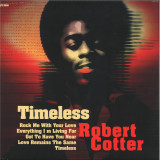
Worthy re-issue of Robert Cotter's second late 70's soul album! Comprising five songs, with four of them being quite lengthy and well-structured for the dance floor, was entirely recorded in the United States by top-notch American musicians. "Timeless", a fresh and lively expression of late 70s soul music, was recorded at the Sundragon Studio in New York. This studio was home to legendary bands such as Talking Heads and Ramones, as well as a few 'disco studio groups' like Andrea True Connection, Tony Valor Sound Orchestra, and Camouflage, who recorded songs that later became considerable hits. For this reason, it's believed that the positive outcome of the album can be partially attributed to Ned Liben, an eclectic New York musician and co-founder of the studio in the Flatiron district of Manhattan, served as an exhaustive interlocutor for any artistic and technical needs. He was also the arranger of "Rock Me With Your Love", the most significant song on the album. Ned's successful mission was to capture the maximum timbral fidelity of Robert Cotter's voice using appropriate recording techniques, assisted by Michael George Ewing, a talented engineer who had previously worked on similar projects with well-known artists like Carol Williams, Maryann Farra & Satin Soul, Touch and Tony Valor. In fact, the piece features original and melodious lines, coupled with an excellent steady rhythm, spanning approximately 8 minutes and 30 seconds - in short, "a delightful sound for every beat." This ensured that the performance of the young singer-songwriter from New Jersey was faithfully reproduced without neglecting the overall musical landscape. The other four songs, arranged by Ben Lazzaroni with the same musicians as the first piece, are no exception. Best Record also delivered on the promise to Robert's older brother, Karl Potter, a powerful percussionist transplanted to Rome, for whom the roman label produced "Sweet & Salty Cha-Cha-Cha" (12", 1986). Robert Cotter, an artist about whom almost nothing has been written, is poised to gain recognition once word spreads about his album, which has been entirely remastered by Dom Scuteri and features a more congenial tracklist. This album is destined to be truly 'timeless', ready to captivate audiences around the world. Even the new cover artwork, created by Nerina Fernandez, pays homage to an artist who, despite expressing himself with elegance and simplicity, radiates energy and exudes love. "Timeless" is an inevitable revelation for anyone who missed it at the time, and for the next 40-plus years, it will remain an absolute must-listen for Robert Cotter's many fans, leaving them all in awe. In addition to the reissue on the classic glossy black vinyl, a strictly limited edition on red vinyl will be released exclusively by Clone Distribution.
Worthy re-issue of Robert Cotter's second late 70's soul album! Comprising five songs, with four of them being quite lengthy and well-structured for the dance floor, was entirely recorded in the United States by top-notch American musicians. "Timeless", a fresh and lively expression of late 70s soul music, was recorded at the Sundragon Studio in New York. This studio was home to legendary bands such as Talking Heads and Ramones, as well as a few 'disco studio groups' like Andrea True Connection, Tony Valor Sound Orchestra, and Camouflage, who recorded songs that later became considerable hits. For this reason, it's believed that the positive outcome of the album can be partially attributed to Ned Liben, an eclectic New York musician and co-founder of the studio in the Flatiron district of Manhattan, served as an exhaustive interlocutor for any artistic and technical needs. He was also the arranger of "Rock Me With Your Love", the most significant song on the album. Ned's successful mission was to capture the maximum timbral fidelity of Robert Cotter's voice using appropriate recording techniques, assisted by Michael George Ewing, a talented engineer who had previously worked on similar projects with well-known artists like Carol Williams, Maryann Farra & Satin Soul, Touch and Tony Valor. In fact, the piece features original and melodious lines, coupled with an excellent steady rhythm, spanning approximately 8 minutes and 30 seconds - in short, "a delightful sound for every beat." This ensured that the performance of the young singer-songwriter from New Jersey was faithfully reproduced without neglecting the overall musical landscape. The other four songs, arranged by Ben Lazzaroni with the same musicians as the first piece, are no exception. Best Record also delivered on the promise to Robert's older brother, Karl Potter, a powerful percussionist transplanted to Rome, for whom the roman label produced "Sweet & Salty Cha-Cha-Cha" (12", 1986). Robert Cotter, an artist about whom almost nothing has been written, is poised to gain recognition once word spreads about his album, which has been entirely remastered by Dom Scuteri and features a more congenial tracklist. This album is destined to be truly 'timeless', ready to captivate audiences around the world. Even the new cover artwork, created by Nerina Fernandez, pays homage to an artist who, despite expressing himself with elegance and simplicity, radiates energy and exudes love. "Timeless" is an inevitable revelation for anyone who missed it at the time, and for the next 40-plus years, it will remain an absolute must-listen for Robert Cotter's many fans, leaving them all in awe.
Malian and French pair Siraba unveil their much-anticipated self-titled debut LP on Damian Lazarus’ Secret Teachings label, a 10-track odyssey fusing Mali’s rich musical traditions with cutting-edge electronic music.
Malian hunter Boubacar Samake and Damien Vandesande, one half of the French electronic band dOP, have won plenty of plaudits for the early singles taken from their debut album as duo Siraba. Those singles, spanning across the summer months, have found the pair bring the traditional sound of the Wassoulou - a river valley of West Africa - to the electronic world after 20 years of friendship. The music comes with an important underlying message of love and respect and results in spellbinding tracks that move heart, body and soul, finding a perfect home on Secret Teachings - a left-of-centre alternative label to Lazarus’ celebrated and often more club- focused Crosstown Rebels. With the arrival of the full album, the pair exhibit and showcase the emotional breadth and depth of their music, with detailed explorations of organic textures and native sounds merged with future-focused ideas and concepts.
The title track opens with an atmospheric mix of spoken words and spine-tingling chords that bring rich Afro flavours, while ‘Dounoiia’ is a languid groove made from hand drums and pixelated synth leads that cast a fine spell. The slow-blooming ‘Bani’ brings rich Malian blues and melancholic horns, while ‘Komafly’ is a rich mix of acoustic strings and broken beats that transports you to a hot and dusty landscape. A vital component of the sounds of the Wassoulou, the indigenous stringed instrument the Ngoni features again on the rousing ‘Nanse’ as spiritual vocals sung in Bambara rouse the soul.
‘Djandjo’ is another rich infusion of Malian culture with simmering electronics to make for something both ancient sounding yet futuristic, and the hypnotic ‘Ngana Fôlly’ with its rich bass is a song ‘dedicated to those who fight for the well-being of their families, for unity... a song for the people who also fight a great disease, between life and death’. The sublime ‘Toro’ is a wavy groove perfect for sundown - a deep and inviting sound rich in soulful vocals and dreamy melodies, while ‘Tolonawoulile’ is driven by the intense strumming of the Ngoni with busy hand claps and hurried drums and last of all ‘Fo Te Mokobana’ sinks into a heart-warming slow groove with sweeping strings and Malian percussion all overlaid with impassioned vocals.
A rich listening experience, Siraba’s debut album is an immersive journey and absorbing dive into the minds of two artists breaking new grounds while spotlighting native traditions and musical techniques spanning hundreds of years.
Repress!
Having established himself as a talented, Jungle-influenced artist, Sam Binary is to appear on The North Quarter with his first extended project on the label. Collaborating with fellow producer Deviant on three tracks and spanning multiple tempos, the EP stays rooted in a common theme: Sam Binary’s love letter to 90s Intelligent Jungle.
Using modern techniques and production styles combined with classic hardware such as the E5000 Ultra sampler and the Mackie CR1604-VLZ mixing desk, the Bristol producer has created a unique, 90s-reminiscent sound. The result is bundled in a 7-track EP, equally suited for the dance floor as it is for listening at home.
“This release is really a love letter to 90s Intelligent Jungle and the Liquid Funk that emerged after it in the 2000s, paying homage to the music that inspired me to originally start producing nearly a decade ago”, Sam Binary explains. ‘Reality Slip’ will be released August 19th on The North Quarter.
Chyskyyrai, whose real name is Valentina Romanova, comes from Yakutia (Republic of Sakha), the northernmost republic of Siberia.
She sings in a variety of traditional vocal techniques, drawing on folk songs, animal imitation but most of all on the ancient mythological epic Olonkho, which has a multitude of archaic delivery styles. Olonkho performance is a traveling one-man theatre and a solo improvisation. Traditionally, the Olonkho storytellers, olonkhosuts, travelled from community to community, tribe to tribe, and performed the same function as a shaman. Mostly they were regarded as spiritual guides, teachers and keepers of cultural values. Their performances could last for several days, and were not just entertainment but also the way of teaching that people are not separate from nature and attuned them to it.
The songs presented on this LP capture a period of her life when she met with Tim Hodgkinson (Henry Cow) and Ken Hyder (Talisker) who had been performing together since 1978, and are well-known for their explorations in the field of shamanic cultures and free jazz. Their collaboration with the “Soviet Jazz Federation” goes back many years until finally in 1990, the duo went on an extensive tour in Siberia as “The Shams” during which they also visited Yakutia. Since then they have made numerous trips to Tuva, Altai and Buryatia playing with the local musicians and studying shamanism.
Recorded in Ken Hyder’s basement, early May 2005. Sleeve artwork by Sophie Lécuyer.
- A1: Turn Ix 03:47
- A2: Super Freeloader 03:41
- A3: Turn X 07:57
- A4: Turn Xi 03:10 Site
- B1: Turn Xii 03:25
- B2: Zeit Ohne Harmonie Iii 05:45
- B3: Turn Xiii 01:57
- B4: Turn Xiv 02:12
- B5: Festival Mood Iii 00:56
- C1: Turn Xv 02:14
- C2: Turn Xvi 06:00
- C3: Turn Xvii 02:34
- C4: Turn Xviii 04:32
- D1: Turn Xix 04:41
- D2: Turn Xx 06:08
- D3: Turn Xxi 01:38
- D4: Festival Mood Iv 01:47
With the label MPS, post-war musical history was written in Germany: noble music productions with many international greats come from the Black Forest and are timelessly legendary. In this tradition, HGBSBlue releases selected projects on high-quality vinyl.
The DLW trio has been working together for twelve years now and is now setting the tone in the modern European music scene, as the trio has long since left the boundaries of jazz behind. DLW, that is the sound-painting vibraphonist Christopher Dell, the virtuoso Danish bassist Jonas Westergaard and the German star drummer Christian Lillinger.
Time and again, the three jazz musicians from Berlin play together with artists from classical or avant-garde music. "Supermodern"
is the project that brings the three DLW musicians together with US pianist Bob Degen. This music is also unikal. It is a reverence
to the legendary Modern Jazz Quartet (MJQ), which in the 1950s was the link between chamber jazz and European classical music.
With "Supermodern," this reference to the MJQ is illuminated from the perspective of European avant-garde music, rather than
its African-American roots, which nevertheless resonate respectfully throughout.
DLW has "developed a concept based on repetition and difference. The starting point for a piece is always a single bar, which is
rhythmically interlaced and repeated trance-like until the smallest irregularities occur, which are written down and creatively
processed further. From this "superimposed combinatorics" (Christopher Dell) a perpetuum-mobile-like sound movement
develops, which is further radicalized on record by sound alienations and cut-up techniques." Thus respectfully wrote the Neue
Züricher Zeitung in August 2023.
Word has long since spread outside the German jazz scene that the DLW projects are always musically new. This is also the case
with the double LP "Supermodern 2", with recordings made in 2021 in analog at the MPS studio in the Black Forest. Together
with US pianist Bob Degen, who has been one of the creative voices of the German jazz scene for about 50 years, they play highenergy music, with sparkling virtuosity and close communication. A musical treat, further enriched by the immensely present
analog sound of this recording.
Teichmann + Söhne’s »Flows« is not so much the result of a collaborative process as it is a process in itself. Over the course of nine pieces, the Gebrüder Teichmann—Andi and Hannes—and their father Uli repeatedly find common ground between the very different musical styles, sound aesthetics, and subcultural codes they have internalised throughout their lives. The source material out of which the album evolved was culled from several recordings of rehearsal sessions in preparation for the trio’s concerts that took place between the years 2012 and 2022. The three added only a few overdubs to those recordings but edited them rigorously to both preserve and transform the spirit of their unlikely collaboration. The combination of Uli’s background as a versatile jazz artist and multi-instrumentalist with his sons’ penchant for dub techniques, modular synthesis, and live sampling as well as their interest in electronic dance music take on ever-different shapes. »Flows,« released on the occasion of Uli’s 80th birthday, is as joyful, lively and free-spirited as its makers.
It took the three musicians decades to get together to jam. Uli and Lu, the mother of Andi and Hannes, ran the legendary Jazzclub Kneiting between 1978 and 1983 while he also made a name for himself as a musician who, besides jazz, is knowledgeable in a plethora of music styles from all over the world and has an instrument collection to match. Naturally, Andi and Hannes rebelled against this versatility by opting for simplicity. Already as pre-teens, they formed a punk band and once they got a whiff of the burgeoning techno scene, strayed even further from their father’s path. They eventually moved from their native Regensburg to Berlin where they made a name for themselves with a slew of releases on seminal labels like Disko B or Kompakt before starting to more regularly collaborate with musicians from the realms of Contemporary Music, Improv, and Sound Art. Even after Uli had finally contributed some saxophone licks to the brother’s 2011 »They Made Us Do It« LP, it indeed needed someone else to make them do it, i.e. finally get together to reconcile their musical differences in a creative way.
Finding out that the three had never performed together, Yoichi Osaki from Berlin’s iconic Miss Hecker venue, a focal point of the city’s so-called Echtzeitmusik (real-time music) and Improv scene, scheduled them to play their first concert on April 1, 2012. Even though the date was chosen deliberately, things got serious very quickly and this first joint concert proved to be the first of many. It also laid the foundation for »Flows« since the three would start recording their rehearsals. Revisiting the roughly 90 recordings, some of which clock in at a full hour, after ten years of playing with each other then started what Hannes describes as a »form-finding process.« It was a holistic one and involved all three of them, extending also to their choice of cover artwork, a piece created by Lu, who died in 2016 and to whom the album is dedicated. For the collage, she had used photos of the place where it all began, Regensburg, and the river that flows through it, the Danube. This made the piece, coincidentally created around the time Teichmann + Söhne started playing their first concerts together, correlate perfectly with the working process of the three musicians on a visual level.
Similarly, Teichmann + Söhne can be thought of as a human-musical collage. It is a meeting of three different musicians who all have in common that they have occupied alternative spaces and perfected a variety of musical styles and subcultural codes throughout their lives. When those flow into each other, this necessarily creates something that is as unique as the nine tracks collected on this album. While it is mostly Uli who takes the lead on pieces like the appropriately titled »Im Zwischen« (»In the Inbetween«), the brothers respond by live sampling his playing, thus serving as a creative interface between acoustic sounds and electronic responses. This in turn provides a framework in which Uli can improvise on a variety of acoustic instruments like the saxophone and the clarinet as well as a mandolin and glockenspiel or even percussion. This indeed makes their music flow—across different generations, between different musical ideas and genres, into previously uncharted territory.
Alan Abrahams aka Portable returns to the label in fine form with his latest full-length LP, Augmented Dreams. The title refers to the use of everyday technological advancements to achieve what were once
only dreams or visions of past generations, making this an explorative concept album that is equal parts not-too-distant science fiction, and about as topical as it gets.
From the gorgeous opening string layers of “The Pull of Time” to the classy 4/4 grooves of “Begin Again” or lead single “Guiding Me”, into the apropos and angular sci-fi broken beat feels of “Parallax” and “The Color of Static”, fitting Detroit-influenced love taps like “Beacon” and “The Mycorrhizal Network”, the politically-inspired “Are We Not Above It?” referencing the lingering effects of colonization featuring NiQ E from South Africa on vocals and L_cio from Brazil on flute, through to the futurist pop elegance of the dreamy duet recorded with Alexey Kochetkov “I Need You” and the conclusive titular track, it is clear that both the in-depth concept and immaculately-crafted musical content in Portable’s inimitable style are balanced in significance and expressive effect. This also functions as a timely statement in itself, as today’s iceberg-tip evolution of AI technology is currently impending over the arts and many of our existing realities.
This ten-song album serves as an imaginative yet hyperrealist narrative on how humanity’s fascination with and reliance on ever-advancing technology defines the times we find ourselves in, while the skillful sonic displays and present-era production techniques along with Abraham’s knack for timeless emotive songwriting offer up this solid soundtrack for the ages.
Outer Order presents his debut EP on his own imprint with a journey through his sonic vision with 5 tracks that suit different moments on or off the dancefloor.
Heavily inspired by late 80s and early 90s UK, Detroit and Chicago productions that were brought to his knowledge by his father, Outer Order set out to recreate his own view on this era by indulging in the hardware and techniques used at the time, setting a timeless tone to this 5 track EP.
Recorded, produced and mixed by Reece Ashibende-Dunn aka Outer Order at his home studio in Mallorca, Spain.
Green Vinyl[16,39 €]
We are thrilled to kick off our label endeavors with one of the rarest and simultaneously best-recorded independently released German new wave singles in history: "Jede Nacht derselbe Traum" ("The Same Dream Every Night") by Total.
Back in late 1983, Total found themselves in a pivotal rendezvous with CBS Records in a Frankfurt hotel lobby. The entire band was present, along with the esteemed NDW manager Jim Rakete, who had played a role in launching Nena to national and international stardom. Also in attendance were the A&R representatives from CBS. It was on this day that Total was presented with the opportunity to ink an album deal with CBS. However, since they had only recorded the titular song thus far, negotiations hit a snag. CBS insisted on a full album rather than a standalone single.
Ultimately, the band decided to independently issue a limited 7" run of "Jede Nacht derselbe Traum" under Günther Mannschreck's Schreckschuss label in January 1984. These vinyl copies became the band's currency for pursuing record deals and promotional prospects. However, despite the potential to achieve commercial success and garner radio airplay, the song and the "Total" project gradually waned from the music landscape. Regrettably, only a few vinyl copies have managed to endure over time. This NDW "holy grail" may have prompted a fair share of dreams for serious vinyl collectors, as to this day, not a single physical copy has been put up for sale on platforms like eBay or Discogs. Interestingly, Maisenbacher has even fielded an offer of over 400 Euros for an original copy, although he regretfully couldn't fulfill the request due to possessing just a single copy himself.
The song itself is a fusion of diverse musical styles. Crafted using the Oberheim OB8 system, complete with the DMX drum machine and a bassline woven from a Jupiter 8 keyboard, it carried a groove reminiscent of New York's electro hip-hop sound in "The Message," setting it apart from typical German new wave productions. Additionally, a Korg Polysix was integrated, and guitar effects were layered to finalize the infectious synth-pop instrumental. Newcomer to the band, Andrea Ströbel, laid down a flawless vocal layer that steered the song towards a straightforward NDW direction, giving it a resonance that surely resonated with mainstream and radio audiences. To complete a B-side for the original vinyl single, the legendary state-of-the-art L480 Lexicon reverb was used. In the more experimental "Maxi Mix," now known as the "Dub Mix," Mannschreck expertly manipulated the machine. The outcome stands as a historical example of incredible studio craftsmanship and the cutting-edge techniques of the 80s.
For the new 12" release, Mannschreck unearthed an alternative mix of the song on the original tapes, featuring a distinct introduction, break, and exciting edits. In addition, DJ Friction, who contributed to the transfer and mastering for the release, treated us to a superb edit that cleverly melds all versions of the song while incorporating a few extra bassline groove elements.
The captivating reissue cover spotlights vocalist Andrea Ströbel, who gazes with determination. A hand reaches out to grab her shirt, attempting to pull her down. Symbolizing the song's theme, it embodies the unsettling dream conveyed by the lyrics-yet she steadfastly resists.
In summary, we are elated to present a significant gem for vinyl enthusiasts: a splendid mid-tempo tune that dances on the boundary of synth-pop, new wave and electro. The new 12" single underwent meticulous mastering, and the outcome is nothing short of astounding, surpassing the sonic quality of the original pressing.
Black Vinyl[14,24 €]
We are thrilled to kick off our label endeavors with one of the rarest and simultaneously best-recorded independently released German new wave singles in history: "Jede Nacht derselbe Traum" ("The Same Dream Every Night") by Total.
Back in late 1983, Total found themselves in a pivotal rendezvous with CBS Records in a Frankfurt hotel lobby. The entire band was present, along with the esteemed NDW manager Jim Rakete, who had played a role in launching Nena to national and international stardom. Also in attendance were the A&R representatives from CBS. It was on this day that Total was presented with the opportunity to ink an album deal with CBS. However, since they had only recorded the titular song thus far, negotiations hit a snag. CBS insisted on a full album rather than a standalone single.
Ultimately, the band decided to independently issue a limited 7" run of "Jede Nacht derselbe Traum" under Günther Mannschreck's Schreckschuss label in January 1984. These vinyl copies became the band's currency for pursuing record deals and promotional prospects. However, despite the potential to achieve commercial success and garner radio airplay, the song and the "Total" project gradually waned from the music landscape. Regrettably, only a few vinyl copies have managed to endure over time. This NDW "holy grail" may have prompted a fair share of dreams for serious vinyl collectors, as to this day, not a single physical copy has been put up for sale on platforms like eBay or Discogs. Interestingly, Maisenbacher has even fielded an offer of over 400 Euros for an original copy, although he regretfully couldn't fulfill the request due to possessing just a single copy himself.
The song itself is a fusion of diverse musical styles. Crafted using the Oberheim OB8 system, complete with the DMX drum machine and a bassline woven from a Jupiter 8 keyboard, it carried a groove reminiscent of New York's electro hip-hop sound in "The Message," setting it apart from typical German new wave productions. Additionally, a Korg Polysix was integrated, and guitar effects were layered to finalize the infectious synth-pop instrumental. Newcomer to the band, Andrea Ströbel, laid down a flawless vocal layer that steered the song towards a straightforward NDW direction, giving it a resonance that surely resonated with mainstream and radio audiences. To complete a B-side for the original vinyl single, the legendary state-of-the-art L480 Lexicon reverb was used. In the more experimental "Maxi Mix," now known as the "Dub Mix," Mannschreck expertly manipulated the machine. The outcome stands as a historical example of incredible studio craftsmanship and the cutting-edge techniques of the 80s.
For the new 12" release, Mannschreck unearthed an alternative mix of the song on the original tapes, featuring a distinct introduction, break, and exciting edits. In addition, DJ Friction, who contributed to the transfer and mastering for the release, treated us to a superb edit that cleverly melds all versions of the song while incorporating a few extra bassline groove elements.
The captivating reissue cover spotlights vocalist Andrea Ströbel, who gazes with determination. A hand reaches out to grab her shirt, attempting to pull her down. Symbolizing the song's theme, it embodies the unsettling dream conveyed by the lyrics-yet she steadfastly resists.
In summary, we are elated to present a significant gem for vinyl enthusiasts: a splendid mid-tempo tune that dances on the boundary of synth-pop, new wave and electro. The new 12" single underwent meticulous mastering, and the outcome is nothing short of astounding, surpassing the sonic quality of the original pressing.
To coincide with The Courettes' first US tour, Damaged Goods put out this special compilation album. Boom! Dynamite includes singles, deep cuts from their studio albums, with B-sides and rarities thrown in for good measure! First pressing on orange vinyl is limited to 1000 copies only! The Courettes are two souls in love with each other and in love with rock 'n' roll. They've been touring nonstop throughout Europe since 2015, bringing their "perfect blend of garage rock, '60s Girl Group, Wall of Sound, surf music and doo wop" to the delight of any audience even remotely interested in rock 'n' roll. Expect excitement, danger, sweat, explosive performances, and most importantly, GREAT tunes! The "hardest working band in showbiz" now venture further away - After visiting the Land of the Rising Sun in 2022, The Courettes are thrilled to tour the USA for the first time in 2023. Described as "The Ronettes meet The Ramones at a wild party at Gold Star Studios echo chamber", The Courettes have released four fantastic albums on the legendary label Damaged Goods Records, each one praised by magazines such as MOJO and Shindig!, most notably the Back In Mono album in 2021, a true milestone in their career. This new compilation, Boom! Dynamite, released exclusively for the US market, guides you through their albums from the very beginning, from the early raw power garage rock onto their present Spector/Levine Wall of Sound Gold Star sound, made using complex recording techniques at StarrSound Studios in Denmark with top producer Soren Christensen and mixing genius Seiki Sato from Japan. Featuring Brazilian Flavia Couri on guitars and vocals, and Danish Martin Couri on drums, The Courettes were born international. For them there are no nations or borders. Their mission is to connect, cherish, and inspire rock 'n' roll souls around the world, including now, in the USA. The Courettes are pure dynamite! Turn up the volume and fuzz out! BOOM!
2023 repress! clear with pink vinyl.
Beach Fossils' sophomore album, Clash the Truth, is modern post-punk triumph that's left a lasting impression on the music scene it was born out of. After releasing their self titled debut and the beloved EP, What a Pleasure, songwriter and composer Dustin Payseur began recording dissonant and introspective demos reflecting on his southern upbringing and young adulthood in New York. The tracks that would eventually make up Clash the Truth involved Payseur taking his songwriting in a new direction, employing jagged instrumentals, existential lyrics, and socially conscious subject matter. The darker themes of Clash the Truth still come out vibrant through bright guitar tones, locomotive drumming, and Payseur's inventive home recording techniques. Referencing the sounds of Factory Records releases, New York's no wave scene, and 90's avant-pop, Beach Fossils expanded their sound past the perimeters of bedroom dream pop.
Kasra V is here to engulf the club. Fresh off the success of his recent release on Radiant Records titled "Hyperdelic," Kasra is submerging listeners with a signature sound touching on dance music visions from different epochs but harnessing a unique aural palette. Kasra applies cut up techniques with sampling and utilizing his own voice as a tool throughout the record, topping the club energy with a punk rock sensibility. Equal parts eccentric and equal parts calculated, the tempest of this record is doused in wild elements: anthemic vocal samples with arena shaking capabilities, 80's hedonistic nostalgia, catchy utopian vibrations with a psychedelic cyber flair, flirting with inspiration from groups like Meat Beat Manifesto and YMO. Euphoric and aerated, but with a slicing undertone utilizing his freaky sampling prowess. Shaytoon is proud to present the next chapter of diaspora alchemy for your listening pleasure. Prepare for a flood.
Skultura is Nick Dunston’s follow-up to the critically acclaimed Spider Season, which was released in July 2022. On Spider Season, Martin Johnson of Jazz Times said “Dunston is a sonic revolutionary in many ways, not the least of which is the instrumentation of his bands.”Spider Season also received glowing reviews from Pitchfork Magazine, TheWire, and New York City Jazz Record. While Skultura is an entirely new band,(featuring Cansu Tanrıkulu on voice/effects/electronics, Mariá Portugal on drums, Liz Kosack on synthesizer, and Eldar Tsalikov on alto saxophone/clarinet), fans of Dunston will find much to admire, and hear a compositional, improvisational, and notably, production style that is becoming uniquely his own. The repertoire of original music on Skultura ranges from spontaneous electro-acoustic ensemble exchanges, to carefully sculpted tone poems that meditate on the manipulated sample-based sides of the quintet. Composition, improvisation, and performance are no longer the only elements at playin Dunston’s recorded work. On Skultura, he continuously shapes the music with various sound-manipulation techniques to create an album that is meticulous as it is visceral. To quote Jacob Garchik’s liner notes, the ‘work is made of continuous waves of inspiration and creation, strata of improvisations made permanent, each layer related to the one below, or not’. Skultura is revered in Europe and the U.S., and will be co-released on the Berlin-based record label Fun In The Church, and the American tape cassette label Tripticks Tapes. Upcoming European performances in the Fall 2023 include Wels Unlimited Festival in Austria, and the Jazz Exzess concert series in Berlin.
To celebrate Spider-Man’s sensational 60th anniversary, Marvel Entertainment partnered with Semmel Exhibitions to launch Spider- Man: Beyond Amazing - The Exhibition, which chronicles the epic history of the ‘wall crawler’. The exhibition runs from May 26, 2023 through October 1, 2023 in Kansas City, and premiered at the Comic- Con Museum in San Diego where it ran from July 1, 2022 through January 1, 2023.
For this historical display, a soundscape was needed to reflect Spidey’s emotional ups and downs: his moments of isolation and loneliness, but also his courage, determination, and the sheer joy of web-slinging. This is where Sebastian M. Purfürst of LEM-Studios came in. To create a soundtrack that would engage visitors in every single moment of the exhibition, Sebastian employs parallel techniques in his musical compositions and productions - not only writing the notes and melodies but creating a fully realized world of sound.
Marvel’s Spider-Man: Beyond Amazing - The Exhibition is available as a strictly limited edition of 2500 individually numbered copies on crystal clear vinyl with a full-colour Spider-Man print on its side B. The package also includes a 4-page booklet and large exhibition poster.
Balmat is a new label with a cloudy outline.
Jointly shepherded by Philip Sherburne and Albert Salinas, two friends living in Cardedeu, Catalonia, and on the Balearic island of Menorca, Balmat grew out of Lapsus Radio, a weekly show on Spain’s Radio 3. Balmat’s mission is simple: to foster new ideas, expand upon personal obsessions, and put enveloping sounds out into the world.
“Balmat” means “empty” or “void” in Catalan. But quite apart from any negative connotations, we prefer to think of it in terms of possibility: a space waiting to be filled.
Balmat’s first release comes from Luke Sanger, a Norwich, UK-based artist whose two decades of electronic music making have encompassed a range of tools and techniques, from MaxMSP to modular synthesis. Along the way he has built an extensive catalog encompassing ambient atmospheres, abstract soundscaping, and more. With Languid Gongue, he puts multiple approaches into play. Experiments in microtonal composition balance out pieces in standard tunings, while esoteric electronic machines merge with familiar acoustic treatments and microphone techniques.
The result is a constellation of his signature sounds: freeform new-age fantasia; spring-loaded toytronic arpeggios; quartz-driven braindance clockworks. Drifting between consonant, almost lyrical compositions and shape-shifting textural sketches, the album drifts with the nonchalance of a sky-high cirrus cloud, and it glows as if illuminated from within. When we heard the material, we knew that it was the perfect choice to launch the label. To us, it sounds like a roadmap for points unknown.
The female-led discodelic soul band Say She She, named as a silent nod to Nile Rodgers (C’est chi-chi!: It's Chic!”), release their sophomore album ‘Silver’ on the heels of an epic break-out year that grows brighter by the day.
The three strong voices of Piya Malik (El Michels Affair staple feature, and former backing singer for Chicano Batman), Sabrina Mileo Cunningham and Nya Gazelle Brown front the band. This harmonizing trio was formed in a classic New York tale of friends that met by following the music: the downtown dancefloors, through the
Lower East Side floorboards and up to the rooftops of Harlem.
‘Silver’ was entirely written and recorded live to tape at Killion Sound studio in North Hollywood earlier this year and produced by Sergio Rios (of Orgone). While these analog recording techniques help root Say She She’s sound in a bedrock of tonal warmth that only tape can achieve, it is also their process of cutting the track
in the moment and capturing the magic of communal creativity that has seen their sound described as “a glorious overload of joyful elation and spiritual elevation” (MOJO) and “infused with the wonky post-disco spirit of early '80s NYC” (The Guardian).
Silver, the element, is known as the metal of self-confidence and the mirror of the soul. With that, the 16-song double-LP projects not only their growth in writing with confidence, but also reflects a deeper exploration into their punk-chic, femmeforward sensibility.
Ultimately, ‘Silver’ oozes with quirk and adventure and embraces the multifaceted nature of what it means to be a modern femme. The She She's fully embrace their role as beauticians, actively reminding people of the inherent beauty in the world. They skillfully employ double entendres and humor to encourage open dialogue and fearlessly address important matters that demand attention.
The female-led discodelic soul band Say She She, named as a silent nod to Nile Rodgers (C’est chi-chi!: It's Chic!”), release their sophomore album ‘Silver’ on the heels of an epic break-out year that grows brighter by the day.
The three strong voices of Piya Malik (El Michels Affair staple feature, and former backing singer for Chicano Batman), Sabrina Mileo Cunningham and Nya Gazelle Brown front the band. This harmonizing trio was formed in a classic New York tale of friends that met by following the music: the downtown dancefloors, through the
Lower East Side floorboards and up to the rooftops of Harlem.
‘Silver’ was entirely written and recorded live to tape at Killion Sound studio in North Hollywood earlier this year and produced by Sergio Rios (of Orgone). While these analog recording techniques help root Say She She’s sound in a bedrock of tonal warmth that only tape can achieve, it is also their process of cutting the track
in the moment and capturing the magic of communal creativity that has seen their sound described as “a glorious overload of joyful elation and spiritual elevation” (MOJO) and “infused with the wonky post-disco spirit of early '80s NYC” (The Guardian).
Silver, the element, is known as the metal of self-confidence and the mirror of the soul. With that, the 16-song double-LP projects not only their growth in writing with confidence, but also reflects a deeper exploration into their punk-chic, femmeforward sensibility.
Ultimately, ‘Silver’ oozes with quirk and adventure and embraces the multifaceted nature of what it means to be a modern femme. The She She's fully embrace their role as beauticians, actively reminding people of the inherent beauty in the world. They skillfully employ double entendres and humor to encourage open dialogue and fearlessly address important matters that demand attention.
Discrepant proudly presents the Vinyl edition of Lebanese trio Malayeen. Malayeen is the project of Lebanese musicians Raed Yassin (Keyboards, Turntables & Electronics), Charbel Haber (Electric Guitar & Electronics) and Khaled Yassine (Darbouka, Percussion). Born from Yassin and Haber's love for the music of quintessential Egyptian guitarist Omar Khorshid, Malayeen disassembles and re-configures the work and style of the iconic guitarist innovative take on Arabic music. The final result makes for an original and unique update of Khorshid & belly dancing inspired songs from the past. Over the course of 7 compositions, appropriately named after Khorshid and famous belly dancers from the Arabic diaspora, the three musicians' varied backgrounds and techniques collide and coalesce in an experimental yet magical fashion, not actually playing Khorshid's music, but inspiring themselves from the cult guitarist's genius to create something completely new, modern and unexpected. A unique LP featuring the combined talents by key players of the Lebanese avant-garde. The Malayeen LP edition is released by Discrepant in collaboration with Lebanese exploratory label Annihaya effectively combining East and West musical strains of thought as well as conclusively deconstructing and displacing this particular form of 'popular' music. Design by Studio Safar S.A.L. Comes with full color poster painting by Omar Khouri Special vinyl one time pressing to 500 copies. "Uplifting, beat-driven pieces, often melodic, definitely Arabic, with destabilizing touches from external sounds, sound manipulations, and textural plays. The 17- minute 'Samia' is a roller-coaster ride culminating in a dizzying solo/duo between Yassine's darbouka and a darbouka track from a record played by Yassin. Great stuff. Monsieur Délire
- 1: Tnt
- 1: 2Swung From The Gutters
- 1: 3Ten-Day Interval
- 1: 4I Set My Fave To The Hillside
- 1: 5The Equator
- 1: 6A Simple Way To Go Faster Than Light That Does Now Work
- 1: 7The Suspension Bridge At Igazu Falls
- 1: 8Four-Day Interval
- 1: 9In Sarah, Mencken, Christ And Beethoven There Were Wome
- 1: 0Almost Always Is Nearly Enough
- 1: Jetty
- 1: 2Everglade
1998: Tortoise"s third studio album TNT is released. In and out of print over the past decade we are happy to finally give everyone what they have been asking for - TNT on vinyl again! Pressed on high quality virgin vinyl, the two LPs are packaged in a deluxe old-style tip-on gatefold jacket fully replicating the original artwork and includes a download coupon for the first time! Tortoise"s third full-length release, TNT, was written and recorded during a 10-month interval in 1997. This longer-than-usual writing/production schedule was purposefully undertaken by the group in the hopes of crafting an expansive, diverse, yet thematically coherent offering. TNT builds upon the spare, instrumental framework of the group"s first, self-titled album, and the extended edits, melodic adventures, and klangfarben of the subsequent full-length release, Millions Now Living Will Never Die. Further to this, Tortoise"s interest in the possibilities offered by the remixing of tracks was realized within the actual production of TNT; individual elements, sections, or sometimes whole compositions mutate within the album"s shifting framework. These techniques were suitably realized thanks in part to the use of non-linear digital recording and editing methods, the first example of such work for the group.
- 1: Subterranean - Movement I
- 1: 2 Subterranean - Movement Ii
- 1: 3 Subterranean - Movement Iii
- 1: 4 The Long Wait - Movement I
- 1: 5 The Long Wait - Movement Ii
- 1: 6 To Hold And To Be Held - Movement I
- 1: 7 To Hold And To Be Held - Movement Ii
- 1: 8 Mon Coeur - Movement I
- 1: 9 Mon Coeur - Movement Ii
- 1: 0 Mon Coeur - Movement Iii
- 1: Be Without Being Seen - Movement I
- 1: 2 Be Without Being Seen - Movement Ii
- 1: 3 Be Without Being Seen - Movement Iii
- 1: 4 Les Parenthèses Enchantées - Movement I
- 1: 5 Les Parenthèses Enchantées - Movement Ii
- 1: 6 Les Parenthèses Enchantées - Movement Iii
- 1: 7 Les Parenthèses Enchantées - Movement Iv
- 1: 8 Les Parenthèses Enchantées - Epilogue
- 1: 9 Night Looping - Movement I
- 1: 20 Night Looping - Movement Ii
- 1: 2 Night Looping - Movement Iii
Colleen thrives on reinvention. For over two decades under the name, French artist Cécile Schott has continuously pushed her compositional practice into new directions. Her creative approaches have included complex samples and loops, instrumental processing and even dub production techniques applied to the baroque viola da gamba. Each album immerses the listener in a wholly unique world while remaining unmistakably a work by Colleen. Schott"s compositions glow with carefully considered textures that move in captivating revolutions while subtly evolving. A connective thread of Schott"s work is the exploration of the intricacies of emotion while reveling in the act of contorting pop and classical forms into new shapes. Colleen"s Le jour et la nuit du réel is a voyage deep into the world of synthesis, a dense thicket populated by drifting echoes and pulsating arpeggios. More than just a creative approach, sound synthesis here becomes a means to interrogate complex concepts, from the self and perception to shifting notions of what is "reality".
Vienna has a storied history as a ground zero for new music. Radian, who call Vienna home, embodies the city"s spirit of innovation. Martin Brandlmayr (drums, electronics), Martin Siewert (guitar, electronics) and John Norman (bass) are stalwarts of the European contemporary music community. Distorted Rooms presents a dazzling new elevation of Radian"s employment and manipulation of microtones with a new emphasis on abstracted guitar motifs, often employing a more loop-based or electronic approach to the guitar"s sonics. Radian"s visionary approach to composition speaks to a lifetime of working in forward-thinking music. The trio expertly hone in on sounds often removed from the sheen of the recording process and mine them for unique, rich textural sound palettes which they then meticulously arrange. Distorted Rooms creative process began with multi-stage recording of often the smallest sounds, from pick-scrapes to an amplifier"s latent hiss. These slivers of sound are then restructured and processed through a variety of techniques that transform them drastically. Radian have always been interested in sounds that might be considered byproducts and maximizing their creative and aural potential. More minor gestures like switching a pedal on and off or toggling the guitar"s pickup are mic"d and spun into textures that crackle and froth to fascinating effect. Radian"s angular, expansive music delights in tension and contradiction, sound and silence, improvisation and composition. The trio employs a singular and wholly unique sense of microtonality. While their creation process is complex, the resulting music is emotionally affecting, creating an aura of suspense and at times unease. Brandlmayr, Siewert, and Norman share an unconventional, wildly imaginative approach to sound.
Engineered by Kurt Ballou at the band's longtime studio/practice spot God City, "No Heroes" shows the band exploring new sonic textures while still retaining the palpable energy they've become known for. While the album blazes out of the gate with the aptly titled "Heartache," songs like "Orphaned" and the intense "Plagues" prove that breakneck speed and heaviness aren't necessarily interrelated, and when Converge lower the tempo, they're able to effortlessly transcend traditional notions of heaviness. Devotees of "Jane Doe" will also be blown away by epic tracks like the nine-minute "Grim Heart/Black Rose," a doom masterpiece which features guest vocals from Only Living Witness' Jonah Jenkins. From Bannon's captivating artwork and introspective lyrics to Ballou's masterful production techniques, Converge's artistic vision has always separated the band from their peers, and "No Heroes" is no exception. Simply a great album.
The Keplar label presents the next instalment in a series of reissues from the catalogue of Sasu Ripatti’s seminal Vladislav Delay project. Originally released on Mille Plateaux, the vinyl edition of »Entain« from 2000 omitted two shorter tracks and included all others in an abridged form. With this reissue, the full album as it was pressed on CD is finally made available on vinyl. Besides a new remaster by Kassian Troyer, it was also given new cover artwork by Marc Hohmann that picks up on that of the »Whistleblower« reissue, released in early 2023 by Keplar. This serial visual approach highlights the conceptual continuity between those masterful explorations of the interplay between dub techniques, noise, and repetition.
Ripatti himself had reworked material from 1999’s »Ele« album for the release of »Entain,« which means that it can be considered the debut album proper of his Vladislav Delay project. It saw the Finnish artist aim more vigorously for abstraction than in his earlier releases as Vladislav Delay for labels such as Chain Reaction, which were collected on the iconic »Multila« compilation in 2000; another milestone from his back catalogue that has been reissued by Keplar in recent times. To mark this special occasion, »Multila« will be repressed by Keplar with a new artwork that matches the new design of »Whisteblower« and »Entain«.
»Multila« and »Entain« correspond with each other conceptually as much as they seem to differ on a musical level. The material on »Multila« was clearly indebted to the Berlin dub techno sound, marked by its grainy and at times abrasive sonic aesthetics. From the very first moments of the 22-minute long opener »Kohde« however, it becomes clear that »Entain« takes things further away from the dancefloor, aiming less for physical impact than for intellectual stimulation. A sort of electronic minimal music, it was primarily interested in letting discrete elements freely come into play with one another.
Much like »Multila,« however, »Entain« highlighted the subtle differences embedded in what only feels like repetitive music. Of course the massive bassline and ghostly dub riddims that permeate »Notke« as well as the deconstructed beat at the core of »Ele« still hint at Ripatti’s roots in beat-driven music. However, they also make his artistic transformation audible by turning their sources of inspirations into something entirely unheard of. »Entain« took the dub techno formula further than any other record before it—onwards into the realms of pure abstraction.