Since their formation in 1977 Mark Perry’s group Alternative TV have moved far away from their more direct punk rock beginnings into all manner of other areas of music that have sometimes themselves drawn from improvisation, free jazz, industrial and electronic music. On Direct Action, Alternative TV’s first studio album since Opposing Forces in 2015, we are presented with six instrumental tracks which steadily rip apart all expectations as they shed all allusions to rock music in favour of the kinda sonic mutilations that once helped 1979’s classic (and Nurse With Wound list endorsed) Vibing Up the Senile Man (Part One) stumble into weird and wonderful shapes. Direct Action marries guttural electronics to sounds most artists would consign to the bin and through Perry’s long perfected mastery of pulling together disparate strands to create something entirely alchemical and invigorating delivers a unique stamp to the ATV story. With the help of longtime collaborator Dave Morgan alongside the input of Gareth Matthews, Ruth Tidmarsh and Cos Chapman, abstract patterns of dishevelled sound rub alongside occasional percussion, disembodied plasma guitar strums and even what seems like an oboe groaning in a murky corner. Similar to its distant cousin of Vibing…, everything adds up to a whole that’s demanding yet completely rewarding as every listen prises open the dark scab of contemporary malaise to reveal something fresh. The front cover’s homage to an incredible album by a pioneering electronic group we are not going to name should in itself point to the unpredictable nature of the music here. If you are savvy enough to get that reference, then you’re on the right path to understanding where Direct Action resides. Easy listening this ain’t. Limited to 600
Search:the act
As soon as Spike discovered punk, he wasted no time forming Reptile Ranch (Wales’ own Scritti Politti), starting a label (Z Block), and releasing the compilation of the Cardiff scene, Is The War Over? After an act dropped out of the cooperatively-funded venture, Spike approached the disbanded Young Marble Giants to contribute a track or two. Bemused, they agreed to reform, and it wasn’t long before Rough Trade rang the public phone listed on the back cover of the LP to poach the combo, leading to an album which hit immediately and has inspired hundreds of artists since. All the while, Spike worked with Debbie Pritchard in a number of unheard bands - but that’s another tale. After YMG’s breakup, singer Alison Statton started Weekend with Spike and Simon Booth, a project which saw chart success and the birth of a nouveau-retro style as individualistic as YMG’s, one later co-opted by lesser acts. Weekend, too, split after their debut album. Despite Weekend having become Alison’s second big act, Rough Trade passed on her next project with Spike. Vinyl Japan stepped in to release the duo’s debut, Tidal Blues and other releases followed, but as real life, jobs, and children beckoned, both Alison and Spike stepped away from music . . for more than twenty years. Their return is both unexpected. Bimini Twist is the work of the two alone. Apart from some vocal tracking in a local studio to best capture Alison’s still wondrous voice - everything was recorded in their homes, much of it ‘live’, and these new songs show the duo’s charm and diversity, featuring Alison’s most personal lyrics and Spike’s peculiar musical genius
These songs came to be a record accidentally and unintentionally. They were written sporadically over a tumultuous two years riddled with more valleys than mountaintops. We considered it a victory when we could actually make ourselves get together to write, even if we struggled to produce anything of any quality. Creativity was tough amidst half-hearted business relationships, being dropped from our label, inconsistent touring, and filing personal bankruptcy. It took a toll on everything: our confidence, our outlook, our health, our happiness. In late 2015, our friend Brandi Carlile invited us to Seattle to play a couple of shows in her hometown. It was there that we explained all that had transpired with our career, how we were barely staying afloat. It was also there that she told us she would be producing our next record. Once we saw that this fantasy could actually become a reality, the frantic search for enough songs to make an album began. To our surprise, we had many things to say, and though some were difficult to write and slow to reveal themselves, we pushed onward. The songs here carry a common thread of what remained when we felt like we’d lost everything. It was in the hardest times that we saw the core of where our music and our souls originate. We still had our homes, our family, our friends, and our fans. This is not a record about rising from the ashes. Rather, it is a deep look into ourselves in an attempt to put out the flames. These songs are our catharsis; an effort to forgive, an effort to heal, an effort to look back into the darkness with newfound light and undeterred fearlessness, an effort to redeem ourselves. The damage was done, but our hearts remained.
Neon Violet[21,43 €]
DOOM JAZZ II: Deception continues the epic story of the DOOM JAZZ saga, with Jamie Saft and Bobby Previtetrading the slow, sensual lines of DOOM JAZZ I for a more active, muscular sound Side One, "The New Friend" and "Everyone is Aware" uses a vintage Yamaha organ to create an atmosphere of mystery and space. Side Two, "Deception"moves into different territory, Saft's distorted Hammond Organ sailing over Previte's active, commanding tom toms in a blues based jam of wild ferocity and intense foreboding. The plot thickens
Violet and Blue LP[21,43 €]
DOOM JAZZ II: Deception continues the epic story of the DOOM JAZZ saga, with Jamie Saft and Bobby Previtetrading the slow, sensual lines of DOOM JAZZ I for a more active, muscular sound Side One, "The New Friend" and "Everyone is Aware" uses a vintage Yamaha organ to create an atmosphere of mystery and space. Side Two, "Deception"moves into different territory, Saft's distorted Hammond Organ sailing over Previte's active, commanding tom toms in a blues based jam of wild ferocity and intense foreboding. The plot thickens
- Derived From The Trout Mask In A Tentative Manner 04:55
- The Dissolution Of Time 08:57
- Abdication 05:02
- The Alphabet Of Steps 06:23
- Les Cycles Extatiques 06:52
- The Geometry Of Rhythmics 05:26
- At The Margin Of Moments 06:37
- Through The Deserts Of Postmodernity 09:36
- Stereometry Of Moving Bodies 06:27
- Suspecting Metaphysical Symbols 07:28
After two years, Carl and Andreas present their second album, and once again, it opens up a wide associative space for us. What strikes us initially is the uncommon instrumentation: a church organ, harpsichord, glass tubes, and more. Like their first album (The Aporias of Futurism), it is mysterious and dark. But it also carries a strong touch of rebellion and adrenaline, sometimes quite pointedly. The pieces are now shorter and feature intricate yet irresistible rhythms. The impact is immediate, yet it maintains a sense of solemnity and ceremony. The Apollonian complexity of the rhythms and subtle melodic interweavings is transformed into a Dionysian, ecstatic, hypnotic, and at times tribal context. "Music for Unknown Rituals" oscillates between primitive instincts and avant-garde intrigues.
The process began in Döblitz, a small village on the Saale river in Germany, inside an old church that houses an organ built in 1886 by Johann Adolph Ibach. Carl and Andreas gained access and secluded themselves there for a few days, accompanied by the organ, an instrument made of glass tubes, and a set of modular synthesizers. After recording the basic tracks in Döblitz, the work continued in Munich and Berlin. Carl played electric guitars, harpsichord, bass, metallophone, xylophone, Indian harmonium, and various percussive instruments. Andreas added layers of electronic sounds, noises, and atmospheric drones. He also created percussive structures extracted and derived from recorded material of technical and industrial noises, which contrasted with the acoustic drums played by Carl. The antithetical approach continues with the dichotomous arrangement of the instruments, often panned hard left and right in the stereo field, creating an antiphonic communication. Some parts, especially the use of the electric guitar, evoke memories of the psychedelic sixties. However, this is anything but a nostalgic album—these musical references are merely remnants, set pieces, and fragments used from a contemporary, post-modern, post-youth-cultural, and post-romantic perspective.
Although Andreas and Carl continue on their chosen path of composing music with an almost literary narrative structure, this album is conceptually and formally completely different from their first effort. If “The Aporias of Futurism” was a revolutionary manifesto (in a pataphysical sense), "Music for Unknown Rituals" is more like the implementation in action; it is the practical application of the previous statement. To put it another way, if "The Aporias of Futurism” was the conceptual manifesto of a dark utopia of modernity, "Music for Unknown Rituals" is the staging of free will surrendering to the myths and catharsis of a Greek tragedy. And in response to this, the artwork features a leitmotif of histrionics with hands, the hands being the first and intuitive part of the body to express something: a ritual, a prayer, a defeat...
— Andreas Gerth is one half of Driftmachine, and Carl Osterhelt is part of F.S.K and collaborates with Hans-Joachim Irmler of Faust. Both became connected through their participation in the Tied & Tickled Trio.
Get On Down is proud to announce a vinyl reissue of one of the West Coast's most revered, yet underrated, hip-hop classics and quite possibly one of the best hip-hop albums of all time: The D.O.C.'s No One Can Do It Better. Produced entirely by Dr. Dre and out of print on vinyl in the U.S. for several years, this limited edition colored LP features original album artwork and thirteen tracks of rap heaven. When his debut album hit in mid-1989, The D.O.C. was in the vortex of the biggest hip-hop happening on the planet: the rise and rule of N.W.A. The group’s breakout album Straight Outta Compton had hit one year prior and had created both controversy and worldwide critical acclaim. As rap history buffs and industry insiders know, The D.O.C. was a crucial behind-the-scenes member of the N.W.A. inner circle - his most important role in the early days of the group was writing many of Eazy-E's rhymes, including his hit 1988 single “We Want Eazy.” He would go on to write for Efli4zaggin, The Chronic and Doggystyle. But The D.O.C. wasn’t in N.W.A. and never wanted to be - he was his own man, with his own vision. And after Compton proceeded to blow up the next crew album was No One Can Do It Better. Significantly, it was the first album where Dr. Dre showed his greatness as a solo producer for one MC. Boasting four singles - “The D.O.C. & The Doctor,” “Mind Blowin’,” the smash “It's Funky Enough” and “The Formula” - the album is flawless from beginning to end. Of particular note beyond the singles is “The Grand Finale,” which was the last time that Ice Cube, M.C. Ren and Eazy-E would rhyme on a track together. The D.O.C. showed on this amazing record that he was one of hip-hops most talented MCs. He nearly died in a horrific car crash as the album was catching fire in the late summer of 1989 which damaged his vocal cords, but he survived and continues to make new music and act as a sounding board for Dr. Dre to this day. More recently a documentary covering D.O.C.'s life titled The DOC debuted at the Tribeca Film Festival with fans eagerly awaiting a wider release. This album is a must have for any Hip-Hop fan
- Intro At The Piano
- Red, White, And Blue
- Improvisation At Heart Mountain
- Summer Of '42 (Orchestral Edition)
- Improvisation In The Root Cellar
- ? ? ? ? ? (Iga Ueno Castle)
- Improvisation At Jerome, Ar
- Theme For Jerome (Orchestral Edition)
- ? ? ? ?? (Nada Sou Sou)
- ? ? ? ? ? ? ? ? (Ue O Muite Arukou)
- A Safe Place For Animals
- Manchester (Acoustic Edition)
- Removal (With Kara Kondo)
- Violin Tsunami For The Victims Of Tacoma Detention
- Epilogue From Improvisations On Eo9066
- For Every Voice That Never Sang
- War
- Removal
- Arrival At Heart Mountain
- Coldest Of The Camps
- Know Your Enemy:japan
- Improvisation For The Tokyo Firebombing
- Intro To 1853
- 1853: Commodore Perry And His Black Ships
- Bach's Double Violin Concerto In The Key Of Gypsy Swing
- Keiko Ishibashi
- My Name Is Kishi Bashi
- Proud American
- The 442Nd - Go For Broke
- Chicago Meditation
- A New Life
- The Pilgrimage
- Omoiyari And The Model Minority Myth
"Omoiyari" means to have empathy and consideration for others, and act on it. This fall, the American indie-folk multi-instrumentalist and singer-songwriter Kishi Bashi is set to release the companion album to his forthcoming documentary song film, titled Music from the Song Film: Omoiyari. Consisting of two LPs_"The Songs" and "The Score"_the release showcases what is essentially the soundtrack to Omoiyari, the feature-length motion picture co-directed by Kishi Bashi, aka Kaoru Ishibashi or "K," which is being released via MTV Documentary Films in November. Focusing on K's own six-year journey of discovery surrounding his research of the incarceration of 120,000 Japanese Americans that followed the attack on Pearl Harbor in 1941, the film is part social justice documentary and part song-film experiment. The album includes K's live improvisations, which are featured in the documentary, many recorded on the sites where the concentration camps stood. Written during and about the artist's transformational dive into his personal identity and serving as a broad survey of the Japanese American experience as well as the incarceration_Music from the Song Film: Omoiyari serves as an evocative musical accompaniment to the lessons of empathy and compassion portrayed in the film and highlights the process and power of one of modern indie's most talented musicians.
Faitiche releases the album Improvisations And Edits, Tokyo 26.09.2001 on vinyl for the first time. For the original 2002 CD on Soup-Disk and Sub Rosa (Audiosphere), Jan Jelinek and the Japanese trio Computer Soup (Satoru Hori – trumpet, Osamu Okubo - toys & electronics, Kei Ikeda - toys & electronics) presented eight tracks all recorded one afternoon in the trio’s living room in Tokyo. They are excerpts from a joint group improvisation that subsequently underwent rudimentary editing, on which Jelinek and Computer Soup worked separately.
Jelinek met the three musicians at his first concert in Japan in 2001, at Tokyo’s Yellow club, where Computer Soup performed as the support act. Delighted by their free improvisation on pocket-sized electronic toys, trumpet and oscillators, he arranged to meet Hori, Okubo and Ikeda a few days later for a session at their apartment. The resulting three-hour recording, made on their living room floor, formed the basis for Improvisations and Edits. A few days later, Jelinek returned to Berlin. Over the following months, they separately chose passages from the recording that were then edited and assembled into an album.
Formed in Tokyo in 1996 as a quintet (including Shusaku Hariya and Daisuke Oishi), Computer Soup began by performing with acoustic instruments on the streets of Shibuya. Ikeda und Okubo soon switched instruments, and from then on the group’s minimalistic but densely woven sound was defined by electronic toys, oscillators and Satoru Hori’s trumpet. Their first album was released in 1997 on the Japanese label Soup Disk. Eight further releases followed.
From the reviews of Improvisations and Edits, Tokyo 26.09.2001 in 2003:
"The mind-blowing first track Straight Life is perhaps the best example of what the album has to offer. Jelinek's trademark smears and washes occupy the midrange, like ghosted images of Joe Zawinul's electric piano floating quietly in the wind. DSP jazz modes are set against a walking bassline (possibly computer generated) and a gently tooted trumpet complete with Harmon mute, a dead ringer for Miles Davis' Prestige-era ballads. The effect is something like a three-dimensional film, with different realities on each layer; images of what jazz was manage to interact with a real-time demonstration of all it could be."
pitchfork, 2003
"Improvisations and Edits is a warm and mellow Ambient release with beautiful glitch fragments, static noise bursts and real trumpet intersections. However, there are times where it is the exact opposite, mainly effect-laden, overdriven and bouncy with a lack of melodies and focus, so be aware of these specific tracks."
ambientexotica, 2003
"Often deliciously dreamy and hazy, Improvisations and Edits is like listening to an exceptional instrumental jazz performance while half-conscious or under some sort of chemical influence. Computerised blips and bleeps, loops and treatments and murky sonic skips curl up around desolate horn notes and scattered instrumental noises that culminate in elegant music."
exclaim.ca, 2003
Orange vinyl. Time is supposed to mellow us, but for Petrol Girls it has distilled their feminist politics into an ever more potent cocktail. Fitting, given that their logo from day one has been a flaming molotov. Since their formation in 2012, the band has been known for playing fast-paced, chaotic punk that takes aim at everything from sexual violence to immigration policy, but over the last few years their sound has evolved in a more nuanced direction. Their 2016 debut album Talk of Violence was a blast of pure political rage, while 2019's Cut & Stitch saw vocalist Ren Aldridge exploring familiar themes from a more personal perspective. Now their latest offering, Baby - to be released through the London-based independent label Hassle on June 24th - sees the band turn another new corner. This time, by embracing irreverence. "We wanted this album to be less epic and less preachy from day one," Aldridge says. "I hate sanctimoniousness. Like, really fucking hate it. But I also know that I have been mega preachy, and felt very pressured to be sanctimonious, because we've always played in a very political punk scene. I lost my fun side, and I really needed to come back to that." Recorded with Pete Miles at Middle Farm Studios in Devon, Baby embraces a more playful sound. A focus on groove and repetition - driven by guitarist Joe York, drummer Zock and bassist Robin Gatt - give the songs a Talking Heads feel, while retaining the band's formative post-punk energy. The lyrics, too, are a departure for Aldridge. While she continues to address heavy topics like burn out, femicide and police violence, the lyrics balance directed anger with tongue-in-cheek humour where appropriate. Angular opener "Preachers" puts the self-aggrandising nature of call-out culture on blast with lyrics like "feeling dead important in the comments", while lead single "Baby, I Had An Abortion" is intentionally puerile from title to finish. On the flip side, tracks like "Violent By Design" see the band kicking back against carceral feminism in the wake of a news cycle dominated by Black Lives Matter protests and PC Wayne Cousins' brutal murder of Sarah Everard. Similarly, "Fight For Our Lives" - a harsh, borderline industrial song - was lyrically co-written by activist and vocalist Janey Starling. Aldridge deliberately wrote the verses to sound like a manifesto, and the lyrics reference Starling's Dignity For Dead Women Campaign with Level Up, which successfully called for the UK media to change the way it reports on fatal incidents of domestic violence. Baby saw Petrol Girls working in new ways - scrapping entire songs rather than trying to force things that didn't feel right, recording to tape for the first time, and deliberately leaving in imperfections. It was a more carefree process, which Aldridge - having gone through a particularly bad period of mental ill-health at the start of 2021 - welcomed. "Our whole thing for a long time, and a big focus of the last record, was making political struggle sustainable," Aldridge says. "And I think having a good time where possible, and things being not totally serious all the time, is really essential."
In the wake of Young Marble Giants’ breakup, two acts were created, with Stuart Moxham taking minimalist, geometric play to extremes while Alison Statton added more warmth and feeling to a similar template, creating something stunning yet based in popular forms. Those two opposing means of forging paths away from one of music’s most astonishingly unique debuts both included Stuart’s brother, Phil. More recently, both have reversed course, with Stuart proving himself a master of classic pop form, with Alison’s work again approaching a modern abstraction of quiet folk music - experimental but accessible. But that’s another tale. With no template to guide him, Stuart’s new music - as The Gist - was regarded as wildly uneven. Stuart admits that he didn’t know which way to go, so perversely, he decided to take all directions at once. The Gist’s original discography stood at a scant 18 songs, yet only seven featured Stuart’s own voice, often in heavily processed and oddly-mixed form. The Gist’s label, Rough Trade, dropped the band. Starting with a critical re-evaluation of The Gist’s sole album Embrace The Herd in an issue of Mojo, the tide begin to turn. Ambience in pop has long enjoyed a cult following, and the nonlinear structure of many of The Gist’s songs have parallels with artists such as Aphex Twin and Seefeel. One song from the era was covered by Etienne Daho in France - sounding rather advanced for French pop at the time, it ended up selling over a million copies and was later covered by Lush and sampled by DJ Koze with Lambchop singer / songwriter Kurt Wagner. Recent discovery of a trove of unreleased recordings show that Stuart had held back an array of excellent material, in demo and completed forms, often in different arrangements. Interior Windows adds 13 new performances or alternate versions to the band’s catalogue, and does the service of making both sides of The Gist’s first 7” 45 (recorded at the same session as the final YMG single) available again, along with their contribution to the NME / Rough Trade cassette compilation C81, and in keeping with The Gist’s tradition, at least one song on which Stuart does not appear
SOARS is the solo project of Kristian Karlsson, synth player in CULT OF LUNA and bass player/vocalist in PG.LOST - and yes, `Repeater', a truly epic instrumental rock album bustling with delay-drenched drama and joyful yet melancholic melodies will make every PG.LOST fan very, very happy. Why is it not a PG.LOST album then? "I got tired of discarding ideas I've written that didn't ft PG.LOST, but at the same time were too good for my ears to throw away. PG.LOST as a collective works at a relatively slow pace, while I by default write music all the time_ so eventually it became clear to me that I needed a new outlet for all those ideas". Karlsson released his debut solo album `Enfold' under the Soars moniker in 2021. Recorded and released all by the artist himself, `Enfold' made waves in the post rock world and the vinyl pressing sold out quickly. Repeater connects seamlessly with the debut album: propelled by the powerful drumming of Christian Augustin (Stiu Nu Stiu, live drummer of Cult of Luna) and Karlsson's charismatic synths melodies, these eight tracks share a distinct reference to the cinematic works of artists like Vangelis and Jean-Michelle Jarre, as well as post rock acts like God is An Astronaut, Caspian and Mogwai. "Soars is a personal journey and expression of a sound that has been developed over the years," explains Karlsson. And this long-term development of his artistry ensures that while painting with a familiar palette of tones and textures as the aforementioned artists, Karlsson always paints a picture that is very much his own. Title track «Repeater» comes saturated with orchestral grandeur and melancholy, and yet somehow exudes a sense of hopefulness which lingers throughout the album. Driven by layers of processed vocals and glorious melodies, «Uprise» literally gives rise to waves of exalted joy, while tracks like «The Waiting» or «Grow» demonstrate that Repeater shines through sheer strength of composition. Wrapping his retro synth sounds into a fat modern production, Repeater is stuffed with stunning dynamic arcs, catchy melodies and atmospheric density. The recording and mix are fawless and, in a sense, timeless. "The recording process was pretty simple," explains Karlsson matter-of-factly. "A lot of the ideas was formed at home in my kitchen and took its fnal form in the studio." With Soars, Karlsson is proving his innate ability to convert his blithe spirit into sound waves. Repeater is a manifestation of a man who lives and breathes music - an album that grabs you and carries you away.
A new 2023 pressing of LOWRIDERS's comeback album Refractions comes in merged bone-magenta coloured vinyl! EU festival dates in 2023 announced! The progenitors of Swedish desert-rock return with their astonishing new record of fuzz-heavy stoner rock bliss! The new album from the progenitors of the Swedish desert rock scene, Lowrider's previous album is a milestone in the global stoner rock underground, soundalikes to Kyuss or Fu Man-Chu, Lowrider manage to add impressive songwriting qualities to their works. Before Monolord, Graveyard, Greenleaf, and Truckfighters, one band stood at the dawn of Sweden's Kyuss-inspired desert rock movement. With their groundbreaking debut EP and seminal "Ode to Io" album, LOWRIDER spawned thousands of imitators. Now, at long last, the progenitors return with blistering new album "Refractions," delivering on their mythic status as founders of a worldwide phenomenon. 'Lowrider's 'Ode to Io' is an absolute landmark. It is essential. Quite possibly the best desert-style rock record not to come from the actual Californian desert.' _ JJ Koczan / The Obelisk 'Thunderous riff-rides like 'Caravan' and 'Saguaro' cannot be denied, and quite honestly leave a much more lasting impression than most anything issued by the likes of Nebula and even Fu Manchu.' _ Ed Rivadavia / All Music Guide 'Ode to Io is desert-rock in its purest and heaviest form. Almost the whole album is indeed explosive, fuzzy and straight to the point... the best definition of stoner-rock you could get.' _ Nuno / Sputnik Music Lowrider paved the way for a whole generation of European fuzz rockers... there was Kyuss in the US, and there was Lowrider here.' _ Beeho / The Heavy Chronicles
-Domino is a spooky, bittersweet collection of cinematic soul cuts influenced by 1970’s ‘Giallo’ film scores layered with luminous vocals.
-Ella Thompson's first solo LP release since Janus (2015).
-Ella is the vocalist from the electro duo GL and formerly frontwoman of The Bamboos.
-Music by Karate Boogaloo aka The Frollen Music Library.
-She will be opening for Lee Fields on his Australian dates in December.
-For fans of Kadhja Bonet, Cleo Sol, Nancy Sinatra, Lady Wray.
Ella Thompson’s Domino is a spooky, bittersweet collection of cinematic soul cuts influenced by 1970s Italian 'Giallo' film scores, with luminous vocals that draw a line between 60s icons like Nancy Sinatra and contemporary soul artists like Kadhja Bonet. Ella’s effortless singing and haunting lyrics paint angular pictures in the moody darkness.
The sparse production is intentionally cinematic, deeply influenced by the music of Italian ‘Giallo’ film scores of the 1970s, particularly by composers like Piero Piccioni but comparable to current artists like Adrian Younge or Bad Bad Not Good in a meditative mood. Minimal but propulsive bass and drums know when to hang back, as they do in the title track and when to step forward as they do in the chugging, deep and funky rhythm section work on the single Never Fight The Way You Feel.
All the instrumentation used in Domino was created by Frollen Music Library, a library music project by the musicians behind Karate Boogaloo, Henry Jenkins, Hudson Whitlock and Darvid Thor, all long-term collaborators and friends of Ella’s.
Ella returned to making music under her own name in 2023 after years of releasing music with her electro-pop duo GL and cult indie band Dorsal Fins. One of Australia’s truly accomplished singers, Ella’s range ranges from art music to cinematic soul, jazz, and pop. In addition to her solo project and bands, she has been a featured artist for numerous acts, most notably deep funk pioneers The Bamboos and Mark Ronson.
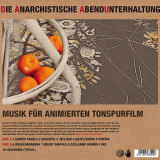
"Musik für animierten Tonspurfilm", the twelfth album by Die Anarchistische Abendunterhaltung (or DAAU, as they are commonly known), is the soundtrack to a series of short, abstract animation films by Rudy Trouvé, who also acted as a creative director during the recording process.
The music originates from acoustic improvisation sessions by accordionist Roel Van Camp, clarinetist Han Stubbe, double bass player Hannes D'Hoine and percussionist Jeroen Stevens. These took place according to conceptual guidelines set by Trouvé. Sometimes the starting point was a play on words or a random chord sequence, sometimes a specific atmosphere, but the playing field was always kept deliberately limited. Hence, the musicians were forced to build a musical structure with minimal means. The result was cut on cassette, after which the Antwerp enfant terrible - Rudy Trouvé-, known from his work with dEUS, Kiss My Jazz, Gore Slut and I H8 Camera among others, happily hit the tracks with a virtual sledge hammer. DAAU's pieces were cut up, sampled, drastically restructured and pasted together again, a method that had been applies earlier on the retrospective album 'Hineininterpretierung' (2017). On top of that audio collage, the musicians added new electronic layers, using a digital accordion, synths, digital bass and marimba. DAAU says: 'On the soundtrack, like on the older record, we were looking for a symbiosis between an acoustic and electronic sound. And there too we messed around with dub and Krautrock references'.
- Brand New Kind Of Actress 5:31
- Down In A Hole 4:18
- Try 4:48
- Chicago Promenade 3:19
- Dress Blues 4:07
- Grown 3:42
- Hurricanes And Hand Grenades 5:07
- In A Razor Town 3:15
- Shotgun Wedding 3:45
- The Magician 4:16
- The Devil Is My Running Mate 3:45
- Whisper 4:39
- Crystal Clear 5:03
- The Assassin 3:38
- Racetrack Romeo 5:11
The debut album from accomplished guitarist and songwriter Jason Isbell, formerly of Drive By Truckers (DBT), is reissued with 4 unreleased tracks from the original recording sessions. The addition of those 4 extra songs finds Sirens Of The Ditch clocking in at 15 total tracks. Sirens Of The Ditch's mystical quality can be partially attributed to the FAME recording studio (Aretha Franklin, Duane Allman, Otis Redding) in Isbell’s hometown of Muscle Shoals, AL where the album was recorded. Co-produced by Isbell and Patterson Hood (DBT), Sirens Of The Ditch features Isbell singing lead vocals and playing guitar throughout, joined by Shonna Tucker (Formerly of DBT) on Bass and Brad Morgan (DBT) on drums. Several musicians pop in for cameos including Spooner Oldham and David Hood (Patterson's father) on "Down In A Hole", John Neff (Formerly of DBT) on "Dress Blues" and Patterson himself guests on "Shotgun Wedding". "a strong debut, full of the kind of confident, charismatic songwriting that just can't be taught." - Pitckfork “Isbell could be roots rock’s Flannery O’Connor.” - Spin
Matt Berry releases a unique collaboration with esteemed Library Music label KPM. KPM is renowned for providing the musical bedrock for so many classics of British TV and international cinema, using the best British composers such as Keith Mansfield, Alan Hawkshaw, John Cameron and Alan Moorhouse to do so. ‘Simplicity’ follows in the footsteps of these giants and is a worthy successor to them. Alongside his formidable acting career, Matt Berry has released a series of acclaimed albums on the Acid Jazz label. Ranging from the folk stylings of ‘Kill The Wolf’, the ambient electronica of ‘Music For Insomniacs’, to the psych rock of ‘Blue Elephant’, these have marked Berry out as an impressive musician and recording artist in his own right. Embodying the form of KPM’s original LPs geared towards film and television pitching, the album consists of 11 sharp and vibrant instrumentals, which will no doubt be heard in productions for many years to come. Released in special collaboration with Acid Jazz, the album is presented in a beautiful graphic sleeve, with notes that allude to the original KPM releases, for something that is instantly hip and familiar, yet unmistakably new.
- I'm A Ramblin' Man
- Rainy Day Woman
- America
- I May Be Used (But Baby I Ain't Used Up)
- Amanda
- Me And Bobby Mcgee
- Trouble Man
- Mamas Don't Let Your Babies Grow Up To Be Cowboys
- Good Ol' Boys (Theme From Dukes Of Hazard)
- Bob Willis Is Still The King
- Are You Sure Hank Done It This Way
- Suspicious Minds
- Honky Tonk Angels
- Good Hearted Woman
- I've Always Been Crazy
- Luckenbach, Texas (Back To The Basics Of Love)
- I Ain't Living Long Like This
This performance by Waylon Jennings was no April Fool's joke. This was the "new" Waylon, both personally and professionally. He had kicked a 20-year drug habit, split with RCA and signed a new deal with MCA Records. He discovered a passion for songwriting, teamed with legendary producer Jimmy Bowen, and produced some of the best work of his 30-year-plus career. He credited his wife and soul mate, Jessie Colter, for much of his inspiration. This was Waylon's second trip to the ACL stage, but the one that best captures the raw edge and driving urgency that pushed country music way past its Nashville boundaries starting in the mid-1970's. He was described as the leader of the country "Outlaw" movement, which he often dismissed as just another marketing scam, but there's no denying that he turned the music on its head and took it way beyond its rural southern roots. This West Texas boy who worked as a DJ and started his own band at 14, then later played with Buddy Holly, left an indelible mark on the music he loved. He was a class act, this man called Hoss. -Terry Lickona (Producer Austin City Limits®)
- A1: Spiritual
- A2: Painted Houses (Feat. Conway The Machine)
- A3: Zelle Transfers
- A4: Drug Trade (Feat. Black Thought)
- A5: Harlem World 97 (Feat. Estelle)
- B1: Spiritual (Instrumental)
- B2: Painted Houses (Instrumental)
- B3: Zelle Transfers (Instrumental)
- B4: Drug Trade (Instrumental)
- B5: Harlem World 97 (Instrumental)
Flying Objects is the new collaborative project from indie heavyweights Smoke DZA and Flying Lotus - featuring Black Thought (The Roots/Jimmy Fallon), Estelle, Conway The Machine, and more. Smoke DZA is a popular independent rapper from New York City who has worked with Big K.R.I.T., Wiz Khalifa, Action Bronson and ASAP Rocky among others, and is a founding member of the Smokers Club. His album, Rolling Stoned was awarded the High Times Doobie Award for Hip Hop album of the year for 2011. Other popular album releases include Rugby Thompson (produced by Harry Fraud), Dream.Zone.Achieve (features from Cam'ron, Joey Bada$$, Ab-Soul, Wiz Khalifa, Curren$y), and Don't Smoke Rock (produced by Pete Rock). Flying Lotus is a producer, DJ, filmmaker and rapper from Los Angeles who has worked with Kendrick Lamar, Danny Brown, Mac Miller, Chance The Rapper, Blu and more. He is also the founder of the record label Brainfeeder. He has released seven studio albums. His debut project 1983 dropped in 2006 on Stones Throw Records and his next six projects all came out on Warp Records - to critical acclaim.
- A1: I Am The Damager
- A2: My Voice My Weapon Of Choice
- A3: 1Of1
- A4: Gogo Boy Girl
- B1: Fancy Feat Catlaine
- B2: Zeit Sie Rinnt
- B3: Zehlendorf Action Superstars
- B4: Westberlin Bass
- C1: Ätzend
- C2: (Skit) Suckafree Fm Call In Line
- C3: Make Ends Meet
- C4: Gangsta Garage Cypher
- D1: Idc Bout What You Think
- D2: Wenn Der Mond In Mein Herz Kracht
- D3: Breakfree
- D4: Think Of Me
After last years „4 THA CULTURE“ and his collaboration with horsegiirL „My Little White Pony“ MCR-T releases his debut album „My Voice My Weapon Of Choice“. My Voice My Weapon Of Choice weaponises MCR-T ́s fierce Soul Power on the mic. This album being more personal than usual, MCR-T does not shy away from giving his listeners insights to his inner demons and personal battles over the course of making this release. Tracks that all tell deep and personal stories while staying true to their club functional nature. MCR-T pays homage to Grace Jones' opening statement on her record “This Is”. Realizing that the liberation of self starts with the paper and pen, the means to an end - therapeutic self expression. Bold statements backed by even bolder sounding rracks all across the electronic music spectrum to underline not only his versatility on the dancefloor but also in the studio. Different flavors for the deserving multifaceted raver of tomorrow.