In the wake of Young Marble Giants’ breakup, two acts were created, with Stuart Moxham taking minimalist, geometric play to extremes while Alison Statton added more warmth and feeling to a similar template, creating something stunning yet based in popular forms. Those two opposing means of forging paths away from one of music’s most astonishingly unique debuts both included Stuart’s brother, Phil. More recently, both have reversed course, with Stuart proving himself a master of classic pop form, with Alison’s work again approaching a modern abstraction of quiet folk music - experimental but accessible. But that’s another tale. With no template to guide him, Stuart’s new music - as The Gist - was regarded as wildly uneven. Stuart admits that he didn’t know which way to go, so perversely, he decided to take all directions at once. The Gist’s original discography stood at a scant 18 songs, yet only seven featured Stuart’s own voice, often in heavily processed and oddly-mixed form. The Gist’s label, Rough Trade, dropped the band. Starting with a critical re-evaluation of The Gist’s sole album Embrace The Herd in an issue of Mojo, the tide begin to turn. Ambience in pop has long enjoyed a cult following, and the nonlinear structure of many of The Gist’s songs have parallels with artists such as Aphex Twin and Seefeel. One song from the era was covered by Etienne Daho in France - sounding rather advanced for French pop at the time, it ended up selling over a million copies and was later covered by Lush and sampled by DJ Koze with Lambchop singer / songwriter Kurt Wagner. Recent discovery of a trove of unreleased recordings show that Stuart had held back an array of excellent material, in demo and completed forms, often in different arrangements. Interior Windows adds 13 new performances or alternate versions to the band’s catalogue, and does the service of making both sides of The Gist’s first 7” 45 (recorded at the same session as the final YMG single) available again, along with their contribution to the NME / Rough Trade cassette compilation C81, and in keeping with The Gist’s tradition, at least one song on which Stuart does not appear
Suche:the gist
- 1
Quavius, the deep south vagabond known for his raw and sophisticated dance collages returns to Lustwerk Music with his second EP for the label, Find Ready. While mostly an instrumental affair, Find Ready is an updated glimpse into the producer / rapper's latest repertoire, ranging from the sunny, Baltimore club-influenced house of "Flo Central" to funky Motor City workouts like "Heaven Is In You" and "Find Ready". The EP starts off on a high clip with a nostalgic, forward-driving deep house instrumental, "That Beat." Quavius dons the mic on three of the seven tracks. "The Gist", the EPs cornerstone, sounds something like a Rakim-meets-Sensate Focus. The A and B side are each topped off with downtempo Hip-hop. "Let it Rock" and "Fa Sho" are contemporary updates on cloud rap that bleed atmosphere and confidence while revealing Quavius' knack for tight songwriting and arrangement.
- A1: And The Native Hipsters-There Goes Concorde Again
- A2: Dislocation Dance - Yops Course
- A3: Laughter In The Garden - Clutching At Straws
- A4: Airkraft- Here Comes That Sound
- B1: Prana - All The Earth Is Sacred
- B2: Surface Mutants - Souls Will Cry
- B3: Ingrid- A Dream
- B4: The Flying Lizards-Another Story
- C1: Siren -Breaking It Down
- C2: Blank Students - We Are Native
- C3: The Drezznels-Class Distinction
- C4: Some Now Are – Aftermath
- D1: The Gist-Fool For A Version
- D2: Johnny G - Miles & Miles
- D3: Janet Armstrong-Exploitation
- D4: The Sticks-Dole Queue Rock
Now, following great acclaim for Volume 1, CTR is proud to unveil another equally eclectic Post-Punk Era Selection Compiled by Jason Boardman ( Before I Die Records) Celebrated Manchester club-night curator & record Label Owner , DJ & digger - supreme.
A second compilation of late 1970s / early 1980s Post-Punk era bedroom & small studio innovations & DIY Inspirations - Featuring more rarely & never heard cuts from that period. Including tracks from the enigmatic Prana, Blank Students, Janet Armstrong & The Native Hipsters ..A rich vein .
Jason Writes Of Volume 2 :
"It was a delightful shock that No Ones Listening Anyway Volume One was so well received - thanks to everyone one who bought & enjoyed it. This led to John asking me to collate Volume Two, so here it is.
This time all the material was recorded & released in the UK between 1978 & 1984.
I was conscious that there was minimal female energy on Volume One so have tried to rectify that here on Volume Two. I have also tried to make it as varied as possible with none hit wonders, oddities, collectables, under the radar B-sides & a couple of previously unreleased on vinyl selections."
- A1: Rayban (Vs Marie Klock)
- A2: Lippery (Vs Youniss)
- A3: The Gist (Vs Personal Trainer)
- A4: Behind The Line (Vs Porcelain Id)
- A5: Day One (Vs Emma Hessels)
- A6: Alice (Vs Youniss)
- B1: Gone As We Name It (Vs Lara Chedraoui)
- B2: De Hefteling (Vs Rehash)
- B3: Hidden Hand (Vs Tim Vanhamel)
- B4: Neil Young (Vs Julie Rains)
- B5: Killing, Dying, Hurting & Crying (Vs Lézard)
Orphic Apparition follow up their inaugural release by RAFRAM, the collaborative project of Toronto's Raf Reza aka Raf Rizzla and UK acid house luminary Ramjac Corporation, with a new two-tracker from the transatlantic bass warriors. Where the RAFRAM 12" gifted us five variations on the same live jam cut from Grow Tottenham, here we have a spontaneous track written by Paul (Ramjac) on the A-side and a fully warped dancehall mix from Raf on the B. (short)
'Press 1 to Repeat' began as an on-the-spot demonstration of the musical self, a natural response to being asked 'What is it that you do?'. Within a few minutes Ramjac had his laptop out and was bashing out a quintessentially English sort of kitchen tabletop version of Kraftwerk - Numbers, the tongue in cheek automated voice on the other end of the line querying his account balance in tow. Proudly showing his friend Ryoko his improvisatory skills, a £10 hifi from a Japanese 2nd hand shop served as the portable monitors whilst the track waited to be brought back to his studio in London. The track is anchored by a bouncy, Irdial-reminiscent percussive workout which punches above its weight for its humble beginnings. Add the dubbed out synth pads and sort of electrical static FX in the background and everything syncs together in cosmic harmony. Hopefully Ryoko now gets the gist!
Raf Rizzla takes the stems and channels some inspiration from the Jamaican movie “Third World Cop” by turning the track on its head with a double-time baseline and half-time melody to craft a big dancehall version with a bit of a modern day On-U twist. Here Raf shows yet another side to his truly versatile production chops which have seen him release house, trance, breaks and downtempo cuts on a variety of Canadian labels prior to starting Orphic Apparition.
We Jazz Records kicks off their new series of archival 7" releases with Esa Pethman "In Belgium 1967" released 23 September 2022. The two-tracker is licensed from the Belgian VRT radio archives and both of the pieces are previously unreleased. Finnish jazz legend Pethman, heard here on alto flute and tenor sax, joins forces with European jazz greats such as Heinz Bigler, Uffe Karskov and Jean Fanis. This is a small but valuable piece of unheard European jazz history from the early heyday of modern jazz. The physical release is a quality "inside-out"-styled EP with 3mm spine and small center hole on the 45rpm vinyl.
An excerpt from the liner notes by Mikko Mattlar:
"Esa Pethman (b. 1938) was one of the key figures of modern Finnish jazz in the 1960s. His album The Modern Sound Of Finland was the first Finnish modern jazz album and his composition "The Flame" a true modern Fenno-jazz evergreen.
Pethman was born in Kuusankoski, 135 kilometres from Helsinki in the Kymenlaakso area. The jazz scene was active even though it was an area of rural landscapes and paper mills. Pethman discovered jazz when he heard a Charlie Parker record being played at a local music shop in the late 1940s. Following Parker, bebop became his favourite style of jazz.
Young Pethman played flute and saxophone in local bands who accompanied schlager singers. They played tangos and waltzes for dancers, but usually started a typical dance event with an hour of jazz. In 1959 Pethman moved to Helsinki to study music at the Sibelius Academy. Back then it was a strictly classical music academy, but Pethman later described the studies as crucial for his development and career. He quickly made his way to studio sessions and into the best orchestras in Helsinki.
As a student of composition, Pethman also began writing his own music. "The Flame" was a melody he just got on his mind one night, and he decided to write it down. The catchy composition was released as a 7" single in 1964, a year before Pethman's debut album. Both records stand as benchmarks for modern Finnish jazz. The album consisted entirely of Pethman's compositions, not versions of jazz standards like a lot of the Finnish jazz released until then.
In the mid 1960s, Finnish jazz was also taking its first international steps. Pethman's quintet took part in the first Montreux Jazz Festival in Switzerland in June 1967. At the Montreux jazz band competition, the quintet came in fourth of the twelve contestants. Despite not winning the competition, the band got an honourable mention, and Pethman was now recognized outside Finland.
In December 1967 Pethman travelled to Brussels. His visit was organised by the national Finnish broadcasting company Yleisradio and their jazz program producer Matti Konttinen. Konttinen was supposed to go to Brussels with Pethman, but the musician ended up traveling alone.
In the Decca recording studios Pethman played two songs. He recorded a version of his most famous composition "The Flame", where he played the alto flute and was accompanied by Belgian musicians. On Swiss saxophonist Heinz Bigler's composition "Like Steel", Pethman played the tenor saxophone. The band was now more international, consisting of Bigler, the Italian Francesco Santucci, the Dane Uffe Karskov, a Belgian rhythm section and Pethman. After 55 years, Pethman still remembers Bigler's remarkable skills as a saxophonist.
The two-day visit included the recording session, a dinner and a concert. Pethman and the other non-Belgian musicians came to Brussels mainly to play at a jazz concert organised by the European Broadcasting Union EBU. They played at the studio first, and the concert was held the following day. Pethman and all the other soloists played as members of an international big band. The studio and live session were produced by the Belgian Radio and Television jazz section leader Elias Gistelinck."
3XL boss and scene hyper-connector Special Guest DJ (aka uon, shy, Caveman LSD) lands on their own label with a debut album of hazed ambient noise and aquatic club anarchitextures, with a patented, heady style bent into new shapes.
For nigh on a decade, Berlin-based American producer, label boss, promoter and DJ Shy has operated at the centre of a scene that's still not fully defined. Their mythical DJ sets, where you're likely to hear precision-tweaked dubstep, dreampop, decelerated rap and dubwise ambient blended into vapour; gives some sense of the vibes at play, and a comb thru their spiderweb of a catalog - as Caveman LSD or uon, as part of Ghostride the Drift, Hoodie, crimeboys, virtualdemonlaxative and Cypher, or as the figurehead of 3XL, Experiences Ltd, xpq? and bblisss labels - further blurs that gist.
They've been caught in the crossfire of Big Ambient, sure, but there's always been something scrappier, sexier and more present going on under the hood. Shy and his network of associates - Huerco, Ulla, Perila, Ben Bondy, Naemi/Exael, Ponteac Streator and Arad Acid, among others - have asserted the interrelatedness of their discrete approaches. So-called "ambient" music doesn't exist in a vacuum, it un-focuses elements that undergird so many more corporeal sounds, and for Shy, their music reflects the druggy, DIY, genre-agnostic ethos of a trans-Atlantic neo-punk underground that exists in some liminal zone between the club, the bedsit and the basement.
Concerned with themes of “anger, sensuality, and dreaming”, the 40 minute roil of ‘Our Fantasy Complex’ frames Special Guest DJ at their most unapologetically oblique and illusive, expanding and contracting between whorls of shoegazing dynamics and extended portions of quasi-speed D&B x dub tech smeared on the mind’s-eye, with a vivid sense of bruised lushness that’s perfused all shy’s work thus far.
Joined by kindred collaborators Ben Bondy, Arad Acid and mu tate, and suspended in agitated bliss by Rashad Becker’s lucid mastering, the results feel out some of 2025’s most considered and distinctive within an amorphous zone that’s become a world unto itself. Ambient music’s fluffier signifiers are swapped out for a sort of sublime tension that, like the sound’s original ‘90s explosion, can be heard to reflect states of altered consciousness - both individual and collective.
Shy's layered, undulating productions are more like the chewed remnants of a thousand mixtapes cooked into a stream-of-consciousness hex. Save for the glistening, zoomed-out parting piece ‘Dream’, it all mostly avoids pretty melodies in favour of a spatio-textural sensuality that wraps us up, sometimes uncomfortably intimately, in shy’s thoughts. That oneiric closer is one of three gritty palate cleansers that swirl around its peaks, where elements of Reese-bass are suspended, writhing below looming atmospheric pressure in ‘How Long Can I Burn?’, emerging charred and flecked with rattled percussion on ‘Yoro (pt I & II)’, as though K-holing thru a blazing summer’s day.
In step with Perila’s notably darker turn of events on her ‘Omnis Festinatio Ex parts Diaboli Est’, album, or the unexpected ferocity of recent Space Afrika live shows, it’s not hard to hear a darkside gravitational pull on this one, where ambient music is no longer just a balm for troubled souls, but also suggestive of humanity’s most frightful odours.
- Something In Return
- Nancy Never Knew
- Out Of The Darkness
- Into The Moving Light
- Anywhere The Wind
- Interlude I
- Never In A 100.000.000 Dreams
- Interlude Ii
- 60: S Medley
- Excerpt From Pudding & Gisteren
- Interlude Iii
- The Last Chord Open
• 180 GRAM AUDIOPHILE VINYL
• INCLUDES INSERT WITH COMIC STRIP AND PRINTED INNERSLEEVE WITH PHOTOS AND TEXT
• LIMITED EDITION OF 500 COPIES ON TURQUOISE VINYL
The third Supersister album is a big favorite with prog fans because it provides a good representation of the group’s combination of Caravan-inspired jamming and Zappa-esque humor.
Pudding en Gisteren is available as a limited edition of 500 copies on turquoise vinyl and includes an insert and printed innersleeve.
- Various Organs
- Crow, Crow
- Night By Night (V3)
- Angelic Aye Are
- Last Summer (Ilkeston Version)
- Shark Attacks
- Two Minute Warning
- Suburban Monochrome
- Suburban Monochrome (Instrumental)
- My Mouth Is Bored
- No One Road (Early Version)
- In A Room 13 Blue Loop (Demo)
- The Long Run (Demo)
- Immaculate Mistake
- Unused Ymg Organ Riff
Young Marble Giants' "Colossal Youth" has mystified and beguiled audiences since its 1980 release. Seen by primary songwriter Stuart Moxham as "a last gasp" at making a record, Stuart insisted the one-off 7" deal offered by Rough Trade be altered to allow an entire album . . . that paid off when with a big seller which produces cover versions even from bands whose members were a decade or two away from being born on the album's release. When YMG disbanded, Stuart was at a loss; he'd never envisioned a follow-up. A series of experimental recordings made with pal Phil Legg (Essential Logic) and supported by other YMG members, musicians from This Heat and Swell Maps, old Cardiffian pals, and new friends like Vivien Goldman resulted in an album, "Embrace The Herd", as The Gist. Released just before Rough Trade made bold moves toward pop charts with Scritti Politti, The Smiths and others, the album was odd for its time, but has since taken on the lustre of genius. Years of silence followed, thereafter intermittently broken by the odd release from small labels. Stuart delved into family life, though he never stopped writing and recording. In more recent years, two retrospective compilation of lost recordings by The Gist have been released, as well as a superb collaboration with French arranger Louis Philippe, "The Devil Laughs". "Fabstract" is the final gathering of Stuart's lost recordings. Compiling long-lost YMG-era tracks with the recent brilliance of "Crow, Crow" and "Suburban Monochrome", through bits of whimsy and vastly alternate versions of fan faves, this diverse album shouldn't work . . . but it does, telling a satisfying story of an underrated talent whose mistake was following his muse, not the charts. This album precedes a new recording, years in the making, produced by Dave Trumfio, which promises to be Stuart's most complete - and original - work since "Colossal Youth". Tracks:
London-based four-piece Adult Jazz announce their first full-length album in a decade, So Sorry So Slow, out 26 April 2024 via Spare Thought. Alongside the announcement comes lovesick new single ‘Suffer One’ featuring Owen Pallett, a cautious excavation of self and sexuality, clambering across a gorgeously shapeshifting, filmic five-minutes.
Containing some of the band’s most abrasive but gentle, beautiful and melismatic work to date, So Sorry So Slow has many defining characteristics: romance, panic, devotion and remorse, threaded together by an intentionally laser-focused love. It’s deeply personal, bruised and candid in its expressions of tenderness, and deeply pained in its concurrent reflections of ecological regret. Across its hour-long runtime, a delicate, frenetic energy and glacial heaviness coexist, the band pitting those paces against one another. In their richly experimental timbre, dancing strings and fluttering falsettos prang against a bed of brass drones like a wounded bird.
“We started writing in 2017 and began recording in 2018,” says vocalist Harry Burgess. “We genuinely thought it might be finished in 2018! But things kept developing and, having resolutely not struck while the iron was hot, there was no real external push to rush things after that, so we just kept letting things shift and unfold until it felt right. Listening back to my voice notes it’s nice to notice that there are fragments of ideas from the whole period 2017-2023 which have shaped the record.”
Recorded in bursts at studios across London and in the band members’ flats, at Konk, on the Isle of Wight and in Sussex, So Sorry is unambiguous in its evolution. Sonically, there are sparks of the arrhythmic brightness that afforded the band’s critically acclaimed debut album Gist Is its cult adoration, for fans of Arthur Russell and Meredith Monk, but with a blossoming, melancholic darkness often overhead. Piano sprees and luscious string sections appear like low-hanging stars on a night-time drive, whilst plunging vocal distortions and humming brass loops resurrect heavy limbs in a bad dream.
“I usually have objects as kind of totems for ideas,” explains Burgess. “The album initially started out to do with performance… the totem was a head mic, one of the subtle skin-tone ones, discreet on the forehead of a West End star. A number of the first songs in their original forms were almost musical theatre piano ballads. I think that was really a device to write about my life as the ‘main character’ (pre internet-speak reframing): regrets about romance, relationships - unsustainable relationships with the self and others.”
“However, once we started writing, the ideas about unsustainable personal relationships, loving unevenly and heartbreak conflated with a more expressly ecological regret. Like contending with big feelings of loss, endings, beauty, desolation, and with how much joy the earth contains in it. Feeling so much gratitude bound up in waves of sadness. Maybe witnessing a slow-motion goodbye to all that, or its last gasps. I love the earth and the life it supports so much. I love how ecosystems fit together - even the brutal stuff. It may be basic to say, but now is the time to be laser focused on that love. I was thinking about human centrality on earth, us as the ‘main character’, the way that is served by faith and romanticism, and the subsequent disingenuous understandings of our position in the ecosystem, as only stewards somehow, rather than subjects. The totems at this point: a herald’s horn, lorry inner tubes, archaeological tools. I guess from doom, industry, history respectively.”
“Now I would say the record is about gripping. Totems being: crampons, rope, drips, desalination equipment, accruing various survival tech. I think gripping sums up both of the threads. There’s the emotionally correct clinging to the earth that is the substrate of everything we value, or the delusional clinging to our imagined dominant position. But also the practical, technological aspects of creating a sustainable relationship, of remaining here. Then I think of romance again.”
So Sorry So Slow comes out 26th April 2024 on Spare Thought, mixed by Fabian Prynn at 4AD Studios and mastered by Alex Wharton at Abbey Road.
Adult Jazz is Harry Burgess, Tim Slater, Steven Wells and Tom Howe.
The duo's third album of instrumental guitar recordings pushes their sinuous compositions into labyrinthine new shapes, interlocking and interlocutory, supported by a cast of stellar collaborators. Interwoven among the dazzling original pieces is a fascinating array of covers, ranging from traditional Breton dance tunes to a deconstruction of Neneh Cherry's "Buffalo Stance." Their melody-first sensibilities are perfectly suited to each other _ playfully complex guitar work that sounds as if it was tossed off in an afternoon of whiskey and laughs. - NPR An intoxicating, intricate web _ Wherever Salsburg and Elkington go, it's always a pleasure. - Aquarium Drunkard Sounds like winter has always been approaching, like Indian summer never quite fades, like fall isn't built around loss. - Stereogum
Much has been written about Young Marble Giants' small, perfect catalogue, which contained roughly two-dozen songs, nearly each one a perfect gem. Less is known about his long wilderness years after the break-up of his first professional band. His next project, The Gist, chopped YMG's minimalism into a new sound. This Is Love, Public Girls and Fool For A Valentine showed his songs to be razor-sharp, but the album's fragmented pieces were a step too far for some, though even the strangest, Carnival Headache, when cast in sunlight by Alison Statton's combo Weekend, was as fine a song as any he'd written - and Love At First Sight became a million-seller when covered by Etienne Daho. Then Stuart disappeared. A rmid-90s resurgence led to fine albums done on low budgets, before more silence followed. The Gist's 2018's release Holding Pattern - unexpected and then quickly followed by YMG singer Alison Statton's first new album with her accompanist Spike in two decades, adding fuel to public interest. The Devil Laughs, recorded a few years back, is a compelling addition to the canon of the 21st century songwriting. Stuart's generally unadorned musical presentation does not hinder his appreciation for the skills of Louis Philippe, whose iconic arrangements across an array of Él label albums inspire the fierce devotion of aficionados around the world. Nor does the unvarnished solidity of Stuart's arrangements deter Louis from hearing possibilities for their presentation in styles which take inspiration from the perfection of 1960's studio technology that led to the rise of Brian Wilson, Burt Bacharach, along with less-recognised names such as Bones Howe and Roy Halee. Tidy Away is Young Marble Giants redux, though the backing vocals hint at maturity which band didn't live to see. Fighting To Lose, written with producer Ken Brake, would pass as a worthy b-side to Bridge Over Troubled Water, and although the songs are otherwise Stuart's, Louis fans will delight at several, like Love Hangover and Sky Over Water, which display his style and production genius as succinctly as anything on his own albums. The Devil Laughs is as out of its time as Colossal Youth was - its subtle but immediate beauty, devoid of "rock", is a recording best understood in the light of those obscure groundbreakers who inspired it - the faux barbershop vocals of Smile-era Beach Boys, the studio lustre of Tom Wilson's work with Simon & Garfunkel, a dash of The Swingle Sisters and French chanson - along with enough hints of Young Marble Giant's modernist folk abstraction to satisfy longtime fans. The Devil Laughs is a small masterpiece of pure expression.
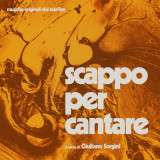
Another dream coming true! One of Giuliano Sorgini's finest and most sought-after titles is finally available as an official LP reissue – the first ever – remastered from the original tapes.
Originally released in 1971on the small library music imprint FAMA, which operated as a sub-label of RCA Italy, the record contains the original music written for Scappo per cantare, a small, pseudo-psychedelic 'musicarello' (musical comedy film) broadcast on RAI television and starring, among others, Italian singers Gianni Morandi and Mauro Lusini.
The only credited album artist is Sorgini, but it's impossible not to perceive, in this record, the hand of his close friend and colleague Alessandro Alessandroni.
This should not come as a surprise. In the early 70s, the two composers and multi-instrumentalists had a fruitful collaboration that saw them, under the monikers Braen (Alessandroni) and Raskovich (Sorgini), produce an abundance of works together, most of which have now gained the recognition they deserve. These include, among others, two 7" singles from their band The Pawnshop, three records in the series Alle sorgenti delle civiltà (Folkmusic), the crime/noir library albums Quarta pagina (Usignolo) and Inchiesta giudiziaria (Octopus Records), as well as the LP Tempo Libero (Panda Records), which was released shortly after the record presented here and in some ways drew rhythmic inspiration from it.
While their collaboration remained unacknowledged on the original release of Scappo per cantare (this was not uncommon at the time, especially in the field of library music), the record sounds perfectly in line with other works composed by Alessandroni in the early 70s, such as Complesso Gisteri's Mostra Collettiva (co-written with Oronzo De Filippi), or even a landmark album like Spontaneous, where Sorgini contributed to a handful of tracks.
So, yes, the sheer beauty of Scappo per cantare is the result of an incredible synergy between two heavyweights of Italian library music! Airy and sweeping melodies à la Zoo Folle, psychedelia à la Under Pompelmo, and various percussion instruments played by Sorgini seamlessly blend and fuse with elements and touches provided by Alessandroni.
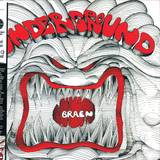
More specifically, we find Alessandroni's signature, melancholy whistle in "Desolazione"; the peaceful and dreamy sound of his 12-string guitar in "Scogliere" and "Con Amore"; the trademark harmonies of his vocal ensemble Cantori Moderni in the last two tracks mentioned and in "Per cantare"; and his ingenious use of distortion on his Fender Stratocaster in the suspenseful transitions "Concentrazione" and "Fantocci", as well as in the frantic/hypnotic hippie numbers "Mordente" and "Fendente" (as a side note, it is worth remembering that Alessandroni experimented extensively with distortion in the rock-infused album Underground, co-written with De Filippi and released in 1971 under the moniker Braen's Machine, probably a reference to British psychedelic band Soft Machine).
The creative relationship between Sorgini and Alessandroni was so symbiotic that it would be useless to try to identify in more detail their respective contributions to the sound of Scappo per cantare. The alchemy between these two musical geniuses is the key to the album's exquisitely Italian mixture of cheerful lounge, sweet psychedelia and smooth easy listening.
To do justice to the quality of the music, this remastered reissue is enriched by a new artwork by Eric Adrian Lee, who drew inspiration from the psychedelic visual culture of the period in which the album was written and recorded.
I"ve been focused on who I am in my music, but now I"m exploring where I am," Alfa Mist says. "I"m asking: how did I get here?" This is the journeying question that underpins Alfa"s fifth album, Variables. Traversing luscious, big band swing, head-nodding boom-bap rhythms and yearning vocal melodies, the record is expansive, soulful and moving, in both body and spirit. On Variables, his second release for ANTI-, Alfa achieves his most fully-realised, expressive musical work to date, coupling his keen ear for looping, memorably emotive piano melodies with intuitive grooves and a free-flowing jazz improvisation. Since the release of his first full-length project Nocturne in 2015, Alfa has established himself as one of the UK"s most focused, indemand and distinct musical voices. He has worked with the likes of Jordan Rakei and Tom Misch. Artists look to him for his unique blend of intimate bedroom production and expansive jazz group orchestration, since Alfa is yet to be boxed into a specific genre. His music spans everything from hip-hop beat-making to producing for artists such as rapper Loyle Carner, composing neo-classical works for the London Contemporary Orchestra, and reworking tracks from composer Olafur Arnalds and pioneering jazz label Blue Note. The return to live shows has been a welcome one for Alfa and his fans, resulting in an extensive tour throughout UK and Europe. Including a sold-out headline show at the Barbican in London. Alfa Mist will be touring Europe, UK and North America in 2023 again. It is a balance between feeling and perfectionism that ultimately gives Alfa"s music its depth and capacity for repeated listening. It is also an ethos that has enabled his remarkable work-ethic to date. "I"ve never been a "one album every four years" artist - I want to put out new projects every year," he says. "Music is an extension of my life; it is the practice of creating."
Emotional Response is delighted to announce Foreign Affairs - a limited edition special remix 7-inch single featuring reworks from Alexis Georgopoulos & Jefre Cantu-Ledesma's "Fragments of A Season" album by Woo and Felicia Atkinson.
Last year's ""Fragments of A Season"" represented a unique chapter in both artist's canon. Georgopoulos, who released the Arp album "Zebra" in June this year and Cantu-Ledesma, who released "On The Echoing Green" in October 2017 - both on Mexican Summer and to critical acclaim - wanted to stretch out and create a discrete work. A peripheral listen to "Fragments" revealed a resonant album of delicate, ambient vignettes, suggesting a Balearic take on Vini Reilly, Young Marble Giants and other poetically-minded, minimalistic post-punk era bands.
The Brothers Ives aka Woo were a major influence on the album's makers and so AG and JCL are thrilled they've submitted a beautiful reworking of the album's "Marine". Whereas the original sounded like Marine Girls and The Gist getting together for a nice beach day jam, Woo's rework transforms it into pulsating track of glistening proportions. Percolating synths, some guitar and clarinet - the true classic, idiosyncratic Woo-ification - creates a woozy, romantic, impossible to categorize slice of Balearic meets dub atmospherics.
If "Marine" is all midday sun, intoxicating and potently optimistic, Atkinson's remake represents the literal and figurative flip, bringing out the overcast dreaminess to "Cleo". Sounding like an outtake from a Rohmer film, or perhaps Cocteau Twins and Broadcast having a picnic in Biarritz, the version veers between abstraction, celluloid ambiguity and suggested narrative. Atkinson's reworking adds poetry of the tune (quite literally!) with her soft vocal under-gliding to perfection. Representing a temporary idyll, a meeting point where cobblestone streets lead to the sea. At nightfall, a discotheque heard in the distance. The morning mist burns off. Only such memories remain.
During the '70s, work days at Umiliani's Sound Workshop Studios were hectic; thousands of sessions were held in order to keep up with a very busy Italian movie industry: Hundreds of soundtracks alongside with music library were recorded and released on vinyl in very limited quantities for TV and film production use only. Those LPs are now proper collectors' items, extremely hard to find.
Filled with hypnotic bass lines, heavy drums and screaming fuzz guitars "Underground", the first LP of the fictitious group known as Braen's Machine, is one of the rarest and the most expensive of them all, always "reaching" sky high prices throughout the second hand vinyl market. A fast-beat jam with hammond scales and a twin lead guitar theme ("Flying") opens the A Side soon followed by "Imphormal", a classicfunk-beat-meetsfender- rhodes-and-psychedelic-guitar number. The music then switch to "thriller territories" with "Murder" which is based on prepared piano swells and a deeply hypnotic walking bass, reminiscent of the best Morricone's soundtracks for Dario Argento's movies. Two highly percussive songs complete the A Side: "Gap" is an improvised song with guitar and keyboards dwelling over an infectious drum rhythm while a marching snare and a vibraslap effect are the special features on "Militar Police".
The mood relaxes slightly on the opening of the B Side with a lazy jazz groove on "New Experience" but the rock influences are soon brought back on the following track "Fall Out". "Obstinacy" is all about keyboards with syncopated rhodes themes and distorted hammond sustained notes whilst the fuzz guitar is back again screaming through the left channel on the last song of the album, "Description". We could happly say that that was the golden age of the Italian music library. But who's behind the name "Braen's Machine" On the original cover the songs are credited to the composers Braen and Gisteri. Braen was a pseudonym often used by Alessandro Alessandroni, an extremely skilled and versatile musician, and one of Umiliani's closestcollaborators. He could write, conduct and arrange, he could sing (ever heard "Mah Na Mah Na"), he could whistle (ever heard Morricone's "For a fistful of dollars") and he could play almost anything: guitar, bass tuba, accordion, sitar and the list grows..... His first album "Alessandro Alessandroni e il suo complesso" (Sermi, 1969), had transformed the Italian library music from orchestral sound beds into the psychedelia we all love; the extremely fuzzy guitars are very "present" on "Underground" too. For a long time Gisteri's real identity was rather mysterious; often wrongly attributed to Umiliani. Gisteri was the pseudonym of Oronzo De Filippi, art name of Rino De Filippi, music supervisor to the Italian public broadcast company (RAI) between the '60s and the '70s. De Filippi composed other notable pieces such as "Riflessi" (Edipan, 1975) and "Nel mondo del lavoro" (Sermi, 1972).
De Filippi passed away few years ago but we were able to contact Alessandroni to talk about this LP. Remembering "Underground" recording session as one of the thousands he took part of, Alessandroni told us that this record was produced very quickly, in two days maximum. This was made possible by a team of wonderfully capable session musicians and the creative genius behind the mixing desk; this incredible combination helped to focus on the mood of each track even more. Unfortunately there are no liner notes but Alessandroni's memories and speculations, based on other music tracked in the same period at Soundworkshop by resident engineer Claudio Batussi, led us to identify this as the most probable lineup: Munari on drums, Majorana on bass, Vannucchi on keyboards and Alessandroni himself on guitar. For this reissue the sound has been restored and the cover art reproduced exactly as it was.
- 1