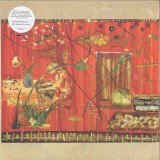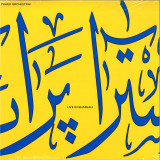
3 x LP - Live in Sharjah Box Set + Booklet. designed by Lorenzo Mason Studio.
If you’ve ever travelled to Egypt and wandered through its crowded streets, you probably ended up buying a cassette or a CDR of popular synth based music heard in most cabs, cabarets, or alleys around town: the almighty Shaabi.Raed Yassin and Paed Conca based their project PRAED on research between Shaabi and Mouled (traditional trance music from Egypt) and the hypnotic structures of both these genres. Repetitive beats, loud Mizmar and loads of energy, with a strong influence from psychedelic rock, free jazz and electronica.
During the years in which the duo produced 4 albums and performed on an endless number of stages around the globe, PRAED started working on anambitious expansive project: an orchestra that could transpose this study of rural and popular culture into an immense, iconic work. In autumn 2018, supported by the Sharjah Art Foundation, PRAED Orchestra! premiered “Live in Sharjah”, interpreting new material merged with some of the band’s iconic pieces. The composition process started with the choice of musicians: the line-up consisted of some of the most innovative artists coming from a wide spectrum of musical practices. Each musician was chosen for a defined role, and the common denominator was their capacity to interpret written material, and their ability to improvise effortlessly. Each role was clearly set to work in unison with the rest of the group, while simultaneously sustaining a centrality in the choir. Solo parts masterfully drawn over the structure as a fil rouge connecting every piece of the entire concert; massive and powerful orchestral sections leading to a breathtaking trance-like state of mind; all of this material ultimately coalescing into an Egyptian Operette that narrates the sorrow, love, and deeply rooted culture of this urban music called Shaabi.
Paed Conca: Clarinet, Electric Bass, Electronics
Raed Yassin: Synthesizers, Vocals, Electronics
Alan Bishop: Alto Saxophone, Vocals
Nadah El Shazly: Vocals, keyboard, Electronics
Christine Kazarian: Electric Harp
Hans Koch: Bass Clarinet, Soprano Sax
Martin Kuchen: Tenor Saxophone, Baritone Sax
Maurice Louca: Keyboard, Organ
Radwan Ghazi Moumneh: Buzuk, Vocals, Modular Synthesizer
Sam Shalabi: Electric Guitar, Oud
Ute Wassermann: Vocals, Mouth Harp, Whistles
Khaled Yassine: Drums, Percussion, Darbuka
Michael Zerang: Drums, Percussion
Recorded live at Calligraphy Square on November 3rd, 2018 in Sharjah, UAE by: Sudish Suman & Shuaib Ahmad Poonthala
Edited by: Rabih Beaini at Morphine Studio, Berlin, Germany
Mixed by: Radwan Ghazi Moumneh at Hotel2Tango Studio, Montreal, Canada. Mastered by: Harris Newman at Grey Market Studio, Montreal, Canada.
Artwork by Lorenzo Mason Studio.
Project manager : Simsara Music
Поиск:the chosen
Все
Loraine James follows up 2019's acclaimed 'For You And I' album with a new four track EP, `Nothing'. Her chosen collaborators empathetically extend the feeling in her music with their own unique energies; Uruguayan singer and producer Lila Tirdo a Violeta, Farsi language rapper Tardast, and HTRK front-woman Jonnine Standish. The arc of the EP starts with Lila Tirdo's numb, repeated vocal on the title track. On `Marg', meaning "death" in Farsi, the tense drama of Tardast's despairing poetry describes the hopelessness of refugee experience, cold chords rolling sympathetically around his words. Jonnine shifts the mood with `Don't You See It?', recounting a moment of clarity which allowed her to leave a destructive relationship, Final track `The Starting Point` finds Loraine solo, with punched in bass and chaotic drums pushed through fxs that settle into a plaintive piano melody, the first and only instrument she says she's able to play "properly".
A 38 minutes exorcism, dionysac sexyness fueled with romanticism, made of mechanical incantations mixed with spectral vocals of forgotten imaginary tribes, words from a physicist (Incomprehensible Image), and mystical breathings… To remind you that music is demanding your soul and body, fully.
A master irritator, disclosing this talent all the way, down to every chosen title, for the album itself and all of its components (would you put Milk in Water ?). As repetitive or minimalist music may already make some of you feel nervous, it seems more accurate to talk here about primitive music – notwithstanding a non violent anarchism. But those are only words and vain attempts to attach TLT to a region or a family. Neither the burden of classical European music legacy, which eventually lead to pop music, seemed to interfere with his wild mind, and if it is no surprising to hear Bach in German electronic music, there is here a clear statement that you are out of this sirupy prison…
For D.W. is a sorcerer. He’s been empirically learning the speaking of trance with years of touring and experimenting with all kinds of audience and venues, from clubs to museums, from Mongolia to Brazil, from his performances with his bands Kreidler or Toresch to solo ones, sustained by a steady limited set up, as the one used when he’s recording : one MPC, rudimentary synths, few effects and a mixer. No sound engineer on stage as only he knows his secret language… Raw dubmaking, leaning towards hip hop, indubitably underlining here a significant distanciation from his previous industrial inspirations. The bewitchment of this record is operating with no warning from the very first seconds until the last epiphany of Sales Pitch.
He is using his knowledge of techno, psychedelism (Inverted Sea), UK bass (Jumping Dead Leafs), only to bring you out of it. We all tend to be slaves, without even being conscious about it, and a balance must be existing between being a slave and showing off. Mr. Weinrich’s answer is unsettling because it is an utter call to this balance, in our world of black and white and political correctness. There is no morality in music… Don’t expect anything else than an unaccountable liberating immediate experience. Don’t expect any kind of music because you are already in the past or the future… From his recording technique mainly relying on one takes, his adoration of mistakes and jeopardy, to the core essence of repetitive music, it is all here about being in the present. No ears no glasses.
Sunquake is the first ever vinyl compilation of work by Désaccord Majeur, the alter ego of French artist Jérôme Mauduit who played a crucial role in Europe's post-industrial/ethno-ambient scene. Linking with figureheads Muslimgauze, O Yuki Conjugate and Rapoon (Zoviet France) via cassette compilations and seminal label Staalplaat, his music is played today by the likes of Vladimir Ivkovic, Elena Colombi and Interstellar Funk. Three carefully chosen cuts by the A Colourful Storm crew, properly cut and mastered at 45 rpm and housed in full-colour printed sleeve. with liner notes by Vladimir Ivkovic.
- A1: Stolen Hours
- B1: Love And Desire
PATRICE YVONNE HOLLOWAY was born in Los Angeles and is perhaps best known as the younger sister of Motown’s Brenda Holloway, the darling of the Northern Soul scene, particularly in recent years. Patrice also signed to Motown and recorded an unreleased version of “The Touch Of Venus” made famous by Edna Wright (aka Sandy Wynns).
In the mid-sixties Patrice signed to Capitol records and recorded “STOLEN HOURS”, arranged by the great Gene Page and written and produced by his brother Billy Page – she was only 15 years old at the time. It failed to hit Stateside but some thirty years later it became a Northern Soul anthem of the nineties, although it was originally played in the early days of Wigan Casino.
Our chosen flip-side, the follow-up single, “LOVE AND DESIRE”, was also penned, produced and arranged by the Page brothers. It failed to even get a commercial release in the U.S. although it was released in the U.K. and commands big money in today’s collectors market. Her final 45 for Capitol came in 1972 and was a credible version of the Sam Nesbit classic “Black Mother Goose”. Sadly, ill health, forced Patrice to step back from performing and she died before her time of a heart attack in 2006.
Patrice was also known as ‘Valerie’, singer with the animated girl-band Josie And The Pussycats produced by Hanna-Barbera and aired on CBS in 1971. She would beome the first black character to regularly appear on U.S. commercial TV.
It takes one to know one. Which is why jazz drummers have always
been ready to join the queue when assessing Art Blakey's influence,
not only in the field of percussion but in the shaping of his chosen
genre. Max Roach described him as "An original - the only drummer
whose time I recognise immediately. When I first met him on 52nd
Street in 1944, he already had the polyrhythmic thing down. He was
doing it before anybody else." Thelonious Monk Jr concurred: "When
I became a drummer, I learned how to swing from Art Blakey. What
he did with the hi-hat and his roll got pressed into my soul. He had a
primal approach to drums." All of which warmed the ears of Blakey,
who admitted that his aim was to be one of the greatest drummers in
the world- an ambition which he undoubtedly achieved
- A1: Kosei Fukuda - ?? - Enso (4 18)
- A2: Uchi - Zro (6 42)
- A3: Ypy - Circulation (6 44)
- B1: Recent Arts - My Default Emotion (5 43)
- B2: Renick Bell - Organize And Unite (4 09)
- B3: Ma + Kosei Fukuda - ????(????)- Enso No Ma (Furutsuki) (1 30)
- B4: Yvesdemey - The Chosen Home (6 11)
- C1: Tobias - He Turned Into Him (5 52)
- C2: Katsunori Sawa - The Stonewall (5 21)
- C3: Yuji Kondo - Zenith (6 09)
- D1: Rabih Beaini - Circle (8 03)
- D2: Ena - 42 1 (4 36)
- D3: Lemna - Moments In Eternal Recurrence (5 00)
Japanese sound artist and producer Kosei Fukuda’s presents a collaborated vision of the first edition of ENSo¯, a two-day audio-visual event collated around the REITEN label. The ENSo¯ Festival invites its artists and audiences alike to appreciate the merging of the improvisational, with the contemplation of rhythmic cycles, based around the conception of enso¯ – ?? – meaning a hand-drawn circle created by one uninterrupted stroke. Now, with an elongated stretch of time in front of us before the next edition of the festival, the compilation stands to provide a sustained glimpse into the world imagined by Fukuda. Blending spontaneity and gravity alike, the record features an array of idiosyncratic artists set to play ENSo¯, all purveyors of their own shaped sound-worlds.
For the A-side, we have Fukada’s own contribution ‘?? – ENSo¯’; a slice of ambient techno dotted somewhere within a faraway galaxy. Venezuelan noise artist UCHI crafts a fourth-world hymn with tribal percussion on the expansive ‘ZRO’, and Osaka based experimentalist YPY aka Korshiro Hino shapes an elusive polyrhythmic ambience on ‘Circulation’. The B-side presents a colossal improvisational track ‘My Default Emotion’ from Berlin based duo Recent Arts. Formed of Chilean artist Valentina Berthelon and German musician Tobias Freund, the duo are masters in audio-visual experimental performances that both surprise and challenge an audience. Renowned artist, programmer and teacher Renick Bell is noted as a pioneer for live coded performance, conducting mutated rhythms that cut across the landscape of electronic sound. His addition to the compilation is a luminescent IDM piece, titled ‘Organize and Unite’. A polished ambient club track from Fukada and MA titled ‘????(????)’ provides a state of organized tranquility, whilst the track ‘The Chosen Home’ from Belgium artist YvesDeMay, whose move from breakbeat to experimental producer has produced gratifying results for all, is a welcome slice of pensive dub- techno.
The C-side brings us a textured and haunting techno track ‘He Turned Into Him’ with revered German artist Tobias, veteran mainstay with an expert hand in shimmering sound design; Kyoto based 10 Label heads Katsunori Sawa and Yuji Kondo brings sample-heavy rushes of sound, the former with ‘The Stonewall’ and the latter with ‘Zenith’, both multi-faceted in their reference points. The D-Side presents the grainy and expansive ‘Circle’ from Lebanese producer Rabih Beaini, who expertly combines club tropes and avant-gardism in his DJing and music. Hypnotic skeletal beats circulate on the pulsating ‘42.1’ by Tokyo artist ENA. Japanese composer Lemna, the alias of Maiko Okimoto rounds it off with a dreamy noise ambience on ‘Moments In Eternal Recurrence’. Released on vinyl July 24th, the compilation stands as a traversable artefact of the festival, rich in spontaneous beauty.
After seven years, the second release of Max Loderbauer on Non Standard Productions arrives again in his style of post - german - electronic - avant garde. “Donnerwetter” is the perfect blue print of modern reduced electronic adventures. Carefully chosen out of a pool of recordings produced by Max in the last years, slightly edited and arranged into a full length album.
Black Vinyl Edition
The Log and the Leeway follows a 6 year journey of personal exploration and drastic change for Bram Bosteels and his singular Kaboom Karavan universe. What entails is a sound-curiosity of rare format, following a metamorphosis that goes beyond the musical.
Early in the process, Bram was struck by the word/concept of a Leeway : the gradual departure from an intented course due to external influences. Following a boyish fascination for explorers travel journals, logbooks and the far fetched corners of the world, he could not have forseen how fitting of a title he had chosen. Drastically all of a sudden one day, completely unexpectedly, Bram experienced his own father dying in front of him from a rare disease. Shocked and confused by this intense encounter, his perspectives and musical course departed from its original path. But at the same time it was an enlightenment and a necessary influence for him to realise the initial idea and finish this album, started over half a decade before.
The ones familiar with Kaboom Karavan already know that nothing really sounds quite like it. Bram’s musical (and non-musical) universe is of the rare breed that seems to be entirely his own. Self-contained, but never opaque. Quite the opposite actually. Bram never pushes us away, instead, by listening to his music we are given view to a synesthetic wunderkammer of images, places, objects and possibilities. Distant but magnetic, alien but intimately familiar, Kaboom is folk music from another dimension. Listening to The Log and the Leeway is like waking up next to a bonfire in the middle of a swamp wearing somebody else’s clothes: You may not know how you got here, but whatever is happening seems to very directly involve YOU. What will happen?
Note from Erik K Skodvin (Miasmah): All the sounds, fabrics, instrumentation and stories that binds The Log and the Leeway together go far beyond what can be touched up in this simple writeup. As someone who have followed this journey since the beginning, and seen it shift from lighthearted fun to the most crepuscular personal experience, heard the stories behind (almost) every field recording and gone through boundless amounts of clips, visual details, notes, and inspirations – I can only say that it is with great pleasure and certain nostalgia I can present this record in full through Miasmah and close this quite extraordinary chapter. Bram is without doubt the most fascinating person I know. Like I told him in April 2020 during a trying time: “If everything fails, we´ll open a Kaboom Karavan museum” - an idea that might not be as far-fetched as it sounds.
Featuring: Cover painting by John Lurie. 16 page booklet of Musical illustration / collagés by Walter Dhoogh & Erik K Skodvin that more or less connects (or confuses) the dots between the music and stories behind. Mastered by Lupo at Loop-O
‘SAWAYAMA’ is the debut album from Japanese pop auteur Rina Sawayama - an exploration of identity, family, gender and sexuality, set to a backdrop of future-facing, genre-splicing pop music. ‘SAWAYAMA’ is an exciting first step from an artist unafraid to push pop into new realms. Championed by Pitchfork, The New York Times, The Guardian, BBC Radio 1 (Hottest Record In The World), NME, Dazed, The Fader and many more, Rina Sawayama is heading out on tour this September, October and November with an all-new live show.
We were very surprised at Versatile when we received this file
from flocofloco And we still have very little info on the track that was
there. “On m’a dit…” by Floco Floco is a lo-fi afro-disco stomper hailing straight from the new ghettos created by confinement. Something had to give and we are glad that Floco Floco, whoever he is, has chosen us to ease his lockdown mind: “I’ve been told to stay at home, on WhatsApp all day long, working in the studio, reading books I haven’t read, I hope it won’t be too long, I don’t know if I can hold, smoking weed day & night, like never I have been before”.
Not a message, just a statement. The answer on the track was so good that we decided to come with more versions… We asked our friend Bufiman aka Jan Schulte to put his magic and he came with two
versions. One stellar arpeggio, with no beats but a serious drive as well as an instrumental Disco version. Gilb’r slowed down the whole affair and turned it into a cosmic nonsense vocal reprise, with a different bassline, chords and arrangement. A great summer pack!
Suction Records welcomes Roger Semsroth back to the label - having previously released 2 full-length albums with us under his retired electro-pop alias, Skanfrom. “Grøndal” (suction051) is the debut vinyl release under a new alias, Nordvest.
These days, Semsroth is best-known for his stark and minimalist techno project, Sleeparchive. The material on Grøndal - icy, melodic, and mostly beatless - is comprised of tracks that were originally released digitally as Sleeparchive, via Bandcamp. The releases were met with general disinterest from Sleeparchive fans, prompting Semsroth to re-brand them as Nordvest, before removing them from Bandcamp altogether.
We’ve chosen 11 highlights from 3 of those digital albums, “Rooftops & Chaotic Streets”, “Scribbles”, and “Sleepless”, for a cohesive 11-track LP of austere, synthetic ambience. Think Tangerine Dream as reinterpreted by Incunabula-era Autechre, and you might be getting somewhere close. While “Rooftops & Chaotic Streets Seven” recalls Sleeparchive, and “Sleepless Six” could very well be a lost Skanfrom track, the rest of the LP clearly warrants a new alias - Nordvest is a new side of Semsroth that we haven’t heard before.
The Bees are a textbook case of the chew and spit cycle that was the late 80’s South African music industry. Although their unknown story is likely unique, it is just as likely that it is no different to that of many other young artists who dreamed of getting their music heard at the time.
By 1988, the independent record label was no longer as uncommon as it had been at the beginning of the decade. As the 80s went on, more seasoned A&R reps and Producers that had gained experience and connections from their work under major labels would be trying to cash in on a market they helped create. Without the need of big rooms or expensive recording equipment, the digital advancements allowed many Producers to open or work in smaller studios and promote unknown artists under their own imprints. They would then have their catalogs marketed and distributed by the same major labels they had been working for just years prior. This would open up the possibility of a new era of stars as potential talent no longer had to be pitched to major labels in hopes of them taking a chance on a new signee over their already established artists. With the market growing and a struggle to keep up with the demand for new sounds this agreement would allow the major labels to put new emerging artists or groups on their catalog with little investment and high reward if it happened to be a hit.
ON Records was just one of the independent players at the time. Ronnie Robot had just signed the unlikely trio The Bees in hopes of adding a hit group to his label roster that consisted of solo acts. Despite the debut’s fresh house inspired sound, it failed to catch on was outsold by the bubblegum disco the label was known for. Over the years unsold back stock and promos would build up with the distributor. Luckily this allowed sealed copies from the label’s catalog to survive into the 90s when the distributor’s stock was unloaded and picked up by legendary Johannesburg jazz shop Kohinoor. Here sealed copies of the Bees first attempt sat under appreciated for over 20 years before becoming a hot title after they started circulating online and became club staples. This is how the first album of an unknown group with no success was able to become a collectors item and earn a reissue over 25 years later.
With their first record behind them The Bees were ready move forward and get back into the studio. A suggestion from producers had the trio change camps and go work with the newly formed Creative Sound Recordings, the label that promised “Music for the Future” and ended up being an essential studio in the early years of Kwaito. They would work with producer Chris Ghelakis and guitarist George Vardas, while a young Marvin Moses sat behind the desk. Musically the sophomore album was as good as a follow up as you could get. Building on the first album, Mashonisa delivers catchy melodies backed by heavy drum programming that would score points with any Pantsula. The Black Box inspired “ Never Give Up” was one of two tracks chosen to be pressed as the promo for the album, hoping to trick listeners with their catchy version of the hit( A year later the label would release their first volume of Black Box covers sang by neo soul diva BB, it would be a great seller). The label printed up an unknown amount of these in a last attempt to push the release in Shabeens and on Radio. The cheaper route of flooding the market with promo copies would only pay off 25 years later when unplayed copies started being rediscovered and had survived the years in a quantity that original run of the full album could not. Once again it was clear that with no mainstream appeal, the quality of the music on its own was not enough to garner any success at the time. The album flopped worse than their first and failed to make it past it’s initial run, making it one of the harder titles to get from the CSR catalog.
Mashonisa would be the last attempt from the Bees. They would disappear from the scene as quickly as they appeared. Of the three members it is only known that lead Singer Solomon Phiri continued in music fronting a wave dance group before he mysteriously vanished in 1993, never to be heard from again. Through a combination of luck and circumstance the group, which is unknown in South Africa to even the most plugged in musicians, producers and radio hosts of the time, managed to finally get some of the recognition they deserved 30 years later. Unfortunately this small blip of fame would happen with none of the band members present to give their side of the story, or even aware of how their two albums became popular enough to be printed on different continents in a new millennia. The Bees suffered the same fate as countless other artists of the time, who thanks to emerging independent labels and willing producers were given an opportunity to have a short career, only to be replaced by the meat grinder of the music industry when they failed to produce a hit.
Uniting cosmic tones and lovely notes, unique sound collages and electronic noises, Muzak pour ascenseurs en panne ("Muzak for Broken Lifts"), Brigitte Barbu's first album, explores a dreamy universe, at the crossroads of electronica and the 70s’ post-tune-in/drop-out, echoing shadows of the peculiar doppelgänger; Pépé Bradock. Ça Plane pour Brigitte Barbu…
Resonant guitar notes, odd sounds, electronic hallucinations, and unexpected warm synth layers all gather together in Brigitte Barbu's first enigmatic album. Recorded and mixed during a reclusive one-week residency in a very special studio, under the benevolent cubic radiation of "Our Lady of the Ark of the Covenant,” using a computer, synthesizers, and various string instruments, giving birth to this resolutely unique album. The guitars were sharply disciplined, propelling strings into strange and hypnotic limbos, somewhere between a weightless journey through time and a fresh science lab experiment.
A perky cosmic album running away from rules and gravity.
"I wanted to compose an ethereal abstract Hip-Hop LP" says Brigitte, "with guitar as a brainwashed instrument, mirroring machines and computers, even if surely far from being unplugged". So much for that… With a real introspective dimension, the record stands out for its pure whimsical mood. The artist had strict rules for composing: “Each track is based on the association between a title chosen for its consonances, an open tuning, a random tempo and frequencies chosen for their supposed effects, real or imagined, on the mind, body & soul.” For example: Taro Patch -> Whale -> 93,75 BPM or Dobro -> Bear-> 118,125 BPM, Air Resistance -> Open Em -> Panther-> 480 BPM etc.
Brigitte surgically framed an electro-acoustic compendium, finding its atmospheric mothership… Brigitte Barbu, referring to a special interlude from a vintage release "Escalope de Dingue” (Fool’s Cutlet), explains that Muzak pour Ascenseurs en Panne is in fact a custom tribute to family, friends, triggered cosmonauts, René Clément and the card game where the winner is the bearded monarch nonchalantly stabbing himself in the head. It’s a lot!
On his third solo album, following the success of "Éternel été", the founder of the electro duo Nôze is exploring, through piano and synths, the encounter between poetry and song. In this new work he has set to music verses by William Shakespeare, Victor Hugo, Pablo Neruda and on three songs, those of the poet Marceline Desbordes-Valmore, a pioneer of romanticism who notably influenced Verlaine and Baudelaire.
But what does this Oh !, giving its title to Ezéchiel Pailhès' third solo album, stand for? Is it an Oh ! of surprise, admiration or pain? "It is rather the Oh ! found in romantic poetry" says the French composer and singer with his deep and sweet voice. "An interjection that refers to a form of lament", even though it can convey other emotions such as complaint, nostalgia, a sad delight or a longed-for solace.
In Tout va bien, his previous album released in 2017, Ezéchiel Pailhès had set two Shakespeare sonnets to music. One of them, "Eternal été" has become a great success, thanks to its lines tinged with spleen and bliss. "Poetry, and its musicality, have always been part of my universe. For this new album, I therefore wanted to explore further the adaptation of poems into songs. "Bien Certain" is, once again, taken from William Shakespeare. "Tu te rappelleras" comes from Pablo Neruda's collection La centaine d'amour. "Oh ! Pourquoi te cacher ?" is from Victor Hugo. As for "Sans l'oublier", "La sincère" and "J'avais froid", they were all written by Marceline Desbordes-Valmore, a 19th century French poetess, still fairly unknown".
With Oh !, Ezechiel Pailhès has become more of a singer than ever before, through seven songs and four instrumental compositions, with intimate and warm modulations, carried by hypnotic piano melodies, instruments with unusual timbre and a subtle electronic production that recalls his past productions with his former duo Nôze.
"I wanted to expand my music further into songs" Ezéchiel adds, "to work more with my voice as a solo instrument and to limit the overlapping of voices and choirs found in my previous records". Produced in his Montreuil home studio, Oh ! is nevertheless imbued with an emotion found in his previous albums, close to 'saudade' or a slight melancholy, sometimes enhanced by chosen texts that evoke the disappointment of love, the longing, the distance between two people, or even men's weakness. "These poems evoke themes that may seem far from the concerns of our times. Yet, they are timeless and eternal; they manage to convey emotions that can often be difficult to say or write."
Among the texts chosen for this new album, the verses of the poet Marceline Desbordes-Valmore (1786-1859) are on a par with William Shakespeare's sonnets or Pablo Neruda's poem found on the same record:
" Sans l'oublier, on peut fuir ce qu'on aime.
On peut bannir son nom de ses discours,
Et, de l'absence implorant le secours,
Se dérober à ce maître suprême,
Sans l'oublier ! "
(…)
" Sans oublier une voix triste et tendre,
Oh ! que de jours j'ai vus naître et finir !
Je la redoute encore dans l'avenir :
C'est une voix que l'on cesse d'entendre,
Sans l'oublier ! "
"Without forgetting, we can run away from what we love.
Banish their name from our conversations,
And, begging the absence for consolation,
Escape the grip of this supreme master,
Without forgetting! "
(…)
"Without forgetting a sad and gentle voice,
Oh, how many days have I seen rise and fall!
And still I fear from the future:
A voice that can no longer be heard,
Without forgetting! "
Although less known today than her male counterparts, Marceline Desbordes-Valmore marked her times and the Romantic movement through the quality of her texts and her formal inventions, which Balzac admired, and whose influence seems to have been decisive on Verlaine and Baudelaire.
"Marceline Desbordes-Valmore's poetry is highly musical," says Ezéchiel with admiration. "Her artistry with rhythm and repetition sounds very good and takes on a new dimension when set to music. She even meant for some of her texts to become songs"
* The original sister label to Ram Records from the old Ram HQ studio in Essex, Liftin’ Spirit Records now celebrates it’s 25th year with a special ‘RELOADED’ limited vinyl series of remastered classics, alongside rare and previously unreleased tracks since the beginning in1992.
* DATs from artists such as Andy C, Ant Miles, Shimon, Joint Venture, Interrogator and Red One have been located in the archives. Also from the Ram & Liftin’ HQ came tracks for the Deep Seven label in 1993 and all these rare DAT masters have been located and now re-cut by Simon, the original Ram & Liftin’ vinyl masterer at ‘The Exchange’. Initially, Deep Seven remasters will present on a printed white label and unreleased tracks will have a black label.
* Further out from the early 90’s these two 1998 tracks still exemplified the established D&B Junglist vibe that Ant Miles (Liftin’ Spirits) adored and honoured. Only recently located in the DAT tape archives, it’s focused production of twisted up organic bass lines has a foot in the present as well as the past.
Promotion across chosen internet websites and Hardcore/Jungle/Drum & Bass 12” vinyl communities.
- A1: Ode To Saint Cecile - Mary Lou Williams
- A2: The Time Of This World Is At Hand - Billy Gault
- A3: Jean Marie - Sam Jones
- A4: Aida - Rene Mclean
- A5: Tipe Tizwe - Jim Mcneely
- A6: Magwaza - Johnny Dyani
- B1: De I Comahlee Ah - Jackie Mclean & Michael Carvin
- B2: Miss Priss - Ken Mcintyre
- B3: Dark Warrior - Khan Jamal
- B4: Camel Driver - Jackie Mclean & The Cosmic Brotherhood
- B5: Naima - Michael Carvin
Founded in 1972, SteepleChase Records is one of the most significant and prolific European jazz record labels. With a catalogue running to well over 200 titles, the Copenhagen-based imprint has recorded and released music from some of the greatest names in jazz, including Dexter Gordon, Andrew Hill, Jackie McLean, Horace Parlan, Chet Baker and Stan Getz.
Starting out by recording visiting Americans when they performed at the legendary Café Montmartre, founder Nils Winther was encouraged to start the label by none other than the great Jackie McLean, who was the first artist to release a record on the new imprint. From there, Steeplechase rapidly grew into one of the foremost labels to document European jazz with all its distinctive originality and style.
With a particular emphasis on recording front rank American artists who had chosen the expatriate life in Europe, Steeplechase was first in line to document the sounds of the greats as they developed in exile. Featuring in-demand tracks from the likes of Billy Gault, Johnny Dyani and Khan Jamal, and unearthing deep cuts from greats like Jackie McLean and Mary Lou Williams, our Spiritual Jazz 11: Steeplechase pays tribute to one of Europe's most important jazz labels.
- A1: The Mover A K.a. Marc Acardipane - The Emperor Takes Place (Nina Kraviz Vdoh Remix)
- A2: Marshall Masters A K.a. Marc Acardipane Feat. Delirio & Da Tmc - Don't Touch That Stereo (Gabber Eleganza Impossible To Remix)
- B1: The Phuture Project A K.a. Marc Acardipane - Escape From 2017 (Dasha Rush Remix/Dirty Mental Mix)
- B2: Rave Creator A K.a. Marc Acardipane - Bleep Blaster (Solid Blake Remix
Remixes V1[12,56 €]
Remixes V3[11,72 €]
Remixes V4[11,72 €]
Remixes V5[12,56 €]
Remixes V6[11,35 €]
Repress
The Godfather of Hardcore, Marc Acardipane, needs no introduction. His outstanding releases over the past 30 years speak for themselves. He has been instrumental in helping to create electronic music history, with countless well-known productions which have been unsurpassed by any other artist of this calibre. His timeless masterpieces have been and always will be heard at hardcore raves spanning the circumference of the Planet. With "9 Is A Classic", "Slaves To The Rave", "Pitch-Hiker", "Stereo Murder" and "We Have Arrived", just to name a few, he clearly proves who's the boss. "The Most Famous Unknown" is a well compiled collection of Marc's music, which showcases a mere portion of what he has composed and produced since the early nineties! The vinyl and digital selection of "The Most Famous Unknown" features remixes by Body Sushi a.k.a. VTSS & Randomer, Dasha Rush, Gabber Eleganza feat. Delirio, Jasss, Kilbourne, Minimum Syndicat, Nina Kraviz, Perc, Solid Blake, Stranger, Umwelt and VTSS, which all deliver excellent interpretations of tracks they have chosen to revamp. All original tracks have been re-mastered to the highest possible standard of quality.