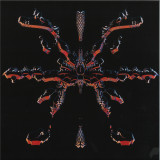
"Moon Mirror, Nada Surf’s new record, has everything fans love and expect from them. Bittersweet anthems that begin quiet but explode into soaring harmonies? Check. Songs that are play-on-repeat heart punches? Check. Songs that are poetic and thought-provoking while also being absolute belt-at-the-top-of-your-voice-with-the-windows-down masterpieces? Check. It’s all here.
For the past 30 years, Nada Surf has had the same core lineup: Matthew Caws, Daniel Lorca, and Ira Elliot. Moon Mirror, their first for New West Records, was produced by the band and Ian Laughton at Rockfield Studios in Wales. For the recording, Matthew, Daniel, and Ira were joined by their friend and longtime keyboard player Louie Lino.
Moon Mirror is a thrilling and moving leap forward for Nada Surf. The songs on the album are true to the human experience—as meaningful and mysterious and sometimes absurd as it is. There’s love, yes, but also grief, deep loneliness, doubt, wonder, and hope. These are not the songs of a band in their 20s. There is hard-won wisdom here, and hard-won belief in possibility—the kind that comes from falling down and getting back up."
quête:the experience
"Springing from Osaka, Japan’s cultural center and historical heart, comes HYPER GAL, a two-piece band consisting of visual artist Koharu Ishida on vocals and noise artist Kurumi Kadoya on drums.
The minimalist duo make maximum impact - stripping music down beyond the bare essentials, to create shimmering, no wave pop from blast beat drums, glittery keyboard loops and ethereal bubblegum vocals - laced with velvet and firecrackers.
On “After Image” HYPER GAL hold fast to their limited palette, but expand their reach. Working with a canvas larger than ever before, the band fearlessly alternate bold, avant-garde strokes with intimate, deliberate gestures. The result is a new world awash in a sea of endless possibilities - only visible with closed eyes and open ears.
“There's something almost vapor-wave-adjacent about the glorious racket riled up by this pair. The effect of repetition throughout, the way the beat slips in and out of time, is hypnotic” - THE WIRE
“Blends elements of noise, no wave, pop and blistering punk to create something remarkable and new… Endlessly inventive and challenging” - MAXIMUMROCKNROLL
“These royalty of no-wave-pop don't blink and their delivery is absolute. An exhilarating, total experience” - NOISE-FI
""Indescribable, just listen to it for yourself. And don't take any stimulants beforehand, you could end up in the emergency room"" – OX FANZINE
“It looks like noise, but there is too much color. Pop, but unsellable. Their music goes beyond barriers, genres and boundaries, as if a virus had been injected into a video game bringing delirious ruin to a perfect world” – SODA POP
“Intensely good. A beautiful challenge, a noise, relentless, not an onslaught, always inviting, like they want to pull you in rather than chase you away. Actually, this is joyous” - THE ORGAN"
2024 Repress /
Seeds has been produced in its entirety by hip-hop mainstay Madlib, and marks the first project Georgia Anne Muldrow where she concentrated solely on her lyrics and vocals, while leaving the production to someone outside her close camp. Georgia describes the recording process as being "a very different experience... But I'm very proud of the hut we built and am excited about the release." Seeds is presented by SomeOthaShip Connect, the label Muldrow started with husband and fellow musician Dudley Perkins aka Declaime.
Dive into the mesmerizing fusion of sounds with Alpha Sect’s latest vinyl release, ‘Fragmented Reality’, on Soil Records.
Featuring remixes by the renowned talents of Curses, Local Suicide x Skelesys, and Raw Ambassador, this EP spans the realms of EBM, Italo-Disco, Wave, and Techno. Each track invites you to journey through a sonic realm where pulsating rhythms and ethereal melodies converge, blurring the lines between genres. With Alpha Sect leading the way, immerse yourself in a hypnotic experience that transcends conventional boundaries.
‘Fragmented Reality’ is out now, offering a unique sonic adventure for the discerning listener.
The debut album from Paris Paloma, 'Cacophony' follows (and includes) her breakthrough single 'labour'. Written around themes of feminine rage, societal expectations on women and deeply embedded misogyny, the album continues the deep consideration and dissection of Paris' own experiences and observations as a woman. 'labour', and subsequent singles including 'as good a reason', have seen her lyrics and music resonate deeply with an every growing fanbase. The 700+ fans at her sold out London show were termed a 'politely loving coven', capturing the sense of community and female energy which Paris inspires. Unheard tracks such as 'his land' are emotive and cinematic, while the gloriously climactic 'the last woman on earth' has become a fan favourite already via TikTok.
With her new single release "Uh-Ah Song" the Ghanaian Frafra Soul singer Florence Adooni announces her debut album "Fo Yelle" on Philophon.
A lot has happened since the release of her first single "Mam Pe'ela Su'ure" in 2021. While this release was a pure studio project, Florence Adooni is now an eight-member live formation, made up of young talents from the highlife scene of Kumasi. The group has already considerable credentials: In 2023, they toured Europe twice and thrilled their audiences at festivals such as Roskilde, Down The Rabbit Hole and Überjazz. And this year, with the debut "Fo Yelle" under the belt, Florence and her group embarking on a 50+ concert summer tour through Europe, from Sweden to Portugal to UK and at festivals like FMM Sines, Xajazz, Africa Oye, Fusion, End of The Road.
The title track "Uh-Ah Song" is based on a rhythm typical of Kumasi and shines with its playful and cheerful character. Florence remembers the process of creating the piece: "When my producer Max Weissenfeldt came to me to play me on the piano an idea for a new piece, my daughter, who had just been born, began to sing in rhythm ah-ah-ah, with all joy in her face ever imaginable, while Max was playing. Max turned around and answered her with uh-uh-uh, to which she replied again with ah-ah-ah. We laughed so much and decided to make it a piece that would capture that very moment of joy we just had experienced. That's why it's somehow a children's song".
"Otoma Da Naba" (The Creator Has Done Well) has a sequencer bass line from a Roland TB-303 as its foundation. While Florence holds her verse in a kind of Ethiopian pentatonic scale, in the pre-chorus she switches to a sweetly swinging heptatonic motif, with a typical highlife guitar in the background creating the atmosphere. In the chorus, the singing then changes in that unique choir style, which is the trademark of Frafra music.
The international debut album "Fo Yelle" will be released on Philophon this summer.
Limited Gray Marble Vinyl. This vinyl edition includes two EPs, one on each side: 'By the Ash Tree' and 'Upstream Dream', originally recorded and released in 2020 and 2021 respectively. To connect these compositions, Matt Kidd (Slow Meadow) composed new segues/crossfades from song to song, allowing the pieces to be experienced in one cohesive and harmonious flow. From Marc Weidenbaum's 'Disquiet' review: "Slow Meadow's new album, 'By the Ash Tree', opens with cascades of delays and proceeds through three tracks of reflective piano". The title track of 'By the Ash Tree' is one of Slow Meadow's most popular and enduring compositions. 'Upstream Dream' was composed around the time of 2019's Happy Occident. Soft electronics, bearing otherworldly tones and, at times, a sense of playful mischief, subtly shift expectations and bring discovery and wonder at every turn. It bookends a period of creative output that introduced Kidd's vision of calming and meditative ambient music. With a foundation of piano, string orchestration, and an ever-evolving electronic palette, Slow Meadow traverses the borders of neoclassical and minimalist electronics and delivers a deeply personal and transportive experience that speaks directly to the ebbs and flows and mundanity and marvels of life.
Next up on _NRV, CHKLTE takes us on a mesmerizing journey. "Enchanted Alley" establishes a hypnotic groove with deep basslines, perfect for late-night sets. "Fallen Algorhythm" delivers a dynamic auditory experience with a driving tempo and ethereal synths. "The Other One Follows" features a rolling bassline and snapping percussion, a straight groove torpedo launched from the kind of sub we'd rather be around. Cristi Cons's remix of "Fallen Algorhythm" adds a pulsating bassline and slicing percussion, creating a high-energy rave weapon sure to vaporize anyone standing in front of the speakers, all while maintaining the essence of the original, if you were at Sunwaves 32, there's no way you didn't hear this bomb drop.
Coming out on September 6th on Sharptone Records, Sundiver is Boston Manor’s fifth album and one that represents a glimmering dawn for the Blackpool five-piece. Grown from a seedbed of optimism and sobriety, the LP celebrates new beginnings, second chances and rebirth. With two members recently stepping into fatherhood, hope is baked into every note. “Datura came out of these really dark few years over the hangover of the pandemic,” Henry reflects. “I'd been struggling a lot with drinking and not taking care of myself and bad mental health and stuff. We wanted Sundiver to be the next morning of the following day.” He explains that it feels good this time round to write through the lens of positivity. “The themes began to emerge, of rebirth, spring, dawn, sunshine and then other elements just started to fit into that.” It was during the making of Sundiver that Henry found out he was going to be a dad. This album is a significant one for the band. Originally coming out of the emo and pop punk scene, they’ve explored sonics and genres throughout their career, taken risks and achieved more than they could ever had dreamed of. They’ve grown up as Boston Manor – their lives and the world changing around them. They’re now taking stock, at a crossroads of the band they were and the band they could be.
While writing the album, they revisited the bands that shaped them in the late 90s and early 00s. “I was listening to the music I loved when I was a teenager and I just thought, why don't we make music like our favourite bands?”, guitarist Mike Cuniff remembers with a smile. “So we brought our interests to the table that way. Y2K kind of vibe. There are elements of Deftones, there are elements of Portishead in there, some Garbage, The Cardigans.” He laughs and adds NSYNC to the list of inspirations. From this cocktail of classics comes a dynamic and ambitious record, rich with depth, groove and more hooks than Peter Pan’s nightmares. Lyrics that foxtrot from parallel universes to personal growth, vivid dreamscapes to raw grief. Individually they’re single strokes full of meaning and magic. Together they’re a landscape.
Container (out Feb 15th) is the first single and it’s them at their best – impassioned and infectious. “This song is about the stagnancy of life creeping up on you & how that can bring about change.,” Henry explains, citing Ocean Song by US band Daughters as an inspiration.
The concept of the butterfly effect is present on Sundiver – how small actions can lead to big changes. This is no clearer than on their second single, Sliding Doors (out April 5th). It has the golden sound of late 90s Lollapalooza rock – think Smashing Pumpkins - rebooted with crisp 2024 production and a potent heaviness. In the lyrics Henry wonders, what if?, pondering on what could be. The idea that there are infinite versions of you whose lives splinter off in different directions at every decision you make. That there’s another you out there somewhere right now reading this sentence, and another me writing it. “So much is down to chance and circumstance,” Henry says. “You might catch that train and your life totally changes. Or you might miss it and things stay the way they are.”
Heat Me Up (out May 30th) is defiant and victorious, the audio equivalent of quitting your shit job and driving into the hot summer sun with a head full of dreams. “The lyrics are about love and gratitude,” Henry shares. “Another theme on the record is just appreciating what you have. It’s about not taking for granted the things that you've been afforded.”
There was some natural magic in the creation of Sundiver. They worked with their usual producer, Larry Hibbitt, and engineer, Alex O’Donovan, but instead of recording in London again they ended up in the green pastures of Welwyn Garden City. “Because Larry lives out in the countryside now, it was a way different environment and way different experience recording this time,” Mike remembers. “That contributed a lot to the brighter sound of the record.” The daily barbecues they had during their recording sessions imbued the process with harmony – five old friends spending quality time together and making quality music.
However, the album is by no means one-note. Birthing this new world they’ve created wasn’t without it’s pain, and that can be heard in the heavier moments on Sundiver. What Is Taken Will Never Be Lost is the most-stripped back on the album, a slow rock number seasoned with the downtempo Portishead influence. The heartfelt lyrics are Henry’s way of processing the loss of his grandfather, who died in a hospice last year(?). “It was just fucking horrible. It was always cold when I went there and they were always trying to get rid of me. The song title, What Was Taken Can Ever Be Lost, is the idea of his memory fading at the time because of dementia.” Henry goes onto explain that shoeboxes of photographs, diaries and a legacy is what he’s left behind. “He lived a really rich life and it has really impacted me and my father. His legacy is etched into the fabric of history in a very small way.” This song continues the connection between his grandfather and the band, as his painted face is emblazoned on the cover of the very first Boston Manor EP, Driftwood. As well as emotionally heavy themes, there’s heaviness in the music of Sundiver too. The closing song, Oil In My Blood, descends into an intense shoegaze outro with Debbie Gough from Heriot screaming hellfire. It’s in moments like this that the band show us aggression and fury can be as much a part of positive change as quiet introspection. The last lyrics of the song, “It resets and starts again,” leaves us in contemplation as the final chord rings out.
Touring the US, Europe and Japan over the years makes for an impressive CV, but if you know anything about Boston Manor you’ll know that they’re all about their hometown. Their choice to work with Blackpool-based photographer Nick Barkworth is testament to that. They’ve been working with him since the pandemic. “He captures Blackpool in a light that really reflects the weirdness and quirkiness of the town,” Henry says.” He's got a really good way of presenting that.” For the Sundiver cover, Nick photographed a 30ft tall abstract glass sculpture made by the local artist John Ditchfield. A striking and bewitching monolith that’s familiar to them but unusual to most people. “It has such kind of a gravity and power to it,” Henry describes the sculpture which stands in a field just outside of the seaside town. “It reminds me of either an explosion or a star or a supernova. To me it represents new life, power and radiance.” Boston Manor have got a knack for that - connecting the otherworldly and the everyday, the stars and the streets.
They’re a band known for using their music to make bigger statements about society. This time round they’re harnessing the uplifting power of music, and the communion it creates, as an antidote to the daily doom and isolation. “It seems like absolute chaos out there at the moment,” Henry says. “You’ve got Gaza and Israel, you've got Russia, you've got the fact that 40% of the world is going to have an election this year and increasingly most governments are leaning very far to the Right. The internet is dividing everybody, people are getting poorer and more desperate. It's really, really scary.” They considered trying to tackle the weight of it all in their music. “We could’ve written Welcome to the Neighbourhood on steroids, where it's just absolute darkness and misery”. He’s referring to their 2018 concept album that deals with class, inequality and the bleaker side of Blackpool. “But I think it's really important to write something that people can be immersed in and find some sort of solace in. Somewhere they can escape to from the modern day pressures and everything that’s going on. We’re all in this together.”
Black Truffle is thrilled to present a Song for two Mothers / Occam IX the first ever solo release from Laetitia Sonami. Born in France in 1957, Sonami studied with Éliane Radigue in Paris before moving to California in 1978 to study electronic music at Mills College, going on to make important innovations in the field of live electronics interfaces and multi-media performance. Sonami is perhaps most closely associated with one of her inventions, the Lady’s Glove, an arm-length tailored glove fitted with movement sensors allowing the performer fluidly to control digital sound parameters and processing, as well as motors, lights and video playback. Having performed with the Lady’s Glove for 25 years, Sonami retired it in 2016, turning her attention to the interface/instrument heard and pictured here, the Spring Sprye.
In Sonami’s own description, “The Spring Spyre is composed of three thin springs that are attached to reverb tank pickups, mounted on a metal ring. The audio generated when the springs are touched, rubbed or struck is analyzed in Max/MSP. The extracted features are then used to train machine learning models in Wekinator and Rapidmax and control the audio synthesis in real time. We never actually hear the springs.” After decades of aversion to documenting her work on recordings, a Song for two Mothers / Occam IX treats listeners to two side-long performances with the Spring Spyre: the very first piece developed for the instrument and the most recent, the two contrasting remarkably in sound palette, energy and form. A Song for two Mothers (2023) spins an intricate web of rippling synthetic burbles, rapid sweeps and fizzing textures. Performed in real time with the sensitive and partly uncontrollable Spring Sprye ("a bit tyrannical," Sonami calls it), the music is delicate yet chaotic. Abrupt gestures hover against a backdrop of silence, "devoid of spatial or temporal direction". After several minutes, the sound-world becomes metallic and percussive, tapping and ticking in pointillistic flurries before a wavering harmonic cloud emerges, sprinkled with resonant drips and pops.
Occam IX is a radically different proposition. At the outset of Sonami’s exploration of the Spring Sprye, she asked her former teacher Éliane Radigue to compose a piece for it—and her: like all of Radigue’s work since she ceased working with analogue electronics at the beginning of the 21st century, Occam IX is written not only for an instrument but also for a particular performer. These scores are developed verbally, through meetings and conversations between performer and composer; each is grounded in an image (usually kept from listeners, to avoid influencing their experience); all magnify the subtlest acoustic phenomena and require great commitment and patience from the performer. Sonami’s is one of the few Occam pieces to make use of electronics, bringing it closer to Radigue’s famous longform pieces for ARP 2500. Beginning from a rumbling low tone, the listener is gradually immersed in slowly lapping waves of synthetic tones, eventually thinning out into delicate bell-like pings against a background of white noise, reminiscent of one of the most beautiful sections of Kyema from the Trilogie de la Morte.
Accompanied by notes from Sonami, her longtime collaborator Paul DeMarinis, and Radigue, and illustrated with scores, photographs and images of the Spring Spyre, a Song for two Mothers / Occam IX is an essential document celebrating an under-recognised pioneer of electronic music and performance.
Kato Hideki's Statement: "The Walk is the first collaboration between me and my brother from another mother, Kramer. We started working together in the late summer in 2023, discussing the thematics and the sonic palette of the album. We shared strong connections with the writings by Robert Walser and Basho - both of them walked, dreamed, lived and died on the road. Ambient music was our natural plane for us to transduce the power of their literature into our music as signifiers. Neither of us imagined just to make 'another ambient record', nor a direct translation of their writings. My instinct was to use various modal colors with modulation - slow yet structured music that sounds deceivingly similar to ambient music. Kramer's genius was apparent to me: his ability to elaborate the music as a composer / musician with his keen ears; to frame the album conceptually, sonically and musically as a producer. What you hear in this album is a true collaboration between two artists who trusted each other to let the music transcend. Here you have it, enjoy YOUR walk - dream, live and die well!" Kato Hideki - Brooklyn, NY on April 3rd, 2024 Kramer's Statement: "Sometime in the latter 20th Century, I became aware of the art of The Brothers Quay, two American animators living in London and making the most beautiful works of art I'd ever experienced in cinema. I noted that some of their work was inspired by_ 'the writings of Robert Walser'. Fast forward to 2024 and I have now read every word there was to read (translated into English) by this unique Swiss-German writer. I'd waited decades to find the right 'environment' in which to create music in dedication to this great prose writer and poet, and in 2023, I found that it was not 'the right environment' that I'd been waiting for, but rather, the right collaborator. Kato Hideki and his extraordinary work as composer for film, dance and just about every other creative discipline you can imagine, was equally as inspiring to me for this project as the words and worlds of Walser and Basho. Our journey in collaborative composition began all over the global map, but arrived at the same physical endpoint, and at the very same point in time. I'm not sure that I would even be interested in music at all, unless there were other artists to partner with as I worked. Working alone means Nothing to me. This months-long act of co-creation i have shared with Kato for "THE WALK" has made me as happy to be alive as Walser and Basho were so happy to be alive while on their walks, as evidenced by their extraordinary descriptive powers, knowing that the world around them - so simple yet so very complex - made life so wondrous, and so well worth the sometimes seemingly insurmountable struggles of finding a way to survive Today, so that we might try again Tomorrow." - Kramer, April 9, 2024 (Asheville, NC)
Belarusian post-punk / synth pop group Molchat Doma have always exuded the kind of brutalist aesthetic of the architecture that adorns their album art. It's cold, gray, imposing, industrial and yet there are human hearts beating within those foundations. In the wake of their breakthrough success in 2020, the trio endured a polarity of experiences, from the nadir of an uprooted life and forced relocation away from their native Minsk to the apex of headlining massive shows across the world. It was in this headspace that the band settled into their new home of Los Angeles to finish writing their fourth album Belaya Polosa, a testament to change in difficult times, a love letter to the digital pulse of the `90s, and a technicolor reinvention of the band's somber dancefloor anthems. From the opening synth swell and drum machine throb of "Ty Zhe Ne Znaesh' Kto Ya," to the goth / post-punk austerity of "Son", to the swirling electronic textures mixed with reverb-drenched guitar flourishes, expansive space, and yearning vocals of title track "Belaya Polosa" - that suggests Depeche Mode at their most reflective or The Cure at their most downtrodden - to the sultry and seductive "Chernye Cvety"_ a track reminiscent of Duran Duran's early `90s output in its fusion of dreamy guitars and authoritative mechanized beats _ and the interwoven layers of instrumentation, soaring chorus, and melodic sophistication of "Ya Tak Ustal", it's clear that Molchat Doma are operating on another level. Molchat Doma gained following with earlier albums that sound like third-generation bootlegs of banned recordings from the Eastern Bloc made after a few key entries in the Factory Records catalog were smuggled in from the West. Belaya Polosa propels them into a new direction while retaining their cold minimalist delivery they're known for. The basement grime and dirty tape-head sound of their previous work are now making space for digital luster and shimmering production values. And while Molchat Doma's broadened aural spectrum adds a synesthetic power to Belaya Polosa, the mood remains rooted in stark and unflinching self-reflection. Molchat Doma retain the duality of being both cold and feverish in their delivery while pushing their music into expanded territories through an armory of new textures. The trio continue to harness the sound of harrowing beauty thriving under harsh realities.
Welcome to the fascinating musical universe of EXOTIC ROOSTERS! It emerges as a burst of freshness and originality, blending an eclectic variety of musical influences to create a truly unique and exciting auditory experience. Comprised of experienced and virtuosic musicians on their respective instruments, the group captivates audiences of all ages with its energy and unmistakable style. Exploring the intersection between tradition and modernity, EXOTIC ROOSTERS combines the rich soundscapes of marimba, vibraphone, double bass, percussion, and drums to create an expansive and nuanced musical landscape. From frenetic rhythms that invite dancing to captivating melodies that transport the listener on an emotional journey, each performance aims to be a celebration of cultural diversity and artistic expression.
In the relentless musical era of the late 90s, two passionate souls, Eugeni Camacho and Rafa Navarro, embarked on a unique sonic odyssey by blending the melodious marimba with the pulsating drums. Together, they successfully created STAMINA PERCUSSIO in their concerts. However, life composed its own score, separating Rafa, who was abducted by the Canary Islands, and Eugeni, who was drawn to vibrant New York. Upon their return, after years of musical exploration in different projects with the Oscars (Oscar Cuchillo and Oscar Rocher), their hearts aligned with a new melody. In the loom of destiny, they discovered the emerging talent of Bernat Cucarella. A prodigy with drumsticks and a 4.0 brain. By uniting Rafa's island experiences, Eugeni's resonant jazz from the Brooklyn alleys, and the rich musical diversity harvested in life's journeys by each of the members, they gave birth to a magical musical tale: EXOTIC ROOSTERS
It is on dark and sweaty dance floors that we get inspired, connect and leave our differences away to live in the present. With this compilation of music pressed in two parts and written by a set of artists from very diverse horizons, it is Polychrome’s perspective on the rave that we want to share. One where sound and light are the only points of reference, opening the space for liberating experiences.
Diffraction EP takes you through the full journey of waveforms traveling through our beloved clubs. Sparking the A-side, Hong Kong’s wonder producer and Mihn Club resident Xiaolin fires up with a progressive and flamboyant house cut, opening an ambitious dance. The tension is taken one notch deeper with Barcelona’s duo Iro Aka signature hypnotic and driving techno sound, dimming the lights for an introspective groove. On the B-side, Lyon’s Desire flirts with an electrifying psy-infused track where pounding beats and floating melodies dance in harmony and psychedelia. It is in a firework that Dublin’s prodigy Dylan Forbes closes out the EP, with an energetic progressive anthem that will light up the space
This collection is reviving the most popular pieces from blockbuster movies by offering a fully fledged state-of-the-art orchestral sound. As the Original Soundtracks for many tracks are recorded in sound quality of the 50s/60s or even in mono – this recording brings a truly revolutionary listening experience to those pieces.
Damien Quintard, who took care of the mastering, co-founded with Brad Pitt “Miraval Studios” in 2021, a recording studio inside Chateau Miraval, bringing back to life the iconic “Studio Miraval”, considered in the 70s till the late 90s as one of the most prestigious studios in the world, recording acts such as Pink Floyd (The Wall), AC/DC, Rammstein, Sting, Muse among others.
ELEINE return with their 4th full-length studio ”We Shall Remain” that breathes everything that is ELEINE. Heavy, chuggy riffs that draws your mind to thrash metal, drumming with death metal hints and vocals that empower, lift and move you. "This combined with our melodic choruses and overall dynamics we feel that "We Shall Remain" gives the listener that signature ELEINE sound in a new and fresh format. Allow yourself to experience ELEINE, allow yourself to join the Eleine Legion", comment Madeleine Liljestam & Rikard Ekberg. This brand new re-pressing comes with a beautiful orange-red opaque-black marbled vinyl!
Hejira is the eighth studio album by Canadian singer-songwriter Joni Mitchell, released in 1976 on Asylum Records. Its material was written during a period of frequent travel in late 1975 and early 1976, and reflects Mitchell's experiences on the road during that time. It is characterized by lyrically dense, sprawling songs and musical backing by several jazz-oriented instrumentalists, most prominently fretless bass player Jaco Pastorius, guitarist Larry Carlton, and drummer John Guerin.
New York’s Sarah Kinsley is fascinated by creating imaginary worlds and alternate realities. We all need an escape. To that end, Sarah’s first album is called Escaper, and to which world you choose to escape is ultimately your own decision. This is vibrant, bold, beautiful music that confronts death and loss, the decimation of old friendships, romantic love’s shortcomings compared to the love shared with close friends, and fraught relationships that flourished and then fizzled. It sounds hugely confident, a real body of work. “A huge way of how I get through life and pain and horrible experiences is through the creation of these spaces where you can become someone else as a distraction—as a means to solving grief,” Sarah says. She works through it all as if the centerpiece of an epic poem, with high drama melodies and huge sweeping choruses.