Repress!
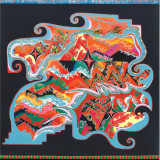
Japanese crustpunk and grindcore icon Eri Fuzz-Kristiansen, aka Gallhammer’s Viviankrist, keeps
the curveballs coming on Diagonal with a bloodied mastication of charred noise and and rhythmic
electronics, following up the label’s acclaimed sides by Sote and Not Waving/Jim O’Rourke
Co-released with the metal-minded Ritual Productions label, ‘Cross-Modulation’ is a brutal
testament to the acridly personalised sound that Viviankrist has explored solo since 1995 in Tokyo,
when she performing vocals, sax and SP-202 sampler in her first industrial/noise unit. 23 years
later her music is still sorely raw, yet riddled with a new found poignance and atmospheric unease
that places her music sometimes as close to Kali Malone’s see-sawing dissonance as the power
electronics of Pan Sonic or the possessed pulses of Conrad Schnitzler and Merzbow.
Since the demise of Eri’s main project Gallhammer at the start of this decade, when she moved
from Tokyo to Oslo (home of her husband and bandmate in Sehnsucht, Maniac - also former
vocalist for BM legends Mayhem), she returned to her early Viviankrist alias from 2017 as a place
to express her primitivist-futurist urges, resulting a trio of CDs including the vicious solo strike
of ‘Morgenrøde’ for Cold Spring. Now on ‘Cross-Modulation’ she intuitively tempers that album’s
phosphorous burn with a deadly incisive application of what Black Metal/Techno pioneer Black
Mecha terms “mentation electronics.”
Alloying avant-metal with rhythmic noise, ambient techno and mind-bending drone to a
metallurgic tang, ‘Cross-Modulation’ serves a dense flux of energies in seven parts, piercing a path
thru maelstrom electronics in ‘Eleventh’ to churn up grizzled Vainio-esque rhythms in ‘Blue Iron’,
while the tenderly bruised ambience of ‘Midnight Sun’ provides a bittersweet palette cleanser for
the tart technoid prang of ‘Insects’, a bout of slow gripping psychedelia in ‘Out of Body’, and the
rugged North European pastoralism of ‘Behind Mirror.’
Search:the express
- 1: Muse
- 2: Akwê
- 3: Nonvignon
- 4: I Miss You
- 5: Lean In (Featuring Mark Guiliana)
- 6: If I Knew (Featuring Burniss Travis & Mark Guiliana)
- 7: Painful Joy
- 8: Okagbé Interlude
- 9: Dou Wé Interlude (Featuring Burniss Travis & Mark Guiliana)
- 10: Astronauta
- 11: Walking After You
- 12: Mi Wa Se Interlude (Featuring Marley Guiliana, Burniss Travis, Mark Guiliana)
Lean In is the exquisite new studio album from GRAMMY-nominated singer Gretchen Parlato and globetrotting guitarist Lionel Loueke - an album that has been twenty years in the making. Meeting in New York City in the early 2000s the pair discovered that they shared an intimate musical bond, a beautiful seed which flowered in performances but was not expressed in the studio, until now! Individually they are internationally renowned, performing with the best of the best and developing a formidable reputation as prolific, creative and world-class Artists. Together they surpass the sum of their parts and form a partnership that is inspired and inspiring. Together Gretchen and Lionel invite you to lean in and join them in the celebration of their musical conjunction.
Heart-wrenching ambient to cerebral techno: INVERNO is Carlo Maria’s debut on Drone.
‘Winter in the northern hemisphere is often seen as the season of death, a state of life so often negatively connoted. I see winter as an incubator of change, where life takes the time to free its potential again.
This record is a memory of past winters and a reminder that new ones will come. It celebrates the state of stillness as a necessary element of movement. It is an invitation to acceptance. The music itself might not necessarily express these ideas, but it acts as a trigger of memories and feelings of the times when these recordings were conceived. I like to see music recordings as pages of a diary.
This music was recorded in a time and space span of various years and locations. Exhumed was recorded at the end of October 2016 in Berlin; the other three tracks were recorded in Milan and performed live in various locations across Italy between in winter/spring 2021/2022.’
- A1: Day In, Day Out
- A2: A Foggy Day
- A3: Stars Fell On Alabama
- B1: One For My Baby (And One More For The Road)
- B2: Just One Of Those Things
- B3: I Didn't Know What Time It Was
It is undeniable that Billie Holiday's singing changed in her later years. Her voice darkened and shifted to a lower range. Her economy of expression distilled her sound to its essence — a kind of heightened speech. The classic LP Songs for Distingué Lovers — her best work of the 1950’s — has also deepened and become burnished with time. Verve’s Acoustic Sounds Series features transfers from analog tapes and remastered 180-gram vinyl in deluxe gatefold packaging
First single to be taken from Skinshape’s ‘Nostalgia’ album. For fans of Khruangbin, El Michels Affair, Tame Impala and Bonobo. Despite the drama insinuated on ‘High Tide, Storm Rising’, Skinshape aka Will Dorey takes it easy with one of his signature laid back lolls featuring tenderly strummed guitar. “The strings in unison, arranged by Jon Moody, almost have a 'Bollywood' feel” says Dorey, completing the contentment with brass melodies that truly set the track adrift on memory bliss. ‘Theme for Lazarus’ is the album’s opener expressing wide-eyed wonderment; expanding upon the delicate, folk-edged setting in which the track sits, his vocals echoing in the distance like somebody you used to know, Dorey offers that “you often get themes for characters in film soundtracks. For the music, I wanted to create something that had elements of classic Skinshape, but also to add some new ideas that I hadn't used before such as the pizzicato strings”.
Superb Gatefold printed sleeve...
Conceptual inside brain travel...
To express the mental acid sounds to check...
First track announces the style with a long Break intro... mental tune... Superb ambiances... very Cinetic and good to mix.
Second track goes 128 BPM acid progressive techno... Excellent Dj tool at a rare speed... flirting with the Trance.
Last track of the A side grow the speed up to 150 BPM with a long break intro tunring after a while more/less 4/4... The sound is very acid and industrial. A big tune !
B side goes up to 160 BPM : Minimal acid sound.
...And finishes in a dark 170 BPM progressive acid track. Mentalcore aera starts here....
Second record opens with a 146 BPM techno mental acid stabilizer. Deep.
Second track is mentalcore big acid overdrive dancefloor pearl from Mr Gasmask !
Last Track of C side from Emetic is a Hardcore splendid exciting tune... maybe the best of this record. Quiet minimal and banging at 170 BPM it reminds the A*Symetric Spivey style:)
... Last side, opens with Minus Polaris and a pure mental acid grower
Last tune of this jewel is from Scandal Orchestra, a Hardcore frontier Hardtek acid track in the classic french good vibe style... Enjoy !
Bruce Falkian is a world famous contemporary artist who exhibits at the world's most prestigious art galleries and fairs. Bruce Falkian moonlights as an agent of espionage against the Terrorism Industrial Complex. Wait... what?
To understand Bruce Falkian we first must understand the link between image and war. In the late 1800s the precursor to the video camera was invented. It was directly inspired by guns, specifically, Samuel Colt's Revolver. It borrowed not only its barrel mechanics, swapping bullets for exposures, but its terminology too. Load, point, scope, aim, shoot, flash. The camera and the gun, united by cordite, would go on to prove the most efficacious tools in shaping the modern world.
The 20th century was a laboratory when it comes to killing and image making, glorified through Hollywood and the Western genre. Propaganda would prove highly effective in creating and sustaining support for militaries fighting for ideological global control. Devised first in the aptly title 'Propaganda' (1928) by Edward Bernays, a nephew of Sigmund Freud, Advertising and Public Relations became the leading media industries, learning how to control the population through images, usually just to buy random crap they didn't need, but other times to overthrow democratically elected politicians in foreign countries. Eventually Western Liberal Democracy assumed domination, built of course on the enslavement of all peoples and nations who didn't fall in line with its specific ideas of living. The Red Scare inspired countless anti-leftist, anti-communist works of art throughout the Cold War, notably and most bizarre, funding the abstract expressionist movement as a non-ideological alternative to socialist realism art. When the Soviet Union fell, Western Liberal Democracy was able to promulgate its unhindered views around the world through its various media empires and actor states. Is it a coincidence that a third of the almost $85 billion dollar global camera equipment market is represented by the greatest propaganda beast the world has ever seen, the USA?
Guns are dangerous because of the obvious. Images are dangerous because we are bad at perceiving what is real (as any jump scare, deepfake, newsreel will attest to.) Videos aren't technically real, they are only a collection of rapidly changing static images which give the illusion of movement. It's easy for us to collectively decide that a video is real, because that's the way our brains perceive reality. People who lead the world of media understand this, which is how they are able to control us, make us invade foreign countries, vote for specific politicians, feel ugly or fat etc. However, ubiquitous as they are, it seems that the image is in crisis. It seems that we've run out of them. Or perhaps our understanding of an image is changing, with the aid of near instantaneous text-to-image AI technology. So what does this mean for guns? What does this mean for war? How will images be used as an aid to war in the 21st century? It remains to be seen, but Bruce Falkian will be a useful agent.
Metroplex dont need an introduction, arguably worlds first and longest running Techno label. OCb aka Driss Bennis is a new face at Metroplex. Since starting his own label Casa Voyager in 2017, the Moroccan artist has gained a reputation for being as versatile an A&R as a producer. Hie debuts his OCB project on Metroplex with ,,The Sequel", an expansive five-tracker, covering a wide range of musical territory from funk-infused breakbeats, fast-paced electro bass, chilled downbeats to focused techno. The astral pads in the opening track ,,THX (The Sequel)" give way to lush electro beats, a funky bass line and warm chords before a vocoded voice exclaims ,,trans human express". Despite its slightly menacing title, ,,Global Warning" has the same ethereal star-gazing vibe, driven by breakbeats and accentuated by dreamy piano chords. On the flip side, the fast-paced electro of ,,Syntax Error" does its title justice with highly-processed fragments of a robotic voice propel the track forward. ,,Translate" is classic Motor City techno - Metroplex style. ,,The Sequel" rounds off with a short, chilled downtempo track, that once again underscores Bennis' musicality. Metroplex is back!!
Black Vinyl[16,77 €]
A Colourful Storm presents Seance, a new set of songs by Maxine Funke.
Following a productive recording period beginning with Silk (2018) and ending with Forest Photographer (2020), Seance marks a remarkable levitation of Funke’s tender, softly spoken songcraft first documented on Lace (2008) and Felt (2012) into new creative heights. Folksong confessionals with the burden of memory. Ghostly confines, murmurs from the cracks. Soil, blood and skin. The beauty and mundanity of the everyday.
The voice of Funke is a distinctive instrument, one which perfectly elucidates her sometimes confessional, at other times deeply inward allusions to love, loss, joy and disquiet. Lyrics grounded in observation and adventure (“Eyeballs, asphalt, grass clippings, peppercorns”) unravel into uneasy truths daubed in self-consciousness and forbidden desire (“I’m not shy / There's just a sparkle in your eye and I don't feel right”). The simplest things can be the most difficult to express.
Opener ’Fairy Baby’ and ‘Homage’ are sensuous and probing, celebrating new beginnings while cautiously closing old chapters. ‘Quiet Shore’, a seven-minute reverie of guitar strum and poetry, conjures spirits long forgotten and shines as Funke’s first solo foray into longform songwriting. A perfect accompaniment to the album’s centrepiece, ‘Lucky Penny’, a euphoric, entrancing rush foreshadowing the delicate dreamspeak still to come.
An assertive, visionary recording by one of New Zealand’s most extraordinary voices, Seance is a lover’s lament, a revealing of self and a secluded wander through fields of enchantment.
For his third album, 'Love You, Drink Water', Awir Leon opens a more direct and personal window on his music. The album is about inner monsters, the search for meaning, failure and hope. The music he proposes plays with the porosity of the lines, because it is at the same time complex, rich, stripped, raw, without compromise, and without pretense. It wants to express in the most vulnerable way what it means to be alive today.
Often compared to renowned explorers such as James Blake, Frank Ocean or Thom Yorke, Awir has spent the last two years travelling the world as the opening act for another great spirit, French artist Woodkid, on an international tour for his latest album S16. During this tour, Awir decided to write this new album, testing and perfecting the songs in front of a large audience that knew nothing about his music.
It is both this audacity and the constant desire to jump into the void that makes Awir an artist apart.
The seemingly simple title, which sounds like a joke, actually hides something much more vital and human.
"One day my three-year-old niece said goodbye to me with the exact words "I love you, drink water". It came out of nowhere, and I thought it was the most thoughtful thing anyone had ever said to me. It was like an epiphany; it was exactly what I wanted to express through my songs.
For Awir Leon, constant research and sincerity are the main drivers of a music that is undeniably singular and powerful. Music that he shapes and dances gracefully over chasms, as if it were necessary to make failures into new points of escape towards vitality.
Love You, Drink Water is silk sewn in pain, a raw and resilient jewel.
Northwind Splatter Vinyl! Isolated at the rural fringe of Northern California, Bailey's Nervous Kats took Shasta County by storm in the early '60s. Combining surf, rock n' roll, exotica, and R&B, the Kats were a teenage dream draped in Magnatone amplifiers and crisp white polo tees. Their self-titled_and only_LP came at the dead end of the band's run, issued on Orville Simmons' one-shot Emma imprint in 1965. The mid-century modern LP of your dreams.
Isolated at the rural fringe of Northern California, Bailey's Nervous Kats took Shasta County by storm in the early '60s. Combining surf, rock n' roll, exotica, and R&B, the Kats were a teenage dream draped in Magnatone amplifiers and crisp white polo tees. Their self-titled_and only_LP came at the dead end of the band's run, issued on Orville Simmons' one-shot Emma imprint in 1965. The mid-century modern LP of your dreams.
- A1: La Sagesse (Women, I'm Calling You) 04:29
- A2: Speaking In Tongues Iii 02:14
- A3: Waiting 06:03
- A4: Shehnai Song 02:04
- A5: Love It Is A Killing Thing 04:49
- A6: Speaking In Tongues Iv 04:58
- B1: Woman And Child 03:37
- B2: En Mireal Del Penal 03:36
- B3: A Sailor's Life 04:21
- B4: Abbess Hildegard 03:26
- B5: Kafi Noir 06:45
An extraordinary exploration of pure vocal power and sensual expression, The Zen Kiss is a highly personal vision of a woman working on the boundaries of convention.
credits
released May 3, 1994
Produced by Steve Coe. Mixed at Real World Studios, Wiltshire, England, November 1993. Mixing engineer Stuart Bruce. Assistant mixing engineer James Cadsky. Recorded at the Coachhouse, Clifton, Bristol. Recorded by Andy Allen and Rik Dowding in the two weeks around the Neptune/ Uranus conjuction of October 1993.
Mastered by Ian Cooper at Metropolis, London.
All drones played or sung by Steve Coe and Sheila Chandra.
All songs written and arranged by Steve Coe and Sheila Chandra except ‘En Mireal del Penal’ by Arroyo/Benito.
Art Direction by Michael Coulson, Real World. Designed by Tony Stiles, Real World. Design Consultation Assorted Images. Series identity Garry Mouat. Photography by Sheila Rock.
Interview by Martha Ladly and Tatiana Spencer.
The next chapter of the Natural Information Society is here. Since Time Is Gravity, credited to Natural Information Society Community Ensemble with Ari Brown, presents a newly expanded manifestation of acclaimed composer & multi-instrumentalist Joshua Abrams nearly 15 year, 7 albums &-counting flagship ensemble. Joining the core NIS of Abrams (guimbri & bass), Lisa Alvarado (harmonium) Mikel Patrick Avery (drums) & Jason Stein (bass clarinet) are Hamid Drake (percussion), Josh Berman & Ben Lamar Gay (cornets), Nick Mazzarella & Mai Sugimoto (alto saxophones & flute), Kara Bershad (harp) & Chicago living legend of the tenor saxophone Ari Brown. Recorded live to tape at Electrical Audio & The Graham Foundation, cover painting Vibratory Cartography: Nepantla, by Lisa Alvarado. 2xLP on Eremite USA, 2xLP & CD on Aguirre/Eremite Europe. Out 14-04.
Since first developing Natural Information Society in 2010, Joshua Abrams has been gradually expanding the group’s conceptual underpinnings, its musical references & the sheer number of the group’s members. Its music is, in a sense, an expansive form of minimalism, based in repeated & overlaid rhythmic patterns, ostinatos & modality. Its roots, its scale & its meaning become clearer in time. If time is gravity, it also allows us to carry more. Having begun as fundamentally a rhythm section with Abrams’ guimbri at its core, the version here can stretch to a tentet, including six horns.
Abrams has been expanding his minimalism gradually, but he has long understood a key to minimalism’s potential: the breadth of its roots in the late 1950s & early 1960s, ranging from the dissatisfaction of young European-stream composers with the limitations of serialism to the simultaneous dissatisfaction of jazz musicians with the dense harmonic vocabulary of bop & hard bop. The former began exploring rhythmic complexity & narrow tonal palates in place of harmonic abstraction (Steve Reich’s Drumming, Philip Glass’ Music with Changing Parts; perhaps above all Terry Riley’s In C & his late ‘60s all-night organ & loop concerts); the later reduced dense chord changes to scales (signally with Miles Davis' Kind of Blue, but rapidly expanding with John Coltrane’s vast project). In the 1950s the LP record opened the world with documentation of Asian & African musics, key influences on both minimalists & jazz musicians. If John Coltrane’s soprano saxophone suggested the keening shehnai of Bismillah Khan, the instrument was rapidly taken up by two key minimalists, LaMonte Young & Riley, similarly appreciative of its flexible intonation, the same thing that kept it out of big bands.
If the guimbri, the North African hide-covered lute that Abrams plays with NIS, involves a rich tradition of hypnotic healing music associated with the Gnawa people, Abrams’ music also touches on other musics as well — other depths, memories & healings, different drones, rhythms & modes. As the group expands on Since Time Is Gravity, he has made certain jazz traditions in the same stream more explicit as well. If there is a mystical & elastic quality involved in the experience of time, both in direction & duration, you will catch it here. The parts for the choir of winds expand on the roles of Abrams’ guimbri, Mikel Patrick Avery & Hamid Drake’s percussion & Lisa Alvarado’s harmonium: at times, the winds are almost looping in the tentet version, each hitting a repeating note in turn, at once drone & distinct inflection on temporal sequence. The brilliance of the work resides in Abrams’ compositions, the NIS’ intuitive execution & in Ari Brown’s singular embodiment of the great tenor saxophone tradition, including the oracular genius of Eddie “Lockjaw” Davis, & Yusef Lateef. The three pieces by the expanded NIS featuring Brown —the opening “Moontide Chorus” & “Is” & the ultimate “Gravity”— have an immediate impact, & togther might be considered a kind of concerto for tenor saxophone. Here Brown presses almost indistinguishably from composed melody to improvised speech, getting so close to language that he might have a text. Everything here is a sign. Note the tap of the Rhythm Ace that links “Moontide Chorus” to “Is”, the attentive heart always present, even when signed by a machine. There’s a link here to the methodologies & meanings of dub music & the linear & vertical collage of beats, textures & tongues: treated with reverence, a sample of a beat-box can be as soulful, as hypnotic, as a mbira or a tamboura. If those pieces with Brown are heard as a suspended concerto, the three embrace & enfold the other works, like the sepals of a flower. That placement will also touch on the mysteries of our perception of time.
Particularly in “Is”, but elsewhere as well, a phenomenon of transcendence arises in which time appears to be tripartite, at once moving backwards & forwards & standing still. This is an act of technical brilliance certainly, but also an illumination of music’s ability to represent temporal consciousness through polymetrics. This particular listener has only heard it before in a few places, including the horn shouts & bowed basses of Coltrane’s Africa, in moments of Charles Mingus’ The Black Saint & the Sinner Lady, in certain pieces where tapes were literally running backwards, & earlier still in Dizzy Gillespie’s Cubana Be, Cubana Bop, in which the composer George Russell & conguero Chano Pozo found a music that spoke at once in the voices of Stravinsky’s Rite of Spring & the vestigial rites, rhythms & songs of the Yoruba language & Santeria religion of inland Cuba.
In Joshua Abrams’ compositions & the realization of them by the NIS, in the time of one’s close listening & memory thereof, distinctions between the “natural” & the “social”, the “quotidian” & the “transcendent” are erased, suspended or perhaps irrelevant. Consider two of the ensemble pieces, one named for nature, the other social science. In “Murmuration” the repeated wind figures of flute & alto saxophone combine with the interlocking patterns of harp, guimbri & frame drum (tar) to create a perfect moving stillness, not an imitation but a witness to the miracle of the starlings’ astonishing collective art, a surfeit of beauty that might be the ultimate defense tactic.
“Stigmergy” takes its name & concept from the Occupy movement’s Heather Marsh, who proposes a social system based on a cooperative rather than competitive models, one in which ideas are freely contributed & developed as ideas rather than an individual’s property. In its form, Abrams’ “Stigmergy” is the closes thing to traditional jazz, a series of accompanied solos by each of the wind players. However, the composed accompaniment is a radically collectivist notion: a repeated rhythmic figure, call it ostinato or riff, in which the different winds each play only a note or two of the figure, a concept both more collectivist & individualistic in its conception than any typical unison figure. It suggests another of the underlying recognitions that propel the Natural Information Society, the group as social organism, the teleology of hypnotic anarchy, all parts in place, functioning systematically, evolving & expressing itself, its nature & society, as a transformative organism.
George Lewis has described music as “a space for reflection on the human condition”. This suggests that, rather than a “distraction”, at least some music might serve as a distraction from distraction. It’s a focus, a clarity, a awareness, an external invitation to interiority, as if music itself is a model for form & contemplation, an organism contemplating for us or as us. If that is a possibility, & I am sure I have heard such musics, than this music is among them. How many of our rhythms, melodies & harmonies (cultural, historical, biological, psychic) might such music carry, translate & transform in the particulate ecstasy of our own murmuration? (Stuart Broomer, April 2022)
Dear friends, music is more than just the sum of its individual parts. It also has a metaphysical character, which is particularly determined by its sociality. Kerrier Collective, a group of friends from Cornwall in England, lives this social aspect by making music together and ¦nding relaxation from their stressful everyday lives. With their worldbuilding
"dreams of the sea" Ep, the collective presents us with dance music not often heard like this. It is inspired by classic folk, pop, jazz, UK garage, latin, disco, house and techno. Imagine The whitest boy alive together with Giorgio Moroder interpreting Dylan songs with musical means of the hardcore continuum in a South American bar - Ok, take that with a wink, but you know what is meant. The title track is a sound journey into the depths of the ocean, where we encounter an
underwater party. A fat Reese bass forms the foundation of this piece, which is complemented by a rich arrangement of shimmering bells, guitar plucking, strings and female vocals.
This breathtaking mood leads into a driving beat accompanied by acid arpeggios. It's all so deep that you think you can hear the call of a whale from somewhere. "Paddington Express" is a slow march accompanied by heavy bass. All around you, a piano ghosts up and down and mysterious vocal snippets create a perfect symbiosis with an acid line. Should you be accompanied "On your last day" by this eponymous track, it will be a good day - a day that may begin with a gloomy, heavy foreboding, but will dissolve into a joyful, peaceful lightness. The guitar lick of this track issimply irresistible. On your last day, you will de¦nitely dance!
The record closes with "Friday afternoon". The name says it all. We all know how it feels. Let this euphoric disco tune carry you into the weekend! P.S.: Physical release comes with handcrafted, screen printed artwork by fabulous graphic artist Zatina Kessl.
What would have happened if Michael Dudikoff had gone missing in action, say – in Poland in 1987 – during the harshest freezing spell of the century? Would he have coped under these conditions like John Rambo has in the town of Hope? We shall never find out, but the soundtrack is already there. Latarnik and Cancer G (members of EABS and Błoto) would call this film Zima Stulecia: Minus 30°C.
When Twin Peaks debuted on Polish National Television with its oneiric music by Angelo Badalamenti, Poland could feel as eerie as the series. Seemingly nothing quite matched, but on the other hand, no one was surprised. Growing up in the 1990s inevitably brings back memories of stalls selling a variety of products. You could buy there cleaning products from Germany, some underwear, Haribo jellies and Jacobs coffee, and have access to the "latest" cultural releases, which would be arriving late in Poland. This is where one could obtain pirated copies of cassette tapes and VHS, the labels of which had typewritten film titles that transported kids' fantasies to another world. With such content distribution, many of these kids got their first glimpse of Predator, Terminator, Robocop, as well as Van Damme's stunts in Bloodsport and a plethora of other B action movies, which to this day - like American Ninja - are rerun on TV over and over again. The afterimages of these soundtracks nestled in the heads of Marcin Rak and Marek Pędziwiatr for years and found expression on their debut album.
The music of Zima Stulecia is difficult to label in terms of genre. It oscillates towards melancholic electronic music. For some it will be techno, others will hear elements of house, all accompanied by improvised synth and percussion music.
Zima Stulecia is a duo that was not supposed to have any chance of success. Many years ago, back in 2006, when they were still budding musicians they met for the first time at a jazz workshop. When they found out where they both came from and that they were separated by almost 800 kilometers, despite having great chemistry in playing, they
jokingly said goodbye with the sentence: "it was fun playing together!". They figured they would never meet again. At the time, none of them imagined that in a few years' time in Wrocław they will form one of the most interesting contemporary jazz bands in Poland: EABS and Błoto. On top of that, they were both born in January 1987. The last of the historic "winters of the century" (eng. for "zima stulecia") occurred at that time in Poland, which ultimately determined their name as a band. Minus 30°C album is a recording of the non-verbal workings of these soulmates, and a fruit of a musical collaboration that has lasted for 16 years.
"Here is our first album. A gleeful and quaint celebration, expressing our love for making music together."
This album simply named ‘MUSIC’ by ROLROLROL (Jameszoo & Niels Broos) is a puttylike exercise in pop, modern jazz and electronic music. Building on an already extensive and longtime collaboration ranging from their work on Jameszoo’s three albums for ‘Brainfeeder' and Niels Broos’s two EP’s for ‘Alpha Pup’.
‘MUSIC’ was created over the span of some years, working out of multiple places occasionally joined by friends.
Please take the five stars not as a statement that this is the best record of 2013, but as a delighted endorsement of a genre classic. With his fifth record (3 with Harpoons, and 2 solo) Ezra Furman has made an album of classicist rock'n'roll that never feels like an exercise, but a living, breathing piece of self-expression. The foundations are obvious, but the simple touches that adorn them are what elevates Day of the Dog. Been So Strange, for example, is the Velvet Underground's chugging R&B reincarnated, but with the delicious addition of a horn section. It leaves you wondering why Lou Reed never thought to do the same, so well does it work. Slacker/Adria is nervy, jittery powerpop until two minutes in, when the bottom drops out of the song and it turns into a doomy riff over which Furman appears to be telling us his nightmares: "I see white crosses burning across a dark landscape." He's seen his critics coming, too: the liner notes contain an index so you can check off the references. Clever, funny, sharp and tuneful – a great rock'n'roll record.” Michael Hann (The Guardian).
Josh Milan has been recording music professionally for over 30 years.He's played every role from artist to engineer in the studio.This project, Honeysweet, focuses on his production and musicianship.Utilizing only one musician on sax, Josh plays every instrument and sings every note on this project. His songs are packed with soulful dance floor grooves inspired by iconic, soulful groups like Brian Auger, Cymande, Pleasure, Africano, Santana and others.
"I wanted to do music that made me and my family feel good when I was growing up. It's the kind of music that families dance to at gatherings with a record player and no DJ”, says Josh. “Intros, Accents, Breakdowns, Bridges, and endings were all part of the music.” This music will transport Josh's audience to a place of musical freedom. This is music with, seemingly, no rules.
Josh Milan describes each track on the Honeysweet EP “Exodus” in his own words :
"Last Night Changed It All featuring Lawrence Clark on sax is the kind of groove that keeps its dance floor value while holding up the banner of true musicianship. This song was written after hearing a DJ set,where the DJ didn’t seem to be concern about staying within a musical box. He played all sorts of music in one set. I knew then that I’d branch out musically when recording.Rhodes, picked bass guitar, rhythm guitar and drum kit is all that's needed on this one.”
"Exodus the manipulation of major and minor chords in this groove make it complex and interesting. The listener is lead by the organ solo featured here. The song is a mental escape. A mental exodus complete with bongo section.”"Being Free is a message that captures the point of this entire project. Musical freedom and expression is where this project gets its
fuel. Horns, are included on this production. A true expression of soulful music. Being free should be all the time I'm your mind all the time.”
“Cranberries and Cream is my tribute to funk grooves as they were featured on records in 70’s. I’m a fan of that sound and I like to play by own funk grooves when I’m alone. This is one of the tracks on the ep I prefer to rock.”
“And So She Waits has eerie sounding pads in the background. They linger throughout the track. Popping in and out, as though they’re waiting for something. You will hear the change in mood once she is no longer waiting. The groove returns to it’s original state. Only she is no longer waiting, he is.”
“Crazy is me bringing the funk to dirty house music. Complete with house piano in the mix. The chords are unsettling. They are, in fact,Crazy. I though adding a horn arrangement to a house track like this would sound interesting and different.”Honeysweet “Exodus” out at all digital outlets and double pack vinyl set.
After the success of their previous "Get Mine/I'm Gone" 7" vinyl 45 release LRK Records is proud to announce the digital single follow up by Bella Brown & The Jealous Lovers!!
Bella Brown & The Jealous Lovers are a Los Angeles based, transplanted fromChicago, unit that specializes in 60s/70s soul and funk. The band is fronted by the dynamically charismatic Bella Brown. A fiery female lead singer that is a mixture of Tina Turner and Sharon Jones, with a persona that is reminiscent of the empowered female
leads of 70s Blaxploitation films. Backed by the musicianship of The Jealous Lovers they form a unit that expertly expresses a uniquely modern interpretation of the traditionalsoul and funk genres.
Their new single "What Will You Leave Behind" exemplifies this
ideal. The track is a heartfelt call to action in these times of failed humanity and injustice. A Motown influenced message of hope that features sympathetic vocals, supportive horns, and a funky twist that asks us to create a better future by considering the effects of our present.
Look for "What Will You Leave Behind" March 3rd, 2023 on all streaming platforms, and stay tuned for an announcement from LRK Records regarding "What Will You Leave Behind" and a future Bella Brown & The Jealous Lovers 7" vinyl 45 released!