Obviously is the new album from beloved band Lake Street Dive. It includes the new single ‘Nobody’s Stopping You Now’, a letter of encouragement from lead vocalist Rachael Price to her teenaged self, co-written with bassist Bridget Kearney. Lake Street Dive has figured out how to write tunes that reflect this particularly turbulent chapter in our shared history. The album track ‘Making Do’, which was released at the end of last year, speaks to the world that future generations are inheriting while exploring the lasting impacts of climate change and our responsibility to address it (featuring a cameo from Senator Ed Markey who co-sponsored the Green New Deal).
As Price puts it, “You’re trying to express your anxieties, your feelings, your sadness, your happiness, all of these things – your authentic state of being in a song. But you’re also trying to create something people will listen to over and over again. That’s the unique fun thing about music, putting these messages into three and a half minute snippets, dropping whatever truth we can and hoping it’s the type of thing that people want to ruminate on.”
Obviously was produced by Grammy Award-winning producer, songwriter, and multi-instrumentalist Mike Elizondo who is best known as a songwriting collaborator for Dr. Dre, Eminem, and 50 Cent and has also served as a record producer for Fiona Apple, Mary J. Blige, Carrie Underwood, and 21 Pilots, among many others. Utilizing Elizondo’s hip-hop record-making expertise coupled with the permanent addition of keyboardist Akie Bermiss, Lake Street Dive’s wide-ranging taste in pop, rock, R&B, and jazz have blended together to make an impressively cohesive sound, combining retro influences with a contemporary attitude. “We’ve been a band for so long that we didn’t want to just become a feedback loop of our own ideas,” recounts Kearney. “It felt like a really good time to bring another person like Mike Elizondo, and he really opened us up. He encouraged us to make bolder arrangement choices, take those chances and try those things. The record really is a success in what we set out to do: continue to challenge ourselves, continue to grow, and do things we’ve never done before.”
The members of Lake Street Dive founded the group in 2004 while attending the New England Conservatory of Music in Boston. The band features Rachael Price (lead vocals), Mike “McDuck” Olson (trumpet, guitar), Bridget Kearney (bass) and Mike Calabrese (drums) as well as their newest member Akie Bermiss (keyboards), who has been a touring member of the group since 2017. Since the band’s inception, they have released six studio albums. Their 2018 self-produced record, Free Yourself Up, debuted at #4 on the US’s Top Album Chart and charted #8 on the Billboard 200. In addition, the album’s hit single ‘Good Kisser’ peaked at #5 at Americana radio and appeared in the Top 20 at AAA radio, both career peaks for the band. The group has toured worldwide performing at major music festivals including Bonnaroo, New Orleans Jazz Festival and Newport Folk Festival while preforming alongside artists such as T Bone Burnett, The Avett Brothers, Robert Finley, Jack Johnson and Trombone Shorty.
Search:the express
Statistique Synthétique draws as much from the history of computer sound synthesis as from its latest developments. But well beyond developing simply as a proof of concept, this piece aims to transcend the abstract status of synthetic sound objects and lead them to a properly hallucinatory state, that is to say to a meeting point where the object and perception dissolve into each other, in a sort of transcendental field. Beyond, also, hylomorphism, to reach the world of matter-form fusions, where perception knows how to see "shoulders of hills", as Cézanne wrote.
Teum (the Silvery Slit) is, as the title suggests, an overture, an opening to the game of multiplications, fragmentations, duplications. But it is also the opening understood as the void that blossoms between two borders, a break from which escapes a double tension, both the pulling force of these two edges which move apart and the opposite force of reconciliation, of compression. Okkyung Lee invites us to a truly telluric moment, a rare moment of expression where tectonic movements and shear stresses become music. If the earthquakes were, as we thought in the 18th century, due to underground thunderstorms, there is no doubt that this piece of music, both celestial and continental, could have been their audible manifestation.
Text by François Bonnet
HeckerStatistique Synthétique2020 / 25'15Computer-generated sound with resynthesized situated texture recordingsWritten and produced by Florian Hecker, 2019 - 2020Texture analysis and resynthesis algorithm: Axel Röbel, Analysis/Synthesis Team, IRCAM, ParisMastered by Rashad BeckerPhoto by Mauricio Guillén, 2019
Thanks to Axel Röbel for his commitment to the project and special appreciation to GRM, Luke Fowler, Mauricio Guillén, Dirk Mayer and Porta33
Location Texture Recordings, using DPA 4060, DPA 4017B, DPA 4021 and DPA 4060 microphones to Sound Devices 702 recorder; except segment 04:31 - 05:37, recorded by Luke Fowler, April 2019 using Sony M10.
00:00 - 02:00 Lopud, Croatia, June 200802:00 - 03:12 Ponta do Sol, Madeira, ER 101, April 201903:12 - 04:14 Prentiss St, Cambridge, MA, February 201504:14 - 04:31 Anjos, Ponta do Sol, Madeira, ER 101, April 201904:31 - 05:37 Atelier Cézanne, Aix-en-Provence, April 201905:37 - 08:31 Anjos, Ponta do Sol, Madeira, ER 101, April 201908:31 - 09:46 Praia dos Anjos, Ponta do Sol, Madeira, ER 101, April 201909:46 - 10:39 Private garden, Kissing, September 200910:39 - 11:15 Praia dos Anjos, Ponta do Sol, Madeira, ER 101, April 201911:15 - 15:11 Porto do Paul do Mar, Calheta, Madeira, April 201915:11 - 16:53 Prinz Eugen Strasse, Vienna, June 200816:53 - 24:27 Risco, Rabaçal, Madeira, April 201924:27 - 25:15 Bois de Boulogne, Avenue du Mahatma Gandhi, Paris, September 2015
:::::::::::::::::::::::::::::
Okkyung LeeTeum (the Silvery Slit)2019 / 20'03Performed, recorded and composed by Okkyung Lee (ASCAP)Mixed by Lasse MarhaugMastered by Guuseppe IelasiPhoto by Lasse MarhaugPart of Re-Imagine Europe, co-funded by the Creative Europe Programme of the European Union.
Cut by Andreas Kauffelt at Schnittstelle, Berlin, September 2020Sleeve design by Stephen O'Malley
- A1: Wolfwalkers Theme
- A2: Wolves
- A3: Running With The Wolves (Wolfwalkers Version)
- A4: Mechanical
- A5: Wolf Or Girl
- A6: I'm A Wolfwalker
- A7: Howls The Wolf (Moll's Song Wolf Run Free) (Moll's Song Wolf Run Free)
- A8: Our Forest
- B1: What Are You Doing Here?
- B2: This Is Intolerable
- B3: Please Mummy
- B4: My Little Wolf
- B5: Our Victory
- B6: Follow Me
- B7: Mebh's Tune
- B8: Robyn's Tune
In the cinema, the composer must go to meet the filmmakers, enter their world, but without giving up his own. This is the difficulty or the paradox of music for the image. By collaborating with directors from a wide variety of backgrounds, I think I have indirectly discovered a lot about myself. It helped me to progress, to explore territories that were not naturally mine. Cinema is a laboratory where I have sought to construct original orchestral formulas combining Corsican polyphonies, musicians from jazz, variety, classical, or even rappers. Like the world today, a fragmented world where all cultures mingle. So said Bruno Coulais, one of the most innovative composers of contemporary cinema, during the tribute paid to him in 2011 at the Cinémathèque de Paris
In 1978, Bruno Coulais, a young composer of concert works, discovered in film music a new means of expression, a way of bringing the demands of his writing to the masses. François Reichenbach, then Josée Dayan, Jacques Davila, Souleymane Cissé or Laurent Heynemann, first on television and then in the cinema, lead him of his own accord in the discovery of this new world.
In 1995, he composed the music for Microcosmos. This centimeter-scale initiatory journey offers him the opportunity to reveal the full dimension of his writing. He injects into his score a strange lyricism, between wonder and fantasy, confirming the lesson learned from François Reichenbach: "to any documentary image, music brings a part of fiction".
The success of Microcosmos established the musician and made him the indispensable composer of other natural tales, notably alongside Jacques Perrin (Le Peuple migrateur, Oceans, Les Saisons, etc.). Other long-term relationships will be forged, in particular with Benoît Jacquot, with whom he has worked for more than a decade, not to mention Frédéric Schoendoerffer, James Huth or Jean-Paul Salomé.
In addition to great popular successes such as Les Choristes, Brice de Nice or Sur La Piste Du Marsipulami, it is hardly surprising that this insatiable curiosity has found in the animated cinema the most inspiring playgrounds, in particular through his collaboration with two exceptional designers, Henry Selick and Tomm Moore.
The first, American director of The Nightmare Before Christmas produced by Tim Burton, invites Bruno Coulais to sign in 2009 the magnificent score of Coraline (film nominated for the Oscars). 10 years later, he is about to find him for a new and beautiful Wendell & Wild adventure. For Irishman Tomm Moore, Bruno Coulais has already composed the music for two Oscar-nominated films, The Secret of Kells (2009) and Song Of the Sea (2014), and in 2020 he will sign the score for Wolfwalkers.
Whether it is about author's films or more mainstream films, Bruno Coulais maintains the same standards, always considering his art as a window open to the world. Much less wise than it seems, he reveals in it a gift of a modern alchemist and a very personal way of mixing the most diverse cultures in universal harmony at work.
Next up on MOM is another exploration of the link between art and music. This time it is dance performance. The musical artist is Okkre (Uge Pañeda) producer of the Spanish duo LCC, who have released two albums on the celebrated Austrian imprint, Editions Mego. Okkre is a composer of soundtracks, DJ and she is currently immersed in researching her "landscapes series" project, connecting countries and cultures that are seemingly unconnected to each other through field recordings... MOM 012 is the soundtrack to a very special performance named ÉPICA. Directed by Barcelona based choreographer Aimar Pérez Galí, it was premiered at Sonar 2017. EPICA brings clubbing culture inside the theatre, to deliver a highly energetic performance, joining bodies, sound and voices of historic and political dissidence. It is about communication between bodies (without language) and the liberty of being on the dancefloor. Freedom of movement, expression and happiness through music! Okkre has provided a startling soundtrack. This soundtrack complements the performance of the dancers beautifully but also deserves to be listened on its own. It is both powerful and dramatic, fitting the title. The music of the soundtrack has been adapted for its imminent release on vinyl. The piece begins with the rhythmic movement of beats, which provides a structured backdrop. They are complemented by a swirling bassline. Overlayed percussion of differing styles comes in and out. Harsh almost metallic synths enter after a few minutes, which also have the sensation of breathing. Later on, powerful synths battle sturdy cymbal assisted percussion. In the latter stages, everything gets even more intense techno feel and the A Side ends with dense dark synths. The music is alive! While the other side gently mixes a melodic bassline that moves like the wind with intertwined chorus and voices, which appeal to the spirit of the artistic work, evoking space for feeling and touching. At the same time, insistent beats offer a club feeling. Scary yet empowering strings create a hypnotic atmosphere alongside falling keys and vocal impressions. The final few minutes provides a strong climax to the record. This features hammering beats, a circling bass and powerful keys. A mighty performance! ÉPICA is indeed epic.
During this difficult situation where we are forced to see beautiful theaters empty and quiet, the eclectic Ital Oscillazioni (Elvio Seta), best known for his bulky live instrumental performances, in the long wait for the release of his 2 first albums offers us a couple of unpublished tracks “obscure-italo” on vinyl, in which he clearly expresses his New Romantic nature.
These two releases blend the raw and pure sound of his vintage synths, with the surprising theatricality of the Opera represented here by Gioacchino Rossini’s “L’Equivoco Stravagante”.
A retrofuturistic Concept-italoDisco that, while we are sweaty and busy dancing it in a dirty nightclub, will transport us for a few moments to an elegant Italian theater of 1982, surrounded by heavy red velvet curtains.
In between acting as Producer on all of the Black Jazz label releases, keyboardist Gene Russell also cut two fine albums for the imprint, of which this is the second, released in 1973. Judging by the quality of their respective solo outings for the label, the fact that Russell’s band includes bassist Henry Franklin and guitarist Calvin Keys bodes very, very well for the quality of this record. And indeed, Talk to My Lady represents a sterling stylistic leap for Russell from his New Direction album, which was the first release issued on Black Jazz; here, he’s leading an electric band instead of the basic piano trio format found on the former record, and playing a number of original, soul jazz compositions like “Get Down” and the title tune. As for the covers, both “Me and Mrs. Jones” and “You Are the Sunshine of My Life” are heartfelt renditions given a little extra bounce by Russell’s ivory tickling and Franklin’s expressive bass playing in particular, while the version of “My Favorite Things” goes way out beyond what John Coltrane played on his original Atlantic studio version. It’s hard to go wrong with a Black Jazz album and you won’t on this one from the label’s creative helm. First-ever LP reissue!
Originally recorded and released in 1980, "Six of One" beautifully captures the detail in Evan Parker's high frequency split tones for which he is now perhaps better known. Five years on from "Saxophone Solos" and with circular breathing and polyphonics well worn into his live performances, Parker's experimentations here produce sustained passages of brilliant flight. Set into the echoes and resonances of St Judes On The Hill church, the results are stunning. "The recital commences with a split tone line of twining sine waves that expand and contract in telepathic collusion. Pitch dynamics narrow and redefine themselves more emphatically on the second piece where sliding legato rivulets born of Parker's compartmentalized tonguing create the sonic semblance of up to three separate voices emanating from the single reed speech center. It's a feat he's accomplished innumerable times since, but every fresh hearing never fails to open an aperture into a style of improvisatory expression that is at once wholly alien and intensely mesmerizing. There's also something strangely subterranean about the flood of sounds, like the rush percolating water through an underground aquifer system enroute to unknown tributaries. The third piece trades tightly braided tones for leaner and more linear phrases, but a vaporous trail of phantom notes still clings to the central line. And so it goes, with the illusion of repetition guiding the momentum, though Parker never explicitly repeats himself." - Derek Taylor, All About Jazz Transferred from the original master tapes at Abbey Road Studios and released in an edition of 500.
From Nanakuli comes a simple yet stunning ode to the islands with “Hawaii Is Beautiful”, composed and performed by Mike Kahikina. Previously unreleased, “Hawaii Is Beautiful” has been restored and remastered from original master tapes.
Kahikina played an active role in Hawaii’s music scene in the 1970s and 80s, writing and performing protest songs in support of sovereignty for the Kingdom of Hawaii and land rights for Kanaka Maoli, or native Hawaiians. Featured in the 1988 music documentary Hawaiian Rainbow is Kahikina’s song “Who Came First” which provides a clear, poignant message: “Who came first to Hawai‘i? All of us kanaka’s. And how come us kanaka’s, we no own the aina?” Kahikina later served as state representative on the Hawaiian Homes Commission from 2011-2019, championing Native Hawaiian’s rights to homestead lands and pressuring the state government to provide better access to and higher quality of housing for kanaka.
Despite the frustration and fiery feelings he expressed in his protest songs (check out his song “I Am A Native” with Nelson Waialae, written in protest of kanaka who were evicted from Waimea Valley), Kahikina still had plenty of room for songs of love and aloha for his home, including a rare 45 devoted to the art of surfing (“Ocean Rider”, recorded under the name Ka’ala). “Hawaii Is Beautiful” is a shimmering statement of Kahikina’s aloha for his home; a palm-trees-are-swaying tribute to the natural beauty of the Hawaiian Islands.
From Nanakuli comes a simple yet stunning ode to the islands with “Hawaii Is Beautiful”, composed and performed by Mike Kahikina. Previously unreleased, “Hawaii Is Beautiful” has been restored and remastered from original master tapes.
Kahikina played an active role in Hawaii’s music scene in the 1970s and 80s, writing and performing protest songs in support of sovereignty for the Kingdom of Hawaii and land rights for Kanaka Maoli, or native Hawaiians. Featured in the 1988 music documentary Hawaiian Rainbow is Kahikina’s song “Who Came First” which provides a clear, poignant message: “Who came first to Hawai‘i? All of us kanaka’s. And how come us kanaka’s, we no own the aina?” Kahikina later served as state representative on the Hawaiian Homes Commission from 2011-2019, championing Native Hawaiian’s rights to homestead lands and pressuring the state government to provide better access to and higher quality of housing for kanaka.
Despite the frustration and fiery feelings he expressed in his protest songs (check out his song “I Am A Native” with Nelson Waialae, written in protest of kanaka who were evicted from Waimea Valley), Kahikina still had plenty of room for songs of love and aloha for his home, including a rare 45 devoted to the art of surfing (“Ocean Rider”, recorded under the name Ka’ala). “Hawaii Is Beautiful” is a shimmering statement of Kahikina’s aloha for his home; a palm-trees-are-swaying tribute to the natural beauty of the Hawaiian Islands.
Father John Misty is the nom-de-plume of Josh Tillman, who
has been recording and releasing solo albums under his own
name since 2003 and who recently left Seattle’s Fleet Foxes
after playing drums with them from 2008-2011.
When discussing Father John Misty, Tillman paraphrases Philip
Roth: “‘It’s all of me and none of me, if you can’t see that, you
won’t get it.’”
‘Fear Fun’, Father John Misty’s album from 2012 and now
available again through Sub Pop, began gestating during what
Tillman describes as an “immobilizing period of depression” in
his former Seattle home, when he had lost interest in
songwriting and wound up finding his voice by writing a novel.
After breaking from Seattle and settling in a spider-infested
Laurel Canyon treehouse, Tillman spent months demoing
songs, eventually liberating himself from his creative impasse.
With the help of LA producer/songwriter/pal Jonathan Wilson, a
wealth of talented musicians kicking around LA and producer
Phil Ek (who everyone knows has worked with Built to Spill,
Modest Mouse, Band of Horses, Fleet Foxes), ‘Fear Fun’
blossomed into a fully-formed expression of Tillman’s
unrestrained vision.
‘Fear Fun’ consists of such disparate elements as Waylon
Jennings, Harry Nilsson, Arthur Russell, All Things Must Pass
and Physical Graffiti, often within the same song. Tillman’s
voice has never been better and often sounds like Roy Orbison
at his most joyous, while the music maintains a dark,
mysterious yet playful, almost Dionysian quality.
Lyrically, his absurdist fever dreams of pain and pleasure elicit,
in equal measures, the blunt descriptive power of Bukowski or
Brautigan, the hedonist-philosophy of Oscar Wilde and the
dried-out wit of Loudon Wainwright III.
6-panel digipack CD. Gatefold LP.
Father John Misty is the nom-de-plume of Josh Tillman, who
has been recording and releasing solo albums under his own
name since 2003 and who recently left Seattle’s Fleet Foxes
after playing drums with them from 2008-2011.
When discussing Father John Misty, Tillman paraphrases Philip
Roth: “‘It’s all of me and none of me, if you can’t see that, you
won’t get it.’”
‘Fear Fun’, Father John Misty’s album from 2012 and now
available again through Sub Pop, began gestating during what
Tillman describes as an “immobilizing period of depression” in
his former Seattle home, when he had lost interest in
songwriting and wound up finding his voice by writing a novel.
After breaking from Seattle and settling in a spider-infested
Laurel Canyon treehouse, Tillman spent months demoing
songs, eventually liberating himself from his creative impasse.
With the help of LA producer/songwriter/pal Jonathan Wilson, a
wealth of talented musicians kicking around LA and producer
Phil Ek (who everyone knows has worked with Built to Spill,
Modest Mouse, Band of Horses, Fleet Foxes), ‘Fear Fun’
blossomed into a fully-formed expression of Tillman’s
unrestrained vision.
‘Fear Fun’ consists of such disparate elements as Waylon
Jennings, Harry Nilsson, Arthur Russell, All Things Must Pass
and Physical Graffiti, often within the same song. Tillman’s
voice has never been better and often sounds like Roy Orbison
at his most joyous, while the music maintains a dark,
mysterious yet playful, almost Dionysian quality.
Lyrically, his absurdist fever dreams of pain and pleasure elicit,
in equal measures, the blunt descriptive power of Bukowski or
Brautigan, the hedonist-philosophy of Oscar Wilde and the
dried-out wit of Loudon Wainwright III.
6-panel digipack CD. Gatefold LP.
Pianist/composer Maria Kannegaard presents ‘Sand i en vik’, a rapid
follow-up to the album ‘Nadeslas’.
Where that latter album was an experimental and expressive affair, the former sees her return to more familiar musical pastures, although with a different viewpoint and attitude. Kannegaard’s piano playing remains immaculate, never cluttered or wasteful, always conveying the right mood or emotion, the perfectly balanced response to both the composition and the development of it.
The compositions carry their own moods and unique characteristics, their own internal tensions, sometimes haunting, sometimes exuberant, sometimes seeming stretched to a breaking point.
Plaintive ballads sit alongside riff-driven stompers, moments of abstract expressionism interweave with stop-start angular motifs, unexpected harmonizations, and moments that seem to be formless before revealing themselves to be details within a larger, clearer picture.
Frequently sounding like much more than a trio, the album is mixed and mastered by the award-winning Stefano Amerio at Artesuono recording studios.
Comes with printed innersleeve and download code. Limited 300. "Musician, composer and one of the most revered figures for today's younger generation of experimental and alternative Arabic music scenes, Kamilya Jubran (text, oud & vocals), collaborates with long standing musical partner, composer, accomplished trumpet player and seasoned electronic musician Werner Hasler (trumpet & electronics). In Wa (Arabic for and), their third album together as a duo, Kamilya Jubran and Werner Hasler continue to interrogate their listening and their expression, their research and their desires, to unravel a musical universe of possibilities; "a unison of timbres, cultures complementing, the complicity of verses, and modes and languages confronting each other" in the duo's own way of communicating respective origins and contemporaneity. Lyrical, within a sound full of contrast and ornamentation, they pursue an expansion of their repertoire with imaginative interpretation and improvisation." Originally released in CD and digital by Everest Records (Switzerland). Vinyl issued in collaboration with Akuphone. Vinyl mastering by Mark Gergis.
Bobby Would LP#2. Wistful waltztime psychobeat for warding off / wallowing in the 2020-21 Weltschmerz. Swelling and smearing the vision of 2018’s skeletal rock’n’roll heartbreaker Baby, most of the songs here are ballads – minimalist, ultra-hypnotic but lavishly melodic space-punk lullabies and bright, bruised expressions of jingle-jangle mourning. Highs, lows and heavenly blows. BW’s guitar is, more than ever, a thing of fearsome and filigree beauty, moving effortlessly from misty, mellifluous DIY pop-dreams to wailing vertiginous whiplash leads and dazed, epiphanic, angels-wept metha-drone, ringing in infinity - and tethered to this earth only by his beloved monotone, numbed-out, serial-killer croon. Spinning in its own orbit, but with recognisable dabs - perhaps - of Phantom Payn / JG39, Les Rallizes Denudes, Gary War, Peter Gutteridge’s Pure...and of course Bobby’s own work in Heavy Metal and Itchy Bugger.
Clive Phillips, Dominic Goodman, Peter Blundell are Mosquitoes, a somewhat inscrutable London-based outfit in operation for something close to seven years now, and have released music across a host of celebrated and broad-minded underground labels. Give or take the occasional interview in the less-straight parts of the music press, this is as much formal biography as their music has thus far allowed, for there's something essentially unknowable at the centre of what makes Mosquitoes what they are. So murky is their early history in fact, the first two self-released Mosquitoes records seemed to disappear from sight before really becoming visible. As more records have emerged, those first communications accumulate new meanings, acting as vital documents in tracking the evolution of a band who stand at the vanguard of contemporary British music.
The second of these records, recorded to tape in summer 2016 and first released as a single-sided 12" under the name MOS-002, is arguably the first true iteration of Mosquitoes. Now fittingly renamed Mosquitoes for its reissue as a dubplate-style 10" on World of Echo on 5th March, these five cryptically titled, shape-shifting tracks, see the trio embrace a near-genre-less fluidity, and in doing so express a unique combination of both freedom and intent. By design or instinct, Mosquitoes stand at their own inverted rock nexus, presenting a music that's turned inside out, and in doing so, music that twists the listener the same way.
In that sense, Mosquitoes plug into a long lineage of DIY savant iconoclasts, those outliers who would deny orthodoxy in order to excavate new languages and ideas - The Dead C, This Heat, the anti-formalism of No Wave, David Toop's General Strike. As such, Mosquitoes rely on a musical pluralism in order to take it apart - you must know how something is made before you reassemble it anew. Labelling this an EP may possibly underplay the breadth and ambition of what's on show. Later records would arguably be more cohesive, but what stands as particularly startling with this early work is their fearless and all-encompassing dive into the avant garde. Consider the anti-rockism of the scorched earth 90s re-imagined through a distinctly avant filter of free jazz and dub aesthetics. And it's the latter which perhaps shapes Mosquitoes most, dub the perfect vehicle for the articulation of such wilful anti-formalism. Make no mistake, this is music that's unafraid to be tough, to demand something of the listener and to not ask permission. And to bear witness to a rejection of formalism so aggressively pursued is to be reconciled.
Justin Thurgur has been at the heart of the UK's World Music scene for over twenty years, primarily through his collaborations with the Afrobeat maestro Dele Sosimi (former keyboardist for both Fela and Femi Kuti) and with the pianist Kishon Khan. Most recently in Khan's projects Lokkhi Terra and the Afrobeat/Cuban crossover, Cubafrobeat.
Thurgur has worked with Cuban giants Giraldo Piloto, Changuito and Julito Padron, with the Nigerian drum legend Tony Allen and with Damon Albarn's Africa Express project; which included Cheick Tidiane-Seck and Fatoumata Diawara. He's also worked with the likes of Bukky Leo, Francis Fuster, Pandit Dinesh, Baby Akhtar, Inemo, Tony Kofi, Kodjovi Kush, The Soothsayers, The Levellers and The Selecter.
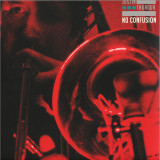
He is perhaps most known as the trombonist from the multi-award winning 'folk' group Bellowhead. Their split in 2016 led to him forming his own band and releasing his debut album as a bandleader, 'No Confusion'.
The album features original compositions written by Thurgur in collaboration with double bassist Max De Wardener, piano/rhodes/Hammond organ player Kishon Khan and guitarist Phil Dawson, with band members including the likes of Graeme Flowers on trumpet, James Allsopp on bass clarinet and Oreste Noda on congas.
Thurgur promoted 'No Confusion' throughout 2016 and 2017, culminating in an enthusiastically received performance at Love Supreme Jazz Festival in 2017. Jazz FM, in particular Chris Philips, gave extensive airplay to the album as well as streaming a live performance from the Jazz FM studios and doing an interview. They subsequently playlisted two of Thurgur's single releases. Lopa Kothari played a track on BBC Radio 3's show 'The World On 3'. The band did a live interview and performance on DJ Ritu's 'A World In London' show on Resonance FM. Beyond this Thurgur has been developing relationships with various other digital radio stations, including Gordon Wedderburn, John Waugh and a number of Global music stations based in Europe.
* The Menahan Street Band includes members of The Roots, Budos Band, Lee Fields and The Expressions and The Dap-Kings...an all star Brooklyn line up!
* First album in 9 years.
*LPs are In gatefold sleeve and contain download code.
* MSB tracks have been the foundation for some of modern hip-hop's most successful beats; their music has been sampled by the likes of Eminem, Jay-Z, Kendrick Lamar, Travis Scott, 50 Cent, Curren$y, to name a few.
Menahan Street Band, a veritable supergroup of some of today's most prolific songwriters, arrangers, and producers return with this beat-forward, cinematic masterpiece.
Their unique brand of instrumental soul has not only been the foundation for some of modern hip-hop's most successful beats, it has also become the perennial soundtrack and veritable vibe-generator for countless parties, art shows, and restaurants throughout NYC and abroad.
While this album carries the aesthetic torch that MSB has skillfully woven into the tapestry of their DNA, it also delves deeper into the experimental, exotic sounds that fill many of the coveted Sound Library and Soundtrack LPs of the late sixties and early seventies - an amalgamation of moog synths, electric pianos, drum machines, and a bevy of analog instrumentation, that ebb and flow in lush swells of Morriconian grandeur.
When it came to playing soul jazz with organ combos, jamming bebop with a quartet, caressing ballads or coming up with fresh approaches to Latin jazz and spirituals, the versatile Grant Green was at the top of his field. Among his many recordings, his most vital and adventurous remains Idle Moments. With such inspiring sidemen as Joe Henderson, Bobby Hutcherson and Duke Pearson, Green is heard at the absolute apex of his creativity throughout this stunning set.
He builds up statements like a masterful speaker, sounds both passionate and thoughtful at every tempo, and never runs out of brilliant and personal ideas to express. Every phrase leads to the next one yet all of his solos are spontaneous. While the other musicians are inspired and in top form, Idle Moments is particularly notable as the height of Grant Green’s musical genius!
A new ship of fools sails on Bolombia lands! These strange people seem to celebrate the whole jazz universe and african idioms, but they've never been in Africa. The great continent, more than physical, is a mental place of encounter and psychedelic skids. Neurotic and schizoid sorcerers, a furious wind drags them towards the total effervescence of the groove: an unprecedented cauldron of dangerous substances, hybrid styles and influences mixed with secret recipe. Their music is an explosive bubble of expressions, a feverish, impulsive and unstoppable ritual. A cosmic attitude, such as Heliocentrics or Embryo, marries the majestic and floating sounds of synths and psych organs, acidified by toxic dub sparks and deadly funk forays. A crazy horn section travels without maps from Sun-Ra and Ethiopian echoes, hard-bop reminiscenses, to sudden and virulent Balkanisms, making this soup an indecipherable combination of flavors.
Mats Gustafsson - Flute, baritone sax, live electronics, Johan Berthling - Electric bass, Andreas Werliin - Drums with Goran Kajfes - Quartertone trumpet, Mats Aleklint - Trombone, sousaphone, horn arrangements. Fire! tracking new paths and reaching new levels of excellence, still honoring their 12 year old vow of presenting a fresh approach to improvised music. Their debut album, You Liked Me Five Minutes Ago, was released in 2009 to wide international acclaim. "The basic strategy of pairing the expressive energy of free jazz with a sturdy sense of groove has yielded something potent and self-contained" (New York Times). Between this and Defeat there's been five albums, including collaborations with Jim O'Rourke (Unreleased?, 2011) and Oren Ambarchi (In The Mouth A Hand, 2012). No two Fire! records sound the same, but with Defeat they have taken their biggest leap so far, with Gustafsson giving the flute a prominent place in the sound image, a surprising and most successful move, his both expressive and ornamental approach given ample room to breathe, especially on the two long tracks bookending the album. In places more subdued than on previous efforts, but with the distinctive bass figures and hypnotic mood fully intact. There are some lively stretches with guests Goran Kajfes and Mats Aleklint, bringing to mind their big band offshoot Fire! Orchestra, albeit on a smaller scale. For over 20 years we have made a habit of releasing music that is beyond easy classification, in later years typified by Hedvig Mollestad, Elephant9 and Krokofant, but cemented by Fire! and their exploratory curiosity and deep love of music in general. We, and many others, have tried to compare the trio to other groups, but listening to Defeat we realize how futile this is. Given the above there's no doubt there are many influences at play, but the resulting brew is in a class by itself.