Die schöne Chrysantheme in ihrer Form mit schlichter, weißer Blütenfarbe wird auch Friedhofsblume genannt. Aufgrund ihrer Langlebigkeit wird sie gerne zur Dekoration von Gräbern verwendet. Für BLACK NAIL CABARET ebnet die Blüte der Chrysantheme den Weg für unser eigenes Porträt am Sterbebett. Der Sensenmann kommt zu uns allen. Die Aussicht auf das Ende verwandelt uns in angsterfüllte Gefäße. Wir könnten diese besser mit so vielen anderen Dingen füllen, aber die Furcht vor dem Tod durchdringt alles. Der Titel des sechsten Albums des ungarischen Pop Noire Duos, "Chrysanthemum", symbolisiert ein Aufbegehren gegen die Angst, aber auch Akzeptanz. BLACK NAIL CABARET bleiben durchaus auch ihrem Hang zur sexuell expliziten Provokation treu, doch die unterbewusste Angst vor dem Tod mit ihrer großen emotionalen Kraft, zieht sich metaphorisch als roter Faden durch "Chrysanthemum". Die Erotik der Ungarn bildet statt billiger Klischees ihre gelebte BDSM-Realität künstlerisch ab, die von hohen ästhetischen Ansprüchen geleitet wird. Musikalisch haben BLACK NAIL CABARET ihr herausragendes Songwriting auf "Chrysanthemum" weiter perfektioniert. Es gelingt dem Duo scheinbar mühelos, dunkle elektronische Klänge mit Elementen des Pop Noire zu vereinigen. Ihre Kompositionen stehen auf eigenen Beinen und benötigen keine elektronischen Spielereien, wodurch sich BLACK NAIL CABARET wohltuend abheben. Spätestens mit ihrem selbst veröffentlichten vierten Langspieler "Pseudopop" (2018) verschmolzen die Ungarn erfolgreich Kunst, Pop, dunkle Harmonien und kraftvolle Elektronik miteinander. Mit dem folgenden fünften Album "Gods Verging on Sanity" (2020) setzten BLACK NAIL CABARET ihren Siegeszug auch international fort. Der exzellente Ruf des Duos verbreitete sich rasch auch durch Mundpropaganda, und das trotz aller Einschränkungen durch die globale Pandemie. Endlich stehen die Sterne günstig, dass BLACK NAIL CABARET die Welt mit diesem dunklen Soundtrack über die Schönheit des Lebens erobern, was diese strahlend weiße Blume von scheinbarer Unschuld letztlich auch symbolisiert, deren Duft aber auch die ewige Macht des Todes verbreitet: "Chrysanthemum".
Cerca:the friend
The Fifth record from the friends for the bag.
A slip into the sound of Future Motion for a new paradigm.
Following a successful release that started the UFO Series, Future Motion goes into sounds for different arenas and pushes tools to technique.
Four sounds to share Where We Come From...
- A1: Simple Minds - Theme For Great Cities
- A2: Cabaret Voltaire - Silent Command
- A3: Ryuichi Sakamoto - Riot In Lagos
- A4: Grauzone - Eisbar
- B1: The Associates - White Car In Germany
- B2: Patrick Cowley - Nightcrawler
- B3: Isabelle Mayereau - On A Trouve
- B4: Chas Jankel - 3,000,000 Synths
- C1: Peter Gabriel - No Self Control
- C2: The Walker Brothers - Nite Flights
- C3: Thomas Leer - Tight As A Drum
- C4: Daryl Hall - The Farther Away I Am
- C5: Harald Grosskopf - So Weit, So Gut
- D1: Robert Fripp - Exposure
- D2: Areski Belkacem & Brigitte Fontaine - Patriarcat
- D3: Basil Kirchin - Silicon Chip
- D4: Holger Czukay - Ode To Perfume
By the turn of the 80s, the impact of David Bowie’s ground- breaking Berlin recordings – the synths, the alienation, the drily futuristic production – was being felt on music across Europe. What’s more, the records being made were reflecting back and influencing Bowie’s own work – 1979’s Lodger and 1980’s Scary Monsters owed a debt to strands of German kosmische (Holger Czukay), new electronica (Patrick Cowley, Harald Grosskopf), and the latest works from old friends and rivals like Robert Fripp, Peter Gabriel and Scott Walker, all of whom had been re-energised by the fizz of 1977.
Compiled by Saint Etienne’s Bob Stanley and the BFI’s Jason Wood, Fantastic Voyage is the companion album to their hugely successful Café Exil collection, which imagined the soundtrack to David Bowie and Iggy Pop’s trans-European train journeys in the mid-to-late seventies. “Fantastic Voyage” is what happened next.
Bowie’s influences and Bowie’s own influence were rebounding off each other as the 70s ended and the 80s began, notably in the emergent synthpop and new romantic scenes as well as through the music of enigmatic acts like the Associates and post-punk pioneers such as Cabaret Voltaire.
Like Low and Heroes, some of the tracks on Fantastic Voyage are spiked with tension (Grauzone’s ‘Eisbär’) while some share those albums’ sense of travel (Simple Minds’ ‘Theme for Great Cities’, Ryuichi Sakamoto’s ‘Riot in Lagos’) and others find common ground with “Lodger’s” dark, subtle humour (Thomas Leer’s ‘Tight as a Drum’, Fripp’s ‘Exposure’).
This is the thrilling, adventurous sound of European music before the watershed moment when Bowie would abandon art- pop for America and the emerging world of MTV with “Let’s Dance” in 1983. Fantastic Voyage soundtracks the few brief years when the echo chamber of Bowie, his inspirations, and his followers created an exciting, borderless music that was ready to challenge Anglo American influences.
Longtime friends and musical collaborators Max Essa and Eddie C join the RNT fold with a 4 tracker of melancholic and exquisitely produced chilled out disco. Begun as a lockdown project, the We Live In The Hills EP explores a vast palette of sonic soundscapes, from the shimmering guitars and acid lines of Melon Stepping, to the insistent rolling bass and whimsical synths of Save Me, the deep funk of the EP’s title track, and the late nite driving soundtrack stylings of Sixth Bridge. This EP tells a hopeful story of emerging from isolation and doubt, like a lovely musical sunrise after a long dark night.
THEODOR is a psychedelic sweet soul band formed by members with diverse musical backgrounds.
Whilst on a road trip to Italy Rob and Lui were listening to tapes of contemporary soul music. The idea was born to record an album channeling a moody and relaxed soundscape. „Right after our trip we called up our good friends Max and Greg, who were immediately on board. We wrote and recorded deep in the pandemic. Those weekend sessions captured this peaceful solitude“ The outcome was their self-titled debut album which will be released in February 2023 on the french label Broc Recordz.
The rich sonic texture and unconventional arrangements of their very first single SHEPARD’S LULLABY gives a hint on what is to be expected on their forthcoming LP. THEODOR created a perfect soundtrack for a hot and humid summer day having a magic dash in your twelve o’clock tea. Playful melodic bass lines and the soulful acoustic drums build the playground for the warm and dreamy keys such as farfisa organs, fender rhodes and 80's synths. The lush instrumentals are spiced by the very different yet complementary voices of Max and Lui.
Cluster's little sister label CLUSTER X delivers another killer EP of banging warehouse techno from Poland's underground legend CHRIS DA BREAK. The A1 'Friend' kicks hard, but there are 2 more throbbing techno bangers from Chris, plus a slamming techno remix of 'Friend' from Chris Liberator & Sterling Moss to make this EP umissable if you llike your beats tough and pounding!
Drum-machine soul, funk, disco and boogie from Buffalo, NY. Rare 7" singles and previously unreleased tracks presented as a complete album. In the early 70s, Jessie Key and Sylvester Cleary - two passionate idealists living in Buffalo, New York - formed a close friendship based on a mutual mission to better their city. The Attica State Prison Riot of 1971 was a burning memory, and the Arthur vs. Nyquist lawsuit - brought against the City of Buffalo for creating and maintaining a racially segregated school system - was on the docket. Key was once a cotton-laborer in Mississippi, who journeyed north for school where he met his kindred spirit, Cleary. The two struck up an intense friendship, bought a drum machine and recorded their first 45, "A Man," a paean to self-actualization and Black American empowerment, which they custom pressed and issued privately. Dozens of recordings followed over a decade long span, issued on local labels and warehoused on cassette tapes. Perennial optimists, Key & Cleary tried any - perhaps every! - path they could demarcate in hopes of forwarding their agenda of self-effected, positive change. They formed Buffalo’s first minority-owned construction company, opened a health food restaurant in a building previously occupied by a fast food chain, and even concocted a candy bar called "The Buffalo Treat," which they manufactured and sold locally. Eventually they started their own label, Buffalo’s Reflection. On it they released their masterpiece, "What It Takes To Live," a sought-after disco and Northern Soul classic, which previously appeared on Now-Again”s Soul Cal anthology. This album collates the breadth of Key & Cleary’s recordings from 1970 until the mid 1980s, both with songs issued on rare 7" singles and previously unreleased. It presents a conjoined musical vision and tells the story of a duo years ahead of their time, both musically and culturally. Love Is The Way was their ethos - their goal was to enlighten humanity and to bend history in a more loving direction through communion.
Burn Out - the latest release from Mini Trees - is a defiantly euphoric EP with the sonic and emotional bandwidth of a full-length record packed neatly into five new songs from Los Angeles-based songwriter Lexi Vega. Inspired by a relentless touring schedule that followed the release of her 2021 debut album Always In Motion, the songs of Burn Out confront questions of identity, exhaustion, and how to navigate creating art in an industry fixated on commodifying it.
A month away from music sparked Vega’s creativity and inspired her to return with long-time friend and producer Jon Joseph. Together they determined to push the limits of Mini Trees’ “bedroom pop” description, opening the door to a number of new
collaborators - keys from Zac Rae (Death Cab for Cutie, Lana Del Rey), arrangements from James McAllister (Sufjan Stevens, Taylor Swift), and even bass from longtime family friend Jimmy Johnson (James Taylor, Phil Collins). These songs shimmer in production, even as they’re saturated with the pervasive sense of fractured identity, disillusionment, and otherness that has shaped much of Vega’s sense of self. The overwhelming weight of these disparate identities is reflected in the EP’s cover art - a bed cluttered with clothes she’s chosen not to wear, familial heirlooms and mementos strewn at her feet.
- A1: Wear Your Love Like Heaven
- A2: Mad John's Escape
- A3: Skip-A-Long Sam
- A4: Sun
- A5: There Was A Time
- B1: Oh Gosh
- B2: Little Boy In Corduroy
- B3: Under The Greenwood Tree" (Words By William Shakespeare, Music By Leitch)
- B4: The Land Of Doesn't Have To Be
- B5: Someone Singing
- C1: The Enchanted Gypsy
- C2: Voyage Into The Golden Screen
- C3: Isle Of Islay
- C4: The Mandolin Man And His Secret
- C5: Lay Of The Last Tinker
- D1: The Tinker And The Crab
- D2: Widow With A Shawl (A Portrait)
- D3: The Lullaby Of Spring
- D4: The Magpie
- D5: Starfish-On-The-Toast
- D6: Epistle To Derrol
Donovan’s Original
A Gift From a Flower to a Garden made for a few firsts: the first double LP of Donovan’s
career, one of the first box sets in pop and, most importantly for Donovan himself; the first
pop album for the children of tomorrow.
He resolved to make A Gift From a Flower to a Garden an album of two halves. The first,
Wear Your Love Like Heaven, was intended for his own generation as they started to think
about the kind of world they wanted to leave behind. The second, For Little Ones, was for
the children they had or would have in the years to come. The result was a kaleidoscopic
folk-jazz suite on the power of love, imbued with all the romance and mystery of an Arthur
Rackham illustration for an ancient English fairy tale. The songs, remarkably adventurous
given Donovan was a globally famous singer at his commercial height, combined the
influences he had amassed so far.
There is something about A Gift From a Flower to a Garden that could never be repeated,
though. It is such an innocent evocation of the childlike imagination, so redolent of its time,
yet set apart from it too. All these years later, the peaceful qualities of this pioneering,
enchanting, deeply unusual album feel more valuable than ever.
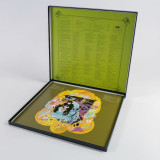
The state51 Box Set
With authenticity core to the project, The state51 Conspiracy engaged one of the UK’s
leading experts in box set design, Daniel Mason at Something Else, to painstakingly recreate
the box, records and accompanying ephemera. The first challenge was to find the deep blue
leatherette paper the original box set was covered in; a problem since it was no longer in
production. “I knew people who had stacks of it, gathering dust on top shelves, so I bought it
up wherever I could find it,” says Mason. Then came the reproduction of 12 loose leaf lyric
sheets on fine art watercolour paper, each of them featuring a watermark and a fairytale-like
illustration by Donovan’s artist friends Sheena McCall and Mick Taylor. Where, though, to
find the same paper stock? “I found out that it was made at a paper mill in North Wales
called Abbey Mills. Unfortunately the mill dissolved in the early 70s and very little of the
paper remained. However enough paper remained to allow us to produce the numbered
certificate also signed by Donovan that sits within the box.”
Then to the iconic cover image. Donovan and Jimi Hendrix’s personal photographer Karl
Ferris, used infra-red film to achieve the psychedelic effect on the cover, but the original
negatives couldn’t be found. Mason then used digital technology to ramp up the colour levels
on a reproduction from an original copy of the album while allowing it to remain a little bit
faded, as it would be after half a century. The same labour of love and care has gone into
producing all elements of the box; from the rebuilding of the famous front cover font to the
hand-numbered and signed certificate; letterpress printed on the original paper stock of the
1968 UK release lyric sheets.
To cap it all off the original mono master tapes were waiting safely in the EMI Donovan
Archive and transferred from tape to digital by Abbey Road Studios where new lacquers
were cut, ensuring Donovan's favoured mono version of the album would be presented both
physically (and digitally for the very first time) in striking audiophile quality. The final touch to
Red Vinyl[20,97 €]
REKORDER is "a kind of retrospective of myself", says M.RUX about his second, long-awaited solo album. For over 10 years, Marten Rux aka M.RUX appears as a DJ, producer, editor, remixer and multi-instrumentalist all over the world and has developed an idiosyncratic sound that opens up subtle fields of tension: M.RUX mixes a sound between experimental sound design and hooklines that stay in your ears forever. Between wild percussion and contemplative harmonies, between ecstasy and meditative calm. In his DJ and live sets, M.RUX usually steps up to the controls with a smile, discreetly bobbing his head, while the audience goes wild. He circumnavigates clichés with trustworthy certainty and develops his very own guiding threads in his selection beyond BPM or genre straitjackets. One constant is his warm, often stoically slow kick drum, which holds all that playfulness together. REKORDER is a manifestation of this typical M.RUX sound. Similar to his concept album "Vermonische Melodien" from 2020 (on the Pingipung label), the artist's curiosity is directed towards the musical visions of the past. When new music technology projected great visions of the future and when new sounds had not yet solidi ed into clichés. REKORDER refers to the recording device, spelled in a German way, because most of the recordings were made in Germany (and in England as well). Phonography is a miracle that has only been around for 150 years: Technology gifts upon us prosthetics for remembering sound. Every recording is a process, and every playback a new performative act. Recordari (Latin) is a beautiful word. It literally means to take something to heart (cor) once again (re-). This doesn't just refer to remembering, but also to a ponderous, loving, sometimes doubtful contemplation. It is a perfect headline for M.RUX’ approach to processing sound. REKORDER draws deeply from its own archive, which has ourished quite splendidly during the pandemic. Multi-instrumentalist M.RUX mixes his own recordings of banjo, guitar, auto-harp, synths, percussion and jews harp with fragments from sessions with friends that have accumulated since 2020. They unfold in the process of re-listening in the mix and transform into a solid musical tapestry. A typical gesture for this album? M.RUX bows deeply to the history of pop music - especially the blues and its melancholy, coolness and shuf ing groove. The harmonic framework of the album is based on blues scales throughout. Instead of conveying blue emotions via lyrics or the tone of the voice, as the original genre does, the synthesizer takes on this role on REKORDER. With his sound design, M.RUX achieves an ecstatic sorrow in his melodies, this gurgling portamento that is reminiscent of R&B (or even the ingenious title melody of the series "Bojack Horseman”). If voices are heard on REKORDER, then as hypnotic fragments that guide us through the groove as conjunctions: "Because...", says the voice in the track of the same name. That's enough. There are no lyrics, no literal weariness, no love-songs or storytelling, REKORDER processes all of this into timbres and groove as vessels for the album’s individual, contemplative melancholy. Never forgetting, with a gentle smile, to swing a leg.
Black Vinyl[17,61 €]
LIMITED RED COLOURED VINYL!
REKORDER is "a kind of retrospective of myself", says M.RUX about his second, long-awaited solo album. For over 10 years, Marten Rux aka M.RUX appears as a DJ, producer, editor, remixer and multi-instrumentalist all over the world and has developed an idiosyncratic sound that opens up subtle fields of tension: M.RUX mixes a sound between experimental sound design and hooklines that stay in your ears forever. Between wild percussion and contemplative harmonies, between ecstasy and meditative calm. In his DJ and live sets, M.RUX usually steps up to the controls with a smile, discreetly bobbing his head, while the audience goes wild. He circumnavigates clichés with trustworthy certainty and develops his very own guiding threads in his selection beyond BPM or genre straitjackets. One constant is his warm, often stoically slow kick drum, which holds all that playfulness together. REKORDER is a manifestation of this typical M.RUX sound. Similar to his concept album "Vermonische Melodien" from 2020 (on the Pingipung label), the artist's curiosity is directed towards the musical visions of the past. When new music technology projected great visions of the future and when new sounds had not yet solidi ed into clichés. REKORDER refers to the recording device, spelled in a German way, because most of the recordings were made in Germany (and in England as well). Phonography is a miracle that has only been around for 150 years: Technology gifts upon us prosthetics for remembering sound. Every recording is a process, and every playback a new performative act. Recordari (Latin) is a beautiful word. It literally means to take something to heart (cor) once again (re-). This doesn't just refer to remembering, but also to a ponderous, loving, sometimes doubtful contemplation. It is a perfect headline for M.RUX’ approach to processing sound. REKORDER draws deeply from its own archive, which has ourished quite splendidly during the pandemic. Multi-instrumentalist M.RUX mixes his own recordings of banjo, guitar, auto-harp, synths, percussion and jews harp with fragments from sessions with friends that have accumulated since 2020. They unfold in the process of re-listening in the mix and transform into a solid musical tapestry. A typical gesture for this album? M.RUX bows deeply to the history of pop music - especially the blues and its melancholy, coolness and shuf ing groove. The harmonic framework of the album is based on blues scales throughout. Instead of conveying blue emotions via lyrics or the tone of the voice, as the original genre does, the synthesizer takes on this role on REKORDER. With his sound design, M.RUX achieves an ecstatic sorrow in his melodies, this gurgling portamento that is reminiscent of R&B (or even the ingenious title melody of the series "Bojack Horseman”). If voices are heard on REKORDER, then as hypnotic fragments that guide us through the groove as conjunctions: "Because...", says the voice in the track of the same name. That's enough. There are no lyrics, no literal weariness, no love-songs or storytelling, REKORDER processes all of this into timbres and groove as vessels for the album’s individual, contemplative melancholy. Never forgetting, with a gentle smile, to swing a leg.
Hollow Coves are a dynamic indie-folk duo of Matt Carins and Ryan Henderson, who are brimming with their passion for travel and observing different shades of the world. The group's tender melodies and poignant lyrics have resonated with fans around the world with the band amassing over half a billion global streams to date. Hollow Coves have received acclaim from the likes of Billboard, Clash, Sunday Times, Ones To Watch, Under the Radar, and more and continue to connect with the hearts and minds of listeners across borders and time zones.
On their sophomore album, the earthy acoustics and breezy rhythms provide a soundtrack to the feeling of change. The essence of shifting one’s perspective is a theme Hollow Coves meditate on as they go through their own musical evolution. They invited friend and acclaimed Aussie artist Matt Corby to help co-produce and bring their new songs to life.
Nothing To Lose by Hollow Coves, released 1 March 2024, includes the following tracks: "Milk and Honey", "Harder to Fake it", "Purple", "Be Alright" and more.
This version of Nothing To Lose comes as a 1xCD in a(n) Digipak packaging.
« Tas Malonumas »
Lithuanian word
Def: meaning That Pleasure
Example: conversation between a young, inexperienced person and an elderly person who’s near death’s door. The old one is telling the young one how life is an unceasing search for pleasure.
Track: takes the form of a mental stroll that takes you far, far away.
« Room of Men Eaters »
Human expression of cannibalism
Def: absurd situation in which men and women eat each other in a room
Track: the contrast between the absurdity of the situation and the apparent normality of speech told by the vocoded voice of Shkema is just astonishing.
« Sarka Syrkaza »
From the future
Def: meaning “super sarcasm”
Example: one day you wake up in the morning and you feel that something within you has changed. All seems to be nonsense and you start to look at everything through the grey glasses of sarcasm. One might look enjoying oneself, but in reality this is an extremely draining state of mind.
Track: musical expression of that state of mind
« Je n’aime pas les fêtes »
World expression
Def: parties are boring
Track: Shkema remix of his friend Afrodelic is a wacky version that contrasts French lyrics talking about how disastrous parties feel with a beat that just makes you want to dance.
Elvis Presley was not only the first but also the greatest star of the rock’n’roll era. His energetic, genre-blurring recordings have retained their appeal for more than half a century, and will do so forever. Elvis has often been criticised for the movies he made, particularly later in his Hollywood career where they became formulaic, and he was often typecast in romantic musical dramas. However, the quality of his music is not in question, and after his 1956 cinematic debut featuring the title song Love Me Tender, Loving You followed in 1957. The latter film featured some great rock’n’roll songs, but most notably the sentimental love song Have I Told You Lately That I Love You? Almost seven decades later, the music of his early years, some of the greatest rock’n’roll love songs ever produced, still stands as his monument.
. The Classic Example were a Los Angeles singing duet consisting of Curtis Colbert and Harriet Hurst. Their eponymous LP was released in 1972 on GSF Records alongside infamous acts such as Skull Snaps and The Whatnauts. Very little is known about the duo, only one LP was recorded and the group disbanded shortly after release. The backing band for the entire album is none other than Hodges, James, Smith, and Crawford. Newly remasted and pressed on audiophile virgin vinyl.
First official vinyl reissue of this sought-after psychedelic folk-rock / Americana / SSW album from 1976.
Major Arcana was a group led by counter-culture Milwaukee icon JIM Spencer, featuring a revolving cast of musicians / collaborators. The core of the band was Jim Spencer (guitar, vocals); Randall Dubis (electric guitar); Michael Burdecki (bass, slide guitar) and Jim Kitchen (percussion, harmonica). They were helped in the studio by some friends / musicians like Sigmund Snopek III and Barry Patton among many others.
Released on Jim Spencer’s own private label (A Major Label, home also to Anonymous of “Inside The Shadow” fame), the album opens with the terrific psych-folk of “Western Wind” and closes with an acid-folk rendition of “Greensleeves”. In between, you’ll also find some blues rock, SSW ballads, jazzy bits…
File next to groups like Pearls Before Swine or Bermuda Triangle.
'Scope Neglect' ist ein experimentelles und genreübergreifendes Album, das aus Frosts Bewunderung für den Metal geschmiedet wurde, wobei er sich bewusst von dessen konventionellen Attributen entfernt hat. Wo das Album Aspekte des Genres berührt, trifft es auf glitchende Elektronik, immersive Ambient-Industrial-Sounds und tief kontemplative Erkundungen, die zu etwas führen, das sich nicht in eine Schublade stecken lässt. Das Album wurde zusammen mit dem Gitarristen Greg Kubacki (von der New Yorker Progressive-Metal-Band Car Bomb) und dem Bassisten Liam Andrews (von der Melbourner Band MY DISCO) in den Candy Bomber Studios in Berlin mit dem Toningenieur Ingo Krauss (Swans, Nick Cave und Mick Harvey) aufgenommen.
Peace Okezie, das Genie hinter Master Peace, nimmt kein Blatt vor den Mund. Er muss die Dinge aussprechen und verkörpert den Satz: "Wenn du es sagen willst, dann sag es einfach." Obwohl er nie unvorsichtig oder unsympathisch mit seinen Worten umgeht, ist dieser Satz eine Bestätigung, die ihn antreibt.
Seine Energie ist auf Augenhöhe mit der eigenwilligen, überschäumenden und vor allem extrem guten Musik, die er macht. Bei Master Peace geht es darum, die Menschen in seine verrückte, wunderbare und kakophonische Welt einzuladen. Er zieht Hörer an, die sich nach Rebellion und Abweichung von der Norm sehnen. Mit seinem Debütalbum "How To Make A Master Peace" verschiebt Master Peace die Parameter des Genres mehr denn je. Peace lässt seine Inspirationen spielen, indem er die Generationen der britischen Musik, die ihn groß gemacht haben, in seinen Sound integriert. "I Might Be Fake" hat die Dringlichkeit von "Giddy Stratospheres" von den Long Blondes aus dem Jahr 2005, gemischt mit der Spacigkeit des Klaxons-Katalogs der späten Nullerjahre. "Shangaladang" ist eine Ode an Peace' Black-Music-Inspirationen, mit einer Anspielung auf Skepta; hier passt er den Text "I've got my hood mates and white niggas" aus dem 2016er Song "Man" des Rappers an seine rauere, The Clash-artige Melodie an.
Der raue Künstler wird bereits als neue Stimme des britischen Indie gefeiert und war bei den AIM Awards 2023 als "One To Watch" nominiert. Das 11-Track-Album ist eine Mischung aus der alternativen Musik, mit der der Brite aufgewachsen ist, von Arctic Monkeys & Friendly Fires bis hin zu Gorillaz.