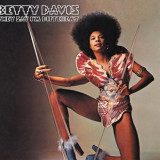
One can hardly imagine the genre-busting, culture-crossing musical magic of Outkast, Prince, Erykah Badu, Rick James, The Roots, or even the early Red Hot Chili Peppers without the influence of R&B pioneer Betty Davis. Her style of raw and revelatory punk-funk defies any notions that women can’t be visionaries in the worlds of rock and pop. In recent years, rappers from Ice Cube to Talib Kweli to Ludacris have rhymed over her intensely strong but sensual music.
There is one testimonial about Betty Davis that is universal: she was a woman ahead of her time. In our contemporary moment, this may not be as self-evident as it was thirty years ago – we live in an age that’s been profoundly changed by flamboyant flaunting of female sexuality: from Parlet to Madonna, Lil Kim to Kelis. Yet, back in 1973 when Betty Davis first showed up in her silver go-go boots, dazzling smile and towering Afro, who could you possibly have compared her to? Marva Whitney had the voice but not the independence. Labelle wouldn’t get sexy with their “Lady Marmalade” for another year while Millie Jackson wasn’t Feelin’ Bitchy until 1977. Even Tina Turner, the most obvious predecessor to Betty’s fierce style wasn’t completely out of Ike’s shadow until later in the decade.
Ms. Davis’s unique story, still sadly mostly unknown, is unlike any other in popular music. Betty wrote the song “Uptown” for the Chambers Brothers before marrying Miles Davis in the late ’60s, influencing him with psychedelic rock, and introducing him to Jimi Hendrix — personally inspiring the classic album Bitches Brew.
But her songwriting ability was way ahead of its time as well. Betty not only wrote every song she ever recorded and produced every album after her first, but the young woman penned the tunes that got The Commodores signed to Motown. The Detroit label soon came calling, pitching a Motown songwriting deal, which Betty turned down. Motown wanted to own everything. Heading to the UK, Marc Bolan of T. Rex urged the creative dynamo to start writing for herself. A common thread throughout Betty’s career would be her unbending Do-It-Yourself ethic, which made her quickly turn down anyone who didn’t fit with the vision. She would eventually say no to Eric Clapton as her album producer, seeing him as too banal.
Her 1974 sophomore album They Say I’m Different features a worthy-of-framing futuristic cover challenging David Bowie’s science fiction funk with real rocking soul-fire, kicked off with the savagely sexual “Shoo-B-Doop and Cop Him” (later sampled by Ice Cube). Her follow up is full of classic cuts like “Don’t Call Her No Tramp” and the hilarious, hard, deep funk of “He Was A Big Freak.”
Поиск:the jackson 5
Все
Known for her powerful vocals, dynamic stage presence, and diverse musical influences, LA-based soul and funk singer Nikka Costa returns from a musical career break with future-forward disco-inspired sounds on ‘Dirty Disco’.
The lyric “Everyone is welcome, everyone’s an Avatar” denotes a place where anyone can go to be themselves and let their freak flag fly! and sets the tone for her disco and soul fused, progressive album, which is recorded with and produced by Justin Stanley (Prince, Jamie Lidell, Beck etc). Along with the talents of versatile musicians such as Brandon Coleman (Kamasi Washington, Thundercat, Donald Glover, Flying Lotus), Greg Phillinganes (Michael Jackson, Stevie Wonder) and Kaveh Rastegar (John Legend, Beck), Nikka Costa invites you to immerse yourself in her “Dirty Disco” world.
“Dirty Disco is about a place anyone can go to be themselves and let their freak flag fly! It’s about a place where no one is looking, no one cares what you're doing or what you're into. It could be a disco, but it could also be another planet or headspace or vibe. It's dark and sparkly, blue and purple. Gritty, raw and sexy. Whatever you want it to be.” - Nikka Costa
"Known for her powerful vocals, dynamic stage presence, and diverse musical influences, LA-based soul and funk singer Nikka Costa returns from a musical career break with future-forward disco-inspired sounds on ‘Dirty Disco’.
The lyric “Everyone is welcome, everyone’s an Avatar” denotes a place where anyone can go to be themselves and let their freak flag fly! and sets the tone for her disco and soul fused, progressive album, which is recorded with and produced by Justin Stanley (Prince, Jamie Lidell, Beck etc). Along with the talents of versatile musicians such as Brandon Coleman (Kamasi Washington, Thundercat, Donald Glover, Flying Lotus), Greg Phillinganes (Michael Jackson, Stevie Wonder) and Kaveh Rastegar (John Legend, Beck), Nikka Costa invites you to immerse yourself in her “Dirty Disco” world.
“Dirty Disco is about a place anyone can go to be themselves and let their freak flag fly! It’s about a place where no one is looking, no one cares what you're doing or what you're into. It could be a disco, but it could also be another planet or headspace or vibe. It's dark and sparkly, blue and purple. Gritty, raw and sexy. Whatever you want it to be.” - Nikka Costa"
Probably the best Milt Jackson LP as a leader, Plenty, Plenty Soul presents him playing the blues in the company of such stars as Cannonball Adderley, Joe Newman, Jimmy Cleveland, Horace Silver, Oscar Pettiford and Art Blakey, among others. THE COMPLETE ALBUM + 1 BONUS TRACK - Contains new specially prepared liner notes by Penguin Guide to Jazz's writer BRIAN MORTON and by Paris' prestigious JAZZ MAGAZINE
d Heartstrings [With the Oscar Peterson Trio]
[d] Heartstrings [With the Oscar Peterson Trio]
THE 1968 ALBUM ON WHICH JOHNNY CASH BECAME A LEGEND: AT FOLSOM PRISON AMONG THE MOST IMPORTANT AND POTENT STATEMENTS OF THE 20TH CENTURY
Johnny Cash already knew his way around Folsom Prison when he and his band stepped inside the institution’s forbidding walls on the morning of January 13, 1968 to record At Folsom Prison. He’d played there two years prior. But this time was different.
Cash took the stage that day for two shows amid a darkening sociopolitical atmosphere and a raging war in Vietnam, as well as the knowledge his career and health hung on by a thread. The Arkansas native shared many of the long odds and abject failures of the inmates for which he performed. The songs he chose, and the conviction with which he delivered them, say as much. The point at which Cash transformed from a country star into a legendary artist, and a bold statement about the American prison state and its commitment to rehabilitation, the triple-platinum At Folsom Prison remains one the most important, potent, and fabled records of the 20th century.
You can hear it echo off the walls of the room; pulse through the itchiness of the Tennessee Three’s acoustic-based boom-chick rhythms; crackle in the announcements conveyed over the intercom; ring in the comedy of the off-cuff remarks and pair of novelty tunes; sense it in palpable energy that wells up within Cash and his audience. And you can experience it like never before via Cash’s knockout singing. The bedrock foundation of all his music, the singer’s baritone resonates with profound degrees of depth, pliability, and passion that underscore how much this appearance meant to him — and the extent he was living the narratives.
Indeed, every song on At Folsom Prison serves a purpose and speaks to the conditions — mental, emotional, physical, geographical, legal, social — the inmates confronted on a daily basis. Beginning with the explicit messages of the opening “Folsom Prison Blues,” Cash makes it clear he understands and shares many of their plights. Not for nothing did the myth of Cash having done hard time persist for decades once this record hit the streets. That’s how real it is, and how dedicated Cash remains to conveying every note with the same truth he invests in the impromptu comments he makes between and amid songs.
Listen to the sorrow, regret, pity, and loneliness of Merle Travis’ “Dark as the Dungeon,” Cash pulling syllables til they threaten to break and inhabiting the mood of bleak phrases such as “pleasures are few” and “the sun never shines.” Witness the isolation, dejection, and sadness punctuating the walking-blues “I Still Miss Someone,” matched in gravity by a solemn reading of “The Long Black Veil” — a traditional dirge that involves murder, cheating, and deception. Cash cuts even deeper on a heartbreaking solo rendition of “Send a Picture of Mother” and plainspoken version of Harlan Howard’s “The Wall,” detailing a suicide disguised as jailbreak through cliched-jaw deliveries that softly curse the impossible situation.
In chronicling temptations, mistakes, mortality, punishment, and life “inside” — for better or worse, the stories of the disenfranchised, forgotten, written-off, and unrepentant — At Folsom Prison also has a blast playing the outlaw role. Cash captures wild-eyed craziness and out-of-control mayhem on a revved-up take of “Cocaine Blues,” taking extra satisfaction in its dastardly tales by way of voice that shifts into character for the sheriff and judge. The gallows humor and racing drama of “25 Minutes to Go”; quicksilver accents and resigned acceptance of “I Got Stripes”; train-whistle blare and twangy locomotion of “Folsom Prison Blues” — all fight the law only to see the law win.
Cash remains deeply committed at every moment, and inseparably connected with the tortured souls removed from the goings-on of the outside world. No wonder all but two songs here stem from the day’s first performance that saw Cash, Luther Perkins, Marshall Grant, and company give everything. As does the Man in Black’s soon-to-be-wife, June Carter. The couple’s fiery duet on “Jackson” scorches; their combination of surrender and fortitude “Give My Love to Rose” puts us in the dying protagonist’s shoes.
And with the closing “Greystone Chapel,” famously penned by convict Glen Sherley, who watched it all happen under the watchful eye of guards, Cash separates the corporeal from the spiritual, relaying lessons about salvation and survival. Heady themes to which he’d return for the remainder of his illustrious career.
Sugar Minott schrieb nicht nur eine Fülle von Eigenkompositionen, sondern schätzte auch die jamaikanische Ska-, Rocksteady- und Reggae-Musik (die er mitentwickelte) sowie die amerikanische Soul- und Pop-Musik sehr. Er brachte nachhaltige Versionen von Michael Jacksons "Good Thing Going", The Persuaders "Love Gonna Pack Up" und Dionne Warwicks "A House Is Not A Home" in das Reggae Idiom. "One Step Ahead" fügt sich perfekt in diese Tradition ein und schlägt mühelos die Brücke zwischen amerikanischem Pop und jamaikanischem Soul.
There are few Jamaican Artists with such an impressive career as George Dekker. For his brand new studio solo album Right To Be Here George Dekker has teamed up with renowned producers Mafia and
Fluxi. The Heywood Brothers Leroy (Mafia) & Dave (Fluxy) have been producing, remixing and touring for over 35 years now and have worked with a very impressive list of artists over the years ranging from touring with James Brown, Maxi Priest to doing remixes for Janet Jackson, Sting, Gypsy Kings and more.
- A1: Blind Date
- A2: Lightning & Thunder Featuring – R. Zee Jackson
- A3: Me & Me Daughter Featuring – Tabby Diamond
- A4: Big Talk Drifter
- A5: Ghetto Girl (Medley)
- A6: St. Anne Collie Featuring – Vin Gordon
- A7: Wisdom & Knowledge
- B1: River Bank (Medley)
- B2: New Fashion Way
- B3: Ali Button (Medley) Featuring – George Dekker
- B4: This Morning Featuring – A.j. Franklin
- B5: I Don't Know What To Do (Medley) Featuring – Vin Gordon
- B6: Blood & Fire Featuring – Fern Brooke
- B7: Cool Runnings
A deeper dive into the mind of the mysterious man who gave us Niggajazz at the top of the pandemic. Although only a six song ep, the title song gained traction for its jazz bop, house appeal. The follow up, New World Order is the first full length from the artist and displays a wider scope of that exact sound. Written and produced in 2021 NWO comprises tunes for the floor as well as the ride. With lush ballad Black Apple, The Common Suicides latin flare, The Torus’ obscurity and Ota Benga with its tribute to the worlds most renown human zoo attraction, this release is complete and advanced from the introduction received prior. We are pleased to present New World Order in a time when most needed to reflect and absorb carefully. We hope you enjoy it as much as we do!
José James - the forward-looking, genre-defying Jazz singer for the hip-hop generation - has done it again. “1978” (his 12th studio album since 2008’s “The Dreamer'') announces an instant classic, combining James’ deep love of jazz and hip-hop with songwriting and production nods to R&B heroes Quincy Jones, Michael Jackson and Leon Ware. Produced by James and featuring an all-star ensemble including Grammy nominees Pedrito Martinez (Camilla Cabello, Eric Clapton), Marcus Machado (Daniel Ceasar, Pharoahe Monch), Jharis Yokley (Sleigh Bells, My Brightest Diamond) Chad Selph (Bilal, FREELANCE) and David Ginyard (Solange, Blood Orange), “1978” pulsates with the socially conscious feel-good vibes of Marvin Gaye, Prince and Stevie Wonder. James also skillfully explores the boundaries of Black music, featuring Brazilian rising star and recent Latin Grammy nominee Xênia França as well as Congolese-Belgian rapper/filmmaker Baloji.
Finally, the stand-out cuts of Rasa’s 1978 LP feature on 45 for the first time - ‘When Will The Day Come’, coupled with ‘Within The Sound’. Back in the summer of ’78, when London McDaniels and his brother Chris frequented a Krishna temple to take advantage of the weekly open feasts, the heads of the temple soon learnt the duo were Berklee College Of Music students and asked them to record an album of contemporary Hare Krishna worship songs. The result was Everything You See Is Me by Rasa, a jazz funk laced classic that’s gained notoriety amongst record collectors across genres, steered by the sons of singer-songwriter Eugene Mcdaniels. Produced and composed by guitarist London McDaniels, with Chris McDaniels on vocals and drums, and lyrics written by Hare Krishna devotee Andrew Marks, the album is coveted by beat heads, rare groove, soul, and balearic heads alike. The songs feature an A-list collective of session players including bassist Anthony Jackson and trumpeter Randy Brecker and have been a sample-source for numerous hip-hop records including Common’s ‘Take It Ez’, Black’ Rob’s Can I Live’ and BDP’s ‘Beef’.
Inspired by the Buddhist sutras, Blitzen Trapper’s radiant new album, 100's of 1000's, Millions of Billions, offers a captivating take on rebirth and transcendence, navigating its way through the space beyond dreams and reality, beyond gods and mortals, beyond life and death. The songs here are as sincere as they are surreal, rooted in rich character studies and deep reflection, and the production is intoxicating to match, blending lo-fi intimacy and trippy psychedelia into a mesmerizing swirl of analog and electronic sounds. Add it all together and you’ve got a gorgeous collection of stripped-down bedroom folk wrapped in lush layers of synthesizers and washed out electric guitars, a poignant, expansive exploration of perception and purpose that manages to look both forwards and backwards all at once. This LP is pressed on clear blue vinyl and limited to 1,000 copies worldwide. Launched roughly two decades ago in Portland, OR, Blitzen Trapper broke out internationally with 2008’s Furr, which cemented their status at the forefront of the modern indie folk revival. Rolling Stone hailed the band’s “hazy, psychedelic Americana,” while NPR praised their “explosive live performances and infectious roots-rock swagger.” Dates with Fleet Foxes, Wilco, and Dawes followed, as did festival appearances at Bonnaroo, Lollapalooza, Newport Folk, and Coachella, among others. The band would go on to release six more similarly lauded studio albums, culminating with 2020’s Holy Smokes Future Jokes, which Mojo proclaimed “sounds like the Beatles at Big Pink.”
100's of 1000's, Millions of Billions by Blitzen Trapper, released 17 May 2024, includes the following tracks: "Cosmic Backseat Education", "Cheap Fantastical Takedown", "Planetarium", "Long Game" and more.
Inspired by the Buddhist sutras, Blitzen Trapper’s radiant new album, 100's of 1000's, Millions of Billions, offers a captivating take on rebirth and transcendence, navigating its way through the space beyond dreams and reality, beyond gods and mortals, beyond life and death. The songs here are as sincere as they are surreal, rooted in rich character studies and deep reflection, and the production is intoxicating to match, blending lo-fi intimacy and trippy psychedelia into a mesmerizing swirl of analog and electronic sounds. Add it all together and you’ve got a gorgeous collection of stripped-down bedroom folk wrapped in lush layers of synthesizers and washed out electric guitars, a poignant, expansive exploration of perception and purpose that manages to look both forwards and backwards all at once. This LP is pressed on clear blue vinyl and limited to 1,000 copies worldwide. Launched roughly two decades ago in Portland, OR, Blitzen Trapper broke out internationally with 2008’s Furr, which cemented their status at the forefront of the modern indie folk revival. Rolling Stone hailed the band’s “hazy, psychedelic Americana,” while NPR praised their “explosive live performances and infectious roots-rock swagger.” Dates with Fleet Foxes, Wilco, and Dawes followed, as did festival appearances at Bonnaroo, Lollapalooza, Newport Folk, and Coachella, among others. The band would go on to release six more similarly lauded studio albums, culminating with 2020’s Holy Smokes Future Jokes, which Mojo proclaimed “sounds like the Beatles at Big Pink.”
100's of 1000's, Millions of Billions by Blitzen Trapper, released 17 May 2024, includes the following tracks: "Cosmic Backseat Education", "Cheap Fantastical Takedown", "Planetarium", "Long Game" and more.
Repress!
PRINCE PHILLIP MITCHELL has been performing, writing and producing since the early sixties and even spent a little time with Alvin Cash's backing group the Cash Registers. He wrote hits for Mel And Tim and Millie Jackson but is best known on the Northern Soul scene for his 'Shout' recording Free For All' and our chosen side, the crossover soul anthem I'm So Happy'.
LOU RAGLAND shot to fame on the Northern Soul scene with his 4-figure rarity I Travel Alone', recorded for 'Amy' Records in May 1967. It was his home town buddy, Edwin Starr, that helped Ragland secure the deal and although a flop at the time it cemented his popularity in England. When Starr came to the UK in 1983 with his Ric-Tic Revue Ragland was invited along and, at last, got the recognition he deserved.
CLUB OF PROBLEMS ist eine ganz neue Band aus Freiburg im Breisgau - die vier Typen dagegen sind längst erfahrene Hasen auf dem Gitarrenpop-Dancefloor. Jeremy James, Purple Reinhard, John Pelzer, Jackson Bollock - man kennt sie u.a. von Gringo Mayer, Prisoners Of Freedom, The Seducers, Serial Off, Neo Rodeo, Backslide, BAR, Virage Dangereux, Nicolas Sturm, Jimi Satans Schuhshop, Achtung Rakete, The Hojos, Institute Of Modern Melancholy. Außerdem: Unbedingt "Öffentliche Telefonbuchlesung" antesten.. Endlich bringen sie für ein gemeinsames Debütalbum all ihre Qualitäten zusammen: Melancholisch und schwer, dabei tanzy und mindestens so beknackt wie diese Zeit. Zwischen Pop, Folk, RnR und Punkrockbasis, zwischen Irrsinn, Unsinn und Sinnlichkeit. 11 Songs, die unsere alltägliche Gegenwart demontieren und als absurd ohrenschmeichelnde Stücke neu zusammensetzen. As big as it get"s!
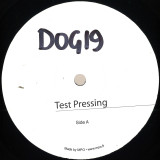
Warehouse Find! Test Pressing
Pattern Select aka Milton Jackson and Show-B have gone well and truly back to the raw on this, their first collaborative work together and debut EP for Delusions Of Grandeur. Both producers have been busy on some top quality projects just recently with Milton Jackson remixing Recloose for Planet E and Show B producing for Robert Owens on Compost. The pair met at a party in Munich, promptly fell in love, and soon enough Pattern Select was born.
Kicking off Tale Of The Tape sees the pair go deep n dark on this low-slung groove where demonic laughter rides the driving hats and insesant crashes until the filtering arpeggiated synth line joins the fun. Tale Of The Dub gives us a stripped back, dub-infused version which goes a little lighter on the craziness of the first version but without losing any of the deep, hypnotic funk.
Cottam is a producer who will need little introduction seeing as he's been getting hyped from all corners of the electronic scene following a series of untitled vinyl only EP's on his own Cottam label. Brilliant releases on Story and Use Of Weapons followed, and now we're very happy to have him bring his own unique take on house music here on this remix of Tale Of The Tape.
Finally, another original entitled Matrix drops the bpm's further for a lazy, hazy, hiphop inspired jam with deep atmospherics and simple rolling groove.
New York Blues Hall of Fame inductee Bette Smith returns with her 3rd studio album – ‘Goodthing’ – a triumphant injection of soul music and gospel into rock & roll. Produced by Grammy-winning producer Jimmy Hogarth (Amy Winehouse, James Bay, Paulo Nutini, Sia), the album showcases Bette Smith’s penchant for anthemic, feel-good Soul Rock carried by her signature raspy, soulful vocals inspired by legends Tina Turner, Aretha Franklin and Etta James.
Tracing elements of her sound to her childhood in rough Bedford-Stuyvesant, Brooklyn, Bette connects the soul music she heard on the corners with the gospel music she heard in church and around the house every weekend - “My mother listened to nothing but gospel,” she recalls, citing Mahalia Jackson and Reverend James Cleveland as other influences.
The album sees her sound scale new heights, and build on the accolades she received on 2017’s debut ‘Jetlagger’ and 2020’s ‘The Good, The Bad, and The Bette’, and her tremendous range and power combined with ‘Goodthing’’s infectious energy, solidify her position as an authentic and dynamic rising soul artist, an iconic force in music.
New York Blues Hall of Fame inductee Bette Smith returns with her 3rd studio album – ‘Goodthing’ – a triumphant injection of soul music and gospel into rock & roll. Produced by Grammy-winning producer Jimmy Hogarth (Amy Winehouse, James Bay, Paulo Nutini, Sia), the album showcases Bette Smith’s penchant for anthemic, feel-good Soul Rock carried by her signature raspy, soulful vocals inspired by legends Tina Turner, Aretha Franklin and Etta James.
Tracing elements of her sound to her childhood in rough Bedford-Stuyvesant, Brooklyn, Bette connects the soul music she heard on the corners with the gospel music she heard in church and around the house every weekend - “My mother listened to nothing but gospel,” she recalls, citing Mahalia Jackson and Reverend James Cleveland as other influences.
The album sees her sound scale new heights, and build on the accolades she received on 2017’s debut ‘Jetlagger’ and 2020’s ‘The Good, The Bad, and The Bette’, and her tremendous range and power combined with ‘Goodthing’’s infectious energy, solidify her position as an authentic and dynamic rising soul artist, an iconic force in music.
- 1: One Of The Bad Ones
- 2: Flame
- 3: My Whole Life Is In The Wrong Key
- 4: We Are The Power
- 5: Black Widow
- 6: Touch
- 7: Dame De La Lumiere
- 8: Let Me Be Your Mother
- 9: You Got It Kid
- 10: Runaway Train
- 11: Downtown Boogie
- 12: More Than Love
'Letters From A Black Widow' ist ein definitives Statement der Beharrlichkeit und Befreiung der mit einem Grammy ausgezeichneten Sängerin/Songwriterin Judith Hill. Die 12 Songs offenbaren meisterhaft Themen, die sie bisher nur in Therapien und Albträumen erforscht hat. Geschichten über Widerstand, hart erkämpfte Klarheit und Erlösung werden durch ein unerschütterliches Soul/Funk/Blues-Fundament erzählt, das von trotzig-schöner Kraft mitschwingt. Als Backgroundsängerin für Michael Jackson, Stevie Wonder & Prince brillierte Hill in der mehrfach prämierten Netflix-Dokumentation '20 Feet From Stardom' (2013) über die Sänger*innen hinter den Stars.
- A1: Magic Momentum
- A2: Rockets To Mars
- A3: The News These Days
- A4: Life (Skit)
- A5: Love Vibration
- B1: Original Flow
- B2: Hold On
- B3: Surviver (Skit)
- B4: Tatamaka Pt.1
- B5: Tatamaka Pt.2
- C1: Time (Skit)
- C2: Time
- C3: Jinja (Skit)
- C4: Kochirakoso
- C5: Our Tactus
- C6: Nah Personal
- D1: No Chains
- D2: Push Comes To Shove
- D3: We No Let Y'all In
- D4: Mexico (Skit)
- D5: Future For Our Children
We Release JAZZ is very happy to announce an exciting new body of work by Joseph Deenmamode aka Mo Kolours. The singular musical spirit’s new 21-track album Original Flow is available as a double LP housed in a heavy 350gsm sleeve with original artwork by Mo Kolours himself and the classic WRJ obi strip, as well as in digipack CD and digital formats.
A catalog of critically acclaimed records, including his self-titled debut (2014), ‘Texture Like Like Sun’ (2015), 2018 album ‘Inner Symbols’ and three companion EPs, established Deenmamode as a prodigious musician and vocalist. Pitchfork extolled his “hypnotic, tribal-infused dance grooves”, DJ Mag appreciated the “colourful celebration of soundsystem culture”, and Resident Advisor advocated that “no one sounds quite like Mo Kolours”. Musical analogies were drawn by The Guardian as “The best album Curtis Mayfield never made with A Tribe Called Quest and Lee Perry” and Mojo as “like Marvin Gaye produced by J Dilla”.
Five years ago, Deenmamode moved to the Japanese countryside. Far away from familiarity, he contemplated his place and further questioned his identity. “I had none of my ‘own’ people around. I had time to really find what makes me tick musically. Japan has helped me go back to those subconscious leanings, really go deep, and reflect the aspects that make up my story”.
The tracks on ‘Original Flow’ have been constructed from sessions, improvisations and soundbites captured around the world during this time; collecting contributions from musicians including Deenamode’s brothers Reginald Omas Mamode and Jeen Bassa plus Andrew Ashong, Charles Bullen, Dwaye Kilvington, Eddie Hick, Stefan Asanovic, Myele Manzanza, Ross Hughes, and Tom Dreissler. Deenamode says “I’m proud of this album’s creative process. Coming from a tradition of scouring through hours of records, I wanted to create my own samples, to find that perfect loop that no other producer could put their hands on. I decided to invite a group of friends and acquaintances, who also happen to be incredible musicians, to a studio in Crystal Palace to improvise based on some loose ideas I had. We spent all day, and recorded everything”.
‘Original Flow’ is an album of UK street-soul nouveau, future indigenous jazz fusion, Rasta Segga, Nyahbinghi jazz, Malagasy Hebrew hip hop. While retaining a spirit of exploration and improvisation, it sees Deenmamode grow and flex beyond beat tape brevity, expanding composition and stretching his musical muscle to play live with other musicians. Themes of empowerment, overcoming adversity, and mental liberation coexist with notes from ancient history, futurism, and science, as well as musings on family and togetherness.
‘Magik Momentum’ springs from a discussion that features at the start of the song, an inspiring mentor answering a question from Deenmamode about improvisation and what role it plays in life when planning and manifesting the future. ‘Rockets to Mars’ questions the lack of care for the billions of people with nothing, while governments plan to explore space. “This sparked a comparison in my mind to a Sonny Okuson song that I would reference when performing. Okuson’s song talked of the lack of resources in many communities in the world, while governments go to the moon”.
He says the music behind ‘The News These Days’ is “possibly my favourite on the album”. Looped like he would a late sixty jazz-fusion sample, there was nothing added and the track was complete within a matter of minutes. “It was the first and best moment from the entire Crystal Palace session”, he adds. The album’s contrasting title track with minimal instrumentation played solo by Deenamode. While frustratingly searching for gems in past recordings, he thought in a burst of ego, “I don’t need no-one else to make a dope beat!” picked up his ravanne, (the traditional frame drum of his fathers home-land of Mauritius), pressed record, and started to play. He says, “In my thoughts were the rhythms of the Nubians in Upper-Egypt and Sudan, the swing of the huge drums played by Mauritanian women, of-course the Sega beat of Mauritius, and the ever inspiring beat of James Yancey”.
Driven by UK broken beat, Cuban congas, Nigerian and Mauritian inflections, ‘Love Vibration’ follows the concept that all emotions carry a vibratory frequency and pays homage to the frequency of creation and the power of love. The two part ‘Tatamaka’ tells of the history of Deenmamode’s ancestors, the maroons of Mauritius. “We are people who managed to run from our oppressors and find refuge in a corner of the island called ‘Le Morne’ where they could not reach us. One bloody day they came in numbers to re-capture, to revenge. Many of us chose to jump to our deaths, rather than be taken back into subjugation. The poem by Creole Richard Sedley Assonne says; “there were hundreds of them, but my people, the maroons chose the kiss of death over the chains of slavery”. Tatamaka was the name of a famed maroon leader who was murdered for claiming his, and our people’s freedom. The song is the imagined journey of escape and freedom by an ancestor of the maroons of Le Morne”.
Born in the west midlands and raised on the traditional sega music of his father’s Indian Ocean homeland of Mauritius alongside records by the likes of Jimi Hendrix, Santana and Michael Jackson; his influences expanded with late 90s jungle and drum and bass nights in Bristol, experiments at art college in Camberwell, and the rich culture of Peckham, “at the time we called it the Afro Quarters of London” says Deenmamode, adding hip hop, dub, soul and soundsystem styles to his individual sound.
He explains, “I love drum music, from hand-drums to 808s. I love music from the ancient past, heritage music, indigenous music, traditional music passed down from the beginning of time. Music from the body, hand claps, grunts and foot stomps. Music with audible depth, busy, bustling, highly charged. Music from the soul, the music from beyond. I love music from the islands and the mountains. The music of the streets, hustle music, alleyway beats. Club music”.
He describes the creative process as thinking in images. “The visual world and the world of sound seem to intermingle in my thought process. When I play the drum with my eyes closed, a world of imagery dances and moves with beat. Improvised drumming feels like I am listening to what I want to hear, rather than trying to play what I want to hear. Following the rhythm and finding new pathways to walk within the patterns is what I experience. In this way I often feel I am just a listener, instead of the player”.
Original Flow is pressed on biovinyl, a sustainable alternative to traditional vinyl. Biovinyl replaces petroleum in S-PVC by recycling used cooking oil or industrial waste gases, resulting in 100% CO2 savings in bio-based S-PVC production. Furthermore, it is 100% recyclable and reusable, embracing the circular economy ideology.