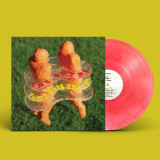
In his youth days, Gontran lived on the road. He describes himself as a member of the alternative hippie generation, not of those who claimed wanted to change the world, but of those who actually took an alternate way of living. He travelled, took any jobs available to make some money to live wherever he was, and wrote beautiful songs accompaining himself on guitar. From time to time, when the stars aligned, when there was the chance, he would rent some studio time and lay down his compositions, always in a pretty bare way with little arrangements added on the spot, mostly by musicians who happened to be there and who improvised their parts - one take, we have it. With this procedure he released Funambule in 1975 and L'envol in 1977. He also worked with Dominique Le Roux on a joint venture LP in 1979.
On offer here is the first ever vinyl reissue of Gontran's second album L'envol, recorded in two hours on a Paris studio with a bass player (F.D. Aldonse) and two female vocalists whose surnames have been lost in the depths of time - Victorine and Theodorine. As the other Gontran albums, it was self released in a limited run private pressing which has nowadays become an elusive piece in the collectors market - so rare that it doesn't even appear on Phileas Folk's great The French Folk Magic Time Guide book.
The beautiful music contained within is a delightful sample of Gontran's excellent singer-songwriter qualities and his commitment to portray his inner world and livings through his musicated poems. He names as his biggest influences big names like Leonard Cohen, who he had the chance to meet and chat with when in Mumbai back in 1999, Bob Dylan or Jack Kerouak, but Gontran was centered in his vivences and commited to his need to express himself that he really doesn't sound like anyone but Gontran.
Amazing homemade folk sounds from an artist who, ironically, was always traveling abroad and stayed little at home!
A very rare private pressing, recently featured in Hans Pokora's last Record Collector Dreams book, valuing an original copy with 4 stars!
Search:the living
• Co-writer Charles Spurling sang and wrote at King in the late 60s, providing songs for James Brown, Hank Ballard, Junior McCants and Peggy & Artie among others. ‘Ball Of Fire’ is an exceptional song, first recorded by Connie Austin as a smouldering mid-tempo number on which she pours her heart out. It would be updated a year later by Marva Whitney who took it at a faster funkier pace. Charles Spurling remembers Connie as a good-looking, fast-living girl who was murdered in Los Angeles soon after.
• Spurling was a good singer himself and had five King releases between 1967 and 1969. The excellent ‘You’ve Got Love On Top Of Love’ failed to make it to wax until now. Kent found the tape in the King vaults and issued it on CD in 2001; now it is on a righteous single.
- A1: The Faint Whimper Of A Desperate Man
- A2: The Faint Whimper Of A Desperate Man (Tim Reaper Remix)
- A3: Life Will Keep Coming Wave After Wave If You Let It
- B1: Vapour Trails Were Callous Scars On Cut Across An Otherwise Perfect Sky
- B2: Vapour Trails Were Callous Scars On Cut Across An Otherwise Perfect Sky (Response & Pliskin Remix)
Thugwidow AKA Alex Lowther-Harris is a Jungle producer currently living in North Wales. Productions range from Hardcore rave tracks to more Ambient Tecky Jungle.
Thugwidow makes his Bukva debut with "An Otherwise Perfect Sky EP", these tracks and remixes represent the culmination of years of work, in honing his sound, working on production and grinding away. This record is a typical Thugwidow sound, the kind of tunes he loves making and listening to. With remixes from some of Thugwidows favourite artists Tim Reaper, Response & Pliskin. This record should be perfect for late nights, early mornings and perhaps the more chilled out moments when there's too much going on in your head.
Local Action is proud to present Cyclorama, the long-awaited debut album by Ariel Zetina.
A resident DJ at Chicago’s iconic Smartbar, a long-standing Discwoman family member and a key part of the city’s dance music and LGBTQ+ communities, Ariel has established herself as one of the most exciting electronic artists operating today - through releases such as 2020’s acclaimed MUAs at the End of the World and 2017’s Organism, and her meticulous approach to DJ mixes - as recently evidenced on Sestina, her 2020 contribution to Mixtape Club.
Written across 2021 and honed this Spring, Cyclorama is Ariel’s most impressive and all-encompassing work yet, showcasing her as a producer, vocalist and also curator, pulling together an ensemble cast of her peers in Chicago (Cae Monāe, Mia Arevalo, DANNN) and some of the most exciting names in contemporary club music (Violet, Bored Lord).
Conceptually, Cyclorama draws heavily from Ariel’s background as a theater writer and producer. Popularized in 19th century German theater, a cyclorama (or cyc) is a large curtain, placed on the back wall of the stage. This creates an illusion of extra depth in the background, and often is used to represent the sky. In Ariel’s words, “I imagine all the tracks on this as the lights and action projected onto the cyclorama. The whole album is like the cyc, a representation of the sky. Or an imagined sky. An imagined dancefloor. An imagined theatrical production.”
As well as drawing conceptually from Ariel’s background in theater, the album draws on a personal level from Ariel’s journey as a trans woman of color - most directly on Cyclorama’s three vocal tracks, ‘Gemstone’, ‘Slab of Meat’ and lead single ‘Have You Ever’.
On ‘Have You Ever’, Ariel collaborates with Cae Monāe, a dear friend and fellow trans woman of color. “‘Have you ever been with a girl like me before?’ and all the lyrics refers to the fear and anxiety that cis men who are attracted to trans women feel, and also any woman that doesn’t fit the mold of a stereotypical woman”, Ariel explains. “Cae and I - and many trans women - have been in so many situations where society tells cis men they cannot be with trans women and this explores that and gives power to all trans women in this situation. The techno reflects that, as well as the “Spell my name” section at the end, showing the true power of trans women.”
On ‘Slab of Meat’, Ariel delivers a hypnotic solo vocal performance that builds in intensity with each line (“I am treated like a slab of meat both emotionally and sexually sometimes, especially one left in the freezer on the back burner. Why did you bring this meat home from the market? For what? You’re wasting meat!”), while ‘Gemstone’, a collaboration with Mia Arevalo, continues the empowering themes of ‘Have You Ever’ in a different context:
“‘Gemstone’ is a call for trans women to take time with your transition because it will all happen eventually. As two girls who have started our transition almost a decade ago, I think we have both seen that we have always needed to take our time to take our time. Reminders not to rush or compare yourself to other girls. I love the metaphor of gemstone months representing different periods of transition. I’ve been so many different women in recent years, and I'm excited to continue my journey.”
It’s immediately followed by album closer ‘Tropical Depression’, the title of which is a reference to Ariel growing up with tropical depressions, storms and hurricanes affecting her hometown of Jacksonville, Florida as well as her family in Belize City:
“This track for me is about living day to day and continuing while dealing with my really intense clinical depression. The sample comes from “Why can’t you let me go?” but is supposed to be transformative and not necessarily legible. How we hold on to our trauma and depression like a protective shell. This is an attempt to deal with it in a different way.”
The Cyclorama album cover, directed by Dylan Bragassa, stars Ariel alongside Monāe and Arevalo in an imagined theater production. In Ariel’s words, “a theoretical performance starring only trans women of color - I wanted an ensemble shot to represent the ensemble nature of this album! Love how Dylan combines so many ideas to create a very unique image that asks so many questions.”
Sublime Frequencies is honored to release the third LP from Baba Commandant and the Mandingo Band. Sonbonbela was recorded in the beginning of 2022 in the Republic of Burkina Faso. The group continue to hone their trademark fusion of Mandingue and afro-beat styles. The Mandingo Band are a hit machine, sculpting seven new tracks of near Beefheart/Magic Band dynamics, Fela inspired groovers dusted out in the Sahel zone, rather than the humidity and sweat of Lagos, creating one of the most original and propulsive musical statements to come from the contemporary West African cultural juggernaut. As with previous releases, the band features the legendary guitar pyrotechnics of Issouf Diabate, truly one of the greatest West African (or Earth for that matter) guitarists of the last forty years. The band is completed by a near bottomless barrel of artistry from the Ouagadougou and Bobo Dioulasso musical talent pool. On bass guitar, Wendeyida Ouedraogo, on drums Abbas Kabore, and on percussion and balafon, Nickie Dembele. Leading the charge again is the captain himself, Mamadou Sanou on the Doso Ngoni featuring one of the most distinctive voices of the modern era. The opposite of the banal trends of auto-tune that have pervaded most of West African popular music, Baba’s voice still impresses with its gravel and grit, showcasing a range that is ancient and defiant in equal measure. This LP is a non-stop hit parade of afro-beat bangers destined to light dance floors and living rooms ablaze!!! This album is dedicated to the memory of Massimbo Taragna, the bass player extraordinaire who was an integral part of the Mandingo Band’s trance stun musical power. He passed away in early 2022. RIP TRACKLIST: Side A: CHASSER LES SACHETS, KAMELEBA, AFRO MANDINGO, SEMAYALA Sida B: SEREJUGU, SONBANBELA, WARIKO
‘Change’ is the brand-new album by Anika, the first solo music from theBerlin based artist in 8 years.
A British ex-pat and former political journalist, Anika has collaborated withBEAK>and Tricky and released two albums with Mexico City’s Exploded.
View to great acclaim. The single ‘Change’ tackles personal growth as well as wider issues and grapples with eternal questions as to whether one can ever truly change.
It has been 11 years since the release of her last solo album, 2010 cultfavourite ‘Anika’; she suddenly found herself with a lot to say. “This album had been planned for a little while and the circumstances of its inception were quite different to what had been expected. This coloured the album quite significantly. The lyrics were all written there on the spot. It’s a vomit of emotions, anxieties, empowerment and of thoughts like - How can this go on? How can we go on?”
The intimacy of its creation and a palpable sense of global anxiety are
seemingly baked into the DNA of Change. Spread across nine tracks, the central feeling of the record is one of heightened frustration buoyed by guarded optimism. The songs offer skittering, austere electronic backdrops reminiscent of classic Broadcast records or ‘High Scores’-era Boards of Canada, playing them against Anika’s remarkable voice - Nico-esque, beautifully plaintive and - in regards to the record’s subject matter - totally resolute. Incantatory tracks like ‘Naysayer’ and ‘Never Coming Back’ are both a call to arms and a warning. “‘Never Coming Back’ was written after reading Rachel Carson’s ‘Silent Spring’,” she explains. “I was living in the old East countryside outside of Berlin, where there seemed to be no shortage of birds. Apparently their numbers have dropped significantly, but it is one of these changes that we never really stop and notice. We take things for granted, until it’s too late. With all this other noise
going on, care for the environment has quickly been moved to the backburner. So long as we get what we want NOW and on demand, who cares about whether we are taking care of the future?”
Unreleased before music by Otto Sidharta, pioneer of Indonesian electronic music. Inspired by Indonesia's multifarious styles of traditional music, that he tries to preserve, the four pieces on Kajang express a contemplation of the self.
Otto Sidharta loves to travel, everywhere within Indonesia, in order to collect almost any environmental tones and harmonies he can gather, as an endless source of composition. He is also deeply inspired by Indonesia's multifarious styles of traditional music, that he tries to preserve, as in some remote places, they keep their own tradition very strongly.
What really interests Sidharta is musicians not interacting with other kinds of music, as in those deep villages, where one might find sounds that feel like very "natural". It results in works expressing Sidharta's personal impression from their music: "I just use my own feeling, with no calculation", not using the tribals motif or style.
Kajang is the name of a tribal people living in the south of Sulawesi, a giant island in eastern Indonesia, a closed community, that Sidharta visited twice: "They cut off their communication with the outside world. They live in a very traditional way and try to avoid any new development in culture that might impact their way of life."
Sidharta's previous album collected early pieces under the title Indonesian Electronic Music 1979-92, released on Sub Rosa in 2017. Kajang gathers a quartet of compositions from 2015 to 2020.
Otto Sidharta is born in Bandung, Indonesia November 6, 1955. In the late 1970' he studied first in Jakarta, under guidance of Slamet Abdul Sjukur, later at the Sweelinck Conservatorium in Holland. In 2015 he accomplished his doctoral study at Institute Seni Indonesia Surakarta and finished in 2016. For years he felt isolated as a composer, not only because of living in Indonesia, but because the nature of his music lay outside the mainstream of electronic composition. Until 2019 he taught for many years in the music departments of several Indonesian universities. He also managed an Indonesian symphony orchestra for five years, a job that included setting up a tour of Japan.
- A1: Ringa Ringa (The Old Pandemic Folk Song) (Feat. The Mediaeval Baebes)
- A2: Day One (Feat. Dina Ipavic)
- A3: Are You Alive? (Feat. Penelope Isles)
- B1: You Are The Frequency (Feat. The Little Pest)
- B2: The New Abnormal
- C1: Home (Feat. Anna B Savage)
- C2: Dirty Rat
- C3: Requiem For The Pre-Apocalypse
- D1: What A Surprise (Feat. The Little Pest)
- D2: Moon Princess (Feat. Coppe)
White Vinyl[33,24 €]
DOUBLE BLACK LP : 2 x 140 G Black Vinyl , Sleeve & 2 x Heavy Weight Printed Inner with UV Gloss Finish
Legendary electronic music duo Orbital return Early 2023 with new album “Optical Delusion”, the Hartnoll brothers first studio album since 2018’s Monster’s Exist. Recorded in Orbital’s Brighton studio, “Optical Delusion” includes contributions from Sleaford Mods, Penelope Isles, Anna B Savage, The Little Pest, Dina Ipavic, Coppe, and perhaps most surprisingly, The Medieval Baebes.
Earlier this year, Orbital celebrated their storied history with “30 Something” which, unlike other Best Of’s, contains reworks, remakes, remixes and re-imaginings of landmark Orbital tracks including “Chime”, “Belfast”, “Halcyon”, “Satan”, and “The Box”
SHORT BIOG:
“A human being experiences himself, his thoughts and feelings as something separate from the rest of humanity – a kind of optical delusion of his consciousness. This delusion is a kind of prison for us, restricting us to our personal desires and to affection for a few persons nearest to us. Our task must be to free ourselves from this prison…”
You many have seen this quote attributed to Albert Einstein on social media, the archetypal Smartest Guy Ever apparently having an out-of-character religious epiphany. It certainly leapt out at Paul Hartnoll of Orbital who spotted it in Michael Pollan’s 2018 book How to Change Your Mind: What the New Science of Psychedelics Teaches Us About Consciousness, Dying, Addiction, Depression and Transcendence.
“As soon as I saw ‘optical delusion’ I thought Oh hey, that’s the album title,” says Paul. “It just seemed to say so much about how people construct their own realities, how we see patterns that aren’t there, how we see what we want to see.
“But it’s actually a misquote. He never quite said that. In the German original what he’s really saying is that human experience is as relative as physics. Wouldn’t it be good if we could accept that, and find a kind of universal theory of everything for the human race? Then you look at everything from history to art to your Twitter feed and you think yeah, that’s what we’re all trying to do all of the time…”
Hence ‘Optical Delusion’, the tenth original Orbital album and the latest in a burst of renewed post-pandemic creativity for two brothers who’ve stayed at the top of their game longer than anyone from the post-1988 Class of Acid House.
Now with ‘Optical Delusion’ the Hartnolls dig deeper into the unquiet psyche of our increasingly surreal and disordered world. Sketched out partly during lockdown but fully recorded in the uncertain After Times, the album summons up conflicting emotions and sometimes beguiling images from years when the science fiction doomsdays that the Hartnolls watched on TV as kids finally came true. There are mesmeric tracks with names like ‘The New Abnormal’ and ‘Requiem For The Pre-Apocalypse’ and ‘Day One’. But there are also straight-up bangers and ethereal cosmic dreams, abstract sound wars and deeply human songs of separation and loss.
And it all starts with a bang. Lead single ‘Dirty Rat’, an outright Fall-meets-Front-242 class rant with vocals by Sleaford Mods mob orator Jason Williamson, harks right back to the Hartnolls’ days of politicised anarcho-squatpunk. It began as a remix swap (Orbital did the Sleafords’ ‘I Don’t Rate You’) and morphed into a comic, brutal, bass-driven harangue not so much against our rulers but at the petty, mean-spirited, frightened, Mail-reading voters who put them there: the people who are “blaming everyone in hospital/blaming everyone at the bottom of the English Channel/blaming everyone who doesn’t look like a fried animal.”
Also key to the album is opening track ‘Ringa Ringa (The Old Pandemic Folk Song)’ which returns to an Orbital truism, that time always becomes a loop. This chugging, cyclical Orbital groove gives way to an unnerving past-meets-present timeslip fit for ‘Sapphire And Steel’ as goth maenads The Mediaeval Baebes materialise to sing ‘Ring O’Roses’ – the innocent nursery rhyme whose roots are in the Black Death.
“I’ve always liked folk music and mediaeval sounds,” says Paul, himself an occasional Morris dancer. “I had the basis of that track and I wanted to spin it off somehow.” Trawling his archives he stumbled on The Mediaeval Baebes’ version of ‘Ring O’Roses’ “and my hackles just went up. I was like, my God, this is the original pandemic folk song.”
?his being Orbital, there are collaborations galore on the album, the roles once played by Alison Goldfrapp, Lady Leshurr or David Gray now filled by new talents. London singer-songwriter Anna B Savage contributes a compellingly fragile, Anohni-like vocal to ‘Home’, in which nature reclaims the scorched and vacant mega-cities. ‘Day One’ is a pulsing techno track featuring the singer Dina Ipavic. Paul got in touch with her after working on a score for a sculpture show of giant robotic installations by his friend Giles Walker during the pandemic. First Paul cut up his own score and Ipavic’s vocals on the track The Crane, which appears on the deluxe version of the album. Then he thought, Why not work with her for real? The result is school of ‘Belfast’, a bassy dreamscape with vocalised clouds billowing above.
The pensive ‘Are You ?live?’ adds to the Orbital product range of existential questions (‘Are We Here?’, ‘Where Is It Going?’) in collaboration Bella Union signings Penelope Isles, AKA brother and sister act Lily and Jack Wolter. “They’re our studio mates, they work upstairs!” says Paul happily. “And they’ve both got amazing voices.”
But Orbital are Orbital and never far from the dancefloor. “Eventually the more abrasive bits came back into the fold…” ‘You Are The Frequency’, first of two tracks to feature mysterious vocalist The Little Pest, surrounds the listener with warped voices ordering you to the dancefloor (Phil: “we wanted the idea that the music is kind of absorbing you”). And the second, the sinister ‘What A Surprise’, traps you in a paranoid electronic hall of mirrors.
In another nod to Orbital’s resurgent past the cover artwork once again comes from fine art painter John Greenwood, creator of fantastical grotesques for the covers of ‘Snivilisation’, ‘In Sides’ and Orbital’s most recent album, 2018’s ‘Monsters Exist’. Orbital had just had a slick Mark Farrow cover for ‘30 Something’ – this is a return to the overripe and bulbous techno-organic constructions that somehow express Orbital’s own uncontrollably fertile sound.
There are gaps in the future that Orbital are desperate to fill too; there will be tours and festivals and rooms and fields full of people. Those long paralysed months when we had little to look forward to but a Zoom DJ set made Paul and Phil appreciate the things that make life worth living.
- A1: Ringa Ringa (The Old Pandemic Folk Song) (Feat. The Mediaeval Baebes)
- A2: Day One (Feat. Dina Ipavic)
- A3: Are You Alive? (Feat. Penelope Isles)
- B1: You Are The Frequency (Feat. The Little Pest)
- B2: The New Abnormal
- C1: Home (Feat. Anna B Savage)
- C2: Dirty Rat
- C3: Requiem For The Pre-Apocalypse
- D1: What A Surprise (Feat. The Little Pest)
- D2: Moon Princess (Feat. Coppe)
Black Vinyl[31,05 €]
2 x Solid White LP, 5mm spine Sleeve UV Gloss Finish, 2x Heavy Weight Printed Inner Sleeve UV Gloss finish, marketing sticker.
Legendary electronic music duo Orbital return Early 2023 with new album “Optical Delusion”, the Hartnoll brothers first studio album since 2018’s Monster’s Exist. Recorded in Orbital’s Brighton studio, “Optical Delusion” includes contributions from Sleaford Mods, Penelope Isles, Anna B Savage, The Little Pest, Dina Ipavic, Coppe, and perhaps most surprisingly, The Medieval Baebes.
Earlier this year, Orbital celebrated their storied history with “30 Something” which, unlike other Best Of’s, contains reworks, remakes, remixes and re-imaginings of landmark Orbital tracks including “Chime”, “Belfast”, “Halcyon”, “Satan”, and “The Box”
SHORT BIOG:
“A human being experiences himself, his thoughts and feelings as something separate from the rest of humanity – a kind of optical delusion of his consciousness. This delusion is a kind of prison for us, restricting us to our personal desires and to affection for a few persons nearest to us. Our task must be to free ourselves from this prison…”
You many have seen this quote attributed to Albert Einstein on social media, the archetypal Smartest Guy Ever apparently having an out-of-character religious epiphany. It certainly leapt out at Paul Hartnoll of Orbital who spotted it in Michael Pollan’s 2018 book How to Change Your Mind: What the New Science of Psychedelics Teaches Us About Consciousness, Dying, Addiction, Depression and Transcendence.
“As soon as I saw ‘optical delusion’ I thought Oh hey, that’s the album title,” says Paul. “It just seemed to say so much about how people construct their own realities, how we see patterns that aren’t there, how we see what we want to see.
“But it’s actually a misquote. He never quite said that. In the German original what he’s really saying is that human experience is as relative as physics. Wouldn’t it be good if we could accept that, and find a kind of universal theory of everything for the human race? Then you look at everything from history to art to your Twitter feed and you think yeah, that’s what we’re all trying to do all of the time…”
Hence ‘Optical Delusion’, the tenth original Orbital album and the latest in a burst of renewed post-pandemic creativity for two brothers who’ve stayed at the top of their game longer than anyone from the post-1988 Class of Acid House.
Now with ‘Optical Delusion’ the Hartnolls dig deeper into the unquiet psyche of our increasingly surreal and disordered world. Sketched out partly during lockdown but fully recorded in the uncertain After Times, the album summons up conflicting emotions and sometimes beguiling images from years when the science fiction doomsdays that the Hartnolls watched on TV as kids finally came true. There are mesmeric tracks with names like ‘The New Abnormal’ and ‘Requiem For The Pre-Apocalypse’ and ‘Day One’. But there are also straight-up bangers and ethereal cosmic dreams, abstract sound wars and deeply human songs of separation and loss.
And it all starts with a bang. Lead single ‘Dirty Rat’, an outright Fall-meets-Front-242 class rant with vocals by Sleaford Mods mob orator Jason Williamson, harks right back to the Hartnolls’ days of politicised anarcho-squatpunk. It began as a remix swap (Orbital did the Sleafords’ ‘I Don’t Rate You’) and morphed into a comic, brutal, bass-driven harangue not so much against our rulers but at the petty, mean-spirited, frightened, Mail-reading voters who put them there: the people who are “blaming everyone in hospital/blaming everyone at the bottom of the English Channel/blaming everyone who doesn’t look like a fried animal.”
Also key to the album is opening track ‘Ringa Ringa (The Old Pandemic Folk Song)’ which returns to an Orbital truism, that time always becomes a loop. This chugging, cyclical Orbital groove gives way to an unnerving past-meets-present timeslip fit for ‘Sapphire And Steel’ as goth maenads The Mediaeval Baebes materialise to sing ‘Ring O’Roses’ – the innocent nursery rhyme whose roots are in the Black Death.
“I’ve always liked folk music and mediaeval sounds,” says Paul, himself an occasional Morris dancer. “I had the basis of that track and I wanted to spin it off somehow.” Trawling his archives he stumbled on The Mediaeval Baebes’ version of ‘Ring O’Roses’ “and my hackles just went up. I was like, my God, this is the original pandemic folk song.”
?his being Orbital, there are collaborations galore on the album, the roles once played by Alison Goldfrapp, Lady Leshurr or David Gray now filled by new talents. London singer-songwriter Anna B Savage contributes a compellingly fragile, Anohni-like vocal to ‘Home’, in which nature reclaims the scorched and vacant mega-cities. ‘Day One’ is a pulsing techno track featuring the singer Dina Ipavic. Paul got in touch with her after working on a score for a sculpture show of giant robotic installations by his friend Giles Walker during the pandemic. First Paul cut up his own score and Ipavic’s vocals on the track The Crane, which appears on the deluxe version of the album. Then he thought, Why not work with her for real? The result is school of ‘Belfast’, a bassy dreamscape with vocalised clouds billowing above.
The pensive ‘Are You ?live?’ adds to the Orbital product range of existential questions (‘Are We Here?’, ‘Where Is It Going?’) in collaboration Bella Union signings Penelope Isles, AKA brother and sister act Lily and Jack Wolter. “They’re our studio mates, they work upstairs!” says Paul happily. “And they’ve both got amazing voices.”
But Orbital are Orbital and never far from the dancefloor. “Eventually the more abrasive bits came back into the fold…” ‘You Are The Frequency’, first of two tracks to feature mysterious vocalist The Little Pest, surrounds the listener with warped voices ordering you to the dancefloor (Phil: “we wanted the idea that the music is kind of absorbing you”). And the second, the sinister ‘What A Surprise’, traps you in a paranoid electronic hall of mirrors.
In another nod to Orbital’s resurgent past the cover artwork once again comes from fine art painter John Greenwood, creator of fantastical grotesques for the covers of ‘Snivilisation’, ‘In Sides’ and Orbital’s most recent album, 2018’s ‘Monsters Exist’. Orbital had just had a slick Mark Farrow cover for ‘30 Something’ – this is a return to the overripe and bulbous techno-organic constructions that somehow express Orbital’s own uncontrollably fertile sound.
There are gaps in the future that Orbital are desperate to fill too; there will be tours and festivals and rooms and fields full of people. Those long paralysed months when we had little to look forward to but a Zoom DJ set made Paul and Phil appreciate the things that make life worth living.
2023 REPRESS in Ltd Transparent Vinyl
Strut are proud to announce the first ever internationally released new studio album by one of the all-time legends of Nigerian music, Orlando Julius, in a mouth-watering new collaboration with London super-group The Heliocentrics. At his club residency in Ibadan, Orlando Julius was one of the very first to begin fusing US R&B with traditional highlife during the mid-'60s with his Modern Aces band. His 'Super Afro Soul' album from '66 set the blueprint for a whole generation of Afrobeat and Afro funk stars and, in an illustrious career, Julius met and played with Louis Armstrong, The Crusaders, Hugh Masekela and Lamont Dozier among others, famously co-composing the classic 'Going Back To My Roots' in 1979 whilst based in the USA.
or 'Jaiyede Afro', Julius takes us back to his own roots, revisiting several compositions from h s early years whi ch have never previ ousl y been recorded. The title track recal l s his experiences as a boy: 'my mother would go to group meetings with other women. They would sing together and play drums, I would play along with them and we would sing this song together.' Infectious chant 'Omo Oba Blues' is a traditional song sung at Julius' school which he re-arranged in 1965 for his Modern Aces band. The epic Afrobeat jam 'Be Counted' stems from his years in the USA: 'this was written around 1976 while I was living on the West coast. I did start recording it for the 'Sisi Sade' album around 1985 but it was never finished.'
Other tracks include 'Buje Buje' and 'Aseni', both re-worked arrangements from his rare 'Orlando Julius and The Afro Sounders' album from 1973.
Recorded at the Heliocentrics' fully analogue HQ in North London, the band follow their memorable collaborations with Mulatu Astatke and Lloyd Miller by taking Orlando's sound into new, progressive directions, retaining the raw grit of his early work and adding psychedelic touches and adventurous new arrangements. They also contribute live favourite, the James Brown cover 'In The Middle' and a series of memorable shorter interludes.
Tricky is back. Back with a new studio album, False Idols, and his own label (also bearing the False Idols name), but also back in a personal sense. I was lost for ages, he says. I was trying to prove something to people, trying to do something to please other people and also myself at the same time, which is never going to work. To be honest with you, Ive been floating around since Chris Blackwell and Island. My last two albums, I thought they were good, but I realise now they werent. This album is about me finding myself again.
It opens with a cover of a Van Morrison song, Somebodys Sins, which sees Tricky and vocalist Francesca Belmonte whispering Jesus died for somebodys sins, but not mine over a sparse groaning bass. The lead single Parenthesis, which features a vocals from Peter Silberman of The Antlers, has more rhythmic grunt, which gives a different dimension to the dark gothic atmosphere that pervades the record. No-one does this kind of thing better.
The resemblance to Maxinquaye is undeniable, though the material on False Idols is gentler; more mature. Many of the songs feature artists signed to Trickys new label, including 24-year Londoner Francesca Belmonte and Fifi Rong. The album also includes collaborations with Nigeria's new global star Nneka, the afore-mentioned Peter Silberman. In the months before the albums release, False Idols will also release an EP "Matter of Time" showcasing the labels roster on new non-album material produced by Tricky.
Why the name False Idols Because theres so much bollocks going on at the moment mate, Tricky fires back. People follow celebrities and read every little thing they do. Its living vicariously through someone else. Get your own life. All this stuff is false idols. In this new album Ill stand behind every track, Tricky says. I dont care whether people like it. Im doing what I want to do, which is what I did with my first record. Thats what made me who I was in the beginning. If people dont like it, it dont matter to me because Im back where I was.
In the midst of a wave of hybridizing ambient, drone, folklore and experimental electroacoustic music, Roxane Métayer has gained a cult following with only a couple of releases to date. Following her debut album (Éclipse Des Ocelles) for Morc with a split EP and a limited cassette for Wabi-Sabi, Roxane now turns to Marionette with her intimate narrative based multi-instrumental recordings, a match made in the heavens if you ask us. With her violin, woodwind, voice and various effect pedals, Métayer takes the listener on a newfound journey into the ancient, medieval, and primordial.
Perlée de sève is Métayer’s second full length, a sophomore to the critically acclaimed Éclipse Des Ocelles, where Métayer continues to sonically realize the map of the fictional habitats that inhabit her mind. Coming from a background of studying narration and different animation mediums, it’s no surprise that her recordings evoke vivid imagery and carry a trace of the environment they were conceived in. The instruments morph as extensions of her body and ultimately become new organs, a means of communicating these bio-memetic stories and creating a dialogue between herself and her surroundings. Meandering melodies intertwine with accompanying drones, mantra-like fragments and a handfeel percussion lend themselves as living and breathing elements in Roxane’s beguiling and spellbinding anecdotes.
Roxane is an observer of the world, her projects conceived from elements that inform her reality, such as the organic imagery and sounds of nature, then transforming that into a strangely familiar parallel universe that would not exist otherwise. Whether it's active research or taking her instruments to the forest, Métayer opens up her imagination by taking this mental journey to discover locations, creatures, and time periods then channeling that into her own fairy tales. The album and track titles act as a portal into those worlds, like chapters in a book where the protagonists are animalia, plantae, and fungi. As Métayer wrote in an interview: “Stories are a privileged way to create an awareness of a specific subject.”
The lyrics of the tracks of "IV:LETVM" revolve around death, war, forces of nature and superstition as well as rituals. This consistently heavy lyrical content is matched by the instrumental brutality of the nine tracks. The quartet from Giessen in Hesse presents itself on its new album exclusively martial, destructive, and evil. Song titles like 'War Dreams Of Itself', 'Lessons Of Darkness', 'Certain Death', 'Suffering' or 'Sadness' point the way ¬– no coincidence that the band’s official logo consists of an axe and a mace. DEPRAVATION cultivate a resounding style mix of black and death metal with a crust side to it, which is served fiercely and lingers bitterly. Exactly this is what the group is after since their first release "I:PRAEDICTVM" in 2012 succeeded by "II:MALEDICTVM" one year later. Following 2020's "III:ODOR MORTIS", "IV:LETVM" marks the second album for LIFEFORCE RECORDS. After more than ten active years, in which split records with ANCST and SLOWLY WE ROT were released, DEPRAVATION enter the scene without the pretense of following current trends or living up to any particular genre. "IV:LETVM" is the expression of diverse musical influences and above all one thing: relentlessly extreme. "IV:LETVM" was recorded at Red Tape Company by Simeon Lauber in Gießen. Nikita Kamprad (Der Weg Einer Freiheit/Ghost City Recordings) is responsible for mixing and mastering.
- A1: Tricky Feat. Tirzah - Sun Down
- A2: Tricky Feat. Mykki Blanco & Francesca Belmonte - Lonnie Listen
- A3: Tricky Feat. Francesca Belmonte - Something In The Way
- B1: Tricky Feat. Nneka - Keep Me In Your Shake
- B2: A.j. - The Unloved (Skit)
- B3: Tricky Feat. Francesca Belmonte - Nicotine Love
- C1: Tricky Feat. Bella Gotti - Gangster Chronicle
- C2: Tricky Feat. Francesca Belmonte - I Had A Dream
- C3: Tricky Feat. Blue Daisy - My Palestine Girl
- D1: Tricky Feat. Bella Gotti - Why Don't You
- D2: Tricky Feat. Tirzah - Silly Games
- D3: Tricky Feat. Oh Land - Right Here
Repress !
One of music's most unpredictable characters Tricky is back with his new album Adrian Thaws, released in conjunction with !K7 Records and his imprint False Idols.
'Calling it Adrian Thaws is saying you don't really know me,' says Tricky, explaining the title of his 11th album. 'So many times people have tried to put a finger on me and every album I
go to a different place.'It's typical of one of music's most unpredictable characters that the first album to bear his
birth name is one of his least introspective. Adrian Thaws is a vivid, attention-grabbing set of songs which roamfrom hip hop to house, jazz to blues, rock to reggae. It was recorded in
Tricky's home studio in London, where he's living again after almost two decades in New York, Los Angeles and Paris, and features an international crew of collaborators: Francesca
Belmonte, Nneka, Mykki Blanco, Bella Gotti, Tirzah, Blue Daisy and Oh Land. It's designed to be played loud.
'I suppose this is my club/hip hop album,' he says. 'I've only heard my music a few times in a club but I grew up in clubs from when I was 14: blues parties, hip hop clubs, a few raves. I'm
not known for doing club music but this album has some club tracks on it — well, what I would consider club music.'
Tricky makes complicated music because Adrian Thaws has had a complicated life. Born in 1968, he grew up in an extended family that was both black and white, urban and rural, containing strong women and volatile men. His choice of cover versions is revealing. Janet Kaye's 1979 lovers rock classic Silly Games reminds him of his childhood in Bristol's Knowle West district. London Posse's 1990 track Gangster Chronicle harks back to his musical apprenticeship with the Wild Bunch and Massive Attack under the name Tricky Kid before he launched his solo career with 1995's startling Maxinquaye. Tricky has always used music to explore the different, sometimes contradictory facets of his
background and personality. 'I can be anything I want when I do an album,' he says. 'I could be a woman, I could bea man. It's great to be able to be all these different things.'
- A1: Main Menu (Cities & Songs)
- A2: Glider
- A3: Better The Mask
- A4: The Ewer (Day) (Day)
- A5: The Ewer (Night) (Night)
- A6: Eccria (Day) (Day)
- A7: Eccria (Night) (Night)
- A8: Campfires
- B1: Exploration (Ships) (Ships)
- B2: Exploration (Ruins) (Ruins)
- B3: Exploration (Nature) (Nature)
- B4: Beetle's Nest
- B5: Glow Worm Cave
- B6: Pyraustas Ruin
- C1: Badlands (Night) (Night)
- C2: Hakoa (Day) (Day)
- C3: Hakoa (Night) (Night)
- C4: Sansee (Day) (Day)
- C5: Sansee (Night) (Night)
- C6: Redsee (Day) (Day)
- C7: The Wash (Day) (Day)
- D1: Chum Lair (Themes & Cut Scenes)
- D2: Beetle Detour
- D3: Machinist's Theme
- D6: Mischievous Children
- D7: Ibexxi Camp (Day) (Day)
- D8: Ibexxi Camp (Night) (Night)
- D9: Burnt Oak Station (Day) (Day)
- D10: Burnt Oak Station (Night) (Night)
- D11: Abandoned Grounds
- D4: Cartographer's Theme
- D5: Mask Caster's Theme
Sony Music Masterworks announces the vinyl format release of 'Sable (Original Video Game Soundtrack)', featuring instrumental and vocal music written by Japanese Breakfast’s Michelle Zauner for the globally acclaimed open world video game. The critically celebrated soundtrack is now being released as a stunning double coloured vinyl (purple/pink). This wasn’t Zauner’s only video game contribution of 2021: for the trailer to the new Sims 4 expansion pack 'Cottage Living', the singer/musician/director/bestselling author recorded a new version of her song 'Be Sweet' in Simlish, the fictional language featured in the Sims games. Drawing from her years of songwriting experience, Sable finds Zauner making new explorations into ambient and experimental music, the resulting soundtrack as breathtaking and otherworldly as the game itself. Sable had been hotly anticipated after being teased at E3 2018. The game is a unique and unforgettable journey accompanying guide Sable through her Gliding; a rite of passage that will take her across vast deserts and mesmerizing landscapes, capped by the remains of spaceships and ancient wonders. Of the soundtrack, Zauner says, “It was important to me that each biome in this world felt unique. I used woodwinds and vocal layering to make monumental ruins feel ancient and unknown, industrial samples and soft synths to make atomic ships feel cold and metallic, classical guitar and bright piano to make encampments feel cozy and familiar. I wanted the main themes to recall iconic works of Joe Hisaishi and Alan Menken, to fill the listener with the childlike wonder of someone on the precipice of a grand discovery."
Repress !
The long-awaited reissue of the best ever album of rare Eastern and psychedelic Jazz music by this famous Hungarian guitarist
Gabor Szabo, originally released in 1968. For the first time as extended edition with 2 bonus tracks: radio versions of Fire Dance
/ Ferris Wheel from the 1969 7” single 7”. Deluxe 8-sided Digipak CD and Gatefold Vinyl come with long, exclusively written
inner notes by the famous researcher and biographer Douglas Payne. Remastered by Martin Bowes at Cage Studios (UK).
Gabor Szabo was one of the most original guitarists to emerge in the 1960s, mixing his Hungarian folk music heritage with a deep
love of jazz and crafting a distinctive, largely self-taught sound. Born in Budapest, on March 8, 1936, Szabo was inspired by a Roy
Rogers cowboy movie to begin playing guitar when he was 14 and often played in dinner clubs and covert jam sessions while still
living in his hometown. He escaped from his country at age 20 on the eve of the Communist uprising and eventually made his way
to America, settling with his family in California.
He attended Berklee College (1958-1960) and in 1961 joined Chico Hamilton's innovative quintet featuring Charles Lloyd. Urged
by Hamilton, Szabo crafted a most distinctive sound; as agile on intricate, nearly-free runs as he was able to sound inspired during
melodic passages. Szabo left the Hamilton group in 1965 to leave his mark on the pop-jazz of the Gary McFarland quintet and the
energy music of Charles Lloyd's fiery and underrated quartet featuring Ron Carter and Tony Williams.
Szabo initiated a solo career in 1966, recording the exceptional album, Spellbinder, which yielded many inspired moments and
"Gypsy Queen," the song Santana turned into a huge hit in 1970. Szabo formed an innovative quintet (1967-1969) featuring the
brilliant, classically trained guitarist Jimmy Stewart and recorded many notable albums during the late '60s. The emergence of
rock music (especially George Harrison, Eric Clapton, and Jimi Hendrix) found Szabo experimenting with feedback and more
commercially oriented forms of jazz.
During the '70s, Szabo regularly performed along the West Coast, hypnotizing audiences with his enchanting, spellbinding style.
From 1970, he locked into a commercial groove, even though records like Mizrab occasionally revealed his seamless jazz, pop,
Gypsy, Indian, and Asian fusions. Szabo had revisited his homeland several times during the '70s, finding opportunities to perform
brilliantly with native talents. He was hospitalized during his final visit and died in 1982, just short of his 46th birthday.
Repress !
The long-awaited reissue of the best ever album of rare Eastern and psychedelic Jazz music by this famous Hungarian guitarist
Gabor Szabo, originally released in 1968. For the first time as extended edition with 2 bonus tracks: radio versions of Fire Dance
/ Ferris Wheel from the 1969 7” single 7”. Deluxe 8-sided Digipak CD and Gatefold Vinyl come with long, exclusively written
inner notes by the famous researcher and biographer Douglas Payne. Remastered by Martin Bowes at Cage Studios (UK).
Gabor Szabo was one of the most original guitarists to emerge in the 1960s, mixing his Hungarian folk music heritage with a deep
love of jazz and crafting a distinctive, largely self-taught sound. Born in Budapest, on March 8, 1936, Szabo was inspired by a Roy
Rogers cowboy movie to begin playing guitar when he was 14 and often played in dinner clubs and covert jam sessions while still
living in his hometown. He escaped from his country at age 20 on the eve of the Communist uprising and eventually made his way
to America, settling with his family in California.
He attended Berklee College (1958-1960) and in 1961 joined Chico Hamilton's innovative quintet featuring Charles Lloyd. Urged
by Hamilton, Szabo crafted a most distinctive sound; as agile on intricate, nearly-free runs as he was able to sound inspired during
melodic passages. Szabo left the Hamilton group in 1965 to leave his mark on the pop-jazz of the Gary McFarland quintet and the
energy music of Charles Lloyd's fiery and underrated quartet featuring Ron Carter and Tony Williams.
Szabo initiated a solo career in 1966, recording the exceptional album, Spellbinder, which yielded many inspired moments and
"Gypsy Queen," the song Santana turned into a huge hit in 1970. Szabo formed an innovative quintet (1967-1969) featuring the
brilliant, classically trained guitarist Jimmy Stewart and recorded many notable albums during the late '60s. The emergence of
rock music (especially George Harrison, Eric Clapton, and Jimi Hendrix) found Szabo experimenting with feedback and more
commercially oriented forms of jazz.
During the '70s, Szabo regularly performed along the West Coast, hypnotizing audiences with his enchanting, spellbinding style.
From 1970, he locked into a commercial groove, even though records like Mizrab occasionally revealed his seamless jazz, pop,
Gypsy, Indian, and Asian fusions. Szabo had revisited his homeland several times during the '70s, finding opportunities to perform
brilliantly with native talents. He was hospitalized during his final visit and died in 1982, just short of his 46th birthday.
RED APPLE MARBLE VINYL REPRESS.
Everything changed for The Beths when they released their debut album, Future Me Hates Me, in 2018. The indie rock band had long been nurtured within Auckland, New Zealand’s tight-knit music scene, working full-time during the day and playing music with friends after hours. Full of uptempo pop rock songs with bright, indelible hooks, the LP garnered them critical acclaim from outlets like Pitchfork and Rolling Stone, and they set out for their first string of shows overseas. They quit their jobs, said goodbye to their home town, and devoted themselves entirely to performing across North America and Europe. They found themselves playing to crowds of devoted fans and opening for acts like Pixies and Death Cab for Cutie. Almost instantly, The Beths turned from a passion project into a full-time career in music.
Songwriter and lead vocalist Elizabeth Stokes worked on what would become The Beths’ second LP, Jump Rope Gazers, in between these intense periods of touring. Like the group’s earlier music, the album tackles themes of anxiety and self-doubt with effervescent power pop choruses and rousing backup vocals, zeroing in on the communality and catharsis that can come from sharing stressful situations with some of your best friends. Stokes’s writing on Jump Rope Gazers grapples with the uneasy proposition of leaving everything and everyone you know behind on another continent, chasing your dreams while struggling to stay close with loved ones back home.
"If you're at a certain age, all your friends scatter to the four winds,” Stokes says. “We did the same thing. When you're home, you miss everybody, and when you're away, you miss everybody. We were just missing people all the time.”
With songs like the rambunctious “Dying To Believe” and the tender, shoegazey “Out of Sight,” The Beths reckon with the distance that life necessarily drives between people over time. People who love each other inevitably fail each other. “I’m sorry for the way that I can’t hold conversations/They’re such a fragile thing to try to support the weight of,” Stokes sings on “Dying to Believe.” The best way to repair that failure, in The Beths’ view, is with abundant and unconditional love, no matter how far it has to travel. On “Out of Sight,” she pledges devotion to a dearly missed friend: “If your world collapses/I’ll be down in the rubble/I’d build you another,” she sings.
“It was a rough year in general, and I found myself saying the words, 'wish you were here, wish I was there,’ over and over again,” she says of the time period in which the album was written. Touring far from home, The Beths committed themselves to taking care of each other as they were trying at the same time to take care of friends living thousands of miles away. They encouraged each other to communicate whenever things got hard, and to pay forward acts of kindness whenever they could. That care and attention shines through on Jump Rope Gazers, where the quartet sounds more locked in than ever. Their most emotive and heartfelt work to date, Jump Rope Gazers stares down all the hard parts of living in communion with other people, even at a distance, while celebrating the ferocious joy that makes it all worth it -- a sentiment we need now more than ever.
- 1: Lick It
- 2: In And Out
- 3: Oozle
- 4: Dont Love Me
- 5: Monday Blues
- 6: Mind Expanders
- 7: I'm A Living Sickness
- 8: College Town
- 9: Be A Caveman
- 10: Get Out Of My Life
- 11: Eat My Dinner
- 12: Queen Of The Surf
- 13: Love Gestapo
- 14: Nothing
- 15: Underwater
- 16: Nobody Spoil My Fun
- 17: I'm A Liar
- 18: Wind Blows Your Hair
- 19: Chocolate River
- 20: 13 Stories High
- 21: When I Needed You
- 22: Stop And Listen
- 23: You Need Love
- 24: Mad And Kinda Sad
- 27: Average Dick
- 28: Every Night
- 29: Schizophrenic X-Mas
- 30: Mommy Daddy
- 31: Love Makes Me A Monster 2
- 32: I Hate Girls
- 33: Leave Your Mouth At Home
- 34: Suburban Nightmare
- 25: Brand New Cadillac
- 26: Love Makes Me A Monster
Originally Released in 1999, this much sought after package is back with new art and a suave ass gatefold jacket! The early paisley garage Dwarves are represented here tearing through their first LP (Horror Stories) and early singles and unreleased tracks that predate their rebirth as punk icons. Thrill to tambourines, Farfisa organs and background vocals with attitude! Hits include Living Sickness, Don't Love Me, Get Outta My Life. "Lick It is everything right on up to the Horror Stories LP. What it plays like is blacklight fractured genius. Part Nuggets adulation, a healthy dose of Cramps style un-repentant psychosis, all lathered with helpings of oozing sexual whatsis. This one's got thirty-four flavors so it's kinda tough picking particular stand-outs. ... I mean, there're plenty of glances towards the future here to clue anyone in as to what was coming." (lollipopmagazine)
- 1: Free Cocaine
- 2: Dead Brides In White
- 3: Let's Get Pregnant
- 4: Fukking Life
- 5: Eat You To Survive
- 6: She's Dead
- 7: I'm In A Head
- 8: Nobody Likes Me
- 9: Hurricane Fighter Plane
- 10: Lesbian Nun
- 11: I Wanna Kill Your Boyfriend
- 12: Sit On My Face
- 13: That's Rock N' Roll
- 14: I'm A Man
- 15: Strange Movies
- 16: Motherfukker
- 17: She's Dead
- 18: Fukkhead
- 19: Fuck So Good
- 20: Real Creepy
- 21: Hate Street
- 22: Crawl
- 23: I'm Not Talking
- 24: Zap Gun
- 25: Don't Feel Alright
- 26: The Creep
- 27: Andy's Poem
- 28: Fukking Life
- 29: Sit On My Face
- 30: I Wanna Kill Your Boyfriend (Alternative Version)
- 31: Fukkhead
Originally Released in 1999, this much sought after package is back with new art and a suave ass gatefold jacket! Beginning their career as a Midwestern garage band, the Dwarves made an abrupt change once they moved to San Francisco, maintaining their recklessness, but getting faster and faster. Free Cocaine traces the arc of that development, collecting singles, demo tracks, and other sessions from that time period, beginning with the Lucifer's Crank EP, and progressing onward. Most early tracks betray tremendous musical inadequacies -- at this point, the Dwarves were hardly the polished pop-punkers they would become by the time they signed to Epitaph. Nonetheless, even this raw material has plenty of catchiness, playing ability issues aside. The album also collects compilation cuts like "Lesbian Nun" from the Amrep compilation Dope, Guns, and Fucking in the Streets and singles all the way up through the late '90s on Man's Ruin. Though known primarily for their hard-living, and reckless violence at shows, with most sets clocking in under 20 minutes, the Dwarves, at this juncture, were the best in the underground rock world at what they did: cooking up fast-as-hell, catchy, raunchy hardcore punk. (allmusic). Mixing Lucifer's Crank, Toolin' For a Warm Teabag and other early Dwarves singles, EPs and unreleased tracks this is the noise rock Dwarves at their most untamed. Zero production value, maximum profanity. Hits include Eat You To Survive, Fucking Life and Dead Brides in White.