Over the course of the last five years, the Delvon Lamarr Organ Trio have established themselves as the world's premier funky organ trio. The organ trio, along with founder and manager Amy Novo, continues to devise the perfect blend of raw, passionate music and engaging industry practices. Through a firm partnership with label Colemine Records, the trio has garnered Billboard charting albums, sold out shows, tens of thousands of albums sold, and millions of streams. Lofty accomplishments for an instrumental organ trio. Now, with permanent drummer Dan Weiss behind to kit, DLO3 is proud to present Cold As Weiss, their third studio album to date that finds them tighter than ever, and continuing to push funky instrumental music to a new generation of fans.
Buscar:the loft
Recorded under a loft bed in the guest bedroom of his Nashville home, Michael Ruth aka Rich Ruth’s “I Survived, It’s Over” starts in a humble space. And while many contemporary music projects are produced in such an environment, “I Survived, It’s Over” sets itself apart in its transformative properties as well as its transparency. What we have here is honest sound exploration, session musician-level instrumentation, and a true love for nature run through the fingers of a dude who can channel some acute and undeniable magic. This music goes deep. "I conceived much of this record amidst the quiet and tumult of 2020 in my neighborhood that had recently been ravaged by a tornado," Ruth recalls, "I spent most of my days working on these pieces between bicycle rides - watching the beautiful Tennessee ecosystem flourish in Shelby Park, listening to Keith Jarrett’s The Koln Concert and John Coltrane’s Ascension." Underneath the swell of the strings and the shredding of the guitars, this record has hard working, rustbelt, drum-heavy roots all over it (which makes sense as Ruth hails from outside of Toledo, the album was mixed by John McEntire from Chicago band Tortoise). Many of the flutes, saxophones, pedal steel, and other instruments were recorded remotely because we live in the future, but this only adds to the collage of sampled and sample-able material that Rich Ruth has to offer. The organic relationships between the artist and other musicians on the album is evident even in the compilation style sampling that needs to occur in putting such a project together. "Working on this music is a daily meditation," says Ruth. "I constantly experiment with sound until it reflects the way I am feeling and attempt to sculpt something meaningful from it. Through years of being a touring musician, it is a constant inspiration and privilege to collaborate with the individuals that graced this record with their voices." And those relationships pay off, because “I Survived, It’s Over” is a sonic meal. It’s rich (no pun intended) with massive instrumentation that’s usually reserved for more symphonic delights. But at the same time it’s simple and leaves space to breathe–space you didn’t know you needed. In his own words; "I Survived, It’s Over is a meditation on healing, confronting trauma, surrendering, and finding peace. I wanted to encapsulate the tranquility and disarray found within this process." Ruth’s heart and the peace that his presence produces is all over this album. And despite his midwestern humility and willingness to brush off any praise, he’s put together something really special that carries its own weight. It's the kind of record that only comes around every once in a while and it's worthy of all the head-bobs, acclaim, and celebratory potlucks that Mike and the gang have coming their way. “I Survived, It’s Over” is a record you should buy for your friend, your foe, and yourself. It’ll sit perfectly on your shelf between Alice Coltrane and Hiroshi Yoshimura.
Mr. K transports us to the golden era of the Loft with two disparate, but equally heavyweight classics from the Mancuso oeuvre mastered and cut loud, deep, and clear for club play.
First up is an edit of a track that embodies the spirit of early ’80s downtown New York City. Released in 1982, “Konk Party” was the band’s calling card and first hit, and represented their multicultural, no wave, hip-hop/disco hybrid perfectly, the opening sax riff itself a sly nod to Wild Sugar’s breakbeat classic “Bring It Here” that the Beastie Boys would later sample. A Loft staple — the video was even filmed there — “Konk Party” was also played widely across the influential clubs of the day, becoming an instant staple at Danceteria, Mudd Club, and other hot spots. The easy-going groove, heavy on the percussion and low-slung bass, complimented by bilingual lyrics from Angel Quiñones, has dated well, and sounds especially ready for action in this new edit from Mr. K, largely inspired by the original 12-inch’s choice Uptown Breakdown Mix. This is the first time “Konk Party” has been available on 7-inch.
The heavy percussion backing is perhaps the only similar element that links our A-side to its flip, but that only goes to show the breadth of styles that coexisted in the audio landscape of the Loft. “Hold On To Your Mind,” first released in 1970 by Northern Irish rock group Andwella, is a heavy, psychedelic tour de force that more than lives up to its cautionary, heady title. Mr. K has outdone himself with his new mix, a supercharged blend of extended percussion breaks — absent on previous 7-inch mixes — driving vocals, and fuzz guitar. For those who have never been able to track down the original single, an expensive proposition, and even for those who have, this new edit is certainly the definitive version.
As we journey on Private Society Vol. 4 connects the dots from the events of the Oasis LP and Abstract Soul. Discerning listeners and collectors clearly ascertain the unfolding story, as pieces of the puzzle begin to form a clear picture in the tapestry of a new trippy fusion house sound. Singular in form and output Fred P continues to go deeper into his ever evolving sound pushing the music forward into the future.
* Comes with the original 1985 artworks & obi strip. * All-star line-up featuring Herbie Hancock, Mory Kante & Bernie Worrell. * 180g blue Vinyl repress. Manu Dibango needs little introduction, born in Cameroon in 1933, Manu developed a musical style fusing jazz, funk, and traditional Cameroonian music. He's definitely among the best known African artists outside of Africa. Collaborations were numerous and include top acts like Fela Kuti, Herbie Hancock, Bill Laswell, Sly & Robbie, Don Cherry and Bernie Worrell. In addition to selling hundreds of thousands of copies of the albums he recorded, he played such huge venues as Yankee Stadium and Madison Square Garden. In 1972, at 40 years of age, Manu Dibango did something almost unheard of for an African artist - he had a pop hit. His song "Soul Makossa" became an enormous hit which influenced popular music for decades to follow. First picked up by David Mancuso (The Loft), "Soul Makossa" took New York dance floors by storm & in July 1973 it became the first disco record to enter the Billboard Top 40_an early instance of Western pop experiencing a paradigm shift thanks to Africa. The song's chant of "ma-mako ma-ma-sa mako-mako sa" echoes through the greatest-selling pop album of all-time, Michael Jackson's Thriller, and it's in the DNA of the music of Kanye West, Rihanna, A Tribe Called Quest, Akon and The Fugees. By 1985, Dibango was back in Paris, one of the most successful African artists in the world, to start on the recordings for the Electric Africa album. This album hooked Manu and the Soul Makossa Gang up with New York avant garde producer Bill Laswell, jazz pianist Herbie Hancock, Parliament-Funkadelic keyboard player Bernie Worrell, Pan African synthesist Wally Badarou, New York guitarist Nicky Scopelitis, African drummer Aiyb Dieng and Malian kora virtuoso Mory Kante. This means of working gave Manu and Laswell license to fuse synthesizers and kora, talking drums and samples, ngoni and electric guitar. What it all boils down to is world beat in its truest sense. Electric Africa remains one of Manu's strongest albums. His deep growl of a honey and sandpaper voice and the energetic honk of his saxophone merge with the seamless samples and the myriad hand percussion and overt funkiness of his band. Herbie Hancock plays on three tracks, contributing an amazing electric piano solo on the title track and interacting with Manu's sax while weaving to the warp of Mory Kante's kora during "L'arbre a Palabres." Similarly but more subtly, Laswell, Badarou and Worrell play dueling synthesizers in and around the band throughout "Pata Piya." All of this makes the album an hypnotic & upbeat Afro-Funk classic that will rock every part your body (and mind). Now finally back available as a limited vinyl edition (Blue vinyl, limited to 500 copies) for the first time since 1985.
LIMITED TO 500 COPIES // HIGH-QUALITY TIP-ON COVER // INCL. DOWNLOAD CODE
OFFICIAL RE-ISSUE OF GÖTZ TANGERDING'S BHAKTI JAZZ DEBUT ALBUM !!!
Born in Donauwörth, a small town in Bavaria in 1951, Götz Tangerding studied piano to concert level at the Leopold Mozart Conservatory in Augsburg. In the 1970s he started to make a name for himself on the local Munich jazz scene and traveled through East Europe with drummer Rudi Roth. In 1976 he came to New England Conservatory of Music in Boston to study compositions with George Russell and Jaki Byard with whom he played in the New York Big Band in 1978.
In 1980 he returned to Munich, Germany and founded his formation Bhakti Jazz as well his own record label Bhakti Records. "First Step", recorded at the Loft in Munich on May 1st and 2nd that same year, was the debut album and showcases the huge talent of the young and gifted band leader.
The two best known tracks are probably "Glimpses of Truth" and "Eastern Moods" which have been re-released back to back on 45RPM single by another german reissue label in the late 2000s. However, these are just two out of nine outstanding compositions from the prolific pianist to be found on this album. Tangerding's tasty style of playing, combined with the psychedelic maze created by his fellow band members on flute (Alan Ett), sax (Alan Ett again!), drums (Rudi Roth), and bass (Urs Hämmerli) plus Lisa Dawson's exotic vocal harmonies are sure grab your ear for a mind-blowing experience.
Götz Tangerding, who died much too young early in 1991, left us with dozens of wonderful compositons. "First Step" does not contain a single weak track. It's a true masterpiece and definitely one of the finest independent german jazz albums from the 1980s.
This is the first OFFICIAL RE-ISSUE - limited to 500 (HAND-STAMPED!) COPIES. The record is housed in a HIGH QUALITY TIP-ON record jacket and comes with a FULL ALBUM DOWNLOAD CODE.
The music world is most fortunate that the past two decades have witnessed the rediscovery of mind-opening music that went under-recognized when originally released, and the wellspring of musical content produced by a generation of brilliant musicians. One such musician was the late great drummer Steve Reid, whose reissued eclectic recordings on his own Mustevic Sound label gave his career a second wind.
Though teased on a well-received compilation, one Mustevic release never saw reissue: New Life Trio’s Visions Of The Third Eye, a tremendous collaborative effort between Reid, guitarist Brandon Ross and bassist David Wertman.
Due to overwhelming demand, Early Future Records and Finders Keepers Records are proud to announce a second limited edition pressing of the classic and final Mustevic recording. The release also includes a 20-page written zine featuring an in-depth testimonial and interview with Brandon Ross, and an explorative essay by Finders Keepers’ Andy Votel, as well as a wealth of archival photos, scores and reviews.
Reid’s long and varied career began in his native New York City, where he was involved early on as a member of the Apollo Theater House Band and the R&B scene of the 1960s, including recordings with Martha Reeves and James Brown. In the late 1960s, Reid spent three years in West Africa absorbing musical traditions and experimenting with artists such as Fela Kuti, Guy Warren and Randy Weston. After a stint in prison for dodging the draft as a conscientious objector, the drummer came out swinging in the 1970s. He worked regularly as a session and Broadway musician even while immersing himself into the jazz world, from the straight-ahead styles of Freddie Hubbard and Horace Silver to the otherworldly sounds of Sun Ra and Charles Tyler.
The do-it-yourself ethos of the New York Loft Scene inspired Reid to create his own label, Mustevic Sound, on which he began releasing his own recordings and those of a couple of friends. One of these trusted friends was David Wertman, a young bassist from New York who released his own Kara Suite on Mustevic in 1976.
New Life Trio’s story began when Wertman moved from New York to the more sedate but creatively vibrant town of Northampton, Massachusetts. Here Wertman met Brandon Ross, a young guitarist from New Jersey who had relocated there with his brother to join a coterie of New York expats who had found a comfortable, collaborative environment amidst the liberal college towns in the area, including avant-garde legends Archie Shepp and Marion Brown. Wertman and Ross became friends and began to perform together regularly, both formally and informally.
A string trio of Wertman, Ross and violinist Terry Jenoure was set to record, but Jenoure dropped out just prior to the date. This led Wertman to call his friend Steve Reid to come join the two at the Tin Pan Hollow Studios in Vermont to record what would become Visions Of The Third Eye on December 6, 1978. Originally conceived as an all-acoustic date, the recording would morph slightly when Ross added electric guitar muscle on a number of pieces. Reid would then take the helm and release the recording in 1980, giving a very auspicious birth to what has now become a classic spiritual jazz recording.
Fast forward to 1995…..New Life Trio gets a belated second wind from Stuart Baker’s inclusion of the Ross-voiced “Empty Streets” on his Universal Sounds of America compilation. The brief, haunting lead track just hinted at what the full Visions Of The Third Eye album had to offer. Audience awareness resulted in the pursuit of out-of-print original LPs, thus the rarity of Visions Of The Third Eye led to it becoming a kind of “holy grail” record for collectors of jazz and creative music. The album’s cover image was even incorporated into the cover of Freedom, Rhythm & Sound (SJB, 2009), a wonderful coffee table book presenting album covers from those revolutionary decades in Black creative music. The recording’s legend was cemented.
New Life Trio’s legend continues to grow partly due to the brevity of its existence. The triumvirate of Reid, Ross and Wertman would never work together again. Each member would continue along his own path, finding success in numerous projects. Reid’s career was reinvigorated with the reissue of the bulk of his Mustevic Sound recordings in the early 2000s, which led him to a rewarding partnership with Four Tet’s Kieran Hebden until Reid’s untimely passing in 2010. Wertman balanced life between Florida and Massachusetts as a regular in the local jazz scene, recording numerous projects with his wife, Lynne Meryl, before passing away in 2013. The fantastically creative Ross has remained active in the New York creative music scene with a number of projects, most notably with Henry Threadgill, Cassandra Wilson and Harriet Tubman, a wildly eclectic co-led band with underpinnings of rock, dub and free jazz.
- A1: Robson Jorge & Lincoln Olivetti - Eva
- A2: Chene Noir - Le Train
- A3: Metropolis - Every Time I See Him
- A4: The Brand New Heavies - Stay This Way (Feat N'dea Davenport - The Lunar Dub)
- B1: Typesun - The Pl (Extended Edit)
- B2: King Errisson - Space Queen
- B3: Yusef Lateef - Robot Man
- C1: Daniel Humair, Francois Jeanneau & Henri Texier - Le Cyclope
- C2: Airto Moreira - O Galho Da Roseira (The Branches Of The Rose Tree) (The Branches Of The Rose Tree)
- C3: Francisco - Wache
- D1: Nar'chiveol - Apocalypse Now Ho
- D2: On - Southern Freeez
- D3: Soylent Green - After All
With some of the best DJs and selectors there is a certain mysterious sound or underlying feeling which unites the music they play, regardless of genre, year or tempo Luke Una is a master of telling a story through music and this compilation is a perfect example of his musical alchemy in action. Featuring tracks from Yusef Lateef, Airto Moreira, Crooked Man, Henri Texier and many more, it is a collection of new, old, rare and under-discovered music from around the world, all united by Luke under the banner of "E-Soul Cultura".It's best described by Luke himself, who writes: "As the 5AM city sleeps and the strobe lights are slowly turned off, we gather on the wrong side of town in a transcendental journey alone together. We are the late night disenfranchised holding on in various after parties, flats, lofts, random kitchens and basements into the outer cosmos with É Soul Cultura.
Music from exotic tear jerkers, Afro- spiritual jazz, cosmic Brazilian celestial grooves, machine street soul, dark horses, lost B- sides, £1 bargain- bin bombs, hidden gems, late night Italo dubbing, deep velvet N.Y.C garage, bass buggin sonic futurism, wrong speed 33BPM pitched up +8 new beat, majestic sunset strings, sweet vocals from heaven, no half steppin jazz dancing in outer- space and odd numbers. Yes… magical moments, together, holding on in witness protection suburban cul- de- sacs and Castle Court flats. Cosmic É high, 3000ft above the city getting evangelical to murky, wonky timeless beautiful music. This thing of ours dreaming of better days. Fail we may, sail we must, the sun will come up again."
Ferocious JP / US free jazz bomb. A rare meeting between the NYC free jazz scene and the Japanese free music scene. Old-style Gatefold LP, with rare photographs & liner notes by Alan Cummings.
Following hot on the heels of the first, mid-sixties generation of Japanese free jazz players like Kaoru Abe, Masayuki Takayanagi, Yōsuke Yamashita, Motoharu Yoshizawa, etc., an exciting second wave of younger players began to emerge in the seventies. Two of its leading members were the saxophonist Kazutoki Umezu and multi-instrumentalist Yoriyuki Harada. Both were post-war babies and immigrants to the city, Umezu from Sendai in the north and Harada from Shimane in the west. They first met as students in the clarinet department at the Kunitachi College of Music, a well-known conservatory in western Tokyo. Harada was already securing sideman gigs on bass with professional jazz groups and was active in student politics, making good use of his connections to set up jazz concerts on campus. It was around this time that the two began to play together in an improvised duo, with Umezu on clarinet and bass clarinet and Harada on piano. They also experimented with graphic scores and prepared piano.
These experiments eventually led to the creation of a trio, with a high-school student called Tetsuya Morimura on drums, that they decided to name Seikatsu Kōjyō Iinkai (Lifestyle Improvement Committee) in joking reference to the Marxist discourse of the student radicals of the time. Around 1973, Umezu and Harada decided to call it a day and go their separate ways. Umezu began playing with the Toshinori Kondo Unit and Harada with the Tadashi Yoshida Quintet. In 1974 Harada formed his own trio and began to play at jazz coffeehouses across Japan.
Then, in September 1974 Umezu travelled alone to New York, where he set about building connections with the loft jazz scene in the city. It was a fortuitous moment to arrive in New York. Rents were cheap in the Lower East Side, possibilities for squatting existed, so many musicians and artists had moved to the area. Umezu soon became known on the scene as Kappo and he started to make connections with some of the young musicians like David Murray, Arthur Blythe, and Oliver Lake. He recalls making the rounds of the lofts every evening, checking out the performances, and getting the chance to sit in with many groups including Juma Sultan’s Aboriginal Music Society and trumpeter Ted Daniel’s orchestra.
Things were going so well that Umezu wrote to Harada and invited him to come to New York. He accepted and arrived in the city in July 1975. Harada and Umezu took the opportunity to resume their artistic collaboration. Their first concert together in over two years took place on July 20th at another loft, Sunrise Studios at 122 2nd Avenue. Umezu remembers Sunrise as an unusually sunny loft with the rarest of things, a grand piano. He invited along Ahmed Abdullah, a trumpeter he had got to know while playing with Ted Daniel. Abdullah led his own group and was a long-term Sun Ra sideman. William Parker, one of the key figures in the loft jazz scene of the period, was on bass. Abdullah also brought along Rashid Sinan on drums. Sinan drummed in Abdullah’s units throughout the seventies, but he had also played on Frank Lowe’s immortal Black Beings album and collaborated with Arthur Doyle, playing on Doyle’s Alabama Feeling album. By all accounts the evening was a huge success, with speed and dynamism of Harada’s piano playing gaining him lots of support.
Since they had managed to save some money from their day jobs, Umezu and Harada decided to set up a recording session with the same line-up on August 11 at Studio We, where there was a well-equipped studio on the third floor. Umezu recalls the session as follows, Of course, we recorded our performances in one take, with zero retakes as far as I remember. On all the tracks we recorded, we moved as one unit, sharp and fast. That was the nature of Lifestyle Improvement Committee, New York Branch.
Umezu and Harada would later become known for the elements of parody and entertainment that they brought to their music, a freewheeling blend of pastiche, humour and on-stage performativity that paralleled the approaches of the Art Ensemble, Sun Ra, and Holland’s ICP. But here, on their first recordings, the humour element is not yet present. Instead, there is a febrile sense of joy in creation and connection. On the Umezu-penned “Kim”, for example, Harada opens the piece with a speedy exploration of the full-range of the keyboard, hitting hard on the bass keys to create a rhythmic bed out of which patterns begin to emerge. Umezu enters at a much slower pace, longer held notes that at first float weightlessly over the urgency of the piano before they begin in splinter and accelerate. When Parker and Sinan kick in, it’s a rollicking tempo with Parker plucking deep and hard and the left-handed Sinan skittering hard across the topside of his kit. Abdullah kicks in a glorious solo twelve minutes in, bright and breathy at once. The piece slows and grows more spacious towards the end, giving Parker a chance to showcase some arco work that shades beautifully into the air against Abdullah’s trumpet.
Limited to 200 copies!! hand-numbered
Back with his second release on DEMO TEST, Roy Vision explores the different layers of an original, raw and multidisciplinary house music.
“4” represents 4 variation styles that the producer fell for many years ago. The selected tracks were produced between 2017 and 2019, with dance in his sight, as demonstrated by the success of the track “La Danse Groove” in the eyes of House Dance lovers.
"Nina’s Talk" give off strong and mastered rhythmics; the energy of the tracks sends us directly to New Jersey of the 90’s. “Feelings” stays geographically close since it crawls in underground New York, where jazz and house music met.
“LL Tribute” is a spiritual connection between Chicago and NYC. It’s a hidden tribute to one of the main characters of the underground New York scene, between The Loft and Paradise Garage, where all social and cultural background were blending, dreaming of a passionate freedom.
180g vinyl pressing of Norwegian trumpeter Mathias Eick's 2021 ECM
album 'When We Leave'
Eick's expressive playing, which according to the New York Times radiates a
"pristine yet penetrating tone", is remarkably well complemented in the company
of his gifted supporting players and fellow travelers. Violinist Hakon Aase, one of
the outstanding improvisers of his generation, shadows the leader with lines that
reflect a profound background in folk as well as jazz. Drummers Helge Andeas
Norbakken and Torstein Lofthus mirror their exchanges, as they interact with
purring precision. Near the centre of the action, pianist Andras Ulvo and bass
guitarist Audun Erlien ferry ideas between frontline and rhythm section and make
statements of their own. On several tracks, the delicate swell of Stian
Carstensen's pedal steel guitar adds a dimension of mystery.
'When we leave' was recorded at Oslo's Rainbow Studio in August 2020.
Mathias Eick: trumpet, keyboard, vocals
Hakon Aase: violin, percussion
Andreas Ulvo: piano
Audun Erlien: bass
Torstein Lofthus: drums
Helge Andreas Norbakken: drums, percussion
Stian Carstensen: pedal steel guitar
On the tribute album Songs for Tres, Psychic Ills band members come together to commemorate the late Tres Warren who passed away just as the world turned upside down in March of 2020. Isolated, feeling helpless and lost by the death of her musical soul mate and collaborator of 18 years, bassist Elizabeth Hart found making music to be her only outlet in a time where people were unable to be physically together to mourn. So, she reached out to Adam Amram, Jon Catfish DeLorme and Brent Cordero, the main players in the Ills line up since the release of their last full length album Inner Journey Out (2016), to ask if they would embark on this cathartic journey with her. This was a different kind of production endeavor for Hart driven solely by “the aching need and urgency” to do something to honor her friend.
Hart, Amram, DeLorme and Cordero reunited for the first time five months after losing Warren at Amram’s loft – the same spot where they’d rehearsed countless times before – although this time with a different objective. In an effort to share, support and create, the old friends joined in the painful and healing experience of making this tribute album to cope with their loss. The band members wrote, arranged, and rehearsed for months and the result of their work culminated in a weekend of recording in the southern Catskill mountains at the end of 2020. This isolated and intimate environment was a perfectly serene and fitting location to finalize their story.
Throughout the album, Hart, Amram and DeLorme take turns as the vocal lead on each of the songs while Cordero showcases his finger-picking guitar skills in addition to his piano and organ playing, which he is known for. Along with the core band members, a number of other musicians played on the album, many of whom had collaborated on prior Psychic Ills releases and wanted to be a part of this last collaboration in memory of Warren. Keeping the project in the Ills family, Hart produced the album alongside Iván Diaz Mathé, the long-time Psychic Ills sound engineer.
The album consists of five original tracks and four cover songs. Initially, learning the covers was just a method for the musicians to “break the ice” and play together again for the first time without their band leader. However, those tracks became just as important to include as the originals because of their essential role in the process of coming together to make the album. The cover songs were chosen because of their unique connections to the band’s memories of Warren. Dennis Wilson’s "Rainbows" and Fleetwood Mac’s "Station Man" come from two of Warren’s favorite albums, Pacific Ocean Blue and Kiln House. The band also recorded Blaze Foley’s "Clay Pigeons" and Powell St. John’s "Right Track Now." The idea for the latter was suggested by Amram. Warren once sent him a clip of Roky Erikson singing a moving rendition of that song in the film Demon Angel and it had stuck with him ever since.
Hart wrote "I’ll Walk With You" on the day of Warrens’ passing, at the time not knowing what it meant. When she got the call with the heartbreaking news, it became clear to her what the song was about. Relying on a gently lilting string arrangement to set the tone, this duet features Mazzy Star vocalist Hope Sandoval alongside Hart. Sandoval previously collaborated with Psychic Ills accompanying Warren on "I Don’t Mind" (2016). The ideas for "Home" and "Walk Around," two other songs on the album by Hart, started simply with an acoustic guitar and lyrics, a hopeful exercise to connect with her lost friend. Brent Cordero’s instrumental "Whole Lotta Piece of Mind" is nothing short of a transcendental experience. By running his pedal steel through a Leslie speaker, Jon Catfish DeLorme crafts the unique tone showcased on Wonderful Feeling, a moving example of studio experimentation combined with old school techniques. DeLorme describes it as “an attempt to highlight the musical experience I shared with Tres both sonically and thematically. What resulted is the unguarded exaltation I feel lucky to have shared with my fellow bandmates.” Adam Amram’s “Into the Sea” was composed spontaneously the week Warren passed. The melodic tune has a hopeful lightness and Amram describes it simply as “a song to my brother”. Their connection shines through.
In fact, the entire album is one that radiates the layers of friendship, love and music that will forever exist between this family of musicians. As the band themselves state: “This album was made out of love and a commitment to honor our dear friend and bandmate.” A portion of the proceeds from the album will be donated to RAICES, a charity who aids children who have been displaced at the Texas/Mexico border.
The instrumental Bruges based trio VENTILATEUR released a promising self-titled EP in 2019. Slowly, plans were forged to record a first full album. The corona pandemic caused those plans to be pushed back, but it provided more time and focus for the music to grow. In April 2021, they finally "went into the studio" to record their debut album. The choice was made not to crawl into a classical studio, but to loft for a week in a country house in a small town in Zeeuws Vlaanderen: Hoofdplaat. It became the title of their first full album.
For this record the band went in search of the most unadulterated and pure form of themselves. The result is minimalistic and stylized compositions that radiate inner peace. Simple but catchy guitar lines, refined bass parts and purified drum grooves are the main ingredients of this cinematic and melancholic album.
Their infectious blend of jazz, post-rock and instrumental soul produces a unique and compelling sound reminiscent of groups like Khruangbin and closer to home Dans Dans.
The album is recorded and produced by Jeff Claeys, who has produced albums by Millionaire, The Van Jets, Isolde Lasoen and others, and who will also produce the new record by Zwangere Guy.
It was certainly unpredictable that a legendary jazz drummer would record one of spiritual disco's most revered songs twenty-three years into his career, but that's exactly what happened when Idris Muhammad laid down the epic "Could Heaven Ever Be Like This" in 1977. Hailing from New Orleans, Muhammad always had more than a touch of funk to his rhythms, and by the late '70s his collaborations with master engineer Rudy Van Gelder on recordings for the CTI and Kudu labels had gelled perfectly with the reigning jazz-funk sound of the day. Arranger Dave Matthews (famously part of the James Brown stable) collaborated with lyricist and former Long Island record store clerk Tony Sarafino on writing the song, which on the original recording unfolds over a nearly 9-minute build. Appearing at the crest of the disco movement, "Could Heaven Ever Be Like This" was an immediate hit with David Mancuso and the attendees of his loft parties, quickly spreading to other venues and even making a small climb up the Billboard R&B charts. For this new issue on Most Excellent Unlimited, Danny Krivit, whose own career as a dancefloor orchestrator from the DJ booth has paralleled the timeframe of the song's existence, has replaced the original loose introduction with a mix-friendly steady groove that maintains the unstoppable pulse of the song while maintaining the cathartic mid-song break and giving the track potential for even more momentum.
Another percussionist is responsible for our flip side track, "Magic's in the Air." Vince Montana was not only an in-house arranger and producer for Philadelphia International and other Philly soul labels, but was an accomplished vibraphone player. His talents are on display and doubly emphasized by Mr. K in this overlooked cut from Ronnie Walker, a falsetto singer who draws a rather strong comparison to the best songs of fellow Philadelphians Blue Magic with this uptempo, subtly synthy 1975 track. Never having appeared on a 12-inch, and indeed never having appeared even on a full-length album, Krivit's edit is the first extended mix of "Magic's in the Air" to date. Alongside "Could Heaven Ever Be Like This," itself notoriously difficult to find in 12-inch form, this latest from MEU's long running series with Mr. K is a bonafide must-have for the discerning DJ.
Dutch SP1200 wizard Kid Sundance delivers pure heat to the Ilian Beat Series.
Mourn The Light were formed in early 2018 by
Dwayne Eldredge, also co-founder of The New
England Stoner And Doom Festival.
Driven by his passion for thunderous, traditional
doom metal mixed with lofty progressive and
power metal leanings, Dwayne was hell-bent on
creating a band that could sonically push a
message of hope in spite of despair.
Following their highly acclaimed 2019-debut EP,
‘Weight Of The World’, and touring the US and
Canada on the back of this, Mourn The Light
returned to the studio to record their first album.
Entitled ‘Suffer, Then We’re Gone’, the band’s
debut album showcases a plethora of influences.
At one moment, Mourn The Light deliver crushingly
massive riffs, only to jump at the next turn,
galloping along with shades of classic heavy,
progressive and power metal taking hold and
leading the way, all the while focusing on incredibly
memorable songs with catchy hooks and anthemic
choruses.
For fans of Solitude Aeturnus, Savatage, Psychotic
Waltz, Trouble, Black Sabbath, Saint Vitus,
Candlemass.
LP pressed on green and orange splatter vinyl.
For Fans Of: New Mastersounds, Soulive, Jimmy Smith, Khruangbin. Over the course of the last five years, the Delvon Lamarr Organ Trio have established themselves as the world's premier funky organ trio. The organ trio, along with founder and manager Amy Novo, continues to devise the perfect blend of raw, passionate music and engaging industry practices. Through a firm partnership with label Colemine Records, the trio has garnered Billboard charting albums, sold out shows, tens of thousands of albums sold, and millions of streams. Lofty accomplishments for an instrumental organ trio. Now, with permanent drummer Dan Weiss behind to kit, DLO3 is proud to present Cold As Weiss, their third studio album to date that finds them tighter than ever, and continuing to push funky instrumental music to a new generation of fans. Third full-length LP. Their KEXP video has over 8 million views and no other KEXP upload in the last three years has more views 60k followers on Spotify. Previous studio album entered at #1 on Billboard Jazz charts. “An obvious mastery of their craft….” MOJO // “keyboard cool recalling bygone times…” UNCUT // “…purveyors of the snappiest grooves…” SHINDIG
Over the course of the last five years, the Delvon Lamarr Organ Trio have established themselves as the world's premier funky organ trio. The organ trio, along with founder and manager Amy Novo, continues to devise the perfect blend of raw, passionate music and engaging industry practices. Through a firm partnership with label Colemine Records, the trio has garnered Billboard charting albums, sold out shows, tens of thousands of albums sold, and millions of streams. Lofty accomplishments for an instrumental organ trio. Now, with permanent drummer Dan Weiss behind to kit, DLO3 is proud to present Cold As Weiss, their third studio album to date that finds them tighter than ever, and continuing to push funky instrumental music to a new generation of fans. For Fans of New Mastersounds, Soulive, Jimmy Smith, Khruangbin.
PAUL DRAPER RETURNS WITH HIS NEW ALBUM, 'CULT LEADER
TACTICS'
Former Mansun frontman, Paul Draper, returns with a collection of his
fnest songwriting since the bands' imperial phase
'Cult Leader Tactics' is a self-help manual on how to become a complete cult in
the music industry & is his frst solo album since 2017's much- lauded 'Spooky
Action'.
'Cult Leader Tactics' offers a satirical analysis of the self-help manual genre. A
guide on how you can get to the top of your chosen profession, or ahead in life &
in affairs of the heart, by acting in a Machiavellian manner, employing dirty tricks
or 'Cult Leader Tactics' to achieve your life goals. After experiencing these types
of human behaviours & themes, the album arrives at the conclusion that the only
true answer in life is love.
Paul plays most of the instruments on the album, including lead vocals, guitar &
various Moogs & synthesisers. An album produced with long-time collaborator &
acclaimed producer Paul 'P-Dub' Walton (Massive Attack, The Cure, Bjork) at Loft
Studios, it also includes guest appearances from Porcupine Tree's Steven Wilson
& Gam of the band 'Sweat' as well as featuring a 288- person C.L.T. Lockdown
Choir.
'Cult Leader Tactics' offers a selection of Paul's most focused & ambitious work
so far, a brilliantly dark commentary on an industry he is all too aware of.
Digipack edition with 16-page bookletOn tour across the UK from 27th February
to 23rd March 2022.'Cult Leader Tactics' will be available via Kscope.
Sharing his InBach album with the world in 2020 set events into motion that ultimately led to Arandel making second edition in the critically acclaimed, borderless project that unites rare instruments, musical reimanigation.
Arandel unites once again behind the musical phrases of the Leipzig composer specialists of ancient and modern instruments (Thomas Bloch), modern synthesizers and moogs, strings experts (Gaspar Claus), and the poetic spoken word of Myra Davies and Bridget St.John.
Textextext - (add your write up)
"There is a Bach for everyone" Arandel says, "and that discovery is what led me here, to InBach". Beneath the intricate history, the godlike adoration placed upon Bach, he was a playful musician, an eclectic one even. And so, a full year after the release of the first InBach record on InFiné, there is enough material to make a second one. "There is so much about Bach I didn't even know when making the first one - but after the release, people kept coming to me, telling me about certain pieces I should listen to or rework; songs that I had never even heard of."
The second InBach grew like a garden from the seeds of the first one - an eclectic journey through melodic fantasies, intricate sound design and a certain Pop silver lining. Some tracks were born out of Arandel's band performing on stage, experimenting with the songs live and composing them anew, like "Nos Contours", a new, French-lyrics version of Bodyline with Ornette, Arandel's stage partner.
InBach vol. 2 is a logical consequence then, of someone diving into a pool of music and history so large that it is being chronicled to this day. A substantial part of the instruments used on the lofty, eclectic album were recorded at the Musée de la Musique Paris: rare instruments like the *Erard square piano, ondioline, Zach's cello, Stroh violins*. They help shape the unique sound of Arandel's InBach project: sometimes _eerily familiar, always otherworldly and elusive.
In the vein of rare instruments, the first guest musician Arandel approached for InBach was Thomas Bloch, who lends his gift to four tracks over the two albums, playing the ondes Martenot, one of the first electronic musical instruments ever invented. Thomas has worked with many major artists in his career of ike of Radiohead, Gorillaz, Marianne Faithful, Tom Waits, Daft Punk.
The record travels *between styles, ideas and moods elegantly - it is a distinctly fun and personal album. Freeing himself from the weighty shackles of expectation surrounding the classical maestro, Arandel goes for the core of every Bach piece he tackles, making them his own. on "Octobre", based on Air On G-String, from Orchestral Suite No. 3 D-dur, BWV 1068, his nephew tells a dreamlike story of an ominous gang of children, literally blossoming in the mud. "Fabula" - featuring the French singer Scalde - based on the melancholic, Christian lament Meine Seele wartet auf den Herrn, becomes a grandiose, auto-tuned pop ballad on InBach vol. 2, featuring the virtuoso cello of fellow InFiné associate *Gaspar Claus*.
The use of spoken word is another new layer to InBach, and acts a lyrical thread carrying the listener through InBach vol.2: the closing track features Bridget St.John, John Peel-associated folk legend from the UK to offer to collaborate on a poem for this second volume, she replied to him with a line from André Gide : "You can't discover new land if you aren't willing to lose sight of every shore". A lovely way to sum up the InBach experience for both artist and listener.
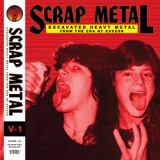
By now you’re probably familiar with our wildly popular Brown Acid series of rare, lost and unreleased proto-metal and stoner rock singles from the 60s-70s. In the endless pursuit of those glorious gems, we often uncover equally brilliant rarities from the late-70s to late-80s Golden Age of Heavy Metal that also just must be heard, but they don’t fit the series’ aesthetic. Scrap Metal, Volume 1 collects some of the greatest unknown and lost Heavy Metal tracks, long buried beneath the avalanche of the era’s classic output.
We all know the old adage that history is told by the winners. But sometimes the losers tell the best stories. And while none of these bands found fame and fortune, this artifact and the volumes to come are testament to the enduring power of heavy music. You can hear the blood, sweat and beers that went into each of these singles. The recordings may be low budget, but the inspiration and talent is immutable. Not only are the amps turned up to 11, the boyish sexual innuendo is cranked to 69. You can hear the convergence of influences — NWOBHM, thrash, glam metal, doom, etc — colliding at once as the era birthed a wellspring of subgenres.
Many of these singles are self-released and were thus limited to a small run of copies. Those that remain are hoarded by collectors and sold for exorbitant amounts. We’ve collected the best of the best for you here. As with Brown Acid, all of these tracks are licensed legitimately and the artists all get paid. Because it’s the right thing to do.
LINER NOTES:
Rapid Tears launch this series with the perfect christening. The Toronto, ON quintet’s 1981 single “Headbang” is such the pinnacle of heavy metal madness that it almost sounds like a spoof. There’s also enough of the rapid-fire sputum that inspired Metallica to bang the head that doesn’t, as such, engage in said practice, to be found on the band’s sole full length Honestly. But “Headbang” is a straightforward glammy anthem for the ages.
Air Raid’s “69 In A 55” may be lyrically so sophomoric that it’s actually pretty clever, but this 1983 Bay Area power metal single is loaded with sleek Judas Priest riffs and interwoven melodies that are downright sublime. The band’s sole release, the 2-song Rock Force 7” features a curious band photo in which 3 band members — dolled up in Crüe makeup and leather — are sexually menacing the lead singer/guitarist tied to a bed. Another low budget highlight is when singer/guitarist Tommy “Thrasher” Merry imitates a delay effect on his vocals as he sings, “tonight!...tonight...night.”
Hades’ “Girls Will Be Girls” has a real demo cassette feel to its vastly uneven mix, but the energy to the performance makes this an undeniable keeper. The long running Paramus, NJ quintet’s 1982 2- song debut 7” titled Deliver Us From Evil features this blistering thrasher dominated by shimmering leads and confident vocals that show why the band went on to near-fame on Metal Blade Records.
Resless don’t need no T to prove that they’ve got “The Power” with this 1984 driving mid-tempo rocker in the vein of Mötley Crüe and Ratt. The River Vale, NJ quartet’s tight crunch wails all over Bon Jovi posers but it’s the band’s unique and subtle deployment of background vocals that gives this rager its staying power.
Pittsburgh, the Steel City, is home to Don Cappa, a band that pays tribute to the burgh, the metal, and the awesomeness of both with “Steel City Metal.” Their lone single, issued in 1987 with only 300 copies released, sounds like the work of some serious steel driving men, with a drummer who might’ve forgotten to wear a hard hat one too many times on the construction site.
The Beast has more of a punk feel to their aggressive “Enemy Ace” track from the 4-song Power Metal EP from 1983 — something like Dr. Know meets D.O.A. But their look, artwork and lyrics all prove that Heavy Metal is where their hearts lie. And this hook filled monster delivers repeated lines like, “I command them all in my lofty realm,” with commendable conviction.
Dead Silence from Denver, Colorado, debuting in 1984 is not to be confused with Dead Silence from Denver, Colorado, who also debuted in 1984. The former a workman’s hard rock bar band, the latter a political peace punk band and neither knowing of the other’s existence throughout their tenure. The pre-internet days were a marvel, indeed.This Dead Silence spits out a slick, Nugent tinged rocker called “Can’t Stop” about life on the road.
The Danger Zone is, by all accounts, not the place to be. And, Hazardous Waste of Boston, MA saw fit to add their two cents on the matter with this 1986 single that combines Van Halen’s flashy musicianship with NWOBHM aggression that sounds so awesome it teeters on itself entering the “Danger Zone.”
Czar’s heavy, doomy “Iron Curtain” single from 1982 hearkens to the sleazy sounds of Saint Vitus and Pentagram with its cranked up DOD Distortion pedal in a Peavey combo amp guitar tone and meaty, barking vocals. The upstate NY quintet only issued this 2-song single, but its driving rhythm, nosedive whammy-bar guitar solos and comparatively mature Cold War subject matter show they had real potential.
Not much is known about Real Steel’s majestic “Viking Queen” from 1987, other than it rocks hard and the 7” 45 sells for upwards of a grand on the collectors market. The Flint, Michigan band recorded at the home studio of local radio personality Bill Lamb, who primarily released Christian Gospel recordings. So, perhaps the band was struck down by a bolt of lightning shortly after this rare single’s release. Whatever the case may be, it’s a must have for fans of classic metal mayhem.
Briti$h is a UK-based artist carving out his own niche using a unique blend of original sounds. Growing up in Ipswich, Briti$h’s relationship with hip hop was strengthened when he moved to Florida, where he lived for 10 years. He became immersed in the music of famed Southern ambassadors such as UGK, Outkast, Scarface and Rick Ross, which went on to subliminally inform his music.
Back in Ipswich, a town that has long been a hotbed of Hip-Hop talent, Briti$h stepped right into the scene and never looked back. His style is impossible to pin down in any one area of Hip-Hop, instead offering a smorgasbord of styles with its roots laid down across the spectrum, from boom bap to trap, but always with a heavy focus on lyrics.
Briti$h’s debut EP, ‘Stuck in a Bunker’, was released in 2018. It delivered a solid introduction to his music, and enjoyed a warm reception from both his fans and peers. The EP was produced by label mate Bunker Beats, on Briti$h’s fledgling label DJGT Entertainment, and was all recorded at his Purple Loft Studios.
Briti$h was involved in a few notable collaborations with the likes of Emjam, Skribblez, El-Emcee, and Rye Shabby. He has also enjoyed airplay from BBC Introducing, the FATP Hip-Hop Show and Graffiti Kings Radio.
"The beauty of all this, as well as its sorrowful brutality, is even more powerful and stupefying since Ghédalia's sudden departure. Because retrospectively, not only is this recording the trace of a rare moment in a Parisian garden, it also summons a ghost, that of a loved one that is gone, and of his voice, which is fully alive here."
Tazartes and Chatham had met once in 1977 at CBGC's and had not seen each other since then when they were asked by their mutual agent to play a private show in Paris. This happened in September 2018 in a house with a garden where sax player Steve Lacy had lived back in the 1990s. This album presents the recording of this show plus another show at La semaine du bizarre festival in Montreuil, France a year later, mixed with a couple of studio sessions. This was probably the last music Tazartès, who died in February 2021, recorded. His unique singing blends perfectly with Chatham's loops on electric guitar, trumpet and flute.
Rhys Chatham is a composer, guitarist, trumpet player and flutist from Manhattan, currently living in Paris, who altered the DNA of rock and created a new type of urban music by fusing the overtone-drenched minimalism of the early 60s with the relentless, elemental fury of the Ramones — the textural intricacies of the avant-garde colliding with the visceral punch of electric guitar-slinging punk rock. Starting with Guitar Trio in the 1970s and culminating with A Crimson Grail for 200 electric guitars in 2009, Chatham has been working for over 30 years to make use of armies of electric guitars in special tunings to merge the extended-time music of the sixties and seventies with serious hard rock. Parallel with his rock-influenced pieces, Chatham has been working with various brass configurations since 1982, and recently has developed a completely new approach to collaborations, improvised and compositional pieces involving trumpet through performances and recordings that started in 2009. Chatham’s trumpet work deploys extended playing techniques inherited from the glory days of the early New York minimalist and 70s loft jazz period. Starting in 2014, Rhys has been touring a solo program featuring an electric guitar in a Pythagorean tuning, Bb trumpet, and bass, alto and C flutes. Rhys was introduced to electronic music and composition by Morton Subotnick in the late 60s, and in the early seventies he studied composition with La Monte Young and played in Tony Conrad’s early group. These composers are, along with Terry Riley, the founders of American minimalism and were a profound influence on Chatham’s work. Chatham’s instrumentation ranges from the seminal composition composed in 1977 entitled Guitar Trio for 3 electric guitars, electric bass and drums, to the epoch evening-length work for 100 electric guitars, An Angel Moves Too Fast to See, composed in 1989… all the way to Chatham’s recent composition for 200 electric guitars, Crimson Grail, which was commissioned by the City of Paris for La Nuit Blanche Festival in 2005. A completely new version of the piece was commissioned by the Lincoln Center Outdoor Summer Festival in 2009. What does a composer do after mounting many performances with forces of 100-200 electric guitars? The composer gets back to basics, at least that’s what Rhys does! Along with the G100 and G3 programs, Chatham is currently offering a solo program, an evening length work with the composer performing himself on electric guitar, trumpets and bass alto and C flutes.
French cult artist Ghedalia Tazartes is an uncompromising character who defied categorization. He recorded alone more than 20 albums, calling his Art “Impromuz” for lack of a better term. Before the years 2000s, his public appearances remained exceptional events. Ghédalia Tazartès’ music has always been a mystery. It switches from musique concrète to – existing or invented – ethnic music, from poetry to noise, or from loops and collages to sad and extremely beautiful tunes in a second, but it constantly is in flux and coherent. In 2004, Ghedalia finally decided to do live performances again. He first worked with other musicians (Les Reines d’Angleterre, David Fenech & Jac Berrocal, Norscq & Black Sifichi, Nicolas Lelièvre) then went solo for ten years. Since then Tazartes has played many shows across Europe including a show in the Patti Smith exhibition at Fondation Cartier in Paris and a cinemix to the “Haxan” silent movie in 2008. In 2018 Ghedalia decided to stop playing solo and to collaborate with other musicians again: Maya Dunietz, Rhys Chatham, Chris Corsano and Dennis Tyfus, Quentin Rollet and Jérôme Lorichon. Ghedalia died at his home in Paris on 9th February 2021.
Distilling order from a crushing whirlwind of chaos has been the stock in trade for Red Kite since the Norwegian jazz-rock supergroup joined forces in 2014. Apophenian Bliss, the much anticipated follow-up to the quartet’s powerhouse 2019 self titled debut references the tendency in the human brain to find patterns and connections even when none actually exist. While it may be a stretch to call Red Kite’s blistering alchemy of surging psychedelia, steamroller rock and fringe-dwelling jazz “benign,” it’s at least a far less harmful application of the term than the conspiracy theories warping minds across the globe.Still, corralling the heady pandemonium of heavy prog, free jazz, combustible fusion and avant-metal into a cohesive sound is one thing; bringing that music to life in the face of the real-world chaos of a global pandemic is something else entirely Musicians : Even Helte Hermansen – Baritone guitar Trond Frønes - Bass Bernt André Moen – Rhodes Torstein Lofthus – Drums and percussion For Fans Of: Mahavishnu Orchestra, Return To Forever
For those only familiar with her previous releases, aya sinclair’s ‘im hole’ will be a dramatic revelation. Under the LOFT pseudonym, she attracted global acclaim for her fwd-thinking club inversions that juxtaposed the British addiction to breaks 'n bass with critical, self-sluicing logic and untethered abstraction, tearing down dance music's hallowed pillars of respectability while winking knowingly to voyeuristic onlookers. On ‘im hole’ this routine has evolved; aya has distilled the incisive sonic experimentation of her earlier releases, the tongue-in-cheek giggles of her DJ sets and edits, and the identity-fluxing lyricism of her live shows. Contorting language, dialect, gender and sexuality between intermittently controlled bursts of rhythm, noise and aural goop, she has sculpted a set of autobiographical vignettes that challenge established norms, question supposed truths and affirm a spectrum of interlocking experiences. But while it's wide open and personal, ‘im hole’ also challenges queer art's tendency to veer towards repetitive solipsism, the music fragmenting familiar sounds and twinning them with familiar words, assembled in unfamiliar ways. Stories are muddled with phonetics just as dubstep is macrodosed with microtonal drone.The anxious, explorative personality that made aya’s past releases so magnetic is magnified here, and her sense of humour is completely naked. It's a Gregg Araki animated biopic of Burial. It's Shakespeare with hoop earrings and a busted skateboard. ‘im hole’ will physically manifest as a hardback cloth-bound book of lyrics, poems and photographs, designed in collaboration with Oliver Van Der Lugt, with single-use download code included.01. somewhere between the 8th and 9th floor 02. what if i should fall asleep and slipp under 03. once wen’t west 04. dis yacky 05. OoBrosThesis 06. the only solution i have found is to simply jump higher 07. still i taste the air 08. Emley lights us moor (ft Iceboy Violet) 09. Tailwind 10. If redacted Thinks He's Having This As A Remix He Can Frankly Do One 11. Backsliding
Multi award-winning composer Shepherd’s seventh album and first on vinyl, with sleeve notes from Percy Mabandu.
Compositions explored on this long-awaited release include new articulations of well-liked familiar melodies like ‘For Keith’, ‘Desert Monk’, ‘Sweet Zim Suite’ and ‘Cry of the Lonely’, along with improvised pieces ‘Zikr’, and ‘Desert Monk’.
Mastered and cut for vinyl by Frank Merritt at The Carvery with heavyweight 180g vinyl pressed at Pallas in Germany.
Shepherd embodies much of South Africa’s piano tradition with visionary clarity. More than his own ingenuity, he holds up an appreciation of the richness of a shared musical inheritance. This must be underscored by an understanding that all pianists, in fact all artists of real commitment, have a wish to be distinctive, along with a real rootedness. The selection of tunes treated here, shores this up about Shepherd. It also points to a deeper, loftier revelation: jazz, and creativity as the ultimate articulations of human hope.
Percy Mabandu, from sleeve notes
Pitchfork 9.4 ‘the first vital band of the 21st century’ Billboard "ágætis byrjun" is alluring, exotic, and unspoiled, just like the country that spawned it. Q Magazine ‘the last great record of the 20th century’ ‘Ágætis byrjun’ is the critically acclaimed second album by Icelandic band Sigur Rós. Their break-through album that propelled them to international fame winning numerous awards and selling over a million records. Tracks from the album have been synched in several notable films such as Vanilla Sky and The Life Aquatic and the album was placed number 2 on the Pitchfork albums of the year 2000. Ágætis byrjun’ was recorded by the band with producer Ken Thomas in 1999 at their Sundlaugin studio in the Icelandic countryside. The out of print vinyl record comes packaged on 2 x 12-inch heavyweight vinyl to the exact original packaging spec. Originally released on Fat-Cat & Smekkleysa this repress see’s the album being released on the bands own record label Krunk.
The Men’s hugely influential album Leave Home came out during an exciting time in New York City. DIY lofts and shitty bars littered downtown Manhattan and North Brooklyn. The Acheron had just opened its doors. Kill Your Idols had broken up. Toxic State Records was just getting started with Crazy Spirit, Dawn of Humans, Hank Wood and Perdition EP’s. The city was alive with punk and noise and filth. And right at that time, The Men were the show to be at.
Every gig was dripping with sweat. Hallways and sidewalks were packed between sets. Chaos reigned in the pit. The Men hit like a bag of hard cement, a hardcore band with a familiar sound but with an aura of absolute chaos and intensity, like everything was on the brink of going off the rails at every moment of their set, a downhill freight train with no brakes. During these shows one’s focus could shoot back and forth between the intimidatingly angry-eyed, bald-headed Chris Hansell (who went on to front Warthog) and the long haired hippie punks Mark Perro, Nick Chiericozzi and Rich Samis, that made up the surrounding band.
Just one of the many juxtapositions the band embraced. If The Men were a chapter in Michael Azzerad’s Our Band Could Be Your Life, the early EP’s and cassettes would obviously be Minor Threat and Black Flag, while Leave Home would likely be… Sonic Youth. It was just before they made the full jump into each record being a smorgasbord of underground genres, from dream pop to folk;
before they had tracks called “Country Song,” for example. But it was a preview of what was to come. Leave Home was a pivot from pure hardcore punk (some might even call it mysterious guy hardcore), as the band got lost in the groove in a way one couldn’t on a straight up punk record. That groove was so strong on “If You Leave…,” “(),” and “Bataille,” while they spaced out on “Shitting With The Shaw,” and stayed as aggro as ever on “LADOCH.” But of course, Leave Home had a re-recording of their hardest track to date, “Think,” making it clear that they were still the moshers we all had come to know and love. If The Men raised their flag as an important New York punk band with Immaculada, they started waving it in the freakiest way with Leave Home.There is no doubt that Leave Home was one of the most influential records of the last decade.
You can hear their mark everywhere from Ty Segal and The Oh Sees to Milk Music and Hank Wood. Few bands have traversed as many genres as The Men and even fewer have done it so well. It is a testament to the band’s undying authenticity and adventurism that the record sounds as timeless and urgent now as it did when it blew the doors of New York punk off its hinges ten years ago, leaving a giant hole for bands of all kinds to come racing through.
In 1970, Kevin and David met whilst they were working in the Labour Exchange Office on Aytoun St, Manchester. Both played guitar and had been searching for other musicians who played atmospheric music. Kevin had been playing in small clubs in Manchester and David performed in a few local bands. One evening, they jammed together at Kevin’s family home, and quickly realized that their playing blended together to form the basis of the sound they had been looking for. In the late ‘70s, the music scene in Manchester was bursting with new bands and music.
However, Kevin and David had little in common with the local acts, being disciples of a more meditative approach. They followed a path of their own, reaching for an otherworldly sound that they heard from artists like John Martyn, David Crosby, Erik Satie, Terry Riley, Eberhard Weber, Alice Coltrane, and Ralph Towner. They experimented combining their acoustic guitars and David’s bass with various effects pedals and techniques to try and achieve a warm and expansive sound that rides the line between ambient, jazz, and psychedelic folk Music.
Towards 1981, they had written eleven songs and accompanied a few with Moog synthesizer laid down by Rob Baxter. All were recorded on cassette decks in their simple home studios. They named this collection of music “Light Patterns”, after a poem Kevin had written. With Light Patterns complete, they set out to find a label to represent their music. They started playing a few gigs in Manchester; Band On The Wall, the Gallery, and other venues, such as Rotters which local promoter Alan Wise had organized. They set up with small amps along with their effects and played as though they were back at home. As Kevin remarks, “It was unusual, to say the least, to play such venues in a low volume chilled out way. However, people listened, often in shocked curiosity, and some even asked for tapes.”
Peter Jenner, of Blackhill Enterprises, eventually picked up the album for his new label, “Sheet”. Peter had managed lots of experimental bands and solo artists, including Pink Floyd in their early Syd Barrett days. He always favored outsiders! The tapes were taken to Strawberry Recording Studios in Manchester, who were surprised when Kevin and David walked in with just a couple of home-produced cassette tapes. Fortunately, they liked them and agreed to master the album. It was then sent to Portland Recording Studios in London for final mastering to vinyl. George Peckham, aka “Porky”, did the pressing with a personal message in the deadwax; “Kaftans, Candles and be Cool Man”. The artwork for the album cover was done by the late Barney Bubbles, a truly visionary artist.
After the album’s release, the pair continued to play together regularly until David moved away from the city. Kevin still resides near Manchester in the rolling hills outside of the city. He continues to experiment with dreamy music in his loft, and we are set to share a selection of his ethereal archival and current compositions in the coming months. David lives a quiet life in a small coastal town in the South, he likes to sail and is an avid cricket fan. We’re excited to make Light Patterns accessible again for the first time in nearly 40 years, remastered from the original tapes. As the original press release said, “Put the album on, lie back and enter the land of no floors”.
Contemporary hard driven Jazz Funk from the north of England. Bee To The Flower, initially released under the influence of Newcastle’s finest Warr
Thompson in a much slower and kind of stepped down version has been rearranged and recorded again by the band expressly for Tesla Groove Internation
at the Loft Studios. We have been on this project for a long while and the biggest thing we blame covid for is the goddamn delay it forced into t
development of artistic projects, of which the physical final release is only the latest of the steps. Driving (and very creative) basslines, a beautiful and almo
psychedelic Fender Rhodes intercalate with a vibrafone played with such a mastery I could only remind of thegreat Pharoah Sanders at the time of h
performances with Lonnie Liston Smith and Nathaniel Betties, one of the greatest afro percussionists of all times. All of this on such a hitting drumming I ju
can’t wait to fire it out of a proper soundsystem. Created in 2011 by north-east based Dave Wilde and Chris Jelly, the original jazz/funk fusion sounds of th
seven piece Newcastle based band have carved a niche as some of the finest exponents of the genre in the UK. The band has given exciting dance induci
live performances up and down the country, at Band on the Wall, Hoochie Coochie and many more, supporting the likes of Craig Charles, Roy Ayers an
Lonnie Liston Smith along the way. New material has been in the making for quite a while, but after the enforced lockdown, King Bee are ready to release th
latest recordings at long last. Worth waiting for.
London-based musician Harriet Zoe Pittard aka Zoee has been described as an artist who writes 'personal pop for people who don't fit in' (Huck Magazine). Previously, Zoee has released singles through Ryan Hemworth's 'Secret Songs' imprint and Vegyn's label Plz Make It Ruins, as well as guesting as a vocalist on tracks with Hot Chip's Joe Goddard and with hyper-pop collective PC Music.Over the past two years Zoee has taken some time to nurture her voice and her sound. Her debut album 'Flaw Flower' is due on June 25th. 'Flaw Flower' is an honest and vulnerable glimpse into Zoee's interior world, a world she creates through marrying her real-life phone notes with imagery taken from modern works of literature such as "The Flowering Corpse" by Djuna Barnes, Sylvia Plath's "A Winter Ship" and Maggie Nelson's "Bluets". Through these 11 new songs, Zoee delves deep into her own emotional life, combining aspects of the everyday with the surreal in order to uncover the beauty found in being flawed. The record nods to the avant pop of the 80s, an era that Zoee has always been drawn to thanks to the expressive and trailblazing music of women including Anne Clark, Joan Armatrading, Cyndi Lauper, Rose McDowall and Anna Domino. The album is characterised by a mix of hi-fi and lo-fi instrumentation. 'The Loft' features a free jazz solo from acclaimed experimental saxophonist Ben Vince alongside stock GarageBand synths. 'Host' combines home demo backing vocals with an elaborate baby grand piano solo. Zoee sources foley sounds from YouTube and pulls from her own domestic field recordings, such as a microwave buzzing in 'Microwave' and a shower running in 'Evening Primrose', often using these sounds as the starting point for the songs. Maintaining intimate bedroom elements whilst developing a more expansive band sound, felt integral to the project, since that's where Zoee's writing process often starts, sat on her bed with her laptop and midi keyboard. Writing for the album began in October 2018 when Zoee started working closely again with friend and long-term musical collaborator Rowan Martin. As the material for the record began to take shape the writing and recording process also evolved with the addition of bassist Kyrone Oak and keys player Laura Norman, as well as contributions from Ben Vince and London pop artist Saint Torrente. "I feel like the songs on this album took me deeper into myself, the sad song that I thought was about a boy is still about that but it's also about loss, about self-determination, about not losing hope, about memory, about domesticity, about detachment, about my dad, about my mum, about change, about feeling incredibly alone, about growing up."
Following a limited 7” vinyl release of SunPalace edits in 2020, BBE Music finally delivers the full-length versions of Moodymann and Kenny Dope’s ‘Rude Movements’ remixes, alongside brand new interpretations by François K, Frankie Feliciano and OPOLOPO, plus a special edit by Phil Asher.
François Kevorkian needs no introduction to fans of House and electronic music. Featuring keys by Eric Kupper, his ‘SATS Dub’ and ‘TradMix’ versions of ‘Rude Movements’ are simply classic works, summoning House music’s golden era forward in time, to the here and now.
Bonus spaced-out ‘Flerken Space Bubbles’ and beat-less ‘Atmosphere’ revisions are also included in the digital version: both invaluable tools for DJs. Ricanstruction label founder and
long-time champion of the good groove, Frankie Feliciano delivers a slick and faithful update of ‘Rude Movements’, with a slight Latin soul twist. Swedish mix-king OPOLOPO turns in a typically live-sounding, funky and dancefloor-ready jam (ready whenever the dancefloor is,
anyway) The full, extended version of Moodymann’s remix retains the original ‘jammed’ feel of Rude Movements, adding stellar flute, sax and piano solos to that hypnotic vibe. Kenny Dope’s Afro-Latin inspired ‘Dancefloor Powder’ version is joined this time by a rough’n’ready, street tough ‘O'Gutta’ mix; calling all b-boys and b-girls! For the expanded digital package, we are also including a special edit by our sorely missed brother Phil Asher, created for his
own DJ sets and now available to all.
Made famous by David Mancuso at his New York Loft Parties, ‘Rude Movements’ was an obscure Brit-funk b-side recorded in the home studio of Mike Collins. The track’s unique sound, coupled with pristine sonics and production values caught the audiophile ears of
Mancuso, and the rest is history. Soon the track found its way into the hands of Loft Party denizens Larry Levan, Nicky Siano, Frankie Knuckles and Danny Krivit and continues to influence House and electronic producers through to this day.
Olafur Arnalds' highly anticipated second full-length album '...and they have escaped the weight of darkness', continues his mission to lure an indie-generation of pop and rock fans into an emotive world of beguiling electronic chamber music and delicate classical arrangements. The sense of an organic crossover recording is reinforced by the involvement of co-producer Bar?i J?hannsson of eccentric pop/rock/electronica-formation Bang Gang. Bar?i has successfully coloured the brittle minimalism of previous releases through the addition of an array of new instruments.
Those expecting a mere continuation of the minimal melancholia of his previous albums are therefore in for a surprise, as the record may be the most uplifting and richly orchestrated work of his career: "The album has a very clear theme", Arnalds relates, "which is that there is always light after darkness. To me, it has a more positive note than my previous works." When ?lafur saw how the opening scene of a Hungarian indie film metaphorically described a solar eclipse, he instantly connected it to the concept, naming the album after a key line of the film's introductory monologue. Staying true to this positive note, '...and they have escaped the weight of darkness' will herald another intense year for ?lafur Arnalds, with the album being accompanied by a world tour, starting in China in March 2010.
Born in the suburban Icelandic town of Mosfellsb?r, a few kilometres outside of Reykjav?k, the 23-year old composer has always enjoyed pushing boundaries with both his studio work and his live-shows. His new opus is set to again challenge his fan base, which is still growing rapidly. Over the past eighteen months Arnalds has advanced from a former support-act for Sigur R?s to an internationally respected artists in his own right. He was privileged to be invited to write the 'Dyad 1909' score for award-winning choreographer Wayne McGregor, aired on BBC Four and on ITV1's South Bank Show. 'Found Songs', a collection of pieces each written, recorded and released in a single day via the Erased Tapes label website, as well as the video for 'Lj?si?' have since managed to generate half a million downloads and video views.
In many ways, the new record is clearly inspired and informed by these events. Several of the pieces were, in fact, written on and off throughout his tour and benefit directly from the intensity of the live situation and the emotional roller-coaster-ride of life on the road: "The first half of 'Gleypa okkur' was written in a sound check in Munich, for example", Arnalds relates, "while the second part was scored in Braunschweig, Germany." On the other hand it is the result of meticulous studio work, of refining compositions in close co operation with compatriot Bar?i Johannsson, known for his eccentric personality and unique electro-acoustic sound: "I definitely wanted to do something a bit different this time, something more. Working with a producer was a part of that." The enthusiasm translates to arrangements displaying a new sense of sonic diversity.
?lafur Arnalds has created an even more open and spacious sound and taken his distinct style to a new level. Compared to his previous works, '...and they have escaped the weight of darkness' makes use of diverse instrumentation ? drums, guitars, voice, Rhodes, a selection of subtle synthesisers, alongside Arnalds' trademark piano as well as Tony Levin on bass. Traditional terminologies become void on his latest offering, which blends contrasting elements into an original, entirely organic new language and a sensitive ballet of the mind.
Arnalds fusion of 21st century electronics and classical vocabulary thereby continues to decisively unwrap the sealed-off world of classical music.
Veteran NYC based Scottish electronic musician Drew McDowall's latest work is his loftiest, most liturgical, and least industrial outing to date —and potentially the apex of his recent discography.Named after an ancient Greek word for votive offering, Agalmaexudes a hooded, devotional aura, creaking and keeling under vast rafters of stone, stained glass, and shredded wires. It's a music of majesty and mystery but also modernity, McDowall's refined modular system shape-shifting strings, piano, pipe organ, and choral masses into disorienting synthetic mirages of the sacred. He cites the intersection of “joy, terror, and the elegiac” as a centering inspiration –or, phrased more bluntly, “that 'what the fuck is going on' feeling.”
As a career collaborator himself, with stints in Coil, Psychic TV, and countless other shorter-lived partnerships, it's telling that McDowall chose this project to gather such an impressive spectrum of peers. Italian synthesist Caterina Barbieri, American drone organist Kali Malone, prolific multi-instrumentalistRobert Aiki Aubrey Lowe, operatic Humanbeast vocalist Maralie Armstrong-Rial, Saudi producer MSYLMA, and warped futurist beat-makers Bashar Suleiman and Elvin Brandhi cameo across the album's 42 minutes, contouring McDowall's nuanced negative spaces with shudders, shadows, and shivering flickers of serenity. Each of them shines in their spotlight, elevating these elusive alchemical states into surreal revelations of texture and transcendence.
McDowall's original working title for the record is revealing: Ritual Music.He speaks of his creative practice in ceremonial terms, negating binaries by seeking the middle path to anuminousequilibrium that erases the distinction between the inner and outer worlds.These compositions feel similarly processional and intuitive, at the crossroads of holiness and hallucination, the sacred vertigo of yawning naves rising into untouchable night skies. It's a vision of industrial music as enigma and invocation, cryptic hymnals of shroudedbeautysummoned in catacombs and crumbling cathedrals.
Despite its depths, Agalmais also an album of immediacy and emotion. Celestial laments of and for times of unrest and suffering. McDowall characterizes his initial intention for this music as an to attempt to convey experiences he felt incapable of putting into words: “To try and approach sublimity, or at least acknowledge it in some way.”Agalmamore than acknowledges the ineffable –it embodies it.
Orions Belte: «Villa Amorini» Jansen Records 2021 Do you remember the time the doorman ran after some drunken kids around the lake outside the club? As he dives into the lake, he scrapes his stomach on a sharp object in the water, but catches up and returns with one youth under each arm. At the same time the singer from the band playing inside, jumps from the loft hoping that the chandelier he grabs will hold him. It doesn’t. Endless afterparties and constantly trying to avoid visits from the police or the liquor control. Still nothing? This was the 90’s club scene in Bergen, and Villa Amorini was the place where everything happened. Starting as an 80’s fine dining spot, it evolved into an extravagant club with tons of artists and DJ’s in screaming shirts and oversized sunglasses. This sets the scene for Orions Belte’s second album. Still a mix of all the sounds they like, reminiscing eras they haven’t experienced, trying to navigate in their own musical atmosphere. Chaotic and calm at the same time. Villa Amorini is recorded at Norsk Riksstudio by engineer Njål Paulsberg, making sure the sounds were on point while leaving the band alone to play together for hours upon hours, chiseling out the base for the album. Where the debut was summery and a bit brighter, this album tends to lean a bit more towards the big city, night life and leftover food from the fridge. Mixed as always by the magnificent Matias Tellez.
- A1: Mexican Wine
- A2: Bright Future In Sales
- A3: Stacy’s Mom
- A4: Hackensack
- A5: No Better Place
- B1: Valley Winter Song
- B2: All Kinds Of Time
- B3: Little Red Light
- B4: Hey Julie
- C1: Halley’s Waitress
- C2: Hung Up On You
- C3: Fire Island
- C4: Peace And Love
- D1: Bought For A Song
- D2: Supercollider
- D3: Yours And Mine
- D4: Elevator Up
t’s the most popular album by one of the greatest power pop bands of all time... and it’s never seen a widespread vinyl release. Welcome Interstate Managers was hailed a classic from the day it came out in 2003, and featured Fountains of Wayne’s biggest hit with “Stacy’s Mom.” The song craft and lyrical wit of Chris Collingwood and the late, great Adam Schlesinger have never been sharper; there’s not a bad song on this record and lot of them (e.g. “Bright Future in Sales;” “Hackensack”) rise to the same lofty perch as “Stacy’s Mom.” Real Gone Music presents this landmark album in a 2-LP set pressed in red vinyl at Gotta Groove Records, and housed inside a gatefold jacket with two printed inner sleeves featuring lyrics. Also included as a bonus track: the non-LP b-side to the “Stacy’s Mom” single, “Elevator Up!” One of the 21st century’s greatest rock albums.
Strut continue their in-depth archive reissues from the Black Fire label witha definitive edition of JuJu's 'Live At 131 Prince Street',recorded in 1973 atOrnette Coleman's gallery in New York and featuring a previously unheardrecording of the Pharoah Sanders composition "Thembi". After forming in San Francisco while working on the Marvin X theatre piece'The Resurrection of the Dead', JuJu began to hone their uncompromisingfusion of Afro-Latin rhythms with free and spiritual jazz before signing toStrata-East for the 'A Message From Mozambique' album in 1972. "Wemoved to New York and became part of the avant-garde community on theLower East Side and Greenwich Village," remembers bandleader PlunkyBranch. Following a high profile live show at the Lincoln Center, OrnetteColeman invited JuJu to his gallery and loft at 131 Prince Street to performthere and to stay on while he left on tour. "That was life-changing for us,"continues Plunky."It was fabulous. The recordings you hear on this albumare in close proximity to each other, maybe across one day or a weekendat the gallery."Alongside tracks written by the JuJu band members, like the5/4 tempo 'At Least We Have A Horizon Now', they play choice coversfrom their peers. Plunky explains, "'Thembi' is a Pharoah Sanders piecewhich he wrote for his wife in 1971 and it's one of my favourite pieces byhim. 'Azucar Pa Ti' was written by Eddie Palmieri; we loved him too andenjoyed Latin music in general. Here we play 'Mozambique', based on anAfro-Cuban rhythm and we regularly played that for 10 minutes beforemorphing into 'Azucar'. 'Out Of This World', written by Johnny Mercer andHarold Arlen, was inspired by John Coltrane who recorded a version of iton his 'Coltrane' album in '62." JuJu's 'Live At 131 Prince Street' is out on Strut on 12th February 2021 on2LP and 1CD. Remastered by The Carvery from the original reel to reeltapes and including full sleeve notes based around a new interview withbandleader James "Plunky" Branch.
- 1: Flying Fish
- 2: The Devil Is Loose
- 3: Hello Everyone
- 4: Wonder Why
- 5: My Buddy And Me
- 6: Say Yes
- 7: Space Talk
- 8: Our Love Is Making Me Sing
- 9: Good Night
Gold Vinyl[27,94 €]
We can’t think of many artists that have had as diverse a career and who have been involved in as many different genres of music as Asha Puthli. A musical pioneer who forged a path through 60's psych, free-jazz, pop, rock, disco, and more.
Asha's 1976 album 'The Devil Is Loose' is maybe her most well-known record. Featuring the beautiful disco-funk-classic 'Space Talk’, Asha's ethereal soaring vocals take us on a journey that almost mirrors Asha's eclectic career. The track was championed by a wide-range of musical scenes and movements, and over space and time it has been commandeered as their own. You would hear it played by David Mancuso at the now ‘mythical’ underground New York party 'The Loft’, in the most discerning disco nightclubs across the globe, in the Rare Groove scene, and also being sampled by hip-hop heavyweights such as The Notorious B.I.G / P Diddy, and The Pharcyde. The appeal and lifespan of ’Space Talk’ keeps on extending and morphing as new audiences gleefully discover it for the first time - it still sounds as relevant and fresh on the dancefloor today - a sign of a true classic.
Here at Mr Bongo we are thrilled to be releasing records by such an iconic musical maverick as Asha, from her roots in India to becoming a globe-trotting artist with a celebrated career in music and acting, whilst always staying true to her art. She has blazed a trail so that others could follow. Whether you are buying this album as a replacement for your worn-out original copy or it's the first time you've heard of Asha Puthli and you're just intrigued and drawn in by the cover, we hope you enjoy this quintessential slice of Asha's world.
• Featuring the legendary ’Space Talk’.
• Played by David Mancuso at the ‘mythical’ underground New York party 'The Loft’.
• Sampled by hip-hop heavyweights such as The Notorious B.I.G / P Diddy, and The Pharcyde.
• Also available on Limited Edition Pink Vinyl
- A1: Arrival Of The New Elders
- A2: Rite Of Accession
- A3: Sojourn
- A4: Tales Of Secrets
- A5: Throughout The Worlds
- A6: Chasing The Hidden
- A7: Chemical Boogie
- A8: Solar Song
Ståle Storlokken - Rhodes piano, Hammond organ, grand piano, Eminent 310, Mellotron, Continuum Nikolai Hængsle - Electric bass, electric and acoustic guitars Torstein Lofthus - Drums, percussion. After a solid run of five studio albums and 2019's two double live albums, Psychedelic Backfire I and II, Elephant9 had taken their groovy mix of high energy rock and power jazz as far as they could. In this respect Arrival Of The New Elders comes as a welcome and most timely addition to their recorded output. More varied, mature and reflective, don't let the self-ironic (?) title mislead you, they are as groovy as ever, but more structured and less jam oriented, with the longest track clocking in around the seven minute mark. Rather short, by their standards.Having built a solid live reputation even before their brilliant 2008 debut Dodovoodoo, the trio boasts what is probably the strongest rhythm section in Norway, complemented with keyboard magician extraordinaire, the one and only Ståle Storlokken. And boy, does he excel himself on this album, notably with more focus on the Rhodes than before. That said, this is nothing if not another strong group effort from what has been a very tight unit straight from the outset. Seven brand new compositions from Storlokken and one from Hængsle make way for what we consider to be their finest and most cohesive album to date. Arrival Of The New Elders was recorded by trusted stalwart Christian Engfelt, with early Dungen producer Mattias Glavå handling the mixing duties.Ståle started his musical journey in Veslefrekk with Jarle Vespestad and Arve Henriksen in the 90s, soon morphing into Supersilent with Helge Sten on board. He's also a member of Moster! and Humcrush, and have collaborated with a number of artists, most notably Motorpsycho. Nikolai is also a member of Bigbang, Needlepoint and Band Of Gold and have appeared on a couple of hundred records. The same goes for Torstein, an associate member of numerous bands ranging from pop and soul to free jazz. But Elephant9 has always been their special baby.