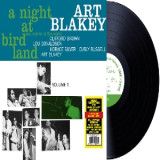
Lee Morgan war ein amerikanischer Jazztrompeter und Komponist. Als einer der wichtigsten Hard BopMusiker der 1960er Jahre wurde Morgan bereits in seinen späten Teenagerjahren bekannt. Er nahm mit Bandleadern wie John Coltrane, Curtis Fuller, Dizzy Gillespie, Hank Mobley und Wayne Shorter auf und spielte in Art Blakeys Jazz Messengers. Morgan blieb bis 1961 bei Blakey und begann in den späten 50er Jahren, als Leader Platten aufzunehmen. Seine Komposition „The Sidewinder“, die auf dem gleichnamigen Album enthalten ist, wurde 1964 zu einem überraschenden Crossover-Hit in den Pop- und R&B-Charts. Nach einem zweiten Engagement in Blakeys Band arbeitete Morgan bis zu seinem Tod 1972 sowohl als Leader als auch als Sideman weiter. Ursprünglich 1960 auf dem Vee-Jay-Label veröffentlicht, ist ”Here’s Lee Morgan” Lee Morgans 10. Album. Auf der Sammlung von 6 Hard Bop-Stücken wird Morgan von Clifford Jordan (Tenorsaxophon), Wynton Kelly (Klavier), Paul Chambers (Bass) und Art Blakey (Schlagzeug) unterstützt. Diese Neuauflage des Albums erscheint als Teil der Original Jazz Classics Series auf 180-Gramm-Vinyl, das bei RTI gepresst wurde, mit analogem Mastering von den Originalbändern bei Cohearent Audio und einem Stoughton TipOn Jacket.
Buscar:the messenger
- Mission Creep
- Lonely Town Feat. Emma Anderson
- High Teens
- A Porsche Shaped Hole
- Swiss Air Feat. Emma Anderson
- I Don’t Know How To Sing
- Messengers Feat. Verity Susman
- 1988:
- Motor Boats
Neon Green Vinyl[27,94 €]
Ride bassist Steve Queralt’s debut solo album Swallow is a beautifully brooding nine-track collection that combines the darkly textured soundscapes of early M83 and Sigur Rós with an electronic sheen reminiscent of Boards Of Canada. It also features guest vocals from Sonic Cathedral labelmate Emma Anderson (formerly of Lush and Sing-Sing) and Verity Susman (Electrelane, Memorials).Swallow has been slowly but surely pieced together between Ride albums and tours over the past five years and, perhaps as a result, has a slightly dystopian, Blade Runner feel that reflects the liminal spaces in which it was created.Despite the fact that the majority of the album is instrumental, there is plenty of power and emotion poured into these moody, moonlit soundtracks. When words do appear, an underlying anger and political slant emerges and amplifies the album’s dark intensity. This is most notable on the closing track, ‘Motor Boats’, where he overlays words from Julie Sheldon’s polemic poem The Same Boat (“We’re all in the same boat they say, but I would disagree”). According to Steve, these simple words of rejection “capture the reality of our times perfectly”. However, it was the collaborations with the two guest vocalists that tied the whole thing together and paved the way to the finished album. “After a few false starts, I had started to doubt the project altogether. It was going nowhere,” says Steve. “Then, out of the darkness, Emma got in touch to tell me that she’d found her voice and could I send her some tracks. A few files back and forth and an afternoon in the studio later and we had ‘Lonely Town’ and ‘Swiss Air’.”In the meantime, Verity from Electrelane had added vocals to the song ‘Messengers’ and transformed the track. Matthew Simms, now her bandmate in Memorials, would go on to mix the finished album.“Swallow has turned out so much better than I had hoped,” enthuses Steve. “I’d fallen out of love with it so many times I was thinking of calling it Loveless. But then, that wouldn’t be the whole story.”
- A1: New Psyche & Beyond The Body
- B1: Night Flying
- B2: Children In The Darkness
Psychedelic rock in the dark!
Dope Purple's new album 'Children In The Darkness’ was recorded when the band hosted a live midnight recording session at Revolver, Taipei City, Taiwan on Friday 3rd March 2023.
Amidst the tense silence of the middle of the night, the five members of Dope Purple, two guest musicians: saxophonist Yong Yandsen from Malaysia, British drummer Darren Moore from Singapore, and a familiar audience, came together to produce the album 'Children In The Darkness’.
The album is a ferocious space psychedelic rock, no starlight, no glamourous psychedelic paradise, just a meditative journey of infinite darkness and ear-splitting tinnitus. Unlike our last album, I didn't have a specific theme or idea for this album, however I named it 'Children In The Darkness’ because all the songs on this album share the same lonely, disorientating chaos that reminds me of children forgotten in the darkness, and Dope Purple has always been a messenger for those children, playing sedative music for their ghosts.
At the end of each performance, I can clearly feel my furious brain melting away and only the calming spirit remains in my body.
- A1: Third Root Radio
- A2: Reflection Of The Times (Feat Reggie Coby)
- A3: Justice Or Else
- B1: Bullets For The Truth (Feat Amalia Ortiz & Queen Yonasda)
- B2: The Messengers (Feat World Trade)
- B3: Yanga's Theme
- C1: Flags And Body Bags (Feat Sofy Encanto Of Elastic Bond)
- C2: A Day In The Life / Poet (Feat Fiend & Marcelandrie); Featuring – Fiend (2)
- C3: The Revolution Won't Go Viral (Feat Bavu Blakes)
- D1: Soul Force (Feat Da'shade, Riders Against The Storm, Bavu Blakes, Vocab)
- D2: Libertad (Feat Mellow Man Ace); Featuring – Mellow Man Ace
- D3: Soul Force (Cookin' Soul Remix); Featuring – Bavu Blakes, Da'shade, Riders Against The Storm, Vocab; Producer – Cookin' Soul
- A1: Wicked Messenger; Written-By – Bob Dylan
- A2: Devotion; Written-By – Ronnie Lane
- A3: Shake, Shudder, Shiver; Written-By – Ron Wood, Ronnie Lane
- A4: Pineapple And The Monkey; Written-By – Ron Wood
- A5: Three Button Hand Me Down; Written-By – Ian Mclagan, Rod Stewart
- B1: Flying; Written-By – Rod Stewart, Ron Wood, Ronnie Lane
- B2: Wicked Messenger; Written-By – Bob Dylan
- B3: Had Me A Real Good Time; Written-By – Rod Stewart, Ron Wood, Ronnie Lane
- B4: A Around The Plynth; Written-By – Ronnie Lane, Rod Stewart, Ron Wood
- B4: B Gasoline Alley; Written-By – Rod Stewart, Ron Wood
- C1: Country Comfort; Written-By – Elton John/Bernie Taupin*
- C2: Had Me A Real Good Time; Written-By – Rod Stewart, Ron Wood, Ronnie Lane; 5:03
- C3: Love In Vain; Written-By – Robert Johnson
- C4: Oh Lord I'm Browned Off; Written-By – Ian Mclagan, Kenney Jones*, Ron Wood, Ronnie Lane
- D1: Maybe I'm Amazed; Written-By – Paul Mccartney
- D2: Stay With Me; Written-By – Rod Stewart, Ron Wood
- 5: 1
- D3: Miss Judy's Farm; Written-By – Rod Stewart, Ron Wood
- D4: Maggie May; Written-By – Martin Quittenton, Rod Stewart
Spectral Bounce’s fifth instalment comes courtesy of L.A.’s rave archivist and dancefloor operative Dreams, A.K.A. Jesse Pimenta. Throughout his decade-long career the California native has inspected, dissected and concocted all manner of dance musics, leaving his mark with drops on Apron Records, Pinkman, BANK NYC and his own imprint Dance Data. On SPEC05 — Dangerous When Wet — he hijacks the synapses with 4 accomplished productions, plotting a high BPM course through manifold styles using the raw aesthetic that characterises his output.
“Losing Control” is a frenetic dancefloor invitation, immediately locking into a pacing groove. Beneath wild hand drums, Dreams plays with an insistent 303 bassline alternating between rasping buzz and oily squelch, while stern vocals are layered on top of breaks that have been processed to a viscerally satisfying end.
Taking things from delirious dance circle to underwater biosphere, the EP’s eponymous track explores a submerged 1980s Miami. Weighty & enveloping, “Dangerous When Wet” is pure aquatic pop-n-lock — hydraulic electro for a drowned world. Ocean floor caustics are transmuted into auditory form: arpeggios bubble up; drones shimmer mystically; hi-hats hiss like air from an open valve. Amongst the sonar bleeps, a barrage of pummeling low-end is sure to give subwoofers a workout.
“XTC Messenger” delivers an infectious paranoid dispatch, astutely balancing the sensual with the deranged. A slow-mo dial tone unfolds languidly, running counter to nervously twitching high frequencies. Its punchy percussion is tuned for maximum dopamine release; the track’s abrupt vocal chops and mechanical kick-snare pulsation evoke the leather jackets and jagged edges of 1980s industrial discotheque.
“Pressure Points” closes the EP on a heady and mesmerising polymetric trip. The parting track is a lithe yet spacious number, propelled by a rattling break. Here Dreams follows from track 2, creating an immersive environment in which sounds tightly twist and twirl. Shifting oscillators call out like tiny creatures as the bass throbs and wriggles further into your brain, long after the needle hits the runout groove.
Mit seinem ersten Blue-Note-Album ”Blues In Trinty” erweiterte der aus Jamaika stammende und damals in England lebende Trompeter Dizzy Reece seine Fangemeinde um so berühmte Kollegen wie Miles Davis und Sonny Rollins. Und Art Blakey wollte ihn und den britischen Tenorsaxofonisten Tubby Hayes, der hier ebenfalls zu hören ist, sofort für seine Jazz Messengers verpflichten. Das Album, auf dem auch zwei prominente Gäste aus den USA mitwirkten, gilt noch heute als absoluter Bop-Klassiker.
Volume 1[22,48 €]
A Night at Birdland Volume 2 continues the energy of the first volume, capturing the essence of hard bop in its emergence. Recorded in 1954, it highlights the quintet led by Art Blakey, featuring Clifford Brown, Lou Donaldson, Horace Silver, and Curly Russell. This second volume delivers vibrant performances such as “Wee-Dot” and “Quicksilver”, where Brown and Silver’s virtuosity particularly shines. Blakey, through his rhythmic power, drives each track with unmatched intensity, foreshadowing the spirit of the Jazz Messengers.
Volume 2[22,48 €]
A Night at Birdland Volume 1 is a live album by drummer Art Blakey, recorded in 1954 at the famous Birdland club. This first volume highlights his quintet, featuring Clifford Brown on trumpet, Lou Donaldson on alto saxophone, Horace Silver on piano, and Curly Russell on bass. The album captures the raw energy of emerging hard bop, with intense tracks like “Split Kick” and “A Night in Tunisia.” Blakey asserts his explosive drumming style, foreshadowing the era of the Jazz Messengers.
The jazz saxophonist Wayne Shorter, released this "Wayning Moments” LP in 1962. It was recorded earlier, in 1961 during Shorter's early years as a
bandleader before his tenure with Art Blakey's Jazz Messengers and later Miles Davis' Second Great Quintet. This album showcases Shorter's early
compositional voice, blending intricate harmonies with expressive improvisation. His playing is energetic, and the interplay with Freddie Hubbard
creates a rich and engaging dialogue.
- Rise
- Running
- Two Hands In My Pocket
- Wescott
- Thrush Song
- I Made A Lovers Prayer
- Dawn Birds
- Buffalo
- Reliever
- Ambassador Cathedral
- Appalachia Borealis
Im Herbst 2022 lebte Phil Cook allein in einem kleinen Haus am Rande von Feld und Wald in North Carolinas Piedmont. Die meiste Zeit seines Leben lang lebte er in der Nähe der Herzen der Städte, die er sein Zuhause nannte, in der Nähe des ächzenden Verkehrs und des Trubels in den Coffee Shops. Diese Nähe Nähe trug dazu bei, dass der gesellige Cook ein produktiver Mitarbeiter wurde, als Mitbegründer von Megafaun bis zur Zusammenarbeit mit The Blind Boys of Alabama, Bon Iver, Hiss Golden Messenger und unzähligen anderen. Aber Cooks nächster war ein Wanderweg, und so ging er hin und lauschte, hingerissen erst von der Stille und dann von den vielen Vögeln. Er begann, sein Fensterbrett jede Nacht einen Spalt offen zu lassen, damit der Chor der Vögel im Morgengrauen ihn begrüßte. Cook begann, diese verworrenen Vogelstimmen aufzunehmen, und er schloss sich ihnen an. Wenn die Sonne schließlich hoch stand, hörte Cook sich die Aufnahmen des Tages an und improvisierte in Echtzeit auf dem Instrument, das seine erste und unerschütterlichste Liebe seines musikalischen Lebens geblieben ist: das Klavier. Als Cook diese Hütte nach einem Jahr verließ, zog er in ein eigenes Haus in Durham, mit viel Platz für seine beiden Jungs zum Spielen und für etwas, das er noch nie besessen hatte: ein richtiges Klavier. In den nächsten Monaten verbrachte Cook unzählige Stunden damit, an diesen Stücken zu feilen. Während des Unterrichts beim großen Südstaaten-Gospelpianisten Chuckey Robinson hatte dieser Cook aufgefordert, weniger Noten zu halten und seine Melodien nicht mehr durch die Verwendung der Pedale des Instruments als Krücken zu benutzen. Seine Musik hatte plötzlich mehr Klarheit, und die Klänge und Gefühle, die sie transportierten, hatten mehr Raum zum Funktionieren. Cook grub sich in die Gefahr und Freude, in die Idee, dass wir unsere Körper zu Knoten verdrehen um zu verstehen, was das Beste für unsere Herzen ist. Im April 2024 kehrte Cook in das Chippewa Valley in Wisconsin zurück, wo er aufgewachsen war. Sein lebenslanger Freund und Bandkollege, Justin Vernon, hatte gerade die Renovierung von April Base abgeschlossen, dem Studio, in dem Cook in den letzten 15 Jahren an mehr als einem Dutzend Platten gearbeitet hat. Cook bat Vernon, Appalachia Borealis so einfach wie möglich zu produzieren, nur zuzuhören und in zwei ausgedehnten Nachmittagssitzungen Feedback zu geben, um die richtigen Takes auszuwählen, die, die das Herz erfasst haben. Natürlich wurde das Ganze komplizierter, als sie anfingen in dem Prozess zu experimentierten. Vernon fügte die Vogelstimmen zu Cooks Kopfhörern hinzu oder entfernte sie, um zu sehen, wie sie sich auf sein Spiel auswirkten. Oder sie leiteten seine Noten durch eine massive Hallkammer und Cook reagierte darauf mit hauchzarten Improvisationen. Appalachia Borealis ist eine zutiefst ergreifende und persönliche Sammlung von 11 Klavier Meditationen, die die emotionale Bandbreite einer vollen und offenen Existenz abbilden. Inspiriert von diesen Improvisationen auf der Fensterbank, spiegelt es nicht nur die Aufruhr und die Traurigkeit einer schwierigen Zeit für Cook, sondern auch die Hoffnung, das Licht und die Freude, nach der anderen Seite zu schauen. Manchmal kann man noch die Vögel hören, deren Melodie und Zeit so viele dieser Lieder inspiriert haben. Selbst wenn sie nicht in Hörweite sind, bleibt ihre Essenz bestehen.
- Neon Demon
- Mine—Sweet Tempest
- Demon Dance—Julian Winding
- What Are You
- Don T Forget Me When You Re Famous
- Gold Paint Shot
- Take Off Your Shoes
- Ruby At The Morgue
- Jesse Sneaks Into Her Room
- Real Lolita Rides Again
- Messenger Walks Among Us
- Runway
- Take Her To Measurements
- Who Wants Sour Milk
- I Would Never Say You Re Fat
- Thank God You Re Awake Remix
- Kinky
- Ruby S Close Up
- Lipstick Drawing
- Something S In My Room
- Are We Having A Party
- Get Her Out Of Me
- Waving Goodbye
The late, great Calvin Keys’1971 debut album for the Black Jazz Records label announced the arrival of a new star in the jazz guitar firmament. Keys had spent the ‘60s backing up the crème de la crème of jazz organists—Jimmy Smith, Jimmy McGriff, Jack McDuff, Richard “Groove” Holmes—but for his first record as a leader, he was eager to play with a piano player instead. So he recruited one of the best—Larry Nash, who, besides being a member of the L.A. Express, played with everybody from Eddie Harris to Bill Withers to Etta James. Bassist Lawrence Evans, drummer Bob Braye, and flautist-songwriter Owen Marshall rounded out the group on Shawn-Neeq, which might remind some of Pat Metheny’s early work (Metheny acknowledges Keys as an influence), or Grant Green.
But what gives Shawn-Neeq extra depth is that it comes from the heart; as Keys says in Pat Thomas’ liner notes, which feature an interview with the artist: “My thing was, I write about some of the experiences that I’ve had in my life.” Keys became a fixture in the Bay Area jazz scene before he passed in April 2024; this is the album that started his journey. Another gem from the celebrated Black Jazz catalog, pressed in blue with black swirl vinyl limited to 750 copies!
- I Miss You, I Do
- Crooked Teeth
- Greyhound Station
- I Love You
- Day Old Thoughts
- Maybe I Ve Wasted My Time
- Took The Train Til The End
- You Re Mine, I M Yours
- Born In Spring
- Happy New Year
Arny Margret, Iceland’s remarkable and poetic upcoming singer-songwriter, is due to release her second album ‘I Miss You, I Do’ on March 7th via One Little Independent Records. The follow-up to 2022’s celebrated, minimalist folk debut ‘they only talk about the weather’ sees her working with new producers in America to develop and hone a sound that’s more textured, expansive, and mature.
‘I Miss You, I Do’ incorporates sessions from Arny Margret’s trips to New York City, North Carolina, and Colorado, as well as those recorded in Iceland. During extensive international touring, she wrote prolifically and spent time getting to know producers and musicians who each brought their own unique and individual talents to the project. Arny’s atmospheric and introspective material has been layered with country-inflected full band ensembles, keys, banjo, harmonium, slide guitar and more, adding an ambience that only enhances her natural ability to convey crystal-clear imagery within thematically rich writing.
In pursuit of her creative vision, Arny enlisted producers Josh Kaufman, Andrew Berlin, Brad Cook, and Guðm. “Kiddi” Kristinn Jónsson. Josh Kaufman is best known for his work with Grateful Dead founder Bob Weir, The National, This Is The Kit, Hiss Golden Messenger, Josh Ritter, and The War on Drugs. Andrew Berlin, GRAMMY nominated for his work on Gregory Alan Isakov’s record ‘Evening Machines’, also mixes national punk rock staples such as A Wilhelm Scream, Rise Against, and Teenage Bottlerocket. Brad Cook served as a producer for Bon Iver, Big Red Machine, Waxahatchee, Hand Habits, Kevin Morby, and Whitney amongst others. Arny also returned to Iceland to record with her long-time collaborator and friend Kiddi Jónsson in Reykjavík, Iceland.
Panamá-born, Chicago-based drummer Daniel Villarreal is known to many for his work in Dos Santos, Wild Belle, The Los Sundowns, Valebol Rudy de Anda, and many more. He's one of the busiest players on the Chicago scene. If you're in the Windy City, find him almost any night of the week at a bar, club, or venue near you, either behind the drumkit or behind the turntables, donning a beaver skin stetson hat, with his baby blue vintage Mercedes parked out front. For his lead artist debut Panamá 77 he engages a diverse array of friends and collaborators - including Bardo Martinez (Chicano Batman), Jeff Parker (Tortoise), Marta Sofia Honer (Adrian Younge), Anna Butterss (Jenny Lewis), and Aquiles Navarro (Irreversible Entanglements) - to create a vibrant and verdant suite of multi-textural psychedelic instrumental folk-funk.
Soul Station is a masterpiece of melodic improvisation, rhythmic interplay, and emotional depth and showcases Hank Mobley's ability to create music that swings hard but remains accessible and lyrical
The album remains a classic in the jazz canon, essential not only for understanding Mobley's contribution to jazz but also for appreciating the broader hard bop movement of the late 1950s and early 1960s. Released in 1960 it is widely regarded as one of his finest works and a classic in the hard bop genre: Hank Mobley was part of the first wave of musicians who helped shape the hard bop sound, a style that blends bebop with blues, gospel, and R&B influences. Mobley was known for his smooth, melodic playing, and while he didn't receive the same level of fame as contemporaries like John Coltrane or Sonny Rollins, he was respected for his consistency and lyrical improvisation. The album features an exceptional quartet of jazz legends: Hank Mobley, Art Blakey, Wynton Kelly and Paul Chambers: this quartet is especially notable because Mobley recorded with Art Blakey's Jazz Messengers and the rhythm section (Kelly and Chambers) was a part of the classic Miles Davis quintet at the time. Their tight interplay and experience shine throughout the record. "Soul Station" stands out because it encapsulates Mobley's mature, melodic sound and his ability to craft memorable, emotionally resonant music without relying on flash or pyrotechnics. It's a must- listen for any jazz enthusiast, and it's often recommended as a starting point for those exploring Mobley's extensive discography.
Als sich die wahrlich einmalige Band PSYCHOTIC WALTZ 1997 auflöste, klaffte eine Lücke, die erst mit der Gründung von DEADSOUL TRIBE im Jahr 2001 wieder geschlossen werden konnte. Sänger, Flötist und Aushängeschild Devon Graves, auch als Buddy Lackey bekannt, war in der Zwischenzeit wegen einer Beziehung nach Wien gezogen, wo er dann auch geeignete Musiker für DEADSOUL TRIBE fand. Auf dem Debüt „Deadsoul Tribe“ spielte Davon Graves noch einige Instrumente selbst, aber man war bereits eine Band mit vier Mitgliedern.
Auch wenn sich der Stil in manchen Punkten von PSYCHOTIC WALTZ unterscheiden mag, ist die Zielgruppe automatisch definiert. Und sogar etwas erweitert, denn neben Metal und Prog kann man auch Einflüsse von Tool heraushören. Das sehr organisch klingende Album bekam sehr gute Kritiken und wurde von den Fans ohne Umwege angenommen. Im Anschluss spielte man auf dem Prog Power Europe Festival in Holland. Es ist erstaunlich, dass die Alben von DEADSOUL TRIBE bisher noch nicht als Vinyl veröffentlicht wurden, zumal der Katalog von PSYCHOTIC WALTZ 2024 eine neue Aufarbeitung bekommen hat (Inside Out/Sony Music). Golden Core schließen diese Lücke nun mit den ersten beiden Alben, natürlich gemastert für Vinyl und mit bedrucktem Einleger. Die LPs sind auf 300 Stück limitiert, die sicherlich schnell ausverkauft sein werden.