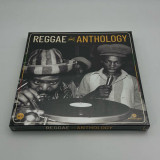
- A1: Bob Marley - Sun Is Shining
- A2: Lee "Scratch" Perry & The Upsetters - Soul Fire
- A3: Cornell Campbell - No Good Girl
- A4: Don Carlos - Rivers Of Babylon
- A5: Gregory Isaacs - Oh What A Feeling
- A6: The Wailers - I Shot The Sheriff (Instrumental)
- B1: Ini Kamoze - World A Music
- B2: Barrington Levy - Warm And Sunny Day
- B3: The Tamlins - Baltimore
- B4: Dennis Brown - Revolution
- B5: Sugar Minott - Rub A Dub Sounds
- B6: Horace Andy - Cus Cus
- C1: Freddy Mcgregor - Big Ship Sailing
- C2: Michael Rose - Artibella
- C3: Bob Marley - Soul Rebel
- C4: John Holt - I've Got To Get Away
- C5: Jimmy Riley - Sexual Healing
- C6: Yellowman - Zungguzungguguzungguzeng
- D1: Black Uhuru - Sinsemilla
- D2: Clint Eastwood - Love Story
- D3: Jackie Edwards - Let Me Go Girl
- D4: U-Brown - Tu Sheng Peng
- D5: Jackie Edwards - Angel Of Love
- D6: The Heptones - Island Woman
- E3: Chaka Demus & Pliers - Murder She Wrote
- E4: Sly & Robbie - Hot You're Hot
- E5: Max Romeo - Material Man
- E6: Wayne Smith - Under Me Sleng Teng
- F1: Derrick Morgan - Sensimella
- F2: Maxi Priest - Only A Smile
- F3: Alton Ellis - I'm Still In Love
- F4: Sly & Robbie Feat. Simply Red - Night Nurse (Radio Mix)
- F5: Sister Nancy - Bam Bam
- F6: Beres Hammond & Zap Pow - Last War
- G1: Ranking Dread - Fattie Boom Boom
- G2: Mighty Diamonds - I Need A Roof
- G3: Capleton - That Day Will Come
- G4: Errol Dunkley - Ok Fred
- G5: Ken Boothe - Artibella
- G6: Eek-A-Mouse - Ganga Smuggling
- H1: John Holt - Police In Helicopter
- H2: Marcia Aitken - I'm Still In Love With You
- H3: Althea & Donna - Uptown Top Ranking
- H4: Johnny Osbourne - Jahoviah
- H5: Winston Mcanuff & Fixi - Garden Of Love
- H6: Gregory Isaacs - Babylon Too Rough
- I1: Matthew Mcanuff - Be Careful
- I2: Morgan Heritage - The Return
- I3: Dillinger - Cool Operator
- I4: Inna De Yard Feat. Ken Boothe - Let The Water Run Dry
- E1: Marcia Griffiths - Come See About Me
- I5: Alborosie - No Cocaine
- I6: Alpha Blondy - Cocody Rock
- J1: Clinton Fearon - This Morning
- J2: Horace Andy - Ain't No Sunshine
- J3: Tom Fire Feat Matthew Mcanuff - Brainwash
- J4: Soom T - Politic Man
- J5: Biga Ranx - Liquid Sunshine
- J6: Ricky Grant - Rocky Road
- E2: Black Uhuru - I Love King Selassie
Suche:the migh
The Morning Papers Have Given Us the Vapours was made with the black watch bandmates and producers/engineers Rob Campanella (Brian Jonestown Massacre, The Tyde, The Warlocks) and Andy Creighton (The World Record, Parson Red Heads). Ben Eshbach, formerly of The Sugarplastic, arranged the strings. Kesha Rose guests on lead vocals on the second single, Oh Do Shut Up. And the great Lindsay Murray once again lends her beautiful backing vox to a number of tracks.
the black watch songwriter/frontman John Andrew Fredrick wrote the ten songs on this, his Los Angeles-based band's latest album, entirely unselfconsciously, with no set goal in mind other than to revel in the joy of songwriting, and, eventually, the luxury of recording his music with his more-than-accomplished band. The Morning Papers Have Given Us the Vapours, produced separately and together by Rob Campanella and Andy Creighton evinces the black watch's often stunning ability to, as Andy Gill once observed in The Independent, "find chaos in the calm, melody in the miasma."
Fredrick, who has also published four comedic novels and a book on the early films of Wes Anderson, jovially describes himself as "a recovering Anglophile--one who'll never, one hopes, fully recover." From his home studio in the Angeleno Heights district of L.A., he waxes eloquent about how being branded, as it were, as a too-ardent lover of British music, film, and literature has left him as bemused as has the tag "prolific" that is often affixed to reviews of his work.
"I just don't think it's all that interesting to note that we've made so many records. Looked at one way, it's a sort of deflection from talking about the timbre if not the quality of the individual songs. Though I know it can be intimidating for fans who've just discovered us--a sort of 'My goodness, where do I start with this band that has put out LPs since 1988?' I get it. I do. I picture someone standing at our slot at a bin at a record store becoming overwhelmed at the prospect of picking the 'wrong' title. And then walking away and not picking up anything from us!" Fredrick laughs. "What can you do indeed?"
He started his career as a songwriter as a result of an American Football injury that left him bedridden in the home he grew up in in Santa Barbara, California. The year The Beatles immortal double-album came out at Christmastime he broke his leg so badly that he had to be home-schooled for an entire year. His parents, ex-teachers themselves, refused to let him watch telly for more than an hour a day. He propped a Silvertone acoustic on top of the massive cast that screamed all the way up to his thigh from his toes, and began to write little melodies and lyrics that, doubtless, did not in the least mask his love for the Fabs, The White Album in especial.
And he read and read and read--histories of the American Revolution and Civil War, mostly, and as many Dickens novels as his mum and dad could bring him. "That year," Fredrick observes, "surely made me who I am today. Proof that intensely unfortunate-seeming events can prove most fortunate. As a sport-mad kid, it made me absolutely mental that I was exiled from the activities I loved most and the school teams I played on. What a blessing undisguised that injury was! Not that I'd like to experience anything like it ever again, mind you."
Fredrick can even recall a few of the melodies he wrote as boy ("Utterly trite, of course, completely jejune"); and in a way, The Morning Papers Have Given Us the Vapours showcases a kind of get-back-to-where-you-once-belonged sensibility. "I didn't intend, this time, to make an album per se. I write both songs and fiction in order to find out what happens, to find out what I might want to say," he notes. "Rob often asks me what a particular song is about; and I often reply that I either don't know, or would prefer that others say. Same thing goes for when people ask me where they should start with our discography. I never know what to say. Our LP from 2011, Led Zeppelin Five (remastered in 2021 for its tenth anniversary), has been our best seller, I think--but that may be because some stoned Zepheads thought their gods had perhaps put out a record they'd missed!"
Despite being deadly serious about music-making, TBW's been known to either whimsically or perversely title their albums. Examples: Jiggery-Pokery (an allusion to John Lennon assessing George Martin's productions), After the Gold Room (a pun on the Neil Young classic plus a local eastside L.A. watering hole), Sugarplum Fairy, Sugarplum Fairy (echoing Lennon's famous count-off to A Day in the Life), Fromthing Somethat (a garbled spoonerism/lyric while doing a vocal), Brilliant Failures (the 2020 release that, along with Fromthing Somethat, was named Album of the Year by venerable indie rock magazine The Big Takeover), and the aforementioned LZ5.
For the new LP, the band recruited longtime friends and allies Ben Eshbach (the Emmy-Award-winning frontman of The Sugarplastic) and Lindsay Murray (Gretchens Wheel) to compose and arrange strings and sing heaps of lovely backing vocals, respectively.
And the result? A collection of songs that Fredrick, in his quite-but-not-quite self-deprecatory way, might call another set of brilliant failures. "Every song, every LP we do, is a failure of sorts--no matter how powerful or beautiful or pleasing-to-us it turns out," John concludes. "I have often said that my aim is to write songs as good as anything on The Beatles... and I will never achieve my goal. And thus I'll have to keep at it, keep trying. And chin-chin to that!"
And now your attention's been brought to a band (or you've heard of them or heard a track or two down the years) that has been pegged by The L.A. Weekly as "a national treasure" as well as "the most criminally-neglected indie pop group imaginable."
So here's to the prospect of that ostensible neglect becoming as much of a thing of the past as John Andrew Fredrick's year-long stint in bed.
For our 50th release on Delusions Of Grandeur we're pleased to bring you seven exclusive tracks from a mighty-fine collection of both existing DOG artists and veritable newcomers alike.
Part Two opens with Underground Quality key player Son Of Sound who brings a bucketful of attitude on Under The Son, laying down a rough-edged groove and getting on one with his vintage keys.
Up next we have Sebastien Vorhaus & Ponty Mython who bring us the beast that is I'm The Slime. Easing us into things with gentle rhodes samples and a skippy groove, Vorhaus (of Soul Of Hex fame) and Mython soon develop things with hints of acid before unleashing a jazz piano riff that can be best described as unhinged.
Flipping over the mysterious Zepp001 hunt and gatherer brings us Enemy. There's elements of disco with bouncing syndrum fills and a mysterious mood prevails as shakers rattle, bells chime and congas slap but when the bassline drops it's clear we're into some serious future s**t here.
Finally, we have our very own Norm De Plume who lays down a bad-boy groove with a rocking bassline, clattering cowbells and tension-building pads bringing an intense build and rounding off our 50th release in fine fashion, we hope you agree.
Superb 45 featuring two Hammond-led instrumentals! We caught up with Mr Guy Hamper for an insightful Q&A_ Q: What a cracking single this is! 'Instrument of Evil' in particular has a very eerie vibe. What was the inspiration for it? A: The track is the sequel to '7% Solution', which featured on the last Guy Hamper Trio LP with Thee Headcoats standing in as rhythm section. A 7% Solution being the amount of morphine Dr Watson administered to Sherlock Holmes. For 'Instrument of Evil' I took Sherlock Holmes' later designation of his syringe as "an Instrument of Evil". This is originally a quote from the bible: "Wicked men do at times reject God's purpose for the state, transforming the good of civil government into an instrument of evil." Point of interest: Morphine addiction happens to tie in with another aspect of the song. In the section that nods to Elmer Bernstein's main title theme to the film of the book The Man With the Golden Arm, in which the main character is also a morphine addict. Another ingredient - we added six-string bass to that section in tribute to Jet Harris - he formerly of top group The Shadows, who recorded a great version of Bernstein's classic. To top it all off the record sleeve references the fine graphics of the great Saul Bass. Phew! Q: The track features contributions from Tom Morley (trumpet) and Anna Jordanous (sax). What's it like working with them? A: They are great and easy to work with. I basically make a playground and let them loose in it with very little direction, apart from pointing out the swings and location of the roundabout. I told Tom "You're a Spanish trumpeter stood on a hill in Spain." For Anna, I think we said "go low and nasty." Q: On the flip side you have 'Incense Rising From a Censer'. A very evocative title for an evocative track. Do you have lyrics in mind for this for a possible later release? A: No lyrics have sprung to mind as yet - but it's always possible. The title is from The Elders observation in Dostoevsky's The Brothers Karamazov, a book I really recommend. Prayer rises to God on the smoke of the incense burning in the censer. I imagine this track being some kind of antidote to 'Instrument of Evil'. Q: This single marks your first time in the new premises of Jim Riley's Ranscombe Studio. What's the new place like? A: The studio is great - the sound - using my old Mighty Caesars drum kit, and Jim engineering, is pure, easy with a better sound than the old premises. Q: Any more Guy Hamper Trio releases in the pipeline? A third album perhaps? A: Again, anything is possible. Me and Jamie (James Taylor, Hammond organ) have talked of writing together in the future. Jamie is a truly great musician - the cherry on the cake if you will. We're just busted old eggs, sour milk, and some gunk. Q: A live Guy Hamper Trio show would be amazing. Any chance of that happening or will it remain a studio-based project? A: It could happen if someone came up with a very cunning plan.
- Saylo
- Can't Take The Hood To Heaven
- Attack Of The Dreadlocks (Feat. Rae Khalil)
- Lynn's Lullaby (Interlude)
- Brownskin Cinnamon
- Grey Seas (Feat. Reaper Mook)
- Cowboy Leather (Feat.pink Siifu)
- Overseas Sam
- Bullets From A Butterfly
- Pearly Gates Playlist
- Things Grandma Told Me
- Bygones
- Lagonda (Feat. Goya Gumbani)
- The Card Players (Feat. Jayellz)
- When I Met Rose
Forest Green Vinyl[27,31 €]
Seafood Sam is a futuristic artifact. If that description might sound confusing at first, it matches the eclectic dualities found in true originals. With his effortless cool and timeless style, the North Long Beach native defies convention and exact comparison. He's a virtuosic rapper, a stop-you-in-your tracks singer, and a symphonic producer. Welcome to the lavish life of a laid-back transcontinental man of mystery, rolling in old school Cadillacs, eating caviar with a blade in his pocket, and making plays in vintage Pelle Pelle gear. A blaxploitation icon for the Instagram age, blessed with the bars of a `90s legend and 23rd century swagger. Seafood Sam is a true hero of modernity. On his full-length album debut for up-and-coming label drink sum wtr (Kari Faux, Deem Spencer, Aja Monet) debut, Standing on Giant Shoulders, Sam splits the difference between Snoop Dogg and D' Angelo, Curren$y and David Ruffin. The songs reveal a forward-thinking sensibility rooted in ancestral soul. He creates spiritual hymns for the streets that tap into universal ideals and irrepressible groove. In an era plagued by short-term thinking, his ambitions reveal a crate-digging depth of music history and a meticulous ear for detail. The giant shoulders in the album's title refer to James Brown, Bobby Brown, and Miles Davis - the holy trinity who inspired Sam's process. From the Godfather of Soul, Sam took a perfectionist's rigor and focus. The example of Bobby Brown lent an unshakeable confidence and self-belief. While the constant artistic left turns of the trumpeter that birthed Ccool offered an aspirational archetype. The story starts in the glory days of Long Beach hip-hop. As a young child, the G-Funk era soundtracked rides in Sam's father's car. Some of his earliest memories are trying to memorize Snoop's verse on "Nuthin' But a "G" Thang." Beyond gangsta rap, the LBC has historically doubled as a capital of lowrider soul and carwash oldies. At any intersection, you could hear Dogg Food or Brenton Wood, Warren G or Barbara Lynn. This too was absorbed via osmosis. It also just so happened that the art of performance was always in Sam's blood. So at family functions, he and his sister supplied entertainment by singing karaoke renditions of The Isley Brothers. While his Harlem Shake remains a thing of local lore. Long Beach is a culturally diverse mecca of skate parks and gang life, street fashion and tricky dance moves. This is the place that raised Sam on a diet of Wu-Tang and Nelly Furtado, Lil Bow Wow and Allen Iverson. He was the middle ground between his two older brothers: one who gangbanged, the other who graduated with a master's degree from UC-Santa Barbara. But it wasn't until the end of high school that Sam started to take rap seriously. Alongside long-time collaborators like Huey Briss and Reaper Mook, Sam's name began to make waves on the northside of the city, but he was partially distracted by a modeling career that paid the bills and took him all to way to walk in Paris' fashion week. The first turning point arrived with 2018's "Ramsey," a self-produced, slick-talk anthem with over 10,000,000 streams across all platforms. With each subsequent release, Sam showcased his peerless consistency, building buzz both online and in the city streets. Spin hailed his "smooth and unhurried cadences and understated lyricism_ that sounds like nothing else in Long Beach." Clash raved about Sam's "evolution as an artist, cruising through nostalgic production with slick, witty rhymes." The culmination arrives with Standing on Giant Shoulders. It's the evidence of a master, a young sensei in the model of Quincy Jones. All rhymes, singing, production, and arrangements were handled by Sam - with an assist from his close Long Beach kinsman Tom Kendall from the group Soular System. It's hard-edged and lyrical enough for disciples of Larry June and Roc Marciano, but orchestral and melodic enough for fans of Anderson .Paak and H.E.R.
Delphine Dora is a prolific composer, improviser and musician who has released on a plethora of labels including Recital, Morc, Sloow Tapes, Feeding Tube, Okraïna and more, and ‘Le Grand Passage’ is her Modern Love debut, a stunning set of songs for piano and voice, recorded in one take without overdubs or edits.
In an act of pure expression, Delphine Dora recorded the 8 songs of ‘The Great Passage’ in a single take, succumbing to a whirlwind of inspiration that transported her beyond the material world. Baroque paradigms bleed into fragile, introspective mantras, expressed through a made up language of existential yearning and channeled through piano and voice. It’s music that caresses the sublime, made without any premeditation.
Delphine was nearing the end of a three-day prepared piano residency when an technician stepped in to tune her grand piano for her final performance. He removed the objects from the strings and fixed the pitch, leaving Dora with a freshly tuned instrument. Mesmerised by its new sound, she proceeded to switch on her recorder and pour out her soul, channeling, in her own words, "something greater than myself".
The result is some of the most unusual but elevated material the prolific composer, improviser and multi-instrumentalist has ever recorded, rooted in a deep understanding of European musical history but willing to push at its boundaries, questioning the earthly logic of life and death, asceticism and impiety. Glistening imperfections lash 'The Great Passage' to the physical world, but Dora - seemingly possessed as she quivers in a fictional dialect - lets her fantasies intensify her spirit, lifting the music towards the heavens. It's not sacred music, per se, but it is unashamedly mystical.
On the luxurious, languid opening, Dora dissolves eerily familiar romantic piano motifs into an attentive ceremony, singing with charged emotion. Her words aren't really decipherable, but their resonance vibrates beyond language; it's striking to hear how confident she is in vulnerability. She lets the piano wrap into her voice, connecting us directly to a unique mode of emotional expression by urging us - the listener - to project our own meaning onto her abstracted words.
Dora refers to the act of improvisation itself as a way to indicate "the fragility of being”, and as her words blur in and out of focus, dipping from a hoarse croak to a choking wail, she places herself at the very edge of musical formality, questioning strictures put in place to suffocate self-expression. Her music has often been labeled "outsider", but here she sounds intimate and interconnected, more self-consciously candid than anything traditional might have allowed. She conjures affecting, plainspoken poetry, like a bedside diary written in a hypnagogic, delirious state: a stream-of-unconsciousness, channelling the beyond.
The album title connects to a book dedicated to French philosopher and activist Simone Weil, who famously pored over global religions to ascertain spiritual truths. To Weil, meditation was a passage to access mystical experience, or a bridge between humanity and divinity. In Dora's hands, this idea is a corridor between herself and the listener, a liminal place where she's able to address feelings without making anything explicit. The title, of course, also refers to life, its impermanence, finitude, and fragility, presenting the complex, multi-dimensionality of being through one of the most undiluted, unbridled set of songs imaginable.
At once a hazy relic and a digital snapshot of the human experience, Your Day Will Come is the debut album from Chanel Beads, arriving April 19 via Jagjaguwar. The remarkable project announces the arrival of New York-based musician Shane Lavers as a new force in experimental music, capturing the many contradictions of modern existence and the strange infiniteness of the digital world. The songs feel like a memory in which you can't distinguish between what actually happened or what was a false reproduction in your mind - although the burning emotion remains intact. Lavers pushed himself to strip his own sense of ego from “Your Day Will Come”. Throughout, Lavers weaves in contributions from his live bandmates, singer-songwriter Maya McGrory (Colle) and experimental instrumentalist Zachary Paul, who offer their own layers of feeling. As McGrory offers a more full-bodied tone and Lavers often sings with his higher-pitched head voice, the two collaborators meet in the middle; it's an intermingling of identities or a subconscious pining for androgyny. In this slippery space, different perspectives merge together, and there's a sense of empathy and humility that arises from the blending of these voices. These days, Chanel Beads live shows see all three performers weaving together in absolute catharsis. This catharsis is pushed to its peak on "Idea June," which sees McGrory taking over lead vocals to project Lavers' lyrics. As McGrory sings, "The waves wash onto my shore," in a voice that's both earnest and digitally processed, it's as though she's speaking as a separate embodiment of Lavers. In under two minutes, the track of clunky acoustic guitar and gutting strings lands somewhere between detachment and kinship. Similar to the off-kilter structure of "Police Scanner," these songs are strangely affecting in their unfinished and liminal forms. Lavers, who is drawn to poor MP3 rips and transitional moments in DJ mixes, knows that these inexact musical artifacts evoke human imperfection. The title of Your Day Will Come could be read as a promise of the arrival of good karma, or it could be a reminder of one's mortality, said out of spite. Yet as Lavers unpacks the haunting feelings of the past that he must release in order to move into his future, he reminds us that grief and hope might be closer than they seem to the naked eye.
New Jackson marks his long awaited follow-up to 2017’s From Night To Night with its successor OOPS!... POP for long-time collaborators Permanent Vacation. A concise triumph in techno pop, its 9 tracks elevate his signature electronic sounds into anthemic new heights.
David Kitt is a prolific sonic polymath who’s enjoyed a colourful career making whatever he likes.
While releasing music under a vast array of aliases and collaborations for close to two and a half decades, New Jackson has remained his irregular home since 2011 for when ‘at one with the machines’. It offers a kaleidoscopic window into his love of dance music, and on his debut album under the alias From Night To Night (released in 2017 on Dublin’s All City label) he unfurled his singular vision; a dilated suite of nocturnal soul coaxed from his beloved electronic equipment with songwriter’s nous, sonically etched as blunted whispers coalesced from the dusky billows of Dublin bay. Further EPs and singles followed, alongside a beloved live show he toured globally, plus detours with his critically-lauded Garies duo (with Lumigraph) and a David Kitt solo album.
In the time since his New Jackson debut, he’s slowly distilled his studio methodology to help mine the true core of his musical self. Within this experimentation, he has stumbled upon the bounty that is OOPS!... POP, his most direct and euphoric body of work to date. Recorded across the span of five years and three different countries, Kitt has managed to transform his beloved alias into a leaner beast, tightening the screws around arrangements and songwriting to inspire an album sonically effortless in demeanour and spontaneously playful in structure and form. Aided by a stacked cast of collaborators including Rita Lynn, Donnacha Costello, Riche “Jape” Egan, Yenkee, Kean Kavanagh, Margie Jean Lewis, Meg Cronin and Fehdah, it bears the hallmarks of the studio albums of yesteryear in its dynamism and gratification while drawing on his rich bouquet of influences across a century of recorded music.
Opener SI SI SI lulls you in with its smothered vocoder’d croons and patient groove, BURNT DEEP next yields a surprising deep house turn, lit gently with casual hedonism. LIKE rewires the playbook entirely, shuffling along its minimal 80’s boogie groove with a cheeky grin, before lead single OUT OF REACH further mines the golden pastures with its glorious stuttering techno power-pop fit with that anthemic chorus. DAY IN SHOCK digi-dubs around the wonderful vocal turn of Fehdah in purest heads-down manner, then THE OK HOLE and STROBE both descend the psychedelic wormhole of anaesthetised breaks and electro with its entranced dancefloor gaze. I WANNA BE ADORED, the Madchester anthem from The Stone Roses, is then surprisingly reimagined as a lost kraut-pop robo sung classic while WITH THE NIGHT AT OUR FEET is our climactic conclusion, a mechanised symphony of dual proportions; a humane core of angelic harmonies chugging along in electro rhythm before soaring strings take us on our way.
New Jackson’s oeuvre, indeed David Kitt’s musical world, is vast; OOPS!... POP then might just be his opus across it all, a towering achievement of soaring catharsis in melody and song that soundtracks the most direct transmissions from his heart to yours
Label mainstays Fouk just dropped the perfect dancefloor Bomb with ‘Mirage’ paired with a high-octane Elisa Bee remix
We all know Dutch duo Fouk from their soulful, bouncy take on house music. They’re also responsible for some of Heist’s biggest tracks like Kill Frenzy or their Lil Louis inspired 2021 release ‘Blue Steel’. On their new EP, the talented duo shows us a fresh side of their sound: the main-room hands-in-the-air-going-wild side. To top things off, Italian producer Elisa Bee made time in her busy schedule of DJ’ing and releasing for artists like Ben Sims on his Hardgroove imprint and Unknown to the Unknown to deliver a killer remix of the title track.
Fouk’s return to Heist after 3 years is a welcome one and with ‘Mirage’, they might just have given us their biggest house track in their decade spanning career. The track is built around a stuttering synth loop and a seductive female vocal chanting ‘What made you wanna…” The real star here is the bassline, which propels the track into a seriously infectious groove. Add some lush strings and moody changeovers and you’ve got yourself a full-blown dancefloor weapon. Mirage has been a staple in Dam Swindle’s sets for the past months and has been one of their set highlights ever since.
“Coffee” is one for the classic Fouk fans. It’s got lovely Rhodes, a joyous combination of whoo’s, snare-rolls and synth hits grooving on top of an infectious orchestral background loop. “Tapioca” is a hybrid latin-electronic groove that builds on punchy synths, live percussion and drunk keys to balance the energy of the track.
Elisa Bee’s remix of ‘Mirage’ is an intense percussive workout that builds on a breakbeat loop and a rave-bassline. The tempo is turned up a notch or 2 and that stutter synth and vocal of the original make this remix a wild warehouse affair.
Closing track of the EP is ‘Abalone’; A lovely bleep-house affair that still has a bit of that warehouse vibe. It’s got the perfect amount of distortion the drums while keeping things dreamy with some face-melting pads throughout the track.
As always, enjoy the music and play it loud!
Lars & Maarten
Is this the future sound of black American jazz - an inclusive yet rhythmically complex groove based music that owes as a much to black urban culture - predominantly hip hop and trap music rhythms - as it does to jazz improv techniques and rhythms? It's certainly interesting that similar elements swim through the music of Robert Glasper and Kamasi Washington, who along with Scott are currently big box office, pulling-in substantial new audiences for their music. Ruler Rebel is the first album of a trilogy celebrating 100 years of recorded jazz, and will be followed by Diaspora and Emancipation Procrastination later. At the heart of this music are polyrhythmic grooves that might come from jazz, New Orleans black Indian music, trap, Malian rhythm Kassa Soro and the interplay between an SPD drum machine and live drumming. Largely featuring Scott's trumpet, the record introduces his articulate and frequently eloquent voice as the narrator of Ruler Rebel, much like the Persian Princess Scheherazade narrating her tales of the mysterious east to Sultan Shahriar over one thousand and one nights. A key track is `Encryption', a summation of Scott's direction of travel on the album. Here the running rhythm is derived from the New Orleansian Afro-Indian culture married with Malian Kassa Soro. This is in turn is layered with SPD-SX electronic drum machine and sampling machine played by Joe Dyson and Cory Fonsville that introduce rhythmic elements from trap and hip hop. Sounds complex? Well it is, but it works. Other highlights include `New Orleansian Love Song' and `New Orleansian Love Song II' and a celebration of Afro-Indian culture on `The Coronation of K. Atunde Adjuah'.
Black[24,79 €]
Is this the future sound of black American jazz - an inclusive yet rhythmically complex groove based music that owes as a much to black urban culture - predominantly hip hop and trap music rhythms - as it does to jazz improv techniques and rhythms? It's certainly interesting that similar elements swim through the music of Robert Glasper and Kamasi Washington, who along with Scott are currently big box office, pulling-in substantial new audiences for their music. Ruler Rebel is the first album of a trilogy celebrating 100 years of recorded jazz, and will be followed by Diaspora and Emancipation Procrastination later. At the heart of this music are polyrhythmic grooves that might come from jazz, New Orleans black Indian music, trap, Malian rhythm Kassa Soro and the interplay between an SPD drum machine and live drumming. Largely featuring Scott's trumpet, the record introduces his articulate and frequently eloquent voice as the narrator of Ruler Rebel, much like the Persian Princess Scheherazade narrating her tales of the mysterious east to Sultan Shahriar over one thousand and one nights. A key track is `Encryption', a summation of Scott's direction of travel on the album. Here the running rhythm is derived from the New Orleansian Afro-Indian culture married with Malian Kassa Soro. This is in turn is layered with SPD-SX electronic drum machine and sampling machine played by Joe Dyson and Cory Fonsville that introduce rhythmic elements from trap and hip hop. Sounds complex? Well it is, but it works. Other highlights include `New Orleansian Love Song' and `New Orleansian Love Song II' and a celebration of Afro-Indian culture on `The Coronation of K. Atunde Adjuah'.
Paul Di'Anno, is a metal legend, his five decade career began explosively as the singer with Iron Maiden, with the albums 'Iron Maiden' and 'Killers' forever cemented in the foundations of heavy metal.
Since leaving Iron Maiden, Paul has been incredibly productive either as a solo artist or a member of bands such as Battlezone and Killers.
The Book of the Beast is the definitive collection of the best of Paul Di'Anno's work since leaving Iron Maiden. Fifteen amazing recordings, including 5 unreleased tracks make up this powerhouse of a set.
In recent years, Paul faced serious health problems that almost ended his career, but thanks to his unrelenting will to fight, Paul is now on a massive world tour with over 100 shows for his passionately loyal fans.
The Book of the Beast delivers the best of Paul Di'Anno, definitive Di'Anno that packs a mighty punch from beginning to end.
- Filial
- Quit Benefit
- Sleepshaker
- Prev
- Pensive
- Cripples Can't Shiver
- Jess And Charlie
- Young Fire
Old Pride is the debut full-length from Baltimore MD’s Pianos Become the Teeth. Atmospheric, relentless, and enrapturing, Old Pride represents a crucial moment in the history of punk and hardcore with its climactic and raw screamo passages strung together with unpredictable structure and elements of post-rock. Songs barrel through seemingly endless reconfigurations of intense composition: flurries of breakdowns, melodic build-ups, and angular blasts might leave you unsure of what’s to come, but there’s a coherence in the sustained ferocity and clever musicianship. Although originally released in 2009, Old Pride remains a beacon of the screamo revival and the renaissance heralded by its release.
"Old Pride" by Pianos Become The Teeth includes the following tracks: "Sleepshaker", "Pensive", "Jess and Charlie" and more.
The vinyl is pressed as a forest green disc.
It’s been a minute, but Sneaker Social Club is gassed to facilitate the return of the mighty House Of Black Lanterns, locking in for the dankest 2-step flex in a sincere ode to pirate radio culture. Dylan Richards has always displayed an affinity for low-end pressure threaded through his versatile HOBL output on Houndstooth and his prior work as King Cannibal, but he’s never dialled in to UKG with this much focus before.
The A side comes on strong with ‘Back To Back Special’, a dark garage creeper with negative space so vast it becomes all consuming — all the better for the ample MC toasting and spring reverb FX splashes to ping out around the skeletal, hard-knocking swing and snarling bass. ‘Out To The Private Number’ maintains the theme, flipping soulful UKG tropes into an ice-cold update for these malevolent times.
On the flip, Richards pushes the formula further out with ‘Slew’, which deploys hardcore-minded bass hooks in a devilishly dissected rhythmic framework and amps up the yard intensity on the MC source material to create a deadly intersection of garage, rave and dancehall. ‘Summon Like’ dials up the eeriness and lets the growl of the bass take centre stage in a potent, unnervingly minimalist dance wrecker that simply confirms the crystal clear vision Richards is pursuing on this record.
It’s a devout love letter to the edgiest of garage’s golden era without being limited to a simple genre study. Instead, a broad church of soundsystem exaltation gets expressed through the Richards’ elevated production vocabulary, capturing the shockout, mind-blowing spirit of the most trailblazing plates when they first got dropped on an unsuspecting crowd.
Recorded in the past 25 years in different parts of the world, Encyclopedia Sónica Vol. 1 compiles the music and sounds of Leo Heiblum. Comes with insert.
Since Leo Heiblum was a little boy, he always found music everywhere. Listening to the engine of his mother's car and hearing incredible rhythms. He always thought every sound we hear can be made into music, every sound that we hear can be heard as music and it can be felt and understood as music. Every sound has an attack, a decay; some have a pitch. What is more beautiful, the sound of a flute, a bird, a trumpet, a car horn, a violin or a mosquito buzzing? They can all be used to make music.
Leo Heiblum believes that If we learn to hear all sounds as “musical” or at least to have the potential to be used to make music, we might look at the world and listen to the world more lovingly. That car passing by had a beautiful crescendo. That dog barking in the distance created a fantastic melody with an impossible-to- transcribe rhythm. Is there no creative intention behind those sounds? Can the listener give them an intention, can the listener transform them into art? Leo Heiblum is trying to organise them and use them in a way that will be musical for us. He hopes that the next time we hear an ocean wave breaking a bond, fire crackling, or a fly flying, we can enjoy the notes and the rhythms they are making. They are being created by something; who knows what the intention is, but some of the most unique beats he's heard come from rocks falling in cenotes or ice breaking down in a glacier. And the melodies he's heard from bats, dogs fighting, or a newborn dog are both haunting and beautiful. The timber from sounds such as the thorn of a cactus, the voice of a homeless person in the street or a mosquito buzzing can be used to create instruments as beautiful as any instrument. And they have a new sound or a familiar old sound used differently. A way that invites us to hear the music created by this planet.
Theo Kottis arrives on Dekmantel with an EP of snappy, melodically-charged house, techno and electro with a distinct 90s edge. Lighthouse marks a shift in focus for the London-based Scottish producer — the result of a self-imposed creative reset which has seen him honing a more mature sound both in the studio and on the decks. The EP’s title track has been on heavy rotation this summer from the likes of Ben UFO, Francesco Del Garda & Palms Trax, and it’s not hard to work out why. ‘Lighthouse’ draws on all the best elements of club music and moulds them into a deadly, effective whole.
From the driving low-end of the Reese bassline to the razor-sharp attack of the 4/4 drums, the swoon of the Motor City pads to the tweaked acid line, it’s a hybrid techno workout of the highest order. Following the inspirational flash point of ‘Lighthouse’ Kottis built out the rest of the EP in a similar vein of characterful, impactful club tracks driven by iconic 90s sounds wielded with precision. ‘Warp’ brings the 303 further to the forefront while ‘Take Control’ digs into deliciously dirty lead lines and ‘Distance’ takes a more explicit electro direction. He might be exploring a revitalised sound, but Kottis holds true to his flair for ear-snagging anthems evidenced on past releases for Permanent Vacation, Space Dust and DGTL amongst many others. As Kottis’ impact on the scene continues to grow, it’s a true pleasure to present some of his fiercest tracks to date on his continued upward trajectory.
Nia Archives is the star at the forefront of the latest era of jungle. Since her emergence in 2020, her collagist soundscapes have helped bring the sound to a new generation of clubgoers (though fair warning: don’t call her a “revivalist” – she’s the first to point out that the scene never went away). So when it comes to talk of the 24-year-old producer, DJ, singer and songwriter’s much-anticipated debut album, the odds are you’re thinking of a full-length record of weightless jungle tracks with basslines so intense they’ll leave your ears ringing.
But the reality of the Bradford-born, Leeds-raised artist’s first ever album – while very much replete with that exquisite jungle sound she does so well – is also doing something a little different. On the thrilling and freeing Silence Is Loud, Nia Archives is looking to make music for beyond the rave. As she explains: “I think music can be experienced in different ways, and there’s different kinds of music for different scenarios. Say you’re at a festival listening to music with thousands of other people, that can feel really uniting. But then you might listen to an album on your own in the bus, or in a taxi; and this project is definitely more a record to sit and listen to than a collection of club tracks.” Nia is intent that Silence Is Loud is taken in as a full body of work of something “more song-focussed, putting interesting sounds on jungle.” It means that this is a record which finds gloomy Britpop, warm Motown, soaring indie, a love for Kings of Leon’s Aha Shake Heartbreak, skittering IDM, Madchester, classic rock, old skool hardcore and more, woven and fused into her ragga and junglist tapestry, all layered with feeling, imbued with her songwriterly lyricism about loneliness, relationships, family, navigating her 20s, and the intense potential power of silence.
The vast sonic palette on Silence Is Loud comes down to Nia’s broad array of influences through her life. With her Jamaican heritage, Nia remembers hearing jungle as a child via her nana, as well as at Bradford Carnival, where she was drawn to the soundsystem culture, dancing carefree on the floats in the parade. The first album she ever bought was Rihanna’s debut, Music of the Sun, and she also went to Pentecostal church back then, and was obsessed with gospel. Aged 16, she moved to Manchester, where she didn’t really know anybody: and so, her solution to meeting people was going out. “Partying was a huge part of my life,” she says, “They used to do little freestyle cyphers at the house parties and I would join in – that’s kind of how I got into singing.” She had found music boring at school, but in meeting all these new people she became interested in making her own music as a hobby. “I was making boom-bap kind of stuff which I didn’t really like in the end,” she laughs, “My lyrics are quite deep, so on a hip-hop beat it all sounds really depressing. I wanted people to dance to my music.” And so she began experimenting with faster tempos alongside that melancholy songwriting, teaching herself how to make beats on Logic: “It’s all been a lot of trial and error, really.”
Nia went to study music in London, and was also interested in visual art, making collages and VHS: “Before the music, I was trying to make a visual archive of my life and the people around me,” she explains, “And then my music was like my diary, and a sonic archive, as well.” Hence, she paired the word “archives” with her middle name, Nia. To this day, in her spare time she’s working on pulling together a documentary on the global nature of the jungle scene.
Back on those first two EPs, Headz Gone West (2021) and Forbidden Feelingz (2022), she honed that junglist sound, painting it with new flecks of colour and vibrance. It was only after she started releasing work that she realised pursuing music could be a viable life path for her. The decision has been paying off ever since. Nia Archives placed third in the prestigious BBC Sound Poll for 2023, alongside garnering a nomination for the Brit Awards’ Rising Star prize, plus wins at the DJ Mag, NME, the MOBOs and Artist and Manager Awards. She has also toured the world – be it North America, Europe or Asia – and even opened a show in London as part of a little something called Beyoncé’s Renaissance World Tour. She’s renowned as a party-starter in her own right, too, with takeovers at Glastonbury, Warehouse Project and her own Bad Gyalz day event. She’s done official remixes for the likes of Jorja Smith, had a huge summer hit with her Yeah Yeah Yeahs rework ‘Off Wiv Ya Headz’, and worked with brands like Corteiz, Nike, Flannels, Burberry, FIFA and Apple. In just three years, it’s fair to say that Nia Archives has become a need-to-know name in dance music.
But Nia is not interested in being one fixed thing. Building on the terrain from her third EP, Sunrise Bang Ur Head Against Tha Wall, the universe of Silence Is Loud is not totally unfamiliar territory; but it’s still emblematic of a bolder scope than we’ve heard from the artist before. Working with Ethan P. Flynn (the songwriter and producer known for his work with FKA twigs and David Byrne), the resulting record is an impressive feat of deftly-sculpted textures; sometimes big and euphoric, like the wobbly, lusty bass of ‘Forbidden Feelingz’, or elsewhere notably gentle and quiet – see: the gorgeous, surprisingly drumless ‘Silence Is Loud (Reprise)’, a heartfelt number that sits somewhere in the school of Adele. “I really sharpened my songwriting skill on this project,” Nia says, “I was really intentional about what I was writing about, and I really loved co-producing with Ethan. His process is so different to anyone I’ve worked with before, and he’s got a kind of DIY set-up like me.” Flynn’s flat overlooks the Barbican, adding that unquantifiable futurist urban quality that the area holds to the music. The pair enjoyed the collaborative process so much that the album was done within three and a half months.
Perhaps this is why Silence Is Loud maintains an exuberant immediacy while still being sleek and spacious, interspersed with flourishes of metallic beats, lush melody and topped with her sugary but powerful vocal, floating over it all. There is an intimacy to the record, perhaps in part due to Nia writing most of her lyrics while sitting in bed in her flat in Bow (once a bedroom producer, always a bedroom producer). You can hear it on the refrain for lead single ‘Crowded Roomz’, which finds rippling guitar lines cutting taut through the beats as Nia refrains: “I feel so lonely crowded rooms.” The song is an examination of life on tour, constantly surrounded by people, but not necessarily those she can be herself around; more than that, the track is exemplary in the category of sad bangers.
Silence Is Loud often finds itself in that push and pull between melancholy and euphoria. There’s a celebration of her unconditional love for her younger brother (the title track), a rumination of an evening with an Irish boy she met by Temple Bar (‘Cards On The Table), or a letter to herself on the light and airy ‘Unfinished Business’, even coming to terms with a lover having a past they haven’t quite processed yet (“nobody comes with a clean slate”). The latter was recorded the week after a music festival, and accordingly captures Nia’s vocal in its not quite healed, husky state.
Nia’s work is always a snapshot of where she’s at when she’s making it. This might not be the debut album you were expecting, but that’s what makes Silence Is Loud so special. Nia Archives has learned the rules of her sound, and is unafraid to break them, pushing jungle and herself into new, unchartered territories that, in turn, go some way to map the history of the greats of British dance music. More than that, it plants her firmly in that lineage.