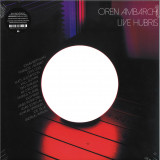
Black Truffle is pleased to announce Live Hubris, documenting the hypnotic and electrifying live performance of Oren Ambarchi’s 2016 LP Hubris by a fifteen-strong band at London’s Café Oto. Over three days in May 2019, Oto toasted Oren Ambarchi at 50/Black Truffle at 10 with Ambarchi and a large group of close friends and collaborators in a series of performances that interspersed existing projects with new collective endeavours, culminating with this: fourteen members of the extended Black Truffle family together on stage, joined by one special virtual guest, to translate the intricately studio-constructed layers of Hubris into a muscular live band workout.
Operating with only the bare minimum of pre-gig preparation after the planned afternoon rehearsal had to be wrapped up prematurely due to noise complaints, the gargantuan group lurches into motion with a 21-minute rendition of ‘Hubris Part 1’, powered by the pulsating electronics of Konrad Sprenger (the ‘ringmaster’ at the ensemble’s core) and no less than seven electric guitars spinning a web of intricately interlocking palm-muted polyrhythms. The layers of closely related but metrically distinct lines create ripples of shifting accents, flickering changes in emphasis that ricochet along the endless central pulse. Gradually building in density, this motorik continuum becomes the backdrop for the haunting tones of Eiko Ishibashi’s processed flute and an extended feature from long-distance guest Jim O’Rourke on guitar synth.
After the brief interlude of the second part, where Albert Marcoeur-esque guitar arpeggios accompany a halting attempt at phone conversation, the full ensemble gears up for the epic side-long rendition of ‘Hubris Part 3’. Now joined by the astonishing triple drum line-up of Joe Talia, Will Guthrie and Andreas Werliin, the layered pulse of the opening piece becomes a burning funk-fusion groove. Beginning on a medium simmer, the ensemble initially stick to its pulsating one-note mantra, over which Ambarchi unfurls a beautiful example of his signature shimmering Leslie-toned guitar harmonics, eventually joined by Ishibashi’s flute and some brooding, distorted dissonance from Julia Reidy’s guitar. Building steadily for the first nine minutes, the heat then rises dramatically with a first, gloriously loose chord change: with the all drummers now rolling and tumbling like a twice-cloned Jack DeJohnette circa 1970, Mats Gustafsson enters on baritone, his tortured roars and shrieks driving the band to peaks of insane intensity. Finally, the exhausted ensemble drops out, leaving only the jagged, skittering fuzz of Ambarchi’s guitar, brought to an abrupt conclusion at the command of crys cole. Arriving on hot pink vinyl with artwork by Lasse Marhaug and an extensive selection of live photos by Ivan Weiss and Fabio Lugaro, Live Hubris brings this ambitious and outrageous evening of music to the safety of the home stereo.
Suche:the noise
‘The Alienist: Angel Of Darkness (Original Series
Soundtrack)’ is now available on vinyl.
The album features music by Ivor Novello Awardwinning composer Bobby Krlic (The Haxan Cloak).
The album is pressed on blue vinyl, with a deluxe
spined sleeve with deboss artwork and the vinyl itself
housed in its own double sided inner sleeve. Digital
download card included.
Bobby Krlic is an award-winning British artist,
composer and music producer based in Los Angeles.
Over the past decade, Krlic has created music under
the The Haxan Cloak, releasing two critically
acclaimed full-length albums (2011’s ‘The Haxan
Cloak’ and 2013’s ‘Excavation’) and touring
extensively as a solo artist building a devout fanbase.
As a producer, Krlic has worked with artists including
Björk, Khalid, Troye Sivan, Goldfrapp, serpentwithfeet,
The Body and noise-rock band HEALTH.
Krlic scored Ari Aster’s 2019 horror film ‘Midsommar’,
earning him an Ivor Novello Award for Best Original
Film Score. Last year, he made new music for ‘Red
Dead Online’ and also co-produced Father John
Misty’s ‘To S.’ and ‘To R.’.
An unflinching, gripping, turn-of-the-century murder
mystery that traverses both New York’s wealthy elite
and the struggling underbelly of the city’s ‘Gilded Age’,
‘The Alienist’ follows Dr. Laszlo Kreizler (Daniel Brühl),
a brilliant and obsessive ‘alienist’ in the controversial
new field of treating mental pathologies.
- A1: Push Out The Noise (Feat Jessica Care Moore - Intro)
- A2: A Beautiful Chicago Kid (Feat Pj)
- A3: When We Move (Feat Black Thought & Seun Kuti)
- A4: Set It Free (Feat Pj)
- A5: Majesty (Where We Gonna Take It) (Where We Gonna Take It)
- B1: Poetry (Feat Marcus King & Isaiah Sharkey)
- B2: Saving Grace (Feat Brittany Howard)
- B3: Star Of The Gang (Feat Pj)
- B4: Imagine (Feat Pj)
- B5: Get It Right
- B6: Exclamation Point (Feat Morgan Parker - Outro)
A Beautiful Revolution Pt. 2 was created with hope and inspiration in mind. The spirit of the album was meant to emulate what a greater day would sound and feel like. We were in the midst of some tough political and socially challenging times. There was still hurt, anger and pain lingering, so I was thinking, “what is the next step in this revolution?” I thought about what being still in these times had brought me and that was a peace beyond understanding, a greater love for self, a closer connection with God, and more appreciation for my family, friends and the simple things in life. I wanted to write about that and create music that embodied that. What does a new day, a brighter day feel like being told through an emcee and some gifted musicians? How could this music be an example of the beautiful aspects of revolution that include joy, self-love, compassion, dreams, peace and good times? As a piece of art, I believe we took it to different places musically only to come back to the original intention. To bring joy to people’s hearts, fun to their lives and smiles to their souls. ABR2. Love Common RADIO: 6Music A List, Album Of The Week on 6Music, support across BBC R1, 1XTRA, Radio 2, 6Music. PRESS: Features in Huck, New Cue, DIY, Daily Star, The Guardian, Line Of Best Fit, MOKO, Clash, NME and more… “If ‘…Pt 1’ felt like a look at the progress we made last year, then this follow up stares down the road ahead – not with trepidation, but with boundless optimism” – DIY **** ‘A Beautiful Revolution, Pt. 2’ is the soundtrack to a new revolt. It’s about unity in the face of adversity and bringing awareness to the Black struggle. But at its core it’s a celebration of Black pride that sees Common in full swing as a champion of peace, love and freedom.” - NME “This is Common’s most hopeful album in years” – The Independent “A late career high” - Clash
The latest entry from Furanum sees label boss Dominik Muller and repeat contributor Tomohiko Sagae return from remix duties on the label's preceding long play release for a four-track split vinyl treatment of Fu020. On The Other Colours of Poison, acting apart yet seemingly as one, they both dispense with nearly any pretense of an introduction, epilogue, or abstract ambiences, and instead opt for a pure and dancefloor-bound effort of four-to-the-floor industrial relentlessness encapsulated in two compositions to a man.
Sagae notably eschews his signature noise-manifesto driven approach in favour of a compelling centering of groove as a prime determinant of musical force. The results of this approach are on display first in 'Tartrazine,' where a rhythmic mind-worm seemingly burrows it's way in, assimilating and holding the beholder in a frantic dance of oscillatory sway. Likewise, in 'Amaranth' an ineluctable sense of technoid acceleration is achieved, with each of the composition's successive loops driving the sense of propulsive sonic force relentlessly forward,
not unlike the turning of a violent accretion disk tearing matter apart.
As for Muller, he builds on his previous work to construct two reliable aural vehicles for the delivery of unrelenting and thematically oriented vehemence. 'Demut' is like a scene of surrender to an engineered and shifting collosus, overwhelming all attempts at its full apprehension as cogent reverberations puncture the surrounding temporal space. On the flipside, in 'Toxic Environment,' he captures the narratively framed pulse of a phrenetically beating heart, beating on despite all odds through sheer force of will and self-overcoming.
Mastered by Kassian Troyer, The Other Colours of Poison will be available on vinyl
February 2021. During a stay in an isolated house in the Alpes-de-Haute-Provence, I returned to four compositions Renaud Bajeux had sent me a few months prior. I had listened intently and enjoyed them very much, but in this new setting, at this very moment, they took on another dimension. For several days, I went on long walks in the surrounding nature and this album, all in half-light, became an obsession. In sync with the perfection of this moment, with this place, it began to haunt me from dawn till long past dusk. At times calming and meditative, at times wild, rugged, and maybe even dangerous, the music seemed to mirror the mountain landscape encircling me. It became evident that Seeking a Vision would be released on Fragments.
Seeking a Vision follows Renaud Bajeux’s first album, Magnetic Voices from the Unseen (Nahal Recordings, 2019), an exploration of electromagnetic fields. In this second opus, Bajeux works with the sound palette of a Serge synthesizer, combining its polymorphic sounds with field recordings of nature. The album’s four parts can be seen as a continuous mental journey through multiple layers of consciousness. Carried by whispering winds and the cracklings of a campfire, they proceed toward meditative states and obscure inner landscapes.
Seeking a Vision was recorded during an INA GRM residency. Elevation was commissioned by the INA GRM.
Renaud Bajeux is a French composer and film sound designer. His work his primarily based on field recordings and modular synthesizers. It can be located at the crossroads of electroacoustic music, noise, and ambient. Renaud Bajeux’s most recent release is a duet with Antoine Gilloire titled Underwater Soil (Superpang, 2021).
All tracks performed and composed by Renaud Bajeux. Mastered by Stephan Mathieu. Artwork by Morgan Cuinet. Layout by Romain Barbot.
London exploratory industrialist Luke Younger characterizes the creation of his latest collection, Axis, as a liberating return to roots: “It felt like going back to the beginning, it felt freeing.” Begun before the pandemic as a soundtrack to a dance performance, the initial vision was for something “visceral, with physical movement in mind.” When the project shifted to indefinite hiatus, he reimagined the material in the context of an LP, while retaining its sense of dynamic physicality. The result is grim and gripping, seasick throbs lurching in a low-ceilinged space, strafed with fractured clanging, hissing steam, and grinding spirals of granular haze. Noise in its most elevated and compelling form, from and for the body as much as the mind.
At only eighteen years old, Paris DJ and producer u.r.trax has a C.V that would make most seasoned selectors blush. Blending the innocence of youth with a ferocious production palette, the emerging techno star has already played Concrete, Dehors Brut, and La Toilette, and has released on Hector Oaks Kaos label, having become infatuated with the sound at a young age - even visiting Tresor at just fourteen!
From death comes rebirth, and on ‘Dying Generation' u.r.trax flies the flag for future-gazing doof with its twisting, left-field turns and throbbing noise. An instant Berlin classic. The glitch and suspense of ‘What Was On Their Mind’ melts into the raver’s core; alarm bells ring, heartbeats race and eyes widen on its six-minute journey.
The headsy vibes on ‘You Are Your Own Distraction’ is a welcome switch-up, its punchy kicks and bouncy aesthetic inviting the listener to dance as weird as they want, before the techno tradition is dropped in favour of a hefty cut of electro flavour, molding the artists own vocals with her production for a “Miss Kitten 2.0” vibe.
Galaxial atmospherics, horror-synths and anxious energy bow us out on ‘Race Against Time’, completing the package with a furious digi-only rework from MRD.
- 1: Atsushi Miura - I Love You (Live At Tokyo Rose)
- 2: Jenny Hval - The Cool, Cool River
- 3: Wilderness - Night Sky
- 4: Oneida - Smokes
- 5: Tim Darcy - Unprecision
- 6: Blacks’ Myths - Free Man
- 7: Drunk - Waltz As Andidote
- 8: Tammar - All's Well That Ends
- 9: Briana Marela - Forever Broken Hearted
- 10: Zodiac Lovers - Why You Hang Around
- 11: Some Nerve - Tvil
- 12: Wilderness - Tomorrow
- 13: Bevel - Blue Umbrella
- 14: Manishevitz - All Mellow People
- 15: Spokane - Useless Things Are Best
- 16: Wold/Fauchion - Beryl Blade Reddening
- 17: Atsushi Miura - I Hate Charlottesville
In most any Dungeons & Dragons adventure worth
completing, the hero must come face-to-face with
themselves in some form - a cursed, mystical mirror that
reveals all that our hero is and is not; a reflection in some
Blood River that displays for our hero the monster they
have become; a doppelganger that reveals how much our
hero has changed since the beginning of the adventure.
So, as their year-long 25th Anniversary campaign enters
its final chapter, Jagjaguwar must also confront their
former self. They’re going all the way back to the
basement of the sushi joint in Charlottesville; all the way
back to when they were just a haphazardly made zine; all
the way back to the original mantra which served at
Jagjaguwar’s early guiding force. The Sentimental Noise
echoing through the caverns of self-discovery is tender
and deafening.
The label have uncovered new and unreleased work from
some of their earliest friends like Drunk, Manishevitz and
Bevel. They’ve called upon necromancers like Norway’s
Jenny Hval, Jagjaguwar legends Wilderness and
Bloomington post-rock heroes Tammar. Mysterious noise
mongers like Canada’s Wold and Oslo’s Some Nerve have
delivered on their promise to absolutely split skulls open.
There are two loving tributes to Patron Saint of Jagjaguwar
John Prine. And they have unearthed two songs from
Atsushi Miura, who once upon a time allowed founder
Darius Van Arman to book shows in the basement of the
sushi restaurant he ran. He dedicates one song to Darius
and in the other, humorously lambasts the college town he
called home for all those years. Today Jagjaguwar dies;
tomorrow Jagjaguwar is reborn.
Double LP on metallic silver vinyl.
Following their recent solo releases Soniscope (Dauw) and Cells #5 (Important Records), Berlin-based multi-instrumentalist Midori Hirano and Tokyo based string experimentalist Atsuko Hatano have teamed up for their first collaborative full-length: Water Ladder. An intense, multilayered continuation of earlier collaborations (Atsuko was featured on Midori’s debut LP back in 2006), the foundation for this new collaborative album was laid when they shared stages in Berlin (Ausland) and Japan in 2019. Working remotely at first, they later recorded parts of the album in Nara’s snoihouse (using omnidirectional polyhedral speakers).
“As we rallied back and forth with our recordings in the process of creating this album, unanticipated fluctuations and irregularities emerged, coming together into a kind of music with a unique resilience and buoyancy that cannot be confined to existing molds. It was as though we had built a Water Ladder to bridge the gap between us,” explains prolific composer and viola player Atsuko Hatano, who’s been busy recording solo and with colleagues such as Jim O’Rourke, Eiko Ishibashi, Mocky, Tatsuhisa Yamamoto, Takeo Toyama, and Anzu Suhara (Asa-chang & Junrei).
Kyoto-born, Berlin-based Midori Hirano, who’s also been releasing music under her MimiCof moniker, adds multiple instruments to the ever-changing sonic landscapes of Water Ladder – an album defined by suspenseful and seemingly suspended compositions that often feel like floating in midair, a sensation the musicians compare to “that distinctive feeling you get from riding a high-speed elevator, where you can no longer tell whether you’re going up or down.”
Devoid of birdsong, the late summer air is nevertheless full of buzzing, whirring, hissing sounds on foreboding album opener “Summer Noise,” a cinematic intro with slow-moving piano chords and an ominous build-up over the course of its sprawling eight minutes. Elsewhere, sudden bursts of viola cut through nighttime peace (“Nocturnal Awakening”), followed by “Cotton Sphere” – which makes the sensation of floating in midair complete: harmonies and melodies rise and form to fall apart again, leaving only trails of previously defined space shimmering in their wake…
Whereas the title track truly explodes half-way in, the final “Cascade” brings closure to the electro-acoustic six-track collection: the floating continues, but the interlocking musical planes are no longer ruffled or rippling, no longer torn in many directions at once. Instead, the sonic streams merge and eventually disappear like ephemeral water falls after heavy rain or sudden snowmelt.
“Water cannot retain its form on its own, and can take any shape as effected by external forces. Its movements cannot be captured by eyesight alone: A body of water that appears to be crashing down into a deep, bottomless waterfall could actually be rising up very slowly into midair,” says Atsuko. “This is an invitation for you to cross the ever-transforming Water Ladder built between Midori and myself.”
Editions Mego is proud to welcome Powell to its roster with a bizarre and strangely emotive new LP of synthetic computer works entitled Piano Music 1-7.
Via his own Diagonal Records imprint, his work on XL Recordings and, most recently, the opening of audio/film platform A Folder afolder.studio, Powell has firm footing in the contemporary electronic landscape. During a wry and obstinate musical life he has twisted myriad synthetic forms into shapes that explore and expand upon the districts of post-punk, techno, noise + computer music, and in the the last year alone he has released four albums of hi-def abstractions, each inspired by a formalisation of music proposed by Iannis Xenakis.
As an extension of this intense period of work/research/play with stochastic functions using probabilities to compose music, various processes emerged that Powell then began to apply to more traditional musical events. Where ordinarily in his work the probabilities and relationships are used to define parameters such as wave-shape, folding, FM, filter modes etc., he now began to use them to create musical formations and visual scores that could be played back using any software/MIDI instrument one of these can be seen on the rear cover of the LP release. While mapping out this cartography of relations, he used a basic Grand Steinway sampler as a placeholder instrument; the longer the process went on, though, the more he began to embrace the acoustic properties of the synthetic piano and make it the bedrock for this new constellation of work.
Piano Music 1-7, subtitled 'Music for Synthetic Piano and Assorted Electronics', consists of seven different synthetic islands strung together into a single composition. All were composed using the aforementioned processes that allowed Powell to play a piano, even if he never learned to do so with his hands. After all, 'In writing electronic music,' Robin Mackay once wrote, 'you also have to direct the invention of new tools.'
At times the piano skips gleefully over shadowing synthesis, whilst at others the synthetic sheets swarm and envelope the keys. The interplay between the two create a fantastical alternate reality, a cosmic machine in which time is eroded, shrunk and expanded, like a wax upon which operations and relations are inscribed or engraved. Many of the pieces express a playfulness or optimism verging on vitalism, as bundles of piano notes dance and interpolate with a never-repeating range of electronic gestures. The feel is of a brightly coloured flower-bed in various stage of bloom. This interplay of the artifical acoustic and the electronic builds on the pioneering processes developed by David Behrman in works such as Leapday Night, and Piano Music 1-7 could also be posited as a modern take on Conlon Nancarrow's investigations for player piano. Similarly, the razor-sharp sonic properties and unfolding of non-human events recall the computer works of Xenakis and the surgical precision of Mego mainstay Florian Hecker.
Recorded in late 2020, these new Powell works propose not just a bold and bright vision of electronic music but serve also as a map with which, for 35 minutes at least, we can navigate our way out of the current milieu. As the artist himself remarks in the sleeve-notes, '. . . What emerged from this fog or soup for me were ideas and processes that felt affirmative and life giving — sensations I had always hoped to convey in my music. Perhaps the optimism or positivity I felt at these musical events unfolding, these clusters and knots tumbling in different directions across time, can also be felt by you.'
Geese are a band that begins and ends in Brooklyn, as a
project between friends to build a home studio out of a
basement.
Their debut album, ‘Projector’ (from which this single is
taken), is born from the same ambition: make music by
any means necessary. The songs were recorded with
sneakers as mic stands and blankets draped over the
amps, all within the afternoon following a school day, up
until they ran the risk of noise complaints.
As a result, ‘Projector’ is as much a moment in time as it is
an album. It represents five teenagers whose love of
music touches every part of their lives: their restless
anxiety about their futures, and their pent-up frustration
with their present - a perspective all too familiar in today’s
uncertain world. Perhaps then it only makes sense that the
figure on the album cover was born from a dream:
curiously alien, yet strangely familiar.
Creative direction by Matt De Jong and Jamie JamesMedina (Fontaines D.C., Arlo Parks, Mura Masa, FKA
Twigs).
Two sold out London shows at The Windmill and The
Sebright Arms. First time ever playing in the UK.
7” features ‘Low Era’ on the A side and a never before
heard bonus track called ‘Smoke In Japan’ on the B side.
Geese are a band that begins and ends in Brooklyn, as a
project between friends to build a home studio out of a
basement.
Their debut album, ‘Projector’ is born from the same
ambition: make music by any means necessary. The
songs were recorded with sneakers as mic stands and
blankets draped over the amps, all within the afternoon
following a school day, up until they ran the risk of noise
complaints.
As a result, ‘Projector’ is as much a moment in time as it is
an album. It represents five teenagers whose love of
music touches every part of their lives: their restless
anxiety about their futures, and their pent-up frustration
with their present - a perspective all too familiar in today’s
uncertain world. Perhaps then it only makes sense that the
figure on the album cover was born from a dream:
curiously alien, yet strangely familiar.
Creative direction by Matt De Jong and Jamie JamesMedina (Fontaines D.C., Arlo Parks, Mura Masa, FKA
Twigs).
Two sold out London shows at The Windmill and The
Sebright Arms. First time ever playing in the UK
Geese are a band that begins and ends in Brooklyn, as a
project between friends to build a home studio out of a
basement.
Their debut album, ‘Projector’ is born from the same
ambition: make music by any means necessary. The
songs were recorded with sneakers as mic stands and
blankets draped over the amps, all within the afternoon
following a school day, up until they ran the risk of noise
complaints.
As a result, ‘Projector’ is as much a moment in time as it is
an album. It represents five teenagers whose love of
music touches every part of their lives: their restless
anxiety about their futures, and their pent-up frustration
with their present - a perspective all too familiar in today’s
uncertain world. Perhaps then it only makes sense that the
figure on the album cover was born from a dream:
curiously alien, yet strangely familiar.
Creative direction by Matt De Jong and Jamie JamesMedina (Fontaines D.C., Arlo Parks, Mura Masa, FKA
Twigs).
Two sold out London shows at The Windmill and The
Sebright Arms. First time ever playing in the UK
Tape
Tony Rolando's debut release Old Cool Echoes is the kind of tape you flip over and play again and again. His second release, an LP for Important titled Breakin' Is A Memory, will be available in early 2022. A CD titled Shared System will follow.
Imagine if you wished away your surroundings and found yourself in a synthetic landscape where the simplest three color pattern animated an entire horizon. If you could suppress your memory enough to experience the new beauty of it, but not so much that you lost the pieces of yourself that make life worth living, this could be your soundtrack.
For more than a decade, Tony Rolando has composed electricity into musical instruments at Make Noise. When he collaborated with Alessandro Cortini in 2019 to create the Strega instrument, the experience rekindled Tony's love of composing and recording music. On "Old Cool Echoes," Tony follows mutating patterns and slow timbral gradients, allowing them to suggest composition as much as he does, occasionally exploring digital media catacombs and dabbling in the microtonal, all with minimal percussion interruption.
No Bragging Rights are releasing a brand new self titled album. As a band we still felt we had more to say. Life took us all in different directions which made writing difficult. Anthony (Tron) joining the band was the spark and the resource we needed to start writing. Daniel would drive 2hrs to Tron’s studio in Tacoma to write and send the demo’d ideas. I was in my last year of undergrad so I would write lyrics/melodies over my Thanksgiving and Christmas breaks. We hit the studio in January which was the first time Martin had seen Daniel or Tron since our last show in 2016. We feel that we were able to bring new elements to our sound without sacrificing our identity as a band.
Bristol's loudest and fiercest duo Bad Tracking step up on home turf via ATC as part of the double drop, giving us their debut album, jammed with unhinged sonics, raw & industrial at its core. But contained within the fury, there's a definite heart, soul and musicality contained within, setting it apart from 'just another noise album' - it's a special one. Mastered and cut by Lewis at Stardelta. Served in printed sleeve, designed by Kin40k.


