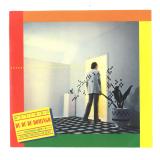
For its sixth release, Rio de Janeiro’s Onda Boa label sees founder Joutro Mundo, step up once again - this time reviving and re-vibing Netinho’s independent 1980s bop, “Du Du Du Domingo”.
Netinho first made his mark in the 1960s as the drummer for Brazilian beat icons Os Incríveis, then again in the 1970s with the heavier, lysergic sounds of Casa das Máquinas. By the 1980s, he had turned toward a new vision, inspired by the spiritual group Amor e Caridade. Released on his own imprint, Manancial do Amor, 1982’s Apartamento 97 – Projeto Amor & Caridade Vol. 2 brought together heavyweights Zé Rodrix, Faísca, and Manito to expand on this funky, pop-rock chapter first introduced with 1980’s Amor & Caridade Vol. 1.
According to Netinho, a year passed in search of inspiration for the follow-up LP before he began receiving notes and poems through his medium, dictated to her by his “protector.” Following that divine intervention, the album’s songs were completed in just two days—including the standout track, “Du Du Du Domingo,” an ode to the beauty of a Sunday afternoon after the toils of the workweek.
Side A presents the original track, lovingly remastered, in all its stripped-down, idiosyncratic glory. A bubbling synth bass paired with a nimble electric bass line set the stage for the plunky synth melody that defines this anomalous yet infectious gem—before giving way to a samba break and a wafting crowd noise that instantly transports you to a sunny Sunday by the sea.
On the B-side, Joutro Mundo injects a new vitality into the track with crisp hi-hats, a thumping kick, and other subtle studio magic. The samba break is brought forward, while the electric bass line—previously bubbling beneath the surface—rises to center stage around the three-minute mark. True to form, Joutro Mundo avoids the obvious, drawing on his deep crates and production sorcery to conjure up yet another gem for the balearic heads and other lovers of left-field dancefloor deviance.
Suche:the noise
For their first album as Gilla Band (formerly Girl Band), the
foursome have redrawn their own paradigm. ‘Most Normal’ is like
little you’ve heard before, a kaleidoscopic spectrum of noise put in
service of broken pop songs, FX-strafed Avant-punk rollercoaster
rides and passages of futurist dancefloor nihilism.
Lockdown robbed Gilla Band of any opportunity to try the new
material out live, but the pandemic also incinerated any idea of a
deadline for the new album. They were free to tinker at leisure, to
rewrite and restructure and reinvent tracks they’d cut, to, as
drummer Adam Faulkner puts it, “pull things apart and be like,
‘Let’s try this. We could try out every wild idea.’”
The group also fell under the spell of modern hip-hop, “where
there’s really heavy-handed production and they’re messing with
the track the whole time,” says Fox. “That felt like a fun route to go
down, it was a definite influence.”
‘Most Normal’ opens with an absolute industrial-noise banger that
sounds like a manic house party throbbing through the walls of the
next room as a downed jetliner brings death from above. What
follows is unpredictable, leading the listener through a sonic house
of mirrors, where the unexpected awaits around every corner.
The common thread holding ‘Most Normal’’s ambitious Avant-pop
shapes together is frontman Dara Kiely. Throughout, he’s an antic,
antagonistic presence, barking wild, hilarious, unsettling spiels,
babbling about smearing fish with lubricant or dressing up in binliners or having to wear hand-me-down bootcut jeans (“It was a
big, shameful thing, growing up, not being able to afford the look I
wanted and having to wear all my brother’s old clothes,” says
Kiely).
‘Most Normal’, then, is a triumph, the bold work of a group who’ve
taken the time to evolve their ideas, to deconstruct and reconstruct
their music and rebuild it into something new, something
challenging and infinitely rewarding. It’s a headphone masterpiece.
It’s a majestic exploration of the infinite possibilities of noise. It’s a
bold riposte to your parochial beliefs on whatever a pop song can
or should be. It’s the best work these musicians have put to
(mangled) tape.
Metallic Life Review is the sound of two people who have collected field recordings of metal objects from around the world for years of their lives together, collaging their magpie hoard into rhythmic patterns, sometimes writing melodies and basslines, but sometimes just letting sound be sound. Patient gathering yields to ADHD editing. Painstakingly made but blink and you"ll miss it. Is it music or is it noise? It is without a doubt exceptionally beautiful music wrought from metal detritus. Metallic Life Review features Susan Alcorn"s pedal steel, Owen Gardner"s glockenspiel, Thor Harris" drumming, Jason Willett"s (Half Japanese) guitar, and Jeff Carey"s aluminum cans, which were melted, molded into custom aluminum rods, and then bowed and struck. The most dramatic difference from any previous Matmos album is that side two was recorded "live in the studio", ala Throbbing Gristle"s Heathen Earth. For the first time on recording, Matmos capture the evolving, shifting, slithering dynamic that happens when they play live and let patterns emerge out of chaos and then collapse and then re-form. Their playful blend of compositional brilliance and improvisational playfulness meld perfectly, truly capturing ecstatic moments in a way that can only happen live.
Several years after a 12” for the Unrelatable imprint, Marco Passarani opens a new chapter with F.F.O.M., a work of extra-terrestrial tales that feel grounded, where the hard, dirty work of the people continues on a different planet. The scenery changes, but the story stays the same: broken dreams on arid ground.
Linking back to his early Nature Records releases, Passarani blends experimentation with an unshakable sense of groove, weaving a more abstract narrative without losing the dancefloor pulse. While distinct from his Studiomaster output, the project shares the same DNA, fusing digital and analog textures until the boundaries dissolve.
True to the raw spirit of pure techno and imbued with the unmistakable nuances of the Roman school, F.F.O.M. is both a nod to the past and a step into uncharted territory, where Martian dust meets earthly sweat.
Each track paints a fragment of this imagined frontier: Tales Of Truth reveals shadowy landscapes hiding the real nature of the so-called new promised land; Alone in the Depth drifts through liquid scenery, a classic TR-808 pulsing deep beneath unknown oceans; Clouded Shore distills the numeric essence of groove in a subtle nod to Kraftwerk; Dominion erupts into the fierce struggle for supremacy over the new territories; Passione Orbitale tells of love for the unknown and voyages toward otherworldly sunsets; Exploration Noises echoes the spirit of Ixora from Passarani’s first Nature Records release, with manic, melancholic SH-101 lines riding electro rhythms.
The digital edition includes two exclusive miniatures, fleeting transmissions from the edge of this Martian settlement.
- A1: When I Sing, I Slip Into The Microphone. Into That Void, I Bring Comrade "Prayers", Then, Turning To Face The Outside, Together We Explode. Part I
- B1: When I Sing, I Slip Into The Microphone. Into That Void, I Bring Comrade "Prayers", Then, Turning To Face The Outside, Together We Explode. Part Ii
- C1: When I Sing, I Slip Into The Microphone. Into That Void, I Bring Comrade "Prayers", Then, Turning To Face The Outside, Together We Explode. Part Ii (Continued)
- D1: When I Sing, I Slip Into The Microphone. Into That Void, I Bring Comrade "Prayers", Then, Turning To Face The Outside, Together We Explode. Part Ii (Conclusion)
- D2: When I Sing, I Slip Into The Microphone. Into That Void, I Bring Comrade "Prayers", Then, Turning To Face The Outside, Together We Explode. Part Iii
Among the true Keiji Haino devotees, Nijiumu’s Era of Sad Wings (released on P.S.F. in 1993) has always held a special place in the pantheon. Operating for only a few years in the early 90s and apparently only performing a handful of shows, Nijiumu operated at the opposite end of the dynamic spectrum to Haino’s famed power trio Fushitsusha, dwelling in a hushed, meditative realm of mysterious droning sonorities and free-floating melodies that occasionally erupts into violence. Black Truffle is pleased to announce a new double-LP edition of a lesser-known 1994 Nijiumu recording, When I sing, I slip into the microphone. Into that void, I bring comrade “prayers”, then, turning to face the outside, together we explode. Here, Nijiumu is the trio of Haino, Tetuzi Akiyama and the obscure Takashi Matsuoka, the three performing on a wide variety of string, wind and percussion instruments, as well as electric guitar and bass, and Haino’s unmistakeable voice.
Like on the early solo Haino album that shares the group’s name (released on P.S.F. in 1993), the instrumentation swims in reverb (the use of which Akiyama recalls as ‘a kind of point of the band’), often obscuring the instrumental sources. On the short opening piece, a distant reed instrument arcs long buzzing melodies over a bed of cymbals and gongs, like a psychedelic take on Tibetan music. The epic second part, occupying almost 50 minutes, begins as a splayed, near-formless cloud of electric guitar and bass, shadowed by bowed and plucked strings, the three elements working through twisting atonal shapes. At various points in the recording, we hear what seems to be the sounds of musicians moving between instruments, their shuffling and bumps fitting seamlessly into this radically open music. Eventually, what sounds like electric guitar moves closer to the foreground, fixing on a repeated melodic cell around which hover mysterious clouds of long tones and a sporadic shaker. At the half-hour mark, the music begins to build to a violently emotive climax, Haino’s impassioned vocal cries punctuating a lumbering, bass-heavy murk, contrasted at points by what sounds like a tin whistle. Suddenly, the volume drops to a near-whisper, opening the way for the stunning final moments, which touch on the slow-motion balladry of Haino’s classic Affection, here given an eccentric twist by an occasional woodblock hit. The third piece opens with a hazy trio of rumbling bass, bowed strings and abstracted slide guitar, the latter calling to mind some of Akiyama’s later solo work. Eventually joined by Haino’s voice, its fragile, haunted tone might remind the listener of the man in black’s documented love of the madrigals of the murderous Count Gesualdo, before the recording abruptly breaks off mid-note. In this new edition, the Nijiumu trio recording is supplemented by a piece recorded solo by Haino in 1973, a bracing electronic blowout stretching almost half an hour. Using a homemade electronics setup to unleash a barrage of crunching distortion and shuddering harmonic fuzz, it takes its place in the canon of extreme live electronics next to Robert Ashley’s Wolfman and Walter Marchetti’s Osmanthus fragrans, looking forward to extreme noise years before Merzbow. Taken as a whole, these four sides of music are a stunning document of some of the lesser-known waystations of Haino’s singular creative path.
The ninth installment in the MEGABREAKZ series dives headfirst into the raw energy of early industrial. A rhythmic discharge straight from the golden era of industrial new beat and industrial dub: rusted percussion, toxic delays, and sweat-drenched basslines. Velax channels the raw spirit of Chicago’s most abrasive scene, Wax Trax!, where beats were machines and noise had a body. But here, everything is filtered through the dub haze of the UK’s early counter-scene, with fractured echoes in the style of Keith LeBlanc, crafting the ideal soundtrack for a crumbling factory. Grit, groove, and distortion as the only possible language. Presented in ONE-OFF truly limited edition of 300 copies lacquered pressed on 180 gr. high quality solid BLACK vinyl.
London based label Natural Selection present their forthcoming release in the form of a 4-track 12" EP, courtesy of Swarm Intelligence, entitled "Radiance". Mastered by Alain Paul and cut by Simon at The Exchange Vinyl. Record Sleeve and labels printed to premium specification, featuring artwork by Kaan Ulgener.
Born in Dublin and now firmly based in Berlin, Simon Hayes aka Swarm Intelligence has cemented his place in the Techno underground with critically acclaimed LPs and EPs on labels such as 47, Instruments of Discipline and Voitax. He returns to Natural Selection, after releasing his track "Generative" on the label's latest VA release; "Natural Selection: Selected Works Vol. 1" in 2024. Featuring amongst an extensive list of heavyweight label affiliates such as SHXCXCHCXSH, Charlton, ASEC, Nørbak, MAEDON, Annie Hall & more. After further connections with the label via live performances at their regular label nights at FOLD London, it was inevitable that Simon would be invited to release a solo EP on their imprint.
His distinctive sound comes from over a decade of releases spanning multiple genres and tempos and oscillates between rhythmic noise, tense atmospherics, uncompromising levels of distortion, and stark, astute beats. This resolutely non-conformist approach to his productions has earned him a reputation as a true trailblazer in the realm of Techno and has led him to perform at some of the world's finest institutions including Berghain, Tresor and Basement NY.
For "Radiance", Swarm intelligence delves further into the sonic unknown, presenting a bold evolution in his uncompromising vision of Techno. Deep, fragmented textures form the backdrop for thunderous, distorted rhythms and IDM-laden drums and percussion, fused with meticulously designed cinematic soundscapes and powerful low-end muscle. Fierce, unrelenting, and deeply conceptual, all rules and boundaries are smashed to pieces and all tracks are equally suitable for blasting through the world's biggest club systems and rigs as they are for home listening.
Keep off the Traxx are travelling at 33rpm and running on time. Baker Lou and Jubi Leigh have climbed aboard the express train and they’re not slowing down. You better mind the gap as these conductors won’t be hanging around.
Opening the debut EP is ‘Slow Down’, a high-energy A1 packed with euphoric synths, catchy vocals, and an acid line that pays homage to the golden era of early progressive house. Next up, ‘Mind the Gap’ delivers an irresistible fusion of raw, gritty house and classic UK garage, complete with chopped vocals and synth hooks that stick in your head long after its over.
‘Brain Dance’ brings a bouncy groove and a fresh return to acid, weaving melodic progressions that keep the energy flowing. Closing out the record is ‘That Noise’, a contemporary psychedelic progressive journey, layered with lush strings and immersive textures.
Emotional Response is delighted to present the debut EP of Aaron Coyes (Peaking Lights / Leisure Connection) new project, as Exotic Gardens. An additional music universe as his love of dub expands to include new wave, goth and acid psychedelics across 5 catchy, bass heavy songs.
While the continuing journey of his duo band, Peaking Lights, with his wife Indra, earns plaudits and fans alike, his early years as a one-man lysergic music polymath that saw his youth in punk and hardcore bands, expanded during a mid-90s burst of “living in San Francisco” creative expansion, devouring music, genres, and influences for life.
Started as a sub-project to Peaking Lights and his personal dub excursions, Exotic Gardens pollinates a rich tapestry. Recording through the pandemic in their then home in Amsterdam, before being archived, assembled, and completed following the move back ‘home’ to the West Coast, California.
Re-embracing that love of his inner goth, the analogue warmth is all there, now featuring Coyes’ dub-languidity of stripped drum machines, widescreen bass, haunting guitar lines and an almost idle voice to peddle true, raw songs.
Combined, the pop layer of hooks and tight grooves instantly catch you. Opener and EP title, Drugs & TV is the perfect anthem for the Exotic Gardens sound, before the “dubwave” of Last Of The Light and Tonite shimmer that yearning melancholy of youth.
In the almost 10 minute dub house opus Organize Your Movement an appreciation and understanding of the psychoactive properties of the Roland 303 and 909, they also hark to a love of Industrial / Noise bands, a lineage from the death pulse of his cult project Rahdunes through to Sound Design and Sound System culture to the pop-dub psychedelics with Indra, now melded here to include a dark assault, whispering invocations and pulsing pads.
To close, Turn It On is a roaming multi-genre evocation, an exotic end from this constant troubadour, cassette junkie, record dealer, sound system builder, always looking to get back on the road, to live to roam.
“I turn it on, you lose your mind’.
Next up on Mesh is Throwing Snow’s ‘Jackals’, a five-track EP drawing on echoes of UK subcultures.
Written in Ireland late last year with the London 2010s in mind, ‘Jackals’ is Throwing Snow’s love letter to his time spent there, tapping into a detailed web of sounds and styles through a personal lens, but skillfully produced to resonate with many. Locating memories in a transient city that is constantly reconfiguring itself, each track is an attempt at honouring fragments of recent, but seemingly distant, musical history. Taking us from DMZ at Brixton Mass to FWD at Plastic People, or Future Garage Fridays in Soho (IYKYK) to early days of NTS, the EP captures some of the fleeting moments that continue to play a significant part in the city’s sonic patchwork.
Production-wise, all the tracks share the same sounds twisted in different directions. The hats are vocoded with noise and random LFOs, and much like the chaos of London, every bounce has a unique pattern.
Opening track ‘Jackals’ walks the line between dub and UK bass, quickly overtaken by a wonky synth lead that spirals eternally upwards. ‘Ohnein’ jumps in with a massive pad swirling above a half-time step. In Throwing Snow’s own words, ‘I had to check with Martyn whether I'd ripped him off, turns out I hadn't, but it's a heavy head nod crossed with Un Vingt from my first 12"’. ‘A Cloud Mountain’ - a nod to the timeless James Holden remix of Nathan Fake’s ‘The Sky Was Pink’, leans into a maximalist progression of deep chords and fractured synths. ‘Forged’ steps into a weightier space with sparse drums driven forward by a deep cut of bass and twitchy echoes. Rounding things off, ‘Path Dependency’ speeds things up with touches of DnB in the drums, distant echoes in the forefront and the occasional sub wobble holding things together.
This is one of the “historical records” linked to the techno and progressive movement of the nineties; it was one of the most used records as the “last record” in the most important Italian clubs and included in all the sets of the most important European DJs. Available in original print and in a rare limited edition blue vinyl version.
- A1: Murking Shadows
- A2: Ecto Green Code
- A3: The Preyers Forest
- A4: Scream Dreamer
- A5: Metal Preyers Feat Sockethead - Red Swines
- A6: Crater Creature
- A7: Carpenters Cabin
- B1: Slime Things Accent
- B2: Wasp Faced Invasions
- B3: Metal Preyers Feat Lord Tusk - Metal Mans Revolt
- B4: On Her Way 0
- B5: Metal Preyers Feat Lord Tusk - Gremlin Gurgle
- B6: Shadow Swamps
- B7: Escape - The Sunrise
Black vinyl LP. Following 2019's acclaimed self-titled debut album, Metal Preyers take the left hand path into a gloomy backwater filled with haunted creatures and fraught with peril. "Shadow Swamps" again finds London-based Jesse Hackett handling the music and Chicago's Mariano Chavez fashioning the album's visual identity, which this time includes a short film and book for a fully immersive experience. "Shadow Swamps" is the soundtrack to a pitch-black fairy tale about a father and daughter as they journey through a swamp avoiding gremlins, red swines and crater creatures. Musically, it pivots between the clattering Czech new wave experimentation of "Valerie and her Week of Wonders" composer Luboš Fišer, or the magical, eccentric lounge of Birmingham's Broadcast, and the grinding industrial grot of Italian pioneer Maurizio Bianchi. This time around, Hackett has roped in production assists from his six year-old-daughter wonder Nyasha hackett who used phone memos to record herself singing - veteran Metal Preyers collaborator Lord Tusk, and Manchester-based painter, DJ and producer Richard Harris, aka Sockethead. The crew inks an unsettling, richly textured sonic landscape, with claws of rhythmic smoke curling around chiming otherworldly xylophone, disembodied fiddle drones echoing over screwed 'n chopped beatbox dirt and half-heard magical vocals buried under clouds of white noise. Track listing: 1 Murking Shadows 2 Ecto Green Code 3 The Preyers Forest 4 Scream Dreamer 5 Red Swines 6 Crate Creature 7 Carpenters Cabin 8 Slime Things Accent 9 Wasp Faced Invasion 10 Metal Mans Revolt 11 On Her Way 12 Gremlin Gurgle 13 Shadow Swamps 14 Escape - The Sunrise
Do you remember Cush?
A nod to the enigmatic Danakil warrior from Corto Maltese — wise, fierce, and fiercely free. That spirit is back, and this time, it speaks through sound.
Welcome to Cush — a bold sonic territory where the elegance of myth meets the urgency of noise.
Across 14 tracks, this power trio delivers a raw, immersive journey that bends genre boundaries and stirs the imagination. A soundscape emerges, somewhere between dystopia and liberation: windswept grooves, fractured brass, buzzing machines, explosive drums. Think improvisation at its most daring, textures at their most tactile, and themes that haunt like echoes from the future.
Cush is a cry. A rebellion. A pulse.
It’s where musique concrète collides with free jazz and industrial atmospheres — and something new is born.
For listeners drawn to Pierre Henry’s audacity, Alain Damasio’s visions, industrial ASMR, or sonic voyages à la Corto: this is your next deep dive.
Unbuckle your seatbelts. You’re in Cush territory.
An album that demands to be heard — and experienced — live.
Shhh. The command to be quiet is not just part of the title of one of the two sprawling compositions on this pioneering album. It's also an apt metaphor for the relaxed hypnotism and spaced-out atmosphere that define In a Silent Way, a record that pushes the boundaries of studio possibilities, artist-producer relationships, and rock-jazz chasms. Recognized as Miles Davis' first full-on fusion effort and part of his "electric" era, the 1969 landmark claims a Who's Who line-up that sends the music into an ethereal stratosphere.
Mastered from the original master tapes and pressed at RTI, this unsurpassed 180g LP edition lifts the veil on the cutting-edge assembly process that created the pair of lengthy suites. Helmed by three electric instruments, the bevelled compositions melt away all preconceived notions of "jazz," ˜rock," and "ambience," following a loose theory Davis dubbed "New Directions."
Few albums are so delicately textured. And on Mobile Fidelity's meticulous reissue, such sulcate elements pour over ink-black backgrounds on a canyon-wide soundstage. In particular, Tony Williams' inventive percussive touch – he causes the cymbals to shimmer as a pieces of silver tend to do when exposed to sunlight – is broadcast with lifelike three-dimensional qualities, the panoramic view extending to Davis' nocturnal trumpet, Wayne Shorter's ribbon-unfurling saxophone, Dave Holland's extrapolative bass, and the mosaic of keys.
If the record's only accomplishment is its introduction of guitarist John McLaughlin to the world, it alone would be enough. Yet In a Silent Way continues to bedazzle, puzzle, and inspire for myriad reasons – not the least of which is the seemingly telepathic communicative methods employed by the group's members. The line-up is great on paper, but, if it's even possible, the octet sounds even better in practice, with the instruments and tonalities conjoining in avant-garde communion like hyper-sensitive tentacles exploring the stippled landscapes of an undiscovered planet.
Diverting from expectation, tubular grooves twist, turn, and spin, sometimes piling atop of each other, always shying away from structure and melody. Ellipsoidal solos provide hesitant guidance, ranging from Chick Corea's Fender Rhodes phrases to Davis' decorative spirals. And as colour is the primary unit of currency on Davis' Sketches of Spain, laid-back episodes, geometric spaces, and quiet sensuality reign here, with the set's maverick reputation attained via musings on solitude rather than explosions of noise.
Controversial for the period, the heavily edited production of In a Silent Way blew open the once-locked doors on what producer's could attempt – and how artists could assist them. Knitted together as one would construct a cross-hatched quilt, songs contain grafts of repeat passages that provide unifying structure and experimental continuity. What a statement.
Step into the emotional landscapes of Saudade’s new EP Expensive Noise, a multi-textured journey where analog machines speak louder than words. Each track captures a different state of mind, blending depth and groove with raw, honest sound design. The EP opens with “Expensive Noise” — direct, grounded, and hypnotic. No detours, no hesitation — just raw analog power locking into a loop with magnetic tension. The groove builds steadily, shifting your state of mind as the rhythm takes hold. “Anyway” brings a dreamy, bittersweet touch. Exclusive to vinyl, this extended version unfolds like a teenage memory you never shared — warm, nostalgic, somewhere between electro and pop, glowing softly from within. “Colored Life” dives into detailed minimal deep house territory. Rounded and generous, its sound design sculpts soft clouds of melodies against crisp, syncopated snares — floating between dream and presence, like a cushion made of rhythm and light. “Porte de la Villette 45” echoes the EP’s birthplace — a raw area near the Parisian périphérique, where engines roar, people hustle, and concrete weighs heavy. Yet within this urban friction stands Studio Villette 45 — a funky, soulful shelter where the machines find their groove. The record closes on “Cœur” (heart in French) — a stripped-down, heartfelt outro. Just a Prophet 5 pad, no tricks. A moment of vulnerability, stillness, and truth — as if the music had finally dropped its armor. Between analog heat and emotional honesty, Expensive Noise is Saudade at his most sincere — building bridges between power and softness, body and soul, sound and silence.
Germany's Invexis comes back to the Manchester-based Scrap & Delete label with the 'Morphium' EP, arriving 19th September 2025. The four tracks follow up his remix for label founder Dorbachov's 'Ellesmere Street' EP earlier in 2025, which won support from Luke Slater, Jako Jako, Dave Clarke, and more. Title track 'Morphium' opens the EP in unexpected territory: an emotive, melodic crossover track that retains Invexis' mechanical backbone while reaching for something more transcendent.
With soaring synth layers and expertly balanced weight, it's a rare euphoric moment in his catalogue; one destined to erupt across festival tents. 'Nordic Noise' pulls things back into colder, rawer terrain, a frostbitten slab of functional minimalism with raw textures, fizzing hi-hats, and relentless groove cycles. 'Instinct' channels classic loop techno through a modern lens, driven by restless percussion and syncopated punch. Finally, 'RS' pays tribute to late-'90s groove science with complex, kinetic motion and heads-down intensity, reimagined for a new generation of warehouse punters.
A1 - Side Effect
Diving straight into the breakbeats for a classic atmospheric workout, Side Effect sees Aural Imbalance utilise the timeless Hot Pants break with a juddering, detailed beat pattern which sets the tone for a delightfully dreamlike track. Inspiring washes of floaty, subtle synthwork sail serenely across bassy seas - an inquisitive, tonally perfect 808 sub rising and falling below like distant waves, far away from land.
A2 - Blue Light
Panning, swooshing effects and filtered breaks introduce Blue Light, dancing gently before presenting us with an elegantly sombre synth that surrounds the ears like a calming comfort blanket. A clutch of discreet melodies develop throughout, hovering over the breaks like a living watercolour, begging you to shut the noise of the world out and allow this expertly crafted atmosphere to soothe your core.
AA1 - Cascade
Clouds of wistful pads wash over delicate hi hats as Aural Imbalance smoothly introduces Cascade, an immensely tight, break-driven track with a beat pattern to die for. The breaks are crisp and intense in the mix with swathes of inimitable ambience flowing as the 808 dutifully rumbles below. This track is a classic, impeccable fusion of atmospherics and breakbeats that make you move, and will fit any discerning DJ setlist.
AA2 - Different World
An inspired, melodic underwater kaleidoscopic introduction welcomes a fitting closing track to the EP, Different World. Conjuring images of playful marine life dancing in the filtered light, a serene landscape of sound rides analogue old-school breaks laden with dense kickdrums and excitable hats. The track develops with quiet intent, effects constantly added and retracted as the breaks flow, effortlessly.
Words by Chris Hayes (Spatial / Red Mist)
New Release Incoming on Riotvan! And it’s someone we already hold close. After making serious noise on our last compilation, we’re beyond stoked to finally present a full EP by none other than Mufti.
This time, he dives into darker, more house-infused territory—an unexpected turn that hits just right. Think late-night haze meets early morning bliss: a heady mix of acid, house, dark wave, and a whisper of romantic melancholy, all wrapped in a sound that feels unmistakably now. We’ve been hooked—and trust us, you will be too. Mufti is in the house. And to top it off: Gallegos leaves his unmistakable signature on the record with a remix of “Lovers Everywhere”. What a remix. Seriously!
Detroit-based electronic music producer and DJ Rebecca Goldberg presents, Dancing Dreamland, a four-track journey of raw techno, electro, and acid. The EP was created during her 2024 artist residency at Modja Modja House in Margate, UK.
Drawing inspiration from Margate’s eclectic soundscape, Goldberg crafted the EP using field recordings captured around the coastal town: its prominent resident seagulls, carnival games, and bustling seaside energy. These organic textures were fused with analog hardware during sessions in renowned artist Yuri Suzuki’s studio, where she was granted access to a range of vintage and modern synthesizers and drum machines.
The result is Dancing Dreamland, a gritty and hypnotic blend of rhythmic percussion and experimental textures. Each track reflects Goldberg’s signature Detroit-rooted minimalism while embracing the playful chaos of the British seaside. The EP pays homage to the cultural crossover between the industrial sound of techno and the natural, atmospheric noise of a historic resort town in artistic transition.