So you thought U-TRAX was all about fancy, state-of-the-art, absolutely undanceable, hard-to-understand, semi-intelligent techno Well, you're absolutely right, but this U-TRAX-release is just not!
Produced by German Heinrich Tillack, these TICK TRAX VOLUME 1 are just the good old way of making techno. Raw & uncomplicated, in the tradition of the Chicago underground.
Heinrich is a bit of an enigma. Having released some 12"s on Detroit's Plus 8 Records (as Sysex), Force Inc. Music Works (as Absolute) and Disko B (as Festival) and his own label Jakpot (both as Festival, as well as Co-Jack, together with Olivier Bondzio aka Hardfloor), he more or less disappeared from the face of the earth. It is said that he is a developer of children's apps for mobile phones nowadays.
The 5 tracks on this 12" are centered mostly around the 909 drum machine and the 303 bassline synthesizer. While two bulky techno tracks feature on side A, the flipside is completely dominated by acid tracks, most of them receiving high praise when they hit the dance floors in the mid 90s.
More recent techno heroes also know how to appreciate these vintage tracks, like Dutchman Danny Wolfers, aka Legowelt, who had this to say about 'Pump Track' on his Facebook page: "Such a fun track, how it stops and starts, almost falls apart. It's mentally challenged simplicity with a giant hall rave vibe... total dance floor control track. On the super cult U-TRAX, one of the coolest Dutch labels from the 90s!"
Original release date: Fall 1994.
Search:the phone
The second and, as later would turn out, also the last release in Heinrich Tillack's critically acclaimed Tick Trax-series. The first Tick Trax-release by this talented producer from Braunschweig (Germany) was released as Volume 1 on U-TRAX in 1994 (cat. no.: 13 UTR SYS 1). It was a very successful record, however a bit too 'rough' for U-TRAX. Therefore, Volume II is launched on the U-TRAX sublabel Phoq U Phonogrammen, that has a more raw approach to techno, acid and electro.
Heinrich is a bit of an enigma. Having released some 12"s on Detroit's Plus 8 Records (as Sysex), Force Inc. Music Works (as Absolute) and Disko B (as Festival) and his own label Jakpot (both as Festival, as well as Co-Jack, together with Olivier Bondzio aka Hardfloor), he more or less disappeared from the face of the earth. It is said that he is a developer of children's apps for mobile phones nowadays.
This second Tick Trax release has 6 tracks, all in the distinctive raw Chicago-style that Heinrich uses only in his Tick Trax-identity. For minimalists, the CR-78 orientated beats on 'Samba Track' (from '93!) will be the track to go for. For heavy pounding floor fillers you can rely on 'Heavy Weight Track' and 'Super Heavy Weight Track'. Our personal favorite is 'Rush Track', another minimal track, but heavy and dark at the same time. The power is the drive in this one!
Original release date: October 1995.
For his first solo EP, Tushen Raï designed a record in the form of a colorful patchwork of sounds, a meticulous collage of samples, surrounding noises and synthesizers. Here, Maori percussion dug on field recording discs from the late 60s and 70s meet Indonesian chants recorded on phones and posted anonymously online. A nostalgic yet deeply contemporary testimony to an imagination weakened resulting from the cultural globalization.
With Drums Circles, Tushen Raï wants to reconnect with the adventure novels, from Jules Vernes to Barjavel, which nourished his childhood. Thought out as an ode to the diversity of our cultures, our practices and our beliefs, Drums Circles is a cry in favor of open-mindedness and curiosity. It is an invitation to discovery rather than to conquest.
A humble invitation to embark on a journey and to collective trance.
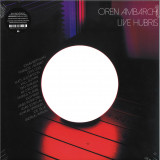
Black Truffle is pleased to announce Live Hubris, documenting the hypnotic and electrifying live performance of Oren Ambarchi’s 2016 LP Hubris by a fifteen-strong band at London’s Café Oto. Over three days in May 2019, Oto toasted Oren Ambarchi at 50/Black Truffle at 10 with Ambarchi and a large group of close friends and collaborators in a series of performances that interspersed existing projects with new collective endeavours, culminating with this: fourteen members of the extended Black Truffle family together on stage, joined by one special virtual guest, to translate the intricately studio-constructed layers of Hubris into a muscular live band workout.
Operating with only the bare minimum of pre-gig preparation after the planned afternoon rehearsal had to be wrapped up prematurely due to noise complaints, the gargantuan group lurches into motion with a 21-minute rendition of ‘Hubris Part 1’, powered by the pulsating electronics of Konrad Sprenger (the ‘ringmaster’ at the ensemble’s core) and no less than seven electric guitars spinning a web of intricately interlocking palm-muted polyrhythms. The layers of closely related but metrically distinct lines create ripples of shifting accents, flickering changes in emphasis that ricochet along the endless central pulse. Gradually building in density, this motorik continuum becomes the backdrop for the haunting tones of Eiko Ishibashi’s processed flute and an extended feature from long-distance guest Jim O’Rourke on guitar synth.
After the brief interlude of the second part, where Albert Marcoeur-esque guitar arpeggios accompany a halting attempt at phone conversation, the full ensemble gears up for the epic side-long rendition of ‘Hubris Part 3’. Now joined by the astonishing triple drum line-up of Joe Talia, Will Guthrie and Andreas Werliin, the layered pulse of the opening piece becomes a burning funk-fusion groove. Beginning on a medium simmer, the ensemble initially stick to its pulsating one-note mantra, over which Ambarchi unfurls a beautiful example of his signature shimmering Leslie-toned guitar harmonics, eventually joined by Ishibashi’s flute and some brooding, distorted dissonance from Julia Reidy’s guitar. Building steadily for the first nine minutes, the heat then rises dramatically with a first, gloriously loose chord change: with the all drummers now rolling and tumbling like a twice-cloned Jack DeJohnette circa 1970, Mats Gustafsson enters on baritone, his tortured roars and shrieks driving the band to peaks of insane intensity. Finally, the exhausted ensemble drops out, leaving only the jagged, skittering fuzz of Ambarchi’s guitar, brought to an abrupt conclusion at the command of crys cole. Arriving on hot pink vinyl with artwork by Lasse Marhaug and an extensive selection of live photos by Ivan Weiss and Fabio Lugaro, Live Hubris brings this ambitious and outrageous evening of music to the safety of the home stereo.
- 1: Victory Dance
- 2: It Beats For You
- 3: Love Love Love
- 4: Magic Bullet
- 5: Laylow
- 6: Lowdown
- 7: Masterplan
- 8: Complex
- 9: Bermuda Highway
- 10: If All Else Fails
- 11: I Think I'm Going To Hell
- 12: Compound Fracture
- 13: Never In The Real World
- 14: Easy Morning Rebel
- 15: Magheetah
- 16: Holden On To Black Metal
- 17: Dondante
- 18: Heartbreaking Man
- 19: Rollin Back
- 20: Phone Went West
Die zweite Veröffentlichung in der MMJ Live-Serie von My Morning Jacket. Aufgenommen live im Auditorium Theatre in Chicago am 11. November 2021 und mit einer Setlist von Karriere-Highlights aus den letzten Jahren: 'Love Love Love', 'Complex' und 'Never In The Real World' vom aktuellen selbstbetitelten Album, sowie die Klassiker 'Dondante', 'Mahgeetah' und 'Phone Went West'. Drei LPs, gepresst auf orangefarbenem Vinyl in limitierter Auflage und verpackt in einem dreifachen Gatefold-Jacket.
GENOCIDE PACT return with their eponymous new album. An overdose of gut-wrenching Death Metal, Genocide Pact is heavy, engrossing, and undoubtedly brutal. "This album reflects on the feeling of watching the world crumble while dealing with personal tragedy," says guitarist/vocalist Tim Mullaney. True to his word - every track on Genocide Pact is a sonic assault brimming with palpable malaise. From the guttural screams in the album's opener "Led to Extinction", to the driving double bass that carries "Perverse Dominion", and a head rattling low end on "Deprive Degrade" - Genocide Pact is wholly negative Death Metal. The fury behind Genocide Pact captures the band's collective frustrations and personal journeys through these turbulent times. "You turn on the news and see mass shootings, a global pandemic, endless war, and corporations and politicians trying to sell you bullshit. You pick up your phone and another friend or family member has died. On top of that, you’re broke as fuck and work endlessly for a boss that doesn’t even know your name. You find yourself paranoid, pissed off, and embracing nihilism," Tim Mullaney says. GENOCIDE PACT have learned to embrace the negativity, churning out one of 2021's ugliest and unforgiving records.
In November 1976, Jef Gilson’s phone rang. What a surprise! It was Serge Rahoerson, one of the musicians he had met in Madagascar at the end of the 60s and who had played on his first album “Malagasy”. Rahoerson announced that he was in Paris for a few days.
Immediately, Jef wanted to organise a recording session, starting the next day. He thought of a trio including Serge, Eddy Louiss on organ and cellist Jean-Charles Capon, who had also been on one of the trips to Tananarive and so had also known Rahoerson there. Unfortunately, Eddy Louiss –who had already played with Gilson and Capon on the album “Bill Coleman Sings And Plays 12 Negro Spirituals” in 1968- had to drop out at the last minute: he was delayed by a session with Claude Nougaro. Jean-Charles Capon had also become a sought-after studio musician since his trip to Madagascar in 1969. He appeared on several key albums on the Saravah label including the now famous “Comme À La Radio” by Brigitte Fontaine, “Un Beau Matin” by Areski and “Chorus” by Michel Roques, without mentioning the album by his own Baroque Jazz Trio. He was also to be found with Jef Gilson for his album on Vogue with the ex-drummer from Miles Davis’ first great quintet, Philly Joe Jones, or also in the orchestra led by Jean-Claude Vannier for the album “Nino Ferrer & Leggs”. He also played regularly on albums by Georges Moustaki.
Jean-Charles Capon and Serge Rahoerson found themselves thus in the studio, with Jef at the controls. He had decided to record the rhythmic structure right away. He would find the soloists later, that didn’t worry him. Serge Rahoerson was on drums. Though a saxophonist by training, Jef remembered that Serge was also capable of great things behind a drum kit: he was the improvised drummer on their cover of “The Creator Has A Master Plan” on the album “Malagasy”... The great memories came flooding back (the nod on the title “Orly - Ivato”), and the old magic worked again.
Brought in momentarily from Europamerica, Gilson’s new big band, in which JC Capon also played, the saxophonists Philippe Maté, from France (another Saravah stablemate) and the American Butch Morris (soon to be a key member of David Murray’s band) were invited to record their parts later and Gilson mixed it all as if it had been one single session (as he had already done on other albums, with the tracks by Christian Vander recorded before the creation and success of Magma).
The album would not appear until 1977, on Palm, Jef’s own label, and was dedicated to the memory of Georges Rahoerson, Serge’s father, who had also played on the album “Malagasy” and who had died prematurely at the age of 51 in 1974.
“I only received my own copy of the album in 1981 when I came to live in France definitively”, a still-moved Serge Rahoerson told us in 2013. “I was playing in a club one night and Jef turned up by surprise with a copy of the album for me, I was so pleased to see him again. When I arrived in France, I told everyone that I had played with Jef Gilson a few years previously, and I was surprised to learn that so few people knew of him. For us, he was of one of the great jazz visionaries.” (Jérôme "Kalcha" Simonneau)
In 2014 The Soul Santas’ first, and only, gig at a
Christmas School Fair was a roaring success, after
which they decided it couldn’t be bettered so didn’t
try. Until, that is, some rehearsal recordings were
found on a phone. These recordings inspired
‘Christmas Crackers, Volume 1’, recorded over two
days in October 2020 at Invada Studios.
The album was released last winter digitally and is
now available on vinyl for the first time.
Pressed on green or red vinyl. The colour isn’t
marked on the packaging so the colour received
will be a lucky dip.
This is a special one. Very much indeed. I was on a train on my way to Galicia earlier this year when my phone started off. It was Mike. Me and him exchange a call every now and then, so I thought it was the classic how-you-doing thing, which of course was. Only that this time the call ended with him saying “I’ve emailed you something, a couple of vocal takes plus the only music line that survived that session which is some great drumming by Gad”. Nothing more. Gad (scratches head)? Who the hell is Gad? When I arrived at destination and found some steady wifi connection I downloaded the stuff and found out “who the hell” Gad was. Nothing less than the “most recorded drummer in the history of soul music” aka James “Big Foot” Gadson who, beside the Kirklands, in his career has been drumming for the likes of Marvin Gaye, Charles Wright, Bill Withers, The Temptations, Martha Reeves, Quincy Jones, you name a Soul Star or a famous album, or a legendary recording session, he was there beating snares and kicks. Having been much satisfied by our work on the “Love Scenario” release Mike wanted us, and I quote him literally, “to do our magic”. We did our best of course, but you just can imagine the pressure. This time we went the extra mile though because at some point, listening again and again to the verses and choruses I figured out it would have been a great experiment to give an ultra retro feel to an original recording of 1980. So, while we were doing our thing I’ve asked my mate Paul from Blue Lotus Recordings in Saint Louis, if they could “do their magic” themselves. They gladly accepted the challenge, I handed them over the vocal takes and Gad’s drumming and the result is this 4 tracks 7”/33 rpm biscuit which we hope you will enjoy as much as we all have enjoyed producing it.
Enterprising composer and musician Eddie Suzuki made his own path throughout his lifetime. Born on October 4, 1929, Suzuki worked as a young shoeshiner in 1940s Honolulu, saving enough money to take piano lessons. In high school, he lead a big band orchestra of 16, and sometimes up to 40 members. By the age of 18, he owned a piano shop that pivoted to become Honolulu’s top guitar store.
For Eddie Suzuki, music always came first. In 1973, after performing and composing songs for many years, Eddie Suzuki and his group, New Hawaii, recorded the now impossibly rare album, High Tide.
The LP is “not a rock-out”, local music journalist Wayne Harada ruminated in a 1973 review. “Rather, it’s one man’s vision — and version — of the now Hawaii.” A seasoned mix of psych, Hawaiian, and pop sensibilities, the music on High Tide gave the listener a look into Eddie’s singular vision celebrating the sights and sounds (and spirit) of Hawaii.
Eddie Suzuki’s New Hawaii:
Laurence Harada, guitar
John Schulmeister, bass
Gary Fittro, drums
Nani Kuaiwa, vocals
Eddie Suzuki, vocals, Hammond organ, Arp synthesizer.
"A beautiful album celebrating Hawaii’s warmth and spirit. The personal story here is that I reached out for a license just 1 week too late — Eddie Suzuki had died the week prior to my initial phone call. It took a couple years until I was able to connect with his son and get his permission to reissue Eddie's music." – Roger Bong, Aloha Got Soul
For those only familiar with her previous releases, aya sinclair’s ‘im hole’ will be a dramatic revelation. Under the LOFT pseudonym, she attracted global acclaim for her fwd-thinking club inversions that juxtaposed the British addiction to breaks 'n bass with critical, self-sluicing logic and untethered abstraction, tearing down dance music's hallowed pillars of respectability while winking knowingly to voyeuristic onlookers. On ‘im hole’ this routine has evolved; aya has distilled the incisive sonic experimentation of her earlier releases, the tongue-in-cheek giggles of her DJ sets and edits, and the identity-fluxing lyricism of her live shows. Contorting language, dialect, gender and sexuality between intermittently controlled bursts of rhythm, noise and aural goop, she has sculpted a set of autobiographical vignettes that challenge established norms, question supposed truths and affirm a spectrum of interlocking experiences. But while it's wide open and personal, ‘im hole’ also challenges queer art's tendency to veer towards repetitive solipsism, the music fragmenting familiar sounds and twinning them with familiar words, assembled in unfamiliar ways. Stories are muddled with phonetics just as dubstep is macrodosed with microtonal drone.The anxious, explorative personality that made aya’s past releases so magnetic is magnified here, and her sense of humour is completely naked. It's a Gregg Araki animated biopic of Burial. It's Shakespeare with hoop earrings and a busted skateboard. ‘im hole’ will physically manifest as a hardback cloth-bound book of lyrics, poems and photographs, designed in collaboration with Oliver Van Der Lugt, with single-use download code included.01. somewhere between the 8th and 9th floor 02. what if i should fall asleep and slipp under 03. once wen’t west 04. dis yacky 05. OoBrosThesis 06. the only solution i have found is to simply jump higher 07. still i taste the air 08. Emley lights us moor (ft Iceboy Violet) 09. Tailwind 10. If redacted Thinks He's Having This As A Remix He Can Frankly Do One 11. Backsliding
Proc Fiskal's second album sees a reorientation of the source elements of his music. Where ‘Insula’ fed off samples of the ramblings of his friends and sounds of his hometown, ‘Siren Spine Sysex’ is laden with an inner voice of sampled Gaelic, Irish and English folk music, contorted and imbued into the futurist body of modern pop; the ghostly anima image of the female folk voice and the lamenting wheeze of the accordion rub against the rush of icey 808s and angles of Grime. Joe Powers’ family history is in folk music, with several of his forebears active in the Scottish Folk revival of the 1960s. It's this cultural baggage - the Caledonian Antisyzygy of the earnest folk tradition he was raised in – alongside the modernist dance music he makes, that brings a personal element to the album. The music of ‘Siren Spine Sysex’ examines dance music as folk music, re-routing them both comparatively, with the wordless emoting of chopped and screwed Gaelic vocals leading to joyous pop songs like ‘8 Mgapixel See Thru Phone’ and 'Leith Tornn Carnal’. Though fast and detailed, ‘Siren Spine Sysex’ feels relaxed and pastoral at times, its edits and drums sensual, swelling, and reactive to the music, its textures influenced by the tinny 16 bit flutes, strings, and wacky scores of gaming soundtracks.
Featuring Anthony Green of Circa Survive, Adam Lazzara and John Nolan of Taking Back Sunday and additional percussion from Benjamin Homola of Grouplove, Fuckin Whatever is a fluid project born of longtime friendships and late nights on the road, but what it could grow to become is entirely unwritten. It all started on the 2016 Taste Of Chaos tour. After Green wrapped his opening set with Saosin each night, itching to play more music, he started setting up impromptu acoustic gigs in the parking lots after his set. One night, his restless energy led to an impromptu backstage jam session with Lazzara, Nolan, Homola, and others––except there were no instruments involved. Using just their voices and a stomp or two in lieu of percussion... before they even realized it, Fuckin Whatever was born. They decided to start recording these nightly jam sessions on their phones, and by the end of the tour, there were literally dozens of recordings. There are some as long as 17-minutes, some recorded in bathrooms, and even one in the legendary tunnel between the stage and sound booth at Red Rocks Amphitheatre in Colorado. What they share in common is the camaraderie of the many talented voices (and sounds) involved. Fast forward to 2020––ugh. With a creative need to continue making and releasing music, Anthony approached the group about releasing some of those recordings. Feeling a similar restlessness, Nolan suggested they try making and recording something for real instead. "I'm Waiting On You" is what came next, and it's truly the spark that led to the rest of this EP coming together. There are zero instruments on Fuckin Whatever's self-titled debut. "It's pretty much 80% mouth noises and 20% Ben slapping things around the house," Lazzara explains. Those voices, however, are among some of the most recognizable in modern rock music, yet here they take on a new life. Call it a band, or a supergroup... it's Fuckin Whatever.
This magnificent project was born in 2006 on one of the most famous labels in the world Mille plateaux . It was in 2006 and just in CD. It was important that a vinyl version existed.
Edith Progue is the project of Paris-based musician, Bernie Swell. After having formed izdatso as a gathering of musicians and visual artists in 1999, Bernie Swell has slowly but surely moved to a more minimal approach towards digital composing. Timeline consists of a chronological report of the different moods experienced by the composer over a 24-hour period of time spent in an apartment overlooking the dark waters of Canal St. Martin in Paris. The dreamy environment created by the melodic sound of an acoustic piano is only troubled by the intrusion of a few micro-electronic beats and sounds. The music was created as an attempt to reconcile the noisy environment that surrounds day-to-day modern urban life with the inner peace that can eventually be found through meditation. While listening to these pieces, you might leave the TV or radio on, or hear a cell phone's new message alert, a fridge sub-bass might rumble or, more simply, an opened window on a busy street would constructively mix with these hypnosonic soundscapes, revealing the hidden art behind any intruding noise/sound manifestation.
The legendary Tony Cook, one of the most influential artists of Funk music, and James Brown’s drummer, has produced many great records since the early 80’s, from Boogie, Electro Funk, and House Music.
This EP showcases the versatility of Tony Cook’s creative repertoire and is a testament to his very unique style of production with unreleased songs.
House anthem Slo Moshun “Bells Of NY” is one of the most iconic gems in the Network catalogue and gets a timely reissue.
The lovingly remastered 12” includes the epic nearly 9 minutes long “House To House Mix” which started the fuss in the first place, plus the much loved by DJs “Xen Mantra Beefy Bells Mix” which like fine wine seems to have matured with age.
It’s almost impossible to explain the hype that exploded when the first copies of this landed in 1993. Network pressed a limited run of the first copies on the Dansa label with
bogus New York producer credits in an attempt to create mystique.
The combination of that relentless uptempo house piano and the break where everythIng slows down underneath a hip hop sample hypnotic proved irresistible, and saturation radio plays from KISS in London turned the track into an instant anthem right away.
The the boss of a rival label boasted they had sourced the track and paid “a fortune” to licence it for UK release. He was making it up as a stampede by labels to locate and release the track began.
Network sensed an opportunity to create major mischief and create even more of a buzz. New York garage producer and Network ally Andrew Komis was enlisted and happily donned the bogus ID of a new kid on the block NYC producer to do phone interviews with UK dance music publications.
His pretend story that Bells Of NY was his homage to the UK House scene laced with Big Apple Hip-Hop was eagerly printed by the magazines.
They were left red faced when the truth emerged that former Nexus 21 and Altern 8 member Mark Archer and his new music making partner Danny Taurus had in fact come up with the gem in homely Staffordshire and not glamorous New York for Network.
All the PR spin in the World would not matter a not if the record didn’t live up to the hype.
Bells Of N.Y did and still does.
It gave Network a first chart hit on their six6 label and more importantly is an all time House Music Classic.
Take One is the cinematic debut release from the minds of Hampshire born emcee Deeflux and seminal producer Kraze. Created through a chaotic and turbulent life journey, the project was born out of the collective need to change direction musically by both artists.
The results are an accomplished and often brutally honest prose, overlaid across a wide range of soundscapes sca-ling the spectrum of alternative rap music. Themed around cinema, each track tells a story like a window into the ar-tists lives covering a range of topics and emotions with Deeflux’s trademark labyrinthine wordplay weaving effortlessly over Kraze’s diverse production.
The LP, originally intended as a mixtape and picked up and pressed by Broke Records was fraught with tragedy. From faulty metal work, lost livelihoods and the eventual loss of all stock it sadly never saw the proposed release until now. Certain Sound received a phone call out of the blue after the stock was
re discovered and have re packaged with the full intended “Directors Cut” as downloadable content in a limited run of coloured and heavy weight black vinyl.
Take your seats and enjoy the show! Artist Bio - Deeflux
Deeflux comes from a diverse musical background. After falling in love with heavy metal at 6 years old he spent his early years as a song writer and guitarist in ska, punk and metal bands before re discovering hip-hop in college where he used the college computers to start his journey beat making.
Finding his voice at 18 he began to craft his style. Influenced by his home town stable of graffiti writers, MCs and beatmakers. he went from working with Reklews (BLAH) to collaborating worldwide on projects such as Oddio Kin.
He has a number of physical releases with his group C O R N E R S (Deeflux, Beit Nun and Benny Diction), live group Natural Selection and last year released 52 singles with his long running DJ Miracle (Boot Records).
Kraze is somewhat of a musical prodigy. In his early teens he was at the epicentre of the first wave of grime and Began DJing on pirate radio & producing music. He eventually landed an artist development deal with EMI & later Sony/ATV.
He was responsible for Devlin’s standout London City and earned two cuts on
his Bud, Sweat and Beers album. During his time with EMI & Sony, he worked with producers such as Naughty-boy, Mojam & Stargate and a variety of artists before eventually leaving the industry to pursue other opportuni-ties. Take One will be his first solo release.
Spirits Having Fun records are ones made from and for shows and spaces—arrangements rooted in a deeply collaborative process, that come to life through intuitive and locked-in live improvisation. Following their 2019 debut Auto-Portrait, Two finds the New York and Chicago based four-piece continuing to challenge ideas of what a rock band can be, pulling apart their musical experiences and reimagining them as kinetic compositions, equally studied but palpably organic.
Two is constructed around gut feelings and strong grooves, elastic rhythms and playful pacing. Its twelve songs expand, contract, and make sharp turns between melodies under singer-guitarist Katie McShane’s meditative lyrics. “Broken Cloud,” which was also released last year on a compilation in support of Chicago Community Jail Support, offers a glimpse into her reflections on the natural world: "A city grew out of the ground / to a mountain it's only a blur."
True to its name, the internal logic of the band is also just a lot of fun, built on trust and deep-rooted musical relationships. Before there was Spirits Having Fun, McShane, bassist Jesse Heasly, guitarist-vocalist Andrew Clinkman, and drummer Phil Sudderberg had performed together in various arrangements over the years. McShane, Heasly and Clinkman met in a specific corner of the Boston underground in 2013, a time when a scene had coalesced around students from local music conservatories frequently collaborating with punk bands and noise artists, exchanging ideas and warping musical worldviews. Heasly and Clinkman played together in Cowboy Band, making mutant, free jazz-inspired takes on old country tunes. When Clinkman moved to Chicago, Heasly and McShane played in experimental groups like EKP and Listening Woman; in Chicago, Clinkman met Sudderberg playing in projects like jazz scene fixture Ken Vandermark’s high-powered band Marker.
Spirits first came together as an attempt at a long-distance collaboration among friends in 2016, driven by the simple feeling of missing each other; they’d meet up for marathon weekends here and there to practice, playing small loops through dive bars and art spaces around the Midwest—just enough for McShane and Heasly to afford plane tickets back home. Being split between Chicago and New York forced the project into a deliberate pace. “We tried to take it slow and let it be what it was,” said McShane. That sense of patience unexpectedly prepared them for March of 2020, when their planned tours and the release of Two were indefinitely delayed.
Two was mostly recorded in the summer of 2019 with the help of omnipresent Chicago engineer Dave Vettraino and DPCD’s Alec Watson, whose contributions on organ, synths, and piano are laced throughout the record. The album reflects a synthesis of solitary and communal songwriting processes—each song drawing on fragments written by individuals, which McShane threaded together and shaped through her distinct compositional lens, making the songs whole before returning to them to the band to mature collectively. When composing, McShane writes first on the keyboard before adapting parts for guitars played by herself and Clinkman. Their dueling approaches to guitar are complementary: McShane, being a newer guitarist, brings a freshness to the project (“I'm just discovering the whole time,” she says) while Clinkman has been playing since childhood.
“There's a lot more collaboration on this record,” says Clinkman, “in terms of all of us letting stuff bloom a little bit more.” The record’s first single, “Hold The Phone” is a good example of this process—it started with a playful intro riff from Clinkman, a melody and bridge added by McShane, a wobbly outro groove added by Heasly, which Sudderberg brought to life. Another single, the dynamic “See a Sky,” written primarily by Heasly, underscores the rhythm section chemistry at play across the record, the song ebbing and flowing around Heasly and Sudderberg’s eclectic percussive palettes.
“Entropy Transfer Partners” is the only song on the record with lyrics by Clinkman, and the album’s most politically direct—a call for solidarity in the face of systemic failures, an acknowledgment of the shared material devastation caused by our country’s ongoing healthcare and housing crises: “These are not things we're experiencing individually. We struggle through them collectively. And we could actually declare, all of us, that it doesn't have to be this way, and fight and organize to ameliorate some of those conditions.” (“We won't work to create the shit you monetize, to run our lives,” they sing.)
From front to back, Two is an absorbing listen simply for its impressive range. But as the members explain themselves, the complexity of the record is about more than its intricate riffs, or how often they count out an odd time signature, but how they reject the notion of boxing the songs in, letting the melodies take on lives of their own. “Making music that feels alive is important to us,” says Clinkman. “Music feels most powerful to me when it deepens our sensation of feeling alive and connected to other humans. It’s so easy to feel worn down and isolated; that your life’s value is fixed to your productivity at your job, or the things that you have or don’t have. Making music that feels joyful and fun seems like one effective antidote to that feeling.”
Standing in the Doorway: Chrissie Hynde sings Bob Dylan.
The songs were recorded in lockdown by Chrissie and her Pretenders bandmate James Walbourne, almost entirely by text message. James would record an initial idea on his phone and send it off to Chrissie to add her vocal, before the tracks were mixed by Tchad Blake (U2, Arctic Monkeys, Fiona Apple). The nine-track album will be released via BMG on 21st May.
Speaking about how the album came together and its inspiration, Chrissie says:
‘A few weeks into lockdown last year, James sent me the new Dylan track Murder Most Foul. Listening to that song completely changed everything for me. I was lifted out of this morose mood that I’d been in.
I remember where I was sitting the day that Kennedy was shot - every reference in the song. Whatever Bob does, he still manages somewhere in there to make you laugh because as much as anything, he’s a comedian. He’s always funny and always has something to say. That’s when I called James and said, ‘let’s do some Dylan covers’ and that’s what started this whole thing.’
Standing in the Doorway: Chrissie Hynde sings Bob Dylan includes Chrissie and James’ versions of In the Summertime, You’re a Big Girl Now, Standing in the Doorway, Don’t Fall Apart on Me Tonight and Tomorrow is a Long Time.