Waking Season is the third full-length album from Beverly, MA post-rock quintet Caspian. The 10-song set was co-produced by Matt Bayles, former keyboard player from Minus the Bear and producer for such seminal albums as Isis’ Oceanic, Botch’s We Are Romans and Mastodon’s Blood Mountain. Waking Season is the follow-up to Caspian’s 2009 album Tertia. 2LP pressing from Triple Crown Records. Guitarist/keyboardist Philip Jamieson on working with Bayles, “We wanted to shake things up and work in a different type of environment, the kind of environment where it wasn’t just us calling the shots all the time. Working with someone who had the credibility to challenge the way we heard the songs outside of our own bubbles was extremely important to us for this record. Matt has a way of pulling the pieces together to make them sound crystal clear, sharp and balanced without removing any raw energy from a track. Working with him was a humbling and enlightening experience and we feel like it really benefited the album.”
Suche:the player
Sumer Is Icumen In is Quentin Thirionet's (Dhavali Giri, Pairi Daeza) debut album. Still, his musical escapades are vast and varied, based almost entirely on improvisation and live recordings, of which he occasionally distributes tapes without further information. Elusive to categorization and identification, unwilling to fix his musical activity under a stable pseudonym, his projects have ranged from gypsy jazz guitar swings, French traditional songs from Auvergne, and various experimental collaborations. Increasingly closer to electronic instrumentation, he crafted what Belgian label KRAAK presents here as Maibaum, his first ever solo output. As the title goes, this may be a maypole on which his multicolored sonic visions spring about.
Former rope access worker and currently a farmer of organic greens, Thirionet lives up to these lines of work as a musician. He assembles precisely what seems like a subtle balance between high manmade structures and soft fertilized soils; a high voltage pylon placed in a biotic landscape. It's all an even blend, spontaneous and steady, but this contraption comes from profound considerations. "I chose these tracks among many others," says Quentin, "because I heard the melodies all the time in my mind, and because I cried while playing them without really understanding why."
Armed with nothing more than a blackbox, a sequencer, a freeze pedal, and a tape player, Thirionet orchestrates a vivid rite of polished futures. At times reminiscent of Hans-Joachim Roedelius' enveloping arrangements, Maibaum's ambiances rely on mild repetitive patterns subsequently textured by prickling sprouts, mechanic dislocations and revamps that stoke and brighten the stirring motions. Jim O'Rourke's I'm Happy and I'm Singing comes to mind in terms of its detailed and prismatic nature, but Sumer Is Incumen In has its particular narrative. It's a tale of regeneration, of spring's delicate procedures and allure, a celebration of gracious and fortunate junctions between nature and machinery.
The album unfolds like a massive engine being made flesh to drift along the ether of a sultry land. The terrain turns pleasant and fertile in the title track; the colors and melodies of May start to unravel. Chromatic columns rise and define the scenery's depth of field breeding a synesthetic stream between crystal lights and warbling organisms. Grande Albero Buono Magico Uoma's brisk kaleidoscopic arpeggios sound like scanning a tree's litmus foliage. Then Ciguri takes us back to the foggy swamp of the beginning but is suddenly lit by an insect’s labyrinthine roundabout. The Jeweled Grid is a poem Quanta Qualia's lustrous metallic voice recites as a report of the album's phenomena. "Shiny revelations jump out. Pearls of thought flicker about." Images from within that distill to swirl around among us. The thicket dissolves as the album concludes calmly in Le Concept De Chien N'aboie Pas. Swaying under sieved solar light, leaves and branches tingle until the winds grow weak. All the warm creatures gathered along the way, and all those who danced around the maypole's splendid equilibrium now withdraw, folding up small to foster rebirth once again.
José Badía Berner
Sunny Crypt is incredibly happy to announce its seventh release: a retrospective compilation of six previously CD-only tracks by Nightmare Lodge, a name that might ring the bell to many enthusiasts of Italian experimental music.
It Passed Like A Dream is a selection of some of our favourite tracks they released between 1994 and 2000, aiming to spotlight a small glimpse of the amazing body of music they did throughout the years.
Nightmare Lodge is a musical project by Minus Habens Records / Disturbance founder Ivan Iusco alongside vocalist B. Mazzilli and bass player Gianni Mantelli, when the Bari based trio decided to decided to embark on a path in search of their own dreamlike musical dimension tied to introspective explorations.
Over the years, the group's lineup evolved, eventually solidifying as a duo comprising Iusco and Russolo.
With their first release dated 1987 and staying active till the early 2000s, it is quite challenging to put the Nightmare Lodge discography in a precise musical box. Their first outings flirted with post-industrial music and a more stripped down sound palette marked by a DIY approach to composition, while in later years leaning towards a more horroresque / cinematic feeling and following the development of new technologies but always charactering their output with a ritualistic, trance inducing and mystical approach, whatever if it’s ambient, downtempo, techno not techno, or a whole lotta else...
The band name is a nod to the eponymous album by Sonny Rollins from 1962, but the project refuses to sound nostalgic. Every performance leads to completely new music, with every player bringing influences from their own generation and background. Recorded by Bartosz Szkielkowski at Pardon To Tu, Warsaw, October 3rd, 2022 (except for LP format extra track). In this quartet Amado gathers three of his strongest longtime influences: German pianist Alexander von Schlippenbach, Norwegian double bass player Ingebrigt Håker Flaten and American drummer Gerry Hemingway. For Amado this band represents a deep dive into his own formative roots, something he has been dealing with more and more in these last few years. With Schlippenbach, Håker Flaten and Hemingway by his side, Amado has the perfect context to explore the classic materials he considers to be the basis of his journey as a musician, an impulse that is part him and part history. This is a quartet whose name really represents, aside from a direct homage to Sonny Rollins, a bridge between different languages, backgrounds and generations, all united through improvisation. Rodrigo Amado - tenor saxophone Alexander Von Schlippenbach - piano Ingebrigt Håker Flaten - bass Gerry Hemingway - drums
- A1: Psycho Killer
- A2: Heaven
- A3: Thank You For Sending Me An Angel
- A4: Found A Job
- A5: Slippery People
- A6: Cities
- B1: Burning Down The House
- B2: Life During Wartime
- B3: Making Flippy Floppy
- B4: Swamp
- C1: What A Day That Was
- C2: This Must Be The Place (Naive Melody) (Naive Melody)
- C3: Once In A Lifetime
- C4: Big Business/I Zimbra
- D1: Genius Of Love
- D2: Girlfriend Is Better
- D3: Take Me To The River
- D4: Crosseyed & Painless
LOS ANGELES—To celebrate the 40th anniversary of the celebrated Talking Heads and Jonathan Demme’s concert film Stop Making Sense, the set will be re-released as a 2LP and 2CD/Blu-ray set this summer.
Released last year, the sold-out Deluxe Edition of the soundtrack will return as a 2-LP black vinyl on Rhino and 2-LP crystal clear vinyl at retail. Both variants feature a 12-page booklet with liner notes from all four band members –Tina Weymouth, David Byrne, Chris Frantz, and Jerry Harrison—and band photos. The 2CD/Blu-ray version includes the entire 28-page booklet from last year’s Deluxe Edition and a Dolby Atmos mix of the complete concert, mixed by Jerry Harrison and E.T. Thorngren, who also mixed the original release. Both will be available on July 26. Pre-order now.
The band appeared together for a sold-out screening and Q&A last night at the Pantages Theater, the same theater at which Stop Making Sense was recorded. They were joined by Blondshell, who performed “Thank You For Sending Me an Angel.” Another special screening with the band will occur in Brooklyn at the King’s Theater on June 13, with the Q&A hosted by Questlove and The Linda Linda’s performing “Found a Job.” The two events cap off a banner year of celebrations for what many consider to be the best concert film of all time.
The inspiration for Stop Making Sense came when director Jonathan Demme saw Talking Heads perform during the band’s 1983 tour for Speaking in Tongues. Afterward, he approached them with the idea of making the show into a concert film. They agreed and worked together over the next few months to finalize the details. Ultimately, Demme filmed three shows at Hollywood’s Pantages Theater in December 1983 to create Stop Making Sense.
The concert film presents a retrospective of the band up to that point, with a performance that weaves together songs from all six of its studio albums. The show progresses methodically, opening with Byrne onstage performing “Psycho Killer” alone with a drum machine. After each song, he’s joined by a new band member until Weymouth, Frantz, and Harrison are all on stage with him. The group continues to grow throughout the concert as members of the stellar touring band are added: keyboardist Bernie Worrell, percussionist Steve Scales, guitarist Alex Weir, and backup singers Lynn Mabry and Ednah Holt.
The band performs 18 songs in Stop Making Sense, including its recent single at the time, “Burning Down The House.” That summer, the song was in heavy rotation on radio and MTV, helping the song become the band’s first top 10 hit in America. It was, however, a different song from Speaking in Tongues that was destined to deliver one of the film’s signature moments. Talking Heads would perform “Girlfriend Is Better” wearing the now iconic, oversized suit inspired by costumes worn in traditional Japanese theater. For good measure, a picture of David Byrne in the suit also graces the album cover.
Stop Making Sense focuses mainly on music by Talking Heads but does include a few songs recorded outside the band: “Genius Of Love” by Tom Tom Club, “What A Day That Was” and “Big Business” from Byrne’s 1981 album, The Catherine Wheel. Limited edition vinyl versions of both of these albums, along with Harrison’s The Red And The Black, were released for this year’s Record Store Day.
When it arrived in September 1984, Stop Making Sense was an artistic and commercial triumph. The film had people dancing in theatre aisles, and the soundtrack sold over two million copies. Just last year, the Library of Congress added Stop Making Sense to the National Film Registry in recognition of its cultural, historical, and aesthetic significance.
Weymouth praises Demme as a collaborator: “…Jonathan was a very enthusiastic, highly adaptive, and imaginative guy who was just as good a listener as he was a talker and collaborator. From the get-go you just got the impression he was as flexible as he was disciplined. Being team players, that boded well for a great relationship and a great film!”
Harrison says the film still holds up today: “To me, Stop Making Sense has remained relevant because the staging and lighting techniques could have been created in a much earlier time period. For example, Vari-Lights, lights with motors to re-aim them, had just come into vogue. Had we used them, there would have been a timestamp on the film, and it eventually would have felt dated...The absence of interviews, combined with the elegant and timeless lighting, created a film that can be watched over and over.”
Byrne says it’s interesting that this album was – for many people – an introduction to Talking Heads. “We had done a live album before this, but coupled with the film, and with the improved mixes and sound quality, this record reached a whole new audience. As often happens, the songs got an added energy when we performed them live and were inspired by having an audience. In many ways, these versions are more exciting than the studio recordings, so maybe that’s why a lot of folks discovered us via this record.”
Frantz recalls the sheer joy surrounding the entire Stop Making Sense experience. “I’m talking about real, conscious, transcendent joy… I’m talking about what the Southern gospel people call ‘getting happy,’ which means ‘to be filled with the Spirit.’ That is what happened to us onstage every night, and from my seat behind the drums, I recognized that this was happening to the audience too. Joy was visible in front of me and all around me every night.”
Beginning in the 60"s, the small chamber group ensemble became increasingly important in the advancement of jazz, enabling horn players including Sonny Rollins, Joe Henderson, and Ornette Coleman to seek uncharted sonic territories and achieve new levels of freedom without the support of chordal instruments. With a mature, cohesive ensemble sound, the young trio juxtaposes tranquility and space with energy and tenacity across nine original compositions showcasing their stylistic breadth. From the swinging waltz "December" with a melodic contour reminiscent of a jazz standard, the soothing folk-influenced simplicity of "Vent", the intimate lyrical interplay between bass and clarinet in "Duo", to the heavy, propulsive power of the title track, the trio demonstrates fearlessness, listening, and spontaneity in a raw and personal recording that puts each of their distinctive voices in the spotlight. Christian Holm-Svendsen, currently resides in New York, studying for a master of music at Manhattan School of Music. In Denmark he played with, among others, The Danish Radio Big Band, Copenhagen Jazz Orchestra, Odense Jazz Orchestra, Jesper Zeuthen, and Regnfang. Daniel Sommer is an award-winning artist and sought-after drummer on the international jazz scene. Known for crossing the borders of different musical landscapes with a distinctive musical approach, Sommer currently performs with Karmen Roivassepp Quartet, Foyn/Hess/AC/Sommer and recently released the trio album "From Within" with Arild Andersen and Rob Luft on April Records. Mariusz Prasniewski is a Polish double bass player, residing in Copenhagen. A part of the Danish and European jazz scene for more than a decade, the bassist has worked with musicians like Tomasz Dabrowski, Anders Mogensen, and Gilad Hekselman.
Limited edition 300 only cyan coloured vinyl LP, housed in a reverse board sleeve with hype sticker, polylined inner bag and download code. Non-Returnable.
Stars align and Oli Heffernan brings his ever-(d)evolving Ivan The Tolerable to Riot Season for two LPs of sublime entropic drift.
Having this time recruited Christian Alderson (The Unit Ama) on drums, John Pope (Ponyland) on double bass, Kevin Nickles (Ecstatic Vision) on flute and saxophone and Ben Hopkinson on electric piano - both works were recorded as a quintet almost instantaneously, the players barely brushing or breathing a note before the whole thing was done.
‘Vertigo’, is all claustrophobic, dense and disorientating - like Sun Ra sitting in with Exploding Star Orchestra
John Hubner (Complex Distractions) on ‘Vertigo’
“An expansive collection of free-flowing sound and mood bringing to mind Coltrane (John and Alice) as well as the great Albert Ayler, while touching on the forward thinking compositions of Rob Mazurek's Exploding Star Orchestra.
From the titanic soundscape of "New Worlds On Earth" to the Marc Moulin touches of "Liquid Voices" and the mysterious eccentricities of "Swimming", 'Vertigo' hangs in the air long after the final note plays.”
Vigil is a (heavy & avantgarde) doom/death metal band from the Unites States, with an aggressive sound - yet emotional and obscure, but also beautiful and emotional. A dark doomy road of sorrow and anger. With two bass players and some influences of post-rock, thrash and progressive metal, Vigil is a showpiece of the apocalypse filtered through ears, hands and emotions. The songs range from old-school European styled doom, with an aggressive death touch, like My Dying Bride, Paradise Lost and Katatonia, all the way to current atmospheric post-rock/metal acts as The Ocean, Isis and Intronaut. There are slow tempos to drag you through the emotional pain, and there are blast beats and thrashy grooves occasionally to spice things up
- A1: Psycho Killer
- A2: Heaven
- A3: Thank You For Sending Me An Angel
- A4: Found A Job
- A5: Slippery People
- A6: Cities
- B1: Burning Down The House
- B2: Life During Wartime
- B3: Making Flippy Floppy
- B4: Swamp
- C1: What A Day That Was
- C2: This Must Be The Place (Naive Melody) (Naive Melody)
- C3: Once In A Lifetime
- C4: Big Business/I Zimbra
- D1: Genius Of Love
- D2: Girlfriend Is Better
- D3: Take Me To The River
- D4: Crosseyed & Painless
LOS ANGELES—To celebrate the 40th anniversary of the celebrated Talking Heads and Jonathan Demme’s concert film Stop Making Sense, the set will be re-released as a 2LP and 2CD/Blu-ray set this summer.
Released last year, the sold-out Deluxe Edition of the soundtrack will return as a 2-LP black vinyl on Rhino and 2-LP crystal clear vinyl at retail. Both variants feature a 12-page booklet with liner notes from all four band members –Tina Weymouth, David Byrne, Chris Frantz, and Jerry Harrison—and band photos. The 2CD/Blu-ray version includes the entire 28-page booklet from last year’s Deluxe Edition and a Dolby Atmos mix of the complete concert, mixed by Jerry Harrison and E.T. Thorngren, who also mixed the original release. Both will be available on July 26. Pre-order now.
The band appeared together for a sold-out screening and Q&A last night at the Pantages Theater, the same theater at which Stop Making Sense was recorded. They were joined by Blondshell, who performed “Thank You For Sending Me an Angel.” Another special screening with the band will occur in Brooklyn at the King’s Theater on June 13, with the Q&A hosted by Questlove and The Linda Linda’s performing “Found a Job.” The two events cap off a banner year of celebrations for what many consider to be the best concert film of all time.
The inspiration for Stop Making Sense came when director Jonathan Demme saw Talking Heads perform during the band’s 1983 tour for Speaking in Tongues. Afterward, he approached them with the idea of making the show into a concert film. They agreed and worked together over the next few months to finalize the details. Ultimately, Demme filmed three shows at Hollywood’s Pantages Theater in December 1983 to create Stop Making Sense.
The concert film presents a retrospective of the band up to that point, with a performance that weaves together songs from all six of its studio albums. The show progresses methodically, opening with Byrne onstage performing “Psycho Killer” alone with a drum machine. After each song, he’s joined by a new band member until Weymouth, Frantz, and Harrison are all on stage with him. The group continues to grow throughout the concert as members of the stellar touring band are added: keyboardist Bernie Worrell, percussionist Steve Scales, guitarist Alex Weir, and backup singers Lynn Mabry and Ednah Holt.
The band performs 18 songs in Stop Making Sense, including its recent single at the time, “Burning Down The House.” That summer, the song was in heavy rotation on radio and MTV, helping the song become the band’s first top 10 hit in America. It was, however, a different song from Speaking in Tongues that was destined to deliver one of the film’s signature moments. Talking Heads would perform “Girlfriend Is Better” wearing the now iconic, oversized suit inspired by costumes worn in traditional Japanese theater. For good measure, a picture of David Byrne in the suit also graces the album cover.
Stop Making Sense focuses mainly on music by Talking Heads but does include a few songs recorded outside the band: “Genius Of Love” by Tom Tom Club, “What A Day That Was” and “Big Business” from Byrne’s 1981 album, The Catherine Wheel. Limited edition vinyl versions of both of these albums, along with Harrison’s The Red And The Black, were released for this year’s Record Store Day.
When it arrived in September 1984, Stop Making Sense was an artistic and commercial triumph. The film had people dancing in theatre aisles, and the soundtrack sold over two million copies. Just last year, the Library of Congress added Stop Making Sense to the National Film Registry in recognition of its cultural, historical, and aesthetic significance.
Weymouth praises Demme as a collaborator: “…Jonathan was a very enthusiastic, highly adaptive, and imaginative guy who was just as good a listener as he was a talker and collaborator. From the get-go you just got the impression he was as flexible as he was disciplined. Being team players, that boded well for a great relationship and a great film!”
Harrison says the film still holds up today: “To me, Stop Making Sense has remained relevant because the staging and lighting techniques could have been created in a much earlier time period. For example, Vari-Lights, lights with motors to re-aim them, had just come into vogue. Had we used them, there would have been a timestamp on the film, and it eventually would have felt dated...The absence of interviews, combined with the elegant and timeless lighting, created a film that can be watched over and over.”
Byrne says it’s interesting that this album was – for many people – an introduction to Talking Heads. “We had done a live album before this, but coupled with the film, and with the improved mixes and sound quality, this record reached a whole new audience. As often happens, the songs got an added energy when we performed them live and were inspired by having an audience. In many ways, these versions are more exciting than the studio recordings, so maybe that’s why a lot of folks discovered us via this record.”
Frantz recalls the sheer joy surrounding the entire Stop Making Sense experience. “I’m talking about real, conscious, transcendent joy… I’m talking about what the Southern gospel people call ‘getting happy,’ which means ‘to be filled with the Spirit.’ That is what happened to us onstage every night, and from my seat behind the drums, I recognized that this was happening to the audience too. Joy was visible in front of me and all around me every night.”
Boxed set of five 7-inch vinyl records, 300 copies limited edition. Artwork poster included.
All tracks remastered from the original master tapes.
Alessandro Alessandroni is no longer remembered simply as 'the whistler' in Morricone's spaghetti western soundtracks – and rightly so, since he was the key figure behind much of Italian 'secret music' from the 60s and 70s, always there in the studio during recording sessions, whether as a multi-instrumentalist or as the leader of session vocal group I Cantori Moderni di Alessandroni. Today his pervasive presence and important role has been finally recognized by music professionals and enthusiasts alike, so much so that he is now considered the true father of Italian library music – a genre whose sound he shaped since 1968.
As a film composer, Alessandroni often worked for small productions that had very limited (and often regional-only) distribution, and whose budgets were worlds apart from those in the 'top league' where friends and colleagues like Morricone, Bacalov, Trovajoli or Piccioni thrived. Rarely released as a soundtrack, this music ended up, at best, forgotten inside dusty ¼-inch reels or, at worst, disappearing into thin air.
After a string of releases that have brought back to life forgotten or lost works by Alessandroni (Sangue di Sbirro, Afro Discoteca, Lost and Found, etc.), it was pretty natural for us at Four Flies to start delving into a little investigated area of his filmography: his scores for erotic films, the last genre to gain popularity in the flourishing Italian film industry of the 60s and 70s, and perhaps the most extreme too, the one that, by pushing things too far, eventually put an end to that industry and its genres.
So, we're now very proud to present Alessandroni Proibito, an exclusive boxed set of five 7-inch records. It contains a total of 14 previously unreleased tracks from the soundtracks of 4 soft-core erotic films that included hard-core sequences and, therefore, fell somewhere in-between normal commercial distribution and the underground scene of adult movie theatres.
Taking an artisanal approach to his musical craft, Alessandroni was not afraid of having to deal with spicy subject matter, wobbly productions, implausible plots, improvised actors, or cinematographers who were clearly no disciples of Storaro. And he was so good at making a virtue out of necessity, at turning budget constraints into creative advantages, that he created soundtracks that far surpass the films' quality, with music that at once captures and elevates the spirit of the erotic genre as if into a condensed symbol.
More specifically, the maestro recorded many of the pieces in a DIY fashion at home, using a 4-track Teac tape machine to arrange his compositions. The Teac allowed him to play different instruments on each track, which meant he could basically put an entire soundtrack together all by himself, or almost all by himself.
These recordings often feature drum machines – which provide that retro, early electronic music vibe – as well as funk guitars and exotic-sounding percussion in the rhythm tracks. In addition, there is an extensive, almost bewildering use of synthesizers to replace solo instruments that would have required a paid session player. On top this minimalist arrangement, Alessandroni layered what he could: some piano chords, a little flute and, most importantly, his signature 12-string guitar phrasing.
The result is just stunning: a unique mixture of electronic music and acoustic instruments, in a style that stops short of kitsch and ranges from cinematic ambient pieces like "Tensione erotica" to disco-funk tracks like "Snake Disco" and "One Sunday Morning", both of which feature vocals by Alessandroni himself.
Alessandroni Proibito comes with artwork by Eric Adrien Lee and a matching 30x70cm folded poster inspired to the insert-size posters which used to be hung outside movie theatres to attract cinema-goers.
The boxed set is being released in a limited edition of just 300 copies and will never be reissued. First come, first served.
Next up in Mr Bongo's Groove Merchant Records reissue series, sees an outing for a much-loved and heavily sampled funk/soul/blues album by Junior Parker. Originally issued under the title The Outside Man on Capitol Records in 1970 with an alternative cover, this reissue replicates the Groove Merchant release titled Love Ain't Nothin' But A Business Goin' On featuring the car cover released in 1971.
The Mississippi-born, Memphis-based blues singer, harmonica player and songwriter Junior Parker (aka Little Junior Parker) had a stellar career in music. Since the early 1950s he released records on labels such as Duke, Mercury, United Artists Records and more. Sadly though, Parker died at the young age of 39 during surgery on November 18, 1971.
Originally released under the alternate title a year before his untimely death, Love Ain't Nothin' But a Business Goin' On is drenched in Parker’s trademark buttery vocals and soulful grooves, swaggering between smokey blues, raw funk outings and orchestrated soul ballads (with sublime arrangements by Horace Ott).
The album also features three Beatles cover versions in the form of ‘Taxman’, ‘Lady Madonna’ and ‘Tomorrow Never Knows’. For 'Taxman', Parker completely reinterprets the song taking into a New Orleans funk realm, a sample of which was used as the main hook line on Cypress Hill's classic 'I Wanna Get High'. Elsewhere, 'Tomorrow Never Knows' is flipped into a tripped-out, psychedelic soul-swamp blues ballad, whilst 'Lady Madonna' is given a funky blues makeover.
As shown with Cypress Hill’s use of ‘Taxman’, since the ‘70s Parker’s legacy has been immortalised for future generations through the deep well of samples that his music has become a source of. Tracks from Love Ain't Nothin' But a Business Goin' On have been sampled by some of the biggest names out there, such as A Tribe Called Quest, DJ Shadow and De La Soul.
A seriously smooth album oozing with soul and emotion from a Blues Hall of Fame inductee, Junior Parker’s Love Ain't Nothin' But A Business Goin' On is a superb example of the early ‘70s crossover funk/soul sound.
Early Mod outings, courtesy of The Blockheads rhythm section!
The Ossie Layne Show - Barcelona 69. EP is the latest vinyl release to become part of the Acid Jazz Records. Rare Mod Series.
This very rare 4-track 33rpm vinyl 7' featuring 'Ian Dury and the Blockheads' bass player Norman Watt-Roy and his brother Garth, led by band leader Ossie Layne.
The EP.s tracks deliver the classic 60.s Soul and Funk sound that Acid Jazz Records and the Rare Mod Series are famous for.
The EP features a version of Rod Stewarts. - Rock My Plimsoll. and Sly and The Family Stones classic 'Sing A Simple Song'.
2024 Re-Release
Newly formed archival label Fresh Hold presents one of Australia’s most mysterious jazz long players - Singing Dust, in collaboration with Efficient Space. Almost bound for obscurity from its inception, the eponymous creation of Queensland-based jazz pianist Robert Welsh was originally issued in 1986 on Melbourne independent label Cleopatra Records. Rich in compositional sophistication and expressive performance, Singing Dust resembles a unique fusion of Indian devotional song, the jazz piano styles of Bill Evans and Keith Jarrett, English folk and Debussey’s tonal impressions, bearing little similarity to the dominant commercial and subcultural music of its time.
Representing a culmination of Welsh’s influences in and outside of music, the dynamic collection of seven compositions accompany the Ghazal devotional poems translated by Australian poet Francis Brabazon. While Singing Dust sits loosely within the spheres of exploration that many jazz players took into world fusion in the '80s, it stands alone in its bright searing light of truth, love and austerity.
A true work of dedication and posterity that will appeal to many serious music lovers, the album has finally been transferred and remastered from original tapes by Dan Elleson, superseding the imperfect 1986 pressing and fully realising Welsh’s expansive vision.
This is the first release from "Wenha", the successor label of "Tribe", which was established by Wendel Harrison in the 70's. This album is full of spirituality and blackness, and it retains the philosophy of "Tribe", but it also incorporates the smooth feeling of the early 80's. This is the first release from "Wenha", the successor label of "Tribe". This is the first release from Wendel Harrison's "Wenha" label, the successor to "Tribe" and a collector's item that has always fetched high prices for its original version, but it has been highly acclaimed not only for its rarity but also for its content, which has made many experts in the industry gasp in delight. This is a superb gem that has made many pundits roar not only in terms of rarity but also in terms of content! The players on the side include Phil Ranelin (Trombone), Harold McKinney (Keyboards), Roy Brooks (Percussion), and many other Detroit heavyweights, including Phil Ranelin (Trombone), who founded the Tribe together. The album starts with "Take Time Out" (A1) featuring soulful vocals, followed by the spiritual jazz "Pink Snowballs And Violet Skies" (A3) with its exhilarating bellow, and then the jet-black groove-filled jazz funk number "Where Am I?" (B1) is a truly historical document that beautifully captures the transition from the '70s to the '80s!
For this reissue, the 7inch "No Turnin' Back / Rocket Love" released at the same time on "Wenha" has been added to VINYL as a BONUS DISC, and a bonus track "Patrina's Dance" (B3) has been added to the LP. This is the latest reissue of the album in a completely new guise!
[h] C1. No Turnin' Back [7-inch]
[i] D1. Rocket Love [7-inch]
- There Were Rebels
- Front-Load The Fun
- Yeah You, Person
- Don't Design Yourself This Way
- Furrowed Sugarloaf
- Rip The Atmosphere From The Wind
- Grow Like A Plant
- No One Displayed The Vigor Necessary To Avert Disaster's Approach
- Blame Yourself
- Instead Of Queen
- Not For Mating, Not For Pleasure, Not For Territory
- Playing Tunes Of Victory On The Instruments Of Our Defeat
It's already hard to describe what Deerhoof sounds like. So we'll skip that part and say this sounds a lot like Deerhoof with a different singer. And in keeping with 30-year Hoofian tradition, melodies soar, big hit earwigs abound, harmonies are complex, and keys change frequently and unexpectedly. Arrangements are in a constant state of impatient agitation. Emotions run high but delivery is usually a falsetto deadpan. We Sang, Therefore We Were is grief delivered in code. Greg plays everything save for a few birds who join in singing now and again. He keeps the instrumentarium severely limited, the sound shambling and anti-slick. It turns out Greg is a really good bass player and guitar player, if a bit more rudimentary and slicing compared to his Deerhoof bandmates. He does play more angry guitar solos. But don't expect another Chippendale/Saunier speed-drum freakout; the songwriting is gorgeous and sophisticated, and drums are almost an afterthought. Here, song is Queen. The singing is high and whispery, tending towards the three-part harmony. What we're saying is: We Sang, Therefore We Were sounds a bit like Deerhoof fronted by The Andrews Sisters. This is a peek inside the mind of one of indie rock's most celebrated drummers, many of whose fans may not even realize the relentlessness of his musicianship and compositional prolificacy. Mozartian chords and sounds insinuate themselves here and there on this record, finally taking over in a big climax at the end, when the drums break off unexpectedly into a laugh-or-cry orchestral outpouring that ironically may be the rawest part of a very raw album. "Satomi, Ed, John and I were chatting between shows in Austin in early December. They encouraged me to make a record on my own. With no one to please but myself, it came together way faster than usual. It was basically done by the holidays. I had been excited by the announcement that the new Rolling Stones record was going to sound 'angry.' I thought, 'Yes, I'm angry too.' But Hackney Diamonds turned out more like cotton candy than punk rock. So I went back to Nirvana. I always loved the catchy melody over massive distortion, the way their songs refused to conform to simple major or minor scales, the dark sarcasm which still resonates in this age of phony blue-check-washing of fascism." The album cover is all text, penned by Greg on the familiar topic of interspecies absurdist operatic anti-Cartesian revolution. The songs' lyrics are all drawn from this epic poem. White House spokespersons are recast as The Queen of the Night from The Magic Flute, The Queen of the Night is recast as a mockingbird singing all night in a battle for survival, and ultimately the mockingbird is recast as a campy drag artist taking pleasure in her own aggressive, tireless music-making.
Following a ten-year hiatus, multi-instrumentalists Rafael Anton Irisarri and Benoît Pioulard return with »How to Color a Thousand Mistakes«, their third LP together as Orcas. Building on the electronic minimalism of »Orcas« (2012) and the Twin Peaks-inspired haze of »Yearling« (2014), the duo have expanded their sound and vision into a full-spectrum ensemble.
In the time since their last major collaboration, Irisarri and Pioulard have done plenty on their own, while also traversing significant life changes: relocation from Seattle to New York, separation and divorce, illness, hospitalizations, and the loss of siblings, parents, and friends. Yet from these tribulations, they gleaned inspiration to reconstruct their lives, creating music with new collaborators and partners. Recorded in a variety of studios and cities including Brooklyn, Cambridge, Oxford, Seattle, and upstate New York, the resulting album, under the tutelage of UK producer James Brown (Arctic Monkeys, Kevin Shields, Nine Inch Nails), is a patiently-crafted beast, equally inspired by impressionism, British new wave, and dream pop.
With Irisarri’s guidance and Brown’s encouragement, Pioulard brings his velvety voice to its harmonized peak on songs like »Wrong Way to Fall« and the Durutti Column-indebted »Fare«. Where his most recent solo albums for Morr Music (»Sylva« and »Eidetic«) navigated foggy forests of ambient pop and stacked tape loops, here his characteristic blur shifts into focus with a unique degree of clarity and confidence. »How fare against balance do I / Navigate my errors?«, Pioulard sings in a heartbreaking tenor, echoing the album’s broader themes of introspection, grief, loss, trial and trauma.
Lead single, »Riptide«, is a summary of Pioulard’s life changes and personal upheavals in the past decade, »flitting eastward toward a yen deep in the past« and learning to glide through the tumult of ocean waves, as a metaphor for the punches one takes in pursuit of grace. Its towering, key-changing midsection arrives with the monumental drumming of Slowdive’s Simon Scott, a long-time friend and cohort who appears on most songs in the set. Scott’s quintessentially English, jazzier approach offers a balance of force and restraint as the backdrop for Irisarri’s majestic guitars, analog synth lines, and Martin Heyne’s Fender Rhodes counterpoints.
Second single, »Next Life«, began as a sketch by Scott, and reached its final form in the hands of Pioulard and Irisarri, at a point that each had endured major concurrent losses, finding a commonality in the need to gaze over the horizon while acknowledging the unavoidable bittersweetness of letting go – not only of people, but of routines, places, and expectations. It’s one of Orcas’ most nuanced pieces, with a mid-tempo, sunset glow that unfolds into a sparkling, slide-guitar finale as it disappears in the rear view.
On third-act highlight, »Bruise«, Scott is doubled on the drum kit by MONO’s Dahm Majuri Cipolla, whose Liebezeit-influenced metronomy anchors a nimble bass groove from Andrew Tasselmyer (of Hotel Neon), and some of the album's most syncopated, spaced-out interplay, courtesy of Puerto Rican guitar player Orlando Méndez (a childhood friend of Irisarri’s). Originally a droney, fingerpicked guitar demo, »Bruise« is the most storied composition here, having gone through almost a dozen versions and lyrical edits, with Brown distilling hours of improvised performances into the final arrangement.
Throughout »How to Color a Thousand Mistakes«, Irisarri uses his deep well of production experience to paint the stereo field with meticulously designed textures, exemplified on the slow burn of »Heaven’s Despite« and the heady rush of »Swells«. As a mixing and mastering engineer with Black Knoll, he has built a client list that reads as a who’s-who of modern, forward-thinking composition, including Temporary Residence, All Saints Records, and Ghostly International, among many others.
As with previous collaborations, Irisarri and Pioulard bring disparate styles and specialties to the table, but with an interpersonal dynamic that transcends friendship into brotherhood, their open-minded workflow and mutual respect are evident at every turn. »How to Color a Thousand Mistakes« brims with tight, complex art rock songwriting, masterful production, and sonic versatility, informed by a plethora of genres and tonal hues. The title might promise answers, but the gravitational center of the album is the dawning realization that, as you reckon with the infinite whims of the cosmos, there could be none.
Perhaps one of the most exciting and anticipated projects in the world of heavy instrumental music is Parlor Greens, a fresh organ trio on Colerine Records! You could say that Parlor Greens are greater than the sum of their parts.. however, the individual parts are simply stellar on their own. Tim Carman (GA-20) on drums, Jimmy James (True Loves, formerly Delvon Lamar Organ Trio) on guitar, and Adam Scone (Scone Cash Players, The Sugarman 3) on organ. Parlor Greens started off as an idea before it even had a name. Carman had been chatting with Colemine label boss Terry Cole about their shared love for organ combo records of yesterday on labels like Blue Note and Prestige. Cole said he'd love to have an organ trio be the first project at the label's new studio, Portage Lounge, located in Loveland, Ohio, So when Carman tapped James and Scone for the session, the stage was set. Carman and Cole had started work a day early to dial in the drum sound, so when the rest of this murderer's row arrived they hit the ground running. It was instant chemistry, Within the first ten minutes of everyone plugging in, a song was written and recorded, "West Memphis". And over the next three days, these three maestros conducted a beautiful and soulful symphony straight to tape. As natural and fun as three old friends getting together after a long absence, only this was the first time they had written and performed together. True magic. So this is the result of that session. Eleven outs. Ten originals. Two sides. All killer, no filler. Straight to the old reliable Tascam 3BB tape machine, mixed up nice and dirty for your enjoyment. Parlor Greens are proud to present their debut long player, in Green / We Dream.
For The Elektric Band’s sophomore outing, Chick Corea - the venerated 27-time Grammy winner and National Endowment for the Arts Jazz Master - entered the studio with Dave Weckl on drums, John Patitucci on bass, and two new players who would solidify the band’s classic line up, guitarist Frank Gambale and saxophonist Eric Marienthal.
More heavily produced than its predecessor, Light Years contains several sequence-driven tracks, Corea’s attempt at reaching out to a wider audience with a brand of music that was tighter, funkier and eminently more communicative than he had recorded on 1986’s The Chick Corea Elektric Band.
The crisp, irrepressibly catchy title track is a prime example of Corea’s more commercial aspirations for the album, with Patitucci laying down a fat, funky groove with some hearty slap bass lines (a distinct flavor of the time), and Marienthal’s pungent alto sax strutting over the top. Not only did this groove-oriented track catch on with listeners, it also won a Grammy for Best R&B Instrumental Performance at the 31st Annual Grammy Awards.
Originally released on GRP Records in 1987, the album also contains the dreamy contemporary jazz offerings of “Second Sight” and “The Dragon,” the sequence-driven “Time Track”, “Flamingo,” featuring Carlos Rios on guitar and, the electrifying, techno tour de force, highly complex closer, “Kaleidoscope.
Sonor Music Editions presents this restored issue of Maestro Sandro Brugnolini's Overground. This elusive masterpiece in library music captures the most impressive work, alongside Underground (1970), of the Italian composer and alto sax player.
Sandro Brugnolini was a prominent member of the Modern Jazz Gang, a famous Italian jazz group, during the 1950s and 60s, which also included Amedeo Tommasi, Cicci Santucci, and Enzo Scoppa. The group was active from 1956 to 1965 and produced some remarkable albums such as Miles Before And After (1960) and the original soundtrack from Gli Arcangeli (1962), which featured the renowned American jazz singer, Helen Merrill. Subsequently, he recorded many of the genre's most iconic releases, including Feelings (1974), albeit uncredited, and ventured into Psychedelic Lounge Funk and Progressive Jazz Beat tunes.
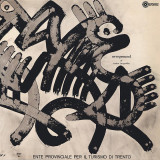
Overground was released on Sincro Edizioni Musicali in 1970 as the soundtrack to Enrico Moscatelli and Mario Rigoni's documentary Persuasione, commissioned by Ente Provinciale Per Il Turismo Di Trento, a local tourism board in Italy, with music composed by Sandro Brugnolini and Luigi Malatesta featuring some of the best musicians in Italy at the time like Angelo Baroncini and Silvano Chimento on guitars, Giorgio Carnini on piano and organ, Enzo Restuccia on drums, and Giovanni Tommaso on bass and effects. The music spans from underground Psychedelic Prog. Rock with swirling organs, trippy effects, and distorted fuzz guitars to sophisticated Lounge grooves with Avant-garde orchestrations.
The music has been transferred and remastered from the original master tapes. It has been lacquer cut in stereo by Jukka Sarapää at Timmion Cutting and packed in a thick cardboard sleeve featuring a fully restored painting by Umberto Mastroianni licensed by Centro Studi dell’Opera di Umberto Mastroianni