
out of Stock
Order now and we will order the item for you at our supplier.
7,86 €
Last In: 5 years ago
Order now and we will order the item for you at our supplier.
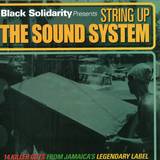
In the beginning of the 80's reggae music became increasingly in tune with what was happening in Kingston's dancehalls....probably more so than at any time since the sound system operators had started to make their own shuffle and boogie in the late 50's..
The international audience and the critics were too busy looking for a new Bob Marley to appreciate what was happening downtown and failed to acknowledge that this was a return to the real,raw roots of the music...brash,confidient,young record producers who were totally in tune with the youth audience stepped forward and seized the moment...
Oswald'Ossie'Thomas began his apprenticeship in the music business at the age of fourteen and served his time as a record salesman for Bunny 'Striker 'Lee and Winston 'Niney the Observer' Holness before moving on to Miss Sonia Pottingers Tip Top Records...
'I ended up working in three record stores on Orange Street from 1976 to 1981...Yeah man,Me deh 'pon me bicycle till I buy my motorcycle..Them days records were coming out left right and centre..everyday'
Ossie Thomas...
It was during his time with Miss Pottinger that Ossie began to produce records for himself and in 1979 Ossie and Phillip Morgan began The Black Solidarity label based deep in the Kingston ghetto on Delamere Avenue.
And the man who had made his name in the business selling other people's records now became one of the most important and influential record producers of the era..
Order now and we will order the item for you at our supplier.

Order now and we will order the item for you at our supplier.

Funny How? is Christophe Chassol’s fifth album.
While it builds directly on his work with the “Ultrascores,” it also marks a turning point: a more contemporary sound, broader songwriting, and more explicitly political and social themes make Funny How? his most accomplished album to date. It’s also his most accessible: inspired by American stand-up comedy, Funny How? sounds like a joyful mix of all the music that inspires the artist: soul, jazz, rap, musicals… Thus, throughout the album, major stand-up figures like Dave Chappelle, Marina Franklin, Dulcé Sloan, and Tiny Thickemz appear alongside emerging comedians filmed in more intimate comedy clubs, composing a moving portrait of the new American scene.
Drawing on archival footage and sequences shot for the project in New York and Chicago, and true to his principle of harmonizing reality, he reveals its hidden notes, replaying and developing them throughout a fascinating process. The result is a major work, a choral, political, and deeply musical narrative. In concert, the work unfolds majestically through a hybrid performance where music and images respond to and converse with one another.
The premiere of Funny How? on April 17 and 18, 2026, at the Cité de la Musique in Paris is already sold out. The album is scheduled for release on May 22, 2026.
expected to be published on 22.05.2026

BLK ODYSSY is an Austin-based artist and producer whose boundary-pushing sound blends soul, hip-hop, rock, funk, and pop. Born in Plainfield, New Jersey, and raised in a household steeped in neo-soul, BLK began channeling his voice through music after the unjust killing of his older brother by police at age 12. That life-altering loss and the experience of growing up Black and male in 21st-century America fuels his raw, layered storytelling. His debut album, BLK VINTAGE (2021), written and produced with close collaborators, served as both a celebration and a critique of Black identity in America. It was met with critical acclaim and re-released in 2022 via Empire as BLK VINTAGE: The Reprise, featuring Mereba, Benny the Butcher, George Clinton, and Baby Rose. The project has since amassed over 100 million streams and positioned BLK ODYSSY as a standout voice in modern soul. His 2023 sophomore album, DIAMONDS & FREAKS, continued his ascent, merging surrealism and social commentary with contributions from Rapsody, KIRBY, Bootsy Collins, Cory Henry, and production from The Alchemist. NPR called BLK “a surrealist R&B auteur,” while Pitchfork praised his ability to bend genre into a cinematic sonic experience. In 2024, following a surreal Tiny Desk performance and festival appearances across Europe—including a headline set at North Sea Jazz Festival and Lollapalooza in Chicago—BLK ODYSSY launched a bold new chapter, with his third studio album, 1-800 FANTASY. The first single from the album, “WANT YOU” (co-produced by Tyler Johnson, known for his work with Harry Styles), marked a shift in tone. That was followed by “XXX” featuring Wiz Khalifa, and “STANK ROSE” featuring Joey Bada$$. Now averaging over 1M+ weekly streams, BLK ODYSSY is unleashing his fourth project, MOOD CONTROL, a ten-track album pushing alt-R&B, soul, and funk to new heights. 1xLP, pressed on Green, Brown & White 3 Color A Side B Side Vinyl.
expected to be published on 22.05.2026
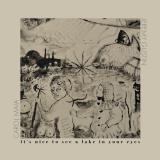
"Carol Maia & Jeremy Gustin’s haunting collaborative album is the result of a long distance partnership during which tracks were traded back and forth across thousands of miles, Jeremy working from his home studio in Brooklyn and Carol from hers in Rio De Janeiro. Later they enlisted support from a number of key players in the Rio scene, Frederico Heliodoro, Paulo Emmery, Ricardo Dias Gomes, and from Brooklyn’s musical community, Will Graefe and Ryan Dugre, to shape this understated masterpiece of sophisticated global pop and quiet experimentalism.
"It's hard to describe what Carol, Jeremy and their guests have achieved on 'it's nice to see a lake in your eyes', a kind of pop music that stands outside of time and is neither Brazilian, American or of any other recognisable place. Maybe it's risen out of the lake they imagined into being? Maybe it's formed like rain in the thousands of miles of air between Rio and New York? Whatever happened was certainly alchemical as you will hear.
"Carol told me her writing on this record was greatly influenced by her reading of Marcelo Ariel's poetry book A água veio do sol, disse o breu so maybe the best thing to do to describe this music is to let you read one of his poems:
A luz do ser é como a água
também veio do Sol
onde todos os planetas querem entrar
Dentro do Sol
O ser é imóvel
como a gratuidade de um êxtase
parecido com a respiração
Fora do Sol
o ser é móvel
Tempo eternidade
e tempo cronológico
The light of being is like water
it also came from the Sun
where all the planets want to enter
Within the Sun
Being is immobile
like the gratuitousness of an ecstasy
similar to breathing
Outside the Sun
Being is mobile
Time eternal
and chronological time
"Jeremy Gustin is an unorthodox drummer, percussionist and songwriter who has toured and recorded with Joan as Policewoman, Iggy Pop, David Byrne, Marc Ribot, Delicate Steve, and Norah Jones. If you follow Hive Mind then you probably know him best from his amazing work on Ricardo Dias Gomes' Muito Sol. Jeremy is also in the experimental pop bands Star Rover and Blurry the Explorer.
"Carol Maia is one of Rio's new generation of singers and musicians currently lighting up the city's vibrant music scene. She also featured heavily on Wolfgang Pérez's album Só Ouço, which was released on Hive Mind in 2025."
expected to be published on 30.05.2026

Burnski is back with another fine bit of A&R on his Constant Sound label, this time with Anil Anas stepping up. He is a producer who has made his mark on the likes of PIV and here kicks off with 'Had Enuff', which brings soulful jungle breakbeats to a house framework complete with police sirens, ragga vocals and 90s organs. It's a fresh blend with a big heart and 'Chrystal Glaze' then brings punchy drum funk and spaced out pads. 'House Fever' ups the energy with more textured drums and trippy synth sequences that help with dance floor take off and 'Trigger Path' closes with pure spaced-house drive. A tasty and tasteful EP packed with utility.
On Stock and ready to ship

2025 Reissue.
Münchenbuchsee, a suburb of Bern, Switzerland. Stephan Eicher is the youngest of three children. His father, a radio and TV repairman, is also a jazz violinist and a sound tinkerer in his spare time. In the family home's converted fallout shelter turned studio, Mr. Eicher experiments with homemade sequencers, tortures handcrafted drum machines, and abuses reel-to-reel tape recorders—all under the fascinated gaze of young Stephan.
The boy quickly develops a musical curiosity, exploring sound through various experiments and wanderings. Alongside his younger brother Martin, Stephan crafts audio plays on a homemade multi-track recorder (essentially several cassette decks hooked together!), which they write, record, add sound effects to, and perform for family and friends. Just a couple of nice kids, really...
Then comes 1972, and Lou Reed's Transformer album changes everything for the Eicher kids. For 13-year-old Stephan, it's a revelation—especially "Vicious", the opening track, which he plays on repeat for months. He convinces his father to buy him an electric guitar. Not stopping there, his father also builds him a tube amp using an old radio.
Then comes adolescence. A rough one. Stephan leaves home at 16 and moves to Zurich. With obvious artistic talent, he persuades his art teacher to help him get into F+F, a radical, alternative art school—despite his young age. Accepted, he starts learning video techniques, determined to become a filmmaker.
At F+F, Stephan organizes Dada-style happenings and concerts with a group of friends known as the Noise Boys. Among them: one of his teachers on bass, Veit Stauffer on drums (who would later found ReR/Recommended Records), his girlfriend Sacha on vocals, and Stephan on guitar. In one of their early performances, they release a remote-controlled mouse covered in dull razor blades into the audience to create panic and chaos. Keeping with this aggressive, confrontational spirit, they once played a concert while wearing headphones blasting Tristan and Isolde, trying to perform their own songs simultaneously—to maximize the cacophony. The goal was always the same: clear the room.
Their “songs,” if you can call them that, followed suit. Take "Hungeriges Afrika", for instance—performed entirely with power drills and some drum feedback.
To make ends meet, Stephan returns to Bern on weekends to work as a waiter at the Spex Club, the city’s main punk venue. On September 16, 1980, during a show by proto-electro group Starter, the police raid the club and arrest everyone. Stephan, who manages to avoid arrest, seizes the opportunity to “borrow” Starter’s gear left behind. He suddenly finds himself in possession of a Roland Promars synth, a Korg MS20, and a gorgeous CR78 drum machine, which he runs through a Big Muff distortion pedal to get that perfect gritty sound.
He then sets out to reinterpret some Noise Boys tracks, reworking them during impromptu sessions recorded on a dictaphone (yes, a dictaphone—now the lo-fi sound makes more sense, doesn’t it?). He ironically titles the resulting cassette "Stephan Eicher spielt Noise Boys" ("Stephan Eicher plays Noise Boys"). This gem features seven tracks, which are the ones reissued here.
Back in Zurich, he visits his friends Andrew Moore and Robert Vogel, who have a DIY cassette duplication setup. They make 25 copies of Stephan Eicher spielt Noise Boys for Stephan and his friends. Robert encourages him to visit Urs Steiger of Off Course Records and play him the tape.
Without much hope, Stephan shows up at Urs’s office. But Urs is instantly hooked and suggests releasing a 7” single. Due to space constraints, they reluctantly drop two of the seven tracks ("Hungeriges Afrika" and "One Second"). As for the musical score featured on the cover—it was randomly chosen and remains a mystery to this day. Calling all music theory nerds!
The 7-inch is pressed in 750 copies and released in the first week of December 1980—a date Stephan remembers well, as it’s the same week John Lennon was killed. Smartly, Urs sends a promo copy to François Murner, Switzerland’s answer to John Peel, who hosts a show on alternative station Sounds. Murner falls in love with the record and starts giving it airtime. To Stephan’s surprise, sales follow—and people actually seem interested in his music.
Even this modest underground success scares Stephan a bit. He stops making music for a year and moves to Bologna, where he works as a programmer at Radio Città, a feminist radio station.
Meanwhile, Stephan’s younger brother Martin, who’s also involved in the punk scene, joins the band Glueams as a singer and guitarist. Glueams, named after the fanzine run by two of its members (drummer Marco Repetto and bassist GT), eventually rebrands as Grauzone. Stephan is invited to their shows to project hacked Super 8 visuals live on stage.
Urs Steiger, now working on a compilation titled Swiss Wave – The Album, asks Grauzone to contribute alongside bands like Liliput, Jack and the Rippers, The Sick, and Ladyshave (Fall 1980).
For the album, Martin tasks Stephan with producing their recording sessions. Under Stephan's artistic direction, two tracks emerge: "Raum" and "Eisbär". During "Eisbär", Martin plays a minimalist bass line borrowed from post-punk band The Feelies (just an open string). Drummer Marco Repetto struggles to keep time. Later that evening, unhappy with the takes, Stephan builds a four-bar drum loop from a ¼-inch tape and uses it instead of the flawed original. He then adds bleepy synths and wind sounds to complete the track’s icy vibe before handing it over to Urs.
The Swiss Wave – The Album compilation is released quietly at first, but things snowball thanks to "Eisbär", which eventually becomes a smash hit—selling over 600,000 singles.
Meanwhile, Stephan plays in a rockabilly band called SMUV (named after Switzerland’s social security agency) and begins producing artists, including the debut album of Starter (1981), which includes a more pop-oriented version of "Minijupe".
By early 1982, Stephan starts spending time with the post-punk girl band Liliput (formerly Kleenex). They’re older than him, and he happily drives them around in his Renault Major, acting as their roadie.
By 1983, Grauzone—signed to the major label EMI, which turned out to be a misstep—is falling apart. Stephan begins to pivot toward a more mainstream pop sound with his debut solo album Les Chansons Bleues.
But that... is already another story.
On Stock and ready to ship
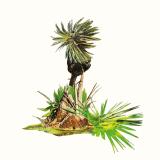
Música para Plátanos takes its name — and much of its inspiration — from the group’s recording studio, situated in the heart of a banana plantation on the humid north shore of Tenerife, Canary Islands. The ever-present sight of the green, sun-drenched fields surrounding their weekly sessions seeped directly into the music: improvised jams that are playful, layered, and deeply connected to place.
This release gathers a distilled selection from those sessions — a kind of “greatest rotten hits” distinct from their ongoing Imaginary Island Music volumes.
The album functions as a living archive bringing together a distilled selection of recordings spanning more than five years: from dusty, long-forgotten sessions to evolving tunes that have become staples of the band's live sets but have never before been committed to record. These long-form sessions served as a petri dish for the Lagoss sound, allowing their experiments to putrefy into their chaotic signature strain of cyber-exotica, unstable kosmische or heavily-corroded dub.
The title obvs nods to Brian Eno’s Music for Airports, but the logic is inverted. Instead of clean, ambient drift, the record inhabits a dense and fertile environment: polyrhythmic structures, Latin-infused electronics, and shifting counter-tempos that feel weighted by the local humidity.
Ultimately, Música para Plátanos is as much about the process as it is the place. Like the plantation outside, the music is subject to the elements; the tracks change shape depending on the heat of the day, what we drank, what we ate. It’s an unstable, honest harvest of sound—shaped by the weather and the state(s) of mind alike.
expected to be published on 19.06.2026

Hidden Spheres is a Rhythm Section mainstay for a reason: having released 3 EPs on the label, he has
developed his sound and fully emerged into a flow state. His residency at Public Records has enabled him to mould an EP perfect for any dancefloor, perfecting a Detroit indebted House style with influences from early Kerri Chandler and Ron Trent perfect for those heads down, hands-up moments.
Delivering 5 tracks that master dancefloor tension, it's difficult to pick a stand out. “Come On, Yeh” harks
back to the New Jersey House sound with dubby organ chord stabs and punchy 909 drums and a sublime bongo loop. “Don’t You Wanna” welcomes the house dancers, with a low-slung, heavily swung groove, resampled pads, and a deep spoken refrain that gives the track its title. Kicking off the B-side “Get Down” hits the subs, with unmistakably phat bass, moody strings and broad use of the iconic M1 organ bass patch “Organ2”. Followed by “I Feel Good” brings police sirens, 808s and swirling pads, to a glorious Deep House tune with a top chime motif that keeps the party moving. The final track of the B side, “You Don’t Know”, takes things down a notch, but maintaining the sublime tension with classic house piano chords and another wicked percussive loop.
Hidden Spheres has returned to his unadulterated House roots, with an EP that stays true to the classic sound. He has shaped an awesome body of work with character from deep spoken word samples, perfect use of dub sirens and grooves that can give any club a reason to invest in bigger
On Stock and ready to ship

On Stock and ready to ship
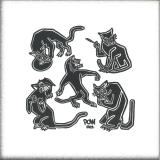
Night Prologue POW001
Panthers on Wax kicks off its catalogue with Night Prologue, a VA that dives head-first into the night from the dark pulse of the club to its most intimate afterglow.
Bringing together four defining voices of the contemporary French underground, the release unfolds like a nocturnal tale in two acts.
Side A hits with two floor-focused weapons:
P.O ignites LA VOITURE DE LA POLICE, a raw mechanical surge « It doesn't matter who did it as long as it burns. »
N2O pushes deeper with DISTO PIA, where distortion fractures, breathes, and rebuilds « Darkness dances, the heart cracks, and the night puts its pieces back together. »
Side B shifts into emotional territory:
PAGENTY delivers LE VENT CHUCHOTE TON NOM, a nostalgic synth drift « The nights are endless oceans in which I search for you. »
LORYN wraps the record with GINI, a glowing synthwave shimmer « More than a soda, Gini holds a forever echo »
From new beat and electro to techno and synthwave, Night Prologue carves out the Panthers on Wax identity, nocturnal, hybrid, and driven by narrative.
On Stock and ready to ship

The Éthiopiques series returns! Essential archive recordings from an extremely fruitful period in Ethiopian music.
Before “Swinging Addis” took over the world, there was Moussié Nerses Nalbandian — the Armenian-born composer who shaped modern Ethiopian music. Mentor, arranger, and pioneer, he laid the foundations of Ethio-jazz.
This Éthiopiques volume revives his forgotten legacy, recorded live by Either/ Orchestra First issue ever with new exclusive photos and in depth liner 8-page insert.
“Ethiopian jazzmen are the best musicians that we have seen so far in Africa.
They really are promising handlers of jazz instruments.”
Wilbur De Paris
(1959, after a concert in Addis Ababa)
አዲስ፡ዘመን። *Addis zèmèn* **A new era.**
The time is the mid-1950s and early 1960s, just before "Swinging Addis" bloomed – or rather boomed – onto the scene. Brass instruments are still dominant, but the advent of the electric guitar, and the very first electronic organs, are just around the corner. Rock’n'Roll, R’n’B, Soul and the Twist have not yet barged their way in. Addis Ababa is steeped in the big band atmosphere of the post-war era, with Glenn Miller's *In the* *Mood* as its world-wide theme song, neck and neck with the Latin craze that was in vogue at the same period. Life has become enjoyable once again, with the return of peace after the terrible Italian Fascist invasion of Ethiopia (1935-1941). The redeployment of modern music is part and parcel of the postwar reconstruction. *Addis zèmèn* – a new era – is the watchword of the postwar period, just as it was all across war-torn Europe.
The generation who were the young parents of baby boomers** were the first to enjoy this musical renaissance, before the baby boomers themselves took over and forever super-charged the soundtrack of the final days of imperial reign. Music is Ethiopia's most popular art form, and very often serves as the best barometer for the upsurge of energy that is critical for reconstruction. Whether it be jazz in Saint-Germain-des-Prés or the *zazous* who revolutionised both jazz and French *chanson* after the *Libération*, be it Madrid's post-Franco Movida, or Dada, the Surrealists and *les années folles* that followed World War I, the periods just after mourning and hardship always give rise to brighter and more tuneful tomorrows. Addis Ababa, as the country's capital, and the epicentre of change, was no exception to this vital rule.
**Two generations of Nalbandian musicians**
Nersès Nalbandian belonged to a family of Armenian exiles, who had moved to Ethiopia in the mid-1920s. The uncle Kevork arrived along with the fabled "*Arba Lidjotch*", the** "*40 Kids*", young Armenian orphans and musicians that the Ras Tafari had recruited when he visited Jerusalem in 1924, intending to turn their brass band into the official imperial band. If Kevork Nalbandian was the one who first opened the way of modernism, pushing innovation so far as to invent musical theatre, it was his nephew Nersès who would go on to become, from the 1940s and until his death in 1977, a pivotal figure of modern Ethiopian music and of the heights it. Going all the way back to the 1950s. Nothing less. And it is Nersès who is largely to thank for the brassy colours that so greatly contributed to the international renown of Ethiopian groove. While the younger generations today venture timidly into the genealogy of their country's modern music, often losing their way amidst a distinctly xenophobic historiographical complacency, many survivors of the imperial period are still around to bear witness and pay tribute to the essential role that "Moussié Nersès" played in the rise of Abyssinia's musical modernity.
Given the year of his birth (15 March 1915), no one knows for sure if Nersès Nalbandian was born in Aintab, today Gaziantep (Turkiye/former Ottoman Empire) or on the other side of the border in Alep, Syria... What is certain is that his family, like the entire Armenian community, was amongst the victims of the genocide perpetrated by the Turks. Alep, the place of safety – today in ruins.
Before Nersès then, there was uncle Kevork (1887-1963). For a quarter of a century, he was a whirlwind of activity in music teaching and theatrical innovation. *Guèbrè Mariam le Gondaré* (የጎንደሬ ገብረ ማርያም አጥቶ ማግኘት, 1926 EC=1934) is his most famous creation. This play included "ten Ethiopian songs" — a totally innovative approach. According to his autobiographical notes, preserved by the Nalbandian family, Kevork indicates that he composed some 50 such pieces over the course of his career. This shows just how much he understood, very early on, the critical importance of song as Ethiopia's crowning artistic form. Indeed, for Ethiopian listeners, the most important thing is the lyrics, with all their multifarious mischief, far more than a strong melody, sophisticated arrangements or even an exceptional voice. (This is also why Ethiopians by and large, and beginning with the artists and producers themselves, believed for a long time — and wrongly — that their music could not possibly be exported, and could never win over audiences abroad, who did not speak the country's languages).
Last but not least, one of Kevork's major contributions remains composing Ethiopia's first national anthem – with lyrics by Yoftahé Negussié.
Nersès Nalbandian moved to Ethiopia at the end of the 1930s, at the behest of his ground-breaking uncle. Proficient in many instruments (pretty much everything but the drums), conductor, choir director, composer, arranger, adapter, creator, piano tuner, purveyor of rented pianos,... he was above all an energetic and influential teacher. From 1946 onwards, thanks to Kevork's connexion, Nersès was appointed musical director of the Addis Ababa Municipality Band. In just a few years, Nersès transformed it into the first truly modern ensemble, thanks to the quality of his teaching, his choice of repertoire, and the sophistication of his arrangements. It was this group that would go on to become the orchestra of the Haile Selassie Theatre shortly after its inauguration in 1955, which was a major celebration of the Emperor's jubilee, marking the 25th anniversary of his on-again-off-again reign.
At some point or other in his long career, Nersès Nalbandian had a hand in the creation of just about every institutional band (Municipality Band, Police Orchestra, Imperial Bodyguard Band, Army Band, Yared Music School…), but it was with the Haile Selassie Theatre – today the National Theatre – that his abilities were most on display, up until his death in 1977. To this must be added the development of choral singing in Ethiopia, hitherto unknown, and a sort of secret garden dedicated to the memory of Armenian sacred music, and brought together in two thick, unpublished volumes. Shortly before his death (November 13, 1977), he was appointed to lead the impressive Ethiopian delegation at Festac in Lagos, Nigeria (January-February 1977).
His status as a stateless foreigner regularly excluded him from the most senior positions, in spite of the respect he commanded (and commands to this day) from the musicians of his era. Naturally gifted and largely self-taught, Nerses was tirelessly curious about new musical developments, drawing inspiration from the very first imported records, and especially from listening intensely to the musical programmes broadcast over short-wave radio – BBC *First*. A prolific composer and arranger, he was constantly mindful of formalising and integrating Ethiopian parameters (specific “musical modes”, pentatonic scale, and the dominance of ternary rhythms) into his “modernisation” of the musical culture, rather than trying to over-westernise it. It even seems very probable that *Moussié* Nerses made a decisive contribution to the development of tighter music-teaching methods, in order to revitalise musical education during this period of prodigious cultural ferment. Flying in the face of all the historiographical and musicological evidence, it is taken as sacrosanct dogma that the four musical modes or chords officially recognised today, the *qǝñǝt* or *qiñit* (ቅኝት), are every bit as millennial as Ethiopia itself. It would appear however that some streamlining of these chords actually took place in around 1960. It was only from this time onward that music teaching was structured around these four fundamental musical modes and chords: *Ambassel*, *Bati*, *Tezeta* and *Antchi Hoyé*. A historical and musical “details” that is, apparently, difficult to swallow, especially if that should honour a *foreigner*. Modern Ethiopian music has Nersès to thank for many of its standards and, to this day, it is not unusual for the National Radio to broadcast thunderous oldies that bear unmistakable traces of his outrageously groovy touch.
On Stock and ready to ship

The latest release from the Villains Inc. camp delivers an Italian-made electro gem.
And as the saying goes: Villains do it better! After the soulful "Time To Go Back EP" back in 2022, the "Generation V EP" (limited to 300 copies) marks the arrival of fresh talents joining the collective. This new wave steps in after the tragic loss of some of the label key figures, carrying the torch and keeping the Villains Inc. spirit alive.
Side A opens with "Vaccin", a hypnotic yet funky electro-bass track by Deepvision and Lefka. Despite their young age, the duo U.A.G.L.I.O. shows remarkable musical maturity and delivers a powerful debut. Expect to hear much more from this awesome team in a near future.
Next comes "FM Resistance" by Jack Bags (half of Dr. Boomer). A synthetic ride of swirling URish style sequences, darkened by moody strings. Breakdance moves guaranteed on the dancefloor!
On the flip, Index Case teams up once again with the late X-Beat (RIP) to provide a furious "Against" anthem, calling for "revolution against the government, against the police". The frantic rhythm and unsettling atmosphere push the track into gloomier territory in a powerful way.
Closing the record, Antizer0’s founder Zora Neti concludes the 12" with "Stereocash_(Pt.2)", a downtempo storm built upon eerie voices and mental sororities. A haunting yet masterful finale.
The legacy of the original V members lives on. Special mention to Simonloop aka Urbanmagic, one of the OG Villains, whose artwork on the B-side captures the grit of the music and makes the vinyl worth owning on its own.
From start to finish, Generation V EP is a masterclass. Crafted with the unmistakable Villains Inc. sound by label owner Gab.Gato, it’s pure underground quality. This record is dedicated to the memory of X-Beat and Yo Flava. Once a Villain, forever a Villain. Support the underground!
On Stock and ready to ship

An’archives is proud to present Hanabi, a compilation of material from legendary Japanese folk singer, actor and writer, Kazuki Tomokawa. Hanabi draws from Tomokawa’s three most recent albums, Vengeance Bourbon (2014), Gleaming Crayon (2016) and Going To Buy Squid (2024), all released in Japan only on the Modest Launch imprint. Pulling together highlights from these three extraordinary albums, Hanabi collects ten songs of shattering intensity, with Tomokawa performing at an ecstatic peak, a mere six decades into his musical career.
Tomokawa’s life story is one of change, risk and dedication. He appeared on the Japanese folk music circuit in the early 1970s, performing at such significant events as the legendary 1971 Folk Music Jamboree. Over the second half of the decade, he released five stunning albums that cemented his reputation as an expansive, lyrical singer-songwriter and performer whose music jack-knifed between pensive melancholy and righteous fury. His recorded output slowed in the 1980s as he became immersed in theatre, acting and painting, but his connection with the sainted Japanese label P.S.F. led to a prodigious burst of albums across the 1990s and 2000s.
Some of those albums had Tomokawa playing alongside free jazz musicians, such as his long-standing collaborator Toshiaki Ishizuka (Brain Police, Vajra, Cinorama), and late double-bass improviser Motoharu Yoshizawa. Some of that spirit can be found amidst the songs on Hanabi, leavened by a more romantic sensibility on a song like “Night Play”, where Tomokawa’s impassioned vocals and guitar swim and bob amongst a drifting string arrangement. The ferocity of “To The Dead Man” is reinforced by a guest appearance, on saxophone, by upcoming free jazz player Harutaka Mochizuki; the two spar with each other while Hiromichi Sakamoto’s cello and electronics swarm under the surface.
For those who’ve missed the three albums that Tomokawa has released across the past fifteen years – understandably so, given the relative impossibility of finding them outside of Japan – Hanabi is a welcome re-introduction to one of Japan’s most significant, poetic and quixotic folk singers and songwriters. As Michel Henritzi notes in his typically perceptive liner notes, capturing the oneiric and unique spirit of Tomokawa’s song, he is nothing less than “a poet who cries out, opening the darkness and shadows with his song, throwing handfuls of ashes from lives that have fled into the wind, to us, his fellow human beings.”
On Stock and ready to ship

The black and white hoverbike flew out of the fog at breakneck speed and raced through the neon-lit urban jungle of the Havan metropolis. It manoeuvred steadily between the skyscrapers, trying to throw off the tail of the corporal's convoy, which was getting closer by the moment, preventing it from sneaking away with the seemingly easy-to-get Zero-G prototype. This weapon could create an anti-gravity field with a single shot and disable even the largest battle cruiser. That's why an elite squad of cyber-soldiers equipped with modified implants and gadgets was sent in pursuit not to allow them to ease off for a second.
With a sharp steering wheel jerk, Spacelunch turned off the main street and into a narrow alley. "Your turn!" – He shouted insistently over the engine's roar. Cat rose from the back seat, took aim, and deftly fired his blaster. In a pall of sparks and smoke, the pursuer's hoverbike spun out of control and crashed into the building. Gritting their teeth, the friends raced through the winding maze of obstacles and tight turns. All senses were heightened with excitement. They could see a gap ahead and a way out into the slums.
Suddenly, a heavily armed police drone blocked the road, aiming its red gun lights at them. Spacelunch decisively grabbed Cat and jumped into the so-fortunately spotted sewer manhole, barely managing to dodge the gunfire barrage. After landing in a pitch-dark narrow tunnel, they moved on, with every step feeling the growing tension in the air and realizing that they could be found out at any moment. The darkness seemed endless. The only consolation was that they had the prototype in their hands, and now all they had to do was get to the spaceship and get off this freaking planet.
On Stock and ready to ship

After the conceptual depth of "Parallel Traces of the Jewel Voice" (2021), dj sniff returns to Discrepant with a more direct and visceral document: Turntable Solos.
Composed from live recordings made during the latter half of 2024, Turntable Solos captures dj sniff’s improvised performances in their rawest form. At the core of his setup is Cut ’n’ Play, a software sampler he originally built in Max / MSP in 2007. Since then, he has continued developing custom tools and instruments that extend what Derek Bailey called the “instrumental impulse” — the tactile, responsive relationship between musician and machine that defines improvisation.
Following a summer 2024 tour of Japan with Gonçalo Cardoso, sniff was encouraged to document and release a selection of his live sets. Not long after, a performance at 20α (Alpha) in Hong Kong would become the emotional and conceptual anchor for the project.
In the liner notes, sniff reflects on the eerie parallels between recent footage of protestors in Los Angeles — assaulted by police using so-called “less-lethal” weapons, and civilians being abducted into detention centers — and the 2019 Hong Kong protests. A place once filled with personal nostalgia began to feel like a grim foreshadowing of what might unfold in Western societies.
In this turbulent context, 20α stands out as a space of resistance and renewal — a beacon for a new generation of experimental musicians, growing in defiance of increasing censorship and surveillance. "Turntable Solos" is both a personal statement and a public act of sonic resilience.
On Stock and ready to ship
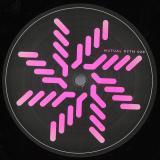
Pic Cover[14,92 €]
Aussie techno innovator Alpharisc returns to Mutual Rytm for a second standout EP.
Shane Yates, aka Alpharisc, has been living and breathing techno for over 30 years. He first began producing in the mid-90s and has amassed a fine hardware collection that lends his sounds a raw, rugged feel. After breaking through with the Wetmusik party and label collective, he has let his music do the talking and isn't afraid of colouring it with a hint of nostalgia. Previous material has come via several notable labels over the years, but his most recent outings have been on SHDW's Mutual Rytm imprint, with his solo EP 'Ram Face' from 2023 becoming an underground favourite alongside a fine outing as part of the label's 'Federation Of Rytm II' and 'Federation Of Rytm III' compilations. Once again, he returns in style, uncovering an impactful selection of gems across his new 'Remain Seated' EP.
The opener 'Peace Be With You' is a straight-up techno weapon with urgent synth flashes peeling off the groove like a police siren. The drums hit hard in true Alpharisc style before 'Hail' builds on that with a more hard-edge groove topped with frosty waves of white noise that electrify the dance floor. 'Remain Seated' brings a hint of trance-leaning energy with its bright sheets of synth lighting up the driving drums and saw-tooth bass loops. Next, 'Look At This' is another brilliantly forceful techno sound with slamming drums and rusty synth loops, layering melancholic pads up top and adding a cerebral edge, while closer 'In Your Mind' is from the Jeff Mills school of synth-laced and serene deep techno with lush pads radiating cosmic light. As a bonus, digital-only cut 'Expedition' brings some backlit celestial synth work to a rubbery and pummelling drum pattern for pure techno escapism.
On Stock and ready to ship

Red Vinyl[27,31 €]
Mr Bongo proudly presents Ritmo Italiano ‘Unspoken Sounds of Italian Tamburo’ a captivating compilation of percussive-driven, Italian gems curated by Sardinian multi-instrumentalist, percussionist and producer, Gabriele Poso. A journey into the heart of Italian musical history, it celebrates Italy’s rich rhythmic traditions, showcasing a selection of genre-traversing, Italian treasures from the ‘60s to the early ‘90s. Honouring the timeless rhythms of Italian percussion masters, alongside a brand-new exclusive composition by Gabriele, ‘Ritmo Italiano’ shines a light on the universal, primal language of the drum.
A connection sparked from an early age; percussion has always deeply resonated with Gabriele. It led to years of studying percussion traditions across Cuba, Puerto Rico, and Brazil, crafting his own songwriting skills in the process. An acclaimed producer and compiler, his releases on Yoruba Records, BBE and Soundway Records have garnered global support. Yet a growing need to rediscover the essence of his country’s cultural heritage laid the foundations for this new compilation.
In Gabriele’s own words, “Italy has always been a crossroads of civilizations, with influences from the Mediterranean, North Africa, the Middle East, and Europe converging over centuries. Ports like Naples, Genoa, and Venice played a crucial role as gateways for musical exchange, a melting pot of sounds and cultures brought by sailors, merchants and travellers. These influences blended with Italy’s own folk and religious traditions, creating Italy’s unique and emotionally resonant rhythms.”
Across the 12 absorbing tracks, there’s jazz influences, Italian library music aesthetics and experimental beats mixing with Afro-Cuban and Mediterranean rhythms. It’s a broad selection anchored by the drums. The synth-heavy, ‘80s jazz funk flavours of Gegè Munari's ‘Police Man’, sit side-by-side with the samba-infused ‘Napulitano D' 'O Brasil’ by Don Marino Barreto Jr. Tribal, earthly energy radiates from Naco’s ‘Volando Con Milton’, with Tullio De Piscopo serving up cosmic disco brilliance, and blistering jazz funk mastery coming courtesy of Agostino Marangolo. Taking the name of the compilation, a new original track by Gabriele, ‘Ritmo Italiano’, blends traditional rhythms with contemporary energy, Afro-Latin influences with Italian jazz essence. Recorded live in one take, it captures a raw, unfiltered vibe.
“Each track tells a story, connecting the past with the present, and highlighting the deep-rooted traditions that shape Italy’s rhythms. The collection also offers a glimpse into the diversity of Italian music with a variety of styles from the organic, earthy beats to the more experimental and modern takes on traditional rhythms. It’s a reflection of how these rhythms have not only shaped Italian culture but also influenced global music.”
On Stock and ready to ship

On Stock and ready to ship
