We are excited to announce the release of the highly anticipated 7-inch single from the rising singer-songwriter Mei Watanabe, created in collaboration with Shinichi Osawa (MONDO GROSSO). This special release marks the debut of the track on vinyl, and it includes the previously unreleased Shinichi Osawa DJ edit on the B-side, making it a must-have for collectors and music lovers alike.
This new single, which reflects Mei Watanabe's exploration of questions about the uncertain world we live in today, was created through over six months of sessions between Watanabe and Osawa. Inspired by Osawa's artistry and music, the track features lyrics penned by Watanabe herself, showcasing her unique vision and voice.
Since its digital release last October, the song has been featured as a Power Play on FM NORTH WAVE and CROSS FM, among many others, and has been receiving significant airplay, generating excitement and buzz across the airwaves.
Suche:the questions
- 1: #4
- 2: #7
- 3: #
- 4: #
- 5: #2
- 6: #10
- 7: #11
- 8: #
- 9: #
The work of each of these powerfully creative & exceptionally perceptive individuals - poet and scholar Fred Moten and jazz bassist Brandon Lopez - concerns itself with how one might navigate the ascending reign of longinstitutionalised madness while simultaneously keeping humanity and sanity intact The synergistic mesh of these two voices in Duo is here presented on record for the frst time, following two acclaimed works on the Reading Group label in trio with Gerald Cleaver. Inimitable poet, cultural theorist, author, 2020 MacArthur Fellow, Fred Moten creates new conceptual spaces that accommodate emergent forms of Black cultural production, aesthetics, and social life. Moten is a professor of performance studies and comparative literature at New York University concerned with social movement, aesthetic experiment, and Black study. He is also a United States Artists Rockefeller Fellow and was elected to the American Academy of Arts and Sciences. Puerto Rican- American bassist Brandon Lopez is the son of a gravedigger who himself put time in doing the same, developing muscles that serve him well in his thorough command of the upright bass. On moving to NYC, Lopez made himself indispensable within numerous realms of creative music. As the Cleveland Review of Books noted, "This is virtuosity as vocabulary, a total command of texture, subtlety, and a depth that can be reached into."
On their previous work in trio with Gerald Cleaver:
"Best Jazz Albums of 2022: Moten is after nothing less than a full interrogation of the ways Black systems of knowledge have been strip-mined and cast aside, and yet have regrown." - New York Times
"8.0 - A conceptually rich, politically weighty album that asks timeless questions without over-explaining...breathlessly complex" - Pitchfork
Fred Moten: texts, voice
Brandon Lopez: bass
- A1: Do U Fm
- A2: Novelist Sad Face
- A3: Green Box
- A4: Dusty
- A5: The Linda Song
- A6: Dm Bf
- B1: I Tried
- B2: Melodies Like Mark
- B3: Wildcat
- B4: How U Remind Me
- B5: Pocky
- B6: Bon Tempiii
- B7: Pt Basement
- B8: Alberqurque Ii
- B9: Mary's
Yellow Coloured Vinyl[29,37 €]
Kneading dough is tricky – you should know how it’s supposed to feel. If you try too hard you could make it worse. It’s a beautiful practice – creation with a gentle touch, to work at something so it can be left alone. “If it’s too drawn out it’s awful. It’s easy to give too much.” Dance in the mirror. Contemplate your veiny hands. Who do they remind you of?
You begin by mixing flour and water. “What happens when your people die? Why’d they move the rock to the other side of Ulster Park?” Eliza Niemi asks two seemingly unrelated questions in a rising melody with guitar accompaniment, like fingers playing spider up to the nape of your neck. Gentle pressure. Strands of gluten form to bind the mix. A new question lingers in the binding. When she admits “but I don’t know how to tell if I’m feeling it or not,” that question surfaces through the text. It is reiterated throughout the album. When I’m working with dough I think the same thing to myself.
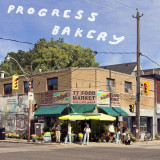
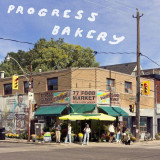
On Progress Bakery, her second album as a solo artist, Eliza knows to leave some questions alone – to let juxtaposition and tension be the proof. It doesn’t have to be hard. The feelings and revelations they provoke rise in the heat. The smell is sweet. Crispy on the outside and soft all the way through. She playfully slip-slides through words and sounds and images, delighting in surprise, skimming ideas like stones cast across clear water, touching down briefly with uncommon grace.
The question provoked between those opening lines resurfaces in the strands between songs – “Do U FM” is fully formed and beautifully layered, while “Novelist Sad Face” is a short, acapella rendering of gentle curiosity. What is holding these ideas together? Some songs demand more, seem to carry a whole load – eventually the skipping stone will halt to sink and resume its idle duty – while others drift in and out of focus, the way thoughts and dreams become interwoven before the mind is sunk into true sleep.
Music and words don’t always have to interact. Where she decides to keep them apart gives a new contour to where and how she puts them together. The kind of thing you’re supposed to take for granted with songs and their singers comes alive in Eliza’s hands – the little miracle of mixing, kneading, stretching, and stopping.
So often on Progress Bakery, Eliza teases out truth and meaning by asking questions. “Do I wanna be crying?” “Do you want me good or do you want me bad?” “Do I need an eye test?” “I’m writing songs in my head while you’re going over stuff with me — is that cruel??” In “Pocky” Eliza ends with a question that feels to me like the actual biography, succinct and revealing:
I don’t wanna be made to see
I just wanna ask “what’s that?”
Grace that ought to be rare, but in its care and precision is offered humbly, with great generosity, and without announcing itself. Eliza’s simple, miraculous music is given further form and shape by a group of collaborators – invaluable guest musicians Jeremy Ray, Evan Cartwright, Steven McPhail, Kenny Boothby, Ed Squires, Carolina Chauffe, Dorothea Paas, Louie Short, and Avalon Tassonyi. Together with Louie Short, who recorded, mixed, and produced the album along with Jeremy Ray and Lukas Cheung, Eliza has cultivated a richness in sound and texture that prods and provokes the ticklish ear. Barely audible guitar tinkering, a brief lo-fi field recording of trumpets, the harmonic clicking of a looped synthesizer, a flourish of reeds, a child’s conversation, each uncanny sound perfectly placed, rippling out under a soft breeze.
Lay in bed alone at night and ask aloud to the stillness,
“What were you doing at the Albuquerque Airport?
What were you doing there??”
And hear your question answered by a dream of swelling, undulating cellos. Try to grasp at the melody and structure. It’s not an answer (if there could be one), but it moves deeper, closer to the weird layer of fleeting moments and disconnected images, barely perceptible at its core. Wait for the dream reel to click into place.
Eliza took me for a ride in Nicole (her beloved Dodge Grand Caravan) and told me she’d been thinking of the album as an embodiment of transition – and I think every transition, known or unknown, carries the weight of new meaning, skittering off the surface tension of life as you know it, creating ripples, sometimes bouncing off and sometimes breaking through. There is a trick you can use to tell if a dough is glutinous enough. You’re supposed to stretch it out as thin as you can without breaking it and hold it up to the light. If you can see through, even if it renders the world murky and uncertain, you should leave it alone. I love this trick. It’s one that Eliza seems to know intuitively: work gently and ask questions and don’t always expect answers, and when you can, take a glimpse at something new, and then leave.
Kneading dough is tricky – you should know how it’s supposed to feel. If you try too hard you could make it worse. It’s a beautiful practice – creation with a gentle touch, to work at something so it can be left alone. “If it’s too drawn out it’s awful. It’s easy to give too much.” Dance in the mirror. Contemplate your veiny hands. Who do they remind you of?
You begin by mixing flour and water. “What happens when your people die? Why’d they move the rock to the other side of Ulster Park?” Eliza Niemi asks two seemingly unrelated questions in a rising melody with guitar accompaniment, like fingers playing spider up to the nape of your neck. Gentle pressure. Strands of gluten form to bind the mix. A new question lingers in the binding. When she admits “but I don’t know how to tell if I’m feeling it or not,” that question surfaces through the text. It is reiterated throughout the album. When I’m working with dough I think the same thing to myself.
On Progress Bakery, her second album as a solo artist, Eliza knows to leave some questions alone – to let juxtaposition and tension be the proof. It doesn’t have to be hard. The feelings and revelations they provoke rise in the heat. The smell is sweet. Crispy on the outside and soft all the way through. She playfully slip-slides through words and sounds and images, delighting in surprise, skimming ideas like stones cast across clear water, touching down briefly with uncommon grace.
The question provoked between those opening lines resurfaces in the strands between songs – “Do U FM” is fully formed and beautifully layered, while “Novelist Sad Face” is a short, acapella rendering of gentle curiosity. What is holding these ideas together? Some songs demand more, seem to carry a whole load – eventually the skipping stone will halt to sink and resume its idle duty – while others drift in and out of focus, the way thoughts and dreams become interwoven before the mind is sunk into true sleep.
Music and words don’t always have to interact. Where she decides to keep them apart gives a new contour to where and how she puts them together. The kind of thing you’re supposed to take for granted with songs and their singers comes alive in Eliza’s hands – the little miracle of mixing, kneading, stretching, and stopping.
So often on Progress Bakery, Eliza teases out truth and meaning by asking questions. “Do I wanna be crying?” “Do you want me good or do you want me bad?” “Do I need an eye test?” “I’m writing songs in my head while you’re going over stuff with me — is that cruel??” In “Pocky” Eliza ends with a question that feels to me like the actual biography, succinct and revealing:
I don’t wanna be made to see
I just wanna ask “what’s that?”
Grace that ought to be rare, but in its care and precision is offered humbly, with great generosity, and without announcing itself. Eliza’s simple, miraculous music is given further form and shape by a group of collaborators – invaluable guest musicians Jeremy Ray, Evan Cartwright, Steven McPhail, Kenny Boothby, Ed Squires, Carolina Chauffe, Dorothea Paas, Louie Short, and Avalon Tassonyi. Together with Louie Short, who recorded, mixed, and produced the album along with Jeremy Ray and Lukas Cheung, Eliza has cultivated a richness in sound and texture that prods and provokes the ticklish ear. Barely audible guitar tinkering, a brief lo-fi field recording of trumpets, the harmonic clicking of a looped synthesizer, a flourish of reeds, a child’s conversation, each uncanny sound perfectly placed, rippling out under a soft breeze.
Lay in bed alone at night and ask aloud to the stillness,
“What were you doing at the Albuquerque Airport?
What were you doing there??”
And hear your question answered by a dream of swelling, undulating cellos. Try to grasp at the melody and structure. It’s not an answer (if there could be one), but it moves deeper, closer to the weird layer of fleeting moments and disconnected images, barely perceptible at its core. Wait for the dream reel to click into place.
Eliza took me for a ride in Nicole (her beloved Dodge Grand Caravan) and told me she’d been thinking of the album as an embodiment of transition – and I think every transition, known or unknown, carries the weight of new meaning, skittering off the surface tension of life as you know it, creating ripples, sometimes bouncing off and sometimes breaking through. There is a trick you can use to tell if a dough is glutinous enough. You’re supposed to stretch it out as thin as you can without breaking it and hold it up to the light. If you can see through, even if it renders the world murky and uncertain, you should leave it alone. I love this trick. It’s one that Eliza seems to know intuitively: work gently and ask questions and don’t always expect answers, and when you can, take a glimpse at something new, and then leave.
- A1: Special
- A2: B.a.b.e
- A3: Fantasy
- A4: Not Hell, Not Heaven
- A5: Tonight (I’m Afraid)
- B1: Fleshed Out
- B2: Let You Down
- B3: Cellophane
- B4: Suffer The Fool (How High Are You?)
- B5: Haunted
- B6: Are We All Angel
Olive Green Vinyl[28,15 €]
Scowl is a band that sounds exactly like their name implies. Venomous, fierce, antagonistic. A sneer not to be crossed. Over the last five years, the Santa Cruz, California, band has firmly planted their flag in the hardcore scene with their vicious sound and ripping live show, sharing stages around the world with Circle Jerks, Touché Amoré, and Limp Bizkit, and filling slots at prominent festivals like Coachella, Sick New World, and Reading and Leeds. But with their new album, Are We All Angels (Dead Oceans), Scowl is aiming to funnel all that aggression through a more expansive version of themselves. Much of Are We All Angels grapples with Scowl’s newfound place in the hardcore scene, a community which has both embraced the band and made them something of a lightning rod over the past few years. Standout single “Not Hell, Not Heaven” outright rejects the narratives cast onto them by outsiders. “It’s about feeling victimized and being a victim, but not wanting to identify with being a victim,” explains vocalist Kat Moss. “It’s trying to find grace in the fact that I have my power. I live in my reality. You have to deal with whatever you're dealing with, and it ain’t working for me.” The band breaks from a sense of disassociation to seek deeper connections on “Fantasy.” “It’s incredibly challenging to try to balance my love for the scene while also feeling, in some spaces, extremely alienated and hated,” Moss says. “‘Fantasy’ is about feeling like I don't know how to connect with these people anymore, because I have shelled myself away so hard.” The album ends in a philosophical place on the closing, titular track, “Are We All Angels,” asking questions like, “Is this all there is?” and ultimately putting it on the listener to decide. “It’s about the personal struggle between good and evil. It doesn’t matter how ‘good’ or ‘bad’ you are, there are systems that will try to rewrite your narrative no matter what you actually do,” explains Moss, noting that punctuation on “Are We All Angels” has been deliberately omitted in an attempt to leave the statement open-ended. Are We All Angels is the highly anticipated follow-up to Scowl’s debut, 2021’s How Flowers Grow, a 16-minute primal scream over punishing riffs. But amidst the pounding chaos, it was the record’s sonic outlier, a cleaner interlude called “Seeds to Sow,” that, true to its name, planted the seed for what was to come for the band. “It kind of laid out this destiny for us, and I feel like now we’re fulfilling that,” says drummer Cole Gilbert. The band continued to expand their sound on 2023’s widely acclaimed Psychic Dance Routine EP, incorporating more pop hooks and favoring gentler singing over heavy screaming, paving the way for what would come next. Scowl’s growth got a huge boost from producer Will Yip (Turnstile, Title Fight, Code Orange, Balance and Composure), who broadened the band’s scope. “Will would say, ‘Everything you have here is correct, but it’s in the wrong place,’” says Gilbert. Moss adds: “Will really helped restructure a lot of the material. Some songs he tore apart to make more space for the really good hooks and choruses.” But even through this more eclectic approach, Scowl loses none of their edge, and still manages to convey the anger and frustration that lies underneath. They are deeply committed to carrying the ethos of punk and its sense of community. “Hardcore and punk have sculpted how we operate, what we want to do as a band, and how we participate,” says guitarist Malachi Greene. “At our core, we are a punk and a hardcore band, regardless of how the song shifts and changes.
- A100:
- Carry No Thing
- Careful
- Please Slow Down
- The White Light Of The Morning
- Wake
- Heavy Hearts
- How It Was It Will Never Be Again
- Something Beautiful And Bright
- Heartbreakdown
- Nobody Lives Here
SYML is the solo venture of artist Brian Fennell. Welsh for “simple”—he makes music that taps into the instincts that drive us to places of sanctuary, whether that be a place or a person. Born and raised in Seattle, Fennell studied piano and became a self-taught producer, programmer, and guitarist. Says Fennell about his album Nobody Lives Here, "We change, the world changes, and there is so much unknown. About a year ago I started writing songs that represent the change that is happening in front of my face, a group that have emerged to become the third SYML album. Many of these songs are about getting older, and the intimate, and sometimes frightening, passing of time. Some are about how getting older revolves around looking forward to things happening, and when they don’t happen, or they feel different than anticipated, we can be left with surprise and sadness. I’m actually reminded of this watching my 2 year old! We learn to live with disappointment. I recorded some of these songs with kids and dogs making noise in the background, and others in silent studios with musicians I’ve listened to and admired for many years. These songs are meant to be pieces of clothing to wear as you need (or I need). Some are bright and bold and others are gentle, but they were all made with a sense of comfort in mind, even when things feel bleak. My wife jokes that when our friends hear some of these songs, they might think we are not “ok”. Thankfully, putting myself inside a sad song is still a good place to feel happy. There's this generally unspoken feeling that musicians don’t listen to their own music. That isn’t true for me. I love living with my songs because their meaning changes as I change. There is as much fear and beauty in the big questions as there is wonder and possibility in the simple, everyday shit we live through.”
180g black vinyl - limited to 200 numbered copies.
"What is my heart now"is the debut solo album by Ziemowit Klimek, known so far from bands such as Immortal Onion, Hania Rani, and Magda Kuraś Quintet. It is a cycle of five improvised compositions – "What," "Is," "My," "Heart," and "Now" – unified by a unique artistic concept, with each piece created in collaboration with a different musician.
The creative process for each of the five duets began with a conversation between Ziemowit, the guest artist, and the video team. Deconstructing the title word into its fundamental elements through questions like "What does 'What' mean? What emotions and associations does this word evoke in us? How can we capture its essence in sound and image?" became the starting point for artistic exploration.
To preserve the authenticity of the material as much as possible, both sound and image were recorded live, with no cuts or post-production editing. Equally important was the choice of spaces that corresponded to the meaning of each title word. Instead of sterile studios, the recordings took place in a variety of unique locations – "Heart" was captured in Ziemowit's most personal space, his bedroom, while "Now" was recorded inside a car during a dynamic drive, where the physical forces acting on the musicians significantly influenced their decisions while playing.
The album resonates with dialogue – not only musical but also emotional and intellectual. It is a meeting of individualities who, for Ziemowit, are not only inspirations as artists but also significant people in his life."What is my heart now"is an album about defining one's identity and capturing the moment, created in an atmosphere of honesty and trust. Ultimately, the question arises: is it even possible to definitively answer the question posed in the album's title?
"What Is My Heart Now"
Ziemowit Klimek (Double bass, Bass, Piano, Moog)
feat.
Krzysztof Hadrych - Guitar
Michał Jan Ciesielski - Saxophon, Volca
Hania Rani - Piano
Mikołaj Kostka - Violin
Jacek Prościński - Drums
QUEENDOM is an album that marks a new era for the project while staying true to the essence of Minuit Machine. Produced under the SYNTH RELIGION label, this opus immerses us in Amandine's introspective realm, oscillating between darkness and light, between doubt and self-conquest. While retaining the emotional DNA of previous productions, QUEENDOM stands out with a more pop-oriented touch, featuring tracks where Amandine sings in French for the first time.
The first single, "HOLD ME," is a powerful pop anthem addressed to the queer community, celebrating the freedom to be oneself and breaking free from societal and patriarchal norms. This track is a true empowerment statement, with striking electro beats supporting a strong message of emancipation and pride.
"Créatures," a collaboration between RAUMM and Minuit Machine, is a modern fairy tale—a timeless love story that could take place in any era. This salvific love, rarely seen today, embodies a poignant depth and beauty.
Continuing the journey, "Cent Fois"—a French-written track—takes us into a techno-pop universe with nostalgic yet hopeful undertones. This song perfectly reflects Minuit Machine's evolution toward a more radiant approach while staying faithful to its dark heritage.
"Party People," on the other hand, is a return to roots with dark wave/italo sounds. This hypnotic and haunting track questions identity in an increasingly robotic society, where individuals are forced to conform to imposed norms. This exploration of the individual versus the collective lies at the core of Minuit Machine's DNA.
"Mes Souvenirs," created in collaboration with Rebeka Warrior, dives intimately into the memories of Amandine and Rebeka. Together, they reveal fragments of their past—precious and vibrant memories that resonate through powerful and melancholic electro sounds.
Finally, the eponymous track "Queendom" invites us to plunge into the depths of Amandine's world—a universe that is both tormented and icy, yet resilient. Supported by a slow and captivating rhythm, this track is designed to grip and haunt the listener, like an incantation.
QUEENDOM is a bold and hybrid work where each track reflects a pursuit of sincerity and artistic reinvention while maintaining the ability to express emotions through rhythms that are both danceable and introspective. The album showcases Minuit Machine's artistic maturity, establishing itself as a must-listen in the darkwave and electronic pop scene.
Amandine entrusted the artistic direction of this album to Manon Dupeyrat, a brilliant young artist who crafted a bespoke universe perfectly aligned with the produced tracks. The album cover, both intimate and anachronistic, invites listeners into Amandine's private world through her bedroom, revealing what she wishes to share.
- A1: Do U Fm
- A2: Novelist Sad Face
- A3: Green Box
- A4: Dusty
- A5: The Linda Song
- A6: Dm Bf
- B1: I Tried
- B2: Melodies Like Mark
- B3: Wildcat
- B4: How U Remind Me
- B5: Pocky
- B6: Bon Tempiii
- B7: Pt Basement
- B8: Alberqurque Ii
- B9: Mary's
Kneading dough is tricky – you should know how it’s supposed to feel. If you try too hard you could make it worse. It’s a beautiful practice – creation with a gentle touch, to work at something so it can be left alone. “If it’s too drawn out it’s awful. It’s easy to give too much.” Dance in the mirror. Contemplate your veiny hands. Who do they remind you of?
You begin by mixing flour and water. “What happens when your people die? Why’d they move the rock to the other side of Ulster Park?” Eliza Niemi asks two seemingly unrelated questions in a rising melody with guitar accompaniment, like fingers playing spider up to the nape of your neck. Gentle pressure. Strands of gluten form to bind the mix. A new question lingers in the binding. When she admits “but I don’t know how to tell if I’m feeling it or not,” that question surfaces through the text. It is reiterated throughout the album. When I’m working with dough I think the same thing to myself.
On Progress Bakery, her second album as a solo artist, Eliza knows to leave some questions alone – to let juxtaposition and tension be the proof. It doesn’t have to be hard. The feelings and revelations they provoke rise in the heat. The smell is sweet. Crispy on the outside and soft all the way through. She playfully slip-slides through words and sounds and images, delighting in surprise, skimming ideas like stones cast across clear water, touching down briefly with uncommon grace.
The question provoked between those opening lines resurfaces in the strands between songs – “Do U FM” is fully formed and beautifully layered, while “Novelist Sad Face” is a short, acapella rendering of gentle curiosity. What is holding these ideas together? Some songs demand more, seem to carry a whole load – eventually the skipping stone will halt to sink and resume its idle duty – while others drift in and out of focus, the way thoughts and dreams become interwoven before the mind is sunk into true sleep.
Music and words don’t always have to interact. Where she decides to keep them apart gives a new contour to where and how she puts them together. The kind of thing you’re supposed to take for granted with songs and their singers comes alive in Eliza’s hands – the little miracle of mixing, kneading, stretching, and stopping.
So often on Progress Bakery, Eliza teases out truth and meaning by asking questions. “Do I wanna be crying?” “Do you want me good or do you want me bad?” “Do I need an eye test?” “I’m writing songs in my head while you’re going over stuff with me — is that cruel??” In “Pocky” Eliza ends with a question that feels to me like the actual biography, succinct and revealing:
I don’t wanna be made to see
I just wanna ask “what’s that?”
Grace that ought to be rare, but in its care and precision is offered humbly, with great generosity, and without announcing itself. Eliza’s simple, miraculous music is given further form and shape by a group of collaborators – invaluable guest musicians Jeremy Ray, Evan Cartwright, Steven McPhail, Kenny Boothby, Ed Squires, Carolina Chauffe, Dorothea Paas, Louie Short, and Avalon Tassonyi. Together with Louie Short, who recorded, mixed, and produced the album along with Jeremy Ray and Lukas Cheung, Eliza has cultivated a richness in sound and texture that prods and provokes the ticklish ear. Barely audible guitar tinkering, a brief lo-fi field recording of trumpets, the harmonic clicking of a looped synthesizer, a flourish of reeds, a child’s conversation, each uncanny sound perfectly placed, rippling out under a soft breeze.
Lay in bed alone at night and ask aloud to the stillness,
“What were you doing at the Albuquerque Airport?
What were you doing there??”
And hear your question answered by a dream of swelling, undulating cellos. Try to grasp at the melody and structure. It’s not an answer (if there could be one), but it moves deeper, closer to the weird layer of fleeting moments and disconnected images, barely perceptible at its core. Wait for the dream reel to click into place.
Eliza took me for a ride in Nicole (her beloved Dodge Grand Caravan) and told me she’d been thinking of the album as an embodiment of transition – and I think every transition, known or unknown, carries the weight of new meaning, skittering off the surface tension of life as you know it, creating ripples, sometimes bouncing off and sometimes breaking through. There is a trick you can use to tell if a dough is glutinous enough. You’re supposed to stretch it out as thin as you can without breaking it and hold it up to the light. If you can see through, even if it renders the world murky and uncertain, you should leave it alone. I love this trick. It’s one that Eliza seems to know intuitively: work gently and ask questions and don’t always expect answers, and when you can, take a glimpse at something new, and then leave.
Now on album number seven , Metronomy has continued where many of their 2000s ‘cool’ band peers have dropped off along the way. Small World is a return to simple pleasures, nature, an embracing in part of more pared down, songwriterly sonics (some moments wouldn’t sound amiss on a Wilco release), all while asking broader existential questions: which feels at least somewhat rooted in the period of time during which it was made – 2020. For all that Mount seems to think he has made a comparatively sombre record, much of Small World still pulses with the zesty, tongue-in-cheek joie de vivre you’d expect of a Metronomy record.
So sure, things are different now Joe Mount is getting older and what’s on his mind is changing, but that doesn’t mark a change in quality for Metronomy. An immaculate set of tracks, Joe Mount’s ability as a songwriter and arranger shines through on Small World, evergreen. Metronomy might be growing up, but they’re not afraid to still have fun with it all. Through the tumultuous ebb and flow of the years, Metronomy continues to endure and make great pop music – and, really, that’s all that we could ask for.
Demonstrating the poignant power of experience + human connection + innate musicality + operating in the present moment, Jeff Mills' Spiral Deluxe collective unveil their second album - The Love Pretender. Driven by the free expression and creativity of improvised performance, Spiral Deluxe is an electronic jazz fusion project comprised electronic music visionary Jeff, along with legendary keyboardist Gerald Mitchell (Underground Resistance/ Los Hermanos), Japanese rocker Yumiko Ohno (Buffalo Daughter/Cornelius) on Moog synthesizer and the Japanese bassist, adopted New Yorker, Kenji "Jino" Hino - son of Terumasa Hino, the world famous jazz trumpeter. Together, the four key players formed a band centred around completely improvised journeys through sound.
During their unrestrained performances, what Jeff describes as sonic "conversations" arose between the musicians, as they each contributed to full-length live shows, and studio sessions. Within the boundless parameters of freeform spontaneity, they developed an unspoken understanding of one another, finding balance and poise within the unplanned performances. The resulting recordings have been used for three releases so far: Two EPs, Kobe Session (2016) and Tathata (2017), and their debut album Voodoo Magic in 2018. With The Love Pretender, we're presented with another stunning collection of "tracks" extracted from one long improv session.
With each musician proficient in their specialism and, of course, an all-out music lover, the communication between the group members became almost telepathic. Very little preparation was needed, and their performances flowed naturally and organically. This can be heard, and felt, throughout The Love Pretender. Tracks like 'The Soloist' evolve effortlessly, each new shift subtly influenced by one of the musicians nudging the conversation into a different phase, and the rest responding accordingly, or vice versa. It's music that embodies the true nature of mindfulness and letting go of fear. In their unstructured, liberated cocoon the artists thrive and create musical moments that have, fortunately, been captured for us all to immerse ourselves in. Jazzy notes fill the air, combined with electronic bass, synthesised beats, sparkling keys and an all-round warm and welcoming atmosphere, with the slight edge you can only get from improvised performance.
Sylvain Luc's posthumous appearance on the album is of significance too. The French guitarist died in March 2024 at the age of 59. His natural flair adds another dimension to the album, bringing a touch of that laid back 1980s American California Coast feeling to tracks such as 'Society's Man'. These contributions to the LP, recorded separately, add character - a final sprinkling of humanity to complement the aliveness and presence of this body of work. Three other musicians also added their creative energy to the project. They were; TOKU, a Japanese jazz musician who specialises in wind instruments, especially the cornet, trumpet and flugel horn. And there's Masa Shimizu, who also has wide-ranging with the guitar, as well as being a producer.
Themes on the album include the optimism one can have by simply trusting the process and trusting that everything will work out in the end. By playing together in the way they do, Spiral Deluxe place their trust in the mystery of what will happen next. Getting comfortable with not knowing is key to a sense of peace with regard to the future and this energy is vital to their collective musical output. By embracing the notion of the unknown, you become an eternal optimist, living in the moment, rather than projecting into the future. This cultivates excitement, an antidote to anxiety.
Meanwhile, the title alludes to the shifts and changes that have occurred in today's society, whereby it's possible to achieve success through pretending. The superficiality, and falsehood, that can often be presented via social media, can lead to questions about what's real and what's not. From AI to the fake personas that populate the dominant platforms, The Love Pretender speaks to a process that is symbolic of the time we're living in. Behaviour that has become acceptable in today's world, which may not have been as welcomed a few decades ago. But this is part of the cycle of life...
Jeff's intention with this music is to present it in high-fidelity, to be listened to over and over and over again. In post-recording he worked for hours to ensure the audio quality was as high as it could be. The goal is to create music that people can live with their entire lives, from his solo work to these masterful improvisations. Music that comes to life, music that has a voice we can replicate with our own vocals. Expressive, unstructured, and alive...
With The Love Pretender Jeff Mills continues his mission to experiment with music outside the bounds of what is typically expected. It's freeing, enlivening, vibrant and uniquely human. As ever, Jeff's visionary outlook and bold approach to musical performance and recording has produced a body of work that epitomises his often revolutionary capabilities. There's no pretending here, just pure unadulterated sonic transmissions from a wonderfully daring, inspiring and optimistic ensemble...
Split Evolution from Chicago and released two singles. The first "Jumpstreet" (vocal/instrumental) on Wasp in 1978 (although copyright on the label states 1974 whilst publishing states 1978) followed by "If Only You Would Say (I Love You)" (vocal/instrumental) on Jumpstreet in 1984 as The Three Phases Of Evolution. Both pretty hard records to find and not even listed on 45Cat but appear to have been reissued by Magnetic Recordings in 2014 (both included below). Interestingly, on the label for the latter it states that it is from the LP "Jumsptreet" so perhaps an album was in the pipeline? They recorded a third single which only made it to a test pressing stage, as the full run was cancelled later on. This unreleased third single "Bedroom Eyes" / "Let Me Do It" is the one out in March on Canonnball Records. The only surviving copy was found by rare soul DJ Dave Thorley on a record hunting trip to the States in the early noughties.
Our 8th Anniversary release is totally, completely, wholeheartedly dedicated to LOVE. Written not to be a ballad neither to be a dancer “Bedroom Eyes” inevitably ended up being both, turning out in what I consider the definitive love song, up there with Sly, Slick and Wicked's Sho' Nuff. It just melts my heart. Warm basslines laying on a catchy drumming which anyone would likely mistake for an Enchantment groove. A man and a woman dueting like if they were actually laying in bed after a consuming day out, and finding relief in each other’s presence. The man, desperate for love, makes questions to which the woman answers in the choruses with a hidden prayer to stay together forever. All with mutual background voices and brass crescendos and strings pizzicatos counterpointing each others to make it a beautiful yet rough arrangement. Just pure Soul love heaven.
Cornelia Murr’s newest album, Run To The Center, began with a question: What do I want? The answer is everything, and it’s never felt more urgent.
On her first LP in six years, Run To The Center, on 22TWENTY, the London-born singer-songwriter delivers her most expansive, confident work yet. Across 10 hypnotic pop songs, Murr crafts a portrait of a woman in her thirties, standing triumphantly in uncertainty and asking life’s essential questions: How do you fit everything you want into a life? How can you want so much and still manage to live?
Run To The Center, which Murr will tour internationally, is her first release since the 2022 EP Corridor and her first LP since her 2018 debut Lake Tear of the Clouds, produced by Jim James of My Morning Jacket. Murr had long wanted to make another LP, but economic and global forces kept getting in the way. Finally, in the spring of 2023, Murr started working with producer Luke Temple (Adrienne Lenker, Hand Habits), adding to her roster of impressive collaborators. Temple, an old friend, helped Murr realize a sweeping album of her most tender, spectral pop yet.
The songs on Run To The Center reflect Murr’s need to explore desire and time. Some are new, born from spontaneous collaboration, while others had lingered in her mind for years. The album’s production, with muscular drums and buoyant synths, is more expansive than her previous work, swirling with a sparse futurism as Murr embraces life’s uncertainties.
Murr wrote much of the album while hunkering down in Red Cloud, Nebraska, restoring an old house. In this unexpected place, she found her center. The result is an album that explores big questions with beauty and humor, as Murr stands fully in her power.
- A1: On Being Ft. Felix Gerbelot
- A2: Peace Exists Here
- A3: I Am In A Church In Gravesend Listening To Old Vinyl And Drinking Coffee
- B1: A Sense Of Getting Closer
- B2: Exist Inside This Machine Ft. Aneek Thapar
- C1: My Choices Are Not My Own Ft. Tawiah And May Kaspar
- C2: The Sun In A Box
- D1: True Under Certain Conditions
- D2: When I Am Alone With My Thoughts. I Am Crushed Ft. Aho Ssan
- E1: You Couldn't Love Me Enough And I've Spent My Whole Life Making Up For It Ft. Niels Orens
- E2: My Mind Is Slipping
- F1: Mother Nature Must Have A Different Plan For Me Ft. Tom Vr
- F2: The Missing Piece
- F3: It's Up To You, What You Do In The Void
Powerful works of art have traditionally sprung from some source deep within an artist and, if they strike the right tone, resonate with an audience to leave a lasting mark. But what if that equation were reversed: what if an artist were to draw their inspiration from deep within their audience, and use that to reflect those ideas, emotions, hopes, fears, pains and aspirations back to us?
Over a two year journey, audio-visual artist and electronic innovator Max Cooper has inverted the creative process by collecting hundreds of anonymous quotes, posing deep but open questions such as "What would you like to express which you cannot in everyday life?" and "What is it like to exist inside your head?"
The goal: to understand what it is truly like to be human right now. The result: his new album On Being, to be released in February 2025 with the first single "Sun In A Box" coming this September 4th.
With On Being, Cooper aimed to probe under the synthetic surface of social media to "create a snapshot of our minds these days," as he puts it by asking people to share anonymously what they dare not ever say publicly. The result is an emotionally raw and shockingly honest kaleidoscope of confessions, ranging from suicide contemplations to miserable marriages to simple pure loneliness, contrasting with hundreds of anonymous confessions of love and longing.
"I was interested in the way I interact with people for my writing process, which usually involves a one-way communication of feelings and ideas that I later find out whether they resonate with others or not," says Cooper.
"With this I could start instead with people's thoughts and feelings, what resonates for them, and make my own interpretations of those musically and visually, and then send those back out to everyone. It's more of a collaborative approach to making an album, and more intense."
Grief, hope, regret, joy, hurt and love form the basis for each track, taking Cooper's ever-evolving creative process in a completely new direction - with profoundly intense results.
"Rendering the experience of being is at the core of what I do musically - but I hadn't realised the impact that other people's words on being would have on me until I started reading the database of thoughts," he says.
"It was like finding a secret window into everyone's minds, and discovering amongst the chaos, pleasure and pain, the experiences that we all share at different times of our lives, and overwhelming emotions and connections that call out to be explored."
Despite what we see in the maelstrom of rage in the echo chambers of society ‘On Being’ reveals that humans still have an innate need to trust one another and express communal generosity - more easily done from the safety of an anonymous portal.
"The quotes carried so much weight for me - I interpreted them with my usual musical tools, but as you can hear in the music, everything got more extreme as I dove into the depths of what everyone had to say later in the record," says Cooper.
The result is a unique work of art that demonstrates unequivocally not only the power of using music without words to express emotions, but the power of words to express what seemed to be inexpressible.
On Being will continue to evolve as Cooper gathers more confessions to feed into this ecosystem of emotions and to create a new range of art projects and other accompanying works which hopefully will speak truthfully to humanity today - and of who we are and who we can become.
2026 Repress
MOLA's music is the unadorned antithesis to a rosy world. She celebrates herself to death, pulls you into her inner chaos and does without the usual romanticising transfiguration of the merciless disorientation that catches up with you on the way home after the last cigarette.
MOLA knows better than anyone that she is a border commuter - and she has never made a secret of it. Perhaps it was fate that the course of events abandoned her shortly after her birth in Erba, Italy, in Germany's most austere metropolis. In Munich, where flying free and falling free are a little more complicated than in the cesspit of Berlin, where one would naturally place Isabella Streifeneder and her music if one didn't know better.
Temporarily reduced to intimacy, then escalating into iconic 80s "Purpel Rain" pathos, MOLA illustrates the emotional chaos that the inner dialogue of left and right brain triggers in her. Unconventional pop music that bundles the nonchalance of great soul anthems, the grace of the Italo-disco of the eighties and the ingenuousness of lascivious hip-hop bangers instead of trying to sound modern by force.
MOLA celebrates defeat, exposes life lies, criticises adulthood, documents radical mood swings. She balances along the abyss in her ball gown, jokes about things you don't joke about, praises and curses intoxication and love - "Vino Bianco no longer tastes like dolce vita, it only tastes like losing".
You can now see MOLA supporting Fatoni, Roy Bianco & the Abbrunzati Boys, Mayberg and Kaffkiez in a flurry of strobe lights after sold-out "nothing breaks me" shows in Munich, Cologne, Berlin & Hamburg. In addition to a festival season that couldn't have been more beautiful, they finally have a big tour of their own coming up for their next album, which will see the light of day in September.
After more than 40 festivals "Snow in Summer" on well-known stages like Lollapalooza Berlin, Rocken am Brocken, Puls Open Air, but also as support for Udo Lindenberg at the Hermann-Hesse-Festival, "Life is Beautiful", the darned second record, sounds almost cynical, ironic or simply naive? In the end, it doesn't matter, because when you are overcome by this spontaneous feeling that is far removed from any rationality, you don't ask any questions. It tastes like the melancholy of a summer in its last breaths, like the last drink of an uncompromisingly insane night.
There is sweating, pogoing and feeling together. Even where it hurts.
You are not just an onlooker or a silent spectator, but part of this empowering feeling of "we".
- A1: The Book Of Sounds - Part 1 07 34 Min
- A2: The Book Of Sounds - Part 2 08 32 Min
- B1: The Book Of Sounds - Part 3 05 05 Min
- B2: The Book Of Sounds - Part 4 05 05Min
- B3: The Book Of Sounds - Part 5 05 52 Min
- B4: The Book Of Sounds - Part 6 03 26 Min
- C1: The Book Of Sounds - Part 7 08 01 Min
- C2: The Book Of Sounds - Part 8 05 09 Min
- C3: The Book Of Sounds - Part 9 02 46 Min
- D1: The Book Of Sounds - Part 10 11 49 Min
- D2: The Book Of Sounds - Part 11 03 30 Min
- D3: The Book Of Sounds - Part 12 04 33 Min
The new recording of The Book of Sounds is an intimate exploration of the piano by pianist Carlos Cipa - a way of looking into the sound, of listening into the moment when Cipa's fingers press down on the piano keys. The Book of Sounds, composed between 1979 and 1982 by composer and pianist Hans Otte, is a musical pendulum movement of one hour in twelve 'pieces', as the composer himself describes them. Chords and melodies repeat themselves, sometimes quickly, sometimes slowly; they follow each other in harmonic cadences and yet never dissolve - a timeless back and forth.
The Book of Sounds is the European-German answer to the concert music of American minimalism. But it is also the essence of many questions about society and the human condition at that time. Inspired by Zen Buddhism, Otte was convinced that a return to simplicity, to the unagitated - a piano, harmonic cadences, a middle register - frees the listener to focus on what is really important in art: the human being. Introspection begins with listening. Seldom have simple chords and melodies been so selectively staged. It is a process of endless reduction - no wild sound dramaturgies, no climaxes, hardly any beginning or end. The interpreting pianist simply prepares a tableaux of perception for the listener. Cipa naturally sets accents; he recorded the 12 pieces on three different pianos - a Steinway grand piano, a Yamaha piano, and a Yamaha CP-70, an early electric piano - to help shape the tonal characteristics.
Carlos Cipa hits the nerve of the times with this new recording. What music can be as art is still up for debate today. The Book of Sounds is not 'art-proof' and in this it is still a provocation today; absolutely unspectacular and practising relaxation. It is a wonderful invitation to feel, experience, and perhaps even find oneself in the confrontation with the work - and for a moment not to fuel the discourse. Cipa, who otherwise appears as a composer himself, here carries out Otte's intended gesture of withdrawal in a double sense and steps into the background as creator but also interpreter, in order to bequeath The Book of Sounds to the loudspeakers and headphones at home in one step forward.
All the shades of green. Plants. Water. The absolute necessities of life. Music, too, is an absolute necessity. To capture both color and sound in a bottle to put atop a piano like a houseplant. A clock. A fern. Synesthesia. This music is meant for that. To close your eyes and see green. To drown in the color of piano. A melancholic covey that pulls hard on the heart strings musically and lyrically, brushed over with a plethora of improvisation in smooth watercolors.
With Tim Hill’s new trajectory, we are offered a fresh neuron sprawl, branching beyond lyrics in interrupted pieces of sound. He takes our reptilian brains and welds them to our unborn futures, placing us inside of his droplet. Here, we're forced to reflect out, something singular multiplies, nature brings her face in, something shifts, our speed changes, the Self refracts and what's left jumps on sustained lines that eventually arch into meditation milk. It becomes a karmic cleanse of the amygdala, a launch from normal feeling life. Tim takes the risk, committing to diving deeper into his own bottomless pool of art, gifting us with sensory treats that dilate our old perimeters. It's sky as theatre, handing out everything but answers to questions. And where do we go? Where starlight mingles. Where minds never land.
A seasoned musician in all forms, Tim Hill has toured the world as a keyboardist, guitarist, saxophonist, and drummer, with a long time stint with LA group the Allah Las, and well known acts such as Nick Waterhouse, Curtis Harding, PAINT, and others.
- A1: Critical Stage
- A2: Sheer Horror
- A3: H.i.v.+
- A4: Traumatize
- B1: So Many Questions
- B2: Time
- B3: Fate
- B4: Necrophilia
- C1: Revenge
- C2: Where Do We Go From Here?
- C3: Under God's Eye
- C4: The Dreamhouse (Mental Version)
- D1: Take My God Away
- D2: Never Get Out
- D3: The Ultimate Machine
- D4: Sweet Jesus
Erstmals ist Suicide Commando’s berüchtigtes Album “Critical Stage” nun auch auf Vinyl erhältlich!
Erlebe den rohen, bahnbrechenden Industrial Sound, mit dem alles begonnen hat, noch einmal ganz neu: Jetzt mit der Tiefe und Wärme, die nur Vinyl erzeugen kann. Diese Limited Edition gehört in die Sammlung eines jeden Suicide Commando Fans. Also, nicht warten, sichere Dir jetzt Deine “Critical Stage” Vinyl und damit Dein eigenes Stück EBM-Geschichte!
"Way Out West" is the debut studio album by the English electronic music duo Way Out West, released on 1 September 1997. The album peaked that same year at # 42 on the UK Albums Chart. It features four singles: "Ajare," "The Gift," "Domination," and "Blue." Several tracks incorporate samples from other music. Most notably, "Blue" includes a melody loosely based on the theme from the film "Withnail and I," while "The Gift" samples Joanna Law's cover of "The First Time Ever I Saw Your Face" (titled "First Time Ever"), and "Ajare" features a sample from "Do Your Dance" by Rose Royce.
- A1: Dear John
- A2: Angel Artist Feat Tom Misch
- A3: Ice Water
- A4: Ottolenghi Feat Jordan Rakei
- A5: You Don't Know Feat Rebel Kleff & Kiko Bun
- A6: Still
- A7: It's Coming Home
- A8: Desoleil (Brilliant Corners) Feat Sampha)
- B1: Loose Ends Feat Jorja Smith
- B2: Not Waving, But Drowning
- B3: Krispy
- B4: Sail Away Freestyle
- B5: Looking Back
- B6: Carluccio
- B7: Dear Ben Feat Jean Coyle-Larner
Loyle Carner will release his highly anticipated sophomore record, 'Not Waving, But Drowning' on 19 April via AMF Records.
'Not Waving, But Drowning' follows Loyle's BRIT (Best Male, Best Newcomer) and Mercury Prize nominated, top 20 debut 'Yesterday's Gone'. The bedrock of honest and raw sentimentality that you heard on 'Yesterday's Gone' left an inextinguishable mark on music in general and UK Hip Hop in particular, standing out as an ageless, bulletproof debut.
'Not Waving, But Drowning', Loyle's new album, gives yet more evidence - as if it were needed - of his razor-sharp flow and his unique storytelling ability. Yes, he can rap, but he allies that with the sensitivity of a poet, the observational skills of a novelist, and warmth of your best friend. The album opens with 'Dear Jean', a letter to his mother in which he's telling her that he has found the love of his life, 'a woman from the skies', and he's moving out.
It goes without saying that Loyle's music is hard to categorise, but what is even more impressive is that for someone who grew up listening to Mos Def, Biggie Smalls, Roots Manuva, and Wu Tang Clan, he doesn't sound like any of them. Although he might from time to time give lyrical nods to them, he's no imitator.
Loyle loves cooking. There are two tracks on this album named after chefs. The British-Israeli chef Yotam Ottolenghi, and the now deceased Italian chef Antonio Carluccio. 'Ottolenghi' the first single from the album was featured on the BBC Radio 1 B-list, BBC 6 Music A-list and has already been streamed over 5 million times.
Loyle refers to real life for everything, the title of 'Yesterday's Gone' came from a song of his step father, the title of his new album 'Not Waving, But Drowning' comes from a poem by his grandfather, which in turn came from a Stevie Smith poem. What you hear on the track 'Krispy' is real. He is pouring his heart out to his best friend Rebel Kleff after their relationship went downhill, he invites him on the track to say his piece but he doesn't turn up, so we get a flugel solo instead.
Loyle also has his own personal black consciousness movement. When he refers to his 'fathers' in the track 'Looking Back' he really is referring to two fathers. His biological father, a black man who he knows, but knows very little of, and his step father, a poet and musician who happens to be a white man but died a sudden unexpected death from epilepsy (SUDEP). With no real emotional ties to his biological father, but a deep connection with a deceased step-father, where does a young child turn He succinctly captures many of the great, unspoken, cultural and historical paradoxes of multicultural Britain on 'Looking Back'.
An album like this is hard to find. It is for those who like their Hip Hop to have soul, and their soul to have spirit. This is because it works on so many levels, but it is reflecting the personality of its creator. There are a host of collaborators here, Jorja Smith, Rebel Kleff, Kiko Bun, Kwes, Jordan Rakei, Sampha, Tom Misch and more, but none are overpowering. They blend righteously into place.
Loyle is not bitter with people who have let him down, or a society that lets so many down, but the combination of anger and love he has gives his voice the perfect blend of strength and vulnerability. This might be a coming of age album, but it's also a coming of ageless album. Loyle's 2019 Spring tour - which includes London's Roundhouse - sold out within 20 minutes of being on sale.
Not Waving, But Drowning
A rapper that raps about family is hard to find. The boys in the 'hood' tend not to be that interested in how much a 'brother' loves his mother, or how much he misses his dad, or even how much he misses his best friend. The boys in the 'hood' tend to be obsessed with the size of their cars, girls, bank accounts, and other personal 'possessions'. Loyle Carner's Mercury and BRIT Prize nominated debut 'Yesterday's Gone' (Released 2017), made it clear that he wasn't that kind of rapper. In fact, every time I talk to him about his work we talk about the world, and we tended to confuse ourselves by calling his work rap, poems, or songs, sometimes in the same sentence. They are in truth all of these things.
Here's some poetry.
Honestly I need them.
I hate them but I grieve them
I think I've finally found the reason
Trust
Like the fire needs the air.
I won't burn unless you're there.
'Not Waving, But Drowning', Loyle's forthcoming new album, gives us yet more evidence, (if it were needed), that he still has what rappers call, flow, but he hasn't lost any of his story telling qualities. Yes, the boy can rap, but a rapper with the sensitivity of a true poet, the observational skills of a novelist, and warmth of your best friend. The album opens with 'Dear Jean', a letter to his mother in which he's telling her that he has found the love of his life, (a woman from the skies), and he's moving out. He really loves the woman from the skies, but he still loves his mum, and so he reassures her that there is no competition, and tells her that 'She's not behind me or behind you, but beside we and beside two', his words. Or to put it another way, moving out without moving out. My words.
It goes without saying that Loyle's music is hard to categorise, but what is even more impressive is that for someone who grew up listening to Mos Def, Biggie Smalls, Roots Manuva, and Wu Tang Clan, he doesn't sound like any of them. Although he might from time to time give lyrical nods to them, he's no imitator. He says finding his own voice was something he always found easy. Although young, (in terms of a musical career), he has confidence in his own words and his own voice, and has never been tempted to sound like he's been hanging out in the USA, or rolling in 'Grime' on the mean streets of East London. And so when it comes to the creative process he doesn't simply find a beat to jump on and ride. Beats are important, but they are tenderly layered with samples, keyboards, or live drums, all imaginatively assembled for the laying on of words. Some tracks start with the idea, some with poetry, and some with a verse from a singer or some other melodic inspiration, but there is no formula.
Here's some poetry.
Don't hold any memories of us
Rather hold you everyday until the memories are dust
Yo we only caught the train
Cos you know I hate the bus
A prolific reader, who has dyslexia is hard to find. Add ADHD (Attention deficit hyperactivity disorder) to that and life should become even more difficult. To deal with your difficulties you devise coping strategies, which can differ from person to person. Loyle loves cooking. There are two tracks on this album named after chefs. The British-Israeli chef Ottolenghi, and the now deceased Italian chef Antonio Carluccio. Loyle describes himself as 'weird' because he is happy to read a cookbook as if he was reading a novel or a book of poetry. He has opened a cookery school for young adults not just because he loves food and wants to make more of it, but because it is one of the few things that can focus the ADHD mind. And when it comes to his other love, football, his approach is the same. Focus. He wanted to be a striker he says, up front scoring goals, but found his best position was in midfield because he was able to focus, check options, and see passes ahead of time, providing passes for other players just when they needed them. He says, 'You don't grow out of ADHD, you grow into it.' Loyle is also working with Levi's® on their music project where he is mentoring young musicians over a six month period, culminating at Liverpool Sound City festival.
More poetry.
When the going is tough
I wait till it falls on deaf ears
Hearsay
Without the boundaries of love
He also said, 'Ask most people and they will say that they love their mothers, but most are not going to rap about her'. On his first album Loyle's mum Jean wrote about the 'scribble of a boy' that growing up would take things apart to see how they worked. On this album she speaks with pride about a man who has found his place in the world.
Yes, poetry.
I'm still looking for the answers
Trying to find the right questions
Still waiting for my fathers
But can't break them in to sections
This poetry is serious. Loyle has his own personal black consciousness movement. He told me that he always felt safe at home, and being the darkest one in the family never meant a thing, but then when he had to face the outside world he felt hostility. It shook him up. Now he had to start asking questions, but what were the questions. This is serious. When he refers to his 'fathers' in the verse above taken from the track 'Looking Back' he really is referring to two fathers. His biological father, a black man who he knows, but knows very little of, and his step father, a poet and musician who happens to be a white man but died a sudden unexpected death from epilepsy (SUDEP). So to whom would a young black (or mixed race) kid turn He succinctly captures many of the great, unspoken, cultural and historical paradoxes of multicultural Britain when he says, 'My great grandfather could of owned my other one.' We are a people descended from enslaved people on one hand, and enslavers on the other, something we are still struggling to come to terms with, and this can be apparent in one family. A big book could have told you that, but here we get it in one line on the track, Looking Back.
Loyle refers to real life for everything. The album is peppered with captured moments that he records on his phone. These moments can range from conversations with taxi drivers, to capturing the moment when England scores a goal in the world cup. The title of 'Yesterday's Gone' came from a song of his step father, the title of his new album 'Not Waving but Drowning' comes from a poem by his grandfather, which in turn came from a Stevie Smith poem. What you hear on the track 'Krispy' is real. He is pouring his heart out to his best friend after their relationship went downhill, he invites him on the track to say his piece but he doesn't turn up, so we get a flugel solo instead. Yes people, this is real.
An album like this is hard to find. It is for those who like their Hip Hop to have soul, and their soul to have spirit, this is an album for those who have, (I'm sorry, I'm going to say it), emotional intelligence. This is because it works on so many levels, but it is reflecting the personality of its creator. There are a host of collaborators here, Jorja Smith, Rebel Kleff, Kiko Bun, Jordan Rakei, Sampha, Tom Misch and more, but none are overpowering. They blend righteously into place. Loyle is not bitter with people who have let him down, or the society that has let him down, but the combination of anger and love he has gives his voice the perfect blend of strength and vulnerability. This might be a coming of age album, but it's also a coming of ageless album. His first album worked, and this second album is a continuation of that work. Not creating a form, but being formless, as someone like Bruce Lee once said.
And here's some poetry from mum.
We talked long in to the darkest hours
Until we saw the burnished sky
And our eyes stung
As our words blurred and became thoughts
As we were silenced by the dawn
We clung to each other like sailors in a storm
Walter Astral's debut album tells the story of Light, its journey through the day and catalyzes it in the Éclispe, a suspended moment when space and time stop to contemplate the universe.
Over the past two years, the two druids have transmuted light into sound in the form of a concept album that explores all facets of Walter Astral, from folk and techno to pop, drum & bass and psychedelic rock, always in the presence of their totem banjo.
Sound explores and is explored, to represent light; magic and the everyday, between digital and analog sounds expressing the natural and the supernatural, humans and the cosmos. Transposing the invisible, the presence of absence, the Eclipse, into silence and sound.
“Eclipse” questions the shadows hidden by light, and the glimmers hidden by shadows, the ambivalence of a state, its capacity to transform, to mutate. Like ancient alchemists, Walter Astral set to music the transitions of states, stars, humans and emotions.
- Riverside
- Marseille
- Alouette
- Blue Left Hand
- Velveteen
- Shotguns
- Rodeo
- Moon On The Water
- Talk Is Cheap
- Banshee
- Divinations
2023 was a whirlwind year for Oracle Sisters. The trio—Julia Johansen, Chris Willatt, and Lewis Lazar—followed the release of their debut album Hydranism with a globe-spanning tour that captivated fans and critics alike. From the highways between Knoxville and Nashville to sold-out clubs in rain-soaked Seattle, and festival stages across the UK, they logged countless hours on the road. Their journey was a tapestry of exhaustion and exhilaration, falling apart, brawls and disputes, love and acceptance. By the year’s end, just two days before Christmas, they found themselves in Tokyo, reflecting on the fleeting nature of time and the fragments of inspiration gathered along the way. It was there the seeds for their next album, Divinations, began to sprout. Composing as a true trio for the first time, Oracle Sisters pieced together sketches formed during stolen moments on tour. These fragments coalesced into Divinations, an album shaped by the band’s nomadic existence. The recording sessions spanned cozy Parisian studios, a barn in northern France, and the storied Valentine Studios in Los Angeles. Their creative process embraced experimentation—swapping primary instruments, playing with toy drum machines, and crafting melodies on quirky tools like the OP-1 and a baby Casio keyboard. This spirit of discovery lent the album a sense of spontaneity and wonder. At its core, Divinations channels mysticism and timeless storytelling. The band’s songwriting draws on diverse influences, from the surrealist poetry of Baudelaire and Rimbaud to the introspective philosophies of Carl Jung. Musically, echoes of Talking Heads, Air, and Leonard Cohen resonate throughout the album and tracks like “Riverside” delve into existential questions— “How far are you going? Is it more than money can buy?” Elsewhere on the album “Marseille,” born in the city that gave the song its name, kicks off as a trance with lyrics that play between the sincere and desperate self-help affirmations, we give ourselves while trying to find a bridge between our individual lives and a universal feeling. Lead-single “Alouette” is Oracle Sisters at their most direct; propelled by a driving bassline and exuberant strings, the track summons the sound of 80’s, 90’s, and early 2000’s rock n roll as they sing about “getting out of dodge, finding a pirate ship and sailing home.” Inspired by the book Caliban and the Witch, “Blue Left Hand” is a lyrical tapestry weaving together history, philosophy, and cultural critique. The lyrics, “It’s in the harbor of every page / It’s in the corner of the playwright’s stage / And every player and every fake / And every witch that we burned at the stake,” reflect on the forces that shaped the capitalist society we know today. Across Divinations’ 11 tracks it’s not only geographic boundaries that were crossed but also the boundaries of time and circumstance. While their work may not consciously reflect specific worldly events, they seek to embrace the universal and offer a space for healing. “Good music would make sense to a farmer in 17th century France as it would to a pastry chef in Slovenia in the 21st century,” shares Lazar. “It’s not written for any temporal powers that be. It’s about expressing our common humanity and taking it from there.” This intuitive approach fuels Oracle Sisters creative process - whether composing in a frozen French farmhouse or performing live with an ever-expanding lineup of collaborators, the band remains committed to exploring the unknown. Through Divinations, they hope to leave listeners feeling transcendent, levitating on waves of intuition and discovery.
Born in Zary and currently based in Poznan, Julia Rover is a singer, songwriter, and DJ. She has been active on the music scene for several years. She has recorded several tracks, performed numerous concerts, and collaborated on productions with other artists. All this inevitably led to what has just happened-her debut EP.
"Co z Toba" ("What's happening with you?" ) is the first entirely new and original (no samples!;) release in the label's catalog, simultaneously inaugurating the series The Very Polish Originals.
This record tells a story on multiple levels. The lyrics reflect tales of relationships. Of emotions. Of questions. Of dilemmas. Of disappointments. Of hopes. Of cold breakups and passionate reunions. The musical layer is also a kind of storytelling, only expressed through different means. Each track musically corresponds with the lyrics, the singing style, and the interpretation.The music complements the lyrics, embedding them in a mood-appropriate "setting."
The EP opener "Co z Tob??" moves within the climate of coldwave basslines. After that comes "Sen" (Dream), veering into territories closer to '80s synth-pop. As it fades, we catch our "Oddech" (Breath) at a slower tempo reminiscent of italo or rather neo-italo styles. We remain 3-4 decades behind. However, this journey does not feel regressive. Instead, it's reinterpretative. Constantly immersed in the DNA of the label, which has been bringing the best of musical history to light for years. The fourth and final track on the record slows down almost into a dark, psychedelic, leftfield ballad, slowly floating towards the '90s. It carries.
And that's almost everything. But it's worth getting here. Because at the end, as a sort of postscript, the title track "Co z Tob??" reappears in a danceable version. So, as it began, so it ends. Just more acid-like.
- Zhikarta
- Ravus
- De-Varium
- Savartuum Avar
- Ykavus
- Abur
LTD RAVUS EDITION[25,17 €]
A maelstrom of music and metaphysics, a crushing conduit for connection, contemplation and catharsis; ritualistic sludge-metal juggernauts Pothamus return to this plane of existence with new album `Abur', the highly anticipated spiritual successor to their colossal debut, `Raya'. The search for meaning stands central as a pillar of belief in the enigmatic world of Pothamus. Whilst blending eastern philosophy and western esotericism into a unique ontology, the band stay true to the fundamentals of music: sounds, instruments and bodies coming together just as they too drift away. To experience Pothamus is to open yourself to an immersive, out-of-body experience that transcends the ordinary and delves deep into the profound. `Abur', Pothamus' sophomore full-length is an odyssey of truly epic proportions. As well as honing their already formidable live sound in the intervening years, the band have widened their musical palette in order to explore a truly original take on heavy music that steers them ever further away from well-trodden post-metal paths. On `Abur' the Pothamus' signature ritualistic sound is elevated by the glacial sounds of the Surpeti, an drone instrument originating from the Indian subcontinent traditionally used for mantra singing, whilst drummer Van Hulle adds his voice in harmony with guitarist Coussens' to create an astounding richness and depth. Capturing Pothamus at their creative zenith was musical contemporary and close friend Chiaran Verheyden (Psychonaut, Hippotraktor) who recorded, mixed and mastered `Abur'. A 44-minute pilgrimage through nature, animism and the depths of the human soul, `Abur' is Pothamus' answer to the big, existential questions that keep us all awake at night. Titanic, all-consuming heaviness is met with ethereal, airy beauty as the band contemplates the interconnectedness of all things, creating a singular sonic universe balanced perfectly between cosmic creation and absolute destruction. FOR FANS OF: Amenra, Heilung, Om, Wardruna, Briqueville, The Black Heart Rebellion 3-panel gatefold CD + 28 pages booklet, gatefold LP + 28 pages booklet
Ivory coloured vinyl! A maelstrom of music and metaphysics, a crushing conduit for connection, contemplation and catharsis; ritualistic sludge-metal juggernauts Pothamus return to this plane of existence with new album `Abur', the highly anticipated spiritual successor to their colossal debut, `Raya'. The search for meaning stands central as a pillar of belief in the enigmatic world of Pothamus. Whilst blending eastern philosophy and western esotericism into a unique ontology, the band stay true to the fundamentals of music: sounds, instruments and bodies coming together just as they too drift away. To experience Pothamus is to open yourself to an immersive, out-of-body experience that transcends the ordinary and delves deep into the profound. `Abur', Pothamus' sophomore full-length is an odyssey of truly epic proportions. As well as honing their already formidable live sound in the intervening years, the band have widened their musical palette in order to explore a truly original take on heavy music that steers them ever further away from well-trodden post-metal paths. On `Abur' the Pothamus' signature ritualistic sound is elevated by the glacial sounds of the Surpeti, an drone instrument originating from the Indian subcontinent traditionally used for mantra singing, whilst drummer Van Hulle adds his voice in harmony with guitarist Coussens' to create an astounding richness and depth. Capturing Pothamus at their creative zenith was musical contemporary and close friend Chiaran Verheyden (Psychonaut, Hippotraktor) who recorded, mixed and mastered `Abur'. A 44-minute pilgrimage through nature, animism and the depths of the human soul, `Abur' is Pothamus' answer to the big, existential questions that keep us all awake at night. Titanic, all-consuming heaviness is met with ethereal, airy beauty as the band contemplates the interconnectedness of all things, creating a singular sonic universe balanced perfectly between cosmic creation and absolute destruction. FOR FANS OF: Amenra, Heilung, Om, Wardruna, Briqueville, The Black Heart Rebellion 3-panel gatefold CD + 28 pages booklet, gatefold LP + 28 pages booklet
- Focus Ring
- Older And Free
- A House With
- Making Love
- Clockmaker
- Confessions
- Lost In My Head
- Shade I'll Never See
- Slow Motion Snow
- Brother's Keeper
Denison Witmer returns with a new collection of ten vibrant and pensive folk-pop songs recorded and produced by Sufjan Stevens, his long-time friend and collaborator. Anything At All finds Denison in a suitably reflective mood, mining sublime revelation from an ordinary, domesticated life. Topics like bird watching, carpentry, houseplants, and hiking offer insights into bigger, existential questions about life, death, meaning, and purpose. What are we doing with the precious time we have left on this earth? Whether it's spent making clocks, gathering berries, planting trees, or putting the kids to bed at night, these songs suggest that a life lived with thoughtfulness and care can lead to deeper joy and fulfillment. Recorded sporadically over a period of two years, Anything At All was primarily created at Sufjan's Catskills studio during the pandemic, with additional sessions recorded by Andy Park, in Seattle, WA. Contributors include Stevens and Park as well as Sam Evian, Hannah Cohen, Sean Lane, and Keenan O'Meara, amongst others. The album's musical aesthetic marries Denison's folksy, Mennonite vibe with Sufjan's signature bells and whistles: lush strings and woodwinds, women's choir, and an occasional jazzy saxophone weave their way around Denison's matter-of-fact vocals and acoustic guitar. These are simple folk songs with bursts of awe and wonder.
- A1: S.i.v.a 01 31
- A2: Galassia M81 04 35
- A3: L'abeille Pourpre 04 31 Video
- A4: Miami 2064 06 09
- A5: L'uomo E La Natura (Part 1) Una Melodia, I Miei Ricordi 04 16
- B1: Dernier Stop Avant Neptune 06 55
- B2: Mer Méditerranée 03 51
- B3: The End Of Capitalism 03 49
- B4: La Terre C'est L'espace 04 29
- B5: L'uomo E La Natura (Part 2) Sogni E Realta 03 25
Emmanuel Mario returns to Karaoke Kalk with his third album under his Astrobal moniker for the Berlin-based imprint. »L’uomo e la natura« (»Man and Nature«) sees the prolific drummer and producer, who has worked with artists such as Laetitia Sadier and label mate Pink Shabab, take a different musical route than before. The French electronic music composer pays homage to the spirit of library music while also making concessions to different strains of pop and even classical music. With only two of the ten songs putting words to the music, »L’uomo e la natura« is a masterful exercise in the evocation of atmospheres: expressing much while saying very little outright—show, don’t tell.
The album was born out of a desire to push the envelope. »I wanted to make music that was both pop and ambitious in its chord progressions as well as surprising in its construction,« explains the Paris-based artist. Taking inspiration from library music artists such as Alessandro Alessandroni or Bruno Nicolai as well as the more cosmic strains of electronic instrumental music, he strove »to create a soundtrack that would immediately bring to mind outer space.« The first of the three singles released ahead of the full album, »L’abeille pourpre,« captures this spirit with funky rhythms and an overjoyed interplay of different melodies, all tied together by wordless yet terminally catchy vocals.
The second single, »Miami 2064,« traverses through many different moods in its six-minute run-time: Starting off as neo-noir synth-wave piece, it then proceeds to pay its dues to the masters of the cosmic music tradition such as Tangerine Dream or, of course, Jean-Michel Jarre before slowly descending back to Earth with guitars and dreamy synthetic vocals, playfully punctuated by a plethora of wistful melodies. It is the perfect encapsulation of the open-ended approach Mario follows throughout the entire album, taking full creative licence in regards to songwriting and arrangements. »I wanted to surprise myself,« he shrugs. He succeeded.
»L’uomo e la natura« rewards multiple listens not only emotionally, but also intellectually. »I also wanted to talk about politics and ecology, because it’s impossible not to,« Mario notes. Some of the track titles express this more openly than others and the two title tracks sung by Mario and Nina Savary use French and Italian lyrics, respectively. However, as a whole the album leaves things open to interpretation. Does »The End of Capitalism« sound elegiac or triumphant? And what do you actually make of this musical vision of the Floridian metropolis, whose mere existence is threatened by climate change already today, four decades from now? Mario doesn’t necessarily answer these questions—he doesn’t tell, he shows.
A new full-length from THE ORB following last year's acclaimed album MOONBUILDING 2703 AD.
An expertly crafted ambient experience from two pioneers at the height of their creativity
180g standard vinyl version comes with download code of the full album
Being pioneers with a new album created in no more than 6 months, THE ORB are bound to be exposed to fan expectations running high, while quizzical questions about little fluffy clouds and the good old times take over. It's especially jarring as the duo of accomplished soundsmiths Alex Paterson and Thomas Fehlmann has become known for its genre-bending curiosity and surprising sonic detours, exploring experimental soundscapes as well as club-friendly beats.
The funny thing is, though, that whatever the context, you know a track from THE ORB when you hear it. Case in point: COW / CHILL OUT, WORLD!, their latest full-length offering - a masterful ambient album that branches out in many directions, but unmistakably sounds like THE ORB in either ear (and probably to your third ear, too).
"The idea was simply to make an ambient album", Dr Paterson explains, "we didn't look back and study earlier recordings, but wanted a more spontaneous approach, a focus on THE ORB today, our vibe in 2016."
In contrast to their much-acclaimed previous full-length MOONBUILDING 2703 AD (KOMPAKT 330 CD 124) - which took years to prepare and finetune -, the new album was produced over the course of only five sessions in six months, directly following the like-minded ALPINE EP (KOMPAKT 339): "it got so spontaneous that a track like 9 ELMS OVER RIVER ENO (CHANNEL 9) consisted only of material collected at North Carolina's Moogfest in May - second-hand records from local stores, field recordings, live samples from gigs that we liked, and of course an excursion to the Eno River, which actually exists. This geographic intimacy and the spontaneity are among the top reasons why we love this album so much."
Herr Fehlmann sees the duo's relentless gigging schedule as a formative influence on the new album: "the countless performances we've played in the last years - probably up to 300 - have brought us closer as a musical unit. The spice of our concerts is improvisation - a fertile process that we've brought to the studio, where we operate with very simple rules of engagement (in this case "ambient") and go wherever the flow takes us." It's an approach that one might expect from traditional acoustic instrumentation, not necessarily an electronic set-up, but for THE ORB it works wonders: "we're quite happy and also a little bit proud that we've reached this level of unscripted levity with purely electronic means. We're finessing ourselves, sort of, always looking for the next sonic surprise that leaves us rubbing our eyes about how the heck we got there."
Once more, THE ORB's trademark playfulness is on full display on COW / CHILL OUT, WORLD!, and it doesn't limit itself to the multi-layered sampling and psychedelic sound composites that the duo has become known for - you'll find it in the album title as well. The simple invitation (or order) to chill out (relax Calm the eff down) is converted into an acronym - and the cow that you might expect to find on a Pink Floyd cover or with iconic UK chill-out/dance pranksters The KLF. It's not so much an obscure trope coming full circle as a perfect example for THE ORB's multitimbral approach to sound and meaning - a compelling, immersive journey to diverse places and impressions.
Each track title is a conceptual work in its own right, playing with multiple references, some of which remain highly personal and mysterious. But the greatest feat of THE ORB's latest outing might just be how all this semantic doodling never gets in the way of the actual listening, at all times directly relating the artists' sonic vitality and cheerful nosiness. Chill out world! and treat yourself to an outstanding new ambient experience from THE ORB.
- A1: Breakout - Bustin
- A2: Breakout - Balls To The Wall
- A3: Breakout - Breaking And Booty Shaking
- A4: Breakout - In The Zone
- A5: Quantum - Closing The Loop
- A6: Quantum - Elsewhere
- A7: Quantum - Many Vortices
- A8: Quantum - Swirls Of Light
- A9: Berzerk - Firin Mah Laser
- A10: Berzerk - Laughing At Danger
- A11: Berzerk - Pew Pew
- A12: Berzerk - Robo Ready
- B1: Gravitar - Cold Canyons
- B2: Gravitar - Lonely Orbit
- B3: Gravitar - Reactor
- B4: Gravitar - Tunnels
- B5: Missile Command - Airborn Assault
- B6: Missile Command - Here S To Victory
- B7: Missile Command - Marching Orders
- B8: Missile Command - Squadrons
- B9: Black Widow - Web Of Destruction
- B10: Black Widow - Creepy Crawlies
- B11: Black Widow - Arachnid Boogie
- B12: Black Widow - Bugs And Basslines
- C3: Asteroids - Spaced Out
- C4: Asteroids - Go For Launch
- C5: Caverns Of Mars - Drone Patrol
- C6: Caverns Of Mars - Dusty Flyin
- C7: Caverns Of Mars - Magma
- C8: Caverns Of Mars - The Red Planet
- D1: Centipede - Doom Buggy
- D2: Centipede - Frantic Wiggling
- D3: Centipede - Chill Pede
- D4: Centipede - A Whole Tone Of Insects
- D5: Yars - An Army Of One
- D6: Yars - Staring Down The Enemy
- D7: Yars - Tactics
- D8: Yars - Zorlon Cannon
- C1: Asteroids - Shoot First Ask Questions Later
- C2: Asteroids - Galactic Gettin Busy
Following the success of the limited edition ATARI 50 vinyl, Microids Records and ATARI are teaming up for a new limited edition vinyl featuring ATARI Recharged.
The Recharged collection is a series of video games by Atari, Inc. that are remakes and reimaginings of classic Atari franchises. The series launched in 2020 with Missile Command: Recharged as the first title and has completely revived several franchises. Berzerk: Recharged, released on November 8, 2023, is the first game in the Berzerk series since the 1980s.
It also includes titles such as Asteroids: Recharged, Caverns of Mars: Recharged, Centipede: Recharged, Yar’s Revenge: Recharged, Gravitar: Recharged, Breakout: Recharged, Black Widow: Recharged, and Quantum: Recharged. A new soundtrack has been created for each game by Megan McDuffee. This vinyl includes the complete soundtrack collection: 40 tracks across 2 colored vinyl records, presented in a gatefold edition.
Canadian DJ and producer Marie Davidson releases her latest single “Contrarian,” made in collaboration with Pierre Guerineau and Soulwax via their DEEWEE label. An all-out onslaught of raw circuitry and electronics, “Contrarian” might just be one of Davidson’s finest club cuts to date.
Earlier in the year, Davidson debuted on the legendary DEEWEE imprint with her single Y.A.A.M. (Your Asses Are Mine), reuniting the Belgium powerhouse Soulwax, who previously reworked Davidson’s acclaimed “Work It” anthem
her wittiest and most biting" - DJ Magazine
“raving under surveillance capitalism” - Pitchfork (8.1)
"funny and wonderfully weird." - Bandcamp (Album of the day)
"reaches new heights" - CLASH 8/10
“packed with party-ready bangers” - The Quietus (Album of the week)
“takes on the big room to take down big tech.” - Resident Advisor (RA Recommends)
“a rallying call for a more humane digital future.” - The Skinny ****
Marie Davidson’s album City Of Clowns, effortlessly weaves through crunching techno straight out of 90s Detroit, fired-up circuitboard breakbeats, and skewed club cuts - a body of work which continues the use of her music as a tool to navigate her place in the world, as an artist, as a woman, and as an entertainer. As high concept as it is open-hearted, she pushes the boundaries of electronic music to digest the most urgent questions of our time – and the result is disarmingly human.
“Contrarian" is an all-out onslaught of raw circuitry and electronics and might just be one of Davidson’s finest club cuts to date.
Limited to 500 copies
Following their groundbreaking collaboration with Art Ensemble of Chicago, Comme à la Radio, Areski and Brigitte Fontaine began recording almost exclusively together as a duo.
Deeply rooted in North African and European folk traditions, the album features evocative vignettes with breezy vocals and minimal accompaniment of classical guitar, strings and woodwinds.
As always, there is a mercurial quality to their lyrics. The title track (translated as "I Do Not Know This Man") suggests at once Apostle Peter's denial and a poetic acknowledgement. On "C'est Normal" Fontaine playfully questions the status quo while Areski offers satirical answers. What makes Je Ne Connais Pas Cet Homme one of their best-loved albums, though, is its remarkable sense of intimacy – as if Areski and Fontaine beckon listeners into their strange and beautiful world.
This first-time domestic release continues Superior Viaduct's reissue campaign of Fontaine's classic '70s catalog.
Available for the first time on vinyl and reaching #2 on the iTunes Jazz Album Chart, CODE RED brings together hits like SILENT MOVIE and the title track CODE RED with newer songs including the sultry album closer ALL THE WORLD'S A STAGE. The album is pure class from start to finish and has been the most requested vinyl issue on the FRESHLY SQUEEZED roster since its original digital release in 2021.
LEEDS based Little Violet is the writer, pianist and vocalist behind these impeccably rendered songs featuring her brilliant studio band. With its high quality contemporary production, vintage styling and superb musicianship, the album was described as "an instant classic of RETRO POP" that takes inspiration from the likes of Caro Emerald and runs with it to create something at once both modern and timeless. "If you think they don't make albums like they used to any more, this is probably one you should hear..."
- A1: The Style You Haven't Done Yet
- A2: Why Is That? (Single Edit)
- A3: The Blueprint
- A4: Jack Of Spades (Lp Version)
- B1: Jah Rulez
- B2: Breath Contro
- B3: Who Protects Us From You?
- B4: You Must Learn
- C1: Hip Hop Rules
- C2: Bo! Bo! Bo!
- C3: Gimme Dat (Woy)
- C4: Ghetto Music
- D1: World Peace
- D2: Jack Of Spades (Remix)
- D3: Why Is That? (Remix)
PRESSED ON BLUE INK-IN-CLEAR COLORED VINYL IN A GATEFOLD JACKET WITH OBI, A FOLD-OUT LYRIC INSERT AND TWO BONUS REMIXES
Among hip-hop fans, Boogie Down Productions first two albums – Criminal Minded (1987) and By All Means Necessary (1988) – loom very large. And for good reason: they both captured one of the late 1980s most important and influential crews at their highest powers of lyricism and musical invention. That said, too many people sleep on BDPs third LP, Ghetto Music. Released in 1989, when the hip-hop world was truly beginning to explode and reach new heights of sales and exposure around the world, the album is arguably as powerful as the group's first two. As on By All Means Necessary, in the wake of the tragic death of the founder, producer, and DJ Scott LaRock, KRS-One pushed along mightily on the production side, with help from his extended crew. Musically the sound created on albums 2 & 3 was funky, catchy, and continually innovative, giving him the perfect backdrop to build his Edutainment syllabus. Lyrically there was never a question about KRS-One's power, and on Ghetto Music he continues to impress, teach, and ask important questions. Clear cases in point are two of the album's singles, "You Must Learn" and "Why Is That?" but he gets even deeper on tracks like the anti-police thought-piece "Who Protects Us From You" (still sadly relevant in 2024), "Ghetto Music" and "World Peace." Out of print on vinyl since 2017, Get On Down in partnership with Sony's CERTIFIED is proud to present this '89 classic fresh for 2024 you suckas! Pressed for the first time on double-colored vinyl and packaged in a gatefold jacket with a fold-out lyric sheet and two bonus remixes.
On December 6, 2024, Randomer will return with a new EP titled MTY-012: Everything Happens for No Reason, released via Anetha’s label, Mama Told Ya.
After a reflective hiatus, the UK prodigy is highly anticipated and ready to deliver meaningful music. The EP features five emotionally charged tracks—four produced by Randomer and one co-produced by Randomer and Anetha. Presented on a single vinyl, the release conveys a deeper message: life’s unpredictability can be embraced, reminding us that we can find our way even in chaos and randomness.
Torn between the meaningful and the meaningless, Randomer channeled his time into crafting music shaped by his extensive study of melodies, subconsciously
seeking to bring harmony to the world. The result is a cathartic journey across five tracks, each evoking a broad spectrum of emotions and inviting listeners to explore the depth of their feelings. Drawing from the music that deeply influenced him, Randomer traverses various genres and moods, seamlessly blending techno, trance, techstep, and sacred choral music in a perpetual act of personal reinvention.
Let the choir sing I Saw the World Melt (A1) right before my eyes, and let the people chant my melancholic melody. Nervous Breakdown. Lost in the riffs with dis ting from London, DHM Jam (A2) fuels me with adrenaline, I’m flying through memories, urged to move on. Yet, I’m still trapped : the clock shows Home Invasion (A3)—better start running. We will survive. But where’s my harmony? I Can’t Believe (B1) it. Why me? Why us? In this trance state of mind, I have so many questions, but those voices on the other side won’t answer. We’re doomed anyway, so why not plug in like the Two Perfect Machines (B2) we are, until the end.
For this new EP, Australian visual artist Nic Hamilton has been commissioned to create a poignant artwork alongside two melting teasers for MTY-012. As always, the design is expertly crafted by Diplomatie Studio, while the mastering is entrusted to Six Bit Deep, ensuring a polished and immersive listening experience.
- Cold Outside
- Nick Of Time
- Lonely One
- It's My Time
- Left Unsaid
- Try Try Try
- Hall Of Mirrors
- Much Too Much
- Your Kinda Thing
- New Questions
- Kill City
- I'm Not Gonna Do It
- Don't Wanna Play
- Nashville Nights
- Today I Shot The Devil
- Tell Me Things
- Live With Me
- Just Another Day
The Fluid are arguably the great unsung band from the fertile underground rock scene of the late '80s and early '90s. The Denver five-piece - John Robinson (vocals), James Clower (guitar), Matt Bischoff (bass), Garrett Shavlik (drums), and the dear departed Ricky Kulwicki (guitar) - fused the fire of '80s hardcore with crunching Detroit protopunk, '60s garage rock, and '70s rock swagger. Think MC5, Faces, '70s Stones, all cranked up and really high on Sex Pistols and Black Flag singles. Rising from the ashes of early-'80s Denver bands Frantix (whose "My Dad's a Fuckin' Alcoholic" is a true gem of American punk) and White Trash, The Fluid were the first non-Seattle band to sign to Sub Pop, and Clear Black Paper was the second full-length album the label ever released. The label honchos were fans of Frantix, and happily got involved with The Fluid when the opportunity arose via the label's European licensing partner, Glitterhouse. Witnessing The Fluid's dominant live presence helped - a particularly fiery early show at Seattle's Central Tavern featured The Fluid, Mudhoney, Mother Love Bone, and Soundgarden all trying to outdo one another on stage. The band fit right in on Sub Pop's nascent roster of acts who, wherever they stood on the spectrum of punk/rock/metal, shared a commitment to thunderous riffs and explosive live shows. Legendary for their ferocious stage presence, The Fluid toured all over the US and Europe, holding their own and then some on bills with Mudhoney, Nirvana, Soundgarden, Dinosaur Jr., and other powerhouses of the era. From 1986 to 1993, The Fluid put out four albums and a number of EPs and singles, including a split 7" with Nirvana in 1991, before doing one album for a major label and promptly disbanding. Yet, while their partners-in-crime bulldozed into the mainstream, The Fluid remained something of a cult band, their audience confined to those who got hip during the band's existence, and crate diggers who nabbed original vinyl or CDs, which had quickly become rarities after selling through their original runs. Why? Record industry machinations? The fickle finger of pop culture? Being from Denver, not Seattle? Who the hell knows_ and who cares! The point is the band ripped, and the world deserves to hear them again. The Fluid took influences they shared with their contemporaries and ran in their own direction, focused on ass-shaking grooves more than misanthropic sludge. Rock anthems like "Cold Outside" sit alongside Stooge-oid rhythmic poundings ("Black Glove"), bluesy romps ("Leave It"), the occasional grungy dirge ("Wasted Time"), and raw punk bangers ("Is It Day I'm Seeing?" from the seminal 1988 Sub Pop 200 compilation). The band wasn't shy about their inspiration, either: scattered through their catalog are covers of The Troggs, The Rolling Stones, MC5, Iggy Pop and James Williamson, and Rare Earth. The Fluid stand out as champions of a feral, urgent, exuberant approach to rock 'n roll. As it turns out, that wasn't a recipe for stardom in the era of hyper-slick pop, boomer dinosaurs crying tears in heaven, and hair-metal power-ballads. But someone had to do it. To set things right, Sub Pop, The Fluid, and producer Jack Endino (Nirvana, Soundgarden, High on Fire, Mudhoney) teamed up to refresh and reissue The Fluid's entire indie-label catalog: their 1986 debut, Punch N Judy; 1988's Clear Black Paper; 1989's Roadmouth; the 1990 Glue EP (produced by Butch Vig, of Nevermind fame); and a treasure trove of rarities and previously unreleased material. All the music has been remastered from original tapes by Endino and JJ Golden, and the bulk of it has been meticulously remixed by Endino and the band, righting some sonic quirks that diminished the impact of the original records. Now, with their definitive material sounding better than ever, it's high time The Fluid get their due.
Mischievous festa punk meets astral steppas, kalaedoscopic free ambient meets harsh noise, scattered amen breaks with IDM and free jazz trumpets meets the earthly plod of digidub. It can only be Felinto from Sao Paulo.
UTOPIA MILHÃO honors the life forces that allow us to transform the darkness where dreams reside. The album brings a new moment of intimacy for Felinto's musical expression flowing through dirty, raw, dense and brilliant dub fractals, ready to transform unexpectedly into a new shape then another, and another, and another... featuring collaborations with magical people: Sarine (Deafkids), Douglas Leal (Deafkids), Guizado (Afrobombas), Sandra X, Paula Rebellato (Rakta), Lorena Hollander, Yao Bobby, Kiko Dinucci, Paulo Papaleo, Cint Murphy, Rodrigo Lima.
Felinto is a political agitator and musician at the heart of the São Paulo underground - a movement that confronts the various effects of the capitalist system of racial, sexual, ,,,,, and 22222 lawand material oppression.
His provocations range from yoga for children and parenting studies (SACYOGA), theatre (PROJETO CRIOULOS and PROJETO JAMES BALDWIN), web series highlighting the black presence in electronic music in São Paulo (MODULAÇÃO PRETA), reflective groups on gender violence and masculinities, occupation of public spaces for political art q(Coletivo Sistema Negro), artistic curatorship (Residência SOMSOCOSMOS) and studies with sound as a tool in conflict mediation practices. Felinto composes for film, theatre and immersive installations such as MEGACITIES presented at the National Gallery of Victoria, Canada in 2023.
He is currently researching - as part of a masters project in clinical psychology - the collectivised dream realities of black people. A field of action that contemporary anthropology, psychoanalysis and psychology call ONIROPOLITICA.
His interest in affinity groups, autonomous networks of micro-political articulation and penal abolitionism led him to the questions: what do black people dream about within the permanent context of civil war and state violence (like the one in Brazil)? How does this experience create dreams and how does the dream affect the construction of identities beyond the boundaries established by the capitalist unconscious?
Label and collaborative musical collective, +33JOY announce their debut release, this first one from Bopperson & Bikbaye.
Born out of a meeting at New York’s annual Winter Jazz Festival, back in 2020, this 4 track EP entitled ‘The Wellness Project’ is a very personal project.
Neil Bopperson is a DJ, musician and producer originally from Yorkshire. Having travelled the world working as a DJ and chef, he landed in London for a while where he remixed afrobeat legend Dele Sosimi for Wah Wah 45s. Now residing in Paris, France, a sharer and carer of music in every aspect, he chooses not to follow trends but instead follow his heart, with variety being an essential part of his musical DNA.
Based in Los Angeles, Bikbaye Inejnema works as a cultural activist, writer, teacher, counselor and spoken word artist. He has a bachelor’s degree in Sociology boasting over ten years experience in social work. He works as a A.T.O.D. (alcohol, tobacco & other drugs) prevention specialist for Homeless Healthcare in L.A. He is also the Executive Director of The Conscious Youth Global Network (CYGN)
Bikbaye strives to utilize art to equip the youth with the skills to become positive, productive citizens. Focusing on diverse topics ranging from leadership development to financial literacy to health and nutrition, Bikbaye gives youth the tools they need to create empowered and enlightened content.
As Bikbaye says, “The goal is to flood the airwaves, the media, everywhere with enlightened art.”
This first release on +33JOY comes in the form of a collaborative project, with music coming predominantly from Neil, with a little help from some additional players - Sam Crowe; keys (Lianne La Havas, Little Simz & Native Dancer) and the saxophone of Nick Briggs; (Joel Culpepper, Poté & The Last Skeptik). All words and vocals are from Bikbaye.
After a chance meeting in NYC, where Bikbaye was hosting talks at The Winter Jazz Festival, speaking mainly about mental health and wellness in the music industry. His words really resonated with Neil, they connected and this EP is the outcome.
Sitting somewhere in the alternative hip hop world, music is used as a vessel for Bikbaye’s words to ring out. Upon being presented with Bikbaye’s recordings, Neil composed music and collected sound design accordingly.
Starting out the set is the stripped back ‘Wellness Is A Practice’, as the opener to proceedings the vocals take forefront and the message is clear. Found sound, an old crunchy keyboard and some guitar pulses keep the poem afloat.
‘Who Are You?’ raises important questions, directed at other artists and music industry professionals. Flute, choirs and spacy drums come together for an eerie and dubbed out moment.
Third track ‘Consumption’ conveys perhaps the most important memo on the release. Sam Crowe’s grand piano floats beautifully over the reading, really highlighting Bikbaye’s statements.
Finally, and with a more hopeful feel, ‘Changes’ was the last addition to the recording sessions. A sketch Neil had been sitting on for a while, DJ Bobafatt added some cuts and Nick Brigg’s sax solo opens this track out to a goosebumps inducing ending. The most upbeat of the four tracks serves as a perfect prelude to the club-ready remixes that will follow this release.
- A1: Intros & Narrators
- A2: Eve & Paradise Lost
- A3: Emily & Her Penthouse In The Sky
- A4: Blue Sky & The Painter
- B1: Leonard & Marianne
- B2: Marie & Polonium
- B3: Red Wine & Wilde
- B4: Seasons & Narcissus
- C1: Drawbridge & The Baroness
- C2: The Soprano & Her Midnight Wonderings
- C3: Essie & Paul
- D1: Mademoiselle & The Nunnery Blaze
- D2: Zheng Yi Sao & Questions For Her
- D3: Telegraph Road 1977 & 2024
Bastille melden mit einem neuen Album „&“ zurück! Es handelt sich um ein Soloprojekt von Dan, das
unter ‘Bastille Presents‘ erscheinen wird.
Das Album ist in jeder Hinsicht zurückhaltend, von der Musik bis zum Kreativen. Textlich schöpft das
Album aus den Geschichten interessanter Individuen und Charaktere im Laufe der Geschichte. Dan spricht
über das Album: ”Ich wollte eine schöne Sammlung von Story-Songs machen - mit dem Leben von verschiedenen interessanten Menschen - um über das Leben, mein Leben und menschliche Erfahrungen zu
sprechen. Diese Sammlung von Tracks klingt intim, organisch und anders, als die Leute es vielleicht
erwarten, und ich bin sehr stolz auf das Gesamtwerk.”