
Поиск:the result
Стили
Все

- A1: Ich Will Dir Helfen
- A2: A La Manière (With Roya Arab)
- A3: Ondine
- B1: Aspiration (With Mona Soyoc)
- B2: One Of These Days (With Hafdis Huld)
- B3: Théorème
- B4: Mortel Battement / Nocturne (With Alain Bashung)
- C1: Organique
- C2: The Watcher (With Mona Soyoc)
- C3: Qu’est-Ce Qui M’a Pris (With Philippe Poirier)
- D1: Xr 116 / Messe Rouge
- D2: Untitled
- D3: Ondine (Alt Take)
- D4: Piasong
14
The sensitive mountain » (la montagne sensible) is the nickname Alain Bashung came up with for Arnaud Rebotini. At the height of his fame, after the success of Fantaisie Militaire in 1998, Bashung readily agreed to create an album with Rebotini. The two men didn’t know each other; their record label had introduced them. Bashung brought in “Mortel Battement” and “Nocturne,” two poems by Jean Tardieu, which he recited in a voice simultaneously warm and flat, and Arnaud produced an impressionist soundscape that ended with an apocalypse of metal. Bashung was so proud of their collaboration that he offered to give several interviews to promote the record. Today, listening back to this moving Léo Ferré influenced "talking singing" exercise, it’s hard not to hear the template for L'Imprudence, the album that Bashung went on to record with Rebotini two years later. In a similar way, the album Organique sparked a productive partnership between Rebotini and filmmaker Robin Campillo, which resulted in their being awarded a César for Best Original Music in 2018. The director, who trusted Rebotini to create the soundtracks for his films Eastern Boys and 120 Beats per Minute, never kept his love for the 2000 record a secret.
Yet it’s an understatement to say that when it was released, Organique was not in the spirit of times. That year was all about the French touch. The funky samples of Modjo’s “Lady” and Superfunk’s “Lucky Star” ruled the sweaty dancefloors. Although Rebotini was familiar with the electronic scene, he had something else in mind when he set about creating Organique. Under his own name or under the pseudonyms Aleph, Avalanche, Black Strobe, Maison Laffitte, and of course Zend Avesta, he had already released several quite bizarre and experimental techno, house, or jungle maxi singles on pioneering labels like P.O.F., Source, and Artefact, run by his friend Jérôme Mestre’s, whom he had met back when both were working as record salesmen at Rough Trade’s ephemeral Parisian store. It was at Artefact, still financed at the time by Barclay and Universal, that he naturally proposed this record project, which was a bit "different." It was his first real album.
Arnaud Rebotini has never hidden his love-hate relationship with the electronic scene. He’s a fan of rave music, Rex, and later Pulp, but he listens mostly to metal and contemporary music, mainly American minimalists such as Terry Riley, Philip Glass, Steve Reich. He wanted to mix this genre with a more French aesthetic inspired by Debussy, whose unconventionality fascinates him. From the first suspended guitar note of Organique, you can pick up another influence, possibly poppier. In the style of Mark Hollis, the erratic leader of Talk Talk, whose only solo album’s silences and dissonances left their mark two years earlier, we hear the fingers touching the keys of the clarinet on “Ondine.” The instruments have presence, character. Nothing is smooth. Everything is organic.
Although it’s sometimes labeled as electronica because of Rebotini’s career, there’s nothing digital about Organique. No "pro tools" editing or samples, only programmed drums and some synth layering. And his guest vocalists. Playing the role of electro producer, he invited Bashung, of course, to join him on the album, but also Roya Arab, who Rebotini first spotted while she was playing in Archive, and her sister Leila, Gus Gus alum Hafdis Huld, Kat Onoma’s Philippe Poirier on the “Samuel Hall” inspired track “Qu’est ce qui m’a pris,” and former KaS Product member Mona Soyoc.
The frustration of a tour where he had "little to do on stage," the desire to sing himself, and the creation of the Black Strobe project, a haunting mix of blues and rock, stopped Zend Avesta from putting out another album. Eighteen years later, the Organique we rediscover today has lost nothing of its strangeness, nor beauty. When it came out, Bashung said, "What is interesting for a musician is to feel that you have a piece of wasteland in front of you, something to clear.” That remains true today.

Mysterious talent Clouds Of Kouros returns to their self-titled imprint to deliver the second EP on the
label this March, with three fresh cuts making up their 'Houghton Time' EP.
The enigmatic Clouds Of Kouros guise first surfaced in November of 2018, with the debut 'Reason's Why' EP picking up a slew of support from Secretsundaze through to Laurent Garnier and more.
Heavily influenced by the early UK rave scene, the project looks set to highlight key early inspirations from within the electronic sphere whilst keeping the focus solely on the music and not the artist behind the project across with each release on the imprint. The latest installment, the 'Houghton Time' EP, was written out of frustration after missing last year's edition of the festival through a last-minute transportation cancellation and in-turn returning to the studio to channel this frustration into a handful new productions. The result is an impressive fresh three tracker that takes cues from breaks through to deep house and beyond set for release on vinyl only this March.
Title cut 'Houghton Time' opens the package with authority as slick breakbeat arrangements combine with menacing basslines and infectious vocal hooks, before 'Diego's Groove' takes things deeper as dubby chords and bright melodies work in tandem. Last up, 'Hide2' completes the EP in style as the focus shifted towards punchy drum licks, resonant stabs and eerie melodies throughout.

An exploration of traditional Chadian music with an electronic twist...
Chad is in many ways a blind spot on the map of today's global musical conversation. Overlooked, misunderstood and misrepresented, outside observers rarely concede the country an autonomous voice over its past, present and future. N'Djamena, the dusty capital of Chad with its well-kept stories of boundary-breaking musical collaborations and thirst for experimentation is a city that reflects the country's diversity: the arid North, bordering the Sahara, where nomadic tribes revere the endless desert with their handcrafted instruments. The lush tropical South, where the frenetic drumming of local initiation ceremonies blends with sounds of neighboring Congo and Cameroon. Right in the middle: N'Djamena, a forgotten melting pot of cultures and peoples bursting with unrecorded stories of life at the margins of the world's attention.
Tackling this view is precisely one of the aims of Pulo NDJ. In May 2018, Nickodemus accepted an invitation from Hape Collective to travel to N'Djamena to teach a group of young adults DJ'ing and electronic music production, which resulted in the encounter between and a group of talented artists from Cameroon, Chad, Congo and Togo. After a weeklong series of listening to original songs & demos, the recordings continued in a pop-up studio created by DJ Buosis & Nickodemus which culimated in Desert To Douala, an album featuring 11 songs, all originally written and recorded in N'Djamena.
The project found its inspiration in the city's un-narrated diversity and seeks to explore the possibilities offered by technology to demonstrate how the country's rich heritage connects with existing musical conversations. It strives to create bridges in a world of walls. It has been a yearlong creative process that built friendships and fostered understanding among people united by a passion for music and creation.

2
Limited edition 12" featuring 2 extended Harlem River Dub remixes by Aaron Coyes / Peaking Lights with art by Robbie Simon. Digital includes an extended version of the original track. Edition of 1,000 on black vinyl.
'I wanted to do something to honor the title track off of my debut album, Harlem River, turning five years old this year. Its been very good to me over the past half decade as well as a staple in my live show. I've asked Aaron Coyes from Peaking Lights to breath some new life into it and give it a remix and I'm very happy with the results. This December I will be performing an hour long version of the song featuring many special guests. I wrote the song to be about new explorations, and it continues to give me—year after year—just that.' - Kevin Morby

Blossoming From The Depths Of Saint-etienne, Worst Records Is Proud To Present The Second Release Of Its Catalogue. Jacques Satre Delivers With « Anatole Trance » A Radical Hallucinogenic Journey Through Warped Horizons Of The Mind. This Long Time Member Of The Positive Education Crew Sets Up A Curious Yet Fascinating Mixture Of Bassdriven Downtempo Techno, Free Range Acidalia And Fierce Sense Of Absurd Humor. The Three Tracks Evolve Slowly, Building Up Between Litanies For Wrecked Concrete Samples And Colourful Enchantment. This Ambivalence Results In Dancefloor Burning Tunes That Could Also Be The Soundtrack For Mesmerizing Off-time Afterhours. A Concentrate Of Local Wizardry That Unveils Once Again Hollow Zones Of The Sound Of Saint-etienne.

The sound of sheet metal, ripping slowly, suspended in low gravity. Screaming in slow motion, claustrophobic and encapsulated. This is the result of Nino Pedone's reworking of Mumdance & Logos' dancefloor deep heaters 'Chaos Engine' and 'Cold', taken from the 2015 LP 'Proto', also released on Tectonic.
No beats, pure drama. Each of Shapednoise's versions pull the original tracks deep into a chasm of crushing reverbs and grinding atmospherics, stretching the originals to their limit - and well beyond. Prepare yourself for a journey that will take you deeper into the darkside.

The french electronic wizards Jacques & Superpoze made music together. The result is simple: 1 track together and 2 original songs, one by Jacques, one by Superpoze. In their own words: Superpoze and I made music together. We gave birth to an instrumental track. There are no lyrics, but it speaks about time flying, About the feeling of evolving or moving backwards, About repetitive events that don't ever follow the same pattern, About the tragedies that sometimes happen and the fear they would happen again, About discovering enthusiasm, About knowing how to read the future in the past, About being knocked out after holding on to an assumption, About winning a chess game by mistake.

Random Numbers comes back with "Islands" EP by BXP.
An ecstatic recon through the meaning of isolation where field recording unfolds the ambient/techno sides of BXP's production. Born from nature, crafted in studio: techno meant for wide landscapes.
"Islands" is the result of a long search spent seeking sounds on various islands during his journey through south-east asia with a Tascam recorder and several directional microphones. He captured natural sounds from jungles, dunes, beaches and wild urban landscapes, not to mention the deep sounds of the Earth's elements: the sea, the wind, the interaction between man and nature.

3
From Winding Synths To Percussive Flurries, Abale Is A Club-oriented Project That Combines Traditional Instrumentation With Electronic Flavours, Resulting In A Syncopated, Colourful Mix. Abale Is The Fruit Of A Long Collaboration Between Two Brothers, Who Are Both Composers And Producers In Their Own Right, Who Grew Up Together Listening To Bass Music, Idm And Various Styles Of Folk.
supplications', Released On Mantic, Is Abale's First E.p. On This Record, The Two Musicians Reap The Benefits Of Their Long Collaboration By Drawing Out, Track After Track, The Invocation Of Their Common Musicality And The Hope Awakened By It. The Tunes Are Steeped In The Brothers' Shared Musical Subjectivity, Clearly Pulling On Their Shared Taste For Varied Traditional Folk Music And A Refined Dance-music Esthetic.
The Result, A Clearly Dancefloor Oriented Release, Is A Record Driven By Powerful Percussions In Which Are Intertwined Wild Voice Samples And Shifting Synth Melodies.

12
Private Selection's first full length LP comes in blistering form from Santiago Leyba. Recorded in L.A. and his hometown of Albuquerque, New Mexico, the songs on 'Western Vices' are a reaction to some of the bleaker circumstances that exist in these places. Not unlike Santiago's past work, this music reflects the paranoid and altered states that some people live in as a result of their surroundings. It lies in contrast to escapism and revels in dreadful realities to bring to life a highly rhythmic, woozy and disenchanted collection of tracks. The 12 songs are named after characters, landmarks and phrases associated with L.A. and Albuquerque, acting as reference points for the dialogue of sounds that hold them together.
Santiago Leyba has been producing music as a solo artist and in collaborative affairs since 2010. Raised in New Mexico, he currently lives and works in New York City. Leyba has recorded and performed most recently as Santiago (Unknown Precept, Private Selection Records), Western Versions (Pastel Voids), and U.S. Hard (Pastel Voids, Blankstairs).
From the artist --
"Western Vices is meant to be listened to at high volumes."

Wehbba collaborates with ghetto tech legend DJ Deeon, to deliver another superlative EP on Drumcode.
Since his debut on Drumcode in 2017, Brazil's Wehbba has become one of the most dependable and impressive artists on the roster. Last year saw two standout EP's 'Eclipse' and 'Catarse' drop on the imprint, alongside 'Just', his strong contribution to A-Sides Vol.7. He also made his mark playing Drumcode events at OFF Week, Resistance Ibiza and the much talked about double header in Manchester and Bristol when DC took over Warehouse Project and Motion respectively.
A true master craftsman in the studio, his first contribution for 2019 is typically impressive. A huge inspiration to Wehbba since his nascent raver days, ghetto tech icon DJ Deeon contributes a fierce vocal to 'We Have Bass', after a serendipitous hook up in São Paulo. A peak career moment collaborating with one of his original heroes and the artist responsible for the classic 'Freak Like Me', the resulting percussive-heavy cut kicks like a rodeo bull. 'Third Wave' is coffee geek Wehbba's homage to his favourite brew, constructing the production to mirror the experience of a caffeine fix, as a loopy trance-inducing groove leads to powerful synth stabs that are heavy on impact. 'Steamroller' is a stripped back slice of techno driven by the Brazilian's Korg MS-20 and found form after it initially begun as a studio jam inspired by Richie Hawtin's 'Minus Orange'.
A Jean-Michel Jarre fan stretching back to his childhood, 'Another Mistake' was conceived after Wehbba saw the French legend in concert last year and was subsequently able to meet him backstage through a mutual friend. While creating the track, the producer imagined Jarre playing the main layers of the hook on his famous Laser-harp, eliciting an almost celestial quality with the melody. This is a stirring slice of techno fit for stadiums. The EP ends with 'Purge', the artist's stream-of-consciousness expression recorded in one-take and a beautiful beat-less way to conclude the work.

A world premiere of AI-generated symphonic music!
All three audio files are compiled from two live recordings with different microphone settings. The cover image is generated by algorithms trained with the following image searches: migration, mediterranean, boat, Libyan coast, EU. Different search engines were used. »Land der Musik« celebrated its world premiere on 7 October 2018 at steirischer herbst '18 - volksfronten in Graz, Austria. Commissioned and produced by steirischer herbst in cooperation with ORF Musikprotokoll.
A1. soundalikeStrauss (an audio reverse-engineering tool is used after the initial cross-fade) A2. AIstrauss (algorithms are trained with midi-files of Johann Strauss waltzes) B1. AImahler (algorithms trained with midi-files of Gustav Mahler symphonies) B2. (untitled)
A new standard of beauty. Artificial intelligence (AI) algorithms can now group photo pixels or audio waves into meaningful categories. This is similar to how our brain operates, yet the outcome seems distinctively non-human. At the same time it appears that the sphere of our appreciation and imagination may just have expanded. The question of whether we are still able to see and hear the difference between automated and so-called autonomous artifacts should be left to historians. On the other hand, producing this analog audio record with this image on the front cover really is an antagonism. A more appropriate medium might be a tracking chip of your online and offline activities generating customized results in real time—be it images, music, or whatever.
If AI is communist (to quote the libertarian Silicon Valley entrepreneur Peter Thiel), then this statistics-based technology might actually reinforce centralized monopoly capitalism and the coming crisis of inequality, just as it might accelerate into Deleuze's notion of the Society of Control. But it might also be seen and heard as a demo, a new standard of beauty, for the redistribution of wealth and for solidarity; in short as a utopia freed from exploitation, nationalism, and racism, liberating us from our own perception of this world. »Land der musik - The Graz AI Score« demonstrates how machine learning might help us to finally create the perfect Austrian national music identity. Yet in doing so, our ultimate aim is to get rid of the construction of national identities all together.
»God created man because he dreamed him. / But man forgot God and created the machine because he dreamed it. / At the end of the twentieth century, however, the machine has forgotten man. / Who could predict who or what she dreams of« (Friedrich Kittler)
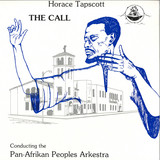
Available on vinyl for the first time in 40 years, Outernational Sounds is proud to present a masterpiece from the Los Angeles jazz underground - Horace Tapscott's burning, spiritualised 1978 set, The Call.
One of the unsung giants of jazz music, the composer, bandleader, arranger, pianist and community activist Horace Tapscott was the undisputed keystone in the grassroots Los Angeles jazz scene. Throughout the 1960s and 1970s, his radical community arts and music formations the UGMA (Underground Musicians Association, later changed to UGMAA - Union of God's Musicians and Artists Ascension), and his protean big band, the Pan Afrikan Peoples Arkestra, were at the epicentre of music, culture and politics in the Los Angeles area.
From their 1960s base at the Watt's Happening Coffee House on 103rd St, to their decade-plus- long 1970s residency at the Immanuel United Church of Christ on 85thE St and Holmes Ave, Tapscott's groups were the beating heart of underground music in LA. Hundreds of musicians passed through and played their part. Major figures in LA jazz such as Arthur Blythe, Azar Lawrence, Jimmy Woods, John Carter, Bobby Bradford, Sonny Criss, Ndugu Chancler and dozens of others all paid dues or just got down with Tapscott, not to mention the core Arkestra regulars who have since become celebrated names - Nate Morgan, Jesse Sharps, Adele Sebastian, Dadisi Komolafe, Gary Bias, to mention only a few.
Tapscott and the Arkestra were down on the ground - playing fundraisers in park and street, organising teach-ins and workshops for young and old, mixing it with radical theatre groups, firebrand poets, political radicals, Black separatists, community groups and churches. They lived communally, and built an ark for the Black arts in the heart of the city. But as a result of this grassroots community focus and Tapscott's antipathy to the music industry, the Arkestra didn't record for nearly two decades. That only changed when long-time jazz fan Tom Albach started Nimbus Records. The label was initiated specifically in order to document Tapscott and his circle, and the first three records showcased Horace and the Arkestra.
The Call was put together from two studio sessions in April 1978, one at Hollywood Sage and Sound, one at United Western - the latter session had the addition of a string section, who can be heard on the moody Cal Massey composition 'Nakatini Suite' and Jesse Sharps' swinging modal trip, 'Peyote Song No. III', with its swirling soprano solo. In keeping with the communal nature of the Arkestra, the other two compositions, 'The Call' and 'Quagmire Manor at Five A.M.' are also by Arkestra members. But at the centre of the music is the builder of the Ark, the visionary whose original call to action started a movement whose legacy continues to this day - Horace Tapscott.
Heed The Call!

11
Life is all about rhythms. We don't know what we're dancing to until we're in so deep we can no longer control ourselves. The rhythm controls us.
Right now both Guti and the Martinez Brothers are dancing to the conga rhythm. Guti's third album, they've been dancing to it since the summer, teasing us with a whole slew of percussive new... And they'll continue throughout 2019. Chance are you will, too. Eventually the rhythm will control all of us. It's too infectious not to.
Here's the 411: 'The Year Of The Conga' is Guti's third and most rooted album to date. It came about through a personal request from brothers Chris & Steve Martinez. Both unapologetic Guti fans they wanted the very first album on their Cuttin' Headz label to be his. The result is a total reconnection back to his Argentinian foundations, his club roots and everything that first lured him to the dancefloor...
'I'm back to my roots and found my Latino groove again,' says Guti who wrote the album throughout 2018, starting it whilst bulleting through Japan by train, the majority crafted in the jungle of Dominican Republic, having collected and sampled native percussion instruments, and then finally mixing down on his return to Europe. 'Every song is full of rhythm and created to make you dance...'
He's not messing around; from the writhing snakelike percussion and rousing calls and cries of opener 'Aee' right through to the final mesmerising waves and farewell struts of finale 'Voladora' this an album is born both for and from the dancefloor. No overthinking, no purism, no exclusion; just unabashed physical hypnosis, fuelled for the floor, guided with gut instinct and years of groovecraft. It's the sound of an artist who's disconnected, explored and reconnected. He's older, he's wider and more in tune with his own pace and palette. One of the most diverse and explorative artists to come from Loco Dice's Desolat stable, this is Guti simplifying his passions down to an essence of everything that's magic about his roots and our shared dancefloor culture.
The highlights are in abundance; those hazy-but-persistent New Jersey organs on 'Telling The Truth', that wobbly sub on 'Red Eye', that shimmering sinewy acid line on 'Se Baila', the spicy pianos and wet horns of 'La Orchestra Fantasma', the list goes on. Each cut designed for deep mix pleasure, each cut rolling with a strong organic flavour and alluring percussive dynamics, each cut showing Guti at his most inspired, warmest, playful and ready to wrap you up so deep in a conga you'll soon lose yourself.
Cuttin Headz, cuttin straight to the chase but never cutting it fine... Let us be the first to wish you happy new year with the first ever album on the currently unstoppable label. We'll wish you a happy new conga, too. 2019's going to be a vintage and Guti and the Martinez Brothers are leading the charge.

Rivertones - the recorded music of Caught by the River - have repressed their classic 2012 Dylan Thomas-in-dub 7" Under Dubwood by the Dubwood Allstars.
Although Under Dubwood might seem an incongruous mix - the words of Dylan Thomas, the voice of Richard Burton and the studio sounds of King Tubby - the resulting single actually makes perfect sense - a gloriously woozy psychedelic skank that places Llareggub somewhere just outside downtown Kingston, JA. Since its release five years ago, Under Dubwood has been a staple on BBC6 Music and was used as soundbed music for the BBC's coverage of Dylan Thomas' centenary in 2014. It remains hugely in demand from the Caught by the River shop and has been sold out for the last eighteen months. The identity of the Dubwood Allstars remains a mystery to all at Rivertones.
On the B-side of the Under Dubwood 7" is River Theme by the Time and Space Machine (aka acid house stalwart Richard Norris of the Grid and Beyond the Wizard's Sleeve). River Theme is a hypnotic, fuzzed-up garage groove that's equal parts Dirty Water Club and Trash.

Although Itta (Vocals, Harmonium) and Marqido (Analog Synthesizers) have been regular fixtures in Seoul's experimental music community for years, the vinyl release of Spiritual reflects the growing international recognition of their singular sound, described by The Wire as 'meditative synthesized vistas.' Spiritual certainly embodies the meditative element of their music, layering hypnotic modular synth with Indian harmonium drone and Itta's transcendental vocals. This is more than functional music for the metaphysically curious, however. Perhaps more than any of their previous releases, Spiritual offers an open accessibility, owing at least partly to the channeling of krautrock-influenced rhythms. Tracks like 'Luft' and 'Morgen Tempel' wouldn't sound out of place in any DJ set with kraut or psychedelic leanings, while 'Barabonda' and 'Dodeuri' dig deep into a more meditative place, serving as perfect expressions of the album's title and intent. Fans of Neu!, Kraftwerk, Laraaji or Klaus Schulze might find themselves in a comfortable yet unexplored place.
Spiritual was originally released in 2017 as a limited-edition cassette of 250 copies, produced in collaboration with Seendosi, an arts enterprise in Seoul Euljiro district, the city's heart of printing, packaging and electronics manufacturing. The cassette sold out within a year of its production, prompting Extra Noir, who had previously released Tengger's 'Breathe In, Breathe Out' on their Extra Noir Vol. 1 compilation, to propose reissuing Spiritual on vinyl. Working with Seendosi once again, the result is a beautifully produced piece of work. Closely attentive to the band's vision, the gatefold sleeve features rich landscape motifs that evoke Tengger's commitment to earthly travel and the less accessible places beyond. Pressed onto clear vinyl, the design of Spiritual has been carefully constructed to reflect the entirely unique music within: heavy ephemerality, dense transcendence and grounded wanderlust.
2026 Repress
Limited White Vinyl Pressing!
daniela will release her 2nd album on housewax - we are more than exited about the result.
so many good tracks - that's why we decided to present you an limited pre-sampler.

* Abyss is a new artist for Kniteforce, and he brings a distinctly different flavor to the label. Having had a few tracks featured on anthologies within the label such as the Death To Digital EPs and the Vinyl is Better albums, he now brings forth his first full EP. His sound is jungle and dark for the majority, from that early era of D'n'B, at the birth of the almost hypnotic sound, with strings and dark spoken word samples, and the omnipresent and heavy amens. The result is something that sounds like it was build in 1994, and has only just resurfaced....
Club / DJ Support
Billy Bunter, the Fat Controller, Glowkid, Slipmatt, Dj Jedi, Dj Luna-C, Dj Brisk, Clayfighter, Jimni Cricket, Bustin, Sc@r, Doughboy, Saiyan, Dave Skywalker, Ponder and many others

12
Movente Is A Debut Lp From A Vital And Long Standing Figure Of Italy's Clubbing Scene Under A Brand New Alias. That Alias Is Cleptophonic, And The Album, Due In 2019, Is An Autobiographical Collage Of Experimental Trip Hop Sounds That Is Truly Immersive.
Under A Former Alias, Cleptophonic Has Spent Years Djing And Experimenting In The Studio And Has Made A Real Impact On His Native Scene As A Result. He Is A Very Delicate Person With Serious Attention To Detail That He Puts To Best Use By Delving Deep Into What He Loves: Playing On Turntables And Immersing Himself In A Sonic Realm Cuts Him Off From The Real World And Acts As Therapy For This Meticulous And Selective Person And Artist.
He Is A Master Of A Stylish Musical Collage Technique - Both In Sound And Images. As Such Movente Is A Collage Of Different Sounds, Sampled With The Turntables And Put Together With Logic, While His Passion For Collage Also Spills Over Onto The Album Cover, Which Is Made By Pieces Of Paper From Magazines, Newspapers And Comic Strips. The Result Is An Experimental Trip-hop Album With A Singular Sound That Puts Together Pieces Of Life, Sounds And Images That Are Meaningful For Him, Especially The Last Song, Which Is Dedicated To His Mother Who Sadly Committed Suicide A Few Years Ago.
There Is A Beauty And Delicacy To The Music Throughout This Most Excellently Escapist Album That Is Utterly Absorbing. Pads Swirl Round Louche Beats, Crisp Hits Ring Out Into The Night And You're Left In A Deep State Of Contemplation Throughout. There Are Warped And Shimmering Cuts, Dub Tracks Drenched In Reverb And Melodically Rich Broken Beats. The Whole Thing Is So Spacious You Get Sucked Right Into The Centre Of It All And The Thoughtful Moods And Deft Sonic Details All Making A Truly Lasting Impact. This Is An Exquisite Album That Encourages You To Really Get Lost In A Unique Musical World.
