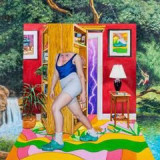
Originally from Normandy now residing in the country's capital, French DJ and producer Adam Boufeldja (aka Adam BFD) has been making a serious name for himself, having put out a string of self-released singles and curating his own self-titled Youtube channel.
Adam’s tracks have always been vivid, detailed portraits; drawing from memories and influences from around the world, and his latest EP is no exception; using his eclectic tastes to produce a record truly unique, and brimming with personality.
‘I’ll be walking’ meanders through an always evolving city, creating space and a sense of an otherwise chaotic and fleeting world. The track’s softly spoken synths hold the torch, while the effortless drums walk us home. ‘Call A Taxi’ follows suit, a fruitful marriage between shuffling drum patterns and hypnotic tones, while the track's subtle low-end provides the glue; closing off an A side that feels more like a story being told than another dance-floor memento.
Title track ‘No Advice’ launches the B side on a slightly more ominous tone, in a microcosmic portrait of opposing forces; before ‘An Ode To La Condesa’ glides through like a letter from an old friend, the smell of fresh ink still prevalent on the page as we’re whisked away through the wide-tree lined avenues of La Condesa. The EP comes to a close with ‘For The Good Times’ combining nostalgic tinged leads, forward-marching drums and sprawling pads that act as a backdrop to another highly impressive EP from one of France’s best emerging artists.
Cerca:the soft
John Scofield's first guitar-solo-recording ever gives a résumé of all the
influences and idioms he has cultivated over his career in performances
on guitar, accompanied by his own rhythmic pulse and chordal backing
using a loop machine
Besides jazz, John is known to have always also had a soft spot for the rock and
roll and country music he grew up with, revealed here in unencumbered renditions
of Buddy Holly's "Not Fade Away" and Hank Williams' "You Win Again". Between
elegant and personal readings of standards, like "It Could Happen To You", the
traditional "Danny Boy" and Keith Jarret's "Coral", Scofield presents his own
timeless compositions - some new, others known.
For the guitarist, it's all about "the way you get the sound out of the string and
what you do with it after you attack it."
John Scofield: electric guitar and looper
Press:
"Scofield is as fiery as ever, plugged in and using loops to give himself a
background groove on some of his gritty originals or putting a punkish spin on
romantic ballads." - **** The Times
"This isn't an album to listen to in a hurry; but if you were pressed for time, the last
two tracks alone would give you a sense of Scofield's extraordinary range. The
bebop- heavy Trance De Jour is antic, angular, questing. But then we close with
You Win Again, a Hank Williams cover, serene as a sunset over the prairie." - ****
The Daily Telegraph
"Here he has distilled his decades in this crazy business into a baker's dozen of
songs that may appear modest in ambition - only one track runs to more than five
minutes, several run to barely three - yet is mighty in impact...This album needed
no other title. This is John Scofield." - **** Jazzwise
"(8/10) The result offers an intimate insight to Sco's skills as both guitarist and
arranger. It's a late-night album - quiet, introspective and really quite beautiful, too,
with Sco's musical soul laid bare before us." - Guitarist
Këkht Aräkh is the Ukrainian project founded in 2018 by Dmitry Marchenko. Originally released on the Finnish label Livor Mortis in 2021, Pale Swordsman goes to even greater extents in building a bold and atmospheric sonic palette, and it’s now seeing a worldwide reissue via Brooklyn label Sacred Bones.
For the sound design of the album, Dmitry was inspired by The Stooges’ Raw Power to deliver a more soft sounding album, decisively less “metal”. Traditional black metal song structures still persist in songs like “Night Descends” and “In The Garden”. However, their rawness and fast tempos is quickly cut through by dark ambient passages in “Amor” and “Intro” and softly played desolate ballads like “Nocturne” and “Lily”.
Këkht Aräkh is the Ukrainian project founded in 2018 by Dmitry Marchenko. Originally released on the Finnish label Livor Mortis in 2021, Pale Swordsman goes to even greater extents in building a bold and atmospheric sonic palette, and it’s now seeing a worldwide reissue via Brooklyn label Sacred Bones.
For the sound design of the album, Dmitry was inspired by The Stooges’ Raw Power to deliver a more soft sounding album, decisively less “metal”. Traditional black metal song structures still persist in songs like “Night Descends” and “In The Garden”. However, their rawness and fast tempos is quickly cut through by dark ambient passages in “Amor” and “Intro” and softly played desolate ballads like “Nocturne” and “Lily”.
Ingredient is the elegant collaboration of Toronto poets, composers, producers and dear friends Ian Daniel Kehoe and Luka Kuplowsky. Their self-titled release is an enigmatic electronic avant-pop record attuned to the micro and macro perspectives of the natural world. Ingredient is an album whose lyrics are more poem than lyric, and whose songs exist in a merger of house music, philosophically-minded lyricism and contemporary R&B. One might recall electronic and art-pop luminaries such as Yukihiro Takahashi, The Blue Nile, and Arthur Russell, or connect it to contemporaries like Nite Jewel, Westerman and Blood Orange. A distinct world of dance, of questions, of secrecy and ultimate softness.
Eight years of friendship forges strange telepathy.
In the summer of 2020, Ian Daniel Kehoe was entrenched in a new feeling of heaviness; psychosomatic symptoms had started to proliferate; stress made new pores across the body, bending sensitivity into pain. His days were met with confusion, detachment, sleeplessness and pain without causation. Disfigured, he felt that what had been central and centering was blown out to the periphery of things. In a moment of self-preservation he reached out to his dear friend Luka Kuplowsky to make an album together. For Kehoe, it was an instinctual grasp for the anchoring truthfulness of deep friendship and the potential for a dedicated creative collaboration. Kuplowsky’s presence was light, supportful and curious, eager to explore musically the sounds they were mutually drawn to: house music, ambient pop, dub. The duality between Kuplowsky and Kehoe – between the Aflight and the Unmoored – is a portrait of a friendship whose exchanges came easy and produced an outpouring of song. Creation and therapy crisscross. In email correspondence that catalogs their process of collaboration, affection abounds: “feels bare without the Luka Licks”, or “Love you so much”, or “Kinda just overwhelmed with deadliness coming in at all angles.” When their voices first come in together on “Wolf,” that harmony arrives in a dramatic avant-pop sound that is bold and wondrous.
Kuplowsky and Kehoe both arrive at Ingredient as established artists whose works are committed to language’s propensity to provoke and mystify. Kuplowsky’s 2020 album Stardust is an idiosyncratic and otherworldly blend of pop and jazz romanticism grounded by Cohen-esque vocals and a stirring philosophical curiosity. Kehoe’s entrance into the new decade has hatched four records of pop experimentation, most recently 2022’s Yes Very So, a euphoric and bold album of poetic synth-pop and meditative ambient instrumentals. Kuplowsky and Kehoe’s union as Ingredient is a beautiful and unusual chemistry that integrates their distinct approaches while bringing forth a newness: a sound that alternates between cinematic technicolor and dubbed out fogginess; a lyricism that exchanges their lucid and clear poetics for a playful and obtuse verse. The album intuitively taps into the opposing emotional states of Kuplowsky and Kehoe during the conception of the record, contrasting the buoyancy of trumpeting keyboards (“Resurface”), angelic synthesized voices (“Come”), and rolling bass (“Photo”) with the record’s underlying darkness of whirring buzzsaw textures (“Transmission”), whooping sirens (“Wolf”) and murky ambience (“Illumination”). Lyrically, this duality arises in the record’s flux between openness (“Variation”, “Raindrop”) and existential dread (“Wolf”). “Illumination” most clearly crystalizes this opposition, reconciling the verses’ neurotic yearning for enlightenment with the chorus’ liberating doctrine of negation: “no more devotion… no more delusion”. Amidst the gradations of light and dark, Kuplowsky and Kehoe trade indelible, lush melodies as though their voices are made of a substance that melts easily one into the other. The harmony of poetry, sound, and texture cuts through your brain fog like a wet diamond.
Ingredient’s self-titled record was assembled by Kuplowsky and Kehoe over the course of six months in a home studio they frequented daily. Amidst synthesizers and drum machines they composed, re-composed, and workshopped a wide array of music, ultimately focusing on a set of eight songs that lived in a shared musical and philosophical world. Recording days often ended in basketball games at a local court or a rooftop commune over a pot of tulsi tea and a crossword puzzle. Kuplowsky brought in the Blue Cliff Record – the classic anthology of Chan Buddhism – whose inscrutable and sublime insights remained constant throughout the recording process as an activator of reorientation and reflection. While Kehoe was frequently rendered physically immobile by bouts of anxiety, a patience and mutual caring governed the pace of their creation; rest, stretching and meditation became equally important as the act of arrangement. Invited into their intimate circle of composition was Thom Gill, whose heavenly voice uplifts “Variation” and “Raindrop,” and Karen Ng, whose alto sax simmers and dances around the funky strut of “Raindrop.”
The lyrics on Ingredient reflect the persistence of change, the infinite variability of nature where randomness and divergence are no accidents. In Daoism, duality, in the form of Yin and Yang, is not contradictory as it is in Western idealist philosophy, but rather composes the eternal and lived paradox of our changeless-changing universe: changeless because all is change, and changing because the dynamism of the Dao makes each moment transformational. Kuplowsky and Kehoe refract this way of seeing the world, as in Variation: “Variation in the natural world / there it is.” Ingredient is an experience of the manifold ways of saying there it is of the transformational world, and there it is, unfolding. Elsewhere, change and ephemerality is addressed through the record’s preoccupation with non-human perspectives, reorienting the listener to the wolf, the mouse, the emerald frog, the centipede, the bird, the fly in the lamp. The album cover visualizes this fascination with the striking image of a reddish-orange frog atop a defamiliarized landscape of dark green leaves. Mirroring the exploratory process of the record’s collaboration, the frog also signals the amphibian’s natural inclination to leap into boundless potential. Kuplowsky and Kehoe’s lyrics manifest philosopher and ecologist Timothy Morton’s concept of “the mesh,” drawing attention to the “vast, entangled web” of interconnectedness that connects all life forms and interweaving the songwriters’ shared wonder into the Animal’s unknowability. As Luka narrates in the breakdown of the dance-floor ready “Photo,” “the closer we observe things, the further they retreat into abstraction.” In Ingredient’s ecosystem, perception is a reversible fractal where the world’s minutest details mirror the shape of the cosmos.
According to the Dao, the path to healing starts by reorienting perception away from the self and toward the self’s subsumption in Totality. For Kehoe, collaborating with Kuplowsky became the reorientation necessary for the self-preservation he was seeking, opening up a shared creative practice to navigate and soften the complexity of his psychological shattering. The album begins with Kuplowsky intoning “colossal faith” which bounces around the stereo field in a cloud of echo, and it is the enormity of “faith” that centers both Kuplowsky and Kehoe’s collaboration and their inquisitiveness in the vast mysteries of our very being. Truth in Ingredient is not an essential nugget, but a bending of the light – it is the equivocal entanglement of how we are in nature as nature, but with a plea or prayer under our breath that marks our felt distance from what we are a part of: “carry me towards the mountains of my birth / returning to the nest / the silence of the earth.”
- A1: Breathe (Feat Lily James)
- A2: Coconut Grove (Feat Homeboy Sandman)
- A3: Don't Even Try It (Feat Liam Bailey)
- A4: Lesson 1956 (Feat Jamie Cullum & Dj Woody)
- A5: My Energy (Feat Eva Lazarus)
- B1: Feel Like Home (Feat The House Gospel Choir)
- B2: Airplane Mode (Feat Lily James & Choosey)
- B3: Harder I Rock (Feat Choosey)
- B4: Way Home (Feat O Love)
- B5: Don't Mean A Thing (Feat Beardyman)
Dressed in a powder blue suit with the frilly shirt to match, DJ Yoda invites you to be his +1 for ‘Prom Nite’, his new album promising retro Americana full of daydreaming reverie, international megastar guests, trip hop acknowledging the likes of Morcheeba and Nightmares on Wax, and the turntable extraordinaire’s bread and butter of cuts, beats and rhymes.
Certainly no stranger to retro sounds having famously peppered his DJ and AV sets with the unexpected the world over, and his ‘How to Cut n Paste’ mix series going all the way back to the 30s, Yoda’s harp-laden puppy love vibe spreads from the sweet and mellow sound of 2019’s ‘Home Cooking’, an album described as ‘boundary-breaking’ by Mojo upon slotting nicely into the UK’s blooming jazz canon. Think deliciously harmonised doo-wop murmuring ‘Goodnight Sweetheart’ with an eye for dreamboats en route to Makeout Point – on ‘My Energy’, Eva Lazarus takes the form of an earth angel, with Yoda on jukebox cut-ups, taking it back to starry-eyed, clean cut days of wonder (or more recently, Little Mix’s ‘Love Me Like You’).
Beginning enigmatically with the assistance of Hollywood A-lister (and former next-door neighbour) Lily James, ‘Breathe’ demonstrate Yoda’s continued evolution as a musician (not to mention shrewd decision maker), with James’ vocal confidence - a little Lana del Rey to her breathiness - returning on the velvet-smooth ‘Airplane Mode’. It’s a smartly executed soundclash accentuated by LA rapper Choosey, the star of the album’s straightest hip-hop shooter ‘Harder I Rock’. Homeboy Sandman adds some kick to the prom punch with typical wordplay sent down ‘Coconut Grove’, and Liam Bailey is perfectly cast for the darkly cinematic sway of ‘Don’t Even Try It’.
On an album of many talking points, the LP’s crowning glory is opening single ‘Feel Like Home’: featuring the vocal comforts of the House Gospel Choir, it’s your go–to pick-me-up when the chips are down, targeting the hairs on the backs of necks like a softer focus version of Jamie xx’s ‘Loud Places’. Extended into an alternative, equally uplifting form by Beardyman’s ‘Don’t Mean Thing’, summer festival season already has its homecoming anthem.
With tongues wagging, the twists and turns step away from Heartbreak Ridge when O Love tucks into the mouthwatering shopping list funk of ‘Way Home’; and ‘Lesson 1956’, featuring Jamie Cullum and DJ Woody, jauntily pays homage to classic Cut Chemist alchemy, Yoda’s celebrated turntable tomfoolery back in full effect and extending the flavours found in ‘Home Cooking’.
Again maximising the experience and enjoyment gained from recording live instruments and prioritising songs over beats, Yoda continues to progress with a mixture of risk-taking, elite musicianship, nostalgia brought bang up to date, and ultimately, good clean fun capable of stirring your soul, making ‘Prom Nite’ a date to remember.
Magpie artwork supplied by London’s ENDLESS, whose signature style has tagged Liberty and Lagerfeld as but two high profile clients, Yoda again maximises the experience and enjoyment gained from recording live instruments and prioritising songs over beats. His continued progress mixes risk-taking, elite musicianship, nostalgia brought bang up to date, and ultimately, good clean fun capable of stirring your soul, making ‘Prom Nite’ a date to remember.
Featured 7” Vinyl singles:
Feel Like Home (feat. The House Gospel Choir)/ Don’t Mean A Thing (feat. Beardyman)
My Energy (feat. Eva Lazarus)/Lesson 1956 (feat. Jamie Cullum & DJ Woody)
new pressing on red & black swirl vinyl. RIYL: New Order, Drab Majesty, The KVB, Black Marble, The Soft Moon. Layering synths, guitars, electronic percussion and live drums, Houses of Heaven fuses early industrial and techno rhythms with the melodicism of shoegaze and a heavy dose of dub-influenced effects on their first full-length album titled 'Silent Places.' Written against the backdrop of the Northern California wildfires, ever-growing tent cities and the continued rise of empty luxury housing in the Bay Area, the album explores the intimate experiences that transpire within the chaotic confines of modern living. Opener "Sleep" basks in the tension surrounding the album's inception with blown-out kick drums, claustrophobic verses, and deteriorating vocal effects. Sharp arpeggiated synths and woozy strings neutralize the track's subterranean anxiety with texture and sensuality. Produced by Matia Simovich (Inhalt) and with engineering credits that include Monte Vallier (Weekend) and John McEntire (Tortoise), it's a potent introduction to the muscular sound design underpinning the album. Booming taiko drums sound the beginning of "Dissolve the Floor," the album's most club-ready track. A pulsing arpeggio gives the song its industrial heartbeat while disintegrating tape delay throws menace into the hazy atmosphere. The undulating techno beat breaks and repairs itself with seductive and satisfying timing. "In Soft Confusion" doesn't stray from the album's obsidian narrative as it envisions and ponders the aftermath of human extinction. Sonically speaking, though, it's the album's most uptempo offering with Tecon's supremely infectious chorus vocal hook and Beck's dizzying guitar riffs. The intricate electronic drum programming is elevated by Ott's live drumming, which lends a refreshingly human touch to the potentially icy, and often mechanical, sonic territory of synthdriven music. Adding density to the album's shadowy allure are the unusual sounds and vintage outboard effects that Tecon and Simovich impressively maneuver into the album's tonal palette. Great care has been taken to finesse familiar pop structures with an inventive edge. It's this mindfulness of past and present that is sure to secure Silent Places as a standout album in the new decade. Also Available From Houses Of Heaven: Remnant 12" EP
Laila Sakini's new album 'Paloma' arrives via Modern Love and is her most striking and ambiguous to date - a pointed and timely meditation on hope and hierarchies that riffs on Zbigniew Preisner's magical "The Double Life of Veronique" score and enduring outsider music tome "The Langley Schools Music Project". Subtly transcendent, fathoms-deep music.
When Laila Sakini's debut album ‘Vivienne’ arrived in 2020, it felt like the record we were waiting for to map out our tangled reactions to an uninvited reality. Never self-consciously strange, it revealed itself slowly and cautiously, like a shadow in the corner of the eye, or an alchemical symbol in a bowl of alphabet spaghetti. This time around Sakini has worked her unique world-building to an even finer point, forming six tracks around a theme that's so close to our heart it's almost beating in time. Initially inspired by Krzysztof Kieślowski's 1991 arthouse classic "The Double Life of Veronique", the cult Polish director's enduring modern fairytale that serves as a cosmic rumination on identity and choice. Detailing two identical women - both singers, both in love - the film lets one live as the other dies, forcing us to consider the implications of art and endurance in the face of life's myriad challenges.
Sakini takes Polish composer Zbigniew Preisner's influential score for the film and uses it as a jumping-off point for ‘Paloma’, bending the more grandiose moments into baroque awkwardness on opening track 'Fluer D'Oranger' and evoking the mood of scene-setting cues 'Weronika' and 'Véronique' on the recorder-led 'The Light That Flickers In The Mirror'. And while Preisner's score zeroed in on the musical virtuosity of the film's lead characters, Sakini reinterprets that as a metaphor for self-discovery. Playing piano, violin, glockenspiel, timbale, recorder, and occasionally singing, Sakini captures a mood of innocence that immediately transports the listener back to simpler times. Her music isn't self-consciously simplistic, but forcing herself to interface with instruments impulsively rather than studiously, her sounds are all heart, no filigree.
In spirit, it reminds us of cult Canadian album "The Langley Schools Music Project", a collection of 1970s recordings of school kids singing rudimentary renditions of pop songs in a school gymnasium. That album's genius was in the bottling of hope and innocence: the feeling of joy from hearing and wholesomely interacting with music that's known and loved without a sense of hierarchy or desire for cultural clout. Sakini subtly subverts this by evoking the amateur spirit in the most bewitching way; instead of sourcing her ideas from Bowie, Fleetwood Mac and the Beach Boys, her stock is the established art canon, and by reforming those sounds she makes an insightful comment on intellectualism and access. European classical music is all too often trapped behind the frosted glass of respectability and assumed skill - craft replaces spirit, and technique replaces soul. By approaching these gestures from a different angle, Sakini softens the edges sonically and intellectually, finding music that bubbles with emotion, and most strikingly - hope.
Her choice of instruments and the way she interacts with them allows us to feel as if we're not only listening but contributing. It's a bottom-up way of absorbing art that's traditionally been top-down, and a reminder that we're all part of the experience, whether we're humming along to the remnants of a theme as it dribbles out of an ear in the shower, or dreaming of spotlights in a parallel life that may or may not be real. Sakini's music is nostalgic in a sense, but nowhere near the buttered popcorn and high-fructose candy migraine of the Netflix/Spotify algorithm generation of regurgitated churn. She makes sounds that remind us of what time and experience may have stolen from us, and how we might recover it.
"Most of this record was created in the shadow of COVID and deep in the maw of Melbourne’s 2020 long winter lockdown. It is a meditation on the nature of connection.
Restricted to a 5km zone, one of the only people I saw outside my family during this time was my old friend and teacher, Ania Walwicz. We met in the overlap between our zones on the waterfront near Docklands to walk and talk on bright, cool winter afternoons. Those conversations became large in my thoughts when Ania suddenly passed away in September. Her voice was in my head as I worked on this music, trawling through threads of ideas, recordings made on my phone, and thoughts jotted down in notebooks.
Ania’s practice as a writer relied on ‘automatic’ processes. Her work was informed by everything she had read (a lot) but it was created in the manner of dreams. In a state where the subconscious might bubble up and the words arrange themselves into meaning bearing forms that resonate more than represent. I thought a lot about that as I made this music. I recorded everyday using the trumpet, my old Revox reel-to-reel, a couple of synths, a harmonium I lent from a friend, and whatever else was around. I worked mostly on just diving a little deeper each time I sat down to it.
Through the simple process of exhalation, I explored my relationship with the trumpet, which has been through so many twists and turns. I let the tones produced by my breath unfurl on long tape loops and degrade beyond recognition through pedal and plugin chains, until the only imprint of the initial gesture remained.
My process also involved long bike rides during which I’d listen to the work of previous days on ear buds, gliding through familiar streets made slightly strange by the absence of people and movement. Often my rides took me along Footscray Rd next to the port, and as I washed down towards Docklands past the old boat moorings I stopped pedalling to coast. The sounds from my darkened studio mingled with the low rush of air past my helmet, the click and whirr of my bike gears, a squalling bird, a whooshing car. And I remembered my last conversation with Ania. Sitting in the late afternoon sun, squinting against the light that raked across the water, she was telling me about all the different words for they have for blue in Polish and Russian, and how words don’t just change our perception of things, but also actually change the thing being perceived.
As I rode home that afternoon, I felt like anything was possible. "
Peter Knight
Rare & unreleased 80's bangers from Sao Tome e Principe's most iconic singer !
Bongo Joe pursues their work with friend DJ Tom B and are sharing the fourth effort in their São Tomé & Principe series : “Recordar é viver”, the first volume of an anthology dedicated to the one and only Pedro Lima, , "A voz do povo de São Tomé" (the people's voice of Sao Tomé).
“Recordar é viver: Antologia Vol. 1” features some previously unreleased tracks and gives a comprehensive look into the discography of one of the islands’ biggest stars, known for his political outspokenness as much as for his soft voice, delicate rumbas, and high-energy puxas.
With his band Os Leonenses he built a brand new genre around the strong rhythms and infectious energy of Sao-Toméan Samba Socopé ("only with the feet” in Portuguese), but with the influence of Congolese soukous, Cape Verdean Coladeira, elements from French West-Indies Cadence/Compas, and Brazilian Afoxé, it soon developed into the infectiously danceable style known as “puxa”. The band kept playing together up until Pedro’s death in 2019, performing at large events around the islands and on the continent.
But Pedro shined also on his own. Alone, he demonstrated his compositional skills and ability to balance the band’s powerful rhythm section with São Tomé & Principe’s harmonic backing vocal traditions, creating strong, dance floor ready puxas or melodic, delicate rumbas.
Pedro Lima died in 2019, leaving behind the 23 children he fathered, with thousands of mourners accompanying him to his final resting place. The public funeral, paid for by ex-president Pinto da Costa, was one of the biggest the islands have ever seen. Lima, "O cantor do povo” (“The people’s singer”), was buried with his wireless microphone, so his powerful voice would always be heard.
The origins of Cos date back to the second half of the sixties when Daniel Schell joined forces with Jean-Paul Musette, Pascale Son and Robert Pernet to form Classroom. When Classroom split, Daniel Schell and Pascale Son moved ahead and formed Cos together with Charles Loos, Alain Goutier and Bob Dartsch. They produced an experimental jazz rock sound linked to the influences above mentioned, but without being mere copycats since they always managed to keep to their own personality.
Postaeolian Train RobberyI is an obscure classic from the 1970's Belgian jazzy prog scene that has become a much sought after piece in the collector's market since it was originally released in 1974. Highly inspired by both the UK's Canterbury scene and the Zeuhl sound, the debut album by Cos has been compared to the likes of Soft Machine, Gong, Hatfield & The North, National Health, Gilgamesh, Egg, Placebo, Magma or Zao, with Pascale Son's unique wordless vocals and nonsense syllables singing in a voice that some sources have compared to Flora Purim's.The album was released on the small obscure label Plus, and has arised interest not only among prog-rock psych-heads and jazz experimentalists, but also among those looking for breaks and bits to sample.
The Wah Wah reissue comes housed in a beautiful reproduction of the original gatefold sleeve, featuring a 4-page image booklet and an insert with photos and liner notes. Mastered from the original tapes. We did the first official LP reissue with its original sleeve of this album some time ago and it sold out so soon that many of you has been asking for a reprint since - here is another 500 copies, again licensed from and with the collaboration of Daniel Schell.
Comes with a reproduction of killer original poster.
There's a certain winking resignation to the title of Nick Lowe's At My
Age, as if it were designed to be spoken with a soft, knowing sigh
Now in his late fifties, Lowe is hardly running away from his advancing years --
quite the contrary, the singer/songwriter is comfortable in his skin and his years.
Certainly, he's comfortable in his music, since At My Age marks the fourth time
that he's mined the intimate, well-worn country-rock vibe of The Impossible Bird,
and if at this point it no longer is a revelation, it's hardly lost its appeal, either. Part
of that lies in Lowe's ever-potent charm, and to overlook an album as exquisitely
crafted as At My Age is to be a fool, because nobody does this kind of relaxed
Americana as well as Lowe, who is still writing songs that stand proudly
alongside his previous classics. For instance, there's "I Trained Her to Love Me," a
song as wickedly witty and bitterly self- loathing as "Cruel to Be Kind" or "The
Beast in Me," a tune that's balanced by the wry new-love anthem "Hope for Us All,"
which has its share of gently funny lines but is nevertheless a ringing, sincere
endorsement of love, worthy of the man who wrote "(What's So Funny 'Bout)
Peace, Love and Understanding?" And that's always been one of Lowe's greatest
gifts, that he is possessed with rare humor but also a big heart, which is what
gives his music great resonance. This 15th anniversary edition of At My Age is
pressed on silver vinyl and limited to 2,500 copies worldwide. This marks the first
time this long- out- of- print classic has ever been available on color
vinyl.Packaging; LP jacket; silver vinyl
Since starting Babehoven in Portland, Oregon in 2017, Maya Bon has
shown herself to be a gifted heart-on-sleeve songwriter, using music to
peel back the layers of her own experience "sometimes sad, sometimes
surreal, always vividly rendered " to reveal universal emotional truths
hidden in the most intimately personal of details
After a handful of self- released EPs and their label debut on Double Double
Whammy with 2022's "Sunk" EP, Babehoven's first full-length album "Light Moving
Time" is due October 28 2022.
"Light Moving Time" is emblematic of Babehoven's wide range of dynamics, and
each of those sounds are taken further. You can hear the pared-down languor of
"Yellow Has a Pretty Good Reputation", the smoldering guitars of "Demonstrating
Visible Difference of Height", the peculiar charm of "Nastavi, Calliope", and the
soft tenderness of "Sunk". Alternating seamlessly acrossstyles, Circles and
Philadelphia have the wispy ambient calm of a Liz Harris track, I'm On Your Team
falls somewhere between a flowy country song and an 80s power ballad, Marion
contains the plucky indie- folk warmth of Hovvdy, and Stand It and Pockets are
coated with My Bloody Valentine's wobbly shoegaze. But in contrast with those
EPs, these tracks utilize Bon's voice with greater emotional impact than ever
before. Pressed on Bone Color vinyl
Monophonics cordially invite you to attend the grand re-opening of the once thriving, once vibrant establishment, the legendary Sage Motel. A place where folks experience the highs and lows of human existence. A place where big dreams and broken hearts live, where people arrive at without ever knowing how they got there. It's where folks find themselves at a crossroads in life. So join us as we examine where the stories are told and experiences unfold.....and sink into a soft pillow of soulful psychedelia.....down at the Sage Motel.
King Gizzard & The Lizard Wizard veröffentlichen ihre 2LP ”Changes”. ”Es ist nicht unbedingt unsere
komplexeste Platte, aber über jedes kleine Stück und jeden Sound, den man hört, wurde viel nachgedacht”,
erklärt Frontman Mackenzie. In der Tat hat sich das Album über fünf ideenreiche Jahre hinweg entwickelt.
Ursprünglich als fünfter Release der Albumreihe im Jahr 2017 gedacht, ist es nun das fünfte Album, das
King Gizzard im Jahr 2022 veröffentlichen wird.
Gute Dinge kommen zu denen, die warten - und das großartige „Changes“ ist jede der 2.628.000 Minuten
wert, die King Gizzard darin investiert haben. Durchtränkt von den warmen Klängen 70er Jahre R’n’B und
geleitet von einfachen, doch facettenreichen Akkordwechseln, ist ihr fünftes Album des Jahres 2022 ein
leuchtendes Soft-Pop-Wunder.
First Pressing of 1,000 on Green Vinyl. Toured with Tori Amos in Spring 2021. At just 23-years-old, identical twin sisters Sophia and Jo Babb had faced a decade of darkness. Then, as Companion, they built lighthouses. With their debut album Second Day of Spring, the duo arrive at the start of a blooming new season, holding a work that softly glows with a sincerity, vulnerability, and hopefulness that they fought hard to find along their way. “A lot of this album is rooted in healing from grief and familial hurt,” says Sophia. “There are songs about marriage and healing from mistrust. Family ties that have been broken.” Second Day of Spring introduces two brilliant songwriters and mesmerizing singers as they share their stories with gazes at once light and weighted, offering listeners comfort in despairing corners.
Myor proudly welcome DJ Sofa to their ever expanding roster of talent. A swiftly rising star within contemporary jungle, her tracks have already found their way into the sets of scene stalwards like Double O, Sully and Tim Reaper.
On her first offering for Myor Massiv she delivers two choice cuts of melodic, beautifully crafted, uptempo dancefloor business.
This is a real treat for fans of original minimal house sounds: a remastered and recut repress of the still hugely in demand first EP from Aspect Music. Opening up are the one and only Soul Capsule with 'Forever Love', a restlessly, tightly looped track that has pent up energy that really gets under your bones. The F Macmillan mix is more cut up still, with puddles of melody, late night freakiness and dry beats all taking you for a trip. Dark Boys then get more direct with the pinging kicks of 'Pluto Rising' and Softcore closes out with a classically colourful melodic house workout.
Ever since he remixed Abimaro & The Free’s ‘Mark’ back in 2014, NuNorthern Soul boss Phil Cooper has kept in touch with Daniel Stenger, the producer and self-taught multi-instrumentalist behind the Flashbaxx project. Cooper was always convinced that Sanger would be capable of crafting a very special release for the label but was willing to give him time to come up with something special.
With Take Care My Friend, a mini-album inspired by the German producer’s deeply rooted love of jazz-funk, Stenger has repaid the faith shown in him. He’s deliv-ered a collection of quality cuts marked out by audible warmth, effortless musicality and memorable, sun-soaked songs.
As he makes clear in the liner notes included with the vinyl version of the mini album, the project began with the recording of luscious, Rhodes-laden opener ‘Al-right’. After staying up all night recording the track, Stenger not only decided to continue recording with the same relatively limited set of instruments (think bass and electric guitars, drums, piano, electric piano, organ, hand percussion and a handful of synthesizers), but also stick to a hybrid sound that added a subtle Lat-in shuffle to his Balearic-minded take on jazz, funk and soul fusion.
We’re biased of course, but there’s no denying that Stenger’s creative choices have resulted in a superb set of tracks. While the restricted kit list provided focus during the music-making process, there’s still plenty of musical variety across the six tracks that make up the set.
For proof, compare and contrast the jazzy, loose-limbed headiness of ‘It Just Happens’, where simmer-ing synth-strings, twinkling melodic motifs and glis-tening guitar licks rise above smooth jazz-funk bass and a gentle broken beat rhythm, and the slow-motion soul brilliance of ‘Strangers’, where Kathryn Kempf’s evocative and poignant lead vocals rise above a sump-tuous downtempo groove and heart-aching piano lines.
This subtly varied but musically coherent vibe contin-ues across the mini album. Stenger indulges in a bit of New York daydreaming on ‘Brooklyn Love Boat’, a wonderfully musically detailed chunk of 1970s style jazz-funk heat that offers knowing nods to Roy Ayers, Herbie Hancock and the jazz-fusion stylings of Azymuth, before opting for a deeper, slower and even more seductive sound on the Hammond-sporting bliss of ‘Take Care My Friend’.
Closing cut ‘City Lights’, a gorgeous, soft-focus affair smothered in echoing Rhodes riffs and immersive chords, has the feel of an underground classic in wait-ing: a stirring, string-drenched future sing-along whose emotion-packed lyrics are delivered brilliantly by Glasgow-born singer/songwriter Chris Pookah.
Despite the song’s subject matter – the painful final breakdown of a relationship – there’s something strangely uplifting about the combination of Pookah’s pitch-perfect vocal delivery and the absorbing warmth of Stenger’s comforting and sonically detailed music. It provides a fittingly impressive finish to a mightily immersive mini album.
Sunda Arc are brothers Nick Smart and Jordan Smart. Best known as key members of folk and jazz influenced minimalists Mammal Hands, their Sunda Arc project takes inspiration from the likes of Jon Hopkins, Rival Consoles, Moderat and Nils Frahm as well as their own music world. Their debut EP 'Flicker' was released in December 2018 and now the duo are set to release their debut LP, 'Tides' on 7th February 2020.
Named for a volcanic arc in the Indian Ocean, created by the process of massive tectonic plates colliding, Sunda Arc strives to mingle electronic and acoustic sounds until they become almost indistinguishable from each other. It's a process where they draw the acoustic properties and quirks out of electronic sounds and find the electronic potential in acoustic sounds. "Finding the ghost in the machine or blending the human elements of playing live is something we are always trying to explore in our work.
Experimentation is a large part of our process and we tend to combine carefully composed material with chaotic ideas to find the balance between the two" — Sunda Arc 'Tides', their debut album, takes its name from the idea of unseen forces that can affect our lives in myriad ways, being pushed and pulled and at the whim of powerful forces outside of our control as well as offering a nod to things such as the tides on our planet, tectonic plate movements and weather systems. There are often chaotic elements in these systems that function in a way that produce a type of controlled randomness on a large scale. This is something they try to reflect in their music by adopting some of the ways these systems work into musical sequences, and using ideas such as chaos theory to control musical parameters. "Tides is a reference to themes we were thinking a lot about during the making of this album. These include the similarities between macro and micro systems, or the circulatory and nervous systems in the body. Things that produce a type of controlled randomness on a large scale". — Sunda Arc 'Hymn', the first single from the album, uses Nick's voice sampled and played back through a keyboard to create a human yet electronic feel.
It mixes soft vocals with heavier electronic elements to create a danceable yet human sound world. 'Dawn', is best described as uplifting-techno, its use of repeated phrases building in intensity and variations to put you into a hypnotic state whilst also being industrial and danceable. 'Daemon' is one of the tracks that really resonates live. Drawing on the sound of UK dubstep it's intense but fun and the bass clarinet blends with synths at the end to create a sound almost like a vocal. 'Secret Window' brings forward another side of the band, focusing around a lo-fi recording of felted piano and bass clarinet.
These are blended with granularised and processed versions of themselves which emerge like ghosts of the instruments throughout the track. 'Cluster' is another key track. It utilises a small group of notes looped in an unusual way to create a sense of cascading patterns over a solid danceable drum groove. It emphasises soprano sax blended into the sound world half-way through to lift into the final section.