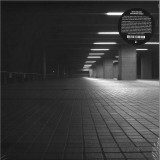
The latest entry in An’archives’ ‘Free Wind Mood’ series, Ki is a trio that pits long-time collaborators Tamio Shiraishi (saxophone, voice) and Takahashi Michiko aka Mico (drums, voice, vocoder, melodica, piano, percussion) against drummer, percussionist and vocalist Fritz Welch. They each bring a wealth of experience, from Shiraishi’s early moves in the Japanese underground of the late ‘70s and early ‘80s – he was a founding member of Fushitsusha, and played with Taco and Machinegun Tango – to his legendary, late-night solo New York subway performances; he and Mico also spent some time playing with No Neck Blues Band, while Welch, currently based in Glasgow, has a long history taking in stints with Peeesseye, Lambs Gamble and FvRTvR.
Tearful Face Of My Cute Love (Is Begging To Me), named after a yakuza song, is Ki’s first LP, after CD-Rs on Chocolate Monk (Ki No Sei, 2009) and Unverified (Stops Dropping, 2010). Documenting two live performances from 2008, it’s a startling, wild freedom chase, each piece stretching languorously across one side of the vinyl, giving the trio maximum space to thunder their way through space and time. Their West Nile 2008 show, on side one, opens with a battery of drums, fierce and livid, before Shiraishi’s unmistakable and remarkable whinnying, high-zone tone slithers into earshot. The stage is set, the battle moves forward, yet there’s remarkable simpatico between the three players, with Mico and Welch volleying guttural vocal exhortations at each other. When it does offer respite – see the sudden swoop into near- silence at around 12:30– everything’s still tense; who knows what’s around the corner?
For all its fury, though, Tearful Face Of My Cute Love... is full of oddly lyrical moments, too – see the sweet melody that winds out, with gentle melancholy, near the very end of the West Nile performance. This lyricism also haunts the second side of the album, a performance from Glassland, Brooklyn, which seems more focused on the intersection of incidents, from clattering cymbals to ghostly swarms of sax scream, to dive-bombing spirals of vocoder. There’s an appealing sense of audio verité here, as though you’re in the room with the performers, shaken and stirred by every movement, lost in the interlocking maze they’re weaving in real time. It’s a bracing, thrilling document of very immediate, human music – of three bodies moving through the world, sounding their environment.
[a] a1 Tearful face of my cute love [is begging to me] (Side A)
[b] b1 Tearful face of my cute love [is begging to me] (Side B)
Suche:the sol percussion
FOR FANS OF:
Airto Moreira, Gilberto Gil, Chick Corea, George Duke, Jorge Ben, Sabrina Malheiros, Hermeto Pascoal, Chico Buarque, Stanley Clarke, Jaco Pastorius, Carlos Santana, Jose Neto, Dizzy Gillespie, Stan Getz, Milton Nascimento
First new studio album in over 15 years by the “Queen Of Brazilian Jazz” Musician line-up includes Airto Moreira, Jose Neto, Diana Purim and Celso Alberti.
One of the all-time greats of Brazilian jazz fusion, Flora Purim, returns with her first studio album in over 15 years, ‘If You Will’, released on Strut on 29th April.
Conceived as a celebration of her music and collaborations, the album explores new compositions alongside fresh versions of Flora’s favourite personal songs and positive lyrics from across her varied career. Title track ‘If You Will’ reprises a song from her inspired collaborations with George Duke: “You will find... good love, real joy, so much peace of mind, if you will…”; the resilient ‘This Is Me’ updates an Airto jam band tune ‘I Don’t Wanna Be Myself Again’; ‘500 Miles High’ marks the heyday of the late Chick Corea’s Return To Forever band and ‘Zahuroo’ interprets a song by Claudia Villela about “a shapeshifting animal creature, a messenger who acts as a bridge between our thoughts and the universe.” A family affair recorded primarily in Curitiba and Sao Paulo, ‘If You Will’ brings together many of Flora’s closest circle of musicians including Airto Moreira, guitarist José Neto, her daughter Diana Purim on vocals and percussionist Celso Alberti.
The album is the latest chapter in Flora’s long, illustrious and varied career. As well as her celebrated partnership with Airto and her early days with Quarteto Novo, Flora has worked with Stan Getz, Gil Evans, Miriam Makeba, George Duke, Chick Corea (as an original member of Return To Forever), Dizzy Gillespie’s United Nation Orchestra, Uruguayan band Opa and many more. Her solo albums on Milestone remain true jazz fusion classics.
‘If You Will’ is released on CD, LP and digital, supported by a full international PR and marketing campaign worldwide. The album was co-produced by Flora Purim and Roberta Cutolo with package photos by Mel Gabardo in Brazil and cover illustration by Gabriela Barbalho.
FOR FANS OF:
Airto Moreira, Gilberto Gil, Chick Corea, George Duke, Jorge Ben, Sabrina Malheiros, Hermeto Pascoal, Chico Buarque, Stanley Clarke, Jaco Pastorius, Carlos Santana, Jose Neto, Dizzy Gillespie, Stan Getz, Milton Nascimento
First new studio album in over 15 years by the “Queen Of Brazilian Jazz” Musician line-up includes Airto Moreira, Jose Neto, Diana Purim and Celso Alberti.
One of the all-time greats of Brazilian jazz fusion, Flora Purim, returns with her first studio album in over 15 years, ‘If You Will’, released on Strut on 29th April.
Conceived as a celebration of her music and collaborations, the album explores new compositions alongside fresh versions of Flora’s favourite personal songs and positive lyrics from across her varied career. Title track ‘If You Will’ reprises a song from her inspired collaborations with George Duke: “You will find... good love, real joy, so much peace of mind, if you will…”; the resilient ‘This Is Me’ updates an Airto jam band tune ‘I Don’t Wanna Be Myself Again’; ‘500 Miles High’ marks the heyday of the late Chick Corea’s Return To Forever band and ‘Zahuroo’ interprets a song by Claudia Villela about “a shapeshifting animal creature, a messenger who acts as a bridge between our thoughts and the universe.” A family affair recorded primarily in Curitiba and Sao Paulo, ‘If You Will’ brings together many of Flora’s closest circle of musicians including Airto Moreira, guitarist José Neto, her daughter Diana Purim on vocals and percussionist Celso Alberti.
The album is the latest chapter in Flora’s long, illustrious and varied career. As well as her celebrated partnership with Airto and her early days with Quarteto Novo, Flora has worked with Stan Getz, Gil Evans, Miriam Makeba, George Duke, Chick Corea (as an original member of Return To Forever), Dizzy Gillespie’s United Nation Orchestra, Uruguayan band Opa and many more. Her solo albums on Milestone remain true jazz fusion classics.
‘If You Will’ is released on CD, LP and digital, supported by a full international PR and marketing campaign worldwide. The album was co-produced by Flora Purim and Roberta Cutolo with package photos by Mel Gabardo in Brazil and cover illustration by Gabriela Barbalho.
repressed !
Emotional Rescue reissue 'Into Dark Water', the second album from UK post-industrial ambient pioneers O Yuki Conjugate (OYC).
The willfully obscure OYC formed in Nottingham in 1982 and have had a sporadic career on the outskirts of musical culture ever since. Initially associated with the early 80s post-industrial scene - along with Soviet France and Muslimgauze - OYC quietly forged their own brand of ambient music at a time when it was distinctly unfashionable to do so.
Always reluctant to categorise their sounds, OYC have been variously described as post-industrial, ambient, darkwave, tribal ambient, chill out, electronica and Fourth World. Take your pick.
'Into Dark Water' was recorded in 1986 over four days in an eight-track garage studio in Nottingham. Produced and engineered by John Kaukis, the result was a blend of flutes, percussion, electronics and loops that focused their sound and became for many the definitive OYC album.
Originally released in 1987 on the Leeds-based Final Image label, 'Into Dark Water' quickly sold out and has been highly sought after ever since. The re-issue, featuring a lovingly recreated sleeve, makes a vinyl version of this classic available again for the first time in over 30 years.
There is a tendency within modern electronica to pigeonhole and categorise, to package music into easily digestible formulae. In direct revolt comes Dutch artist Satori and his new album Dreamin’ Colours, released globally April 22nd, 2022, on renowned imprint Crosstown Rebels. Recorded at the esteemed Sonic Vista Studios in Ibiza, the nine-track LP has been greatly anticipated off the back of its proceeding’s singles: Yellow Blue Bus ft. Laska, Lalai ft. Ariana Vafadari and most recently Gin Song.
An ethereal, swirling body of work, Dreamin’ Colours is rich in texture, colour and imagination. Satori stretches himself out through languorous, mystical explorations of both the digital and the analogue elements of music, the result a beautifully conspired collection of world music, steeped in electronic and Balkan roots, and straddling a multitude of genres from blues and indie electronic to opera, folk and beyond.
Colourful Dream begins proceedings, taking the form of a gently-building opener. From the pluck of a guitar string to hypnotic flute-like elements, we soon arrive at the enchanting world of Lalai ft. Ariana Vafadari. Recorded in a four-hundred-year-old water well, it showcases the transcendent sound with which Satori has become best known, meandering through rustling hats and tribal-like drum patterns whilst the dulcet tones of Ariana shimmer softly throughout.
Tuti ft. Kalima takes on a harder edge, with gritty drum patterns opening into melancholic chords early on. Kalima’s vocals add an emotive touch to the piece, paving the way for Moj Dilbere: a euphoric cut that feels tribal and reflective in one.
We land at a similarly ethereal soundscape on The Gin Song ft. Mybaby, as star-like synths pulse alongside punchy percussion before Yellow Blue Bus ft. Laska takes its place. It begins with real-life ambience, made up of sounds recorded live in Ibiza as a bus passes and birds chirp merrily in the background. This swiftly gives way to a guitar-flecked bassline, opening neatly into the vocal offerings of both Satori and Laska.
Troublemaker ft. El Mundo retains an inherent melodic quality, progressing through poignant strings and whispering kick-hat combos. Powerful and poignant, the mesmeric sounds of Ora Dea and Moshe meander subtly into Lonely Boy (Redux) ft. Hugo Oak. The closing saga brings things to a wonderfully subdued finish, rounding off the album on a wholeheartedly calming note.
Although raised in the Netherlands, where commercial electronic music is of course king, on Dreamin’ Colours it is undeniably Satori’s Balkan heritage that layers his production with dreamy, ethereal, Eastern European influences. The album’s overriding voice lies in his exultant celebration of Eastern European music, weaving vibrant threads of its earthy, melodic, rhythmic sounds into his thick musical tapestry. Written during the pandemic and driven by the ache of separated love, the album is, Satori says, his most personal yet.
From holding down an eighteen-month residency at Heart, Ibiza to having nearly four-hundred-thousand listeners on Spotify each month, Satori is a truly worldwide artist in today’s electronic music scene. Having been championed by Damian Lazarus early on in his career, he has emerged as a must-see live act for fans from all corners of the globe. November 2021 marked the start of his USA tour, where his Maktub concept adorned some of the country’s most iconic clubbing institutions, whilst his discography speaks for itself, with a plethora of acclaimed releases on labels including Crosstown Rebels, Sol Selectas and DGTL Records to name a few. As Dreamin’ Colours introduces him to an ever-growing audience, Satori remains one of the most exhilarating, untamed and truly authentic forces in music.
Cerrot is a Puerto Rican artist that currently resides in Barcelona. "Iteritax" is his solo debut trip after appearances on Nina Kraviz's stream-turned-compilation Hot Steel series. He recorded the 11-track EP in 2020 after falling into a flow that saw him create several tracks a day. The Plasma distortion unit pedal is at the core of the EP's raw, harsh and undone style. "Iteritax" is defined by strong percussion and a variety of modular synth recordings. "What started out as daily jam sessions effortlessly transformed into tracks and ultimately this EP. This approach has allowed me to tap into an infinite source of inspiration. Once I started jamming I had so many routes to take and it all just flowed for me. This same sense of freedom is what I aim to bring out in people with these tracks." - Cerrot
The Ricardo Villalobos / Samuel Rohrer partnership has yielded increasingly interesting results over the past few years, with the former’s remixes of the latter’s trio Ambiq being supplemented by further reinterpretations of Rohrer’s solo work and live meetings at select events like Berlin’s Funkhaus and Radialsystem V. As should be the case with any strong collaboration, this partnership has been based on mutual challenge rather than compromise,
seeing each participant shuttle key technical and emotive aspects of the other’s work to previously unexpected places.
Those who have been closely following this relationship will notice a definite sense of continuity between previous outings and the new collaborative release entitled MICROGESTURES. As with those earlier Villalobos / Rohrer pairings, these four new pieces are defined by a special quality of being many things that once: that is to say, depending on the listener’s own level of focus, these can feel very tightly constructed and disciplined, or playful and freely wandering. That the tracks are equally engaging regardless of one’s chosen listening “mode” is a testament to the level of thought put into them; you could almost imagining the creators poring over some elaborate sketched set of architectural blueprints rather than coolly monitoring the usual multi-track editing software.
Altogether the music here is firmly a-melodic and percussive, but within these deliberate limitations there is still a greater variety of individual sounds than most would bother with. Each track is its own observatory of microgestures clustering together into a dense communicative fog or a sort of robotic sound swarm. Yet while all
these tracks are variations on that theme, each one has its own character and, consequently, its own rewards in terms of the exact sectors of the imagination that it activates.
Take for example “Cochlea” and its twin “Helix,” on which the magnetizing, busy layers of percussion are tempered with mischievously disruptive blossomings of digital noise, as well as sampled radio communications (which again bring us back to the idea of listeners’ attentiveness changing the meaning of this music - these
curious transmissions can either be taken as a purely aesthetic element or as something to be actively decoded).
Club-oriented elements are also not absent from this suite, particularly on “Incus” with its traditional sequenced baseline, crisp synthetic trap and hats, and dizzily sliding set of bell-like tones laid on top.?
Yet this track, too, is powered as much by its restless desire to deviate as by its rhythmic consistency: throughout the eleven-minute running time, a mass of ambiguous and restless machine sounds build a parallel narrative, and will maybe prompt the occasional glance over the shoulder as they seem to be taking on their own life. “Lobule” rounds out the program with the most rhythmically eventful sound set off the five.
What this all adds up to is a confident music which builds that quality from its faith in possibilities rather than firm conclusions: it’s an inspiring addition to both the musical landscape and reality in general
Loraine James' new ambient-minded alias, Whatever The Weather, follows her 2021 solo LP Reflection (Hyperdub). In contrast to her club music sensibilities, this mode embraces keyboard improvisations and vocal experimentation, foregoing percussive structure in favor of shaping atmosphere and tone. From this divergent headspace emerged new coordinates and climates, a new outlet: Whatever The Weather. A longtime fan of ambient-adjacent Ghostly International artists such as Telefon Tel Aviv (who she'd ask to master the album), HTRK (whose singer Jonnine Standish features on Nothing), and Lusine (whom she remixed at the start of 2021), James saw the label as the ideal home for this eponymous album of airy, transportive tracks as they began to formulate. The titling on Whatever The Weather works in degrees; simple parameters allowing James to focus on the nuances as a mood-builder. Her suspended universe fluctuates; freezing, thawing, swaying and blooming from track to track. James describes her jam-based approach for the sessions as "free-flowing, stopping when I felt like I was done," allowing her subconscious to lead. The improvisations have an intrinsic fluidity to them, akin to sudden weather events passing over a single environment - the location feels fixed while the conditions vary. The album opens at "25°C," a sunshower of soft hums and keys. As the longest piece, it serves to establish stability, the inflection point where any move above or below this temperate breeze breaks the bliss. Given James' proclivity for organized chaos in her production, this scene is fleeting, naturally. From that utopia, we plummet to the most melancholic read on the meter, "0°C," its isolated synth line traversing a hailstorm of steely beats and static. Next, the dial jumps for the propulsive standout "17°C." Like a timelapse of springtime in the city, the single accelerates across a frenzy of frames; car horns, screeching brakes, and crosswalk chatter fill the pauses between rapid jolts of multi-shaped percussion. For portions of the work, James leans neo-classical, rendering pensive vignettes of cascading piano keys and warm delay. "2°C (Intermittent Rain)" ends the A-Side on a short and stormy loop; a resulting sense of reset permeates the B-Side's opener, "10°C." The producer mingles intuitively on echoed organ, locking into and abandoning atypical rhythms that suggest her jazz-oriented interests. "4°C" and "30°C" display the range of James' vocal experiments. The former chops and pitches her voice to a rhythmic, otherworldly effect, the latter reveals James at her most straightforward (she cites Deftones' Chino Moreno and American Football's Mike Kinsella as inspirations), singing tenderly and unobstructed for nearly the duration before beats collide in the climax. Whatever The Weather closes at "36°C," while a sweltering heat by any standards the track eases along comfortably on a chorus of synth waves, acting as an apt bookend for this evocative, sky-tracing collection that started in a similar state. Cyclical, seasonal, and unpredictable, true to its namesake.
2023 Repress
"banging piece of sound art" - The Observer
"...a fascinating piece of Brutalist techno that pivots between crisp machine-like minimalism and granulated noise." - Clash
"A piece of immediately engaging techno it reveals more of itself with each listen." - CMU Daily
Nik Colk Void is well established with her work as one half of Factory Floor, one third of Carter Tutti Void (alongside Chris Carter and Cosey Fanni Tutti) and with the late Peter Rehberg as NPVR, but perhaps surprisingly, "Bucked up Space" is her first solo album release.
Void explains, "When Peter Rehberg initially asked me to produce a record for Editions Mego, I didn't feel quite ready and asked if we could make a record together instead. Collaboration is so ingrained into what I do, I only felt ready to make this album after working through ideas live, using the audience in place of the collaborator."
Bucked Up Space combines Void's love of improvisation with the driving force of beat-driven music absorbed from performing in galleries, residencies and clubs across the UK and Europe. She goes on to say, "You find out more about yourself when you explain your ideas to others, and that's how I felt the live performance worked for me."
The process steadily teased out a language and Void employed a variety of tactics in the recording process including a methodical approach of collecting data at her home studio in a manner not dissimilar to keeping a diary. Her microscopic focus on raw instrumental noise, layered and reformulated, resulted in a sound catalogue that Void divided into groups for their tone, density and texture.
These initial pieces were taken to a studio in Margate to put them into a more cohesive compositional context. Something that pragmatically started as cold and detached was given warmth, unity and emotion in the studio. Via improvised repetition co-existing alongside organised production, Void conjures new sonic muscle with tracks such as 'Interruption Is Good' and 'FlatTime'. Initial recordings are rendered into sequences initiating the organic rhythms, triggering awkward jerks of high hats and percussion, or used to activate the margins of post effects detectable in the tracks like 'Demna', 'Big Breather' and 'Oversized'.
Void explains: "It was important to me that the simplicity in the work disguised a lot of complexity, I want this work to be absorbed instinctively."
The sleeve image, a still from We Are City by Brazilian artist Maria de Lima, was chosen to illustrate Bucked Up Space, which Void describes as "a distorted reality, the space that lives at start of an idea, then floats in public view, before returning to inform my understanding of the idea. Once the idea is out in the world, it moves and morphs into something else entirely."
Written, performed and produced by Nik Colk Void, the album was engineered by James Greenwood, mastered by Rashad Becker and tracks 1, 4, 5, 7 and 9 were mixed by Marta Salogni.
Bucked up Space is the result of the ideas and resulting sounds of free exploration morphing into a personal structured album that fearlessly moulds patience, listening and restraint. It's a sharp focussed work embracing collective action through the lens of the self. All this, and also one of the best abstract dance records you will hear in some time!
The artistic oeuvre of Berlin-based Sonja Deffner is as extensive and diverse as its contexts are high-profile: If the classically trained musician could in recent years be heard as a member of the groups Jason & Theodor, Die Heiterkeit, Globus and PTTRNS, as part of Christiane Rösinger's touring band, or as a recording musician on Andreas Spechtl's (Ja, Panik) albums, she has at the same time produced an acclaimed graphic work, video works and made her theater debut. Under the name Kalme, Deffner now presents her solo debut »Neue Sprache«, which feels like a culmination: Deffner doesn't need much space to present an artistic position of spectacular incisiveness and maturity.
The formal language of Kalme's debut evolves with reference to experimental pop and R&B, but equally informed by ambient electronics or dub techno. Analog and digital sound synthesis meet Deffner's characteristic use of field recordings, acoustic instrumentation (clarinet, percussion) meets musical post-production, sampling meets expressive synthesizer playing. At the center of the album, however, are Deffner's remarkable lyrics, written in German for the first time. Deffner creates a language of stark, emotional poignancy that is as conspiratorial as it is precise. The themes of the tracks develop between the poles of movement and stagnation, understood as motifs of biographical as well as musical ways of being or relating. In this forcefield, personal and political considerations coincide again and again, for example when Deffner reflects on her experiences with the social conditioning of femininity and motherhood.
The album title »Neue Sprache« (»New Language«), then, describes a search for forms of articulation of solidarization: language as a tool of a new relationship to the world that allows testimony to individual experience without reproducing categories of repression. In this way, Kalme's debut simultaneously achieves a radical intimacy, just as, on the other hand, the confrontation of language and sound repeatedly opens up fissures that deny any semblance of comfort. »Neue Sprache« does not stop at this modernist gesture, however, but unquestionably takes a stand. That's what Kalme's »Neue Sprache« ultimately is: the taking of a position. A statement.
Lost somewhere between the mysterious alleys of 70s Istanbul and the scorching sun and crystal blue sea of Jaffa, Tel Aviv, Şatellites self-titled debut album is set to be released on Batov Records on April 1st.
The Şatellites’ sound shimmers between traditional Turkish folk and instrumentation, ethereal psychedelic guitar leads and groovy dance floor baselines. The resulting concoction of songs draws on cross continental influence yet at its core is a desire to illuminate the vivid qualities of classic Turkish music, honouring the Anatolian folk and psych artists from this golden era of music. From the funky disco beat of Disko Arabesque to the celestial lead guitar in Yağmur Yağar Taş Üstüne, the band add fire and flair to time-honoured pieces of Turkish music giving them new meanings. Covering important tracks such as female singer Kamuran Akkor’s track Olurmu Dersin, and musician and guitarist Zafer Dilek’s Yekte, the album covers an array of original pieces of different musical styles and sounds, that once have and continue to flow out of Turkey. The band boasts six members; Ariel Harrosh (Bass) Lotan Yaish (Drums), Yuli Shafriri (Vocals), Tsuf Mishali (Keys and Synths), Tal Eyal (Percussion) and Itamar Kluger (Diwan saz, both electric and acoustic, electric baglama, Greek 4 double string bouzouki). They came together some years after band leader Itamar Kluger discovered the saz whilst travelling the Kaçkar mountains in Turkey’s eastern region. The saz being a long necked, plucked stringed instrument native to the rural areas of the country, which remains an integral part of Şatellites’ union, and plays predominance throughout the bands’ album and music.
In the same way the guitar was electrified in the 1930s, the electrification of the saz in the 1960s led to an explosion of rock music dredged in middle eastern influence, a musical genre fittingly called “Anatolian Rock” and based on the principles of Anglo-American and psychedelic rock music, yet incorporating the style, rhythm, and scales of traditional Anatolian folk music.
As such, throughout the creation of the album, the band conceived the idea of intertwining differing elements such as the groove of funk, the rhythm of disco, and reverb of psychedelic, with traditional middle-eastern rhythm and structure, opening up the wealth of Turkish music to the western world, so that anyone and everyone can relate to something from the album. With that said, Şatellites emphasise that their music is not fundamentally Turkish music, on the contrary, they merely try to sound as close to the genre as possible. Their sole aim is to honour this amazing culture and to present it to the world in a more accessible and attainable form.
- A1: School Girl Crush (Feat Kendra Morris)
- A2: Groovin' (Feat Jamie Allensworth)
- A3: You Got To Be A Man (Feat Sy Smith)
- A4: Gimme Little Sign (Feat Chris Dowd)
- A5: Inner City Blues (Make Mewanna Holler) (Make Mewanna Holler)
- A6: Whatcha See Is Whatcha Get (Feat Alex De'sert, Jesse Wagner & Malik The Freq Moore)
- A7: Aht Uh Mi Hed (Feat John Arthur Bigham)
- A8: Gossip (Feat Malik The Freq Moore)
- A9: Me & Baby Brother (Feat Kevin Sandbloom)
- A10: There's A Break In The Road (Feat Afrodyete)
- A11: Put On Train
- A12: Let's Stay Together (Feat Destani Wolf)
- A13: This Christmas (Feat Durand Jones)
Since their debut 45 back in 2019, Night Owls have consistently taken the bar up a notch re-imagining classic funk & soul with a Jamaican twist. With eight sold out 45’s in a span of three years and regular airplay on BBC6, KCRW and more, we’re happy to announce this much anticipated LP “Versions” comprising all their groove filled singles to date. This all-star production team comprised of Dan Ubick (The Lions, Connie Price and the Keystones, De La Soul) on Guitar & Percussion, Blake Colie (Arise Roots,The Lions, Hollie Cook) on Drum Kit, Dave Wilder (The Lions, Ziggy Marley, Macy Gray) on Bass, and Roger Rivas (The Aggrolites, Jason Mraz, LBDA) on Organ & Piano, team up with many of today’s top soul singers to bring their signature take on beloved chart topping hits and deep cuts. Featuring vocalists Afrodyete (Breakestra),Terin Ector (Orgone), Durand Jones (The Indications), Malik “The Freq” Moore (The Lions),Alex Désert (Hepcat,The Lions), Jesse Wagner (The Aggro- lites), Jamie Allensworth (Jungle Fire), Sy Smith (Macy Gray, Sheila E.), Chris Dowd (Fishbone), John Arthur Bigham (Fishbone, Soul of John Black), Kevin Sandbloom, Kendra Morris and Destani Wolf (Matisyahu,The Pharcyde), each track was carefully selected by producer Dan Ubick to match the featured vocalists strength resulting in a heavy soul and dub infused LP that surely won’t want to leave your turntable!
- A1: Deux Ans Plus Tôt (02:24)
- A2: Trilogie I (Tâm) (04:04)
- A3: Trilogie Ii (Belles Larmes) (01:33)
- A4: Trilogie Iii (Phoenix Rouge) (02:24)
- A5: Les Rivières Vont À La Mère (04:32)
- A6: Pour Marthe (04:08)
- B1: Mon Âme Vers La Tienne (02:19)
- B2: Sur L’embarcadère / Ðêm Tàn Be^´n Ngu?? (04:14)
- B3: Maman (02:31)
- B4: Le Rêve Noir (02:11)
- B5: Je Revive (01:57)
- B6: Regarde Maintenant (03:43)
- B7: La Floraison Du Bambou (02:52)
We finally made it: BEWITH100LP! And what better way for a re-issue label to celebrate such a landmark catalogue number than to give it to a record of new music. We couldn’t resist when the artist is Official Be With Family Member Kenny Dickenson and when the music is his lovely, lovely score to French-Vietnamese artist Mai Hua's 2020 documentary film “Les Rivières”. If you enjoy the more minimal, intimate piano of the likes of Nils Frahm or John Carroll Kirby’s solo work, you’re certain to fall for this beautiful album.
Taking six years to make, Mai’s film explores what happened when she brought her dying grandmother to France, pulling together four generations of women from the same family. Kenny’s score accompanies all the pretty things, sad things, dirty, beautiful, happy, broken and reborn moments of these women’s experiences.
The whole score is built around delicate, sparkling piano motifs. At times they’re joined by cello and complemented with ambient chords and other flourishes. It’s a very particular palette that Kenny and Mai established early on, as Kenny explains: “We had agreed on a particular sonic aesthetic early on in the process - to use specific and relatively minimal instrumentation, reflecting the intimacy of the picture. So piano and cello were quite prominent in instructing a sense of space and immediacy. Until I had to get the junkyard percussion out… ”
When it comes to describing the end results, Kenny’s happy to wear his influences on his sleeve:
“When the director and I sat down for the creative meetings early in the process, we watched ‘Wolf Children’, a Japanese animation film by Mamoru Hosoda. The amazing soundtrack by Masakatsu Takagi was a launching point for me and thereafter I leaned into more modern classical composers - Reich, Sakamoto, Glass as well as Jon Hassell’s Fourth World output. Richard Reed Parry’s ‘Music for Heart and Breath’ was a good early touchstone for me and Mark Hollis’ sparse, considered and deliberate approach was a constant presence. Also labels like Ghostly, ASIP and the ubiquitous Erased Tapes should probably get a nod here too…”
We’d even suggest there’s the occasional Yann Tiersen moment in there too.
Out of sheer necessity the collaboration between Kenny and Mai continued beyond this initial creative direction. With Kenny speaking neither French nor Vietnamese, Mai acted as translator, a process that naturally lead to discussing the film beyond just what was being said in the footage. Mai herself explains just how successful this relationship felt to her: “Music plays a very important role in all my work, particularly in Les Rivières. I cried every time Kenny sent me a new composition. I felt understood in a way that words cannot describe. It was absolutely magical and I am so happy if this music can make your soul vibrate too.”
Kenny composed much of the music in London, at the same time that Mai was shooting and editing. As the film took shape and the music also evolved, another challenge presented itself when Kenny relocated to Los Angeles part way through, resulting in Arnulf Lindners beautiful cello taking on new shapes- multi sampled, played and manipulated by Kenny into new compositions.
What Kenny has put together for the film score release is definitely a “soundtrack LP”, with the music arranged to work as a proper album in its own right that should be listened to from start to finish. Indeed the album also includes a new piece “Pour Marthe” that Kenny composed in memory of Mai’s grandmother who died after the film was finished.
Kenny’s personal highlight is also ours: “When I listen back to the album as a whole now, I never want part II of the Trilogy (Belles Larmes) to end. I have fond memories of recording it and I love how the dynamic of the piece gradually evolves from falling on the ‘1 and the 3’ to the ‘1 and the 2’. It’s so short and sweet, I keep wanting it to last for longer. But it’s kind of perfect as it is.”
Pretty much our sentiment for the album as a whole.
Running a record label means we often get asked advice about pressing a record. In this case the music was too good not to offer to release it ourselves. To Kenny, having the Les Rivières score on vinyl also feels like the final part of the project.
“It’s a beautiful thing to have it on vinyl. It’s quite an intimate soundtrack so there’s something really perfect about being able to listen to it on that format. When I was a kid, my Uncle Pat who used to work at Woolworths would visit and bring random records from their record department over to us. I can remember listening to “Theme From Exodus” by Ernest Gold. I had no idea what it was about but the imagery it conjured up when listening to that record was just mind blowing to me at that age. Soundtracks can have their own life on vinyl I think, and removed from their original context is this unique format for reinvention. So I’m excited that people who haven’t (and have for that matter) seen the film can have that experience.”
This might not be a re-issue, but the Les Rivières film score album has still been given the full Be With treatment. The vinyl has been mastered by Simon Francis (under Kenny’s ever-watchful eye/ear, of course), cut by Pete Norman and pressed at Record Industry. The sleeve follows the film’s poster and other promotional material, including Lucile Gomez’s almost magical illustration.
We’re under no illusions that many people reading this will have seen “Les Rivières”, but that doesn’t really matter when it comes to listening to the score. Just on its own, Kenny’s music still captures the robustness and the delicacy of lives lived.
International musicgroup SexJudas feat.Ricky returns to Optimo Music this Winter with a new album: Night Songs. The eight track LP draws inspiration from the night and features Malian percussionist Sidiki Camara,jazz clarinetist Andreas Røysum and noise rocker Linn Nystadnes. Making their own blend of disco, post punk and African music.
“It’s the return of Sex Judas feat.Ricky, this time as a six piece in fully fledged band mode. We’re here to take you on a journey through suburban psychedelia, forming our own brew of postpunk, disco and electronic, as well as traditional music from Mali. Night Songs is a meditation on the night time. The excess, the dreams, the highs and lows of night time activity.”-Sex Judas feat. Ricky.
“Black Cat In A Black Room” begins proceedings, taking the form of a psychedelic six-minute offering packed full of tribal drums and desert-like percussion. “A Man Without Purpose” comes next with its African-inspired vocal, before “Hab Mich Lieb” soon arrives. The six-minute cut is hypnotic, trippy and relaxing all in one, as is “Slow Down” feat. Linn Nystadnes. Taking on more of a funk-rock feel, there’s plenty of groove in the guitar-laced bassline, whilst in “Cold Clementine”, Sex Judas tells the sad tale of rave casualty over a dark and funky groove.
We’re taken down a spiritual path on The Light You Saw Was Not For Real, as Andreas Røysum’s clarinet solos sit underneath shamanic vocal offerings that open neatly into The Night Within The Night. Aslow-burning cut, riffs and hats serenade us before When You Wake Up Everything Will Be Fine brings proceedings to a close. Dream-like chords wrap us in a warm and glowing hue, with the harp-like sounds from Sidiki’s Ngoni, leaving us in a starry-eyed state to finish.
The calming nature of the album is a nod to the band’s influences: they were inspired by the great meditative records of the past, setting off on a musical trip that saw them record the whole release at legendary Norwegian studio Athletic Sound. This happened during lockdown and whilst the LP was never meant to be comment on the pandemic, there remains a brooding intensity to each track because of it. Sex Judas feat. Ricky originally began life as the solo project of Tore Gjedrem (from electronic duo Ost & Kjex), but has since grown into a steady six piece involving the talents of Sidiki Camara (djembe/ngoni/balafon), Ivar Winther (guitar/keys), Tracee Meyn (vocals), Tore Brevik (drums/percussion) and Kristian Edvardsen (bass). Centre stage is also illustrator and comic artist Sindre Goksøyr, this time portraying each character as they paddle their way into the sunset and uncharted territories.
Malian-born, Norwegian-based percussionist Sidiki Camara has played a pivotal role in promoting “Night Songs” to world music circles. Having lived in Norway since 2006, he has helped bring WestAfrican rhythms into the country’s wider jazz scene.
10th anniversary reissue of this rhythmically churning one-man-band monster of an album, recorded in a single inspired studio session & originally released in 2012 on Editions Mego.
From the original Editions Mego press release:
“For anyone who still associates Oren Ambarchi exclusively with the clipped, bass-heavy tones of solo electric guitar works such as Suspension, this rhythmically churning one-man-band monster of an album-length piece might seem to come out of nowhere. However, listeners who have followed the breadth of his work for the last few years (solo and in projects with collaborators from Jim O’Rourke to Stephen O’Malley and Keith Rowe to Keiji Haino) will have noted how Ambarchi has allowed increasingly clear traces of his enthusiasms as a music listener (for classic rock, minimal techno and 70’s fusion, among other areas) to surface in his performances and recordings, all the time filtering them through his signature long-form structures and psychoacoustic sonics.
Recorded in a single inspired studio session, Sagittarian Domain displaces Ambarchi’s trademark guitar sound from the centre of the mix, its presence felt only as an occasional ghostly reverberated shimmer. Endlessly pulsating guitar and bass lines sit alongside electronic percussion and thundering motorik drumming (familiar from his work with Keiji Haino) at the core of the piece, locking into a voodoo groove like Faust covering a 70’s cop show theme. The work is founded on hypnotic almost-repetition, the accents of the drum hits and interlocking bass and guitar lines shifting almost imperceptibly back and forwards over the beat as they undergo gradual transformations of timbre. Cut-up and phase-shifted strings enter around the half-way mark like an abstracted memory of the eastern-tinged fusion of the Mahavishnu Orchestra’s classic Visions of the Emerald Beyond, before returning for an extended, stark yet affecting come-down coda, equal parts Gavin Bryars and Purple Rain.
While Sagittarian Domain contains traces of a diversity of influences, it mines all of them to uncover something that is clearly an extension of Ambarchi’s own investigations up to this point, exhibiting the same care for micro-detail and surrender to the physicality of sound that are present in all of his work, extending them in new ways to repetition, pulse and rhythm”.
Following his feature on We Miss The Crowd EP - the last addition to our Killer Cuts series - Romeo Louisa returns to the Shall Not Fade catalog with a blissful solo EP.
Rarified Terms sees the emerging French producer come into his powers with three soulful deep house tracks which reflect his musical background in jazz, and see reworks from the likes of Shall Not Fade family members and fellow collaborators, THEOS and Denyl Brook, and London duo, Funk Cartel.
The EP starts as it means to go on. A skippy house beat, jazz-like piano chords and diva-esque vocal phrases lend "Desires" a driving propulsion, equally suited to the dancefloor as it is to a more laid-back listening environment. Next up, the stripped-back melody on the title track makes way for a focus on percussion, paying tribute to Romeo's brief residence in London with a half broken garage beat. "The House of Jazz" sees the EP at its classiest with soulful piano chords and a bouncing deep house rhythm, at times punctuated by drum accents which reference the sporadic nature of jazz improvisation.
Next up, enter Silver Steps Records boss, Denyl Brook, and fraternal duo, Funk Cartel, who offer their take on the title track before French producer THEOS rethinks "The House of Jazz", teasing out the lower ends so that the track is led by a funk-infused bassline.
Alex Lentini & STOMP BOXX return to Drumcode following January’s outstanding contribution ‘Natural Desire’.
The release marked the first in 2021 for the label and perhaps, fortuitously, their follow up ‘Split the Noise’ marks the final on Adam Beyer’s imprint for the year, reinforcing the respect the DC boss has for the Italian pair and their developing studio talents.
‘Split the Noise’ EP continues their creative, multi-faceted production approach. ‘Solstice’ is a distorted concoction of bass and techno, abrasive and beautifully eerie.
One for the winter warehouse season ahead. ‘Azimuth’ is an intergalactic trip to the moon and explores the more experimental side of techno, while having enough streamlined drive to move the dancefloor forward. ‘Equimulate’ works through a range of perky moods before a rasping bottom appears and propels the track into brain spangling territory.
The title track is an immersive weapon that sucks you in via knife-sharp percussion, spit-fire effects and a ripping Reese-inspired bassline. A full assault of noise and delicious bass that takes no prisoners.
Repressed !
Hear & Now's Story Is One Of Friendship And A Shared Passion For Music. It Began With A Chance Meeting On The Dancefoor At Red Zone In Perugia, One Of Italy's Most Legendary Clubs
Of The 1990s. Nearly Three Decades On, These Glassy-eyed Clubbers Have Joined Forces To Deliver One Of The Most Magical And Sun-kissed Albums That Claremont 56 Has Ever Released. By The Time Ricky L And Marcoradi Frst Joined Forces In The Studio In 2016, Both Had Become Established Producers Within Italy's Vibrant Deep House Scene. Between Them, They'd Released Records And Remixes On Such Labels As Ibadan, Uomo, Reincarnation, Top Tracks, Restricted
Tracks And Vega. Keen To Step Away From The Dancefoor, They Decided To Simply Create Beautiful Music For Bleary-eyed After-hours Sofa Sessions, Lazy Summer Afternoons And Early
Mornings Spent Blinking At The Rising Sun.
Aurora Baleare, Their Debut Album, Follows On From A Fantastic Double A-side 12' For Claremont 56 In February 2017. Those Two Tracks Take Pride Of Place Amongst An Eight-track Selection Simply Brimming With Evocative Workouts, Gentle Soundscapes And Noon-bright Sonic Bliss. While You'll Fnd Luscious Instrumental Cuts Designed To Inspire Baggy, Glassy-eyed Shuffing - See The Mid-tempo, Spine-tingling Brilliance Of salsedine', Mind-massaging hirundo' And Dreamy Slow-house Treat sabbia Magica' - It's The Effortless Brilliance Of Marcoradi's Improvised Guitar Playing And The Duo's tmospheric Approach That Really Catches The Ear.
Check, For Example, The Heady Horizontal Shuffe Of trasimeno', Where Poignant Ambient Chords, Jazzy Electric Guitar Solos And Deep Space Electronics Tumble Down Over Shuffing Beats And A Squeezable Synthesizer Bassline, And The Sun-down Adriatic Wonder Of stella Dei Venti', A Track So Effortlessly Loved-up And Blissful That You Might Be Overcome By Emotion (it Certainly Had Us Daydreaming Of Days Spent Exploring The Intense Natural Beauty Of Italy's Adriatic Coast).
Moments Like This, Where The Duo's Dreamy Electronics And Smile-inducing Melodies Seemingly Shimmer Across The Sound Spectrum, Can Be Found Dotted Throughout Aurora Baleare. There's The Darting Digital Synthesizer Motifs, Sparse Hand Percussion And Ricocheting Solos Of airone', The Italo-disco-inspired Chugging Positivity Of la Marsa' And The Title Track's Humid Beachside Breeze, Where Intertwined Electronic And Acoustic Lead Lines Seemingly Glimmer Like Rays Of Sunshine Bouncing Off The Surface Of A Becalmed, Crystal Clear Ocean. Their Roots May Be On The Dancefoor, But Hear & Now Are Fast Becoming Down Tempo Masters. You Can Dance If You Want To, But You May Just Want To Hug A Stranger Instead.
- 01: Entre Vareta Y Canasta (Tangos)
- 02: Sin Prisa (BulerÍA)
- 03: Ya No Hay Olas En La Arena (Taranta)
- 04: Lirios Y Rosas (Fantangos De Huelva)
- 05: A Mi Manuela (BulerÍA)
- 06: SabÚ (Martinete)
- 07: Brota De Mi CorazÓN (GranaÍNa)
- 08: Te La Regalo (BulerÍA)
- 09: Palabras Que Escribe El Aire (Tientos)
- 10: No Tiene DueÑO (SoleÁ)
- 11: Vidalita (Popular)
Diego el Cigala is, with any doubt, one of the greatest flamenco geniuses of our times. Not only because of his voice and charisma, but also for recording such vast and wide discography singing with majesty and no complex any style he could be challenged to perform. At Flamencoenvinilo we wanted to re-catch one of his early works back to his flamenco roots: "Entre Vareta y Canasta" (18 Chulos) was originally published in the year 2000 and, as many of his works, this album has proved the test of time and it has become a true classic. This will be the first time this album comes out on 12". Limited to 500 copies. Accompanied by Niño Josele (guitar) and a large group of percussionists, "Entre Vareta y Canasta" the second album by Diego El Cigala made him known among many people outside the traditional nucleus of flamenco for his simplicity, purity and mastery. The unique voice of this artist moves with naturalness and feeling in styles as different as martinete, bulería or fandangos.