Borghesia is an electronic music group, founded in 1982 in Ljubljana, Slovenia. The band was formed by four members of alternative theatrical group Theatre FV-112/15: Dario Seraval, Aldo Ivancic, Neven Korda and Zemira Alajbegovic. They established FV Video to self-publish their video projects and FV Založba – the first independent record label in ex-Yugoslavia. Aldo and Dario took care of songwriting, production and recording while Zemira and Neven handled the visuals. In the late 80s the band signed to PIAS and went on to release a string of successful albums and played world-wide tours.
Clones was Borghesia's second album, self-released on cassette only in 1984. The band borrowed synthesizers (Roland SH-101, Casio VL-1, Korg Polysix) and a Roland 808 drum machine from friends. Every song was played live - no overdubs - and recorded to a cassette deck over a few nights at their club Disco FV during 1983-1984. The music on "Clones" is meant to accompany various video installations and performances. All of the songs are instrumental and feature various cutting edge techniques for 1983. Hypnotic, proto-techno and acid rhythms and synth lines. Music on the A Side of the LP is faster and club oriented while the B Side offers a drugged out soundtrack to get lost in.
All songs have been remastered for vinyl by George Horn at Fantasy Studios in Berkeley directly from the original master tape. Each LP is housed in a silver jacket with original gelatin print by photographer Jane Štravs. A fold-out poster is included with unreleased photos, original artwork and liner notes by Željko Luketić. After 28 years, Borghesia's "music for video" is finally appearing on vinyl for the first time.
Search:the techniques
- Osmium 0
- Osmium 1
- Osmium 2
- Osmium 3
- Osmium 4
- Osmium 5
- Osmium 6
- Osmium 7
Limited edition white vinyl (800 copies) The self-styled ritualistic electro-mechanical ensemble OSMIUM is a veritable supergroup. Made up of Oscar-winning composer and instrumentalist Hildur Gudnadóttir, veteran engineer and producer James Ginzburg, Senyawa's idiosyncratic vocalist Rully Shabara and Grammy-winning sound designer / producer Sam Slater, while each member brings along a laundry list of accolades, the project is far greater than the sum of its parts. Alloying burnished electroacoustic soundscapes with dense, metallic drones, barbed rhythms and buckled, bio-mechanical vocalizations, OSMIUM's eagerly awaited debut album doesn't try to cast a rigid future. Rather, it tempers a viscous flow of unorthodox speculations that smolders through the distant past, blazing a trail all the way to the frontier of fate. Absorbed by questions about the relationship between humans and technology, tradition and progression, the individual and the group, OSMIUM channel their experience and expertise into a set of forward-thinking sonic interrogations that skewer established cultural preconceptions. And although genre is acknowledged - the album draws from folk, doom metal, 20th century minimalism, industrial music and extreme noise - there's never a sense that it's riveted firmly in place. Widely known for her soundtrack work (including `Joker' and `Chernobyl') Gudnadóttir plays the halldorophone, a unique cello-like electroacoustic instrument designed by Halldór Ulfarsson that allows the performer to harness unstable feedback loops. Taking his cues from this process, Slater (who has worked alongside Jóhann Jóhannsson, Ben Frost and others) generates rhythms using a self-oscillating drum he designed with KOMA Elektronik and Subtext boss and Emptyset member Ginzburg responds in kind, producing booming tambura-like sonorities from a device he developed himself based on the monocord, an ancient single- stringed resonator. OSMIUM synchronize the three unique instruments using a custom system of robotics to generate basic rhythms that underpin their improvisations and experiments, and Shabara's alien tones supply the band with their conceptual fulcrum. The vocalist is one of South Asia's most recognizable underground artists, and the sounds he's able to create using exhaustively rehearsed extended techniques are so distinctive that he's been studied by scientists back home in Indonesia. Never weighed down by needless sound design or modish ornamentation, it's music that feels authentically experimental; OSMIUM have figured out an awkward symmetry between their discrete approaches, concentrating their gaze on the outcome rather than the process. The result is a work of science fiction that's driven by interaction, conversation and sensation.
Khadim is a stunning reconfiguration of the Ndagga Rhythm Force sound. The instrumentation is radically pared down. The guitar is gone; the concatenation of sabars; the drum-kit. Each of the four tracks hones in on just one or two drummers; otherwise the sole recorded element is the singing; everything else is programmed. Synths are dialogically locked into the drumming. Tellingly, Ernestus has reached for his beloved Prophet-5, a signature go-to since Basic Channel days, thirty years ago. Texturally, the sound is more dubwise; prickling with effects. There is a new spaciousness, announced at the start by the ambient sounds of Dakar street-life. At the microphone, Mbene Diatta Seck revels in this new openness: mbalax diva, she feelingly turns each of the four songs into a discrete dramatic episode, using different sets of rhetorical techniques. The music throughout is taut, grooving, complex, like before; but more volatile, intuitive and reaching, with turbulent emotional and spiritual expressivity.
Not that Khadim represents any kind of break. Its transformativeness is rooted in the hundreds upon hundreds of hours the Rhythm Force has played together. Nearly a decade has passed since Yermande, the unit's previous album. Every year throughout that period — barring lockdowns — the group has toured extensively, in Europe, the US, and Japan. With improvisation at the core of its music-making, each performance has been evolutionary, as it turns out heading towards Khadim. “I didn’t want to simply continue with the same formula," says Ernestus. “I preferred to wait for a new approach. Playing live so many times, I wanted to capture some of the energy and freedom of those performances.” Though several members of the touring ensemble sit out this recording — sabar drummers, kit-drummer, synth-player — their presence abides in the structure and swing of the music here.
Lamp Fall is a homage to Cheikh Ibra Fall, founder of the Baye Fall spiritual community. The mosque in the city of Touba is known as Lamp Fall, because the main tower resembles a lantern. Soy duggu Touba, moom guey séen / When you enter Touba, he is the one who greets you. After a swift, incantatory start Mbene sings with reflective seriousness. Her voice swirls with reverb, over a tight, funky, propulsive interplay between synth and drums, threaded with one-two jabs of bass. Cheikh Ibra Fall mi may way, mo diayndiou ré, la mu jëndé ko taalibe... Cheikh Ibra Fall amo morome, aboridial / Cheikh Ibra Fall shows the way forward, he gives us strength, he gathers his disciples... Overflowing with grace, Cheikh Ibra Fall has no equal.
Interwoven with Wolof proverbs, Dieuw Bakhul is a recriminatory song about treachery, lies, and back-biting. Over moody, roiling synths and ominous, lean bass, Mbene throws out fluttering scraps of vocal, as if re-running old conversations in her head. The music shadows her despair to the verge of breakdown, at one moment seemingly so lost in thought and memories, that it threatens to disintegrate. Bayilene di wor seen xarit ak seen an da ndo... Dieuw bakhul, dieuw ñaw na / Stop judging your friends and companions... A lie is no good, a lie is ugly.
Khadim is a show-stopper; currently the centrepiece of Ndagga Rhythm Force live performances. The song is dedicated to Cheikh Ahmadou Bamba, aka Khadim, founder of the Mouride Sufi order. Serigne Bamba mi may wayeu / Serigne Bamba is the one who makes me sing. The verses name-check revered members of his family and brotherhood, like Sokhna Diarra, Mame Thierno, and Serigne Bara. Though Islam has been practised in Senegal for a millennium, it wasn’t until the start of the twentieth century that it began to thoroughly permeate ordinary Senegalese society, hand-in-hand with anti-colonialism. The verses here recall Bamba’s banishment by the French to Gabon, and later to Mauritania, in those foundational times. During exile, his captors once introduced a lion to his cell: gaïnde gua waf, dieba lu ci Cheikhoul Khadim / the lion doesn’t budge, it gives itself over to Cheikh Khadim. Deep, surging bass, steady kick-drum, and simple, reverbed chords on the off-beat lend the feel and impetus of steppers reggae. A reed plays snatches of a traditional Baye Fall melody; the dazzling polyrhythmic drumming is by Serigne Mamoune Seck. Mbene compellingly blends percussive vocalese, narrative suspense, exultant praise, introspection, and grievance.
Nimzat is a devotional tribute to Cheikh Sadbou, a contemporary of Bamba, buried in a mausoleum in Nizmat, in southern Mauritania. Way nala, kagne nala... souma danana fata dale / I call upon you and wonder about you... If I am overwhelmed, come to my aid. The town holds special significance for Khadr Sufism. An annual pilgrimage there is conducted to this day. The rhythm is buoyantly funky; the mood is sombre, reined-in, foreboding. Punctuated by peals of thunder, Mbene sings with restrained, intense reverence; huskily confidential, steadfast. Nanu dem ba Nimzat, dé ba sali khina / Let us go to Nimzat, to seal our devotion.
Mbene Diatta Seck: vocals.
Bada Seck: bougarabou, thiol, mbeung mbeung bal, tungune.
Serigne Mamoune Seck: bougarabou, khine, mbeung mbeung, tungune.
Text by Mark Ainley (Honest Jons).
Mastered by Rashad Becker.
Everything else by Mark Ernestus.
- A1: Space Drift
- A2: Memory Loss
- A3: Siren-Call
- A4: Harmonisers Of The Spheres
- A5: Telepathy Beyond Time
- A6: Older Than Time
- A7: Congestion Hoe-Down
- A8: Shadowland
- A9: Celandine & Columbine
- A10: The Dying Of The Light
- A11: Cloud
- A12: Darkness At Noon
- A13: Future Perfect
- A14: The Killing Skies
- B1: Into The Depths She Calls
- B2: Lazy Summer Afternoons
- B3: Insects Revolt
- B4: Blood Runs Cold
- B5: Post Apocalypse Fog
- B6: Fish Don’t Cry
- B7: Ghost In The Abbey
- B8: Insects Dance
- B9: Dreams Of Magic & Cornfields
- B10: Devil’s Lightening
- B11: Danger Hurts
- B12: Why Me?
First ever release of pioneering radiophonic / experimental / electronic / soundtrack composer you may never have heard of but really should have by now. 26 tracks in all.
As we began the mammoth task of whittling down material for this album Elizabeth recalled the time she met Delia Derbyshire. It was during a party for existing and former Radiophonic Workshop composers at BBC Maida Vale in the early 1980s. Delia introduced herself with typical energy and exuberance proclaiming "It's up to you now - I'm passing the baton. Show these men how we get things done". That must have been quite an honour and responsibility for a young, female composer establishing herself within the male-dominated environs at Delaware Road.
Looking back over a musical career spanning almost five decades, it's clear Elizabeth rose to the challenge and made her mark. She was consistently in demand with television and radio producers, composing for an array of ground-breaking, critically acclaimed and popular BBC projects. Whilst Delia's legacy has achieved mythical status with her position as an innovator and feminist icon secured, the majority of Elizabeth's recorded work remains unavailable so her contribution to the output of the Workshop and evolution of British electronic music is somewhat under-appreciated.
Perhaps this record will help start to remedy the situation. Included are early tape experiments, home demos and non-BBC commissions from the early 1970's to the late 2000s. Having listened to 260+ digital audio tapes from Elizabeth's personal archive we have barely scratched the surface but hope to provide an indication of the breadth of her compositional and sound design skills.
Classically trained in cello and piano, Elizabeth graduated from the University of East Anglia with a degree in Music in 1973. She was mentored by Tristram Cary who helped her to become UEA's first recipient of a Masters in Electronic Music and later awarded an Honorary Doctorate by Staffordshire University. Joining the BBC as a studio manager in 1975, Elizabeth transferred to the Radiophonic Workshop in 1978. One of her first tasks was to create special sound effects for Blake's 7 using tape loops, the EMS 100 and trusted VCS3.
Her celebrated score for The Living Planet in 1982 featured early use of the PPG synthesizer and earned an Emmy nomination. Over the following years studio technology evolved rapidly, but Elizabeth transitioned from analogue recording techniques to newer digital platforms with relative ease, using samplers, midi sequencing and computer controlled workstations.
With an incredible 1,400 commissions to her name, she created special sound for The Day Of The Triffids, Lord Of The Rings, countless radio dramas including Iris Murdoch's The Sea, The Sea, Harold Pinter's Moonlight, all of Howard Barker's plays, productions of King Lear, Wordsworth's Prelude and The Pallisers. The success of The Living Planet led to further work for the BBC Natural History Unit followed by numerous commissions for The Natural World. At one point in the late 1980's at least five of her signature tunes were being broadcast every week including Points Of View, Horizon, Doctors To Be and Everyman.
After the closure of the Workshop in 1996 Elizabeth became freelance, arranging Faure's Pavane for the BBC World Cup '98 coverage (reaching no. 9 in the UK singles chart). She wrote additional music for Monty Python's Holy Grail DVD, scored Michael Palin's Full Circle and Sahara TV series, The Lost Gardens Of Heligan and The Human Body with Robert Winston.
Retiring from the music industry in the late 2000's, Elizabeth recently returned to her East Anglian roots and now lives near the coast. She walks daily, listening to all kinds of music, new and old, on her beloved air-pods.
Satya is excited to welcome Sweden’s very own Chris Llopis, a veteran of electronic music, with his highly anticipated EP Echo Ridge, to its vinyl only catalog.
Chris has been a prominent figure in electronic music since the late ‘90s, releasing on respected labels like Fabric Records, Tooloop, and Micronica. Inspired by a trip to Spain at age 13, Chris began DJing on Technics SL1210 turntables and later immersed himself in Copenhagen’s vibrant techno scene. His first vinyl release on Tatsu in 1998 brought him global recognition. Today, Chris’s sound blends timeless influences with modern techniques.
Echo Ridge is inspired by Chris’s love for funk-driven bass lines and the energy of underground raves. “I wanted to create tracks with strong rhythms and a playful edge,” he says. “The bass line is the soul of a track, and this EP captures the vibe of late-night moments when everything clicks.” The EP combines the groove-heavy minimal style of the late ‘90s with a fresh, contemporary edge, delivering tracks that energize the dance floor.
Chris’s creative process thrives during early morning studio sessions. “It’s the perfect time for clarity and creativity,” he shares. For Echo Ridge, Chris used iconic gear like the Juno 106, Elektron Analog Four, Eventide H3000, and Roland Space Echo RE-201, alongside Ableton 12 and Max for Live, to craft its warm, textured sound.
Out on the shelves June 13, 2025, the EP is a celebration of Llopis’s evolution as an artist and his deep connection to the dance floor. With its groove-driven energy and meticulous attention to detail, the release is a must-have for fans of minimal house and vinyl enthusiasts alike.
- Circle
- Eye Contact
- Seventeen Nights
- My Waterfall
- Wasting Time
- Final Lap
- Eraser Ii
- Shipwrecked
- Open Shadow
- Like A Stone
Neo Gibson, born in Virginia and based in New York City, records, performs, and produces as 7038634357. This numerical alias, under which Gibson has been releasing work since 2016, offers a window into the careful ambivalences of the musical project. It conjures the impersonal_the opacity and randomness of data, a number that is hard to remember or even say out loud_while also suggesting a direct line of communication with the artist, down to an area code indexing their biography. 7038634357 uses a restricted palette to achieve music that is formally precise and emotionally direct. Their digital-native approach to production, in which frank melodies cross paths with heavy distortion, contains traces of both trance's maximalist arcs and a songwriterly intimacy. Expressive details may appear submerged or abraded, subjected to a canny sense of dynamics and textural specificity. Waterfall Horizon, Gibson's second vinyl record with Blank Forms Editions under the moniker 7038634357, was written for live performance and workshopped over successive shows during their 2022 European tour. Here, hallmarks of their earlier, studio-crafted recordings_digital distortion that obfuscates their lyrics and a slow-burning ambience_are noticeably pared back. Instead, Waterfall Horizon takes on a pop inflection, adopting more traditional lyric scaffolds so that the interstices from verse to chorus or track to track can flourish within their limited tonal range.Across recordings and performances, Gibson activates wide-ranging mechanisms of audience connection: from the relative anonymity of internet platforms to live experiments with the spatial effects of amplification. They have a particular interest in site-specific performances in non-musical spaces, and have performed in a variety of contexts, including the mezzanine of the West 4th Street subway station in New York City and INA GRM/Radio France's Présences électronique festival. Under their own name, Gibson has maintained a longstanding collaboration with the artist Charles Stobbs, working primarily with FM transmission and techniques derived from the early-seventeenth-century English tradition of change-ringing bells. The first 7038634357 vinyl record, Neo Seven, was released on Blank Forms Editions in 2023; previous releases include self-released cassettes and CD-Rs, as well as a pair of EPs on Genome 6.66 Mbp (2018, 2019).
Hi-Dynamic Instrumental & Dub is the latest release from Breadwinners records released on 2nd May 2025. With 11 tracks in total, it has been manufactured in the UK at Press On Vinyl. After a series of vocal-led albums on Breadwinners records, this is first full length instrumental based dub album in a number of years. Featuring the legendary Vin Gordon on Trombone and two of the finest saxophonists in the north west of England in Nat Birchall and Stally. Drawing on rhythm tracks created over the last few years by Al Breadwinner at his analogue Bakery Studio in Manchester, the album utilises various vintage outboard effects and lost dub techniques to create this “Hi-dynamic” sound.
On his second EP for Altered Circuits, "Signal Drift", Jacopo Latini further distills his sound. Taking a more minimalist approach, he unreservedly treats the groove as the focal point. Still relying on his staple talent for weaving melodies and hooks, he delivers four trippy club tracks that show more can be done with less. Opener "Sharp" delivers immediate proof. After starting with a sequence of eerie sci-fi atmospherics and recondite vocoded vocals, the adding and subtracting happens so ingeniously, the track switches to club velocity 303 squelches and enhanced drum programming seamlessly. Similar techniques in building and layering are deployed on "Impulse", but this time, the shifts seem a tad more dramatic. The track revolves around an FM bass melody that's equally effective as it is simple, and its return to this stripped theme, surrounded by characteristic jittery hats, squashed claps, and a little more frills, keeps the listener on his toes. A bass patch, its sustain knob turned wide open, somewhat buried in the mix, drives "Bright Sound" together with a heavily modulated formant mid lead. Deadpan vocals add icing, and slightly euphoric, phased chords bring in a touch of subtle contrast. Closer "Rave Harvey" is a rare diversion as it starts in medias res with chords that reconfigure nineties trance and a distinct bassline immediately going for the limelight. It also shows Latini switching up his palette, trading restraint for vigor, with a slab of direct, unfiltered hi-energy as a result.
- A1: With You There To Help Me
- A2: Nothing To Say
- B1: Inside
- B2: Son
- B3: For Michael Collins, Jeffrey And Me
- C1: To Cry You A Song
- C2: A Time For Everything
- C3: Teacher
- D1: Play In Time
- D2: Sossity; You're A Woman
- D3: Alive And Well And Living In
Mastered by Matthew Lutthans at The Mastering Lab from flat copies of the original U.K. and U.S. analogue master tapes Third studio album featured advanced studio recording techniques Featuring original U.S. tracklisting with bonus track "Alive And Well And Living In" from U.K. release Plated and pressed at Quality Record Pressings Gatefold old-style tip-on jacket by Stoughton Printing Jethro Tull's 1970 classic Benefit was their third studio album in as many years, following the successes of This Was (1968) and Stand Up (1969). For Benefit, Ian Anderson (flute, guitars, vocals), Martin Barre (guitars), Glenn Cornick (bass), and Clive Bunker (drums) were joined by John Evan on piano and organ.
Evan would go on to play on all of Jethro Tull's albums throughout the '70s. It was also the last to include Cornick, who was fired from the band upon completion of touring for the album. Recorded at Morgan Studios, where the band recorded Stand Up, the album featured more advanced studio techniques, such as a backward-recorded flute on "With You There To Help Me" and a sped-up guitar on "Play In Time." Frontman Ian Anderson said Evan had changed the band's style: "John has added a new dimension musically and I can write more freely now.
In fact anything is possible with him at the keyboard." Compared to Stand Up, although containing a similar mix of bluesy hard-rockers and melodic acoustic numbers, Benefit had, as Ian Anderson put it, a "harder, slightly darker feel" compared to previous material. The eclectic fusion of folk, rock, and progressive elements creates a sonic tapestry unlike any other. Anderson's virtuosic flute playing intertwines with Barre's electrifying guitar work, weaving intricate melodies that transport listeners to a world of introspection and imagination. From the hauntingly beautiful "With You There to Help Me" to the whimsical energy of "To Cry You a Song," each track invites exploration of both the inner self and the world beyond.
This Analogue Productions 45 RPM release, plated and pressed at Quality Record Pressings, gives this historic album the rich sonic presentation it deserves. The dead-quiet double-LP, with the music spread over four sides of vinyl, reduces distortion and high frequency loss as the wider-spaced grooves let your stereo cartridge track more accurately. Benefit stands as a testament to Jethro Tull's pioneering spirit, pushing the boundaries of musical expression and leaving an indelible mark on the landscape of rock music. This reissue is clean, balanced and richly detailed, the way an Analogue Productions reissue should sound.
- 1: Ulamky Lyusterka
- 2: Hra V Tsvirkuna
- 3: Vdykh Vydykh
- 4: Pole Polynu
- 5: Zovsim Niskil’ky
- 6: Mertvi Zhyttyam
- 7: Sontse Pam’yatti
- 8: Vichnyy Vohon’
Ukrainian composer Katarina Gryvul presents her third LP, SPOMYN, on Subtext. SPOMYN ('recollection') is an exploration of memory’s fragile, fragmented nature, revealing how it shapes the core of who we are. Each track is a fragment — a flicker of something lost, distorted, or forgotten — brought to life through unmediated emotion, acting as an invocation of continuity, connecting us to those who came before us and the fleeting moments of their existence that still resonate within us, and become elements in the lattice of our own selves. Gryvul’s corrupted choral pop compositions, augmented with full frequency electronic and organic experimentation, characterize SPOMYN’s uncanny and chimeric sound. Much like the blurred edges of memory itself, SPOMYN resists resolution, inviting listeners to disintegrate into worlds that linger in shadow and evoke the beauty of the unknowable.
Following her last LP Tysha (‘silence'), released in early 2022 on the Ukrainian imprint Standard Deviation, SPOMYN finds itself in a changed and fractured world in which the urgency to maintain a clear remembrance of the past in the face of erasure and misinformation is ever increasing.
Katarina Gryvul explores the simultaneously fixed and fluid nature of collective and personal narratives by filtering the remembrances of her cultural and musical experience through an idiosyncratic and intuitive approach to music production. The result is aggressively iconoclastic while holding dear the essence of the traditions she has inherited. Katarina Gryvul is a classically trained composer, violinist, and music producer. She blends concept of holophony with avant-garde techniques to develop distinct soundscapes through instruments, voice, analog synths and spatial audio.
The first in a proposed series of transmissions, Surface Detail's mystifying debut introduces an incorporeal body that exists only through sound and sensation, prompting listeners to discern a spiritual realm beyond the physical. Its surging electro-acoustic compositions push past the material world to plunge into deeper sonic dimensions, slowly revealing a philosophy borne of near-death and out-of-body experiences that challenges perception itself.
Overhauling vintage experimental techniques with their bespoke modern methodologies and processes, Surface Detail rearrange the musical timeline, merging vastly different concepts to hint at questions rather than provide solid answers. Their uniquely immersive soundscapes use texture, rhythm and tonality to help brush away the superficial and contemplate the unknown, approaching its delicate, controversial subject matter with sensitivity and sensuality. Not just an auditory experience, 'Surface Detail' tests the potential of sound itself, eliciting visceral physical reactions with its uncanny subtleties.
Those principles are divulged immediately on opening track 'Marée Noire', as breathy saxophone notes loops and swirl over cosmic oscillations and microtonally tuned drones. It's music that cracks open a passage that snakes through various genres, suggesting silhouettes rather than affirming banal musical preconceptions. Skeletal rhythms appear in the ether for only a moment, disappearing into the sonic landscape, and Surface Detail's bespoke instrumentation materializes just to bring out the cellular intricacy of the music, concentrating the gaze on microscopic textures and irregularities that discompose the senses. As the album drifts forward, it bends material reality even further: on 'Southern Breach', warm, lower-register organ tones intermingle with sinewy guitar twangs, evaporating into warped, hypnotic oscillations and eerie echoes; and by 'Superbook of the Dead', the conspicuous details have almost disappeared completely, replaced by subterranean clangs, industrial ambience and other-worldly electrical interference.
It's in this way that Surface Detail softly assert their convictions, insinuating a narrative that subliminally ushers listeners down an hypnagogic River Styx by removing all traces of the familiar. On closing track 'Broken Silicates', distant lullabies, dissociated stutters and ghostly woodwind sounds blot fractal patterns on the wide open space, reincarnating the album in a liminal zone that's not constrained by somatic logic. Whisper quiet and utterly beguiling, it transcends material existence, dissolving barriers between surface and depth.
'Quiet Pieces' initiates Abul Mogard’s personal imprint Soft Echoes with a definitive self-portrait of calm, contemplative, and discreet inner landscapes made audible. It is the first solo album on vinyl in four years. RIYL Alessandro Cortini, William Basinski, The Caretaker.
While sifting through archived material left idle from earlier projects, a chance encounter with a late uncle’s trove of beloved 78rpm classical and opera records prompted the reworking and completion of what would eventually become the album. Spinning dusty records at 33 and 45rpm, Abul Mogard recombined their enduring spectres with unfinished sketches from his archive. The resulting soundscape blurs distinctions between his memories and those of another, exquisitely short-circuiting the senses with its waking, dream-like lucidity.
This was a process I hadn’t explored in my earlier works. I began sampling brief moments from these records, altering them with studio effects and playing them at slower speeds. In many cases, I wasn’t entirely sure how the original music sounded. These fragments, once further processed, became a source of inspiration for my new compositions. Over time, I realised that the old pieces from the archive and the new material derived from the samples naturally complemented each other.”
The resulting pieces hover over a threshold, a liminal space that harmonises the old and older material. Voluminous waves of quiet and loud undulate between consonance and dissonance, conjuring imagery of a decaying grandeur that humanity’s decadence has surrendered to the elements. Abul Mogard’s seemingly abandoned yet vast landscapes are nevertheless intimate with timbral frissons of red-lined distortion. Elusive, yet as tangible as sea spray or smog, they affect the olfactory senses with a rarified, synesthetic quality that modestly engages one’s emotional register – a hypnotic, distinguishing feature long hailed as one of the hallmarks of his work. A fidelity to memory and dream recall is sensitively probed in the journey from the stately symphonic stasis of 'Following a dream' to the almost industrial, untethered brutality evoked by a looming silhouette that’s never fully visible in 'Constantly slipping away', culminating in the foreboding coda of 'Like a bird'. Those pieces appear to shield the album’s sentimental core, where the tempestuous play of light and shadow of 'In a studded procession' escalates to breathtaking, panoramic climax, while 'Through whispers' evokes an out-of-body-like experience encountered with visceral poignancy.
Looking back, Mogard notes an unexpected influence: “I realise being inspired by Phill Niblock, whose work I had barely known at the time but explored after his passing in 2024. His album 'Boston Tenor Index' changed the way I approached dissonance. It encouraged me to push my sound further, to the edge of a space where I began to feel uncomfortable.”
The album artwork, created by longtime collaborator Marja de Sanctis, features a photograph taken at the Temple of Jupiter Anxur, an archaeological site overlooking the Mediterranean Sea. Captured with an iPhone, the image traces the residual presence of construction techniques and architectural forms of the Romans, where material history is transcribed through contemporary tools. The convergence of ancient and modern technology aims to reverberate the site’s lasting spiritual presence – an echo persisting in what is now perceived as a quiet, emptied space. The spiral gestures towards infinity and light. Past and present dissolve into one another, reflecting 'Quiet Pieces' meditation on sound, memory, and time.
RIYL Alessandro Cortini, William Basinski, The Caretaker
2025 Repress
Om Unit surprises us with a second volume of his 'Acid Dub Studies' project, once again fusing his love for the 303 with studio techniques given to us by musical heroes such as King Tubby, Adrian Sherwood, Jammys and Basic Channel
This second volume further solidifies the convincing narrative created by its best-selling predecessor, heading in a more groove-based direction in places whilst being underpinned by the same sonic narrative that has been enjoyed by many music fans from a variety of different spheres for the past 18 months or so
Support so far for the Acid Dub Studies project has come from many corners including some of the most highly respected names in UK Radio such as Don Letts and Steve Barker, Benji B and Tom Ravenscroft as well as a whole host of truly global worldwide underground support both via radio and in the dance
Om Unit says of this record: 'I felt encouraged by the sheer love for the original selection of works to go back in again and continue to experiment with this approach to writing whilst refining some of the process. Being able to combine processes and influence has been the mainstay of my creative life and I hope this next volume of Acid Dub will be enjoyed by everyone who was a fan of the first'
The beloved 303 bassline continues to inspire every new generation and Acid Dub Studies II is another storybook of sound in that vast continuum that shows no sign of slowing down.
- Almon Memela - Amapoyisa
- Cowboy Superman - Ntombi Kazipheli
- Mfongozi Guitar Players - Marabi Jazz
- Casper Shiki - Ngazula
- Elliot Gumede - Amasoka
- The Play Singer - Imitwalo
- The Play Singer - Kusile Dale
- Enoch Mahlobo And Shezi - Wenzani
- The Blind Man With His Guitar - Isoka Labaleka
- Nongomo Trio - Guga Mzimba
- The Play Singer - Nga Fika Ekaya
- Cowboy Superman - I Lele Insizwa
- Mbaqanga Guitar Trio - Come Again
- Cowboy Sweethearts - Sambamba Lomfana
- Cowboy Superman And Beauty - Kumnandi Kwazulu
- The Blind Guitar Player - Ungakhulumi
- Thoko And Almon - Mandlovu
- Zachariah And His Guitar - Abafana
- Mampondo And Sobantu - Themba Lami
- Baca Boys - Ngiyamqoma
- Dennis Khanyile - Thembile
- The Play Singer - U Ngi Cebe E Poisen
- Mike Khuzwayo And The Playboys - Zibedu
- The Blind Man And His Guitar - Unledo Wabantu
- Almon Memela - Lashona
"Amazing! Like stumbling on a treasure-trove of unheard Charlie Patton and Blind Willie McTell 78s, but imbued with the spirit of Mahlathini and Ladysmith." Joe Boyd
'But for this compilation of rescued songs masterfully restored from rare 78 rpm shellacs, few could imagine the diversely beautiful roots of Zulu Guitar Music emerging during the period 1950 – 1965. Story-tellers and master musicians appropriate outlaw personae, re-purpose country and western, Hawaiian and other styles, to stretch and challenge our notion of “the Zulu guitar”.
Twenty-five songs (18 on vinyl) plunge us into the depths of the migrant experience. Translations in the liner notes offer us glimpses of pugnacity, melancholy and heartache, all coloured by the paternalism that circumscribed the singers’ apartheid-dominated lives.
The early *mbaqanga* undertow in many of the songs subverts the wanderlust of Country and Western music into a fugitivity burdened by nostalgia. Something irretrievable has been lost, prompting a blending of ideas and cultures to make sense through thankless acts of musical divination. Inadvertently they have been thrust into the role of the antihero, where outwitting competition for lovers is as important as evading the Black Jacks (apartheid’s municipal cops) and their informants.
Considering the politically repressive period that this music emerges from, we can surmise that the specificity in the storytelling went a long way towards evading censure. But even when words are absent, there is a narrative arc suggested by the musical expression.
With most of the master tapes wilfully destroyed or lost, modern transcription and restoration techniques from the original shellac discs present the original sound most likely more clearly than ever heard before.'
Produced for reissue by Chris Albertyn and Matt Temple at Matsuli Music and Siemon Allen at Flatinternational.
Artwork design by Siemon Allen.
Liner note and translations by Kwanele Sosibo.
Audio restoration and lacquers by Frank Merritt at The Carvery and pressed at Pallas, Germany.
Original 78rpm recordings sourced from the collections of Chris Albertyn at Matsuli Music, and Siemon Allen at the Flatinternational Archive.
A fully licensed, analogue reissue -- sure, on cassette and not on vinyl, that's a
long story -- of the first Index LP, originally released in 1967
The "Black Album" is one of the all-time holy grails of psychedelia, with originals going
for more than $4,000. It is an album "with a really druggie sound, full of feedback and
fuzzy guitars. The vocals, when present, are not easily heard. The cover of 'Eight Miles
High' is very good, probably one of the best cover versions I have ever heard. The
original songs all follow a similar pattern as the covers, with hazy guitar riffs and loud
rhythms. The last track is particularly noisy and unstructured. Hidden in amongst the
echoing canyons of sound there's some really snotty punk attitude wrapped up in
trippy velvet fuzz."
This record is magnificent-- bizarre, atmospheric, amateurish (in the best of all
possible ways). It has a wonderful bleak sound, both droning and murky... the atonal
sound of 1960's rock that would leave the most lasting impression on what would
become future punk, post-punk and indie rock artists.
"Much has been written about this incredible band. Much of it isn't true. Index was
formed in the early spring of 1967 in Grosse Pointe, Michigan. I was 18 years old
when I met a chain-smoking 16-year-old named Gary Francis. Our conversation soon
got around to rock and roll. He told me that he and his friend, John Ford, were forming
a band. I told him that I played drums and we arranged a jam session at John's home
on Lakeshore Drive. Our first meeting was incredible. Our sound was full and
powerful. John's lead guitar techniques were fresh and innovative. After our first
sessions we knew we had something special. Index was born. Soon we hit the local
'sock hop' circuit, playing at high schools and teen clubs in the area. We poured our
unique sound out at The Hideout, Undercroft and G.P. War Memorial every weekend.
One afternoon John pulled out a new album he had been listening to. It was a new
band with a mind-shattering sound called 'The Jimi Hendrix Experience.' John played
some songs he had written inspired by this 'psychedelic' sound. Over the next few
days, 'Fire Eyes,' 'Shock Wave' and 'Feedback' were written. This album was recorded
in December of 1967 at the Ford estate. It is recorded in mono with literally one
microphone and with all instruments and vocals recorded at the same time. The cover
photo is of founders of a singing group John joined at Yale. The stiff, board- like
figures seem to characterize the exact opposite of this musical collection. This
reissue is taken from the original recordings. Nothing has been added and all songs
are in their original length. Over the years various bootleg copies of this album have
surfaced but this is the original work." --Jim Valice
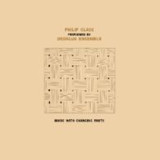
- A1: Music With Changing Parts (1) 13'17
- B1: Music With Changing Parts (2) 13'56
- C1: Music With Changing Parts (3) 13'56
- D 1: Music With Changing Parts (4) 13'45
Founding work of minimalism, Music with Changing Parts is a piece with free instrumentation.The musicians choose which part to play among the 8 staves of the score. At each indicated cue, the musicians can change part, which produces an abrupt change of instrumentation. While the music is based on a melodic material limited to a few notes that are repeated in patterns that expand or contract, the changes in orchestration refresh the listening experience by producing sonic contrasts. These techniques at work
in Music with Changing Parts , written in 1970, will lead Philip Glass to renew his language and move from the monochromatic works that precede it to more dramatic works such as music in 12 parts and especially the opera Einstein on the Beach. When Philip Glass began rehearsing the piece, he was surprised to hear long notes when everything was written in eighth notes. After making sure that none of the musicians were playing held notes, he realized that the fact that the same notes were played by all the instruments in the ensemble produced, through a psycho-acoustic effect, a harmonic substrate of resonant frequencies. He then decided to add to
the score the possibility of playing long notes to reinforce this effect
Album was released in three versions: classic with black vinyl, limited edition with solid green vinyl (hand numbered 100 copies) and special Japan edition (with OBI and transparent green vinyl). All versions have 180g vinyl.
Ljóstillífun is the latest album by musician/sound artist Pan Thorarensen. The album is inspired by Iceland's flóra, its plant kingdom, and the country's mysterious natural landscapes. The title, Ljóstillífun, translates to Photosynthesis in English.
Pan extensively incorporated field recordings of nature using specialized microphones during the album's production. He combined these with various handcrafted electronic instruments, synthesizers, and sound design techniques to create a truly unique sonic environment.
"The music will guide the listener into a meditative state, immersing them in Iceland's flóra, stillness, and the breathtaking beauty of its nature."
For this project, Pan collaborated with several esteemed artists, including:
• Italian composer and guitarist Eraldo Bernocchi
• Venetian ambient producer and composer Gigi Masin
• Portland-based sound designer and field recordist Patricia Wolf
• Japanese ambient artist Moshimoss
• Berlin-based Japanese violinist Hoshiko Yamane (Tangerine Dream)
Beyond his solo work, Pan has composed music for short films and documentaries and has released numerous albums under various stage names. One of his projects is the ambient trio Stereo Hypnosis, in which he collaborates with his father, Óskar Thorarensen, and composer/guitarist Þorkell Atlason.
For the past 16 years, Pan has traveled the world exhibiting his art and performing at numerous music festivals. Throughout these journeys, he has formed deep connections with musicians, visual artists, agents, journalists, and event organizers.
A key figure in Iceland's electronic music scene, Pan is widely respected for his artistic contributions. Fifteen years ago, he founded and has since organized Extreme Chill, an annual electronic music festival that attracts both local and international electronic music enthusiasts, drawing them into the ethereal embrace of Iceland's natural beauty.
The album is released by the renowned Polish independent label U Know Me Records, which celebrates its 15th anniversary this year. After more than 125 releases this is the very first one without Polish artists involved in the recordings. UKM starts a new chapter...
Album was released in three versions: classic with black vinyl, limited edition with solid green vinyl (hand numbered 100 copies) and special Japan edition (with OBI and transparent green vinyl). All versions have 180g vinyl.
Ljóstillífun is the latest album by musician/sound artist Pan Thorarensen. The album is inspired by Iceland's flóra, its plant kingdom, and the country's mysterious natural landscapes. The title, Ljóstillífun, translates to Photosynthesis in English.
Pan extensively incorporated field recordings of nature using specialized microphones during the album's production. He combined these with various handcrafted electronic instruments, synthesizers, and sound design techniques to create a truly unique sonic environment.
"The music will guide the listener into a meditative state, immersing them in Iceland's flóra, stillness, and the breathtaking beauty of its nature."
For this project, Pan collaborated with several esteemed artists, including:
• Italian composer and guitarist Eraldo Bernocchi
• Venetian ambient producer and composer Gigi Masin
• Portland-based sound designer and field recordist Patricia Wolf
• Japanese ambient artist Moshimoss
• Berlin-based Japanese violinist Hoshiko Yamane (Tangerine Dream)
Beyond his solo work, Pan has composed music for short films and documentaries and has released numerous albums under various stage names. One of his projects is the ambient trio Stereo Hypnosis, in which he collaborates with his father, Óskar Thorarensen, and composer/guitarist Þorkell Atlason.
For the past 16 years, Pan has traveled the world exhibiting his art and performing at numerous music festivals. Throughout these journeys, he has formed deep connections with musicians, visual artists, agents, journalists, and event organizers.
A key figure in Iceland's electronic music scene, Pan is widely respected for his artistic contributions. Fifteen years ago, he founded and has since organized Extreme Chill, an annual electronic music festival that attracts both local and international electronic music enthusiasts, drawing them into the ethereal embrace of Iceland's natural beauty.
The album is released by the renowned Polish independent label U Know Me Records, which celebrates its 15th anniversary this year. After more than 125 releases this is the very first one without Polish artists involved in the recordings. UKM starts a new chapter...
Album was released in three versions: classic with black vinyl, limited edition with solid green vinyl (hand numbered 100 copies) and special Japan edition (with OBI and transparent green vinyl). All versions have 180g vinyl.
Ljóstillífun is the latest album by musician/sound artist Pan Thorarensen. The album is inspired by Iceland's flóra, its plant kingdom, and the country's mysterious natural landscapes. The title, Ljóstillífun, translates to Photosynthesis in English.
Pan extensively incorporated field recordings of nature using specialized microphones during the album's production. He combined these with various handcrafted electronic instruments, synthesizers, and sound design techniques to create a truly unique sonic environment.
"The music will guide the listener into a meditative state, immersing them in Iceland's flóra, stillness, and the breathtaking beauty of its nature."
For this project, Pan collaborated with several esteemed artists, including:
• Italian composer and guitarist Eraldo Bernocchi
• Venetian ambient producer and composer Gigi Masin
• Portland-based sound designer and field recordist Patricia Wolf
• Japanese ambient artist Moshimoss
• Berlin-based Japanese violinist Hoshiko Yamane (Tangerine Dream)
Beyond his solo work, Pan has composed music for short films and documentaries and has released numerous albums under various stage names. One of his projects is the ambient trio Stereo Hypnosis, in which he collaborates with his father, Óskar Thorarensen, and composer/guitarist Þorkell Atlason.
For the past 16 years, Pan has traveled the world exhibiting his art and performing at numerous music festivals. Throughout these journeys, he has formed deep connections with musicians, visual artists, agents, journalists, and event organizers.
A key figure in Iceland's electronic music scene, Pan is widely respected for his artistic contributions. Fifteen years ago, he founded and has since organized Extreme Chill, an annual electronic music festival that attracts both local and international electronic music enthusiasts, drawing them into the ethereal embrace of Iceland's natural beauty.
The album is released by the renowned Polish independent label U Know Me Records, which celebrates its 15th anniversary this year. After more than 125 releases this is the very first one without Polish artists involved in the recordings. UKM starts a new chapter...
Repress!
Sought after instrumentals for critically acclaimed album Sour Soul, by Toronto jazz / hip hop band BadBadNotGood and Staten Island rap champ, Ghostface Killah. Inspired by 1960's and 70's music and taking inspiration from the recording techniques and production of that era, they embrace live instrumentation and zero sampling. BadBadNotGood with producer Frank Dukes created a dramatic, cinematic musical staging for Ghostface's vivid storytelling and this is the first and only time the instrumentals will be available as a standalone album.