Radio Diaspora works on the concept of cultural identity, which is flexible and dynamic. This provocation is generated by referring to all African ancestry moved by the diaspora and its sonorous, vocal, polyrhythmic, and polyphonic codes - all the ancestral heritage that has spread throughout the world following expropriations, genocide, and slavery - sampling and amplifying references that become triggers of energetic approaches. A heavy core of representations and senses aims to exorcize through noise and strangeness all secular violence against people of the African diaspora. In the title song of this album, 'Negro Humor', the respected Brazilian actor Grande Otelo highlights the contradiction of the clown, which awakens joy in everyone but is a sorrowful, lonely figure, ridiculing himself and putting himself in the most embarrassing situations. Relieved, loud laughter echoes in the audience because it is not the target of ridicule. In 'Despacho', Radio Diaspora explores the dichotomy of society by introducing a speech by Brazilian lawyer Hédio Silva Júnior specialised in Afro-Brazilian religion. He questions a rule under discussion in Brazil's Congress that would prohibit the use of chickens in Candomblé and Umbanda rituals. Silva Júnior points out that everyone takes a stand to protect the rights of animals, but the same cannot be said of the defense of young black people and outlying societies. The track 'Meia-Noite' evokes a celebrated point of Umbanda, an Afro-Brazilian religious syncretic cult, permeated by free jazz and electronic atmospheres developed by the duo. The other songs on the album are divided into two parts. They feature the voices of North American icons of the black struggle for civil rights: The tracks 'A.H.M. Al-Shabazz 1 and 2', amid sonic dissonances, use extracts from speeches by the American leader Malcolm X, and in 'Muhammad Ali 1 and 2' we hear quotes from famous interviews given by the boxer and activist. Ali ironizes the questions he asked his mother as a child, why all good and positive things are associated with white. "Mother, how come is everything white? Why is Jesus white with blonde hair and blue eyes? Angels are white, the Pope, Mary, and even the angels. When we die, will we go to heaven? She said naturally we go to heaven. So, I said, what happened to all the black angels they took from the pictures." His Inquiry, however, is seen as a joke by the white audience present at the TV show, which laughs off Ali's scathing criticism. Radio Diaspora uses art as an instinctive force to reject submission to traditions and culture as taming. Music is the weapon. "The (album) sound means to exorcise racism out of our minds and make us ready to act". - Rômulo Alexis
Suche:the voices
"Diré a mi gente" is a 1969 Colombian pop classic with one foot in protest song and the other in acid rock, harsh sounding but also current and sincere. The rawness of the lyrics, the simple and dynamic electrified instrumentation and the contrast with the sweetness and innocence of the adolescent vocals make it reminiscent of Nadaism via Pablus Gallinazo, the bittersweet tenderness of Elia y Elizabeth and the post Los Yetis duet of Norman y Darío. First time vinyl reissue. Liner notes by Mexican DJ and collector Carlos Icaza aka Tropicaza (Dublab / Worldwide FM). "Diré a mi gente" is an essential Colombian album that connects the new generations that grew up after the fall of the socialist block. It's a classic with one foot in protest song and the other in acid rock, harsh sounding but also current, raw and sincere. It's reminiscent of Nadaism via Pablus Gallinazo, the bittersweet tenderness of Elia y Elizabeth and the post Yetis duet of Norman y Darío. It was recorded by the brothers Ana y Jaime Valencia and originally released in 1969 on the local label Discos 15. The messages it conveys are still fresh and the blend of superb songs, arrangements and the candor of the duo's performance proves the relevance and importance of re-listening to this album in an increasingly nihilistic and depoliticized world. The teenage voices enhance the truthfulness and power of conviction of the classic songs of Alí Primera and Daniel Viglietti. The endearing song 'Cuántos momentos', originally recorded by Iván Darío López from Los Yetis-Norman y Darío, stands out on the album. 'Es largo el camino', with more stark lyrics by Nelson Osorio backed by Astudillo's screeching guitar, sends shivers down your spine. "Diré a mi gente" reaffirms that the transformative power of music is still there, latent, waiting to be unleashed. Even though the road traveled to get there is sometimes long.
"Art is awe, art is mystery expressed," writes Kaitlyn Aurelia Smith. "Art is somatic, even if it is experienced cerebrally. It is felt." The central mysteries of Smith's ninth studio album, Let's Turn it Into Sound, have to do with perception, expression, and communication: How can we communicate when spoken language is inadequate? How do we understand what it is we're feeling? How do we translate our experience of the world into something that someone else can understand? For Smith, a self-described "feeler," the answers are inspired by compound words in non-English languages, translation, sculptural fashion, dance, butoh, wushu shaolin, and other forms of sensory and somatic experience. Just like fashion uses lines, shapes, colors, textures, and silhouettes to communicate on a sensual level separate from the conscious mind, Let's Turn it Into Sound strives to use sound to communicate what words alone cannot. "The album is a puzzle," Smith says. "It is a symbol of receiving a compound of a ton of feelings from going out into a situation, and the song titles are instructions to breaking apart the feelings and understanding them." The energized "Is it Me or is it You" comes from traversing the gaps between how you see yourself and how another might see you, through a filter of their own projections. The hushed sense of revelation that brackets "There is Something" refers to the feeling of walking into a room and being subconsciously aware of the dynamic present. All the while, Smith interprets these feelings through sound. This auditory interpretation process, driven by earnest curiosity, led Smith to record some thoughts and questions that popped up along the journey in Somatic Hearing_a booklet which accompanies the album. Over three frenzied months, recording alone in her home studio, Smith allowed herself to pursue new experiments to accompany her usual toolkit of modular, analogue, and rare synthesizers (including her signature Buchla), orchestral sounds, and the voice. She created a new vocal processing technique, and gave herself permission to pursue a pacing that felt intuitive, rather one that followed typical song structures. She walked around in the windiest season with a subwoofer backpack and an umbrella, listening to the low end of the album amidst 60mph gusts. She listened to herself, and, in doing so, to an inner community which suddenly opened to her. Underlying the album is a dynamic relationship between what Smith describes as six distinct voices, each a multifaceted storyteller. By acknowledging these characters, she was acknowledging her whole being: the woven plurality of self, the complex process of noticing and resolving inner conflicts, and the joy of finding harmony in flux. "I started to feel so embodied by all of these characters. This is all the felt, unsaid stuff my inner community wants to communicate but it doesn't have the English language as its form of communication, and so this album was a form of giving space to let it talk and not judge it and just let it play." By not adhering to expected song structures, each song feels even more like a conversation, with each character getting to express themselves in full.
- 1: One Last Time (Feat Blick Bassy)
- 2: Happy (Feat Camille)
- 3: Super Rich Kids (Feat Malik Djoudi)
- 4: Chandelier (Feat Sandra Nkaké)
- 5: Malamente (Feat Camélia Jordana)
- 6: Don't Stop The Music (Feat Camille)
- 7: Royals (Feat Malik Djoudi)
- 8: Bad Guy (Feat Blick Bassy)
- 9: Dance Monkey (Feat Camélia Jordana)
- 10: Video Games (Feat Sandra Nkaké)
With their ability to move seamlessly from the triangle to the donkey jaw, cymbals to Chinese gong, vibraphone to wind machine, percussionists are undoubtedly the most atypical members of the classical orchestra. Paul Changarnier, Nicolas Cousin and Alexandre Esperet are a case in point. Having set their sights on the marimba - Latin American xylophone, cousin of the African balafon - they decided to use it as the main vehicle for their artistic dreams. With the label No Format, they embarked on a project which would see them taking on pop hits of the kind that are produced in mega studios on the other side of the Atlantic and dazzle with a thousand lights and special effects. But they wanted to do it without leaving France or their beloved instruments. They wanted to make pop without machines, guitars, bass or synths. They ended up finding a hitherto unknown instrumental formula that belongs to them and them only, one conceived as the perfect fit for the voices from the well-known French artists that were called upon to interpret the songs. Camille, with her extraordinary energy, makes Rihanna"s "Don"t Stop the Music" waltz in a new organic mode; Blick Bassy redecorates Ariana Grande"s "One Last Time" in the colours of Bassa; Malik Djoudi envelopes Frank Ocean"s "Super Rich Kids" with a subtle ethereal texture; Camélia Jordana made her mark on this bonanza of reinvention by slowing down the tempo of "Dance Monkey"; The voice of Sandra Nkaké, imbued Lana del Rey"s "Video Games" with a solemn and sublime mystery. Like an old love that"s rediscovered with new eyes, an air that comes back from far away but could have been born today, somehow familiar but never seen before. Déjà vu but never heard until now. Déjà Vu: the name of this magnificent, unprecedented experience, this unidentifiable flying platter.
Cerrero, Llorona Records founder's solo project, joins young "Gaita flute" and trumpet wizard El "León" Pardo (Ondatrópica) for an acid cumbia infused dub journey to the underground electronic sound of south America. Blend of ritualism and futurism, rough ethereal sound, melancholic voices and analog dub mixing for a unique record that presents the work of the thriving electronic acts from Colombia. Llorona's in-house act, Cerrero, teaming up with another Colombian, gaitero and trompetista, El Leon Pardo. The enigmatic and cult like figure has featured on many-a-Colombian record in recent years, including, Ondatropica and Velandia y La Tigra. Though this might be one of the most exciting match-ups yet. Cerrero's minimalistic electronic beats channeled through an analogue console alongside the abraded howls of gaita and accentuated trumpet work. The deep and bassy four-track EP, Canción Para Un Amigo, was justly named to mark the meeting of these two brilliant minds. Mixed in the extemporaneous ambience of a live recorded session, it makes for a riveting listen. Six standalone tracks, bound through crescendoing loops which culminate in an ethereal and atmospheric ritual of sound which evokes Colombian ancestry. From the spellbinding opening of gaita-led "Canción Para Un Amigo", the EP evolves through "Todo Te Llevaste", a track skillfully stitched between its vocal interludes by the rat-a-tat of accented tambor, a fanfare of trumpets and underpinning bass line. Closing out via "Cumbia en Lejanía"'s, gaita / trumpet led interplay into "Despedida", a pining jazz melody soaked in reverb, it's as complete of a work we've heard yet from Cerrero and represents another glistening gem in the ever increasing bows of the Llorona catalogue. Inescapably mesmeric as it is a true delight.
After the well-earned Adarra prize awarded by San Sebastián city council in 2021, the name of Amaia Zubiria is back on people's lips, one of the most outstandingly beautiful voices in the history of folk and Basque music in general. In fact, thanks to the albums recorded with Haizea and with Txomin Artola and many other collaborations, she has been a constant presence in a long, fruitful career spanning over 40 years. However, despite this popularity, much of her extensive body of work is unknown or remains almost forgotten, apart from four or five records and her most popular songs. This is a shame, because her forgotten back catalogue contains many of Amaia's most moving songs. Among them, as a taster and an invitation to get into her music, we encourage you to listen to the enchanting "Itxasoan laino dago", recorded together with Pascal Gaigne in 1985. A track featuring the electronic sounds created with great care by Pascal and adorned by Michel Doneda's saxophone and guided with a magical sophistication by the talented sound engineer from Hendaye, Jean Phocas. It is an impossibly beautiful melt of avant garde and traditional music.
Bassist and composer Milo Fitzpatrick (Portico Quartet) launches new collaborative project with saxophonist Jordan Smart (Mammal Hands)
Vega Trails is a new project from double-bassist and composer Milo Fitzpatrick, a founder member of Portico Quartet, who has also performed with the likes of Nick Mulvey and Jono McCleary and features saxophonist Jordan Smart (Mammal Hands, Sunda Arc) in a richly powerful duo bringing together two powerfully charismatic musicians. The project which takes its name from Carl Sagan's science fiction novel 'Contact' (a book about signals of new life detected from the Vega system) andwas born out of a desire to bring the elements of bass and melody to the foreground in their rawest form and Fitzpatrick explains that he deliberatelychose the stripped back approach.
"There is so much in just one musician's sound; the emotional, the intellectual, the vulnerability and power of their character. But often these delicate nuances can be submerged in the quest for a group sound. In Vega Trails I wanted to grant the musicians space to breathe and be heard and for the listener to witness the intimacy and depth of a conversation between two voices, bass and melody. I was also interested in how the limitations would guide both the composition and performance and to push us both to places close to the limits of what we could play, and it is in this place where I believe the character of a musician blossoms and comes forward".
Tremors in the Static was composed during Lockdown as Fitzpatrick immersed himself in music that had space and sparseness such as Swedish fiddle music and Indian Classical music. Jan Johansson's legendary 'Jazz på Svenska' (jazz versions of Swedish folk songs) was another influence, as was a collection of ancient lullabies by Spanish soprano singer Montserrat Figueras. Through exploring the harmonic and textural possibilities on the bass, Fitzpatrick would cycle riffs and motifs whilst singing melodies, and he began to create the music debuted here. However, it was only after listening to Charlie Haden's album of duets, 'Closeness', that the project would come into focus as a duo, and Fitzpatrick immediately knew that the second musician had to be Jordan Smart.
"I saw Jordan play at two Gondwana Records events – in Berlin and Tokyo. Both times I was mesmerised by the intensity and conviction of his playing. His commitment to the cause of transcending himself and the listener made a lasting impression on me. When I began writing this record, I knew I needed a strong player who had equal conviction in their playing as me, but also someone who understood the importance of melody"
It was an inspired idea as Smart brought an openness and positivity which allowed the music to be both experimental and bold. Smart's ability to play tenor and soprano saxophone with equal command, as well as bass clarinet and Ney flute, allowed them to open up the pallet of sound and pull the melodies into varying emotional landscapes.The final piece of the puzzle was the performance space. Fitzpatrick knew that he wanted the two players to react off of a third element. The music was written for an ambient space which interacted with the notes: decaying and disintegrating them into silence. They found the perfect space in a church in Fitzpatrick's local neighbourhood of Stamford Hill.
"The recording space is the canvas on which the sound interacts and flows, it is the frame in which notes can live, breathe and die and is as important as the other elements. A resonant recording space, like a church, allows this stripped back sound to resonate, echo and linger, enough to create images and landscapes in which stories can play out".
This then is Vega Trails, a project that brings together two open-mined and communicative musicians for the first time, to tell beautiful winding stories together and to create something soulful and new.Something bigger than both of them and something that leaves us all richer for hearing it. Enjoy!
- A1: Nothing To Declare
- A2: Totally Spies (Feat Lafawndah)
- A3: Nightflame (Feat Orion Sun)
- A4: Anthology
- A5: Discipline
- A6: Blessgrips
- A7: Easy Jet
- A8: Candace Parker (Feat Muqata'a)
- B1: No More Kings
- B2: Capitol (Feat Alli Logout)
- B3: Sixteen
- B4: Spirit Airlines
- B5: Crown
- B6: More Victories (Feat M Tellez)
- B7: Seven
- B8: Lead Level 15 (Feat Ase Manual)
The LP version is limited to 1000 copies, pressed on blue vinyl, in a high grade spot-varnished gatefold sleeve.
700 Bliss is the forward-thinking duo of DJ Haram and Moor Mother. Their first full length for Hyperdub is an album of noise rap that ties together the raw edges of club music and hip hop with punk energy, jazz, house-party catharsis, percussion-heavy analogue sound design, and cheeky skits, ranging from experimental rap tracks with rolling hi hats and lyrical bravado, to poetry set to noise and sound collage.
Moor Mother and DJ Haram started collaborating in 2014 and eventually formed 700 Bliss, a blistering live act in Philly's DIY scene, releasing their 2018 debut, Spa 700 on Halcyon Veil / Don Giovanni Records. Since that time, both artists have grown global followings. Moor Mother is a prolific solo artist and collaborator, writer, and member of Black Quantum Futurism while Haram has been curating and creating radio shows, DJing, and producing (including an EP for Hyperdub in 2019).
‘Nothing To Declare’ is a smart, danceable revelation, a chiseled soundscape of dive bombing bass, piercing bleeps, crunchy distortion, and wavering synth lines. Welcoming in a variety of voices from their extended, cross-genre scene, 700 Bliss also bring along a cast of collaborators, including vocalists Orion Sun, Lawfandah, Ase Manual, and Ali Logout (from the band Special Interest), plus Palestinian producer Muqata'a, and writer M Téllez who delivers a surreal sci fi monologue over a pounding kick drum on ‘More Victories’.
‘Nothing To Declare’ is a deeply layered rewriting of hip hop and electronic music that gives more with each listen. You won't hear another rap album like it in 2022.
On High Flying Man, the third LP by Matt Berry’s pseudo-eponymous project The Berries, loss and desire take center stage. Berry delves deep into 21st century malaise, crafting densely layered songs which project an unshakable yearning for deliverance from the world’s shortcomings. Each track extends an outstretched palm towards universal connection, blending a complex of mix of pop hooks, rock swagger, and psychedelia into dejected populist anthems. Faced with the perils of an isolating world, High Flying Man reignites the tradition of great American songwriting, speaking in the voice of the longing masses. At heart, Berry demands more life, rejecting both arty cynicism and nostalgic escapism.
Berry cut his teeth at a young age playing in the bands Happy Diving (Topshelf Records) and Big Bite (Pop Wig), and has since regularly served as a touring member for bands like Angel Dust and Dark Tea. His early work with Happy Diving and Big Bite solidified his position as an upcoming star in the world of fuzzed-out indie rock, earning him tours and opening slots with the likes of Turnstile, Dinosaur Jr., Nothing, The Swirlies, and The Coathangers. With The Berries, however, Berry turns the Big Muffs down (although not off), creating sonic space to stretch his wings as a burgeoning pop songwriter. The psychedelic-surrealist textures of his earlier output are not gone, per say, but rather find themselves folded into more expansive, rock-oriented arrangements, becoming accoutrements as opposed to the driving force of each song itself.
High Flying Man follows The Berries’ previous releases, 2018’s Start All Over Again and 2019’s Berryland. While longtime listeners will undoubtedly recognize Berry’s disaffected drawl and melodic sensibility, High Flying Man’s complex arrangements and expansive sonic landscape place it well apart from its predecessors. Berry enlisted live band members Danny Paul (drums), Emma Danner (backing vocals), and Lance Umble (bass) during the recording of High Flying Man, as well as the mixing talents of Rob Schnapf (Elliott Smith, Beck, Guided by Voices), breaking from the self-produced home recording ethos of the previous Berries LPs. The collaborative nature of High Flying Man’s recording process is reflected in the quality of each song’s arrangement. Freed from the pressure of being individually responsible for every detail committed to tape, Berry was able to focus his attention more fully on the creative demands of constructing a dynamic and cohesive record. High Flying Man pivots away from any sort of obvious nod to Americana tropes, baggy British attitude, or Neil Young-esque riffing, leaning head on into a lush, idiosyncratic grandeur.
Each track evokes the irreverent and flashy style of a songwriting voice finding itself for the first time. Berry’s guitar heroics extend towards new heights, channeling the simple pop mastery of Lindsay Buckingham (“Prime”) and the wicked emotion of a 21st century “November Rain” (“High Flying Man”). Unusual stylistic juxtapositions give certain songs an almost timeless quality: Bert Jansch-esque crooning finds its counterpoint in sweeping, distortion-soaked riffs (“A Drop of Rain”), the primitive rhythms of Amon Duul are given an arena-sized, Britpop facelift (“Life’s Blood”). On High Flying Man, however, the ballad reigns supreme. “Down That Road Again” drips with sentimentality, powered by soft, undeniable pop melodies and pared-down chord progressions. Album-centerpiece “Eagle Eye” teeters between pure grace and extreme sorrow, unfolding into a massive, immediately memorable tide of melancholic beauty.
Lyrically, High Flying Man is both simple and direct. Although often bitter about the state of the world, Berry has no overtly political axe to grind. In some instances, he takes jabs at the moral laziness of aging millennials, expressing his yearning for a return to vitality and conviction (“Prime”). In other instances, Berry turns his criticism inwards, examining his longing for a better life and his repeated tendency to self-sabotage (“Down That Road Again”). These two poles balance each other out, creating a thematic tenor which is more so self-implicating and empathetic than critical. If anyone is to blame, it is the world we have been saddled with, not the people left to pick up its pieces. Although often personal, Berry’s words evoke a universal experience of continued belief in the face of loss. “High Flying Man” chronicles the growing distance between Berry and an old friend who has been shipwrecked by the weight of trauma, evoking the sorrow of trying to love someone who is no longer able to keep up with reality. Even the most somber passages of “Eagle Eye” (“long before I become aware of it, my friend/it’s 6 AM and I’m gonna die”) find their redemption in a burning devotion towards something worth living for (“If there’s one thing I can depend on/it’s my old friend/my shining light/my eagle eye”).
With High Flying Man, Matt Berry embraces undying love in the face of isolation. Daring to want more life becomes a spiritual rallying cry against a world that has failed to make life either meaningful or beautiful. At their core, these songs are not about revolution, but they are about the faith that gives something like revolution a purpose in the first place.
Johnny Clarke ruled the Dancehall in the mid 1970’s, using the cleaver 'Flyers Rhythms' that gave some of his tunes an edge with the Sound Systems. But his voice was always.
bigger than this and his versatility to sing a wide range of vocal styles, has seen him cut through the decades as one of Reggae’s best voices.
Johnny Clarke (b.1955.Jamaica) cut his musical teeth at the age of seventeen, recording his first song ‘God made the sea and sun’ for Producer Clancy Eccles. A low-key release but one that led to Johnny catching Producer Rupie Edwards eye, when he appeared at a talent contest at Bull Bay. Impressed by his voice both live and on disc, Rupie cut a few tunes with Johnny, ’Don’t Go Julie’ and ‘Everyday Wondering’ the latter of which had success not only in Jamaica, but also in the UK reggae market. The back bones of ‘Everyday Wandering’ now voiced by Rupie himself would lead onto an even bigger hit in the 70’s with the classic ‘Irie Feelings’.
Johnny Clarke’s decision to move on around this time coincided with producer Bunny ‘Striker’ Lee looking for a new singer to compete in the ever-moving Dancehall arena. Johnnie’s break came in a strange way, having provided backing vocals initially to a Bunny Lee produced cut, Earl Zero’s ‘None Shall Escape the Judgment’. The very same session the drummer on the track, Carlton ‘Santa’ Davis, when asked by Bunny to come up with some new sound and while working the High - Hat cymbals, hitting it when open, then when shut (based on the Philadelphia Disco Sound known as the Phili - Sound) gave what the reggae world would call a ‘Flyers Sound’. On transferring the tune to four tracks to mix down at King Tubby’s studio, Earl Zero’s vocal was mistakenly left off. Johnny Clarke being present at King Tubby’s and knowing the track already inside out, then sang the lead vocal. The track became a smash Sound System favourite and the rest as they say is history.
Johnny Clarke became one of Bunny’s main vocalists during the heyday that was the 1970’s. It’s from this vast cannon that we have selected some of the singer’s finest cuts. His soulful voice worked the musical field from Dread to Rockers to Lovers Rock.A great gift that on playing this album we hope you’ll agree carries through with the tests of time.
Spring Snow is a compilation of eight leading experimental artists from different cultures and musical backgrounds who were asked to freely reflect on the word, nostalgia.
The word, nostalgia, in particular comes from the Greek nostos (homecoming) and algos (pain), which are reflected on both sides of the record.
Li Yilei's SHI, meaning 'time' in Japanese, sets the stage with its free-form synth notes and traverse rhythms. The listener is then presented with a memory of an orchestra, conducted by Lucy Liyou, leading to euphoric moments from Sawako and Gonima.
The latter half explores the melancholic and sometimes painful side of nostalgia and youth. Forest Management opens the journey with a late-night rumination, which seems to loop endlessly. Jiyoung Wi, from South Korea, reflects on her birth and upbringing, and leverages her own voice to narrate the story.
Things take a deeper turn with Gaël Segalen's The Bed of Wewa, which paints a rougher picture with its noisy soundscapes, pounding synth notes, and synthetic voices. The trip concludes with Evicshen's rumbling and noisy track, titled Inguinal.
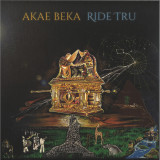
Akae Beka's inimitable style of rich, deep, multi-layered songwriting, uncompromising devotion to RasTafari and soulful healing melodies developed over decades performing with St. Croix based band Midnite and countless recordings. At the point of his untimely passing in 2019, he had released over 70LP's. He is without a doubt one of the most prolific reggae artists ever known.
The stellar production trinity that is Zion I Kings have been involved collectively and individually in creating some of the most highly regarded contributions to the vast Akae Beka catalogue. Ride Tru, originally released digitally and on CD in 2014, stood every chance disappearing into the all eclipsing shadow of the LP released by them earlier that year, Beauty for Ashes, which had been named by iTunes as the reggae album of the year. A monumental achievement for undiluted, uncompromising RasTafari roots reggae music this side of the millennium. So needless to say, the bar was high and Vaughn Benjamin and Zion I Kings must have known that, as they managed to raise it higher again.
Ride Tru continues in the same form, rootsy, soulful, refreshingly polished and authentically raw, the threads of anciency that any devout reggae lover will be looking for and the threads of modernity that keep it alive and appealing in the modern day. A uniquely regal tapestry that has become synonymous with music created from the unity of Zion I Kings and Vaughn Benjamin
Following 8 years of anxious anticipation, for the countless Akae Beka fans that are also vinyl connoisseurs, this LP is now being released on as a 12" vinyl LP courtesy of Before Zero Records. This offers the listener not only the chance to enjoy this LP in an analogue form, but also the chance to hold the artwork as a 12" square masterpiece, created by the hands of Ras Marcus, the artist who gave the powerful visual presence that became synonymous to much of the I Grade / Akae Beka works over the years.
“How does an artist follow an album considered by many to be the best reggae album of 2014?..... you get right back in the studio with the same brilliant production team and follow that album a few short months later with one that nearly eclipses it entirely.”
Midnight Raver — Worldareggae
“...remarkable for the clarity of Tippy’s mix and the contrast between the hardness of Lloyd Richards’ drums and the softness of the guitars, keyboards and brass. The woozy analogue warmth of an old Augustus Pablo production – Son of Jah Dub - for Worry Free demonstrates how well Vaughn sits on the sounds of the original masters (an avenue that should be pursued further). Another veteran guest is the late Style Scott - who beats out one of his final patterns on How I & I Carry On.”
Angus Taylor — United Reggae
- 1: Several Hands On Our Piano
- 2: Don't
- 3: Flashback Caruso
- 4: Voices And Trumpet And All
- 5: J'ai Mal Aux Dents
- 6: Beim Nächsten Ton Ist Es
- 7: Two Drums, Bass, Organ
- 8: Dr. Schwitters Intro
- 9: Several Hands On Our Piano (Continued)
- 10: Beam Me Up, Scotty
- 11: Elerimomuvid
- 12: Dr. Schwitters (Continued)
- 13: Have A Good Time, Everybody
- 14: Above And Under Our Piano
- 15: Hermanns Lament
- 16: Donnerwetter
- 17: Was Ist Hier Los?
- 18: Rudolf Der Pianist
- 19: Ricochets
- 20: I've Heard That One Before
- 21: Watch Your Step
- 22: Under Our Piano Again
- 23: Fluid Chorus
- 24: Stretch Out Time
- 25: Der Baum
- 26: Chère Chambre
There's something perversely fabulous about the thought of this warped masterwork wandering into 60,000 unsuspecting British homes in 1973. Faust's second-and-a-half album hit the shops to celebrate their signing to the nascent Virgin Records, who were looking to take advantage of the zeitgeist for German music at that time. Undeterred by the fact the band's unwillingness to engage with the commercial landscape had seen them dropped from Polydor, Branson and co cooked up a suitably spectacular marketing strategy, selling the LP for 49p, the bargain price of a single. Shoppers flocked in their thousands to grab a copy, raced home and then spent the next forty five minutes checking their tracking, banging the speakers and blowing the needle, all to no avail. Do not adjust your set - This is Faust.
- A1: Umzansi (Feat Black Quantum Futurism & Mary Lattimore)
- A2: April 7Th (Feat Keir Neuringer)
- A3: Golden Lady (Feat Melanie Charles)
- A4: Joe Mcphee Nation Time (Feat Keir Neuringer - Intro)
- A5: Ode To Mary (Feat Orion Sun & Jason Moran)
- A6: Woody Shaw (Feat Melanie Charles)
- A7: Meditation Rag (Feat Aquiles Navarro & Alya Al Sultani)
- A8: So Sweet Amina (Feat Justmadnice & Keir Neuringer)
- A9: Dust Together (Feat Wolf Weston & Aquiles Navarro)
- B1: Rap Jasm (Feat Akai Solo & Justmadnice)
- B2: Blues Away (Feat Fatboi Sharif)
- B3: Blame (Feat Justmadnice)
- B4: Arms Save (Feat Nicole Mitchell)
- B5: Real Trill Hours (Feat Yung Morpheus)
- B6: Evening (Feat Wolf Weston)
- B7: Barely Woke (Feat Wolf Weston)
- B8: Noise Jism
- B9: Thomas Stanley Jazzcodes (Feat Irreversible Entanglements & Thomas Stanley - Outro)
Coming out on July, Jazz Codes is Moor Mother's second and latest album for Anti- and a com?panion to her celebrated 2021 release Black Encyclopedia of the Air. Jazz Codes uses free jazz as a starting point but the collection continues the recent turn in Moor Mother's multifaceted catalog toward more melody, more singing voices, more choruses, more complexity. In its warm, densely layered course through jazz, blues, soul, hip-hop, and other Black classical traditions, Jazz Codes sets the ear blissfully adrift and unhitches the mind from habit. Through her work, Ayewa illuminates the principles of her multidisciplinary collaborative practice Black Quantum Futur?ism, a theoretical framework for perceiving and adjusting reality through art, writing, music, and performance, informed by historical Black ontologies.The songwriter, composer, vocalist, poet, and educator Camae Ayewa spent years organizing and performing in Philadelphia's underground music community before moving to Los Angeles to teach composition at the University of Southern California's Thornton School of Music. She released her debut album as Moor Mother, Fetish Bones, in 2016, and has since put out an abundance of acclaimed music, both as a solo artist and in collaboration with other musicians who share her drive to dig up the untold. She has performed and recorded with the free jazz groups Irreversible Entanglements and the Art Ensemble of Chica?go, and made records with billy woods, Mental Jewelry, and YATTA.
Two amazing originally unissued Kent Soul discoveries that were featured on their Bill Haney’s Atlanta Soul Brotherhood CD from 1998.
The late great Bill Haney, unacknowledged genius of Southern Soul and owner of the revered Chant record label was interviewed by Rod Dearlove and published in Voices From The Shadows. It was recalled that Roy Hamilton came to town to work the clubs, Bill had the dramatic song ‘My Peaceful Forest’, and somehow got the ‘The Golden Voice’ to record it - what an epic production it turned out to be!
Similarly, The Drifter’s Charlie Thomas whilst in town to perform got to record ‘Don’t Let Me Know’, the recording comes in at just over two minutes, we have had an extended version cleared for this 7” release.
Fear Inoculum is the Grammy award winning masterpiece from Tool. Following the release of the limited edition single pressing ultra-deluxe 5 disc vinyl box set, this critically acclaimed album is available now as a 3 disc 180g vinyl set that features new artwork in a triple gatefold jacket and an exclusive poster.
Tool members include drummer Danny Carey, guitarist Adam Jones, bassist Justin Chancellor and vocalist Maynard James Keenan.
Utter presents the second full-length album by enigmatic duo Vādin - a collaboration between sound artists and performers Christian Duka and Lucie Štepánková (aka Avsluta). “Black Tortoise” is a voyage accompanied by the uncanny, the shadow-dwelling specters and arcane symbolism derived from ancient Chinese astronomy.
“Astrologia” opens the album with an eerie torrent of droning voices and glassy, percussive interventions, leading into the patiently unfolding opening of the “The Presence” with it’s ominous narrative riding the swelling, thunderous rhythms culminating in swarms of hallucinatory chaos. The doom of “Calliope” follows, infused with cavernous, beastly vocalisations which lure the listener into “The Furnace”, a drowsy kaleidoscope of rhythms weaved together with Štepánková’s mother-tongue narration. And further on still, into the make-believe world conjured up by the buzzing and swarming objects overheard on “Plateau”.
Available on limited vinyl and digital formats. A special fold-out pamphlet is included with physical copies.
Spoken word by Lucie Štepánková. Mixed at SAE Institute by Christian Duka and mastered by Rashad Becker at Clunk. Transferred and cut by Helmut Erler at D&M.
Artwork designed by Marco Maldarella.
The Belgians pimp their fourth album's psychedelic pop with disco funk and there fore groove somewhere between TAME IMPALA and PARCELS.On Movements, the Brussels-based rock quintet Great Mountain Fire lavishly enriches its infectious indie-pop songs with soul grooves. The lively sound and dexterous ensemble dance away our inarticulate sense of disquiet. The laidback funky rhythms, often combined with playful falsetto voices, bring out the dextrous ensemble as much as possible. The band discovered Sly & the Family Stone, Larry Graham. the afro rhythms David Byrne famously tried to embrace in his works, Marvin Gaye and "Strawberry Letter 23", a 1971 song by soul singer Shuggie Otis. Still it's an indie-guitar vibe that's ride GREAT MOUNTAIN FIRE.