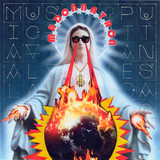
“Having moved forwards emotionally from the wilds of dystopian stalking and associated hobbies, Madonnatron have instead been found frolicking through the green pastures of gangsta pimps, Hindu God wars, Cyber Men invasion, loveless nightclub hook-ups, modern Italian Nabokov, and revered screen goddess Elizabeth Taylor. Think of them as post-punk lab rats in the Secrets Of Nimh, feasting dubiously on back-dated episodes of Top Of The Pops. With notorious roaring guitars, chanting vocals and rabid drums they audibly glow in the dark, are strong-armed, and will probably bite you.”
Like their debut, which was released to much acclaim in July 2017, Musica Alla Puttanesca was produced by Liam D. May at Trashmouth Studios.
Their atmospheric, raw, and confrontational live shows carry a sonic force that by turns will make you weep, cross yourselves, and weep again. In the last couple of years, Madonnatron delivered a successful UK headline tour; supported The Moonlandingz,
Search:thin men
Mais Alors !!?... c’est à l’envers is the first release of new French Label ICI BIENTÔT (Here Soon ...), launched by Paris Fleamarket’s Record Shop, Geminicricket. On the Menu... Suspended Time,
Unsung Heroes, Hidden Records and Next Door Marvels.
In 1983, NEF released their first and only album, Mais Alors !!?... c’est à l’envers. At that point, the band already had a long history, interwoven with that of various musical trends and alternative
movements from the late sixties to the early eighties. That’s certainly what makes this record so special and able to conciliate such different worlds as Electronic Prog, Film Score, New Wave …
The band’s destiny was most certainly tied to their native region, the South of France, an idyllic environment that attracted a number of musicians during the 1970s, allowing the group to attend many
concerts or share the bill with several groups that have gone on to become well known: Can, Ash Ra Tempel, Magma, Catherine Ribeiro, Zao, Chêne Noir, Art Zoyd …
Founded in 1975 by Richard Lorenzi, NEF started as a kind of Free Rock band with multiple influences, going from Prog to Musique Concrete, in which any method of making sound, any way of
bringing out sounds was good … 2 musicians and a photographer, full member of the band who was projecting slides over the music and influenced their dreamlike universe. In 1978, Vincent Tronc came on board with his keyboards and synths. While the group had been influenced by electroacoustic techniques until then, Vincent broadened NEF’s horizons, bringing in a host of new influences: Ash Ra Tempel, Kraftwerk, Klaus Schulze … the beginnings of electronic music. When the album is recorded in 1983, new directions were taken and changed NEF’s usual sound.
First, the idea of playing the accordion, clearly not a common thing and a new Drum Machine, the Roland CJ-5000. Pressed the day a figure of French Chanson died, NEF’s pressing is botched up, a
good part of the records were unusable since the records came out totally warped. Then, at the end of the eighties the small stock of remaining records is lost in the sadly famous flood of Nîmes. 2000
records had been pressed, but very few survived! All the more reason to reissue Mais Alors !!?... c’est à l’envers, an unsung record, free and multifaceted, a quirky and daring musical ovni, transcending eras and genres, between synthetic
Krautrock and Film Score, reminiscent of NEU! (with a red nose), François de Roubaix and Pascal Comelade.
- A1: Rainbow Deux (6 57)
- A2: Let Love In (6 14)
- A3: Sigh (4 08)
- B1: The Darkest Night (7 32)
- B2: Surrender Now (6 08)
- B3: Summer Is Her Name (4 37)
- C1: Are You Ready (3 18)
- C2: Streets (Keep Me Runnin’) (7 00)
- C3: Samba Dreams (3 20)
- D1: Let’s Go Deep (5 27)
- D2: We Should Be Laughin’ (3 45)
- D3: Wishful Thinking (4 00)
TThe melodically adventurous soul of Leon Ware continues its expression in his final opus Rainbow Deux, released on double vinyl on September 13th. The album features new songs recorded and performed by Leon before his health turned, leading to his transition on February 23rd 2017. Co-produced by Taylor Graves, it has stellar musical contributions from the likes of Kamasi Washington, Thundercat, Ronald Bruner Jr, Rob Bacon and Wayne Linsey.
Taylor Graves came into Leon’s musical family in 2002 when he, his brother Cameron and the Bruner brothers Ronald Jr and Stephen (Thundercat) were playing along with their schoolmate Kamasi at an L.A. jazz club. Taylor, Cameron, Ronald and Stephen became Leon’s band for his debut shows in Japan in 2002 and Taylor continued to work with Leon as his mentor and collaborator over the next 15 years.
“Leon was ALWAYS writing something or developing his musical palette” his wife Carol Ware tells us, so it’s impossible to pinpoint any single moment of Rainbow Deux’s genesis. Six of the songs go back to 2012/2013 and were released in 2014 as part of Sigh, a Japan-only CD collection heavy with Rob Bacon’s tasteful licks and Wayne Linsey’s piano vibes. The rest of the material comes from Leon’s sessions with Taylor.
Describing Leon’s and his process, here’s Taylor: “We’d start by having some great homemade food! Then a glass of wine ‘to slow down time’. After we’d have our fill and smoked our joints we’d go into his studio room to listen and create.”
The album was finished-up around August of 2016 in a back-and-forth between Leon and his go-to mastering engineer Toni Economides in the UK.
Leon worked on Rainbow Deux with life’s greatest challenge looming over him, yet it is one of his most focused and cohesive solo offerings since the 1980s. The entire record is a vibe: mellow, deep and smooth as silk. The lyrical themes are eternal, and the music is elegant, soulful and sensual.
The album opens with the hypnotic throb of “For The Rainbow”, coming on like a percussive, slow-mo house shuffle. Gilles Peterson is a fan. The exotic “Let Love In” follows, with its gradual-build Island Funk, intricate guitar picks and sassy female vocals. It explodes when it hits its stride. “Sigh” is the stylish slow jam close-out to side A. Serene guitars and polished drums create neck snapping funk, with a swaggering finger-snap strut.
Side B opens with the easy-burning broken-beaty “The Darkest Night”, the centrepiece of the album. Kamasi Washington’s lurking sax, restrained and beautiful, unfurls into the dank, sticky atmosphere of Thundercat’s signature creeping bass laid over his brother’s in-the-pocket drums. Leon’s vocals are perfect, a masterclass in seductive sax-soul.
“Surrender Now” conjures waves of vocals to swell and wash over the glossy piano, subtly bumping hip-hop drums and bubbling synth-bass stabs. It’s got the trademark Leon layers. “Summer Is Her Name” has Kamasi’s effortless, melancholic sunshine sax give way to rising tempos and propulsive rhythms.
“Are You Ready” is a total highlight (and we’ve been playing it out for ages). It’s a nimble groove of piano and synth rolling around Theo Croker’s sensual trumpet playing. Digi-soul at its finest. With lush G-Funk sensibilities “Streets (Keep Me Runnin’)” sounds like a lost Dam-Funk produced gem. All tough kicks and snares and street sounds. Leon’s hood pass will be forever intact.
“Samba Dreams” is the first of two tracks that bring a little Rio magic to Rainbow Deux. Leon created a whole body of work in partnership with Brazilian legend Marcos Valle that includes “Rockin’ You Eternally” - a hit for Leon - and “Estrelar” – a hit for Marcos. Leon channels his obvious love of Brazilian music here through more of Croker’s sumptuous trumpet, played over loose percussion. “Let’s Go Deep” is next up. A dreamy between-the-sheets quiet storm anthem and a real showcase for Leon’s vocals.
The dripping, honeyed harp-funk of “We Should Be Laughin’” marks the star turn of the brilliant Kimbra. Leon first met her on-stage to do an impromptu duet of “Inside My Love” during an open-air celebration of Minnie Riperton in July of 2014. Kimbra was working with Taylor on her music and he brought her to Leon’s house to do some writing. This was the result.
Warm synths radiate shuffling samba soul on “Wishful Thinking” as those Brazilian rhythms return to bring Rainbow Deux to a close.
During an apartment move Leon and Carol rediscovered some watercolours Leon had done years ago. One of these paintings had been dubbed “Deux Hearts” and Leon decided it should be on the cover of Rainbow Deux, getting as far as approving a draft concept for the artwork.
Carol has overseen developing that draft into the final gatefold sleeve. It brings together quotes, photographs and tributes in what is a reflection on the music, relationships and philosophy of the sensual minister.
Gerry “the gov” Brown, Leon’s long-time sound engineer, was by his side throughout the project, recording and mixing. The album was mastered by Toni Economides and Simon Francis’ additional sensitive work makes sure this double LP sounds like it should on vinyl.
Be With’s first ever release was Leon’s eponymous LP. Re-issuing that album planted the seed of a relationship that has grown to grant us the privilege of presenting his crowning achievement. We know that Leon’s fans all over the Earth will love Rainbow Deux. But we also hope that this album, the final entry in a phenomenal body of work, will reach new fans and find fresh conduits for the spirit of this oft-unsung hero of Soul.
Leon always said “they will get it when I'm gone.”
He also said that “the spirit never dies”…
This new and grainy Sbire release sees La Chaux-de-Fonds electronic craftman Gaspard de La Montagne work as per usual with Nathan Baumann. The two of them share a long history of forward thinking music projects, including EPs, videos, movie soundtracks and so on. Things have changed on this one though as Baumann co-signs the record, instead of an usual credit mention. Both artists describe these 7 tracks as a small album which average format of tunes leans towards pop music. A thoughtful and progressive tracklist bounds all titles together as a whole journey, landmarked by Baumann's ethereal vocals and minimalistic french lyrics. This new approach makes Auras a moving and bittersweet journey that will see you wander from a crowded club to your lonely bed.
- A1: A Roller Skating Jam Named Saturdays - De La Soul Featuring Q-Tip & Vinia Mojica
- A2: Bonita Applebum - A Tribe Called Quest
- A3: Sunshine Men - The Freestyle Fellowship
- A4: Mistadobalina - Del Tha Funkeé Homosapien
- A5: What's Up Doc? (Can We Rock?) (K-Cut's Fat Trac Remix) - Fu-Schnickens With Shaquille O’neal (Shaq-Fu)
- B1: Doowutchyalike - Digital Underground
- B2: Peachfuzz - Kmd
- B3: Doin' Our Own Dang - Jungle Brothers
- B4: Mama Gave Birth To The Soul Children - Queen Latifah Featuring De La Soul
- B5: O.p.p. - Naughty By Nature
- C1: Where I'm From - Digable Planets
- C2: It's A Shame (My Sister) - Monie Love Featuring True Image
- C3: K Sera Sera - Justin Warfield
- C4: All For One - Brand Nubian
- C5: Case Of The P.t.a. - Leaders Of The New School
- D1: My Definition Of A Boombastic Jazz Style (Album Version) - Dream Warriors
- D2: The Choice Is Yours (Revisited) - Black Sheep
- D3: Age Ain't Nothin' But A # - Chi-Ali
- D4: We Run Things (It's Like Dat) - Da Bush Babees
- D5: You're Not Coming Home (Mase's Funkay Recall Mix) - Groove Garden
It wasn’t really a movement, barely even a moment, but the Daisy Age was an ethos that permeated pop, R&B and hip hop at the turn of the 90s. Playfulness and good humour were central to De La Soul’s 1989 debut album, “3 Feet High And Rising”, which would go on to cast a long, multi-coloured shadow over rap.
In Britain, the timing for “3 Feet High And Rising” couldn’t have been better. The acid house explosion of 1988 would lead to a radical breaking down of musical barriers in 1989, and its associated look – loose clothing, dayglo colours, smiley faces – chimed with the positivity of De La Soul and rising New York rap acts the Jungle Brothers and A Tribe Called Quest, all at the heart of a growing collective called Native Tongues.
The Native Tongues’ charismatic, summery aura quickly spread west to the Bay Area’s similarly-minded Hieroglyphics crew (Del Tha Funky Homosapien’s ‘Mistadobalina’); Canada’s Dream Warriors (‘My Definition Of A Boombastic Jazz Style’) used “3 Feet High”’s colour palette and borrowed Count Basie and Quincy Jones riffs; Naughty By Nature (OPP) were mentored by Native Tongues heroine Queen Latifah, while Londoner Monie Love was also adopted by the collective, resulting in her Grammy-nominated ‘It’s A Shame (My Sister)’.
It wasn’t built to last, but the Daisy Age reintroduced Multiplication Rock, bubble writing and the gently psychedelic into the charts. It was a brief, but extraordinarily warm and optimistic moment. The songs on this collection promised that the 90s would be a lot more easy-going than the 80s.
Available on CD and double LP.
- A1: Pata Pata (Mono Version)
- A2: Ha Po Zamani (Mono Version)
- A3: What Is Love (Mono Version)
- A4: Maria Fulo (Mono Version)
- A5: Yetentu Tizaleny (Mono Version)
- A6: Click Song Number One (Mono Version)
- B1: Ring Bell, Ring Bell (Mono Version)
- B2: Jol’inkomo (Mono Version)
- B3: West Wind (Mono Version)
- B4: Saduva (Mono Version)
- B5: A Piece Of Ground (Mono Version)
- C1: Pata Pata (Stereo Version)
- C2: Ha Po Zamani (Stereo Version)
- C3: What Is Love (Stereo Version)
- C4: Maria Fulo (Stereo Version)
- C5: Yetentu Tizaleny (Stereo Version)
- C6: Click Song Number One (Stereo Version)
- D1: Ring Bell, Ring Bell (Stereo Version)
- D2: Jol’inkomo (Stereo Version)
- D3: West Wind (Stereo Version)
- D4: Saduva (Stereo Version)
- D5: A Piece Of Ground (Stereo Version)
Strut presents an all-time classic of South African music, the definitive remastered edition of Miriam Makeba’s ‘Pata Pata’, her first album recorded for Reprise in 1966.
The album marked a significant international breakthrough for Makeba. Moving to the US after the anti-apartheid film ‘Come Back, Africa’ gained international attention and staying there in exile, she quickly built her career in New York during
the ‘60s, mentored by Harry Belafonte. Signing with Reprise after a period with RCA, she returned to one of her older songs: “I wrote ‘Pata Pata’ back in 1956, back in South Africa,” remembered Makeba in her autobiography. “It was a fun little song and I was thinking of a dance that we do at home (“pata” means ‘touch” in Zulu and Xhosa).” Originally a hit in South Africa with her early vocal harmony group the Skylarks, the new recording, produced by Jerry Ragovoy, brought a lighter uptempo R’nB arrangement, adding some English lyrics. “It was my first truly big seller. All of
a sudden, people who never knew I had been in America since 1959 were asking me to be on their television shows and play at their concert halls during 1967. In the discotheques, they invented a new dance called the ‘Pata Pata’ where couples dance
apart and then reach out and touch each other. I went to Argentina for a concert and, across South America, they are singing my song.” The track peaked on the Billboard Hot 100 at no. 12 and the album. Other songs In the album included a version of the traditional Xhosa classic, ‘Click Song Number One’ (‘Qongqothwane’), the atmospheric ‘West Wind’, later famously
covered by her friend Nina Simone, and a version of Tilahun Gessesse’s ‘Yetentu Tizaleny’ which Makeba learned on a trip to Addis to perform for Haile Selassie at the Organisation Of African Unity. Mastered by The Carvery from the original reel to reel tapes, ‘Pata Pata’ is released in its mono and stereo versions for the first time. Physical formats feature brand new sleeve notes alongside rare photos from the time of recording and session details.
The album is released on 6th September on 2LP, 1CD, streaming and digital
Charles Trees. Myth, tall tale, legend of a human being, one of those people who one minute you'll be scouring reddit for obscure content and the next, stepping on stage to casually DJ to thousands of people like “no big whoop” at a French music festival. Charles is unassuming, the kind of person who effortlessly mixes ghettotech into soul for lulz, who samples a speech (/rant) by Funkmaster Flex in an acid track, or rides BMG & Derek Plaslaiko’s “True Story of a Detroit Groove” with Velvet Underground’s “Sister Ray” for 8 minutes straight.
Charles' relationship with electronic music started early. In high school, Dave Shayman (Disco D) introduced Charles to DJing and he was a regular at Dubplate Pressure*– Todd Osborn's now-legendary record store in Ann Arbor. By 1998, he was already playing on raves in Detroit. A year later, he was the first person to show Zach Saginaw (Shigeto) to Ghostly International, arguably altering the course of our lives forever. In the late 2000s, they became label mates on Moodgadget, the record label of Jakub Alexander (Heathered Pearls).
Through out the years, Charles has been a musical mentor (whether DJing, producing or throwing shows) to many, danced at every weekly at every venue in Ann Arbor & Detroit, produced Hip Hop, and fronted a psych rock band. He has released music on Moodgadget (US), Musique Large (FR), Lovemonk (ES), Vanity Press (US) and JFX Lab (FR). Today, between DJing, hosting radio shows and producing new music, Charles regularly throws shows/parties/raves, and hosts a monthly at Deluxx Fluxx.
We love Charles Trees and we're proud to present "2019," the eighth record on Portage Garage Sounds.
*Additional reading: Dubplate Pressure: was the precursor to Technical Equipment Supply; how Todd Osborn was discovered by Richard D. James and signed to Rephlex Records; where Sam Valenti IV, the founder of Ghostly International, met Tadd Mullinix (Dabrye, JTC, Charles Manier, X-Altera); one of the reasons why we're all here
"Got No"
Hit the ground running.
Chopped up vocal stabs and a playful syncopated melody accompany this percussion heavy two-step shuffle as it speeds down the Lodge on a Friday night in Detroit.
"Think First"
Undeniable rhythm section pocket.
Acoustic bass and dirty ride symbols swing alongside lush keyboards and sprinkles of light melodicism in this psych house banger.
Think St. Germain with CAN playing a warped version of "Rose Rouge."
"In Arms"
Crave the rave. Whips crack and sizzle in this dubbed out techno slapper. A modern take on a classic sound. Trees conjures an era close to his heart: when the warehouse was church and service didn't stop until the sun came up.
"Acja feat. Marcus Elliot ("12 club mix)
Beautifully understated and triumphant.
This closer marks the return of Detroit Saxophonist Marcus Elliot (Detroit pt II - PGS 001). His notes dance and soar over a creeping acid line, while driving drums and warm pads effortlessly take you home in this powerful house anthem.
You just can't keep a man like Carlton Jumel Smith down. This time around we get another soulful K.O. from his debut album in the form of "Love Our Love Affair", a mid-tempo groover drawn from that sweet well of southern soul.
One of the fortes of Carlton's "1634 Lexington Ave." LP is that it flows along as an entity but also revels in the strengths of its individual parts. This fourth single brings out another stylistic strain from Carlton and Cold Diamond & Mink's repertoire. After the tight intro and the vibraphone licks have set the scene there are twists and turns plus some classy action from Jukka Eskola on trumpet, did we mention the instrumental on the flip side?
This single might be just the thing you needed to jump start the morning or blast in your Sunday evening radio show.
Durban gqom ambassador DJ Lag and London-based Okzharp combine over four club heavy tracks rooted in their long-term long-distance connection, the EP’s title originating from the Durban nickname for the local clubs where much early gqom-style music was played. Opener ‘Now What’ layers a wooden percussion scraper with a ticking cow bell and chants. Set at a slightly faster pace than most gqom, the track harbours a dark energy at its core generated by a low rumbling background synth and pitch shifting claps.
‘Steam One’ - inspired by DJ Lag’s set at Hyperdub’s club night Ø after he brought the heavy steam room vibe - has a slow and entrancing build up with a subtle melody layering on stabbing syncopated kicks, leading up to awoozy synth breakdown. “We were inspired by that moment in the club when things get hazy and bendy and glowy. It has South Durban via South London DNA, so inevitably there's a heavy kwai-gqom vibe with a grimey funky London twist running through it”. ‘Nyusa’ opens with a grinding acidicbass line overlaid with a metallic and gravelly melody with suppressed chants.
Sharp kicks drive the track leading up to a wobbly synth breakdown and back up synth stabs raising the energy. Finally, ‘Sambe’ pairs menacingstrings with a steel drum melody, displaying characteristics of both funky house and gqom in a subtle meeting of the two styles. ‘Steam Rooms’ is a collection of dancefloor heaters set to make the club sweat, the amalgamation of a London / Durban link up reflecting both producers environments and sound palettes for icey cold gqom tracks with funky house shadings.
Archie Hamilton’s Moscow Records invites Mennie for his first solo release of 2019, featuring two spacey cuts in the form of ‘Proxima’.
Joining Moscow Records following releases on Poker Flat, Infuse and Rawax, Mennie is a regular DJ at Florence’s Tenax Club when not performing across Europe including appearances in the UK, France, Germany and Spain. Alongside Julien Sandre, the Italian producer is also one half of Jarau and together they’ve released on labels like One Records, Visionquest and Pleasure Zone.
Kicking things off, ‘Proxima’ injects acid squelches into an atmospheric background which builds to include a wonky bassline laced with echoing distorted vocals. Flip over and ‘Do That’ utilizes a similar otherworldly aesthetic, with metallic effects, electronic bleeps and rattling drum patterns, all guided by a funk infused bass.
For our fourth installment of the “Roar Groove meets Dirt Crew” series we present you this new set of shimmering and dubbed out Revenge cuts. After the last episode Graeme has been very busy working his “live” studio setup to come up with a whole range of new jams of which we have selected the below four tracks. We think these best represent his unique style and once you hear these in a club you instantly know “That’s a Revenge Tune”, something we have always loved about his sound.
The opening “Like an Ending” is a trippy, melancholic-euphoric track driven by a Moog Voyager bass line and classic House keys and vibe. The original recording was an 11 minute live take that he has been able to capture the essence off and narrow it down to this thumping club jam.
The A2 is all about those good times and it reminds us a lot of early 90s “French Touch”, filtering House at it’s best, it keeps running around in your head and with it’s slower pace we are sure this one will do especially well on the early morning dance floors and high summer sun drenched beaches.
On the other side we enter darker and more dubbed out territories. Here is the first track in Graeme’s words “This one had been knocking around for a couple of years in various forms, but it wasn’t really until I stripped it all back and let the arpeggiated synth do it’s thing that it really seemed to gel. It’s really the rhythm of the whole thing, I ended up scrapping extra hi-hats and stuff that was just getting in the way.” And we have to mention that we personally love that marimba! This track is like a spaceship floating the skies and eventually touching down.
To close out this new work we have one of these typical stab-y Revenge chuggers, loose and floating, synth lines underlaid by a distinctive beat, it has kind of a breakbeat feel to it and with the improvising on those synths and melodies on top of it all it’s a true Dub House track.
Summer is here and this record sets the pace and tone! Enjoy!
When South-Americans gather, many things can arise, but one will be certain: it
will be intense. It could be it a party, a conflict, a work of art or an EP such as this
one that involves a Brasilian label releasing a collection of eclectic, dark and deep
electro-boogie and post-punk by a Colombian artist. Gladkazuka is the guitarist
on Matías Aguayo’s pan-american ensemble The Desdemonas and here he offers
us four slices of synthetic trunk funk on Gop Tun’s label. Each one of them are
guaranteed not only to entice sensations of all types and provoke emotions of all
kinds but also with the intensity expected from such a combination and required
for maximum fun.
As with the first SchleiBen series, Emotional Response follows the success of the second set of split releases with a stand-alone album by one of the highlights, in Neil Tolliday.
Recorded over a 17-year period, the ambient, drone and noise pieces collected here offer a glimpse in to the depth of a supremely talented, thoughtful and at times, troubled musical mind.
As his love for house music and the success of his Nail moniker grew and waned during the ascent 90s boom, there followed his somewhat surprising success as one half of Balearic-pop combo Bent, propelling Tolliday in to a world of indie-charts and endless touring. The eventual unhappiness of this 'music career' and increasing need for personal escapism led him start experiment new musical forms of expression.
A thinker and oft-over drinker, success was viewed with a deep suspicion and introspection, drug use and later, depression. As his other music projects slowly imploded, this new, personal music was for many years, made purely for Tolliday's own absorption and comedowns.
Taken from an initial 4 track recording in Nottingham in 2000, more pieces were subsequently recorded around the globe on numerous devices - old portable cassette recorders, hand held digital stereos and even mobile phones. These heavily manipulated samples were slowed down, reversed, smudged and stretched before analog and modular patching, Mellotron, editing, programming and post production were added to the melting pot.
With hundreds of tracks collated, in the last few years Tolliday began putting them out via Bandcamp using different aliases, on made up record labels, with no press or mention to anyone. This would happen every 6-9 months - a new label was created with logo, band/artist names and a few albums worth of music, leaving it there for a few weeks before then deleting the lot.
Here then is a snapshot of those recordings, chosen to represent the depth of music, while trying not to think too much about in to the emotions that were used in making them. With special hand painted artwork by Sam Purcell, commissioned from the artist's own photographs taken from a adjournment at Homerton hospital, the hope is to do justice to such wonderful music and present Neil Tolliday, finally an artist, shorn of pseudonyms, in a broader light.
- A1: Turning Invisible In An Imaginary Rose Garden One Evening
- A2: Amhrán An Dreoilín
- A3: Jonny Tries To Catch A Pomegranate
- A4: The Road To Your Door
- A5: Requiem For Joe Dillon / Light A Penny Candle
- B1: Somebody Else\'S Blues
- B2: God Bless Little Peter
- B3: That Go To Sleep Rag
- B4: Mad Sweeney’s Day Off
- B5: Again, But With Feeling This Time
- B6: Start Again (Carry On)
"I love it. SO beautiful"
Josh Rosenthal [Tompkins Square]
Songs For A One-String Guitar is the debut instrumental acoustic guitar LP from Jonny Dillon. Better known for his analogue electronic music productions and all-hardware live sets under the ‘Automatic Tasty’ moniker [Lunar Disko, CPU, Wrong Island], Jonny’s records (bearing heavy acid and electro influences), along with live appearances at venues like Berlin’s Panorama Bar and Kiev’s Closer belie the fact that he has been quietly exploring the musical landscape of the guitar for nearly twenty years.
Recorded as a series of sketches over the last 10 years, Songs For A One-String Guitar represents a snapshot taken over a long exposure; one individual’s private response to a variety of currents and inspirations both musical and emotional. While informed in large measure by the world of Irish traditional music and song (of Sweeney’s Men, Planxty and Seán Garvey) along with that of primitivism and the American Spiritual (of John Fahey, Hank Williams and Mississippi John Hurt) these songs are equally a personal attempt to give expression to an inner landscape, from the experience of sorrow and loss to the promise of redemption and renewal.
The LP opens with ‘Turning Invisible In An Imaginary Rose Garden One-Evening’ a contemplative piece played in free-time; “I’ve been playing this piece for years, and it’s gone by so many different names in that time. It’s a sort of shoe-staring daydream, to my mind at least. I want people to disappear when they hear it, and think it suits the LP to open up slowly and reflectively”. While a contemplative strain underpins some of these songs, others are informed more directly by the experience of grief; “I wrote ‘A Requiem For Joe Dillon’ at the death of my uncle. He used play lots of wonderful songs of his own at family gatherings when I was a child, and while a very gifted and sensitive soul, was also troubled by his own demons. The last time I saw him alive was at my family home with my father; I was going out to see some friends and Joe called me back, gave me a hug and made the sign of the cross with his thumb on my forehead, to bless me. It still chokes me up when I think about it. A song of his ‘Light A Penny Candle’ I included to finish the piece in his honour.” A sense of longing and hope is present in other pieces; “Songs like ‘Again But With Feeling This Time’ and ‘Start Again (Carry On)’ come from a sort of hopeful yearning feeling which is always within me; a melancholic sort of joy in search of redemption. For me, music has the strange capacity to express contrary positions simultaneously; to console, redeem and offer transcendence while also expressing suffering and pain. I don’t know what any of this means, but feel as though I’m trying to find my way home by writing the same song over and over again.”
Songs For A One-String Guitar may seem to represent a departure for those who know Dillon for his electronic productions alone, though the reality is that these songs merely represent a new opening onto an old landscape; they are an invitation to more fully share in one individual’s yearning to find meaning through creative expression. “These songs are very personal to me, so there’s a certain nervousness in my seeing them released. I hope that they prove of some use, and that they do some small good to those who hear them.”
Picture Vinyl "A balance between things that you know people will like and things that you think people will like" is what John Peel had to say on his BBC homepage about Apparat's music programming concept. Apparat then appeared at the Peel Session in May of 2004 substituting like with die for in JP's statement. Indeed, it's sad but true: John Peel passed away a few months later to a heart attack while vacationing in Peru. Apparat could only find a more fitting farewell mood with the rerecording of his session: a sonic dedication to the huge mentor John Peel from Shitkatapult and their people.
Apparat is known as a fluctuating mood-maker by way of his computer companion. In this case he leaves his garb behind. Apparat swings the composer's stick with emotion to give yearning its segway by conducting pieces of lonely melancholic beauty with godly discretion. New strings are thanks to the violin and cello of Kathrin Pfänder and Lisa Stepf aka Complexácord, whose soul-drenched expression lets your mind sway.
The trio harmonizes with dream-like perfection. It reminds one once again of the experimental modus operandi combining classical instruments with electronic music. Singer Raz Ohara and clarinet/sax player Hormel Eastwood find their chosen virtuous and emotional space on this promising cloud. What remains are warm dark drops of elegiac pop the pour down the back of your heart.
This Apparat John Peel Session was remastered by Bo Kondren at Calyx Studios in February 2019 incl. the digital bonus track - Komponent as Telefon Tel Aviv Remix.
The physical appears as picture disc featuring the wonderful original design by Hanna Zeckau & Carsten Aermes on vinyl.
The original release from 2005 (Strike 153) also contained more Remixes by Bus, Rechenzentrum and Apparat himself.
Hard Fist comes back stronger than ever with a sixth release, this time from Pletnev with a remix from Sascha Funke.
Extra prolific Russian born Alex Pletnev has been making music under various aliases and in a number of live bands. Now settled in Vilnius he explores stellar chugging rhythms, afro and oriental vibes for labels like Media Fury and Bahnsteig23 and more atmospheric, dark and industrial EPs on Le Temps Perdu records. This new one is “the tale of an imaginary world, a babel myth of when human beings were together as one because they spoke a single language. It is an allusion of No Border movement supporting freedom of mobility and fighting human immigration control.”
This fantastic release is the most club focussed music Pletnev has ever produced with instrumental, heady opener ‘Guest from Bangkok’ really locking you in a groove. Loose percussion and churning drums make for dark disco of the highest order. Then comes ‘Peep of Dawn,’ an almost frightening, long and slow ceremony of menacing electronic music. A voice resonates while powerful bass sends shivers down your spine and the whole atmospheric and absorbing affair really casts a spell.
Excellent punchy guitar riffs and shamanic rhythms on ‘Red Shoes’ reminds you of a run to catch the setting sun. It’s another spellbinding and rock-laced disco track that oozes grit and rawness. With the closing track, BPitch Control man Sascha Funke remixes ‘My Word Against Yours' into a cosmic and jerky affair that alludes to a journey into outer space. It’s sparse and creepy and brilliantly evocative.
Once again here, the Hard Fist label—which has its own residency at Paris’s mighty Rex Club—tells its unique story with forward thinking club music full of a wide array of influences.
WYLLOWE is Anna Sheard and Rory More – a nascent writing duo with a shared enjoyment of all things folky and groovy (think early '70s Sergio Mendes, '60s sunshine pop and modal jazz versions of Scarborough Fair). The new 7-inch release Fortunate Fool is a rolling and loping affair with a lilting melody accompanied by a chiming 12-string Fender, electric piano and Lowrey organ; its soaring lament and understated groove is an open-road elbows-in-the-wind driving song.
The B side, Berwick Street Blue, brings to the fore Anna's alluring lyricism and Rory's oscillant motifs calling to mind the compositions of continental soundtrack composers and the sonorous femme-fronted productions of the late 1960s. Lush choral harmonies, layered guitars and resonant piano and organ ebb and flow over a soulfully intoned lyrical paean to a part of London lost and changed forever.
Is another EP from D.K. about to land on Antinote while the first one has been announced only a month ago
Well, this looks very much like a series and - spoiler alert - Riding For A Fall EP is the second installment in a
trilogy.
With a BPM crossing the 120 line on 2 out of 3 tracks, there's little doubt that this second 12' is also meant to be
played in a club environment. The 9:37 min long Voices sprawls over the whole A-side. Like many productions
stamped 'D.K.', the structure is linear only in appearance: it winds up and down between fantasized exotic
landscapes, digital plug-ins mimicking 'far east' instruments that are barely recognizable. It gets even snakier with
the Samurai Showdown-inspired Shoubuari (Battle): pixel swords brushing past our ears, martial drumming and
menacing synths (D.K., were you the kind of kid who owned a Neo Geo) - it's pretty obvious that we're in the
world of SNK's legendary fighting game.
Things calm down with Riding For A Fall: less button-mashing, more concentration as we're witnessing the sacred
martial art known as Street Fighter's quarter circles... But enough with these video game metaphors! No need to
be a pro-gamer to enjoy this piece of music. It's sad & slow house music with a cinematographic quality - and,
perhaps, the most moving moment in this series of 12'.
To be continued...
Eagerly awaited debut album from oft-cited UK's most out-there band, features in the works with The Quietus and Wire already.
180GM PRESSING - 500 COPIES ONLY.
Difficult times required difficult music, my Yarns, that's why we had Guttersnipe; with its own sort of energy-kind there then.Reiner: A singular yield, a singular yield now.Barns: A whot
Reiner: A singular yield mate! Rich guitar strang, flow motive pounding underneath.Vox like Death come winding through the fields. Barns: Hell of a way to describe a vocal style.
Me: Nah but for real my Donny, Have you read a presser 1 sheet lately It's the most
They say the PR era, circa late 80's killed the golden age of music journalism:
They say Guttersnipe have continuously melted all the forms that they come up against. They are right. Because Guttersnipe is not part of a tradition we know well. You will identify the departure from it though, immediately, upon hearing My Mother The Vent. This LP, the promotional version of which, likely sits in your hands (disk, whatever). The innovation here is a FIRM commitment to the flowmotive polyrhythm underwriting the seared, nay fried, tonal rainbow and de-reasoned vox.
Not Nate Nelson, nor John the masseuse dude from Sightings but TIPULA CONFUSA. Don't want to put the captain obvious pants on so tight I can't jump around the yard because why waste a good yard hang. I'll put on my blighty nighty instead. UROCERAS GIGAS has bridged so many gaps, finally unlocked the AxeWeld CODE and is really playing the thing. Not to mention bringing forth a world-view so utterly unique. Good luck finding anything like it.
Finally some REAL disjunction in the music; clear and intended. In an age when most computer music composers use stochastic systems and still manage to drop some linear pathground shit, the brawler drums and slanky guitar constructions on My Mother The Vent are a genuine treat. I've spent too much of my adult life so far hearing too much of this shit to not recognize REAL GAME. And here it crawls out of the grey shadows of ol' BLIGHTY.
Our post-music age: after the fine human endeavour known as music, the result of letting the cybernetic run ITS horrible game on us. I'm not waxing confusingly in a rarefied tone here. Nor running the boring sci-fi script. I really think that is were we is. We left the human-music-on-a-human-scale behind and much to our detriment. Here we sit in our crumbling reality. But Guttersnipe come paleo, like the rhapsodes with long ass memories rattling off Homeric verse well into the age of manuscript culture, but here, with future tones. Luckily. Otherwise, me and the record label here wouldn't be wasting our time and yours with a 1 sheet for My Mother The Vent.
So a proper first time on wax for these amazing creatures is a welcome addition to the world of things. These drums and these guit-lines are so cranké, as they say here in my odd neighborhood. These voices are so utterly expressive without even the damn language at hand ; like the great horns. We'll rinse this record out, I'll put on my old blighty nighty and go dance in the street. Alex Moskos, Montreal, August 2018Guttersnipe is:UROCERAS GIGAS - Guitar, Analog Synth, VoxTIPULA CONFUSA - Drums, Drum Synth, Vox
French producer Erell Ranson's affinity for the deeper shades of Detroit sound is well known, but his ability to absorb those influences and create beautiful music with his own signature is the reason we're so excited to welcome him into our family. Having previously released on labels such as Kalahari Oyster Cult, aDepth audio, Nice & Nasty Records and his own MySelf Recordings, amongst others, Erell's became quite skilled in crafting sophisticated and emotional tracks which still seem to feel perfectly at home in a crowded 3 AM club situation. EP for Barba, titled "Dreams Of Nila", is a 4-tracker consisting of "Dreams Of Nila", "Reminiscence 0f The Past", and "Far Away Of Your Side", with the latter receiving an additional remix treatment by a Rotterdam-based project Duplex. "Dreams Of Nila" is a somewhat more leaning towards Chicago-ish side of things, with its huge bassline enveloped by shuffling 707 drums. Soft-sounding synth pad sequences work as an emotion injection and appear perfectly timed, without removing the edge of this, essentially, club track. "Reminiscence Of The Past" is the most direct of the bunch. Syncopated bass drum, forward-leaning groove and those classic techno snare roll fills make this track hard to ignore as it is, without mentioning complex interaction of synth lines, chords and beautiful detroit-reminiscent string stabs. Wonderfully executed counterpoint of hard edge and soft touch is what makes this cut a truly special one. Techno in its fullest form. "Far Away Of Your Side" is somewhat closer to the energy level of "Dreams Of Nila", and is a well-paced deep cut perfect for later moments in the night when subtle approach is everything. Slow synth pads give your mind some time to relax while the groove keeps your body occupied. Duplex remix of "Far Away Of Your Side" takes the track another notch down but in a more sideways manner. Broken electro groove is what keeps the foundation of the track while Chris Aarse & John Matze (aka Duplex) masterfully work their synths and pads to keep the tension for the whole duration of the track. Melancholy mood is tangible here, and at its best, ready for the dancefloor.


