Schlammpeitziger's album yields even more fruit. Six weeks after the release of his longplayer "What's Fruit" Pingipung releases this 12inch EP with remixes. The motley set of six electronic musicians and bands dice Schlammpeitziger's countless melodies into a delicious fruit salad! Candie Hank (Patric Catani) deals with the title track "What's Fruit" and beams the mantra-like vocals of the original unerringly to the dancefloor. Andreas Dorau, the infamous hero of German New Wave music form the 80s, is a year long companion of Schlammpeitziger. He sings about autumn leaves, on top of the instrumental hit "Balcony Sofaune", which is transformed into a disco piece by Dorau's producer sdfkt. (Golden Pudel Club, Hamburg). Springintgut dedicates himself to the complex melodic layers of "Pipe Claphorse", waves a giddy tambourine and tops it off with a three voiced cello chorus. The B side is opened by Mouse On Mars who turn "Balcony Sofaune" into an ever growing and collapsing bass monster, while focusing on the bold brass theme of the original. Thomas Mahmoud Zahl slows it down with a head- nodder. He thwarts the melancholy of "Schneid ein Stück aus der Zeit" with a stoically bouncing beat, which dubs and grooves like it wants to go on forever. Dub-Master hey (one half of Pingipung's Hey-Ø- Hansen) sends the same track through his studio, offers new harmonies with his quiet acoustic guitar and sugars it all with a galactic vocoder.
Поиск:thomas mahmoud
Все
- 1
In the 1970s the American composer Henry Flynt started a series of pieces under the title - New American Ethnic Music'. In so doing he worked together native styles of music such as blues, Country or Hillbilly with electronic production methods to make something altogether new. So far in Germany it has never been attempted to rework folklore electronically for a compilation. However, this picture changes if one redefines the idea of who the population is. Incomers have brought new - national anthems' to Germany, which means: even the Portuguese Fado, the African Gnawa, the Croatian Klapa or the Vietnamese Quan ho are these days at home in Germany.
With the cultural project - Heimatlieder aus Deutschland' ('Native songs from Germany') founded by former Spex editor Mark Terkessidis and label manager Jochen Kühling all the various styles of traditional folk music now found in Germany has been collected. Thirteen of the songs recorded for the project have now been transformed by contemporary electronic producers to present a - New German Ethnic Music'. But why remixes For one thing electronic music has recently focused a lot on the past (Ghost Music, Hypnagogic Pop etc.) - electronic editing is well suited to follow the effects of the immigrant music which the - imaginary national anthems' has created. Furthermore the project's instigators were curious how - electronic musicians' would handle folk music and folk songs which is a hugely difficult task. To this end artists were sought out who could get along with the idea of each music style and who are known to already have experimented with the human voice. The results are as varied as the music styles and Djs involved. Some melodies remain completely intact while others are abstracted beyond recognition.
Margaret Dygas' associative approach ensured that she presents a polish song about a girls arranged marriage with a claustrophobic feeling. With his remix of the Marrabenta of Mozambique Mark Ernestus has continued the rhythmic experiments he is known for with Jeri Jeri. Thomas Mahmoud translated Gnawa into dub and finally Ulrich Schnauss turned the song of the Italian Chorus of - Donni So' into a hymn for the horizon-expanding power of migration.
Hopefully this compilation will also expand some horizons.
Margaret Dygas - Impulse Remix
Thomas Mahmoud - Arab Disco Dub Remix
- A1: Loch Ohne Licht (Ada Remix)
- A2: Schlammpeitziger (Wolfgang Voigt Megamix)
- A3: Selten Gesehnes (Thomas Mahmoud Remix)
- B1: Loch Ohne Licht (Der Bionaut Im Räuberleitersinkflug)
- B2: Selten Gesehnes (Stefan Mohr Remix)
- B3: Loch Ohne Licht (Hjirok “Loch Mit Licht” Remix)
- B4: Parzipan (Andreas Dorau / Zwanie Jonson Remix)
Hey guys,
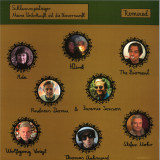
At the end of last year, we celebrated the release of Jo “Schlammpeitziger” Zimmermann's brand new album “Meine Unterkunft ist die Unvernunft” on his 60th birthday at Kompakt Recordstore. Now we are delighted to present the accompanying remixes. An illustrious group of long-time companions has come together to pay tribute to the master of electronic eccentricity with remixes. Schlammpeitziger says thank you in his own way by immortalizing all the contributors with finely selected photos, hand-decorated on the cover.
Hey Leute,
Ende letzten Jahres haben wir die Veröffentlichung des brandneuen Albums "Meine Unterkunft ist die Unvernunft" von Jo "Schlammpeitziger" Zimmermann, zu seinem 60sten Geburtstag, groß im Kompakt Plattenladen gefeiert. Nun freuen wir uns, die dazugehörigen Remixe vorstellen zu dürfen. Ein illustrer Reigen langjähriger Weggefährt*Innen hat sich zusammengefunden, um dem Meister der elektronischen Verschrobenheit, die Remix-Ehre zu erweisen. Schlammpeitziger bedankt sich auf seine Art, indem er alle Mitwirkenden mit fein ausgesuchten Fotos, handverziert auf dem Cover verewigt.
Phoebe Killdeer & The Shift is the collaboration between newly Berliner Phoebe Killdeer (Nouvelle Vague, The Short Straws) with experimental musicians Thomas Mahmoud-Zahl (SFX, The Nest, Tannhäuser Sterben & das Tod, Von Spar) and Ole Wulfers (Kapaikos, Party Diktator), supported by actress and singer Maria de Medeiros (i. e. »The Saddest Music in the World«, »Pulp Fiction«).
»The Piano's Playing The Devils Tune« is »free music« in a most emphatic sense: The interplay between the abstract instrumentation on the one hand, equally recalling genres as diverse as noise rock, bass music and musique concre`te, as well as the intimate, concrete humanity of the sound on the other hand establishes a sprawling sonic space that gravitates around the haunting vocal passages of Killdeer and de Medeiros. »The Piano's Playing The Devils Tune« thereby succeeds in combining a decidedly experimental gesture with an urgent, uncanny familiarity and warmth; a precise sense of composition with an almost lavish casualness.
Phoebe Killdeer & The Shift do not resolve the numerous paradoxes that mark »The Piano's Playing The Devils Tune«: The result is an equally challenging and rewarding album that in fact — as played out as this predicate may be — truly defies categorization. Devils tunes.
- 1