Regal drops the first remix package from his debut album featuring Slam, PTU and Boston 168.
Involve Records boss Regal presents "RWYS Remixes Pt.01" - the first installment of three immense remix packages from the Spanish techno giant's debut album, "Remember Why You Started". Recruiting international powerhouse duo's Slam, PTU & Boston 168 to rework the earth-shattering originals.
Scotland's luminary duo Slam kicks off with their edit of "She Dances Alone". The pair's distinctive tweak is the alchemization of the kick drum, pivoting into a thunderous force. The kick is paired with claps that ricochet above a determined synth line, while the low-slung baseline mists under twinkling keys and sprinklings of hoover noise, giving the rework an old school feel. Uplifting major notes inject brightness & contrast to the track, with the cunning acid line lingering 'til close.
Next, enigmatic Russian twosome PTU transform "Dealing With My Pain", a once low tempo mid-point track, into a primary dancefloor weapon. This heavily industrialised rendition utilises an incessantly deep bass drum while maintaining the commanding male vocal sample. Blistering hi-hats, and a wildly distorted synth breakdown build a brash and dubious mood. The thumping kick drum drives the track forward, looping electrical elements that ring out from ear to ear, surrounding you with wild noise and energy.
Italy's acid techno aficionado's Boston 168 step up to close with their interpretation of "Fearful Nights". In true style, the duo mould the very start of the track to blend with their signature sound. A bumping kick drum and quintessential 303 manipulate the melody, resulting in a far more venomous composition than the original. Sinister synth stabs slice through the chaos with a hi-hat and snare drum combination for extra effect.
Buscar:three drives
"The core of confusion and upheaval that drove some of the band's most fiery earlier work, however, is replaced by a more stabilized undercurrent, a mentality that's reflected in songs not afraid to try new things and honestly explore uncomfortable feelings. When combined with exciting production and songwriting choices, that mindset helps make Feels So Good // Feels So Bad one of the Shivas' best albums.” - AllMusic "Portland, Oregon-hailing psych-surf band The Shivas accomplish another time-traveling, reverb-ridden sound that refuses to get boring. Jared Molyneux’s guitar work knows when to be bright or bashful at the right times, breaking into guitar solos that possess a late-’60s groove… The Shivas seem to blissfully flourish” - Paste "a consistent treat for the ears” - The Vinyl District "Though the psych-tinged guitar riff that drives 'Feels So Bad' was written while The Shivas were still on the road, its lyrics didn’t fall into place until the band was well into lockdown, unsure of when they’d be able to return to their most imperative true love: Live shows... Accordingly, 'Feels So Bad' permeates with a sense of urgent desperation, building off a chugging prog-rock instrumental.” - Consequence (on “Feels So Bad”) "They hooked the audience with their throwback rock sounds. The guitar strums and rhythmic drum beats were layered atop smooth and hallucinogenic vocals. The eyes can tell the take at times and there was a sparkle there that said that the band members just love doing live performances." - California Rocker "This single layers on the fuzz but keeps it dreamy, with an especially sticky guitar riff sure to lodge itself in your brain with minimal effort." - Portland Monthly (on “If I Could Choose”) “'My Baby Don’t' translates the genuine vibrant joy
of the live experience into the studio, bringing the band’s ‘60s garage rock roots, sharp pop vocal harmonies, and fervent performances along for the ride." - Under The Radar "Perfectly straddling the line between a solid-head bopping track and an introspective deep cut, The Shivas’ 'Undone' is a rock & roll gem. The track sounds straight out of the late 60s and fits seamlessly in the Portland band’s electrifying catalog." - The Luna Collective "The first time I clicked play on this track, I knew it was a yes for me." - Ear To The Ground Music (on “If I Could Choose”) "The harmonies would make the “Happy Together” Turtles blush, but the unsettling guitar doesn’t shy away from the woollier implications of the ’60s." - Willamette Week (on “If I Could Choose”) "'Undone' is just the perfect song for the good days and the bad ones." - GlamGlare "another hit" - Austin Town Hall (on “Undone”) "one of the best forthcoming albums of the year" - Austin Town Hall RADIO: #3 Most Added @ NACC - 50 official adds BIO Every working musician has had their life turned upside down by Covid-19. For The Shivas, who had recently released a new LP and normally keep a rigorous touring schedule, it was a particularly screeching halt. “We were about to go to SXSW, the following weekend was Treefort in Boise, and then we were going to open for our friends’ band on tour in the US before going to Europe,” Jared Molyneux remembers. Then everything just stopped. They were faced with a dilemma. “It forced us to adapt or just quit,” Molyneux says. “The reality is that shows are our job.” In truth, live shows aren’t just The Shivas job: they are the band’s greatest love. Shivas shows are bombastic, explosive and thoroughly communal live rock and roll experiences where barriers between the performers and their audience seem to dissolve into the sweat and sound. The stage—or the basement, or the living room—that’s The Shivas’ true element. It’s their raison d’etre. It’s their religion. The band’s live urgency may have been born in 2006, when the band’s young members—who began booking West Coast tours while still in high school—waited without fanfare on sidewalks or in parking lots, before being rushed onstage for their sets at 21-and-up clubs. Maybe it developed a little later, as The Shivas blasted their way through Portland’s storied and unsanctioned mid-aughts house show scene. Whatever the origin of their famously kinetic live experience, it’s the show that keeps them coming back after over 1,000 performances spread over 25 countries in 15 years. In those 15 years, The Shivas have grown tight-knit as a group. Guitarist/singer Jared Molyneux, bassist Eric Shanafelt and drummer/singer Kristin Leonard have all been with the band since its earliest days; guitarist Jeff City, another high school friend, joined in 2017. Together they’ve learned to thread a seemingly impossible needle: They’ve honed and tightened their performances without sacrificing the element of surprise that makes each show special. And despite touring and recording for most of their lives, they speak about their project with humility, in the DIY vernacular of their Pacific Northwest upbringing. They talk up their own favorite bands, play all-ages shows as much as possible, and bring a sort of blue-collar humanism to the live performances they relish so much. “We just want to make people feel good,” Molyneux says. “We want them to forget they have to work tomorrow.” Kristin Leonard elaborates, “The live show is all about that feeling of catharsis—in ourselves and in everyone who comes out. We’re creating this safe space where we can all let go. Where we can exhale. And it feels really good when we are able to facilitate that.” So when Covid hit, the band knew it was time for transformation. After a settling realization that live music would be grounded for the foreseeable future, The Shivas booked significant studio time with Cameron Spies, who also produced the 2019 Dark Thoughts LP. They also transformed their lives: three of the band’s four members found work with a local nonprofit serving unhoused Portland residents. They became engaged in protests and fundraisers for social justice. They spent a whole summer actually living in Portland, settling into the city they had always called home, but that sometimes felt like a temporary stop between tours. “We got into a more community-minded headspace,” Leonard says. “And that did give us some purpose. It felt cool to see everybody come together to stick up for what they believe in. It feels like an incredibly formative last twelve months.” The album that emerged from this new moment finds The Shivas reborn as a band that seems seasoned and perfectly at home with itself. There is a calm, even a hopefulness, to Feels So Good // Feels So Bad that sounds new. The Shivas didn’t write or record the album with a particular theme in mind, but one seems to have emerged: where Dark Thoughts was about confronting your demons with fearless self-examination, much of Feels So Good // Feels So Bad is about what happens once you find that peace: how being honest with yourself changes your relationships and your priorities. “I do think it’s about acceptance,” Leonard says. “There’s a weird relaxation that comes with being at peace with things you can’t control or have regrets about.” Maybe that’s why the squealing, riff-laden break-up song opener, “Feels So Bad,” is such a shock to the system. But it’s more of an exorcism than a melodrama: more a song about not being able to do the thing you love (in
this case, playing live shows) than splitting with a partner. “It’s like part of you goes to sleep,” Leonard says. As bandmates who are also in a long-term relationship, Molyneux and Leonard know that their songs might be seen as glimpses into their personal lives, but their songwriting is rarely autobiography. Leonard compares their process to something more akin to screenwriting. “There’s bound to be some autobiographical material in there,” she says. “But the common denominator is the exploration of universal feelings: ones that everyone experiences or can relate to.” The goal is to use the music to drill down into something genuine and sincere, beyond genre or stylistic affectation. That’s where The Shivas have arrived. Whatever growth led the band to Feels So Good // Feels So Bad, plenty of their fascinations remain. They’re still turning love songs into psychedelic, transcendent epics. “Tell Me That You Love Me” subverts doo-wop extravagance and dabbles in Flamenco rhythms. “Rock Me Baby” is a bubblegum anthem soaked in so much reverb that we might just be hearing it from the stadium nosebleeds. “Sometimes” is almost impossibly huge, like a witchy outtake from the Brill Building era. Those songs feel like logical expansions from a band that has always excelled at a timeless sort of rock and roll that tinkers with and explodes elements from every era. But on the towering and mournful “You Wanna Be My Man,” a slow-burning six-minute shoegaze prayer for a higher sort of love, there is a level of emotional nuance that feels like something altogether revolutionary. It’s there again in the stripped-down vulnerability of the album-closing elegy “Please Don’t Go.” Yes, Feels So Good // Feels So Bad is an album about acceptance. Sometimes that acceptance feels enlightened and sometimes it feels like the end result of a lot of kicking and screaming. The Shivas have adapted in both of those ways. With new tours scheduled and a new album on the way, they’re still hoping--like all of us--for a new era of vibrant, cathartic live music. The lessons they learned from having their normal upended, though, have only helped them grow
Kapingbdi came together in Liberia, West Africa, during the late 1970’s and had their own unique style. This six to seven-piece band played original compositions in a vibrant mix of African Rhythms, Soul, Spiritual Jazz, Funk and Rock. Led by Kojo Samuels on sax, flute and vocals “Born in The Night” presents the essential tracks from their rare studio LPs produced between 1978-1981. The work has been carefully edited and remastered in 2019 for vinyl LP and a 6-Page Digipack CD, which includes two additional recordings. Kapingbdi toured through Europe and the U.S. and were the only Afro funk band to ever come out of Liberia.
Kapingbdi hail from Liberia, West Africa and have their own imitable style. They effortlessly combine traditional African music in a modern mix of Jazz, Funk, Soul and Rock. The band is a fusion of the old and the new.
The word "Kapingbdi" is taken from the Sierra Leone language Mende and means "born in the night". Kojo Samuels was given the name by his Latin teacher whilst attending high school in Freetown, They often meet and debate at night in the city and soon after Kojo is called Kapingbdi. The name serves as a description of his origin. Born In Lagos, Nigeria in 1943. The son of slave children. His mother from Nigeria and father from Sierra Leone who moved the family to Liberia, during the 1950’s.
Kojo has played music for as long as he can remember. He starts with the harmonica and later becomes a drummer and percussionist in his first band at school. During his art studies 1965-1972, he tours Germany and works as an art teacher in the USA. His band Kapingbdi is reorganized five times and consists of up to seven musicians. In a VW-Bulli he drives the group from concert to concert and if the drummer fails, he jumps in himself. Between 1978 and 1981 three Kapingbdi LPs are produced for the independent label Trikont, recorded in Hamburg and Munich. During this creative period, the band plays at festivals in Africa and Europe. In 1984, the band tours the United States and shortly after, they came to an end.
At their best, Kapingbdi would rouse the audience with original compositions like "Human Rights", justice for all, especially for South Africans, and "You Go Go You Go Come". The officials and employees in the government departments have no time for the common man, for any questions such as job search, scholarship or similar, he receives the answer "go, come back tomorrow" and the same thing the following day. Or "Now Is The Time For Cry For Love." Now it is time to scream for love and finally, time for humanity and justice. Despite immense difficulties, the musicians consciously live and work in Africa and are at home in Liberia.
On April 12, 1980, ordinary soldiers and non-commissioned officers organize a coup against the government. This is an attempt to put an end to a policy of exploitation of the Liberian people. Whilst efforts to eradicate poverty, lawlessness and illiteracy are obvious throughout the country, Liberia is still Americanized to a high degree. This is evident, as the radio programs of that time almost exclusively played American disco music. Under these conditions, the people seek a reconnection to their folk music, and Kapingbdi were aware of this. Kojo tried many times to come together with traditional Liberian musicians. This passion takes him north of the country. Meeting and playing with the old hornblowers and playing music on traditional instruments, such as the elephant tusk.
Kapingbdi make high quality tape copies of their own vinyl LPs and patiently try to displace all unauthorized tapes from the domestic "market". Nevertheless, it is hard to make a living through music in Liberia. Kapingbdi, is now celebrated. The radio plays are in abundance, but royalties are not forthcoming. Their musical link is the feeling of Afrobeat and Highlife, which is found in each of the many Kapingbdi pieces. They embody Jazz, which is understood to be the most refined example of black music outside of Africa. In Liberia, Jazz is virtually impossible to hear. Bright shining names such as John Coltrane, Charlie Parker or Miles Davis were widely unknown. Thus, the Black Jazz, including its Back-To-Africa movement of the 60’s and 70‘s, passes by without leaving a trace in Africa itself.
Kojo's claim at the time, was to make African music with the depth, sensitivity and the freedom of the technical level of Jazz. This makes Kapingbdi the torchbeares. The underpaid prophets in small Liberia. It is the passion with which the founder of the band continues to work on their music for years. Tirelessly, stimulating and encouraging his fellow musicians. This is ultimately responsible for the success of Kapingbdi in Liberia itself. The local audience seems to listen to the band in fascinated astonishment. One wonders about the ability to develop as demonstrated by Kapingbdi on the basis of their music. It is African and unusually jazzy, danceable and better than the American disco music heard on the radio.
Rather than chase the money and the job opportunities in Europe, Kapingbdi are firmly rooted in Africa. The musicians live in Monrovia, the capital of Liberia, at the Kabingbdi workshop, located in the Congotown area on the eastern edge of the sprawling city. Kojo works here as a sculptor, painter, batik artist and musician. The sales revenue that his activities generate, gives him the opportunity to support the development of African Jazz music. The highest percentage of funds are from Germany and Kojo’s work ethic is “to work on your own thing“. The stance taken aims to support the welfare of Liberians and Africans. The other musicians of the group live in a second house that is nearby.
For the sake of consistency, Kapingbdi is a full-time band. However, the revenue, from all of the sources, could not keep them afloat. Equally, as important to the group are Kojos's knowledge of traditional African music and his sculpting skills. His knowledge is shared with others at the afternoon workshops. It is here that they discuss new lyrics, engage in political debate and the self-imposed task of improving conditions in Africa. At times the debate became heated, especially during rehearsals. This was regarded as good and integrative, sowing the seeds of innitiative to keep the band together.
From 1980 to 1985 Kojo also opened and ran the club "Panjebota", located on the grounds of the U.S. Consulate in Monrovia. Almost every evening Kapingbdi perform the song "Wrong Curfew Walk", whose lyrics lament the killing of citizens during the curfew imposed by the Liberian government. When the head of state Samuel Doe hears the song, he behaves agressively and forces Kojo to close the "Panjebota". Kojo had already moved on. Soonafter he meets Fela Kuti at the Africa-Festival and plays concerts in Germany with Cecil Taylor's workshop band.
Kapingbdi is for thinking, dreaming, dancing. What they sing about is what they have experienced. Kojo Samuels is 76 years old today and still follows his vocation as a critical musician, artist and activist.
Ekkehart Fleischhammer / Sonorama 2019 (with the help of original press sheets and the memories of Kojo Samuels)
Influential house and techno titan wAFF is branching out with his own new label, Nature. As well as donating a portion of profits to animal charities, the label will become a platform for music that in some ways heals us, just like nature itself. The innovative DJ and producer kicks it off with his own new three tracker, Colours.
You name it, wAFF has done it. The UK artist has headlined every major club and festival in the world, has released for labels like Cocoon, Hot Creations, Desolat and Moon Harbour Recordings and always brings his own flavours every time he steps out. It is now almost a decade since he broke through, so is the perfect time to start his own imprint.
Says wAFF, "There’s so much that’s happened over the past two years that I really wanted to create a platform of expression and creativity that would be meaningful not just for me but for everyone. I hope the label will be something that brings us back down to earth, to ground us. Nature is so important to me so I wanted something that felt like an extension of myself and what I care about so much. Nature, provides all life with what we need, nature heals us and that’s something I like to think of with this label. By providing the best quality of music for everyone, it can help with healing."
The stylish Colours is a taught, driving house track with slinky hi hats and rubbery drums. The monstrous bassline bobbles away down low and is sure to lock in any crowd. Django is another inventive groove, with lush claps and a knotted bassline that drives the track along beneath infectious percussion and silky smooth synths. Switchin is the most raw of the lot with its busy leads, razor sharp tech house drums and glitchy effects. Add in some turbocharged chords and you have a sleazy and standout banger.
These are three vital tunes that start off this label in fantastic fashion.
Emigrate. The one-time project has become more than that. Much more. The three studio albums, EMIGRATE (2007), SILENT SO LONG (2014) and A MILLION DEGREES (2018), prove that squarely behind Emigrate stands Richard Zven Kruspe – an extremely creative mind who needs the freedom to explore his music and his vision in ways outside of Rammstein. With Emigrate there are no limits, no barriers. Everything is possible, nothing held back, and it’s this ethos that underlines THE PERSISTENCE OF MEMORY, the new studio album, set for release on November 5th. THE PERSISTENCE OF MEMORY is a special jewel indeed, with the nine featured songs bringing together ideas that Richard has collected across the last two decades. Industrial Rock, Rock with electronic elements, however you choose to describe it, there’s no question that the songs here always contain a strong sense of melody, as rousing as they are deep. At one stage, it seemed that the tracks might be part of a bigger project – a vinyl box set of the first three albums with an additional LP included. On this bonus LP would be a selection of unreleased songs dating from 2001 right through to 2018. In the end, however, this material was considered too precious to sit beneath the ‘bonus’ heading, so THE PERSISTENCE OF MEMORY was born... Richard reacquainted himself with his hard drives, coming across ideas, songs and lyrics that deserved to be brought into the light, material too good to remain in the archives. He threw himself fully into the task at hand, as he always does, working on the basis that "A good idea remains a good idea”, and if he felt that there was more to be gained he was open to taking another look at the arrangements and the lyrics; new parts were also recorded here an’ there, after which the entire mix was given a fresh polish, ensuring that the nine songs have a contemporary yet timeless coat of paint. This time, Richard tried to keep things as simple as possible, allowing the creativity to flow, keeping his sights firmly set on pure, raw Emigrate songs. Says Richard: "These songs were created at a certain point in my life, but ideas don't have an expiration date. Sounds, lyrics and themes, on the other hand, do." "Freeze My Mind", for example, is one of the first Emigrate songs ever written, going right back to 2001. Now, 20 years later, it sounds fresh, of the moment, yet Emigrate through & through, something that is true of the album as a whole. Some of the elements are forged in a familiar heat, but these are married to new ways of working, new influences and challenges.
- 1: Flip Me Upside Down
- 2: This Car Drives All By Itself
- 3: If You Ever Leave, I’m Coming With You
- 4: Ready For The High
- 5: Method To The Madness
- 6: People Don’t Change People, Time Does
- 7: Everything I Love Is Going To Die
- 8: Work Is Easy, Life Is Hard
- 9: Wildfire
- 10: Don’t Poke The Bear
- 11: Worry
- 12: Fix Yourself, Then The World (Reach Beyond Your Fingers)
Cassette[14,92 €]
The Wombats kick off the most exciting phase of their constantly evolving success story today with the announcement of their fifth studio album Fix Yourself, Not The World, due for release on 7th January 2022 via AWAL. Alongside this, the indie heroes have revealed plans for a five date headline UK arena tour in April 2022, playing massive nights in Leeds, Glasgow, Cardiff and Liverpool, as well as their biggest ever headline show at The O2, London on 15th April. Tickets will go on sale from 9am BST on 20th August.
The announcement comes accompanied by a brand new single ‘If You Ever Leave, I’m Coming With You’, which is BBC Radio 1’s Future Sounds Hottest Record In The World.
Recording remotely over the past year from their respective homes, the band have been working hard to produce some of the most captivating, inventive and forward-thinking music of their career to date. With frontman Matthew “Murph” Murphy in Los Angeles, bassist Tord Øverland Knudsen in Oslo and drummer Dan Haggis in London, they discussed each day’s plan via Zoom, then recorded separately, sending individual files to producers Jacknife Lee (U2, The Killers), Gabe Simon (Dua Lipa, Lana Del Rey), Paul Meaney (Twenty One Pilots, Nothing But Thieves), Mark Crew (Bastille, Rag‘n’Bone Man) and Mike Crossey (The 1975, The War on Drugs, Yungblud) to mix into the finished tracks. “It was pure madness, to be honest,” explains Murph.
“We’re so excited for people to hear this new album! We’ve explored new genres and pushed ourselves further than ever musically. It will always stand out for us in our memories from our other albums as we recorded it across three cities during lockdown, and we weren’t all in the same room at the same time!” says Dan Haggis.
- 1: Flip Me Upside Down
- 2: This Car Drives All By Itself
- 3: If You Ever Leave, I’m Coming With You
- 4: Ready For The High
- 5: Method To The Madness
- 6: People Don’t Change People, Time Does
- 7: Everything I Love Is Going To Die
- 8: Work Is Easy, Life Is Hard
- 9: Wildfire
- 10: Don’t Poke The Bear
- 11: Worry
- 12: Fix Yourself, Then The World (Reach Beyond Your Fingers)
Vinyl[20,13 €]
The Wombats kick off the most exciting phase of their constantly evolving success story today with the announcement of their fifth studio album Fix Yourself, Not The World, due for release on 7th January 2022 via AWAL. Alongside this, the indie heroes have revealed plans for a five date headline UK arena tour in April 2022, playing massive nights in Leeds, Glasgow, Cardiff and Liverpool, as well as their biggest ever headline show at The O2, London on 15th April. Tickets will go on sale from 9am BST on 20th August.
The announcement comes accompanied by a brand new single ‘If You Ever Leave, I’m Coming With You’, which is BBC Radio 1’s Future Sounds Hottest Record In The World.
Recording remotely over the past year from their respective homes, the band have been working hard to produce some of the most captivating, inventive and forward-thinking music of their career to date. With frontman Matthew “Murph” Murphy in Los Angeles, bassist Tord Øverland Knudsen in Oslo and drummer Dan Haggis in London, they discussed each day’s plan via Zoom, then recorded separately, sending individual files to producers Jacknife Lee (U2, The Killers), Gabe Simon (Dua Lipa, Lana Del Rey), Paul Meaney (Twenty One Pilots, Nothing But Thieves), Mark Crew (Bastille, Rag‘n’Bone Man) and Mike Crossey (The 1975, The War on Drugs, Yungblud) to mix into the finished tracks. “It was pure madness, to be honest,” explains Murph.
“We’re so excited for people to hear this new album! We’ve explored new genres and pushed ourselves further than ever musically. It will always stand out for us in our memories from our other albums as we recorded it across three cities during lockdown, and we weren’t all in the same room at the same time!” says Dan Haggis.
- A1: Saint Etienne - Cool Kids Of Death (Underworld Mix)
- A2: Unloved - Why Not (Gwenno Remix)
- A3: Nots - Reactor (Mikey Young Remix)
- B1: Mildlife - Automatic (Jono Ma Ascend Mix)
- B2: Espiritu - Los Americanos (Mother Mix)
- B3: Confidence Man - Out The Window (Greg & Che Wilson Remix)
- C1: Mattiel - Guns Of Brixton (Rub-A-Dub Style Part 2)
- C2: Baxter Dury - Miami (Parrot & Cocker Too Remix)
- C3: Jimi Goodwin - Terracotta Warrior (Andy Votel Spazio 1975 De-Mix)
- D1: Working Mens Club - X (Minsky Rock Remix)
- D2: Moonflowers - Get Higher (Get Dubber Mix)
- D3: Raf Rundell - Monsterpiece (Harvey Sutherland Remix)
- D4: Cherry Ghost - Finally (Time & Space Machine Edit)
Marshall McLuhan’s famous edict ‘the medium is the message’ has never been more apt than with regard to modern remix culture. Although the idea of the remix goes way back to the Jamaican dub pioneers and New York disco remixers of the 1970s, the form didn’t truly come into its own until the acid house explosion of the 1980s, when remixers’ credentials often subsumed — and sometimes surpassed — the original source material. Some, among them our lost friend Andrew Weatherall, used remixing as a springboard into multiple other directions, and became auteurs in their own right.
Forged in the white-hot heat of post-acid house Britain, these Heavenly remixes are perfectly weighted with respect and irreverence, the remixer in each case carefully chosen to add heft to the song (as on Al Breadwinner’s dubwise reworking of Mattiel’s ’Guns of Brixton’— the pairing more a game of chess than a best-of-three arm wrestle).
Although Heavenly was founded in the wake of huge upheavals in electronic music, it was still imbued with its own curious parallel life. I’ve always thought of Heavenly as one of the UK’s alt-pop labels; a place where brilliant pop bands live and record, if the general public would only realise. Some of them have ended up in the real, actual charts (Saint Etienne, Doves), but that’s missing the point about Heavenly, who are, like Factory and Fast Product before them, pop music’s conscience.
There is no sense of order to this compilation and we make no apologies. It’s the Heavenly way. Think of it as a present from Loki, the Norse god of mischief. You’ll find a smattering of older tracks: album openers Saint Etienne are taken on a Poseidon Adventure with Underworld, who inject ‘Cool Kids of Death’ with typically manic energy. Elsewhere, ’90s Brum duo Mother add dancefloor pzazz to Espiritu’s innate glamour on an all-funked-up reworking of ‘Los Americanos’, and Mark Lusardi’s remix of Moonflowers’ ‘Get Higher’ is an early Heavenly classic.
On ‘Terracotta Warrior’, a perfect, psyched-out, Mancunian union is created betwixt Jimi Goodwin and Andy Votel, whilst Goodwin cohort Simon Aldred, in his Cherry Ghost guise, receives a proper Tamla-Motowning from Richard Norris (aka Time & Space Machine) on an inspired cover of Cece Peniston’s glam-house hit, ‘Finally’.
There are several of Heavenly’s current darlings here too. One of the most exciting young British prospects, Yorkshire’s Working Men’s Club, effectively remix themselves, as Minsky Rock — WMC’s Syd Minsky-Sargeant and producer Ross Orton — cleave ‘X’ into a riotous industrial racket. Jagwar Ma’s Jono Ma takes the Kraftwerkian leitmotif on ‘Automatic’ and drives the Australian jazz-funkers Mildlife down an electro-convulsive psychedelic tunnel (thankfully no-one was harmed during the making of this remix); Sheffield’s DJ Parrot and Jarvis Cocker deliver one of the outstanding remixes of 2018, turning Baxter Dury’s ‘Miami’ into a lovelorn minor opera; and, making its first appearance on vinyl, David Holmes’ Unloved project is taken on a panoramic Welsh waltz thanks to Gwenno.
There may well be no rhyme, nor reason, to how these compilations have been put together, beyond the fact that they are assembled with love, an innate understanding of the power of great pop music, and a skilled marriage of song and remixer — but does one really need anything more than that for an album to make sense? I’d suggest not.
‘Expressions of Interest’ is the debut album from Melbourne/Naarm post-punk group screensaver.
Sonically, the 10 track album is rich and detailed, and pays homage to its era of inspiration (late 70s-mid 80s post-punk and new wave) with gripping vocals, dissonant guitar, melodic basslines, washes of synths and motorik drumming. Engineered by Julian Cue alongside band member Chris Stephenson and recorded over multiple studio sessions between 2020-2021
The album opens with the ominously titled ‘Body Parts’, an immediately arresting song that showcases the bands penchant for blending classic post-punk elements, leaning into a sound somewhere between the Banshees and Protomartyr.
Maynard doubles down on these themes in the frenetic second track, ‘No Movement’. Guttural organ tones swim under overdriven guitar, jagged and intense. Additional textures and sound effects are used percussively to embellish the dynamics, creating a feverish atmosphere with some Martin Hannett like flourishes.
The album takes a surprising turn into electronic driven krautrock on track three with 'Buy, Sell, Trade' - a rollicking piece of danceable ephemera, dominated by swirling synth sounds and punctuated with electronics reminiscent of Sparks/Moroder collaborations. Chris Stephenson's masterful guitar work begins with Greg Sage-esque determination before a crescendo into a lush Frippertronics outro.
'MEDS' transports us back to the foundation established on 'Body Parts', a gothy piece, full of tribal toms and dirge-y synths. Industrial punk rock nearly swallowed whole by the keys in the middle and slowly building back to complimentary guitar and vocal hooks.
It's from this point in the album that the band let's their other influences rise to the surface, as they explore touches of EDM on 'Static State' - a brutal, death-disco style track, Krystal Maynard's lead synth and gloomy vocal complimenting the pounding drums and dub-esque bass line culminating in a track worthy of the dancefloor.
Opening side two we have 'Skin', beginning with a solid and simple backbeat, James Beck’s post-punk percussion provides a steady and minimal framework for the rest of the band to colour in with great depth and detail. Giles Fielke’s bass guitar wobbles brilliantly leading the verse melody, whilst Chris Stephenson’s guitar drives the chorus that folds neatly in on itself.
In ‘Attention Economy’, Krystal Maynard is flexible with her lyrical style, and knows how and when to lend her voice to the greater backdrop of the composition. ‘Attention Economy’ has an almost Kraftwerkian structure - repetitious, but engaging with its constant tom driven beat, lush synth lines and minimal bass tones.
Just when you thought things had slowed down, screensaver ramp things right back up again with ‘Overnight Low’ - a no holds barred thumper. Giles Fielke underpins the hard-edged sound with his bassline, keeping things smooth and tight. It brings to mind a hybrid of PiL’s ‘Annalisa’ and Wire’s ‘Two People In a Room.’
Before you can catch your breath, we have ‘Regular Hours’ - another industrial track, and perhaps the sister song to ‘Static State’ heard earlier on side one. Seething electronic drum samples cut through an abyss of growling synths, Giles Fielke hanging up the bass temporarily to accompany Krystal Maynard on synth duties.
The album closes with the fittingly titled ‘Soft Landing’, literally bringing the listener back down...softly. The song is heavy on atmos, and resembles the aesthetics previously encountered on ‘Attention Economy’ a few tracks earlier.
‘Expressions of Interest” was recorded at various locations across Melbourne, with a handful of songs being captured before the start of the Covid pandemic in January 2020. With the recording timeline being drastically altered, the band shifted focus to work on what would become their first single ‘Strange Anxiety’, throughout the first months of the Melbourne 2020 lockdown.
Truly adventurous and life enhancing music that invigorates your soul. TIP!
Press Release:
Gordan join traditional Serbian singing with abstraction, energy and minimalism. Their music is marked by radical reduction, seemingly endless ascension and a passion for experiments.
The Serbian singer Svetlana Spajić is an internationally recognized and acclaimed artist. She, like almost no other contemporary singer, is a master of all the complex local stylistic variations of singing from Balkan music. Guido Möbius plays bass and various electronic sound generators. Additionally he uses guitar amps, microphones and effects to provoke feedback which either harmonize or are juxtaposed with the song. It is a dialogue between sound and noise which is accentuated or fragmented by means of Andi Stecher’s expressive drumming. With a rich pool of ideas the percussionist drives the sound forward breathlessly and grounds it. Together the trio form a dynamic body of sound.
Gordan recorded their debut during the first wave of the Covid19 pandemic in Europe in March 2020. Due to the lockdown in Berlin at that time the city didn’t have many distractions to offer, so the trio just concentrated on work. The atmosphere of being isolated in a recording studio had a big impact on the musical results. All three band members came up with ideas for new pieces, which were immediately tested, worked out and recorded. On abstract instrumentals provided by Stecher and Möbius, Svetlana Spajic sometimes reacted with personal interpretations of serbian traditionals, and the other way around. Most of the time it was as if the music just happend to the band; playing together felt natural from the first moment on.
Some of the old serbian traditional songs that Spajic sang are extinct forms with a specific local melodic mode. The skillful improvisation of their lyrics and ornaments was of great importance and very estimated among village singers. The title song Down In The Meadow for instance originally is a love song from the village of Odevce in eastern Kosovo, Serbia. The singing manner is of a great intensity and sonority, with lots of specific local ornaments. It disappeared along with the village communities from the area. Oh, my Rose flowers is from the region of Kopaonik mountain (southwest Serbia) and the mode, scale is known as ”kopaonički glas” (Kopaonik mountain air). Svetlana adopted the style from the late singer Veličko Veličković from the village of Ostraće. It is an old mountain solo chant, rich in fast ornamentation movements and microtonal intervals. Don’t ask how I live is Svetlana’s homage to the new popular folk music movement from the 80ies known as Južni Vetar (Southern Wind) led by a musician and composer Mile Ilić, known as Mile Bas (“Mile the Bass”) which revolutionized popular music introducing tabooed oriental music and original arrangements.
All music by Spajic Stecher Möbius except ‘Don’t Ask How I Live’ by Miodrag M. Ilić, original title Što me pitaš
All lyrics are traditional, except ‘Don’t Ask How I Live’
Svetlana Spajic — vocals
Andi Stecher — drums & percussion
Guido Möbius — bass, feedback, electronics
Recorded by Alberto Lucendo at UFO sound studios Berlin in March 2020 mixed by Morphosis
Mastering by Neel at Enisslab, Rome
Artwork by Lorenzo Mason Studio
Forming off the back of contemporary jazz outfit Zeitgeist, Voronoi take the power and rhythmic complexity of heavier prog-metal and fuse it with the sophistication of classical music and jazz. A passion for science fiction thematically drives the band’s heaving and
chopping style, whereas artists such as Autechre, Car Bomb, Tigran Hamasyan and J.S. Bach help shape the rigid, experimental structure of The Last Three Seconds.
“Compositionally and stylistically we have moved into much heavier territory than our contemporary jazz foundations,” says Keyboardist Aleks Podraza. “It really shows. If you were to put this record against the first tunes we played together as Zeitgeist, it would be like introducing a much capable Thelonious Monk to a less hectic Dillinger Escape Plan.”
As the first single off The Last Three Seconds, Gamma Signals serves as a toe in the water for the depth of things to come. The full-bodied riffwork captures the stop-start format of prog-metal heavyweights without being explicitly metal. Yet beyond this, glitchy, experimental electronics cut through the composition like a knife. The final product is something that captures the magic of the cosmos – a place where worlds orbit worlds, genres orbit genres. Each element remains different and unique, but still intrinsically tied to the other.
“Gamma Signals is about pulsars and how when Jocelyn Bell-Burnell first discovered them, the media thought they were aliens trying to contact us,” says Podraza. “Broadly, this song is about my love for and fascination with cosmology as a whole. That's a theme that runs through the veins of most of the album.”
Those following Vorono’s career will need little convincing on the quality of The Last Three Seconds. Collectively, band members have performed and recorded with groups like The Cinematic Orchestra, KOYO, NJYO, Jenova Collective, The Often Herd, Mik Artistik’s Ego Trip, Wandering Monster and more. This in turn has garnered sizable attention at festivals such as Leeds and Reading Festival, Download Festival, Ronnie Scott’s Jazz Club - not to mention Voronoi’s thrashing set at 2019’s ArcTanGent.
The cool and collected chaos of The Last Three Seconds serves as a snapshot of this live energy, as passion and fury hum at the end of every complex composition. From start to finish, the record is nothing less than executed perfectly, undoubtedly appealing to even the most seasoned of prog-lovers
Infernal Sounds welcome back the heavyweight Von D, as he delivers the gargantuan three-track Hunedoara EP, fresh off the back of his debut release on Deep Medi. Spanning way back to 004 on the label in which he made his debut on Infernal Sounds with two tracks 'Cross Of Hendaye' & 'Finis Gloriae Mundi', he drives a different style and reflection on this endeavour. The title-track 'Hunedoara' is the crowd pleaser - hitting you with the heavyweight stomping war chant, whereas both 'Akasha' and the textural 'Layers' on the B-side are melody centered and display the more playful side to the French producers repertoire. Having already received the backing from the likes of Truth, DJ Squarewave, and many other reputable artists in the scene, this is a plate that's armed for the dance or for playing at home.
2x12"
since long, chilean/swiss producer and dj luciano is a prominent figure in the global electron-ic club music circle. already from a young age on he was exposed to music profoundly, as his father worked as a jukebox repairman and possessed a large record collection.
when he was twelve, his mother gifted him a guitar, that turned luciano shortly into a mem-ber of a school punk rock band. soon after, his passion for electronic music rose. infected by detroit techno and engaged by close friends like producer dandy jack, he started to play rec-ords in local santiago de chile dance clubs and became involved in the minimal techno scene around friends like ricardo villalobos.
when luciano moved back from chile to switzerland in 2000, he established a residency at weetamix club in geneva, started releasing his own productions on labels like mental groove and joining the cocoon team in ibiza to play at the famous monday night at club amnesia.
since then he is a regular on the balearic island, holding residencies at clubs like dc10 or, with his “vagabundos” serial, at ushuaïa. besides playing around the globe with the likes of carl craig, richie hawtin or loco dice, he is releasing groundbreaking minimal techno and house on his label cadenza since 2003, featuring music by artists like nsi, ricardo villalobos, pikaya, reboot, maayan nidam and himself.
his very own music, so far issued on three albums and countless eps, was always ambiguous. there is his club leaning creativity that can dance slightly into pop spheres while never for-getting the power of precise sliced rhythms and subtle bass sensations.
and then there is a calmer luciano, that displays his love for “music to listen at home, done for a spiritual travel, an inner universe and a moment paralyzed in ether”, as he describes it.
on his first ever mule musiq album release “luci neu house”, luciano now delivers meditative journey music full of repetitive patterns that slowly playing tricks on the listeners subcon-sciousness. “i love music that has a dimension more than music designed for the radio or tv format. mu-sic, that is designed to bring you a higher level of energy and creativity.
so, there is no pretentious things in it ... more just sounds and dimension that will lead your head into the fall of jupiter” he reveals about the one-hour long composition “luci neu house”, whose esoteric deepness reminds on the intensely meditative class of his older pro-ductions like “behind my soul” from 2010.
an epic tune cut on vinyl into four 15-minute long pieces, who shift slowly, almost unper-ceived, whilst absorbing the mind of close observers into a micro-sliced world of moving gen-tleness.
maelstrom magnetism against the gravity of time, that also can be found on the additional mule musiq 257 12inch, which functions as a soothing footnote to luciano’s album.
the almost 13 minutes long trip “flags of himalaya” opens with restful percussions that unhur-riedly start to dance with soft string, piano and horn melodies. on the opposite, the nine-minute long “the evasion of the spiritual soldier” grooves laidback with jazzy rhythms and italo leaning melodies.
a perfect tune for slow dance sensations and endless sunset seaside drives. at a total length of almost 90 minutes, all new mule musiq music composed by luciano distributes a mesmer-izing healing spirit, that grounds organically, even if it is totally rooted in the digital, soft-ware driven world of composing music. “check your buddha” tunes, that somehow sound novel during each new listening circle.
For his return to Make Mistakes, Derek Russo ventures into the Belly of the Whale with three pieces of beautiful, retro future, dance floor chic.
Embryonic Speck opens up the record, evoking classic rave beats, in a crisp, clear, modern style. With this cut, Derek has crafted a late-night slayer for the discerning dance floor. A relentless groove drives the track along, creating the hypnotic, smoky dreams of rave’s past.
Night Sea Journey takes it down into disco depths. A wandering bassline swaggers through the track, crashing through dark waves of sound. Sexy and mysterious, made to drag the sweaty sea on the dance floor through the night.
Straddling, a piece of timeless, familiar house music, rounds things out by bringing in a touch more warmth and whimsy. Still for the darkness, but with a lighter mood, and booty wiggle bass. Deep, and grooving, with a playful sexiness, what more could you ask for?
“Consider the subtleness of the sea; how its most dreaded creatures glide under water, unapparent for the most part, and treacherously hidden beneath the loveliest tints of azure. Consider also the devilish brilliance and beauty of many of its most remorseless tribes, as the dainty embellished shape of many species of sharks. Consider, once more, the universal cannibalism of the sea; all whose creatures prey upon each other, carrying on eternal war since the world began.
Consider all this; and then turn to the green, gentle, and most docile earth; consider them both, the sea and the land; and do you not find a strange analogy to something in yourself? For as this appalling ocean surrounds the verdant land, so in the soul of man there lies one insular Tahiti, full of peace and joy, but encompassed by all the horrors of the half-known life. God keep thee! Push not off from that isle, thou canst never return!”
― Herman Melville, Moby Dick
- 1: ) | Written Words
- 2: ) | Self Inflicted
- 3: ) | Looking After You
Hammered Hulls are a brand new band from Washington D.C. made up of some very old connections.
Mary Timony (bass) and Alec MacKaye (vocals) grew up in the same Washington neighborhood and have spent the better part of their lives in each other’s somewhat distant orbit. Always aware of each other, but never able to play together.
Mark Cisneros (Guitar) has been in D.C. for more than a decade. He cut his teeth in Los Angeles listening to both Mary and Alec’s bands, but also a healthy dose of free jazz and garage. He is the man who plays every- thing with everyone, but this is his band.
Hammered Hulls are rounded out by Chris Wilson (drums), a monstrous drummer with no shortage of love for all three of his bandmates. Every person in this band is a fan of every other person in this band. Mutual respect drives this train. But to say they are an odd collection of influences is to understate the point. If you tried you couldn’t imagine what this band might sound like.
This single was recorded and mixed in a single day at Inner Ear studios, appropriate home to everyone in the DC scene.
mark Cisneros - guitar Alec macKaye - vocals mary Timony - bass Chris Wilson - drums
Aleqs Notal's introduction to the Sistrum family, 2017's Ascending Nodes, offered a taste of his capacity for jazzy undertones and rhythmically complex percussion. His return to the label, the LYU EP, takes his propensity for drums a step further. Heavy hand percussion drives the release across all three cuts, with a fourth mix that's stripped down to just its bare bones parts.
Matt Edwards launches Stranger in The Night with his first solo material since 2017.
The Rekids offshoot will release regular music by four artists, namely Radio Slave, King
Britt, Anthony Rother and Fred P, who will each drop three EPs over the next year.
'With Rekids being 100% focused on releasing music for dance floors I felt the need to
create a new platform to explore a wider musical vision and invite some of my all-time
electronic musical heroes to be a part of the series,' says Matt Edwards.
Both numbers near the 12-minute mark but each track portrays a different aesthetic.
Opening with precision drums and crystalline notes, 'Ground Control' makes a nod
towards the hi-tech soul sound of Detroit and drives forward using a sultry bassline, erratic
chords and the occasional icy stab as an array of contrasting sounds operate in unison.
On the flip, a syncopated rhythm lays the foundation for 'Last Communication' whilst a
tantalising melody joins poignant synths, constructing a profound and hypnotising journey.
For the fourth release on 6dimensions, Steve Bicknell has delved into the catalogue of the Lost Recordings series on his previous imprint; Cosmic.Steve Bicknell's Awakening The Past feature three tracks from Why And For Whom, the first of Bicknell's Lost Recordings releases. Originally released in 1996, Why And For Whom Has been named one of the best UK Techno records of all time with Bicknell being billed as a 'criminally underrated producer'.With the re-release of these tracks in 2017, it is clear to see that the tracks have stood the test of time. All four-tracks on Awakening The Past were previously untitled but have been renamed with a focus on the human condition. With the 6dimensions label being founded on the principles of the 'human mind's natural make-up' it seems a natural decision to rename the tracks to suite the label ethos. Although one quarter of Awakening The Past was released 20 years ago, Bicknell's focus on mood shows coherence between his work then and now. The era of production can be distinguished in the EP, however, this is only eminent through a difference in recording technique. More importantly, the mood of older and newer productions are indistinguishable from each other and display Bicknell's unrelenting dedication to his own focus on concept of aesthetic. Physical Life' opens the EP with a rawness that is carried through the EP. With tape hiss underpinning the track, Bicknell's signature bass grumbles hold together hi-hats which progressively filter in and out over the course of the track. Bicknell's use of filters carries through onto the second track of EP, 'Natural Vibrations' boasts an erratic and high-pitched 303 sequence that shows a bit of experimentalism before the EP steps back into Bicknell's more familiar techno odysseys. 'Fearing The Minds Fears' paints a tense atmosphere, lashings of motoric modular synth are added with little fuss as the track title confirms its significance. Finally, 'Conscious Awakening' drives the EP to a close with dizzying pace: it's here that Bicknell's ability to control the emotion of the listener is really evident.
New York native Caiazzo releases 'The Devotion' on his and P.Leone's E-Missions imprint featuring three dusky techno tracks and a remix from White Material co-founder Young Male.
Much like P.Leone, Caiazzo's debut release (entitled 'The Dredge') landed on Work Them Records; Spencer Parker's label that's featured names such as Radio Slave, Rodhad, DJ Richard and Ryan Elliot. Launching E-Missions earlier this year, the pair continue their high quality output by following up two releases from P.Leone with three uncompromising original cuts from Caiazzo himself.
Rolling percussion drives '917 (Sportmixxx)' whilst intoxicating drones operate throughout, making way for 'Lifeform' with its layers of thick synthesised sounds that build on top of a relentless drum composition with subtle but effective transitions. 'Godbody' offers a stripped back approach to techno with an intricate percussive composition that allows a deep low-end and a hypnotic perc to take control.
Finally, White Material label boss Young Male provides his take on 'Godbody' where bass hits combine with haunting atmospheres and warped rhythms, closing the release with style.
On EP5, legendary German musician Burnt Friedman makes his Dekmantel Records debut with 'Monsun'. The Berlin based artist, who built a reputation for himself through his explorations into obscure, finely-tuned, experimental dub through his label Nonplace, alongside his collaborative relationship with the late Can drummer Jaki Liebezeit, is one of the crucial, sonic manipulators of our time. 'Monsun' finds Friedman crafting flowing, percussive, dub techno that is both esoteric, and progressive. Befitting of a Dekmantel release. Alongside Friedman sits legendary Detroit act Ectomorph, aka. BMG & Erika, also making their Dekmantel inauguration, with a record that surmises' the group's anologue, style of Motor City beats.
.
There would be no Dekmantel celebration without longtime family members, JuJu & Jordash. With three LPs and countless EPs released on the imprint to date, alongside a sleuth of festival, and party appearances, the improvisational duo have become masters of off-kilter, and poly-rhytmic electronic funk, of which 'Neon Swing' -a fast-paced and extremely invigorative cut- is of prime example. And then there's Dekmantel favourite Fatima Yamaha - an artist who has a keen ear for gentle, analogue hooks that have gone to become ample festival fodder. The Dutchman maintains an ear for the serene with the track 'Platforms', a sullen, yet beautiful ambient track, the drives deep into the emotive world of soft, tender, heartfelt music.
They say all good things comes in threes, and with the marking of Nachtbraker's 3rd release for Heist, we can confirm this universal truth once again. Maurits Verwoerd comes back to Heist with more dancefloor muscle than ever before, and shows us great development of his sound: while keeping his unconventional drum patterns and love for the deeper side of house, he adds some filtered funk flavor along the way. 'Gotta act to react' drives on a saturated bassline, a hypnotizing guitar lick and some seriously loose hi-hats, but really delivers once those hard to place filtered hits come in. 'Pollo con Pollo' is potentially Maurits' most clear attempt at a straightforward groove, with a lovely dreamy guitar loop running throughout the track. Add his loose sense of arrangement and changeovers, and it's still anything but straightforward. The B- side gets nice and weird with 2 versions of Intermezz(l)ow, the one being a lovely textured interlude and the other a rough drum workout built around the same theme. When we asked Maurits who he wanted to have as a remixer, he suggested he'd do a remix himself. We knew better than to argue with him, and since he is who he is, we're not entirely surprised he came up with a great dubbed out acid-tinged flip of 'Gotta act to react'. This EP really shows Nachtbraker's steady rise and will most likely take him out of the shadows he so enjoys, into headline territory and we're glad to support him in this journey. Sincerely yours, Lars & Maarten
Up and away / To your journey to the sun / Drink your rocket juice / Fly away (Hey, Shooter).
High up in the skies, amongst the clouds, Rocket Juice & The Moon was born. Literally. It happened back in 2008, when Damon Albarn, Flea and Tony Allen convened on the same Lagos flight, to play and exchange musical ideas in that city as part of the Africa Express collective. Relishing a shared enthusiasm for one another's work, and bonding immediately, there and then the triumvirate laid down the blueprint for Rocket Juice.
Still, more than a year passed before conditions were set for three weeks together at Albarn's West London studio, recording and refining two-dozen startlingly out and deeply funky instrumental grooves. The next stage was to invite onboard some extremely talented friends, with further sessions in Dallas, New York, Chicago and Paris... Erykah Badu, no less, queen of contemporary soul. Three companions from Africa Express: Malian singer Fatoumata Diawara, whose debut album has topped World Music charts since its release last Autumn; her multi-talented compatriot Cheick Tidiane Seck, whose prodigious keyboardism has lit up releases by artists ranging from Youssou N'Dour to Hank Jones; the young, Ghanaian rapper M.anifest, quizzically existential, switching seamlessly between Twi and English. And the Hypnotic Brass Ensemble, long-time stalwarts in the Honest Jon's set-up — since one of the team discovered them busking near the shop in Portobello Road, on his lunchbreak — with a second album for the label due in May... Finally, the tracks were dispatched for mixing to Berlin, to be meticulously honed, polished and envenomed by Mark Ernestus, one half of the legendary Basic Channel and Rhythm & Sound partnerships.
The result is Rocket Juice & The Moon — out March 26, 2012, on Honest Jon's Records — a triumphant exploration and proliferation of kinetic Afro-funk rhythms: organic, exuberant, communal music-making, evidenced by the project's live debut on stage as part of the Honest Jon's Chop Up in late 2011, which hit London, Marseille, Dublin, and Cork to such great acclaim (witness the flurry of smart-phone film-clips uploaded in the days thereafter).
From the inaugural bars — that absurdly funky slice of instructional timekeeping, 1-2-3-4-5-6 — the liquid pulse of Fela Kuti's classic recordings drives the action through a suite of 18 shape-shifting compositions. The greatest drummer in the world has never sounded so good as he does here. His intricate cross-patterns jostle and lock with Flea's nimble, rumbling bass riffs. Joined by Seck on There and Extinguished — 'when you dispose of something burning, be sure it's out' — Albarn's keyboards spray synth fusillades up top, over, and under... splicing into the mess of wires running between the freaked Afro-disco of William Onyeabor and the space-jazz-moog of Sun Ra. The HBE brings extra intensity and drama to Leave-Taking — likewise Flea's trumpet to Rotary Connection — teasing out the haunting melody coiled in the mix.
Where the best of vintage Afrobeat sides sustained their concentrated energies over the course of sprawling, marathon jams, RJ & TM manages something altogether different: the group bottles the idiom into capsules of funk... and real songs. Beautifully buoyed by Erykah Badu's unmistakable vocals, Hey, Shooter brilliantly traverses metaphysical spaceways sans any semblance of noodling. Lolo and Follow-Fashion — featuring the open-hearted sensuality of Diawara's singing, M.anifest's quick, brawny science, and more brass blasts — play like its musical cousins or codas. Indeed, the album's shrewd sequencing creates the composite effect of tracks working both individually or within the context of an extended song-cycle.
The lovely ballad, Poison, is bittersweet and ruminative: 'If you're looking for love, beware the signs / They will paralyze you one by one / Poison, it will only break your heart.' Down-tempo and dubby, Check Out and Worries amplify the range of styles and moods. And by the time of Fatherless — a chugging Afro blues that evokes John Lee Hooker lost in Lagos, one gets the sneaking suspicion there's very little outside the reach of this collective's inventive musical grasp.
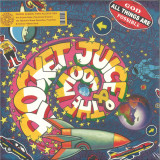
There is, in fact, a palpable openness pervading Rocket Juice & The Moon — the sense of a limber willingness to follow creative impulse — right down to how the group acquired its name. When Ogunajo Ademola — the Lagotian commissioned to do the album's cover artwork — dubbed his submission 'Rocket Juice & The Moon', it quickly morphed into the formal name of the project, like trying to hold onto mercury.
Surely, the stars above also approved.