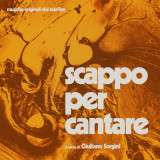
Another dream coming true! One of Giuliano Sorgini's finest and most sought-after titles is finally available as an official LP reissue – the first ever – remastered from the original tapes.
Originally released in 1971on the small library music imprint FAMA, which operated as a sub-label of RCA Italy, the record contains the original music written for Scappo per cantare, a small, pseudo-psychedelic 'musicarello' (musical comedy film) broadcast on RAI television and starring, among others, Italian singers Gianni Morandi and Mauro Lusini.
The only credited album artist is Sorgini, but it's impossible not to perceive, in this record, the hand of his close friend and colleague Alessandro Alessandroni.
This should not come as a surprise. In the early 70s, the two composers and multi-instrumentalists had a fruitful collaboration that saw them, under the monikers Braen (Alessandroni) and Raskovich (Sorgini), produce an abundance of works together, most of which have now gained the recognition they deserve. These include, among others, two 7" singles from their band The Pawnshop, three records in the series Alle sorgenti delle civiltà (Folkmusic), the crime/noir library albums Quarta pagina (Usignolo) and Inchiesta giudiziaria (Octopus Records), as well as the LP Tempo Libero (Panda Records), which was released shortly after the record presented here and in some ways drew rhythmic inspiration from it.
While their collaboration remained unacknowledged on the original release of Scappo per cantare (this was not uncommon at the time, especially in the field of library music), the record sounds perfectly in line with other works composed by Alessandroni in the early 70s, such as Complesso Gisteri's Mostra Collettiva (co-written with Oronzo De Filippi), or even a landmark album like Spontaneous, where Sorgini contributed to a handful of tracks.
So, yes, the sheer beauty of Scappo per cantare is the result of an incredible synergy between two heavyweights of Italian library music! Airy and sweeping melodies à la Zoo Folle, psychedelia à la Under Pompelmo, and various percussion instruments played by Sorgini seamlessly blend and fuse with elements and touches provided by Alessandroni.
More specifically, we find Alessandroni's signature, melancholy whistle in "Desolazione"; the peaceful and dreamy sound of his 12-string guitar in "Scogliere" and "Con Amore"; the trademark harmonies of his vocal ensemble Cantori Moderni in the last two tracks mentioned and in "Per cantare"; and his ingenious use of distortion on his Fender Stratocaster in the suspenseful transitions "Concentrazione" and "Fantocci", as well as in the frantic/hypnotic hippie numbers "Mordente" and "Fendente" (as a side note, it is worth remembering that Alessandroni experimented extensively with distortion in the rock-infused album Underground, co-written with De Filippi and released in 1971 under the moniker Braen's Machine, probably a reference to British psychedelic band Soft Machine).
The creative relationship between Sorgini and Alessandroni was so symbiotic that it would be useless to try to identify in more detail their respective contributions to the sound of Scappo per cantare. The alchemy between these two musical geniuses is the key to the album's exquisitely Italian mixture of cheerful lounge, sweet psychedelia and smooth easy listening.
To do justice to the quality of the music, this remastered reissue is enriched by a new artwork by Eric Adrian Lee, who drew inspiration from the psychedelic visual culture of the period in which the album was written and recorded.
Suche:three n one
Too Pure are excited to get Moonshake’s debut album, ‘Eva Luna’, back in
print, releasing a deluxe edition, re-mastered from analogue 1Ú2” tape, on
blue double vinyl.
The reissue contains 19 tracks - the album’s original 10, the non-LP threesong single ‘Secondhand Clothes’, the two B-sides from the ‘Beautiful
Pigeon’ single and four tracks from a November 1992 John Peel session.
The release also includes an 8-page full-colour booklet.
Moonshake were formed in 1991 by David Callahan (vocals, guitars,
samplers), formerly of The Wolfhounds, and New York musician Margaret
Fiedler (vocals, guitars, samplers). Callahan and Fiedler recorded a demo for
Creation Records, and were joined by John Frenett (bass) and Miguel
Morland (‘Mig’, drums) to record and release the ‘First EP’ for Creation in
1991.
They took their name from a 1973 single by Can. Both Fiedler and Callahan
wrote songs, and they would (generally) sing on the songs that they wrote.
Their output of shared inspiration produced wildly different results - Can, PIL,
Kraftwerk, MBV and Erik B & Rakim were a melting pot that made
Moonshake somewhat uncategorizable, and as Margaret noted in an
interview, “Moonshake was a collision - it was supposed to be a collision.”
Their debut album, ‘Eva Luna’, took its name from a novel by Chilean author
Isabel Allende, and the tracks on it are split evenly between the two
songwriters. Callahan’s songs are somewhat angry, dissonant, post-punk
affairs, while Fiedler’s are just as angular, but her quieter sometimes near
whispered vocals compliment her writing partner’s equally. Producer /
engineer Guy Fixsen, fresh from his work on My Bloody Valentine’s
‘Loveless’, was instrumental in making the album cohesive.
This album has been critically revisited often since its original release, with
Tiny Mix Tapes describing their sound as “an updated take on Can and
Public Image Limited’s rhythmic propulsion with noisier guitar work and a
predilection for sampling influenced by The Young Gods.” Last year, in a
wonderfully long piece to celebrate the album’s 30th anniversary, Louder
Than War wrote that they were blown away by the album’s “utterly
spellbinding, dizzyingly genre-defying approach at articulating explicitly the
sound of a city in the throes of urban psychosis and derangement... ‘Eva
Luna’ really is one hell of a ground-breaking record, and it stands resolutely
alone among all of the albums released in 1992 as no other band has
managed to create anything remotely similar before or since. It really is a
unique album with few equals.”
In 1993, the original incarnation of the band split up, and Margaret Fiedler
and John Frenett went on to form Laika with Guy Fixsen. Callahan and
Morland continued on with guest musicians, with Callahan ultimately
remaining the band’s sole original member. Moonshake ended in 1997 but
their legacy is indisputable.
Limited Black & White Swirl Vinyl. On December 29, 2012, three songs into Chastity Belt's first KEXP in-studio, something extraordinary happened: they shared "Black Sail" with the world. That year, I'd seen Chastity Belt play countless basement, bar, and DIY shows all over Seattle, but nothing could've prepared me for how my friends turned patience and quiet observation into something so affecting and effortlessly cool. Ten years later, "Black Sail" isn't just a fan favorite - it's practically a statement of purpose for the great albums that followed. But before those records, there was No Regerts: the sound of four friends evolving from a party band into a "real" one (whatever that means) in real-time. They're above it all on "Seattle Party," "Happiness," and "Evil," but remain the sirens of Whitman College's cursed frat houses - see the explosive choruses of "James Dean," "Healthy Punk," and "Pussy Weed Beer." When No Regerts came out in the summer of 2013, Seattle - and the world at large - took notice. I still hear these songs in surprising places, and they still surprise me - just as they did a decade ago. If you missed out the first time, this is your second chance.
al
In spring 1994 Mouse on Mars contributed an exclusive piece to Sähkö Recordings’ ambient radio project, a one-week public radio program that was aired citywide in Helsinki, Finland. Andi Toma and Jan St. Werner recorded sounds in and around their studio in Düsseldorf Bilk to construct one continuous composition that spanned the course of one neighborhood walk. Midi-controlled synths, samplers, analogue effects, tape delays, effect pedals, guitars and a jew’s harp were juxtaposed with recordings captured during the walk. An additional microphone that pointed out of the studio window was occasionally dubbed into the mix. The resulting collage was broadcast just a few months before the group’s debut album Vulvaland came out and never aired again. 30 years into the band’s existence Andi Toma and Jan St. Werner revise the duo’s history by producing three LPs that would place the band’s discography under a slightly different light. Bilk marks the beginning of that investigation: a free-flowing assemblage of everything that vibrates and can be caught on tape. A 30 year old recording with subtle new edits and additions.
Recorded at the Academy of St. Martin in the Fields by Andi Toma and Jan St. Werner.
Artwork Soulis Moustakidis. Art Direction Rupert Smyth. Vinyl Master Cem Oral.
At long last: the classic Steely Dan catalog is back on vinyl. Led by Walter Becker and Donald Fagen, Steely Dan released 7 albums from 1972-1980. The vinyl series continues with Aja, the band’s 1977’s platinum-selling jazz-rock masterwork, which includes the three hit singles –“Deacon Blues,” Peg” and “Josie” – and the elegant title cut. The LP has been remastered by Bernie Grundman from an analog, non-EQ’d, tape copy.
So many stellar albums by Fagen and Becker in the 70′s but this one is timeless. Amazing songs produced and performed to perfection by some of the best session musicians and singers in the business. An Absolute masterpiece from start to finish!
One of the most prolific and celebrated blues-rock artists in the UK,
Danny Bryant is to release a brand-new album - 'Rise' - on 29 September through Jazzhaus Records
His 13th album, it is Danny at his dynamic best - his distinctive guitar once again complementing his gravel tone vocal that exudes with the raw emotion this new body of work intended.'Rise' follows the release of his critically acclaimed 2021 album 'Rage To Survive' which Blues Matters! Magazine described as"... everything I part with money for and this will be played and played" and Classic Rock Magazine noted Danny's true blues- rock credentials by describing it as"... new songs with blues- rock provenance." Written by Danny (except for the Bob Dylan cover 'I Want You') and co- produced with Ian Dowling and mastered by Gwyn Mathias, 'Rise', like all twelve albums previous, further deepens Danny's authority as one of the leaders in British blues- rock proving his genuine authenticity.
The album opens with title track 'Rise' - 2 mins 52 of pure blues-rock with Danny's playing evolving throughout to then fade and almost blend into 'Animal In Me' which raises the tempo with its more classic blues rhythmic pattern allowing his vocal to stretch and shine before track three - 'Louise' - slows the album back down with a more solemn acoustic feel that brings anguish out in the track.
Track four - 'Hard Way To Go' - goes back to the more riff- heavy- guitar playing Danny is known for before beautifully contrasting with the toned down acoustic playing of 'Scarlett Street'. 'Into The Slipstream' moves the album into a positive optimistic direction beautifully encapsulated by a gospel vocal accompaniment that supports and builds the track throughout before once again contrasting yet blending brilliantly with track seven 'Julienne' that is more piano focused, relying on Danny's vocal to bring the emotion while still running gospel vocal through the track.
The final three tracks of the album are almost an encapsulation of the whole album. 'Silver and Gold' has a more traditional, stripped back blues feel, whilst Bob Dylan cover 'I Want You' follows a simple acoustic chord pattern and once again Danny's vocal carries the tracks passion throughout with light and shade demonstrating his vocal power before going into the final track 'Drown Jam' that as the title suggests, is Danny playing with pure feel. The album's final trio of
tracks is testament to why Danny is one of Britain's great blues-rock artists.
- A1: Welcome To Lunar Industries
- A2: Can't Get There From Here
- A3: Two Weeks & Counting
- A4: We're Not Programs, Gerty, We're People
- A5: The Nursery
- A6: I'm Sam Bell
- B1: Sacrifice
- B2: I'm Sam Bell, Too
- B3: We're Going Home
- B4: Memories (Someone We'll Never Know)
- B5: Welcome To Lunar Industries (Three Year Stretch....)
- B6: Are You Receiving?
“One of Hollywood’s most exciting film composers” – DAZED & CONFUSED Clint Mansell’s emotionally gripping and melodically thrilling score for psychological cult classic luna-drama Moon is now again available on Black Records on White Vinyl Directed by Duncan Jones, starring Sam Rockwell and Kevin Spacey, Moon is a science fiction thriller about a solitary lunar employee who finds that he may not be able to go home to Earth so easily. Sam Bell (Sam Rockwell) is an employee contracted by the company Lunar to mine on the Moon the natural gas Helium 3, which could reverse Earth's energy crisis. Stationed alone on the lunar base Sarang with only a robot named Gerty (voiced by Kevin Spacey), Sam is two weeks away from completing his three-year assignment, when he begins feeling out of place… Former ‘Pop Will Eat Itself’ frontman Clint Mansell - now based in Los Angeles - has become the go-to composer for independent Hollywood cinema. Producing peerless soundtracks to award winning Darren Arronofsky films Requiem For A Dream, The Fountain and The Wrestler.
Amber Run is a British indie rock band from Nottingham, who released three albums and four EPs. They recorded their debut album throughout January and February 2014 with Sam Winfield and Brit Award-winning record producer Mike Crossey, who previously produced albums for Arctic Monkeys, The 1975, Twenty One Pilots, Walk the Moon, Foals, Keane, Jake Bugg and Yungblud
Back in Black is the third album by American Hip-Hop group Whodini. The album was certified Gold in the US and spawned three singles; "Funky Beat", "One Love" and "Growing Up". All singles charted in Billboard's Hot R&B/Hip-Hop Songs. Like the group's previous work, Back In Black is produced by Larry Smith, who also co-produced with Russell Simmons on Run-DMC.
Back In Black is available as a limited edition of 1000 individually numbered copies on smokey coloured vinyl.
Mick Flannery is one of Ireland's most acclaimed songwriters and singers
The award- winning, double- platinum selling artist has released seven studio
albums, three of which have reached No. 1 status.
On September 15th he will release his eighth studio album 'Goodtime Charlie'.
Featuring collaborations with Valerie June, Anais Mitchell and Tianna Esperanza.
Mick has partnered with US Label Oh Boy Records, which for them will be their
first non-American signing.
"Mick Flannery has a voice for the ages, a complete Master of his craft" cited by
Clash Magazine, whilst The Sunday Times said he "conjures up exquisite storytelling." His last album in 2021 consisted of a collection of duets with up and
coming Irish artist Susan O'Neill. American Songwriter called 'In The Game' a
"Sorrowful Masterpiece." The record was nominated for the Choice Music Prize,
and won the RTE Radio 1 song of the year two years in a row for tracks 'Baby Talk'
and 'Chain Reaction.' The album was the biggest selling independent record in
Ireland in 2021.
Mick Flannery's songs are fluent in expressing layered aspects of the human
condition, its flaws, triumphs, and general uncertainty. Originally a stone mason
by trade, he once described his stage presence as that of a 'Mountain goat'
however over the years that shy awkwardness of said mountain goat has started
to dissipate. His live shows are renowned for his self- deprecating humor,
audience engagement and the ability to bring people on a journey of both
heartbreak and joy, often in the same instance
- A1: Intro
- A2: Drumgita
- A3: Ancient Boogie (Mantra)
- A4: Artnam
- A5: Mantra
- A6: (One) Boogie Home Going
- B1: Going Home Boogie (One)
- B2: Un Minuto (One)
- B3: Un Minuto (Two)
- B4: Going Home Boogie (Two)
- B5: Going Home Boogie (Three)
- C1: Drumsong (One)
- C2: Drumsong (Two)
- C3: Drumsong (Three)
- C4: Strumelody
- D1: Drumelody (One)
- D2: Drumelody (Two)
- D3: Ydolemurd
- D4: Hum Drum Dring (One)
- D5: Hum Drum Dring (Two) (The Freedrum Song)
Occasionally, you find music outside the commercial mainstream, outside of everything – the music of visionaries, eccentrics, inventors, loners, the keepers of secrets, the path-finders. Moondog, Daphne Oram, Harry Partch are from this mould. And so too is Lori Vambe.
New on Strut, the first ever reissue of Vambe’s privately pressed original albums from 1982, Drumland Dreamland and Drumgita Solo. A self-taught drummer, inventor, and sonic experimentalist, Lori Vambe is a unique figure in British music. Creator of his own instrument, the drumgita (pronounced ‘drum-guitar’) or string-drum, Vambe intended to create a kind of music that had never been made in order to pursue access to the fourth dimension.
Vambe was born in Harare, Zimbabwe and his father, Lawrence Vambe, was a noted Zimbabwean journalist and author. Moving to London in 1959, Vambe immersed himself in the Brixton squat movement of the early 1970s, teaching himself to drum and creating a short-lived performance group, The Healing Drums of Brixton (Vambe, the sculptor Alexander Sokolov and outsider musician Michael O’Shea). Vambe later had a dream-vision involving a feeling of ecstasy while playing an unknown instrument that extended from his own umbilical cord; the instrument would manifest itself as the drumgita. In 1982, he privately produced a pair of home recordings, the diptych set Drumgita Solo and Drumland Dreamland, releasing them on his own label Drumony. On these records, he rejected any commercial aesthetic and employed tape effects, temporal shifts, reversed sound and overdubbing to investigate space-time and access the fourth dimension. Combining layered drums with the rhythmic throb of the drumgita and, on Drumland Dreamland, an improvised piano performance by Brazilian concert pianist Rafael Dos Santos, the albums are both hypnotic and perturbing.
Both albums were cut at Portland Studios by Chas Chandler and stand as a concealed monument of Black British experimental music. 500 copies of each record were originally pressed, and both were released together. The albums were never performed live.
For this first ever reissue of Drumland Drumland and Drumgita Solo, Strut presents the two albums in their original artwork, housed in a deluxe slipcase including an additional 8-page 12”-sized booklet featuring unseen photos, liner notes and an interview with Lori Vambe by The Wire magazine writer Francis Gooding. Both albums are fully remastered by The Carvery.
A frequent collaborator of THE BANSHEES OF INISHERIN writer/director Martin McDonagh’s, Academy Award®-nominated composer Carter Burwell previously worked on three of his films, starting with In Bruges. He also worked on Seven Psychopaths, as well as his Oscar-nominated score for Three Billboards Outside Ebbing, Missouri, their last collaboration.
For THE BANSHEES OF INISHERIN, McDonagh already had, for one section of the film, a piece in mind that’s performed by a Balinese gamelan ensemble – mostly metallic instruments. Taking that inspiration, Burwell weaved gamelin instruments alongside the score’s three main instruments: the celeste – a keyboard that plays bell sounds, the harp, and the flute to create the film’s highly-acclaimed score.
“The score to Banshees is, like its slow simmering conflict, delicate and nuanced and heartbreaking all at once,” said Mondo Creative Director Mo Shafeek..” It takes small steps backwards and forwards like crashing waves on a lonely island, strings and woodwinds dancing with one another, in a waltz. The whole score plays like a dance between two overlapping voices - occasionally harmonizing, but never connecting. Occasionally beautiful, but always a bit melancholy.”
Brotherhood Of Peace (aka B.O.P.) brought the world some of the best breezy power pop, Southern rock and heavy boogie all packed into one brilliant album in 1976, the fittingly titled Cuttin’ Loose. The album is a free-flowing nine song collection of genre blending would-be hits suited for both ’70s AM gold and FM album rock that never received its proper due, until now. The album flows somewhat similar to the way Big Star combined heavy riffs with airy pop sweetness, but B.O.P. brought more of a blues rock groove to the proceedings, resulting in heavier undercurrents to songs with glowing three-part harmonies and impeccable power trio musicianship. By the mid-’70s, rock ’n’ roll was truly anything goes. Experimentation, excess and inventing new genres was all the rage, and the trio of spritely young men—guitarist / vocalist Dennis Tolbert, bassist / vocalist Mike Arrington and drummer / vocalist Ronnie Smith—gamely tackled whatever sound they pleased. Fortunately, the band captured it all on their lone album, released on the small independent label Avanti Records in March 1976. The Mount Airy, North Carolina trio got its start as teens in 1969 as the backing band to a large 20-50 person traveling church choir called the New Americans. By 1970, the band was ready to move on to performing on their own. First as a sextet, the band soon trimmed down to a three-piece, working the local club circuit like madmen, sometimes playing three shows a day. At the height of their live tightness, B.O.P. recorded the album with local musicians Don Dixon and Robert Kirkland of the band Arrogance who worked at Charlotte recording studio Reflection Sound in October 1975. The band laid out the highlights of their live set in the studio, which ran the range of influences from The Raspberries to Deep Purple, Doobie Brothers to Nazareth, Lynyrd Skynyrd and Grand Funk. The initial pressing of 1000 copies was released in March 1976, but without major label machinery for retail distribution, radio and press, the album never took off. The band mostly sold them at live shows, via consignment at local stores and in limited distribution in the Southeastern region. However, to date, the record still occasionally pops up for sale online worldwide at exorbitant collectors’ prices. Until now, finally getting a proper reissue via Riding Easy Records.
In 1995 the self-titled full-length debut of Die Anarchistische Abendunterhaltung (DAAU) was released. The band consisted of four young, 'classically derailed' musicians who played their own compositions with acoustic instruments such as violin, cello, clarinet and accordion. Their work contained influences from Roma music, Eastern European folk, klezmer and jazz, but was performed with the energy, rebellious spirit and Sturm und Drang of a bona fide punk band. DAAU was part of the fertile Antwerp scene, which also produced dEUS, Zita Swoon and Kiss My Jazz, and soon signed an international record deal with Sony Classical.
The group's influential first record, which has been out of print for a while, is now finally being released again and is available on vinyl for the very first time.
In those early days, DAAU consisted of four young, classically trained musicians who tackled their instrumental compositions with a true punk spirit. 'If we'd had guitars, bass or drums at that time, we would probably have been just another rock band', says accordionist Roel Van Camp, who, together with his schoolmates Buni Lenski on violin, the latter's brother Simon on cello and Han Stubbe on clarinet made up the Antwerp quartet. 'With our acoustic instruments we tried to create our own version of the music we loved listening to, from sixties rock and prog to new wave.'
The quartet, which initially played in streets and cafes, appealed to a diverse audience and sometimes joked that they were a classically trained unit that had 'gone off the rails'. 'As befits teenagers, we wanted to shake things up', Stubbe remembers, 'even though we always kept cherishing our classical backgrounds.' Van Camp: 'Our education was never supposed to feel like a straitjacket. We were free-spirited enough to ignore the laws and regulations of the music academy and to create our own sound. Our compositions were open to influences from Roma music, Eastern European folk, klezmer and jazz'. 'That eclecticism was a direct result of the zeitgeist', Han Stubbe adds. 'We loved different styles and happily mixed them together'.
The monniker Die Anarchistische Abendunterhaltung was derived from Steppenwolf, a novel by German writer Hermann Hesse about a character who was outside society. 'In the book, the narrator talks of a theatre', Van Camp explains. 'And at the entrance there is a warning sign sign that says: if you go in here, you are guaranteed to lose your mind. That was an apt description of the way our music worked'.
Almost all tracks on DAAU's first album were 'Drieslagstelsels' (or 'three-course rotations'). The term referred to an agricultural method of the early Middle Ages, but also to the fact that each song of the group consisted of three major movements. Van Camp: 'The titles of those pieces referred to our method of writing. We piled up a huge bunch of ideas, because we wanted to tell more than just one story. With each composition, we took the listener for a ride'.
In 1995 the self-titled full-length debut of Die Anarchistische Abendunterhaltung (DAAU) was released. The band consisted of four young, 'classically derailed' musicians who played their own compositions with acoustic instruments such as violin, cello, clarinet and accordion. Their work contained influences from Roma music, Eastern European folk, klezmer and jazz, but was performed with the energy, rebellious spirit and Sturm und Drang of a bona fide punk band. DAAU was part of the fertile Antwerp scene, which also produced dEUS, Zita Swoon and Kiss My Jazz, and soon signed an international record deal with Sony Classical.
The group's influential first record, which has been out of print for a while, is now finally being released again and is available on vinyl for the very first time.
In those early days, DAAU consisted of four young, classically trained musicians who tackled their instrumental compositions with a true punk spirit. 'If we'd had guitars, bass or drums at that time, we would probably have been just another rock band', says accordionist Roel Van Camp, who, together with his schoolmates Buni Lenski on violin, the latter's brother Simon on cello and Han Stubbe on clarinet made up the Antwerp quartet. 'With our acoustic instruments we tried to create our own version of the music we loved listening to, from sixties rock and prog to new wave.'
The quartet, which initially played in streets and cafes, appealed to a diverse audience and sometimes joked that they were a classically trained unit that had 'gone off the rails'. 'As befits teenagers, we wanted to shake things up', Stubbe remembers, 'even though we always kept cherishing our classical backgrounds.' Van Camp: 'Our education was never supposed to feel like a straitjacket. We were free-spirited enough to ignore the laws and regulations of the music academy and to create our own sound. Our compositions were open to influences from Roma music, Eastern European folk, klezmer and jazz'. 'That eclecticism was a direct result of the zeitgeist', Han Stubbe adds. 'We loved different styles and happily mixed them together'.
The monniker Die Anarchistische Abendunterhaltung was derived from Steppenwolf, a novel by German writer Hermann Hesse about a character who was outside society. 'In the book, the narrator talks of a theatre', Van Camp explains. 'And at the entrance there is a warning sign sign that says: if you go in here, you are guaranteed to lose your mind. That was an apt description of the way our music worked'.
Almost all tracks on DAAU's first album were 'Drieslagstelsels' (or 'three-course rotations'). The term referred to an agricultural method of the early Middle Ages, but also to the fact that each song of the group consisted of three major movements. Van Camp: 'The titles of those pieces referred to our method of writing. We piled up a huge bunch of ideas, because we wanted to tell more than just one story. With each composition, we took the listener for a ride'.
The undoubted Queen of British Soul and 2023 Olivier Award winner, Beverley Knight returns with a brand new album The Fifth Chapter - on September 29th on Tag8/BMG. The album Includes the first single “Last One On My Mind” which was ROW on R2 and the follow up “Systematic Overload ” which we expcct to also be a R2 favourite
Zoe Ball will be playing Systematic Overload as a first play on R2 on 17th September. Beverley appears at R2 In The Park on 16.09 with appearances on Vernon Kaye TOMY, Rylan KaRyoke appearance confirmed live and interviews with Graham Norton, and a Chris Evans session on Virgin. Press to include Guardian, Sunday Times, and Attitude.
The Fifth Chapter comes on the back of what has undoubtedly been Beverley’s most successful period ever as the iconic Ms Knight celebrates 30 years making music with several top 10 albums and over a million UK albums sold.
UK national TV appearances will support the album release - we expect Royal Variety, Strictly, Sunday Brunch, The One Show and BBC Breakfast news performances and interviews, while Beverley has already appeared on ITN News, and GoggleBox on the launch of the album.
Beverley will take on her biggest ever UK tour throughout October and November, to over 30,000 people, ending with a headline date at the London Palladium on November 14th. The album brings together some of the greatest contemporary songwriting talent including Diane Warren, Seb Coe, Ollie Green and Andrew Roachford, as well as co-production with the likes of AC Burrell, Jimmy Hogarth, Mitch Allen & Josh Cohen/DJ Waldie, The Fifth Chapter is a spectacular journey through the inspirations that have defined her incredible career.
Beverley has collected numerous awards and accolades including an MBE, three MOBO Awards, numerous Brit and Mercury Music Prize nominations and, most recently, an Olivier Award for her role as Emmeline Pankhurst in the critically acclaimed musical SYLVIA at London's Old Vic Theatre. She also recently appeared as a judge on Starstruck alongside Adam Lambert, and Shania Twain.
As one of the most triumphant and beguiling directorial debut features to emerge from the fruitful Polish New Wave, Andrzej Zulawski’s 1971 film Third Part Of The Night not only earned the thirty-year-old filmmaker a place next to other radical Polish directors such as Polanski, Skolimowski and Has, but also galvanised a creative bond with long running collaborator and composer Andrzej Korzyński, providing fans of foreign abstract/suspense cinema with a potent creative fusion to match those of Polanki/Komeda, Fellini/Rota and Argento/Goblin, amongst others.
Quite simply one of the heaviest psych rock film soundtracks of all time Andrzej Korzyński’s short and unreleased score matched the blueprint that adorned the drawing boards of conceptual French jazz orch rock composers like Jean-Claude Vannier, Francois De Roubaix and Alain Gourageur, creating a soundtrack that unknowingly begs comparison to Masahiko Satô’s Belladonna Of Sadness and Billy Green’s Stone. As one of the first progressive pop writers to come out of the vibrant (but carefully scrutinised) Polish beat scene with his bands Ricecar 64 and later Arp Life (and composing for national heroes such as Czeslaw Niemen, Niebiesko-Czarni and Test) Korzyński’s growing passion for conceptual rock and jazz music soon lead to instrumental composition and soundtrack scores.
His cinematic debuts scoring two consecutive transitional new wave films for Andrzej Wajda (in collaboration with the radical Polski pop groups Trubadurzy and Grupa ABC) also provided Korzyński with another significant cinematic muse in that of the stunning actress Malgorzata Braunek with whom they would both eventually achieve their finest performances under the direction of the ravenous first-timer Żuławski. Third Part Of The Night (1971) perhaps epitomises that triangular on-screen unison in its vibrant youth and feeds it through a hallucinogenic mangle finding astonishing beauty (within a repulsive synopsis) against a bleak and shattered backdrop and accompanied by progressive, psychedelic orchestral rock music – elements which would intensify for all three creatives with the next film, Diabel, which was banned by the Polish government the following year until 1988.
Third Part Of The Night also marks the public unison of Żuławski and Braunek whose later private romantic relationship is said to form the basis for another defining Żuławski/Korzyński defining endeavour with the 1981 film Possession exactly a decade later, encapsulating a period that bequeaths a previously unopened vault of some of the composers finest and most inspired sonic adventures.
- A1: The Ghosts Of Christmas Eve
- A2: Boughs Of Holly
- A3: The World That She Sees
- A4: The World That He Sees
- A5: Midnight Christmas Eve
- B1: The March Of The Kings/Hark The Herald Angel
- B2: The Three Kings And I (What Really Happened)
- B3: Christmas Canon
- B4: Joy/Angels We Have Heard On High
- C1: Find Our Way Home
- C2: Appalachian Snowfall
- C3: The Music Box
- C4: The Snow Came Down
- C5: Christmas In The Air
- D1: Dream Child (A Christmas Dream)
- D2: An Angel’s Share
- D3: Music Box Blues
- D4: Christmas Jam (Live)
clear 2x12"[58,19 €]
Released in 1998, THE CHRISTMAS ATTIC earned double-platinum certification and continues to captivate audiences with fan favorites like “Music Box Blues,” “Boughs Of Holly,” and “Ghosts Of Christmas Eve.” The album also introduced “Christmas Canon,” which has become one of the band’s most popular songs and a modern holiday classic. THE CHRISTMAS ATTIC tells the heartwarming tale of a little girl’s magical night spent in an attic filled with yuletide memories, accompanied by spellbinding guitar solos and soaring choral vocals set against a rock orchestral backdrop. The record serves as the second installment in TSO’s celebrated Christmas trilogy, which also includes Christmas Eve and Other Stories (1996) and The Lost Christmas Eve (2004).
TSO was conceived by the group’s late founder, composer, and lyricist Paul O’Neill. His ambitious vision was to create a progressive rock band that combined rock opera and classical rock with a dazzling live show that featured lights, lasers, and pyrotechnics. In the 1980s and 1990s, O’Neill produced several albums for the influential heavy metal band Savatage, which is how he connected with longtime collaborators Jon Oliva (vocals), Al Pitrelli (guitar), and Robert Kinkel (keyboards/producer).
With more than 10 million albums sold, TSO has inspired generations of fans to rediscover the multi-dimensional art form of rock opera. Since its touring debut in 1999, the band has emerged as one of the world’s top live acts, performing for over 10 million people across the globe, selling more than $280 million worth of tickets, and donating $11 million to charity.
- A1: The Ghosts Of Christmas Eve
- A2: Boughs Of Holly
- A3: The World That She Sees
- A4: The World That He Sees
- A5: Midnight Christmas Eve
- B1: The March Of The Kings/Hark The Herald Angel
- B2: The Three Kings And I (What Really Happened)
- B3: Christmas Canon
- B4: Joy/Angels We Have Heard On High
- C1: Find Our Way Home
- C2: Appalachian Snowfall
- C3: The Music Box
- C4: The Snow Came Down
- C5: Christmas In The Air
- D1: Dream Child (A Christmas Dream)
- D2: An Angel’s Share
- D3: Music Box Blues
- D4: Christmas Jam (Live)
black 2x12"[49,79 €]
Released in 1998, THE CHRISTMAS ATTIC earned double-platinum certification and continues to captivate audiences with fan favorites like “Music Box Blues,” “Boughs Of Holly,” and “Ghosts Of Christmas Eve.” The album also introduced “Christmas Canon,” which has become one of the band’s most popular songs and a modern holiday classic. THE CHRISTMAS ATTIC tells the heartwarming tale of a little girl’s magical night spent in an attic filled with yuletide memories, accompanied by spellbinding guitar solos and soaring choral vocals set against a rock orchestral backdrop. The record serves as the second installment in TSO’s celebrated Christmas trilogy, which also includes Christmas Eve and Other Stories (1996) and The Lost Christmas Eve (2004).
TSO was conceived by the group’s late founder, composer, and lyricist Paul O’Neill. His ambitious vision was to create a progressive rock band that combined rock opera and classical rock with a dazzling live show that featured lights, lasers, and pyrotechnics. In the 1980s and 1990s, O’Neill produced several albums for the influential heavy metal band Savatage, which is how he connected with longtime collaborators Jon Oliva (vocals), Al Pitrelli (guitar), and Robert Kinkel (keyboards/producer).
With more than 10 million albums sold, TSO has inspired generations of fans to rediscover the multi-dimensional art form of rock opera. Since its touring debut in 1999, the band has emerged as one of the world’s top live acts, performing for over 10 million people across the globe, selling more than $280 million worth of tickets, and donating $11 million to charity.
The Esbjörn Svensson Trio, e.s.t. for short, are still
celebrated today as one of the most important and
influential European jazz bands of the last 20
years.
In 1999, the three Swedes achieved their
international breakthrough with ‘From Gagarin’s
Point Of View’. A star rose in the musical sky and a
unique world career followed. But sometimes stars
shine for much longer than one thinks. On ‘e.s.t.
Live 95’ there are recordings that prove that this
was also true for the Esbjörn Svensson Trio.
The band, founded in 1993, found their very
specific sound early on but it was not initially
noticed outside its home country. In 1995, when
the trio’s namesake still wore long hair and a
headband, these recordings were made at various
locations in Sweden. And whoever hears how the
trio played back then is left breathless.
Much of what distinguishes e.s.t. was already
strongly pronounced here: the coherence and
powerful grip of the playing; the catchy themes that
immediately jump out at the listener and yet do not
become clichéd; the fusion of the music of role
models like Thelonious Monk and Keith Jarrett into
a style of their own, always infected by the forward
thrust of rock. Magical moments were saved for
eternity by these recordings.
Now this e.s.t. early work is available on double
vinyl.