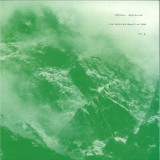
GEORGIA's new kaleidoscopic hyper-music-entity "State Effect (Accel)" expands the NYC's duo project in a high-dimensional phase space—and does so within their all-kind-of-music frame.
State Effect (Accel) is happening this very moment, it is a positive cry for change—a brilliant plan.
This record is "viscous" — whatever I do, wherever I am, it sort of "sticks" to me.
It is "nonlocal" — its 'accelerated' effects are globally distributed through a huge tract of time. It forces me to experience time in an unusual way.
It is "phased" — I only experience pieces of it at any one time.
It is "inter-objective" — it consists of all kinds of other/multiple entities but it is not reducible to the sum of its parts.
This music reveals the present and its psychic dimension, no titles could have been more relevant.
Justin Tripp and Brian Close's new kaleidoscopic hyper-music-entity expands their GEORGIA project in a high-dimensional phase space. A great work of cognitive music mapping that plots all the states of a system — Lovely bubbly HTML.
The eight tracker long playing make extensive use of the vocal participation of Paris/Berlin-based artist/DJ MARYLOU aka OISEAU DANSEUR and Gabi Asfour of visionary NY fashion collective threeASFOUR.
Suche:three pieces
Ryley Walker currently resides in New York City. But his latest LP is a Chicago record in spirit. The masterful Course In Fable, the songwriter’s fi@h solo effort,
draws from the deep well of that city’s ferCle 1990s scene, when bands like Tortoise, The Sea and Cake and Gastr del Sol were reshaping the underground,
mixing and matching indie rock, jazz, prog and beyond.
Walker spent his formaCve years in Chicago, absorbing those heady sounds and finding ways to make them his own. Even though he emerged at first in folkrock
troubadour mode, it makes sense that he’s arrived at this point; each LP has grown more intricate and assured, his influences disClling into something
original and unusual. To put it simply: Course In Fable is Walker’s best record yet, full of acCve imaginaCon and endless possibiliCes.
Last October, Ryley went straight to one of the primary architects of the Chicago sound to make the LP. John McEn:re, Course In Fable’s producer/engineer/
mixer, can rightly be called a legend for his work with Tortoise, Stereolab, The Red Krayola, Jim O’Rourke and countless others over a prolific career that now
spans more than three decades. Seeing his name in an album’s liners is preVy much a trademark of quality.
Another Windy City exile, McEnCre is based on the west coast these days, working out of the Portland, OR studio he’s dubbed Soma West. On the seven songs
here, he delivers the signature shimmering and prisCne sonics he’s become known for over the years. But McEnCre was also inCmately involved with Course
In Fable’s overall creaCve process. “I told him to take the mixes and have at it,” Walker says.
The result is a rich, immersive affair — a headphones record if ever there was one. Course In Fable’s songs are twisty, labyrinthine things, stuffed full of ideas
(Walker half-jokingly calls it his “prog record”). But no maVer how complex it gets, the album is never overwhelmingly busy. Wiry guitars melt into gorgeous
string secCons (arranged by Douglas Jenkins of the Portland Cello Project). Tricky Cme signatures abound but feel as natural as can be. Melodies o@en dri@ in
unexpected direcCons but remain downright hummable. Like Walker’s beloved Genesis, the pop element is never too far from the surface even when shit
gets weird. (And speaking of weird, Ryley says that in addiCon to Genesis, much of the album’s inspiraCon comes from “Australian extreme scooter riders on
YouTube and balding gear heads on Craigslist.” Go figure.)
To help put together these various puzzle pieces, Ryley assembled a band made up of several longCme collaborators. Bill MacKay (another Chicago mainstay)
and Walker have made two excellent instrumental duo records of interlocking guitars and warm give-and-take — a rapport very much in evidence
throughout Course In Fable. The freakishly talented drummer Ryan Jewell has performed with Walker for years now in a variety of seangs, from
straighborward song-centric sets to blown-out improv extravaganzas. Bassist Andrew ScoJ Young (Tiger Hatchery, Health&Beauty) has logged many miles on
tour with Walker; he and Jewell are frequently astonishing, a buoyant-but-always-locked-in rhythm secCon, able to navigate someCmes dizzying turnarounds
with apparent ease. Listening to the interplay between Walker and these musicians and you might be fooled into thinking they’d spent a year roadtesCng
Course In Fable’s songs. But it all came together relaCvely fast, thanks to demos, rehearsals and the kind of musical empathy that comes from years of
playing together.
Beneath the wondrous interplay, you’ll find some of Walker’s most personal – if sCll typically crypCc — lyrics, hinCng at some of the trials the songwriter has
been dealing with in recent years. Balanced with necessary doses of dark humor and oddball poetry, Course In Fable feels most of all like a life-affirming
record, fresh air in the lungs, sun on your skin. “Fuck me, I’m alive,” Ryley sings at one point, a moment of both disbelief and pure joy.
Walker has released his albums on a who’s-who of independent labels over the past decade — Tompkins Square, Dead Oceans, Thrill Jockey and Drag City
among them. This Cme around, he’s doing it DIY-style, puang Course In Fable out on his own Husky Pants imprint. You’re in good hands. This is an album that
sounds great (mastered by Greg Calbi), looks great (artwork by Jenny Nelson and design by Michael Vallera). It probably even smells great. Whether you’ve
been onboard since the beginning or are new to the Ryley Walker universe, you’re in for a treat.
Zwerm is a Belgian-Dutch electric guitar quartet (with a backyard rehearsal shed located in Antwerp) that operates along the borders between styles and traverses traditions that are typically not convergent. Zwerm rhymes Larry Polansky with Nadah El Shazly and are galvanized by the likes of guitars pioneers like The Velvet Underground and Sonic Youth, the microtonal DYI-er Harry Partch, Middle Eastern sonorities and the prog-madness of Kind Gizzard & the Lizard Wizard. ‘Musical adventure’ is not just a hollow cliché for this quartet, but a genuine commitment. Zwerm calls itself a ‘guitar quartet’, but that can be interpreted broadly as well as with a pinch of salt: “If we want to do something on instruments we don’t really master, we’ll just figure out a way to make it work.”
Toon Callier, Johannes Westendorp, Kobe van Cauwenberghe and Bruno Nelissen all met in 2007 while working on a project with Glenn Branca. A new guitar quartet was born and it became clear rather quickly that staying in the strictly contemporary compositions lane was not for this quartet-with-five-to-six-members (an organizational chart is available upon request).
An appetite for new and lasting collaborations has been a constant theme throughout their artistic parcours. The group has shared stages with theatrical producers like Walpurgis and Post uit Hessdalen, dancers such as Ecce and with the musicians Fred Frith, Stephen O’Malley, Shiva Feshareki, Rudy Trouvé, Mauro Pawlowski, Larry Polansky, Eric Thielemans, Yannis Kyriakides, François Sarhan, Serge Verstockt and Stefan Prins. These projects have not always translated into records, but they have been decisive in creating a unique musical approach. In 2015, when Zwerm was asked by De Handelsbeurs to collaborate with Fred Frith, they proceeded to pen a few new musical sketches over which Firth sublimely improvised. In 2018 ‘Badminton in Tehran’ was released, their first record that was made up completely of only the group’s compositions.
“a basket full of buttons here
and if you push the wrong one: fear
and if you push the right one: love
or maybe none of the above”
The route that Zwerm has taken is often defined by the question “What if... ?” - like a dart thrown at a musical map, not quite blindly, but naive enough to lead to unexpected endings.
“What if we play Renaissance pieces written by John Dowland, but instead of playing lutes we play these tunes with a Telecaster – and then jam it through effect pedals and an amplifier?”
“What if we connect one hundred guitar pedals and just leave our guitars at home?”
“What if we record a record with ten different one-page-pieces that we found on the Internet?”
In 2020 our metaphorical dart landed on “What if we tried microtonality?”.
‘Microtonality’ sounds a bit creepy, but actually there is nothing to be afraid of: there are no out-of- tune notes, just alternate notes. On the continents where Western musical theory is less stringently applied, microtonality is the rule, and has become the subject of many deep and thoughtfully written theories. However for Zwerm, this phenomenon occurs in many, often surprisingly lighthearted forms. A dilapidated piano that has settled into a beautiful microtonal tuning of its own accord, enthusiastic choral singing, a guitar whose three strings are tuned a quarter-tone higher, a saz (Turkishquarter-tone lute), a maddening guitar pedal, ...
"the dreams they were convicted for telling only lies reality came after for claiming to be wise what you don’t see is what you get just never light a spark I’m a crow in the dark”
“And… what if we work with a drummer?” Enter Karen Willems - dummer, extraordinaire, and ardent player in groups, projects and collaborations galore. One chance meeting and the deal was done. It was obvious before the start that Willems was the versatile and creative percussionist-in-a-toy-store necessary for this project. And in the studio, to our delight, she demonstrated an easy dexterity when switching quickly from one idea to the next.
At the reins behind the scenes was producer Rudy Trouvé, who – during previous sessions for ‘Badminton in Terhran’, when the classically trained guitarists went completely off the rails, staring deeply and forlornly into their scores, looking for answers – was able to pinpoint the problem and get the wagons rolling in the right direction again. Completing the team were Mark Dedecker (recording)and Joris Calluwaerts (mixing).
The results are in and it’s called ‘ Great Expectations’ – a title that, in several ways, fits perfectly with these strange times.‘Great Expectations’ goes wide! Zwerm is at its best when it can run along the borders between style and across traditions that otherwise would not necessarily intersect. The most straightforward rockers have a proggy tinge while the dreamy psychedelic songs lean more toward Richard Youngs. And if a nice melody dared come to close to becoming a ‘Kit-Katjingle’, then barbs-a-la-Pere-Ubu were trailed, tracked, found and promptly embedded. ‘Heavy Machinery’ sits neatly somewhere between Captain Beefheart and Richard Wagner, and ‘On My Way To Aguno’, set to an Iranian folk song chord progression, grew into a hyper-personal lullaby. Zwerm used the saz (Turkish lute) and the sinter (Moroccan gnawa bass instrument) without falling into pastiche psychedelia, but you can still sense the orient.
Back in October 2009, Strut’s Inspiration Information series was in full swing. Following an acclaimed collaboration between Mulatu Astatke and The Heliocentrics, Finnish maverick Jimi Tenor hit the studio for a mouth-watering head to head with Afrobeat drumming legend, Tony Allen.
Tenor had already built a reputation as a fascinating enigma in modern day music. Consistently one of the most inspired and unpredictable live artists around, his work since his breakthrough album ‘Intervision’ (Warp, 1997) had involved open-minded projects ranging from live film soundtracks and orchestral pieces to a series of Afro-based albums with his band Kabu Kabu. Enjoying a burgeoning revival, Tony Allen had continued to attract new fans. Celebrated as the creator of the Afrobeat rhythm and a lynchpin of Fela Kuti’s Africa 70 band, his work at the time of this recording had included the first album as The Good, The Bad & The Queen with Damon Albarn and his debut recording for World Circuit Records, ‘Secret Agent’.
Recorded at Lovelite Studios in Berlin during November 2008 ith further sessions in Finland and Paris, the Tenor / Allen collaboration whipped up a raw, heavy analogue sound mixing the full range of Allen’s Afrobeat repertoire with Tenor’s off-kilter brew of dark humour, tongue-in-cheek lyrics and tight, firing musicianship. The sessions involved key members of Tenor’s Kabu Kabu band and Berlin-based guest MC Allonymous with tracks evolving naturally from jamming ideas together over five intense days of recording, fuelled by plenty of African food and whisky. Tenor’s trademark range of home-made instruments rubbed shoulders with vintage keyboards and traditional African percussion.
The resulting set became one of the best recordings that both artists produced during this period. Tracks range from Jimi’s S&M tableau, ‘Darker Side of Night’ to the apocalyptic commentary on our times, ‘Path To Wisdom’ and the hilarious lampooning of the UK immigration system, ‘Mama England’, composed on the Tenor tour bus. The album also featured fusions based around more traditional low-slung Afrobeat structures (‘Sinuhe’, ‘Got My Egusi’) and ended with the epic freestyle juggernaut, ‘Three Continents’, a life affirming, mesmeric groove built around another rough-as-nails Allenko rhythm base. 'Inspiration Information: Jimi Tenor / Tony Allen' is re-released on 22nd February 2021 and is dedicated to the memory of the great, incomparable Tony Allen.
First reissue of long out-of-print and sought after release from 2009
Unique fusion of Afrobeat drumming and psychedelic Jazz
Vinyl cut from original sessions
The music on Dance Nos. 1-5 was originally conceived as a three-way collaboration between composer Philip Glass, choreographer Lucinda Childs and artist Sol LeWitt. Dance received its world premiere in Amsterdam on October 19, 1979 and its New York premiere at the Brooklyn Academy of Music on November 29, 1979.
Post-dating Einstein on the Beach - Glass’s 1975-76 collaboration with director Robert Wilson - Dance was another Glass collaboration, this time with choreographer Lucinda Childs, known for her austere, athematically exact dances, and artist Sol LeWitt, who provided a ghostly, gigantic black- and-white film for several of the piece’s five sections.
RELEASE: 5-3-2021
• 180 GRAM AUDIOPHILE VINYL
• DELUXE HEAVYWEIGHT SLEEVE WITH GLOSS LAMINATE
• PVC JACKET
• THE COMPLETE ALBUM, AVAILABLE ON VINYL FOR THE FIRST TIME IN ITS ENTIRETY ON A 3LP-SET
WITH FIVE SIDES OF MUSIC
• INCLUDES PHILIP GLASS CATALOGUE WITH INFO ON THE PHILIP GLASS SERIES ON MOV
SIDE A
Dance has an abstract purity that easily earned it the label “minimalist,” a term that Glass himself disavows but that seems appropriate, at least in this case. After Dance, Glass’s music took several turns, not so much in style as in the various new contexts in which it was presented: major opera commissions and film scores led him to write for forces other than those of the Philip Glass Ensemble. At the same time, an attempt to reach a wide audience resulted in some shorter, perhaps more accessible, narrative pieces. Dance marked the blossoming of the composer’s experimental work. Here, though, the music - particularly Dance Nos. “1”, “3” and “5”, all written for the Ensemble— has an unforgettable exuberance that somehow speaks all at once of joyful innocence, intense erotic desire, tenderness, regret and, finally, acceptance. On the other hand, Dance Nos. “2” and “4” see Glass composing several large-scale works for solo organ; for instance, Dance No. 2 originated as a 1978 work entitled Fourth Series Part Two. This piece, later incorporated into Dance, and Dance No. “4” as well, have a more subdued, more darkly romantic quality than the work’s other sections and are quite unlike anything Glass had previously written. Still, they too, with their mysterious tilts of time and key signatures, continue the exploration of polyrhythms and harmonic complexities within the context of Glass’s repetitive, “minimalist” style.
The complete Dance Nos. 1-5 album is now available on vinyl for the first time in its entirety on a 3LP-set with five sides of music. The 3 LP’s are housed in a heavyweight sleeve.
Tape / Cassette
Dust Editions presents Evan Caminiti’s original score for the short film Autoscopy from London based director Claes Nordwall. The film premiered at the Nevada City Film Festival in August 2020 and is featured in the 2021 edition of the Slamdance Film Festival.
Autoscopy follows a young man who escapes to the Swedish wilderness for a period of creativity and introspection. The tranquility and isolation he finds there morphs into something more sinister when he discovers an abandoned flotation tank in the forest, leading him on a hallucinatory voyage deep into the heart of nature and his own psyche.
Caminiti’s score channels the beauty, desolation, and dread Nordwall captures in the film’s disorienting arc. Boundaries are dissolved between the organic and the unnatural, the imagined and the experienced; electric guitar dissolves into spectral whispers, blurring into rippling synthesizers and heaving drones. Caminiti explores dissonance and space, veering into realms of extreme digital deconstruction before plunging into amplifier sizzling abandon.
This OST release features three additional pieces not heard in the film.
Serge Synthesizer Recorded at EMS Stockholm, September 2017
Electric guitar, vocals, additional synthesizers recorded at Spider House, Los Angeles 2020.
Arranged and produced at Spider House, Los Angeles, 2020
Mastered by Stephan Mathieu at Schwebung Mastering
Harry Bertoia's Glowing Sounds LP contains three versions of the same composition, each transferred at different tape speeds in accordance with the artist's instructions. This is the third LP to be released from Bertoia's extensive tape archive and it's the first, of many, to be released using instructions left behind by the artist himself.
Bertoia wrote the concept for this Glowing Sounds LP on a note in 1975 and slipped it into the master tape case where it sat unread for 45 years. The idea was simple, transfer the original recording at its original speed and two slower speeds. Bertoia noticed that the results, however, were profound.
Recorded on January 20, 1975 using two large gongs, Glowing Sounds is one of the most powerfully minimal recordings yet discovered in Bertoia's collection. The artist's note left with the tape indicated that it was recorded at a speed of 15 IPS (inches per second) but slowing it down to speeds of 7.5 IPS and 3.25 IPS were quite effective for enhanced playback. Side A features the original 15 IPS recording and the 50% slower 7.5 IPS recording. Side B features a 20 minute, ultra-slow version at 3.25 IPS.
Long, deep drones and powerful overtones define the sound of this recording. Comparison of the three speeds provides a revealing magnification of Bertoia's gongs, overtones and the artist's inventive approach to performance, composition and recording.
Bio:
Harry Bertoia first gained some artistic visibility in the early 1940s, then came into prominence with his sculptural, ergonomic chairs, produced by Knoll Furniture beginning in 1952, which quickly became classics of modernist furniture. Inspired by the resonant sounds emanating from metals as he worked them and encouraged by his brother Oreste, whose passion was music, Harry restored a fieldstone "Pennsylvania Dutch" barn as the home for this experiment in sounding sculptures which he had begun in the late 1950s. Bertoia was an obsessive composer and relentless experimenter, often working late into the night and accumulating hundreds of tapes of his best performances; Oreste, too, would explore and record the sculptures' sounds during his annual visits to his brother's home in rural Pennsylvania.
Harry Bertoia's recently dismantled Sonambient barn collection was an attentive listener's paradise full of warm, expressive instruments that were gorgeous visually and audibly. Nothing could prepare you, even on return visits, for the overwhelming experience of entering the spacious wood and plaster interior where gongs, some of them giant, hung among the ranks of standing sculptures of various metals. Over nearly twenty years of adding, culling and rearranging, Bertoia carefully selected nearly 100 harmonious pieces ranging in height from under a foot to more than fifteen feet. He considered this barn a full experience, sights and sounds comprising not a collection of works, but one piece unto itself. It was here, deep in the woods, that his Sonambient recording work took place.
Learning by experimentation was common for Bertoia and he mastered the art of tape recording, turning the Sonambient barn into a sound studio with four overhead microphones hanging from the rafters in a square formation. He would experiment with overdubbing by performing along to previous recordings, sometimes backwards, constantly improving his methods while also honing his performance skills. Bertoia was a careful editor of his own work and only chosen recordings remained, each with a date and carefully considered observations written on a note included with each tape. Through these pieces of paper a the artist's logic can be uncovered, a careful approach to composition, ideas, feelings and forms. The story of Sonambient barn collection will slowly be told through the release of recordings from the archive as well as installations and performances built from Bertoia's own recordings, lectures and a book.
Grey Vinyl
Serum is a series where we invite talented electronic music producers for a temporary creative collaboration. For the fourth edition we are glad to share three timeless pieces of deep dubbed out techno by Mohlao (aka Multicast Dynamics, VC-118A). The record is then completed by an atmospheric tribal interpretation by Dorisburg.
By uniting these newfound friends of ours, we welcome the new solar cycle and wish everyone a healthy and prosperous venture toward summer.
Nuno Canavarro's Plux Quba hails from three decades in the past, yet the simple profi le of it's abstract/ambient/cutup collage makes it a record that sits quite comfortably in our IDM-informed future. In 1988, Plux Quba was a primal dark horse in the world of pants-forward electronic music - an obscurity issued with little explanation from the laid-back west coast of Europe: Portugal, of all places! - though the casual listener could hardly know that from an examination of the LP jacket. The vanguard of electronics in late-80s Europe was being pushed by organizations like Nurse With Wound, The Hafler Trio, HNAS - and yet, when Christoph Heemann came across this recording, it struck his ears and the ears of fellow listeners like nothing before. Plux Quba was handed around between the principles of the early 90s A-Musik scene: Jan St. Werner, C-Schulz, Frank Dommert, Georg Odijk, plus interested fellow travelers like Jim O'Rourke, to the intense curiosity of all. To ears that were already saturated with all things kraut, the dark corners of prog and the frontline of experimental and improvised music, it proved elusive. Not simply in how it sounded and how that sound was achieved, but in where it was coming from - like later Robert Ashley at times; certain stretches of melody recalled some of Eno's ambient pieces - but mostly, it was a completely alien soundscape!
This album could easily have turned top-heavy. After all, here’s a record which, in just under 40 minutes, covers anything from Arabic scales to Japanese sounds, from free jazz references to concepts by Finnish pianist Kari Ikonen’s favourite painter Vasiliy Kandinsky.
To realise his vision, Ikonen even personally developed a device allowing him to play micro-intervals on his piano. And yet, things turned out differently: If anything, the results sound dream-like and mesmerising rather than stodgy and severe.
The album’s genesis may serve to explain this paradox. In August of 2019, Ikonen suddenly found himself with a month of free time. Without thinking twice and as if in a premonition of the Covid-lock-down, he recorded ‘Impressions, Improvisations and Compositions’ at his own home. His only companion was his beloved Steinway, captured by a personal selection of high-end microphones. Just a few days after the final session, the pieces landed on the desk of ECM- and Blue-Note-engineer Johannes Lundberg who mixed the album at his Gothenburg Epideminstudios. Clearly then, the music is spontaneous. But it’s also refined and deep. The influence of Kandinsky inspired
Ikonen to write some of his most complex and monumental pieces.
Favorite Recordings presents an exclusive reissue of the first private press eponymous LP by Sacbé, a Mexican Jazz Fusion masterpiece from 1977. Unique and beautifully recorded, with a breezy feel brought by the synthesizers, Sacbé could be likened to what Azymuth was doing at the same time in Brazil. Available as a vinyl-only limited pressing Deluxe Tip-On LP, coming with its original printed innersleeve, remastered by The Carvery.
Sacbé was composed of Eugenio (keyboards), Enrique (electric bass) & Fernando Toussaint (drums), three brothers hailing from the huge Mexico city, and their friend and sax player Alejandro Campos. Growing up in a family of musicians, they quickly became familiar with jazz music. However they were mostly self-taught, most of them choosing at first to work and study outside the music industry, but somehow, Eugenio had the opportunity to start studies at the Berklee Music University. Before leaving, he deeply wanted to play jazz with his brothers. That’s how Sacbé was created on a hot day of October 1976.
The band then built step by step a challenging repertoire including Chick Corea, Herbie Hancock, Weather Report, Milton Nascimento, Focus, Passport, and many more… Gradually, Eugenio started to compose more tracks, and through a cooperative work of arrangement, Sacbé ended up playing only their own compositions. That was not an easy choice for the band, resulting in a lot fewer opportunities to play in bars and clubs at night, while they were cumulating small jobs during the daytime. But their dedication, tightness, and integrity started to attract a wider audience thanks to their sessions at the Musicafé and helped Sacbé to assert its imprint within Mexico’s creative artistic circles. A group of artists with similar attitudes was created and they began working almost as a team, holding live shows, exhibitions, and dance performances, all with a very unique and creative proposal. It’s at this period that the band met Luis Gil, a young designer and recording engineer, who had access to one of the best studios of the city called LAGAB. Recording at nights and weekends for free, the Toussaint brothers had, therefore, the chance to really put their band quite literally under the microscope.
With tenacity, they explored all the possibilities of interpretations, structures and improvisations, collaborating with great musicians and finding themselves in the position of being their own producers, despite being only around 20 years old! This album is the result of this perfectionism ethics, shared by everyone involved. “Sacbé” means white road in the Mayan culture, it was the name for the roads connecting the main ceremonial centres with the jungle, made of roughly three feet of coral limestone. They were sacred roads used by high priests and warriors, which echoed the musical path of the three brothers. Putting the pieces together, they managed to create their own label and pressed 1000 copies of their reunited recordings in 1977. The artwork was painted by Enrique, inspired by the work of Le Douanier Rousseau and the Mayan jungle. Hopefully, the LP met some success in Mexico and California, opening many radio and TV doors for them. It was the starting point for a whole career of recordings, with a total of seven albums including various guests.
As they were working their asses off on their respective projects last year, these two lads came together to deliver a not so formal four-handed introductive dance record. The purpose is crystal clear : one record capturing through three maximalists club tracks, both their obsession for digressive New Beat, Rave-infused House and in the background, dirty breakbeats bumping into thick Emo pads of Italo Disco or some leftfield Post Punk music. Those two were too young to experience the post-Disco big bang which occurred between 88 to 94, but they manage to embrace the spirit and twist it without any shame. Far from contemplating the European dance legacy, they bend it to create a second merciless big bang, right to the face. By that way, they offer you, happy raving people, these three restless pieces that are 200% coherent on their holy belief of a « Maximal Dance » aesthetic.
In August 2016 Ultramarine created a photo film featuring photographs from Ian Cooper's Survey East website which focuses on a particular stretch of the Blackwater Estuary in Essex.
The film (and accompanying soundtrack) was screened on rotation at the Caught By The River Thames festival at Fulham Palace in London.
For this original Blackwaterside audio/print project, Ultramarine created two new pieces of music inspired by their time working close to the estuary. Glasgow based printmaker/sculptor Bronwen Sleigh visited this remote corner of Essex to sketch and draw, using these visual references to create a lithograph, printed in three colours, which features on the cover of the book accompanying the 7" single.
The book features a series of Ian Cooper's original photographs, alongside poetry by the writer Philip Terry, inspired by the Essex coast, taken from his book Quennets.
- Originally released by publishing imprint Random Spectacular
- Re-released by Blackford Hill with obi strip
- 7" vinyl single
- 28-page booklet of photographs and poetry
- Wraparound cover by printmaker Bronwen Sleigh
- Digital download card (including an extra 16 minutes of bonus audio)
- Limited edition of 350 copies
- Played by Nick Luscombe on BBC Radio 3 'Late Junction'
- Played by Gideon Coe on BBC Radio 6
WRWTFWW Records is profoundly enchanted to announce the full official reissue of Somei Satoh’s magnificent Avatamsaka Sutra inspired Mandala Trilogy with one additional never-released piece, sourced from original masters and available on double vinyl in heavy 350gsm sleeve with liner notes by passionate Japanese music connoisseur/collector/critic/dj Masaaki Hara.
Deep deep deep into the abyss…
The Mandala Trilogy blends Somei Satoh’s own slowed down Buddhist chant vocalization and early electronics to create a radiant and meditative atmosphere conveying serenity and timelessness. It includes three pieces recorded separately. "Mandala" was recorded at the NHK Studio of Electronic Music in 1982 and was included on the album Mandala/ Sumeru, released on Kojima Recordings’ ALM. "Mantra" was a NHK commissioned work, recorded at the same studio in 1986. "Tantra" was recorded at Victoria University of Wellington’s Lilburn Studios for electronic music and recording in 1990.
Included as a bonus is the 20-minute "Mai", a composition commissioned by harpist Ayako Shinoza-ki and recorded at the Kioi Hall in Tokyo on November 11th 2004. The piece was conducted by Tetsuji Honna and performed by the Kioi Sinfonietta Tokyo. Satoh says: "The harp is one of my favorite instruments. Also, by combining my affectionate percussion instrument, the chromatic gong and steel drum, with the harp’s most beautiful tone, I attempted to bring out a mystical sound." Alt-hough it is not an electronic music piece, the stunning composition elegantly complements the deep mystical world that Satoh expresses in his Mandala Trilogy.
Mandala Trilogy + 1 is reissued in conjunction with Somei Satoh’s Emerald Tablet / Echoes LP, also available on WRWTFWW Records.
"...The most beautiful thing about my burrow is the stillness. Of course, that is deceptive. At any moment it may be shattered and then all will be over. For the time being, however, the silence is with me." - Franz Kafka
In early 2019, at the Sonic Pieces 10 year anniversary in Berlin, label head Monique Recknagel hand-picked three duos from the imprint to perform live together for the first time. One of the collaborations was between Deaf Center's Erik K Skodvin and electronic composer Jasmine Guffond. The performance went so well that Monique commissioned the duo to record a full-length together.
Six months later, Guffond and Skodvin headed to Berlin's VOX-TON studio and recorded for two days, joined by Finnish musician Merja Kokkonen (Islaja), who improvised wordless vocals. With Guffond on laptop and a cymbal and Skodvin using piano, feedback, farfisa organ and percussion, the two composed an album of deep, enveloping sound that slithers through genre, absorbing Kokkonen's unique voice into five intricate and evolving pieces.
"The Burrow" takes its name from Franz Kafka's unfinished short story that was written only six months before his death. The tale, published posthumously in 1931, centres around a small creature who builds a burrow that's anxiously fortified in an attempt to protect against perceived attacks. This sense of fear of the outside world feels even more focused in 2020. Each track is named after animals that are either extinct or almost extinct, adding a sense of loss that hangs in the air, punctuated by screams and deep reverberating piano hits. As the world we thought we knew quickly retreats from view and the idea of safety shifts rapidly, Skodvin and Guffond explore the impulse to protect what we know with an emotionally charged sound that provides a foil with cautious, haunting spaces in between.
Counterchange presents 'Eigenlicht' by Portuguese-German multi-instrumentalist, producer and award-winning film composer John Gürtler.
Gently teetering between krautrock-influenced synth mantras and saxophone improvisations, down-tempo electronica, sound design experiments and moments of rich ambience, 'Eigenlicht' is a diverse album of electro-acoustic music. The 11 tracks were recorded between two studios and on location at Berlin's infamous Teufelsberg, the abandoned Cold War era US spy-radio and radar outpost named 'Field Station Berlin', surrounded by forest to the west of the city.
A document of Gürtler's development, many of the pieces here were first laid down in his bunker-like former basement studios at Drontheimer Straße in north Berlin, before he eventually elevated above ground - both physically and musically - building his current Paradox Paradise studio and becoming an established film music composer. In 2019 John won the European Film Academy Award for Best Score, for his soundtrack for Nora Fingscheidt's debut feature 'Systemsprenger' (System Crasher).
In recent years John collaborated on a number of projects with acclaimed German producer and composer Phillip Sollmann aka Efdemin, performing live and releasing the 'Gegen Die Zeit' EP on Sky Walking, a subsidiary of Dial records where he also remixed Efdemin's 'Parallaxis' under the moniker The Borderland State.
In part an ode to the Macbeth Systems M5 modular synthesizer, with its three oscillators, much of the album features the towering instrument, whose uniquely rich tone and rumbling, pure bass end characterises tracks like 'Eigenlicht', 'M5', 'Synthetics' and 'Five Voice'.
"The M5's built in spring reverb and huge sliders and faders - as opposed to all the tiny knobs on Eurorack synths - make it as playable as any acoustic instrument."
John's primary background is in acoustic music, coming from woodwind and keyboard instruments, improvisation and composition. The leap into working with computers and electronic instruments found him exploring ways to make synths and samplers sound as organic as possible.
It's been three years since the last vinyl by Ntogn was unveiled and now we're glad to share with you the result of his venture through the recent winter.
'Smedjan' is inspired by the dwarven craftsmanship of Norse mythology. It is made completely with organic sounds gathered from, and recorded in, the forests of Bålsta which is rich with northern heritage. Everything you hear is either processed textures of birch wood blocks, layers of a custom made Ukrainian artisan mouth harp or the artist's own voice.
There is no synthesis in this record. The kick drums are made by hitting these pieces of wood against each other with contact microphones. Bass layers are extracted from bark scraping against bark. Hi hats are crafted by recorded fire of the same wood logs burning and ambiance is built from the forests where the trees grew and from the woodshed where the artist chopped the wood during winter to keep his cabin warm. The rhythms and sounds in this shed is what inspired the making of this record.
By shaping these sounds of wood and metal Ntogn strives to create a sonic experience that connects the listener to the old Norse stories of the dwarven craftsmanship of Svartalfheim. It is they who made the famous trinkets and weapons that empower the gods of Asgård through stories of trickery and despair which has later inspired tales and literature for over a thousand years.
The record has been distilled from material that was meant to become a two-hour live set specifically made for Mo:dem festival which was unfortunately cancelled due to the corona pandemic. It was also the foundation of the artist's thesis at the university of sound design where he made a study of the effects of organic sound on an electronic expression such as techno music.
It will be released digitally and as a 200 copy limited edition black vinyl adorned with an artwork drawn by the artist's partner Gabriella Holmström using the ashes of the same birch wood blocks that was used to make the sonic content.
The record has received early support from Francois X, Takaaki Itoh, Abstract Division, BLNDR and Rambadu to name a few.
*:・゚✧*:・゚✧
Ntogn en'togg-n is a conceptual electro-acoustic project developed by Hypnus Records' founder and sound design graduate Michel Iseneld (b. 1988, Sweden). It aims to breath life into a fascination for magic with the use of contemporary and classic sound design techniques. This has resulted in what Resident Advisor's William Lynch describes as 'fierce, artistic techno that sounds like little else out there' and a discography ranging from earth-shattering techno to dark, throbbing ambient excursions.
After spending nearly three years in isolation, deeply lost in literature on history, philosophy, occultism and epic fairy-tales; Michel developed an inner world which eventually found an outlet through the means of music in 2013. By the use of field recordings and various samplings of his voice and surroundings, something peculiar sprouted as his inner images started to manifest and mature into an organic sound inspired by the emerging hypnotic deep techno scene.
Today, all music is released on his own imprint Tome in order to preserve the projects' artistic freedom and originality. After two years of sound design studies at the university and a new-found passion for modular synthesis; there's plenty of music in store aimed to satiate the curious minds.
F.S.Blumm is a man most might not know. He ́s no pop artist, and not overtly experimental either. But somehow with In Sight he has done the impossible: put his own sound in that perfect middle point, leaving his voice behind to deep-dive into some truly memorable, fully composed pieces.
In Sight is the kind of record you can put on at first crack of dawn, to enjoy its beautiful instrumental varieties during morning routine, while equally fitting as a listening experience towards the darker time of day, in the background or as highly rewarding deep listening experience. It ́s the kind of album that would be great to encounter played in a tiny Japanese jazz bar on a vintage, top notch speaker system together with a handful of local oddities. It sounds incredibly well produced and is full of beautiful, heart-warming, melancholic moments performed on everything from guitars to percussion, vibraphone, strings, piano and who knows what else. Frank shines on this record. He has created quietly composed pieces for moments one could only wish were real.
As often with F.S.Blumm ́s music, it ́s hard to pin down where to categorize it. He might be best known as frequent collaborator of Nils Frahm. Together they made three great duo albums for Sonic Pieces previously. Although this is far from his first solo album, it is his first for the label, and after listening to it on repeat for some time, we can only say that this is Frank on his finest, creating some of the most thought provoking instrumental music you can find in these parts of the world.
The Danish label/imprint arbitrary announces the release of Framework 3 (arbitrary11) by Mads Emil Nielsen. Framework 3 is the latest instalment in Nielsen’s sequence of graphic scores and recordings. The series includes the Danish composer’s own subjective translations of visual materials and sound pieces accompanied by visual notations.
On this release he collaborates with Katja Gretzinger and Nicola Ratti. Published as a limited edition art print folder, Framework 3 consists of risographed scores and recordings on 10” vinyl and CD – with recordings by Nielsen, along with graphic scores by Gretzinger and contributions by Ratti.
Raised in a family of architects Nielsen has for several years been occupied with the question of “how do you intuitively sonify an image?” along with the complementary processes of translating sounds and music into illustrations and scores. In early 2019, he produced various drawings and sound pieces which formed the starting point for the three tracks on this 10” vinyl EP. The audio is derived from synthesizer recordings and basic electronic sound sources (sine waves, feedback, noise) and percussive loops combined with recordings made in the studios at EMS (Elektronmusikstudion, Stockholm).
The audio material was translated by graphic designer Katja Gretzinger into a series of visual notations made while listening to the music. Gretzinger developed various symbols, forms and structures, such as points, bars, 3D balls, irregular patterns / “swarms” and regular patterns (vertical hatchings). These were combined with found image materials and cut-outs from old prints and layered with large geometric forms, which define the individual character of each of the three parts. The resulting 18-page graphic score is included in the release in the form of risograph printed sheets.
Nielsen then invited musician Nicola Ratti, who is also trained as an architect, to create sonic re-interpretations of the graphic score. Ratti reinterpreted the imagery as a selection of sound elements positioned in a three-dimensional area; which he visualized as the space between the composer / artist, Ratti himself and the loudspeakers. These recordings are included on the CD.
1, 2, 3 written & produced by Mads Emil Nielsen, Copenhagen / Berlin, 2019 / 2020 (reworked and combined with a live recording from Standards, Milan, September 2019). Recording by + thanks to URSSS. CD: 1, 2, 3 written & produced by Nicola Ratti, Milan, 2020.
Scores by Katja Gretzinger. Artwork/design (packaging, discs, text) by Mads Emil Nielsen.
Vinyl reissue of the now classic 1971 album. Produced by Transamericas in collaboration
with the band from original master tapes, in a fully analog process at recording studios in María Pinto
(Chile), London and Haarlem (Holland).
Los Jaivas (“El Volantín”) is the first LP by Chilean rock band Los Jaivas, one of South America's biggest names in the fusion of folk roots and psychedelia during the 1970s. Los Jaivas were born in the city of Viña del Mar, with their five members determined to guide their initial sound through improvisation and experimentation, «trusting that in time a language would emerge that would give us our identity», in their own words.
This debut album (popularly known as El Volantín - The Kite -, because of its cover illustration) combined the free-flow of extended electrical pieces with more conventional three-minute songs filled with references to Chile's popular culture and the musicians’ own upbringing. Theirs was a solitary path, not just for the band but also for the beginnings of Chilean rock. Los Jaivas blazed a trail that was rich in musical references, with ideas inspired by Jimi Hendrix, the Congolese Missa Luba, Argentinian folk (Atahualpa Yupanqui, Ariel Ramírez), South American avant-garde composers (Ginastera, Villa-Lobos, Violeta Parra), the experimentation of pianist Henry Cowell, Caribbean rhythms and Miles Davis’ trumpet re-inventions.
Re-release of the record originally released on 2016-02-05!
Remastered and cut by Rashad Becker at D&M Berlin and presented in an exact replica sleeve of the original 1966 release by Stephen O'Malley.
sales information: Black Truffle is honoured to present the first vinyl reissue of the classic debut album from AMM, AMMMusic. Coinciding with the 50th anniversary of its recording in 1966, this reissue makes one of the cornerstones of the experimental music tradition available again in its original form, replete with Keith Rowe's beautiful pop art cover and the terse aphorisms by the group that served as its original liner notes. A testament to the interaction between the experimental avant-garde and the countercultural underground, the album was originally released on Elektra, recorded by Jac Holzman (the label's founder, responsible for signing The Doors, Love, and The Stooges) and produced by DNA, a group that included Pink Floyd's first manager Peter Jenner. (Pink Floyd paid tribute to AMM's influence on their improvisational sensibility with the track 'Flaming' on their debut album, named after the piece that occupies AMMMusic's first side, 'Later During a Flaming Riviera Sunset').
Formed in 1965 by three players from the emerging British jazz avant-garde - Keith Rowe and Lou Gare had played with the great progressive big band leader Mike Westbrook and Eddie Prévost played in a post-bop group with Gare - AMM quickly evolved from a free jazz group into something decidedly more difficult to categorise. By the time these recordings were made, two more members had joined the group: another Westbrook associate, Lawrence Sheaf, and the radical composer Cornelius Cardew. Then at work on his masterpiece of graphic notation Treatise, Cardew brought with him extensive experience of the post-serialist and Cageian currents in contemporary composition. Using a combination of conventional instruments and unconventional methods of sound production (most famously Keith Rowe's prepared tabletop guitar, but also prepared piano and transistor radio), the group performed improvised pieces often running for over two hours and ranging from extended periods of silence to terrifying cacophonies.
Evan Parker famously described the improvisational logic of AMM's music as 'laminal', in contrast to the 'atomistic' approach more common among the generation of British improvisers (Bailey, Rutherford, Stevens and co.) to which he himself belonged. AMM improvised in layers: layers of sound subtly rising and falling or abruptly starting and stopping without being propelled by the implied pulse of free jazz improvisation. Rather than a pulse, AMM's music began with the sound of the room in which it was played, the Cageian anarchy of silence. By embracing the non-synchronous simultaneity of layered sound, AMM was able to create a musical container into which nearly anything could be incorporated at any moment: on AMMMusic, long tones sit next to abrasive thuds, the howl of uncontrolled feedback accompanies Cardew's purposeful piano chords, radios beam in snatches of orchestral music (and, on the LP's second side, an extended fragment of 'Mockingbird').
AMM's clearest break with jazz-based improvisation concerned the idea of individuality. Where improvised music has tended to foster the development of idiosyncratic stylists who move freely from one group to another, AMM, initially through an engagement with eastern philosophy and mysticism and later though a politicized communitarianism, sought to develop a collective sonic identity in which individual contributions could barely be discerned. In the performances captured on AMMMusic
the use of numerous auxiliary instruments and devices, including radios played by three members of the group, contribute to the sensation that the music is composed as a single monolithic object with multiple facets, rather than as an interaction between five distinct voices.
- Francis Plagne
Composed as a means to map the cultural translation between Chinese culture and European traditions, Piotr Kurek’s A Sacrifice Shall Be Made / All The Wicked Scenes is comprised of pieces composed between 2016 and 2018 specifically to accompany theatre performances directed by Tian Gebing (500m and The Decalogue) and Grzegorz Jarzyna (Two Swords). Kurek attended performance rehearsals in Beijing and Shanghai, with additional preparations and recording sessions taking place back in Warsaw.
While most of Kurek’s past work is unaccompanied by other musicians or outside help, A Sacrifice Shall Be Made / All The Wicked Scenes features various Polish and Chinese musicians both from classical and experimental scene (Barbara Kinga Majewska, Grzegorz Hardej, Łukasz Rychlicki and Hubert Zemler) as well as by actors of Paper Tiger Theatre Studio from Beijing. This approach of Kurek exploring new players and places is further juxtaposed as Kurek recycled samples from his own past, including various recordings with musicians he did throughout years, found sounds from the Internet, or cannibalised old solo work.
Recorded over the course of several years, this aural report of a monumental multi-disciplinary venture is in the end an enthralled and enthralling survey of a contemporary composer who is unencumbered by geographic or cultural boundaries. Concurrently, ditching any resemblance to local musical traditions and rearranging the compositions for all three performances, Kurek has formed an architecture that allows the phases of rituals to unfold while projecting social structure assumed in myth making. The regrouping of different moments in these stories is a curious way of narrating another myth — a synthetic, polyvalent story set in a city that strangely reassembles Beijing, Giza, and Prague at the same time.
Piotr Kurek is a Warsaw based musician and composer who straddles the world of electronic music taking inspiration from various genres but fitting comfortably in none. Through his unconventional use of a wide array of instruments both electronic and acoustic, he built a reputation for himself as a qualified inventor of hypnotic worlds drenched in uncanny arrangements.
Kurek has already released a range of idiosyncratic, forward-thinking works on a variety of imprints (including but not limited to Sangoplasmo, Black Sweat Records, Hands In The Dark, Dunno Recordings, Crónica, Foxy Digitalis) and participated in numerous music festivals including Unsound, CTM, OFF, TodaysArt and UH Fest as well as participating in extensive tours in Poland and abroad. In 2014 and 2015 he opened for Bonnie “Prince” Billy’s two European mini-tours. In 2016 he has been selected as a part of Shape platform for innovative music and audiovisual art from Europe.
The third release from Night Dreamer’s essential “Direct-to-Disc” sessions sees an incredible meeting between legendary US saxophonist Gary Bartz and leading UK spiritual jazz ensemble, Maisha, featuring two Bartz classics and three brand new joint songs written by both Bartz & Maisha in close collaboration. Having cut his teeth playing with the likes of Charles Mingus, Max Roach, Art Blakey and finally in 1970, Miles Davis at the peak of his electric period, Gary Bartz became a leading figure of the early-to-mid 70s spiritual jazz movement, releasing a string of ground-breaking albums on legendary NYC jazz label Prestige Records with his NTU Troop, featuring classics such as “Celestial Blues”, “Uhuru Dance” and “I’ve Known Rivers”, before collaborating on Blue Note Records with the Mizell Brothers on the anthemic jazz funk of “Music Is My Sanctuary”. An oeuvre much loved by soul jazzers and hip hop fans alike. Led by drummer Jake Long, Maisha have been central to the UK’s jazz explosion, and have fast become the UK’s most exciting and in-demand young spiritual jazz ensemble, from steller shows at Jazz re:freshed, Total Refreshment Centre & Church of Sound and supporting the Sun Ra Arkestra, to releasing their critically acclaimed debut LP, “There Is A Place” on Gilles Peterson’s Brownswood Recordings in 2018. Theirs is an organic & explosive sound that blends influences from afrobeat and broken beat to Persian music, with a deep love and understanding of jazz, particularly the heritage of spiritual jazz led by titans such as Pharoah Sanders, Alice Coltrane and of course, Gary Bartz. Which makes this collaboration even more special. Bartz was first invited to share a stage with Maisha by Gilles Peterson to headline the inaugural We Out Here festival. Their chemistry was rich and instantaneous, certainly a two-way street, with the young musicians reinvigorating the legend’s performance and wowing the intergenerational festival audience. A European tour followed, including a London Jazz Festival highlight at the Royal Festival Hall, celebrating the 50th anniversary of his album “Another Earth”, originally featuring fellow legends, Pharoah Sanders, Charles Tolliver, Stanley Cowell, and John Coltrane’s own bassist, Reggie Workman. Now the relationship has evolved into a special straight-to-disc recording for Night Dreamer Records, that captures the vitality of their collaboration. Whilst Bartz and Maisha reinvent classic Bartz compositions “Uhuru Sasa” and “Dr Follows Dance”, extending the pieces into long piece improvised grooves, their recording session gave birth to three brand new joint compositions, written the very same day. These include the propulsive “Leta’s Dance” that magically combines the Bartz’ soulful musical lyricism with Maisha’s African-jazz influences, and the organic jazz funk of “Harlem to Haarlem”, featuring a hot solo from guest trumpeter Axel Kaner-Lidstrom of Cykada & Levitation Orchestra fame. Like previous Night Dreamer efforts from afrobeat star Seun Kuti & Egypt 80, and the beautiful
collaboration between Brazilian stars Seu Jorge & Rogê, the album was recorded in Haarlem’s Artone Studio, a stones throw from Amsterdam, in just one-take, straight-to-disc, avoiding postproduction embellishments and retaining the purity of the performance lost in modern recording techniques. This record really is an event, in and of itself, a meeting of talents, minds, generations and zeitgeist moments, captured in a unique and pure manner. The music does not disappoint, as Maisha have been inspired to reach new heights whilst we find Bartz truly reinvigorated, and both artists in tune to the spirit of the other.
2x12"
since long, chilean/swiss producer and dj luciano is a prominent figure in the global electron-ic club music circle. already from a young age on he was exposed to music profoundly, as his father worked as a jukebox repairman and possessed a large record collection.
when he was twelve, his mother gifted him a guitar, that turned luciano shortly into a mem-ber of a school punk rock band. soon after, his passion for electronic music rose. infected by detroit techno and engaged by close friends like producer dandy jack, he started to play rec-ords in local santiago de chile dance clubs and became involved in the minimal techno scene around friends like ricardo villalobos.
when luciano moved back from chile to switzerland in 2000, he established a residency at weetamix club in geneva, started releasing his own productions on labels like mental groove and joining the cocoon team in ibiza to play at the famous monday night at club amnesia.
since then he is a regular on the balearic island, holding residencies at clubs like dc10 or, with his “vagabundos” serial, at ushuaïa. besides playing around the globe with the likes of carl craig, richie hawtin or loco dice, he is releasing groundbreaking minimal techno and house on his label cadenza since 2003, featuring music by artists like nsi, ricardo villalobos, pikaya, reboot, maayan nidam and himself.
his very own music, so far issued on three albums and countless eps, was always ambiguous. there is his club leaning creativity that can dance slightly into pop spheres while never for-getting the power of precise sliced rhythms and subtle bass sensations.
and then there is a calmer luciano, that displays his love for “music to listen at home, done for a spiritual travel, an inner universe and a moment paralyzed in ether”, as he describes it.
on his first ever mule musiq album release “luci neu house”, luciano now delivers meditative journey music full of repetitive patterns that slowly playing tricks on the listeners subcon-sciousness. “i love music that has a dimension more than music designed for the radio or tv format. mu-sic, that is designed to bring you a higher level of energy and creativity.
so, there is no pretentious things in it ... more just sounds and dimension that will lead your head into the fall of jupiter” he reveals about the one-hour long composition “luci neu house”, whose esoteric deepness reminds on the intensely meditative class of his older pro-ductions like “behind my soul” from 2010.
an epic tune cut on vinyl into four 15-minute long pieces, who shift slowly, almost unper-ceived, whilst absorbing the mind of close observers into a micro-sliced world of moving gen-tleness.
maelstrom magnetism against the gravity of time, that also can be found on the additional mule musiq 257 12inch, which functions as a soothing footnote to luciano’s album.
the almost 13 minutes long trip “flags of himalaya” opens with restful percussions that unhur-riedly start to dance with soft string, piano and horn melodies. on the opposite, the nine-minute long “the evasion of the spiritual soldier” grooves laidback with jazzy rhythms and italo leaning melodies.
a perfect tune for slow dance sensations and endless sunset seaside drives. at a total length of almost 90 minutes, all new mule musiq music composed by luciano distributes a mesmer-izing healing spirit, that grounds organically, even if it is totally rooted in the digital, soft-ware driven world of composing music. “check your buddha” tunes, that somehow sound novel during each new listening circle.
Nils Frahm, born in 1982, had an early introduction to music. During his childhood he was taught to play piano by Nahum Brodski a student of the last scholar of Tschaikowski. It was through this that Nils began to immerse himself in the styles of the classical pianists before him as well as contemporary composers. Today Nils Frahm works as an accomplished composer and producer in Berlin. In early 2008 he founded Durton Studio, where he has worked with Peter Broderick and Dustin O' Halloran amongst other fellow musicians.
The three instrumentals, which make up his debut release 'Wintermusik' are piano led pieces, coloured with occasional celeste and reed organ parts. The record's equal measures of sorrowful refrains and uplifting passages, combined with a real intimacy that makes for an album you'll want to return to again and again.
The songs were originally intended as a Christmas present for friends and family, hence its winter release via London-based cinematic music label Erased Tapes. As the curator of the Swedish boutique label Kning Disk's Piano Series, Peter Broderick invited Nils to record a new Nils Frahm, born in 1982, had an early introduction to music.
During his childhood he was taught to play piano by Nahum Brodski a student of the last scholar of Tschaikowski. It was through this that Nils began to immerse himself in the styles of the classical pianists before him as well as contemporary composers. Today Nils Frahm works as an accomplished composer and producer in Berlin. In early 2008 he founded Durton Studio, where he has worked with Peter Broderick and Dustin O' Halloran amongst other fellow musicians.
The three instrumentals, which make up his debut release 'Wintermusik' are piano led pieces, coloured with occasional celeste and reed organ parts. The record's equal measures of sorrowful refrains and uplifting passages, combined with a real intimacy that makes for an album you'll want to return to again and again. The songs were originally intended as a Christmas present for friends and family, hence its winter release via London-based cinematic music label Erased Tapes.
As the curator of the Swedish boutique label Kning Disk's Piano Series, Peter Broderick invited Nils to record a new album of piano improvisations the result is 'The Bells', which will now be released on Erased Tapes in the UK, Ireland and North America. Perhaps the most stunning aspect of what on the surface appears to be an entirely pre-planned and composed body of work comes with the discovery that these pieces were in fact improvised.
These two friends share a common affinity in that they both possess an absolute mastery of melody, composition and performance able to deliver with devastating effect. The modest Mr. Broderick states 'I remember thinking to myself as I lay there stunned, that I could spend ten years trying to write an amazing piece of piano music, and still it would never be half as good as these improvisations!'
Recorded in a rented, beautiful old church in the heart of Berlin over two nights, Nils 'just played' with the occasional instruction from Peter 'I spouted "Make a song using only the notes C, E, and G", or "Make a song that you could imagine me rapping over the top of" (Track 8 'My Things'). At one point I was even inside the piano, laying on the strings, asking him to make a song called 'Peter Is Dead In The Piano'. The resultant work 'The Bells' shares the same excitement and air of playfulness.
For a musician this early in his career, Frahm displays an incredibly developed sense of control and restraint in his work. As the recognition continues to grow for both, 'Wintermusik' and 'The Bells', we are pleased to announce that 2010 will also see his next album release on Erased Tapes.
DJ Die Soon is a local legend and ongoing inspiration in the Berlin underground electronic music scene. Remaining largely unknown outside the city, with only a handful of releases and appearances to date, the man behind the mask delivers truly freakish beats built from chaos driven crushed drums and eerie horror style basslines.
KAPPA SLAP wrenches the Morphine catalog by the neck, takes it off it’s feet and slams it back unsteadily in front of the fans who loved the Container, Metasplice and Hieroglyphic Being output of the label. DJ Die Soon delivers extreme work here. The album is a mixture of instrumental pieces and vocal tracks featuring the talents of five contrasting MC's. Three Ugandan lyricists feature: there’s MC Yallah, with whom he worked during a residency for the Nyege Nyege Festival , Lord Spikeheart from the Duma hardcore pressure band, and the mighty ECKO BAZZ. Long time friend and collaborator Infinite Livez (Ninja Tunes) appears on the cosmic & eccentric Ranthworth, and finally there’s Japan’s MA, who recently dropped the incredible AMA album on the label. Incidentally, the pair (both Japanese) decided to collaborate after acclaimed performance at the Morphine Showcase Berlin’s Berghain in 2019.
KAPPA SLAP contains a lot of our favorite sounds all in one album. Stunningly, DJ Die Soon manages to paint the Morphine picture in one hard stroke.
Artwork courtesy of Lorenzo Mason Studio
The compilation "Celestial Birds" reveals and focuses on the widely unkown electronic compositions of the AACM founder and jazz pianist MUHAL RICHARD ABRAMS. #5 in the Perihel Series, curated by zeitkratzer director REINHOLD FRIEDL.
Anybody interested in jazz knows that Chicago has always been an impressive hot spot for new talents – and still is. One essential landmark in the history and development of jazz was the founding of the AACM (Association for the Advancement of Creative Musicians) in May 1965. This non-profit organization was a melting pot (and starting point) for artists like ANTHONY BRAXTON, ROSCOE MITCHELL, GEORGE LEWIS or LESTER BOWIE and his ART ENSEMBLE OF CHICAGO but one of its actual founding members is known only to the deep connaisseurs: MUHAL RICHARD ABRAMS (1930 – 2017).
The autodidact pianist and composer left music school and university, deciding to learn music by himself.
From 1961 on, the EXPERIMENTAL BAND was his first ensemble, but it soon turned out that ABRAMS' interests went beyond jazz and that he was open to the avant-garde and new music and most of all: electronic music. Which led to a double problem: On the one hand, black musicians had almost no access to the rare electronic music studios located in and funded by universities or broadcasting corporations. On the other hand, there were strong reservations regarding electronic music in the black music community.
In his important book "A Power Stranger Than Itself – The AACM and American Experimental Music" GEORGE LEWIS writes that "the use of electronics … proved controversial and widely misunderstood in a world of jazz in which acoustic instruments became conflated with musical, and eventually, cultural and even racial authenticity." ABRAMS' response was to actually "hide" his electronic pieces on the B-sides of his albums, and this compilation focuses on some of his best electronic experiments: the 22-minute long epic "The Bird Song" from 1968 in its original version incl. the reverb that was removed on the later CD reissue on DELMARK, the synthesizer compositions "Conversations With The Three Of Me" (1989) and "Think All, Focus One"1995) plus " Spihumonesty" (1980) with a 2nd synthesizer played by GEORGE LEWIS and YOUSEF YANCEY on theremin.
"Celestial Birds" casts a new light on the underrated experimenter MUHAL RICHARD ABRAMS, his innovative approach to composition and pieces that lay dormant for way too long!
For his return to Make Mistakes, Derek Russo ventures into the Belly of the Whale with three pieces of beautiful, retro future, dance floor chic.
Embryonic Speck opens up the record, evoking classic rave beats, in a crisp, clear, modern style. With this cut, Derek has crafted a late-night slayer for the discerning dance floor. A relentless groove drives the track along, creating the hypnotic, smoky dreams of rave’s past.
Night Sea Journey takes it down into disco depths. A wandering bassline swaggers through the track, crashing through dark waves of sound. Sexy and mysterious, made to drag the sweaty sea on the dance floor through the night.
Straddling, a piece of timeless, familiar house music, rounds things out by bringing in a touch more warmth and whimsy. Still for the darkness, but with a lighter mood, and booty wiggle bass. Deep, and grooving, with a playful sexiness, what more could you ask for?
“Consider the subtleness of the sea; how its most dreaded creatures glide under water, unapparent for the most part, and treacherously hidden beneath the loveliest tints of azure. Consider also the devilish brilliance and beauty of many of its most remorseless tribes, as the dainty embellished shape of many species of sharks. Consider, once more, the universal cannibalism of the sea; all whose creatures prey upon each other, carrying on eternal war since the world began.
Consider all this; and then turn to the green, gentle, and most docile earth; consider them both, the sea and the land; and do you not find a strange analogy to something in yourself? For as this appalling ocean surrounds the verdant land, so in the soul of man there lies one insular Tahiti, full of peace and joy, but encompassed by all the horrors of the half-known life. God keep thee! Push not off from that isle, thou canst never return!”
― Herman Melville, Moby Dick
Amos’ Flat is a three part album by VASE in collaboration with Opal Tapes & INDEX:Records: an odyssey of sonic manoeuvres through ambient, bass and IDM. This trilogy reveals VASE dissecting compositions down to sparse rhythmic explorations, disruptive power shifts and nebulous bass bliss.
Amos’ Flat: Room 1 will be sculpted into the physical form of a 12” vinyl record, released by INDEX:Records, followed by Opal Tapes reeling out Room 1 & 2 on double Cassette Tape.
Room 3 transcends into the digital, where VASE passes the brush to fellow artists, to rework into their own decorative pieces. Featured artists for Room 3 include Basic house, Fis, Katsunori Sawa, Shelley Parker and PYUR.
Carla dal Forno announces her second full-length album, Look Up Sharp , on her own Kallista records.
Dal Forno beckons a bold new era in her peerless output pushing her dub-damaged DIY dispatches to the limits of flawless dream-pop. In a transformative move towards crystal clear vocals and sharpened production, Look Up Sharp is an evolutionary leap from the thick fog and pastoral stillness of her Blackest Ever Black missives, You Know What It’s Like (2016) and The Garden EP (2017). Three years since her plain-speaking debut album, the Melbourne-via-Berlin artist finds herself absorbed in London’s sprawling mess. The small-town dreams and inertia that preoccupied dal Forno’s first album have dissolved into the chaotic city, its shifting identities, far-flung surroundings and blank faces. Look Up Sharp is the story of this life in flux, longing for intimacy, falling short and embracing the unfamiliar. Dal Forno connects with kindred spirits and finds refuge in darkened alleys, secret gardens and wherever else she dares to look.
In her own territory between plaintive pop, folk and post-punk dal Forno conjures the ghosts of AC Marias, Virginia Astley and Broadcast through her brushwork of art-damaged fx and spectral atmospheres. The first half of the record is filled with dubbed-out humid bass lines, which tether stoned hazes of psychedelic synth work as on ‘Took A Long Time’ and ‘No Trace.’ These are contrasted with songs like ‘I’m Conscious and ‘So Much better’ that channel the lilting power of YMG and are clear sequels-in-waiting to dead-eyed classics like ‘Fast Moving Cars.’
The B-side begins with the feverish bass and meandering melody of ‘Don’t Follow Me,’ which takes The Cure’s ‘A Forest’ as its conceptual springboard. It’s the clearest lyrical example since ‘The Garden’ of dal Forno’s unmatched ability to unpick the masculine void of post-punk and new wave nostalgia to reflect contemporary nuance. Look Up Sharp reaches its satisfying conclusion with ‘Push On’ - dal Forno’s most explicit foray into an undiscovered trip hop universe between Massive Attack and Tracey Thorn. The album’s last gasp finds personal validation in fragility: ‘I push on / I’m the Place I’m Going,’ a self discovery lifted by reverberant broken beats and glass-blown vocals.
Adding further depth to Look Up Sharp are the instrumentals, which flow seamlessly between the vocal-led pieces. ‘Hype Sleep’ and ‘Heart of Hearts’ drink from the same stream as The Flying Lizard’s dubbed-out madness and the vivid purple sunsets of Eno’s Another Green World. While ‘Creep Out of Bed’ and ‘Leaving for Japan’ funnel the fourth-world psychedelia of Cyclobe’s industrial-folk into the vortex of Nico’s The Marble Index.
Conceived as a whole, Look Up Sharp is a singular prism in which light, sound and concept bend at all angles. A deeply personal but infinitely relatable album its many surfaces are complex but authentic, enduring but imperfect, hard-edged but delicate. A diamond. Look up sharp or you’ll miss it.
Comic book artist, graphic designer and free jazz improviser are only some of the many talents from Beirut born Mazen Kerbaj. After appearing as part of various ensembles on the label, Ariha Brass Quartet (CREP46) and Johnny Kafta Anti-Vegetarian Orchestra (CREP22), Kerbaj finally lands a solo outfit of his own onto the Discrepant dancefloor of insubordination.
14 years after his first (and only) solo album "Brt Vrt Zrt Krt" (Al Maslakh, 2005) Mazen returns with a series of subtle compositions of his own with not one but two(!) solo albums of prepared trumpet that further cement his international position as a serial trumpet botherer.
Whilst Vol. 2.1 showcases his (almost) (un)familiar arsenal of squawks, cackles, howls and squeals, Vol. 2.2 goes deep into the nether regions of waltzing drones and bell tweaks so deep that would make most cetaceans loose their concentration. The notion of being transported to a luring mutant underwater alien community is still present on these long(er) trips with the added meditative pieces being occasionally pierced by noise creepers, nothing is what you want or expect and that’s the way it should be.
If Vol. 2.1 is the classic follow up LP, this one is the beast from the deep, it comes surging and screeching from a deep oceanic sink hole, only to hypnotize you with perverted dance moves before diving back into the sinking, wettest and darkest cave in the world. Vol. 2.2 is a summons album; it shatters any bar there was with its intentional use of everything Vol. 2.1 was denied. It grabs you by wherever available way and it only releases you when you’re ready to listen to it again. Listen to both albums back to back, in no particular order and you’ll know that there’s nothing you can do but come back to it like a doped up seal stranded in a phantom island – appearing and disappearing as the music dictates it to.
- A1: Theme For Us Feat Joshua Idehen & Chip Wickham
- A2: The Socials Feat Soothsayers
- A3: Life Is Valuable Feat James Alexander Bright
- A4: Before
- A5: After Feat And Is Phi
- B1: I Never Feat Madison Mcferrin
- B2: Won’t Get Better Feat Emma-Jean Thackray
- B3: Don’t Stop Here Feat Ego Ella May
- B4: Thru You Feat Georgia Anne Muldrow
Albert’s Favourites co-founder Adam Scrimshire is set to release his fourth album 'Listeners'. Musically, 'Listeners' draws from Scrimshire's passion for jazz, soul and electronic music of all styles; from an energetic combination of Afrobeat and garage on 'Won't Get Better', to the lushly orchestrated neo-soul of 'Thru You', and the harmonious jazz experimentations of 'I Never'. The album features a host of esteemed guest vocalists and musicians telling their own personal stories, including Georgia Anne Muldrow, Emma-Jean Thackray, Joshua Idehen, Madison McFerrin, Chip Wickham, and James Alexander Bright.
"With this album I wanted to get a more focused sound after six years of relearning and development in the studio. But I also struggled to find my own words, to speak about where I/we are now. So I allowed my collaborators total freedom to tell their own story and as they came back to me, they were telling the same stories I wanted to. It's resulted in some deeply personal confessional pieces: mourning family, collapsing relationships, extremes of self doubt and analysis, trying to balance public and inner persona, and a reminder that life in all forms is important.
It’s called 'Listeners' as I am a listener here, I feel like I've been given these very personal experiences to care for. Listeners because, the travesty of the last few years is that we stopped listening to each other, everyone is shouting at each other and no one is learning. And Listeners because I hope I've made something that is for other people more than I have before. I've tried to craft something warmer and more enjoyable, made for those who give me their time in listening to my music."
- Adam Scrimshire
Since joining the Wah Wah 45s label in 2007, Scrimshire has released three albums of experimental cinematic jazz, and electronic sounds. Following his 2009 debut ‘Along Came The Devil One Night’, his second album ‘The Hollow’ (2011) was a BBC 6 Music Album of the Week, with Gilles Peterson calling it “A late contender for album of the year”.
In the time since the release of his last album ‘Bight’ (“An eclectic range of influences ranging from disco to fusion to more contemporary electronic styles” XLR8R) in 2013, Adam has worked with long-time musical accomplice Dave Koor on new project Modified Man, and launched Albert’s Favourites releasing projects by The Expansions, Hector Plimmer and Jonny Drop. He has continued to gain radio and DJ support for his successful “Scrimshire Edits” series and has produced and mixed records for artist including Stac, Daudi Matsiko, Bastien Keb, Ronin Arkestra, Jonny Drop. He has also continued to develop the Wah Wah 45s label, where he is now a co-owner and director.
Preceded by singles 'Thru You' featuring Georgia Anne Muldrow and 'Life Is Valuable' featuring James Alexander Bright; 'Listeners' is set for release on LP and digital formats via Albert’s Favourites on 19th July 2019.
DJ Support / Press:
Huey Morgan (BBC Radio 6 Music)
Jamie Cullum support on BBC Radio 2
Jamz Supernova on BBC Radio 1Xtra
Thru You Premiered By Mary Anne Hobbs on BBC 6 Music “So Beautiful
Originally a Library oriented Music label, Apollo Sound by the mid 70s commissioned contemporary musical pieces from new composers, aiming presumably to provide atmospheric backgrounds for film, television and advertising, and to feed the burgeoning demand for ‘New Age’ music. Therefore comes Following The Light.
While certainly melodic, Owen’s music makes no concessions to mid-afternoon mindfulness or commercial use and reuse. Instead, Following The Light - whose title is taken from the Tao. Number 27 - is a deep and immersive listening experience, clearly the work of a singular musical imagination following its own rules in its own way.
With the help of Katherine Sweeney on violin and Milada Polasek on electric piano and organ, Albert Alan Owen recorded Following The Light in “live” condition, taking profit of a strong use of the digital effects which were in its infancy at this time; the music was written to make the most of what technology was available, resulting a singular piece of music of sheer beauty
The record demands to be considered as a stand-alone unit, its three sections unfolding elegant and propulsive by turns, as reoccurring themes answer each other through the layers. There are echoes of Reich and Riley in the use of delay, that warm rolling repetition and those bass pulses. But this is not in the service of a system. There is something more lyrical, more humane at work in the music.
With Following the Light, Albert Alan Owen has given us a record that stands outside of time and place, it’s familiar elements made strange and new, all bathed in magic hour light.
French lifeguard and sonic artist Roméo Poirier’s long sold out debut tape finally gets a vinyl reissue. “Plage Arrière” is a deep sea meditation on a constellation of Greek beaches across three islands. Trumpets, echo-clicks and Harold Budd-esque shimmer piano whirl together on these seductive scapes, which recall the sub-aqeaous ambitions of Jürgen Müller or Jan Jelinek inspecting a coral reef.
Like sand-caked postcards, or pieces of seaglass tumbled and re-engineered by their surroundings, each piece exists a keepsake from the song's namesake beach.
These missives glide in and out of earshot, bustling like miniature engines, finely tuned and rhythmically confounding. They echo the factory sampling work of YMO on Technodelic: industrial but somehow good-natured, a symbiosis of machinery and wildlife - like an artificial reef or propeller blades smothered in algae.
Plage Arrière is Roméo’s second album this year following “Kystwerk”, where he joined forces with the Norwegian poet Lars Haga Raavand. “Plage” also marks the inaugural release for SWIMS, a new experimental-focused imprint of Cold Blow, who are releasing the LP alongside London label and NTS residents Kit Records.
The album has been remastered for vinyl by Sam Annand of Esk. Building on its original artwork, the vinyl edition features new photography by Roméo himself.
Patience began as bedroom synth project for songwriter Roxanne Clifford after the break up of her acclaimed indie pop band Veronica Falls. Born out of a desire to experiment with a new sound and analogue synthesizers, the project has since grown to become an all-encompassing persona and serves as the main vehicle for the full emotional spectrum always latent in Clifford’s songwriting. From her first long-sold-out 7” singles on Night School, her knack for melodic hooks and oblique emotional stances already contained a glistening sheen of promise. ‘Dizzy Spells’ serves as an intimate portrait of Clifford’s creative adventure, almost diaristic, conceived and recorded in her home studio, as well as with collaborators Todd Edwards (Daft Punk/Uk Garage fame), Lewis Cook (Free Love/Happy Meals) and engineer Misha Hering (Virginia Wing). Dizzy Spells delivers a debut album that twists Clifford’s songwriting into new shapes and ecstasies. The album dances around melancholy, thrown to the floor like a bad dream to be circled, emerging bright-eyed into the early morning full of hope. The Girls Are Chewing Gum (produced by Todd Edwards) bursts open Dizzy Spells like fresh fruit: sweet and rich with a synth-bass line beamed down from Chicago House heaven. Exquisitely sung by Clifford, it’s a wonderful, funky, instant-classic hinting at sexuality and memories dredged from our bodies’ secrets. The bouncy production expertly renders the addictive power of our ephemeral pleasures. Living Things Don’t Last chases themes of longing and loss, opening up into a life affirming chorus that sings of transience, the passing of time and railing against inertia. It’s the perfect example of a song formula that Roxanne Clifford has almost patented: simple and cutting straight to the point. There are shades of Strawberry Switchblade or French synth pop pioneer Jacno in the happy/sad dichotomy and it is all the better for it. Dizzy Spells features all three long-sold out singles, embedded in the full depth of Patience’s soundworld they fit like pieces of a puzzle. White Of An Eye, The Church and The Pressure—all recorded in Clifford’s former home of Glasgow—crackle with razor sharp melodies and dancefloor-ready dynamics. There are exciting additions to Patience’s sonic palette, brought into sharp relief on Voices In The Sand. In this song, a plaintive Clifford enunciates a heart-torn plea to the antagonist, a mournful cascade of synths and haunting vocals evocative of AC Marias, a sepia-toned ode to anxiety, “a storm is on the way”. On No Roses, a Vince Clarkesque production belies a sunburnt sadness. Clifford defiantly sings “you would go out tonight, but there’s nowhere you like,” describing a disenchantment with her adopted city of Los Angeles, she longs for home in a singular refrain “No roses… no roses for us.” An ode to English folk singer Shirley Collins, a surprising yet innate influence throughout Clifford’s work. On Moral Damage, former Veronica Falls bandmate Marion Herbain joins Clifford on an anglo-french duet that feels instant and spontaneous, a cutting comment on emotional accountability. More than a vehicle for Roxanne Clifford’s songwriting prowess, Patience is holding our hand through the night, dancing with tears in our eyes, dizzy and spellbound.
West Coast mainstay Dave Aju continues with his own varied style and pace, coming correct once again on Circus Company
with a truly special three-tracker of straight up dance floor bombs. This San Francisco DJ/producer is a master sampler, groove
innovator and jazz influenced artist who has been with this label for ten years. In that time, he has turned out plenty of timeless
LPs and EPs that have earned him a deserving reputation as a truly cultured craftsman.
Just in time for the warm summer months ahead, these pieces are fit for maximum daytime, nighttime, and after-hours pleasure
respectively. The releas kicks off with title track ‘Love In Zero Gravity’, one of those raw undefinable Dave Aju grooves, loaded
with soul and unique musicality. It builds in bass-heavy intensity, bright epic bursts and ecstatic waves like we've never heard
from him before. Next up the voodoo stylings continue on ‘Aubergine Dream’ but in a much deeper mode, where ultra-sweaty
basement funk collides with the darkest shades of purple imaginable, all laced-up with otherworldly lysergic lines. Finally,
‘Gatadu’ rounds things out with pure class, a bouncing robust house cut done-up with generous helpings of live percussion, rich
textures, and Aju's velvety vox - the perfect recipe to keep dancing long into Sunday's sun rays, all smiles and sing-a-long vibes
for the real heads and lovers. This is another superb offering from one of dance music’s most fascinating artists.
Recorded on 27th May 1965 at the Van Gelder Studio, Englewood Cliffs, New Jersey.Recorded right in the middle of Dexter’s golden Blue Note period. Featuring an all-star band of Freddie Hubbard (trumpet), Barry Harris (piano), Bob Cranshaw (bass) and Billy Higgins (drums). Dexter’s take on the famous ballad ‘I’m A Fool To Want You’ has become one of his trademark pieces. Elsewhere, the album features three fine Dexter originals (‘Hanky Panky’, ‘Jodi’ and the title track) plus ‘Devilette’ and ‘Lady Iris B’.
XOA, led by London based producer and musician Nick Tyson, is setto
release debut album 'Way West' via Five Easy Pieces.
XOA means to look outwards; to draw inspiration from many
sources.'Way West' is alive withthis: steeped in the rich analogue sonics
of the past,the warmth of machines and influence fromthe sounds of
London's fervent musicscene.
Featuring a blend of contemporary electronic production and
liveinstrumentation, 70s Afrobeat inspired drums and cosmic melodies
are thrustintothe present day with strong cues from house and techno.
Three vocalists contribute across the album, with Tyson choosingto work
with singers he has apersonal admiration and friendship with. HollieCook,
known to many for her ethereal pop tingedreggae, delivers a
sumptuouscontribution on 'Heartland', adding a beautiful emotional
dimensionto the hornled track. Lulu Jones' vocals are treated more as a
sample for the garagetinged 'CallOn Me' and Ruby Wood, of Submotion
Orchestra, has worked with Tysonover a number ofprojects and their
shared love of 90s soul comes to the fore onthe laid back grooves and
sunkissed 'Only One Thing'.
Black Truffle is honoured to announce the first ever vinyl reissue of David Rosenboom’s legendary Brainwave Music, originally released on A.R.C. Records in 1975 and here expanded to a double LP with the addition of over 40 minutes of contemporaneous material. Pioneer of live electronics, innovator in music education, collaborator with artists as diverse as Jon Hassell, Jacqueline Humbert, Terry Riley and Anthony Braxton, Rosenboom is renowned for his ground-breaking experiments with the use of brain biofeedback to control live electronic systems.
Each of the three pieces that make up the original Brainwave Music LP integrates biofeedback with musical technology in different ways. In the side-long opening piece “Portable Gold and Philosophers’ Stones”, four performers have electrodes and monitoring devices attached to their bodies to receive information about brainwaves, temperature, and galvanic skin response. This information is analysed and fed into a complex set of frequency dividers and filters, manned by Rosenboom, but essentially played by each of the performers through their psychophysiological responses to the situation. The result is a slowly unfolding web of filtered electronic tones over a tanpura-esque fundamental, possessing the unhurried, stately grandeur of an electronic raga. In “Chilean Drought”, three different variations of a text about a drought in Chile, each read by a different voice in a different style, are associated with the Beta, Alpha, and Theta brainwave bands. Alongside an insistent piano accompaniment, we hear a constantly shifting combination of the three vocal recordings controlled by the relative preponderance of each of the brainwave bands in the soloist whose brainwaves are being monitored. “Piano Etude I (Alpha)”, the earliest piece included here, is based on research into the link between Alpha brain wave production and the execution of repetitive motor tasks. As Rosenboom plays a very rapid, incessantly repeated pattern in both hands – deliberately designed to be difficult to execute without being in an alert, non-thinking state similar to that associated with strong Alpha brainwave production – two filters controlled by monitoring his brainwaves process the piano sound, moving gradually higher in frequency as the average Alpha amplitude increases, resulting in a hypnotic, constantly shifting blur of repeated notes reflected through the shimmering, watery lights of the filters. For this reissue, the original LP is supplemented with an additional LP containing an unreleased 1977 live recording of Rosenboom’s “On Being Invisible”, in which the composer himself performs on an array of electronics that are fed information from his brainwaves. Stretching out over 40 minutes, the piece begins in similar territory to “Portable Gold and Philosophers’ Stones” but eventually becomes far wilder, building up to pointillistic bleeps and dense layers of electronic fizz that unexpectedly cut to near-silence. As Rosenboom explains, the piece creates a situation in which the ‘performer’s active imaginative listening became one of the ways to play their instrument, as well as an active agent in how self-organizing musical forms might emerge.’ Enriched with archival images and new notes from the composer, this expanded reissue of Brainwave Music is essential listening for anyone interested in the history of live electronic music and alive to the possibilities it might still contain.