repress !
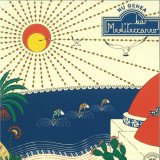
Four years after Nuova Napoli, Nu Genea are back with Bar Mediterraneo, a new album and journey, which projects the sounds of the Neapolitan duo formed by Massimo Di Lena and Lucio Aquilina even further.
Nu Genea's Bar Mediterraneo is an idea of a shared place where people meet and fuse together; a space that leaves its doors open to travellers and their lives, always exposed to the whims of fate. Some of this can be experienced through the multitude of sounds that come together in the tracks, layers of different acoustic instruments, voices and synthesizers merging in a unique musical blend.
Opening up to the voices of many different people, separated by languages but united by the sea and the music, Nu Genea's hometown, Napoli, becomes a true place of encounter.
You can hear this all along. In "Gelbi", a gorgeously deep and propulsive Ney flute plunges into murky waters of the melancholic Tunisian dialect sung by Marzouk Mejri. In "Marechia'", unbridled happiness and sun ooze from the delicate vocals of Célia Kameni and create an acrobatic bridge between French and Neapolitan language. In "Straniero", your soul is arrested from the moment the slow spell-binding mandolin ignites the hypnotic patterns recorded by the legendary Afrobeat drummer Tony Allen. In "Bar Mediterraneo", the title track, bittersweet guitar’s riffs, analog waves and choirs are overwhelming the song giving you what you would like to hear on a boat trip along the Amalfi Coast.
Nu Genea couldn't afford to overlook their firmly anchored roots into the Neapolitan culture and its dialect with "Tienaté", where the power of neapolitan language (interpreted by Fabiana Martone) supports those quarter-tone strings and the uncessant folk-disco groove that spreads to the entire song. In "Praja Magia", repetitive mandolin riffs lead the song, giving space to a choral yet tight vocal line that speaks of Varcaturo, a village close to Napoli. In "Rire", a volley of poetic, deceptively laidback, lyrical fury interpreted by Sicilian Marco Castello intimately combines with a highly musical, multi-textured instrumental backbone and the swoon of a chanson in its heart. In "La Crisi'', the lyrics of a Raffaele Viviani’s poem from 1930 have been adapted to a laidback jazz-funk groove in full NG style. In "Vesuvio", revaluing the evocative verses and powerful mantra of Vesuvio, Nu Genea re-adapted to the dancefloor a folk song by the working-class band E’ Zezi from Pomigliano D'Arco, combining the voices of a school choir with Jupiter-6 arpeggios and bold percussions.
Bar Mediterraneo is the place where people constantly return to transform curiosity into participation, tradition into sharing, unfamiliar into familiar. When travellers come through its “doors”, carrying their treasures of words and emotions, they aren’t strangers any more. They take part in a shared experience, enriching themselves and others by leading to unexpected musical journeys.
Cerca:title tracks
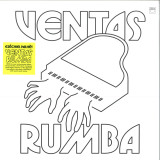
With his new instrumental album Ventas Rumba, the French composer (and singer) returns to his signature instrument, the piano, blending it with warm synth tones. This album represents a "return to his roots ", allowing Ezéchiel Pailhès to reinvent himself in a seamless way while still exploring ballads and ritornellos, halfway between light-heartedness and melancholy. Ezéchiel Pailhès has been meaning to write a solo piano album for as long as he can remember. Hardly surprising, of course, for this academically-trained pianist, brought up on classical music and then studied jazz. Yet, since his 2001 debut with the electro-pop duo Nôze, and his subsequent four albums, the artist had constantly postponed this project that was so close to his heart. Then in 2022, just as he was getting ready to start producing an album of new songs, this long-standing aim finally materialized.
The melodies he wrote seemed to stand on their own naturally, spurring him on to compose this series of fourteen tracks, recorded in sessions split between France and Latvia.
A new piano: the Una Corda
Ezéchiel wanted this project dedicated to the piano to begin a new narrative, to explore new instrumental terrain and new tones, something far removed from the familiar piano he has been playing all his life. He opted for the Una Corda piano, designed by David Klavins, a groundbreaking instrument builder renowned for his distinctive pianos with vertical shapes and frames.
The Una Corda, created in 2014, is an upright piano with a single string per note (unlike three strings on traditional pianos). Enticed by the "crystalline and unique" tones of this instrument, which is hard to find in France, Ezéchiel travelled to Kuldiga, Latvia (where David Klavins set up his workshops and studios), to record the first part of the album. Although the title of the album may initially conjure up images of a distant, sensual dance, the reality is quite different. Ventas Rumba indeed refers to the waterfall and rapids (in Latvian: rumba) of the river Ventas, which runs near this small village in the western part of the country. Ezéchiel chose to blur the lines, as the sound and musicality of the title likely evoke both his short stay in the Baltic country, and also a form of distant exotic imagery perfectly in tune with his own mischievous wit. Tracks as short stories
Back in France, Ezéchiel enhanced the first tracks recorded in Kuldiga with subtle synth tone layers, and added other tracks composed and recorded at his Montreuil studio. The album reflects a deliberate and sensitive orchestration of piano, synth keyboards and digital effects, as he puts it: "playing to erase the differences between the tones of the various instruments", as if each instrument's texture echoed the others. According to Ezéchiel, you can listen to Ventas Rumba as you would leaf through "a collection of short stories", through compositions that rarely exceed three minutes and evoke figures of movement, lightness, curves or modulation, such as "La ligne", "La valse des singes" or "Fly Finger". Others more seriously relate to a kind of spirituality, which quietly infuses such different tracks as "Ferveur", "Éclair" and "Louanges". Ezéchiel adds: “I’m by no means religious, but I like what God has managed to get musicians to achieve (laughs)". "Louanges", for instance, despite its electronic edge, "refers to Olivier Messiaen, a very devout composer who I greatly admire". Other tracks are directly inspired by the classical music he listens to on a daily basis. For example, Chopin's “8th Nocturne” formed the backdrop of “Pianovado”. Likewise, the harmonic structure of Beethoven's “Waldstein Sonata No. 21” inspired “Opus 53”. Aside from these multiple references and inspirations, which quickly recede behind a style that is uniquely his, Ezéchiel Pailhès keeps exploring ideas already found on his first solo albums, this time in an instrumental format, undoubtedly purer, fostering an imaginary world that evokes the shapes and themes of ballads, ritornellos, light-heartedness, passing time, reverie or a universal subdued melancholy.
One of the most essential works from Nurse With Wound, coming in an extended luxury 3x picture LP and 2CD edition, with many unreleased, alternative versions and songs.
This album is the sister album to Current 93’s same titled album and it’s a crownjewel for collectors of avantgarde and experimental music.
The original release of Nurse with Wound’s gargantuan “Thunder Perfect Mind” in 1992 coincided with that of Current 93’s homonymous genre-defining album. Legend has it that the gnostic name initially appeared to Steven Stapleton in a dream as the title of Tibet’s then still nameless upcoming album. Both records feature contributions from David Tibet, Colin Potter, Rose McDowall, John Balance of Coil, Alan Trench of Orchis and Joolie Wood amongst others. The title and the partial overlap of the personnel on both albums isn’t quite where the similarities end, both albums have since become undisputed milestones in their respective artists’ oeuvre. At the core of the definitive 2023 Infinite Fog re-release fully overseen by Steven Stapleton are the two original tracks “Cold” – a classic unsettling rhythmic Nurse collage-fest, significantly closer to jittery psychelia than the oft-cited “industrial feel” and the epic “Colder Still”, easily one of the most mind-bending breathtaking NWW compositions up to this point and well beyond. The track soothes ghostly atmosphere and reveals new surprises with every listen, not least of which is a direct link to its sister release from c93 as well as the first appearance of the signature rhythm loop that would mutate and re-emerge on several later tracks. The album also is the first full-length collaboration with genius sound wizard Colin Potter who has since become a ubiquitous sidekick both on Nurse albums as well as in live performances. As a follow-up to what is widely acknowledged as one of the best-loved exercises in drone of the 20th century “Soliloquy for Lilith”, TPM is a much more varied but at least equally rewarding experience. Infinite Fog are beyond pleased to be able to offer a significantly enhanced, remastered and extended 3 LP version for old and new fans alike.
Church Andrews and Matt Davies weave intricate patterns from Fibonacci sequences on new mini-album, Yucca.
Producer and composer Church Andrews (aka Kirk Barley) and drummer Matt Davies return to explore the outer limits of rhythm on a six-track suite that is at once angular and fluid, natural and systematic. Drawn to the restrictions of working solely with one synth and live drums, the pair found creativity in limitation, developing a compositional dialogue between the sonic timbres of Kirk’s productions and Matt’s percussive practice.
Evoking the primitive yet complex form of the plant from which it takes its name, Yucca features tracks that are built around rhythmic ratios of the Fibonacci sequence. Mirroring spiral patterns exhibited in nature, each track evolves like a cellular structure of its own, from the livewire syntax of ‘Chirp’ and the deconstructed ebb and flow of ‘Ferns’, to the mini-album’s title track, where crisp grooves flit between modulated electronics like fireflies.
“I’ve always been inspired by music that is complex without sounding complex,” Matt explains. He maintains a sense of bounce amid the intricate phrasing and cites drummers Roy Haynes and his grandson Marcus Gilmore as inspirations, alongside sabar drummers from Senegal and Mridangam drumming of South India.
With a shared background in hip-hop and the swung beats of J Dilla and Flying Lotus, Kirk Barley and Matt Davies were also inspired by the minimalism of Terry Riley and the sparse palette of dub techno.
Written and recorded in Lewisham in the spring and summer of 2023, Yucca follows the release of Axis in 2022, with the duo having also performed at festivals such as Rewire and Waking Life, and recorded live sessions for FACT magazine and Worldwide FM.
The third release on Yorkshire-based Odda Recordings, following Kirk Barley’s Marionette and Flaer’s Preludes, Yucca confirms the label’s reputation for championing music on the unstable ground between the organic and the synthetic.
Significant Other unveils a new project: Pain Management. A new imprint presenting music and visual media across a variety of formats. The outlet launches with an original 4 track EP: When It Rains.
Christening the label with his first full length release since 2021, the subversive producer steps out from behind the curtain with a batch of tracks guaranteed to soothe psychic woes and challenge sound systems alike.
True to the name of the label, this debut release delivers a healthy dose of leftfield club weight. Tough and tender in equal measure, it’s a record that explores in-between zones. A fever dream of narrative experiments at the outer edges of club music, packing enough punch to shake a dancefloor, but enough delicacy to soundtrack the ride home. The final product is a meeting of outsider sonics and sleazy dance tropes, body music for restless minds.
The record begins with the lead single ‘RPG’ (A1). A smoked out, drug chug power ballad featuring fellow NYC underground alum James K. Anchored around a growling 4/4 battle beat, swells of dub and inchoate vocal cries rise intermittently from the haze. Within the fever dream fugue of thuggish sub weight and engine-room crud, a tender, sustained warmth shimmers.
A2’s ‘I Get Such Bad Headaches’ is a twisted club thumper built around a questioning vocal refrain. It’s a tongue in cheek nod to the label’s origins that takes shape in a sleazy beat track with some serious club weight. Slowed n’ chopped to the maximum, it’s a low slung sleeper-hit with attitude. DJ Screw meets Tylenol PM, a bass-boosted anthem for the neural punishment enjoyer.
The B-side opens with the title track, ‘When It Rains (It Pours)’, a droned out mess of distant voices and textural grit. Anchored around the titular looping axiom, the track has a deathly, abyssal weight to it. A claustrophobic hymn of surrender, faithful to its stark refrain.
‘Bad Blood’ wraps the record on a tender note. A sluggish heartbeat pumps beneath the fog of dub delays and distortion, propelling forward a lethargic rhythm. Out of nowhere a blissed out synth line pierces the tension. A sharp, emotive melody disrupting the paramnesia with something new. If the record’s title track suggests a downward spiral through some psychic storm, then ‘Bad Blood’ shows the outline of dry land coming slowly into focus.
Art Direction by Ciaran Birch
- 1: Forró Violento (Instrumental)
- 2: Grão De Areia
- 3: Não Vou Reclamar De Deus
- 4: Toda Beleza
- 5: Put@Ria!
- 6: Rubelía
- 7: Posso Dizer
- 8: Vinheta As Palavras I
- 9: As Palavras
- 10: Forró Violento
- 11: Torto Arado
- 12: Lua De Garrafa
- 13: Na Mão Do Palhaço
- 14: Doutor Albieri
- 15: Samba De Amanda E Té
- 16: Amor De Mãe
- 17: Vinheta As Palavras Ii
- 18: Assum Preto
- 19: Forró No Escuro
- 20: Toda Beleza (Pelos Loirinhos)
Black Vinyl[26,68 €]
Some albums are game-changers in a genre. Take OutKast's Speakerboxxx / The Love Below or Primal Scream's Screamadelica, they observe, study, and then flip what an album can mean to a genre or moment in time.
From the very first listen of Rubel’s Latin Grammy-nominated third album As Palavras, Vol. 1 & 2, you can feel its transformative force for the MPB genre. Here we see one of Rio’s brightest stars, fusing the contemporary with the classic, soaking up the richness of Brazil’s musical heritage. The result is a marauding 20-track epic, incorporating traditional styles such as forró, MPB, pagode and samba with modern baile funk, rasteirinha and hip-hop.
The album exudes a sense of freedom and creativity, playfully and provocatively juggling the familiar with the forward-thinking. The tracks are divided across two records, navigating feelings of love, heartbreak and discovery, whilst balancing themes of violence, passion, irony and affection. Collaborating with some of the country’s most esteemed artists such as Gabriel do Borel, Liniker, Luedji Luna, Tim Bernardes and Ana Caetano, Rubel takes this fusion of styles, subjects and flavours to the global stage.
The grand, forró-blending, choral opener, ‘Forró Violento (Instrumental)’ sets the tone for the album, with references and links between tradition and modernity everywhere to be seen. From the Ana Frango Elétrico produced, funk flexing, samba-soul brilliance of ‘Não Vou Reclamar de Deus’, to the album’s title cut ‘As Palavras’, in collaboration with Tim Bernardes, that melds MPB influences with electronic elements and hip-hop touches.
Across both sides of the album, Rubel’s story-telling gift is given space to shine. ‘Torto Arado’ featuring Liniker and Luedji Luna, beautifully references the racial injustice, tragedy, hope and ambition found in one the most celebrated Brazilian novels of recent times by Itamar Vieira Júnior. Elsewhere, ‘Na Mão do Palhaço’ manifests a satirical march about a suicidal conservative middle-aged man, who is rescued by the miracle of the carnival.
At times the album is gentle and intimate with tracks like ‘Toda Beleza’ featuring Bala Desejo, or the ode to friendship ‘Lua de Garrafa’, composed with the legendary Milton Nascimento. At others, the grooves hit harder, with sounds from the favelas laced within. ‘Put@ria!’, explores the universe of baile funk, with BK’ and MC Carol trading off on the mic, as ‘Rubelía’ moves between reggaeton, funk, and hip hop. The latter is a tribute to a key influence of the album, Spanish star Rosalía and her parallel mix of current with classic.
Ultimately though the beauty of this album lies in its concept. In the midst of a country divided, ‘As Palavras Vol. 1 & 2’ sets out to bring together genres and generations, grounded in rhythms and words that have helped define Brazil through the ages.
Digital Base, producer and DJ from Seville, has been producing Breakbeat music tracks for more than 30 years, being one of the oldest producers on the scene who is still active. He was one of the people responsible for the legendary iBreaks label and co-founder of the promoter and label Ibreaks Spain, being a reference for the hardcore breaks sound at the end of the 90s and a pioneer of the Techfunks & Electro House Breaks sound at the beginning of the century. His creations have evolved over time, currently leading to a substyle that some call "Liquid Breaks" without forgetting the Old Skool of yesteryear. Labels aside, from his label Old Skool Records he has us accustomed to the release of extraordinary compositions with a high emotional charge, musicality and impeccable rhythms, which give a timeless character to everything that comes out of his studio. In this new vinyl titled "He Didn't Do It On Purpose", you can find all these ingredients, which define the genuine sound that Digital Base has forged over low heat, made to last in times of immediacy.
- 1: Static On The Radio – 6:3
- 2: Bluebird – 5:9
- 3: Combing My Hair In A Brand New Style – 6:24
- 4: That Girl From Brownsville Texas – 6:22
- 5: Borrowed Wings – 4:34
- 6: If Jesus Drove A Motor Home – 4:3
- 7: Objects In Motion – 5:58
- 8: Buzzards Of Love – 7:00
- 9: Alabama Chrome – 4:25
- 10: Phone Booth In Heaven – 7:09
- 11: Land Called Home – 4
- 12: Suckerz Promisez – 5:58*
- 13: Stranger Candy – 7:25*
- 14: Cinderblock Walls – 5:27*
20th anniversary of Jim White’s haunting outer space alt.country classic that has a title so long nobody can remember the name of it. Featuring Aimee Mann, M. Ward, Bill Frisell and the Barenaked Ladies. Now it’s on vinyl for the first time, pressed on Substrate Black in a gatefold jacket plus three additional bonus tracks
Throw the gauntlet: Fast Castle is back with Gent1e $oul’s “Shoals”-EP, our furthest excursion into the unexplored depths of mind-bending bassweight! Having perfected his build order on his recent “Block Printing'' and “Silk Armor”-EPs, Gent1e $oul continues to infuse his productions with sonic bass strategies over five versatile tracks.
“Dark Age” provides an aggressive opening, immediately applying pressure with nasty bass wobbles, dembow echoes and a 4x4 switch that might catch distracted players off guard. Tried and tested in many settings, this is an essential option for the incoming dancefloor rush!
With its heavy neo-stepper energy, ”Bad Neighbor” lays siege to dancefloor resistance with a piercing lead, breathing drums and powerful waves of sub wubs. Just like the AoE2’s legendary trebuchet of the same name, “Bad Neighbor” – paired with the right Soundsystem – will make the walls shake.
“Dusty Acer” is a homage to Gent1e $oul’s dear but aging AoE2 gaming machine, capable of producing similar noises to this dark UKG cuts’ central bassline.
Deep dubstep cut “Illumination” takes us to the for a wholesome mana refill: Mystic ambiences make you pull down your cowl, before diving into a fully blown sub massage.
The standout self-titled cut “Shoals” concludes the release: A deep-yet-powerful half-stepping perc grower at 160bpm, operating on subdued rhythmic shifts and layers.
As a special tribute to the AoE2 community, all tunes are flavored with the game's original sound effects. Thanks for keeping us inspired, Nili_Aoe for NAC5 and T90 for HC5!
repress !
Following acclaimed singles from Powell, Blood Music, Shit & Shine and Prostitutes, the next release from Diagonal is a landmark. It marks both the London label's first full-length album release, and the return of abrasive and furiously funky hip-hop deconstructionists Death Comet Crew, one of the most quietly influential underground acts to emerge from the creative melting pot of 1980s New York.
Ghost Among The Crew documents the group's return to studio operations for the first time since the 80s, as well as their first ever full-length studio album. It's a remarkable trip: a consolidation of their early feral disassemblies of hip-hop and electro, but also broader in scope, chewing up and spitting out fragments of soul, jazz fusion, punk and industrial music.
Death Comet Crew were founded in New York City in 1983 by Stuart Argabright, a founder member of post-punk/industrial mavericks Ike Yard and the mind behind Dominatrix and later Black Rain. Their sound, then as now, was a singular proposition: urban in mood, exploratory, often compellingly danceable, yet confrontational. It emerged from the interweaving talents of the group's varied members: guitarist Michael Diekmann (of Ike Yard), bassist Shinichi Shimokawa (later of Black Rain) and Nick Taylor aka DJ High Priest, frequently joined by the late, great hip hop artist and graffiti writer Rammellzee. Having recorded two studio EPs - 1985's At The Marble Bar (featuring Rammellzee) and its follow-up Mystic Eyes - the group disbanded barely a year after forming. They left behind a reputation for their incendiary live performances, several recordings from which were gathered on crucial 2004 compilation This Is Riphop.
The musical climate that first birthed Death Comet Crew was one of fertile cross-pollination of styles. In the late 1970s and early 1980s, the seeds of modern day urban musics - hip hop, punk and post-punk, no wave - were taking root in the streets of recession-struck New York City. Argabright recalls dancing at the downtown Mudd Club around 1980 to a bold mixture of styles, with DJs cutting from synth-pop and post-punk to funk, soul and early hip-hop: Bowie and James Brown next to Run DMC, Ultravox and Gary Numan. Indeed, the names of his New York contemporaries operating around the same time - the likes of Liquid Liquid, Run DMC, Afrika Bambaataa, Arthur Russell, ESG, Swans, Sonic Youth, Bill Laswell and more - have since been inscribed in modern music history.
With previous projects Dominatrix and Ike Yard having recently become inactive, in 1984 Argabright formed Death Comet Crew as a means of exploring new sonic avenues. He'd been experimenting with tape, recording and procesing the sounds of his surrounding environment and dialogue from films and TV. Joined by Shimokawa, Diekmann and Taylor, and using drum machines, turntables, spidery guitar and bass, the group assembled a scrambled collage of rhythms and sampled voices. Their live performances were, in Argabright's words, "aurally violent, sharp-edged, downright lacerating", hacking gleefully away at hip hop and electro's rhythmic frameworks. Rammellzee joined the group to vocal 1985 debut EP At The Marble Bar; his MC turn on highlight 'Exterior Street' is all the more remarkable for having been entirely freestyled in the studio. When Death Comet Crew reformed in 2003 for a string of live shows, he continued as an active member of the group, touring and working with them during the recording of Ghost Among The Crew, until he sadly passed away in 2010.
After reforming, Death Comet Crew began writing and recording new material. Now, following on from their just-released Galacticoast 12" through Citinite, Ghost Among The Crew - its title a homage to Rammellzee - hones the group's abrasive early experimentations while tripping into bold and astrally minded new territory. Alongside the core quartet of Argabright, Diekmann, Shimokawa and Taylor are new voices, including Rapscallion (a friend of Rammellzee's), Jessica 6/Hercules & Love Affair singer Nomi Ruiz, and Carolyn 'Honeychild' Coleman. Its eight tracks are steeped in the impulsive spirit of electric Miles and the deep space romances of Sun Ra, and possessed of an enigmatic yet undeniable pop edge. But equally they're pricked with urban paranoia and dread, traits that have long been hallmarks of Argabright's musical projects.
'Me Czar Of The Magyars' opens the album in a twist of tension like the turning of a ratchet. Its taut electroid shudder is paired with machine gunned cymbal hits and a voice telling of "wormwood and opium dens" - the sound of being teleported from everyday city streets into the astral plane, where every sensory input is heightened and the promise of danger or pleasure lurks unseen around every corner. Later, Coleman's lyrics pay tribute to Rammellzee on the sci-fi funk of 'Deep Space Woman'. 'Let The Clubs Ring' melts lounge bar organs and frazzled guitar into freakishly unstable shapes, while 'Drag Racing' matches its title, rocketing along frantically atop clattering drums. 'Moons On Titan's Seas' is halfway interlude pause for rest, like an exotic cocktail in a bar orbiting some as-yet-undiscovered new world. These varied strands are somehow all summarised in album closer 'Ignition Spark', which sets Ruiz's vocals alongside Taylor's and Argabright's. The zone the trio inhabit in this final track exists in perpetual push-pull between contemplation, memory, intrigue and violence, a decisive opening of a new chapter in Death Comet Crew's history.
As with all Diagonal releases, the initial vinyl pressing will be packaged in unique, specially designed artwork.
After several successful singles, Ella’s only Sound Stage 7 release was recorded at Music City Recorders in Nashville, Tennessee. The self-titled LP is all classic, no filler and surely ranks among the deepest soul in her catalogue. Full of strong ballads that showcase her raw and emotive style each song is perfectly arranged to showcase Ella's powerful vocals. Standout tracks include ‘Sit Down and Cry’, ‘All The Time’, and ‘ Stop Giving Your Man Away’. The LP also features Ella’s 1969 hit ‘He Called Me Baby’ which entered the top 40 R&B charts and garnered a Grammy nomination. Newly remastered and pressed on audiophile virgin vinyl. Limited to only 500 copies.
Audrey Powne's stunning debut album, From The Fire, is set to be one of those must have LPs in any music lover's collection. Something of an auteur release it features nine tracks all composed by Audrey, with all string arrangements and all produced by her. Audrey's decision to produce the whole album herself came from a desire to take creative control of her music and apply techniques developed from the influences of the producers she had previously worked with. If all of the above were not enough Audrey also wrote the lyrics for those tracks on which she sings, and as a multi-instrumentalist contributes piano, Rhodes and organ. She also features as a trumpeter with dextrous and soaring solos as evidenced by the two single releases so far; Feed The Fire and the title track, From The Fire. Due to be released by BBE as both a vinyl and on digital From The Fire is an album of Soul-Jazz with a serious environmental and social messages as well as one which blends classical music, hip-hop and influences from Roy Hargrove, Bill Evans and Herbie Hancock. Indeed it is Roy Hargrove's studio techniques evident in his work with the RH Factor that Audrey credits as a major factor in her producer role here. As well as her solo work, Melbourne born Audrey Powne has also worked as a session player with acts as diverse as Maceo Parker, Midnight Oil, Jimmy Barnes, Masta Ace and the Grammy nominated band The Teskey Brothers. With testimonies and positive reviews from Gilles Peterson, Earmilk, Bandcamp Daily, tracks on the Sunny Side Up compilation and performances on Boiler Room Audrey Powne is a supreme talent whose star is on the rise. From The Fire is destined to become a future classic.
The prolific and versatile Ian Martin arrives on Shipwrec with four tracks that make up Future Dawn. Cosmic Garden opens. A piece that blurs genre lines; soft synth-lines are coupled with ruffled rhythms that immerse the listener in gentle orchestral ebbs and flows. Sounds of isolation introduce Future Dawn, modulations reaching over an ever-widening expanse before strings descend. Drums arrive late in this atmospheric journey, one that pulses with a primal energy while conjuring vivid images. The ominously titled Dead Calm opens the flip. Soundtracks have always been an inspiration for Martin and the scores of the silver screen are at the forefront of this work. Brittle beat patterns are the bedrock on which melodies whirl - a bitter acid bass bubbling as tension builds to paranoic peaks. Darker skies loom with the marine chop of Phantom Machine finishing. A flotsam and jetsam of hi hats swirl in the liquid undulations of distorted bass and aquatic echoes, rougher rusted rhythms providing ballast to the eddies and maelstrom of Martin's machines.
Our 20th celebration year continues with a very special comeback! It’s exactly ten years now since the last Ben La Desh release on our label, his sublime “Stellar Talk EP” hit big waves and together with the “Midnight Rendez-Vous EP” from 2012 he cemented himself in the lo-fi deep space house scene as an artist to look out for, no one produced deep house like he did back then. After a longer break from releasing music he is back and we think stronger as ever, with analogue gear and well curated sampling and live field recording we present you his “Fine Rise EP”.
The opener “Heel Goed” is an amazing track with that distinctive 909 beat and DX bass driven “La Desh” flavour and a truly wonderful vocal sample from a 90s TV commercial, hilariously funny and brilliant at the same time! We can’t wait to see the faces of people, especially on the Dutch dancefloors, when they try to figure out and discover what the ladies are talking about! Second A side track is the super funky “Lift Adrift” that flanges itself to outer space, etherical with chopped break beats and various percussive and rhythmic Pearl Syncussion layers running through effect pedals, Lift Adrift!
On the other side we start out with the deep title track “Fine Rise”. Here Ben treats us again to his trademark spaced out effects driven sound and on top a killer bass line and synth lead melody, reminiscent of the golden age of (good) trance music. Followed by the break beat gem that is “Asanti”, cautiously cut up breaks and layered machine drums with bubbly Syncussion sounds, rain drops falling down on different surfaces recorded in a garden in the French Drôme and processed African Kalimba. Did we already say Etherical? It is!
Closing out this great new record is the ambient piece “Expanding Signal”, an analogue tune that consists of field recordings and deep dubby chords, a building Juno pulse, swooshes and again a profound DX bassline, think of “Sun Electric” or “The Orb”.
Enjoy this one and play it loud on the dance floors or silently in your bedroom, it works everywhere as far as we are concerned!
All tracks mastered by Salz Mastering in Cologne. Photography & Art by Break 3000.
Following the singles "Zanzare" and "Barocco", Chiaré is the self-titled debut album from songwriter and multi-instrumentalist Chiaré, aka Chiara Ianniciello, the latest recipient of the Bianca D'Aponte Award for emerging Italian singer-songwriters.
The album, which will be out on April 19th, contains eight atmospheric and intimate tracks where Chiara's warm and gentle voice weaves snapshots from her feelings and her personal story over retro-flavoured, jazz-infused arrangements that are reminiscent of some of Italy's finest singer-songwriters (Lucio Battisti and Pino Daniele in particular).
"It all started about three years ago," says Chiara. "Ernesto Massimino Voza and I started from a sound that somehow wasn't really me, and after a long process of trial and error, we finally found what seemed to be right for me. Peppe Maiellano, who arranged all the music, brought it full circle. The album has a common thread: love. Almost all of the songs are about strategic love, the fear of freely loving someone and the frustration at not being able to get out of an on-and-off relationship that made me suffer, but that I've tried to narrate with some irony. If my writing were an artistic movement, it would be naturalism. I drew a lot of inspiration from Pino Daniele, Eduardo De Crescenzo, and Lucio Battisti, while trying to develop my own personal, authentic style."
Chiara holds a diploma in jazz singing and is now completing her studies in classical double bass. In her debut album she uses both standard Italian and the Neapolitan dialect, mixing jazz, soul and R'n'B. Modernity and tradition come together, creating a delicate yet irresistible sound.
- A1: Forro Violento (Instrumental)
- A2: Grao De Areia
- A3: Nao Vou Reclamar De Deus
- A4: Toda Beleza
- A5: Put@Ria!
- B1: Rubelia
- B2: Posso Dizer
- B3: Vinheta As Palavras
- B4: As Palavras
- B5: Forro Violento
- C1: Torto Arado
- C2: Lua De Garrafa
- C3: Na Mao Do Palhaco
- C4: Doutor Albieri
- C5: Samba De Amanda E Te
- D1: Amor De Mae
- D2: Vinheta As Palavras Ii
- D3: Assum Preto
- D4: Forro No Escuro
- D5: Toda Beleza (Pelos Loirinhos)
Pink Vinyl[29,96 €]
Some albums are game-changers in a genre. Take OutKast's Speakerboxxx / The Love Below or Primal Scream's Screamadelica, they observe, study, and then flip what an album can mean to a genre or moment in time.
From the very first listen of Rubel’s Latin Grammy-nominated third album As Palavras, Vol. 1 & 2, you can feel its transformative force for the MPB genre. Here we see one of Rio’s brightest stars, fusing the contemporary with the classic, soaking up the richness of Brazil’s musical heritage. The result is a marauding 20-track epic, incorporating traditional styles such as forró, MPB, pagode and samba with modern baile funk, rasteirinha and hip-hop.
The album exudes a sense of freedom and creativity, playfully and provocatively juggling the familiar with the forward-thinking. The tracks are divided across two records, navigating feelings of love, heartbreak and discovery, whilst balancing themes of violence, passion, irony and affection. Collaborating with some of the country’s most esteemed artists such as Gabriel do Borel, Liniker, Luedji Luna, Tim Bernardes and Ana Caetano, Rubel takes this fusion of styles, subjects and flavours to the global stage.
The grand, forró-blending, choral opener, ‘Forró Violento (Instrumental)’ sets the tone for the album, with references and links between tradition and modernity everywhere to be seen. From the Ana Frango Elétrico produced, funk flexing, samba-soul brilliance of ‘Não Vou Reclamar de Deus’, to the album’s title cut ‘As Palavras’, in collaboration with Tim Bernardes, that melds MPB influences with electronic elements and hip-hop touches.
Across both sides of the album, Rubel’s story-telling gift is given space to shine. ‘Torto Arado’ featuring Liniker and Luedji Luna, beautifully references the racial injustice, tragedy, hope and ambition found in one the most celebrated Brazilian novels of recent times by Itamar Vieira Júnior. Elsewhere, ‘Na Mão do Palhaço’ manifests a satirical march about a suicidal conservative middle-aged man, who is rescued by the miracle of the carnival.
At times the album is gentle and intimate with tracks like ‘Toda Beleza’ featuring Bala Desejo, or the ode to friendship ‘Lua de Garrafa’, composed with the legendary Milton Nascimento. At others, the grooves hit harder, with sounds from the favelas laced within. ‘Put@ria!’, explores the universe of baile funk, with BK’ and MC Carol trading off on the mic, as ‘Rubelía’ moves between reggaeton, funk, and hip hop. The latter is a tribute to a key influence of the album, Spanish star Rosalía and her parallel mix of current with classic.
Ultimately though the beauty of this album lies in its concept. In the midst of a country divided, ‘As Palavras Vol. 1 & 2’ sets out to bring together genres and generations, grounded in rhythms and words that have helped define Brazil through the ages.
2024 Repress
Imagine a held-up-in-traffic Wayne Shorter arriving late to a Weather Report studio session and Joe Zawinul, Victor Bailey, and Omar Hakim filling in the time by jamming on a grooving house cut. Had that happened, it might have sounded a little bit like “It Never Stops,” one of two ultra-fresh tracks on Kaidi Tatham's Yore debut. Jazz and house are obviously distinct genres, yet as this irresistible cut makes clear swing is common to both. The other track, the cerebrally titled “One for the Brain,” locates itself closer to house music proper but is no less appealing for doing so.
Given the jazzy vibe of “It Never Stops,” it's fitting that Benji B once deemed Tatham the "Herbie Hancock of the United Kingdom.” Regarded as one of the originators of the Broken Beat sound, the UK-based multi-instrumentalist has worked with many an artist, from Bugz In The Attic and The Herbaliser to DJ Jazzy Jeff, and his session work credits list Slum Village, Amy Winehouse, Soul II Soul, and others. His own discography includes EPs and releases for labels such as 2000 Black, First World Records, Theo Parrish's Sound Signature, Eglo Records, and now, of course, Yore.
“It Never Stops” rolls in on a wave of silky synthesizer textures and percolating precision with a tight, funky groove that instantly pulls you into its velvety world. Triangles, electric bass, and clavinet add collective radiance to the material as the tune struts its way into your psyche. As if to make the jazz connection even more explicit, Tatham works an acoustic piano solo into the cut's second half before shifting focus back to the groove for the coda. “One for the Brain,” by comparison, digs into its chugging house pulse with fervour whilst also sweetening the arrangement with painterly synth flourishes. This one charges with breathless determination and like “It Never Stops” nods in jazz's direction with the inclusion of a freewheeling piano solo. Every minute and second on this strictly limited 12“ release seem's meaningful. No Represses / Limited 200 Copies.
Warehouse Find! Test Pressing!
Time for one of Freerange's longest standing regular producers to return to the label for his first EP in three years. The Stepping Tones EP is absolutely classic Shur-I-Kan from start to finish with two original tracks plus a remix from the very excellent Berlin newcomers Kim Brown.
The title track opens with a big, bold, bouncing bassline and driving groove but as we hear the arrangement unfold the layers of keys build and drop bringing the trademark Shur-I-Kan musicality and energy to the track. In our opinion this is one of his strongest tracks yet and we're pretty sure this will be a firm favorite this summer, set to be heard everywhere from Croatian boat parties to Dalston basements and beyond.
Up next we have Kim Brown with their remix of Stepping Tones and what a job! The Berlin duo have made a big impact the last couple of years with their incredibly deep and beautiful Spring Theory and People's Republic releases on Just Another Beat. Completely sublime downbeat deep house is the key here, owing as much to ambient and orchestral music as to the rough and raw lo-slung club beats we're hearing from labels such as Dial and Smallville. Their remix brings rugged drums, dubby keys and lush strings to the fore with the addition of a twisted, filtering vocal enhancing the warm glowing sunrise vibe which emanates from this track.
Conundrum closes the EP with another deep, jazzy and cinematic Shur-I-Kan masterpiece and once again he layers up the textures and harmonic elements slowly and expertly, introducing the little hooks over time until before you know it you're bathed in a warm shower of lushness with tingles running down your spine.
Warehouse Find! - Test Pressing!
It seems like ages since we last had Roberto Rodriguez on the label with his excellent Be Somebody back in 2008, so we're plenty happy to welcome him back for a long overdue follow up. Roberto clearly hasn't just been sitting on his arse the last 4 years however, having established the Serenades label which released his own LP Dawn last year, as well as putting out the killer Thinking Of You release on Fina plus numerous remixes for rock solid labels such as Let's Play House, On The Prowl, Moodmusic and 2020 Vision. Those familiar with Roberto's productions and credentials will know he has a fine ear for disco and 90's house born out of years collecting records and DJing in the best clubs in his native Helsinki.
Kicking off with Dance Like Nobody's Watching, we see Roberto tread confidently into pure, unadulterated retro house territory with NJ organ stabs, swinging 909 drum groove and choice vocal hits.
Oxymoron keeps things a little deeper with tracky filtering chords and driving drums resulting in a garage-influenced feel with bucket loads of raw attitude.
Finally we have The Black Madonna on board for a remix of the title track. The Chicago producer impressed us recently with her brilliant disco-infused tracks on Stripped & Chewed and Home Taping labels and thought her the perfect choice to contribute to the release. Here she delivers a lesson in stripped back Chicago warehouse vibes keeping everything to a bare minimum for maximum club bump. Kick, claps and piano stabs form the basic groove as she confidently develops the arrangement slowly and surely.
Warehouse Find! Test Pressing!
Simbad makes a welcome return to Freerange following last year’s brilliant Take My Hand EP featuring South African vocalist Brian Temba. Now based predominantly in Cape Town, the French Londoner producer and DJ is one of the most prolific artists in the scene having notched up countless EP’s, remixes and production work for labels like Apron, G.A.M.M. Faces, Hyperdub, Atjazz, BBE & Brownswood. His association with Gilles Peterson and Worldwide runs deep, hosting regular shows on WWFM as well as traversing the globe delivering his unique and eclectic sets from Africa
to Asia and beyond.
Peaceful Revolution is one of those special house tracks which transcends boundaries, encapsulating an outernational sound in a way that Simbad excels in. Featuring South African upcoming producer Zito Mowa & vocalist Lwandile Zulu who brings a raw and impassioned energy to the deep and soulful mood, this tune was recorded in support of the troubled events from the past few months (Black Lives Matter movement).
Next up we have a track entitled Let Go which could quite easily be the lead track of the EP if they weren’t all as good as each other! This is late night emotive house music at its most sublime. Drop this at the right time and watch the floor come together in collective bliss.
Flip over for SMBD’s Shaolin Dub remix of Peaceful Revolution which pushes the original to the outer limits of the audio spectrum. Sub-sonic low end rumbles sitting in contrast to the ghost like whispers, glitches and industrial noises that pierce the ethereal pads.
Closing out this special release we find the unassumingly titled Soulful Jam, a low-slung groove which sees Simbad going heavy on fizzing analogue synths with a serene synth solo takin centre stage amongst the lush chords.


