Search:tone of arc

Styles
All
Perila - omnis festinatio ex parte diaboli LP

One of contemporary ambient’s preeminent figures lands on its leading label, enacting a transition into a new phase of rhythmic noise and tonal shadowplay laced with peculiar sensitivities, wrangling Dilloway-influenced tape noise thru ASMR ambience, fritzed dub techno, layered vocal drone and ritualistic mantras.

Perila steps up solo with a heavily satisfying debut for West Mineral, investigating negative space and states of subconsciousness. The shift in tone feeds forward into arcane realms of resonant dark ambient and dream-pop, harnessed in amorphous structures using dub-as-method. It’s wholly immersive stuff in a way that’s long been Perlia’s calling card, but here more careful in its command of personalised, atmospheric physics from the Coil-esque ‘cheerleader’, thru the deeply smudged and sexy trip hop of ‘lava’, and the oozing, sloshing OOBE-like spectres of ‘give it all’.

The title of the album is a reference to Carl Jung’s phrase "all haste is of the devil” which informs Perila’s writing process here; she slows down in an attempt to feel more and tap into her shadow self. Album opener 'cheerbleeder' is a doomed, tremolo-heavy mass of ghost notes, while the rattling chains and strangulated voices on ‘metal snax' sounds like they belong on a Wolf Eyes tape. 'grain levy tep dusk' strikes closer to recently unearthed industrial plates from Tolerance and Mentocome, with rusted clangs threaded into deflated, half-speed pulses. The album keeps growing from there, shifting and expanding as Perila exhales and absorbs her cognitive blind spots. She credits "trance states" for helping her let go, and we broadly get to experience that on the mantra-like 'thunder me' and the blurry all-vocal highlight 'hold my leg', which sounds like it could have been snatched from Grouper's 'Way Their Crept' sessions.

As with all of Alexandra Zakharenko’s work under various aliases - Aseptic Stir, Baby Bong, Wedontneedwords, Perila - her allure is self-evident to lovers of textured, diffuse electronics, and never more so than on this lip-bitingly potent suite of delicacies and primordial urges, perfectly balancing ancient and techngnostic aspects with an x-amount of seductive strangeness left in the margins.

out of Stock

Order now and we will order the item for you at our supplier.

Last In: 9 months ago
27,52 €
Zé Ibarra - Afim

Zé Ibarra

Afim

12inchMRBLP324T
Mr Bongo
29.10.2025

Mr Bongo proudly presents, ‘AFIM’, the second solo album by one of Brazil’s most exciting new talents, Zé Ibarra. You may be familiar with the hypnotic, entrancing tones of Ibarra’s vocals through his work with the Latin Grammy award-winning, four-piece, Bala Desejo and the band Dônica. He has also toured with the musical titan, Milton Nascimento, performing guitar and vocals, which is quite the honour and a testament to Ibarra's craft. As a solo artist, he has performed headline solo shows in Japan, Portugal and the US, as well as recently completing a support tour with the great, Seu Jorge.

‘AFIM’ is comprised of eight tracks, featuring Zé’s own compositions as well as cover versions of tracks by contemporaries and friends, Sophia Chablau, Tom Veloso, and Dora Morelenbaum. It combines elements of MPB, jazz, pop and progressive rock in a bold, authoritative style. The album represents the intersection between different facets of the artist, from the stripped-down, intimate, guitar singer-songwriter, to dense arrangements with sweeping strings sections. Writing this album allowed Ibarra "to explore sides of myself that had not yet been organized in an album: a certain darkness, a more cinematic musicality, a desire for new soundscapes.

The album features the single, 'Transe', a song with an instantly comforting tone reminiscent of classic Brazilian songs of the past (think Caetano Veloso). It is built on a rhythmic guitar that supports dynamic sound layers, opening space for Ibarra's intense interpretation. Cinematic atmospheres that lend an air of mystery come courtesy of string arrangements by Jaques Morelenbaum.

His unique cover version of Sophia Chablau's 'Segredo' is equally compelling, taking Sophia's punky-indie original in a different direction and making it feel like his own. 'Essa Confusão', a song celebrating the intensity of love and co-written by Dora Morelenbaum, is steered into epic, 70's AOR, singer-songwriter territory with wind arrangements by Ibarra, Jorge Continentino and strings by Jaques Morelenbaum.

The album is the result of the collaboration of experienced musicians and long-time partners of Ibarra. Fellow Bala Desejo and Dônica member Lucas Nunes co-produced the album. The core band featured on the record consists of Lucas Nunes on organs, Alberto Continentino on bass, Daniel Conceição and Thomas Harres on drums and percussion, Rodrigo Pacato on additional percussion, Chico Lira on Fender Rhodes and Guilherme Lírio on guitar.

The overall feel of the record is archetypically quintessential without slipping into retro mode. It is a stunning album from one of the finest musicians of his generation. A true star of Brazil’s blooming contemporary scene.

out of Stock

Order now and we will order the item for you at our supplier.

Last In: 6 months ago
27,10 €
JUDGITZU - SATOR AREPO LP

The Sator Arepo, or Sator Square, is an ancient word puzzle comprising five palindromes that's etched on various historical sites throughout the Western world. Its origins are unknown, but the square has long been thought to hold magical properties, used as a charm against illness and evil, to cure insanity or to determine whether someone was guilty of witchcraft. Self-styled "punk ethnomusicologist", acoustician and musician Julien Hairon uses this mystical symbol as the starting point for his debut Judgitzu album in an attempt to reconnect with his Celtic heritage, exploring how its hallowed messages might harmonize with contemporary Tanzanian dance music.Hairon has been traveling across the world for over a decade, collecting field recordings from countries such as Indonesia, Australia, Cambodia, China and Bangladesh, and presenting them on his Les Cartes Postales Sonores label, re-issuing any curious cassettes and CDs he came across on the PetPets' TAPES imprint. It was during this time that he became fascinated by rituals that involved spirits, prompting him to examine his own ancestry when he returned to Brittany. "Many artifacts in the landscape remain," Hairon explains, "and the power of spirits is still palpable." He represents this Celtic mysticism on 'Sator Arepo' with murky drones and magickal synth tones, using xenharmonic scales (tuning outside of standard 12-tone equal temperament) that reach back to the ancient world. These sounds are augmented with fast-paced, sci-fi rhythms informed by his time in Tanzania; "Singeli has contaminated me," admits the producer.The most astonishing example of this is 'Miracle', a thrusting soundsystem experiment that layers serpentine, bagpipe-esque electronic wails over extravagant clusters of blocky percussion. Driven by the frenetic 175BPM pulse that echoes through the streets of Dar Es Salaam - popularized globally by forward-thinking producers like Sisso, Duke and Jay Mitta - Hairon opens up a rare conversation, seeking to draw parallels between today's most urgent dance forms and the archaic rituals of antiquity. On 'Vitalimetre', Hairon drives his sonic palette into the red, harmonizing with Dutch hardstyle and gabber, and splaying distorted drones over maddeningly blown-out kicks and ratcheting percussion. 'L'or Des Fous' takes a more meditative route, prioritizing Hairon's eccentric tonality with expressive sheets of pitch-warped sound that ghost walk across energized, rattling beats.If you heard Hairon's last Judgitzu release 'Umeme / Kelele', described by Boomkat as "one of 2019's deadliest dancefloor sessions," then you'll know how mindboggling this material can be. And with 'Sator Arepo', the French producer deepens his reach, grasping a world that we've almost forgotten and juxtaposing it with a landscape most of us barely comprehend.

out of Stock

Order now and we will order the item for you at our supplier.

Last In: 9 months ago
23,49 €
Rafael Anton Irisarri - A Fragile Geography: Reworks (TAPE)

A decade after its release, A Fragile Geography returns transformed. This limited edition cassette accompanies the AFG10 anniversary reissue, offering an inspired re-envisioning of Rafael Anton Irisarri’s landmark compositions. Reworks presents distinctive readings of these pieces, with each artist leaving their personal mark on the material. The titles remain unchanged, with the sole exception of “Hiatus,” reborn here as “Ausencia.” Together, these reimaginings extend the emotional cartography of the album into new terrains.

KMRU reframes “Displacement” with expansive, glimmering layers that open into meditative ambient landscapes. Nairobi born and Berlin based, he is known for morphing field recordings into vivid aural experiences, often capturing the texture of footsteps, foliage, and distant city life and weaving them into contemplative soundscapes. In this version he introduces subtle new sounds, including stringlike synths that trace and heighten the piece’s emotional arc. The result invites close listening, offering enveloping tones where the organic and the synthetic gently collide and flow.

Penelope Trappes renders “Reprisal” as a voice-led invocation of the delicate and the intimate. Her wistful vocals bloom with fragile sorrow, rising over shimmering strands of strings to create a sound world at once sacred and shadowed. She is adept at channeling inherited grief into music that is transcendent and otherworldly. The interplay of her voice, the strings, and her use of space and depth draws those qualities into Irisarri’s orbit, imbuing “Reprisal” with the same spiritual weight and clarity that define her most powerful work.

Kevin Richard Martin (a.k.a. The Bug) transforms “Empire Systems” into a cavernous “Iced Mix,” driven by polyrhythmic double bass motifs and sculpted from subterranean pressure and negative space. Known for pushing sound to its physical limits, Martin brings the stark intensity of his dub and noise infused practice into Irisarri’s architecture. The track seethes with harmonic distortion and erupts in white noise rhythms, its brooding low end depth and icy reverberant textures amplifying the tension. Vulnerability and force are set in stark relief, as silences feel as heavy as the bursts of sound themselves. The result is a stark study in atmosphere, restraint and impact, reframed through Martin’s singular lens of sonic mass and low end intensity.

On Side B, Mabe Fratti opens with a cinematic, dreamlike, Lynchian reimagining of “Hiatus” in her native Spanish (“Ausencia”). She threads cello and voice so wondrously that her rendering feels at once hauntingly beautiful and disquieting. Emotionally charged melodies shift in unexpected directions, while her soft, intimate vocals hover above Irisarri’s brooding synth textures. Fratti’s gift for blending experimental and avant pop sensibilities with visceral, emotionally powerful expression shines resplendently here. She gives voice to Irisarri’s reflections on the passage of time and his growing desire to reconnect with his familial roots.

Abul Mogard stretches “Persistence” into a vast drone elegy. A master of patient sound sculpting, Mogard layers evolving waves of analog synths into a dense shroud that radiates its own internal light. Gradual surges of tone and subtle harmonic shifts emphasize the piece’s endurance and inevitability. Irisarri’s original composition, in Mogard's hands, becomes a rumination on time’s unrelenting flow. Melancholy and transcendence coexist in equal measure in this engulfing, cathartic rework.

William Basinski and Gary Thomas Wright close the cycle with a spectral version of “Secretly Wishing for Rain.” Basinski’s field recordings of Reseda rainfall and birdsong, which open and close the rework, add a personal touch and evoke the imagined sound of a grainy film reel flickering to life. The piece suspends Irisarri’s yearning for the Pacific Northwest, lodging it hazily between memory, place and an unreachable dream. It feels like a fading recollection, half forgotten and half felt. A final gesture that dissolves the album into vapor, leaving the listener adrift in its lingering afterglow.

Mastered with great care by Stephan Mathieu and featuring a remixed version of the original artwork by Daniel Castrejón, this edition refracts the language of the original through new prisms. Less a return than a passage, across time, across interpretation, into uncharted emotional realms.

out of Stock

Order now and we will order the item for you at our supplier.

Last In: 11 months ago
15,08 €
Stefano Pilia - Lacinia LP 2x12"

Stefano Pilia

Lacinia LP 2x12"

2x12inchDSZEIT19-LP
Die Schachtel
10.10.2025

Returning to Die Schachtel with his fourth full-length with the label, the Genoa born, Bologna based, guitarist and electroacoustic composer, Stefano Pilia, delivers “Lacinia”, a new, immersive cycle of compositions, delving deeper into the realm of metaphysical, spiritual, and divine meaning, weaving astounding arrangements of sonority from a palette of synths, strings, brass, organ, various electroacoustic instruments, and percussion. Resting at a refined intersection of the acoustic and electroacoustic, drone, and chamber music - overwhelmingly beautiful, delicate, and bold, - “Lacinia” stands as a high-water mark in Pilia’s already remarkable and forward-looking career.

Since its founding in Milan during the early years of the new millennium, Die Schachtel has occupied a singular place in the landscape of experimental music, issuing a carefully curated body of reissues and archival releases by historically significant figures and projects like Christina Kubisch, Luciano Cilio, Marino Zuccheri, Prima Materia, Claudio Rocchi, Lino Capra Vaccina, Gruppo di Improvvisazione Nuova Consonanza, Roland Kayn, and numerous others, balanced against bristling contemporary counterparts by the likes of Jim O'Rourke, Giovanni Di Domenico, Nicola Ratti, Luigi ArchettI, Valerio Tricoli, etc. Running like a spine through the label’s output is a deep dedication to the work of the Italian guitarist and electroacoustic composer Stefano Pilia. Now Die Schachtel returns with “Lacinia”, Pilia’s forth full-length with the label and their first release of 2024. Building on the ground of deeply personal engagement with metaphysical, spiritual, and divine meaning, explored within his previous LP with Die Schachtel, 2022’s “Spiralis Aurea”, “Lacinia” encounters the composer working in close calibration with various ensembles, including the Bologna based Ensemble Concordanze and Comunale di Bologna String Orchestra, weaving synths, strings, brass, organ, various electroacoustic instruments, and percussion into an astounding reconfiguration of immersive, contemporary minimalism that stands among Pilia’s most noteworthy releases to date. Issued by Die Schachtel in two special double vinyl editions and a CD edition, “Lacinia” features artwork by Bruno Stucchi/Dinamomilano, and is an absolute marvel that draws you in and doesn’t let go.

First emerging during the early 2000s, over the past two decades – via solo releases and numerous collations with artists like Oren Ambarchi, Valerio Tricoli, Alessandra Novaga, Z'EV, Andrea Belfi, David Grubbs, and numerous others - the Genoa born, Bologna based, guitarist and electroacoustic composer, Stefano Pilia has presented a singular voice within Italian experimental music, harnessing visceral energy and hands-on immediacy within delicately woven tapestries of sonority, each investigating the sculptural properties of sound and illuminating its relationship to space, memory, and the suspension of time. “Lacinia”, Pilia’s forth solo venture with Die Schachtel, encounters the composer reentering his longstanding practice of collaboration with various ensemble forms, including the Bologna based Ensemble Concordanze, for the albums central piece, “Lacinia Off Axis”, spinning stunning string confirmations by Pietro David Carami and Elena Maury on violin, Alessandro Savio on viola, and Mattia Cipolli on cello.

A new, important cycle of compositions by Pilia, “Lacinia” (meaning "lace" in Latin) builds upon the exploration of the metaphysical, spiritual, and divine dimensions through numbers, geometry, and the creation of tonal forms explored by 2022’s “Spiralis Aurea”, mirroring archetypal, immutable forms at the juncture of the abstract realm of mathematics and architectural structures in the physical world, expands the poetics and compositional ideas featured in its predecessor. Regraded by Pilia as both a series of individual compositions and a single work, “Lacinia” was conceived to “define a circular path (a sort of "rhizomatic lace") where the beginning and end touch, suggesting the concept of time not only as linear but also cyclical and ritualistic—an eternal return, a process of transformation where matter changes, its state changes, but without altering the invisible internal principle of mutation”, embarking upon a a series of “steps, degrees, and energetic quanta in a progression of archetypal whole numbers and transcendent creation.”

The resulting 16 tracks unfold as a series of complex sonic meditations. While deeply resonant with the minimalism of composers like Arvo Pärt, LaMonte Young, Pauline Oliveros, and Eliane Radigue, Pilia digs deep and moves far beyond the predictable tonal relationships and structures of that idiom, echoing the ancient liturgical and devotional music of composers like Gesualdo da Venosa, Monteverdi, and John Dowland, at a refined intersection of the acoustic and electroacoustic, drone, and chamber music.

Fascinatingly structured as a whole to include a number of motif returns, across which we encounter works like “Lacinia Off Axis” appearing in slightly different rendering, states, or evolutions three times, and compositions like “Eve” appearing twice in subtly different forms and arrangements - first for four oscillators, guitar and voice and then for string orchestra - as well “Maris Stella”, which similarly makes two appearances, first for horn trio, organ and percussion, and then for string orchestra, with “Lacinia” Pilia delves further into the world of chamber music than ever before, creating a deeply inward, mediative body of work the totality of which, guided by its rich string arrangements of arching, sorrowful tone, feels almost like a mass for some unproclaimed loss; simultaneously locked in the nuances of a moment, while managing to suspend time.

Perhaps most remarkable is Pilia's ability to create a remarkable sense of sonic cohesion while using such a varied number of ensembles and instrumentation. From the sprawling string arrangements delivered by Comunale di Bologna String Orchestra, under the direction of Paolo Mancini, and Ensemble Concordanze, and a flute trio (Cadux / Plectere) brilliantly played by Manuel Zurria, to pieces for sax, organ and percussion, violin duo and percussion, organ and percussion, Pilia manages to create a sense of singular, encompassing world that flows forward like a shifting stream.

Overwhelmingly beautiful, delicate, and bold, “Lacinia” is unquestionably a high-water mark in Stefano Pilia’s already remarkable, forward-looking career. Nothing short of a marvel of contemporary Minimalism that, through its shifting arrangements of harmonics, tonality, and texture draws flickering images of ancient forms of music into the present day, “Lacinia” is Issued by Die Schachtel in two special editions on double vinyl and a CD edition, featuring artwork by Bruno Stucchi/Dinamomilano. This is an immersive all-consuming listen that can’t be missed.

out of Stock

Order now and we will order the item for you at our supplier.

Last In: 11 months ago
46,43 €
Nijiumu - When I sing, I slip into the microphone. Into that void, I bring comrade "prayers", then, turning to

Among the true Keiji Haino devotees, Nijiumu’s Era of Sad Wings (released on P.S.F. in 1993) has always held a special place in the pantheon. Operating for only a few years in the early 90s and apparently only performing a handful of shows, Nijiumu operated at the opposite end of the dynamic spectrum to Haino’s famed power trio Fushitsusha, dwelling in a hushed, meditative realm of mysterious droning sonorities and free-floating melodies that occasionally erupts into violence. Black Truffle is pleased to announce a new double-LP edition of a lesser-known 1994 Nijiumu recording, When I sing, I slip into the microphone. Into that void, I bring comrade “prayers”, then, turning to face the outside, together we explode. Here, Nijiumu is the trio of Haino, Tetuzi Akiyama and the obscure Takashi Matsuoka, the three performing on a wide variety of string, wind and percussion instruments, as well as electric guitar and bass, and Haino’s unmistakeable voice.

Like on the early solo Haino album that shares the group’s name (released on P.S.F. in 1993), the instrumentation swims in reverb (the use of which Akiyama recalls as ‘a kind of point of the band’), often obscuring the instrumental sources. On the short opening piece, a distant reed instrument arcs long buzzing melodies over a bed of cymbals and gongs, like a psychedelic take on Tibetan music. The epic second part, occupying almost 50 minutes, begins as a splayed, near-formless cloud of electric guitar and bass, shadowed by bowed and plucked strings, the three elements working through twisting atonal shapes. At various points in the recording, we hear what seems to be the sounds of musicians moving between instruments, their shuffling and bumps fitting seamlessly into this radically open music. Eventually, what sounds like electric guitar moves closer to the foreground, fixing on a repeated melodic cell around which hover mysterious clouds of long tones and a sporadic shaker. At the half-hour mark, the music begins to build to a violently emotive climax, Haino’s impassioned vocal cries punctuating a lumbering, bass-heavy murk, contrasted at points by what sounds like a tin whistle. Suddenly, the volume drops to a near-whisper, opening the way for the stunning final moments, which touch on the slow-motion balladry of Haino’s classic Affection, here given an eccentric twist by an occasional woodblock hit. The third piece opens with a hazy trio of rumbling bass, bowed strings and abstracted slide guitar, the latter calling to mind some of Akiyama’s later solo work. Eventually joined by Haino’s voice, its fragile, haunted tone might remind the listener of the man in black’s documented love of the madrigals of the murderous Count Gesualdo, before the recording abruptly breaks off mid-note. In this new edition, the Nijiumu trio recording is supplemented by a piece recorded solo by Haino in 1973, a bracing electronic blowout stretching almost half an hour. Using a homemade electronics setup to unleash a barrage of crunching distortion and shuddering harmonic fuzz, it takes its place in the canon of extreme live electronics next to Robert Ashley’s Wolfman and Walter Marchetti’s Osmanthus fragrans, looking forward to extreme noise years before Merzbow. Taken as a whole, these four sides of music are a stunning document of some of the lesser-known waystations of Haino’s singular creative path.

out of Stock

Order now and we will order the item for you at our supplier.

Last In: 11 months ago
33,57 €
THRICE - HORIZONS / WEST
also available

OXBLOOD / BLACK MARBLED Vinyl[23,49 €]


"Horizons/West" (2025) completes the thematic arc begun with "Horizons/East" (2021), pairing personal reflection with sweeping sonic ambition. Self-produced by the band, engineered by guitarist Teppei Teranishi, mixed by Scott Evans, and mastered by Matthew J. Barnhart, "Horizons/West"balances cinematic tones with spacious atmosphere. Teranishi calls it "less dense," while vocalist Dustin Kensrue sees it as their first sequel-two halves of a larger emotional and political panorama. Blending post-rock textures from their earlier albums "Beggars" and "Major/Minor", with rhythmic complexity from "Horizons/East", the band sharpens its edge without losing nuance. Kensrue"s vocals shift from whisper to roar, anchoring meditations on perception, memory, and social influence. "Horizons/West" looks inward while never ignoring the larger world - urging listeners not to adopt beliefs, but to interrogate them. After more than two decades, Thrice continues building catharsis from chaos, and clarity from noise.

pre-order now03.10.2025

expected to be published on 03.10.2025

22,65 €
THRICE - HORIZONS / WEST

THRICE

HORIZONS / WEST

12inch281294
Epitaph Europe
03.10.2025
also available

Black Vinyl[22,65 €]


"Horizons/West" (2025) completes the thematic arc begun with "Horizons/East" (2021), pairing personal reflection with sweeping sonic ambition. Self-produced by the band, engineered by guitarist Teppei Teranishi, mixed by Scott Evans, and mastered by Matthew J. Barnhart, "Horizons/West"balances cinematic tones with spacious atmosphere. Teranishi calls it "less dense," while vocalist Dustin Kensrue sees it as their first sequel-two halves of a larger emotional and political panorama. Blending post-rock textures from their earlier albums "Beggars" and "Major/Minor", with rhythmic complexity from "Horizons/East", the band sharpens its edge without losing nuance. Kensrue"s vocals shift from whisper to roar, anchoring meditations on perception, memory, and social influence. "Horizons/West" looks inward while never ignoring the larger world - urging listeners not to adopt beliefs, but to interrogate them. After more than two decades, Thrice continues building catharsis from chaos, and clarity from noise.

pre-order now03.10.2025

expected to be published on 03.10.2025

23,49 €
Amelia Cuni - Melopea LP

Black Truffle is pleased to announce Melopea, presenting two new pieces highlighting the incredible voice of Amelia Cuni (1958-2024), the great Italian singer, based in Berlin in later life, whose mastery of the classical Indian dhrupad developed in parallel with a commitment to contemporary experimental approaches. After two stunning archival releases documenting traditional dhrupad performances in India in the 1990s (BT079 and BT092), the two side-long pieces here embody the freedom with which Cuni explored new contexts and settings for her singing.

Both make use of a long recording of Cuni singing the pentatonic Raag Bhoop (or Bhopali) made in 2012 by her partner Werner Durand in Berlin. ‘Melopea’ began from Cuni and Durand’s superimposition of this recording with violinist Silvia Tarozzi and cellist Deborah Walker’s performance of Éliane Radigue’s ‘Occam River II’. Inspired by the beauty of this chance encounter (and other experiments with non-synchronous collaboration during the pandemic years), Tarozzi and Walker recorded independently, without hearing Cuni’s voice but ‘having her present in memory’. Tarozzi and Walker’s bowed strings places Cuni’s magisterial performance in a new context, emphasising, as Radigue commented upon hearing the initial layering of her piece with Cuni’s voice, a shared ‘searching toward the partials, overtones, these natural constituents of acoustical sounds in their richness’. Beginning with whispered bowed harmonics, the violin and cello swap the stability of dhrupad’s traditional tanpura drone for a slowly evolving, uneasy web of harmonic interactions recalling some of Harley Gaber’s work, sometimes sitting on dissonances for long periods or allowing changing interference patterns to come to the fore. Primarily focusing on her lower register, Cuni’s performance demonstrates her mastery of microtonal pitch subtleties, elegant sweeping glissandi and meditatively unhurried pacing.

The continuation of the same recording by Cuni forms the foundation of ‘Bhoop-Murchana’, with Anthea Caddy on cello and Werner Durand on soprano saxophone. In contrast to the randomised layering of the first piece, here Durand and Caddy have carefully selected pitches based on the raag Cuni sings, using the ‘Murchana’ form, which uses the constituent notes of the raag as tonics of new raags, retaining the same interval structure. Both players who have developed tones of striking depth and harmonic purity on their instruments, Caddy and Durand’s patient long tones are simultaneously rigorously grounded in the physical properties of sound and possessed of an immaterial, floating quality. Combined with Cuni’s voice and, near the piece’s end, her contributions on hammered and plucked tanpura, the effect borders on miraculous. To surrender to this music is like slipping into an onsen pool, feeling the instantaneous release of every tension. Accompanied by liner notes from Durand, Tarozzi and Walker, Melopea is both a moving tribute to the profound art of Amelia Cuni and, for the uninitiated, a perfect introduction to it.

out of Stock

Order now and we will order the item for you at our supplier.

Last In: 12 months ago
23,49 €
RABBATH ELECTRIC ORCHESTRA - AMALL

François and Sylvain Rabbath have turned six years of touring into a joint album that patiently and intensely distills a variety of musical flavors gathered from around the world.

Since the early 1960s, François Rabbath's double bass has resonated through enough landmark recordings to fill several shelves in a record collection. As an arranger, composer, and musician, his imprint on music goes far beyond his collaborations with Barbara, Paco Ibáñez, Charles Aznavour, or Édith Piaf. Aspiring double bassists owe him a groundbreaking method for learning the instrument. Born into a lush musical universe that quickly became his own, his son Sylvain first accompanied him on his travels before settling at the piano and sharing stages around the world at his side.

Those years of accumulating visas in their passports were put to good use by father and son. The continents, countries, and cities they passed through became a rich source of inspiration for composing Amall, the album by the Rabbath Electric Orchestra.

Long hours spent in the air or on the road, watching passing landscapes that never stayed the same, were transformed into compositions imbued with the atmospheres of the places they crossed or visited. Inspiration sometimes struck with force, like a green oasis appearing in a desert of stone—unexpectedly, as glowing red rocks suddenly dominated an otherwise open landscape with an endless horizon, while the mind wandered into a state between meditation and introspection.
Born from these travels, the pieces took on their final colors once brought into the studio, refined, and finally arranged to welcome the guitars of Keziah Jones and Matthieu Chedid, the piano of Laurent de Wilde, the bass of Victor Wooten, the saxophone of Raphaël Imbert, and the percussion of Minino Garay. Enhanced by the scale of the jazz-soul orchestrations, by the richness of arrangements bursting from strings, brass, rhythms, or keyboards, the epic breath of vast plains became ingrained. The urban tension of funk, echoing their movements, found its place—alongside more electric expressions or the ambience of a darkened room.
Melancholic and melodious, expressive and edgy, the bowed double bass—played in the high register where few dare to go—emerged as the musical guide. One that draws a path between Seville and Minneapolis, connects François Rabbath's native Syria to France, and bridges South America to Europe. It sets the tone to follow—the emotion that will carry the piece, and if not filled with light, will carry it there nonetheless.
Musical visions packed in luggage, transported in cargo holds, or imprinted in their minds just long enough to cover the distances to the next stop—father and son deepened their bond, beyond family and art. And their hands have never held each other more tightly.

François et Sylvain Rabbath ont fait fructifier six ans de tournées pour un album commun distillant patiemment et intensément la variété de parfums musicaux récoltés autour du monde.
Depuis le début des 60’s, la contrebasse de François Rabbath résonne dans assez de références pour combler plusieurs étagères d’une collection de disques. Arrangeur, compositeur, musicien, l'empreinte laissée dans la musique va bien au-delà de ses collaborations avec Barbara, Paco Ibanez, Charles Aznavour, ou Edith Piaf. C’est à lui que les
apprentis contrebassistes doivent une méthode novatrice pour apprendre l’instrument.

Né dans un univers musical luxuriant qui est vite devenu aussi le sien, c’est d’abord dans ses voyages que son fils Sylvain l’a accompagné, avant de s’installer au piano, et parcourir les scènes du monde à ses côtés. Ces années où les visas se sont entassés sur leurs passeports, père et fils les ont mises à profit. Continents, pays, et villes qui se sont succédés sont devenues un gisement pour composer Amall, l’album du Rabbath Electric Orchestra.

Les longs moments passés dans les airs ou sur la route à contempler un paysage qui défile sans pour autant rester le même, se sont convertis en compositions habitées par les ambiances de ces endroits traversés ou visités. Là où l’inspiration s’est imposée parfois brutalement, sous
la forme d’un oasis de verdure surgissant au milieu d’un désert de pierres. Au hasard d’imposantes roches rougeoyantes s’invitant dans un paysage jusqu’alors dégagé sur un horizon sans fin, quand l’esprit se laisse aller à un mélange de méditation et d'introspection.

Nés de ces pérégrinations, les titres ont pris leurs couleurs définitives une fois ramenés en studio, peaufinés puis, enfin, pensés pour y inviter les guitares de Keziah Jones et de Matthieu Chedid, le piano de Laurent de Wilde, la basse de Victor Wooten, le saxophone de Raphaël Imbert, les percussions de Minino Garay. Sublimé par la dimension des orchestrations jazz-soul, par la richesse des arrangements jaillissant des cordes, des cuivres, des rythmiques ou des claviers, le souffle épique des plaines immenses s’est imprimé.
La nervosité citadine du funk rythmant les déplacements a trouvé sa place, non loin d’une expression plus électrique ou d’une atmosphère de salle obscure.

Mélancolique et mélodieuse, expressive et nerveuse, la contrebasse jouée à l’archet, dans les notes hautes du manche où peu s’aventurent, s’est érigée en guide musical. Celui qui trace le chemin entre Séville et Minneapolis, relie la Syrie natale de François Rabbath à la France,
réduit la distance entre l’Amérique du Sud et l’Europe. Donne la note à suivre, l’émotion qui traversera le morceau qui, s’il n’est pas habité par la lumière, le portera néanmoins jusque là.

Visions musicales mises dans le coffre, transportées en soute ou imprimées dans l’esprit le temps de couvrir les distances qui les mèneront aux prochaines, c’est côte à côte que père et fils ont prolongé leur lien par delà des seules limites familiales et artistiques. Et leurs mains ne se sont jamais serrées aussi fort.
credits

pre-order now19.09.2025

expected to be published on 19.09.2025

20,59 €
Sun Ra - Hidden Fire (2x12")

Sun Ra

Hidden Fire (2x12")

2x12inchSTRUTLP475
STRUT
19.09.2025
  • A1: Retrospect - This World Is Not My Home
  • A2: Hidden Fire Improvisation
  • B1: Hidden Fire Blues
  • B2: Hidden Fire Blues
  • C1: My Brothers The Wind And Son #9
  • C2: My Brothers The Wind And Son #9
  • D1: Hidden Fire I
  • D2: Hidden Fire II

Strut Records proudly presents the official reissue of Hidden Fire Volumes 1 & 2, the final album released by Sun Ra on his El Saturn label in 1988.
Captured live over three nights at the Knitting Factory in New York City, these performances mark the closing chapter of a 33-year odyssey of radical, independent music-making. Originally issued in tiny quantities with minimal packaging and cryptic artwork—often featuring hand-written labels or Ra’s own handmade designs—Hidden Fire was among the most elusive entries in Sun Ra’s vast discography.
Musically, these recordings stand apart from Ra’s other '80s compositions. Here, Hidden Fire plunges into darker, more dissonant territory. Ra performs exclusively on the Yamaha DX7 synthesiser, pushing its digital sound palette into alien dimensions. The Arkestra lineup is uniquely configured, featuring a rare and heavy string section with three violins, including the legendary Billy Bang, and the singular space vocalist Art Jenkins, whose eerie textures and vocalisations had not been heard so prominently since the early 1960s Choreographers Workshop sessions. The music is raw, unsettled, and often overwhelming.
“Retrospect / This World Is Not My Home” opens with a palindromic riff that evokes Ellington before unraveling into a stark sermon from Ra, warning of death’s dominion over Earth-bound minds. “Hidden Fire Improvisation” is a furious explosion of tone science, with Marshall Allen, Billy Bang, and John Gilmore delivering fire-breathing solos over relentless drumming and Ra’s cascading synth clusters. “Hidden Fire Blues” offers a warped, electrified version of Ra’s familiar blues feature, led by Bruce Edwards on guitar and Rollo Radford on electric bass, transformed through the haze of DX7 textures. “My Brothers The Wind And Sun #9” evokes the experimental weight of The Heliocentric Worlds with its crashing percussion, pulsing synth-vocal duets, and string- driven chaos that seems to spiral into oblivion.
Even the quieter moments—such as “Hidden Fire II,” a duet between Ra and Art Jenkins—feel thick with unease and shadowy beauty. These performances represent a Sun Ra less concerned with cosmic joy or outer-space swing, and more focused on conjuring portals to the unknown.
Remastered from original sources and presented with archival photos, new liner notes by Paul Griffiths, and restored artwork inspired by the original Saturn editions, this reissue offers a definitive window into the last creative surge of one of music’s most visionary figures across two Vinyl LP’s.

pre-order now19.09.2025

expected to be published on 19.09.2025

24,79 €
Various - Dolores: Salsa & Guaracha From 70's French West Indies

In Guadeloupe, many people think that jazz and ka music are like a ring and a finger. To some extent, the same could be said about so called Latin music and the music played in the French West Indies.

Both aesthetics were born in the Caribbean and bear so many connections that they can easily be considered cousins. In constant dialogue, there are lots of examples of their fruitful alliance and have been for a while. The English country dance that used to be practiced in European lounges came to be called kadrille in Martinique and contradanza in Cuba. They both featured additional percussion instruments inherited from the transatlantic deportation. Drawing from shared feelings about the same traumatized identity – later to be creolized – it would be hard not to assume that they were meant to inspire each other. The golden age of the orchestras that graced the Pigalle nights during the interwar period further proves the point. As soon as the 1930s, Havana-born Don Barreto naturally mixed danzón and biguine music in a combo based at Melody's Bar. In the following decade, Félix Valvert, a conductor who was born and raised in Basse-Terre in Guadelupe, also worked wonders in Montparnasse with La Coupole, which was an orchestra made up of eclectic musicians. Afro- Caribbean performers of various origins were often hired on rhythm and brass sections in jazz bands, which used to enliven the typical French balls of the capital. In the 1930s and onwards, Rico’s Creole Band was one of them.


Martinican violinist-clarinettist Ernest Léardée, who would become the king of biguine music as well as the main figure of French Uncle Ben's TV commercials (a dark stigma of post-colonial stereotypes), had musicians from the whole Caribbean sphere play at his Bal Blomet – and they all enchanted "ces Zazous-là" (according the words of Léardée's biguine-calypso piece). In les Antilles (French for French West Indies), music history started to speed up in the 1950s, when trade expanded and radio stations grew bigger. The Guadelupean and Martiniquais youth tuned in their old galena radio sets to South American and Caribbean music. As for the women traders, les pacotilleuses, they bought and sold goods across different islands (the "passing of items through various hands" was thought to be most pleasurable) and brought back countless sounds in their luggage. Such was the case of Madame Balthazar, who once returned from Puerto Rico with the first 45rpm and 33rpm to ever enter Martinique.

Out of this adventure was created the famous Martinican label La Maison des Merengues, a music business she opened and undertook with her husband and which proved to be a major landmark. At the end of the 1950s, in Puerto Rico, Marius Cultier competed in the Piano International Contest playing a version of Monk's Round 'Midnight. He won the first prize and this distinction foreshadowed everything that was to come. Cultier, the heretic Monk of jazz, was quickly praised for writing superb melodies, always tinged with a twist that conferred a unique sound to his music. It didn't take long for the gifted self-taught musician to get to play with Los Cubanos, making a name for himself thanks to his impressive maestria on merengues.

The rest is history. Besides, in the late 1950s, Frantz Charles-Denis, born into the upper middle class in Saint-Pierre and better known by his first name Francisco, went back home after working at La Cabane Cubaine – a club located rue Fontaine where he had caught the Latin fever. Francisco's music was therefore heavily marked by his Cuban cousins' influence, which gave the combos he led a specific style and also led to renewal. Things were swinging hard in La Savane, located in the main square in Fort-de-France. He set up the Shango club close by and tested out the biguine lélé there, a new music formula spiced up with Latin rhythms. Soon afterwards, fate had him fly to Puerto Rico and Venezuela.

As for percussionist Henri Guédon (percussions were only a part of his many talents), he was born in Fort-de-France in May 22nd 1944, the day marking the celebration of the abolition of slavery. As an old man, he could remember that in " his father's Teppaz, a lot of hectic 6/8 music was constantly playing...". In the opening lines of his Lettre à Dizzy, a small illustrated collection of writings published by Del Arco, he highlighted the huge impact that cubop had on him as a teenage boy, around 1960. He eventually turned out to be the lider maximo in La Contesta, a big band steeped in Latin jazz. He was also the one who originated the word zouk to describe music which brought the sound of the New York barrio to Paris. It was the culmination of a journey that started in Sainte-Marie: "a mythical place for bélé, the equivalent of Cuban guaguancó". In the early 1960s, the tertiary economy developed to the detriment of agriculture. Yet rural life was where roots music emerged in Martinique and in Guadeloupe.

Record companies played a major part in the process of Latin versions sweeping across the islands – before reaching everywhere else. Producer Célini, boss of the great Aux Ondes label, and Marcel Mavounzy, both the head of Émeraude records - a firm which was founded in 1953 - as well as the brother of famous saxophonist Robert Mavounzy, were big names to bear in mind. Although there were many of them - all of whom are featured on this record - Henri Debs was definitely the major figure in the recording adventure. He proved to be so influential that he even got compared to Berry Gordy. In the mid 1950s, when he acquired his first Teppaz, he worked on his first compositions: a bolero and a chachacha. Then, he became the one man who made people discover Caribbean music, from calypso to merengue. He was among the first ones to rush out to San Juan, Puerto Rico, to buy records and distribute them through a store run by one of his brothers in Fort-de-France. He had members of the Fania All Star come and perform there, which he was madly proud about. He was also the first one to pay attention to Haitian music, such as compas direct and various other rhythms which would soon flood the market. As a result, many of the combos hitting his legendary studio would end up boosted by widespread "Afro-Latin" rhythms. However, he never denied his identity: gwo ka drums were given a major role, although they were instruments which had long been banned from the "official" music spheres. The present selection bears witness to such a creative swarming. Here are fourteen tracks of untimely yet unprecedented cross-fertilization: all types of music rooted in the Creole archipelago have found their way, whatsoever, to the tracklisting. Whether originating from the city or being more rural, they all go back to what Edouard Glissant, in an interview about the place of West Indian music in the Afro-American scope, called "the trace of singing, the one which got erased by slavery." "It is so in jazz, but also in reggae, calypso, biguine, salsa... This trace also manifests through the drums, whether Guadelupean, Dominican, Jamaican or Cuban... None of them being quite the same. They all point to the idea of a trace, seeking it out and connecting to each other through it. This is the hallmark of the African diaspora: its ability to create something new, in relation to itself, out of a trace. It may be the memory of a rhythm, the crafting of a drum, a means of expression which doesn't resort to an old language but to the modalities of it." The opening track features one of the emblematic orchestras of this aesthetic identity, criscrossing many music types from the archipelago. The 1974 Ray Barretto guajira – Ray Barretto was a major New York drummer influenced by Charlie Parker and Chano Pozzo – is magnificently performed by Malavoi, a legendary Fayolais group (i.e from Fort-de-France). Additionally, the compilation ends on a piece by Los Martiniqueños de Francisco. It symbolically closes the circle as it is a genuine potomitan of Martinique culture which also functions as a tireless campaigner for Afro-Caribbean music. Practicing the danmyé rounds (a kind of capoeiria) to the rhythm of the bèlè drum, it delivers a terrific Caterete, a kind of champeta of Afro- Colombian obedience which was originally composed by Colombian Fabián Ramón Veloz Fernández for the group Wgenda Kenya. The icing on the cake is Brazilian Marku Ribas, who found refuge in Martinique in the early 1970s, bringing his singing to the last trance-inducing track. These two "versions" convey the whole tone of a selection composed of rarities and classics of the tropicalized genre, swarming with tonic accents and convoluted rhythms. It is the sort of cocktail that the West Indians never failed to spice up with their own ingredients. For instance, the Los Caraïbes cover of Dónde, a famous Cuban theme composed by producer Ernesto Duarte Brito, has a typical violin and features renowned Martinique singer Joby Valente and his piquant voice.


The track used to be – or so we think – their only existing 45rpm. The meaningful Amor en chachachá by L'Ensemble Tropicana, a band which included Haitian musicians among whom was composer and leader Michel Desgrotte, also recalls how Latin music was pervasive in the tropics in the mid-1960s. They were the ones keeping people dancing at Le Cocoteraie in Guadelupe and La Bananeraie in Martinique. Around the same time, another "foreign" band, Congolese Freddy Mars N'Kounkou's Ryco Jazz, achieved some success on both islands by covering Latin jazz classics – such as their adaptation of Wachi Wara, a "soul sauce" by Dizzy Gillespie and Chano Pozo whose interweaving of strings and percussions can have anyone hit the dancefloor. How can you resist Dap Pinian indeed, a powerful guaguancó by Eugene Balthazar, performed by the Tropicana Orchestra and published by the Martinique-founded La Maison des Merengues? It also acts as a symbol of the maelstrom at work. Going by the name Paco et L'orchestre Cachunga, Roger Jaffory used to play guaguancó too: his Fania-inspired Oye mi consejo is one example of his style. Baila!!!!! Dancing was also one of the Kings' focus points. Oriza is a Puerto Rican bomba and a "classic" originally composed by Nuevayorquino trumpeter Ernie Agosto, which reserves major space for brasses, giving it a special sheen.

Emerging from the New York barrios crucible was also La Perfecta, a Martinique group originating from Trinidad, whose name directly references the totemic Eddie Palmieri figure as well as his own band, also called La Perfecta. Here they borrow Toumbadora from Colombian producer and composer Efraín Lancheros and interpret it by emphasizing percussions, which set fire to the track even more than the wind instruments. The same goes for Martinique's Super Jaguars, who use Tatalibaba – a composition by Cuban guitarist Florencio "Picolo" Santana which was made famous by Celia Cruz & La Sonora Matencera – as a pretext for sending their cadences into a frenzy. In a more typically salsa vein, the Super Combo, a famous Guadelupean orchestra from Pointe-Noire that was formed around the Desplan family and had Roger Plonquitte and Elie Bianay on board, adapt Serana, a theme by Roberto Angleró Pepín, a Puerto Rican composer, singer and musician also known for his song Soy Boricua. Here again, their vision comes close to surpassing the original. In the 1970s, L'Ensemble Abricot provided a handful of tracks of different syles, hence reaching the pinnacle of the art of achieving variety and giving pleasure. They played boleros, biguines, compas direct, guaguancó and even a good old boogaloo - the type they wanted to keep close to their hearts for ever, "pour toujours", as they sang along together in one of their songs. Léon Bertide's Martinican ensemble excelled at the boogaloo which had been composed by Puerto Rican saxophonist Hector Santos for the legendary El Gran Combo.


Three years later, in 1972, Henri Guédon, with the help of Paul Rosine on the vibraphone, tackled the Bilongo made famous by Eddie Palmieri. Such a classic!!!!! And so were the Aiglons, the band from Guadelupe: choosing to execute Pensando en tí, a composition by Dominican Aniceto Batista, on a cooler tempo than the original, they noticeably used a wonderfully (un)tuned keyboard in place of the accordion. On the high-value collectible single – the first one released by Les Aiglons under the Duli Disc label – there is a sticker classifying the track under the generic name "Afro". Now that is what we call a symbol. Jacques Denis

out of Stock

Order now and we will order the item for you at our supplier.

Last In: 6 months ago
21,43 €
Thomas Ankersmit - The Dip
 
2

Students of Decay presents The Dip, a new full-length recording by Berlin-based artist and composer Thomas Ankersmit, marking his debut with the label and sixth album to date. Comprised of two expansive, sidelong pieces composed entirely on the Serge Modular synthesizer, it signals a subtle yet significant shift in Ankersmit’s trajectory, imbuing the hyper-physical, psychoacoustic intensities of his live performances with introspective, atmospheric, and even melodic elements.

Primarily known for a site-responsive approach to sound, often realized in the moment of performance, Ankersmit’s turn toward the studio in the last few years has opened up a new dimension within his practice. It is in this quiet rupture that The Dip emerged, a study in internality and suspended states, rich with cinematic undercurrents and ghostly spatial suggestion. Here, electricity itself feels transfigured – becoming supple, even organic – within an environment shaped entirely by analog signals.

Over the past two decades, Ankersmit has established himself as one of the foremost practitioners of the Serge, the notoriously idiosyncratic and expressive instrument that has remained central to his work. On The Dip, he harnesses its potential not for brute force or disorientation, but for spaciousness, resonance, and lyrical abstraction. Without resorting to additional processing or effects, he draws out tones that feel simultaneously raw and refined, articulated and blurred – intricate structures that seem to breathe and evolve of their own volition.

The result is a kind of auditory hallucination, a “cinema for the ears,” wherein impressions, emotional arcs, and imagined topographies unfold. Each side of The Dip plays like a single gesture unfolding in time – a spatial narrative constructed through vibration, density, and the movement of air.

The Dip follows acclaimed works on PAN, Touch, and Shelter Press, and reaffirms Thomas Ankersmit’s position as one of the most focused and probing voices in contemporary experimental music. Quietly radical and meticulously constructed, it is less a departure than a deepening – a descent into a more private sonic world, where the boundaries between perception, memory, and pure signal dissolve.

pre-order now29.08.2025

expected to be published on 29.08.2025

22,65 €
The Allegorist - From Birth Until Death LP

A“This album is about what it means to be human, and its creation is my offering. I attempt to tell a tale of the human experience in the reflection of my own.”

‘In the Andean mythology, condors are believed to be immortal. It is said that once they feel old, without energy, and useless, they climb to the highest peak and let themselves fall to death.’

The Allegorist is a visionary, enigmatic, transmedia, and boundary-pushing artist known for crafting deep, immersive dark sonic tales. Embracing a wide array of influences, weaving together the mysteries, art and spirituality, the art project defies categorisation, resonating with those who seek the unconventional.

From Birth Until Death is an introspective and immersive concept album that reflects on the essence of the human experience. Crafted over six years by The Allegorist (aka Anna Jordan), the album traces the arc of life—from its fragile beginnings to its inevitable end—using sound art to explore existential and philosophical terrain. Inspired by the Andean mythology of the condor – a symbol of immortality – the album blends electronic soundscapes with raw field recordings, evoking a deep sense of connection between the natural world and human existence.

The album’s progression mirrors the stages of life, starting with the birth of new beginnings and culminating in death, with each track offering a unique reflection on the moments in between. From the dynamic energy of Momentum, to the ethereal, illusionary world of Fata Morgana, the tracks guide the listener through emotions, perceptions, and experiences that shape the human condition.

A distinctive feature of From Birth Until Death is its intricate production. The album incorporates field recordings from Grunewald Forest, a distant roar of a jet, barking dogs, blending the sounds of nature – footsteps in the snow, birdsong, ocean waves – with layered synthesisers and electronic beats. The bass and ambient textures are crafted using an array of analog hardware, while all vocals, both lead and backing, are performed and recorded by Jordan. Some of the vocal takes were intentionally left raw, capturing the spontaneous energy of early recordings, while others were re-recorded to balance the album’s organic yet polished feel. Each element is meticulously crafted, revealing its deeper meaning as the album unfolds like a multidimensional, living sculpture.

At its core, From Birth Until Death is a meditation on the full spectrum of life. The album’s title track, From Birth Until Death, encapsulates this journey, reflecting on the passage of time and the unique experience of being human. The final track, Death, offers a melancholic yet beautiful exploration of endings, not as finalities, but as moments in the grand cycle of life. With its combination of evocative sound design and deeply personal themes, From Birth Until Death invites listeners to contemplate their own lives, offering a moving experience of reflection, growth, and transformation.

About From Birth Until Death
Words By Robin Rimbaud (Scanner)

From Birth Until Death is a deeply personal and reflective album and beautifully crafted. A detailed listen reveals that Jordan was in search of a profoundly human and authentic expression. In an era when so much around us seems defined by speed, Anna Jordan, aka The Allegorist, stands apart – aware that skimming the surface of life is neither sufficient nor rewarding. She reminds us of the value of deep, authentic listening.

The track Andean Condor seductively draws us into a smoky, blurred rhythmic soundscape, capturing the essence of the darkest Berlin nightclub, while Birth pulses with an almost shamanic transformation of sound, moving from the organic to the musical. It features a recording of Jordan’s footsteps in the snow in Grunewald Forest, Germany.

At times, the music feels almost sculptural in shape and tone – lifting, pushing, lilting, opening, and closing – where each piece is given room to fully develop. Many of the works blend synthetic sound with the natural, incorporating the human voice alongside environmental recordings: the wild waves of the ocean, a jet flying overhead, and barking dogs.

With From Birth Until Death, Jordan, like an alchemical architect revealing in the process of getting lost and relinquishing control, leaves us with a taut, immersive soundtrack in which to lose ourselves.

About the album ‘From Birth Until Death’
words by The Allegorist

“The album From Birth Until Death did not come easily to me. I started working on it in 2019, and it underwent many alterations over the years. I produced multiple versions of the tracks each year, but the album name, the track titles, and the album cover art stayed the same for 6 years. Not everything I did fit into the album’s final form, but I hope the heavy selection just made it better. I played this piece live in my techno live set between 2019 and 2020, and in the years after, I performed different art, ambient, and vocal versions of it, most notably the one at the church St. Marienkirche in Berlin in 2022. It just wanted to live and didn’t want to be finished. As I aged, this album aged with me. And now I’m ready to let it go.”

out of Stock

Order now and we will order the item for you at our supplier.

Last In: 13 months ago
26,47 €
MOSES BROWN - STONE OVER STONE
  • IN THE BEGINNING
  • DEMOLITION
  • REALITY OF LIVING IN A CONSTRUCTION SITE
  • WATER SONG
  • STEEL I-BEAMS
  • TAKING OUT THE TRASH
  • THE FIRST DINNER
  • THE NEW NEIGHBORS
  • HOUSE FOR SALE
  • AND NOW THE MEMORY

LP comes with 24 page 8.5x11 full color booklet. In the blurred and memorial hallways of bygone time, to remember is to wander between the rooms of our own experiences, to appear and disappear, like a play of overlapping shadows. In music set drifting through the architecture of his own memories, Moses Brown weaves a story that oscillates between the past and the present, like a mason turning over stones to reconstruct his childhood home in this beautiful and disquieting soundtrack to growing up. On Stone Upon Stone, Moses' first solo LP attributed to his given name after several releases under the brilliant and despondent "Peace de Resistance" moniker, he moves sidelong into the realm of soundtracks with this score to the construction of his childhood home in a story spanning 1993-2023. Laid out in lush and provocative minimalist instrumentals, the album unfolds a story about the planning, partial construction, and dissolution of a home in constant state of becoming through the lens of its only child, coming of age under flux. Influenced by the approach of friends and collaborators Straw Man Army's OST to Charles Darwin's Voyage of the Beagle, Stone Upon Stone was originally intended as a soundtrack to a novel of the same name by Wieslaw Mysliwski, an epic set in Poland about a family's construction of a mausoleum. Struck by the story's parallels with his own family's project, he got the idea to complete the work as a personal narrative. Created from layers of different mellotron voices then separated, re-amplified, and recorded as if they were a sitting chamber orchestra, the music eerily blurs the line between human and synthetic, giving way to something akin to a memory with it's blurriness of fact and fiction. In the same spirit of association, this record is certainly influenced by other minimalists working within the confines of "soundtrack", like Philip Glass' North Star and the film work of Michael Nyman. But Brown's soundtrack works within its own peculiar depth of field, living in the listener's imagination, thriving in its own sense of loneliness, aspiration, and confusion that only childhood can evoke. Listeners will feel the entropy of aging in Stone Upon Stone, like a memoir in cascading tones, that sets it apart from so much else in DIY music, and rewards with repeated listens. For Fans of Philip Glass, Kali Malone, Julius Eastman, Mica Levi, Roedelius.

pre-order now22.08.2025

expected to be published on 22.08.2025

22,27 €
Franck Roger - Real Tone Classics 004

Real Tone Classics – a limited-edition vinyl release showcasing four iconic tracks handpicked from the legendary archives of Real Tone Records. A timeless tribute to house music’s golden era.

out of Stock

Order now and we will order the item for you at our supplier.

Last In: 7 months ago
13,87 €
Jürg Frey - Extended Circular Music

Jürg Frey

Extended Circular Music

12inchBLUME026
Blume Editions
01.08.2025

Since its founding back in 2014, Blume has carved a unique place in cultural landscape, issuing free-standing works, spanning the historical and contemporary, that represent singular gestures of creativity within the field of experimental sound. Joining their broad efforts in building networks of context and understanding that already includes the works by Werner Durand, Sarah Hennies, Bruce Nauman, John Butcher, Jocy de Oliveira, Mary Jane Leach, Valentina Magaletti, Alvin Curran, Julius Eastman, Alvin Lucier, and following the first ever vinyl release to attend to James Tenney's legendary Postal Pieces, the label now presents the first LP published by the visionary Swiss composer Jürg Frey. Drawing from the transformative power of breath and resonance, this release represents one of the most profound explorations of musical metamorphosis to emerge from the contemporary experimental landscape.

The completed work represents a "conjunction of these two artists" that has "activated a transformative form of experimentalism." These renderings "dance with an airy lightness, humour, and play, imbuing them with a beauty and emotiveness that can be rare within experimental music." They exist as "breaths, carrying the curiosities of life, belonging to no time and all time, to no one and everyone: a human music to be inhaled and pondered, for which the outcome remains unknown." In this liminal space between composition and interpretation, between breath and resonance, Zurria and Frey have created something that transcends the boundaries of experimental music itself, offering what might be called a metaphysical cartography of sound in its most essential form. As Bradford Bailey observes in his penetrating liner notes, "music is rarely a fixed entity," existing instead in a state of perpetual flux, "taking on the influences of its interpreters and performers." This fundamental truth finds its most eloquent expression in the transformative collaboration between Italian flutist Manuel Zurria and Frey, longtime member of the Wandelweiser Group. Where conventional recordings might preserve a definitive version, this release activates what Bailey calls "states of unknowing and continued experimentation," allowing Frey's compositions to evolve into entirely new dimensional territories. The original string quartet and piano works dissolve into breath-carried architectures of sound, where "the original remains in a constant dialogue with its transformation." This is not mere arrangement but ontological metamorphosis - an alchemical process through which crystalline harmonies are reborn as atmospheric phenomena.

The metaphysical dimensions of this transformation become clear through detailed analysis of the musical result. Where Frey's original compositions operate through what he calls "basic confidence in the clear and restricted material," Zurria's interpretation activates entirely new perceptual territories. Space holds almost atomic sense of weight against the airy punctuations of timbres, textures, and tones, creating "suspensions of time within which questions and identities posed by instrumentation fade." The Extended Circular Music pieces - each comprising "a small number of bars to be repeated an undetermined number of times" - become organizations of sound that defy being definitive or fixed. Originally scored for different combinations of violin, viola, cello, and piano, these works now exist as pure phenomena of breath and resonance, where "hanging, breath-length utterances dance and intertwine amongst complex harmonic clusters and conjunctions."

The philosophical implications of this transformation illuminate a lineage of composers who have moved "away from abstraction and responding to the need to create" something beyond mere technique. Drawing parallels to Morton Feldman's understanding of non-functional harmony, Zurria's approach represents "a transformative form of experimentalism" that activates what Frey calls the "thaumaturgic power" of music - its capacity to heal and transform consciousness itself. The result is "a radical reimagining of ambience: sprawling sonorities and resonances adrift in space, carrying the liberated traces of the work's former incarnations and their truths." In Zurria's interpretation, Frey's String Quartet n.3 becomes something approaching "an organ played in slow motion, its seals leaking," while the Extended Circular Music pieces transform into "glacial chords from a diverse palette of voicings, harmonies, timbres, and tones."

Performed by Manuel Zurria. Recorded and mixed by Zurria at BigCardo, Catania between 2022-2024, with mastering by Bruno Germano at Vacuumstudio, Bologna, this Blume release represents a profound exploration of musical transformation.

pre-order now01.08.2025

expected to be published on 01.08.2025

25,42 €
Various - Maybe I'm Dreaming (LP 2x12")
  • The Watson Brothers Band - Just Whistle
  • Jim Huxley - Tessa on a Magazine
  • Rick Penta - My Story Changes
  • MAK - That's Life
  • Palm Pizazz! - Silent Letter
  • Twice As Nice - Thoughts of You
  • Barracuda - Baby I Love You
  • Elderberry Jak - Forrest on the Mountain
  • Dennis - Walk With Me
  • Jim Ware - Green Eyed Gypsy
  • John Lyle - Oh My Wind
  • Peter Kraemer - Let The Light Slip
  • Brian Freel - Nightrider
  • Michael Moore - Holland
  • Clete Stallbaumer - John's Song
  • Ronnie White - The Jump
  • David Owens - Take Off Your Armour
  • The Squad - D.L.M.H.I.M.A
  • Christoph Spendel Group - Forever
  • Awakening - Gotta Do Somethin / Might As Well Cultivate

'Maybe I'm Dreaming' ist die neueste Sammlung von Mikey Young (Total Control, Eddy Current Suppression Ring) und Keith Abrahamsson (Gründer und Leiter A&R bei Anthology Recordings) - den Köpfen hinter den beliebten Kompilationen 'Follow the Sun', 'Sad About the Times' und '...Still Sad'. Die zwanzig Tracks von 'Maybe I'm Dreaming' weichen von ihren Vorgängern ab. Sie stammen vollständig aus privaten Pressungen und umspannen neue Jahrzehnte und Produktionsmodi innerhalb der Genres Homepunk-Folk, Softrock und sonstiger FM-Radio-Musik der 70er und 80er Jahre. Die Magie von 'Maybe I'm Dreaming' liegt in den unerzählten Geschichten der Künstler:innen, die hinter diesen Liedern stehen - diejenigen, die den großen Durchbruch verpasst haben, deren Songhandwerk und unerwiderte Sorgfalt aber die richtigen Töne treffen.

'Maybe I'm Dreaming' taucht tief in die isolierte Wildnis ein - eine private Welt, in der Produktionsmacken, nächtliches Bandrauschen und Ein-Mann-Studio-Träume keine Wahl waren, sondern das ausgeteilte Blatt.

Die Songs wurden in persönlichen Sammlungen, in den Tiefen von YouTube, in verfallenen Webarchiven und in den düsteren Ecken von Discogs ausgegraben. Die Auswahl vieler Stücke basiert dabei nicht nur auf Intuition, sondern auch auf persönlichen Verbindungen. Einige Tracks wurden über Freunde entdeckt und fügen der Zusammenstellung einen unsichtbaren, aber tief empfundenen Faden der Kameradschaft hinzu.

Zwar entfernt sich 'Maybe I'm Dreaming' vom Archetyp des „traurigen Mannes mit Gitarre“, der über den Vorgängern schwebte, aber die vertraute emotionale Schwere bleibt erhalten - eine Balance aus Sehnsucht und Leichtigkeit, die diese Ecke des musikalischen Universums definiert. Jeder Track schwankt sanft zwischen Resignation und Hoffnung, Traurigkeit und Gelassenheit, als würden die Künstler selbst einem unerreichbaren Traum hinterherjagen und die Aufnahmen nicht wegen des Ruhmes, sondern aus dem einfachen Bedürfnis heraus machen, diesen ursprünglichen, kreativen Drang in die Welt hinauszutragen.

'Maybe I'm Dreaming' ist eine Einladung, noch ein wenig länger mit halb geschlossenen Augen im Grenzbereich zwischen Erinnerung und Vorstellung zu schweben. Vielleicht träumst du. Vielleicht bist du wach. Vielleicht spielt es keine Rolle.

- 2LP: (Das Doppel-LP-Set mit dem Artwork von Dang Wayne Olsen wird in einer breiten Kartontasche mit bedruckten Innenhüllen geliefert. Zudem enthält es einen Traumtagebucheintrag von Josh Lewellen, dem Experten für Artefakte aus dem pazifischen Nordwesten.)

pre-order now01.08.2025

expected to be published on 01.08.2025

27,69 €
VARIOUS - ALL THE YOUNG DROIDS: JUNKSHOP SYNTH POP 1978-1985 (LP 2x12")
 
24
also available

Black Vinyl[27,69 €]

LTD Trans Pink Vinyl[27,69 €]


Compiled by Philip King
“And then came the rise of synth pop : blokes with dodgy haircuts hunched over keyboard-operated
machines stuffed with wires and do-it-yourself tone oscillators making sounds like a brood of geese
passing gas in a wind tunnel. Whoopee! This is the way the ‘70s ended : not with a blood-curdling bang
bang but with a cheap, synthesized, emasculating whimper.”
NICK KENT, NME.

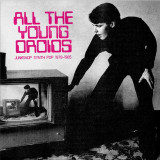
All The Young Droids: Junkshop Synth Pop 1978-1985 is a new compilation that charts the
underbelly of the epoch-defining sound of the synthesiser in 80s popular music. Compiled by Philip
King (previously seen compiling All The Young Droogs, Glitterbest and Boobs - The Junkshop
Glam Discotheque), the music here connects the dots between DIY synth enthusiasts grappling with
new, cheap synthesisers at the tail-end of punk and wannabe, jobbing songwriters enthral to the new
music pioneered by Gary Numan, Depeche Mode and Daniel Miller’s Mute Records. Featuring rare
tracks of auto-didactic progressive pop music, proto-techno punk, shoot-for-the-stars-land-in-the-gutter
chart flops and heralded, underground synth classics, School Daze paints a picture of beautiful failure.
Complete with extensive sleeve notes written by King and never before seen imagery, all 24 tracks
were remastered by RPM in-house engineer Simon Murphy, many from vinyl copies due to lost master
tapes. The story told on All The Young Droids is one of the dawning opportunity presented by both the
emergence to the market of cheaper analog synthesisers and the distribution networks plus indie labels
that exploded with the advent of punk music in 1976. While the music that sprouted out all over the
globe in the wake of these factors was decried as fake, plastic, a refutation of punk’s guitar-led
revolution, it’s telling that much of the music on All The Young Droids.. was created in bedrooms,
ramshackle studios and home-made set ups with often borrowed equipment. In the era of record labels
jumping to capitalise on the success of The Sex Pistols, The Clash (both on major labels, of course)
these artists struggled to stand out from a new gold-rush with next to no budget or PR team. With radio
and labels desperate for the new Yazoo, what resulted was a testament to necessity being the mother
of invention.

At the time, the synthesiser was the music of the future, a shiny new machine that could paint like an
orchestra with a single finger and a 4-track. In the hands of Manchester avant-pranksters Gerry & The
Holograms it’s a pulsing, sardonic weapon.. the only instrument on the Messthetics classic lampooning
of New Wave fashion. In Hamburg, a 16 year old Andreas Dorau used it to write and record (with his
female classmates on vocals) a global smash in Fred Vom Jupiter (later licensed to Mute Records).
The hard-to-find English version (Fred From Jupiter, natch) is included here. Many artists with alreadystoried careers caught the bug and recorded synthesiser-fuelled peons to space, computers, the future
and, of course, love-interests. Harry Kakoulli, late of Squeeze, recorded a solo album in 1979 that
included the incredible power-synth-pop smash-that-never-smashed I’m On A Rocket. Similarly, Ian
North of Neo and American Power Pop stalwarts Milk ’n’ Cookies bought a Korg MS20 and used a
tape machine to record We’re Not Lonely, an absolute lost-classic of minimal synth pop. We’re Not
Lonely also features on the Junkshop Synth Pop sampler 7” twinned with John Howard unreleased
track You Will See, released April 12th 2025.

There are plenty of compilation debuts in evidence. Sole Sister were a mysterious trio who were
featured on the Scaling Triangles compilation of female-fronted, queer-adjacent post-punk /
underground music that also featured The Petticoats. Selwin Image were from San Francisco and
featured members of the recently defunct power pop/punk group The Pushups. Their stupidly catchy
The Unknown fizzes with New Wave energy - think XTC to Sparks but remains unreleased until now.
Dream Unit’s A Drop In The Ocean is an early synth wave cut, positively teaming with Joy Division
instrumentation, previously only released on a long-forgotten and super rare, self-released EP.
Incandescent Luminaire’s Famous Names belies an archetypal struggle of a small-town trying to
make it in a cruel industry but is a thrilling New Romantic-Synth Wave cross over with a OMD
gloominess that’s a joy to hear. Feminist Minimal Wave track I Am A Time Bomb by performance artist
Peta Lilly and Michael Chance is a revelation destined for new found cult status. It was released on 7”
and lost until now.

The flipside to the subterranean, never-made-it synth pop mentioned above are the ambitious, even
fruity attempts at success that have a perennial elegance to their confidence. New Jersey-ite Billy
London (real name Ed Barth) tried to cash in on the synth boom with Woman, released by a major
label, a lurching new wave track built on the Louie Louie rhythm and a wonderfully camp Lou Reedstyle sleazy vocal before exploding in the synthesised chorus. The song bombed but with a chorus like
this, you have to wonder why? Ex-Glitter Band member John Springate’s My Life is truly epic, with
doomed chord progressions and massive sounding drums turning into at least 3 different songs in the
course of the track. Before you wonder what’s going on the song resolves with a glorious return to the
main refrain.

The dry-ice-dressed dance floor is well catered for too. Design’s Premonition and Vision’s Lucifer’s
Friend are stone-cold minimal synth bangers, well loved but given a new lease of life here. The
Warlord’s The Ultimate Warlord was released in 1978, a homespun proto Hi NRG banger that was
later re-recorded by The Immortals in Canada who had a club hit with it. One-man- band Disco
Volante’s No Motion was re-issued by Synth wave label Medical in 2012 but makes its first vinyl
compilation appearance here. Close your eyes and you can imagine what Lawrence of Felt would have
sounded like with some cheap Korgs a little earlier in his career. Gibraltar-based trio The Microbes
imagined a computer programming people to dance - how prescient - and ended up with a propulsive,
robo-funk track with splendid rubbery bass playing over a tectonic drum machine. Previously picked up
by Belgian label Stroom TV, Dee Jay Bert & Eagle’s heavily Euro-accented I Am Your Master
demands the listener to “come to paradise!” In a frankly terrifying manner.
All The Young Droids is the first compilation to peel away from the narrative that dour, Minimal Synth
and Cold Wave were the only musical children of the first rush of synth pop. Philip King and School
Daze Records describe a much more complicated world: along with the austere, Brutalist children of
Daniel Miller (who produced Alan Burnham’s Bowie-Low-influenced Science Fiction here) was a
plethora of desperate cash-ins, accidental mainstream hits, ambitious pop dramas and major label
punts that went nowhere. Crucially, the compilation blurs the line between junk and treasure. What if the
two things are interchangeable. What if it’s all science fiction?

out of Stock

Order now and we will order the item for you at our supplier.

Last In: 14 months ago
32,73 €
Gonçalo F. Cardoso - Impressões de Várias Ilhas (Recordings from Macaronésia)
  • 1: Bufadeiros de São Vicente (São Vincente, Cabo Verde)
  • 2: La Cueva Scuba Libre (La Gomera, Canarias)
  • 3: Chá da Gorreana (São Miguel, Açores)
  • 4: Noite em Rabo De Peixe (São Miguel, Açores)
  • 5: Pardelas - Dueto (La Gomera, Canarias)
  • 6: Rãs em Xoxo (Santo Antão, Cabo Verde)
  • 7: El Chat Gracioso (La Graciosa, Canarias)
  • 8: Cozido na Caldeira Velha (São Miguel, Açores)
  • 9: Salinas de Pedra Lume ( Sal, Cabo Verde)
  • 10: Noche en Punta Brava (Tenerife, Canarias)
  • 11: A Lagoa do Combro (São Miguel, Açores)
  • 12: Piedras Húmedas en Castro (Tenerife, Canarias)
  • 13: Digestão nas Furnas (São Miguel, Açores)
  • 14: O Peixe tá Congelado (Santo Antão, Cabo Verde)

After impressions of Unguja and Borneo islands, Discrepant's chieftain Gonçalo F. Cardoso continues his sonic travelogue on insularity with 'Impressões de Várias Ilhas’.

Literally translated as "impressions from various islands", this third tome dwells on recordings and inspirations from three archipelagos of Macaronésia. Soaking in the sounds and recollections from Azores, Cape Verde and Canary Islands these diaristic endeavours spread throughout a number of real environments, from water caves and black stone beaches and lagoons to small harbours and everyday life scenarios, to project them into this not quite imaginary but not quite real memory haze that goes from a deeply personal impression to a resonating one.

Melding raw field recordings with processed ones and synthesized landscapes, Cardoso never falters into sonic tourism, conjuring small-ish takes both vivid and dreamy, infused with a sense of wonder that feels both bewildering, comforting and escapist. The breaking waves of 'Bufadeiros de São Vicente' soothing in their irregular pattern, mingling with the lone echoing tones not completely removed from Black Dice's 'Beaches & Canyon's most pensive passages, flow into the underwater ambience and suspended pads of 'La Cueva Scuba Livre', as reflections of the same sea crashing in on different lands, nature’s psychogeography. Further on, the queasy warm chord and scraping murmurs of 'Noite em Rabo de Peixe' mirror their nighttime framing while 'Rãs em Xoxo' veers closer to pure musique concréte, crossed by a subdued feeling of unease that lingers in the nostalgia of 'Cozido da Caldeira Velha', brimming within the haze of a Boards of Canada vignette. Summoning the past lives and future hauntings of its scenery, 'Salinas de Pedra Lume' is like the quiet epic of the album, meandering into the unknown among crackling field recordings, decaying synths and flute-like howls - or is it howl-like flutes? - recurring as glimpses from foregone existences, not necessarily Gonçalo’s own. Maybe ours?

Music & Photography by Gonçalo F. Cardoso
Artwork layout by Jeroen Wille
Master by Rashad Becker

Discrepant 2025
Pressed in Spain

pre-order now25.07.2025

expected to be published on 25.07.2025

19,29 €
Radio Species - Compressed Knowledge (TAPE)

Scavenger tones and scrambled cassette residue drift across the surface of Compressed Knowledge, a quietly astonishing new work by Philadelphia-based sound artist Tyler Games, operating here as Radio Species. Following releases on Regional Bears, Irrational Tentent, and his own now-defunct Born Physical Form imprint, Games works in a space between musique concrète, tape collage, and microsound, using an economy of gesture to create a suite of fundamentally elusive compositions. Harmonic loops stutter and fold in on themselves, hazy rhythms break free from their clocks, snatches of speech cut out mid-thought as a layer of room tone and tape gunk holds everything in suspension. There’s a sense of broadcast without a source, flickering across half-tuned frequencies––hinting at formal structures while continually slipping away from them. The result is not archival in the traditional sense, but archaeological: these tracks are partial objects, pulled from the noise floor of memory. In its refusal to resolve into stable meaning or musical form, this is work that draws from traditions of sound ethnography, experimental documentation, and concrète montage––where listening itself becomes a mode of speculative reconstruction.

pre-order now18.07.2025

expected to be published on 18.07.2025

10,88 €
PARADE - Lightning Hit The Trees

PARADE is an 8-piece group, predominantly from Brighton and now based in London. Its members - who are all involved in their own capacities in music, art, fashion, design and more - have been making music since they met at college in Brighton, flipping records and making beats in founding member Jago’s attic room. Since then the sound has evolved to incorporate live instrumentation alongside electronic elements. Though always collaborating in each other’s orbits, PARADE was fully formed when all members gravitated towards South-East London, scattering around in musically less mythologised areas across Nunhead, Forest Hill, Camberwell and Norwood.

Lightning Hit The Trees is the band's debut mixtape, and was entirely written, produced, engineered, and mixed in just two weeks. It was recorded in a shipping container in Forest Hill on basic, often broken, equipment with ideas often formed in the moment. As demonstrated by these two first singles, the mixtape pulls together a body of music that incorporates a wide range of ideas from a group of inventive, inspired new artists and comes together in a remarkably clear and unified vision. The mixtape is guided by uncanny valleys, cinematic tones, “hyper-real” mixing techniques, and by a light with no shadow. Influences include: Wim Wenders, Juergen Teller, Velvet Underground, Radio Dept., Scott Walker, Magliano, Soft Machine, This Heat, Pixies, John Cassavetes, Domenico Gnoli, Dadaists, Judy Garland, Cindy Lee, Arca, Bette Davis, Sun Ra.

pre-order now18.07.2025

expected to be published on 18.07.2025

23,49 €
Zelooperz & Real Bad Man - Dear Psilocybin LP
  • A1: Dear Psilocybin
  • A2: World Blew
  • A3: In The Wind (feat. The Alchemist)
  • A4: Sweet Celine
  • A5: Explains it Scientifically
  • A6: Lost All Control
  • B1: Accidental Killer
  • B2: Hansel & Gretel" (feat. Boldy James)
  • B3: Trenchblade
  • B4: Past Life (feat. Mavi)
  • B5: Buggin
  • B6: Kingdom Come (Hyping Me Up)
  • B7: Arîba! Arîba!

LA-based producer Real Bad Man and Detroit artist ZelooperZ release their joint album Dear Psilocybin via the pro-ducer’s own Real Bad Man Records. The album marks the duo’s first collaboration, culminating in a full-length project that also features guest appearances from Boldy James, MAVI and a verse from The Alchemist. On Dear Psilocybin, ZelooperZ invokes unconventional production out of Real Bad Man to match his own unpredictable and outlandish delivery, working outside of traditional song structures and existing in a lane of his own. The Detroit multihyphenate, who is an integral part of Danny Brown’s Bruiser Brigadecollective and also an accomplished visual artist, painted the album’s corresponding cover artwork as well.

“I definitely haven’t made anything like this before, it’s a very subtle version of my music as far as tone, ” ZelooperZ explained in a conversation with Real Bad Man for his RBM Radio show. He elaborates on the off-kilter approach to the way he recorded to say, “the album feels like a movie soundtrack for a film about a man losing his mind and getting spurts of memories along the way. ”

Speaking about how the project differs from the rest of his collaborative catalog, RBM says, “It’s trippy and it’s a little different – but the main goal was for it to be authentic to Z and his process. ” That dedication to authenticity rings true across his catalog, drawing back to the foundations of his beginnings as a producer, learning the fundamentals of sampling, experimenting with chords and learning to piece songs together by ear. RBM builds a cohesive production arc around each artist he works with, catered to their strengths as artists, working with a variety of lyrical stylists includ-ing Memphis rapper Lukah, Pink Siifu, Blu, Kool Keith, Elcamino & more.

Real Bad Man is the production moniker of visual artist and designer Adam Jay Weissman. A designer and visual artist first, he made his foray into music through his On High Alert series of imaginative, multi-generational compilations, which have featured the likes of Roc Marciano, ROME STREETZ, Pink Siifu, Maxo and more. In the years since, he’s partnered with some of hip-hop’s most talented and adventurous artists on full-length projects, refining and shaping the trajectory of some of rap’s most exciting independent artists.

pre-order now04.07.2025

expected to be published on 04.07.2025

30,04 €
VARIOUS - ALL THE YOUNG DROIDS: JUNKSHOP SYNTH POP 1978-1985 (LP 2x12")
 
24
also available

MB Crystal Vinyl[32,73 €]

LTD Trans Pink Vinyl[27,69 €]


Compiled by Philip King
“And then came the rise of synth pop : blokes with dodgy haircuts hunched over keyboard-operated
machines stuffed with wires and do-it-yourself tone oscillators making sounds like a brood of geese
passing gas in a wind tunnel. Whoopee! This is the way the ‘70s ended : not with a blood-curdling bang
bang but with a cheap, synthesized, emasculating whimper.”
NICK KENT, NME.

All The Young Droids: Junkshop Synth Pop 1978-1985 is a new compilation that charts the
underbelly of the epoch-defining sound of the synthesiser in 80s popular music. Compiled by Philip
King (previously seen compiling All The Young Droogs, Glitterbest and Boobs - The Junkshop
Glam Discotheque), the music here connects the dots between DIY synth enthusiasts grappling with
new, cheap synthesisers at the tail-end of punk and wannabe, jobbing songwriters enthral to the new
music pioneered by Gary Numan, Depeche Mode and Daniel Miller’s Mute Records. Featuring rare
tracks of auto-didactic progressive pop music, proto-techno punk, shoot-for-the-stars-land-in-the-gutter
chart flops and heralded, underground synth classics, School Daze paints a picture of beautiful failure.
Complete with extensive sleeve notes written by King and never before seen imagery, all 24 tracks
were remastered by RPM in-house engineer Simon Murphy, many from vinyl copies due to lost master
tapes. The story told on All The Young Droids is one of the dawning opportunity presented by both the
emergence to the market of cheaper analog synthesisers and the distribution networks plus indie labels
that exploded with the advent of punk music in 1976. While the music that sprouted out all over the
globe in the wake of these factors was decried as fake, plastic, a refutation of punk’s guitar-led
revolution, it’s telling that much of the music on All The Young Droids.. was created in bedrooms,
ramshackle studios and home-made set ups with often borrowed equipment. In the era of record labels
jumping to capitalise on the success of The Sex Pistols, The Clash (both on major labels, of course)
these artists struggled to stand out from a new gold-rush with next to no budget or PR team. With radio
and labels desperate for the new Yazoo, what resulted was a testament to necessity being the mother
of invention.

At the time, the synthesiser was the music of the future, a shiny new machine that could paint like an
orchestra with a single finger and a 4-track. In the hands of Manchester avant-pranksters Gerry & The
Holograms it’s a pulsing, sardonic weapon.. the only instrument on the Messthetics classic lampooning
of New Wave fashion. In Hamburg, a 16 year old Andreas Dorau used it to write and record (with his
female classmates on vocals) a global smash in Fred Vom Jupiter (later licensed to Mute Records).
The hard-to-find English version (Fred From Jupiter, natch) is included here. Many artists with alreadystoried careers caught the bug and recorded synthesiser-fuelled peons to space, computers, the future
and, of course, love-interests. Harry Kakoulli, late of Squeeze, recorded a solo album in 1979 that
included the incredible power-synth-pop smash-that-never-smashed I’m On A Rocket. Similarly, Ian
North of Neo and American Power Pop stalwarts Milk ’n’ Cookies bought a Korg MS20 and used a
tape machine to record We’re Not Lonely, an absolute lost-classic of minimal synth pop. We’re Not
Lonely also features on the Junkshop Synth Pop sampler 7” twinned with John Howard unreleased
track You Will See, released April 12th 2025.

There are plenty of compilation debuts in evidence. Sole Sister were a mysterious trio who were
featured on the Scaling Triangles compilation of female-fronted, queer-adjacent post-punk /
underground music that also featured The Petticoats. Selwin Image were from San Francisco and
featured members of the recently defunct power pop/punk group The Pushups. Their stupidly catchy
The Unknown fizzes with New Wave energy - think XTC to Sparks but remains unreleased until now.
Dream Unit’s A Drop In The Ocean is an early synth wave cut, positively teaming with Joy Division
instrumentation, previously only released on a long-forgotten and super rare, self-released EP.
Incandescent Luminaire’s Famous Names belies an archetypal struggle of a small-town trying to
make it in a cruel industry but is a thrilling New Romantic-Synth Wave cross over with a OMD
gloominess that’s a joy to hear. Feminist Minimal Wave track I Am A Time Bomb by performance artist
Peta Lilly and Michael Chance is a revelation destined for new found cult status. It was released on 7”
and lost until now.

The flipside to the subterranean, never-made-it synth pop mentioned above are the ambitious, even
fruity attempts at success that have a perennial elegance to their confidence. New Jersey-ite Billy
London (real name Ed Barth) tried to cash in on the synth boom with Woman, released by a major
label, a lurching new wave track built on the Louie Louie rhythm and a wonderfully camp Lou Reedstyle sleazy vocal before exploding in the synthesised chorus. The song bombed but with a chorus like
this, you have to wonder why? Ex-Glitter Band member John Springate’s My Life is truly epic, with
doomed chord progressions and massive sounding drums turning into at least 3 different songs in the
course of the track. Before you wonder what’s going on the song resolves with a glorious return to the
main refrain.

The dry-ice-dressed dance floor is well catered for too. Design’s Premonition and Vision’s Lucifer’s
Friend are stone-cold minimal synth bangers, well loved but given a new lease of life here. The
Warlord’s The Ultimate Warlord was released in 1978, a homespun proto Hi NRG banger that was
later re-recorded by The Immortals in Canada who had a club hit with it. One-man- band Disco
Volante’s No Motion was re-issued by Synth wave label Medical in 2012 but makes its first vinyl
compilation appearance here. Close your eyes and you can imagine what Lawrence of Felt would have
sounded like with some cheap Korgs a little earlier in his career. Gibraltar-based trio The Microbes
imagined a computer programming people to dance - how prescient - and ended up with a propulsive,
robo-funk track with splendid rubbery bass playing over a tectonic drum machine. Previously picked up
by Belgian label Stroom TV, Dee Jay Bert & Eagle’s heavily Euro-accented I Am Your Master
demands the listener to “come to paradise!” In a frankly terrifying manner.
All The Young Droids is the first compilation to peel away from the narrative that dour, Minimal Synth
and Cold Wave were the only musical children of the first rush of synth pop. Philip King and School
Daze Records describe a much more complicated world: along with the austere, Brutalist children of
Daniel Miller (who produced Alan Burnham’s Bowie-Low-influenced Science Fiction here) was a
plethora of desperate cash-ins, accidental mainstream hits, ambitious pop dramas and major label
punts that went nowhere. Crucially, the compilation blurs the line between junk and treasure. What if the
two things are interchangeable. What if it’s all science fiction?

out of Stock

Order now and we will order the item for you at our supplier.

Last In: 10 months ago
27,69 €
Civilistjävel! x Mayssa Jallad - Marjaa: The Battle of the Hotels (Versions)

Civilistjävel! x Mayssa Jallad’s ‘Marjaa: The Battle of the Hotels (Versions)’ is a radical response to Mayssa Jallad’s 2023 original LP, a lyrical account of epochal events in Beirut at the dawn of Lebanon's civil war. ‘…(Versions)’ sees Civilistjävel! (aka Swedish producer Tomas Bodén) apply a stripped, dub methodology to Mayssa's rich stems, refracting the Arabic source through the hazy prism of Northern European electronica. Retaining ‘Marjaa…’s deep spatial framing and vaporous, shifting nature, traces are lifted and set down in a new landscape: a ghost of a ghost. Informed by Tomas' singular strand of ambient, minimalist, dub techno, ‘… (Versions)’ recalls the reductive, shimmering pulse of pioneering Berlin-based practitioners Basic Channel/Chain Reaction, but with the parameters stretched into the ether. Where versions typically focus on a rhythm, here the anchor is the tone and texture of Mayssa’s voice, around which a new world has been constructed. Disembodied and liminal, it conjures an eerie panorama that feels like a postscript to the original, further emphasizing the geopolitical events that have had such devastating effect in Mayssa’s homeland of Lebanon since that record’s release. ‘Marjaa…’ (tr. ‘reference’) combined Mayssa Jallad’s two main vocations: music and urban research/architectural history. The album was co-written with Fadi Tabbal and based on Mayssa's Historic Preservation master's thesis (‘Beirut’s Civil War Hotel District: Preserving the World’s First High-Rise Urban Battlefield’). The thesis examined a 5-month conflict that took place within Beirut's skyscraper-laden luxury hotel district of Minet El Husn near the start of the Lebanese Civil War. Addressing a post-war generation who have never been taught this difficult history, ‘Marjaa…’ was an attempt to process trauma, and “a call to protest for the renewal, rather than the recycling of the political class that once destroyed the country and holds us, to this day, hostage of its violence.” Often perceived as a mysterious, shadowy presence, Civilistjävel! has come increasingly to the fore in recent years through a consistently dazzling stream of records, released both anonymously and via Fergus Jones’ FELT imprint, often appearing with scant information and tracks for the most part untitled. Having featured tracks from ‘Marjaa…’ on mixes, and included the album in his picks of 2023, in early 2024 Tomas asked Mayssa to provide vocals for a track on his album ‘Brödföda’. Mayssa remembers, “Tomas asked me to choose one of the tracks he was working on. I was in Boston at the time, so I took a walk and chose a track. I wrote the lyrics at the public park, wondering if I was the only one around that was losing sleep over the genocide in Palestine and the war in South Lebanon. I went back to the apartment and recorded the vocals on my phone, while listening to the track on headphones. Tomas reworked it with the voice and sent it back. I liked it immediately.” Despite the geographical distance from Beirut to Uppsala, Sweden, where Tomas resides, Mayssa’s contribution sounds very much at home in Civilistjävel!’s atmospheric, contemplative sound-world. Tomas’ request was reciprocated by Mayssa soon after, resulting in the spectral, glassy ambience of ‘Etel, Kharita (Version)’. This was followed by an invitation to work on more tracks, which Tomas immediately embraced, intensively jamming out versions live to two-track tape in downtime between travelling. If not entirely dissimilar to his regular working practice, the immediacy of it was unusual. Much was improvised live with just a keyboard (not tethered to a grid), and a restricted set-up that largely forbade later edits - only the rhythm tracks are programmed. A sharp conceptual thinker and composer, Tomas takes creative liberties with Mayssa’s songs in a way that is deeply felt and sympathetically aligned, whilst unashamedly outside of the original context of the record. The voice is leaned into as an instrument, without the clear, specific details of language, and this axis provides an uncertain, amorphous footing - structure is often suggested or hinted at, before disappearing or collapsing into fog, and folding back into the message within the song. A somewhat unprecedented source for an album of versions, even those familiar with ‘Marjaa: The Battle of the Hotels’ may at points struggle to hear the songs these versions are rebuilt from, despite the vocal narratives remaining virtually intact. The light has shifted; eroded buildings are foregrounded; fragments of memories appear in chiaroscuro. Signs and signifiers have been replaced. Shorn of the original's warm guitar, ‘Baynana (Version)’ feels like an ominous visitation, the sun no longer visible. ‘Holiday Inn (March 21 to 29) (Version)’ is a molten, clattering invocation. The beat-less tracks nod towards the cold, otherworldly sound-scaping of late '90s isolationism. More propulsive and embodied, ‘Holiday Inn (January to March) (Version)’ and ‘Kharita (Dub)’ are strobing, iridescent techno - lithe, shifting and mutating with almost implausible finesse. A stunning addition to Civilistjävel!’s growing catalogue, ‘…(Versions)’ is a luminous counterpoint to ‘Marjaa…’, and a welcome reminder of how incredible that record remains.

out of Stock

Order now and we will order the item for you at our supplier.

Last In: 14 months ago
25,17 €
Isaiah Collier, William Hooker, William Parker - The Ancients LP 2x12"

The debut recording by The Ancients, the intergenerational coalition of Isaiah Collier, William Hooker, & William Parker formed by parker to play concerts in conjunction with the milford graves mind body deal exhibition at the institute of contemporary art los angeles & now a working group. across x2LPs of side-length long-form improvised sets recorded at 2220 arts & archives in LA & the chapel in San Francisco, The Ancients bring the free jazz trio languages first explored by the Cecil Taylor Unit & Ornette Coleman’s -Golden Circle- band (expanded upon in later eras by Sam Rivers' Trio & Parker’s collective trios with Charles Gayle/Graves & Peter Brötzmann/Hamid Drake) into their own unique & scintillating realms of expression.

As we tumble further into the throes of history’s tides, people of hope & creativity rely on the works of our great artists to lift our spirits & focus our resolve. -ascension- was recorded less than a year after the passage of the civil rights act & four months after the assassination of Malcolm X. -journey in satchidananda- was recorded the month reagan was re-elected governor of California. M’boom made its debut recording weeks after the watergate scandal broke & a couple months after the wounded knee occupation ended. The music of the ancients builds on these great musical legacies. it resounds with the pride of survival & the joys of making & sharing music. It delivers to us hope & balm. something real in you, real in history, & real in the music is shared, right on time.

When Eremite records commenced operations during the 1990s free jazz resurgence, heavyweight freedom-seeking tenor saxophonists such as Fred Anderson, Peter Brötzmann, Charles Gayle, Kidd Jordan, & David S. Ware were at the height of their powers. Isaiah Collier’s tenor playing in the ancients is bracing testimony that the wellspring lives on. to hear the young chicago firebrand blowing freely with veteran improvisers in an entirely open-form group music is a revelatory study of his vast talent, personal voice, & the intensity of his expression —as well as a bold complement to his composition-based albums as a bandleader (including -the almighty-, a new york times' best albums of 2024 selection).

I've admired drummer William hooker since first encountering his music in a hartford ct city park, early ‘90s (on a double bill with Jerry González & Fort Apache Band). From the man himself right off the bandstand i bought his even-then rare 1st recording, the 1976 self-released x2LP opus -is eternal life- (reissued 2019 by superior viaduct). An imposing force on his instrument & an intrepid DIY cat, Hooker’s been exuberantly swinging in&out of free time for 50+ years. informed by the innovations of Sunny Murray & Tony Williams yet entirely himself, there is no other term for it than “pure hooker.” at age 78, with the ancients & everywhere else, THE HOOK is in peak form.

With a discography approaching 600 entries & 50+ years working across the musical maps, including in the history-defining bands of Don Cherry, Cecil Taylor, Bill Dixon, Peter Brötzmann, in his own wondrous ensembles from small group to orchestra to opera, a bastion of compassionate leadership & a poetic champion of his musical community, in tireless service to what he rather egolessly refers to as “the tone world”, multi-instrumentalist, improviser & composer william parker is a living hero of the grassroots & the black mystery musics, not to mention one of the great bassists in the history of jazz. To quote George Clinton, conquering the stumbling blocks comes easier when the conqueror is in tune with the infinite.

Live to 2-track concert recordings by Bryce Gonzales, Highland Dynamics. Mastered by Joe Lizzi, Queens, NY.

out of Stock

Order now and we will order the item for you at our supplier.

Last In: 7 months ago
30,21 €
Various - LCR001

Various

LCR001

12inchLCR001
Le Chatroom
13.06.2025

Le Chatroom, a record label established in 2016 by the English producer Kouslin, searches for the missing link between underground bass music and outer national sounds. Its music is defined by the blend of synthetic and organic tones, modern / classic instruments and low- end heavy percussive rhythms.

Pushing artists from all around the globe that share the same love for this newfound sound, Kouslin's aim with Le Chatroom is to promote musical diversity, open-mindedness and experimentation at a time when unity between cultures is crucial. With 'LCR001' the label advances into a new physical environment from which this release should be experienced.

Real talk and native percussion establish the steady climax of 'Brothers', the A-side of Le Chatroom's inaugural wax release. Kouslin cuts through this sediment with a bright flute, before the state of the sound switches into something far darker and meditative. By placing several samples at irregular intervals, the Londoner achieves a fascinating charm that'll unite us all.

Booming bass in 'Gyals' lingers with a steady pace while percy tribal hits forge a raw groove that's far from common. With this movement, the producer from Bristol disintegrates the sense of a generic production and sticks to his true nature. Through this it becomes clear that Galtier has his polyrhythms down to a science.

Londoner Sheik clinches the B-side with a craze that unveils a nearly psychotic sense of sample architecture. Pushing crystal clear 808 kicks in- between the haunting atmospheres and a wall of pressure simply becomes one of his most inventive takes documented on wax. If you love to swerve through a minefield, the odd 'Oxram' would be your favourite pick off this first outline.

The three producers that feature on 'LCR001' pass on their fundamentals to conjure Le Chatroom's philosophy red-handed. Together they do the imprint's name justice by handing over critical bass repertoire that'll excite many!

out of Stock

Order now and we will order the item for you at our supplier.

11,72 €
Dreams - Dangerous When Wet

Spectral Bounce’s fifth instalment comes courtesy of L.A.’s rave archivist and dancefloor operative Dreams, A.K.A. Jesse Pimenta. Throughout his decade-long career the California native has inspected, dissected and concocted all manner of dance musics, leaving his mark with drops on Apron Records, Pinkman, BANK NYC and his own imprint Dance Data. On SPEC05 — Dangerous When Wet — he hijacks the synapses with 4 accomplished productions, plotting a high BPM course through manifold styles using the raw aesthetic that characterises his output.

“Losing Control” is a frenetic dancefloor invitation, immediately locking into a pacing groove. Beneath wild hand drums, Dreams plays with an insistent 303 bassline alternating between rasping buzz and oily squelch, while stern vocals are layered on top of breaks that have been processed to a viscerally satisfying end.

Taking things from delirious dance circle to underwater biosphere, the EP’s eponymous track explores a submerged 1980s Miami. Weighty & enveloping, “Dangerous When Wet” is pure aquatic pop-n-lock — hydraulic electro for a drowned world. Ocean floor caustics are transmuted into auditory form: arpeggios bubble up; drones shimmer mystically; hi-hats hiss like air from an open valve. Amongst the sonar bleeps, a barrage of pummeling low-end is sure to give subwoofers a workout.

“XTC Messenger” delivers an infectious paranoid dispatch, astutely balancing the sensual with the deranged. A slow-mo dial tone unfolds languidly, running counter to nervously twitching high frequencies. Its punchy percussion is tuned for maximum dopamine release; the track’s abrupt vocal chops and mechanical kick-snare pulsation evoke the leather jackets and jagged edges of 1980s industrial discotheque.

“Pressure Points” closes the EP on a heady and mesmerising polymetric trip. The parting track is a lithe yet spacious number, propelled by a rattling break. Here Dreams follows from track 2, creating an immersive environment in which sounds tightly twist and twirl. Shifting oscillators call out like tiny creatures as the bass throbs and wriggles further into your brain, long after the needle hits the runout groove.

out of Stock

Order now and we will order the item for you at our supplier.

Last In: 7 months ago
13,03 €
Daniel O’Sullivan - Eros (LP)

WOW. Daniel O'Sullivan's transcendent new album, Eros, is one of the greatest things we've ever heard. A simply stunning song cycle of hypnotic, experimental contemporary chamber music composed for a 14-piece ensemble. Combining minimalism, complex syncopation, detailed acoustic textures, weird intervals and samurai precision, this record will elegantly blow your mind. When Daniel first sent us this, he pitched it as “Liquid Swords meets Michael Nyman”. Trust us, he wasn't wrong. A "unique hybrid orchestral music", it presents a confluence of Daniel's longstanding fixations; indeed, there's elements of Nyman, Antonio Carlos Jobim, Magma, Aaron Copland and RZA. But this is wholly O'Sullivan's. Originally commissioned for the Sonoton Music Library in Munich, Eros now receives a deluxe vinyl release courtesy of Be With Records, bringing this meticulously crafted work to a wider audience. Limited to just 500 copies for the world, these are gonna fly.

An English composer and multi-instrumentalist, Daniel O'Sullivan’s career has been marked by versatility and innovation. In addition to his work with Sonoton, he has composed extensively for the legendary KPM music library, contributing to its storied legacy of production music. As a deep virtuoso and collaborator, O'Sullivan has also played in a number of influential projects, including Ulver, Sunn O))), This Is Not This Heat, Grumbling Fur and Miracle (with Steve Moore), leaving an indelible mark on the contemporary experimental music landscape.

O’Sullivan’s first foray into classically informed chamber music, Eros is a culmination of his long-standing fixations and expansive musical influences. The album features arrangements that are as detailed as they are emotionally resonant, showcasing his unparalleled ear for intervals and mastery of counterpoint. The music brims with complex rhythmic syncopation and a sensitivity to texture and space, resulting in a soundscape that is both intoxicating and dauntingly precise.

Recorded June 2023 and February 2024, in Brussels, London and Carmarthenshire, Wales, Eros features members of Echo Collective (Neil Leiter and Margaret Hermant), Thighpaulsandra (from seminal post-industrial band Coil), and jazz pioneer Oren Marshall. Daniel's sonic weapons of choice, in his own inimitable words, were "Big Bad Drum, Pee Anne Oh, Low End Brass, Willowy Winds & Samurai Strings." You get the picture. As a cyclical suite, this is a record that really needs to be heard in its entitreity, from start to finish, to truly appreciate the genius at work here.

A jaw-dropping statement of intent, the minimalist "Golden Verses" sets the tone with its complex cue which has your neck snapping right when it feels like it needs to. Listen and you'll understand. A syncopated tangle of sharp strings, crunchy bass, drums percussion and bright piano and mallets vie for position with French horn and woodwind melody in the most compelling and unexpected ways. Quite simply, it's one of the finest album openers I've ever heard. It's followed by the atmospheric rippling minimalism of "Lyre Lyre", a gorgeous gem with shimmering chimes, bright melody, human percussion and syncopated pizzicato strings. It kinda comes on like a less-abstract Boards Of Canada, bursting with typical wonderment. The piano and string-drenched "Dolorous Stroke" effortlessly builds its warm, pastoral orchestration with flowing piano arpeggio, steadfast drums, expressive string quartet, rich low brass, woodwind and lyrical flute. Just sublime.

The insistent frenetic propulsion of "Plain Paper" is utterly beguiling, featuring a determined string motif, urgent drums and percussion, driving low brass and breathless, energetic flute. The haunting, interweaving string arpeggios that propel "Grapes Draped" presents a claustrophobic minimalism for chaos and darkness, with growling low woodwind and brass, spiky harpsichord, skittering flutes and tight drums. Up next, "Xanix Annum" is a stately minimalist waltz with expressive lyrical string quartet and delicate woodwind, anchored by drums and percussion. "Painting Rose" is a bouncy stop-start track with angular syncopated strings and a piano pulse underneath bright harpsichord and flutes. "Rotunda Garden" presents ethereal textural minimalism for landscapes and reflection with flowing string arpeggios, warm, low woodwind drones, floating choir and cymbal swells. Closing out this extraordinary side of music, the glowing, flowing minimalism of "Flowry Orb" features urgent organ, piano and woodwind arpeggios, half-time drums with shimmering cymbals, a soaring, beautiful violin solo and hypnotic vocal chant.

Side 2 opens with "Theia Mania" a determinedly off-kilter, angular track featuring low wind, brass and drum stomp in dialogue with lively string trio, woodwind and solo horn. The light, airy minimalism of "Painting Percy" is built around an interplay of rhythmic motifs for piano, low brass, bassoon, fluttering flutes, urgent strings, drums and percussion whilst "For Archetypes" is a delicate, gently syncopated chamber cue for nostalgia, nature, reflection and moments of calm, with steady piano motif, intimate woodwind and French horn, and warm, graceful strings. The urgent Ars Memoriae is a propulsive march for progress, processes and industry, underpinned by driving tuba, with determined strings, resolute drums, and vivid, expressive flute, clarinet and French horn.

The syncopated energetic minimalism of "Mirrored Seven" presents layers of melodic and cyclical piano, drums, low brass, harp, flute and strings. "Pure Ornament" follows, a slowly evolving chamber cue with flowing clarinet, string and harp arpeggio, plodding tuba and percussion, fluttering flute and graceful, lyrical solos. Stunning! Up next, "Brave Boy" moves from its tender, warm, lullaby-like intro with lyrical flute, clarinet and strings before opening into a playful backend driven by a bouncy tuba riff and syncopated piano, woodwind, string trio, and drums and percussion. Rounding out this astonishing piece, "Waxen Waned" is a warm, pastoral chamber cue with light lyrical woodwind, tender French horn and subtly pulsing string trio.

The album's title is a reference to Plato’s conception of Eros, which is more than romantic or physical desire. It is a dynamic and creative force that drives individuals to seek perfection whether in art, relationships, philosophy or the pursuit of truth. Wholly appropriate, here, we think. When asked what his influences were in making this astounding record, he answered thusly: "Non-musical: Householding, Pythagoras, Goethe, Grail romances, Hermeticism, Doctrine of Signatures (Parcelsus, Bohme, Pliny), Eric Rohmer, John Stezaker, Yasujiro Ozu. Musical: Duke Ellington (late suites), Smile-era Brian, early RZA, Wagner (Parsifal Overture), Magma, Mancini, Axelrod, YMO, Hildegard, Nyman, Penguin Cafe Orchestra, Jobim (Stone Flower), Alessandro Alessandroni, Tavener, Moondog, Orthodox Music, Secular Music." That's some pretty deep shit. Makes you want to dive in, no?

Mastering for this vinyl edition was overseen by Be With regular Simon Francis, and it was cut by the esteemed Cicely Balston at Abbey Road Studios to be pressed in the Netherlands by Record Industry. Truly, Eros is a work of extraordinary depth and sophistication. It invites listeners to immerse themselves in its intricate layers, to lose themselves in its hypnotic rhythms, and to marvel at the precision of its execution. With this release, O’Sullivan reaffirms his position as one of the most inventive and uncompromising voices in contemporary music. Do. Not. Sleep.

pre-order now23.05.2025

expected to be published on 23.05.2025

26,85 €
GIGI FM - VIRGO SPACE ACID

Gigi Fm

VIRGO SPACE ACID

12inchSRN003
SEA~RÈNE
21.05.2025

Following the first two releases on Sea~rène, GiGi FM returns with “Virgo Space Acid”, a deeply personal and sonically assertive exploration of transformation and healing.

Rooted in the energies of 2025, the Year of the Snake, this four-track EP channels the mystery and intuition of the serpent, weaving together Virgo’s archetypal forces of the healer and the alchemist.


Across driven beats, hypnotic acid sequences, and vocal-infused textures, “Virgo Space Acid” reflects a journey of renewal, self-ownership, and inner power.

From Berghain to The Bunker New York, GiGi FM has long been known for her ability to channel movement into sound. With “Virgo Space Acid”, she refines her craft even further, working with fewer elements yet pushing them to their fullest expressive potential. She explores the full range of her voice, shaping it into textures, atmospheric layers, and even percussion, while separately reworking classic 909 drum machine sounds into something entirely her own. This EP is a statement of both discipline and liberation, where minimalism meets deep transformation.


Opener “Calibration” sets the tone with its mantra-like intention: an invitation to realign and tune into one’s own energy. Built around a driving bassline, nostalgic yet forward-moving synths, and GiGi’s own spoken word, “A breath holds time, calibrates space”, the track creates a moment of clarity before the journey begins.

“Mercury” follows, embodying the trickster, the messenger, the shapeshifter. Playful and urgent, its bouncing synth sequences move like conversations in motion, with rising tones driving the track forward, pushing toward a restless ascension that mirrors Mercury’s role as a bridge between realms, both celestial and internal.

The title track, “Virgo Space Acid”, is the wormhole: the brain battle, the transformation. With a heavyweight 303 bassline, spiraling bleeps reminiscent of birds, and powerful classic 909, it is pure tension and release, an acid-drenched trip through motion and evolution.

Closing the record, “Floresta” is a sensual and grounding moment of reflection. Named after the stage at Waking Life Festival where GiGi felt a pivotal shift in her healing journey, the track mirrors the scene with dub chord sequences, emotional rising pads, and percussive vocal elements. Like the purple and pink drapes floating above the dance floor at sunset, Floresta is both a farewell and a prelude, a misty horizon where one chapter closes and another awaits.

With “Virgo Space Acid”, GiGi FM continues to expand her sonic language, deepening her connection between body, rhythm, and transformation. More assertive, more urgent, yet deeply intuitive, this is a record of movement, clarity, and self-empowerment.


"We are Sea~rène, swimming in-between supernatural tides, forever following the emotional waves of the universe." GiGi FM

out of Stock

Order now and we will order the item for you at our supplier.

Last In: 5 months ago
13,66 €
J.H. GURAJ - THE FLIP SIDE
  • 1: Leap Of No Faith
  • 2: Ask The River
  • 3: Way Too Long Goodbye
  • 4: Spleen On Speed
  • 5: You Got It All Wrong So Did I
  • 6: Fake AF
  • 7: Slowdown Attempts
  • 8: Nothing I Can Do But Flow
  • 9: Everything Sideways
  • 10: Us As Ghosts

Sometimes records reflect life with an unsettling precision, your own breath sticking to a mirror, confounding or transforming reality. J.H. Guraj, real name Dominique Vaccaro, is back with ‘The Flip Side’, an accomplished work of grace and sprawling elegance documenting struggle and a near-death experience that summons ghosts of Western primitive masters, rollicking free folk, minimalist orchestrations, weeping guitars and smooth psychedelics.

Time stopped for J.H. Guraj in 2021 following a brush with mortality, extensive forced recovery and subsequent hints of depression after an almost fatal bike crash, leaving our wandering soul, once again, at the edges. While his previous record ‘Introspection / Migration’ hinted at Middle-Eastern influences and merged the artists’ Arbëreshë upbringing with stoic ecstasis, free-form structures and guitar wizardry under sepia tone curtains, ‘The Flip Side’ twists, turns, falls down and rises to new heights, the widescreen breadth of Dominique Vaccaro’s cinematic vision projects new colours, a stark contrast of pastoral emerald green and pitch black asphalt, urban decay and mercurial mystery.

Like passages from some archaic songbook what astonishes is how detailed the new compositions are, a warm embrace like ‘Way To Long Goodbye’, counterpoint pianos leading the way down a Gershwin avenue; ‘You Got It All Wrong So Did I’ with its Van Dyke Parks arrangement; the 9 minute epic ‘Us As Ghosts’ a haunting ballad that resolves into kosmische landscapes; the muted symphony of ‘Fake Af’ and the spectral disorientation of ‘Nothing I Can Do But Flow’. Gentle drumming from collaborator Gianluca Panici augment the eeriness of ‘The Flip Side’, motions that create a sense of suspension and yearning.

pre-order now16.05.2025

expected to be published on 16.05.2025

29,20 €
Sebastian Mullaert - K-FILES 01

Sebastian Mullaert

K-FILES 01

12inchK-FILES001
Kontra Musik
15.05.2025

"Sebastian Mullaert has always favoured the long arc: of tracks, of creative cycles, of artistic trust. His next chapter unfolds in the form of a new vinyl only label, born in close collaboration with Ulf Eriksson - his longtime friend, ally and the steady pulse behind Kontra Musik, a label that's been both home and launchpad for many of Mullaert's most vital releases. K-Files is built on two foundations: singularity and multiplicity. Every release will present a single track refracted through three or four different versions - each one approaching the core idea from a distinct creative angle. These are tools not just for DJs, but for listeners who hear dance music as more than just rhythm - as mood, as exploration, as transformation. The first release, K-FILES 01, sets the tone: deep, dubby, and spacious, it invites patience and immersion. But like all good rituals, the process will shift. Future releases are already poised to explore other territories: sharper energies, stranger grooves, unexpected colours. In a world increasingly defined by instant access and digital saturation, K-Files stands intentionally apart - a slower offering. A return to physicality, to process, to the tactile rituals of listening, selecting, and playing music with care. K-Files is a sublabel for those who play records not just to move bodies, but to open space. A platform for sonic evolution, variation, and perspective. A place where dance music is not pinned down - but opened up. Each record will be released exclusively on vinyl."

out of Stock

Order now and we will order the item for you at our supplier.

Last In: 15 months ago
13,03 €
Yui Onodera - Kiso Three Rivers LP

Yui Onodera

Kiso Three Rivers LP

12inchFIELD36
Field
09.05.2025

Exploring the water engineering relationship between Japan and the Netherlands across a trilogy of experimental releases, the third and final part of Field Records' Waterworks series is courtesy of Yui Onodera. Pairing delicate synthesis and instrumentation with field recordings and negative space, the accomplished artist and sound architect examines the impact of water engineering on Japan's Kiso Three Rivers.

The location refers to the confluence of the Kiso, Nagara and Ibi rivers on the Nōbi plain in Gifu prefecture. In the late 19th century, Japanese authorities collaborated with Dutch engineer Johannes de Rijke to separate the three rivers at the lower part of the Kiso delta. These extensive improvements, which were finalized in 1912, successfully shielded the city of Nagoya from regular flooding.

Onodera's minimalist palette and detailed approach to spatial sound design balances microscopic field recordings and tonally-rich traditional instruments, which he applies with stark focus to the subject of the Kiso Three Rivers across eight extended pieces of music arranged into two distinct parts. The A side's shorter tracks are delicately sculpted miniatures interweaving chiming bell tones, treated guitar impressions and hushed pads. The B side's two longer suites are more overtly minimal in nature, emphasising sampled water sources accented with patient brush strokes of synthesis.

This project is supported by the Embassy of the Kingdom of the Netherlands in Tokyo, Japan.

out of Stock

Order now and we will order the item for you at our supplier.

Last In: 8 months ago
19,75 €
Z.I.P.P.O - Eleven

Z.i.p.p.o

Eleven

12inchSK11X031
SK_Eleven
02.05.2025

Z.I.P.P.O returns to SK11 with his second EP 'Eleven', a collection of four tracks that defy formula while remaining anchored to the roots of techno. Boldly unconventional yet highly functional, each piece serves as a passage: a shift in tempo, tone, or texture, shaped by a deeply personal sonic vision. Rather than offering a fixed narrative, the record encourages fluid movement - between genres, emotional states, and sonic architectures. Eleven is a finely tuned exercise in tension, groove, and release a thoughtful and uncompromising work from one of Italy's most singular voices.

The EP kicks off with the title track "Eleven", which carries the weight of a timeless hymn - balancing melancholy and release through an impactful lead motif, anchored by a heavy, hypnotic kick. "Hypernova" dives into submerged territory, where swinging percussions, chopped vocals, and aquatic atmospheres unfold with eerie precision on its 909 workout. On the B side, "Kaus" moves in a state of continuous evolution: elegant and deep, driven by tribal rhythms and swelling chords that glide into trance-like dimensions. "Replication" closes the cycle with relentless pressure: twisted sound design, full-bodied groove, and a sense of motion that refuses to resolve.

out of Stock

Order now and we will order the item for you at our supplier.

Last In: 4 months ago
13,03 €
Mark de Clive-Lowe - past present (tone poems across time)
  • 1: forgiveness
  • 2: embrace
  • 3: present past
  • 4: compassion
  • 5: reflection
  • 6: past present
  • 7: revelation
  • 8: peace
  • 9: heart
  • 10: gratitude
  • 11: acceptance

past present (tone poems across time)" is Mark de Clive-Lowe's exquisite new solo album and his debut for Greg Boraman's Impressive Collective label in partnership with BBE Music. Previously the pair released the Pharoah Sanders tribute album 'Freedom', and the equally lauded 'Hotel San Claudio' in collaboration with Shigeto & Melanie Charles. A deeply personal sonic exploration by Mark, "past present" is a reflection on family, heritage, and healing which was created in tandem with retracing his late father’s journey across Japan 70 years ago. The project is a collection of ambient jazz, emotional cinematic soundscapes that weave analog synths with field recordings from Japanese sacred sites and nature locations. "past present” partially came into existence thanks to the perseverance of producer, percussionist and Mark’s friend Carlos Niño, who after experiencing Mark's multi-layered motifs in the studio and in live contexts over many years explains, "I kept hearing him make an album like this, I kept telling him that he needed to, and that it would be his best album yet. Subtle, poetic, solo, texturally rhythmic, expressive, full of rippling layers, and arrangements representing such profound thoughts, feelings, relationships, and memories". Mark also took on board Carlos' recommendation of recording the bulk of "past present" at Ken Barrientos’ analog synth studio, 'The Breath' in Pomona, California - where he utilized no less than 22 different keyboards to create the ethereal and engaging soundscapes across all 11 tracks, also intertwining his own field recordings made during a long, explorative stay in Japan. Being such an individual and personal concept, it was only correct that Mark wrote the extensive album liner notes, to fully illustrate the decades-long backstory to this stunning collection. Mark completes the album's presentation using archive images from his family's private photo collection - an entire process he likens to time travel and signs off to the listener by stating that he hopes "it takes you on your own journey of imagination and reflection, leading to unexpected places, just as it has for me

pre-order now18.04.2025

expected to be published on 18.04.2025

34,03 €
MOBBS & Susu Laroche - ZERO

Mobbs&Susu Laroche

ZERO

12inchLOVE138LP
Modern Love
28.03.2025
  • THRONE
  • ROAM
  • AXE
  • DAWN
  • FOREST

An air of ancient ritualism cloaks Modern Love’s midnight meeting between UK producer MOBBS and French-Egyptian spellcaster Susu Laroche, carving out a channel between hexed trip hop and shoegaze that’s one part DJ Screw, one part MBV, operating within a long shadow of influence cast by Curve, Leila, Cocteau Twins, Nearly God.

Clasping chiral energies on their debut collab, MOBBS brings a history spanning shadowy production work for big name artists to the grimly stylised vein of performance art and musick explored by Susu Laroche, an Egyptian-French with strong binds to chthonic contemporary London.

Their maiden sacrifice heightens the senses to blends of monotonic, sandalwood scented incantations and carpet-burned downbeats swept in slurred dub. Songs are subtly variegated in tone to spell out shifting plays of light evoking bedsit antechambers and warehouse innards lit by iPhone candle or extractor hood and emergency light bulbs on their last lumens.

It's music that's as elaborately serrated and blemished as early MBV, but positioned in a vastly different cultural landscape, drawing from hip-hop, drone, psych and basement noise. The pair’s range of cultural obsessions maintains a precarious balance between shadowy histories and an asphyxiating present; all too often, when the past is projected it's thru a mollifying, nostalgic lens, so their critical, prudent hybrid sound is a vital, chilling corrective.

From the bell-ringing, chain-rattle jag of ‘Throne’ thru the sleepwalker drift of ‘Roam’, and concrete plangency of ‘Forest’, the marriage of MOBBS’ illusive textures with Laroche’s feel for analog image and film (as evinced in her art for the likes of Blackhaine and Mica Levi) imprints their sound in gauzy layers that leave fleeting impressions on the mind’s eye. At their heaviest, Laroche’s arcane declarations descend in impressive enactments, undressing the excesses of over-glossed trip hop to reveal and revel in the sound at its starkest, sexiest, for new waves of washed up souls.

pre-order now28.03.2025

expected to be published on 28.03.2025

27,52 €
JUDITH HAMANN - AUNES

Judith Hamann

AUNES

12inchSPLP154
Shelter Press
14.03.2025
  • BY THE LINE
  • CASA DI RIPOSO, GESU' REDENTORE
  • SEVENTEEN FABRICS OF MEASURE
  • BRUSTSTÄRKE (LUNG SONG)
  • SCHLOSS, NIGHT
  • NEITHER FROM NOR TOWARDS

Aunes is a rare solo album from peripatetic Australian cellist-composer-performer Judith Hamann, presenting six pieces recorded across several years and countries. Developing the collage techniques and expanded sound palettes heard on their previous releases, Aunes makes use of synthesizers, organ, voice and location recordings alongside the dazzlingly pure, enveloping tones of Hamann's cello. The record takes its name from an old French unit of measurement for fabric, varying around the country and from material to material. Unlike the platinum metre bar deposited in the National Archives after the Revolution as an immovable standard, an aune of silk differed from an aune of linen: the measure could not be separated from the material. In much the same way, in these six pieces_which Hamann thinks of as `songs'_formal aspects such as tuning, pacing, melodic shape and timbre are not abstractions applied universally to musical material but are inextricable from the instruments and sounds used, even from the places and communities in which the music was made. Audible location sound embeds the music in its place of making, as in the delicate duet for church organ and wordless singing `schloss, night', where shuffles and cluttering in the reverberant church space form a phantom accompaniment, gradually displaced by a uneasy shimmer of wavering tones from half-opened organ stops. `Casa Di Riposo, Gesu' Redentore' documents a walk up a hill to an outdoor mass in Chiusure, layering voices near and far with footsteps, insects and other incidental sounds. Like in the work of Moniek Darge or Luc Ferrari, location recordings are folded on themselves in space and time, their documentary function dislocated to dreamlike effect. On other pieces, it is the emphatic presence of the performing body that grounds the music, whether in the intimate fragility of Hamann's softly sung and hummed vocal tones or the clothing that rustles across a microphone on the opening `by the line'. The idea of a music inextricable from its material conditions is perhaps most strikingly communicated on the album's briefest piece `bruststärke (lung song)', composed from layered whistling recorded while Hamann suffered through an asthma flare up, the results halfway between field recordings of an imaginary aviary and the audiopoems of Henri Chopin. More than any of Hamann's previous solo works, a strong melodic sensibility runs through Aunes, even when, like on `seventeen fabrics of measure', the music hangs together by the merest thread. At other points, Hamann's love of pop music is more obvious: the rich synth harmonies of `by the line' could almost be a melting fragment of a backing track from Hounds of Love. The expansive closing piece `neither from nor toward' exemplifies the highly personal musical language that Hamann has developed in recent years through constant solo performance (and a rigorous discipline of instrumental practice), pairing two overdubbed voices with the boundless depth and harmonic richness of just-intoned cello notes, calling up Ockegham or Linda Caitlin Smith in its elegiac slow motion arcs. Hamann's most personal work yet, Aunes arrives in a striking sleeve reproducing a section of a painting made from sewn pieces of dyed wool by Wilder Alison, a friend and fellow resident at Akademie Schloss Solitude, one of the temporary homes where much of this music was recorded.

pre-order now14.03.2025

expected to be published on 14.03.2025

22,27 €
Roza Terenzi - Ministry Of Wish

The B is back! Roza Terenzi puts the B in SBC; bounce, bass and.. Boss. Returning with a four track all original EP “Ministry of Wish” the label head is calling on corners of her ever expanding distinctive sound with a sliding scale (etherial to filth) sound bath. Something for every occasion, whether you’re looking to get down and dirty, leave the dancefloor in dust or stargaze via subbass, we got you covered. Recorded between Berlin and Perth, the tracks all signify moments in time that feels like it’s going too fast, an archival stamp on the year 2024; sometimes after a party that lingers with mythical adrenaline, sometimes a personal moment to express reflection.

With the only predictability being Roza’s penchant for Genre Bending, STEP14 sets the tone for the freaky, fabulous year to come of Step Ball Chain in 2025.

out of Stock

Order now and we will order the item for you at our supplier.

Last In: 7 months ago
13,66 €
Geins’t Naït - Archives 3/3

The industrial treasure chest of Laurent Petitgand & Thierry Mérigout Geins’t Naït unit gets a third and final archival jag, playing to a spectrum of styles from misfit tape cut-ups to sludgy grooves and trampling sidewinds of the filthiest, sickest calibre.

The three volumes mining the Geins’t Naït Archive have parsed some 40 years of work for the most potent industrial blatz, culminating in some of the gnarliest and richest tackle on this final volume. As also highlighted on releases via Vladimir Ivkovic’s Offen Music label, it’s hard to fully surmise Geins’t Naït’s oeuvre, but you kinda know it when it hits. It’s industrial, or more specifically post-industrial, in the classic sense of everything after Throbbing Gristle and their famous label; buzzing with atonality and often heavily rhythm-driven, but not necessarily built for the club. In some senses, it's adjacent to freakier ‘floors in a way shared by the likes of Bourbonese Qualk or Din A Testbild, likeminded miscreants who emerged in TG’s shadow during the ‘80s.

‘Archives 3/3’ opens with a particularly Gallic slant on the paradigm in ‘Michel’, and shells a slew of thee crankiest gear that shares a certain tone and thrust toward trippy abstraction with Anne Gillis. ‘Abstrac 2’ finds them speaking in ogreish tongues on an uncanny waltz, before dialling up the pomp with near-EBM levels of muscularity and fanfare on ‘Poiro’, and unleashing reverse-looped heck like a La Peste joint in ‘GN is Good For You’. The keening pulse and nose attack of ‘Rappel’ reminds us of CHBB, and the evil slug of ‘Hate’ feels summoned from Parisian catacombs, whilst ‘Wladimir’ stands out for its phosphorous synth burn and prototypical Él-G poetry, leaving ‘Base Cour’ to souse the senses in distortion and barnyard squabble.

pre-order now07.03.2025

expected to be published on 07.03.2025

31,72 €
Masakatsu Takagi - Mirai

Masakatsu Takagi

Mirai

12inchMOVATT362
Music On Vinyl
07.03.2025

Mirai is a 2018 Japanese animated adventure fantasy comedy film written and directed by Mamoru Hosoda and produced by Studio Chizu (known for Belle, Wolf Children and The Boy and the Beast). The film stars the voices of Moka Kamishiraishi, Haru Kuroki and Gen Hoshino a.o. It was met with critical acclaim and became nominated for an Academy Award in 2019 for Best Animated Feature Film. Additionally, the movie received an Annie Award in the same year. Mirai follows the story of a four-year-old boy named Kun whose world is turned upside down when he meets his new baby sister. After venturing into a magical garden, Kun encounters strange guests from the past and future, including his sister Mirai, as a teenager. Together, Kun and teenage Mirai go on a journey through time and space, uncovering their family's incredible story. The soundtrack for the film was written by Masakatsu Takagi, who had previously scored Hosoda's Wolf Children and The Boy and the Beast. His work for Studio Chizu has been praised for its magical and whimsical atmosphere. For Mirai specifically, this dreamy aesthetic was mixed with a contemporary sound and made to be simple in tone and be reflective of family. Mirai is available as a limited edition of 500 numbered copies on turquoise coloured vinyl and includes a 4-page booklet.

pre-order now07.03.2025

expected to be published on 07.03.2025

31,89 €
Items per Page:

Language