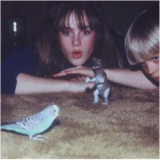
Telephone Explosion proudly presents the self-titled debut LP from Toronto’s UH HUH, out physically and digitally on April 14, 2023. The album features eight tracks of dub-damaged art rock which conjure a potent vision of spaced-out 1980s post-punks feeding their angular rhythms and bass-heavy grooves through layer upon layer of grime-spattered spring reverb.
There is a palpable sense of discovery and exploration throughout UH HUH’s 37 heady minutes. Elastic basslines and serpentine guitar phrases throb and glide, cutting through dubwise reverberations like hands moving through an opaque cloud of reefer smoke.
Formerly known as Teenanger, the reconfigured (and reinvigorated) group’s newfound sense of sonic identity is put on display the moment the door kicks open. The percolating spaciousness of opener “Somewhere Beyond” is followed by the cyclical grooves of “Redemption Pause.” Vocalists Christopher Swimmings and Melissa Ball each take respective turns at lead vocal duties, showcasing their contrasting yet complimentary styles.
“Babylon”, a slab of overcast, loping funk features both singers on the same track, alternating between Swimmings’ stoned syncopation and Ball’s saccharine melancholy. This juxtaposition leans against a backdrop of reverb-soaked drums, watery guitar chords and rippling trumpet.
The slinking, fractured grooves of “Rain (In The Afternoon)” and “Citrus Song” call to mind the deranged minimal dub-wave of Naffi or Vivien Goldman. Both songs feature lyrical content heavily inspired by the Florida swamplands, although the aural landscape on these tracks is decidedly more brutalist than Boca Raton. Two of the songs included here are reworkings of previously released Teenanger numbers. “Blinds Drawn” is reduced to its core elements of bottom-heavy rhythm, spliced guitar shanks and Swimmings’ murmured ruminations. “Good, You”, on the other hand, is completely re-imagined as a blissed-out melt of opiated bossa nova.
After countless hours of experimentation during the album’s recording sessions at Toronto’s Studio Z, the band decided to send their drum machines, snare drums and percussion through an obscure 1960’s Japanese Guyatone guitar amp with a notoriously ecstatic spring reverb sound. The result was immediately inspiring.
The dank, busted and clanking tones produced by the Guyatone evoke a muggy, humid atmosphere that mimics the photo on UH HUH’s cover. The process of re-amping is literally the means through which UH HUH found the sound of this record. UH HUH is a record that asks more questions than it does provide answers. This is searching music that requires that the listener lean into it, the more time you spend in between the beats, bars, notes contained within, the more vivid the picture becomes.
Search:tones
SOURCED FROM THE ORIGINAL MASTER TAPES: 2LP SET PRESENTS 1991 ALBUM IN 45RPM SPEED FOR FIRST TIME.
PCM Digital Master to Analog Console to Lathe.
Dire Straits never made a big to-do about its final run. In classic understated British fashion, the band simply let its music speak for itself. And how. Originally released in September 1991, On Every Street became the group’s swan song – a lasting testament to the influence, musicianship, and integrity of an ensemble whose merit has never been tainted by cash-grab reunions or farewell treks. It remains an essential part of the Dire Straits catalog and a blueprint of the distinctive U.K. roots rock the collective played for its 15-year career.
Sourced from the original master tapes, housed in gatefold packaging, and pressed at RTI, Mobile Fidelity’s 180g 45RPM 2LP set of On Every Street presents the album like it has always been meant to be experienced: in reference-grade audiophile sound. Recorded at AIR Studios in London and produced by Dire Straits leader Mark Knopfler, it features all of the band’s sonic hallmarks – wide instrumental separation, visceral textures, seemingly limitless air, broad soundstages, atmospherics that you can almost reach out and feel. Each element is made more vibrant, physical, and lifelike on this collectible reissue, which marks the first time this 60-minute work has been available at 45RPM speed.
Afforded generous groove space and black backgrounds, the songs from On Every Street burst with nuanced details and vibrant colors. Dire Straits’ playing appears to float, their intricate performances organized amid hypnotic, fluid, three-dimensional arrangements. Mobile Fidelity’s definitive-sounding set also brings into transparent view Knopfler’s finely sculpted guitar lines, expressive tones, and laid-back vocals – as well as the balanced accompaniment from his band mates. Here’s a record on which you can hear the full blossom and decay of individual notes, and imagine the size and shape of the studio. It is in every regard a demonstration disc. And it happens to be filled with timeless fare.
Remarkably, On Every Street almost never came to light. Dire Straits initially dissolved in September 1988 after touring behind its blockbuster Brothers in Arms and suffering the departure of two members. At the time, Knopfler professed his desire to work on solo material; bassist John Illsley also explored side projects. But Knopfler’s decision in 1989 to form the country-leaning Notting Hillbillies reignited a spark to reconvene his primary band and craft a fresh batch of songs. Six years removed from Brothers in Arms, Knopfler, Illsley, keyboardist Alan Clark, and keyboardist Guy Fletcher teamed with A-list session pros – steel guitarist Paul Franklin, percussionist Danny Cummings, saxophonist Chris White, guitarist Phil Palmer included – to create what still stands as an unforgettable farewell.
The platinum record brings the band full circle in that it returns Dire Straits to a quartet formation; finds the group refreshingly out of step with the era’s prevailing trends; and sees Knopfler and Co. knocking out song after song with the deceptive ease of a punter tossing back a pint at a pub. That subtle cool, clever poise, and innate control – signature traits that no other band ever matched – dominate On Every Street. Knopfler’s clean, virtuosic six-string escapades unfurl with dizzying melodicism and economical efficiency. Led by his winding fills and focused solos, Dire Straits traverse a hybrid landscape of rock, jazz, country, boogie, blues, and pop strains with near-faultless prowess.
More than any other entry in the group’s oeuvre, On Every Street welcomes quick detours down back alleys and into the depths of human souls. What makes it more brilliant is its staunch refusal to cater to commercial expectations or take advantage of prior successes; every passage feels true, every measure echoed in the service of song. It’s evident in the humorous satire of “Heavy Fuel,” closeted desperation of the witty “Calling Elvis,” and shake-and-bake bounce of “The Bug.” It pours from the album’s darker corners, as on the high-and-lonesome melancholy of the title track and bruised emotionalism of “When It Comes to You.”
Hinting at the open-minded approaches and boundless curiosity he’d embrace as a solo artist, Knopfler doesn’t limit himself when it comes to style or subject matter. Look no further than “You and Your Friend,” a shuffle whose all-inclusive lyrics encourage an array of interpretative meanings. Another of the album’s deep cuts, “Iron Hand,” comes on as one of the band’s most memorable moments – the narrative addressing the abuses of power at the 1984 Battle of Orgreave during the U.K. miners’ strike. Given cinematic heft by the expert production, the true-fiction account puts into perspective the richness, poetry, and depth of On Every Street.
“Every victory has a taste that’s bittersweet,” sings Knopfler on the title track. At least that bittersweetness seldom sounded so damn good on record.
Van Halen did more than announce to the world the earthshaking arrival of a revolutionary guitarist. Performed by an enterprising California quartet that took its name from two of its principal members, the 1978 debut ripped headlines away from punk, injected fresh energy into a then-moribund rock 'n' roll scene, reimagined how heavy music and throwback pop could coexist, and invited everyone to experience the top-down pleasures of a beach-front Saturday night every day of the week no matter where they lived. Painstakingly restored by Mobile Fidelity Sound Lab, and the first of a multi-album series in an exciting partnership between the famous reissue label and Van Halen, Van Halen delivers feel-good thrills and hormonally charged desires like never before.
Limited to 12,000 numbered copies, pressed on dead-quiet MoFi SuperVinyl at RTI, and mastered from the original analogue master tapes, Mobile Fidelity's ultra-hi-fi UltraDisc One-Step 180g 45RPM 2LP collector's edition pays tribute to the record's merit and allows fans to experience Van Halen's original blend of raw power, Hollywood flair, and vaudeville fun for generations to come. Playing with reference-setting sonics that elevate a 10-times-platinum landmark whose importance cannot be quantitatively measured, this definitive version provides a clear, clean, transparent, balanced, and turn-the-volume-up-to-11 view of an album that birthed entirely new styles. Since MoFi's unique SuperVinyl compound allows you to crank the decibels to your wildest desires without risking noise-floor interference, prepare to not only hear but feel Van Halen in your chest, no fifth-row concert seat necessary.
The premium packaging and gorgeous presentation of the UD1S Van Halen pressing befit its extremely select status. Housed in a deluxe box, it features special foil-stamped jackets and faithful-to-the-original graphics that illuminate the splendor of the recording. No expense has been spared. Aurally and visually, this UD1S reissue exists as a curatorial artefact meant to be preserved, touched, and examined. It is made for discerning listeners that prize sound quality and production, and who desire to fully immerse themselves in the art – and everything involved with the album, from the iconic cover art to the meticulous finishes and, yes, of course, Eddie Van Halen's pioneering fretwork and his brother Alex's double-bass percussion.
Indeed, could a piece of music that transformed how countless guitarists approached their instrument be more fittingly named than "Eruption"? Likely not, and in just 102 seconds, Eddie Van Halen rewrote, reimagined, and reconfigured a vocabulary last significantly updated a decade earlier by fellow six-string wizard Jimi Hendrix. Akin to the Washington State legend, Eddie Van Halen developed his own techniques and tones all the while making his seismic accomplishments seem effortless. Devoid of the pretence, ego, and showiness that infected many of his imitators, the Dutch native sticks to a straightforward approach that underlines the authority, prowess, and visionary scope of his playing and then-unheard-of finger-tapping skills. Throughout Van Halen, he establishes himself as an instant idol – a savant whose otherworldly combination of breadth, poise, feel, speed, force, and melody seems beamed in from another galaxy.
As does nearly every song on the record, whose cohesiveness and dynamic put into perspective the advanced chemistry and one-for-all spirit the youthful band had out of the gates. Having paid its dues for years in bars and clubs – going as far as recording a 24-track demo for Kiss bassist Gene Simmons at Village Recorders only to be spurned by management companies that felt its music wouldn't go anywhere – Van Halen finally got a deserved break when Warner Bros. executives signed the group in 1977. The subsequent recording sessions further testify on behalf of the band's synergy and alignment. Completed in just a few weeks with producer Ted Templeman, Van Halen was primarily cut live in the studio with minimal overdubs and edits. The explosiveness, energy, and electricity remain definitive, and as heard on this UD1S set, put the group on a private stage – humming amplifiers, Frankenstrat guitar, bright spotlights, sweaty headbands, and then some.
Van Halen yielded just one hit in the form of a Top 40 single (a breathless cover of the Kinks' "You Really Got Me") but practically every song on the revered LP has become a staple. Named the 202nd Greatest Album of All Time by Rolling Stone and considered by countless experts as one of the best debuts in history, the record displays what can happen with four distinct talents gel and strive for the same purposes. In Van Halen's case, the latter almost always involved partying, freedom, sex, and, in the immortal words of singer David Lee Roth, living "life like there's no tomorrow." The celebration manifests from the opening notes of the strutting "Runnin' with the Devil" – announced with the blare of droning car horns, Michael Anthony's robust bass line, and Alex Van Halen's thumping drumming – and continues through the conclusion of the white-hot "On Fire," goosed by Eddie Van Halen's race-track-ready lines, Roth's flamboyant deliveries, and the rhythm section's cat-like pounce.
Picking out individual highlights on Van Halen is akin to trying to count all the stars in a clear nighttime desert sky: There are far too many to identify, once you see one you notice another dozen you didn't spot before, and the cluster is best enjoyed as a whole. What's evident over repeat listens is the sheer diversity, a fact that's often overlooked: The high harmonies and background funk of "Jamie's Cryin'"; the insistent cane-and-a-tophat shuffle and doo-wop shoo-bop vocal break on "I'm the One"; the throwback acoustic blues that spreads into fast-paced, single-entendre wildfire on the Roth-led standout interpretation of John Brim's "Ice Cream Man." Like the man says, on Van Halen, all the flavours are guaranteed to satisfy.
More About Mobile Fidelity UltraDisc One-Step and Why It Is Superior
Instead of utilizing the industry-standard three-step lacquer process, Mobile Fidelity Sound Lab's new UltraDisc One-Step (UD1S) uses only one step, bypassing two processes of generational loss. While three-step processing is designed for optimum yield and efficiency, UD1S is created for the ultimate in sound quality. Just as Mobile Fidelity pioneered the UHQR (Ultra High-Quality Record) with JVC in the 1980s, UD1S again represents another state-of-the-art advance in the record-manufacturing process. MFSL engineers begin with the original master recordings, painstakingly transfer them to DSD 256, and meticulously cut a set of lacquers. These lacquers are used to create a very fragile, pristine UD1S stamper called a "convert." Delicate "converts" are then formed into the actual record stampers, producing a final product that literally and figuratively brings you closer to the music. By skipping the additional steps of pulling another positive and an additional negative, as done in the three-step process used in standard pressings, UD1S produces a final LP with the lowest noise floor possible today. The removal of the additional two steps of generational loss in the plating process reveals tremendous amounts of extra musical detail and dynamics, which are otherwise lost due to the standard copying process. Every conceivable aspect of vinyl production is optimized to produce the most perfect record album available today.
MoFi SuperVinyl
Developed by NEOTECH and RTI, MoFi SuperVinyl is the most exacting-to-specification vinyl compound ever devised. Analogue lovers have never seen (or heard) anything like it. Extraordinarily expensive and extremely painstaking to produce, the special proprietary compound addresses two specific areas of improvement: noise floor reduction and enhanced groove definition. The vinyl composition features a new carbonless dye (hold the disc up to the light and see) and produces the world's quietest surfaces. This high-definition formula also allows for the creation of cleaner grooves that are indistinguishable from the original lacquer. MoFi SuperVinyl provides the closest approximation of what the label's engineers hear in the mastering lab.
Big Crown Records is proud to present the debut full length offering from Les Imprimés, Rêverie. The stirring and ethereal sounds of Les Imprimés have been making fans of anyone who hears them since their first 7” single hit the speakers. Morten Martens is the man behind the band. Born, raised, and working in Kristiansand, Norway, he keeps a low profile while making his heartfelt, highly infectious, and unique music. This album is a long time coming for Martens and it is sure to make him a name to be reckoned with.
The first thing you notice listening to Les Imprimés is the high level of musicianship. Martens plays nearly every instrument on the recordings and handles the production and arranging. He has been making records for decades, winning a Spellemann Award (aka, the Norwegian Grammy) in 2006 for producing a Hip Hop album as well as getting nominations across three other genres. While awards and accolades speak to the level of his talent, this new album really shows who he is as an artist on his own terms.
Moving away from being a hired gun on the touring scene naturally led him to start doing more studio work. Slowly collecting gear and getting more experience behind the boards he built his own studio on the island of Odderøya and was making a living playing with and recording other people's music. As the story goes, after those sessions would end he would work on his own project into the wee hours of the night. From these late night sessions, Les Imprimés was born and Rêverie began to take shape.
However, "it wasn't until COVID, when things locked down, that I was really able to find the time to focus on Les Imprimés" Morten says about creating and leading his own solo project. "It was a scary time. But I knew I had to do something with it." He took the sum of his influences, combined them with his own vibe and got busy writing the music, playing the instruments, and singing the songs. "It's soul music, but I don't exactly have the soul voice," Morten explains humbly. "But I do it my own way, in a way that's mine."
It is his sound, his fingerprint, his sensibility, that makes his music hard to categorize. He has crafted an album of songs with different energies that all fit together to make one gorgeous record. The lead single “Falling Away” starts with a raw drum break and turns into a lushly arranged tune that paints the picture of love when it slips away. On “Still Here” he professes his resilience through life’s twists and turns over a thundering track that puts a new spin on the B side ballad genre. Songs like “You” and “Our Love” mix tones from 60s and 70s Soul with arrangement nods to Doo Wop records while Martens’ lyrics and delivery leave you singing the melodies long after they finish. “Love & Flowers” finds Martens in a moment of clarity with a song that fits the niche sub genre of happy break up tunes, the four on the floor track will move the dancefloor while the message will resonate with anyone who put too much effort into the wrong situation in their lives. However, it is songs like “Muse” and “Chess” that really encapsulate the uniqueness of Les Imprimés as they push the boundaries of genre, one a profession of love for music and the other a cover of an electronic record respectively. Martens’ lyrics, emotion, and delivery truly make the whole thing come together and stand out from any of his peers. There’s an infectiousness and a pop sensibility in the writing that is done with the utmost class and taste giving Les Imprimés the rare quality of immediate attraction that only deepens the more you listen.
Elements of Life brings a full on boogie disco tune with some 80s synth goodness. The backgrounds are provided by an all star cast of singers including Cindy Mizelle, Audrey Wheeler, Anané, Dawn Tallman, and Ramona Dunlap. The song is penned by Nico Vega, just at 19 years old writing lyrics with the soul of a person who’s been through various experiences in life. It isa statement song coming from an adolescent stating where we are in the world today with war, and encouraging all to stop fighting, “no more war”,“Let Us Shine Bright As Day”, “Let Us Find A Peaceful Way”, “Let Me Hear You Say”, these words are crying out to the world.
Remixes by Josh Milan on the Josh Milan Honeycomb versions, feeding us an early 80s tune reminding us of the seminal label West End Records. The Louie Vega mixes stay true to the Elements Of Life sound mixed with some Detroit bass groove and synth overtones. A bonus track also added to the release featuring Axel Tosca on keyboards is entitled “Los Tonos Sagrados” which means The Sacred Tones.This instrumental has the early afrobeat rhythm with Axel Tosca ripping through with an organ solo and snare hits accenting the drums and music.Take a listen and enjoy the sounds of “Let Us Shine” and “Los Tonos Sagrados” and it’ll sure to have you with your arms up and eyes closed singing along with the choon in no time!! Available soon at all streaming and digital outlets, with vinyl coming too!!
The wait for HULKOFF's forthcoming folk-metal album "Hersir" will soon be over. The album will be released on December 15, which is the official release date. Hersir is HULKOFF's fourth album and is preceded by "KVEN" 2017, Pansarfolk 2020 and Ragnarök 2021. With a dash of Scandinavian melancholy, ancient instruments and acoustic violins, Hersir offers an assortment of rockhard, earthy, melodic and furious folk-metal - a throwback in time accompanied by familiar and ancient Nordic tones. HULKOFF's sound is a seamless fusion of melody and aggression, forged to resonate with the ancient echoes of the North. His lyrics are a gateway to the distant past, delving into the ancestral tales and beliefs of the Kvens, Scythians, Goths, Celts, Finns, and the later Norse, all of which from which influences can be glimpsed through HULKOFF's rich repertoire. Songwriter, composer, and guitarist Pär Hulkoff stands apart from other artists with his uniquely deep voice and thunderous folk-sound - that are impossible to imitate. Unusual but familiar tones surround the ancient source material of Hersir, resulting in highly varied songs that range from aggressively uplifting to gnarly and determined folk-metal. Hersir comes with eleven tracks, blended with both English and Swedish lyrics.
The second crushing, soul mangling, neck bustin' album from Texas hardcore thrashers: Power Trip. Quite possibly the best thrash album you will have heard in the last decade. IMMENSE, MAMMOTH, MASSIVE.
Recorded by Arthur Rizik (Inquisition) , mastered by Joel Grind (Poison Idea, Toxic Holocaust) and features cover art by Paolo Girard.
POWER TRIP is a real band like no other. Their raw energy, musical proficiency, perfect song structure, rich tones, fierce riffs, persecution, and collective attitude have seeded them as one of the most prolific underground staples in the US metal, punk, and hardcore scenes. POWER TRIP has relentlessly toured the world for years with the likes of Anthrax, Lamb Of God, Cro-Mags, Negative Approach, Turnstile, Backtrack, Eyehategod, Bane, Off!, and more, and has performed with countless others, in addition to pummeling audiences at major festivals all over the US, Europe, and beyond. The band will be touring endlessly in support of this new album!
Luigi Madonna is back on his record label Contempo and continues to showcase the darker and more underground side of his sound with the analogue grooves on this hypnotic release.
This four-track EP blends raw sound design with industrial percussion and modulating synth lines, to create dance floor focused cuts in the style that Luigi Madonna has previously championed via Contempo.
Previous releases on Contempo have also featured tracks and remixes from the likes of JSPR, Alarico, Lobster and Marc Faenger.
"Yakamoz" opens the release with its rumbling bassline tense synths and thrashing hi-hats, before the ominous synth stabs, trippy vocals and brutal percussion of "Hydratonic" take control. "Slow Sigh" has a stripped-back style with murky atmospheric, high-speed rhythms and sinister vocal tones. "Ikigai (Jam Edit)" is an experimental track that closes out the release with its breakbeat rhythms, heavy sub-bass and glitching synth lines.
Berlin based producer and DJ, Fletcher, joins the roster of Anthony Georges Patrices’ Ausblick imprint this December with his ‘Blurred Lines’ EP. The past decade has seen Fletcher steadily unveiling his own distinctive twist on dub techno and micro house with a debut album on Steve O’Sullivan’s Mosaic and further material on the likes of Roger Gerressen’s Irenic, Ohm Series, his own Tact Recordings/Tactics. Here though he drops his new two tracker on the growing Ausblick label, following its recent release from label boss AGP with a remix from Playhouse legend LoSoul. Title-cut ‘Blurred Lines’ leads and see Fletcher lay down a sturdy, shuffled percussive groove at the foundation of the composition while ghostly chimes, swelling subs and modulating synths ebb and flow within its eight-minute duration. ‘What’s It All About’ follows and edges into more mind mending, minimalistic realms with oscillating bass tones, organic percussion and murky atmospherics all intertwined to create a low-slung dance floor focused tool.
Big Thief's music, rooted in the songs of Adrianne Lenker, paints in vivid tones "the process of harnessing pain, loss, and love, while simultaneously letting go, looking into your own eyes through someone else's, and being okay with the inevitability of death," says Adrianne.
Masterpiece, Big Thief's debut album, is -lled with characters and visceral narratives, songs that pivot in the space of a few words. Adrianne's voice and guitar playing speak of rich emotional territory with grace and insight. In her words, the record tracks "the masterpiece of existence, which is always folding into itself, people attempting to connect, to both shake themselves awake and to shake o the numbness of certain points in their life. The interpretations might be impressionistic or surrealistic, but they're grounded in simple things.'
Adrianne met her longtime musical partner, guitarist and singer, Buck Meek, in Brooklyn a few years ago, and they quickly formed a creative bond tempered by the experience of traveling and performing for months on end in old dive bars, yards, barns, and basements together. They recorded a pair of duo albums (A-Sides and B-Sides), and Adrianne showcased her songs on a solo album, Hours Were The Birds.
Now, as a full rock and roll band, with Buck on guitar, Max Oleartchik on bass, and James Krivchenia on drums, they bring a steady wildness, giving the songs an even deeper layer of nostalgia. "These guys feel like a pack of wolves at my back," says Adrianne, "they make the songs howl and bark with a fierce tenderness that gives me courage."
After spending last July in an old house that they turned into a studio on Lake Champlain with producer Andrew Sarlo, the resulting collection soars on what Big Thief fan Sharon Van Etten calls "...a real journey, with intelligent stories and twist-and-turn melodies.
Robert Hood's techno and Femi Kuti's Afrobeat intertwine in a new form where jazz-grooves reign supreme. For the fourth season of La Compagnie des Indes & Sourdoreille "Variations" live series of creations for France TV, the duo were united around the singer and producer James Brown, performing a tribute to the legendary Godfather of Soul who passed away in 2006. This "Variations" album is the live recording of this unique collaboration and performance, capturing a very special moment in time.
The evening witnessed a meeting of two icons in their own genres: one with synths and drum machines, the other on saxophone: Robert Hood and Femi Kuti embody excellence in their respective fields and the pair combined to make something truly unique, soulful, funky and spontaneous. Recorded in one 30+ minute take, "Variations" is embellished by Femi's exquisitely free-flowing yet restrained saxophone, whilst Hood anchors the groove with layers of pads and kicks with the long-time mastery of a true DJ.
Alongside Jeff Mills and Mad Mike, Hood is one of the original members of Detroit techno group Underground Resistance. His style is characterised by minimalist and experimental tones with an assertive groove. Throughout the '90s, he helped pave the way for techno to flourish - giving birth to minimal techno with his seminal album "Minimal Nation". Since then, he has been consistently forwarding electronic music culture with ground-breaking productions, sensational performances and his M-Plant label.
Alongside him, Femi Kuti takes on every musical style with his saxophone, which he plays with a virtuoso touch: pop, soul, electronic music and Afrobeat, of which he is one of the leading exponents. The son of Afrobeat singer and political activist Fela Kuti, he has inherited his father's zeal for both music and activism, where he continues to highlight the plight of most Nigerians living conditions in the oil rich state.
With "Variations" the duo capture an explosive combination on a special night in Paris 4 years ago, November 2019, filmed at the ADP Group headquarters (Paris Aéroport - Charles de Gaulle (CDG) - Roissy).
"It is so amazing when a vision comes to fruition. I enjoyed collaborating with the legendary Femi Kuti for this special project." Robert Hood
Black Truffle is pleased to announce the first LP documenting master khene player Sombat Simla, the label’s first collaboration with Japanese sound artist, field recordist, and researcher Yasuhiro Morinaga. Simla is known in Thailand as one of the greatest living players of the khene, the ancient bamboo mouth organ particularly associated with Laos but found throughout East and Southeast Asia. His virtuosic and endlessly inventive renditions of traditional and popular songs have earned him the title ‘the god of khene’, and he is known for his innovative techniques and ability to mimic other instruments and non-musical sound, including, as a writer for the Bangkok Post describes, ‘the sound of a train journey, complete with traffic crossings and the call of barbecue chicken vendors’. Aided by a group of Thai friends, in 2018 Morinaga travelled to the Maha Sarakham province in the Isan region, arranging to meet Simla in a remote spot surrounded by rice fields. Then and there, Morinaga recorded the solo performances heard on the LP’s first side. At Morinaga’s request, Simla began with a rendition of the train song ‘Lot Fay Tay Lang’. Beginning with long tones that seem to mimic a train horn, the performance soon moves into a rapid chugging rhythm, interrupted at points by vocal exclamations and the remarkable timbre Simla produces by singing through the khene. To listeners unfamiliar with Thai music, the pentatonic scales and rhythmic chug of many of the pieces can have surprising echoes of the rawest American blues. The range of Simla’s performance is astonishing, moving from compulsive rhythmic workouts on single chords and rapid-fire runs of single notes to gentle sing-song melodies, and using a fascinating array of techniques, including a rapid tremolo that sometimes sounds almost electronic. Later the same day, Morinaga followed Simla to a cattle shed where he met percussionist Mali Moodsansee to play some molam (folk songs found in Isan and neighbouring Laos), with Pattardon Ekchatree joining in on cymbal. At times, these molam songs have a wistful, romantic character quite different from the solo pieces. Backed up by the propulsive hand drums, Simla again dazzles with his melodic fluidity, rhythmic drive, and wild displays of unorthodox technique. As Morinaga writes, ‘It felt like they had been playing together so long that their breathing was perfectly in sync, and it was like listening to the precision of James Brown’s funk’. Accompanied by extensive liner notes by Morinaga detailing the day of recording, this is a stunning document of a master musician, seamlessly integrating tradition and innovation.
ARTIST OVERVIEW Mixing warm acoustic tones and strong vocals with heavy emo elements, the band launched several DIY tours, quickly developing a national presence. Signing with Boston indie Topshelf Records, they released their debut album, “The Earth Pushed Back" and in 2014, Have Mercy signed with vaunted indie Hopeless Records, which released their second LP, “A Place of Our Own”, later that year. Working with producers Paul Leavitt (All Time Low) and Brian McTernan (Thrice), Swindle and a rotating crew recorded the band’s Hopeless follow-up, “Make the Best of It”, which was released in early 2017. Have Mercy returned with “The Love Life” in 2019, which charted Swindle’s tumultuous personal life over the previous three years. The band came back in August 2022 with a self-tiled EP, released via Zodhiac Records, which caught the attention of Brooklyn Vegan, FLOOD Magazine, The Noise, and more. In september 2022 they shared an unreleased B-Side from their 2012 EP, My Oldest Friend, titled "Seventeen" via Rude Records. BAND MEMBERS Andrew Johnson // Guitar, Backing Vocals Brian Swindle // Lead Vocals, Guitar, Keyboard Nick Woolford // Bass, Backing Vocals TOURING HISTORY Since 2012, Have Mercy has toured both nationally and internationally with such acts as Taking Back Sunday, Motion City Soundtrack, Senses Fail, Mayday Parade, The Maine, The Wonder Years, Turnover, Real Friends and Neck Deep
Candlemass was formed by bassist & songwriter Leif Edling in Stockholm, Sweden in 1984 & is well known for its epic doom metal, having a great influence over a generation of the genre's subsequent greats such as Paradise Lost & My Dying Bride - Candlemass themselves taking a large influence from Black Sabbath.
'Ancient Dreams' was Candlemass' third album, released in 1988 & it featured a natural progression of slow- mid tempo epic arrangements from their previous release, 'Nightfall' - perhaps even more distinction between slow & faster parts - with the unique tones & unmistakable voice of Messiah Marcolin still dominating proceedings on this pure doom metal classic.
With a perfect balance between melody & sheer heaviness, it is still debatable as to whether this is the ultimate Candlemass & therefore greatest doom metal album of all time, with some giving this particular title preference over the seminal 'Nightfall' album. 'Ancient Dreams' was produced by Leif Edling & Candlemass & was recorded at Stockholm Recording studios in 1988.
Marking 35 years since release, this edition of 'Ancient Dreams' is presented on limited green marble-effect vinyl, featuring the original cover art
‘Rituals’ is the new album of spiralling drone & ambient formations by Italian artist Danilo Betti aka April Clocks (Union Editions / Mixed Up); a new work of sublime disorientation by the Rimini-based outlier, arising from a period of reinvigorated artistic practice.
Emerging just over a year after the project’s second album ‘It Takes Time’, ‘Rituals’ heads deeper into spheres of consuming, hypnagogic haze, coursing through nine coalescent compositions of amorphous yet absorbing electronics.
Where ‘It Takes Time’ represented an autodidactic interpretation of Betti’s formative influences – namely shoegaze & proto-ambient - ‘Rituals’ is an enigmatic proposition, the product of subconscious resonances, a mysterious sound world that finds traces of evanescent beauty and uncanny captivation in sustained tones, cavernous oscillations, and aesthetic imperfections, like the notes of subtle surface noise embedded within many of these productions.
Attesting to the value of Betti’s background as an industrious solo artist, making music away from prevailing sites of activity, ‘Rituals’ consolidates the inspirations and hallmarks of the April Clocks project into an acute reflection of Betti’s vision, one that feels completely his own.
In the buried somnolent splendour of the opener ‘Hypersleep’, through the sound art rustle and time-stretched cycles of ‘A Cure’, into the stroboscopic magnitude of ‘Ceremony’ and the haunting string loops of ‘Coward’, Betti captures compelling impressions drawn from a submerged perspective; a deluge of smokescreens and crosscurrents from the other side.
Bearing the influence of subliminal states, ‘Rituals’ is nevertheless lucid and arresting. There are sumptuous holding patterns of ambient evaporation that stream into vast maelstroms of sound (‘Displaced Euphoria’), enervated organ themes that distil sensations of stasis and dissociation (‘Wound’), as well as psychedelic movements in wide tracts of negative space (‘No Time, No Land’). From here, the acoustic glitch of ‘Disappearer’ and the stratospheric slipstreams of ‘Mirror Being’ bring the album to an astonishingly dramatic conclusion.
Throughout such moments of reverie and tension, ‘Rituals’ makes for a hypnotic listening experience. It’s an album that signals a pronounced sense of development for the April Clocks project, from past vestiges of physicality to present degrees of heightened abstraction and ethereality, from the Warp-influenced rhythms and frameworks of ‘It Takes Time’ to the wide- ranging, experimental sounds that unfold here.
Encompassing forms of decomposition and otherworldly futurism, decay and sublimation, distortion and lustre, this is unique, cerebral music that reaches inward and ascends outward, drifting elsewhere, according to its own coordinates.
Recorded and Mixed at Tower of Disintegration, 2022.
Mastered by Miles Whittaker.
Laolu makes his Crosstown Rebels debut with ‘Now I See’, combining with Off The Meds frontman Kamohelo Khoaripe across the two-track release. Having emerged via his versatile and dynamic DJ sets for the likes of Circoloco, with releases via labels such as Keinemusik, Innervisions and Anjunadeep, Swiss DJ/producer Laolu has stamped his mark while racking up support from Dixon and Black Coffee. Arriving in fine form, he closes out November with a classy label debut on Damian Lazarus’ renowned Crosstown Rebels as he serves up his latest two-track release ‘Now I See’ - a vibrant and personal release shaped and finalised after a decade following the birth of his daughter.
Spirited and resonant, combining soulful female vocals with organic percussion and sweeping melodies throughout, ‘Now I See’ is a warm and sonorous production set for heartfelt dancefloor moments, while ‘Monday To Sunday’ featuring the impactful vocals of Kamohelo takes a darker path as swirling bass patterns, menacing synths and warped tones merge around the commanding flute for a powerful late night cut.
Repress!
Two huge Bobby Womack classics, the heart-on-a-sleeve 'How Could You Break My Heart' and the sweet soul love song, 'Give It Up' get a much deserved, official remastered reissue.
Produced and composed alongside Patrick Moten, who worked with the likes of Loleatta Holloway, Anita Baker and Rosie Gaines, 'How Could You Break My Heart' was a massive record on the modern soul scene and still a favourite across the board with the biggest selectors and DJs on the circuit.
The blend of warm woozy keys and magical piano touches, over energetic strings, powerful horns and tight percussion, are near impossible not to get swept up by and provide the perfect backing for Womack to bare all. Arguably one of the greatest soul singers to have ever done it, endless amounts of passion and raw emotion emanate from his rugged tones as he swallows the bitter pill of heartache and rejection.
On the B side the bittersweet 'Give It Up' where soaring strings and sumptuous chord progressions, marry with the full range of Womack's vocals and those expert backing harmonies. A luscious sax solo and funk bass give a sultry feel that mixes with the tenderness on show, providing a powerful metaphor for the swirling emotions that come part and parcel with this ever-relatable tale of reaching out for love.
Trans-Millenia Consort is the near mythical debut album by the late West Coast composer, healer, and medium Pauline Anna Strom. First released in 1982, the album is a bold and beautiful evocation
of a life that exists between and beyond time. Evoking ancient rituals and primordial futures, the music of Trans-Millenia Consort glows with a strange iridescence; its pulsing embryonic waveforms flutter and drift, tones fall like raindrops of the long- ago, and melodies shimmer and dance across the ages like fireflies of a lost world. Restored and mixed from the original reels by Marta Salogni, and newly remastered, this is the album’s first ever official reissue, and the definitive edition of a visionary statement.
Following on from recent works for 12k, The Trilogy Tapes, and Important, Far More Decentralized is a new collection of subtle, enchanting pieces from Tokyo-based sound and visual artist Akhira Sano. Working with electronic, instrumental, and concrete sounds, he crafts immersive assemblages of long overlapping tones and blurred resonance, cut through with textural crunch and hiss. The resonant bell-like tones of opener ‘Kouai’ invite the listener in, calling up the warm sound palette of ambient classics like Hiroshi Yoshimura’s Music for Nine Postcards, but leaving any sense of compositional anchor behind for a free-floating harmonic drift. Woven through this seductive tonal cloud is a wavering stream of white noise and tactile pops, its textural grit threatening to derail the calmly reflective pool of pitched sounds, but never quite doing so. Each of these seven pieces occupies a similarly ruminative harmonic space while possessing its own identity. On ‘Neow’, lush tonal swells form around fragmented samples, touching on the techniques of early 2000s glitch artists like Ekkehard Ehlers. ‘Orbv’ is particularly subtle in its combination of rippling back-masked tonal wash, almost subliminal suggestions of field recordings, and distant traces of raw electronic interference, as if a Toshimaru Nakamura recording is playing through an open window across the road. ‘Margin’ weaves together a skein of wistful slow-motion melodies while untraceable, resonant clinks and ambiguous static washes rise gradually to the surface. In comparison to his recent Phase Contrast for Recollection on 12k, recognisable instrumental sounds are a rarity here, yet a hand-played feeling is present throughout. On ‘Teens’, filtered electric guitar tones reminiscent of the melancholic miniatures of Andrew Chalk float over aqueous burbles, bringing the album to a magisterial close. In the crowded field of contemporary electronic music tending toward ambience, Sano is a distinctive voice. Like his elegant abstract paintings, here seemingly static surfaces of unhurried calm reveal rich interior worlds of subtle activity and gentle chaos. Where much contemporary ambient music aims for an almost stifling cleanliness of tone, Sano breathes life into Far More Decentralized through the acceptance of imperfection, accident, and rough edges. As the artist himself says, ‘In a world where everything can be made perfectly, I think it’s a beautiful and primal act to touch the fragile and imperfect’