Drop a needle on Psyché's debut double-sider – the debut album is out on May 19th – and you'll see visions, or rather Mediterranean visions, be they of waves of heat shimmering above dunes of sand, or of women dancing around a bonfire on a rocky plain, or of bushy cliffs overlooking emerald-green and turquoise sea. The name Psyché is of course ancient Greek for 'soul' or 'mind',signifying the band's love of psychedelic funk, but also the wide range of Mediterranean influences – from Southern Europe to the Balkan Peninsula, and from Anatolia to the Maghreb – that provide an endless source of inspiration for their hypnotic sound and minimalist style.
Psyché members Marcello Giannini (Guru, Nu Genea, Slivovitz), Andrea De Fazio (Parbleu, Nu Genea, Funkin Machine) and Paolo Petrella (Nu Genea) have been active in the Naples music scene for almost two decades, most notably during the first wave of the new Neapolitan Power movement (Slivovitz, Revenaz Quartet). Over the years they have often crossed paths and collaborated on side projects in various genres (math-rock duo Arduo and, more recently, Italo-disco duo Fratelli Malibu), before working together as the rhythm section of Nu Genea's live band. Following their first tour with Nu Genea in 2018, they started Psyché with the intent of exploring more minimalist styles and making musicwith just a few elements.
A unique combination of psychedelia, groove and improvisation, the music of Psyché goes back to the roots of our future; it evokes visions of a mythical past, blending centuries-old music traditions and mixing them with modern genres. Like a warm Mediterranean breeze, it travels across lands, seas and eras, distilling essential rhythms and cosmic pulsations.
"Cumbia Mahàre", on side A of the 7-inch, dives deep into the origins of rhythm, drawing us into the movements of an imaginary ritual dance (the term mahàre was used in Southern Italian dialects to indicate witches). Through the interplay between minimal synths and exhilarating rhythmic patterns of drums, percussion, guitar and bass, Psyché take a fresh and bold approach to contemporary afrobeat and cumbia fusion.
"Ophis", on side B, is a mesmeric blend of African, Balkan and Turkish rhythms and sounds. Ethereal vocalizations and warm, hypnotic bass lines combine with psychedelic riffs and haunting melodies on guitar to evoke ancient cultures whose spiritslithers like a snake across the dunes of a sun-scorched desert.
Search:traditions
A deluxe edition as a 2 x LP on yellow vinyl, features bonus demos, b-sides and live session recordings. The Hidden Cameras burst onto the Toronto music scene in the early 2000"s boasting an irresistible combination of pop and queer sensibilities. Playing self-proclaimed "Gay Church Folk Music" a new genre of their own making and songs ranging from haunted, aching ballads to foot-stomping anthems, the band"s outrageous stage shows packed such disparate venues as sweaty dance bars, art museums, a working porn cinema as well as many churches. Fronted by lead singer-songwriter Joel Gibb, the ensemble continues its musical provocations to this day, with Berlin now as its centre of gravity. The Hidden Cameras had yet to release a note of commercially available music when, in early 2002, they became among the most discussed and celebrated unsigned bands in the history of their native Toronto. By the close of the year, they had been the subject of uncommonly sensational features in The Globe and Mail (Canada"s national newspaper) as well as in every daily and weekly in Toronto. The reasons for the reckless enthusiasm of these usually cautious journals was simple: revelatory live performances that attacked and transcended the staid, dispassionate traditions of rock nightclub culture; and the songs of band front-man and mastermind Joel Gibb, a talent of uncommon melodic and poetic gifts. "The Smell of Our Own", The Hidden Cameras debut album was originally released in April 2003 on Rough Trade to tremendous critical acclaim.
- 1: 70 For String Quartet
- 1: 2 Below They Dwell
- 1: 3 .2205 For String Quartet
- 1: 4 Five Winters
- 1: 5 Flickering Lights
- 1: 6 .404 For String Quartet
- 1: 7 Dreaming Of The North-West-Passage
- 1: 8 .800 For String Quartet
- 1: 9 Heel, Narcissus
- 1: 0 Hymn For The Common People
- 1: Glorious Times
- 1: 2 The Lion Hides In High Grass
- 1: 3 Debt Of Honor
- 1: 4 Blood Money
- 1: 5 The Machinists
- 1: 6 Snake Pit
- 1: 7 To Be A Mountain
- 1: 8 A Palace Made Of Lies
- 1: 9 Scratch My Back And I'll Scratch Yours
- 1: 20 The Bazaar
- 2: 1 Dance Of The Fireflies
- 2: All Hands On Deck
- 2: 3 They're Waltzing In
- 2: 4 Abandon Ship
- 2: 5 Momentum
- 2: 6 Her Majesty Arrived
- 2: 7 Babylonian Towers
- 2: 8 Man Is Wolf To Man
- 2: 9 Industrial Accidents
- 2: 10 The Fixed Star
- 2: 11 A Pile Of Dust
- 2: 1 Fair Winds And Following Seas
- 2: 13 Welcome To Brightsands
- 2: 14 Seed Of Change
- 2: 15 In The Belly Of The Beast
- 2: 16 Conqueror Of Clouds
- 2: 17 Wanderlust
- 2: 18 Cannonade
- 2: 19 Aeronautical Engineering
- 2: 0 The Great Depression
- 2: 1 We Take Back What's Ours
- 2: New World Dawning
Nach dem Erfolg des offiziellen Anno 1800-Vinylsoundtracks feiern Black Screen Records und Ubisoft Mainz die populäre Aufbausimulation mit "The Four Season": Der opulente zweite Soundtrack entführt in die lebendigen musikalischen Welten der vier Erweiterungssets des Spiels und erscheint pünktlich zum 25jährigen Jubiläum der Traditionsmarke am 31.03.2023, natürlich auf audiophilem 180g Doppelvinyl. Alle neuen Musikstücke werden zur gleichen Zeit auf Spotify verfügbar sein. Das Album wird erneut in wunderschönem Klappcover mit Artworks von Ubisoft Mainz ausgeliefert und kommt mit kostenlosem Download-Code für den digitalen Soundtrack, inklusive 8 Bonustracks. Musikalisch dokumentiert die Doppel-LP nicht nur die enorme inhaltliche Abwechslung der vier Anno 1800-"Seasons", sondern auch die stilistische Bandbreite der Komponisten Steffen Brinkmann, Jochen Flach, Armin Haas, Alexander Röder, Tilman Sillescu und Matthias Wolf (Dynamedion). Die Stücke erzählen von versunkenen Schätzen und reichen Ernten, von Expeditionen in die Arktis und ins gefährliche Land der Löwen, von der Eroberung des Reichs der Lüfte oder dem überwältigenden Ausblick von den majestätischen Dächern der Stadt. Kurzum: Die Welt von Anno 1800 und der facettenreichen Spielerweiterungen wird als akustische Reise erlebbar gemacht. Anno 1800 ist eine von Ubisoft Mainz entwickelte und von Ubisoft veröffentlichte Aufbausimulation, in der Spieler die industrielle Revolution anführen, Metropolen errichten und mit Diplomatie, Handel oder Krieg um die Vorherrschaft wetteifern. Das erfolgreiche PC-Strategiespiel begeistert mehr als 2,5 Millionen Spieler auf der ganzen Welt mit einer Kombination aus bewährten Spielelementen, innovativen Neuerungen und dynamischem Spielverlauf in einer der spannendsten Epochen der Menschheitsgeschichte.
- A1: The Leaders - Wait A Minute
- A2: Archie Shepp - Song For Mozambique
- A3: Oliver Lake Quartet - Tap Dancer
- A4: Karl Berger And Friends - Guitar Vibes
- B1: Sun Ra Arkestra - Mayan Temples
- B2: Muhal Richard Abrams Octet – Laja
- B3: Andrew Cyrille & Maono - Metamusicians’ Stomp
- C1: The John Carter Octet - Ode To The Flower Maiden
- C2: Diedre Murray, Fred Hopkins - Zebra Walk
- C3: Joseph Jarman, Don Moye Feat Johnny Dyani - Mama Marimba
- D1: Sun Ra Arkestra - Love On A Far Away Planet
- D2: The Don Pullen Quartet - The Sixth Sense
- D3: World Saxophone Quartet
Woke rhythms and high-spirited grooves from the vaults of two seminal Italian jazz labels, between the 70s and 80s. Intensely curated by Khalab.
Hyperituals is a philological investigation that deeply delves into the possibilities of sound, rhythm, remix, and endless sampling. Inspiring listening, interpretation, and reinterpretation.
This volume is dedicated to the catalogue of the Italian Black Saint. Thanks to a constant, cutting-edge, and meticulous commitment, Black Saint & Soul Note established themself as two of the most important imprints for international jazz. They always placed the artists, their visions, and their music at the centre, giving them total freedom of creative expression. By combining jazz tradition with the political vanguard sentiment of the time, the two labels were able to press and produce more than five hundred records, many of which are by some of the brightest names in creative jazz or the ‘avant-garde’ of the era.
Curated by Khalab, the selection - focused on rhythms, grooves, and Afrocentric traditions - blends moments in which the rhythmic aspect is powerfully explicit, with others in which the kinetic aspect dialogues on different levels with African American cultural contexts.
Created between Palm Springs, California and Hilo, Hawai'i, V is the first double album from the Hawaiian-New Zealand singer-songwriter, multi-instrumentalist and producer Ruban Nielson's Unknown Mortal Orchestra band. Designed to play as one continuous movement and road-tested on dry California freeways, V is the definitive Unknown Mortal Orchestra car record. It's also the fifth full-length album Ruban has released in twelve years. Across fourteen sunbleached songs - written solo or with his brother Kody - Ruban draws from the rich traditions of West Coast AOR, yacht rock, weirdo pop and Hawaiian Hapa-haole music. Over a laidback blend of singalong anthems and cinematic instrumentals, he evokes blue skies, afternoons spent lounging by hotel swimming pools and the alluring darkness that lurks below perfect, pristine surfaces. It's a duality expressed in the dilapidated sunset blues and the saltcorroded soul Ruban explores through tracks like `Layla' and `Nadja. ' During the pandemic's early days, Ruban reunited with Kody at a cousin's wedding in Hawai'i. With assistance from their father, Chris Nielson (saxophone/flute) and longstanding Unknown Mortal Orchestra member Jake Portrait, they brought everything Ruban had been thinking about together. The result was V, due for release on March 3, 2023, through Jagjaguwar. When they talked about records that moved them in that spine-shivering manner, Ruban started thinking about the 70s AM radio rock and 80s pop songs that had lurked on the edge of his subconscious mind for most of his life. He wanted to write his version of records like that, leading to the two glorious uptempo singles Unknown Mortal Orchestra released in 2021, `Weekend Run' and `That Life'. However, the golden good times never last forever. Not long after, health issues began to plague his extended family.Putting his recordings aside, he helped his mother and his uncle move home from New Zealand and Portland to Hawai'i, and began dividing his time between Hawai'i and Palm Springs. During this period he reconnected with his relatives, reassessed his past, and started to look at things with fresh eyes. Hawai'i brought back memories of the darker side of his parents' lifestyle as entertainers. On those trips, he heard those classic AM radio rock records everywhere. They were inextricably intertwined with the palm trees, swimming pools, and glamorized hedonism he'd internalized from his childhood. There's a type of music in Hawai'i called Hapa-haole (Half white). You can hear it expressed in signature Unknown Mortal Orchestra style through the humid guitar-led atmosphere of V's penultimate song, `I Killed Captain Cook'. Although the songs are presented in a traditional Hawaiian manner, they're mostly sung in English. Having been influenced by Hawaiian music since Unknown Mortal Orchestra's first album, Ruban saw a space for himself within the tradition. When he reflected on his success, he realised he had the responsibility and platform to represent Hapa-haole music on the global stage.
Yellow Vinyl
Created between Palm Springs, California and Hilo, Hawai'i, V is the first double album from the Hawaiian-New Zealand singer-songwriter, multi-instrumentalist and producer Ruban Nielson's Unknown Mortal Orchestra band. Designed to play as one continuous movement and road-tested on dry California freeways, V is the definitive Unknown Mortal Orchestra car record. It's also the fifth full-length album Ruban has released in twelve years. Across fourteen sunbleached songs - written solo or with his brother Kody - Ruban draws from the rich traditions of West Coast AOR, yacht rock, weirdo pop and Hawaiian Hapa-haole music. Over a laidback blend of singalong anthems and cinematic instrumentals, he evokes blue skies, afternoons spent lounging by hotel swimming pools and the alluring darkness that lurks below perfect, pristine surfaces. It's a duality expressed in the dilapidated sunset blues and the saltcorroded soul Ruban explores through tracks like `Layla' and `Nadja. ' During the pandemic's early days, Ruban reunited with Kody at a cousin's wedding in Hawai'i. With assistance from their father, Chris Nielson (saxophone/flute) and longstanding Unknown Mortal Orchestra member Jake Portrait, they brought everything Ruban had been thinking about together. The result was V, due for release on March 3, 2023, through Jagjaguwar. When they talked about records that moved them in that spine-shivering manner, Ruban started thinking about the 70s AM radio rock and 80s pop songs that had lurked on the edge of his subconscious mind for most of his life. He wanted to write his version of records like that, leading to the two glorious uptempo singles Unknown Mortal Orchestra released in 2021, `Weekend Run' and `That Life'. However, the golden good times never last forever. Not long after, health issues began to plague his extended family.Putting his recordings aside, he helped his mother and his uncle move home from New Zealand and Portland to Hawai'i, and began dividing his time between Hawai'i and Palm Springs. During this period he reconnected with his relatives, reassessed his past, and started to look at things with fresh eyes. Hawai'i brought back memories of the darker side of his parents' lifestyle as entertainers. On those trips, he heard those classic AM radio rock records everywhere. They were inextricably intertwined with the palm trees, swimming pools, and glamorized hedonism he'd internalized from his childhood. There's a type of music in Hawai'i called Hapa-haole (Half white). You can hear it expressed in signature Unknown Mortal Orchestra style through the humid guitar-led atmosphere of V's penultimate song, `I Killed Captain Cook'. Although the songs are presented in a traditional Hawaiian manner, they're mostly sung in English. Having been influenced by Hawaiian music since Unknown Mortal Orchestra's first album, Ruban saw a space for himself within the tradition. When he reflected on his success, he realised he had the responsibility and platform to represent Hapa-haole music on the global stage.
Ground Groove, the third full-length release from the LA-based, Iranian-American producer and DJ, Maral, begins with an invocation: the sprawling, achingly heavy Feedback Jam opens the floodgates of history. Conventional (linear) spacetime collapses, crushed beneath the track’s lumbering 4/4 heartbeat and successive waves of distortion. As each wave recedes, samples trickle forward in the mix — seeking, perhaps, to fill the void. Voices and instruments rise and fall in uncanny reverse. Overlapping, implied melodies flicker into focus, then flit away. Feedback Jam is at once an initiation ritual, and a thesis statement for the record that follows.
Drawing upon a vast personal archive of Iranian folk, classical, and pop recordings (some sourced from mixtapes made by her parents in the eighties/nineties), Maral presents, on Ground Groove, a further refinement of the signature “folk club” sound she developed as a live DJ— a sound she would later codify on Mahur Club (2019) and Push (2020). By collecting, dissecting, and re/presenting sonic fragments from Iran, Maral practices a kind of dance-floor ethnomusicology. The subject of her inquiry: Iranian
culture and contexts, throughout history and in the present. But, crucially, this inquiry is instantiated within and throughout the body of the listener, whether this listener is dancing in the club, or riding the train, nodding along with headphones on.
Maral speaks of being in collaboration with her samples, treating each as a distinct bandmate, often consulting with an artist’s catalog (or even a single recording) as one would a trusted creative partner. In so-doing, Maral claims to seek to transcend the self. In this regard, her output neatly triangulates contemporary dance and heavy music with much of the traditional religious music that she samples. Broadly speaking, each of these idioms addresses a desire —shared by audience and performer alike—to transcend the self through volume, repetition, and movement.
Having, in her youth, studied the Setar under Nader Majd (the founder of Virginia’s Center for Persian Classical Music), Maral cycled through various genres (ex: punk, emo, dub) in her adolescence and early twenties, all the while expanding her knowledge of, and appreciation for, Iran’s diverse musical traditions during regular summer trips to Tehran. In college, Maral taught herself to make beats with a ripped copy of Ableton (which remains her DAW of choice), eventually transitioning to playing and hosting various club nights. Forever abiding by an autodidactic, DIY impulse to create art and foster community, Maral relocated to Los Angeles in 2013, where she quickly immersed herself in the city’s numerous overlapping music scenes.
Collaboration (beyond sampling) has proven an important component of her process, with notable spoken word contributions from the likes of Lee Scratch Perry and Penny Rimbaud, as well as a 2021 Panda Bear collab track (On Your Way), which the Animal Collective founder co-produced. Maral is equally attentive to the visual components of her records (album art, music videos, etc.), drawing upon the work of peers and friends for inspiration.
Indeed, the genesis of Ground Groove can be traced back to an audio-visual collaboration between Maral and the artist Brenna Murphy, originally commissioned for the 2021 Rewire Festival — a project that would eventually serve as the album’s foundation. Tracks eight through eleven on Ground Groove comprise Maral’s half of this installation, with tracks one through seven composed afterwards, inspired by the fruits of Maral and Murphy’s collaboration. Murphy’s visuals will be released alongside Ground Groove as a visual accompaniment. Additionally, Murphy designed the album’s art, directed the video for the lead single (the aforementioned Feedback Jam), and is featured on track six, Shy Night.
Composed largely on Ableton, Ground Groove features more frequent and more prominent live recordings from Maral (guitar, bass, and vocals) than either Push or Mahar Club. The cult favorite Roland MC-909 groovebox rears its head on Mari’s Groove. Mixed by Trayer Tryon (Hundred Waters) and mastered by Daddy Kev, the attention to sonic quality on Ground Groove constitutes another significant step in Maral’s development as a studio artist.
Ground Groove’s eleven tracks are “grooves” in the obvious sense, in that they are each driven by a persistent, propulsive rhythm, but the album’s title may just as well suggest the glacial passage of time—the scope of human history, in which individual voices, like streams, carve paths (impossibly) through earth and stone, winding their way to the vast sea of the present.
- A1: Acts Of Man
- A2: Backyard Skulls
- A3: Holy
- A4: The Woodpile
- A5: Late March, Death March
- A6: December's Traditions
- B1: Housing (In)
- B2: Dead Now
- B3: State Hospital
- B4: Nitrous Gas
- B5: Housing (Out)
- B6: The Oil Slick
- C1: If You Were Me
- C2: Snow Still Melting
- C3: Escape Route
- C4: Default Blues
- C5: Radio Silence
- D1: Candlelit
- D2: Architect
- D3: Norland Wind
- D4: Holy (Alternate Version)
- D5: The Woodpile (Alternate Version)
- D6: Late March, Death March (Alternate Version)
To celebrate the 10th Anniversary of Frightened Rabbit’s critically acclaimed Pedestrian Verse album, this special edition double vinyl release contains the original 12 track album with an additional 11 bonus tracks.
Disc 1 is pressed on clear vinyl and disc 2 is pressed on black vinyl.
The records are housed in a gatefold outer sleeve with a gold foiled motif on the front cover and printed inner sleeves containing album lyrics.
Gondwana Records announces 'Goodbyes' the debut album from Estonian pianist and composer, Hanakiv, a deeply beautiful, meditative piano album featuring special guest Alabaster dePlume
"This is an album about healing. It is about saying your goodbyes to everything that doesn't serve you anymore. Each of these songs has a little goodbye in it. So, these are very beautiful and necessary goodbyes".
Hanakiv is a young composer and musician from Estonia (now based in London) who creates meditative piano-based ambient music with elements from classical and electronic music. 'Goodbyes' is her debut recording and draws on influences as diverse as Tim Hecker, Björk "Vespertine", Kara-Lis Coverdale, Arvo Pärt, Erkki-Sven Tüür and Aphex Twin as well as her own cultural heritage. Music has an important part in Estonian culture, especially choir music and its traditions, but Hanakiv also draws on her love of nature – the beautiful Estonian seaside and forests - and on her time in Iceland. However, it was moving to London that gave her the freedom to make her own music: "London gave me the freedom and courage to really be who I am (as a person and musically)" and her heritage and her new home both offer inspiration to Goodbyes, as Hanakiv moves between these two opposite places, a bustling metropolis and a small country full of nature, drawing inspiration from both as she sculpts her own voice.
Hanakiv had an unconventional music education – she started studying music at a school for handbells when she was nine and was part of a handbell ensemble for eight years. Starting on piano at the same time she went on to study composition at high school, and later at the Estonian Academy of Music. Eventually switching to electroacoustic composition, she studied in Reykjavik, and did internships in Malmö, and again Reykjavik before moving to London. She grew up in a musical family and her grandmother was a piano teacher and choir conductor.
"I would always ask her to take me to her choir rehearsals. I remember sitting under the grand piano, listening to the choir and just being mesmerised by the sounds. She also teaches in a local music school in the south of Estonia with about ten pianos, and I'd spend a lot of time there as well. I believe this was the starting point for me to get to where I am now. The last two pieces on the album (Home II and Home I) are composed in this same music school, so it feels like a full circle.
An early influence was Regina Spektor "the first artist who made me really want to play piano" alongside dream pop and Sigur Rós' as well as Estonian contemporary composers such as Erkki-Sven Tüür and Arvo Pärt. Later her studies took her to Reykjavík: "There is this amazing record shop called 12 Tónar in Reykjavik where you can drink espressos and listen to all their vinyls. I spent quite a lot of time there. There is something about Icelandic music that really excited me (the mixture of contemporary electronic sounds with melancholy, emotionality). This is when I started getting more into electronic music, and experimenting outside of classical music". Following a year long break from studying and inspired by making an electroacoustic soundtrack for a friend's abstract video, she was inspired to complete a masters in electroacoustic composition, diving fully into the worlds of sound recording and mixing and focusing on surround sound and how to position and move sounds in space, eventually doing an internship with composer Kent Olofson in Malmö, who works with multi-speaker systems for theatre productions. "I learnt a lot from him and he introduced me to some of my favourite plugins I've used a lot on this album as well."
Hanakiv moved to London just as the pandemic hit and found herself trapped, in a big new city, without any network or family and so just concentrated on making music. "I stayed in my room with my basic equipment - keyboard, Korg minilogue, SM 58 and Rode nt1-a microphones, laptop and speakers. I was reading about mixing, and trying out different things and listening to a lot of music to get the sense of the mixes and production and finishing a commission piece for 5.1 multi speaker system at that time so I set up four speakers for quadrophonic surround sound in my room!". She also found her way back to piano - my instrument – and started practicing again, playing the pieces she used to play, but also just improvising, and this was the beginning of what would become her debut album, 'Goodbyes'.
"I started appreciating everything about music again (even melody!), and everything just came together naturally, and I arrived to a point where I finally found my voice, and I had something that I wanted to say and share. I composed "Meditation I" first and started with "Goodbye", and all the other pieces are derived from that. Without "Meditation I" there wouldn't be this album. If you listen closely, "Meditation I" starts where "Goodbye" ends; "Meditation II" is born from "Meditation I".
But it was meeting Fi Roberts, a sound engineer based at the legendary Strongrom Studios in Shoreditch, London in December 2020 that really brought the album into focus. The pair bonded over an interest in prepared piano and a similar approach to production ideas (a balance of not overdoing it, and letting the songs speak for themselves, but being open to explore) and Fi became a friend but also a confidant and eventually co-producer
"Fi has a big impact on this record but I don't know how to really explain that properly. Of course, this album is sonically stunning thanks to her amazing mixes and recording skills, but she also believed in this music so much and it created something very special - that's difficult to measure with words. She just works with heart, and I really appreciate that"
This then is 'Goodbyes', the first offering from a major new voice, who offers us a meditative work full of space and tranquillity but also life and friendship and meaning. And we are very proud to welcome her to the Gondwana family.
Repress
Palms Trax signals the arrival of his new label CWPT with ‘Petu’, a new single featuring South African vocalist, Nonku Phiri. Originally debuting in dub form during the Berlin-based DJ and producer’s set at The Music Locker as part of Grand Theft Auto Online, ‘Petu’ re-emerges here as a soulful collaboration, neatly complimented by a wide-eyed take from Masalo.
Initially written as a slow-heating instrumental to connect the various musical dots across a DJ set, Palms Trax nonetheless had a vocalist in mind throughout, a fresh voice to lend ‘Petu’ universality and energy. Introduced through mutual friend Esa, Johannesburg’s Nonku Phiri draws on her signature style influenced by vintage Afropop styles and folk traditions, delivering a smooth and vulnerable tale of desire. Triumphant brass recorded by instrumental collective Jungle By Night adds to the depth of instrumentation and feeling throughout, each element driven by Palms Trax’s ebullient percussion and an altogether celebratory energy felt across both the original and dub cuts.
Closely associated with Dutch dance music staple Rush Hour Records, Masalo subtly raises the tempo on his high-energy rework of Petu, spinning off the interconnected elements of the original into a memorable and gloriously Italo-tinged house trip.
Established in 2021, CWPT will play home to Palms Trax original productions alongside collaborations, mixtapes, new-generation artists and vital reissues. An online blog will feature interviews, reportage and charts exploring the stories past and present at the fringe of Palms Trax’s wide-reaching record collection.
Originally released in 1979 on Mistlur Records in Sweden, Nyanser is widely considered Thomas Almvqvist’s masterpiece.
It's almost unspeakably beautiful.
With his adventurous, virtuoso guitar technique to the fore, the album explores a unique path through world music, folk, jazz and acoustic experimentation, whilst retaining a very personal vision.
It’s aged very, very well indeed and is now rare and immensely sought-after, coveted for many years by collectors of all musical genres. This Be With re-issue, remastered from the original analogue tapes, shows off just why this deserves to be back in press.
The majority of the album is a solo exercise with Thomas playing Rhodes, flute, synthesizer and percussion as well as his idiosyncratic guitar on all tracks. Alongside Thomas in the studio were an array of young, experimental Swedish musicians in the nascent stages of their careers including the much lauded Swedish composer Ann-Sofi Söderqvist, vocalist Turid Lundqvist and perhaps the key contributor to the album, Hans Peter Andersson, whose alto, tenor and baritone saxophone contributions shift the album from into the realms of jazz, most notably on “Horisont” and “E.M.”
The whole ensemble comes together on the centrepiece of the album, the joyous aquatic harmony of “Coral Reef”, one we've been playing out for the past 5 years to dropped jaws. The album presents a very visual aesthetic, each track evoking images of landscapes and far-flung corners of the earth. Almvqvist himself considered the visual aspect of his sound very important, describing his approach as “picture music.”
Nyanser is considered one of the earliest examples of a fusion of world music, jazz and folk traditions, certainly from a Scandinavian artist. Despite its impact on release being minimal outside of those aficionados tuned into such sounds, over the years the album has become something of a "lost" cult classic and a fine example of the experimentalism going on in Scandinavian music at the time. The English translation of nyanser - ‘shades’ - is a particularly apt description of the sounds contained within.
Thomas very sadly passed away in 2008 at the age of 55. We hope this reissue will go some way to bringing his unique output to a wider audience and secure the legacy he deserves as one of Sweden’s great guitarists and musical visionaries. It sounds sensational, if we do say so ourselves. Working with audio from the original analogue tapes, the vinyl mastering chops of Simon Francis are on full show here in what he considers to be some of his best ever work for Be With. Pete Norman’s cutting skills have made sure nothing is lost whilst the beautiful artwork has been restored here at Be With HQ as the finishing touch to helping this revered work find a rightful place in every record collection.
Following well-received collaborative outings for us as 1/2 of the SF dynamo duo Moniker whose classic “Billy D” anthem and respective Patrice Scott remix graced the early catalog, followed by the galactic
flex Straylight EP with Cali brethren Dave Aju on velvet vocoder vox b/w a stellar Kai Alcé remix on the Another offshoot imprint, and of course his indelible contributions to the arrangements/derangement of the wondrous KAMM LP Cookie Policies, Kenneth Scott is essentially an extended family household name for our camp and so we’re beyond proud to present his initial solo release for the Circus Company label proper. Schooled as always in the deepest of electronic music roots and classiest of track traditions, the three pieces that form the Light Blooming EP puzzle display all the prized synth wizardry and production ingenuity we’ve come to expect from the Berlin-based veteran.
“Firesound” kicks us off in fine form, with a glistening array of pads and tight arpeggios that give way to a soulful funk strut that any fan of Detroit-style electro flavors will enjoy to the fullest. We then move to
the stylized 4/4 pulse of the aptly-titled “Lost Sonar”, an extended live set for Lost Sonar Collective skillfully condensed and finessed into a smooth-as-silk true deep house cut, where warm synth tones set the sound bed while shards of sharper percussion and angular textures flash and fizz throughout, creating an ultra-fresh contrasting feel while a rock-solid groove grinds us along faithfully. Scott then finally closes out the set with the powerful and titular “Light Blooming” which begins with a similar rising pad intro before unleashing fierce and raw overdriven drum programming, teasing us out to the two minute mark when the mighty sub bass line and multi-layered arps drop in to devastating effect, bubbling and building to a bold harmonic apex, before eventually bringing us down softly and somehow with ease
after such a glorious rise.
Filled with early-Warp feels and futurist sci-fi hopes in equal measure, the Light Blooming EP is three tracks of pure funk precision and expressive musical class from the man Kenneth Scott
"Portuguesa" enthält 14 Songs und wurde von Carminho
produziert. Der Fado-Star aus Portugal steuerte neben
weiteren Songwriter:innen auch einen Teil der Texte und
traditionellen Fado-Kompositionen bei. Über die Arbeit an
dem Album sagt sie: " Portuguesa ist das Resultat zehn
konzentrierter Tage in den Namouche Studios im März
2022, genauso flossen jedoch die beiden vorherigen
Jahre darin ein. Ich bin immer auf der Suche nach
diesem ganz speziellen Schwindelgefühl, bei dem ich mit
neuen Kombinationen derselben Grundzutaten meine
Identität finden kann. Das hier ist meine Geschichte,
meine Ursprünge, meine Einflüsse und die Musik, in der
ich mich wiederfinde."
Der Fado ist Carminhos Leben, und kaum eine andere
Sängerin verleiht dieser portugiesischen Form des Liedes
so viel Kraft, Leidenschaft und Tiefe wie sie. Indem sie
sich ganz diesem tiefsinnigen Traditionsgenre widmet,
erschafft sie neue traditionelle Fados, denen sie ihren
eigenen Stempel einprägt. In ihren tiefen Reflexionen über
das Wesen des Fado erkundet Carminho unterschiedliche
Kombinationen innerhalb des Kanons, überdenkt die Form
und bewegt sich in dem vertrauten Element so sicher wie
ein Fisch im Wasser.
- A1: Psalm 34:4
- A2: Metatron, Archangel Of Kether
- A3: Raziel, Archangel Of Chokmah
- A4: Tzadkiel, Archangel Of Chesed
- A5: Tzaphkiel, Archangel Of Binah
- A6: Kamael, Archangel Of Geburah
- A7: Gabriel, Archangel Of Yesod
- B1: Michael, Archangel Of Hod
- B2: Raphael, Archangel Of Tiphareth
- B3: Haniel, Archangel Of Netzach
- B4: The Sun
- B5: Sandalphon, Archangel Of Malkuth
- B6: Anu/Enlil/Enki (The Way Of Anu)
John Bence can be described as a Savant in the world of Avant-Garde classical composition, and puts his mastery on full display in his newest release with Thrill Jockey. Archangels is a deep dive into the world and soundscape that Bence carefully crafts to offer a glimpse of the divine. Raised in Bristol"s burgeoning underground electronic music scene and a graduate of the Royal Birmingham Conservatoire, John Bence manages to employ compositional complexity to manifest potent emotions. Bence"s acclaimed early works focused on the human experience, charting the composer"s own experiences with addiction and alcoholism in both stark minimalism and caustic noise eruptions. Having written Archangels two years into his recovery, Bence deftly threads together gauzy electronic atmospheres, brooding orchestral passages, and minimalist piano meditations. Throughout his work, he manages to finely sew together Gregorian chant, orchestral arrangements, rippling synthesizers, and field recordings to reveal new surprises at every turn. Archangels is a compelling addition to contemporary composition by an artist unbound by classical traditions.
BASSIST/COMPOSER PETROS KLAMPANIS LOOKS TO PAST AND FUTURE AS HE TRANSFORMS TRADITIONAL GREEK MUSIC WITH TORA COLLECTIVE
Unique instrumentation bridges Greek folkloric and modern jazz worlds, with Klampanis (bass, artistic direction), Areti Ketime (vocals), Thomas Konstantinou (oud, laouto), Giorgos Kotsinis (clarinet), Kristjan Randalu (piano), Ziv Ravitz (drums, electronics, co-production) and more.
Following up his acclaimed recent outings Rooftop Stories and Irrationalities, bassist and composer Petros Klampanis creates one of his most inventive musical settings to date with Tora Collective, his sixth album as a leader. For Klampanis, who grew up in Athens, Greece
surrounded by the confluence of Mediterranean and Balkan folk cultures, making music has always meant navigating cultural crossroads. With Tora Collective (“Tora”=“Now”) he puts traditional Greek music at the centre, even as he presents it from a bold new angle.
In addition to the two new originals “Disoriented” and “South By Southeast,” Klampanis and his compact hybrid jazz/Greek folk ensemble interpret popular Greek songs such as “Xehorismata,” “Sybethera,” “Hariklaki” and “Menexedes ke Zoumboulia.” These songs, Klampanis asserts, are “not just part of Greek cultural heritage or a fragment of the past, but also as part of the future: they live into the present, breathe into the ‘here and now,’ while constantly evolving in a dynamic state and in dialogue with contemporary music.”
“For me it’s a personal thing,” he says. “I want to reflect on what Greek music and culture offer the world. How can music from the Aegean to Epirus and from the Ionian Islands to Crete, meet and speak to the hearts and minds of musicians and audiences from different parts of the world, different traditions and backgrounds?”
To that end, Tora Collective draws on regional characteristics, as Klampanis explains: “Every region has a strong identity. In Epirus the clarinet is more prominent and the music has this slow, groovy, meditative vibe. The islands are lighter sounding, Macedonia is groovier, faster tempos and energetic dances. Music from Asia Minor or Istanbul is more sophisticated. Greeks often refer to Istanbul as ‘Poli,’ from Constantinopoli, so the songs from there are called ‘Politika.’”
There is magic in the clear and consistent voice of Areti Ketime throughout Tora Collective, as can also be said for the supremely voice-like articulation of Giorgos Kotsinis on clarinet. Ziv Ravitz, on drums and electronics, also plays a pivotal role as coproducer: “He added so much in the orchestration,” says Klampanis. “His knowledge of electronics, all these non-acoustic sounds and keyboards, treatments of the acoustic instruments, it’s all because of Ziv. He brought a new perspective on the whole thing.”
The string element in Tora Collective is also strong: in addition to Klampanis’ bass there is Thomas Konstantinou on oud and the traditional Greek laouto, as well as Kristjan Randalu (the pianist in Klampanis’ Irrationalities trio) providing an anchor and bringing Klampanis’ inventive arrangements into harmonic focus. Additional guests appear: Alexandros Arkadopoulos on clarinet for “Disoriented,” Laura Robles on percussion for “South by Southeast” and trumpeters Sebastian Studnitzky and Andreas Polyzogopoulos on “Milo Mou ke Mandarini” and “Hariklaki,” respectively. (“Milo Mou” is slated as a post-release bonus track.)
Using traditional Greek music to discover a common new voice, the project aims to build dialogue, spark creativity, cultivate respect for the past, pave a path forward, discover a new musical storytelling powerful enough to reach and touch audiences in many countries. This is an experiment that bridges worlds: the east and the west, the traditional and the modern, the nostalgic and the forward-looking, using the power of music and improvisation.
- 1: La Nouille … L'air
- 2: Complainte De La Bete
- 3: Mordue
- 4: Les Vaches Musiciennes
- 5: La Fille Brule
- 6: Un Bezoar Dans Le Ventre
- 7: Failli Tomber
- 8: La Vie Secršte Des Doryphores
- 9: Boue Qui Roule
- 10: Vengeance Tardive
- 11: Ingurgiter Ton Image
- 12: Para Lo Lop
- 13: La Fontaine Noire
- 14: La Violeta
- 15: Je Suis Sur L'autoroute
- 16: Aucel Perdut
- 17: Chant Pour Dissuader L'etre Aim De Sortir La Nuit
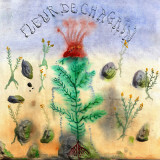
Pauline Marx, formerly of the fantastic duo La Fureur de Vouivre, seems like a being from another time and place; namely, an escaped marauder lurking in the forests of a Bruegel painting and integrating the surreal flora and fauna of a Boschian creation into the scenery and lore of deep Brittany. Her invented mythology is loaded with murky rituals and contorted mantras, backed by the surprising sounds and textures of terrains so earthly and so unreal.
The Devil at the Crossroads
Where do you think you come from? Where do you think you're going? Lasciate ogni speranza, voi ch’entrate: you, with the noodle to the four winds, who pass the threshold of this disc, you better leave all hope there, and glide in the poisonous footstep of the devil your guide.
Where do you think you come from? The mountain is no longer just the mountain; after your passage, it will no longer even be a mountain. Like the whole landscape, it will have been eaten, sauced by invisible leeches. Your nostalgia for the ground and your thirst to find the source will have only discovered a forest of vain words and foul water. Where do you think you're going? At the crossroads, the world is consumed in the previous future. Only the devil will know how to make you overcome the disgust of traditions, and only the love for the devil will give you enough vim to reach your goal: a village, perhaps, but which belongs to no one, a haven to your excessiveness .
The dark tradition to which this game of ternary trampling belongs, like the rhythm of a heart in tune with the inverted world, has no country and no assigned time. Rather a topology of Eve awakened after a thousand-year sleep, an idiosyncratic and possessed reading of our common humus, made up of stories composted in the limbo of the past, of songs captured in extremis vitae and rebus in the privatized antechambers of death.
What does she tell us about? Of our automobile and in love roamings, of the porosity of the membranes that separate beings and things, of the constant inversion of signs. The seventeen stages of this short journey, where intertwine the throbbing of objects, blown horns and rubbed horsehair, form the map of a country never to be found, ours, where only the voice of an old child and the disgusting devil's poisonous charm can guide us.
Parisian DJ, producer and emerging fashion icon Kiddy Smile embodies the lifeblood of house music past and present. His music flashes with nostalgia for those mid-80s New York basements where house music first came alive. 'Teardrops In The Box' pulses with the intoxicating energy of a Ball in Kiddy's native Paris, with its deep-rooted traditions but its intensely forward-focussing culture.
Following up on his fearsome debut 'Let A B!tch Know' on Defected, Kiddy Smile has deployed the well-established remixing capabilities of Mystic Bill, a house champion from the underground schools of Detroit and Chicago. His 'Jersey Dub' eases back on the tempo for a syncopated strut to The Garden State, while the 'Vocal Mix' is a bulkier prospect, emphasising Kiddy's growling vocal with some serious attitude bass. Finally, his vinyl-exclusive 'Acid Mix' is specifically designed for getting twisted on dark, underground floors. Cowbell and raw synths give 'Teardrops In The Box' unadulterated dancefloor credentials but this is more than a club record; the layers to this track run deep.
Killer shit from Flore - Tip for fans of Simo Cell, Ploy, Metrist and Batu
After the widely acclaimed "Rituals" album released in April 2020, Flore is now back to the cherished area of banger engineering with a four packer of original compositions to be unleashed this spring 2022 on her own POLAAR imprint.
The project’s title itself shows clearly what her program is all about : "Legacy & Broken Pieces" has to be seen as a cruise into the anterior future rather than a trip down memory lane. Following this mantra, it’s more than clear that her music does not constitute a tribute to any previous club music history, but has to be seen as a true proposition of sonic innovation and moving paradigms.
"I'm tired of the nostalgia that can be found in electronic music nowadays. With everything that is going on right now, the world will never be the same. Then why should music has to be so ?" says Flore.
Thus, she offers to rework this legacy with her very own vision of sound wizardry, providing a wide range of sonic textures to fulfill this forward goal of breaking patterns within the electronic continuum. Yet another proof of Flore’s skills for always trying to innovate and never repeat herself.
“Disruption” echoes an aerial jungle of the former century while “Fiery Principle” rides Jamaican waves of bass soon dynamited by minced voice samples evoking a soul goddess from the 90’s. The upbeat intro of “The Switcher” leads us towards a choir of drums navigating various black rooted rhythm traditions, but tripping into a very refined and spatial production effort. The records ends with “Primary Mineral”. Its rough and matte sound seems to drill into a wall of fragmented beats racing towards an elusive end, suggesting another musical adventures to be revisited soon…
Yair Elazar Glotman is a Berlin based composer and experimental sound artist. Having trained in classical double bass and electroacoustic composition, he uses these traditions in combination with improvisation, with particular focus on analogue processes, to create textural and spatial works. In recent years, Glotman has been known for his notable pieces in film and media composition, working closely with influentential late composer Jóhann Jóhannsonn on acclaimed titles such Mandy (2018) and Last and First Men (2019), which he co-composed and produced the score. . Apart from his work in film and media, Glotman is a celebrated recording artist in his own right, venturing into dark corners of ambient drone and post-classical with acclaimed albums such as his 2020 album Emanate via Fat Cat’s imprint 13070, 2017 album Negative Chambers with close collaborator Mats Erlandsson released via Miasmah Recordings, and his solo album Études released in 2015 via Subtext, receiving him high acclaim from the likes of Pitchfork, Guardian, BBC 6 Music, The Quietus, Uncut, Electronic Sound and more.