Between Christmas 2000 and New Year 2001 producers Ekkehard Ehlers and Stephan Mathieu recorded an album of warm, soft, delicately crackling electronic music in the space of that week. It was christened with the ambivalent title "Heroin" and was released on CD via the label Brombron in 2001 and later in 2003 re-issued on Kit Clayton's Orthlorng Musork on double-LP with remixes the pair had commissioned as expansions.
17 years later Heroin sees its first vinyl release to include all 13 tracks from the original CD track-list on this LP + 12“ set. The centerpiece "Herz" finally receives its long deserved vinyl treatment (side C, at 45rpm) and on the flip side Thomas Brinkmann contributes a mirror in a magnificent remix of that very piece on side D.
Ehlers and Mathieu were both highly prolific solo artists during the period 2000-2004, and in just two years after the initial release of "Heroin" each had produced over half a dozen new solo recordings: among them the serial masterpiece Ehlers' "Plays" (Cornelius Cardew, Hurbert Fichte, John Cassavetes, Albert Ayler, Robert Johnson) released as 5 stunning LPs in a series on Staubgold, while Mathieu's 'Full Swing Edits' spread over five 10" records plus his album 'FrequencyLib' on Mille Plateaux, 'Die Entdeckung des Wetters' on Lucky Kitchen and ‘The Sad Mac’ on Atsushi Sasaki’s Headz label were greeted to critical acclaim.
Both artists were expanding their conceptual sonic approaches in the glow of developing laptop technologies which would to these times in 2020 seem quite primitive, but these two in that period used the state-of-the-art to aid and abet their conceptual visions, while at times the duo used unorthodox experimentation - yet always had a distinctively melodic and musical form at its heart and soul.
Ehlers can be seen as a conceptualist, as a meta-musician who interrogates the mediums and methods of sound production - reflecting on the conditions and possibilities of improvisation (e.g. "Plays Albert Ayler") and exploits ideas of mutation and distortion of popular aesthetics played out within a ghostly form of divine pop beauty in his project März.
Mathieu, originally a drummer and co-founder of what has come to be known as the Berlin 'Echtzeitmusik' scene. His approach could be similarly described as working a critical analyst and researcher: Subtly and precisely working in the realm of processing as a method of intervening in melodious/harmonic analog sound sources.
Ehlers and Mathieu may not think too much about their singular productions and publications outcomes, but instead concentrate on the process and musical personality that characterizes their gesture- style itself stays in the background - and they usher a music from small minimal sound sources coaching a patient music of slow intervention - much like a refraction of light than a concrete painting or a blurred photograph - beatus accident.
And indeed, "Heroin" is an album that embraces the happy accident being made up of reduced, often very catchy and very direct micro hooks which seem laser-guided into a space accepting obvious melodic beauty in what feels like an observation of musics unfolding and revealing it's DNA, embed with for a kind of yearning for innocence and naiveté - as if Satie were on the jukebox in "The Crying of Lot 49". Not to say the music is "reduced", but rather: 'restricted' and born from acceptance of limitations, and the artists allowing the sounds to just "be.." with some incremental degrees of coercion.
The album not only sounds like that of 2 producers who are both dreamers and scientists, but that Ehlers and Mathieu chose to work with these means in a dialogue together to reduce pop music to its musical/tonal core, it is not Pop music anymore, rather a ghostly pointilistic itteration of song. "Heroin" is located at this transition, around that point at which tracks, that were or could have become pop compositions, irrevocably slip into a static harmonic nirvana. We are invited to follow the arch of Heroin in a slow-motion morphine musical haze.
Heroin sounded timeless when originally released and proof is that it remains so, one wishes that Ehlers and Mathieu would convene again for a week, a month or an entire year to continue this process of slow rumination, picking affectionately over the sounds they both love - and then maybe when everything is condensed, evaporated they would write more songs with those sonic refractive elements that remain.
Search:trans am
GES: Anthology of American Pop Music
Six great pop standards remembered: five pop songs are dissected by sampler, stretched, compressed, and re-collaged. In this way, their identity is lost. What remains is a vague concreteness: flashes of déjà vu and remote echoes that evoke the original.
GES (Gesellschaft zur Emanzipation des Samples)
-
Active members: Helmut Schmidt, Jan Jelinek
Founded: 2009
Headquarters: Federal Court of Justice, Karlsruhe, Germany
-
GES Glossary
Acoustic Surveillance Series
A 7-inch vinyl record series curated by GES focussing on historical methods of acoustic surveillance. Each record introduces a surveillance system from the past. Starting with Uguisubari in 2017, the series will continue with the release of Orecchio di Dionisio in 2021. GES is open to further suggestions on this subject.
Bundesgerichtshof (German Federal Court of Justice), Karlsruhe
“The use of audio samples as artistic practice may justify the infringement of copyright and intellectual property rights.” (ruling of the German Federal Court of Justice pertaining to Metall auf Metall II, 2016). The court is also the official headquarters of GES.
Circulations
What happens to copyright claims when music from a passing car is captured in a street recording? Is it legal to use this recording freely or is it necessary to obtain licensing rights? Circulations re-enacts this recording situation: audio players are placed in public spaces, where they reproduce the desired sample material. The acoustically choreographed space is then recorded, creating a field recording in which everyday noises circulate together with seemingly incidental music.
Emancipation of Sampling
Fuelled by its criminalization, the act of sampling existing recordings forfeited some of its artistic prestige (see Sampling). GES wishes to rehabilitate and re-emancipate the practice of sampling as a form of art in its own right. Strategy: 1. Name samples and sources explicitly. 2. Choose samples that are as popular and as recognizable as possible (Beatles, Carpenters, etc.). 3. The editing and manipulation of the sample must not compromise its recognizability (negotiable). 4. Use as many samples as possible. 5. Always name more sample sources than were actually used in the composition.
Field Recording
A compositional practice widely used in sound art and ethnomusicology that involves the recording of natural acoustical phenomena. Two additional requirements are usually imposed: The recording process should take place outside a studio environment, i.e. outdoors. And the person recording does not generate any of the acoustic material him/herself. GES expands this definition by introducing the concept of choreographed public space (see Circulations).
Gambling
An acoustic event favoured by GES, already used in numerous sound collages (must take place in public). The most popular option is thimblerig, a cup and ball gambling game commonly played in the street. Compositional instruction by GES: Place an audio playback device in the proximity of a thimblerigger. Play works for orchestra (by Debussy or Mahler). Move slowly towards the gamblers with a microphone.
Helmut Schmidt
Multiple identity and fictional character devised by GES. Figures variously within the semiotic system of GES as member, guest artist or public representative. Following the historical example of Subcommandante Marcos (EZLN).
Kraftwerk
The German band founded by electropop musicians Florian Schneider-Esleben and Ralf Hütter (a.k.a. Die Prozessoren) is the natural enemy of GES. Protected by computer-generated avatars, Kraftwerk operates a quote-hostile cultural hegemony. Their strategy: Install a special brand in the collective consciousness by means of a sophisticated system of quotations and references that may in turn not be quoted by anyone else. Other bands with such delusions of omnipotence: U2, Metallica.
Marcel Duchamp
As the inventor of the readymade, Duchamp may be viewed as a precursor to the art of sampling. However, the artist is appreciated above all for his sonorous qualities, as his vocal silence has often been sampled and processed. It was the inspiration for Jelinek's radio play Zwischen.
Orecchio di Dionisio
This 65-meter-deep limestone cave in the Sicilian town of Syracuse, carved out of a hillside in ancient times, has exceptional acoustics: A person standing at the cave entrance can hear every word whispered deep down inside it. The painter Michelangelo da Caravaggio gave it its name (The Ear of Dionysius) in 1608. The cave indeed resembles an ear and – according to Caravaggio – had a specific function: The tyrant Dionysius I imprisoned his political prisoners in the cave in order to spy on them. Orecchio di Dionisio will be featured in the Acoustic Surveillance Series in the near future.
Sampling
Compositional practice whereby recorded music is fragmented, turned into sound collages and transferred into different contexts of meaning. Since the advent of affordable sampling technology in the 1990s, the music industry has been trying to criminalize and/or promote the practice. Both strategies are driven by the same principle: Profit.
Uguisubari
Sound-making floorboards in Japanese temple and castle complexes, featured in the Acoustic Surveillance Series in 2017. In the Edo period, the “nightingale floor” (literal translation of uguisubari) was a popular acoustic warning system. The principle was straightforward: When someone stepped onto the boards, nails would rub against metal clamps beneath the floor, creating a tell-tale squeaky sound that was said to resemble the chirping of the Japanese nightingale.
Wind
A generator of acoustic events and an amplifier/transmitter of existing sounds. A meteorological form of energy appreciated by the GES on account of its unpredictability. A series about wind as an acoustic phenomenon is planned. Working title: Hotel Corridors.
Zwischen (Between)
Radio play by GES member Jan Jelinek based on recordings of various public interview situations. From the speech of the interviewees (all of them eloquent personalities) the pauses between coherent utterances were extracted and assembled. What we hear is an archaic body language: modes of breathing, word particles and onomatopoeic turmoil. A key question for GES: Which comes first, personal rights or artistic freedom? For Zwischen, Jelinek used only recordings by public figures that were already available to the public.
Repress
Vienna based artist jeånne maintaining ancient aesthetics on A side. fast pacing acid structures under aggressive beats, enveloped in melancholic strings and melodies.
DJ DISRESPECT aka Toni Moralez already proven his strong production skills on this and also other labels. He is now delivering two adrenaline kicking, schranz-like dancefloor destroyers out of the depths of Frankfurt am Main.
RICO PUESTEL debuts on his TIME IN THE SPECIAL PRACTICE OF RELATIVITY label with a mind-boggling journey of 41 minutes — split in two parts to fit on vinyl! HEPTAKAIDEKA is what it won't be and will be what it never was: Something from in-between worlds, a place beyond far beyond, where time dissolves into relativity...
Every modern electronic music presenter should be able to find joyful, elevated, convulsing or simply useful moments within the extent of this track that is designed to have its inherent connecting factors and starting points in place for every DJ set — letting it be just a few minutes, well-placed groove looping or bigger amounts of its entirety for diving into a long night, bringing it to an end or making it standing out in-between.
Starting off with a hazy half-grasp hint of what's to come, a mysteriously pervasive bionic loop emerges, slowly coalescing with a bone-dry groove on the rise. Taking up a first quadrant of the track, already gnawing into the long-term memory, it manages to gradually establish itself along the pathway while the "rhythmatics" endure some subtle layer-shifting with occult-like strings come sliding in from somewhere unknown like an admonitory subtext.
Being halfway through (and all the way in), everything smoothly crumbles down to its basic framework, still shaking off its own reminiscences while foregone vestiges almost perilously try to reassemble themselves. All of that leading to a clearly unforeseen yet fortunate drift into a 1980's-like synth peak time section after about 27 minutes being in that track, finally cherishing an evolving emotional felicity and the climax of its own being that tends to feel like an overarching salvation.
As everything being eventually finite, the track starts to bring to mind where it came from by assuredly falling back into a story told before with the well-established bionic loop that once used to run free, sounding somehow different and more tamed now. Ending with dignity, the consistently resurfaced admonitory strings lead the way to its conclusion and possibly new beginnings, solely leaving behind the heartbeat-like booming that carried it all, now fading away...
Coming into existence during a series of multiple productions of exuberant proportions with Rico making the studio his citadel-like stronghold, this is an extensive story of desires, instincts, pride, fall, mirth, solicitude, tension, détente and basically life itself while subtly yet versatilely entertaining on a dodgy yet accessible level throughout the wingspread of Techno, House, Minimal, Dub, Electronica and Ambient influences.
The CD version not only brings you the title track in the guise of its non-split completeness but eminently churns out the extra drumming dub treat DEKAEPTA for a pleasurable groove-delight as well as the trippy bonus beauty VOSEM' that transits as a precious component of infinity.
The global lockdown has seen a number of new hobbies and skills adopted. Yoga mats now decorate homes. Bread makers jockey for space in kitchens. Soiled paint brushes caked in acrylics lie abandoned. At Frigio Records HQ, confinement might have changed the rhythm but it hasn’t changed the aim; to find new and exciting music for 2020. The result? Frigio Allstars 3.
Daniel Holt returns for this new instalment in the Allstars series. Diving deep into the darkness, Holt resurfaces with the nine minute industrial throb of “Vaccuous Transient.” A stomping beat pierces sci-fi score synthlines in a track brimming with menace. Staying in the US, Grey people debuts on Frigio with the grime smeared jack of “Bruxism.” The flip is all first timers to the Madrid label with Scannoir offering “De Panaesher.” Sitting somewhere between synth lament and uplifting wave, this track is a true modern classic from a member of the GOTT camp. Madrid’s very own Negocius man follows with “101 Wars” a winding worming work of glazed electronics to kill any dance floor and the amazing finale, “The Smile Of The Body” coming care of Bari’s talent based in Berlin under the moniker of Sons Of Traders.
Frigio Allstars 3 comes from the murky underbelly of electronics, where the nights are long and the days are short. Ashen tones pricked with lighter shades, all smeared with attitude in this collection of underground tracks made for the underground.
Three years after their last collaboration “Lost in the Moment”, part of Darius’ debut album Utopia, the French producer and Nigerian born future soul artist Wayne Snow unveil their stellar single “Equilibrium”.
The message of unity has never felt more relevant than the times we are living through right now. This project composed one year ago, serves as a stark reminder that we can all transcend above our differences and connect through the experience of music together, regardless of colour and race.
The undeniable synergy of both artists create a harmony magnified by the richness of their diverse cultures and musical background.
The beat instantly catches us in a warm and arresting atmosphere. The main melody reveals an uptempo rhythm gently interwoven in Wayne Snow’ emotive voice, born in Nigeria, living in Berlin in preparation for his next album. His lyrics infuse a carefree candor, which only suggests love and euphoria, fruit of an universal balance and a collective caring energy.
After multiple collaborations among “Helios” or the “Nightbirds” improvised live project (feat. FKJ and Crayon), the two artists reunite once again on “Equilibrium”. Heady and joyful, only few seconds are enough to form a timeless memory and make this track an instant classic. Darius holds Wayne’s powerful vocals, which travel through the composition as gospel pipe dreams. His Funk and Disco influences, embodied by his heart-warming and dynamic groove reminds us of his iconic project Romance (2014). Driven by a festive and upbeat energy, Darius finally renews himself with a return to his musical roots, whilst Wayne Snow steps up towards an audacious expression and a peek into his forthcoming artist album.
Lovers of pastel and retro aesthetics, we find the artist’s aesthetic language elevated through an impressive video treatment by the esteemed French director Alice Kong set for release on July 23rd. The audio release will precede a week earlier on July 16th, part of his forthcoming project.
Reissue of this long lost funky Afrobeat/Reggae classic from 1978
For fans of Fela Kuti, Peter Tosh, Bob Marley, Segun Bucknor
The year is 1978 and one hot thing from the musical underground is Reggae music from Jamaica, the USA or the UK, where most of the acts had musicians of Caribbean descent. Reggae had the groove, the rebel spirit, and the relaxed attitude all in one, to enchant a big part of the world’s inhabitants. And while at least Jamaica as a relatively poor and so-called "Third World“ country proved to spawn Reggae acts of the highest quality, literally nobody dared to look further and dig deeper into the underground except of a few maniacs who were not satisfied with spinning Marley over and over again. And maybe they stumbled over the 1970s Afro Beat sound from countries like Zambia or Nigeria and then got interested. What did they find in the simmering metropolises of this still mysterious continent? Somewhere in Nigeria, they would have certainly caught a glimpse of mind-blowing performances of The Sea Lions, a six-piece group mixing the then hip Reggae and Afro Beat styles to generate fresh and furious music with a hypnotizing atmosphere.
Polyrhythmic beat patterns build the foundation, the utterly fruitful soil for the heartwarming melodies wailed out by the guitars and the commanding vocals with their conjuring charm. Great organ work builds the link between the groove section and the melody instruments. You can imagine what a pleasant experience this band might have been live back in 1978 when their sole album "Free The People“ got released. And this album, of which copies in only good conditions already fetch prices of $450, while nice clean pieces might go up to $1200, lives up to the expectations one might have from watching a live show by the Sea Lions. The sound is vivid, transparent, powerful, and clean enough to make the music a real pleasure listening to, but earthy enough to present nothing but the band going wild here. The songs all have a similar pace, not too fast, but swinging and pulsating to spread their energy to and among the listeners. The melodies are simple but come from the depth of the heart. This feels typical for African 70s music and despite being kind of reduced, these melodies keep haunting you still even hours after the record been taken off the turntable and put back into its sleeve. They bring images of an ever pulsating city by night, warm climate, palm trees, people at the bar, a witches cauldron of sounds, smells, voice, and pictures. And you feel the magic floating through the air while this groove will not let you go so easily.
You can either dance your soul out to this ultimate reissue or you can sit down, listen and let the music tell you a story of the dark corners of the big city, the narrow alleys that lead you into a boiling labyrinth of mystical dreams. And in songs like "You Can Make It If You Try“ you will find the whole magic of the African world, a world so fascinating for us Europeans but still so unapproachable in some ways and dangerous for the weak. Do not try to resist, this is your pleasure. Grab a copy and the Sea Lions will carry you off to their place. I haven’t heard such a killer Afro Beat and Reggae album with songs this exciting and wild in a long time. If you equally love Peter Tosh, Bob Marley, Segun Bucknor, and Fela Kuti, look no further. Here is the spiritual essence of all these great artists merged into one giant act.
German techno and house composer Tim Engelhardt takes you on a deep dive into his peculiar-yet-relatable world of musical meanderings with ‘Idiosynkrasia’. True to the nature of idiosyncrasy, the album is more than the sum of its parts.
‘Idiosynkrasia’ is an ode to the inspiration Tim finds in all kinds of spaces and places: each cut woven from the same cloth of meticulously formed melodic structures and expertly crafted harmonies, gently amplified and unfettered by genre. From the opening track it’s clear that Tim has a profound awareness of rhythm and sound, his background as a pianist lending an easy fluidity to the album as it expands and contracts to tell a story which is gentle, humble and reflective.
Using granular processed recordings of piano, floating strings and other instruments to transmute emotions like love, nostalgia, vulnerability and longing, the album shifts through meditative, flow-state inducing tracks, morphing into cuts designed for dancing it all out.
Take it straight, mix it up or down: ‘Idiosynkrasia’ is cinematic in form and orchestral in structure, each track is marked with Tim’s unique sonic signature and careful attention to instrumentation.
Inhale the spirited and lively flow; exhale and surrender into epiphanic moments: this is an album which will catalyse deep breaths, reflection and a different way of thinking.
- A1: Cosmic Protrusion
- A2: Energy Wind
- A3: Path To The Fortress
- A4: Indian Milk
- B1: 5Am-Prn-Ksv
- B2: Translucent Formlessness
- B3: Primitive Nightmare
- B4: Duga-3
- C1: Stolen Paintings
- C2: Beat Instrumental
- C3: Jobim’s Cigar
- C4: Sphinx
- C5: Ancient Flight Text
- D1: Ascending Spirals
- D2: Alpine Bossa
- D3: Bronze Frog
- D4: Penta
„Gianmarco Liguori has created his own fascinating niche in music which exists at a place where jazz, soundtracks and improvised art music intersect … mesmerising, sometimes eerily ambient … grounded in electronica soundtracks, experimental Miles Davis of the Seventies, slightly funky Eighties jazz-rock with a nod to minimalism and impressionism … Albums by Liguori offer the indefinable and stand at some distance from just about everything else going on in New Zealand music.”
Graham Reid, NZ Herald
Duga-3, composed and produced by New Zealand-based multi-instrumentalist Gianmarco Liguori, was originally released in 2011 in an edition of 200 copies. The album quickly sold out, with original copies sought after by collectors and fans of Murray McNabb and Kim
Paterson (who appear on the LP), both pioneers of jazz rock in New
Zealand in the early 1970s.
Co-producer Murray McNabb (1947-2013), keyboardist with legendary NZ jazz rock group, Dr Tree in the
1970s, recorded his album Song For The Dreamweaver with ECM artists
Ron McLure and Adam Nussbaum in New York (1990), and had performed with the
likes of Don Cherry, Ed Blackwell, Charlie Haden, Joe Henderson and Sam Rivers. He
was also a top-tier composer/arranger for film, television and radio.
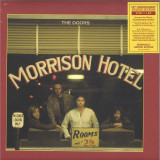
The Doors returned to their roots and were reborn a rock ’n’ roll band on Morrison Hotel, the group’s fifth studio album. Completed in only a few weeks and released in February 1970, the hard-charging album took its name from the Skid Row hotel in downtown Los Angeles that’s featured in the iconic cover photo taken by Henry Diltz.
Morrison Hotel: 50th Anniversary Deluxe Edition includes the original album newly remastered by The Doors’ longtime engineer and mixer Bruce Botnick, plus a bonus disc of unreleased studio outtakes, and the original album on 180-gram virgin vinyl. The music will also be available from digital and streaming services the same day.
For this new collection, the original album has been expanded with more than an hour of unreleased recordings taken from the sessions for Morrison Hotel. These 19 outtakes transport listeners into the studio with Jim Morrison, John Densmore, Robby Krieger, and Ray Manzarek for an unprecedented perspective on the making of the album. Botnick says: “There are many takes, different arrangements, false starts, and insightful studio conversations between the band – who were in the studio – and producer Paul Rothchild – who was in the control room. It’s like being a fly on the wall.”
Several of these unheard recordings spotlight how Queen Of The Highway and Roadhouse Blues evolved across multiple sessions. It’s especially interesting to hear how the band played with different bass players on Roadhouse Blues. Early versions include Harvey Brooks, who played on the band’s previous album, The Soft Parade. Later takes feature guitar legend Lonnie Mack on bass along with The Lovin’ Spoonful’s John Sebastian on harmonica who, due to contractual restrictions at the time, had to be credited as G. Puglese.
Among the treasure trove of unreleased outtakes are also rough versions of Morrison Hotel tracks Peace Frog and Blue Sunday, as well as The Doors rarity I Will Never Be Untrue. The collection also captures some incredible session outtakes of the band jamming on cover versions of the Motown classic Money (That’s What I Want) and B.B. King’s Rock Me.
Unclassifiable percussionist and producer Chiminyo will be releasing his long-awaited debut album “I Am Panda” via London tastemaker label Gearbox Records on the 25th of September. The ten-track album is a foray into unexplored sonic territory, featuring a host of diverse guest musicians from London’s burgeoning music scene. Chiminyo's music may be rooted in the London jazz scene, but his music is transcendent of anything that could be defined as such. Whilst his joint use of analogue and digital technology meaningfully honours the manic city lights of London’s bustling scene, it remains ever-changing crossing over into hip-hop, future pop, experimental electronic and global spheres. Chiminyo's tech-heavy drum kit set-up, combines the raw, immediate live sound of percussion and the futuristic timbres of his electronic productions to create his own, daring soundscapes. Via laboriously self-coded software, each cymbal crash and drum hit triggers a synth or sample, allowing Chiminyo complete control and freeing him of all loops, click-tracks and backing tracks.However, it is important to note that Chiminyo's music is far more than just a technical feat. Whilst still highly innovative in it's composition, "I AM PANDA" is purely the result of a deep and tireless exploration of the music that Chiminyo truly resonates with to create a soulful, spiritual, and evocative record that feeds off the conflicting duality between technology and nature. Composed and arranged by Chiminyo and recorded at Konk Studios by Ricardo Damian (Jorja Smith, Sampha, Binker & Moses), the new album also features a host of talented guests including Kweku Sackey aka K.O.G, singer Dunja Botic, and spoken word artist Brother Portrait of Steam Down fame. The new album follows on from Chiminyo's 2019 debut EP "I Am Chiminyo", which served as a visceral introduction to his unique sound, and earned plaudits from the likes of Gilles Peterson, BBC 1Xtra, CLASH, Red Bull, Jazzwise, Jazz FM and more. As well as his own solo project, Chiminyo also performs and records with some of the leading figures of London’s music scene, including spiritual jazz-leaning outfit Maisha and psychedelic energy bomb Cykada. He has also previously collaborated and recorded with Gary Bartz, Nubya Garcia, Shabaka Hutchings, Theon Cross, and Zara McFarlane.
Tape / Cassette
Longstanding collaborators & Bay Area based experimental duo Kush Arora & Lucas Patzek aka Only Now & Orogen return with ‘AVULS’, the project’s sophomore release.
Building on the unearthly, black hole transmissions and creaking, exospheric ambience of their self-titled debut, Only Now & Orogen present an abyssal, elemental broadcast from another unchartered extra-terrestrial zone. Remote and astronomical yet tied to a newfound sense of rhythmic structure, ‘AVULS’ navigates a course through inverted beat-led frameworks, surging detonations of sub-bass, and severely turbulent, monumentally scaled soundscapes.
Amidst this large, slow-moving cyclone of sound sit fragmentary emergences of choral voices and Gregorian chants; a distant, esoteric presence within dense eruptions of attritional noise and infinite recesses of low end.
In harsh, pointillistic detail and through infernal surround sound, Only Now & Orogen channel dub, noise and power electronics, evoking a distorted, ritualistic inflection on the Voyager Golden Record; a mass of tectonic motion and friction; a storm in deep space.
- A1: Made Of Stone
- A2: I Am The Resurrection (Jon Carter Remix)
- A3: Fools Gold (Grooverider Mix)
- B1: One Love (Utah Saints Remix)
- B2: I Wanna Be Adored (Rabbit In The Moon Remix - Bloody Valentine Edit)
- B3: Fools Gold (A Guy Called Gerald Top Won Mix)
- C1: Elephant Stone (Mint Royale Remix)
- C2: Waterfall (Paul Oakenfold & Steve Osborne 12" Remix)
- C3: She Bangs The Drums (Elephant Remix)
- D1: Shoot You Down (The Soul Hooligan Remix)
- D2: Waterfall (Justin Robertson Mix)
- D3: Elizabeth My Dear (Kinobe Remix)
The Remixes is a compilation album by The Stone Roses, which features remixes by various producers including Utah Saints and Paul Oakenfold. Various techno luminaries ply their skills reworking some of those early classic songs, and it is immediately clear that the Roses, even beyond the genius of their songs, were a preeminent dance band.
The Remixes is available as a limited edition of 3000 individually numbered copies on transparent & red swirled vinyl. The package includes an insert.
Repress
René Pawlowitz presents himself in many different forms; whether it’s as Head High, EQD, Wax, WK7, The Traveller or more recently as Hoover - he consistently, and without any fuss or hype - produces some of the most effective, quality techno you can find on the planet. The Shed alias is usually reserved for his best work.
With this in mind, it really is a special event to announce this amazing new EP from Shed on Tectonic, showcasing 3 distinctive and highly effective techno cuts.
‘Try’ takes a broken-beat techno rhythm for it’s spine - reminiscent a little of the 2008/9 dubstep/techno crossover period. Tension is set with dissonant elements pulsing around swooping subs until we are saved by the heroic pads that ease in, building ever upwards to a lush finale. Close your eyes and be transported back to the rave.
‘Box’ is a darker, more percussive affair - claustrophobic and industrial. 130bpm 4/4 distorted kicks set the stage as frantic drum machine hats and claps crash about heavily reverb’ed ghostly samples.
Lastly we come to ‘Sweep’, a hypnotic bleepy roller with a bass heavy presence. As the riff loops up and over, drums build and a dissonant synth part creeps in. The not-quite 4/4 kick drives you ever forward with a gentle stumble as rattling hi hats flair about over head. Great finish to a great EP.
Bleep deep warm house w/s spoken words. Blue ambient intelligent techno on the flip side.Vinyl only
‘Evolve’ is the first full length album from composer, music producer and violinist Vito Gatto, a concept album that guides the listener on a one-way journey through the various phases of an imaginary evolutionary process. Gatto graduated in Violin from the Milan Conservatory of Music, his research starts from the unconventional application of a classical background into both making music in the studio, and live performances. For this work, Vito decided to put himself in a restricted composing and technical environment; all the arpeggiated sounds on the album are made from one single violin note that Vito sampled. He transforms the same note throughout the entire album, using the different treatment of this micro sample and the arpeggiator programming as the construction of a mutating and evolving structure. The album is Instinctively executed, almost improvised, and elements like distorted bass lines, hardcore inspired percussions, whistles and alienating string melodies represent unexpected alterations. Vito decided to keep these instinctive additions clean from excessive control as a representation of the beauty of the unpredictable. The album track list is an expression of evolutionary phases. From the minimalistic piano piece ‘Decomposition’ to ‘Quiete’ which expresses the state of calm after a shift has occurred, ‘Nostalgia’ and ‘Stasi’ represent a hazy trance like state. Vito challenges the listener to ask questions like ’am I in the right place? Is this who I set out to become? Do I have to keep evolving, or should I try to regress?’ ‘Evolve’ creates continuous connections between traditional and experimental music, creating dialogue between classical instruments and industrial techno, ambient, noise and de-constructed sounds. The Album will be released in both digital and vinyl formats via NeMu, a fresh new label founded by Vito Gatto himself. The label will focus on experimental projects based on the exchange between acoustic, concrete and electronic sources. The Artwork is part of ‘Jewels’, a series of ceramic sculptures by Benni Bosetto, courtesy of the artist and ADA Project, Rome
- A1: Death Of A Princess (An Apology)
- A2: The Gorilla Interview
- A3: Confrontation Song
- A4: Airline Safety
- A5: National Wealth Beds
- A6: Simultaneous Translation
- A7: The General Synod’s “Life Of Python”
- A8: The Ayatollah Song
- A9: Closedown
- B1: Points Of View
- B2: Rowan’s Rant
- B3: Stout Life
- B4: Gob On You
- B5: Gay Christian
- B6: Final Demands
- B7: I Like Bouncing
- B8: Oh! Bosanquet!
- B9: I Believe
“Not The Nine O'Clock News gave the world alternative comedy and made the media scene we have today.” – Mark Lewisohn, Radio Times Guide to TV Comedy Celebrating over 40 years since the ground-breaking comedy series arrived on BBC TV, Demon Records proudly presents all three original LPs - Not The Nine O’Clock News, Hedgehog Sandwich and the double LP The Memory Kinda Lingers - lovingly mastered on heavyweight themed coloured vinyl.
Let the famous signature tune take you back to the heady days of 1979, when Labour gave way to the Conservatives, striking workers created the Winter of Discontent, and Not The Nine O’Clock News inherited the BBC2 time slot vacated by Fawlty Towers. It quickly became a trailblazing smash hit, running for four series and making stars of Rowan Atkinson, Mel Smith, Pamela Stephenson and Griff Rhys-Jones.
Among the many famous, and much-loved, sketches included on the LPs are David Bloody Attenborough (aka Gerald the Gorilla), Points of View, General Synod’s “Life of Python”, Constable Savage, University Challenge, Hi-Fi Shop, That’s Lies, Not The Parrot Sketch, Open
Marriage, Question Time, Game For A Laugh, Two Ninnies, McEnroe’s Breakfast, What A Load of Willies, The Pope’s Visit, Simon and Garfunkel and – yes – The Return of Constable Savage. Produced and devised by John Lloyd and Sean Hardie, Not The Nine O’Clock News won a Silver Rose at the Montreux Festival and a BAFTA for Best Light Entertainment Programme. Its large writing team included such future luminaries of TV comedy as Richard Curtis, David Renwick,
Andrew Marshall, Guy Jenkin, Laurie Rowley, John Lloyd and Andy Hamilton. Presented as a faithfully reproduced facsimile gatefolds, and remastered from the original tapes.
Prolific American artist Jon Hester returns to Rekids for the first instalment of his new album, ‘Converge’, this September.
Jon Hester grew up in the Midwest US, living in Chicago and Minneapolis while taking musical cues from Detroit. Initially he was a dancer, and later transitioned to the decks with a refined understanding of what it takes to move a club. He progressed to hosting his own events, holding residencies, and working at a record shop, and now brings his physical rhythms and adventurous drums to his productions, with output on respected labels such as Transmat, Deeply Rooted, Dystopian, Klockworks, and LET Recordings, not to mention multiple appearances on Rekids.
Continuing to show fine form on his debut album, Hester now serves up eight of his signature house and techno fusions with plenty of his trademark directness across four sides of vinyl. The superb 'Sending Signals' opens the album with scene-setting synth modulations full of sci-fi atmosphere. It's the calm before the storm as 'Metropolitan' then immediately sets off on a cantering groove that is eventually run through with busy, jazzy piano keys that bring the soul.
'Haze' has excellently taught kick drums with hypnotic synth tones adding colour, and features Hester on saxophone. When 'Rain' comes, things grow darker and more menacing, with shakers and urgent stabs keeping you moving at a slick pace.
The second half of this compelling record features the loopy punches and pulses of the super smooth 'Dreamstate', beautifully cosmic and widescreen techno of 'Free' and pensive but urgent deep electro of standout cut 'Flex.' Last of all, 'Equinox' is lit up with distant chords which bring a far-sighted gaze to the rolling, robust kicks.
The first vinyl release of 2020 on Nang, belongs to the Parisian producer and newcomer to the label, Kelton Prima. The veteran artist has been producing and Djing since the late 80's, also releasing under the alias of D_Tekt. Prima has released on the Belgian label Disco Praline, Chicago based imprint Mathematics Recordings, Pizzico Nobel and also has contributed remixes for Thieves Like Us and Plastique de Rêve among others. Along side him on this release features Hard Ton, the Italian artist, who released previously on NANG188. The duo deliver a cover version of Culture Club's 1983 hit, Miss Me Blind. The release sticks with a retro aesthetic, yet given a modern high impact make-over and features 4 edits.
The "Miss Me Blind" original takes you you on a voyage, straight to a dance floor worthy of the infamous New Dance Show in the late 80's. The upbeat, nu-disco grooves, with Solid bass lines (that later trans into squelchy acid affair) are counter balanced with Hard Tons sublime vocals. The Vintage drum machine sequence is perfectly matched with shimmering synths and guitar riffs.
Second on the release is the The Caribbean House "Vision". This edit takes things a little deeper with a modulating bass arpeggio, that pans across the stereo field. Spliced and pitched down vocal cuts feature in this version alongside chime bell melody and pads that creates a emotional ride.
DJ Rocca, the Italian producer a Nang Records regular, delivers a rhythmic and percussive remix. This is classic Rocca style with retro drum machine programming, and a variety of smooth and silky Italo synth patches. The final edit of "Miss Me Blind" consists of Club Domani's bouncy, bass heavy club version. This upbeat and energetic remix keeping things rolling with break-downs and snare filled drops.
b 02: Miss Me Blind (The Caribbean House Vision) feat. Hard Ton
[c] 03: Miss Me Blind (DJ Rocca Italo Vocal Remix) [feat. Hard Ton]
[d] 04: Miss Me Blind (Club Domani Remix) [feat. Hard Ton]
Searching for new ways to express himself, Maarten Smeets (one half of Detroit Swindle) has found a new perspective on music in his alter ego “Wanderist”. Here, he shares his unique view on contemporary electronic music with strong influences from dub, electro, techno and ambient in tempo’s that match the intensity, funk and drive of his sound. As Wanderist, he has been writing some of his more abstract work of recent times. His sound is melancholic yet euphoric, using powerful loops and dreamlike melodies to create a dense flow in his compositions. His debut release is signed to Aus music later in 2020 and he has also launched his own label titled ‘Transient Nature’ where his own work will be released along with the work of like-minded artists. With a large catalog of music ready to release and collaborations with various labels planned for 2021, the future is bright for Wanderist.