"Taking influence from the pioneers of Música Popular Brasileira, Wolfgang Pérez has crafted an exquisite album of summery experimental pop music that encapsulates the beauty and chaos of modern Brazil. A must-listen for fans of Tom Zé, Gilberto Gil, Kiko Dinucci, Negro Leo, Ricardo Dias Gomes, and João Gilberto.
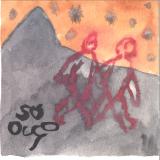
Genre-blending songwriter, arranger, and guitarist Wolfgang Pérez is set to release his highly anticipated new album Só Ouço in July 2025 on Hive Mind. Known for his unique fusion of influences, the German-Spanish artist first captured attention with his 2021 debut WHO CARES WHO CARES (Fun In The Church), followed by the critically acclaimed Spanish-language album AHORA (BAUMUSIK, 2024).
Só Ouço is the fruit of an 18-month creative residency in Rio de Janeiro, where Pérez collaborated with a group of young Brazilian musicians. Deeply inspired by the city's sounds and rhythms, the album marks an exciting chapter in Pérez’s evolving artistic journey.
In 2022, Wolfgang Pérez arrived in Rio de Janeiro on a university exchange to study composition, and quickly found himself immersed in the city’s rich musical landscape. Introduced early on to Rio icons like Thiago Nassif, Arto Lindsay, and Ana Frango Elétrico, what began as a semester turned into a transformative three-semester stay. Pérez absorbed the city's contrasts - it's beauty, its people, it's chaos and violence, all it's contradictions and life - while deeply studying Brazilian music at UFRJ/UNIRIO under the guidance of masters Josimar Carneiro, Marcello Gonçalves and Almir Cortes.
Wolfgang spent the first 6 months or so soaking in as much as possible, going to shows, to the baile funk parties, walking the streets, hiking the mountains in and around Rio, listening to music, making friends, learning where to go and where not to, learning the language, learning the slang, incorporating the culture. He used the time to forget himself in the vibrance of the city.
After this the band came together through a series of chance encounters and happy accidents...some loose jam sessions led to shows around Rio, where Wolfgang, alongside Luis Magalhães (bass), Pedro Fonte (drums) and Paulo Emmery (electric guitar), started to flesh out some of Wolfgang's compositions. At a show at Audio Rebel they met Angelo Wolf (owner of Wolf Estúdio and engineer for artists such as Bala Desejo, Dora Morelenbaum, Zé Ibarra, Marcos Valle, Antonio Neves and Ana Frango Elétrico); moved by the music, Wolf offered Pérez residency and studio time at Wolf Estúdio, providing the foundation for Só Ouço. Angelo was a catalyst for the production of Só Ouço, his openness and generosity helping to shape the sound of the record. Carol Maia, a young guitarist, lyricist and singer brought a sensitivity and tenderness to the songs, while Antonio Neves helped to pull together the brass and woodwind players who would complete the lush sound of the album.
Meticulously arranged, and beautifully composed, Só Ouço is a joy to listen to and surprising at every turn. Classic songwriting and cutting edge production blend to produce an album that is by turns tender and gentle, abrasive and unsettling, a joyful celebration of life in all its complexity."
Cerca:trans x
On September 19, 2025, Mac Declos will release his second album, MTY-013 « Nothing Stands Still », on Mama Told Ya. Following the acclaimed MTY-007 « Hard Work Always Pays Off » and a trilogy of striking EPs : Angel Eyes (2025), Endless Cycle (2024), and Cuir en Cage (2023), as well as countless DJ sets and All Night Longs around the globe, Mac is now ready to unveil a bold new chapter in his musical journey.
Nothing Stands Still is a sonic artefact: a double-vinyl album composed of 12 timeless tracks. Eleven pieces are produced solely by Mac Declos, with one co-produced alongside Anetha. The album also features unique contributions from Mac’s mother, Doona Rolls, and Mac’s dad, Eric Declosmenil, adding emotional
depth to the project. While music is often elusive and ephemeral, with Nothing Stands Still, Mac Declos set out to create an archive of the future that transcends time and trend, an echo meant to endure. Once again, Mama Told Ya reminds us: Music remains.
"The Happening by Tomorrow Comes The Harvest is the least case, a provocative confrontation. It's a challenge or dare to the idea that music can be useful if we are able to experience it. I would imagine that to many, music having an objective beyond the listener doesn't make sense because the general thought is that Music is made for us to consume, to make us remember, to influence us and to make us feel something. The Happening does all those things but much more. What it does is expand the scope from us to "it". Creating and constructing music for the subject of existence is a tall order.
The concept of The Happening is about the beginning and the end of Time and Space; the initial point of when reality starts and its conclusional apex. In the beginning, there is a great light. And from this light, comes life. Life is lived until it isn't.
This is what The Happening implies. It speaks about a 9-minute frame in reality, used to emphasize something that happened a very long time ago, something that happened in its creation and what will eventually happen far in the future.
The Happening was of an accidental birth. The love child of three musicians (Jeff Mills, Prabhu Edouard and Jean-Phillippe Dary) who was just asked to play "something" so that the camera crew could have extra b-roll for all the previous footages of the band while they were working in the recording studio in the North of Paris for their album Forbidden Planet. There was no discussion of what they'll do, no plan, no direction other than to use music to reach a level of consciousness.
Somehow within these transformative 9 minutes, something was felt by each of them, explored to its furthest point, which lead to this extraordinary creation. The Happening refers to the life and death of everything living thing. Infinity."
Jeff Mills
Scintillating, alchemical kosmische; visionary, deep, and luminous; and beautifully sleeved, with gold foiling and silver ink.
Works In Metal fans out a set of acid treatments and finely sharpened blades — cutting, shaping, suspending form. Sounds are melted down and forged as if liquid metal.
The works are paired. Arc’s Blue Flame previews the smoking volatility at the album’s core. Echoes and resonance soften the dissonant, bright textures; all overlaid with Fofana’s signature, percussive kick drums. Welding drills into the discordant thrills and spills of metamorphosis. Sparks fly and the bittersweet arc of change unfolds.
Fofana discreetly folds in text, poetry, and field recordings, spooring their decomposition and recomposition with a prismatic point of view. The coupling Obscure Light (Decomposition) and Obscure Light (Recomposition) marks something new in his music. The pulse is brightly honed, cascading beyond the dancefloor, exultingly eluding musical genre.
Works in Metal is perhaps Fofana’s most narrative album. At its heart is the killer, extended Lure of the Fragment / So Another Sound Suggests Itself. Melodies circle in call-and-response patterns, balancing proximity and distance, signalling the inward gravity required to work with metal. A nested story-line, with birds flying in; an album within an album. Dredging up memories and associations, Fofana filters in selections from his sound-archives. Layered with synths, field recordings become instruments in their own right. The last three minutes proffer precious clarity — a memory, in miniature, flashed onto molten metal.
In 1943 Suzanne Césaire declared that ‘our surrealism will then supply them the leaven from their very depths. It will be time finally to transcend the sordid contemporary antinomies: Whites-Blacks, Europeans-Africans, civilized-savage: the powerful magic of the mahoulis will be recovered, drawn from the very wellsprings of life. Colonial idiocies will be purified by the welding arc’s blue flame. The mettle of our metal, our cutting edge of steel, our unique communions — all will be recovered’. Works in Metal is a tribute to her prophecy; its enactment, sculpted in sound.
Amonita, the ethereal musician known for her enchanting compositions and captivating live performances, is set to release her latest body of work, the Rainbow EP, under Lee Burridge’s esteemed record label All Day I Dream.
Since her debut in 2017, Amonita has been on a steadfast mission to craft iconic melodies that resonate deeply with listeners, evoking emotions that linger long after the music fades. She seamlessly blends live instrumentation with electronic elements, creating an immersive sonic experience that transports audiences to a world of serenity and wonder. Amonita is no stranger to All Day I Dream; In addition to her Secret of Happiness EP in 2019 and Aura EP in 2021, Amonita has contributed tracks on two A Winter Samplercompilations, and was featured on Gorje Hewek’s 2021 Collages album released on the label.
Drawing inspiration from her time spent in Turkey surrounded by nature, Amonita infuses the Rainbow EP with the essence of the awe-inspiring beauty she experienced: sun-kissed landscapes, tranquil seas, and the vibrant hues of a majestic rainbow. Her music speaks to the hearts of true dreamers – those who believe in love, walk barefoot in the rain, watch sunsets, admire the stars, and are impressed by the mystery and beauty of the moon.
In her own words, Amonita shares, "No matter how difficult your path through storms and thunder is, after that you will see a rainbow!"
This sentiment encapsulates the overarching theme of resilience and hope that resonates throughout the EP, serving as a beacon of light in challenging times. The Rainbow EP is a testament to Amonita's boundless creativity and passion for storytelling through music. From the shimmering melodies of title track ‘Rainbow’ to the hypnotic rhythms of ‘Amulet’ to the dark and mysterious ‘Moon Dust’, each track invites listeners on a transcendent voyage of discovery.
Prepare to be spellbound as Amonita unveils the Rainbow EP on March 29th. Experience the magic for yourself and let the music transport you to a world where you can dream while awake and rainbows reign supreme.
- A1: Crumbling Concrete
- B1: Rusted Iron
DINTE issues another cassette-only mixtape taking in Soviet punk selections, 1985 to 1992, issued in partnership with Philadelphia's World Gone Mad.
Absolute fire this, a mixtape survey of punk, no wave and all sorts of angular post-punk fantasies from the USSR, 1985-1992.
You can go whistle for a tracklist for this one, but trust that it’s all top grade, shot from the hip, frazzled, growling and assymetric as fuck, from stomping jangle to more light-footed, motorilk post-punk to some lost-in-translation Casio dub bubblers and into more bleak gothic realms - and not a dud in sight.
Issued in partnership with Philadelphia's World Gone Mad.
Celebrated DJ, producer, and sonic explorer Auntie Flo (aka Brian d’Souza) — described by The Guardian as “one of global club culture’s most vital voices” — returns this autumn with ‘Birds of Paradise’: a rhythmically rich, emotionally resonant, and ecologically grounded new album, out 23 October via his A State of Flo imprint. The album will be launched with a special live show at London’s Jazz Caféon the same day.
‘Birds of Paradise’ draws on d’Souza’s global club experience while deepening his connection with the natural world. Built around classic Roland drum machines and iconic vintage synths, the record is a joyful, body-driven celebration of rhythm and movement, but one grounded in ecology and place. The album’s spiritual centre lies in Saligao, Goa, near d’Souza’s maternal homeland where his Auntie Florie (where the name is derived from) is buried. Where he found his ‘paradise’ nearby, staying in a converted fisherman’s hut and recorded dawn choruses from a riverside studio overlooking mangrove-lined waters. Environmental textures from Japan also make their way into the music, creating a sonic map rooted in lived experience.
“Birds of Paradise is about finding beauty and rhythm in a chaotic world. It’s about listening, to nature, to our bodies, to what’s real. It’s a reminder that dance music can be both joyful and grounded.” The album blends Afro-Latin polyrhythms with Western 4/4 patterns, fusing instinctive, dancefloor energy with field recordings that anchor the music in the earth. Described by d’Souza as “tropical with a few deeper edges, a balance of light and dark.”
The new record follows the acclaimed ‘In My Dreams, I’m A Bird and I’m Free’, which earned 4 stars and Global Album of the Month from The Guardian, featured in Disco Pogo’s Albums of the Year, and received support from Luke Una, Resident Advisor, Juno, Bandcamp, Mixmag, DJ Mag, Electronic Sound, The Skinny, Beatport, Ban Ban Ton Ton, and more. The album’s launch show at Omeara London sold out. Other recent projects include the ‘Outernational Dance’ EP on cult label Multi Culti, event series ‘Plants Can Dance (and Mushroom’s Sing)’ which explore plant and fungi bioelectricity as a means of live composition, and ‘Black Beacon’, a haunting cassette release and soundwalk series recorded on the abandoned military island of Orford Ness. There, d’Souza explored the eerie intersection of nature, decay, and deep time, gaining special access to restricted buildings to capture long-form soundscape compositions.
Alongside his production work, d’Souza has emerged as a leading voice at the intersection of sound and science. He curated music for Imperial College’s groundbreaking psychedelic therapy trials, developing six-phase playlists to guide participants through psilocybin-assisted sessions treating conditions such as fibromyalgia and gambling addiction. His five-hour ambient set at Watching Trees Festival, selected as Resident Advisor’s Mix of the Day, continued this exploration into the therapeutic potential of sound in altered states. He also spent six months collaborating with BBC producer Tom Raine on a documentary for BBC World Service, centred on a two-week journey through Kenya and Goa. There, he performed live, led plant music workshops, and joined a deep listening retreat rooted in field recording. “I realised my studio isn’t just four soundproofed walls filled with instruments — it’s the journey itself. It’s the people I meet, the natural world I listen to, and the connections I feel.”
This same commitment to deep listening fuels his live concept Plants Can Dance, a project that combines the biosonification of plants and fungi with modular synthesis. The next event, on 14 September at Hideout Hackney Wick, will feature performances by Stella Z and Lapalace, with d’Souza and resident Lamine playing live alongside responsive plants in collaboration with Repot Hackney Wick and the label Music To Watch Seeds Grow By. “I’ve spent years exploring how electronic music can connect us, not just to each other, but to the natural world. Whether it’s translating mushroom data into melody or capturing birdsong at dawn, it’s about finding resonance across bodies, ecosystems, and machines.”
Rooted in his Goan and Kenyan heritage and shaped by years of travel and collaboration, d’Souza’s creative mission is simple: to reconnect the electronic world with the natural one. Through A State of Flo, he continues to blur the boundaries between club culture, sound art, and ecological awareness.
When we did the first ever vinyl reissue of this 1972 masterpiece back in 2012 it sold out so fast and so many lost the chance to grab a copy has translated into continuous messages asking us to do a repressing of this marvel - which we did and, again, it sold like hot bread. So here is a new edition of this UK jazz masterpiece, this time with a twist :
- Silk-screened cover art : we respect the original design, but have upgraded the printing from regular offset to silk screen to give it an artistic touch!
- In adition to the limited black vinyl edition (400 copies), we offer an ultra limited clear vinyl version (100 copies-only!)
One of the big names in UK Jazz, Neil Ardley was offered the leadership of the seminal New Jazz Orchestra in 1964. Under his direction the Orchestra moved though different styles and changes of personnel, bringing in musicians such as Mike Gibbs (trombone), Harry Beckett andHenry Lowther (trumpets) or even Jack Bruce (bass), some of them also contributed with the writing of some original compositions, making the NJO the root from which the UK's 70's jazz scene was to blossom.
By 1972 the NJO was already defunct, but his legacy remained in the works of its members. Ardley's 'A Symphony Of Amaranths' is a perfect example of what was boiling in the UK jazz scene. It was Ardleys tribute to his idols Duke Ellington and Gil Evans, and featured the skills of some great musicians of the scene including Don Rendell,Stan Tracey, Henry Lowther, Harry Beckett, Jeff Clyne & Jon Hiseman. Side B is inspired by the words of Edward Lear, W. B. Yeats, James Joyce and Lewis Carroll that are musicated by Ardley and feature, among other highlights, Ivor Cutler's narration of 'The Dong With A Luminous Nose' and Norma Winstone's vocals on 'Will You Walk A Little Faster'.
Musicians that participated in the recording session :
- Derek Watkins, Nigel Carter, Henry Lowther, Harold Beckett (trumpets)
- Derek Wadsworth, Ray Premru (trombones)
- Dick Hart (tuba)
- Barbara Thompson, Dave Gelly, Don Rendell, Dick Heckstall-Smith (woodwind, saxes)
- John Clementson (oboe)
- Bunny Gould (bassoon)
- Dave Gelly (glockenspiel)
- Neil Ardley (prepared piano)
- David Snell, Sidonie Goossens (harp)
- Stan Tracey (piano, celeste)
- Karl Jenkins (electric piano)
- Alan Branscombe (harpsichord)
- Frank Ricotti (vibraphone, percussion)
- Chris Laurence, Jeff Clyne (bass)
- Jon Hiseman (drums, percussion)
- Eric Gruenberg, Jack Rothstein, Kelly Isaacs (violin)
- Ken Essex (viola)
- Charles Tunnell, Francis Gabarro (cello)
- Ivor Cutler (narrator)
- Norma Winstone (vocal)
- Jack Rothstein, Neil Ardley (conductors)
Having worked together on his 2024 album Colours & Light, Project Gemini aka Paul Osborne joins forces once again with Wendy Martinez, French singer and composer, and also part of renowned psych-girl group Gloria on a new collaborative EP. Landing on Mr Bongo, ‘Time Stands Still / Le temps s'arrête’ is a sonic exploration that shows a shared love of the progressive music emanating out of France in the ‘60s and ‘70s and the celebrated film soundtrack composers of the time. A more melodic and romantic excursion than Paul’s previous recordings, this EP marries his richly textured, cinematic psych rock with Martinez’s captivating vocal presence.
A body of work born during the period Paul was finishing up his last LP Colours & Light, he penned an album’s worth of instrumental library-style music and had the idea of having Wendy add vocals and lyrics to a selection of them. The instrumental record got scrapped, but thankfully ‘Time Stands Still’ grew out of it.
Paul was a fan of Wendy’s work as both a solo artist and in the band Gloria, and her inclusion on the Project Gemini tracks ‘Entre chien et loup’ & ‘Extra Nuit’ showed a clear synergy to their musical approaches and sounds. For ‘Time Stands Still’ he sent over instrumental tracks one by one, with Wendy taking time to find melodies and French poetry she was happy with and returning her ideas from her home just outside of Lyon.
Drawing inspiration from French soundtrack composers such as François de Roubaix, Frances Lai and Michel Colombier, as well as French female artists including Léonie and Laurence Vanay, these productions are a contemporary love letter to this sound, not a homage. Mixing psych, folk, chanson, and French new wave, it’s music that pulls you in deeper, with groove, grit and passion at its core.
'Je n'ai plus peur' kicks things off with a sultry energy. It’s a psych-funk production drenched in attitude, swagger, and edge, which nods to the left-field side of Serge Gainsbourg’s music. Elsewhere, 'Âme contre âme' feels like the opener from a forgotten new-wave film, managing to be at both beautiful yet sinister and longing. 'The Crawler' could be incidental music from the same film, with Wendy using her voice as an instrument layering the backing track as Paul's bass takes centre stage. The ghostly spoken word of 'Ce qui est intact' echoes a funky version of what the Théâtre du Chêne Noir d'Avignon may have recorded.
A transportive journey ‘Time Stands Still’ is nostalgic yet new in the same smoke-filled breath. Fuzzed-up guitars and driving basslines meld with folk-leaning organs and mellotron vibrations to give that eerie, otherworldly edge. All of which are seasoned by the sensuous, layered vocal tones of Wendy Martinez, alongside crisp drums from Tony Coote and considered percussive touches by Paul Elliot.
RYC presents a four-track journey at the junction of their respective universes, teleporting us straight to a propulsive, mind-expanding headspace as we're invited to explore sonic territories still uncharted and harmonics yet unravelled. The collaborative A-side begins with the dynamic title-track, 'Cross Passage', a proactively future-facing number packing the kind of utopian drive that used to define the original techno sound. A highly cinematic narrative boasting Detroit-style vision and epic breath, 'Cross Passage' builds bridges between hi-tech elation and organic integration, transcending mere functionality to push back and expand the limits of techno as a deep communication vessel between the individual and the mass. Firing off like a binary script gone astray, 'Fibre Axis' takes us on a further bumpy ride across shape-shifting interfaces and blurred-out digital scapes, via abrupt pixel landslides and fractured 3D renderings. Side-B finds each producer dishing out a slice of his/her own musical idiom. Polygonia strikes first with the pulsating 'Voltage Blues' - a mesmeric roller cut from pure eerie synth algebra, boundary-pushing abstraction and surgical but experimental-leaning rhythmic assault. The result is a piece of cutting-edge techno hoodoo, ready to take on clubs with utmost abrasive swagger. Sniping a hail of rainbow-like analogue synth outpour, Wata Igarashi's solo contribution 'The Tunnel Dreams' rounds off the journey on a fiercely nonconformist note. Merging a hard-hitting main swing with 8-bit-esque audio pointillism and brooding bass undertones, the Japanese producer cuts a path of antigravitational abandon and relentless rush towards absolving euphoria, which shall leave all in the room levitating somewhere between sheer daze and love-thirsty XTC. *Clad in the sleekest cover art courtesy of designer Atact, RYCL024 is pressed to red & white marbled vinyl for you, fancy platter collectors and picky audio-visual aesthetes alike.
Returning with its final instalments, Die Schachtel's Decay Music series extends its explorations of inspired contemporary experimental efforts of the ambient, ethereal, and emotively abstract with Luigi Turra and Elio Martusciello’s “Liminale” and Sergio Armaroli and David Toop’s “And I Entered Into Sleep”, two astounding electroacoustic gestures of blurred space and time, plumbing complexity of meaning bound to sonority. Creatively groundbreaking and inspired, radically rethinking the terms of what ambient music can be perceived to be, they stand among the most striking efforts to appear within the series to date.
An aural bridge between two distinct generations of Italian experimental musicians, “Liminale” is the debut collaborative outing from the creative partnership of Luigi Turra and Elio Martusciello. Active within the context for roughly two decades, Turra (b. 1975) is a reductionist/electroacoustic composer, noted from his tense deployment of concrete and acoustic sources — particularly small sounds and noises — whose work threads the balance between silence, tactile auditory perception, and aleatoric music. Martusciello (b. 1959), on the other hand, is a musician and composer working across the fields of acousmatic and electroacoustic composition, sound installation, multi-media and audiovisual art, and computer music improvisation, who is widely celebrated for both his solo efforts and his collaborations with Eugene Chadbourne, Mike Cooper, Alvin Curran, Chris Cutler, Rhodri Davies, Iancu Dumitrescu, Michel Godard, Tim Hodgkinson, Lawrence D. "Butch" Morris, Jérôme Noetinger, Tony Oxley, Evan Parker, Z'EV, and others.
A single, nearly 40 minute work, extending across the two sides of the LP, “Liminale” — as its title eludes — is an exploration of the liminal through sonic means: “places that exist on the threshold, transitional spaces suspended between a before and an after, between the real and the evanescent” conceiving the soundscape as “a liminal place, a space to be inhabited without the certainty of where it leads.” Unfurling like a labyrinth navigated in darkness, the piece’s first half is marked by sparseness and restraint, as slow-paced guitar tones and harmonics thread silences and resonant ambience within a sprawling sense of space, delicately populated by tiny sounds, fleeting punctuations drawn from undeterminable sources, vocal utterances, and the unexpected appearance of intoxicating piano tones.
As “Liminale” progresses into its second half, Turra and Martusciello enter a more densely populated notion of the in between. No less defined by the presence of space and mystery, discreet textures rustle and writhe within passages of pure concrete abstraction and a fragmented, stretched sense of musicality: long-tones, metallic pulses, minimal vibrations, processed vocalizations, guitar harmonics, and deconstructed piano melodies, buried in spectral, gauzy hazes drifting from beyond arm’s reach within an imagistic and immersive landscape of profoundly meditative scope, where each sonic element flirts the line between emergence and disappearance.
Intimate, fragile, and achingly beautiful, “Liminale”, Luigi Turra and Elio Martusciello’s debut collaboration, is a masterstroke in sound-craft and composition, revealing the potency of meaning locked within transitional spaces and the undefined, and imbuing silence with monumental gravity and weight. Mastered for vinyl by Giuseppe Ielasi, and taking electroacoustic minimalism to an etherial extreme, “Liminale” is issued as the ninth entry in Die Schachtel’s Decay Music series, highlighting inspired contemporary experimental efforts of the ambient, ethereal, and emotively abstract.
- A1: Saw My Mama Cryin’
- A2: Lonely
- A3: The Sky Is Fallin’ Down
- A4: Blues For My Baby
- B1: You Can’t Go Home Again
- B2: Recovery_
- B3: Turn Off Your Tv
- C1: Lifestyle Of The Rich And Famous
- C2: Never Knew You Well
- C3: Puppet Master
- C4: Money Rules The World
- D1: All I Want Is You
- D2: Brother’s Keeper
- D3: Blues For The Modern Daze
- D4: Pray For Rain
Blues for the Modern Daze is an album by American blues rock musician Walter Trout, focussing more on the "traditional" blues, and taking a more straightforward approach to songwriting. The album reached #1 on the UK Jazz & Blues Chart and #4 on the Billboard Blues Chart.
It was produced by Trout himself together with Grammy-nominated producer Eric Corne. Some of the highlights on this album include the tracks "Saw My Mama Cryin'", "The Sky Is Fallin' Down" and "Pray For Rain"._x000d__x000a_Blues for the Modern Daze is available as a limited edition of 1000 numbered copies of translucent pink & blue marbled vinyl. It is housed in a gatefold sleeve and includes a 4-page booklet with lyrics.
LINKS
- A1: Almost Gone
- A2: Omaha Prelude
- A3: Omaha
- A4: Tomorrow Seems So Far Away
- B1: Please Take Me Home
- B2: Playin’ Hideaway
- C1: Haunted By The Night
- C2: Fly Away
- C3: Move On
- D1: My Ship Came In
- D2: Cold, Cold Ground
- D3: Gonna Live Again
- D4: Sammy Sammy
Battle Scars by American blues rock musician Walter Trout is a studio album originally released in 2015. The album is a deeply personal one, as it chronicles Trout's battle with a life-threatening liver disease and transplant. It serves as a reflection on his illness, hospitalization, and survival, including lyrics that document key moments during this period. Battle Scars was produced by Grammy-nominated producer Eric Corne and features the tracks "Almost Gone", "Playin' Hideaway", "Omaha" and "Gonna Live Again", amongst others._x000d__x000a_Battle Scars is available as a 10th anniversary edition of 1000 individually numbered copies on aquamarine coloured vinyl and is housed in a gatefold sleeve.
10 year anniversary edition of Kreng's massive »Works for Abattoir Férme 2007 - 2011”« 4 LPs worth of slow, skin crawling cinematic ambience made for the Belgian theatre group Abattoir Fermé.
It could hardly be a better time to again dive deep into Kreng and Abattoir Fermé's disturbingly beautiful underground worlds. Through 8 full- length vinyl sides we are transported through the most terrifying, shadow- filled, down-right bizarre moments of the subconscious. What could be the sound of your darkest dreams or most surreal fantasies gradually unfolds throughout the three and a half hour duration. Exactly this is what Abattoir Fermé specialises in, and Pepijn Caudron's scores perfectly reflect and accompanies both this theatricality as well as our own fears and desires in a masterful way.
Each extended side is crafted from an arsenal of samples, disintegrating vinyl and corroded tape, and Pepijn Caudron manipulates these sounds in a way that belies the sources. Rather than allow the sounds to emerge, they stay trapped beneath swathes of noise, tape delay and oppressive bass giving us a compositions that emerge like a cross between William Basinski, Jerry Goldsmith (circa Alien) and Henryk Górecki.’ »Works for Abattoir Fermé« is not for the faint of heart, but for the rest of us it might be just what the Doctor ordered...
“Is all that we see or seem but a dream within a dream?” This quote from a poem by Edgar Allan Poe sums up the lamenting, primal work that is "All That We See or Seem"; a project conceived between Finland, England and Brazil. The self-titled album consists of two long-form pieces of droning mysticism hailing from the trio of Gruth (concept, production, electronics), Ellen Southern (vocals, field recordings, percussion) and Johanna Puuperä (violin, modular synthesizer, additional vocals).
The album opens straight into a thousand yard stare with “Myrskymielellä", adapted from a 1891 poem by the Finnish national poet, Eino Leino, who wrote it at the tender age of 13. Here a blank distant droning of synths and the sounds of flowing water hover underneath like a dark river observed from the air. This is a sound and feeling that will stay constant for the entirety of the piece´s thirty minute duration. It is a trance-inducing composition that slowly unfolds elements of pagan ancestry into its own life. At first, faint female vocals are introduced as distant spatial elements, which gradually advance into waves of cries and anguish as the piece progresses and moves further into the storm. The tranquility of the first half is slowly morphed into a full blown ceremony as driving ritualistic percussion and a foreboding witch-like presence shifts the piece into a Dead Can Dance-like territory. Here a constant enveloping mixture of violins, modular synths, field recordings and vocal screams creates the feeling of a grande finale. It is an astounding piece of music that develops like a drone symphony for the beginning of time.
With the second piece, “A Dream Within A Dream”, from Edgar Allan Poe´s 1849 poem, you are transported to the shores of an undisclosed island; a place where it´s only you, your thoughts and the endless emptiness. The continual sound of waves is soon brought together with a cloud of synths and mourning violins that will keep a steady dreamlike state during most of the piece´s duration. This time the wordless vocals feel almost angelic in their pageantry. The composition flows like a slow caress of the soul and feels like the spirit twin of Gavin Bryars' “The Sinking of the Titanic” with its lamenting slow movements towards the unknown.
Truly a ghost of a record, “All That We See or Seem” is an experience hard to shake and feels like entering sacred ground. We are in a place surrounded by earth, both ancient and present. "Let loose, Vanha, the rage of an earthly storm! Detach the elements, completely open the sky! In the Earth, let an incessant storm prevail, so that in my chest I would not feel the miserable pain” - Eino Leino
The Pitch is a quartet made up of Boris Baltschun, Koen Nutters, Michael Thieke and Morten Joh. Founded in Berlin in 2009, they play a hypnotic form of structured improvisation full of acoustic exploration and electronic intervention. On Neutral Star, The Pitch are joined by Australian guitarist/composer extraordinaire Julia Reidy for a record of star gazing electro-acoustic jazz.
Reidy's playing and compositional technique between Takoma-style fingerpicking and Glenn Branca'esque microtonality, perfectly complements the loose improvisational framework The Pitch is providing. Endless ≠ Limitless, a recent piece by Reidy and Joh, is transformed from a washed-out/obscured tape delay composition into a colorful, meandering ensemble piece with a swarming character - blooming with intrigue for the patient ear. The B-side strikes a more gentle tone: the 24-minute Neutral Star begins with a siren-like overtone whose drone-like flowing slowly morphs into a deterritorial modality with jazzy undertone. Accompanied by constant eruptions of vibraphone, clarinet, electronics and double bass punctuation – while permanently questioned by Reidy's drippingly pearly steel guitar work. Slowly evolving into new territories through the expansive instrumentation and keen listening between the players.
The fact that Neutral Star was recorded in one take (by Rabih Beaini in his Morphine Raum studio/venue) in front of a live audience and without overdubs is hard to believe, even for the trained ear. The recording appears to be too multilayered for a single snapshot, with its compositional structures constantly shifting and moving against themselves, counterintuitively and anti-cyclically. Reidy´s playing has been described as "unstable harmonic territory, and the collaboration with The Pitch interprets this concept brilliantly - adding further non-places to the territory. And the listener, however, is never left alone in the process of tectonic shifts - at least as long as their listening is attentive and contemplative at once.
Furthering the passionate exploration of cinema that has guided her two previous LPs - 2017’s ‘Fassbinder Wunderkammer’ and 2020’s ‘I Should Have Been a Gardener’ - the Milanese guitarist/composer, Alessandra Novaga, returns to Die Schachtel with ‘The Artistic Image Is Always a Miracle’, two sides off shimmering, tense compositions – culminating as one of her most creatively ambitious and conceptually rich outings to date – freely inspired by the life and work of the Russian director Andrej Tarkovsky and the music of Johann Sebastian Bach.
Classically trained at the Musik Akademie in Basel, Switzerland, over the last decade Alessandra Novaga has emerged as one of the leading figures within northern Italy’s thriving new, experimental, and improvised music scene, rendering striking solo efforts, in addition to collaborations with Loren Connors, Stefano Pilia, Elliott Sharp, Nicola Ratti, Paula Matthusen, Sandro Mussida, Kid Millions, Travis Just, Francesco Gagliardi, and others. Remarkably ambitious and forward thinking, her approach to the guitar embarks upon a relentless deconstruction and rethinking of her instrument’s unique properties through distinct applications of structure, resonance, space, and tone, creating in a deeply personal and emotive music, seeking narrative and meaning within the abstractions of sound.
In 2017, with the LP, ‘Fassbinder Wunderkammer’, issued by Setola Di Maiale, Novaga embarked upon the exploration of her love of film. Having begun with Rainer Werner Fassbinder, this was followed in 2020 by Die Schachtel’s release of ‘I Should Have Been a Gardener’, a deeply intimate mediation on the life and work of Derek Jarman. Rather than focusing on a fixed point of inspiration or a single film to work from, these pieces achieve a form of abstract portraiture, distilling elements drawn from these filmmaker’s life and work into ambient networks of texture and tonality. ‘The Artistic Image Is Always a Miracle”’ freely inspired by the Russian director Andrej Tarkovsky and the music of Johann Sebastian Bach, finds Novaga radically expanding her sonic palette within this approach.
The seeds of ‘The Artistic Image Is Always a Miracle’ can be traced to a conversation that Novaga had with Alan Licht (contained in the highly regarded Common Tones: Selected interviews with artists and musicians 1995–2020, Blank Forms, 2021), relating to the connections between music and cinema, which led her to consider Andrej Tarkovsky’s use of Bach's music within a symbiotic framework: how the music illuminates the imagism of the films, and the film illuminates new dimensions of the music. Slowly developing over the subsequent years, the resulting album comprises six individual works, some of which draw directly upon pieces of Bach’s music that Tarkovsky used in his films – specifically 'Erbarme dich, Mein Gott', 'Das alte Jahr vergangen ist', and 'Ich ruf zu dir, Herr Jesu Christ' - while others draw upon the sensibilities and moods evoked in the imagination by the director’s films.
As a point of departure and illumination into the process and spirit that underscored the creation of the album, Novaga points toward a passage in Tarkovsky’s "Sculpting in Time”:
“Art is born and takes hold wherever there is a timeless and insatiable longing for the spiritual, for the ideal: that longing which draws people to art. Modern art has taken a wrong turn in abandoning the search for the meaning of existence in order to affirm the value of the individual for its own sake. What purports to be art begins to look like an eccentric occupation for suspect characters who maintain that any personalized action is of intrinsic value simply as a display of self-will. But in artistic creation the personality does not assert itself, it serves another, higher and communal idea.”
‘The Artistic Image Is Always a Miracle’ can be understood as a realisation of the collectivism of which Tarkovsky speaks, in the service of something far beyond the expression of self. Encountering Novaga moving into fairly uncharted waters, three of the album’s pieces incorporate the human voice we encounter the voices of others: that of the poet Arsenij Tarkovsky, the director’s father; a singer from Bach’s ‘Erbarme dich, Mein Gott’, capturing a broadcast in an underground parking lot, and Novaga’s own, rendering the melody from Bach’s “Ich ruf zu dir, Herr Jesu Christ”. Roughly alternating between solo excursions on guitar and bristling electroacoustic pieces, over the course of the album’s two sides Novaga weaves one of her most abstract and ambitious bodies of recordings to date, shifting between the complex tonal mediations generated by the six strings of her instrument, and phycological densities activated by the expanded pallet of sonority made possible by the tactics and approaches of musique concrète.
An immersive, deeply engaging meeting of beauty and melancholy within a labyrinth of voices and ideas, ‘The Artistic Image Is Always a Miracle’ transfigures the life and work of Andrej Tarkovski – one of the greatest auteurs in the history of cinema – into a singular, experimental statement of collective truth. Belonging to recent, ambitious stream of contemporary new music releases on Die Schachtel that’s already included Novaga’s ‘I Should Have Been a Gardener’, Stefano Pilia’s ‘Spiralis Aurea’, Jim O'Rourke & Giovanni Di Domenico’ ‘Immanent In Nervous Activity’, Claudio Rocchetti’s ‘Labirinto Verticale’, and Damāvand’s ‘As Long As You Come To My Garden’, among others, ‘The Artistic Image Is Always a Miracle’ is available on as a limited edition of 300 dark turquoise vinyl LPs released on June 21, 2024. The LP, designed by Bruno Stucchi / dinamomilano, comes with an 8-pages insert illuminated by Alessandra’s text as well as the lovely and intense photographs of Matilde Piazzi.
- A1: Cadux Plectere I
- A2: Lacinia Off Axis
- A3: Maris Stella Plectere Ii
- A4: Ere
- B1: Arborea Plectere Iii
- B2: Eve
- B3: Sidereus Plectere Iv
- B4: Lacinia In Axis
- C1: Veris Plectere V
- C2: Nova Pt I
- C3: Eve For String Orchestra
- C4: Nova Pt Ii
- D1: Matrix Plectere Vi
- D2: Maris Stella Plectere Vii
- D3: Lacinia Off Axis
- D4: Cycle Plectere Viii
Returning to Die Schachtel with his fourth full-length with the label, the Genoa born, Bologna based, guitarist and electroacoustic composer, Stefano Pilia, delivers “Lacinia”, a new, immersive cycle of compositions, delving deeper into the realm of metaphysical, spiritual, and divine meaning, weaving astounding arrangements of sonority from a palette of synths, strings, brass, organ, various electroacoustic instruments, and percussion. Resting at a refined intersection of the acoustic and electroacoustic, drone, and chamber music - overwhelmingly beautiful, delicate, and bold, - “Lacinia” stands as a high-water mark in Pilia’s already remarkable and forward-looking career.
Since its founding in Milan during the early years of the new millennium, Die Schachtel has occupied a singular place in the landscape of experimental music, issuing a carefully curated body of reissues and archival releases by historically significant figures and projects like Christina Kubisch, Luciano Cilio, Marino Zuccheri, Prima Materia, Claudio Rocchi, Lino Capra Vaccina, Gruppo di Improvvisazione Nuova Consonanza, Roland Kayn, and numerous others, balanced against bristling contemporary counterparts by the likes of Jim O'Rourke, Giovanni Di Domenico, Nicola Ratti, Luigi ArchettI, Valerio Tricoli, etc. Running like a spine through the label’s output is a deep dedication to the work of the Italian guitarist and electroacoustic composer Stefano Pilia. Now Die Schachtel returns with “Lacinia”, Pilia’s forth full-length with the label and their first release of 2024. Building on the ground of deeply personal engagement with metaphysical, spiritual, and divine meaning, explored within his previous LP with Die Schachtel, 2022’s “Spiralis Aurea”, “Lacinia” encounters the composer working in close calibration with various ensembles, including the Bologna based Ensemble Concordanze and Comunale di Bologna String Orchestra, weaving synths, strings, brass, organ, various electroacoustic instruments, and percussion into an astounding reconfiguration of immersive, contemporary minimalism that stands among Pilia’s most noteworthy releases to date. Issued by Die Schachtel in two special double vinyl editions and a CD edition, “Lacinia” features artwork by Bruno Stucchi/Dinamomilano, and is an absolute marvel that draws you in and doesn’t let go.
First emerging during the early 2000s, over the past two decades – via solo releases and numerous collations with artists like Oren Ambarchi, Valerio Tricoli, Alessandra Novaga, Z'EV, Andrea Belfi, David Grubbs, and numerous others - the Genoa born, Bologna based, guitarist and electroacoustic composer, Stefano Pilia has presented a singular voice within Italian experimental music, harnessing visceral energy and hands-on immediacy within delicately woven tapestries of sonority, each investigating the sculptural properties of sound and illuminating its relationship to space, memory, and the suspension of time. “Lacinia”, Pilia’s forth solo venture with Die Schachtel, encounters the composer reentering his longstanding practice of collaboration with various ensemble forms, including the Bologna based Ensemble Concordanze, for the albums central piece, “Lacinia Off Axis”, spinning stunning string confirmations by Pietro David Carami and Elena Maury on violin, Alessandro Savio on viola, and Mattia Cipolli on cello.
A new, important cycle of compositions by Pilia, “Lacinia” (meaning "lace" in Latin) builds upon the exploration of the metaphysical, spiritual, and divine dimensions through numbers, geometry, and the creation of tonal forms explored by 2022’s “Spiralis Aurea”, mirroring archetypal, immutable forms at the juncture of the abstract realm of mathematics and architectural structures in the physical world, expands the poetics and compositional ideas featured in its predecessor. Regraded by Pilia as both a series of individual compositions and a single work, “Lacinia” was conceived to “define a circular path (a sort of "rhizomatic lace") where the beginning and end touch, suggesting the concept of time not only as linear but also cyclical and ritualistic—an eternal return, a process of transformation where matter changes, its state changes, but without altering the invisible internal principle of mutation”, embarking upon a a series of “steps, degrees, and energetic quanta in a progression of archetypal whole numbers and transcendent creation.”
The resulting 16 tracks unfold as a series of complex sonic meditations. While deeply resonant with the minimalism of composers like Arvo Pärt, LaMonte Young, Pauline Oliveros, and Eliane Radigue, Pilia digs deep and moves far beyond the predictable tonal relationships and structures of that idiom, echoing the ancient liturgical and devotional music of composers like Gesualdo da Venosa, Monteverdi, and John Dowland, at a refined intersection of the acoustic and electroacoustic, drone, and chamber music.
Fascinatingly structured as a whole to include a number of motif returns, across which we encounter works like “Lacinia Off Axis” appearing in slightly different rendering, states, or evolutions three times, and compositions like “Eve” appearing twice in subtly different forms and arrangements - first for four oscillators, guitar and voice and then for string orchestra - as well “Maris Stella”, which similarly makes two appearances, first for horn trio, organ and percussion, and then for string orchestra, with “Lacinia” Pilia delves further into the world of chamber music than ever before, creating a deeply inward, mediative body of work the totality of which, guided by its rich string arrangements of arching, sorrowful tone, feels almost like a mass for some unproclaimed loss; simultaneously locked in the nuances of a moment, while managing to suspend time.
Perhaps most remarkable is Pilia's ability to create a remarkable sense of sonic cohesion while using such a varied number of ensembles and instrumentation. From the sprawling string arrangements delivered by Comunale di Bologna String Orchestra, under the direction of Paolo Mancini, and Ensemble Concordanze, and a flute trio (Cadux / Plectere) brilliantly played by Manuel Zurria, to pieces for sax, organ and percussion, violin duo and percussion, organ and percussion, Pilia manages to create a sense of singular, encompassing world that flows forward like a shifting stream.
Overwhelmingly beautiful, delicate, and bold, “Lacinia” is unquestionably a high-water mark in Stefano Pilia’s already remarkable, forward-looking career. Nothing short of a marvel of contemporary Minimalism that, through its shifting arrangements of harmonics, tonality, and texture draws flickering images of ancient forms of music into the present day, “Lacinia” is Issued by Die Schachtel in two special editions on double vinyl and a CD edition, featuring artwork by Bruno Stucchi/Dinamomilano. This is an immersive all-consuming listen that can’t be missed.
Returning with its final instalments, Die Schachtel's Decay Music series extends its explorations of inspired contemporary experimental efforts of the ambient, ethereal, and emotively abstract with Luigi Turra and Elio Martusciello’s “Liminale” and Sergio Armaroli and David Toop’s “And I Entered Into Sleep”, two astounding electroacoustic gestures of blurred space and time, plumbing complexity of meaning bound to sonority. Creatively groundbreaking and inspired, radically rethinking the terms of what ambient music can be perceived to be, they stand among the most striking efforts to appear within the series to date.
Reconfiguring the notion of bridge building on a multitude of terms, it feels fitting that the tenth and final installment of Die Schachtel’s Decay Music series, Sergio Armaroli and David Toop’s “And I Entered Into Sleep”, was co-created by an artist whose work featured in the first suite of LPs issued by Brian Eno’s Obscure Records in 1975, the groundwork toward which Decay Music’s own efforts nod. Since that auspicious debut, “New and Rediscovered Musical Instruments” — his split with Max Eastley — David Toop has been regarded as a pioneer in British experimental and improvised music: a sonic voyager who has continuously challenged the sources and materiality of sound through rigorously thoughtful performances, a vast catalog of recordings, and a steady flow of highly influential texts. Be it as a member of Alterations, his group breaking group with Peter Cusack, Terry Day, and Steve Beresford that ran between 1977 to 1986, or through is noteworthy work with artists like Rie Nakajima, Thurston Moore, Paul Burwell, Rhodri Davies, Lee Patterson, Ryuichi Sakamoto, Akio Suzuki, Elaine Mitchener, and numerous others, collaboration has always played a central role within Toop’s singular practice, but few can claim the sprawling sense of beauty and intimacy that’s achieved by “And I Entered Into Sleep”, his first recorded outing with Sergio Armaroli.
A composer, percussionist, vibraphonist, and multidisciplinary artist, Armaroli has been issuing radical and forward-thinking musical gestures for decades, working as one of Italy’s most noteworthy interpreters of composer’s like Giacinto Scelsi, John Cage, Franco Evangelisti, Giancarlo Schiaffini, and Walter Branchi, as both a solo performer and member of the highly regarded Rib Trio, as well as forging a singular practice as a composer, intertwining his efforts as a painter, concrete percussionist, fragmentary poet and sound artist, within a total art, rooted “within the language of jazz and improvisation” as an “extension of the concept of art”. Like Toop, Armaroli’s career has been populated by many collaborators, notably with Riccardo Sinigaglia, Alvin Curran, and Walter Prati, among others, setting the stage for a remarkable meeting between the pair.
Featuring Armaroli on vibraphone and prepared vibraphone and Toop on electronics, “And I Entered Into Sleep” is “a sonic journey, a Proustian suggestion à la Recherche, into the unconscious between electronic and acoustic sounds”. Using a bell that sounds at the beginning of Proust’s “À la Recherché du Temps Perdu”, which reappears more than 3,000 pages later — signaling a transition of phases, as well an auditory trigger of memory — as a departure point, as an association to the percussive vibraphone pulses that thread the album’s two sides, the pair weave a striking interior world of immersive psychological depth. Feeling almost subaquatic at times, like captured glimpses of rumbling, shadowy ecosystems lost within murky ambiences, before washing ashore in a series of pointillistic, highly detailed alien landscapes of the mind, each artist’s markedly different sound-sources, and treatment of the subsequent material elements, dance in abstract grace, incorporating subtle nods to minimalism, free jazz, and musique concrète within its seamless total form of sparse texture and tone.
Easily one of the most striking and memorable releases by either artist to appear in recent years, Sergio Armaroli and David Toop’s “And I Entered Into Sleep” traverses uncharted realms at the borders of literary reference, sound art, ambience and abstraction through delicately musical sounds, revealing new depths at every turn. Issued as the tenth and final album in Die Schachtel’s Decay Music series, highlighting inspired contemporary experimental efforts of the ambient, ethereal, and emotively abstract.
Jessica93, prodigal bastard of our glorious french squat scene, relocated on Born Bad : this is no picnic. Geoffroy Laporte, alone against all odds, alternates bass and guitar to build harsh loops with a drum machine spitting pre-Gulf War patterns. That’s where it gets tricky : every musical posse claims him. Grunge, sure, but Jessica doesn’t indulge in necrophilia. His circuit is punk, he doesn’t dress the part though. Cold wave, the atmosphere fits somehow, but the gear does not. The self-confident rock horde saw him playing with hair in his eyes… but he never joined the Party. Metal had something to say but sadly, nobody listened. Maybe it's time to give it a rest and let Jessica93 cook his great misery broth on her own, called « 666 tours de périph’ » (666 laps on the beltway). Witnessing Jessica93 live makes you dread that he'll get up the next morning, drive 200 miles and one nap later kick it again, when it takes us a good week to recover from the bad half of that same evening. Like so many other unknown soldiers during our very own world war of music, he patrols small venues relentlessly.
At the heart of this cultural pentacle painted by french weirdos Bryan's Magic Tears, and Carine Krinator, Jessica93 has built a sound validated by years of chosen vagrancy, birthing bands with joyously stupid monikers, in the humid jungle of small labels. Jessica93's debut album had a track celebrating Omar Little, HBO’s gay bandit from Baltimore. This story begins on the beltway, where Florence Rey, accidental copkiller turned to political icon of the 90’s. Geoffroy offers his brilliant analysis : " C’est la police qui nous tire d’ssus / C’est mon trou d’balle qui leur chie d’ssus « (Police shoots us down / my dripping asshole gets the job done).
A previous album was haunted by bedbugs, this one is essentially about love, a delicious scourge just as hard to eradicate. Two black diamonds peek out of the LP : ’’La colline du crack’’, heartbreak song about the ultimate temptation of violent delights, located on crackhead central in Paris. The brilliant chorus, ‘Take my hand and come with me to Crack Hill’ will put an end to the rumours, almost everything was really false. And Bébé Requin, alternative obituary that’ll make you shiver, where our nice couple states ‘’on kiffe la drogue dure et les ptits chiens’ (‘we love hard drugs and little dogs’). And that is the reason we face the wall of sound jostled by unnecessary shoulder thrusts: those nice fat chunks of charcoal poetry, hidden under light sarcasm.
The rest of the record demonstrates the know-how acquired in loop-by-loop construction of ruins that are pleasant to squat in together. There’s your classic doom delicatessen, with bits of heavy metal inside, crafted with the manic care typical of hard wankers. Arthur Satàn, who produced and mixed the album at home in Bordeaux, helped him get his head out of the reverb safe house. And Jessica93 took the opportunity to switch to the dark side of the language : french at last. Worth the wait ! Sing along : « nique sa mère / nique sa grosse mère » (translate that yourself).