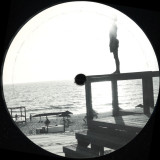
This summer fortunea head Klaus Benedek returns with a 2 track single!
The A-side features the title track „At The Shore“ and is not only a fitting piece for sunset and afterhour sessions. It brings back nostalgic memories of a simpler, laid-back and peaceful time on the beach. A smoove guitar is the key element in this track. It builds up to a break that dives into the waves of the ocean. Almost siren sounding vocal cut ups splash threw this journey and a beautiful haunting pad is giving it the icing on the cake.
The B-side -- although in a similar vibe as the title track -- has a more somber feeling to it. „South Bronx Depression“ reflects the mood of the troubled New York neighbourhood during the 70s and 80s. A pompous jazz fanfare has been sampled, filtered, chopped and transformed as the track’s hookline. Eerie synthesizer stings make their entrance, while the narrator tells his story.
Limited to 300 copies. Mastering by Patrick Pulsinger.
Support by Tensnake, Iron Curtis, Loz Goddard, Alkalino, Roman Rauch, Peletronic
Buscar:transform
Available on vinyl for the first time in 40 years, Outernational Sounds proudly presents a cornerstone document from the Los Angeles jazz underground, Flight 17 – the first appearance on record of the legendary Pan-Afrikan Peoples Arkestra, led by their founder and mastermind, Horace Tapscott.
"The Arkestra would allow the creativity in the community to come together, would allow people to recognize each other as one people and ask, “Now what can we do to make this community better? What can we do for this community together?”...That’s how the Pan-Afrikan Peoples Arkestra – the Ark – began, with the knowledge that we wanted to preserve the black arts in the community."
Horace Tapscott
Horace Tapscott’s Pan-Afrikan Peoples Arkestra (P.A.P.A.) was one of the most transformative, forward-thinking and straight-up heavy big bands to have played jazz in the 1960s and 1970s. Countless musicians passed through its ranks, and in Tapscott it was led by a musical visionary who should be ranked with the very greatest names in the music. If P.A.P.A. doesn’t have the interstellar rep of that other famous Arkestra, and if the name Tapscott doesn’t ring bells like Monk or Tyner, there’s a reason why: in an industry dominated by record labels, a band that doesn’t record doesn’t count. And the Pan-Afrikan Peoples Arkestra didn’t record for nearly twenty years. But recording success was never their concern – they weren’t about that.
First formed as the Underground Musicians Association in the early 1960s, Tapscott always wanted his group to be a community project. From their base in Watts, UGMA got down at the grassroots. They played for the people, organising fundraisers in parks and coffee houses, hosting teach-ins and workshops for young and old, and mixing it with radical theatre groups, firebrand poets, political radicals, Black separatists, community groups and churches. They lived communally, supporting each other and their people, and built an ark for the Black arts in the heart of the city. The group was renamed the Pan-Afrikan Peoples Arkestra in 1971, and soon after they established a monthly residency at the Immanuel United Church of Christ which ran for over a decade, while still playing all over LA and beyond. But through all this, they never released a note of music.
It was the intervention of Tom Albach, a fan of Tapscott and the group, that finally got them on wax. Determined that their work should be documented, Albach founded Nimbus Records specifically to release the music of Tapscott, the Arkestra, and the individuals that comprised it. The first recording sessions in early 1978 yielded enough material for two albums, and the first release was Flight 17. From the surging avant-gardism of Herbie Baker’s title track to the laid- back summertime groove of Kamonta Lawrence Polk’s ‘Maui’, or Roberto Miranda’s uptempo Latin jam ‘Horacio’, Flight 17 showcased the radical voices of the Arkestra’s members. Led out by Tapscott’s hard-swinging piano, this is the first flight on wax of the West Coasts’ foundational community big band – energised, hip and together. Open up the gates and prepare for departure!
This edition of Flight 17 contains two tracks previously only available on the 1997 CD edition: ‘Coltrane Medley’ and ‘Village Dance’, recorded live at the Immanuel United Church of Christ. It is released as a limited vinyl-only edition on a 180g pressing by Pallas. Fully licensed from Nimbus West founder Tom Albach.
Having broken a decade's silence with 2016's 'System', LA-based electronic musician Joseph Fraioli, a.k.a. Datach’i, returns this summer with his eighth album 'Bones'.
Released on Venetian Snares' Timesig imprint, 'Bones' features 12 tracks of mind expanding electronica, once again recorded on his custom-built Eurorack modular system. Much like its predecessor, 'Bones' manages to make the most of the possibilities modular systems offer, whilst avoiding their many pitfalls that can often turn such music into little more than a dry academic exercise. Indeed 'Bones' is a remarkably intimate album, written and recorded in the time following his father's death, and reflects this intense period of personal change in Joseph's life.
"Creating this music was a therapy of sorts," Joseph recalls. "It was almost like a close friend being there for me, and it's something that I hope others can perhaps utilize in the same way."
The connection to his father is something that is reflected not just in the emotional intensity of 'Bones', but in the actual production itself. "My father and I were very close," he explains. "Whilst he was sick with cancer I bought him a guitar as he wanted to learn how to play, just to have something to do while he was getting treated. After he passed away my mother gave me the guitar to have as a sort of memory of him. I had the idea to record some sounds and music on the guitar and load it onto granular sample players on the modular synth so I could make new music from those sounds as a sort of tribute to my dad. You can hear some of those sounds on a few of the tracks here like 'Arrivals', 'Motion in the Living Room' and 'Undimension'."
The resulting album grapples with the intensity of these emotions. But for all their weight, tracks like 'Saugerties Road', ‘Rockledge 3A’ and ‘Antumalal’ transform that heaviness into something warm and comforting whilst the aforementioned 'Arrivals' or ‘Wand’ ultimately achieve some kind of escape velocity and soar. Even though 'Bones' is about endings and finding closure, it also looks forward to new beginnings.
"It was something very much on my mind throughout recording this album," he relates, "ends being beginnings and beginnings being the end. Cycles of time and how time works, it's all reflected throughout the album right down to how the tracks are ordered."
Ranging from blissful ambience and guileless, starry eyed melodies, to intricate claustrophobic rhythms that forever sound close to collapsing in on themselves before expanding into bold new patterns, 'Bones' is the work of a producer who, twenty years on from his debut, continues to push the boundaries of electronic music.
Direct and simple: Christian S embarks to Permanent Vacation and brings five house-not-house tunes.
The bitter gloomy title track “Tannin” vibrates with a dry bassline over which an acid-flavored synth-line
arguments with higher hi-hat spirits. Matias Aguayo added his very special ability for creating haunting
chords and drums to the tune “Dancer” and transformed it together with Christian S into a nervous
house sensation. In contrast, Cologne DJ and producer Korkut Elbay also did some twists on
“Dancer”. His edit concentrates more detailed on the witchy chord construction. With Columbian
producer Sano Christian S puts his love for percussive spheres on the table and created a tune that is
made for magic floor moments, when all dancers melt into to one entity. Finally, the enchanted solo
track “Passant” wafts gently while a nervous melody haunts the listener. It rounds up a free spirited,
percussive, edgy yet catchy EP that is made for all circumstances of the night.
- A1: Rose Skies
- A2: Brilliance
- A3: Eternal Dreams
- A4: Blue Wind
- B1: Crystal Flight
- B2: Starglider
Suzanne Doucet was born in Tuebingen, Germany where as a three year old, Doucet discovered her innate artistic gifts. Instinctively, she was always drawing, playing music, singing, and writing. By the age of 18, Suzanne was an established pop star in Germany with several #1 hits. She also made her mark as a composer, actress, TV moderator, director, engineer, and producer. At age 25. she took a sabbatical from the music business to go on a spiritual odyssey. In 1970 she released a triple album of field recordings and mind-expanding psychedelia under the name Zweistein. For the next ten years, she developed her own style of New Age music while exploring many areas of metaphysics and spiritual practices, including astrology, music therapy, tarot, yoga and the Kabbalah.
In 1979, Doucet launched a record label in West Germany named Isis, after the Egyptian goddess of feminine divinity. She formed the duo New Age with her musical partner Christian Bühner, and released the 1982 cassette album ‘Transformation’ and the follow-up ‘Transmission’, released on cassette in 1983. After this release, Bühner and Doucet moved to Los Angeles, hoping to find more kindred spirits in the burgeoning New Age scene there. Doucet met Tajalli (William Wichman). William had a small home studio and they played music together almost every day. William had a Juno 60 and Suzanne had her SD-1 keyboard. Their album ‘Brilliance’ was released in 1984 on cassette with the critically acclaimed track "Crystal Flight," which was featured in several Visionary Videos. All songs have been remastered by George Horn at Fantasy Studios and each album is housed in jackets using the original cassette artwork.
Exactly a year on from 'Travel Light', we release the final single from Children of Zeus' debut album. A dinked 7" single, containing one of the stand-out tracks from the album, 'Hard Work', and a re-vocalled Lover's Rock version of 'The Heart Beat' (a demo version of which appeared on 'The Winter Tape' from Christmas 2018).
'Hard Work' is a term than can easily summarise the past twelve months in the life of Tyler Daley and Konny Kon. They've been busily touring Australia, New Zealand, South Africa, Europe and the UK twice in that time, as well as rocking shows at countless festivals across the continent.
'Travel Light' was named "Album of the Year" by Complex Magazine, BBC 6 Music's Huey Morgan and Rinse FM's Jyoty, as well as taking 2nd place at the Worldwide Awards (for which their label First Word was named "Label of the Year") and numerous high-placing's from Fact, Mixmag, The Vinyl Factory, Juno, Bandcamp, Mi-Soul, Wordplay & Piccadilly Records, amongst numerous other notable selectors, blogs, tastemakers and musicians, with fans far & wide from Radio 1's Benji B to Chase & Status, Jazzy Jeff to Lily Allen, Stormzy to Goldie.
The depth of styles & genres included on 'Travel Light' confirmed that Tyler & Konny are not easy to put in a box. Their initial inspirations of Manchester pirate radio in the 80's/90's all make up to form the sonic tapestry of hip hop, soul, r&b, broken beat, jungle and, in this instance, reggae.
One of the album's biggest surprises was this now-anthemic track, 'Hard Work', which sees Tyler Daley effortlessly ride a one-drop riddim drenched in positivity, and is a highlight in their live sets, as anyone who's witnessed will testament to. Meanwhile, the flip-side transforms the quiet storm vibe of 'The Heart Beat' into a heavy, heavy dubwise track, creating an essential accompaniment and fitting sequel to the original lick.
Pressed on a limited edition rustic JA-style dinked 7", this one is, of course, essential for any discerning collector, fan and DJ. Released on First Word Records, July 12th 2019.
- A1: Boss City
- A2: Burning Spear
- A3: Take Five
- A4: Super Bad
- A5: Keep Doing It
- A6: Thunder Soul
- B1: Do You Dig It, Man?
- B2: Headwiggle
- B3: Do Your Thing
- B4: Scorpio
- C1: Thank You
- C2: Al’s Tune
- C3: All Praises
- C4: Shaft Side
- D1: Kashmere
- D2: $$ Kash Register $$
- D3: Zero Point – Parts 1 & 2 (45 Version)
- D4: Getting It Out Of My System
After capturing audience awards festivals like SXSW and the Los Angeles Film Festival, the word is out that Kashmere was the greatest high school band - ever. Their story is tucked in between slabs of hard 70s funk, soul, and jazz: Conrad Johnson transformed a bunch of rough-hewn high schoolers into a band that could compete with any in the nation – professional, or otherwise. Forget high school bands, we’re talking about sixteen year old kids who would give the JBs a run for their money! The Kashmere Stage Band released a total of eight albums and three 45s on Johnson’s Kram label. The band’s best tracks are collected here. Producer Eothen “Egon” Alapatt features an expanded booklet with updated liner notes and essays, more rare photos and ephemera, and a download card which contains the B+/Flying Lotus produced Texas Jewels: The Making Of Texas Thunder Soul short, a recently unearthed 1973 documentary on the band, and a 1972 performance.
Jacob Long’s reductionist rhythmic ambient vessel, Earthen Sea, ebbs towards a more purely elemental state on his second excursion for Kranky, Grass and Trees.
He describes the creative process as one of “simplifying things as much as possible,” designing uncluttered spaces traced in nothing but breath, field recordings, and “sounds that could be played by hand but weren’t.”
The results feel decentralized but dynamic, low-lit evocations of ambiguous nocturnal environments – dub techno disassembled into stray pulses and spare parts. It’s a music both interior and infinite, languorous yet transformative, made in the outer boroughs of a metropolis but existing in its own liminal wilderness.
Long’s vision is a grounding one, rooted in the physical body but attuned to larger currents: “In response to living in a fairly hectic city, and at a very hectic time for the world at large, creating something more drawn back and restrained felt appropriate.
track listing:1. Existing Closer or Deeper in Space 2. Window, Skin, and Mirror 3. Spatial Ambiguity4. A Blank Slate 5. Living Space and Usually 6. Shallow, Shadowless 7. Less and Less
The palm trees whistle in the pink meteor shower. An entanglement of
nature’s mystical tones settle. Sonics trigger movement in the Oceans crust while giants filter the earth’s waters, thrusting the waters with their gnarly space knobs. The damsel in distress is a hadronic mechanical design like no other, moulded, tested and shaped by the entheogen melanges of the Omegian race. Many a cosmic knight whipped there sword out to retrieve , but in rightful and aware conquest the dilation and deja vu of multidimensional experiences returned the opal tone to the Omega Men. The Midi rain will dance , and the grooving aqua orbs of life will continue on.
- A1: Star Service “Star’s Surface” (From Artifacts From Earth)
- A2: Sean Thomas “Step With Ride (Vinyl Edit)” (Find The Original On Wrest Of Time)
- A3: Roy England “Solidarity” (From Solidarity)
- B1: Cmd “Wild Light” (From Wild Light)
- B2: Atlas Of Nothing Feat. Pro Club “Collider Supercollider” (From Audio Surveillance Zone)
- B3: Bpmf “Sunrise On Venus” (From Atmospheres)
"Summer", the third of four parts in our vinyl retrospective series Perfect Collection, is available for preorder now. The careful curation and narrational compiling really starts to show its poignancy with this one, and, besides, three is always a turning point. The 12" showcases several dance floor makers + movers from Montreal's CMD, Philadelphia's Sean Thomas and bpmf, to one of San Francisco's best kept secret, Atlas Of Nothing. We also have a quintessential summer track from the esteemed Roy England along with a dazzling intro track by beloved electronica duo Star Service. Comes with watery fuchsia looks by Josh Ivy and transformative remastering by Dietrich Schoenemann.
The prescient sound of an abstract never-coming future built from the everlasting commitment to the boundless experimentation. The prolific one-of-a-kind Terrence Dixon is back to 30D Records.
“Vertical Hold EP”, holds on his unlimited creative scheme: on the basis of the Detroit sound, he transforms that legacy in a fully refurbished approach wherein the true creativity smashes any possible stereotype.
Every track leads us to the unexpected. From the skillful Dixon’s mind, any sonic universe is possible. The straight low pad of “Due Process” flows on a kaleidoscopic background, energized by a danceable bass drum. Second cut, “Vertical Hold”, is a wicked amazing sequential madness from a dreamlike dance floor. “Transition Area” seeks and finds out the depth, a mental mantra to disappear in. The rhythmic and mechanical arpeggiator of “Total Vehicle” drive us to a dancing frenetic hypnosis. And, finally, “Assembly Building”, unfolds a fine-draw and imaginative minimalistic groove.
Five tracks that you cannot miss out. An essential state-of-art Techno work you must have
Pre-Order. Releases June 21.
Unsurprisingly for a creator as prolific as Muslimgauze’s Bryn Jones was, when he was asked for a contribution for any sort of group project, he would tend to provide more options than necessary. In the case of longtime label Staalplaat’s 1996 compilation Sonderangebot, where Jones would find himself in the company of everyone from Charlemagne Palestine to Reptilicus, the selected track was the characteristically headspinning “Kaliskinazure”, nine minutes of insistent digital percussion bouncing the listener back and forth between samples of wailing women’s voices and a trebly, blurry little whirr that traces the percussion. It’s distinctive enough even among the vast Muslimgauze corpus, but as the continued excavation of DATs Jones submitted to his labels continues, sure enough there’s more to that track’s story, too.
An extended “Kaliskinazure” makes up the second of four tracks on Babylon Is Iraq, although it’s been lost to the mists of time whether an outside editor excised the more drifting, less needling coda that makes up the extra six minutes found here, or whether Jones simply submitted both versions of the track at different times. This more complete version of “Kaliskinazure” is surrounded by shorter tracks, with the opening “Kaliskinazure — Momada” sounding not very much like either track it references (instead being a barely-there wisp of far-away sampled wind instruments and what sounds like treated cymbal sounds) and the title track constantly coming to a full, roiling digital boil. The lengthy “Momada” closes out the album with a different, more tersely internal arrangement surrounding the same percussion pattern that will be familiar to any Sonderangebot fans, although the way the quieter atmosphere transforms the feeling of that rhythm indicates once more than Jones’ way of reconfiguring his pieces over and over was perhaps more purposive and even more effective than he’s sometimes given credit for. The result is a fascinating expansion on one of Muslimgauze’s strongest stand-alone moments.
"a kind of Radiophonic Workshop Rebel Alliance…" - The Quietus
Modern music concrete quartet Langham Research Centre follow-up their debut album, Tape Works, Vol. 1 with a short EP of remixes, also on nonclassical. Remixes come from a fan of theirs – experimental veteran Jim O'Rourke – and Berlin-based industrial duo group A.
On Side A, Jim O'Rourke uses 'Quasar Melodics' as his source material, transforming fizzing grains of sound into an oceanic swirl of noise. On the flip, group A find metallic rhythms and eerie melancholy in 'Perpetual Motion'.
On 7" and digital, the EP has gained radio play on BBC's Late Junction.
Henrik Schwarz & Alma Quartet present CCMYK, a new album on Henrik's own label Between Buttons. Produced in collaboration with the Alma String Quartet, it's a free conversation between classical and electronic music, carefully transformed into a set of astonishing tracks, ready for club or concert hall. Though based on free improvisations between Laptop and String Instruments, CCMYK is not a record of bumbling jams. Rather, it's a record of startling density, control and emotional complexity. This is the sound of open conversation between piercing intellects, taking their individual instruments and musical backgrounds to create a new universe of sound. The vinyl comes in a unique, handmade, limited 4 colour CMYK pressing. Every record is unique! Black is available as well.
Purveyors of contemporary electronic music Anagram return with their second remix EP that calls upon some of the scene's most compelling and uncompromising names. Coalescence, the next chapter from the label, will unfold as a series of remix EP's reinforcing the labels core values of community, togetherness and growth. The first instalment reflects on their previous three releases reimagining four titles under the controls of Drugstore resident Tiljana T, Ostgut Ton legend Ryan Elliot, Klockworks artist Newa and the Tel Aviv based Yotam Avni. Orchestrating the rework of Elad Magdasi's 'Liquid Dreams' is Serbian talent Tiljana T who runs with the cinematic ideas behind the original but uses snapping hits, ebullient bass notes and plenty delay to fuel the cut with a new lease of life. The accompanying A-side sees Ryan Elliott do what Ryan Elliot does best by keeping things straight up four to the floor transforming 'Sound of the Siren' by Barbara Ford into pulsating peak hour material. On the flip side are two remixes taken from label co-founder Sinfol's latest solo EP 'Pull Back'. First up, Newa gets the blood rushing injecting breaking beats and furious energy into 'Life Of Measure' resulting in a high tempo no-nonsense techno affair that embodies the sound of the bustling Tbilisi scene. Tying together Coalescence Vol. I is arguably the most dynamic choice of the four remixes in Yotam Avni's 'Final Push' Remix. With a meticulous assortment of intricately crafted synth lines and sequences, he manages to deconstruct Sinfol's title cut of its acid workouts and replenish it with an equally rivalled amount of energy. Four artists, four remixes, Coalescence Vol. I!
U Know Me Records proudly presents a special album showcasing Polish drumming scene - each track was produced by a different drummer - these are their portraits.
official video promo: https://youtu.be/qxuTYjMRUMM
In the 21st century drummers imperceptibly switched from the background to the front line, despite popular music not exactly pandering to them. In the early days of rock culture this joke made the rounds "What's the last thing a drummer says in a band?" "Perhaps we could play one of my songs…?"
In popular music the drummer became the first to compete with machines. They were the first band members that consequently began disappearing, however, as contemporary electronic music took hold, they were also the first to return. First they were incorporated into compositions but gradually - took centre stage. Thanks partly to the ubiquitous culture of Hip Hop recognising the drummer's role as key in any recording, alongside the eclecticism of new music, which demanded fluid transitions between musical forms, a drummer's adaptive skills – as a trained multi instrumentalist – became truly impressive. This new generation of drummers seen on Polish stages today are exceptional even against the backdrop of today's unusually creative and well-educated music scene which rejects narrow minded or genre-centric views.
This album exhibits portraits from the cream of today's Polish drummers. Kovalevo Tone Bank by Michał Bryndal tags the 1980's, the era which began stealing drummers' bread. Incidentally, the heavy groove laid down by the artist references a hit by Wham!, the same hit in which the group decided to cut the drummer's part because he was late and replace him with a LinnDrumm machine. Hubert Zemler in The Life and Death of Ben Bekele and Łukasz Moskal in Father Sparrow show they've found themselves perfectly in close cooperation with electronic instruments.
Multifaceted improvisors - Qba Janicki (Kabina projekcyjna) and Jan Młynarski (Roj) - transform their drums kits into multifunctional devices capable of delivering wildly diverse palettes of sound. Rafał Dutkiewicz (Displaced) showcases drums as the lead instrument on a club track. Marcin Rak (Alpaka) does the same, but with the conventions of Funk and Hip Hop, whereas Krzysztof Dziedzic (Vagabonde) gravitates towards the edges of jazz. Each of them here is a leader and… plays one of their songs.
Bartek Chaciński
(translation: Sean Palmer)
"A manner or style, a frame of mind, thought or existence" (Mode).
"Intelligence quotient, the use of perception or awareness." (IQ).
Mode I/Q, the self-proclaimed unknown band, was a richly textured, bold project starting life in 1979 out the embers of punk and new wave resulting in a hypnotic convergence of love, the future, life and art.
Lucian and Nicolas, two creative spirits who viewed the world through their own prism, augmented by a moving cast of friends and acolytes, were together compelled to make great music. This was a concept from the heart, with transformativelive performances, channelling spaces into art "Mode" events orchestrated to bring about a full integration of site and sound.
Psychedelic, punk overtones. A funky electronic hybrid, mixing Kraftwerk with black music. Guitars delayed and twisted through echo boxes and micro synths. Casio and Commodores delivering the machine funk. CBGBs, Max's Kansas City and Danceteria - Mode I/Q played and much, much more.
Just 3 releases deep, 1984's mini LP Mind/Soul captures the band at their best. 6 songs to immerse, dance and shake the mind.
180gr vinyl. Recorded in 1987 and now released for the first time ever with artwork by Sarah Yu Zeebroek.In 1987 Gerry Vergult (Aroma Di Amore ) and Gerrit Valckenaers (Adult Fantasies) created an abstract universe where minimal post-punk basslines blend together with dub, tropical vibes, jazz, and dreamy electronica.
Most of the october nights in 1987 you could find Gerry Vergult (Aroma Di Amore / Fred A. / Adult Fantasies) and Gerrit Valckenaers (Adult Fantasies /The Colorist Orchestra / multi-instrumentalist) in a desolated Top studio in Gent. At that time and place they sneakily crafted and shaped this Nasca record while they were supposed to finish a new Fred A. record. They created an abstract universe where minimal post-punk basslines blend together with radio sounds in 'Nothing Toulouse', tropical tribal vibes oscillates between futuristic nostalgia and hunted dreams in 'Ketama' and 'Ritz', a sampled heartbeat slowly mutates in mesmerising midnight jazz and a drugged out dub groove of 'Kamayacha' transforms into the inner city blues of 'Josaphat'.
All tracks composed, arranged and performed by Gerry Vergult & Gerrit Valckenaers
Gerrit Valckenaers: piano, saxophone, clarinet, synths, samples, electronics
Gerry Vergult: guitar, bass, synths, samples, electronics
Produced by Koen Van Regenmortel
For people who like Jah Wobble, Jon Hassell, Brian Eno & David Byrne, dub, world, jazz, and dreamy electronica
Recorded in 1987 and now released for the first time ever with artwork by Sarah Yu Zeebroek.
- A1: Noel Kelehan Quintet - Spon Song
- A2: John Wadham - Floatin
- A3: Louis Stewart - Araby
- B1: Joe O'donnell - Caravan
- B2: Taste - On The Boards
- B3: Granny's Intentions - Nutmeg, Bitter-Sweet
- B4: Mellow Candle - Lonely Man
- C1: Sonny Condell - Red Sail
- C2: Supply, Demand & Curve - When You're By Yourself
- C3: Rosemarie Taylor - Mister Sleep
- C4: Apartment - Weekend
- D1: The Plattermen - Africah Wah Wah
- D2: Jonathan Kelly's Outside - Misery
- D3: Dr. Strangely Strange - Mary Malone Of Moscow
- D4: Stacc - Holy Smoke
- D5: Zebra - Silent Partners
'Buntús Rince' translates from Irish as 'basic rhythms', and this new compilation explores how Irish musicians were influenced by strands of different genres of music from around the world, merging them to create their own unique sounds. The compilation features some of the most innovative and talented figures in the history of Irish music and includes rare Irish jazz, fusion and folk outliers from the 1970s and early 1980s from musicians relatively unknown outside of Ireland.
Often regarded as a musical backwater, the 1970s finally saw Ireland begin to make its mark on international music. The nature of this feat is all the more commendable, considering how isolated and conservative the country still was in the middle of the last century. The emergence of acts like Skid Row, Thin Lizzy and Van Morrison instilled in budding young Irish musicians the belief to dream big.
Unlike many other European countries, Ireland had not benefited from the cultural impact of immigration. Pioneering Irish musicians did not have access to the type of vibrant music scenes ubiquitous to most European cities at that time. With no talented players or even in some cases recordings of the music, they had to cultivate and invent their own small scenes.
A jazz scene had begun to blossom in Dublin in the late 1950s. Self-taught players like Noel Kelehan and Louis Stewart emerged as the Irish standard-bearers. Their level of musicianship saw them play with some of the world's most renowned artists. The 1960s would see the emergence of the 'beat' scene in Ireland, with groups like Granny's Intentions, Taste and Eire Apparent finally challenging the hegemony of Irish Showbands. Change was in the air.
The late 1960s also saw many Irish emigrants returning home, bringing with them inspiration from the new styles and sounds of London and further afield. The arrival in the late 1960s of pirate radio stations like Radio Caroline, new music magazines and the availability of music on vinyl meant that different genres were now becoming more accessible. The musical landscape of the country began to transform and evolve, influencing a new generation of musicians in the process.
The 1970s saw advancements in studio technology. 8-track studios began appearing in Dublin, offering more opportunities for groups to record singles and albums. Synthesizers and other instruments were also becoming easier to acquire as the younger generation turned to electric jazz and fusion music.
While the level of musicianship was high, the levels of opportunities in Ireland were still very limited. Many groups and solo musicians had to emigrate to try and succeed.
Thankfully for those who remained, this new emerging scene didn't go totally unnoticed and local labels began to take a chance on more obscure Irish groups. Labels like Mulligan and also producers like John D'Ardis and Terri Hooley championed and documented music from the Irish underground of the 1970s.
Their valuable work is a common thread which connects many of the tracks on this compilation. From the soaring flute playing of Brian Dunning, to the swinging piano of Noel Kelehan and the sonic force of Jolyon Jackson's synthesizers; 'Buntús Rince' lifts the lid on a vastly underappreciated period of Irish music history.
One for the collectors.
A Quest Called Tribe begins with a series of portraits drawn by Stéphane Carricondo in
2017 dedicated to Hip-Hop legends. As close partner in art Medline proposed to create a
soundtrack for them, and first interpreting ATCQ's classics with elements of the past,
present and future. The best way to materialize this multidimensional tribute was obviously
a vinyl. And it's the one we unveil today.
On the visual side, ATCQ's portraits are composing the front cover and, assembled into a
great scene, are printed on a colorful A2 poster. Stéphane Carricondo's natural lines are
highlighting each member's soul map. The alchemy of the dark ink on emptiness gives to
them an impressive sparkle of life.
On the musical side, the classic themes are transformed into a polymorphic fusion, were
jazz, funk and soul from the original sample sources converse with Tribe's characteristic
beats. Medline added a hint of his magic, unique rhythms, improvisations, arrangements,
original orchestration and inspired melodies.
The album is an ode to the band that marked both artist's life and mind. A cultural print and
school of sound that designed Hip-Hop foundations. With a blooming expression Medline
and Stéphane Carricondo are going to the roots of ATCQ in a quest for the tribe.


