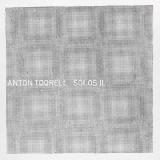
Anton Toorell’s second solo album, Solos II, deepens and intensifies the six-string language introduced on his 2022 debut, Solos. Rather than widening his scope, the Swedish guitarist, composer and producer sharpens his focus, homing in on the physical and sonic relationship between player, instrument and tuning. The result is three extended pieces of cascading tonality that feel disciplined yet light, their conceptual frameworks always secondary to the luminous sounds Toorell draws from two guitars.
Throughout Solos II, Toorell explores both the guitar’s potential for silvery, sometimes clashing textures and his own physical engagement with the instrument. Across ‘Volta’, ‘Cripta’ and ‘Scala’, he plays two guitars simultaneously: one fretted with the left hand using hammer-ons and pull-offs, while the right hand activates mostly open strings on a guitar resting in his lap. Despite the inherent complexity of this approach, the music never feels busy or demonstrative. Technique remains a quiet servant to Toorell’s compositional instincts and improvisational sensitivity.
The album leaves space for unplanned resonances and happy accidents, yet its structures are clear, resilient and finely balanced. The seventeen-minute ‘Volta’ unfolds as a shimmering continuum, its repeated figures gently reshaped through minute inflections, creating a sensation of constant motion. ‘Cripta’ spirals inward, cycling hypnotically in a way that recalls both Terry Riley’s iterative minimalism and the hallucinatory guitar loops of early Seefeel.
With the closing ‘Scala’, the recording environment comes fully into view. Captured in a 16th-century wine cellar at Palazzo Stabile in Piemonte, Italy, the room functions as a guiding presence and an implicit third instrument. Toorell tuned the guitars in response to the cellar’s reverberant character, seeking configurations that would open up the space itself.
Cerca:tüth
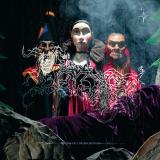
Over six years have passed since HAGZISSA's successful debut album, They Ride Along. Some may have even declared the Austrians as dead in between; however, HAGZISSA never ceased to wander the borderlands of the here and beyond. In silence and yet in turmoil, too, a nightmare has been slain and gutted - in necromantic pride, its offspring gleams and dances to never-ending music of the night!
HAGZISSA's brand-new Revelry of a Maltreated Jade EP is a showcase of a pack in motion, marking this as the last recording with A White Pawn (Kringa, Weathered Crest et al.) and the first with V.Adalbert II (Sněť, Bahratal et al.). The four-song work is immediately recognizable as HAGZISSA: a now-trademark style of eyrie, olde-worlde black METAL that's obscure, enigmatic, and unbound. Here, intensities are both reigned in and let loose to roam even wilder, as Iron Curtain heavy metal magick weaves a spell perhaps even more potent than said full-length. The result is somehow more approachable and more foreign, but compellingly potent either way.
With heads both in the past and the future, thus passes the glory of the world and dives deep into another plane! Can't you hear their flutes and horns and whispers? So come, then, and join in boisterous battue!
2LP 180gm heavyweight 45 RPM Audiophile Edition, Featuring a half speed remaster by Miles Showell at Abbey Road Studios, Housed in polylined inners, Printed insert with sleevenote. The Alan Parsons Project"s multi-million selling album The Turn of a Friendly Card (1980), their celebrated prog pop tour de force, is reissued in a variety of formats, including this 2LP heavyweight, 45 RPM Audiophile edition. Expertly cut by Miles Showell at Abbey Road Studios on a customised Neumann VMS 80 lathe at half speed using high-resolution archive transfers taken from Eric Woolfson"s rarely played, mint condition duplicate masters run at the time of the original sessions in 1980. Like other Alan Parsons Project albums, there were a variety of different lead vocalists employed including Chris Rainbow, Lenny Zakatek, Elmer Gantry as well as Eric Woolfson himself. Plus, a selection of session musicians such as guitarists Ian Bairnson and David Paton and drummer Stuart Elliott with arrangements by Andrew Powell.
- A1: 6Up 5Oh Cop-Out (Pro/Con)
- A2: Skeleton Appreciation Day In Vestal, Ny (Bones)
- A3: Front Street
- B1: ?Aikido! (Neurotic/Erotic
- B2: White Knuckle Jerk (Where Do You Get Off?)
- B3: Cover This Song (A Little Bit Mine)
- B4: Thermodynamic Lawyer Esq, G F.d
- C1: Red Moon
- C2: Lysergide Daydream
- C3: The First Step
- C4: Jimmy Mushrooms' Last Drink Bedtime In Wayne, Nj
- D1: Chemical Overreaction / Compound Fracture
- D2: Everything Is A Lot
Will Wood's very first LP displays a variety of genres, with a chaotic homemade anti-folk feel and an experimental edge. "Everything is a Lot" began its long production in 2014, when the singer-songwriter was still 20 years old and performing drunken alt-comedy at open mics. With no funding, Wood led a slapdash band into the studio to bring songs mainly from his teenage years to life, and the unstructured production process and youthful experimentation gave it a uniquely loose and chaotic feel. The debut LP's sound is defined by Wood's Jay Hawkins-esque vocal delivery, an out-of-tune old upright piano, wailing wind instruments, jangly guitar, high-powered yet loose drums, and sardonic overdriven kazoo solos. Delivering everything from swing jazz and twee indie pop to pseudo-mariachi and waltz, these sounds and their accompanying bizarre lyrics come together to match the existential title, "Everything is a Lot." Will Wood's early career can be primarily defined by his experimental vocal delivery, honky-tonk piano smashing, and darkly edgy songwriting. While his stylings have matured and taken on a more precise approach, his refusal to conform to expectations and constant shifts in the genre have continued to be hallmarks of his songwriting and production. In his "Will Wood and the Tapeworms" releases (Everything Is A Lot in 2015, SELF-iSH in 2016), audiences can see the first glimpses into what would eventually become his signature style, presented in a uniquely raw and chaotic state of potential.
Meticulously assembled from a good 15 years' worth of source material, Cong Burn boss John Howes' second Paperclip Minimiser transmission proliferates its predecessor's network of turn-of-the-millennium aesthetics and concepts, bringing us closer to the lost future promised by the mid-digital age. If the debut album rooted itself in 2006, using an era-specific rig to activate its vintage Winamp-ready sound, 'II' pushes the clock forward just a little, recycling an unreleased album that Howes engineered in various locations across the north of England, starting way back in 2011. Working quickly and methodically with his homebrewed "DIY DAW" system, Howes improvised live using the record's bank of sounds, transforming the skittering bio-electronic rhythms, bitcrushed modem whines and inclement Lancs soundscapes into a suite of sleek, bass heavy steppers.
Howes has refined his setup and process over the years to function as an antithesis of contemporary production logic, a system that he can use easily to retreat from the excessive layering, overdubbing and editing that plagues modern electronic music. With only limited separate channels in each track, 'II' sounds both archaic and strangely novel. Showing respect to the early days of techno, when stone-cold classics were jammed out live using just a drum machine, a sampler and a couple of synths, Howes simultaneously acknowledges the promise of the transition to a digital future, as nascent algorithmic technology began to rehydrate stale rhythmic and melodic patterns. Fabricating its wrinkled cyberpunk landscape from shovelware blips and whines, spacious environmental echoes and lustrous, plasticky FM hits, 'II' is dense but never congested. It's a reminder that bass music thrives when it's given the room it needs to breathe.
It started in a Brooklyn studio back in 2011. A raw demo, a shared vision, and a deep reverence for the echoes of Basic Channel and King Tubby. After years of meticulous overdubbing and sonic layering, Marter (Bass) & Yony (Drums) have finally completed their masterpiece. Originally licensed to Bill Laswell’s label for digital release, this warm, lo-fi journey is finally available in its truest form. Recorded on 4-track and 8-track tape before meeting ProTools, every frequency breathes with analog soul.
This album sold out immediately upon its initial release in 2018. Due to overwhelming demand, a highly limited number of copies have been repressed with sticker on black jacket.
2nd album is on the way!
Daniel Steinberg debuts on Rekids the Berlin-based Arms & Legs boss drops the ‘Free Living’ EP
Berlin-based producer and DJ Daniel Steinberg lands on Rekids for the fi rst time with the ‘Free Living’ EP, 13th March 2026. Active for over two decades and emerging at the height of the stripped-back, funkier end of minimal house, Steinberg has built a reputation for pairing infectious hooks with tightly programmed grooves, and has ploughed his path via his label, Arms & Legs Records, as well as labels like NuGroove, Front Room, and Southern Fried.
The title track of Daniel Steinberg’s ‘Free Living’ EP sets the tone with slow-slung, dusty House pressure, where restraint and subtlety shape a deep, immersive groove. Blues-tinged vocal fragments sit low in the mix alongside understated trumpet motifs and tender chords, forming a warm-up cut that gradually raises the energy. ‘Concrete Master’ shifts gear entirely, delivering raw, in-your-face house driven by sleazy rap snippets and snarling hits, built for peak-time impact. ‘Seven Sense’ follows with turbo-charged momentum, pairing vamping piano lines with gospel-leaning vocal stabs for hands-in-the-air release, before ‘Perfect Catch’ closes the EP with loopy chords, chopped grooves, and a playful, party-starting sensibility, delivered with characteristic precision. Founded in 2006, Radio Slave’s Rekids expanded with the techno-focused Rekids Special Projects in 2017 and its latest sublabel, REK’D, in 2024. With Matt Edwards as sole A&R, Rekids continues to champion emerging and established artists alike, remaining a trusted home for house and related sounds, with recent releases from DJ Minx, Echonomist, Tal Fussman, and more.
2026 Repress
Weiss has made a bit of a welcomed habit in recent years of dropping a Sun-drenched bomb on Toolroom around this time of year and following on from 'You're Sunshine' last year, 'Feel My Needs' is his submission for 2018!
Recent Weiss highlights have included him playing the main stage at Dirtybird's own Campout festival, regular dates at the world-renowned Fabric as well as a US tour and an album in the making.
In true Weiss style, this record will have the hairs on the back of your neck standing to attention in a matter of seconds. Lush, old skool piano riffs and sublime vocal licks, all laid over the top of a crisp and infectious house backing.
This is a sure-fire future anthem with two killer remixes to add to the vinyl from Purple Disco Machine and Gorgon City, both of which have been premiered on the mighty Radio 1 Dance shows.
DJ Support:
Pete Tong, Annie Mac, Danny Howard, MistaJam, Huxley, Gorgon City, Claptone, S-Man, Dario D'Attis, Robosonic, Dosem, Tube & Berger, Steve Lawler, Groove Armada, Sonny Fodera, Man Without A Clue, The Magician, Eli Brown, TCTS, Martin Ikin, Mat.Joe, Richy Ahmed, Low Steppa, Kry Wolf, Kraak & Smaak, The Golden Boy
Released in 2000, Alan Braxe and Fred Falke's “Intro” is five minutes of faultlessly melancholy, perfectly elegant, dance music that nudged French House into the future.
“Intro” is now being re-released for its 25th birthday, using the remastered version of the song from the 2023 re-issue of Alan Braxe, Fred Falke & Friends - The Upper Cuts album, with Braxe and Falke also making new remixes of their golden child. Given that “Intro” was pretty much perfect the first time around, the results are astoundingly strong.
Falke’s remix takes “Intro” into new dimensions, cosmic and suspiciously dubby, a newly-recorded bass line sending the mix on its psychedelic way. Braxe’s remix is raw and dirty, a “hotel room edit” as he calls it, that nods to the history of French House as it sparkles up the spine.
Both tunes are evidence that - actually - you can remix the un-remixable, so long as it is done with infinite love and incredible skill.
- A1: Dun
- A2: Sleep
- A3: Make My Feat Big Krit & Dice Raw
- A4: One Time Feat Phonte & Dice Raw
- A5: Kool On Feat Greg Porn & Truck North
- A6: The Otherside Feat Bilal Olivier & Greg Porn
- B1: Stomp Feat Greg Porn
- B2: Lighthouse Feat Dice Raw
- B3: I Remember
- B4: Tip The Scale Feat Dice Raw
- B5: Redford (For Yia-Yia & Pappou) (Redford Suite)
- B6: Possibility (2Nd Movement)
- B7: Will To Power (3Rd Movement)
- B8: Finality (4Th Movement)
Undun is the story of a man, Redford Stevens, dying in reverse, rewinding from the moment he became a statistic and hitting the points in his life where he's at his most self-aware. That he's a criminal who got caught up in the familiar street-hustle trappings that the modern media's documented countless times is a pivotal detail-- it's hit at an angle that seems to emphasize the futile inevitability of it all. His life could be any number of misdirected narratives that ends with a toe tag, and what details listeners learn about him are hazy, buried under archetypal turns of fate and decisive struggles. That this protagonist is a fictionalized composite of a handful of real people, filtered through a matter-of-fact narrative that splits character ambivalence with journalistic impartiality, only makes his lack of direction and the failure of any real closure stand out even more. "Lotta niggas go to prison," Dice Raw states on "Tip the Scale", "how many come out Malcolm X?"
So the Roots' latest album isn't a sprawling, rise-and-fall crime story, not a condemnation or a veneration of a man living outside the law, not a bullet-riddled grand guignol heavy on explicit details of soldiers getting cut down. It's a character study of a man whose existential crisis ends only with his death-- a death gone largely unspecified, the glamor and tragedy washed over with a doomed resignation. That's a hard thing to pull off, even for a band as given to deep-thinking concepts as the Roots are. And when your main lyrical catalyst is Black Thought-- a man more given to allusions than direct statements-- it's likely that it'll take a while for the full scope of Undun to really sink in.
If and when it does, it might strike listeners as a bit skeletal: omit the mood-setting instrumental bookends, including a brief, four-part orchestral suite that builds off Sufjan Stevens' "Redford (For Yia-Yia and Pappou)", and you've got maybe a half hour's worth of material. By ?uestlove's accounts, writing Redford's story introduced the headaches and challenges that come with scriptwriting into their songwriting, and what's left on Undun is the end result of frequent revisions and rewrites that attempt to reconcile character, theme, and continuity. If it comes at the expense of nuance, it's not always obvious: There's an easy-to-trace narrative line from Redford's acceptance of his fate ("Sleep") to his acknowledgement of how close it's approaching ("Make My"), back through declarations of aggravated toughness ("One Time"), and celebratory fatalism ("Kool On"), along ups and downs that juxtapose motivation ("Stomp") and helplessness ("Lighthouse"). When the vocal portion of the album ends with two of the bleakest sets of verses in the Roots discography, peaking with the estrangement of "I Remember" and the desperation of "Tip the Scale", Undun reveals itself as a story where a man's actual death isn't quite as tragic as the circumstances that pushed him to it.
MTY-3.14 “π”, released on March 14, 2026, is the fifth and final chapter of a journey begun fifteen years ago.
This standard edition presents the final form of Polar Inertia across three 12" vinyl records, featuring 11 tracks. Nothing added, nothing removed—only the music, unfolding in full.
Images dissolve, words fall away. What remains are faint echoes, like footprints slowly erased in fresh snow.
This final opus does not close the path. It fades into it. π is not an ending, but a state: the moment where movement continues, even as the world turns silent.
A last step.
A final trace.
Still moving, beneath the cold.
POLAR INERTIA
We are no one because we want to be no one,
And to be no one we have to be everywhere and nowhere- Polar Inertia examines the enigmatic and blurry realms, embracing the art of obscured vision.
Encountering the collective Polar Inertia is much like being absorbed by fog and captivated by its ever-shifting forms and densities, with things being as indistinguishable as in a whiteout.
Formed in 2010 by a group of artists, Polar Inertia transcends visibility, delving into structures that lie beyond the public gaze. Layers upon layers intertwine within the fabric of Polar Inertia, extending beyond their profound electronic compositions and live performances. It manifests as a conceptual universe, where sound, monochrome aesthetics, and elusive narratives converge, much like trying to grasp the intangible fog. The entity that is Polar Inertia is involved in installations, print- and video work and texts created for different contexts and live in different spheres such as Palais de Tokyo in Paris or the Lyon Biennale of Contemporary Art. Still, clubs and festivals are perfect spaces to experience these nebulous soundworlds and immerse in them. Fittingly, some of Polar Inertia’s appearances include the colossal halls of Berghain and Bassiani and at experimental festivals like Mutek Montreal and Atonal Berlin, that like to break with the classic club conventions.
Polar Inertia's sonic landscape unfolds with wafting textures accompanied by resonating beats and drones, reverberating through empty spaces, merging with the vast expanse of nothingness. Their sound exists at the crossroads of ambient, experimental, and deep techno, interwoven with vocal narratives. Since their inaugural release “Indirect Light“ on Dement3d Records in 2011, they remain a stronghold of relevance and captivation in the electronic domain.
Mastered by sixbitdeep, with artistic direction by Diplomatie Studio.
- Lemon Poem Song
- Open Road
- Seven Hours
- Waltz For Robert
- The Longest Night
- Disappear
- Green Books
- Beledo Balado
- Pens To The Foal Mode
- Time Station
- Which Bridge Did You Cross
- Turmoil
- Daevid's Special Cuppa
- Carol Ann (Bonus Track)
- Curious Dust (Bonus Track)
- Tarn Hows (Bonus Track)
- Seven Hours (Alt Take) (Bonus Track)
- We Thought It Was Tuesday (Bonus Track)
'Thirteen' is the thirteenth studio album by classic British prog band Soft Machine. The album of superlative new material, marks a fresh chapter in the group's 60-year history.
Soft Machine in 2026 is not what you would expect, they've produced a vibrant and exciting Jazz record that deserves to be heard!
The long-awaited reissue of Another Song by Music Service, one of the finest Italo-Disco tracks goes to Antony Soumas, the amazing Greek DJ owner of Disco Time Records in Athens. Tony's passion for Italo-Disco style is known worldwide and is worth further amplifying. Among the spin-offs conceived by Amin-Peck (editor's note: in strict Bolognese dialect means "I hang myself!"), Another Song turns out to be the favorite of the "purists" of Italo. The synthesizers of George Fyron and Leonard Parker are excellent as always, but here we also find awesome sauce male voices! In a certain sense you have the sensation of listening to Big In Japan, but perhaps it is just a suggestion of the dee-jays who push one record after another. One last curiosity dictated by the sagacious dj-writer Antonio Stanzani, better known as Ciancio DJ: the Music Service band proposed to Luca Zanarini to sing Another Song, but the lyrics of the song did not yet existed His friend Gianni Ruberti made himself available and by isolating in a room for two hours he made the lyrics that all of us after more than 40 years enjoy.
Melodize is bringing the world back on the dance floor with Lauer and his 4-track “K1m Fantasy” EP. Behind the label is Brooklyn-based DJ and musician Beartrax, who is known for his groovy yet moody compositions. Philipp Lauer, known as Lauer, is a true veteran in the electronic music sphere, with over 20 years of experience, yet his sound remains novel and fresh.
This time, Melodize and Lauer shape the world of a fantasy dance floor where everything is possible. “K1m Fantasy” starts with Lauer letting his confidence shine through as an experienced professional with a signature sound in the first track “Boss Electro”, which will inevitably showcase why he’s the boss.
The playful tune of “Rabbits” takes the listener on a journey through electro-induced synths much like the image of curious rabbits playing on a grass field. The eponymous B-side “K1m Fantasy,” with its steadily unfolding mellow soundscape, is an introspective piece exploring the fantastical world of the techno dance floor where all becomes one.
Lauer’s last treat is “Choirs,” where brassy exclamations take turns with a haunting choir of electronic voices, reminding us that unity is key to pleasure and existence.
- A1: Chiemi Eri - Aizu Bandaisan
- A2: Pinky & Killers - Soran Bushi
- A3: Tokyo Children's Choir - Kokiriko
- A4: Michiya Mihashi & Tokyo Cuban Boys - Sado Okesa
- A5: Dark Ducks - Konpira Funefune
- A6: Ebonee Webb - Cowboy's Elegy
- A7: Akira Ishikawa & Count Buffalo - Tanchame
- B1: Satoru Oda & His Group - Yagi Bushi
- B2: Pinky & Killers - Otemoyan
- B3: Miki Nakasone - Kunjan Sabakui
- B4: Leon Pops - Mamurogawa Ondo
- B5: The Peanuts - Ohara Bushi
- B6: Tokyo Academy Mixed Choir - Kiyari Kuzushi
- B7: King Orchestra - Dojou Sukui (Yasugi Bushi)
- For all fans of the Wamono series!
- All tracks selected by DJ Yoshizawa Dynamite. Includes the first ever vinyl release of The Peanuts' "Ohara Bushi" track, originally released only on tape in 1970.
- Fully licensed King Records masters.
- Mastering and lacquer cut by Jukka Sarapaa at Timmion Cutting Lab, Helsinki, Finland.
- 180g heavy vinyl pressing, reverse board jacket.
- Artwork by Nicolas Kerembellec (Nker).
---
Active as a professional DJ in Japan since the late eighties, DJ Yoshizawa Dynamite is also a renowned remixer, compiler and producer. An avid record collector and an expert of Wamono music, Yoshizawa has published in 2015 the now-classic Wamono A to Z records guide book, which instantly sold-out. The book unveiled a myriad of beautiful and rare records from a highly prolific, but still then unknown, Japanese groove scene. He has also selected a large part of the music in our highly acclaimed Wamono compilations.
For this brand new chapter in the series, Yoshizawa explores King Records' legendary catalog and unearths exceptional, rare and unknown musical gems. King Records has been releasing music since 1931 and is one of the most prestigious labels in Japan. Traditional Japanese music, known as "Minyo", are ancient songs once sung by fishermen, coal miners and sumo wrestlers. They are reimagined here with vibrant afro latin, rock, rare groove and funky arrangements in this killer selection of music released on King between 1963 and 1979. Also worth mentioning is the track Ohara Bushi by The Peanuts, which was released only on tape in 1970 and is now available for the first time ever on vinyl format.
Put the needle on the record, turn up the volume and dig right now into the Wamono sound - the cream of the Japanese funk, soul, rare groove and disco music developed throughout the years since the end of the fifties in Japan!
---
180GWALP08 - Manufactured and distributed by 180g.
- A1: Assault & Battery / The Golden Void
- A2: The Wizard Blew His Horn
- A3: Opa-Loka
- A4: The Demented Man
- B1: Magnu
- B2: Standing At The Edge
- B3: Spiral Galaxy 28948
- B4: Warriors
- B5: Dying Seas
- B6: Kings Of Speed
Half speed vinyl edition of the classic album, 'Warrior On The Edge Of Time' by HAWKWIND. Recorded in 1975, the album is a ground-breaking classic from Hawkwind’s long career. Featuring a line-up of DAVE BROCK, NIK TURNER, LEMMY, SIMON HOUSE, SIMON KING and ALAN POWELL, the album is arguably one of the finest rock albums of the mid-1970s. This new Atomhenge half speed master edition of has been cut at AIR Studios utilising the original master tapes. The half-speed mastered cutting process offers the finest audio reproduction and this new edition is the definitive LP release of this classic album
“Tectonic” is a concise portrait of SIMON BERZ’s geological sound explorations across continents over the last 15 years: drums, electronics, and a set of electronically manipulated basalt stones from Iceland.
SIMON BERZ is a transdisciplinary drummer, sound artist, and music educator based in Switzerland and Berlin. Working at the intersection of improvised music, sound art, and performance, and deliberately crossing boundaries between disciplines, his aesthetics are shaped by a sustained engagement with natural materials, particularly stone, and their sonic transformation through electronic manipulation. Beyond his performance work, BERZ founded BADABUM as an art label and a music school.
For the last 30 years, BERZ has been performing in Japan, China, Russia, the USA, Cuba, Iceland, Turkey, and across Europe. He has collaborated with artists including BILL LASWELL,BABY SOMMER, DAMO SUZUKI (CAN), JAMES TURRELL, JIMI TENOR, JOHN SINGLAIR, JOJO MAYER (NERVE), KONDO TOSHINORI, KIDD JORDAN, LAUREN NEWTON, LEE “SCRATCH“ PERRY, MAURO PAWLOWSKI (dEUS), NILS PETTER MOLVÆR, NIKI GLASPIE, NORBERT MÖSLANG, PAUL LOWENS, PFADFINDEREI, ROB MAZUREK, SKÚLI SVERRISSON, and he was the live drummer for APPARAT. As BERZ understands artistic practice as energy emerging from nature and through dialogue with people, his recorded output is intentionally selective, with one highlight being “Beats versus Breath” with KONDO and LASWELL (2023). Alongside a regular drumkit and electronics, he has developed his own instruments such as the “Lithophon” in which resonating stones are turned into amplified sound through water drops, and “Tectonic”, a set of Icelandic basalt stones shaped through electronic manipulation. These self- built instruments form the material basis for his performances, installations, and sound recordings.
“Tectonic” is also the title of BERZ’s latest work: a summary of his geological sound explorations across continents. From Iceland to Indonesia and Bali, from New Orleans to China, in caves and at shores, BERZ carried his millions-of-years-old basalt stones as both instrument and collaborator. On Java, he met Baron, a builder of stone gamelan instruments. At the Pacitan Tabuhan Cave (Indonesia) he performed with MISBACH BILOK and WUKIR SURYADI (SENYAWA) who work with corals as instruments. BERZ brought these encounters and “field recordings” to the Stöðvarfjörður studio in Iceland, where he recorded with his “Tectonic” set-up, drums, and electronics. The music was later mixed in Berlin by DIRK DRESSELHAUS (SCHNEIDER TM). The resulting album moves from club-driven tracks to ambient passages, from gamelan-inspired textures to HipHop-like beat patterns. It resists easy categorization while staying direct and physical in its impact.
- Never Love Again
- Real Love
- First Touch
- Want You
- Blue Tuesday
- Cliffs
- Starts To End
- Alone Tonight
- Something’s Changed
- Who You Are
- Give It Back To Me
Francis of Delirium is the moniker of 22-year old, Luxembourg-based Jana Bahrich. The young artist’s incredible journey up until this point has seen her release 3 critically acclaimed EPs, ‘All Change’, 'Wading’ and ‘The Funhouse’. With praise so far from the likes of Stereogum, FADER, Pitchfork, Line of Best Fit, 6 Music, Radio 1, KEXP and NPR to name but a few, Francis of Delirium is on the precipice of something extremely exciting with debut album ‘Lighthouse’.
The announcement of ‘Lighthouse’ comes following a busy year of touring with the likes of Soccer Mommy, Briston Maroney, Horsegirl, The Districts and hitting Eurosonic, Iceland Airwaves and Tree Fort Fest, as well as opening for The 1975 & Kings of Leon.
Production duties on ‘Lighthouse’ were shared by Catherine Marks (Boygenius, Wolf Alice) and Jana Bahrich/Chris Hewitt. ‘Lighthouse’ was mixed by Jolyon Thomas (U2, Royal Blood).
The first resonant space Zosha Warpeha played in was the Emanuel Vigeland Museum in Oslo, Norway. Built as a mausoleum, its walls reach up into a gradual archway, creating an environment where sound expands and reverberates for twelve seconds before decaying into silence. Warpeha was greeted only by dim lights when she entered, and it wasn’t until she had spent several minutes listening that she was able to make out the frescoes that covered every inch of the room: graphic depictions of the cycle of life from conception through death. As the sound of her Hardanger d’amore encountered the walls and these slowly emerging scenes, they obscured its point of origin in both time and space, augmenting its own life cycle. The experience sat in the back of her mind over the next several years as she developed her own patient style of composition and performance, one that comes into full bloom on her new album I grow accustomed to the dark.
When Warpeha was selected as an artist in residence at Brooklyn’s ISSUE Project Room in 2025, she saw it as an opportunity to more intentionally explore how her music might fill a room with ample natural reverb. I grow accustomed to the dark documents two single-take solo performances for Hardanger d’amore and voice at IPR, with both pieces composed in a unique tuning system developed to interact with the space itself. Listeners can trace resonance from the contact of the bow on gut strings into the body of the instrument, its five sympathetic strings offering another layer of refraction, before the sound is thrown about the cavity of the room. The echoes emerge like a photographic double exposure, or wisps of smoke that linger in the air, creating ghostly harmonic convergences that blur the line between what is there and not-there. Sound begins to act like light, a synesthetic alchemy that transforms drones into beams and ornamental trills into flickers.
Both side-long compositions, “filament” and “visual purple,” exemplify a duality that animates Warpeha’s music: an expressive, individualistic style that draws on extensive knowledge of her instrument’s history in folk traditions, and an austere, devotional quality maintained by focus and precision. Though very different in character and structure, both pieces evolve slowly through numerous repetitive phrases, passages of stillness, and bursts of intensity. “filament” opens with a cycle of delicate melodic fragments played and sung around a drone before blossoming into an outpouring of swooping arpeggios, harmonics flying from the strings like sparks off a bonfire. The disorienting pulsation of harmonic beating forms the core of “visual purple,” the close-tone dissonance building to a swarm of open strings ringing boldly throughout the space. After the knotty tones reach their climax, the piece collapses into studied quietude, hushed, but without any drop in intensity.
When Warpeha first visited the Vigeland Museum in 2019, she was in Oslo to deepen her relationship to the Hardanger fiddle through the study of Norwegian traditional music, which is primarily passed down aurally. The experience of learning songs by ear, not only internalizing the tune but also absorbing the techniques and tonalities by listening, was a crucial step in her development as a composer. The years since have seen her sharpen those skills as a prolific member of the New York avant-garde and improvised music communities. Warpeha’s music encourages listeners to join her in this journey, to listen closely with each repeated phrase and through each dramatic shift. Like the frescoes on Vigeland’s walls, with time and intention, the depth of I grow accustomed to the dark comes on like a revelation.