The Patchouli Brothers are best friends bound together by oddities. They share an affinity for the esoteric side of disco, house, and all other forms of soulful dance music. They hold down a residency at Beam Me Up, a disco night in Toronto & Montreal, and have had releases on some of their favourite labels like Defected, Nervous, Razor-n-Tape, Soundway, GAMM, Soul Clap, Star Creature, Pleasure of Love & Basic Fingers.
We are so stoked to have them join us here for their first release on Sosilly and our seventh vinyl release SSE007… Like Bond they delivered nothing short of pure class! 4 x absolute fire cuts that can turn any place upside down.
Search:turn me up
Welcome to the second edition of Era Specific Noise! This release sees the debut of three talented new artists to the label - there's nothing better than a good VA. With an audible sonic influence and shared appreciation for the originality and love poured into old-school techno, ESPN002 has something for every drum machine lover out there.
We kick things off with Toecruncher's track "Turnstyle", the first of two driving pieces of dancefloor-friendly techno that make up the A side. A classic 16th note bassline, strong percussion, and just the right amount of ear candy and ephemeral pads - this work practically mixes itself into your DJ set. The next output by label head Richardson "Situational Awareness" builds off this style and adds a growling, modulated synthline, a uniqueness which ensures its memorability and slot in your bag.
The clarity in production of B1 "Occhio per occhio" by Alfa Cornae is hard to put into words. There's a mountain of percussion in this hardgroove-inspired piece and yet, everything seems to have its own place - and those squelchy breakdowns don't hurt either. Rounding off the release is "Kintsugi" - a slamming, industrial yet ethereal piece by Andrea Crestani. We personally enjoy a release that tells a story, and this track has all the hallmarks and melancholy of an EP closer.
We hope you enjoy your stay with Era Specific Noise - New school old school.
This Biscuit is built for the bold. Brimming with attitude, four trippy, hard-hitting productions. No filler here - every track a peak time head-turner.
Opening the A-side, we have France’s BOOH, co-founder of BOOOoo! Records. Seamlessly blending rich EBM, techno and electro influences, Hidden Between Two Ferns is an ever-evolving weapon, pulsating with intrigue and intensity.
A2 brings some straight-up electro business from Argentina’s Micro.Tron. Rhythm focused with a dark essence, Microclima Robot hits hard and commands attention.
At B1, the devastatingly epic Then I Dropped It, masterfully delivered by longtime label friend JJ Fortune. Signature sounds from this hugely talented artist.
Closing out this powerful piece of plastic, Vloon steps up with a growling, menacing electro weapon - raw and unrelenting.
As always, this is a strictly plastic affair. No digi release, not ever.
Single Sided Vinyl
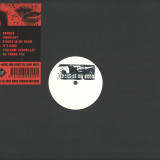
Meet Camy Huot: a French performance artist, music producer, and DJ currently based in Utrecht, The Netherlands. Known for driving the pulse of the underground scene via her events, radio shows and DJ sets at live shows & festivals (e.g. Best Kept Secret, Gothic Pogo and Grauzone)
The night stretches elastic, twisted. You’re a hostage to the rhythm, riding the edge of something primal and broken. Neon shadows flinch and fold into your peripheral vision. A voice, your own maybe, says you don’t have to worry about it. The night insists. The echoes pile up in your skull, turning themselves inside out. –It’s boring here, and I don’t wanna go home–
For her debut EP “Echoes in my Room”, Camy Huot set out to write about what she knows, channeling a primal collection of fucked up thoughts through an invigorating, brutally honest clash of feverish noise, cavernous textures and arpeggiated beats.
For fans of Sexy Sushi, L.F.T.
Bomj Diego had one simple dream – to spend a lazy summer weekend at his friend’s dacha, kicking back in a plastic lawn chair, sipping on Ovip Lokos, and letting the world spin as slowly as the rusty ceiling fan in the old guest house.
One Friday, he finally got his chance. He loaded up a plastic bag with a few cans of Ovip Lokos, an ancient Bluetooth speaker, and a single flip-flop (he’d lost the other one in a heated game of dominoes the week before). But as soon as he got off the train at the dacha station, Diego realized he had no idea where the actual dacha was. No address, no signal, just the distant sound of a chainsaw and the smell of freshly cut grass.
Undeterred, he followed the smoke of a barbecue like a hungry wolf. After an hour of wandering, he stumbled into a random backyard where a group of old timers were playing cards around a makeshift table. “Ah, Diego! You made it!” one of them shouted, raising a can of Ovip Lokos. Diego had no idea who the guy was, but he immediately sat down, cracked open his own can, and joined the game.
Hours later, as the sun dipped behind the trees and the mosquitoes started their evening shift, Diego realized – this wasn’t his friend’s dacha. In fact, it wasn’t even the right village. But the old men insisted he stay for shashlik, and as the Ovip Lokos flowed, Diego figured, “Eh, close enough.”
He never did make it to the right dacha, but sometimes, it’s the wrong turn that makes the best story.
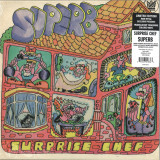
Australia's world-renowned cinematic soul outfit Surprise Chef return with new album Superb. A record that represents a change in their creative approach and turns up the heat in their music. Trading in their meticulous writing and recording techniques for a looser and less planned approach with the intentions of bringing more levity to the process, and it comes through in spades. The high caliber musicianship is still front and center, but they push their sound into a more energetic and fun place on this album. Album opener "Sleep Dreams" is the closest thing to a Surprise Chef tune one would come to expect but then lead single "Bully Ball" comes on and you get the picture that they came to kick in the door on this one. The song's gritty drums thunder through the speakers and get covered with percussion, keys, bass, and guitar chanks that stay in the pocket and bring the funk with them. The band pushes the boundaries of arrangement with tunes like "Body Slam" that starts off like a sweet soul track then pulls a 180, turning dark and haunting, centering on a sound they created by tucking a timpani into a bathroom two doors down from the mixing board. That same sense of experimentation comes up again on "Fare Evader" where they pepper another neck breaking rhythm track with synth notes that sound like robot sound effects from a 70s sci-film. The fellas turn up the tempo for the dance with tunes like "Consulate Case" and "Tag Dag"; the former pulling influence from afro-funk and the latter from jazz-funk. They take us deep into the beautiful world of Surprise Chef ballads on "Websites" and double down on their abilities to make beautiful and ethereal tracks with "Dreamer's Disease". With their new album Superb, their new approach, and plans to tour the world, we are about to see Surprise Chef take the step from the underground's most beloved to a household name and we are definitely here for it.
2025 Repress
Jim Coles once again turns the tide towards a new horizon and travels further into the echo chamber. Leading on from the much-lauded ‘Secret Location’ mini-album with Seekersinternational, one-offs such as ‘Open Palms dub’ (Dub Stuy) and other teasings, ‘Acid Dub Studies’ is the fully-fledged result of the merging of the calligraphic expression of the 303 Acid bassline with the stern sway of Dub Reggae and the hazier edges of Dub Techno and Ambient music.
For those who have been paying close attention, this project will come as a welcome return to the vulnerability and playfulness of early Om Unit records such as his sub-radar single from 2010 ‘Lightgrids/Lavender’ (All City Records) or the unearthed chugging ambience of ‘Friend of Day’ (Idle Hands) and indeed in some sense draws from similar wellsprings as moments on 2013’s Bass classic ‘Threads’.
Whilst being perhaps an ‘interim project’ this is still a vital and important expression of exploration and playfulness. A study in the true sense and borne out of a subtle but pervasive frustration with the rigidity found in musical words he has up to now been cohabiting, Acid Dub Studies comes from the pressing need to break with perceived expectation and to explore an honest and natural space away from the genre labels and tags that had been often lazily applied to his sizeable catalogue of music.
With no desire to reinvent the wheel, rather to paint pictures in an honest framework, the LP was crafted using a medley of classic analogue mixing techniques inspired as much by the adventurous dubbing of Adrian Sherwood as by the inward-delving haze of Scott Monteith’s Deadbeat project. Created during a period of lonely introspective walks through his home town of Bristol, the cover art is a photograph of some of the iron kerbstones that are found almost exclusively in the characterful and hardy city which were installed in the late 1800’s to protect pavements from cart wheels. Something about the permanence of those iron slabs and cobblestones inspired a sense of comfort and determination.
Acid Dub Studies is due for release as yet another self-released label-free project leading on from recent EP titles ‘Violet’ and ‘Submerged’ both of which hinted at some of the shapes found in this full length album.
Once again Jim has shown a rare convincing adaptability that few electronic artists can embody. Another step on the journey of personal and creative curiosity that fans are sure to appreciate.
Australia's world-renowned cinematic soul outfit Surprise Chef return with new album Superb. A record that represents a change in their creative approach and turns up the heat in their music. Trading in their meticulous writing and recording techniques for a looser and less planned approach with the intentions of bringing more levity to the process, and it comes through in spades. The high caliber musicianship is still front and center, but they push their sound into a more energetic and fun place on this album. Album opener "Sleep Dreams" is the closest thing to a Surprise Chef tune one would come to expect but then lead single "Bully Ball" comes on and you get the picture that they came to kick in the door on this one. The song's gritty drums thunder through the speakers and get covered with percussion, keys, bass, and guitar chanks that stay in the pocket and bring the funk with them. The band pushes the boundaries of arrangement with tunes like "Body Slam" that starts off like a sweet soul track then pulls a 180, turning dark and haunting, centering on a sound they created by tucking a timpani into a bathroom two doors down from the mixing board. That same sense of experimentation comes up again on "Fare Evader" where they pepper another neck breaking rhythm track with synth notes that sound like robot sound effects from a 70s sci-film. The fellas turn up the tempo for the dance with tunes like "Consulate Case" and "Tag Dag"; the former pulling influence from afro-funk and the latter from jazz-funk. They take us deep into the beautiful world of Surprise Chef ballads on "Websites" and double down on their abilities to make beautiful and ethereal tracks with "Dreamer's Disease". With their new album Superb, their new approach, and plans to tour the world, we are about to see Surprise Chef take the step from the underground's most beloved to a household name and we are definitely here for it.
Limited 2025 Repress
Black Truffle is pleased to announce the release of Ichida, the first release from the duo of two important yet often underappreciated musicians, Eiko Ishibashi and Darin Gray. Ishibashi is a singer-songwriter, keyboardist, drummer, and multi-instrumentalist, known in Japan both for her own elaborately conceptual solo albums and for her frequent collaborations with figures such as Jim O'Rourke, Merzbow, and Phew. Darin Gray is a bassist and multi-instrumentalist known for a multitude of collaborations (with O'Rourke and Loren Connors, among many others), for On Fillmore, his cinematic post-exotica project with Glenn Kotche, and as one half of Chikamorachi with Chris Corsano, one of the finest free-jazz rhythm sections around. Presenting the entirely of a live set performed at Tokyo's Super Deluxe in March 2013, the set begins as a duet for Ishibashi's flute and Gray's upright bass. Calmly melodic yet harmonically inventive, with shades of 'spiritual jazz', the pair's acoustic ruminations are gradually joined by Ishibashi's lush electronics, which randomly flicker between chords in a manner recalling the classic work of David Behrman. As the electronics build into a gloomy fog of slowly cycling loops, Gray lays his bass aside and turns to making strangely mournful interjections on a mouthpiece. Eventually Ishibashi moves to the piano, enveloping the audience in rippling pools of sustained, octave-doubled melody, provided by Gray's bass with a fluid and dynamic foundation. For much of the second side, both Ishibashi and Gray turn to electronics, ultimately arriving in a bizarre space of melancholic arpeggios and random sputter and sizzle, oddly reminiscent of 70s outsider prog acts like Wapassou. An uneasy coda of rich piano chords ends the set. Captured in warm room ambience and beautifully mixed by Jim O'Rourke, Ichida is a rare combination of improvisational acumen and emotional directness, both adventurous and immediately accessible.
- A1: Winter Wonderland (Feat Kansas Smitty's) (2 40)
- A2: I Believe In Father Christmas (3 51)
- A3: Man With The Bag (Feat Kansas Smitty's) (2 54)
- A4: Christmas Don't Let Me Down (3 21)
- A5: Sleigh Ride (Feat Kansas Smitty's) (2 24)
- A6: Amazing Grace (Feat The Vernon Spring) (2 53)
- B1: This Winter (Feat Lady Blackbird & Kansas Smitty's) (2 54)
- B2: Silent Night (3 50)
- B3: Jingle Bells (Feat Kansas Smitty's) (2 55)
- B4: Frosty The Snowman (Feat Kansas Smitty's) (2 09)
- B5: Have Yourself A Merry Little Christmas (5 34)
- B6: God Rest Ye Merry Gentlemen (Feat Kansas Smitty's) (2 15)
- B7: Let No Walls Divide (3 21)
- C1: It's Christmas (3 12)
- C2: Beautiful, Together (3 26)
- C3: Hang Your Lights (4 57)
- C4: The Jolly Fat Man (3 05)
- C5: The Pianoman At Christmas (4 27)
- D1: Turn On The Lights (4 16)
- D2: So Many Santas (3 28)
- D3: Christmas Never Gets Old (2 43)
- D4: How Do You Fly (5 55)
- D5: Christmas Caught Me Crying (3 17)
Multi platinum-selling musician and multi-instrumentalist Jamie Cullum today announces The Pianoman At Christmas - The Complete Edition. Due for release on 19th November via Island Records. The deluxe album completes last year’s critically acclaimed hit album The Pianoman At Christmas Part 1, with its Second Part - featuring 11 covers of classic Christmas songs, as well as two original songs, including lead single ‘Christmas Don’t Let Me Down’, out now.
Drawing from the past and inspired by the present, The Pianoman At Christmas - The Complete Edition sees Jamie team up with London jazz innovators Kansas Smitty’s, as well as composer and producer The Vernon Spring and acclaimed LA-based jazz singer Lady Blackbird to complete a piece of work that is imbued with seasonal sophistication. Alongside his two original tracks, Jamie breathes new life into classics such as ‘Winter Wonderland’, ‘Silent Night’ and ‘Frosty The Snowman’, ranging from ‘Amazing Grace’ to ‘Man With The Bag’ and ‘Sleigh Ride’. The Complete Edition will be released on double CD and double black vinyl formats, alongside a limited run of 180G Heavyweight coloured vinyl in red and gold.
Speaking on the release, Jamie said -
“I had a huge amount of fun creating part two of TPAC. Recorded live, all in the room together - it’s the party after the big show, with friends, drinks and some of the finest musicians on planet earth.”
Released almost a year to the day before The Complete Edition is due out, The Pianoman At Christmas featured 11 original songs played by 57 of Britain’s best musicians, recorded in Abbey Road’s famous Studio 2 and produced by Greg Wells whose The Greatest Showman soundtrack spent 28 weeks at number 1. The album sold over 37,000 copies, spending 6 weeks in the album chart and peaking at number 11. In December Jamie broke the Guinness World Record for the largest music lesson ever, when he held a virtual piano lesson for 2,282 people, teaching them the carol ‘In The Bleak Midwinter’ with special guests Robbie Williams, Sigrid and Dodie.
With 10 million album sales and over 890 million streams to date, Jamie is a celebrated musician the world over with loyal fans in every corner of the globe. With a career spanning over 20 years, his legendary live shows have seen him perform and work alongside artists as diverse as Herbie Hancock, Pharrell Williams, Kendrick Lamar and IDLES - Jamie writing on the latter’s album Ultra Mono. The success of Jamie’s major label breakthrough, Twentysomething in 2003 and its follow up Catching Tales saw him nominated for a BRIT, Grammy and numerous other awards around the world. In 2020 he won an Ivor Novello Award for his track ‘Age of Anxiety’, taken from his acclaimed 9th studio album Taller. In addition to his enduringly successful recording career, Jamie has also established himself as a multi-award winning music broadcaster; his BBC Radio 2 show celebrated its 11th year on air this year.
With her debut album Black Acid Soul earning critical praise, Lady Blackbird is a revelatory new talent with music that transcends the jazz scene through which the LA-based artist is rooted. Reflecting influences as varied as Billie Holiday, Gladys Knight, Tina Turner and Chaka Khan, with critics drawing comparisons to Adele, Amy and Celeste, Lady Blackbird’s distinct and beguiling voice is not one to be missed.
UK band Kansas Smitty’s have developed a musical voice wholly unique from what’s happening around them. They are led by band leader and producer Giacomo Smith who's cinematic compositions feature on their releases, most recently 2021's acclaimed Things Happened Here for Berlin based label !K7. In 2015 they launched their own east London venue and bar, of the same name, which became one of the conception points for the current UK jazz boom.
Londoner Sam Beste aka The Vernon Spring is a polymath in music who has production, writing and performance credits as eclectic as Amy Winehouse, Matthew Herbert, Kano, Joy Crookes, Beth Orton, Blood Orange, Gabriels and MF DOOM. Since 2019 he has been making waves with solo project The Vernon Spring, which foregrounds his rare capacity to hold sophistication and simplicity in the same hands through highly intimate muted-piano compositions and improvisations.
The first release to document the solo cello work of musician and composer Lucy Railton, the 40-minute composition Blue Veil recorded at Église du Saint-Esprit in Paris invites listeners into the realm of precision-tuned states of resonance: states made manifest through Railton's careful traversal of her cello's most subtle acoustic characteristics as they harmonically interlock with mind's embodied modalities of attention and imagination. Blue Veil arises out of, is sustained in and finally dissolves back into Railton's momentary presence with her intimate connection to the cello, a way of hearing that allows for a deeper engagement with harmonic resonance, one that opens a space for immediate encounters of mind and sound. Railton's exploratory practice of harmonic perception emerges from a focus on the physical qualities of intervallic and chordal sounds, their textural qualities, degrees of friction, and inner pulsations. Composing in the moment guided by resonances within the cello's body, her own, and their shared vibrational space, Railton moves through Blue Veil by giving sounds what they ask for: sounds of pure texture manifesting as a move through temporal transparency, sounds of rough texture marking regions of dimensionally dense space. Railton's creative and highly refined use of just intonation harmony deforms sound's inner movements in ways that suggest a mode of listening that actively supplies imagery of sounds implied or completely absent rather than merely savouring those fully present. This active mode of "listening-with", playfully and semi-metaphorically referred to by Railton as "sing-along music", allows listening to reflexively participate in the music's movement as it gradually passes through richly saturated domains of harmonic imagination. And just as the precision-tuned tones of Blue Veil lose their individuality when fusing multifaceted uniformity, listening's structures of reference and recognition dissolve into nameless waves of intensity, continuously unfolding themselves upon and merging with the listener. Blue Veil is the result of a deep exploration of the inner worlds of tuning, an undertaking in turn informed by and emerging out of Railton's realisations of the music of Catherine Lamb and Ellen Arkbro, her collaborative work with Kali Malone and Stephen O'Malley as well as her interpretive practice in performing the work of Maryanne Amacher, Morton Feldman and others.
Zuul supplies pressure control’s debut release, Routine Machine.
Following releases on Exarde and White Scar, the Laik label-head’s signature sound takes a menacing turn. In a departure from his usual output he delivers a grizzly 5 tracker filled with EBM, New Beat and Wave affined floor-fillers; all fraught with tension, straight out of the Kirkstall strip.
Fitting for peak-time, warm-ups and rub-downs, the EP is filled with snarling, left-of-centre bombs. All reminiscent of the golden-era sound forged in Frankfurt and Ghent circa 88-91, with new-school stylings for the modern day working disk-jockey.
Constructed exclusively for dark and discerning dance floors.
You can run, but you can’t hide.
Credits:
All music by Ollie Burgess
Pressing and distribution by by One Eye Witness
Design by Al Robertson
Mastering by Marco Pellegrino
Words by Josh Bayat
Sababa 5 collaborate with India born singer Sophia Solomon on their most exciting double A-side to date, merging Bollywood-style songs with their signature blend of Middle Eastern grooves.
Renowned for their instrumental releases that fuse traditional and contemporary Middle Eastern music with psychedelic rock, funk, and disco, Sababa 5 have also pushed boundaries in collaborations with vocalists such as Shiran Tzfira, Yurika Hanashima, and Inbal Nur Dekel. These efforts have won them support from the likes of Gilles Peterson, Cerys Matthews, and Jeremy Sole, on BBC Radio 6 Music and KCRW. Now, the band joins forces with Sophia Solomon for their latest musical exploration.
Born in Bengaluru, South India, and trained in Hindustani classical music in Mumbai, Sophia Solomon is a versatile, multilingual singer, recording artist, and live performer, drawing inspiration from Bollywood legend Asha Bhosle. A standout moment early in her career - a global tribute to Mahatma Gandhi - ignited her passion for bridging musical traditions across cultures.
“Shehzadi” (“Princess”) is an Indo-disco delight. Solomon’s Hindi vocals soar effortlessly across Sababa 5’s finely balanced arrangement of hypnotic drums, pulsing electric bass, fanning electric guitar, and sparkling synths in a beguiling minor key. There’s a strong hint of 80s nostalgia with a contemporary shine, evoking a Stranger Things meets Bollywood charm.
“Ranjha” (“Lover”) takes on a more Middle Eastern feel, with synth notes that undulate with longing and emotion, reminiscent of traditional instruments like the saz or baglama. The upbeat groove pairs seamlessly with Solomon’s dynamic, hope-filled vocals. Well-timed pauses add dramatic flair, while Sophia’s performance allows space for an exuberant synth solo.
This exciting collaboration marks another bold turn for Sababa 5, infused with new life through Sophia Solomon's artistry. “Shehzadi” and “Ranjha” represent a fruitful exchange of cross-cultural musical exploration, destined to be played on repeat far and wide.
180 G. BLACK VINYL WITH LINER NOTES IN CREOLE, FRENCH, ENGLISH
Originally released in 1979, "Spiritual Sound" lives up to its name, a soaring, triumphant album, six tracks of spirit magic from Guadeloupe.
Telluric, intense, terribly alive, the gwoka drums of Guadeloupe carry the identity of a painful and fervent island. Marked forever by the crime of slavery, Guadeloupe's créolité cherishes the ka drums and their natural environment: the low-pitched boula drum with male goatskin, the high-pitched soloist makè drum with female goatskin, the chacha, ti bwa, triangle, calabash and other percussion instruments that surround them, and the voices - the fiery, proud, timbred, urgent voices of the gwoka.
This album is also a legend for its voices: in his then dazzling youth, singer Lukuber Séjor was one of the first gwoka artists to largely feminize the chorus of répondè, who converse with his text delivered in a straight and powerful voice.
And everything here sets new standards. In 1979, Mizik Filamonik - Spiritual Sound proclaimed a spiritual patriotism of ferocious intensity. The album by Lukuber Séjor - whose spelling alone is a battle - sets out to give Guadeloupe the intangible weapons of self-respect and self-knowledge, through a singular practice of traditional music.
The genesis of gwoka music is less straightforward than one might imagine... The drums performed the servile task of accompanying the work of slaves in the fields and during the “corvées” imposed by the administration, before being freely practiced by the common people after the abolition of 1848. At the heart of the conviviality of the Guadeloupeans furthest from the cities - geographically and socially - the gwoka drums come out for carnival, funeral wakes and neighborhood celebrations, but also during strikes, fits of anger and armed vigils of the riots and revolts that have punctuated the island's history. For generations, governors of the colony and then the prefects of the overseas department of Guadeloupe have been viewing the gwoka as a potential for turbulence and a threat to public order.
But as the Beatlesmania, “chanson engagée” and rock revolutions unfolded in Europe, young people turned to the drums of mizik a vié nèg (“bad negro music”, in Creole), which Guadeloupeans had learned to despise by following the “assimilation” process advocated by the school system and most of the political class. At the end of the sixties, in a Guadeloupe mourning the deadly repression of the May 1967 social movement, they played traditional music, refusing to wrap it up in tourist prettiness and madras folk costumes. Instinctively, they played a rough and contemporary gwoka, led by the incendiary Guy Konkèt. This was the era of decisive 45 rpm records such as Robert Loyson's Kann a la richès, which brought to light the fieriest words of union rallies.
At his home in Sainte-Anne, Lukuber Séjor played with flautist Olivier Vamur and his brother Claude Vamur, who cobbled together a drum kit from tin crockery and became, a few years later, the most influential drummer in Kassav'.
These were the years of the Bumidom program, when young Guadeloupeans were encouraged to emigrate to mainland France. At the age of twenty, Lukuber Séjor embarked on the liner Irpinia, disembarking at Le Havre and taking the train to the Gare Saint-Lazare - the route taken by thousands of young West Indians who went on to study or looked for work, all the while trying to maintain a link with their homeland. In this case, it's at the Antony university residence, where Lukuber played the drum and participated in a thousand gwoka updates and aggiornamentos, while exile reinforced the need for a spiritual link with the native land.
In 1978, Guy Konkèt played at the Salle Wagram, a historic event for West Indian music. After serving as répondè - i.e. backing vocalist - on one of his home-recorded albums, Lukuber joined his live band. Little by little, he became one of the key artists on a circuit parallel to French show business. At a student party in Caen, he met a young woman from Martinique who, at the time, was more motivated by her ambitions as a visual artist than by her vocation as a musician. Her name was Jocelyne Béroard and, a few years before she plunged into the Kassav' adventure and became the greatest West Indian singer of her generation, she designed the cover of Lukuber Séjor's LP.
This ambition was obvious and imposed its will. A more or less regular band was formed, with Roger Raspail, Rudy Mompière and Éric Danquin on ka drums, Claude Vamur on ti bwa, Olivier Vamur and Françoise Lancréot on flutes and Annick Noël on keyboards. Lukuber Séjor is set on wanting to extend the gwoka palette to other instruments, as the jazz-rock revolution opens a thousand new doors. Annick Noël will play a wide range of timbres and textures on electric piano and synthesizer. Another novelty: the répondè are two men and two women, Roger Raspail, Olivier Vamur, Françoise Lancréot and Maryann Mathéus ...
Mizik Filamonik - Spiritual Sound is a self-production in which the singer and leader sank all his savings, allowing him no more than a single day in the studio. The first side is more of a musical manifesto, with the first two tracks, Éritage and Penn é plézi, being instrumentals. The third, Son, forcefully celebrates the need for Guadeloupeans to connect with the gwoka. In fact, Jocelyne Béroard's cover shows a tambouyé in the shadow of a cloudy sky, against which a radiant sun is rising and whose light will soon flood the entire landscape. The silhouette and face of this man strongly evoke the immense Vélo, master of the ka, rejected at the time on the fringes of society.
The second side of the LP is surprising. Formally, three tracks are explicitly linked like the three parts of a triptych. Primyé voyaj evokes the appalling tribulation of Africans deported as slaves to Guadeloupe; dézyèm voyaj speaks of the Bumidom program and the economic, political and social forces driving young Guadeloupeans towards the mirage of prosperity in France; twazyèm voyaj closes the cycle with the emigrants' return from Europe after years away from their island...
This gwoka, obsessed with the need to save Guadeloupe spiritually, appeals far beyond the politicized audience. Mizik Filamonik - Spiritual Sound instantly became a classic, although Lukuber Séjor never really made a career for himself as a musician.
After all, the album was released in 1980, with no promotional resources in France or Guadeloupe - and therefore no concerts. The thirty-two-year-old author, composer and performer made his own third trip back to Guadeloupe. He set up a small woodworking business, which he lost in Hurricane Hugo in 1989. His other activity, teaching in a medical-educational institute, became the core of his professional life. He continued to be an active campaigner - a campaigner for the Creole language, a campaigner for the reawakening of identity, a campaigner for special education, a campaigner for a thousand causes that he ignited with his generous and perceptive enthusiasm, such as the defense of breadfruit fries...
The echoes of his 1979 album have not died down. Of course, the use of Penn é plézi as the theme tune for Radio Guadeloupe's funeral notices from 1980 to 1992 kept him in the collective memory, but he continues to sing and compose sporadically, as with his all-female
vocal group Vwapoulouéka... Still convinced that music is a means of liberating the spirit, he continues the journey of a young man eager to deploy the power of Creole music and language.
Bertrand Dicale
Something special happens when acts like 2fox and vocalists like Laville team up. In 2024 theybrought us one of the year’s most exciting soulful house releases called 'Elevation'. The trackhit #2 on Traxsource’s Best of ADE 2024 and it was consistentlyin the top 10 of soulful housecharts across DJ retail sites. This catchy vocal floating on top of a modern Motown inspiredbass line has had crowds singing along night after night. On this vinyl and digital package,legends Louie Vega and Tommy Musto take their remix turns on 'Elevation' along with labelbosses Soul Clap plus an exclusive percapella from 2Fox.
Louie Vega’s remix turns up the tempo and swings with a heavy bass piano line, knocking percussions, sweeping synth pads. Laville and background vocalists Nandi and Beth Aggetthave plenty of space to soar and give this remix a gospel tinge. It’s a nine plus minute ceremonyof sound that will still leave you wanting more and more!
Tommy Musto’s Zero Hour Mix dials in the soulful sounds of the track, bringing the organforward for a jazzy take for those who want to feel cosmic vibrations.
Soul Clap’s remix is future forward and Detroit inspired. As it evolves over 8 plus minutes, astrong melodic build up and eventual release will leave every listener feeling elevated!
These remixes along with original extended mix are available digitally and also packaged on 12-inch vinyl with artwork designed by Noah Prebish of Unknown Pleathers. Stay tuned for a dubs 12-inch release just a few weeks from now with unique versions of these remixes
As bassist for dance-punk outfit The Rapture, Mattie Safer cut his teeth in the music scene alongside a wave of now-legendary early 2000s NYC acts like the Yeah Yeah Yeahs, LCD Soundsystem and more (a time period recently immortalized in the documentary film ‘Meet Me In The Bathroom.’) Fast-forward nearly 2 decades and Mattie has found the sweeter side of dance music as the current lead vocalist for slo-mo kings Poolside, and now he presents his 2nd solo lovetempo project on Razor-N-Tape.
Championed heavily by Gilles Peterson, lovetempo’s modern soul classic 'But I Do' gets a vinyl release with a trio of remixes. Crackazat delivers in his signature style, weav-ing the organic elements and earworm vocals of the original into a deep and jazzy mix. Lon-doner Daisybelle bumps the BPMs up a few notches and adds pulsing synths to her take, and Brazilian duo From House To Disco turn in a dubby club remix to round out the record.
We wanted to celebrate the music of integral Samurai family member Last Life by revisiting his Samurai contributions with remixes from artists Mauro saw as best candidates for adding a new perception.
The second and final collection of remixes of tracks from Last Life's Samurai Music catalogue has now taken it's final form.
Label regulars Sam KDC, Ancestral Voices, Torn and Presha take their scalpels to Mauro's constructions and turn up the intensity, rebuilding them into 4 sinewy exercises in sinister force.
Subterranean stalwart and Underground Quality boss Jus Ed reworks a trio of archive tracks on his 'Mash Up' EP, embracing production with newfound freedom as he continues his ceaseless creative journey. The Bridgeport native has been turning out raw, uncompromising house jams for decades, routinely delivering dancefloor fire. Here, the freak flex of '209 Remix' powers over a relentless synth hook, with vocal cuts, rhythmic bleeps and emotive pads completing the stripped-back sonic landscape. The brooding dub traction of 'Back To Basics' sees hypnotic chords drift over sleazy drums as vocal delays roll into the distance before Ed gets some gripes off his chest via 'Fack Ass Muthafukas' i sending a disapproving message to someone or other, with pointed spoken words jibing over a sinister bass hook.
Chontane returns with Set A Dot, the third release on his label, TANE. Offering a four-track statement of pure rhythmic intensity and intricate groove construction. Known for his precision-driven approach to techno, Chontane continues to refine his sound, fusing raw
percussive elements, hypnotic basslines, and evolving sonic textures into club-ready weapons that move both the mind and body..
From the outset, Magallanes asserts itself with rolling drum patterns and pulsating synths, locking listeners into its hypnotic rhythm. Hypnotic synth pulses weave through the track, building tension gradually until it breaks into a dense, rhythmic crescendo.
Next up, Turn the Tables lives up to its name, amplifying the energy with snapping hi-hats, deep bass momentum, and restrained synth modulations. A functional yet immersive trip through layered percussive textures.
The B-side offers a deeper, more atmospheric twist. Cycle Break channels a grooveheavy, tribal-infused flow, using intricate rhythmic interplay and distant, metallic textures to create a track that breathes and expands across the mix.
Rounding out the release, Set A Dot leans into pure forward motion, with skittering percussion, sharp synths, and a rolling low-end pulse, making it a go-to tool for seamless DJ layering and extended club sets.
With Set A Dot, Chontane refines his signature style, delivering tracks that are meticulously detailed and irresistibly powerful.
A journey through rhythm, texture, and raw energy.