Two Form a Click (DJ Snaffy, Wretchen Redspiders) collide with Horatio Pollard to deliver two sides of beautifully coalesced psychedelic synthesis, heavy with dub's production values and freed from the grid of analog electronics.
Suche:two form a click
Stevie Cox and Ansboy: two powerhouses of the Glaswegian club scene join forces for their collaborative debut EP on Rhythm Section INTL- ‘Twice Like Rice’. It’s a weighty four-track EP designed for the dancefloor, taking in myriad influences from dub techno, breaks, trance and good old fashioned house music. The Ep is full of deep, pulsating rhythms, lush textures and emotive peaks - all road tested in Stevie’s Iconic home turf: Sub Club.
Stevie Cox has long been a name long ruminating on everyone's lips, as a resident DJ of the iconic ‘Sub Club’ with an ever-growing tour schedule and back catalogue of releases via the likes of Klasse Wrecks and Optimo. Whilst the name Ansboy may be new to some, it is a fresh alias for the grammy nominated producer and mixdown engineer Robert Etherson who has long been a staple in the Scottish scene with an international touring repertoire under his belt.
The two friends met in their hometown of Glasgow and began their musical journey together last year after Robert taught Stevie how to do mixdowns. The pair clicked effortlessly, quickly discovering they shared the same passion for emotive, deep and progressive dance music. Their first track together - which took shape in the form of ‘Drift’ - a high-energy synth led anthem, came out with a special selection of tracks curated by Bradley Zero for his exclusive SHOUTS Summer sampler in 2025.
For the Twice Like Rice EP, their work evokes all corners of the dancefloor, kicking things off with ‘GC’ - a peak time breaks-infused trancey-heater - a master class in building dancefloor tension which gives way into a searing crescendo. Things spin towards a darker percussive focus on the more intense ‘Twice Like Rice’.
On the b-side things return to blissful euphoria with ‘Virgil’ - a warm up dub-techno ballad, before the emotional release of ‘Subculture closure’ inspired ‘Carter21’.
Acclaimed producer, DJ, and dancefloor healer Octo Octa (Maya Bouldry-Morrison) announces her fourth full-length album, Sigils For Survival. Following 2013's Between Two Selves, 2017's Where Are We Going?, and 2019's Resonant Body, the new record marks a decade since Maya publicly came out as transgender in November 2015. ''As an autobiographical artist, I set out to write an album that would be a milestone for this past decade of joy and sorrow,'' Maya explains. ''Sigils For Survival is my attempt to encapsulate the intentions and techniques that I used to move through life into a spell.'' For each of the record's eight tracks, Maya drew a sigil. Each is a personal symbol intended to ''bind magic to the song and seal its intention.'' These drawings appear throughout the physical edition's design. Maya's sister, New York artist Hope Morrison, incorporated each sigil into her original paintings, which comprise the album's vivid artwork. Hope Morrison, whose imagery translates the sigils' energy into vivid form; the layout was designed by Jo?o Ervedosa. Created entirely on hardware instruments and later mixed in Logic, Sigils For Survival captures the tactile immediacy of live performance. Maya preserved the feel of MIDI-clock drift and off-grid recording, letting her machines interact in the rhythmic pocket, rather than confirming them to a click. Alongside her signature deep, ecstatic electronics, the album features hand-played dulcimer, hand-pan, and recorder. Her voice also returns, carrying spells of love, protection, and transformation. Across Sigils For Survival, Octo Octa channels the ecstatic house lineage into an intimate ritual space. The music speaks of immediacy, play, and communion -- of magic as method, love as survival, and sound as spellcraft. Sigils For Survival is both a document of ten years lived fully and an invocation for the next chapter -- a glowing testament to music's power to protect, transform, and set the spirit free.
Repress.
Fast-rising Dutch DJ/producer BELLA becomes the first new artist signing to Sally C’s Big Saldo’s Chunkers imprint, with the inspiring ‘Note to Self’ EP – her debut production.
Relationships are key for Sally C. Since the inception of Big Saldo’s Chunkers in 2020, she’s released three carefully chosen EPs, all from her own studio. When she met BELLA while playing a festival in Amsterdam during summer 2022, the click was instantaneous, with the pair going on to play an impromptu b2b that day. Vibing both musically and energetically, they kept in touch, with BELLA sending Sally her maiden productions ‘Note To Self’ and ‘Orchestra Spring’. Sally connected so deeply with the tracks that they’d form the backbone of her debut artist EP on Big Saldo’s Chunkers.
One listen to the final EP and it’s not hard to see why Sally wanted to emboss them as Chunkers. Three fresh originals taking in influence from ‘90s house, acid, electro and prog, all with a unique hard-to-pin-down energy that makes them hit with a special swing.
The title track – also the first production made for the EP - sees BELLA lay down a sonic blueprint – both for her own sound and the full body of work. “This set the vibe and guided me through the creative process. I was really trying to make something that felt my own, that was also unique and not something I’ve heard before,” she shares. ‘Note to Self’ is heavy on attitude and bounce, driven by banging old skool drums, a rapid-fire grime-style vocal and a duo of synth lines – one uplifting, the other mining a slick ‘80s sheen, and the results are memorable. An absolute tune that Sally’s delighted to add to the Chunker catalogue.
‘Orchestra Spring’ is the perky sequel, a wicked one-two punch of kaleidoscopic groovy house with lashings of attitude that loves to scribble outside the lines with lots of retro samples and trippy energy. ‘Odd Symphony’ completes the trio, a blazing late-night cut driven by a gurgling acid underbelly, gritty drums and warm chords, giving the EP a brilliant afterglow.
W.R.F. was formed in 2015 by Nina and late studio partner Andrew Weatherall to help wrangle the vast output recorded together beyond his solo releases.
Spotlighting nine tracks from the Apparently Solo series of EPs recorded between 2016- 2019 and released on Bandcamp in 2023, this lustrous time capsule marks the culmination of Walsh and Weatherall’s creative relationship born after they clicked at London’s earliest acid house clubs, becoming partners then managers of their Sabres Of Paradise/Sabrettes labels before taking different paths by the late '90s.
An accomplished musician, Nina had learned the art of studio technology by the time they reunited and started working together in 2012. Created at her Facility 4 Studio situated in the dangerous, gang-ridden no man’s land between Streatham and Mitcham, Anamchara captures the super-prolific creative stretch starting in 2015 that produced Weatherall’s Convenanza and Qualia solo sets, W.R.F.’s The Phoenix Suburb (And Other Stories) plus a whole lot more. According to Nina, Andrew envisioned the spectacular ‘Borderland’ as natural successor to ‘Smokebelch’, his most revered track. When it came to his remix, Nina enlisted renowned viola virtuoso Sarah Sarhandi and composed new harmonies with Pachelbel’s Canon in D Minor in mind.
The set also catches the breakthrough period when, through Nina’s careful coaxing, Andrew started using the computer system she’d set up to better express his musical visions by arranging the elements, grooves and melodies she sent him. Still considered the UK’s greatest DJ-producer, Andrew’s arrangements were inspired by his club-igniting sets. “This allowed me to mix the colours for his palette whilst he was painting the picture,” says Nina. Anamchara straddles the gamut of musical styles explored by W.R.F. at this time, from slower paced psychedelic “drug chug” outings ‘We Two’. ‘Heat To Meat Ratio’, ‘Hidden Watchers Part 1’ to banging acid house and techno sometimes inspired by the violence outside the studio door, including ‘SCHLAP’, ‘Crack-Ed’ and churning acid juggernaut ‘Yacidik’ (“After much dangling of the acid carrot, Andrew took a bite and, after one familiar raised eyebrow, never looked back,” says Nina).
Many tracks fly elements from the enormous sonic library Nina inherited from late partner Erick Legrand that she called The Akashic Library of Sound. Marking Andrew’s 2016 admission into the vault, ‘Rattly Old Puffin’ boasts Erick’s psychedelic guitar and tumbling drum loop Weatherall would run with, including on ‘Borderland’. “Erick was like our third member,” says Nina.
Bringing down the curtain, ‘Alma’’s exquisitely poignant melody that unfolds over thirteen time-stopping minutes was composed by Nina while navigating Erick’s birth and departure date anniversaries to accompany Andrew’s reading from Gordon Burn’s 1991 same-named novel at 2018’s Durham Literary Festival. Burn’s novel imagines early 60s popstrel Alma Cogan, who succumbed to cancer in 1966 surviving to reflect on fame. “Now it just makes me think of Erick. And every time I hear those well-placed cymbal crashes I can only think of the Captain himself.”
A beautiful grand finale for this astonishing selection of pure gold from the vaults.
Kris Needs / 2026
The third chapter of Vesuvius Soul Records connects distant corners of the underground — from Canada to the UK, passing through Barcelona and Naples — building a sonic bridge between different energies and creative visions.
Void Fill, a supergroup formed by members of Gad Whip, Everything Is Geometry, and King Pong Dub System, deliver two tracks that merge new wave and post-punk tension with synth-pop sensibility, each paired with its instrumental version. Their sound blends analog drive and emotional depth, echoing the label’s exploratory spirit.
On remix duty, the A-side features Lvca, one of the most influential names in today’s European underground scene. The B-side comes from Computer Rage, the Neapolitan duo behind VSR002.
This is the story of an artist in search of sound and breath: an artist who dares to question the rhythm of silence—an invitation to rethink music, sound, and musical collaboration. This is the story of a journey that, after opening countless paths, has finally found its vessel—and its messengers. Three artists of profound musical truth and radical freedom, merging into an exceptional trio that crosses genres and transcends words in a journey toward pure emotion.
Le Rythme du Silence is the culmination of this long search. Yom delivers it here with violinist Théo Ceccaldi and cellist Valentin Ceccaldi—kindred spirits in sound. “I’ve been working on this idea of the ‘rhythm of silence’ for years,” Yom explains. “I first heard the phrase from a Sufi master, describing the foundation of meditation. It struck something deep in me. I’ve practiced meditation for a long time, and we often think of it as a kind of stillness—opposed to noise and life. But in truth, the rhythm of silence enables meditation. It means accepting that the world continues to move and live around you, even as you try to be still. I wanted to compose from that place. To imagine sound as vibratory matter—the primal substance of creation. That required letting go of fixed structures: forgetting melodies, abandoning the idea of a constructed solo. I needed to leave behind music as a system, and touch sound as a living, breathing entity. It took years. Many projects led me elsewhere. But with the Ceccaldi brothers, I finally found the right resonance. Working with them was simply obvious—it was indredibly powerful.”
Yom first rose to prominence reimagining Jewish traditional music with his 2008 debut New King of Klezmer Clarinet. Since then, his path has led through rock (With Love, 2011; You Will Never Die, 2018), electronic utopias (The Empire of Love, 2013), meditative and sacred soundscapes (Prière, 2018), and countless unclassifiable hybrids (Unue, 2009; Green Apocalypse, 2010). It was inevitable that he would eventually cross paths with the free-spirited Théo and Valentin Ceccaldi—two artists who also place collaboration and genre-blurring at the heart of their artistic development. Their projects are always bold, demanding, and full of life (Kutu, Tricollectif, ONJ, Velvet Revolution, Grand Orchestre du Tricot, Lagon Noir, Constantine, etc.). And so, when the three met within the iXi string quartet, something clicked.
“I was seated between the two of them in the quartet,” Yom recalls, “and I could feel their energy flowing from both sides—it was wild! They’re so tuned into each other, they don’t need words. It’s like they’re connected by musical Wi-Fi. The groove happens instantly. They’re precise when they want to be—thanks to their experience in pop-influenced projects —but they can also let go completely, diving into pure sound. That’s exactly what this project needed.”
Without a single rehearsal, the trio formed instinctively. They began performing Yom’s compositions live, unfolding them into a single continuous piece, where clarinet and strings stretch the limits of sound and breath.
Bowed, plucked, or prepared with clothespins, the Ceccaldi strings engage in a playful and intense dialogue with Yom’s custom B-flat clarinet. Through their imaginative listening and fearless invention, air and space open into a vast new soundscape—one that lies somewhere between meditation and healing music.
“When Yom shared the concept of the rhythm of silence, we were immediately drawn in,” says cellist Valentin Ceccaldi. “There’s a deep intensity and spiritual commitment in his music that really spoke to me. With this trio, we’re trying to dive into the core of sound—but also to create a kind of communion with the audience. It’s like gradually turning up the volume on silence, and realizing it’s made of countless tiny sounds—the music of particles in motion" This stripped-down intensity demands full presence—body and mind—of these three musicians, vibrationally connected in a state close to trance. With them, we enter a journey - not religious, but sacred nonetheless.
The Rhythm of Silence becomes an echo of our most intimate, most distant inner landscapes.
An album—and a trio—to return to without end.
Oversized custom cut LP jackets (13” / 33.02 cm width)
Silkscreened with bespoke iridescent citrus green ink by Mark Rice
Short story by Natalia Zuluaga
Flexi 7”:
steaming mescaline (extended mix by bad lsd trips)
Citrus green metallic foil stamp
Pressed in full stereo
Edition of 150
I.
bad lsd trips is the collaborative duo of makers doris dana and domingo castillo flores. Respectively the two have fostered practices that have sprawled out through various approaches and, whether in the lanes of the musical or the contemporary arts, the phenomenology of the social and inclusive prevails. On ultrafest, this motif continues through the psychedelia of its eight time-defying recordings, welcoming the listener into an open temporal architecture of the stereo field as a signifier of environment. It is worth noting that the group began collaborating in Miami, Florida with longer form improvisations recorded to a stereo cassette deck. In these recordings, the paved geographical sprawl and oceanic view permeated the approach to amassing long swaths of sound material. Listening back on that work at the time of this writing, each track feels as though one is walking into an active space, arriving to an event already in full swing and finding your place inside of it. On ultrafest (this album) something different occurs. The space and events are built around you as you move through the record.
II.
The name of the album is ultrafest, which should effectively provoke your mind's eye the imagery of young people dancing, salivating, grinding, and imbibing chemical compounds to the perversely formalized musical genres of “Electronic Dance Music” and latter-era Dubstep often heard in European Uber rides and energy drink commercials. A far distance from the icy and machinic reverie of Techno’s finest rave eras or the notable historical contributions of Miami’s cerebral producers to IDM’s global output, ultrafest is a libidinal catharsis as festival scaled to a multinational corporation of hedonistic excess. The festival has been a hallmark of Miami cultural industry production and optical enticement for tourism, purportedly bringing in nearly a billion dollars in revenue to the city since 2012. Scores of documentation exist wherein this decadent escapism leaves the concertgoer, usually in some neon garment on a near nude body potentially adorned with fluffy faux fur leg warmers, facing a comedown from the combination of volume, sun, dehydration, and methylenedioxy-methylamphetamine. This MDMA experience characterizes an aspect of the way bad lsd trips employs vocals and pitch on this album. The detached, high octaved longing of a high pitched vocal is decoupled from its typical auditory body of song. High-pass clicks and pops touch the (h)air on the back of the neck, promising goosebumps and teasing towards euphoric rushes of dopamine, yet also exist decoupled from the body of song. As the dopamine depletes and the sun imposes itself, Miami’s downtown of skeleton real estate is your company as you meander towards your parked vehicle to rest your fatigued senses, elevated heart rate, and quench the need for air conditioning on your skin. The immediacy of bombastic social immersion to architectural alienation palpable here.
III...
- Nick Klein
“Apaga La Luz” has proven itself to be a bonified club hit with the Tony Touchand Pablo Fierro mixes released last summer 2022. A new buzz has beencreated with the brand new 2023 remixes by Two Soul Fusion AKA Louie Vega & Josh Milan, David Morales, Mike Dunn, and David Guetta. Yes you heard correct, these all star super talents have lent their expertise and made it work once again on dance floors worldwide in a big way. Just click on play and let the remixes take control.
Dancefloors at festival and clubs have been blowing up all summer to this sureshot fire choon championed by David Guetta, David Morales, Mike Dunn, Louie Vega, Anané Vega, Seth Troxler, Marco Corola, Paco Osuna, The Martinez Brothers, Pablo Fierro, and many more. Stream it, or load it in digital form, coming soon September 29, 2023 on Vega Records and what a true honor it is to have these leaders in thegame contribute their craft to these incredible remixes. Double Pack 12” Vinyl mastered by the DON of mastering Herb “Pump” Powers and Original cover art by artist RULER conceptualized by Pucci. Get the decks ready !!!
Força Maior combines the vital saxophone explorations of Pedro Alves Sousa with the infinitely subtle electronic processing of Pedro Tavares. Sousa (aka Má Estrela) is known for manipulating his woodwind through guitar pedalboards & amplifiers, creating far-from-ordinary sonics rooted in unceasing curiosity. For his part, Tavares (aka funcionário) conjoins video & sound work to create space for the pensive wanderings where memory and imagination interlace.
The album Morte Lilás was recorded over a week in June 2023 in Pedro Alves Sousa's family farm, located in the village of Ferreirim, near Lamego, in Portugal. The partly abandoned farm served as the residency, studio, and inspiration for the album: it is a 400-year-old granite farm that belonged to a member of the "40 conspirators"—a group that led the revolution for Portugal's independence from Spain in the 17th century.
Morte Lilás is a remarkable album of committed meditation. Each day on the farm was a recording day for the two Pedros: Sousa on sax & electronics, Tavares on sampler & processing. Apart from slight sonic incursions from the surrounds—the birds on 'Quinta à tarde'—and the sporadic use of sine tones, the source sounds all start from the saxophone. It is then processed both by Sousa & Tavares. The album unfolds as a saxophonic tapestry that breathes with quiet intensity. Each piece invites close listening, revealing fine gestures and tonal shifts that shape a contemplative, ambient space. Força Maior move with calm precision.
The album opens with the unhurried overture 'Quinta à Tarde' a Portuguese pun on Eno's Thursday Afternoon that announces the textures at play. Sousa's breathy entrance is paired with a soft, delicately shifting, backdrop. As the track progresses, time seems to stretch. The arrangement resists urgency, favouring subtle evolution over dramatic turns. Pensive layers shift & drift, creating a sense of suspended motion that brings the listener into the environs of Morte Lilás. 'Quinta à Tarde' is a long-form fade, shifting emphasis from Sousa to Tavares.
'Cubos' continues the gauzy feel, but with a more up-tempo tilt. Rhythmic clicks & pings setup a swung time for the sax to interpose melodic lines that are fed back & bent with cascading delays. Força Maior in distilled form.
Força Maior is in top form on the title track 'Morte Lilás', a sprawling centrepiece that showcases their command of atmosphere & emotional pacing. By turning up the reverberation & leaning into a continuous format, they dissolve the gap between hypnotic trance & articulate reverie. Then, a moment of stillness. The track pauses, not abruptly but like a tide pulling back, revealing the contours beneath. What follows is a return to the album's more relaxed architecture: understated rhythms, softened textures, and a sense of spaciousness that opens space for reflection. It is a transition that feels organic, as if the song itself needed to exhale before settling back into its contemplative groove.
'Menta' is another short-form miniature of the band's signature contours: beautiful loops of air pressure gradients that carry an emotive weight & light.
The album closes with 'Cascata do Inferno'. The title suggests violence, but the music whispers instead—an atmospheric cascade of breath & tone that emerges in slow, deliberate waves. Short melodic cycles are matched by shimmering electronic chords. It's a piece that rewards patience, draws the listener in to drift downstream, eyes closed, into the serene turbulence of its current.
DJ Support: Andy Votel, Nemone (BBC Radio 6), Andy Bell, The Quietus and more
The sweet hum from the vampire wood returns as Five Green Moons make another orbit. Ritual incantations and Dubwise vibrations are fused with angular guitars and skittering basement electronics to form a new entity. Moon 2.
Justin Robertson's second outing as Five Green Moons is a fusion of influences. The presence of occult mystery can be felt in the chants and vocal motifs, there lurks a manifestation of elastic post punk in the zigzag echo further enhanced by the appearance of Brix Smith, former high priestess of the Fall on two tracks. One could draw comparisons with P.I.L, Holy Tongue, the hauntological sound of Current 93, the trippy off kilter hypnotism of Brown Rice era Don Cherry, and of course the solid foundations of Dub. The bass is heavy, the sound spacious. This is a new form of pastoral dub!
Pressed on Limited Green Vinyl.
- A1: Time Or Tide
- B1: I Loved And I Lost
Occasionally, one experiences serendipitous events in life. On the 13th of July this year, I received a message from Tim Trapnell, who had discovered an unknown 60’s track on YouTube and expressed his admiration for its exceptional quality. Intrigued by the message, I clicked on the link and was immediately captivated by the musical composition. Within minutes, I embarked on a quest to uncover more information about the band and the particular track. On the 16th of July, only three days after, I’ve received a message from Jim Bojorquez (aka JC), the lead vocalist of the Baron of Soul, “Hello Yann, I was delighted to hear that you have discovered and enjoyed my original composition, ‘Time or vs Tide.’ It was written by myself and Clark Baldwin. that the recording was performed live and this song was never released in any format back in the day. I have reached out to Jim Bojorquez the next day and we spent a considerable amount of time conversing via video chat about his illustrious 60-year music career as an artist in San Jose, California.
I proposed to Jim that I could release two songs from The Barons of Soul through Epsilon Record Co. I re-mastered both songs and made a deal with Jimmie that same day. So today, I am so pleased to present these two previously unissued tracks. "Time or Tide" is a powerful uptempo piece featuring an exceptional brass section and a Hammond B3. The vocals are exceptionally punchy and catchy, ensuring an unforgettable listening experience. "I Loved and I Lost” is a remarkable take of the Impressions classic written by Curtis Mayfield’s If you are an enthusiast of 60s uptempo music like Tim and myself, then this new and exceptional 45 is an absolute must-listen and must have!
- 1: Home Of The Brave
- 2: Georgia Song
- 3: Country Tune
- 4: Gossamer Wings
- 5: Our Lives Are Shaped By What We Love
- 6: Wondrous Castles
- 7: Battened Ships
- 8: Sunny California Woman
- 9: Black Top Island (Of The West)
- 10: Broken Road
Motown’s L.A.-based Mowest label lasted less than two years, but managed in that short time to release some of the most adventurous music the company ever put out. And probably the most intrepid—and nowadays, adored—Mowest release of them all was the 1992 self-titled release from Odyssey. This one-off brought elite West Coast sessionmen like Wrecking Crew mainstay Don Peake, one-time Chicago member Donnie Dacus, and arranger/orchestrator extraordinaire Gene Page together with a bunch of West Coast hippie rockers (as Peake says, “We were invited to lunch, introduced to some nice people and told we were going to form a band”).
The happy result was a record that has appeared on more deejay turntables than you can count, a one-of-a-kind blend of funky Motown bottom with a spacy sensibility and sound that fits right in next to, say, the latest Khruangbin album on your psychedelic chill playlist even as it activates your 5th Dimension sunshine pop endorphins. The single “Our Lives Are Shaped by What We Love” is probably the pick to click, but the whole album is a total vibe. We’re reissuing Odyssey for the first time ever in the U.S. (the Japanese have long been all over this album) in blue-green “ocean spray” vinyl, complete with original album art including the lyric insert. Remastered for the format by Mike Milchner at Sonic Vision, and pressed at Gotta Groove Records for superior sound. A must!
Amuleto Apotropaico has a way to fend off demons by channeling a secular spiritualism rooted in a rigorous but playful connexion to the infinite possibilities of noise. The propulsion of their continuous music ebbs into and flows out of this primordial flux through their unique brand of brutalist liturgy.
Amuleto Apotropaico is a Portuguese duo consisting of António Feiteira (drums & electronics) and Francisco Pedro Oliveira (guitar, flute & electronics) formed in 2021. Having grown up together, saturated in the lore of their hometown of Santa Maria da Feira, the duo now resides in Porto and continues to moor their rhythmic rituals in the traditions of Northern Iberia.
None of this is a nostalgic look back to a time-that-never-was. Amuleto Apotropaico's cycles are ouroboric: every step forward invokes a simultaneous step backward such that their observance of sonic ceremony (seeming to invoke a now-forgotten tradition) becomes a constructivist gesture that shapes its own legacy. If time-travel exists, this duo has found out how.
For their self-titled first release (also the first release of the Perf label), António Feiteira has culled, recomposed and processed recordings from the band's last two years of concerts in order to create a exciting 4-tracker. Apotropia I & II, which open sides A and B on the vinyl release, are both textural meditations on subtle density. Feiteira's sensitive percussion flourishes are married to Oliveira's modular-enhanced flute and guitar patterns. Albedo e Rito showcases the duo's sense of melodic contour while crescendoing to a peak of lightness. Bruxa do Calhau Branco, lifts the whole journey into an astral dimension where multi-layered drums, synths and digital clicks breathe out, announcing that their moment of worship has settled back into the ubiquitous hubbub of room hum.
- A1: She Loves Me
- A2: Dansons Dans
- A3: Nobody Moved
- A4: Dance Riff
- A5: No Trip
- B1: Shadance
- B2: Sequence X
- B3: A Cut & A Wipe 2024
- B4: Aceton
- B5: Iootd Dream Feat. Adrienne Altenhaus
- C1: Constant Click Feat. Adrienne Altenhaus
- C2: Mission Control
- C3: Princeton
- C4: A Car
- C5: Sonate Part Iii
- C6: Kunst-Zaken '87
- D1: Minimalize
- D2: Linda
- D3: À Saint-Tropez
- D4: A Shadow
- D5: Abstractions
2LP in printed inner sleeves + 12 page booklet with detailed info, secrets and unpublished pictures written by Walter Verdin himself. This collection dives deep into Verdin's prolific and experimental music from 1980 to the beginning of this millennium, capturing an era of a DIY punk spirit, improvisation, creative freedom and swimming against the tide.
We are thrilled to announce the upcoming release of 'Pingpong', a 2LP compilation showcasing previously unreleased works by Walter Verdin, the founding member behind Pas De Deux, the Belgian band which delivered 80's cult classics 'Rendez-Vous' & 'Cardiocleptomanie'. This collection dives deep into Verdin's prolific and experimental music from 1980 to the beginning of this millennium, capturing an era of a DIY punk spirit, improvisation, creative freedom and swimming against the tide.
This album is not just a compilation-it's a sonic journey into Verdin's unique approach to music-making, which he nurtured in the AV studio at KU Leuven's Audiovisual Department (AVD). Having begun his civil service there in 1980, Verdin was exposed to a rich array of audio and video tools that would shape his work for years to come. From the outset, Verdin's process was defined by an openness to experimentation, where he would explore sound and music organically rather than following pre-existing concepts.
The songs on Pingpong reflect his fascination with creating spontaneous, layered compositions. These recordings were made using limited tools, such as his duophonic Yamaha CS-40M synthesizer, borrowed drum machines, and tape loops, and were further enriched by techniques such as reverb and vintage sound manipulation. The results are raw, tactile, and full of personality-often more vibrant and personal than the polished, commercial recordings that would follow in professional studios.
Throughout the 1980s and 1990s, Verdin developed his craft, regularly drawing from his diverse interests in film history, soundtracks, video art, and avant-garde music. His innovative use of tape recorders, improvisational techniques, and later, MIDI and digital tools, makes for a fascinating and varied listening experience. This compilation includes everything from proto-techno and abstract new wave to avant-pop songs, sample-driven experiments, and the oddball TV-inspired tunes that have long been a staple of his work.
This selection is a true reflection of Verdin's "keen amateur" approach: a method focused on discovery, happy accidents, and unexpected results. These compositions aren't about achieving technical perfection, but about capturing moments of sonic exploration and transformation. The 21 recordings have been meticulously curated, with some tracks freshly arranged while others remain true to their original, unedited forms.
'Pingpong' finally brings these forgotten gems into the light. The album includes not only unreleased music but also fragments from Verdin's video art and multimedia projects, offering a rare glimpse into his creative evolution over two decades. Stretching up the boundaries between medium and message, aligning his own musical univers.
Take a deep breath and dive into the works of an artist whose explorations pushed his boundaries of sound and technology.
A Belgian sonic cut up, ping ponging in between many worlds.
Kneading dough is tricky – you should know how it’s supposed to feel. If you try too hard you could make it worse. It’s a beautiful practice – creation with a gentle touch, to work at something so it can be left alone. “If it’s too drawn out it’s awful. It’s easy to give too much.” Dance in the mirror. Contemplate your veiny hands. Who do they remind you of?
You begin by mixing flour and water. “What happens when your people die? Why’d they move the rock to the other side of Ulster Park?” Eliza Niemi asks two seemingly unrelated questions in a rising melody with guitar accompaniment, like fingers playing spider up to the nape of your neck. Gentle pressure. Strands of gluten form to bind the mix. A new question lingers in the binding. When she admits “but I don’t know how to tell if I’m feeling it or not,” that question surfaces through the text. It is reiterated throughout the album. When I’m working with dough I think the same thing to myself.
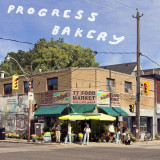
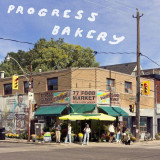
On Progress Bakery, her second album as a solo artist, Eliza knows to leave some questions alone – to let juxtaposition and tension be the proof. It doesn’t have to be hard. The feelings and revelations they provoke rise in the heat. The smell is sweet. Crispy on the outside and soft all the way through. She playfully slip-slides through words and sounds and images, delighting in surprise, skimming ideas like stones cast across clear water, touching down briefly with uncommon grace.
The question provoked between those opening lines resurfaces in the strands between songs – “Do U FM” is fully formed and beautifully layered, while “Novelist Sad Face” is a short, acapella rendering of gentle curiosity. What is holding these ideas together? Some songs demand more, seem to carry a whole load – eventually the skipping stone will halt to sink and resume its idle duty – while others drift in and out of focus, the way thoughts and dreams become interwoven before the mind is sunk into true sleep.
Music and words don’t always have to interact. Where she decides to keep them apart gives a new contour to where and how she puts them together. The kind of thing you’re supposed to take for granted with songs and their singers comes alive in Eliza’s hands – the little miracle of mixing, kneading, stretching, and stopping.
So often on Progress Bakery, Eliza teases out truth and meaning by asking questions. “Do I wanna be crying?” “Do you want me good or do you want me bad?” “Do I need an eye test?” “I’m writing songs in my head while you’re going over stuff with me — is that cruel??” In “Pocky” Eliza ends with a question that feels to me like the actual biography, succinct and revealing:
I don’t wanna be made to see
I just wanna ask “what’s that?”
Grace that ought to be rare, but in its care and precision is offered humbly, with great generosity, and without announcing itself. Eliza’s simple, miraculous music is given further form and shape by a group of collaborators – invaluable guest musicians Jeremy Ray, Evan Cartwright, Steven McPhail, Kenny Boothby, Ed Squires, Carolina Chauffe, Dorothea Paas, Louie Short, and Avalon Tassonyi. Together with Louie Short, who recorded, mixed, and produced the album along with Jeremy Ray and Lukas Cheung, Eliza has cultivated a richness in sound and texture that prods and provokes the ticklish ear. Barely audible guitar tinkering, a brief lo-fi field recording of trumpets, the harmonic clicking of a looped synthesizer, a flourish of reeds, a child’s conversation, each uncanny sound perfectly placed, rippling out under a soft breeze.
Lay in bed alone at night and ask aloud to the stillness,
“What were you doing at the Albuquerque Airport?
What were you doing there??”
And hear your question answered by a dream of swelling, undulating cellos. Try to grasp at the melody and structure. It’s not an answer (if there could be one), but it moves deeper, closer to the weird layer of fleeting moments and disconnected images, barely perceptible at its core. Wait for the dream reel to click into place.
Eliza took me for a ride in Nicole (her beloved Dodge Grand Caravan) and told me she’d been thinking of the album as an embodiment of transition – and I think every transition, known or unknown, carries the weight of new meaning, skittering off the surface tension of life as you know it, creating ripples, sometimes bouncing off and sometimes breaking through. There is a trick you can use to tell if a dough is glutinous enough. You’re supposed to stretch it out as thin as you can without breaking it and hold it up to the light. If you can see through, even if it renders the world murky and uncertain, you should leave it alone. I love this trick. It’s one that Eliza seems to know intuitively: work gently and ask questions and don’t always expect answers, and when you can, take a glimpse at something new, and then leave.
- A1: Do U Fm
- A2: Novelist Sad Face
- A3: Green Box
- A4: Dusty
- A5: The Linda Song
- A6: Dm Bf
- B1: I Tried
- B2: Melodies Like Mark
- B3: Wildcat
- B4: How U Remind Me
- B5: Pocky
- B6: Bon Tempiii
- B7: Pt Basement
- B8: Alberqurque Ii
- B9: Mary's
Yellow Coloured Vinyl[29,37 €]
Kneading dough is tricky – you should know how it’s supposed to feel. If you try too hard you could make it worse. It’s a beautiful practice – creation with a gentle touch, to work at something so it can be left alone. “If it’s too drawn out it’s awful. It’s easy to give too much.” Dance in the mirror. Contemplate your veiny hands. Who do they remind you of?
You begin by mixing flour and water. “What happens when your people die? Why’d they move the rock to the other side of Ulster Park?” Eliza Niemi asks two seemingly unrelated questions in a rising melody with guitar accompaniment, like fingers playing spider up to the nape of your neck. Gentle pressure. Strands of gluten form to bind the mix. A new question lingers in the binding. When she admits “but I don’t know how to tell if I’m feeling it or not,” that question surfaces through the text. It is reiterated throughout the album. When I’m working with dough I think the same thing to myself.
On Progress Bakery, her second album as a solo artist, Eliza knows to leave some questions alone – to let juxtaposition and tension be the proof. It doesn’t have to be hard. The feelings and revelations they provoke rise in the heat. The smell is sweet. Crispy on the outside and soft all the way through. She playfully slip-slides through words and sounds and images, delighting in surprise, skimming ideas like stones cast across clear water, touching down briefly with uncommon grace.
The question provoked between those opening lines resurfaces in the strands between songs – “Do U FM” is fully formed and beautifully layered, while “Novelist Sad Face” is a short, acapella rendering of gentle curiosity. What is holding these ideas together? Some songs demand more, seem to carry a whole load – eventually the skipping stone will halt to sink and resume its idle duty – while others drift in and out of focus, the way thoughts and dreams become interwoven before the mind is sunk into true sleep.
Music and words don’t always have to interact. Where she decides to keep them apart gives a new contour to where and how she puts them together. The kind of thing you’re supposed to take for granted with songs and their singers comes alive in Eliza’s hands – the little miracle of mixing, kneading, stretching, and stopping.
So often on Progress Bakery, Eliza teases out truth and meaning by asking questions. “Do I wanna be crying?” “Do you want me good or do you want me bad?” “Do I need an eye test?” “I’m writing songs in my head while you’re going over stuff with me — is that cruel??” In “Pocky” Eliza ends with a question that feels to me like the actual biography, succinct and revealing:
I don’t wanna be made to see
I just wanna ask “what’s that?”
Grace that ought to be rare, but in its care and precision is offered humbly, with great generosity, and without announcing itself. Eliza’s simple, miraculous music is given further form and shape by a group of collaborators – invaluable guest musicians Jeremy Ray, Evan Cartwright, Steven McPhail, Kenny Boothby, Ed Squires, Carolina Chauffe, Dorothea Paas, Louie Short, and Avalon Tassonyi. Together with Louie Short, who recorded, mixed, and produced the album along with Jeremy Ray and Lukas Cheung, Eliza has cultivated a richness in sound and texture that prods and provokes the ticklish ear. Barely audible guitar tinkering, a brief lo-fi field recording of trumpets, the harmonic clicking of a looped synthesizer, a flourish of reeds, a child’s conversation, each uncanny sound perfectly placed, rippling out under a soft breeze.
Lay in bed alone at night and ask aloud to the stillness,
“What were you doing at the Albuquerque Airport?
What were you doing there??”
And hear your question answered by a dream of swelling, undulating cellos. Try to grasp at the melody and structure. It’s not an answer (if there could be one), but it moves deeper, closer to the weird layer of fleeting moments and disconnected images, barely perceptible at its core. Wait for the dream reel to click into place.
Eliza took me for a ride in Nicole (her beloved Dodge Grand Caravan) and told me she’d been thinking of the album as an embodiment of transition – and I think every transition, known or unknown, carries the weight of new meaning, skittering off the surface tension of life as you know it, creating ripples, sometimes bouncing off and sometimes breaking through. There is a trick you can use to tell if a dough is glutinous enough. You’re supposed to stretch it out as thin as you can without breaking it and hold it up to the light. If you can see through, even if it renders the world murky and uncertain, you should leave it alone. I love this trick. It’s one that Eliza seems to know intuitively: work gently and ask questions and don’t always expect answers, and when you can, take a glimpse at something new, and then leave.
- A1: Do U Fm
- A2: Novelist Sad Face
- A3: Green Box
- A4: Dusty
- A5: The Linda Song
- A6: Dm Bf
- B1: I Tried
- B2: Melodies Like Mark
- B3: Wildcat
- B4: How U Remind Me
- B5: Pocky
- B6: Bon Tempiii
- B7: Pt Basement
- B8: Alberqurque Ii
- B9: Mary's
Kneading dough is tricky – you should know how it’s supposed to feel. If you try too hard you could make it worse. It’s a beautiful practice – creation with a gentle touch, to work at something so it can be left alone. “If it’s too drawn out it’s awful. It’s easy to give too much.” Dance in the mirror. Contemplate your veiny hands. Who do they remind you of?
You begin by mixing flour and water. “What happens when your people die? Why’d they move the rock to the other side of Ulster Park?” Eliza Niemi asks two seemingly unrelated questions in a rising melody with guitar accompaniment, like fingers playing spider up to the nape of your neck. Gentle pressure. Strands of gluten form to bind the mix. A new question lingers in the binding. When she admits “but I don’t know how to tell if I’m feeling it or not,” that question surfaces through the text. It is reiterated throughout the album. When I’m working with dough I think the same thing to myself.
On Progress Bakery, her second album as a solo artist, Eliza knows to leave some questions alone – to let juxtaposition and tension be the proof. It doesn’t have to be hard. The feelings and revelations they provoke rise in the heat. The smell is sweet. Crispy on the outside and soft all the way through. She playfully slip-slides through words and sounds and images, delighting in surprise, skimming ideas like stones cast across clear water, touching down briefly with uncommon grace.
The question provoked between those opening lines resurfaces in the strands between songs – “Do U FM” is fully formed and beautifully layered, while “Novelist Sad Face” is a short, acapella rendering of gentle curiosity. What is holding these ideas together? Some songs demand more, seem to carry a whole load – eventually the skipping stone will halt to sink and resume its idle duty – while others drift in and out of focus, the way thoughts and dreams become interwoven before the mind is sunk into true sleep.
Music and words don’t always have to interact. Where she decides to keep them apart gives a new contour to where and how she puts them together. The kind of thing you’re supposed to take for granted with songs and their singers comes alive in Eliza’s hands – the little miracle of mixing, kneading, stretching, and stopping.
So often on Progress Bakery, Eliza teases out truth and meaning by asking questions. “Do I wanna be crying?” “Do you want me good or do you want me bad?” “Do I need an eye test?” “I’m writing songs in my head while you’re going over stuff with me — is that cruel??” In “Pocky” Eliza ends with a question that feels to me like the actual biography, succinct and revealing:
I don’t wanna be made to see
I just wanna ask “what’s that?”
Grace that ought to be rare, but in its care and precision is offered humbly, with great generosity, and without announcing itself. Eliza’s simple, miraculous music is given further form and shape by a group of collaborators – invaluable guest musicians Jeremy Ray, Evan Cartwright, Steven McPhail, Kenny Boothby, Ed Squires, Carolina Chauffe, Dorothea Paas, Louie Short, and Avalon Tassonyi. Together with Louie Short, who recorded, mixed, and produced the album along with Jeremy Ray and Lukas Cheung, Eliza has cultivated a richness in sound and texture that prods and provokes the ticklish ear. Barely audible guitar tinkering, a brief lo-fi field recording of trumpets, the harmonic clicking of a looped synthesizer, a flourish of reeds, a child’s conversation, each uncanny sound perfectly placed, rippling out under a soft breeze.
Lay in bed alone at night and ask aloud to the stillness,
“What were you doing at the Albuquerque Airport?
What were you doing there??”
And hear your question answered by a dream of swelling, undulating cellos. Try to grasp at the melody and structure. It’s not an answer (if there could be one), but it moves deeper, closer to the weird layer of fleeting moments and disconnected images, barely perceptible at its core. Wait for the dream reel to click into place.
Eliza took me for a ride in Nicole (her beloved Dodge Grand Caravan) and told me she’d been thinking of the album as an embodiment of transition – and I think every transition, known or unknown, carries the weight of new meaning, skittering off the surface tension of life as you know it, creating ripples, sometimes bouncing off and sometimes breaking through. There is a trick you can use to tell if a dough is glutinous enough. You’re supposed to stretch it out as thin as you can without breaking it and hold it up to the light. If you can see through, even if it renders the world murky and uncertain, you should leave it alone. I love this trick. It’s one that Eliza seems to know intuitively: work gently and ask questions and don’t always expect answers, and when you can, take a glimpse at something new, and then leave.
- 1: Trigger System
- 2: Cinematheque
- 3: Theory On Sex As An Art Form
- 4: Sarasota
- 5: Twenty-Five Diamonds
- 6: Aeronautical
- 7: Sound
- 8: Something About A Nightmare
Opaque White Vinyl[28,36 €]
By the late 90s the independent music scene in San Diego, CA had become synonymous with noisy, post-hardcore bands that were pushing the boundaries of what it meant to be punk. Camera Obscura were one of those bands. They cut their teeth on the angular and abrasive sounds of Antioch Arrow, Clickatat Ikatowi, and Heroin, and incorporated synths and electronics to create their own dark, jarring, experimental rock sound.
The band’s musical output was sparse. In addition to two 45s, the band released their only LP, To Change the Shape of an Envelope in 2000 on Troubleman Unlimited. The album runs the gamut sonically with dark, high energy songs like “Twenty-Five Diamonds” and “Sarasota”, the early industrial sound of “Something About a Nightmare”, and the shoegaze influenced “Cinematheque”.
In October of 2024, the band announced a partnership with Solid Brass records to begin work on reissuing their long out of print album. To Change the Shape of an Envelope has been completely remastered by Pete Lyman at Infrasonic Mastering with new artwork by Sonny Kay (The VSS, GSL Records).
To Change the Shape of an Envelope will be available digitally for the first time ever as well as on limited edition transparent red or opaque white vinyl on 2/7/25 from Solid Brass Records.
By the late 90s the independent music scene in San Diego, CA had become synonymous with noisy, post-hardcore bands that were pushing the boundaries of what it meant to be punk. Camera Obscura were one of those bands. They cut their teeth on the angular and abrasive sounds of Antioch Arrow, Clickatat Ikatowi, and Heroin, and incorporated synths and electronics to create their own dark, jarring, experimental rock sound.
The band’s musical output was sparse. In addition to two 45s, the band released their only LP, To Change the Shape of an Envelope in 2000 on Troubleman Unlimited. The album runs the gamut sonically with dark, high energy songs like “Twenty-Five Diamonds” and “Sarasota”, the early industrial sound of “Something About a Nightmare”, and the shoegaze influenced “Cinematheque”.
In October of 2024, the band announced a partnership with Solid Brass records to begin work on reissuing their long out of print album. To Change the Shape of an Envelope has been completely remastered by Pete Lyman at Infrasonic Mastering with new artwork by Sonny Kay (The VSS, GSL Records).
To Change the Shape of an Envelope will be available digitally for the first time ever as well as on limited edition transparent red or opaque white vinyl on 2/7/25 from Solid Brass Records.
LIMITED INDIES LOSER EDITION PRESSED ON BLUE TRANSPARENT VINYL! Stella makes her Sub Pop debut with the mesmerizing Up and Away, an old-school pop paean to the pangs and raptures of love. From the Greek folk-inflected get-go, we're swept up in Stella's world - and it's quite the captivating place to be. The singer-songwriter joined forces with artist and producer Tom Calvert (aka Redinho), and it was a match made in Athens; the results are heavenly. Tom caught one of Stella's gigs on a visit to the city. He reached out, they started hanging out, and the pair soon clicked creatively. Both mention chemistry when asked about their collaboration and it's clear, from what we hear, they had it in spades. The meld is seamless. Stella's songs have always riffed on American and Greek mid-century pop but Up and Away doubles down on the vintage aesthetic. Tom says he styled the record "as if it was a rare gem from the '60s found in a box of records in Athens," and Stella notes she was ready for a more "deeply Greek touch - it felt comfortable and right, smoothly fusing with the pop." The bouzouki appears on a full five tracks played by Christos Skondras who, she says, "was brilliant at improvising," while Sofia Labropoulou on the kanun "brought an insane amount of dreaminess to the last two songs. Having these amazing musicians play for Up and Away - I couldn't be more grateful." While not exclusively a confessional artist, Stella is always intimate - when she sings, it's personal. She writes "about things I feel passion for. Stories about me, about others, about all that's there in love and war." Stella was "in a very emotional state at the time, which came through in the lyrics and vocals." And it's true, her honeyed voice - layered in those unmistakable harmonies of hers - thrillingly runs the gamut from tender to terse, by turns bracing and smitten, aching and forlorn. But it's the lyrics that feel key. Across her output, Stella has proven herself a strong storyteller, and Up and Away is no exception (the guise of the medieval bard she assumes on the cover is telling). Past releases have been studded with gem-like vignettes - a diverse array of stories set tightly together to form non-linear narratives unified by emotion. Her latest feels singular in that it seems to trace a longer-form tale across songs, with each track escalating the record's erotic arc. By the end of the album, Up and Away's core concerns are clear: the conflicting and conflicted emotions inherent in love, that live on in ways we can't always understand or control. Love is like this record: when it's over, you still feel it for time to come.
With a squall of guitar and a crash of drums, two years on from the release of their exhilarating debut EP, Chicago noisemakers Babe Report finally release their debut album in 2024, in the form of the rough-and-ready Did You Get Better, released this Spring via Exploding In Sound. Formed of ten new songs, and all wrapped in under half an hour, it’s an immediate and breathless arrival.
Opening track ‘Turtle of Reaper’ arrives in a flurry of noise and energy. Presented as an indictment of the fear-mongering in click-bait media, it’s a cacophonous two-minutes of scorched vocals and frenetic drums, the chorus a call back to 12/31/99, when all the news told people to turn off their computers before Y2K hit.
‘Universal’ offers something somewhat more refined, with occasional moments of restraint amid the commotion that arrives in a hardy whack of heavy riffs.
“This one is all about climbing up onto your neighbor’s back to succeed,” the band explain. “Most aspects of life are not a zero-sum game, but when they are, it feels ethically wrong to win.”
Elsewhere, ‘Allergy 2000’ is the album’s weighty centre-point, characterized by its soaring guitar lead line and stifled, murky vocals what might have started out as an experiment in writing a Yo La Tengo song soon comes into its own with a rabid tempo shift that feels indicative of the album’s fervent nature, never allowing the listener to rest on their laurels.
However it finds you or you find it, Did You Get Better finds a way to take the reins, ploughing headfirst into its journey and rarely looking back for approval, to even worry if anyone else is joining for the ride."
idal Perspectives is an album by Giovanni Di Domenico, Pak Yan Lau, and John Also Bennett. Recorded across a single afternoon in Brussels, Belgium, the album’s four parts are a rippling alchemy of processed Rhodes piano, sizzling ceramics, and liquified bass flute, a rare meeting of three unique voices from the contemporary music landscape that manages to flow with the effortless inevitability of the oceanic tides.
Giovanni Di Domenico, an accomplished composer and prolific collaborator who has released albums with Jim O’Rourke, Eiko Ishibashi and Akira Sakata, among many others, initiated the collaboration with Bennett after the two met at a record fair in Saint-Gilles, Belgium and bonded over a shared inquisitiveness for unconventional sonic combinations. Along with Pak Yan Lau, a Belgian-born sound artist and improviser who has developed her own rich and unique sonic footprint, the trio entered the studio with little, if any, discussion beforehand, jumping right into playing without preconceived structures. The resulting recordings had a depth of sound and emotional resonance surprising even them, with finished pieces emerging from single live takes and minor edits.
Bennett, known for his solo work as well as his collaborations with Christina Vantzou as CV & JAB, gives us here a taste of his bass flute in free flowing form. Unconstricted by concept, joyfully and lazily bouncing off the melodic shimmers of Di Domenico’s Rhodes, Bennett uses his flute’s pitch information to trigger long tones that emerge like rays of light piercing through low hanging clouds - moments of clarity among a clicking world of sonic stimuli. Meanwhile, Lau’s crackling and sometimes dissonant contributions on prepared piano, live hydrophone, and custom ceramic sound objects balance out the triangle, adding a sense of microcosmic intrigue that allows the music to seamlessly ebb and flow between moments of comfort and foggy uncertainty.
The album’s title track and climax, the eighteen minute “Tidal Perspectives”, drifts in with some kind of clarity, Lau’s glinting tonal waves edging in just beyond the horizon lines drawn by Di Domenico’s Rhodes and Bennett’s bass flute. But like the tidal flows of the Atlantic that inspired its title, just as you begin to perceive what’s happening, the currents have already taken you out to sea. Tidal Perspectives will be released on June 14th, 2024, in a limited edition of 300 LPs by Editions Basilic.
Keplar presents the first-ever vinyl edition of the 2003 album »From Tokyo to Naiagara« by Tujiko Noriko. This reissue with new artwork by Joji Koyama is an abridged version of the album as Tomlab label owner Tom Steinle and producer Aki Onda had originally intended to publish it alongside the original CD version. Written by the France-based Tujiko while she still lived in Japan, »From Tokyo to Naiagara« followed up on her two seminal Mego albums and marked a turning point in both the artist’s career and personal life: While she was preparing to leave Japan behind, she succinctly connected the dots between her experiments in pop music and her interest for more abstract sounds. Tujiko worked primarily with a Yamaha synthesizer and an MPC sampler while also incorporating contributions by other musicians such as Onda, Riow Arai and Sakana Hosomi into the pieces. Sometimes approaching an IDM and clicks’n’cuts-style production or working with trip-hop and hip-hop beats while using conventional song structures in the most unconventional of ways, the album showcases her multifaceted influences and skills as a singer and musician to full effect.
Tujiko fondly remembers the time when she made the album. »I had a lot of time for myself back then and I didn’t even feel like I was very busy,« she says today. She describes producing it in close collaboration with Onda, who would relocate to New York City shortly after, as »quite Tokyo and very local.« They explored parts of the city that they hadn’t yet been to for a photography project (finding, among other things, a coin laundry called Naiagara—a transliteration of Niagara). This left its mark on a record that mixes melancholia with joy. The driving opener »Narita Made,« named after one of Tokyo’s airports, already makes this clear: Tujiko’s wistful vocals and lyrics like »I miss you terribly« emphasises the sense of bittersweetness that forms the common thread for a sonically diverse and stylistically open-ended album—this music is looking back while moving forward. It is probably no surprise that its reissue too evokes tender memories of Onda and Steinle in Tujiko, while also reminding her of what lies ahead. »I have so much more to do and not enough time for that,« she muses, before quickly adding: »But I also feel less alone having that album again.«
Influenced in equal parts by the experience of strolling through previously unknown Tokyoite back alleys and thinking about the paths not (yet) taken, »From Tokyo to Naiagara« is precisely that: the perfect travel companion for a journey that leads its listeners from past to future.
Killer roots on both sides, perfect companion to his "Sings Songs..." album !
.
Double sided heavyweight roots 10" from the late Gladdy Anderson. Made around the same time as his killer "Sings Songs For Today and Tomorrow" LP (now back in stock, click here!), here again are two killer tracks with Gladdy's sweet vocals over hard riddims from his band the Roots Radics. The A-side made the rounds as a dubplate first, then the vocal and dub ended up on different albums, while the B-side saw release as a single and an album track in extended format.
- A1: Please Come Out
- A2: Wicked
- B1: Working With
- IB2: N My Head
- C1: Got Your Money
- C2: Didn't You Know
- D1: Two-Door
- E1: Memory Lane
- E2: Good Girls And Boys
- F1: All I Want From You
- F2: Don't Sell Rock
- G1: What Yours
- G2: Tweets
- H1: You Check
- H2: Hero Forever
- I1: Don't Pick Up
- I2: You Don't Know Me Anymore
- J1: Tenderly With You
- J2: Now Let's Wait
Sasu Ripatti's complete "Dancefloor Classics" series. Music for imaginary dancefloors, released on Ripatti's own label Rajaton.
”Look up, into the light” she said, while the camera shutter clicked. ”Like this? Does it look holy?” His neck felt stiff. Her reply: ”Yes, just like that. What do you mean holy? Like religious? ”No, more like trying to look very far, somewhere beyond what we can see.” ”Okay, stand still, I’m going to come close to you now. The light hits your face great.” click, click, click.
He noticed her fingernails. They were not polished. Natural. Even somewhat rugged, as if something wore out the fingers slightly. What had these hands held besides the camera? What made the edges of her fingernails drift off?
He thought it’s weird to look straight into the camera. The photographer had closed her left eye, the one not looking into the lens. Then it opened, she looked up, perusing the surroundings, then she closed her eye again, then looked up, closed, looking up, very quickly. It all seemed very professional. Maybe she calculated the light, making sure it’s close to perfect. ”What will these photos look like?” – the thought popped into his head briefly. It was liberating to think it wouldn’t matter.
”What’s that song playing?” he asked. ”Wait a sec, Ol’ Dirty Bastard?” she replied. ”Oh yeah, right. But the sample?” ”Hey, could you look up again, like that. No, lower.”
New directions: ”Look out from the window, turn left.” ”My left or yours?” ”Yours, I always try to think from the direction of my model.” How professional! This is a good shoot, so natural. Should I worry about how the photos look like? No, I don’t want to. His thoughts bounced around. What would the story be like? It’s a big newspaper, everyone will read it. Maybe someone drinks coffee and eats a stroopwafel while they do it. Will they place the waffle on top of the mug for a brief while, so that it gets hot and the syrup melts a little? Then it feels wet, and you can bend the cookie.
She broke his train of thought off midway through: ”Now turn right, but look left, and slightly up, but don’t turn your face right.” ”Umm, like this? Sounds like a set of pilates instructions.” she laughed ”You do pilates?” ”Yeah, it’s hard sometimes. Have you tried?” ”No”, she said. ”I’m not good for sports that are done in groups.” ”Yeah, but in pilates you can just be inside your mind, drowning in your private thoughts.”
”What are you thinking in pilates?” she asked, taking more photos. ”Well, mostly just which way is right. And which left.” click, click.
Q&A with Sasu Ripatti:
1) Tell us something about the EP series ”Dancefloor Classics”, what’s the idea and what can we expect?
I’ve been slowly writing these sort of dance music pieces and finally curated them together for a conceptual release. I like to create music for a dancefloor that exists only in my imagination and doesn’t try to suck up to the standardized reality.
2) Your vinyl format is 10” which is quite special (as opposed to LP / 12”). Why did you choose it?
It’s my favourite format, absolutely. The size is perfect, and you can make it sound really good @ 45 rpm. And you still can make great artwork.
3) You seem interested in sampling/repurposing, what does it mean to you as an artist to approach something already existing from a new angle? How does the source material inform you about the approach to take?
I guess i could flip it around and just say I’ve outgrown synths or electronic sounds to a great extend, and having gotten rid off all my synths already good while ago I’ve used samples as my main source material a lot. It’s obvious on this series that i’ve sampled existing music, but I also sample instruments and things in the studio and resample my own library that I have built over the years, it’s quite large. To me the end result matters, not so much how I get there. Once I have something on my keyboard and play around, it’s all an instrument, though with sampling other music it becomes a really interesting and complex one as you’re possibly playing rhythm, but also harmonic content and maybe hooks or whatever, all at once.
I never sample premeditadedly, like listening to records and looking for that mindblowing 3 sec part. I just throw the cards in the air and see what lands where, just full intuition and hopefully zero mind involved, playing tons of stuff, trying things, just recording hours of stuff. Then comes the interesting part to listen to hours of mostly crazy stuff and finding that mindblowing 3 sec part.
4) What is your relationship with the dancefloor (conceptually and/or in experiences / as a performer)?
Very complicated. I have never really felt comfortable on a dancefloor but have always wanted to. There’s something in club music, in theory, that really speaks to me. It has never really materialized for me – speaking mainly from a performer’s point of view who goes to check on a dancefloor for a moment after a concert. I never have DJ’d or felt much interest towards it. But again, I love the idea and concept of DJing. As well as producing music for imaginary DJs. Lately, as in the past 10+ years, I haven’t even performed in any sort of club spaces. So my relationship to the dancefloor is quite removed and reduced, but there’s quite a bit of passion and interest left.
All tracks composed and produced by Sasu Ripatti.
Artwork & photography by Marc Hohmann.
Mastering by Stephan Mathieu for Schwebung Mastering.
Vinyl cut by SST Brueggemann.
Publishing by WARP Music Ltd.
Sub Pop debut by accomplished Greek artist Σtella, produced by Redinho (Swet Shop Boys).
‘Up And Away’ is an eclectic, compelling modern pop album showcasing Σtella’s skilled songwriting and the influence of classic love songs, Greek folk, and contemporary electronic-music production.
Σtella makes her Sub Pop debut with the mesmerizing ‘Up And Away’, an oldschool pop paean to the pangs and raptures of love. From the Greek folkinflected get-go, we’re swept up in Σtella’s world - and it’s quite the captivating place to be.
The singer songwriter joined forces with artist and producer Tom Calvert (aka Redinho), and it was a match made in Athens; the results are heavenly. Tom caught one of Σtella’s gigs on a visit to the city. He reached out, they started hanging out, and the pair soon clicked creatively. Both mention chemistry when asked about their collaboration and it’s clear, from what we hear, they had it in spades. The meld is seamless.
Σtella’s songs have always riffed on American and Greek mid-century pop but ‘Up And Away’ doubles down on the vintage aesthetic. Tom says he styled the record “as if it was a rare gem from the ’60s found in a box of records in Athens,” and Σtella notes she was ready for a more “deeply Greek touch - it felt comfortable and right, smoothly fusing with the pop.” The bouzouki appears on a full five tracks played by Christos Skondras who, she says, “was brilliant at improvising,” while Sofia Labropoulou on the kanun “brought an insane amount of dreaminess to the last two songs. Having these amazing musicians play for ‘Up And Away’ - I couldn’t be more grateful.”
While not exclusively a confessional artist, Σtella is always intimate - when she sings, it’s personal. She writes “about things I feel passion for. Stories about me, about others, about all that’s there in love and war.” Σtella was “in a very emotional state at the time, which came through in the lyrics and vocals.” And it’s true, her honeyed voice - layered in those unmistakable harmonies of hers - thrillingly runs the gamut from tender to terse, by turns bracing and smitten, aching and forlorn. But it’s the lyrics that feel key. Across her output, Σtella has proven herself a strong storyteller, and ‘Up And Away’ is no exception (the guise of the medieval bard she assumes on the cover is telling). Past releases have been studded with gem-like vignettes - a diverse array of stories set tightly together to form non-linear narratives unified by emotion. Her latest feels singular in that it seems to trace a longer-form tale across songs, with each track escalating the record’s erotic arc.
By the end of the album, ‘Up And Away’s core concerns are clear: the conflicting and conflicted emotions inherent in love, that live on in ways we can’t always understand or control. Love is like this record: when it’s over, you still feel it for time to come.
Loser Edition LP pressed on blue vinyl.
- A1: Live At The Sahara Tahoe, 1973 (Remaster 2022)
- A2: Farben Says Love To Love You Baby (Remaster 2022)
- A3: Muskeln (Remaster 2022)
- B1: Suntouch Edit (Remaster 2022)
- B2: Farben Says As Long As There's Love Around (Remaster 2022)
- B3: 6Ff (Remaster 2022)
- C1: Beautone (Remaster 2022)
- C2: Farben Says So Much Love (Remaster 2022)
- C3: T Microsystems (Remaster 2022)
- D1: Raute (Remaster 2022)
- D2: Silikon (Remaster 2022)
- D3: Farben Says Love Oh Love (Remaster 2022)
On textstar+ Jan Jelinek brings together the material from the CMYK series, four EPs he released between 1999 and 2002 under the pseudonym farben (the German word for both colours and paints), on a vinyl double LP for the first time. The selection of tracks has been remastered from the original tapes, joined by two additional pieces that appeared on compilations during the same period.
A Polaroid. Still life with tangled leads and consumer electronics, late twentieth century. Black and various shades of dirty white are the dominant non-colours. The image’s spatial depth remains diffuse, the links between its elements speculative. A note stuck to the wall (a legend, perhaps, or an all-explaining blueprint in text form?) is impossible to decipher. You can’t see what connects the picture’s signs. You have to hear it.
farben says: Every sound is a text. A bearer of meaning in search of a reader. Hoping the ideas inscribed in its autonomous existence will be understood as intended. While its beauty lies precisely in misunderstanding, in reading the coded message a new way every time. A thousand colours of sound, a thousand different ways to hear, to see, to understand.
On textstar+ Jan Jelinek brings together the material from the CMYK series, four EPs he released between 1999 and 2002 under the pseudonym farben (the German word for both colours and paints), on a vinyl double LP for the first time. The selection of tracks has been remastered from the original tapes, joined by two additional pieces that appeared on compilations during the same period. Another new element is the Polaroid, showing the origins of a world: Jelinek’s home studio in Berlin at the time.
farben says: Move your body! The project has its roots in Jelinek’s love of house as a reductionist vision of soul. Of four to the floor as a proposition that can be accessed anywhere. Of electronic dance music as a realm of possibility that can be continually expanded. farben was written as contemporary house music. As a text about excitement and euphoria. The arrangements were made directly while recording to DAT, on a twelve-channel mixing desk. Several track titles suggest a link to live concerts, coupled with the context of machine music and bedroom recording. Others affirm pop music’s most extravagant stock phrases about various states of love.
Jelinek produced the tracks with the aim of making music for dancefloors. An idea that failed very productively. In the locations to which it was originally addressed, the project barely figured. But people did listen, and they listened all the more closely to this music that opened up new acoustic and associative scope for house. farben is the opposite of genre: a music spawning new terms (clicks & cuts, micro-house) that never manage to fully capture it.
farben says: Signifiers. The four CMYK EPs are designed as a network of references that cannot be missed but that can also never be precisely deciphered. The vectors of sound, word and image point to Isaac Hayes and Ornette Coleman, to Detroit and the first generation of the Red Army Faction, to Karl Marx and Friedrich Engels. So multifarious that they are distorted to the point of recognition. Overall we hear sonic docufictions whose appealing vagueness derives precisely from this oscillation between clarity and ambiguity, which is also the source of their poetry: the lyricism of the pure circulation of signs.
The artwork is based on photographs of former Red Army Faction members, broken down into the four colours of the CMYK model. The motifs dissolve into individual dots of a single colour, so close to the faces that their expressions are only hinted at. Taken together, the individual colours compose a new whole out of fragmentary material, defying definition and thus maintaining their vibrancy. The same occurs on the level of sound. The sampler Jelinek used for these tracks had to be fed with floppy disks, imposing a memory limit of 1.44 megabytes per audio quotation from soul or jazz records. As a necessary consequence of this, the individual references, like the dots of colour, are dissolved into details and abstractions. They appear as splinters that recombine in new ways to create new meanings. The joy of collapsing metaphors.
farben says: New departures. Even two decades after its original release, textstar+ does not come across as an epitaph to the modern era. Instead, it appears as a euphoric affirmation of the utopias of the twentieth century, translated into new sound texts via the aesthetic strategies of abstraction, collage, networking and speculation. 1.44 megabytes of history, one thousand signifiers, one album. From “Live ...” to “... Love”.
Arno Raffeiner, 2021
First and foremost, deathcrash approached the task of putting together their debut album as music lovers. To all four members, a good album seemed to stamp out periods of their life, capturing a time, a feeling, a mood. This was their approach when trying to make whole two-years-worth of fragmented songwriting. Their songs may differ from each other in certain ways, but they manage to conjure similar feelings. ‘Return’ captures many of the difficult moments of the last couple years in the band members’ personal lives and yet, as a whole its complexity emerges as a beautiful and hopeful message. Amongst other things, writing the album was a cathartic process for the band, and so it can be for the listener too. The first parts of ‘Return’ came from quite a dark and jaded place. To get better can be a path marred by self-sabotage and a desire to hide. It can be easier to have no faith in something new, and rely on the comfort of an old feeling, even if it hurts. There is a reassurance in pain, a familiarity in its narrative. Return asks when things heal, where does the wound go? deathcrash recorded Return with their close friend and producer Ric James, who they’ve worked with since their early recordings. The album was recorded live, with an emphasis on dynamics, bringing together tense intimacy with atmospheric vastness. The members brought things to light they previously hadn’t, and shared words, riffs, ideas and thoughts for the first time. Each band member is able to see something that the others can’t, and write something unique. For deathcrash that is where the magic of making the album happens, when it clicks for everyone. As the album took form, a lot went on, and in many ways deathcrash got back in touch with a newer, more open feeling, sometimes happy, sometimes fearful. Something good returned that had previously been lost, and this is captured on the album. The album aims not to romanticise a dark place however, being equally about hope and renewal.
- A1: Projekt Gestalten - The Beast Within
- A2: The Princess Of Death - Trance
- B1: Projekt Gestalten - Trial And Execution Of The Black Wolf
- B2: The Princess Of Death - When The Saints Go Marching
- C1: Projekt Gestalten - Prey To Be Undone
- C2: The Princess Of Death - The Shrine Revelation
- D1: Projekt Gestalten - The Curse Of Engelhart
- D2: The Princess Of Death - Curse, Shattered
- D3: Projekt Gestalten & The Princess Of Death - Requiem For The Swan King
"The Beast Within" is the new album by Brazilian artist, Diego Garcia; exploring gender identities within contemporary electronic music. The artist uses two of their distinguished artistic identities: The Princess of Death, her feminine identity - where there is an exploration of a more introspective and corrosive textures commonly associated with patriarchal values; and Projekt Gestalten, his masculine identity - where melodic and hypnotic sounds, often associated with matriarchy, are emphasized.
In this project, Diego's aim is to dichotomize their gender identities inspired by a point-and-click adventure game from the 90's called "Gabriel Knight 2 - The Beast Within". The story was written by American game designer, Jane Jensen with original music composed by her husband, Robert Holmes. The protagonist is on the trail of a strange wolf, murderer of a little girl. Gabriel was asked to take care of this evil and suspects that this case is paranormal in nature. Together with his assistant, Grace Nakimura, he discovers the dark truth behind the history of Bavaria. The gameplay alternates between Gabriel and Grace and its storyline is only explored indirectly by Diego - as it is deeply connected with their childhood and formative years and still remains as one of their all-time favorite games.
Just like in the gameplay, Diego alternates between both of their feminine and masculine identities in order to create original pieces of music. As Projekt Gestalten, an array of dance tracks are functionally presented; ranging from melodic and trippy to club-ready driving techno; dissecting a more rational aspect of the game's storyline. In contrast, The Princess of Death goes into an ambient and experimental approach; exploring liturgical themes that includes a dark and dystopian cover of the traditional gospel song "When The Saints Go Marching In", a song that is featured throughout the whole franchise of the game in many different versions. In the end, the gender polarizing concept is extrapolated and both aliases are finally merged into one another; leading to the Gestalt principle, alluded to in Diego's main alias, being fully applied as a whole.
The project's ultimate goal is to challenge preconceived notions of how a specific gender should sound/behave and to explore light/dark, sacred/secular, good/evil, male/female using, as the blueprint, a gender-neutral game where the player is forced to assume a feminine and a masculine role in order to navigate through the story. All of these ideas are perfectly aligned with Diego's own trajectory as an artist and their distinct artistic identities featuring distorted gender values - which comes full circle in this project.
The Nonesuch debut of Hurray for the Riff Raff (aka Alynda Segarra), LIFE ON EARTH, is a departure for the Bronx-born, New Orleans-based singer/songwriter. Its eleven new “nature punk” tracks on the theme of survival are music for a world in flux – songs about thriving, not just surviving, while disaster is happening. Hurray for the Riff Raff tours North America this spring, beginning March 19 in Atlanta and continuing through April 20 in Nashville, with stops in Austin, Chicago, Los Angeles, and New York, among others. International tour dates will be announced shortly.
For her eighth full-length album, Segarra (they/she) drew inspiration from The Clash, Beverly Glenn-Copeland, Bad Bunny, and the author of Emergent Strategy, adrienne maree brown. Recorded during the pandemic, Life on Earth was produced by Brad Cook (Waxahatchee, Bon Iver, Kevin Morby).
Life on Earth’s first single, ‘RHODODENDRON’, is about “finding rebellion in plant life. Being called by the natural world and seeing the life that surrounds you in a way you never have. A mind expansion. A psychedelic trip. A spiritual breakthrough. Learning to adapt, and being open to the wisdom of your landscape. Being called to fix things in your own backyard, your own community,” says Segarra.
Of the ‘Rhododendron’ video, which was directed by New Orleans-based artist Lucia Honey, Segarra says: “It is really far out and fun. I got this bodysuit that just looks like the inside of the human body. It looks like you’re skinless. It’s in a scene where I’m playing to an audience of plants. Just really absurd, but I put that suit on and I was like man, this feels really good. It feels like, ‘This is who I am. Let’s just take the skin off.’
“It reminds me a little bit of Kids in the Hall,” they continue. “With this ‘Rhododendron’ shoot, something clicked in me where I was like, ‘All I have to do is be myself.’ I had been thinking that I had to be something bigger than myself. I felt like I was just never quite making the mark and then something clicked where I was like, ‘I just gotta be me. I could do that. I could show up and be me. And if people don’t like it, then I don’t know what to fucking tell them.’ It was like a brain shift of, ‘Oh, this can be fun. It doesn’t have to be suffering.’ With so many videos and photo shoots before, it really felt like suffering. I felt so uncomfortable being perceived. I didn’t know who I was.”
Honey adds: “We wanted to create something surreal, playful, and saturated that indulged heavily in the aesthetic of the early ‘90s. Alynda and I had many overlapping visual and philosophical references which sparked the initial collaboration. We wanted to make this video an homage to Gregg Araki’s Teenage Apocalypse trilogy but as a nature documentary crossover. I came across Araki’s work as a queer teenager, and he’s always been a big inspiration. Sex, blood, punk rock, camp, etc.
“We live in a moment where the future is bleaker and more unknown than ever, so there becomes a deep comfort in nostalgia and reliving the past. Through our talks, I realised Alynda’s new album touches on many of these same subjects, but perhaps in reverse; running from a past that is always haunting you. Shifting into a more refined self/identity through confronting one’s trauma and baggage. It was easy to reach collaborative synergy for this video project because we’re both interested in tackling similar issues.”
Alynda Segarra was born and raised in the Bronx, which they left at the age of seventeen, running away from everything and everyone they knew, hopping freight trains or hitchhiking across the country in the company of a band of street urchins. Segarra moved to New Orleans in 2007 and formed two bands: Dead Man’s Street Orchestra and Hurray for the Riff Raff. In 2015, Segarra decamped to Nashville, then to New York, to make her most recent album, 2016’s critically praised The Navigator, an ambitious and fully realized concept album that was her quest to reclaim her Puerto Rican identity. Segarra’s previous records as Hurray for the Riff Raff are Crossing the Rubicon (EP, 2007), It Don’t Mean I Don’t Love You (2008), Young Blood Blues (2010), Hurray for the Riff Raff (2011), Look Out Mama (2012), My Dearest Darkest Neighbor (2013), and Small Town Heroes (2014).
- A1: Da Beginning
- A2: Break Da Law "95
- A3: Da Summa
- A4: Live By Yo Rep (Bone Dis) (Bone Dis)
- B1: In Da Game
- B2: Now I'm Hi (Part 3)
- B3: Long Nite
- B4: Sweet Robbery (Part 2)
- C1: Back Against The Wall
- C2: Fuckin Wit Dis Click
- C3: All Or Nothin
- C4: Gotta Touch 'Em (Part 2)
- D1: Tear Da Club Up
- D2: Big Bizness (Screwed) (Screwed)
- D3: Mystic Syles
- D4: Porno Movies
On May 9, 1995, the release of an album by a new Memphis rap group changed the future of Memphis rap and the future of rap itself. The release of "Mystic Stylez" by Three 6 Mafia marked the first commercial release of a supergroup that had formed through the merger of DJ Paul and Juicy J, two of Memphis' most popular mixtape DJs in the early 90's. The group would go on to record 9 albums and be the first rap group ever to receive an Academy Award for their song "It's Hard Out Here For A Pimp." Three 6 Mafia also helped launch the careers of Lil Wyte, La Chat, Project Pat, Gangsta Boo & more.
20th Anniversary Double LP Red Vinyl Edition
In the most literal sense, globally renowned whistler Molly Lewis makes her gorgeous
and curious compositions out of thin air.
New entrees into the Exotica canon; sprawling, would-be Spaghetti Western scores;
and a dash of Old Hollywood glamour - the whistle-led songs on her debut EP ‘The
Forgotten Edge’ are as complex, delicate and indelible as anything performed with
viola or piano.
“Whistling is like a human theremin,” said Lewis, an Australian native who’s spent the
last several years in LA and whose performances there and around the world are
changing any preconceived notions of whistling by the room-full.
That’s not to say Lewis is all serious and snooty about the craft. Quite the contrary.
Her sense of humour is witty, self-deprecating and zany. She’s as likely to reference
the slapstick Leslie Nielsen film series ‘Naked Gun’ for music video concepts as she
is a classic piece of noir cinema.
Look no further than the equatorial and breezy opening cut ‘Oceanic Feeling’, a
lovely walk across the flotsam-sprinkled sands in the rum-pumping vein of Les
Baxter. Meanwhile, the title track - and really, the entire collection here - is a loving,
albeit rather haunting, salute to one of Lewis’s heroes, the Italian composer and
musician Alessandro Alessandroni, whose whistle and guitar you hear on the title
theme of Ennio Morricone’s ‘A Fistful of Dollars’. Lewis and her ensemble create
classic cinema for your mind.
Her own love for the artform began when, around the age of twelve she was given
the CD ‘Steve ‘The Whistler’ Herbst Whistles Broadway’. Something contained in it
clicked. “It wasn’t that I was immediately obsessed, but I knew it was something I
could do well,” Lewis said.
The daughter of a musician mother and a documentary filmmaker father who often
focused his films on niche communities and topics, Lewis recalls watching a
television documentary with her parents about The International Whistlers
Convention in Louisburg, North Carolina. “My dad said, ‘If you ever make it into the
competition, I’ll take you there’,” Lewis said. Turns out, there was no bar to entry, just
a small fee. And so, several years later, she and her father travelled to the
convention. New to the form, Lewis didn’t take home one of the bigger prizes but they
were awarded the prize for Whistler Who Traveled The Greatest Distance. “We really
just used the trip to drive around the United States,” she said.
After studying film in Australia, Lewis moved to Los Angeles to be close to the film
industry. There, her circle of artist friends grew naturally and with providence - her
unique talent drawing more and more recognition. And over the last few years,
Lewis’s Café Molly events at LA spots like Zebulon, Non Plus Ultra and The Natural
History Museum have become fabled, elegant happenings with appearances from
guests like John C. Reilly, Karen O and Mac DeMarco.
Recorded with a crack team of friends and musicians during 2020’s quarantine, ‘The
Forgotten Edge’ is rife with incredible performances from Thomas Brenneck (Sharon
Jones & The Dap-Kings / Budos Band), Joe Harrison (Charles Bradley, Lee Fields),
Eric Hagstrom (Brainstory), Abe Rounds (Meshell Ndegeocello, Andrew Bird, Blake
Mills), Leon Michels (El Michels Affair), Gabriel Rowland and Dave Guy.
Cryovac Recordings recognizes and recruits artists with individualism and creativity to add to its list of collaborators. Cryovac has evolved into a project that is brought to life by craftsmen, musicians and visual artists that give their time and effort for a common cause. Cryovac aims to weave a thread between the varying sonic approaches that describe a direction techno must go. A. García tends the cryovac from conception to press; combining with Mike Kretsch to create a unique minimal sound. Mr. Joshooa has the tools and know how to describe his personality as his work. He swims the Detroit techno-sphere wearing many hats, and is always pushing techno forward by any means necessary. Cryovac is a vehicle for the rebel spirit; we hope you listen to it.
The Cat Lover E.P. starts with Mr. Joshooa taking his time weaving a slow funky grind. “Horse Hockey’ is the name of this 4/4 two step that gallops and bangs its way through cinematic synth rises, heroic harmony, and crunchy to smooth samples. Mr. Joshooa's mischievousness is on full display with his second jam “fuck around”. Tumbling samples form a bop that is maneuvered playfully through a hectic arrangement. Side 2 is a. garcia and Mike Kretsch’s domain. Their first effort minimally clicks and rings into a soulful melody; popping rhythm holds your body to terra firma so your mind can “spacetravel”. B2 ,”meerkat”, opens with a raw kick on top of marmic synth evolving into a dramatic techno drive turning and shaking along a desolate road
- 1: Road To Avalon
- 2: Click Click Domino (Feat. Marcus King)
- 3: Line On The Page
- 4: Raining For You
- 5: Little Liars
- 6: Deep River (Feat. Marcus King)
- 7: Heartworn Traders
- 8: Calico Coming Down
- 9: Learn To Love You Better
- 10: Long Gone & Heartworn (Feat. Jake Kiszka)
- 11: Mountain Lion Blues
- 12: Sing A Hallelujah
- 13: Has My Midnight Begun
For nearly two straight years following the release of their critically acclaimed debut, Chasing Lights, Ida Mae lived on the road, crisscrossing the US from coast to coast as they performed hundreds of dates with everyone from Willie Nelson and Alison Krauss to Marcus King and Greta Van Fleet. And while those shows were certainly formative for the electrifying British duo, it was what happened in between — the countless hours spent driving through small towns and big cities, past sprawling suburbs and forgotten ghost towns, across rolling plains and snow-capped mountains — that truly laid the groundwork for the band’s transportive new album, Click Click Domino. Written primarily in the backseat of a moving car, the record embodies all the momentum and possibility of the great American unknown, offering up a series of cinematic vignettes full of hope and disappointment, promise and regret, connection and loneliness. The songs on Click Click Domino are raw and direct, fueled by an innovative mix of vintage instruments and modern electronics, and the performances are loose and exhilarating to match, drawing on early rock and roll, classic country, British folk, and 50’s soul to forge a sound that’s equal parts Alan Lomax field recording and 21st century garage band. Turpin and Jean produced the album themselves, recording primarily on their own in their adopted hometown of Nashville during the COVID-19 pandemic, and while the collection is certainly bolstered by appearances from high profile guests like Marcus King, Greta Van Fleet’s Jake Kiszka, and Ethan Johns, the heart and soul of the record remains Ida Mae’s intoxicating chemistry, which has never felt more vibrant, ambitious, or self-assured. Now married, Turpin and Jean first met a little over a decade ago while attending university in Bath. The pair bonded immediately over their love for the sounds of bygone eras, and they quickly earned rave reviews everywhere from the BBC to the NME with their raucous first group, Kill It Kid. Starting over fresh as a duo named for Sonny Terry and Brownie McGhee’s “Ida Mae,” the first song they ever harmonized on, Turpin and Jean relocated to Nashville in 2019 and released Chasing Lights to similarly widespread critical acclaim. Rolling Stone hailed the album’s “stomping swirl of blues and guitar-heavy Americana,” while The Independent lauded its “retro lustre” and “impressive experimentation,” and NPR’s Heavy Rotation called it “tightly drawn, harmonic and hypnotic.” The music helped the earn the duo a slew of support dates with the likes of Greta Van Fleet, The Marcus King Band, Blackberry Smoke, Josh Ritter, Rodrigo y Gabriela, and The Lone Bellow, as well as performances at Bonnaroo, the Telluride Blues & Brews Festival, the Philadelphia Folk Festival, Germany’s Reeperbahn Festival, and Switzerland’s Zermatt Unplugged.
• The tracks from the group’s two 1984 EPs together on a swanky 10-inch vinyl LP. Inner bag features liner notes by Kris Needs incorporating new interviews with all three Delmonas and a series of great photos by Eugene Doyen.
• Sarah Crouch, Hilary Wilkins and Louise Baker started singing together as a unique spark of spontaneous magic inextricably linked to their boyfriends in the Milkshakes, then rocking a garage-punk antidote to shiny synth-pop and brash chart stars with a direct lifeline back to rock’n’roll’s original simplicity and wildness. After Billy Childish and Bruce Brand formed the Pop Rivets in 1978, the guys hooked up with Micky Hampshire and Russell Wilkins to found the Milkshakes. Sarah shared a student house with boyfriend Micky plus Billy. After she and Hilary, then dating Russell, sang backing vocals on the Milkshakes’ rollicking Beatles-translated take on the Shirelles’ ‘Boys’, Louise’s arrival turned them into a girl group pretty much by accident.
• “I loved the music the Milkshakes were playing,” Louise recalls. “Loved the small, intimate venues and most of the bands that played with them, especially the Prisoners. I’d gone with the Milkshakes to Belgium and was somehow persuaded to get up on stage and sing something. Next thing I knew, there was some kind of plan to get the three of us in the studio.” At first the three girls were called the Milk-boilers, renaming themselves the Delmonas by the time Ace Records’ Roger Armstrong and Ted Carroll suggested recording the EPs that furnish this collection. “I think we were asked to each think of three songs and turn up,” says Louise. “I mostly listened to music from the 60s: lots of girl groups, Irma Thomas, Dusty Springfield, Bo Diddley, Velvet Underground, Kinks. Bruce had the best record collection; Mel Tormé was in there somewhere and one of my faves. Sarah came up with doing the Doors cover.”
• ‘Comin’ Home Baby’ was written as an instrumental before Bob Dorough added lyrics and Mel Tormé recorded it in 1962. The Delmonas’ finger-clicking, noir-dynamic version kicked off their first EP with authentic-sounding 60s production resonance, iced with mysterioso organ. The Cookies scored a hit with Goffin & King’s ‘Chains’ in 1962, the Beatles’ version providing the Hamburg Star-Club template for the Delmonas’ energised rendition. The first EP, “The Delmonas Volume 1”, rounded off with two songs from the Childish-Hampshire songwriting partnership: ‘Woa’ Now’ and ‘He Tells Me He Loves Me’, the latter recalling the New York Dolls covering the Shangri-Las’ ‘Give Him A Great Big Kiss’, mainly because it has similar chords.
• “The Delmonas Volume 2” opened with Sarah’s idea of covering the Doors’ hit. “We thought, ‘How would the Kinks have played it?’” she affirms. ‘Hello, I Love You’ had got the Doors into hot water with the Kinks’ publishers for its resemblance to ‘All Day And All Of The Night’. The Delmonas home in and highlight that similarity, adding bonkers psychedelic drop and evocative new coda. Their surf-tinged version of the Milkshakes’ ‘I’m The One For You’ is followed by the swampy screaming of ‘Peter Gunn Locomotion’, a cover of a 1963 single by Freddie Starr in his pre-stand-up comedian days as singer with the Midnighters. The set closed with the sultry organ-led vamp of the Milkshakes’ ‘I Want You’, the nearest the Delmonas get to the slowies Sarah helpfully points out they referred to as “shag songs”.
• All these tracks would re-appear on their “Dangerous Charms” album, along with out-takes and recordings from a BBC session, before the original trio splintered, leaving Sarah and Hilary to return for further adventures as Ludella Black and Ida Red. The eight tracks here capture a moment when three fun-loving friends got to live out some musical fantasies and had a blast doing it. 37 years later, it sounds just as contagious.
Sometimes, savagery is the most effective form of communication. For that, there are the Dueling Experts, the dark ninjas behind one of 2020’s most filthy, cohesive, and authentic hip-hop records. A masterclass of verbal carnage and bell-ringing beats that reminds you that if ain’t raw, it’s worthless. You may know Verbal Kent, the battle-scarred Chicago sensei, who has proven his mettle time and time again on wax -- both in his solo albums and in Ugly Heroes. But you’ve never heard him as serrated as he sounds alongside the Ghanian MC, Recognize Ali. Spitting pyroclastic flows over a treasure trove of lo-fi beats excavated from the legendary and mysterious producer, Lord Beatjitzu, the two craftsmen attack with meticulous rhyme schemes and hardbody vocals to spark melees. The beats are so adamantine that they could crush diamonds. Meanwhile, Kent and Ali exhibit a chemistry reminiscent of all-time greats like Billy Danze and Lil Fame of M.O.P., Raekwon and Ghostface, and Rock (Sean Price) and Ruck of the Boot Camp Click. This is the sound of war. Hip-hop to slap the proverbial taste of your mouth. The soundtrack to bloody knuckle brawls and broken glass. Beats that sound like they were dropped on the floor and coated in filth, boasting an almost Beta-like quality while simultaneously exemplifying sampling and chopping in a 90’s RZA-like fashion. This is the second installment "DE2: Sand the Floor
Peter Hook and The Light are an English rock band, formed in May 2010 by bass guitarist/vocalist Peter Hook, formerly of the influential post-punk bands Joy Division and New Order.
The band is noted for performing the Joy Division and New Order albums live.Their setlists primarily feature the two Joy Division albums, Unknown Pleasures and Closer or the first two New Order albums, Movement and Power, Corruption & Lies, depending on the respective tour.
The very concept is bound to stir up conflicted feelings -- bafflement, interest, cynicism, anger -- in any Joy Division fan. Here’s that band’s Peter Hook, singing lead and playing bass, supported by a guitarist, drummer, keyboard player, and additional bassist. In front of a Melbourne crowd, the band roars through the entirety of Joy Division's Unknown Pleasures, book-ending the album with six additional reinterpretations. The musicians play their hearts out, and Hook is absolutely locked into the material. One can’t deny the man’s conviction. The moments of aggression are far more suited for his gruff, seething vocals than the likes of “Candidate” and “I Remember Nothing,” where he has some trouble dialing it down. As an in-the-flesh experience, this was probably quite thrilling. As a home listening experience, it seems unnecessary -- at best, a curiosity -- especially when the source material is a couple clicks away.
St Leonard’s premier manipulator of drones, loops and echoes delivers his most buzzed out, kosmische and beat driven work to date in a deluxe white vinyl album release for Castles in Space.
Here, Kieran explains the genesis and production of his masterwork:
“Eternal Return was unusual for me in that I actually set out to make an album, rather than find myself with a set of tunes that evolved into a project.
The “Eternal Return” is a concept I have been inspired by before. However it clicked with me in a more profound way recently. Far from seeing the prospect of living life over, unknowingly, on an endless loop as depressing, I suddenly felt amazing comfort in the theory. The Stoic emperor Marcus Aurelius said, “Waste no more time arguing about what a good man should be. Be one.” Far from being trapped in the loop I am elated to feel that it's simply about living the best life you can. One that you wouldn't fear having to live again.
To place the album in context against this newly realised perception, I think of the Side One as the battle to get to that realisation and enlightenment and Side Two represents the acceptance and the decision on how to proceed. The turning point is from thinking about the things I love most and what I would want to experience over and over again. I hope it is an uplifting listening experience. As it happens, the album originally had a darker ending. I think I actually learned a bit about my point of view during the process. There are drums, which wouldn’t often feature in my music (there are in fact more drums on this LP than in my combined output over the last 8 years) and the pieces are noticeably shorter, more focussed and concise than my usual longer form work.
Musically this album is probably the least clearly influenced by anything I regularly listened to. The main outcome was wanting to challenge myself and to add whatever the pieces needed and go with that. I think I was also probably pushed on by the wealth of amazing music being made by my peers across Bandcamp and social media. 2020 was an incredible year in this particular sphere of electronic music. The album was made as I started to transition from a semi-modular to a modular synth set up. I think that this was a key driving force, since a lot of the time I didn’t know exactly what I was doing. It is nice to be surprised by what you’re creating.
Finally, whilst this is in no way a “lockdown album”, the period of time in which much of it was recorded definitely had a bearing on how it sounds. For one thing I spent a lot more time around my studio space when working from home. In keeping with the album's theme, the lockdown also helped consolidate my feelings on what is important in life and what isn’t. One piece was in fact sketched out as a first draft while I sat on mute during a Zoom meeting.
To coincide with the announcement, the pair have shared a video for the album’s title track directed by Sam Davis and Tom Andrew, who has previously received two UK Music Video Awards nominations for his work with Avery. Speaking about the video, Andrew explains, “We were keen to capture a visual representation of the tempo and atmospheric emotion of the track and make a video exploring the notion of collaboration. A super-motion approach allowed us to explore details of motion shared between two people, in tactile actions of aiding and supporting.” Cortini adds, “The video embodies the volatility and hidden nature of the music’s subject and meaning. A meaning that is ultimately personal and unique the listener/spectator.” Watch the clip .
Beginning as a collaborative experiment before the pair had even met, Avery and Cortini then worked remotely and free of concept or deadline over several years. The result, finally completed when both artists were touring with Nine Inch Nails in 2018, is a quietly powerful album rooted in trust, process and experimentation. The first fruits of their labour were unveiled last year when ‘Water’ and ‘Sun’ appeared online, subsequently released as a very limited 7” run that was sold at FYF Festival and Mount Analog in Los Angeles, and Phonica Records in London. Both tracks are included on the album.
“It was very much a shared process”, notes Avery. “I would like to credit Alessandro with his belief that music has a life of its own, as well as the importance he places on the first take... That even something that may be considered out-of-step by some should be respected. Some of the tracks were borne simply out of a tiny synth part, or a bit of tape hiss that we had recorded. And that approach taught me a lot. It’s a record that’s been worked on hard, but not laboured over.”
“I was a big fan of Daniel’s, and his work always spoke to me in a certain way,’’ explains Cortini. “Then, when we started working together, it just clicked. It’s very hard to explain, but I can always hear the love in his work, and that is true on this record. After our first collaboration, we just kept sending each other music and maintaining that dialogue. Next thing you know, we’re sitting in a hotel room in New York and had finished the record in three hours.”
The collaborative album follows Avery’s second record Song For Alpha, released in early 2018, and last year’s expanded edition B-sides & Remixes. Mixmag called the sophomore LP “A beautiful maturation of Avery’s work as a producer,” while The Guardian hailed its “Majestic, cavernous techno” and Loud & Quiet praised Avery as “A producer fast approaching the peak of his powers,” “This album cements Daniel Avery as one of the best,” wrote DIY. The London-based producer will perform at BBC Radio 3’s Unclassified Live on April 3rd, a new series of concerts in the Southbank Centre's Queen Elizabeth Hall presented by Unclassified host and presenter Elizabeth Alker and conducted by André de Ridder – tickets are available here. Avery has also just been announced in the first wave of acts for London festivals Re-Textured and the inaugural Wide Awake, taking place in April and June respectively.
Cortini released his most recent solo album Volume Massimo on Mute in July 2019, following Fine, the Italian artist’s final album under his SONOIO alias, which came out the previous year. The Quietus called the former “an album that showcases just how much Cortini‘s aesthetic has developed since his early days,” while Exclaim! hailed it “a melodic exploration of textures and layers … an instrumental masterpiece that adds to an already incredible body of work by the gifted and skilled composer.”