Jazz by Sun Ra, Vol. 2.
These albums are important because they are Sun Ra's first recordings before the Saturn sessions, made in 1956 when the Chicago musicians were searching for something more, something beyond.
In 1957, Transition Records gave us Volume 1, but before Volume 2 could be released, the label went bankrupt, and it took more than a decade for it to finally be released on the Delmark label. Today, for the first time, both volumes are available, as they were meant to be from the beginning.
Volume 2 is presented here for the first time with the silver cover originally planned by Transition!
Cerca:two s tones
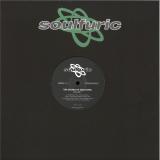
- A1: Hardsoul Featuring Ron Carroll ‘Back Together’ (Main Classic Mix)
- A2: Urban Blues Project Featuring Bobby Pruitt ‘We Are One’ (Art Of Tones Extended Remix)
- B1: Urban Blues Project Present Michael Procter ‘Love Don’t Live’ (The U B.p. Classic Club Mix)
- B2: The Thompson Project & Crackazat Featuring Gary L ‘Messin’ With My Mind’ (Crackazat Extended Remix)
he next instalment from Soulfuric Recordings is the first edition of “The Sound Of Soulfuric Volume 1” taken from the vaults are four unearthed gems spanning two classics, two exclusives, and long-awaited vinyl debuts from house music specialists such as Hardsoul feat Ron Carroll, Urban Blues Project, The Thompson Project & Crackazat and Art Of Tones.
Stepping up first is Hardsoul featuring the legendary Ron Carroll with “Back Together” (Main Classic Mix) a track that should be found in every soulful house DJ’s set, with Ron’s alluring vocals this one is definitely made to keep the dancers moving and in case of dancefloor emergencies reach for this record.
Up next is Urban Blues Project featuring Bobby Pruitt “We Are One” (Art of Tones Extended Remix) which is being brought out for the first time on vinyl, the original mix was first released in 2001 and the now the Art Of Tones Remix has breathed new life into it making it a must have for anyone who is a fan of the original.
Flipping over to the B side, Urban Blues Project return once again with Love Don’t Live (The U.B.P. Classic Club Mix) with Michael Procter. A Soulfuric classic that has been championed time and time again, first released in 1996 and now being revived almost 20 years later on fresh wax.
Rounding off Volume 1 The Thompson Project & Crackazat featuring Gary L with “Messin’ With My Mind” (Crackazat Extended Remix) this has also never been on vinyl before, released earlier this year this soulful house banger got the touch-up from Bristol’s finest Crackazat who adds his touch to the Florida duo’s offering.
House heads can come together once again and seize the opportunity to get their hands on this outstanding EP.
Léo Dupleix return to Black Truffle with Round Sky, following the enchanting Resonant Trees (BT119). The composer here performs on analogue synthesizer, harpsichord and spinet as one member of Asterales, a group that brings together four important figures in the international community of musicians working with just intonation: Dupleix, Jon Heilbron (double bass), Rebecca Lane (quarter-tone flute) and Frederik Rasten (guitars). The quartet perform three recent pieces by Dupleix, each of which is like a different view on the same landscape of unruffled calm, where the unique harmonic events made possible by just intonation flicker across melodies and harmonies like light on the surface of water.
The first side is dedicated to ‘Poème d’air’, composed while Dupleix was immersed in the music of 14thcentury ars nova composer-poet Guillaume de Machaut. A sustained study of the ‘sonic possibilities of low-pitched sounds in just intonation’, it begins with a long, rumbling pitch from Heilbron’s bass, soon joined by the organ-like tones of the composer on synthesizer. The piece is made up of cycling sequences of chords, each of which is repeated for several minutes before the music either freezes on a single harmony or silently pauses before the next episode begins. These structures are initially dominated by the bass and synthesizer, with Lane’s pure vibrato-less flute tone and Rasten picked harmonics adding flashes of colour. As the piece develops, flute and guitar become more prominent and the bass climbs to higher registers. The development culminates in a stunning episode around fifteen minutes in where the texture thins out, casting a spotlight on a melodic figure exploiting the uncanny sound of Lane’s quarter-tone flute.
On the second side we are treated to two briefer pieces, closer to the sound of Resonant Trees as they return harpsichord and spinet to the foreground. ‘Ghosts’ centres on a harpsichord melody that slowly expands as it repeats, growing from a haunting six-note cell to a flowing succession of notes whose shape become increasingly difficult to perceive. Alongside this melodic development, an increasingly lush accompaniment grows, with long tones from bass, flute, e-bowed guitar and synthesizer holding notes picked out the harpsichord melody in a swaying harmonic cloud. Dupleix notes that the concluding ‘Round Sky’ was written in the countryside in spring, a circumstance that seems far from irrelevant to the impression the piece makes when its euphonous spinet arpeggios emerge from a gentle synthesizer drone like a flower from a bud. Performed as a duo with Rasten, with both instrumentalists also singing, this title piece exemplifies what makes Dupleix’s music so unique: grounded in a rigorous application of just intonation principles yet as open as Harold Budd or Andrew Chalk to an uncomplicated, intuitive experience of beauty.
- 01: Two Former Friends (Original)
- 02: Dance Of The Silver Beetles (Original)
- 03: Miniature White Deer (Original)
- 04: All The Goodbyes (You Tried To Defer)
- 05: Regretful Polar Bear (Original)
- 06: Anxious Shadow Puppets (Original)
- 07: Failed Space Walk (Original)
- 08: Devils (Original)
- 09: A Leopard With No Spots (Original)
- 10: Abandoned Boy (Left In Charge Of The Family Business)
- 11: Metal Mosquitos (Original)
- 12: A Cat Left To His Own Devices (Original)
- 13: Well-Heeled Human Driftwood (Original)
- 14: Flamingo With Bandaged Neck (Original)
Chris Menist pares his sound right back for A book of imaginary beings, his fourth Awkward Corners outing with a project of electronic and abstracted global grooves. Experimenting with simple melodies and uncluttered arrangements, as well as taking inspiration from the Borges' short stories alluded to in the title, the project took shape in the early part of 2025, in the shorter days and dark evenings of January.
The initial challenge was to knock a basic track into shape each evening after work, then refine it later. There's a melancholy in the air in late winter, compounded by the creeping threat of national and geopolitical instability. Ulla, Natural Information Society, Jabu, Torso and Dawuna formed some of the background soundtrack as each tune took shape.
The track titles came after sitting with the sounds for a while, giving shape to images of people, creatures and their stories for a book that is yet to be written.
Two former friends sets the tone for the album perfectly as a minimal electronic piece with a slowly simmering synth bassline underpinning the groove whilst the trademark Awkward sound of the Shahi Baaja enters drenched in effects. It's the first demonstration of Chris' unique ability to create a world from apparently very little.
Dance of the silver beetles is completely unique in that we can hear chopped up Illimba samples seemingly playing backwards and forewords sometimes alone, sometimes together in duet with Chris' conga rhythms. Add to that a more conventional Illimba melody and added shaker percussion and you have one of A book of imaginary beings most curious chapters.
Anxious shadow puppets is closer to the Awkward Corners sound from previous albums as electronic pulses move around the arrangement with the urgency that the track title suggests. Chris' percussive roots move to the fore with the congas that tie down the Paradise Bangkok Molam International Band's sound. Here, the bassline is more playful and works together with one of Chris' many African Illimbas.
Fans of Chris' adventures on his Roland 808 will dig A leopard with no spots, although the minimal mood continues to flow through on this track. The lolloping, but hard-hitting rhythm track provides the grounding for strange and twisting feedback-sounding tones to work the soundscape.
Abandoned boy (left in charge of the family business) is Awkward Corners at his atmospheric best. Drift off to the sublime sounds of Chris exploring the Shahi Baaja, whilst a soft, repetitive synth line and abstracted pads give the listener that feeling of meditation and peace.
Flamingo with bandaged neck is A book of imaginary beings' perfect coda and is exclusively Shahi Baaja draped in reverbs and delays. It feels like the resolution and the closing of a book that – as of yet – remains unwritten.
Awkward Corners is Chris Menist, a musician, DJ and writer. It started life as a small project in Islamabad, where Chris was living at the time. Initial recordings were made with local musicians in Pakistan and then subsequently in Thailand. This culminated in the Sweet Decay LP that came out on Finders Keepers' Disposable Music in 2014, and in turn led to a limited tape release on Boomkat/Reel Torque of original compositions and re-edits of Thai 45s the same year. Chris released – Dislocation Songs – his second LP proper with Shapes of Rhythm in May 2020, collaborating on many of the tracks with award-winning performer Sarathy Korwar. The LP was picked up by many radio stations including NTS, Resonance FM, BBC 6 Music, Balamii and many more. It made Tom Ravenscroft's LPs of 2020. Amateur Dramatics, Chris' second LP arrived just a year later in 2021 and was a more ambitious project featuring more jazz-focussed compositions and featuring Tamar Osborn and Kitty Whitelaw. Shortly after that came another pivot with the heavier, dancefloor-friendly EP Somebody Somewhere. Somebody Somewhere is Dancing in a Field brought the House (yes House!) vibes, whilst Hector Plimmer turned in a remix of No Words in the same club mood.
As one of NTS Radio's longest-standing presenters, Chris continues to hold down the Paradise Bangkok show. Playing drums and percussion since he was a kid, Chris is the percussionist for The Paradise Bangkok Molam International Band as well as co-founding the record label of the same name. Chris has curated compilations for labels such as Finders Keepers, Soundway and Dust-To-Digital. He has been featured on the Boiler Room, Vinyl Factory Collections, played at the Four Tet curated Nuits Sonores festival, and has put together an edition of Volumes which featured unreleased Awkward Corners compositions.
[d] 04: All the Goodbyes (You Tried to Defer) [Original]
[j] 10: Abandoned Boy (Left in Charge of the Family Business) [Original]
* Blocks & Escher return to release on their own Narratives Music imprint with a double A side single, highlighting all of the musical emotion, production detail and bass weight, for which they are so highly regarded.
* Tracklist:
A. Charm Pt1 & Pt2: After five years with no release, Narratives Music is a fitting platform for the statement lead track “Charm” which disregards current trends and presents a full 11-minute journey through colors and moods. From the soothing nostalgic chords of the intro, Charm builds up through two contrasting movements, opening to a switching crescendo of bass hits at the mid-way point before delivering a cavernous “third drop”.
A2. All That Glitters: A long introduction intertwines tones of sorrow, joy and longing through its strings, guitars and vocals. This track breathes with space and beauty - even when the drums finally arrive, the intricate beat and low bass has air and a maturity to move a dancefloor without compromising its essence. This track has been a regular intro for DJs throughout the summer of 2025.
Returning with its final instalments, Die Schachtel's Decay Music series extends its explorations of inspired contemporary experimental efforts of the ambient, ethereal, and emotively abstract with Luigi Turra and Elio Martusciello’s “Liminale” and Sergio Armaroli and David Toop’s “And I Entered Into Sleep”, two astounding electroacoustic gestures of blurred space and time, plumbing complexity of meaning bound to sonority. Creatively groundbreaking and inspired, radically rethinking the terms of what ambient music can be perceived to be, they stand among the most striking efforts to appear within the series to date.
An aural bridge between two distinct generations of Italian experimental musicians, “Liminale” is the debut collaborative outing from the creative partnership of Luigi Turra and Elio Martusciello. Active within the context for roughly two decades, Turra (b. 1975) is a reductionist/electroacoustic composer, noted from his tense deployment of concrete and acoustic sources — particularly small sounds and noises — whose work threads the balance between silence, tactile auditory perception, and aleatoric music. Martusciello (b. 1959), on the other hand, is a musician and composer working across the fields of acousmatic and electroacoustic composition, sound installation, multi-media and audiovisual art, and computer music improvisation, who is widely celebrated for both his solo efforts and his collaborations with Eugene Chadbourne, Mike Cooper, Alvin Curran, Chris Cutler, Rhodri Davies, Iancu Dumitrescu, Michel Godard, Tim Hodgkinson, Lawrence D. "Butch" Morris, Jérôme Noetinger, Tony Oxley, Evan Parker, Z'EV, and others.
A single, nearly 40 minute work, extending across the two sides of the LP, “Liminale” — as its title eludes — is an exploration of the liminal through sonic means: “places that exist on the threshold, transitional spaces suspended between a before and an after, between the real and the evanescent” conceiving the soundscape as “a liminal place, a space to be inhabited without the certainty of where it leads.” Unfurling like a labyrinth navigated in darkness, the piece’s first half is marked by sparseness and restraint, as slow-paced guitar tones and harmonics thread silences and resonant ambience within a sprawling sense of space, delicately populated by tiny sounds, fleeting punctuations drawn from undeterminable sources, vocal utterances, and the unexpected appearance of intoxicating piano tones.
As “Liminale” progresses into its second half, Turra and Martusciello enter a more densely populated notion of the in between. No less defined by the presence of space and mystery, discreet textures rustle and writhe within passages of pure concrete abstraction and a fragmented, stretched sense of musicality: long-tones, metallic pulses, minimal vibrations, processed vocalizations, guitar harmonics, and deconstructed piano melodies, buried in spectral, gauzy hazes drifting from beyond arm’s reach within an imagistic and immersive landscape of profoundly meditative scope, where each sonic element flirts the line between emergence and disappearance.
Intimate, fragile, and achingly beautiful, “Liminale”, Luigi Turra and Elio Martusciello’s debut collaboration, is a masterstroke in sound-craft and composition, revealing the potency of meaning locked within transitional spaces and the undefined, and imbuing silence with monumental gravity and weight. Mastered for vinyl by Giuseppe Ielasi, and taking electroacoustic minimalism to an etherial extreme, “Liminale” is issued as the ninth entry in Die Schachtel’s Decay Music series, highlighting inspired contemporary experimental efforts of the ambient, ethereal, and emotively abstract.
Furthering the passionate exploration of cinema that has guided her two previous LPs - 2017’s ‘Fassbinder Wunderkammer’ and 2020’s ‘I Should Have Been a Gardener’ - the Milanese guitarist/composer, Alessandra Novaga, returns to Die Schachtel with ‘The Artistic Image Is Always a Miracle’, two sides off shimmering, tense compositions – culminating as one of her most creatively ambitious and conceptually rich outings to date – freely inspired by the life and work of the Russian director Andrej Tarkovsky and the music of Johann Sebastian Bach.
Classically trained at the Musik Akademie in Basel, Switzerland, over the last decade Alessandra Novaga has emerged as one of the leading figures within northern Italy’s thriving new, experimental, and improvised music scene, rendering striking solo efforts, in addition to collaborations with Loren Connors, Stefano Pilia, Elliott Sharp, Nicola Ratti, Paula Matthusen, Sandro Mussida, Kid Millions, Travis Just, Francesco Gagliardi, and others. Remarkably ambitious and forward thinking, her approach to the guitar embarks upon a relentless deconstruction and rethinking of her instrument’s unique properties through distinct applications of structure, resonance, space, and tone, creating in a deeply personal and emotive music, seeking narrative and meaning within the abstractions of sound.
In 2017, with the LP, ‘Fassbinder Wunderkammer’, issued by Setola Di Maiale, Novaga embarked upon the exploration of her love of film. Having begun with Rainer Werner Fassbinder, this was followed in 2020 by Die Schachtel’s release of ‘I Should Have Been a Gardener’, a deeply intimate mediation on the life and work of Derek Jarman. Rather than focusing on a fixed point of inspiration or a single film to work from, these pieces achieve a form of abstract portraiture, distilling elements drawn from these filmmaker’s life and work into ambient networks of texture and tonality. ‘The Artistic Image Is Always a Miracle”’ freely inspired by the Russian director Andrej Tarkovsky and the music of Johann Sebastian Bach, finds Novaga radically expanding her sonic palette within this approach.
The seeds of ‘The Artistic Image Is Always a Miracle’ can be traced to a conversation that Novaga had with Alan Licht (contained in the highly regarded Common Tones: Selected interviews with artists and musicians 1995–2020, Blank Forms, 2021), relating to the connections between music and cinema, which led her to consider Andrej Tarkovsky’s use of Bach's music within a symbiotic framework: how the music illuminates the imagism of the films, and the film illuminates new dimensions of the music. Slowly developing over the subsequent years, the resulting album comprises six individual works, some of which draw directly upon pieces of Bach’s music that Tarkovsky used in his films – specifically 'Erbarme dich, Mein Gott', 'Das alte Jahr vergangen ist', and 'Ich ruf zu dir, Herr Jesu Christ' - while others draw upon the sensibilities and moods evoked in the imagination by the director’s films.
As a point of departure and illumination into the process and spirit that underscored the creation of the album, Novaga points toward a passage in Tarkovsky’s "Sculpting in Time”:
“Art is born and takes hold wherever there is a timeless and insatiable longing for the spiritual, for the ideal: that longing which draws people to art. Modern art has taken a wrong turn in abandoning the search for the meaning of existence in order to affirm the value of the individual for its own sake. What purports to be art begins to look like an eccentric occupation for suspect characters who maintain that any personalized action is of intrinsic value simply as a display of self-will. But in artistic creation the personality does not assert itself, it serves another, higher and communal idea.”
‘The Artistic Image Is Always a Miracle’ can be understood as a realisation of the collectivism of which Tarkovsky speaks, in the service of something far beyond the expression of self. Encountering Novaga moving into fairly uncharted waters, three of the album’s pieces incorporate the human voice we encounter the voices of others: that of the poet Arsenij Tarkovsky, the director’s father; a singer from Bach’s ‘Erbarme dich, Mein Gott’, capturing a broadcast in an underground parking lot, and Novaga’s own, rendering the melody from Bach’s “Ich ruf zu dir, Herr Jesu Christ”. Roughly alternating between solo excursions on guitar and bristling electroacoustic pieces, over the course of the album’s two sides Novaga weaves one of her most abstract and ambitious bodies of recordings to date, shifting between the complex tonal mediations generated by the six strings of her instrument, and phycological densities activated by the expanded pallet of sonority made possible by the tactics and approaches of musique concrète.
An immersive, deeply engaging meeting of beauty and melancholy within a labyrinth of voices and ideas, ‘The Artistic Image Is Always a Miracle’ transfigures the life and work of Andrej Tarkovski – one of the greatest auteurs in the history of cinema – into a singular, experimental statement of collective truth. Belonging to recent, ambitious stream of contemporary new music releases on Die Schachtel that’s already included Novaga’s ‘I Should Have Been a Gardener’, Stefano Pilia’s ‘Spiralis Aurea’, Jim O'Rourke & Giovanni Di Domenico’ ‘Immanent In Nervous Activity’, Claudio Rocchetti’s ‘Labirinto Verticale’, and Damāvand’s ‘As Long As You Come To My Garden’, among others, ‘The Artistic Image Is Always a Miracle’ is available on as a limited edition of 300 dark turquoise vinyl LPs released on June 21, 2024. The LP, designed by Bruno Stucchi / dinamomilano, comes with an 8-pages insert illuminated by Alessandra’s text as well as the lovely and intense photographs of Matilde Piazzi.
OXBLOOD / BLACK MARBLED Vinyl[23,49 €]
"Horizons/West" (2025) completes the thematic arc begun with "Horizons/East" (2021), pairing personal reflection with sweeping sonic ambition. Self-produced by the band, engineered by guitarist Teppei Teranishi, mixed by Scott Evans, and mastered by Matthew J. Barnhart, "Horizons/West"balances cinematic tones with spacious atmosphere. Teranishi calls it "less dense," while vocalist Dustin Kensrue sees it as their first sequel-two halves of a larger emotional and political panorama. Blending post-rock textures from their earlier albums "Beggars" and "Major/Minor", with rhythmic complexity from "Horizons/East", the band sharpens its edge without losing nuance. Kensrue"s vocals shift from whisper to roar, anchoring meditations on perception, memory, and social influence. "Horizons/West" looks inward while never ignoring the larger world - urging listeners not to adopt beliefs, but to interrogate them. After more than two decades, Thrice continues building catharsis from chaos, and clarity from noise.
Black Vinyl[22,65 €]
"Horizons/West" (2025) completes the thematic arc begun with "Horizons/East" (2021), pairing personal reflection with sweeping sonic ambition. Self-produced by the band, engineered by guitarist Teppei Teranishi, mixed by Scott Evans, and mastered by Matthew J. Barnhart, "Horizons/West"balances cinematic tones with spacious atmosphere. Teranishi calls it "less dense," while vocalist Dustin Kensrue sees it as their first sequel-two halves of a larger emotional and political panorama. Blending post-rock textures from their earlier albums "Beggars" and "Major/Minor", with rhythmic complexity from "Horizons/East", the band sharpens its edge without losing nuance. Kensrue"s vocals shift from whisper to roar, anchoring meditations on perception, memory, and social influence. "Horizons/West" looks inward while never ignoring the larger world - urging listeners not to adopt beliefs, but to interrogate them. After more than two decades, Thrice continues building catharsis from chaos, and clarity from noise.
Blue House Rockin’ is the result of a unique collaboration between Soul Sugar and Dub Shepherds — two projects united by a shared love for roots reggae, vintage studio gear, and warm analog sound.
The album was recorded live over two intense days at Blue House Studio by Christophe “French kiss” Adam, using ribbon and tube microphones from the ’50s and ’60s from the ’50s and ’60s, a Hammond organ, upright piano, Fender bass and Gibson guitars, classic amps and preamps, along with drums, syndrums and percussion. The sessions were transferred to a 24-track tape machine, and final mixes were crafted the old-school way by the Dub Shepherds at their own Bat Records Studio, using analog consoles and hardware vintage effects.
The tracklist brings together deep cuts, timeless classics, and original compositions. Curtis Mayfield’s Give Me Your Love and Aaron Frazer’s My God Has a Telephone (Colemine Records) — two soul gems, one vintage, one modern — are reimagined in reggae style, both featuring the great Jolly Joseph on lead vocals, working wonders with his falsetto. He also shines on Hold My Hand, a sweet and mellow original composition with lovers rock flair, written on the spot during the session.
Other standout moments include the soulful fire of UK singer Shniece McMenamin, who lights up Family Affair (Mary J. Blige / Dr. Dre) — flipped into a fiery hip-hop-meets-reggae version packed with energy and attitude.
Instrumentals like Disco Jack, Choice of Music, and Drum Song — all originally composed by Jamaican organ legend Jackie Mittoo — bring Guillaume “Booker G” Metenier’s Hammond work to the front. The playful exchange between organ, guitar, and a rock-solid rhythm section is elevated by swirling spring reverb, dub echoes, and filter sweeps.
The album’s explosive title track — Blue House Rock — was composed and recorded on the spot at the end of the session. A raw, greasy groove that sounds like The Meters jamming at Studio One or a lost instrumental from a Beastie Boys B-side.
Blue House Rockin’ is a vibrant blend of soulful roots reggae and funk, wrapped in the deep, dusty tones of analog tape. A joyful and authentic studio experience, captured live — and played loud.
- Seaweed
- Summer Meadows
- Something You Said
- Hey Moon
- Tief
- Don't Want To Hate You
- Rain On My Heart
- Blue Mountain
- This Is Why
- Best Of Me
- Ton Amour
Soulful and radiant, ALA.NI shines in Sunshine Music. Ten years after "You & I", which left a mark in France and internationally (with collaborations including Iggy Pop, Lakeith Stanfield, and Jon Batiste), the golden-voiced Londoner returns with a new album blending vintage tones and Caribbean influences. Shaped by a two-year stay in Jamaica, the musician delivers eleven timelessly elegant tracks infused with the laid-back charm of life surrounded by lush nature. Calypso, ragga, bossa, rocksteady... In this new album, ALA.NI allows herself subtle rewritings of the most emblematic Caribbean rhythms, with interpretations that go as far as Brazil. Her crystalline voice dances, with jazz inflections reminiscent of Sade Adu and Minnie Riperton.
- A1: Damian Lazarus Ft. Mathew Jonson - R U Dreaming? (Harry Romero 'Raw Dog' Remix)
- A2: Damian Lazarus Ft. Teed & A-Trak - Falling Down (Jonathan Kaspar Sunrise Remix)
- B1: Damian Lazarus Ft. Jem Cooke - Searchin (Themba's Club Remix)
- B2: Damian Lazarus Ft. Mëstiza - La Hija De Juan Simon (Mëstiza Remix)
Part II[13,24 €]
Following the release of his fifth studio album ‘Magickal’ at the start of the year, Damian Lazarus now opens a new chapter in the project’s evolution with ‘Magickal Remixed (Part I)’, this first instalment of the two-part series features bold reimagining’s from Harry Romero, Jonathan Kaspar, THEMBA and Mëstiza, offering four fresh takes on standout cuts from the acclaimed long-player.
The package opens with Harry Romero’s ‘Raw Dog’ remix of ‘R U Dreaming?’, originally a deeply introspective cut featuring Canadian maestro Mathew Jonson. Here, the New York favourite dials up the low-end pressure and rhythmic weight, bringing raw tribal energy and heavyweight swing to the original’s dreamlike tones. Jonathan Kaspar’s ‘Sunrise Remix’ of ‘Falling Down’, Lazarus’ collaboration with TEED and A-Trak, comes next. Channelling radiant euphoria through rising pads and sweeping melodic phrasing, it leans into the emotional intensity of the original while transforming it into a full-blown moment of sunrise transcendence.
On the B Side THEMBA delivers striking remix of Damian Lazarus and Jem Cooke’s ‘Searchin’.
THEMBA’s remix builds on that foundation and takes it into expansive, Afro-infused club territory, layering hypnotic percussion, deep rolling grooves, and subtle atmospheric shifts that heighten the emotion and push the track into new late-night spaces. Closing out the release, Spanish duo Mëstiza return to reinterpret their collaboration with the Crosstown head honcho, ‘La Hija De Juan Simón’. Expanding on the track’s flamenco-inspired roots, they layer hand-played percussion, haunting vocal flourishes, and dense atmospheres into a hypnotic, slow-burning groove, bridging folklore and futurism in their unmistakable style.
"Eternal Life EP" is a double A-side release featuring two mixes of the title track by father-daughter duo, Floorplan alongside two new solo tracks by Robert Hood.
The glorious "Eternal Life" is an infectious track to raise the roof as only Floorplan can, whether it's Lyric and Robert's tough House A1 version or the more stripped back Mix 2. Flipping to the AA-side Robert delivers his signature "real" minimal Techno sound on the shimmering "God Flow" before closing out with the darker tones of "The Throne". It's an essential release that can take you all the way from daytime festival fields through to late night warehouse dance floors on one EP.
Floorplan x Robert Hood "Eternal Life EP" will follow the vinyl release of Robert Hood's "Art Project EP" which will hit record stores from 13 June.
Marja Ahti is a Swedish artist living in Turku, Finland. She works with found sounds, objects and electronics, creating auditory assemblages that reveal a profound sensitivity to sound’s tactile potential. This new record sees her palette expand to include more recognisable acoustic instrumentation, albeit working in collaboration with musicians who are already reconfiguring how those instruments can sound.
Touch This Fragrant Surface of Earth has its roots in a tape piece presented at Lampo in Chicago. Ahti then started working with Isak Hedtjärn (clarinet), Ryan Packard (percussion) and My Hellgren (cello) at the electronic music studios (EMS) in Stockholm. Incorporating recordings from those sessions, Ahti presented a new iteration of the work at the Seventh Edition Festival for Other Music in February 2024 with the trio performing live on stage whilst Ahti helmed the mixing desk, spatialising a specially made tape part through the INA GRM’s Acousmonium speaker orchestra. The piece has since gone through several further iterations before arriving at the version we have here on the LP's B-side where immense bass pressure and high frequency tones buffer restless amplified breath and scrape that folds over itself with extraordinary dynamics and subterranean activity before giving way to gorgeous resonant forms and passages of ritual purpose and sheer, unmistakeable beauty.
The A-side is Touch This Fragrant Surface of Earth’s gentle double. Still Life with Poppies, Mirror and Two Clouds offers a companion reconfiguration of Ahti’s resynthesised percussion sustain and the same recordings of Hedtjärn and Hellgren from EMS, but here they’re nestled in a sonic landscape of calm and restraint that gives them a wholly other character. Ahti also draws on older recordings she’d made of Sholto Dobie’s diy pipe organs and uses these to create repeating patterns and flourishes of sliding pitches that emerge unexpected out of cycling passages of Ahti’s clear struck metal, destabilising electronic interventions and minimal piano figures.
Marja Ahti: “I’ve been fascinated with the kind of elemental quality the sounds I'm using have such as airy sounds or earthy, wooden sounds. These qualities can also be found in wind instruments and percussion and the musicians I worked with on Touch This Fragrant Surface of Earth are really good at enhancing these qualities in their playing. I wanted to have this connection between found sounds, field recordings, or pre-recorded sounds, objects, and material, and see where these sounds might meet each other, and hopefully blend is a natural way without a divide between instrumental music, or acoustic music, or electronic music. But also, when you bring in people they come with their personalities and their ideas which is also energizing and brings surprising things into the collaboration that I couldn't come up with myself. I was really interested in making this a proper collaboration and not just coming up with the piece and giving it to them. We had the sessions at EMS where we could share ideas and Isak, Ryan and My could bring in their own ideas. Making recordings there gave me time to process these ideas and to also approach them in the same way that I would work with any other sound.”
Students of Decay presents The Dip, a new full-length recording by Berlin-based artist and composer Thomas Ankersmit, marking his debut with the label and sixth album to date. Comprised of two expansive, sidelong pieces composed entirely on the Serge Modular synthesizer, it signals a subtle yet significant shift in Ankersmit’s trajectory, imbuing the hyper-physical, psychoacoustic intensities of his live performances with introspective, atmospheric, and even melodic elements.
Primarily known for a site-responsive approach to sound, often realized in the moment of performance, Ankersmit’s turn toward the studio in the last few years has opened up a new dimension within his practice. It is in this quiet rupture that The Dip emerged, a study in internality and suspended states, rich with cinematic undercurrents and ghostly spatial suggestion. Here, electricity itself feels transfigured – becoming supple, even organic – within an environment shaped entirely by analog signals.
Over the past two decades, Ankersmit has established himself as one of the foremost practitioners of the Serge, the notoriously idiosyncratic and expressive instrument that has remained central to his work. On The Dip, he harnesses its potential not for brute force or disorientation, but for spaciousness, resonance, and lyrical abstraction. Without resorting to additional processing or effects, he draws out tones that feel simultaneously raw and refined, articulated and blurred – intricate structures that seem to breathe and evolve of their own volition.
The result is a kind of auditory hallucination, a “cinema for the ears,” wherein impressions, emotional arcs, and imagined topographies unfold. Each side of The Dip plays like a single gesture unfolding in time – a spatial narrative constructed through vibration, density, and the movement of air.
The Dip follows acclaimed works on PAN, Touch, and Shelter Press, and reaffirms Thomas Ankersmit’s position as one of the most focused and probing voices in contemporary experimental music. Quietly radical and meticulously constructed, it is less a departure than a deepening – a descent into a more private sonic world, where the boundaries between perception, memory, and pure signal dissolve.
I envision this music as emanating from a moon inhabited by otherworldly life forms and ecosystems; these sounds as evoking the moon’s topographies, beings, lunar rivers, and strands of light — as if this moon’s essence were itself sonic, vibrational matter.
Musically and acoustically, Strands Of Lunar Light departs from a set of tones corresponding to a confined harmonic series segment of a very low fundamental frequency: 5.15 hertz. Through twelve continuous sections, each employing various methods of activating openly tuned guitar strings, the music is sculpted from the twenty-four pitches corresponding to harmonics 24 through 47 of this fundamental frequency.
At times, the natural second (octave) harmonics of the open strings are activated and introduce a secondary, octave transposed version of the original harmonic series segment, doubling the fundamental frequency to 10.30 hertz, and thereby revealing a brighter vibrational realm.
As a consequence of the rational pitch relationships integral to harmonic series of tones, these two sub-audio fundamental frequencies (pitch wise existing two and three octaves below the E-string of a double bass, respectively) can be heard in the music as the frequencies of the interference patterns produced by the simultaneous sounding of any pair of adjacent tones in the respective sets of tones.
These interference patterns, of 5.15 or 10.30 hertz (depending on the octave of the tones produced), are perceived as even pulsations occurring with varying degrees of clarity over the course of the piece.
I imagine these fundamental frequencies and their related harmonic tones as the elemental components of a moon, and this music as offering a glimpse into its vast lunar-sonic existence.
Fredrik Rasten, August 2024
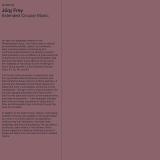
Since its founding back in 2014, Blume has carved a unique place in cultural landscape, issuing free-standing works, spanning the historical and contemporary, that represent singular gestures of creativity within the field of experimental sound. Joining their broad efforts in building networks of context and understanding that already includes the works by Werner Durand, Sarah Hennies, Bruce Nauman, John Butcher, Jocy de Oliveira, Mary Jane Leach, Valentina Magaletti, Alvin Curran, Julius Eastman, Alvin Lucier, and following the first ever vinyl release to attend to James Tenney's legendary Postal Pieces, the label now presents the first LP published by the visionary Swiss composer Jürg Frey. Drawing from the transformative power of breath and resonance, this release represents one of the most profound explorations of musical metamorphosis to emerge from the contemporary experimental landscape.
The completed work represents a "conjunction of these two artists" that has "activated a transformative form of experimentalism." These renderings "dance with an airy lightness, humour, and play, imbuing them with a beauty and emotiveness that can be rare within experimental music." They exist as "breaths, carrying the curiosities of life, belonging to no time and all time, to no one and everyone: a human music to be inhaled and pondered, for which the outcome remains unknown." In this liminal space between composition and interpretation, between breath and resonance, Zurria and Frey have created something that transcends the boundaries of experimental music itself, offering what might be called a metaphysical cartography of sound in its most essential form. As Bradford Bailey observes in his penetrating liner notes, "music is rarely a fixed entity," existing instead in a state of perpetual flux, "taking on the influences of its interpreters and performers." This fundamental truth finds its most eloquent expression in the transformative collaboration between Italian flutist Manuel Zurria and Frey, longtime member of the Wandelweiser Group. Where conventional recordings might preserve a definitive version, this release activates what Bailey calls "states of unknowing and continued experimentation," allowing Frey's compositions to evolve into entirely new dimensional territories. The original string quartet and piano works dissolve into breath-carried architectures of sound, where "the original remains in a constant dialogue with its transformation." This is not mere arrangement but ontological metamorphosis - an alchemical process through which crystalline harmonies are reborn as atmospheric phenomena.
The metaphysical dimensions of this transformation become clear through detailed analysis of the musical result. Where Frey's original compositions operate through what he calls "basic confidence in the clear and restricted material," Zurria's interpretation activates entirely new perceptual territories. Space holds almost atomic sense of weight against the airy punctuations of timbres, textures, and tones, creating "suspensions of time within which questions and identities posed by instrumentation fade." The Extended Circular Music pieces - each comprising "a small number of bars to be repeated an undetermined number of times" - become organizations of sound that defy being definitive or fixed. Originally scored for different combinations of violin, viola, cello, and piano, these works now exist as pure phenomena of breath and resonance, where "hanging, breath-length utterances dance and intertwine amongst complex harmonic clusters and conjunctions."
The philosophical implications of this transformation illuminate a lineage of composers who have moved "away from abstraction and responding to the need to create" something beyond mere technique. Drawing parallels to Morton Feldman's understanding of non-functional harmony, Zurria's approach represents "a transformative form of experimentalism" that activates what Frey calls the "thaumaturgic power" of music - its capacity to heal and transform consciousness itself. The result is "a radical reimagining of ambience: sprawling sonorities and resonances adrift in space, carrying the liberated traces of the work's former incarnations and their truths." In Zurria's interpretation, Frey's String Quartet n.3 becomes something approaching "an organ played in slow motion, its seals leaking," while the Extended Circular Music pieces transform into "glacial chords from a diverse palette of voicings, harmonies, timbres, and tones."
Performed by Manuel Zurria. Recorded and mixed by Zurria at BigCardo, Catania between 2022-2024, with mastering by Bruno Germano at Vacuumstudio, Bologna, this Blume release represents a profound exploration of musical transformation.
PARADE is an 8-piece group, predominantly from Brighton and now based in London. Its members - who are all involved in their own capacities in music, art, fashion, design and more - have been making music since they met at college in Brighton, flipping records and making beats in founding member Jago’s attic room. Since then the sound has evolved to incorporate live instrumentation alongside electronic elements. Though always collaborating in each other’s orbits, PARADE was fully formed when all members gravitated towards South-East London, scattering around in musically less mythologised areas across Nunhead, Forest Hill, Camberwell and Norwood.
Lightning Hit The Trees is the band's debut mixtape, and was entirely written, produced, engineered, and mixed in just two weeks. It was recorded in a shipping container in Forest Hill on basic, often broken, equipment with ideas often formed in the moment. As demonstrated by these two first singles, the mixtape pulls together a body of music that incorporates a wide range of ideas from a group of inventive, inspired new artists and comes together in a remarkably clear and unified vision. The mixtape is guided by uncanny valleys, cinematic tones, “hyper-real” mixing techniques, and by a light with no shadow. Influences include: Wim Wenders, Juergen Teller, Velvet Underground, Radio Dept., Scott Walker, Magliano, Soft Machine, This Heat, Pixies, John Cassavetes, Domenico Gnoli, Dadaists, Judy Garland, Cindy Lee, Arca, Bette Davis, Sun Ra.
To mark 10 years since SOPHIE’s game-changing singles collection PRODUCT, Numbers are celebrating with a special edition featuring 11 songs across Deluxe Vinyl and Compact Disc.
This anniversary release includes bonus tracks, track-by-track slide posters, and a SOPHIE PRODUCT Card. Physical editions are now available for pre-order and released on 11th July 2025.
SOPHIE classics ‘BIPP’, ‘LEMONADE’ and ‘VYZEE’ are joined by two immaculate PRODUCT-era songs ‘OOH’ and ‘GET HIGHER’ recorded and produced at the time, each with colourful single artwork completing the set.
‘OOH’ is one of SOPHIE's earliest productions that has been through several revisions since 2011. It was one of three original tracks that Numbers had signed when SOPHIE uploaded the song alongside 'BIPP' and 'ELLE' to her Soundcloud, and while it had been through several iterations and speed changes, this finalised version was completed by SOPHIE in 2019.
SOPHIE once described ‘OOH’ as “hi tech club dance pop”. Musically speaking, the earworm hook is carved out by her signature portamento-infused synths and candy-coated lyrics, a firm cult classic approved by AG Cook and Charli XCX. Initially titled 'MAKE RESPECT', the track was first performed live by SOPHIE in 2011 to a handful of lucky people at a beach afterparty surrounding Sonar Festival, Barcelona and later that year at Manhattan's New Museum. The vocal was recorded as the first track in the same one-day recording session as SOPHIE's debut single 'NOTHING MORE TO SAY', released on the Huntley & Palmers label, where Sophie's songwriting was performed by the London vocalist Jaide Green.
The genesis of the ‘OOH’ and ‘NOTHING MORE TO SAY’ recording session is lore-worthy in its own right: after watching Jaide Green perform live with Olly Murs during the sixth series of The X Factor in 2009, SOPHIE reached out and invited Jaide to record in her home bedroom studio.
‘GET HIGHER’ was born during joyous sessions in 2013, when SOPHIE’s beat was introduced to the vocalists Cassie Davis and Sean Mullins. The track feels like a visionary precursor to ‘Vroom Vroom’, and doesn't sound out of place next to the sub-clang intensity of SOPHIE’s ‘HARD’ and ‘MSMSMSM’. Striking a playful balance between blissed-out hyperpop and club-ready Atlanta trap, it showcases SOPHIE’s signature, laser sharp sound design. Originally released as a bonus track on the Japanese CD edition of PRODUCT, ‘GET HIGHER’ has remained a hidden gem.
A groundbreaking producer, songwriter and performer, SOPHIE's visionary approach reshaped the landscape of pop and electronic music. Emerging in the early 2010s, SOPHIE introduced a hyper-detailed, futuristic sound defined by metallic textures, elastic basslines, and an uncanny blend of synthetic and emotional tones. Collaborating with artists including Charli XCX, Madonna, Vince Staples and Arca, SOPHIE helped pioneer a new pop movement while challenging conventions around identity, genre and production. SOPHIE's work continues to resonate deeply, leaving a lasting impact on a generation of artists and listeners alike. Discography: PRODUCT (2015), OIL OF EVERY PEARL'S UN-INSIDES (2018), SOPHIE (released posthumously, 2024).
Dutch club jazz band New Cool Collective returns with a tasty 7" featuring two cinema classics. On the A-side, they serve up their own fresh and super funky cover of 'Enter the Dragon,' the iconic theme associated with Bruce Lee and his martial arts masterpiece of the same name. The B-side features their take on 'Misirlou' which is a legendary surf rock track by Dick Dale & The Del-Tones that was made world famous when it was used as the theme from Quentin Taranto's chef d'ouevre, Pulp Fiction. This double-sider is standout for its nostalgic movie associations but also on a purely musical level it oozes class.